

31 Blue and Orange Fall Decor Ideas for People Tired of All-Beige Autumn
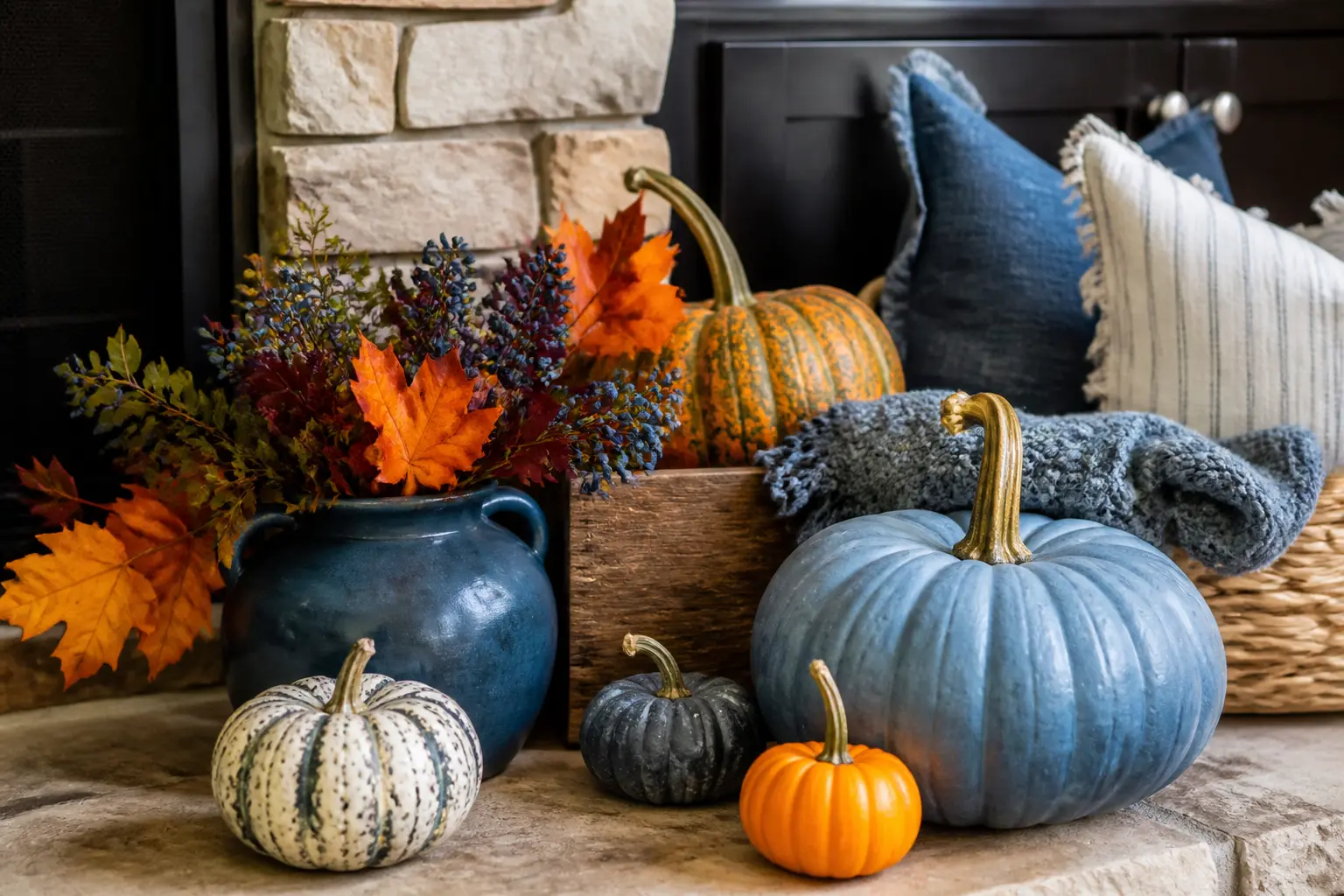
Beige had its moment. Cream gourds against a shiplap wall are genuinely lovely, and also genuinely everywhere. Blue and orange fall decor does something different: it borrows autumn’s best colour (that particular burnt amber-orange) and pairs it with the one that makes it sing, which turns out to be blue, in almost any shade you own.
The combination has excellent bones. Navy gives orange the contrast it needs to stop reading as pumpkin-spice-generic. Cobalt and periwinkle soften it into something almost floral. Add in the chinoiserie-and-velvet direction that has been quietly taking over for the past year and you have a look that is seasonal without being predictable. For more room-by-room ideas, see 35 Fall Decor Ideas Grouped by Where They Actually Go.
Below are 31 specific ideas, grouped by where they go and what they ask of you. None of them require a glue gun marathon, and none of them look like everyone else’s front porch.
This post contains affiliate links. If you buy through them, I may earn a small commission at no extra cost to you.
Front Door and Porch
The front door is the one spot everyone judges, which makes it the one spot worth an actual decision. Orange pops at distance; blue holds it in place and stops it from reading as Halloween-only.
Porch work also sets expectations for everything inside. Get the palette right here and the rest of the house just has to agree with it. For a longer look at what holds up past October, see 32 Fall Porch Decor Ideas That Hold Up Past the First Frost.
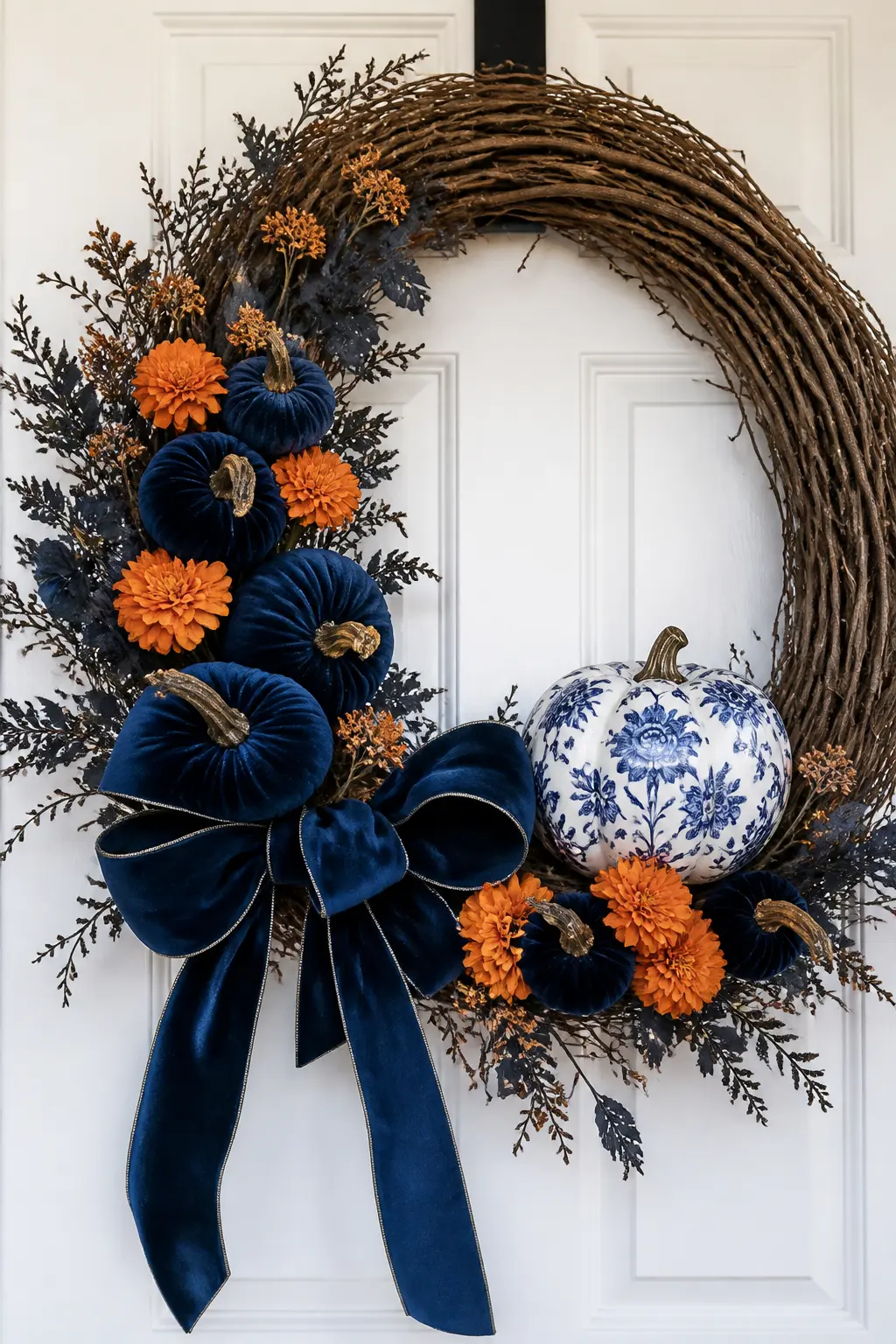
Navy Velvet Bow Wreath with Chinoiserie Pumpkin
Start with a full grapevine base, at least 24 inches, so the bow has something substantial to anchor to. Weave in faux orange marigolds and a few sprigs of amber berry picks, then tuck two or three navy velvet pumpkins at the top third of the ring where eyes land first.
The statement piece is a single white pumpkin hand-painted with blue-and-white floral motifs, placed slightly off-centre at the base. Wire it to the frame rather than gluing it so you can swap it out without destroying the wreath. A wide navy velvet ribbon, wired rather than tied floppy, sits at the bottom and doubles the bow’s fullness.
🛍 Shopping guide
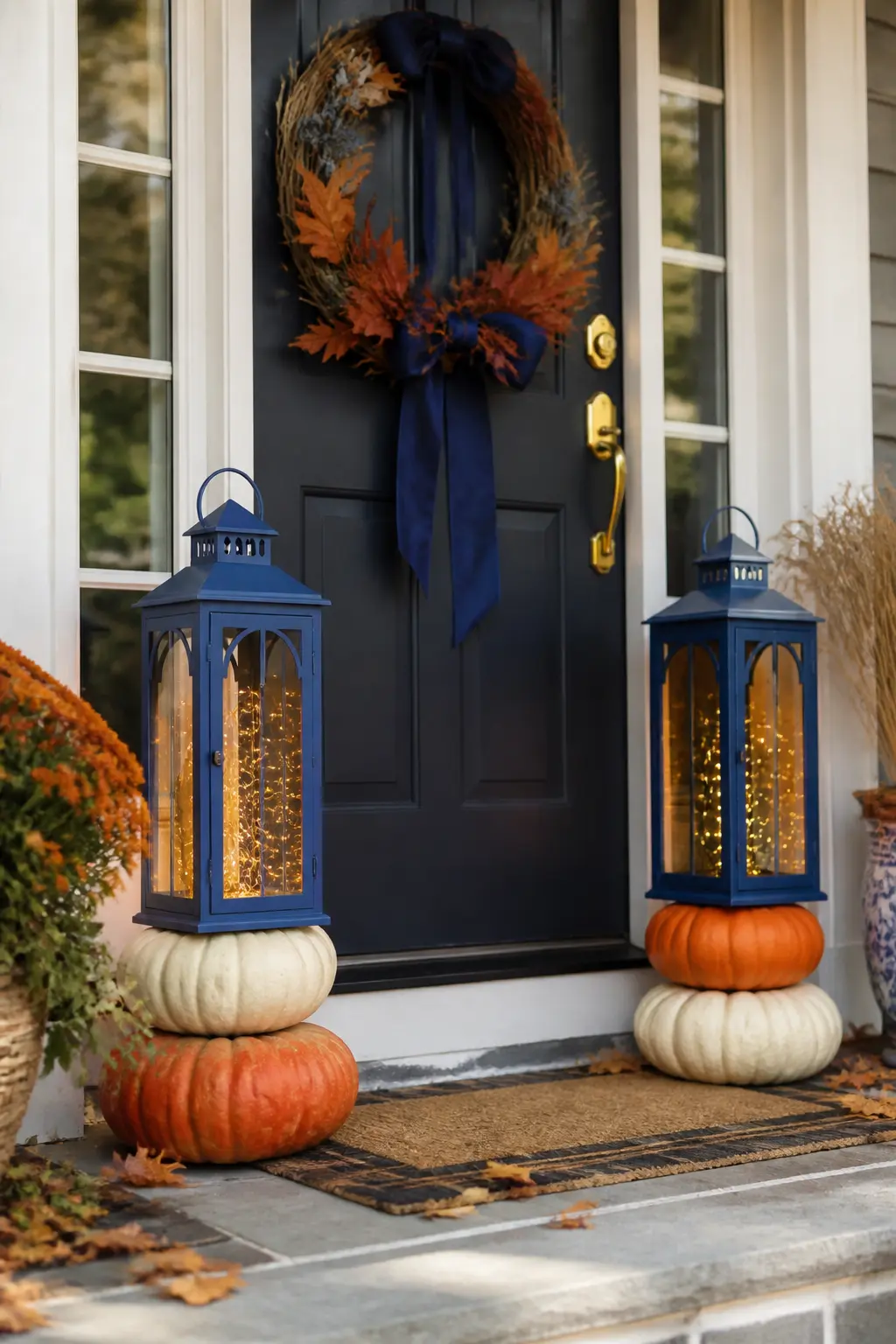
Cobalt Lantern Flanking the Front Door
Two matching lanterns in cobalt blue, one each side of the door, cut the need for complicated porch styling. Set each on a stack of two or three orange and white pumpkins of varying sizes, which acts as a plinth and connects the lantern visually to the ground.
Inside the lantern, skip the candle and use a cluster of amber fairy lights on a timer. The warm filament tone shifts the cobalt glass from cold to golden at dusk, which is the whole point of a front porch lantern.
🛍 Shopping guide
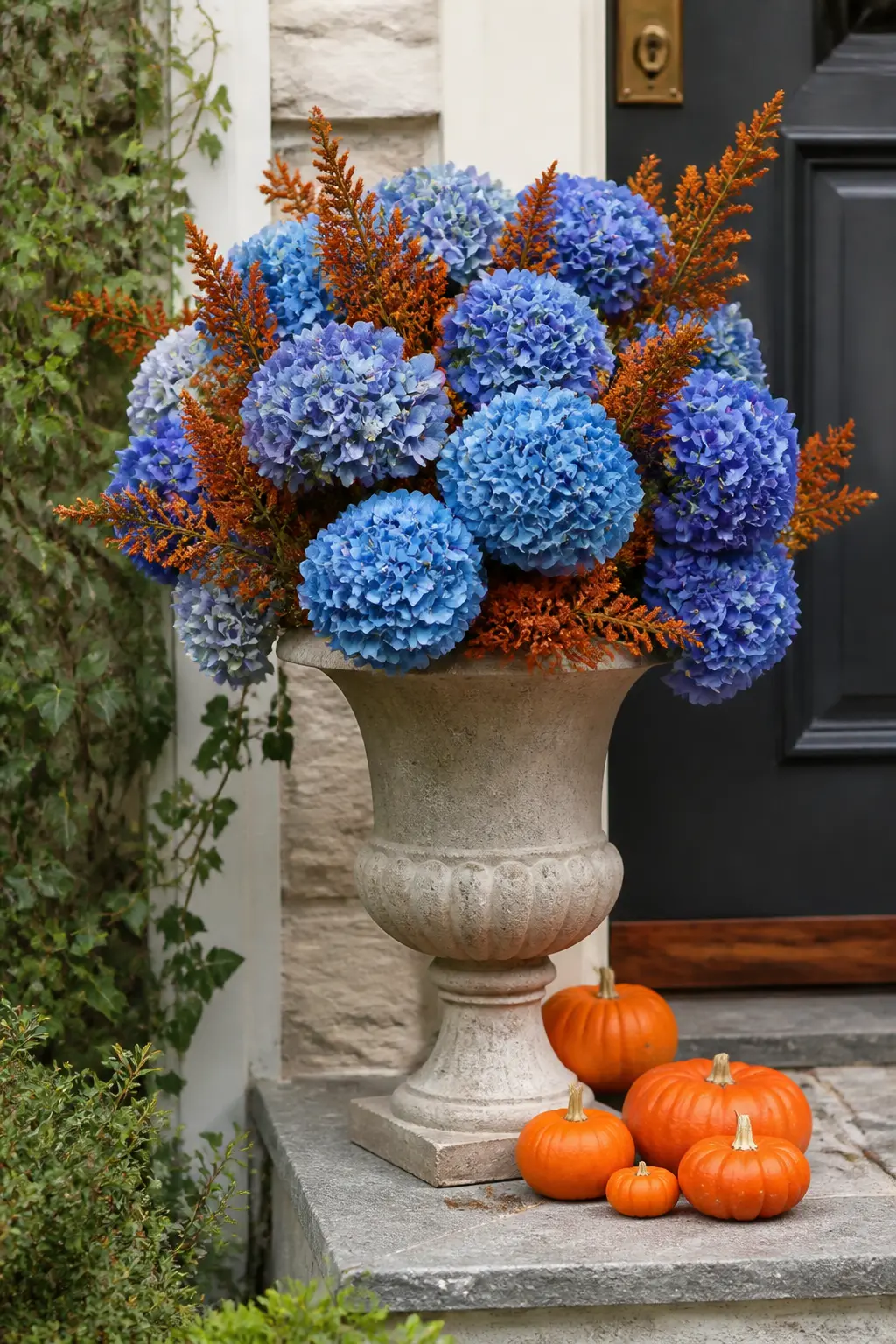
Blue Hydrangea and Mini Pumpkin Porch Urn
A tall concrete or ceramic urn gets the same treatment as a summer planter, just with different cargo. Pack the base with preserved or faux blue hydrangea heads, periwinkle and medium blue, then push several stems of dried orange amaranth or orange celosia through the gaps.
Nestle four or five mini orange pumpkins at the base of the urn, right on the porch surface, so they spill out slightly. The urn reads formal; the pumpkins on the ground keep it from being stiff. Use two urns flanking steps if the porch is wide enough.
🛍 Shopping guide
Mantel and Living Room
The mantel is the interior equivalent of the front door: everyone looks at it, and it sets the room’s mood fast. Blue and orange plays particularly well here because a white painted mantel gives you a clean ground for both colours without becoming a third thing to manage.
Living room surfaces work the same way. A cobalt throw folded over an orange-cushioned sofa, or a cluster of navy ceramic vessels at different heights, earns the look without rearranging furniture. For a full treatment of mantel styling, see 40 Fall Mantle Decor Ideas That Hold a Straight Line.
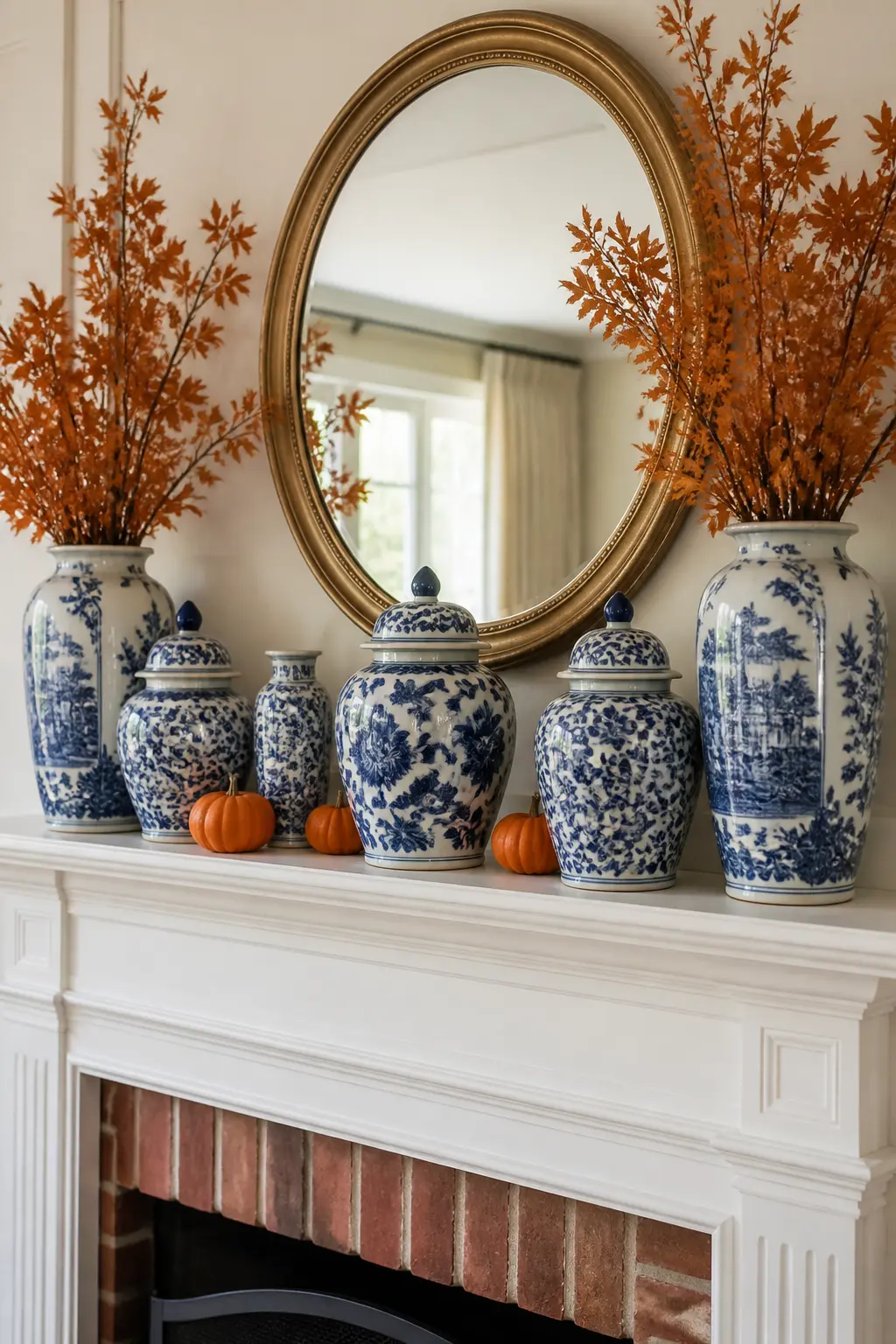
Chinoiserie Blue and White Vase Mantel Cluster
Collect four to six blue-and-white ceramic vases or jars in different heights and silhouettes, the mix matters more than matching, and arrange them in a loose line across the mantel shelf. Stand the tallest at one end and step down unevenly, leaving small gaps between each piece.
Place one small orange or rust-coloured pumpkin between every other vase, sitting directly on the shelf. Add a few stems of orange autumn branches or flame-coloured maple twigs in the two tallest vases. The branches should extend above the mirror or art above the mantel, connecting the shelf to the wall behind it.
🛍 Shopping guide
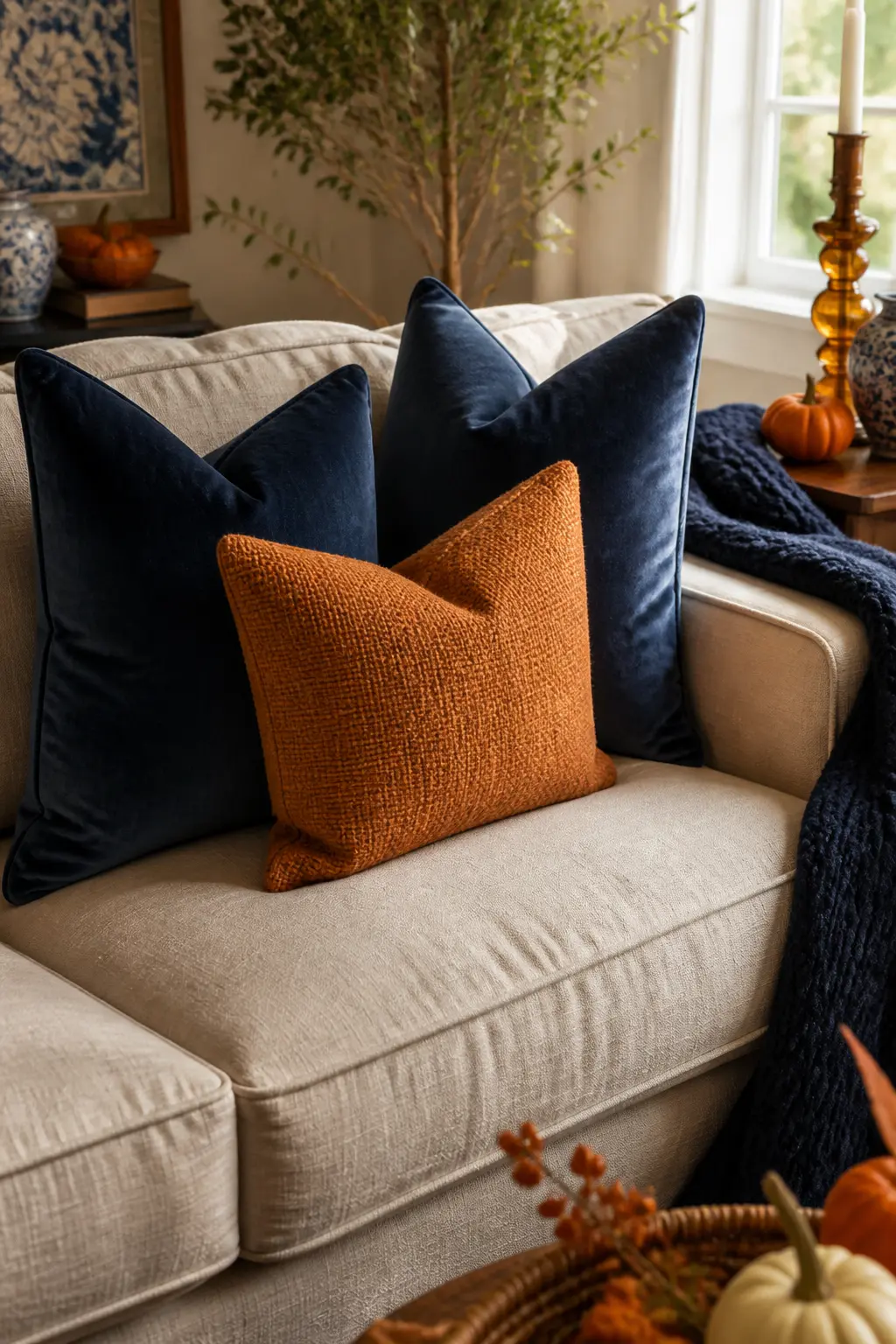
Indigo Velvet Pillow Cluster on a Neutral Sofa
The easiest living room swap is the one you already have: cushions. Two indigo velvet cushions, one square and one rectangular lumbar, paired with one deep orange woven cushion, transform a grey or cream sofa with no further effort.
Fold a midnight blue chunky-knit throw over the arm opposite the cushions to balance the blue across the sofa without mirroring it exactly. Set a single amber glass candlestick on the side table nearby. That one object carries the orange tone off the sofa and into the room without requiring a full vignette.
🛍 Shopping guide
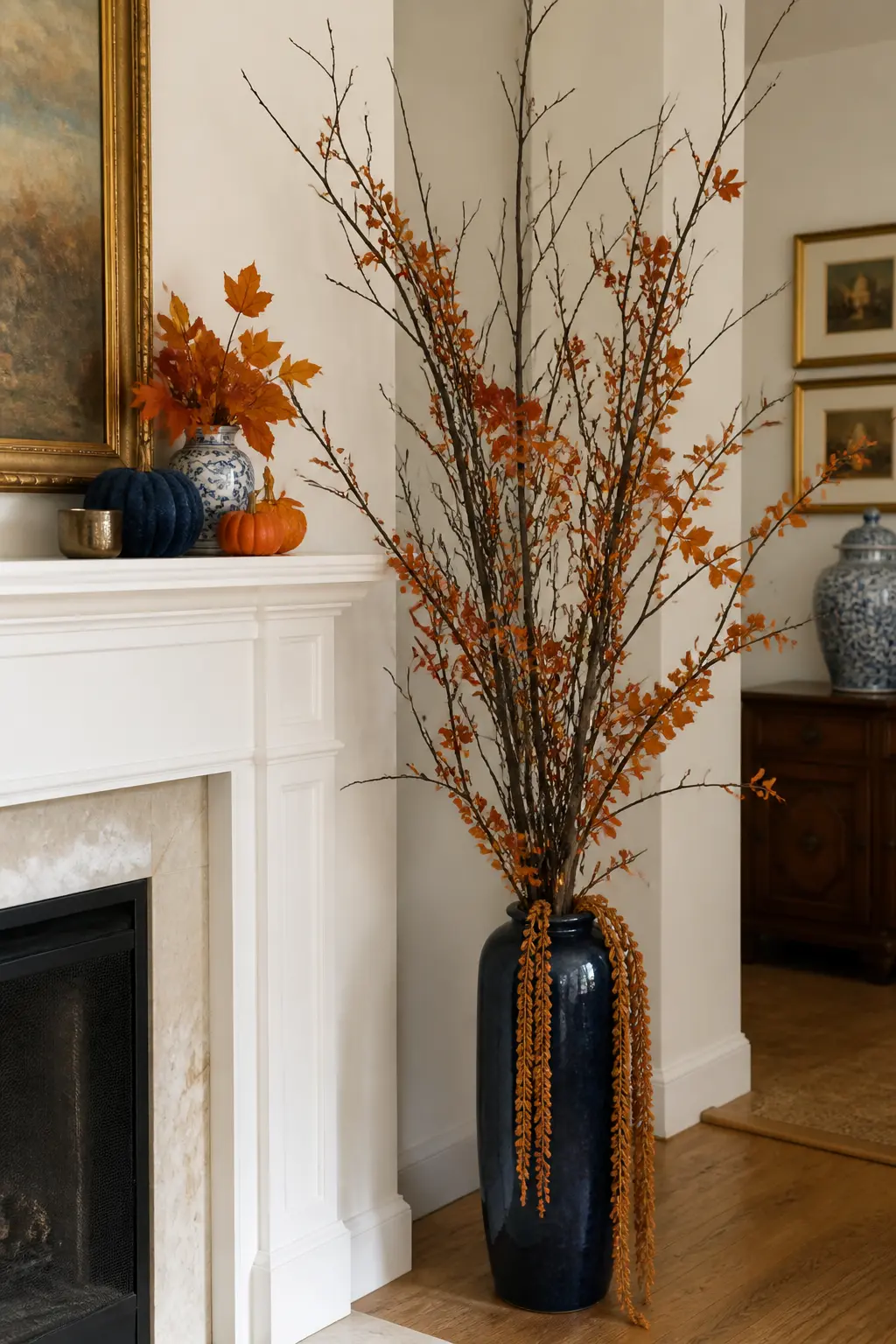
Blue and Orange Branch Arrangement in a Tall Blue Vase
A single tall arrangement in a navy or cobalt vase placed on the floor beside a fireplace or at the end of a sofa does more visual work than a dozen small accessories scattered around a room. Use long birch or dogwood branches sprayed in matte black or left natural, and weave in stems of faux orange autumn leaves and a few dried orange amaranth trails.
The vase on the floor changes the scale of the room by drawing the eye upward, which is something shelf-level objects cannot do. A 12-to-16-inch navy ceramic vase is stable enough without a base or pedestal.
🛍 Shopping guide
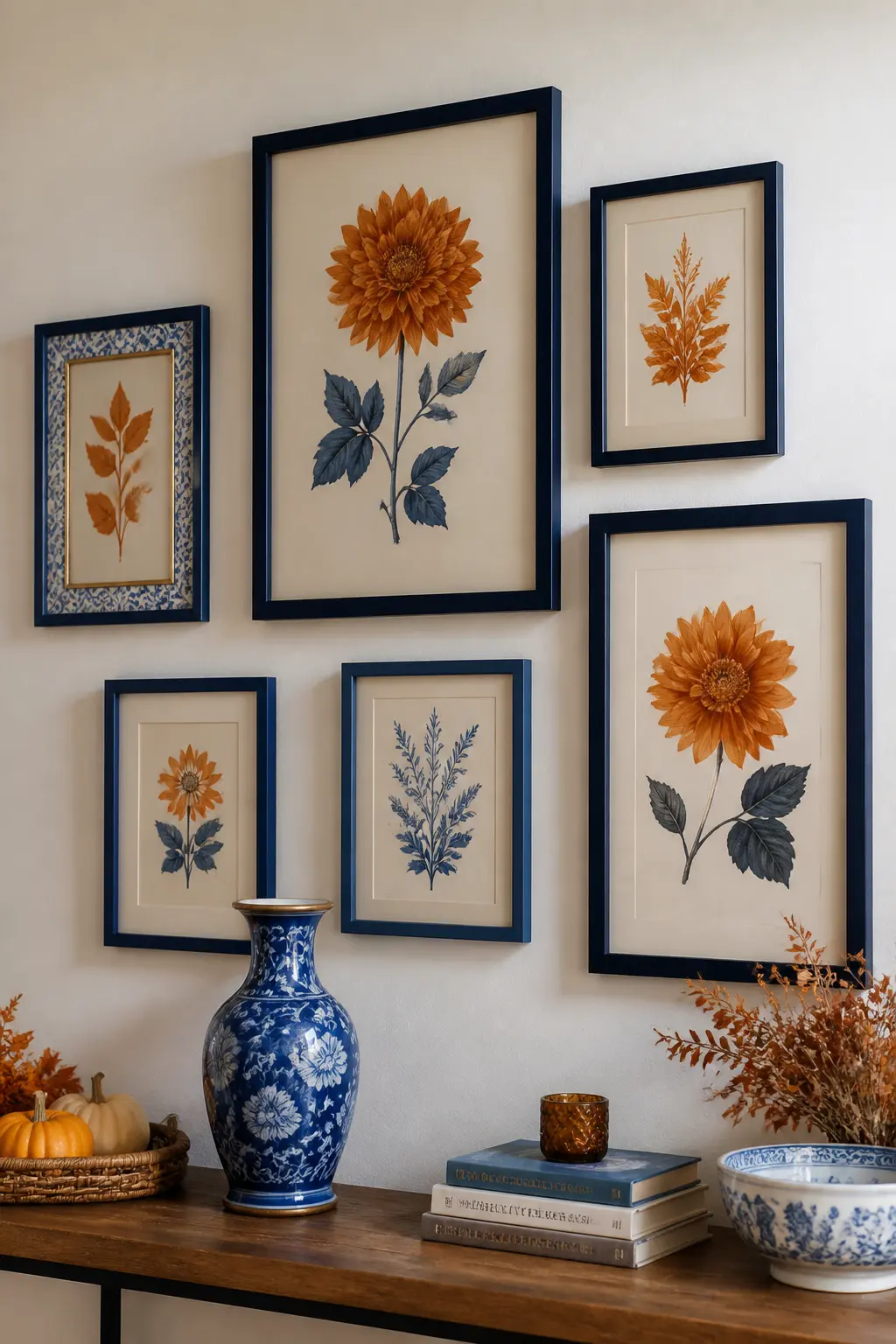
Cobalt and Orange Gallery Wall with Autumn Botanicals
A gallery wall does not need to be permanent to be worth doing. Hang four to six frames with autumn botanical prints, pressed orange leaves under glass or painted studies of orange dahlias and navy delphinium, in a loose cluster above a console table.
Use cobalt blue and navy frames rather than the default black or gold, and mix frame widths rather than matching them. The blue frames connect the wall to any other blue objects in the room, which is what makes a gallery wall feel designed rather than assembled from whatever was available.
🛍 Shopping guide
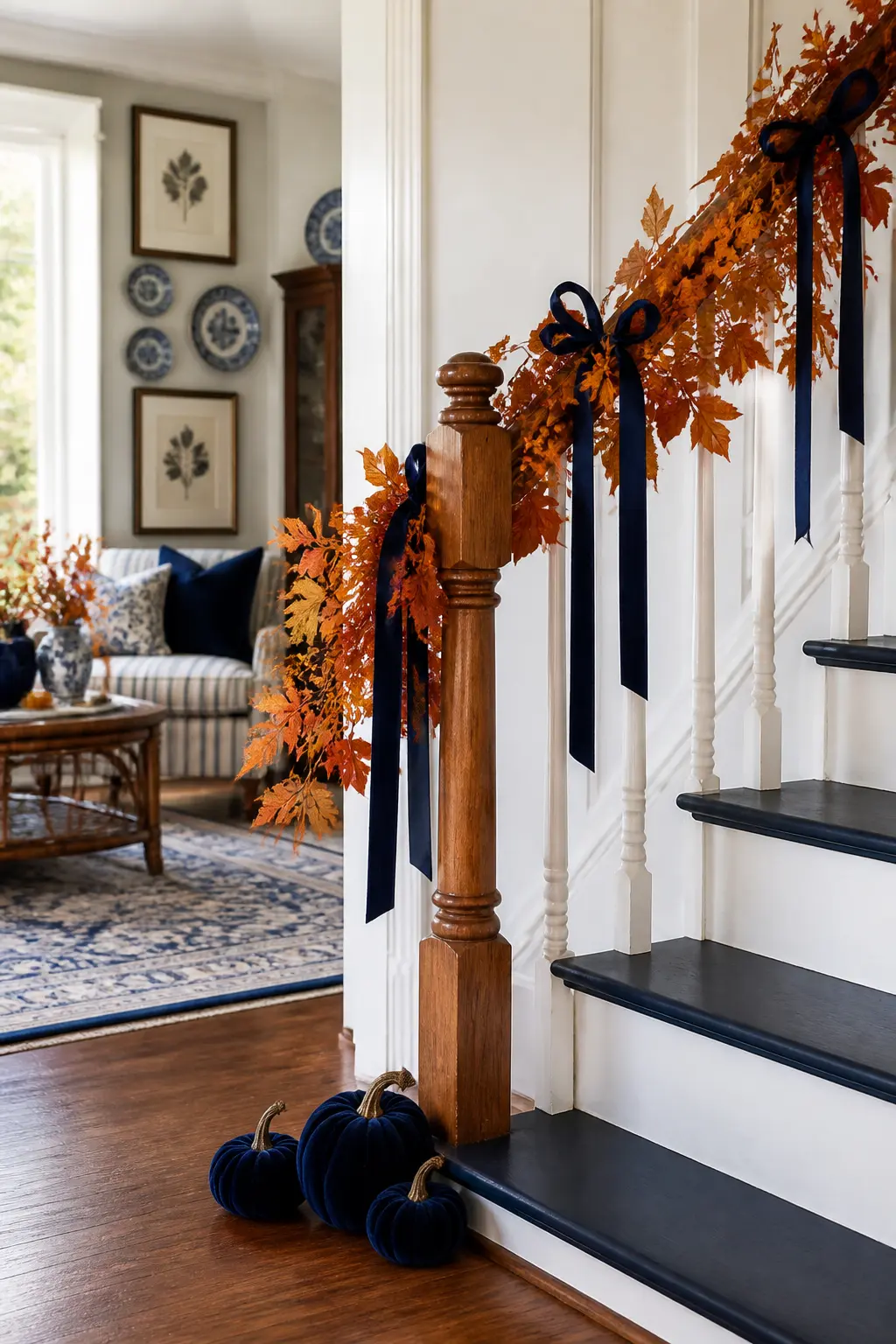
Blue and Orange Staircase Garland
A staircase banister is one of the most underused surfaces in autumn decorating. Run a faux autumn leaf garland, in orange, amber and brown, along the banister rail and secure it loosely with a few twists of blue velvet ribbon at every third baluster.
Let the ribbon ends trail slightly rather than tying them into bows: trailing ribbon reads as styling, tight bows read as decoration. Add three small navy velvet pumpkins at the base of the newel post where the garland pools. The garland gives the staircase autumn texture; the blue ribbon and pumpkins put it inside this colour palette.
🛍 Shopping guide
Table and Dining
A table setting is where blue and orange pays off the fastest. You set it, you photograph it, you eat off it, and then you put it away. No permanent commitment required.
Blue linen already exists in most households and needs only a few orange elements to become seasonal. Resist the urge to add every autumn object you own: three things done well read better than nine things crammed in.
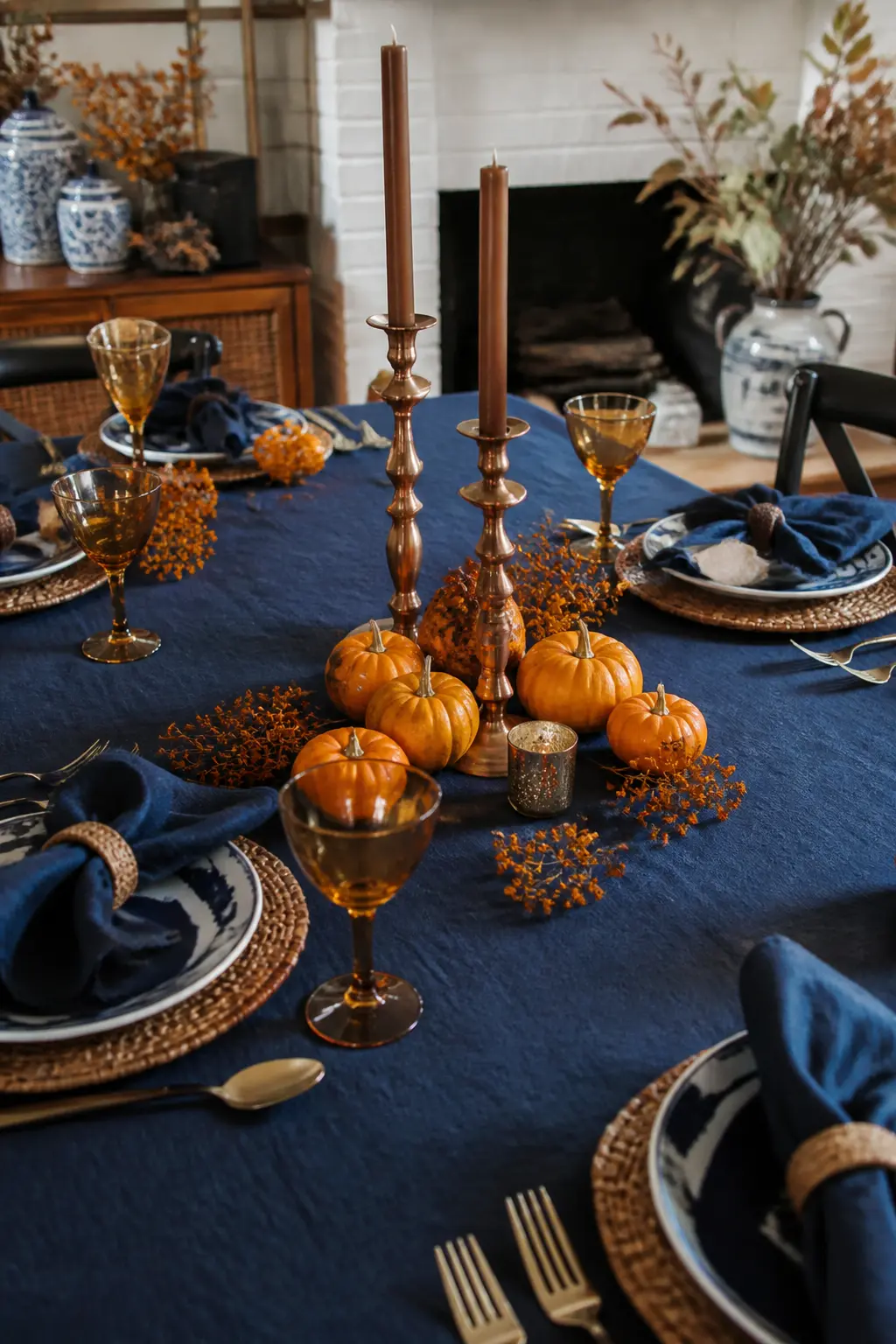
Navy Linen Tablecloth with Copper and Orange Centrepiece
A navy linen tablecloth is the table equivalent of a clean wall: everything you put on it looks more considered. Lay it flat, no runner on top, and let the cloth be the base layer.
Centre three copper candlesticks in graduated heights, grouped closely rather than spaced down the table. Tuck small orange gourds and a few dried orange flowers around the bases. The copper picks up the warmth of the orange and reads as autumn without committing to any one seasonal motif. Fold navy linen napkins loosely and set them under the salad fork so a triangle of fabric shows.
🛍 Shopping guide
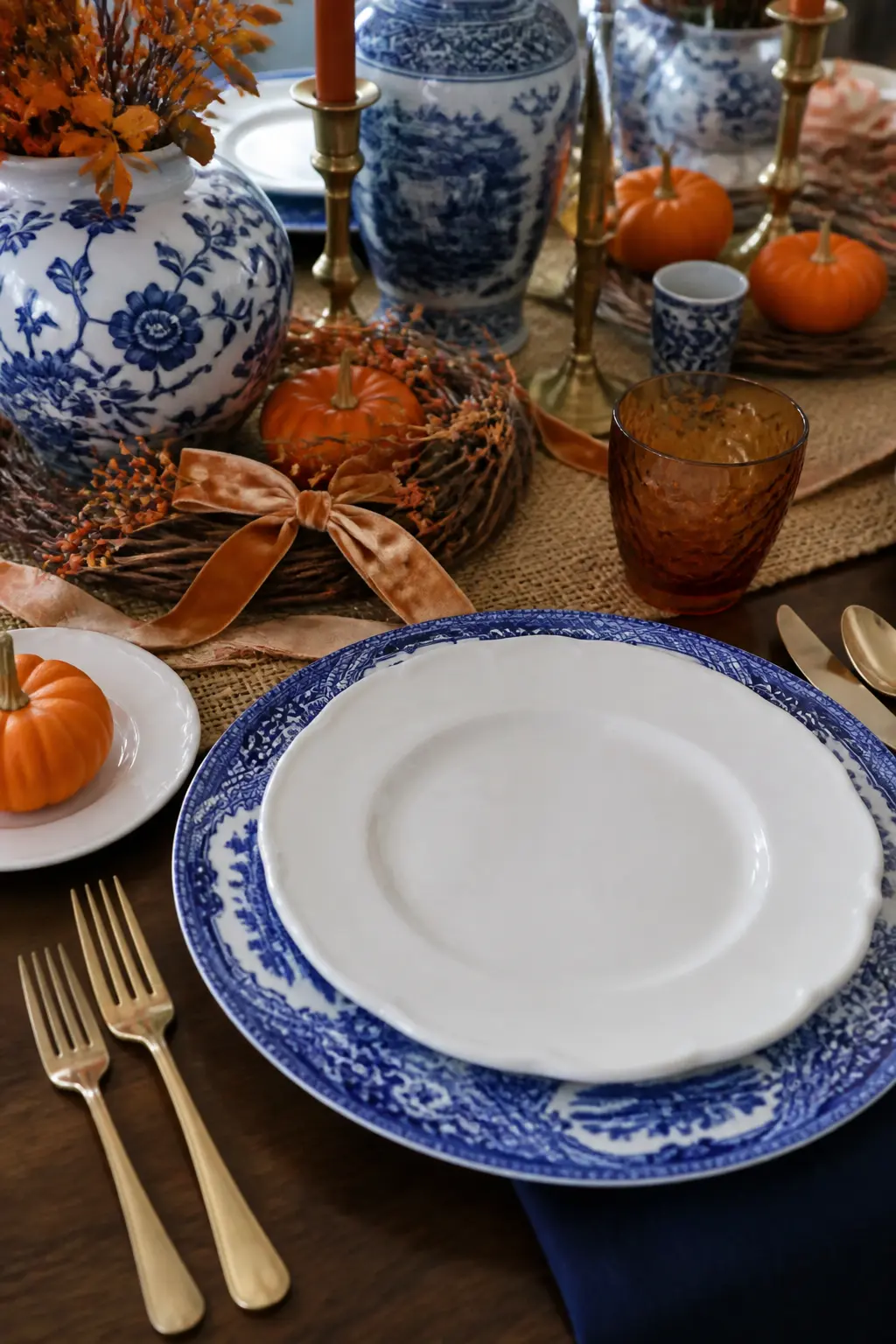
Blue Transferware Plate Charger Setting
Blue transferware charger plates, or even blue-and-white dinner plates used as chargers, give a table the kind of instant polish that a plain gold charger cannot quite reach. The blue-and-white pattern already contains both the colour and the detail, so the rest of the setting can be simple.
Set a small orange pumpkin on the bread plate at each place, or a single orange marigold head in a bud vase where the water glass would normally sit. White dinner plates stack on top of the charger. Flatware in antique brass rather than silver bridges the blue and the orange without adding a third colour.
🛍 Shopping guide
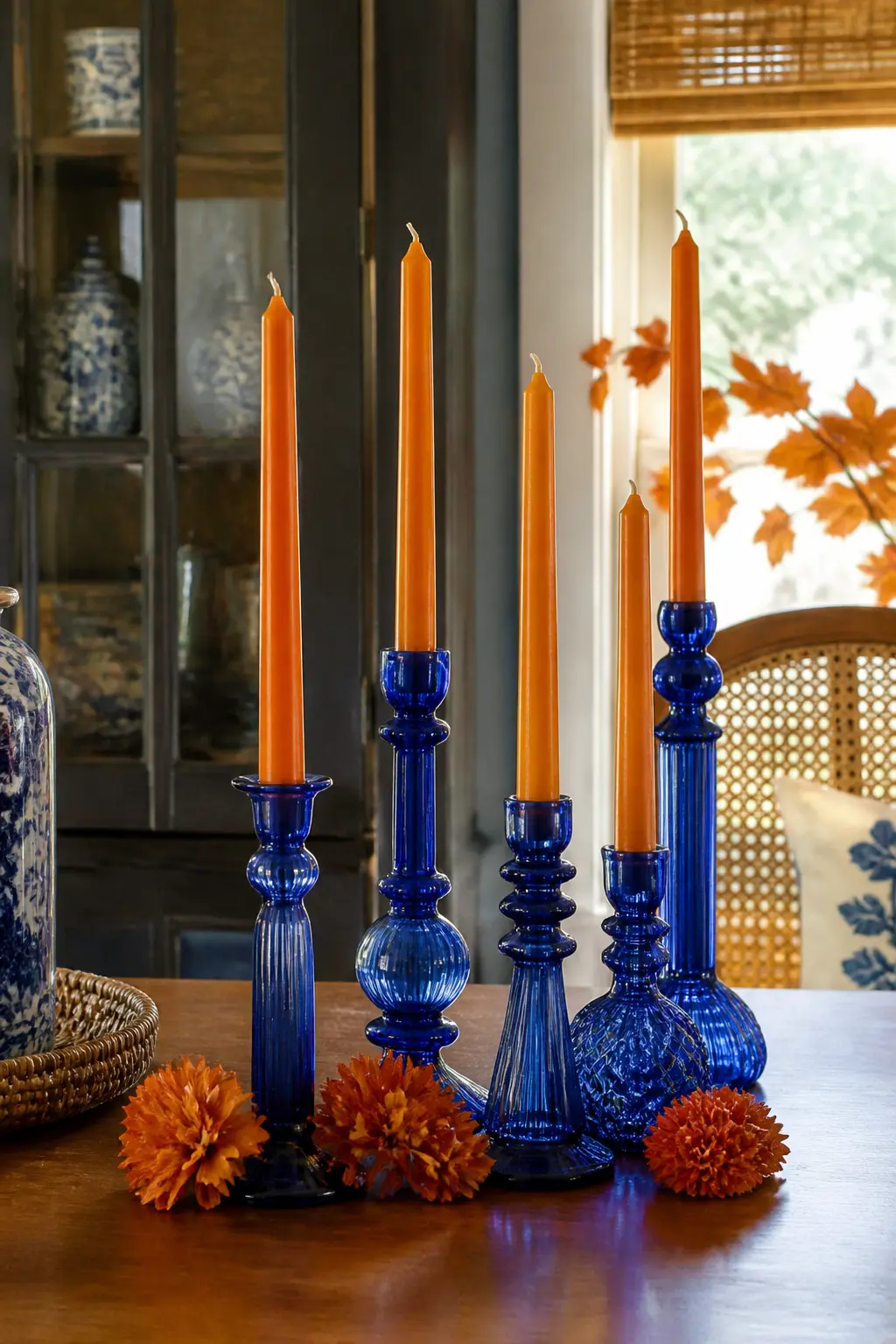
Orange Taper Candles in Blue Glass Holders
This works as a centrepiece on its own or paired with any of the other table ideas. Buy orange taper candles, deep amber-orange rather than candy-bright, and set them in cobalt blue glass taper holders at varying heights.
Group five holders together in the centre of the table, odd numbers always read as arrangements rather than rows. Add a few loose dried orange flower heads between the bases. The cobalt glass picks up the candlelight and casts a blue-tinted glow that is genuinely beautiful in a dim room.
🛍 Shopping guide
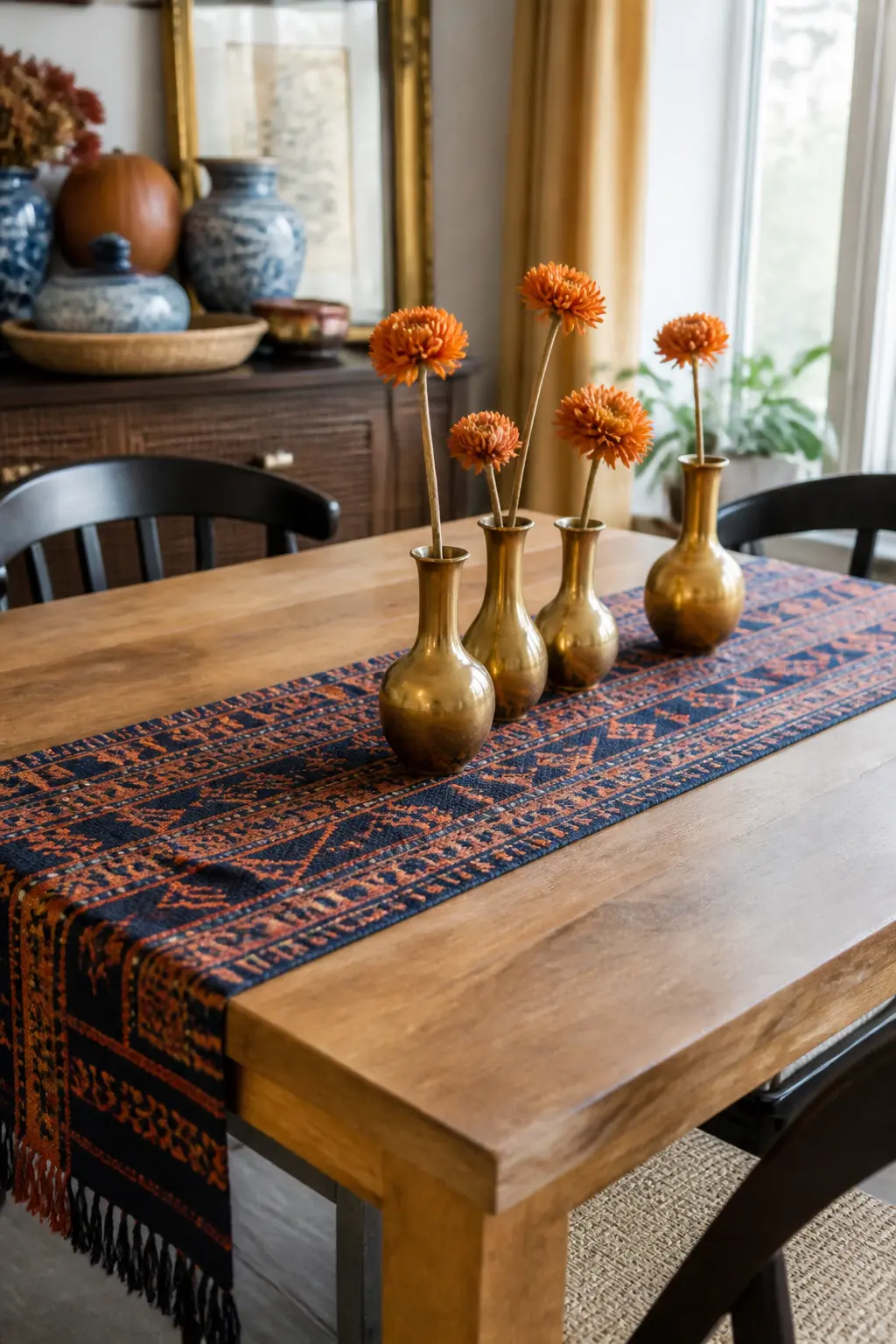
Orange and Navy Woven Table Runner with Brass Accents
A woven table runner in a geometric pattern that combines burnt orange and navy works harder than a tablecloth because it shows the table surface underneath, which keeps the look from becoming too heavy in a small dining room.
Down the centre of the runner, set a row of small brass bud vases, three to five, each holding a single dried orange bloom or a spray of amber grass. Brass reads warmer than silver and cooler than copper, which means it balances both the blue and the orange in the runner without pulling the table toward either colour.
🛍 Shopping guide
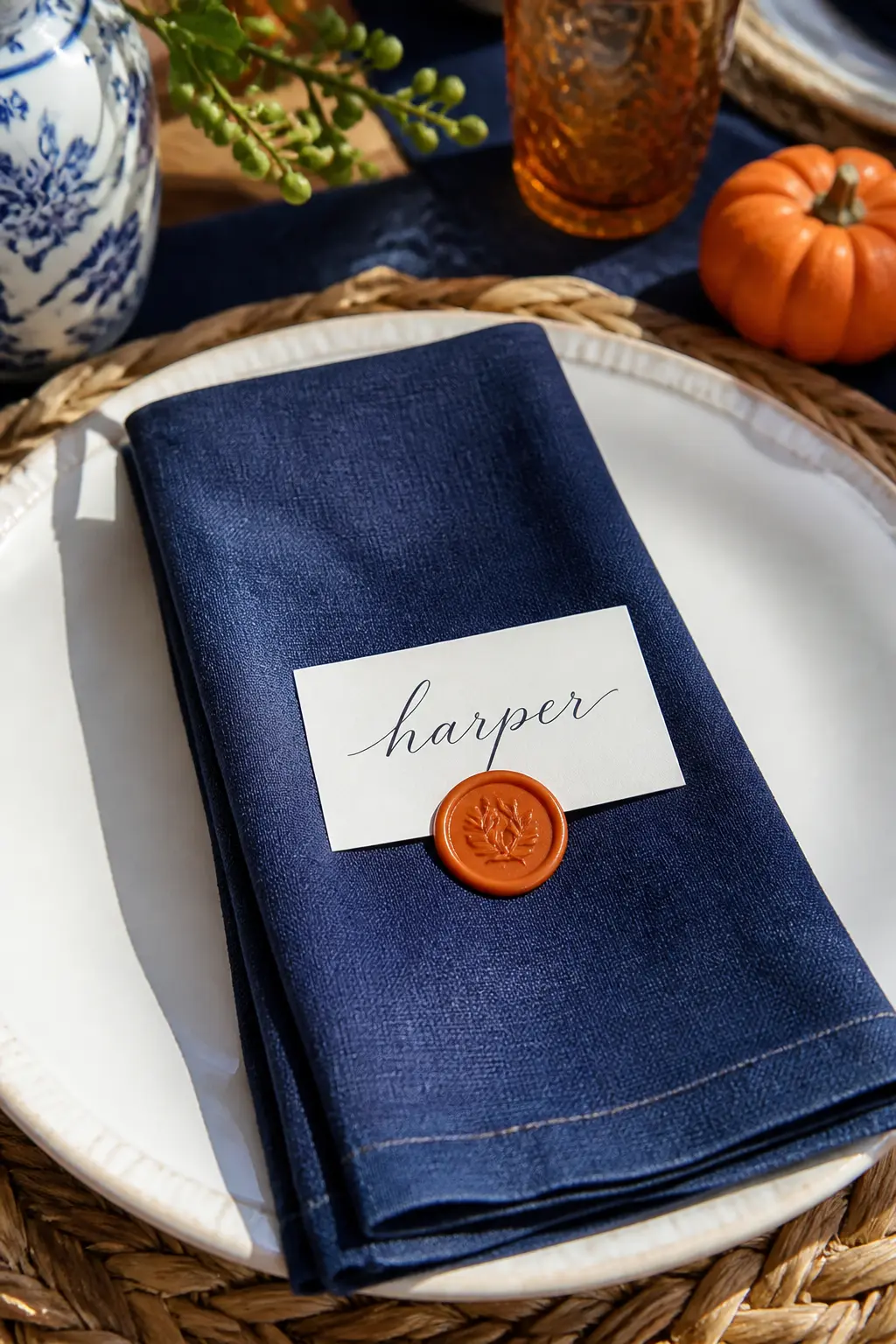
Indigo Linen Napkin with Orange Wax Seal Place Card
An indigo linen napkin folded simply into a rectangle, then topped with a small card sealed with an orange wax medallion, is one of the fastest ways to make a dinner table look considered. Write the guest’s name on the card in a dark ink.
The orange wax seal is the only orange on an otherwise blue surface, which makes it more striking than it would be surrounded by other autumn objects. Stack the napkin on the plate rather than beside the fork. It reads as a gift rather than table linen.
Painted and Decorated Pumpkins
Painted pumpkins are the fastest way into this palette. Real ones last three to four weeks outdoors; faux ones live in a bin for the next ten autumns. Both are valid.
The trick is restraint: one technique per pumpkin, not five. A single chinoiserie motif in white and navy on a plain orange pumpkin does more than every stencil pattern applied at once. For the wider craft angle, see 19 Fall Crafts for Adults That Look Like Decor.
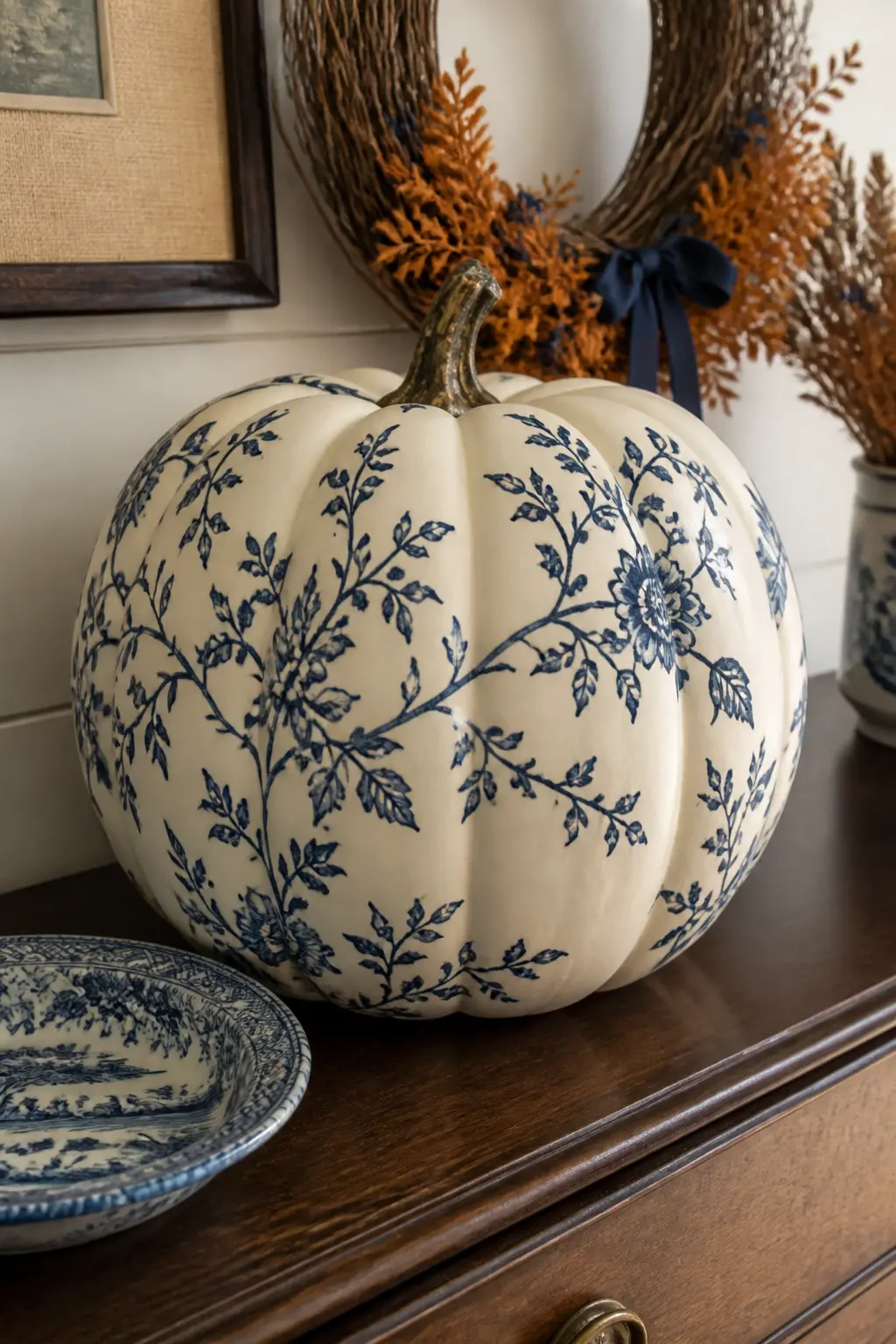
Chinoiserie-Painted Large Pumpkin
A large, smooth-skinned faux pumpkin in white or cream is the canvas. Use navy blue craft paint and a fine liner brush to paint simple chinoiserie-style motifs: a few flowering branches, a bird, a minimal landscape element. Keep the motifs loose and slightly imperfect, which is what makes them look like pottery rather than clipart.
Seal with a matte varnish to prevent chipping. Set this pumpkin alone on a console table or mantel: it does not need company to make a statement. One well-painted piece reads as intentional; four painted pumpkins in a row read as a craft project.
🛍 Shopping guide
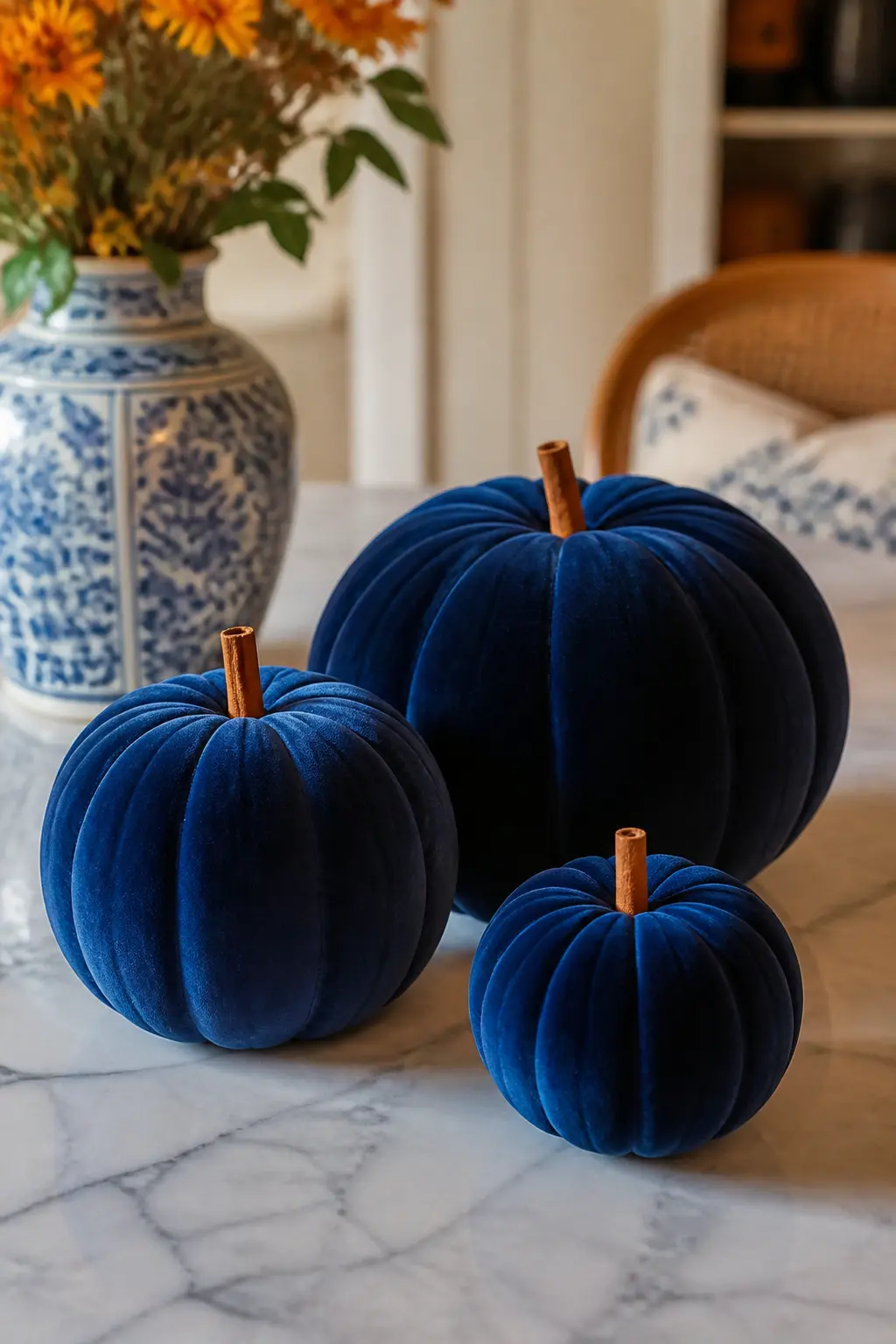
Navy Velvet Fabric-Wrapped Pumpkin
No paint required. Cut a square of navy velvet fabric large enough to drape over a medium faux pumpkin with a few inches of overhang. Press the fabric into the ridges with a blunt tool or your fingers, gather it at the base stem, and secure the excess tightly with a thin gold wire or a rubber band hidden under a snippet of ribbon.
Replace the pumpkin’s original stem with a cinnamon stick for texture. The velvet absorbs light differently across each ridge, which gives the pumpkin a dimensional quality that painted surfaces rarely achieve. Cluster two or three at different scales on a mantel or console.
🛍 Shopping guide
Cobalt Blue Dipped Base Pumpkin
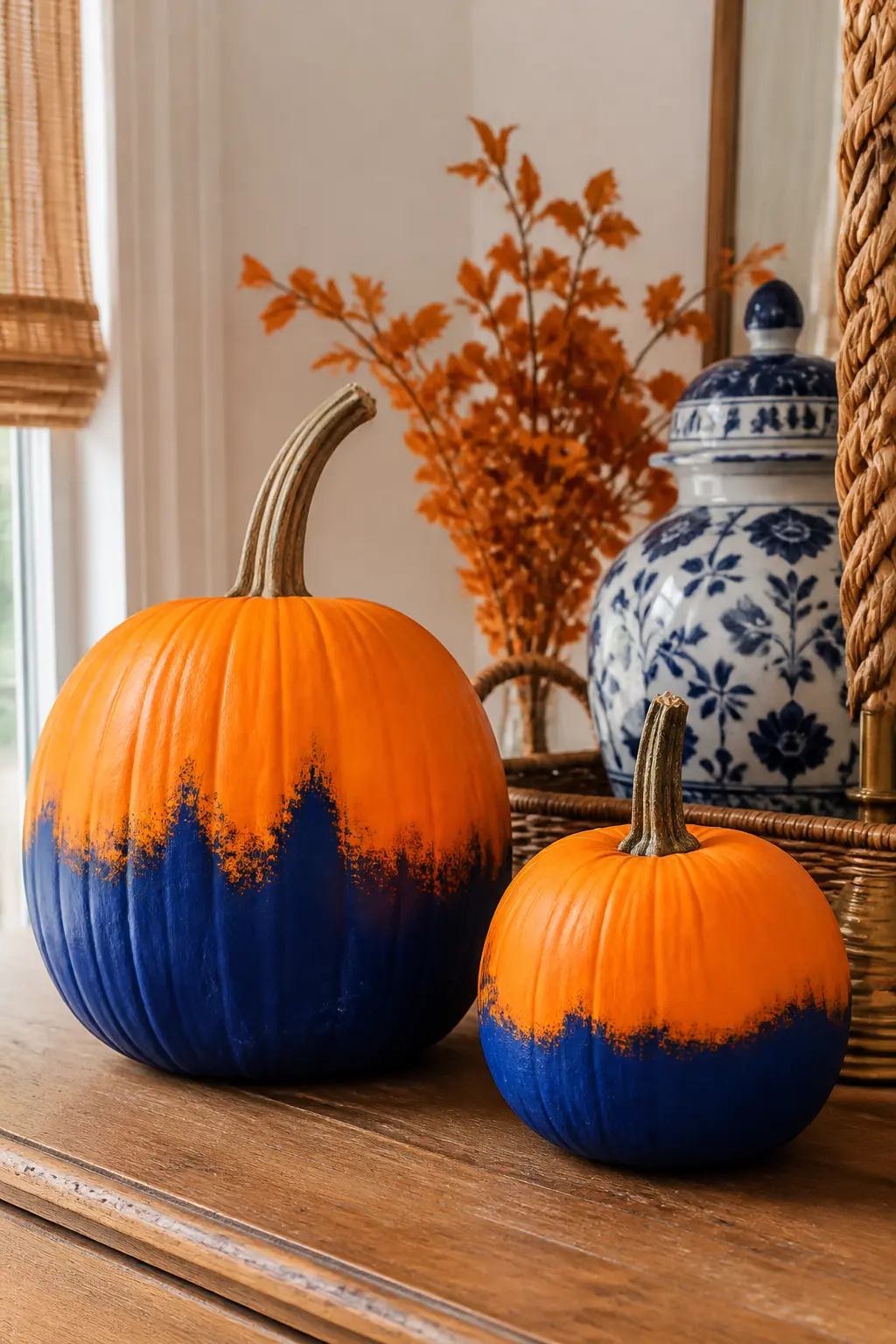
Dip-painting is faster than it looks and harder to get wrong. Lay a real or faux orange pumpkin on its side, prop it steady on a folded cloth, and use a wide flat brush to paint the lower third of the pumpkin in cobalt blue craft paint. Keep the edge uneven and slightly brushy rather than trying to make a ruler-straight line.
The orange above and the cobalt below create a gradient effect where they meet that no tape line can replicate. Once dry, seal with matte varnish. These read beautifully grouped with plain orange pumpkins because the unpainted ones provide the contrast the dipped ones need.
🛍 Shopping guide
Gold Leaf and Navy Striped Pumpkin
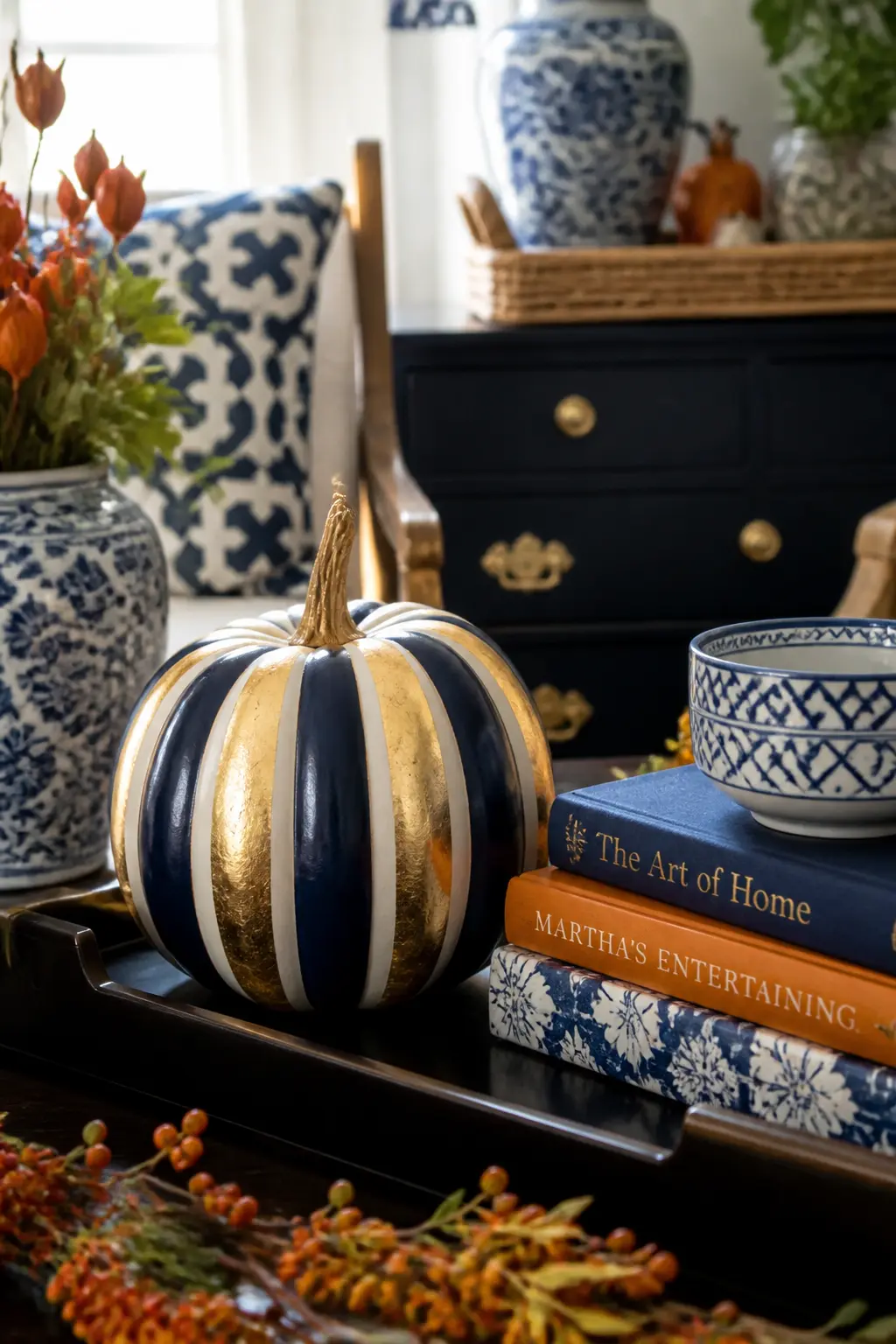
Use painter’s tape to mask off alternating vertical ribs of a medium white faux pumpkin. Paint the exposed ribs in navy blue, let them dry, and remove the tape carefully. Apply gold leaf size to the remaining white ribs, let it tack, and press gold leaf sheets across them.
The result is alternating navy and gold ribs on a white pumpkin. Set it on a small stack of books in cobalt blue cloth covers or beside a blue-and-white ceramic piece so it reads as part of a considered grouping rather than an isolated craft project.
🛍 Shopping guide
Monogram Wax Seal Pumpkin
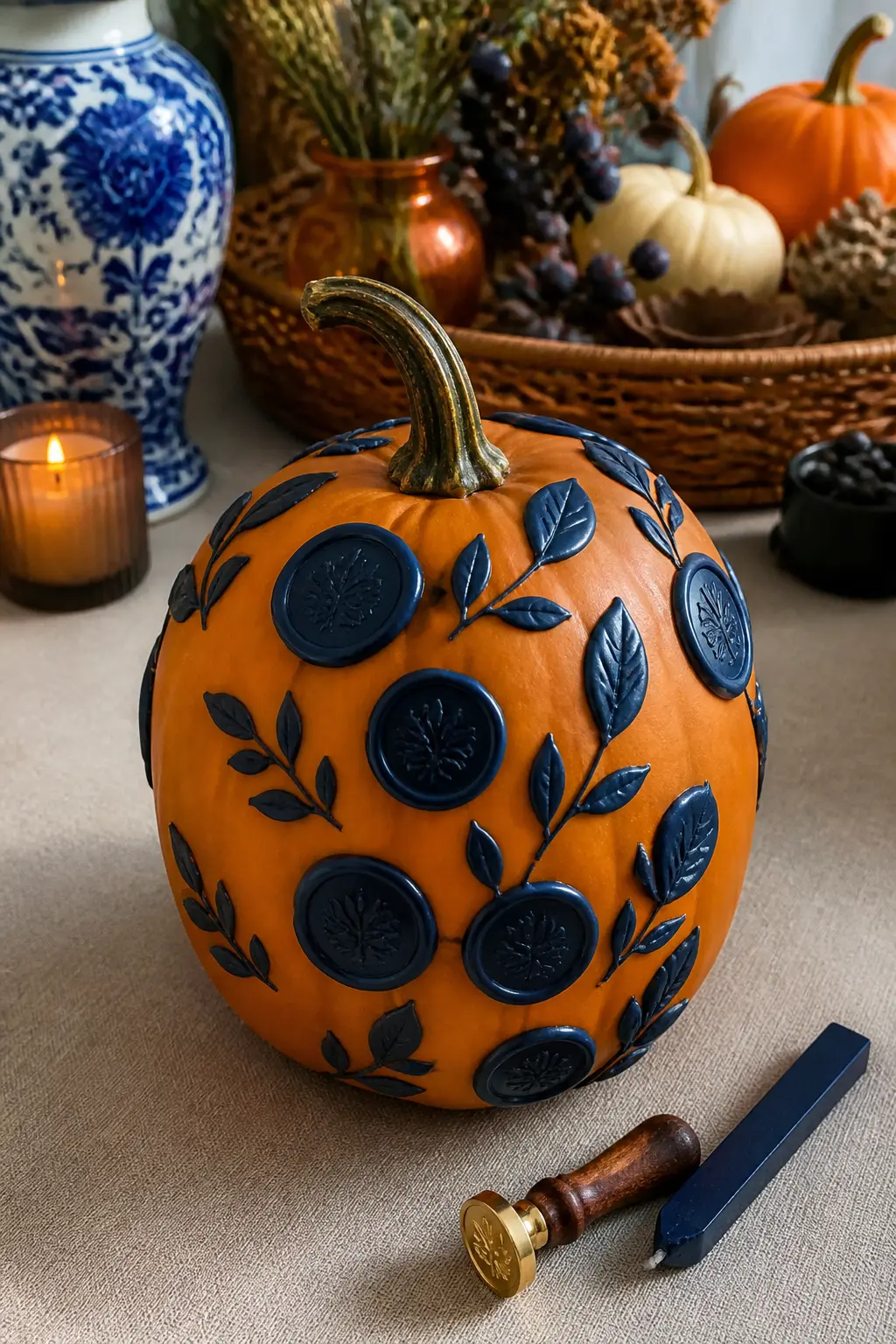
Press navy blue wax seals, the kind used on envelopes, directly onto a smooth-surfaced orange or white pumpkin. Use a wax seal gun or a spoon-melting kit with navy sealing wax, and a monogram, botanical or geometric stamp. Work in rows or scatter them across the pumpkin surface.
The wax sets in under a minute and adheres to a dry pumpkin surface without glue. The result looks like something from a high-end stationery shop rather than a craft table. A single large seal on a small pumpkin is just as effective as a covered surface.
🛍 Shopping guide
Wreaths
A wreath commits to the season the moment it goes up, which is exactly why it needs to be worth looking at every time you come home. Blue in a wreath is almost always surprising, which is the point.
Faux hydrangeas and velvet ribbon both hold colour better than dried naturals outdoors. If yours is in a covered porch, you have more latitude. For the full wreath universe, see 33 Halloween Wreath Ideas Your Neighbors Will Stop to Look At.
Periwinkle Hydrangea Twig Wreath
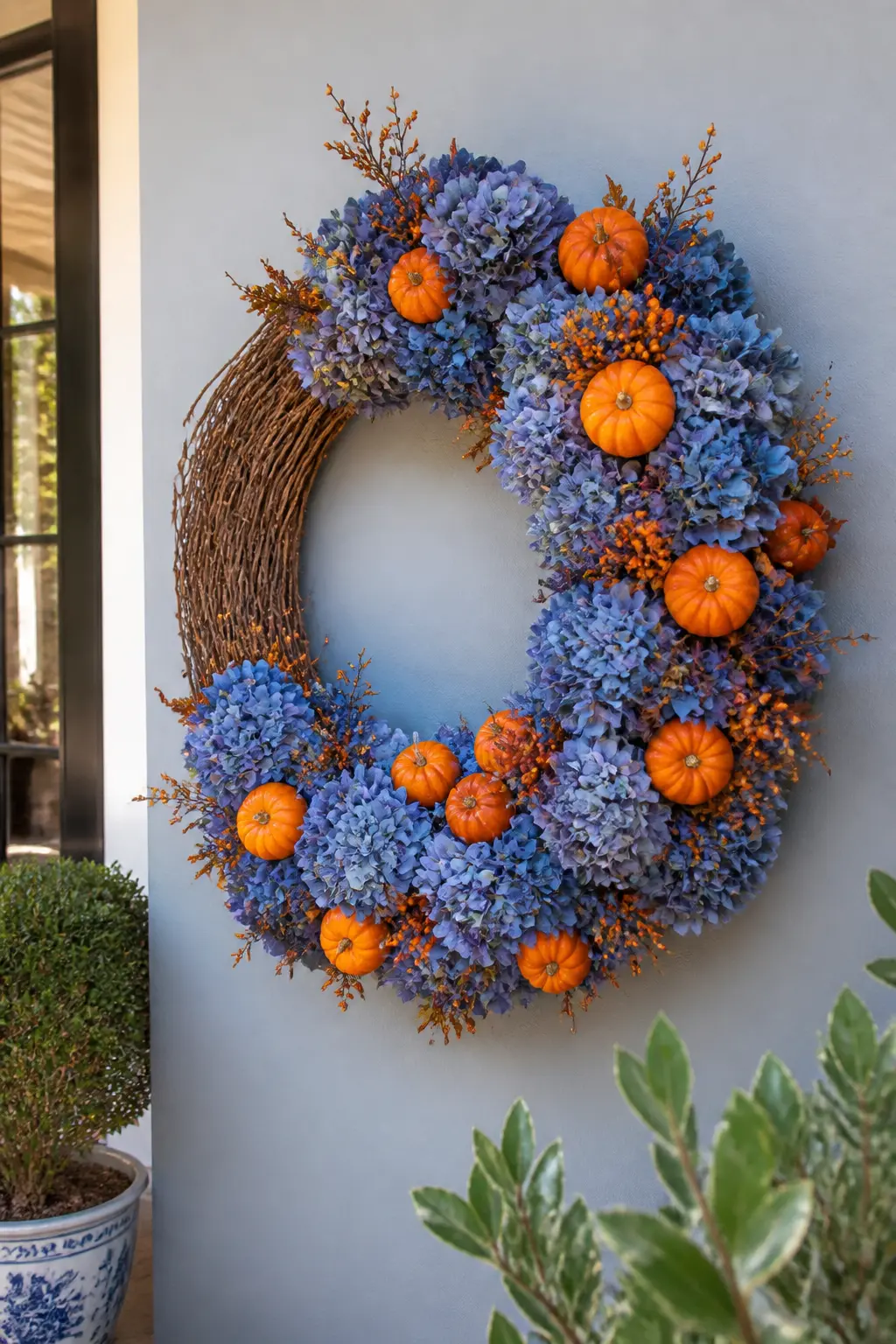
A twig base, thinner and more graphic than grapevine, lets individual flowers read clearly without looking crowded. Cover roughly two thirds of the ring with periwinkle and soft blue faux hydrangea clusters, leaving the bare twig visible on one arc.
Scatter a dozen mini orange pumpkins and a handful of amber berry clusters through the hydrangea, tucking rather than hot-gluing so nothing looks stiff. The exposed twig section is not a gap: it is negative space that makes the rest of the wreath look intentional. Hang on a pale door for maximum contrast.
🛍 Shopping guide
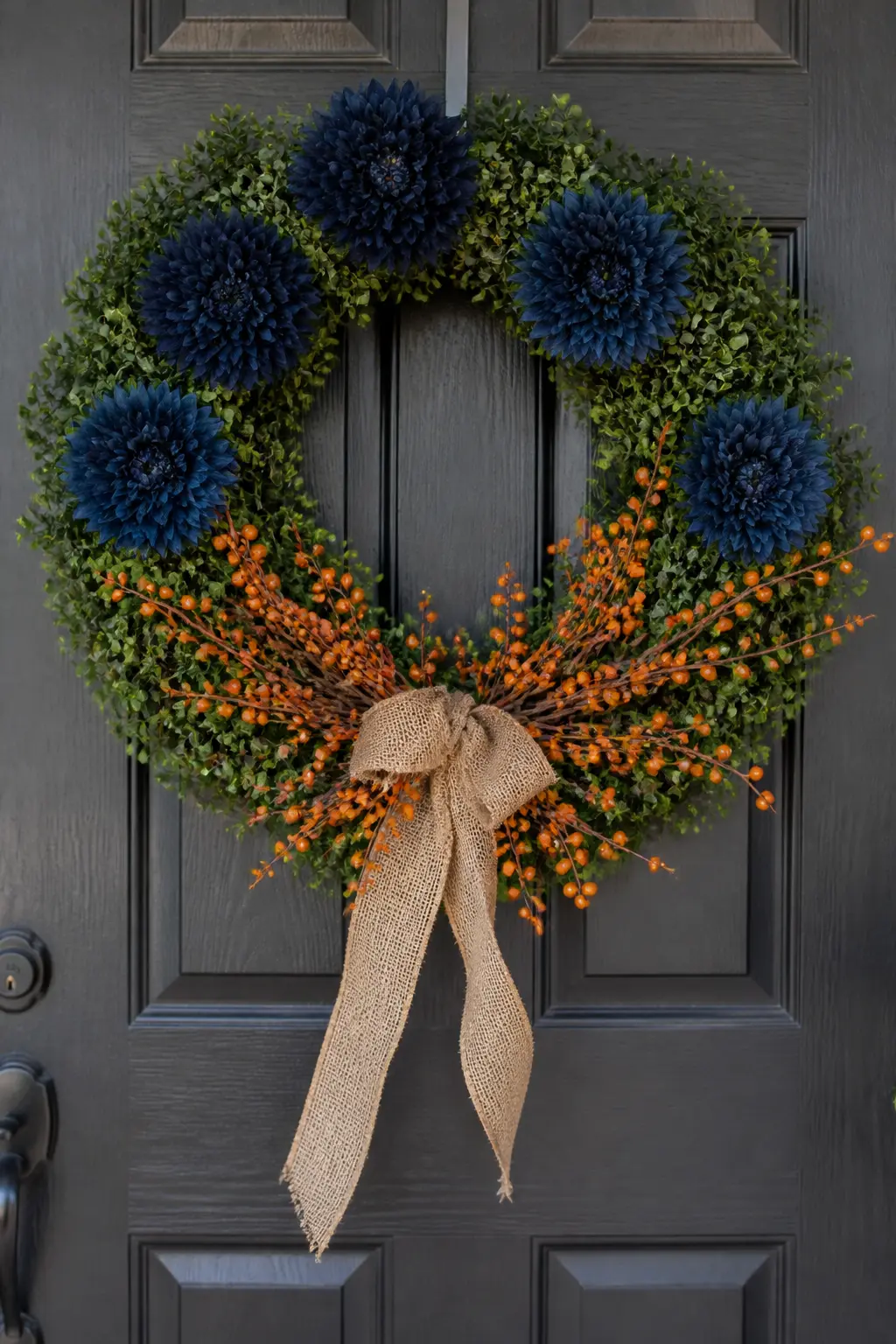
Navy Mum and Orange Berry Boxwood Wreath
A faux boxwood base gives the wreath a year-round starting point. Press navy or deep indigo faux chrysanthemum blooms in clusters of three and five across the top and sides, then thread bright orange berry sprigs through the lower half.
Finish with a length of natural burlap ribbon, barely knotted, at the base. The burlap is the thing that keeps the navy-and-orange combination from reading as a school sports team. It adds the natural, slightly rough texture that grounds the whole arrangement and places it firmly in autumn.
🛍 Shopping guide
Bedroom and Soft Furnishings
The bedroom is where most fall decor advice quietly gives up and hands you a plaid throw. That is fine, but blue and orange gives you something more interesting to do with bedding you may already own.
Navy duvet covers are everywhere. Swap in amber, rust or deep orange through cushions, a knitted blanket or a ceramic lamp base and the room reads autumn without buying a single piece of seasonal decor. For a full bedroom treatment, see 38 Fall Bedroom Decor Ideas for the Room You Retreat To.
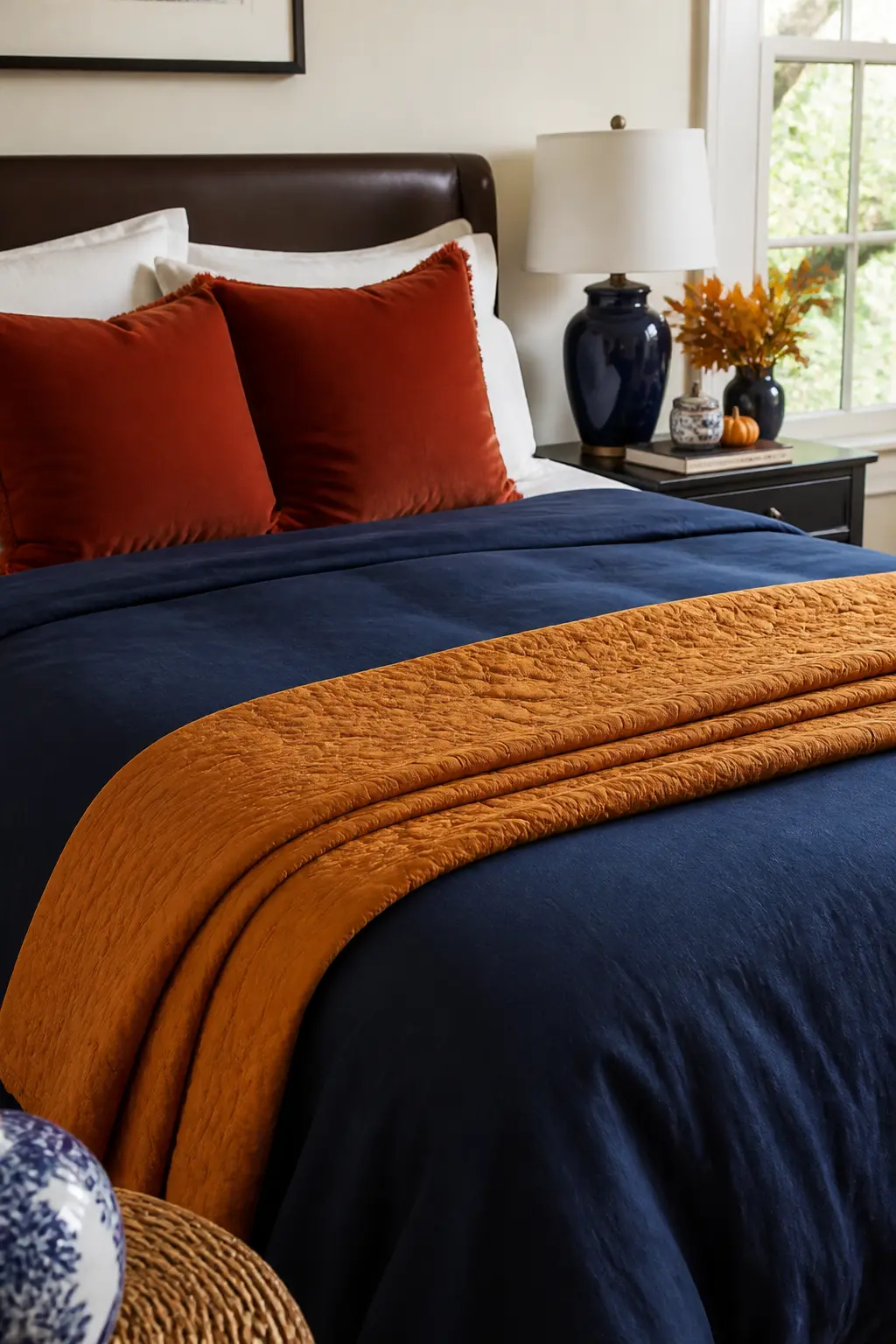
Navy Bedroom Duvet with Amber Quilt Fold
A navy duvet cover, full or king, already contains the dominant colour. The seasonal layer comes from a single amber or burnt orange cotton quilt folded across the lower third of the bed. Leave it casually folded rather than tucked in; the visible fold and the contrast it creates against the navy cover do all the work.
Add two amber or deep terracotta cushions in front of the sleeping pillows. These sit in front during the day and come off at night, so they cost exactly zero effort to maintain. A navy ceramic lamp on the bedside table connects the duvet to the wider room.
🛍 Shopping guide
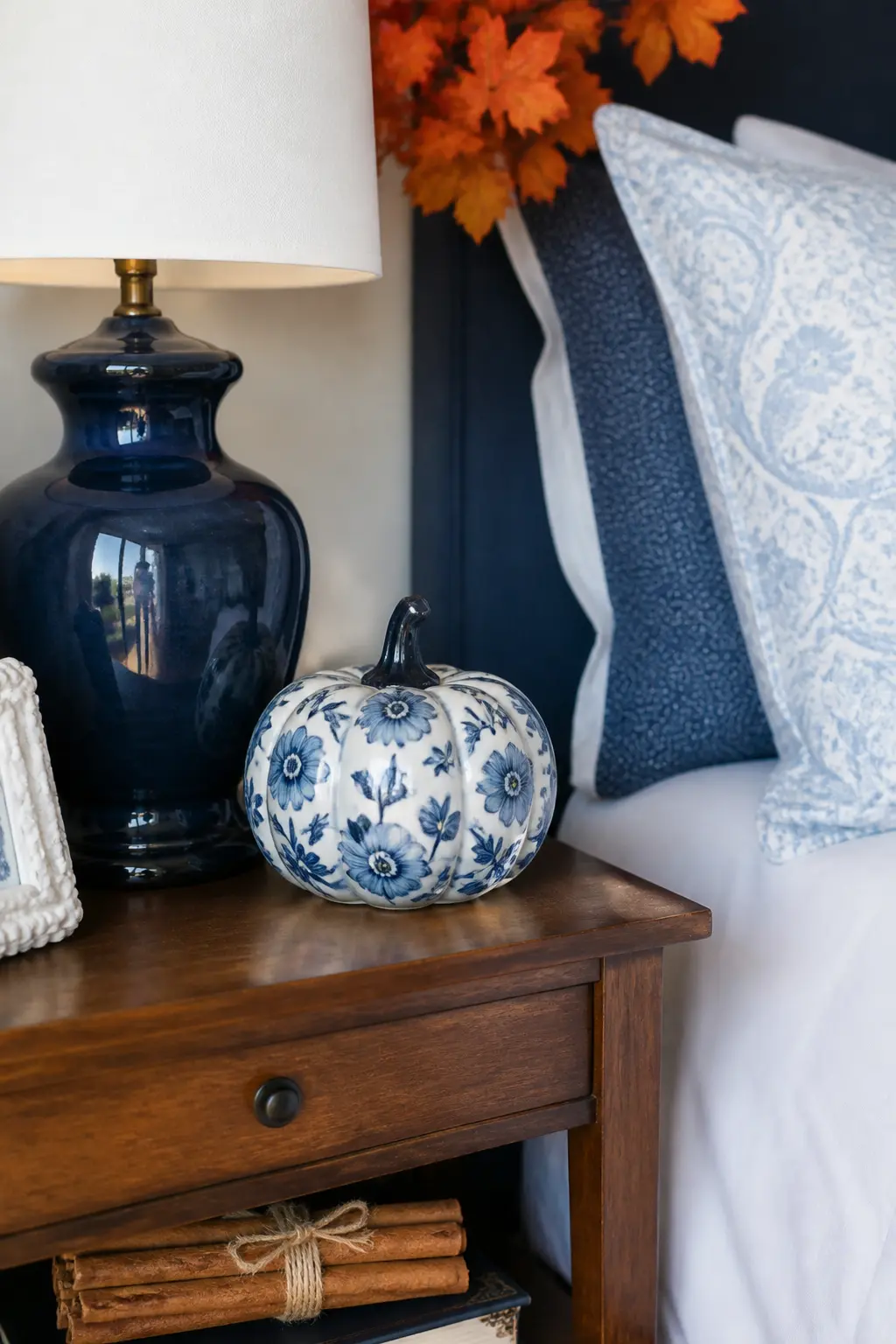
Blue and White Ceramic Pumpkin on a Bedside Table
A single object on a bedside table works better than a styled vignette in most bedrooms because the surface also needs to hold a glass of water and a book. A ceramic pumpkin in blue-and-white, hand-painted or transfer-printed, is small enough to sit beside a lamp without crowding and distinctive enough to read as seasonal without being obvious about it.
Set it directly on the wood surface. Nothing else required. If the bedside has a lower shelf, set a small bundle of cinnamon sticks below it for a detail that is only visible up close.
Periwinkle Throw with Orange Embroidered Cushion
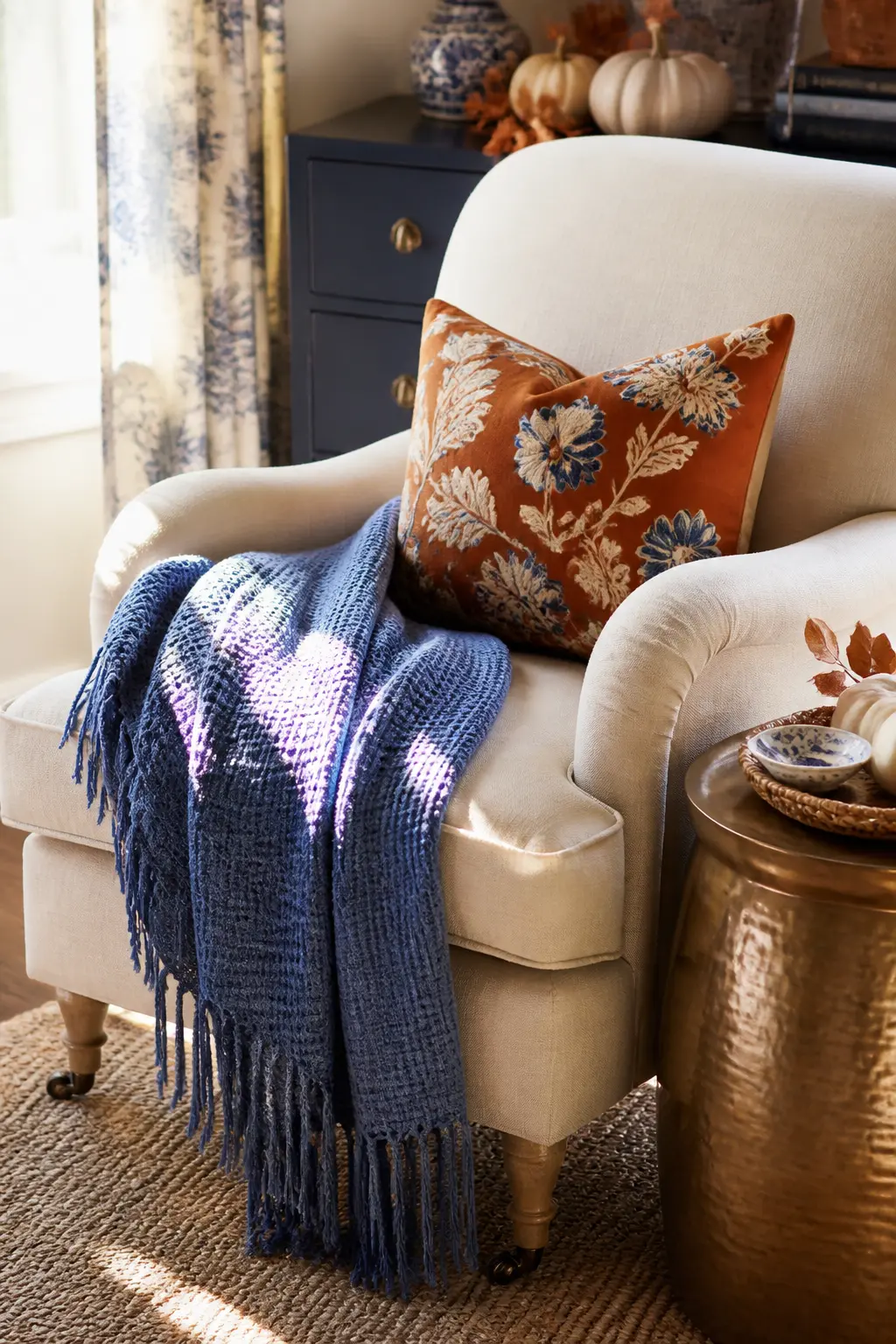
Periwinkle is the quieter option in the blue family, closer to lavender, and it softens the orange pairing significantly. A periwinkle waffle-weave throw folded over a bedroom armchair reads as both cool-toned and warm-season simultaneously, which is a useful thing in a transitional month.
Pair it with one cushion in orange with a botanical or geometric embroidered detail in white or cream. The embroidery detail keeps the orange from reading as a block of colour. This works in rooms that already have blue or purple tones: the periwinkle bridges both directions.
Kitchen and Everyday Surfaces
The kitchen gets seasonal decor last and loses it first, which means anything that goes here needs to be low-effort and genuinely useful. Blue and orange earns its place here through ceramics, linens and fruit bowls rather than dedicated seasonal pieces.
A blue-and-white ceramic bowl filled with clementines or small pumpkins takes four seconds to arrange and reads immediately as intentional. See 30 Fall Kitchen Decor Ideas That Do Not Get in the Way of Cooking for more ideas that stay out of your way.
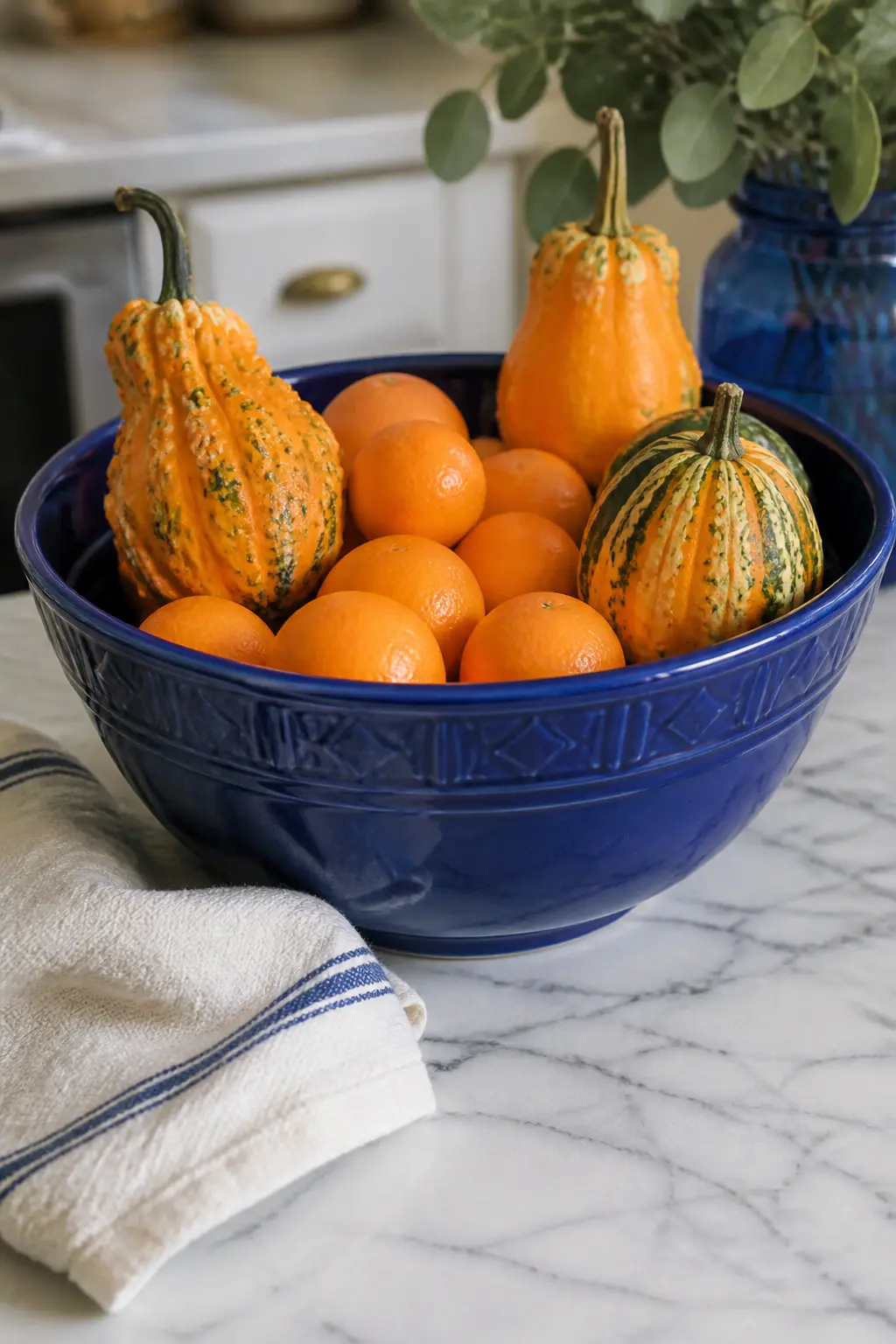
Blue Ceramic Mixing Bowl with Clementines and Mini Gourds
A wide blue ceramic mixing bowl, the kind already living in most kitchens, becomes a seasonal centrepiece when filled with a dozen clementines and four or five small green-and-orange gourds. The clementines are orange, edible and constantly restocked, which solves the freshness problem that plagues most kitchen decor.
Set this on the kitchen island or the counter beside the stove. The blue bowl reads as chinaware and the fruit reads as cooking, so nothing about it says seasonal decoration. It is the quietest idea on this list and one of the most useful.
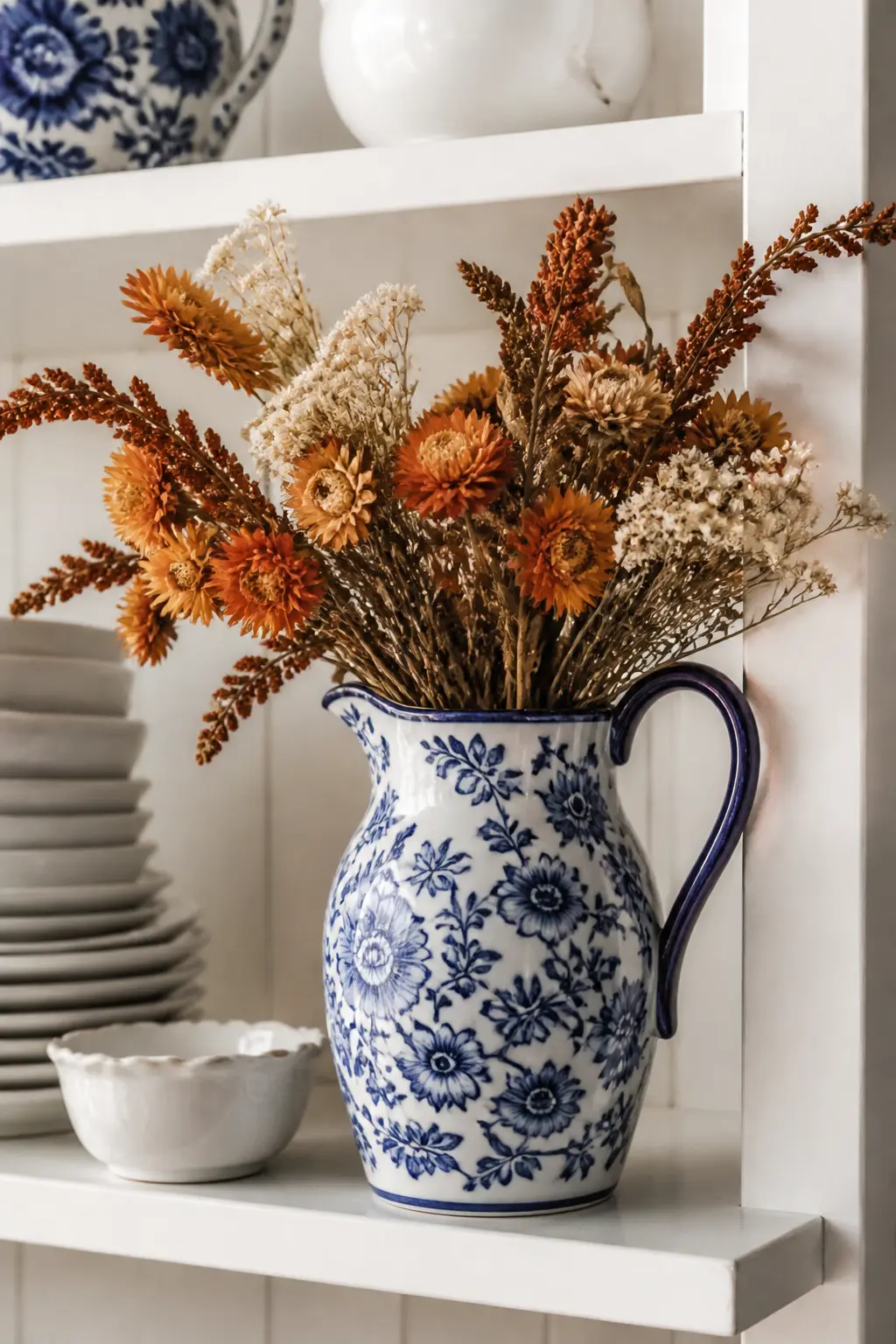
Blue and White Pitcher with Orange Dried Botanicals
A blue-and-white ceramic pitcher on an open kitchen shelf, filled with a loose arrangement of dried orange botanicals, does two things at once: it uses vertical space on a shelf that would otherwise hold nothing interesting, and it brings fall colour into a space without candles, gourds or any surface clutter.
Use dried orange strawflowers, orange amaranth and a few sprigs of dried white rice flower for variation. The arrangement needs no water and no maintenance: refresh it after several weeks when the colours start to fade. This is the longest-lasting fall decor in the whole kitchen.
🛍 Shopping guide
Navy Enamel Cookware as Kitchen Decor
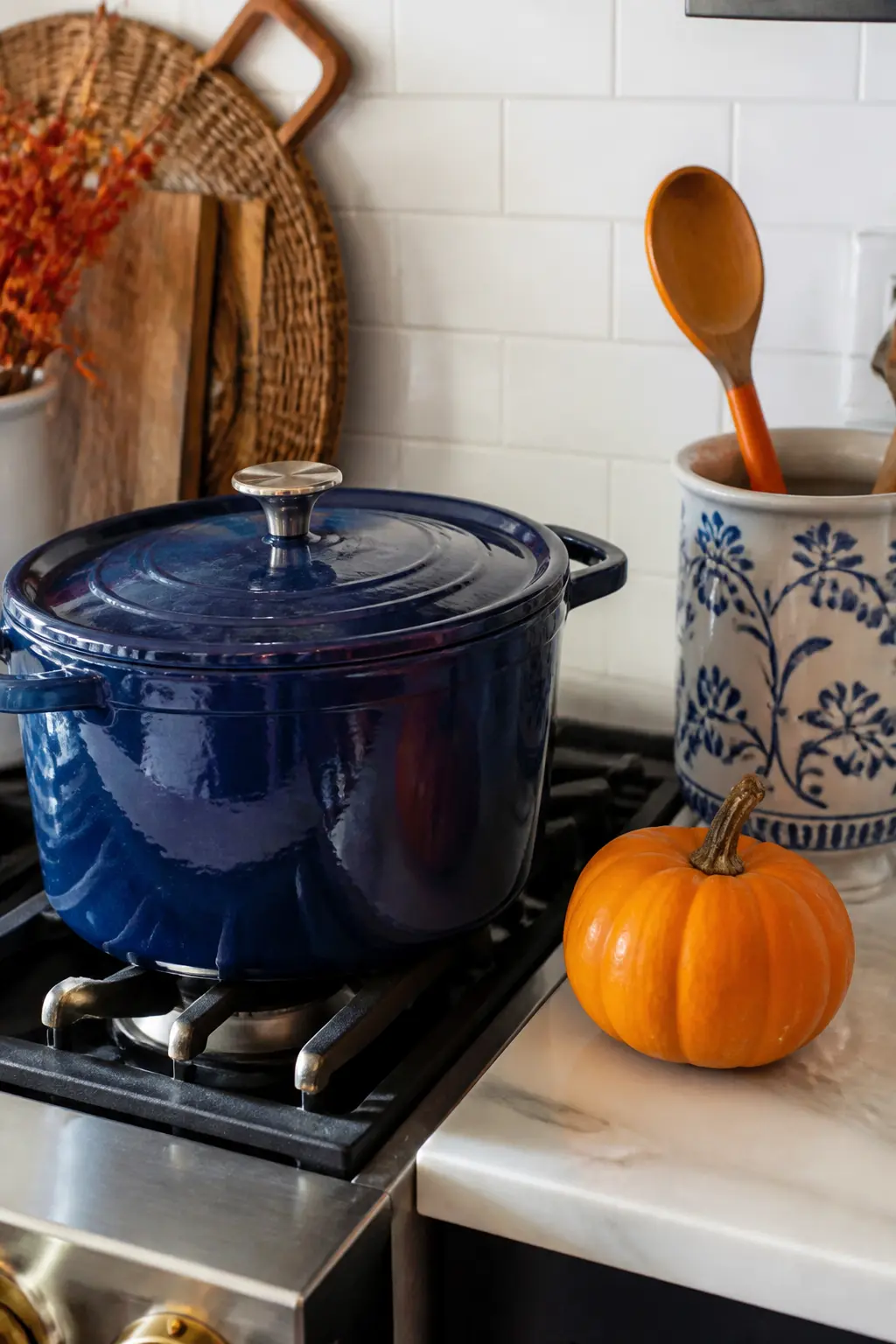
Navy enamel cookware left out on the stovetop or hanging from a pot rack is kitchen decor that also cooks dinner, which is the best possible efficiency ratio. Set a navy enamel Dutch oven on the back burner beside a small orange pumpkin on the counter beside it, and you have a two-object autumn vignette with essentially zero effort.
The scale contrast between a large Dutch oven and a tiny pumpkin is what makes this read as styled rather than accidental. Add a wooden spoon with an orange handle in the utensil pot for a detail that ties the two together.
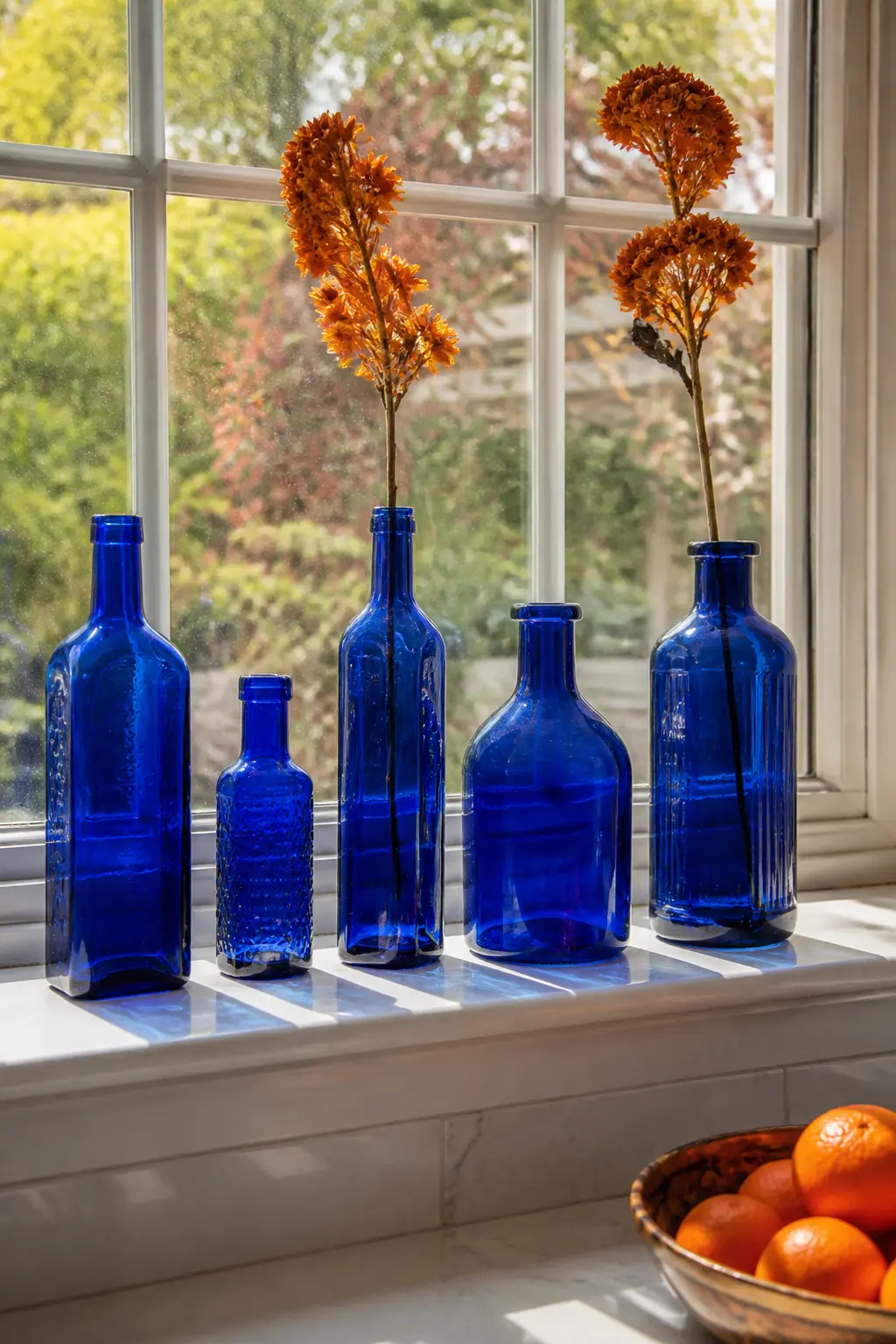
Cobalt Glass Bottle Collection as a Windowsill Vignette
A row of cobalt blue glass bottles and vases in different shapes, set on a windowsill where autumn light passes through them, casts a blue-tinted shadow pattern on the surface inside. It is the lowest-effort idea on this list and one of the most genuinely beautiful.
Set three to five bottles in a loose row and tuck single dried orange blooms or small orange autumn branches into the two or three tallest ones. The light does the rest. Move them to any south or west-facing window where afternoon light enters directly.
Outdoor and Garden
Outside the front door and porch, blue reads differently: it competes with the sky on bright days and disappears on overcast ones. The answer is to anchor it with material, not just colour. Navy galvanised metal, cobalt glazed pots and indigo-stained wood all hold their tone better than fabric does outdoors.
Orange is easier: it shows up against every lawn and every grey fence, which is exactly why it works as the lead colour for garden and path displays. For what works beyond the porch rail, see 34 Fall Outdoor Decor Ideas That Work Past the Porch.
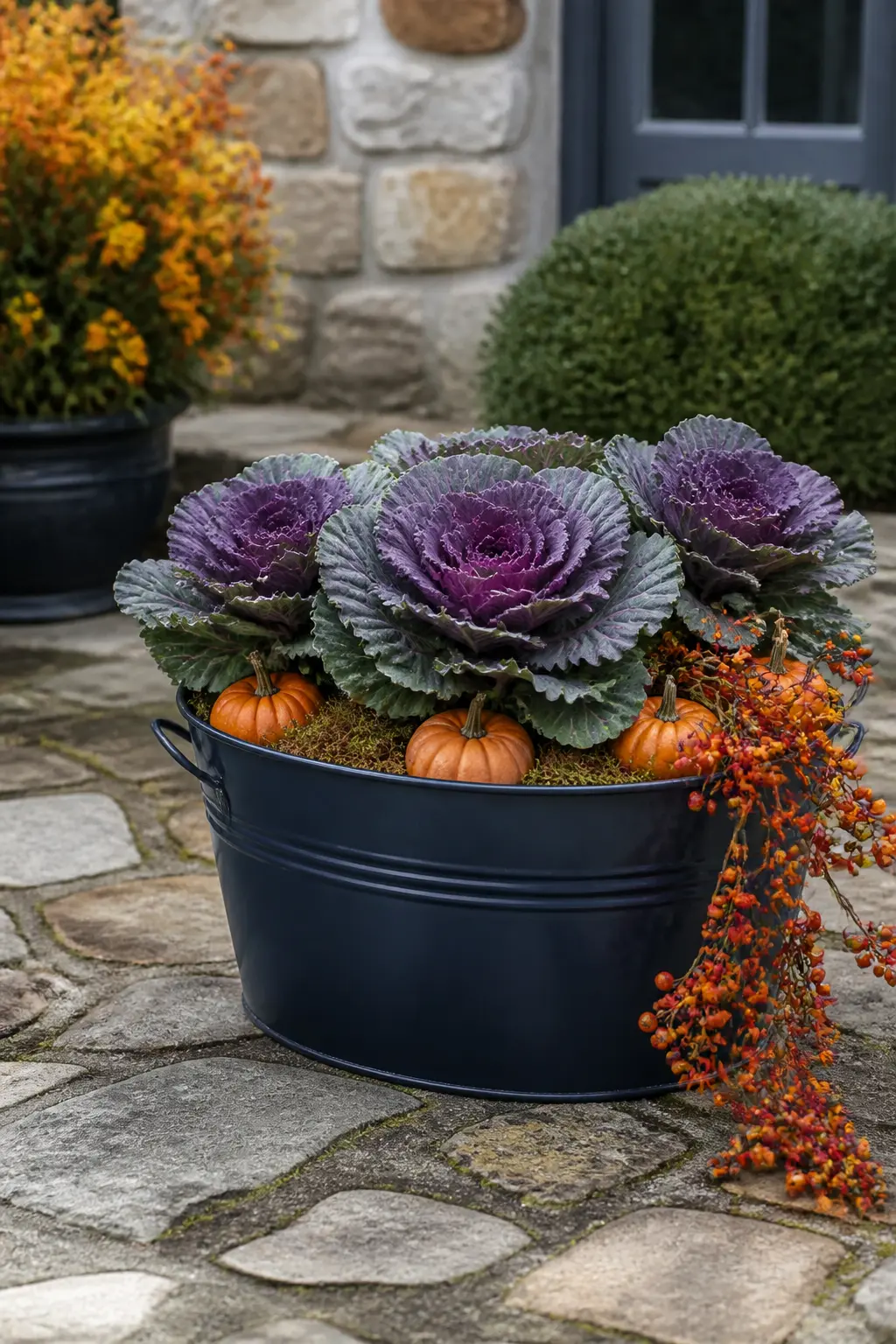
Navy Galvanised Metal Tub Planted with Ornamental Cabbage
Ornamental cabbage and kale come in blue-green, purple and near-indigo tones, and they thrive in exactly the cool conditions that make outdoor autumn decor a challenge. Plant three heads of ornamental cabbage in a navy galvanised metal tub, add a handful of small orange pumpkins around the base and a trail of dried orange bittersweet at the handle.
This arrangement handles rain, cold and wind better than almost any faux alternative, and the cabbage stays vivid until a hard frost. Set it at the foot of the front steps or beside a garden gate where it can be seen at distance.
🛍 Shopping guide
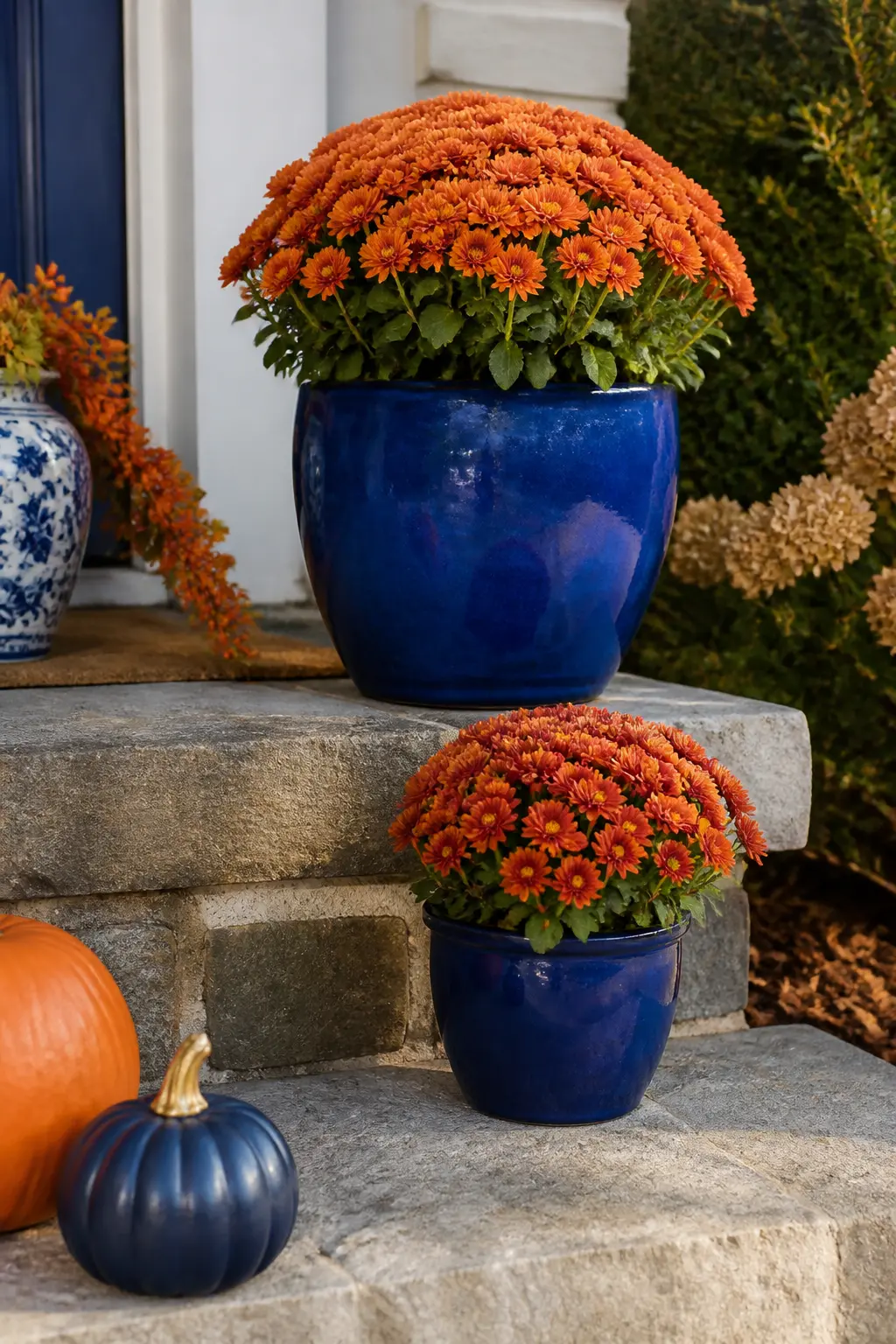
Cobalt Blue Glazed Garden Pot with Orange Mums
A cobalt blue glazed pot is a year-round garden asset that earns its keep the moment orange chrysanthemums go in. Plant a large orange garden mum, the kind sold by the flat in autumn at garden centres, in a 14-to-16-inch cobalt glazed ceramic pot and set it directly on a porch step or a garden bench.
No additional styling needed. The contrast between the cobalt glaze and the orange bloom is sufficient on its own. A second pot in the same cobalt with a rust-orange mum creates depth without needing to match sizes or heights exactly.
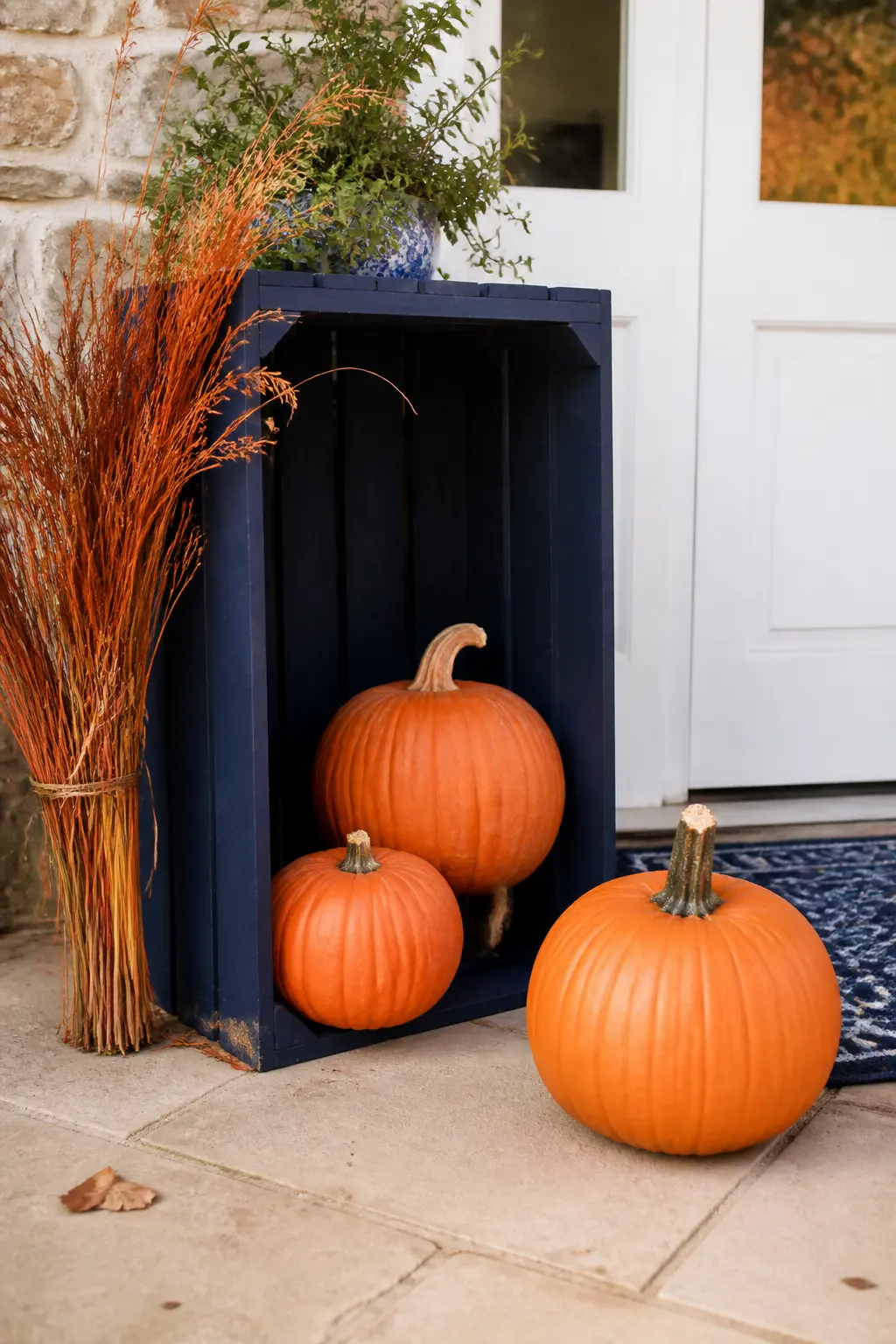
Indigo-Stained Wooden Pumpkin Crate Display
A standard wooden crate, stained or painted in a deep indigo or navy blue, set on its side or upright, becomes a display shelf for orange pumpkins and gourds at the base of a front door. Stack three or four pumpkins of varying sizes inside and beside the crate, and tuck a few stems of dried wheat or orange grass around the base.
The painted crate does the same job as a hay bale, which is to group the pumpkins and give them a foundation, but it reads as furniture rather than farm supply. Set it against a light-coloured door or wall where the indigo stain registers clearly.
🛍 Shopping guide
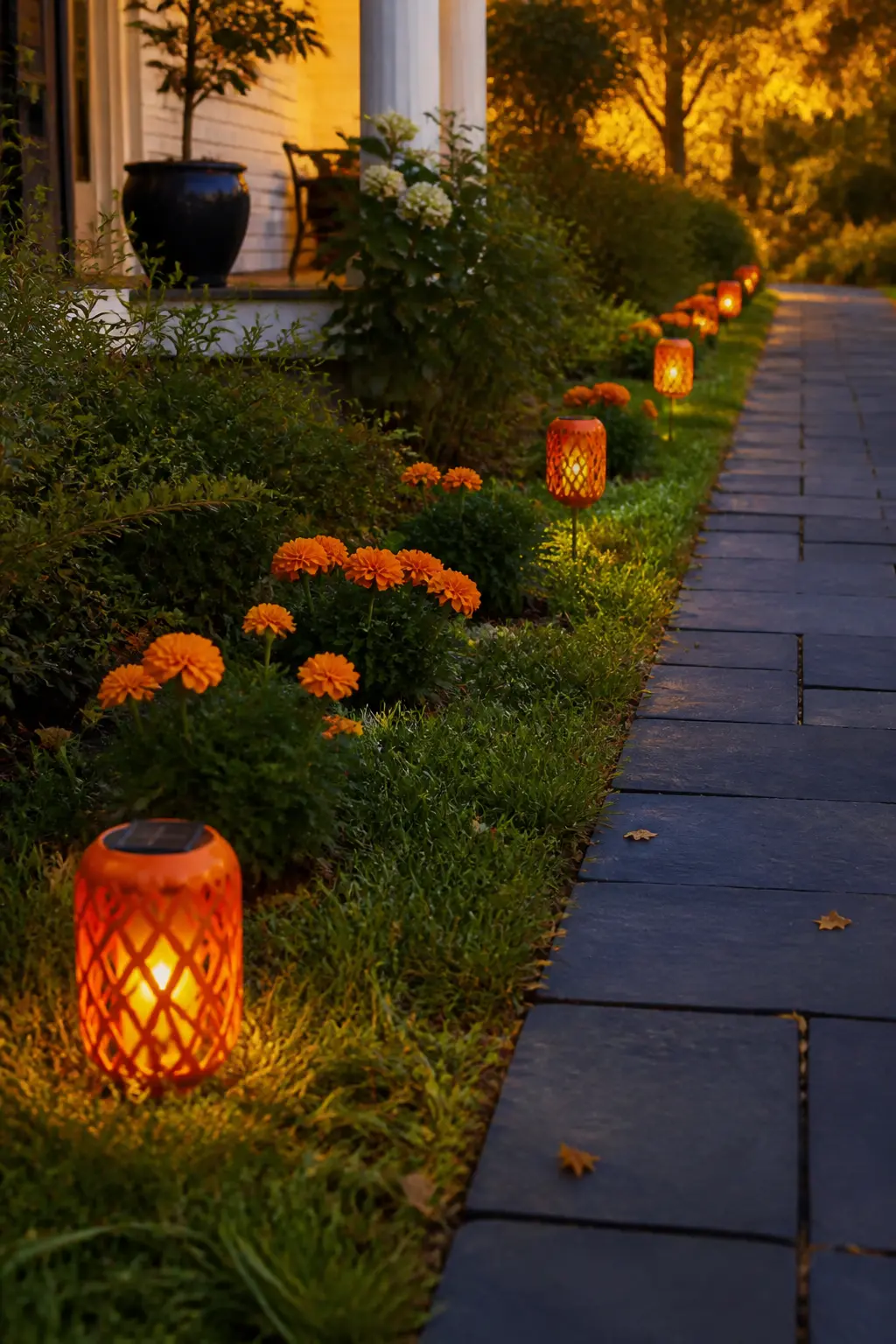
Orange Lantern Pathway with Blue Stone Edging
Line a garden path or driveway edge with small orange solar lanterns, set directly on the ground every four feet or so. Intersperse small gourds or orange marigold plants between the lanterns, sitting on the grass or gravel border.
Blue comes from slate edging tiles or blue-grey gravel used as the path surface. The cool-toned stone and the warm lantern glow create an evening contrast that photographs well and costs almost nothing to maintain. Solar lanterns charge during the day and switch on automatically at dusk.
🛍 Shopping guide
Frequently Asked Questions
Does blue and orange fall decor work in a house that already has a lot of neutral tones?
Yes, and it often works better there than in a room with existing strong colours. Cream, white and light grey walls all act as a clean ground for both navy and orange. The neutrals recede and the palette reads clearly without competing.
Which blue works best with orange for fall: navy, cobalt or periwinkle?
Navy gives the most contrast and the most formal result, which suits mantels, dining tables and front doors. Cobalt is brighter and works well with natural materials like rattan and terracotta. Periwinkle softens the pairing and suits bedrooms and living rooms where a quieter seasonal note is more appropriate. All three work; the choice depends on the room’s existing tone.
How do you keep blue and orange from looking like a sports team colour scheme?
Material and proportion do the most work here. Using blue in velvet, glazed ceramic or linen, and keeping the orange in natural forms like pumpkins, dried flowers and terracotta, separates the palette from a graphic sports identity. Avoid equal quantities of both colours: let one lead and use the other as an accent.
Can blue and orange fall decor work for a Thanksgiving table specifically?
Completely. Navy linen, blue-and-white chinoiserie serving pieces and copper or brass candlesticks with orange taper candles make a Thanksgiving table that reads as seasonally intentional without defaulting to the usual brown-and-rust palette. The combination photographs very well in the warm afternoon light most Thanksgiving dinners have.
What is the easiest single change that makes the biggest difference?
A navy linen tablecloth or a pair of cobalt blue lanterns at the front door. Both are single purchases, both work across multiple seasons with minor accessory changes, and both shift a space’s personality faster than any collection of small objects would.
Turn scattered props into 15 Halloween yard decorations that each tell a story from the street. Ever
11 halloween kitchen decorations that look deliberate, not desperate. Real ideas by zone, from the i
16 DIY Halloween garland ideas you can actually finish in an afternoon: painted mini pumpkins, retro
Leave a Reply