

Fall outdoor decor earns its keep when it covers the whole footprint, not just a single bale by the front step. Think in zones: the driveway arrival, the walk up to the door, the patio where people actually sit, and the lawn in between. Each zone gets its own moment, and together they read as one considered look.
The palette matters as much as the props. Deep wine, warm brass, and aged terracotta age well through the whole season. Bright orange fades fast, literally and aesthetically. Work with what your yard already has, trees, fence lines, a garden gate, and let the decor follow those bones.
Everything here works without a power outlet in the middle of the lawn, without plastic, and without anything that tips into Halloween territory. If you want the indoor side of things, these Thanksgiving decor ideas carry the same spirit inside. Now, start at the street and work your way in.
This post contains affiliate links. If you buy through them, I may earn a small commission at no extra cost to you.
Driveway Entrance
The driveway entrance is the first thing anyone sees from the street, which makes it the highest-return zone in the yard. Height matters here: corn stalks, a loaded wagon, or a tall urn pull the eye up and signal intention.
Keep it bilateral if the drive has two sides, or anchor one strong focal point to the right where the eye lands first.
Corn Stalk Bundles at the Driveway Entrance
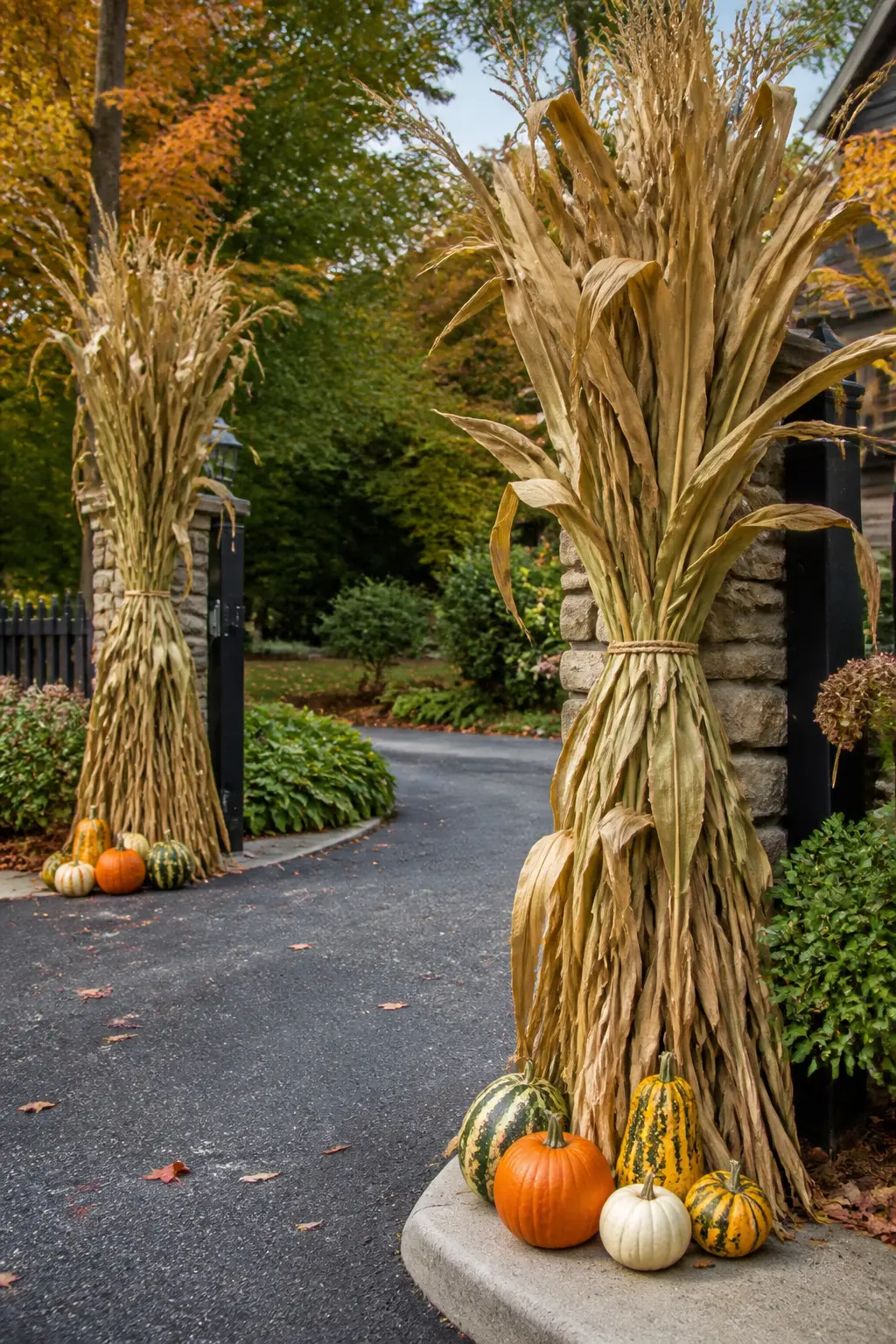
Two bundles of dried corn stalks, one on each side of the drive opening, are the simplest possible signal that the season has arrived. Tie each bundle with natural jute twine at three points and lean them against a post, mailbox pillar, or wooden stake driven into the ground.
The stalks add height without adding bulk. Tuck a few small gourds at the base of each bundle to ground them visually and keep them from looking like they blew in from the field.
Wooden Wagon at the Driveway Entrance with Gourds
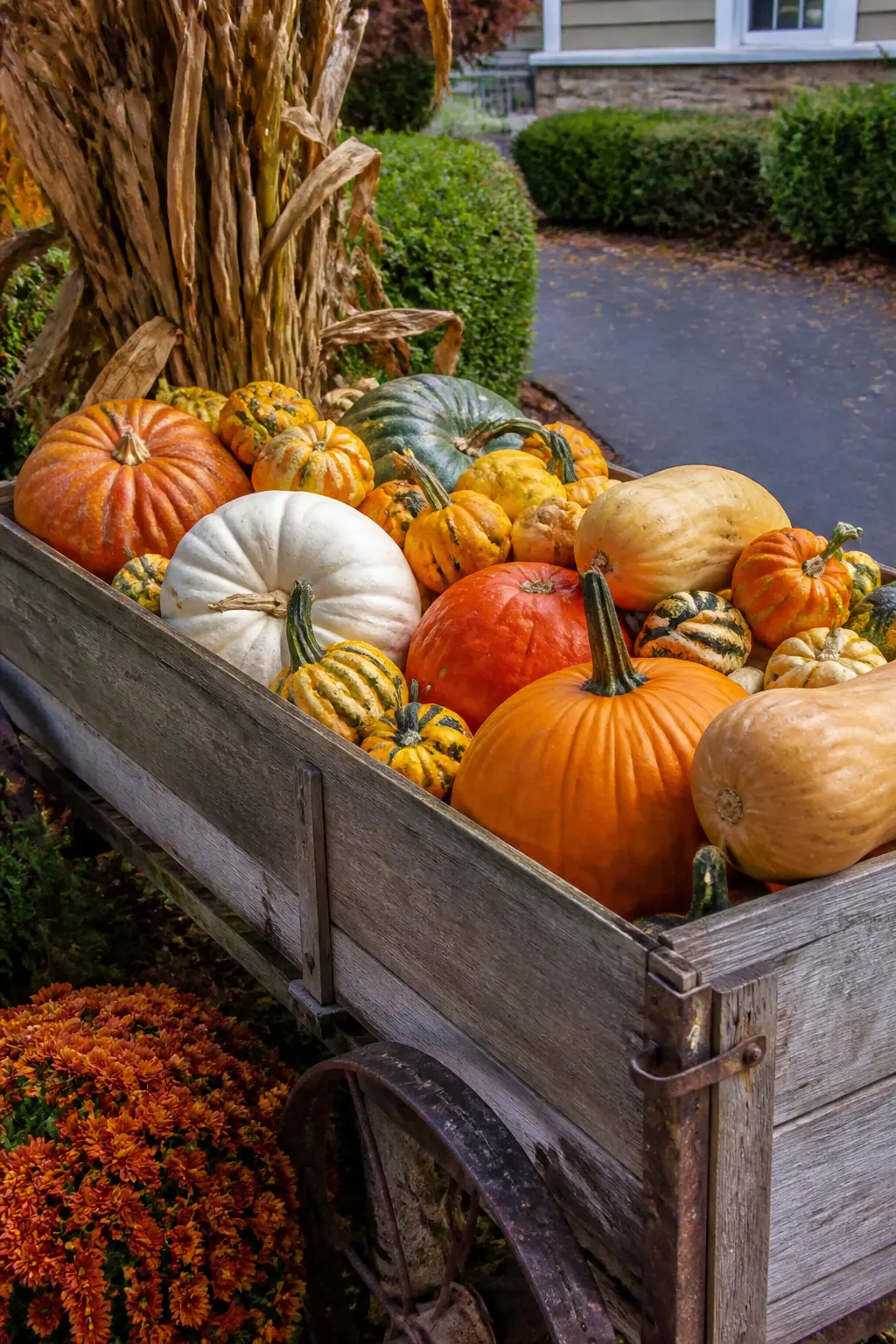
A wooden wagon parked just inside the driveway entrance does two things: it signals the season from the street, and it holds a generous pile of gourds without needing any additional structure. Choose a wagon with slatted sides so the gourds are visible and do not need to be stacked too high to read.
Mix sizes deliberately. Large pumpkins on the bottom, mid-size gourds in the middle, and a handful of small ornamental varieties tumbling over the front edge. A single dried stem bundle tucked upright at one end adds vertical interest without dominating.
Ornamental Grasses in Large Pots Along the Drive
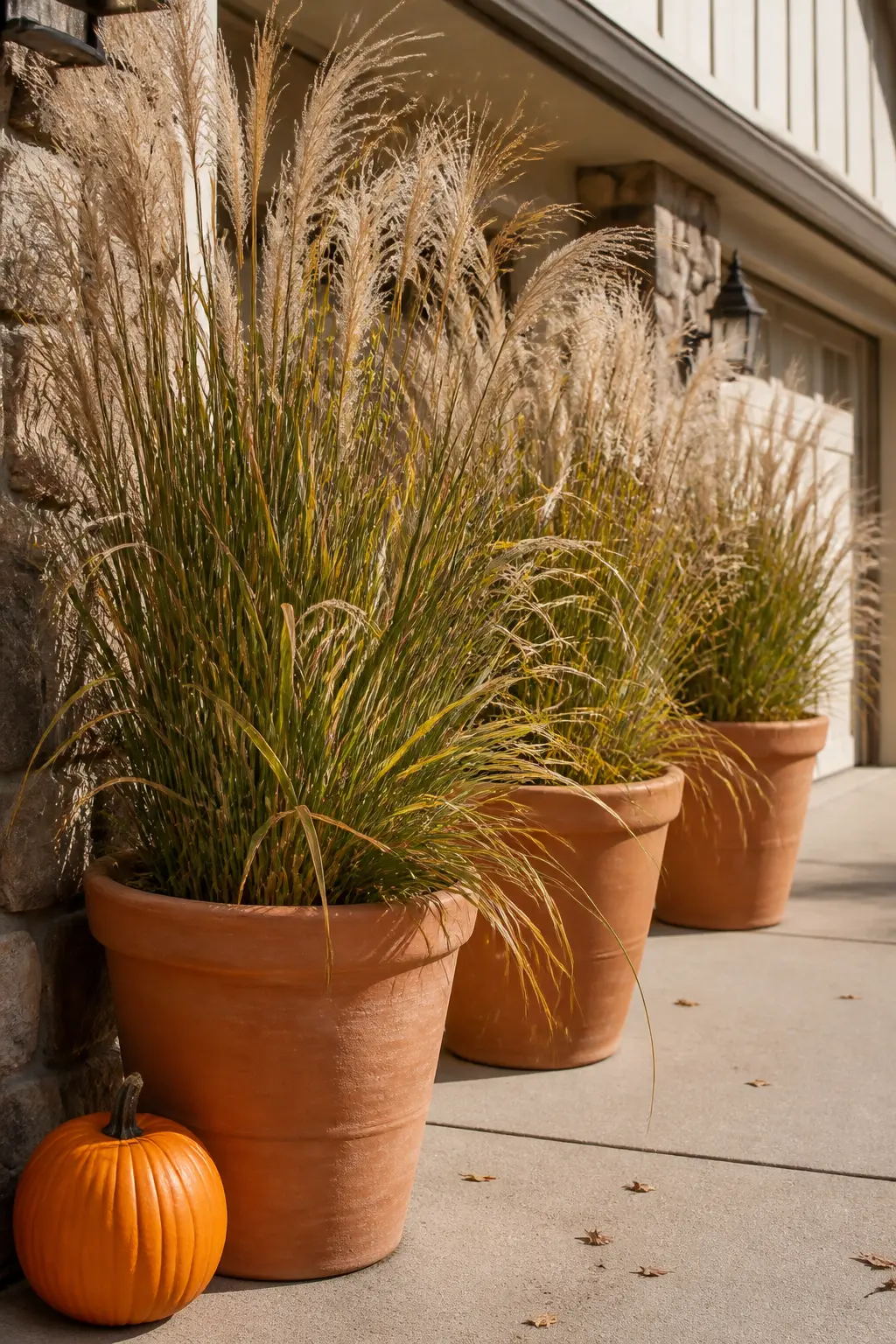
Large terracotta or concrete pots planted with ornamental grasses earn their keep through the whole season and well into winter. The feathery plumes move in the wind in a way that plastic never can, and the warm straw color of the seed heads reads as fall without any additional props.
Line three or four pots along the drive edge at unequal intervals. The variation in spacing is what keeps the row from looking like a parking lot barrier. Add a single medium pumpkin at the base of every other pot to link the grasses to the broader yard palette.
🛍 Shopping guide
Along the Walk
The walkway is a sequence, not a single placement. Repeat small elements at a rhythm, pumpkins at each path bend, lanterns every six feet, mums in matching tubs, and the eye travels forward on its own. Odd numbers read as deliberate; even numbers read as accidental.
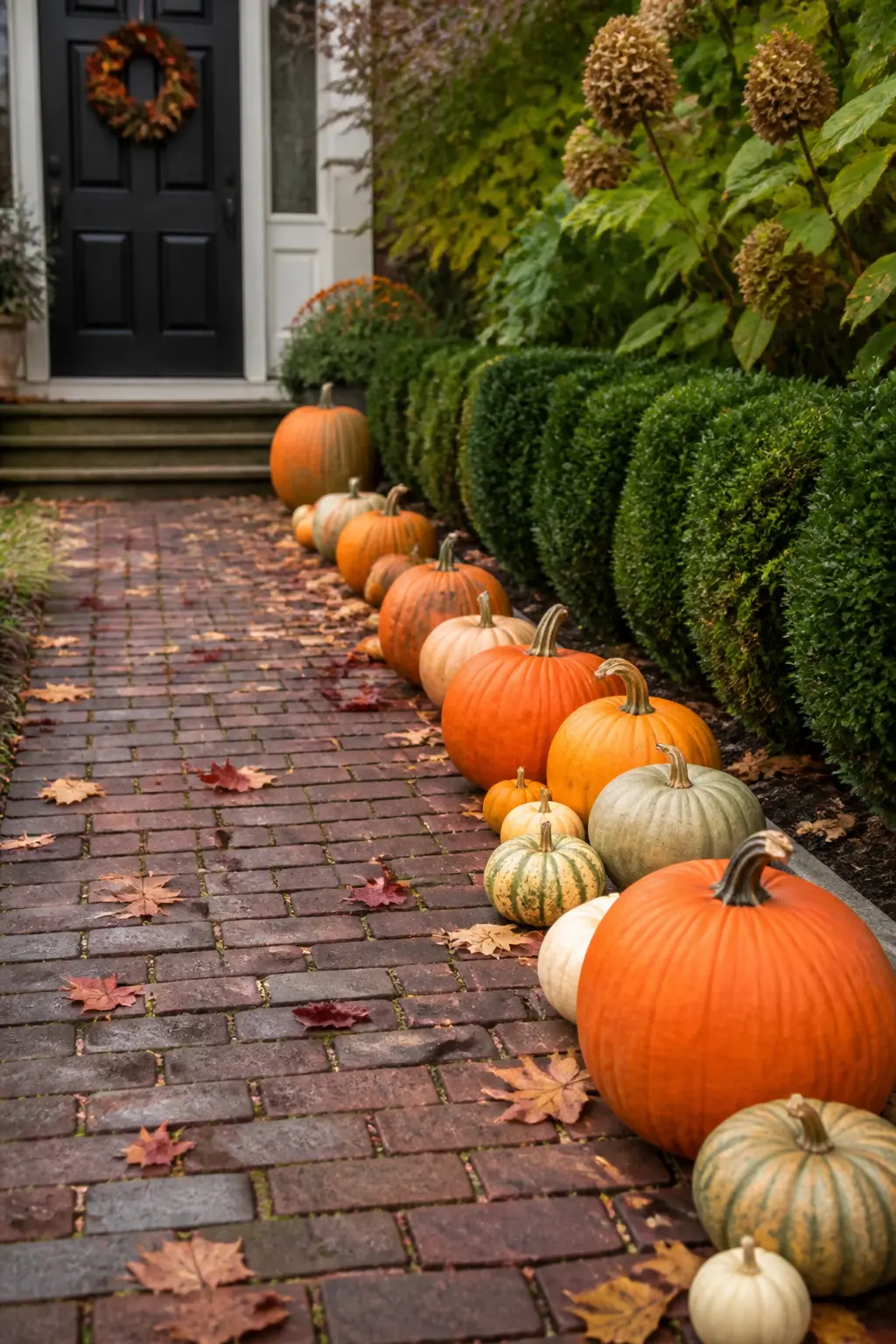
Pumpkin Row Lining the Walkway Edge
A row of pumpkins in graduating sizes along one edge of the front walk costs almost nothing to set up and reads from the street. Keep all of them on the same side so the walk stays clear and the line has direction.
Vary the sizes, but keep the color family consistent, all warm neutrals, or all deep hues, rather than mixing bright and pale.
Press each pumpkin gently into the soil at the walk edge so it does not roll. On a flat concrete edge, a small circle of gravel under each one solves the same problem and looks intentional.
🛍 Shopping guide
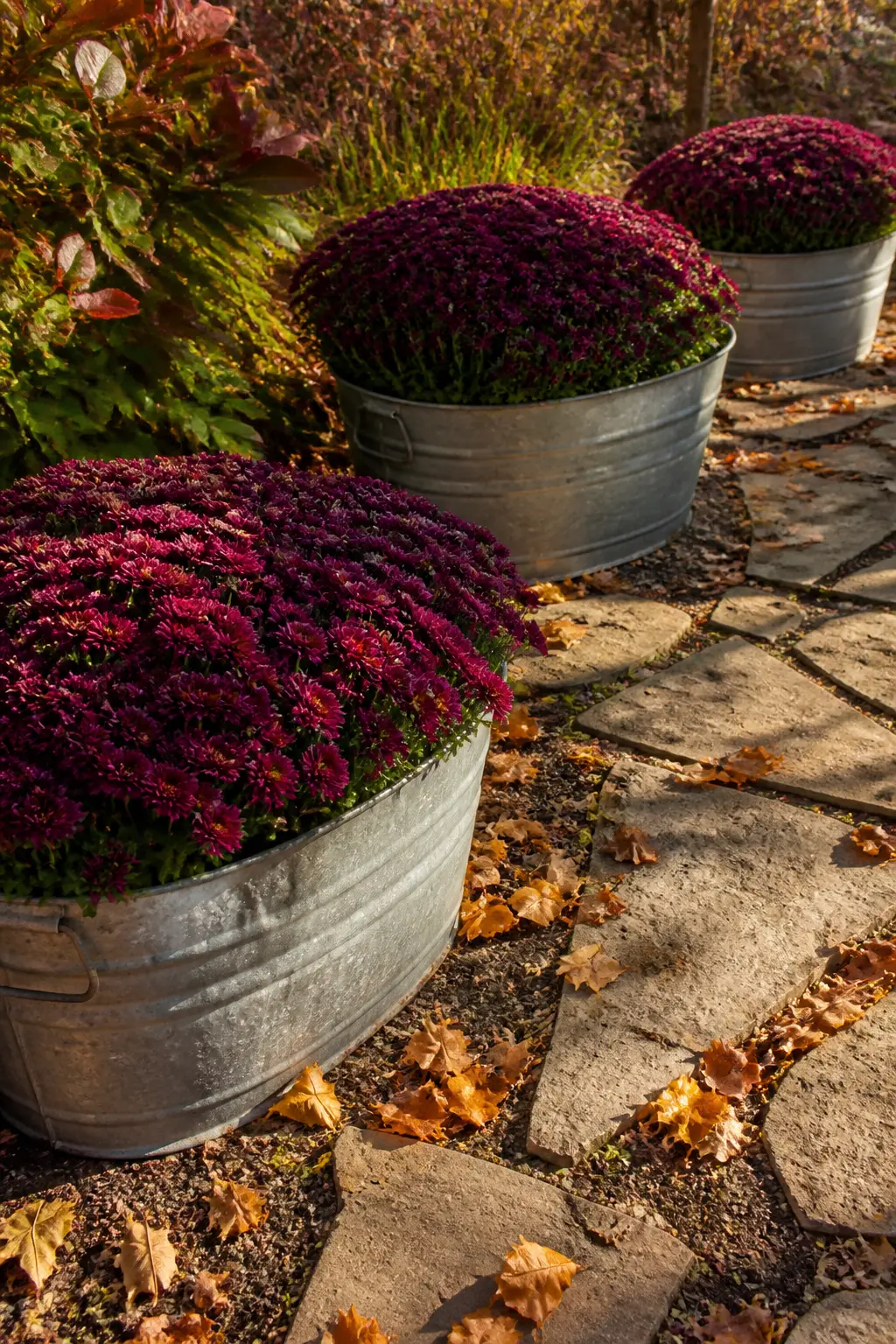
Galvanized Tubs Planted with Mums Along the Walk
Galvanized metal tubs planted with potted mums are more reusable and more interesting than plain nursery pots. The metal reflects light in a way that keeps the walk looking alive even on a grey afternoon. Choose mums in deep burgundy, burnt copper, or wine rather than bright yellow, and the whole walkway shifts into a richer register.
Set the tubs at the same side of the walk as the pumpkin row, alternating between a tub and a pumpkin so the two elements weave together without competing.
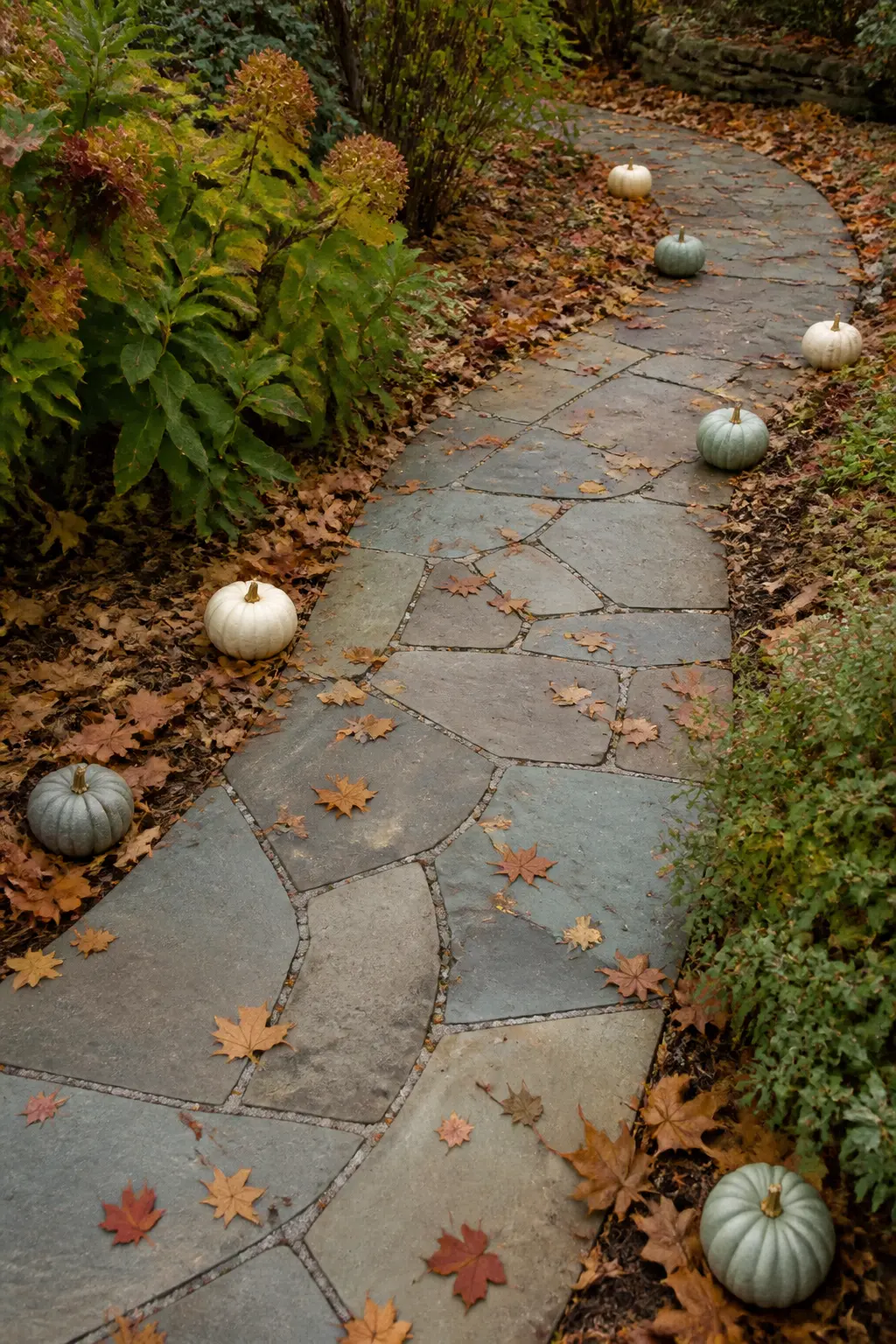
Stone Path Edged with Small Pumpkins at Each Turn
A path that curves or changes direction has natural punctuation points at each bend. Place one or two small pumpkins right at those turns and the path guides the eye without any additional lighting or signage. It works because the decor follows the logic of the space rather than being imposed on it.
Use pumpkin varieties with textured skin or unusual color, blue-grey Jarrahdales, pale Cinderellas, or deeply ribbed sugar pumpkins, so the small scale does not read as an afterthought.
🛍 Shopping guide
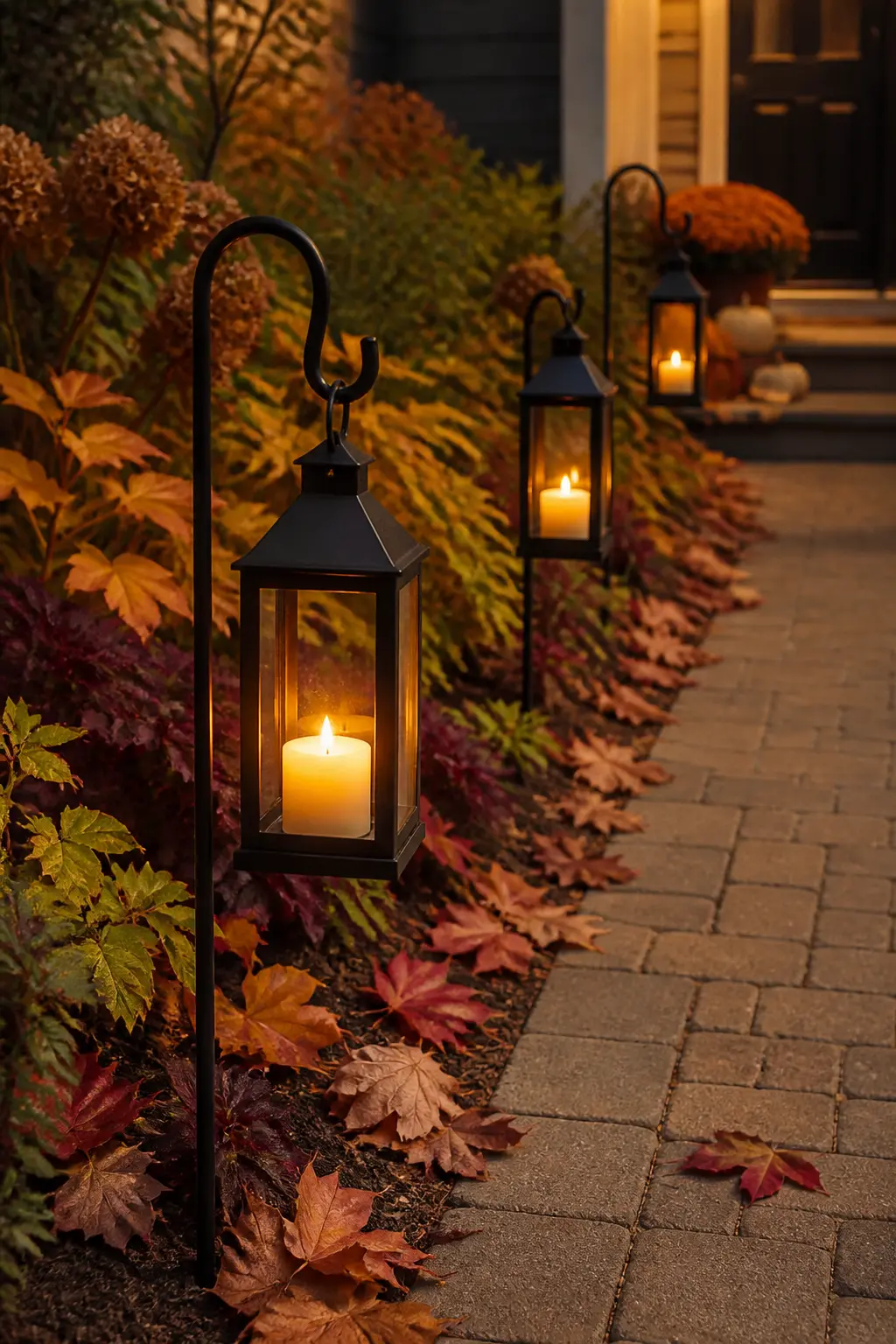
Lanterns Staked Along the Path at Intervals
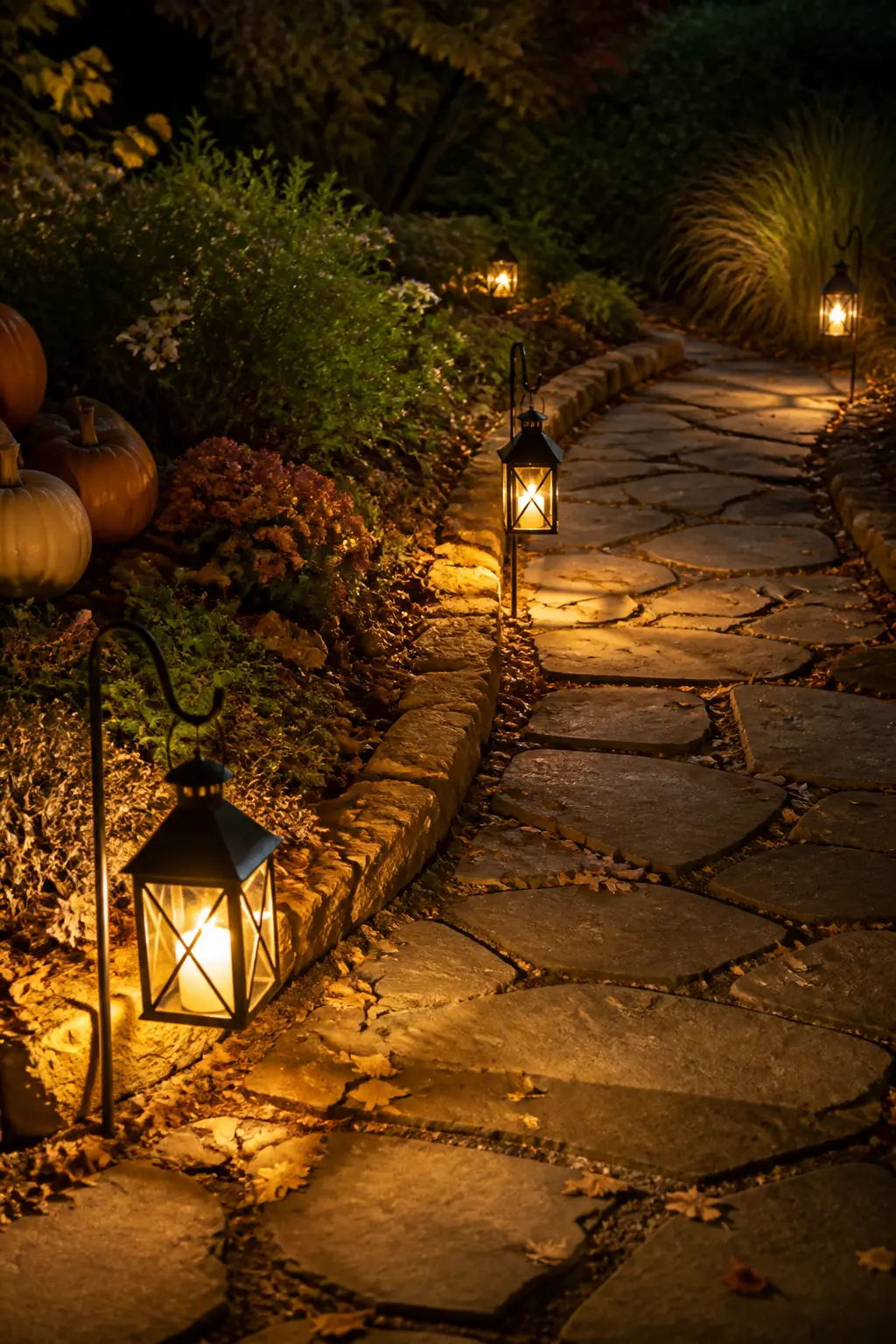
Staked lanterns solve the after-dark walkway problem without any wiring. Choose lanterns with a flat black or aged bronze finish, place a battery-powered candle inside each one, and push the stake directly into the soil at the walk edge. They work in rain, they work in wind, and the warm glow through the glass is genuinely lovely at dusk.
Space them further apart than your instinct says. Six to eight feet between lanterns looks intentional; three feet looks like an airport runway. Odd numbers in a run always read better than even.
🛍 Shopping guide
Fence, Gate, and Property Lines
Fences and gates are ready-made structure, so use them. Wiring dried bundles to rails or dressing a post cap costs almost nothing and fills a long stretch of yard edge without buying more pots. The trick is restraint: dress every third post, not every one.
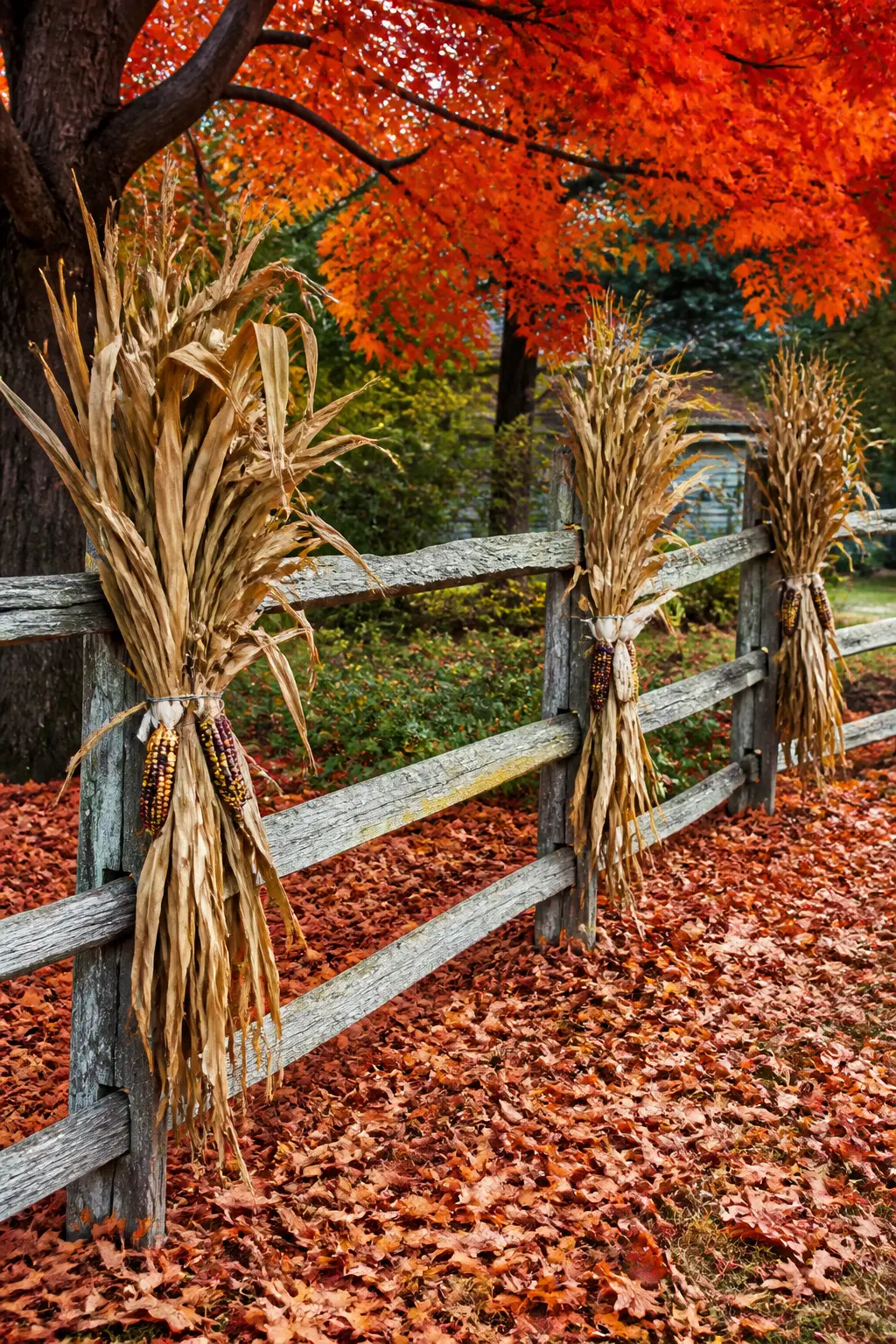
Split-Rail Fence with Dried Corn Bundles Wired On
A split-rail fence is a natural grid waiting to be dressed. Wire dried corn bundles to the rails at every third span, facing outward toward the street, and the fence transforms from a property marker into a seasonal installation. Use florist wire looped twice around the rail, then twisted tight at the back where it will not show.
Let the bundles vary slightly in fullness. Perfect uniformity reads as fake; slight variation reads as hand-done and intentional.
🛍 Shopping guide
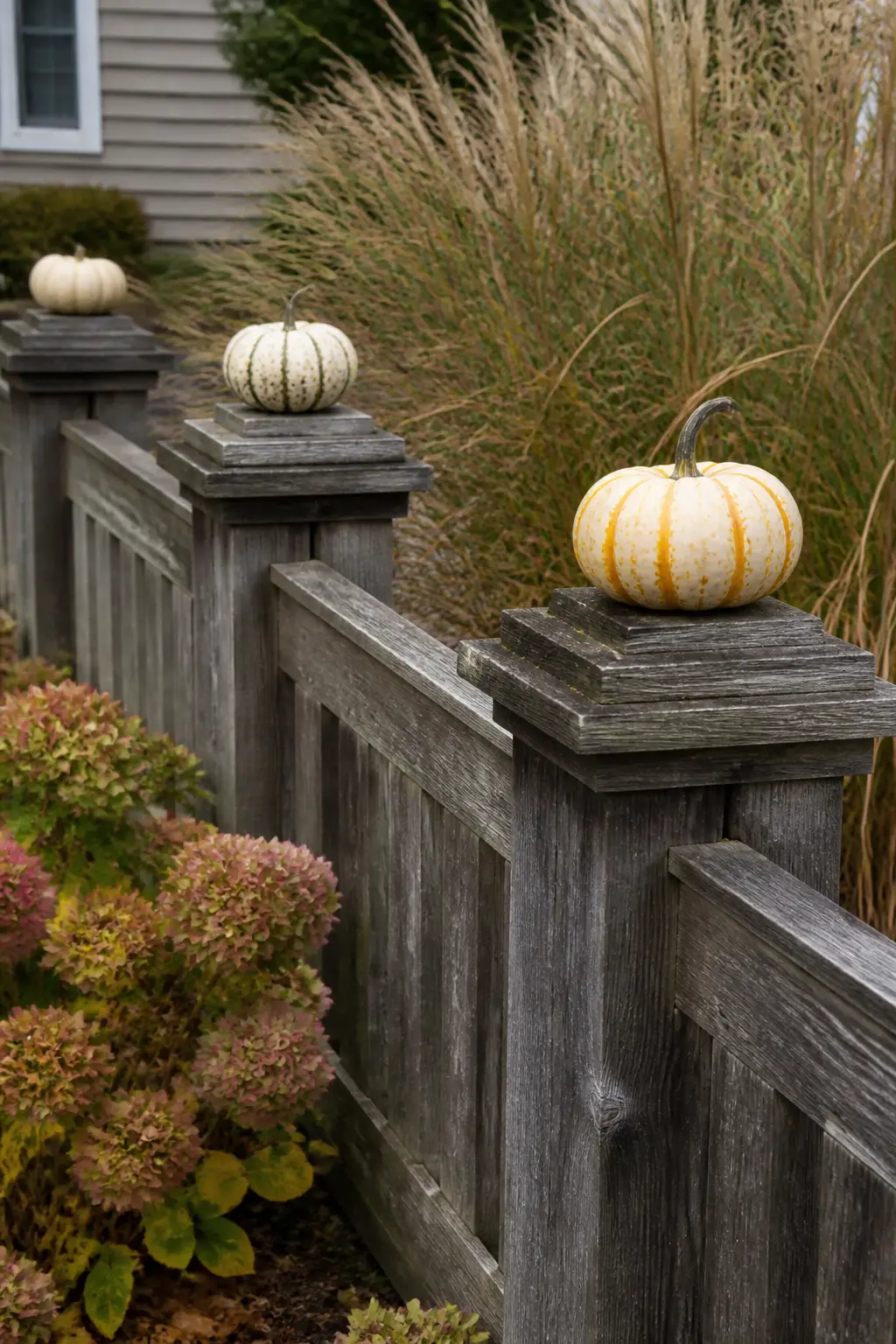
Fence Post Caps Topped with Small Pumpkins
Flat-topped fence posts are a ready-made display shelf that most people ignore. Set a small pumpkin on each post cap along the property line and the fence becomes a repeating pattern that reads from a moving car. Mini white pumpkins or small green-striped ones look more considered than standard orange.
If the post caps are slightly rounded, press a small disc of floral foam to the top first. It grips the pumpkin stem and keeps it from wobbling in the wind.
Garden Gate Dressed at One Corner Only
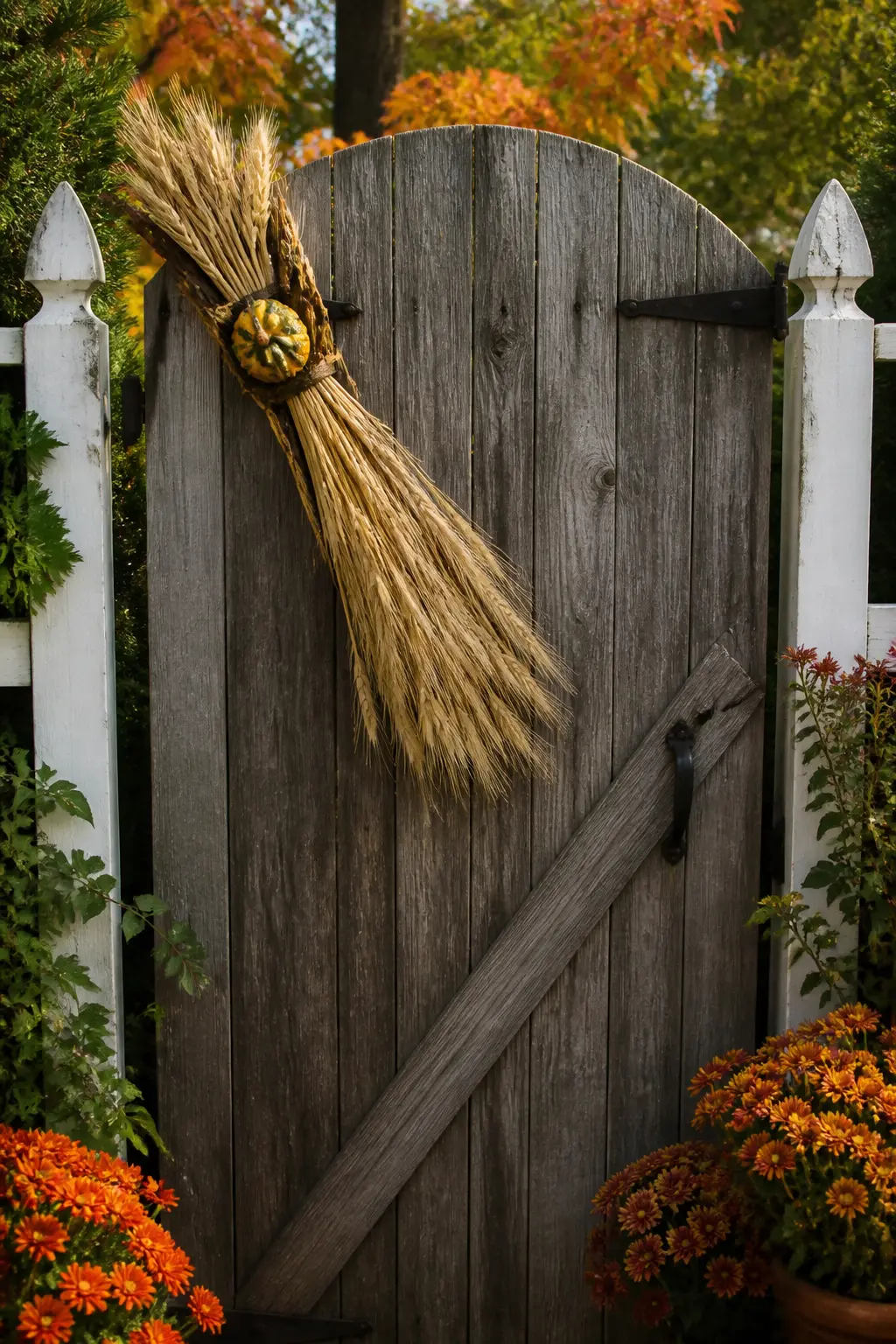
The instinct is to dress both sides of a garden gate symmetrically, and that is exactly why dressing one corner only looks more confident. Tie a dried bundle of wheat, barley, or eucalyptus stems to the upper left corner of the gate with jute twine. Let it hang down the gate face at an angle.
The asymmetry draws the eye to the gate, which is the whole point of a gate. Add one small gourd wired to the bundle at its midpoint to connect the stem decor to the rest of the yard palette.
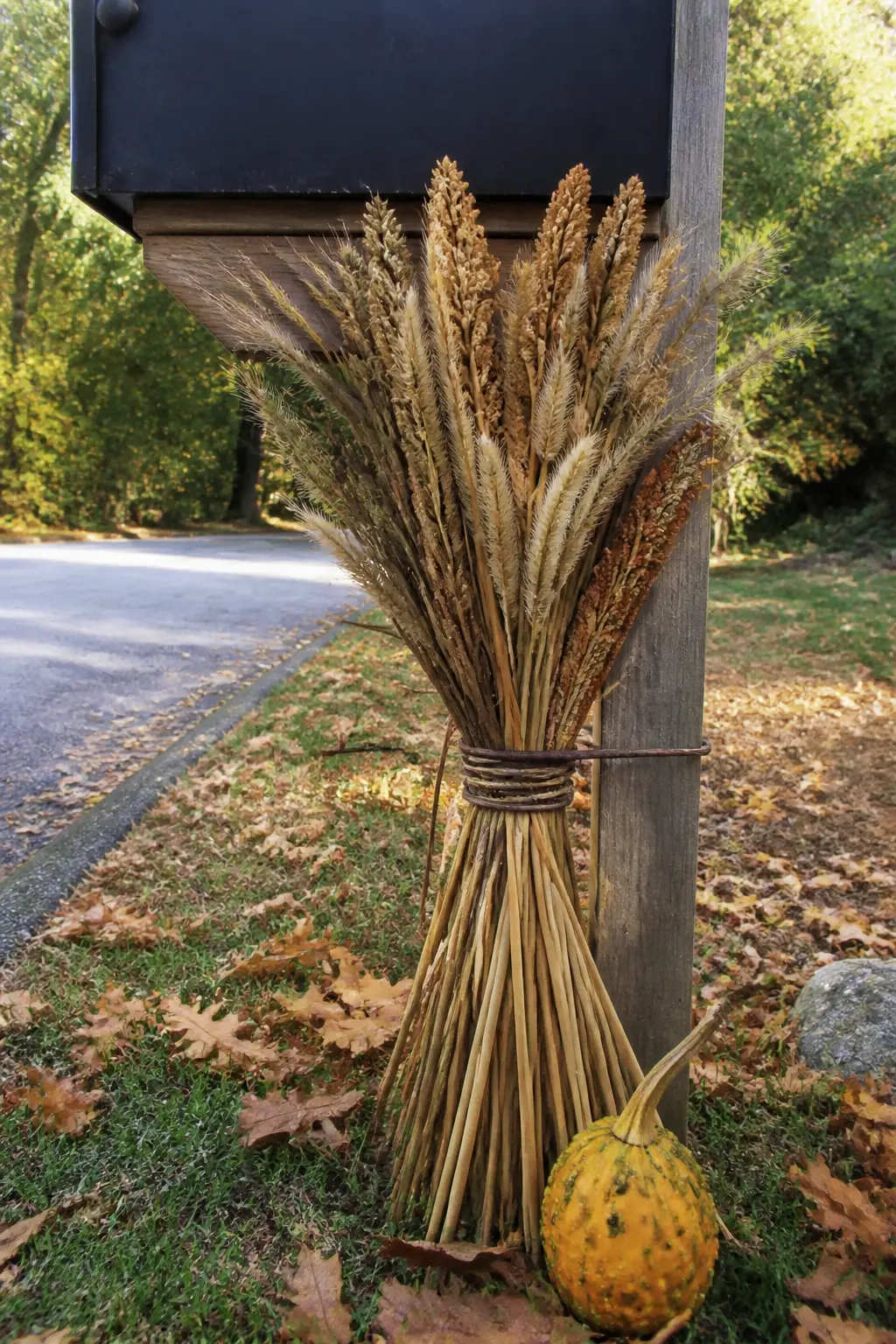
Mailbox Base Wrapped with Dried Stems and a Small Gourd
The mailbox is at street level and at eye level for anyone walking past, which makes it worth dressing even if the house is set back from the road.
Gather a bundle of dried stems, wheat, millet, or sorghum, and wire it around the post just below the box. Tuck a single small gourd into the bundle or set it at the base of the post.
Keep the stems all the same variety for a cleaner look, or mix one feathery grass with one rigid stem for texture. The gourd ties the mailbox moment to the pumpkin palette running down the walk.
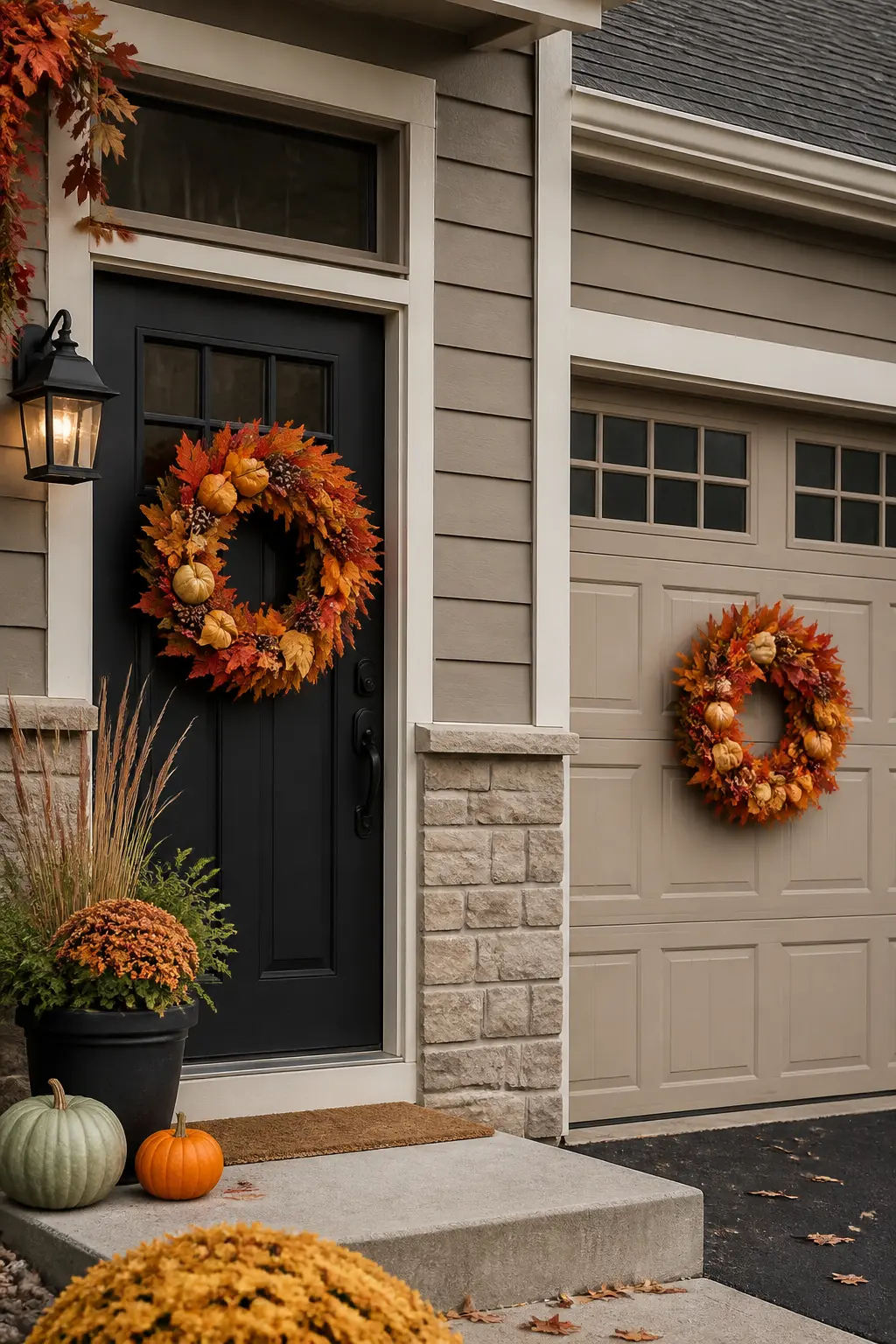
Wreath on the Garage Door as Well as the Front Door
Most people hang a single wreath on the front door and call it done. Hang a second one on the garage door and the whole facade gains symmetry. The garage wreath can be simpler, dried stems and a few magnolia leaves rather than a full arrangement, because it is viewed from further away and does not need close-up detail.
Match the hanger style on both doors. A magnetic wreath hanger on each keeps the paint intact and means both wreaths hang at the same angle.
🛍 Shopping guide
Lawn Focal Points
Open lawn needs anchors or it looks unfinished. A hay bale grouping, a filled wagon, or a scarecrow at the garden bed edge gives the eye somewhere to rest between the walk and the patio. One or two strong moments beat a dozen scattered pieces.
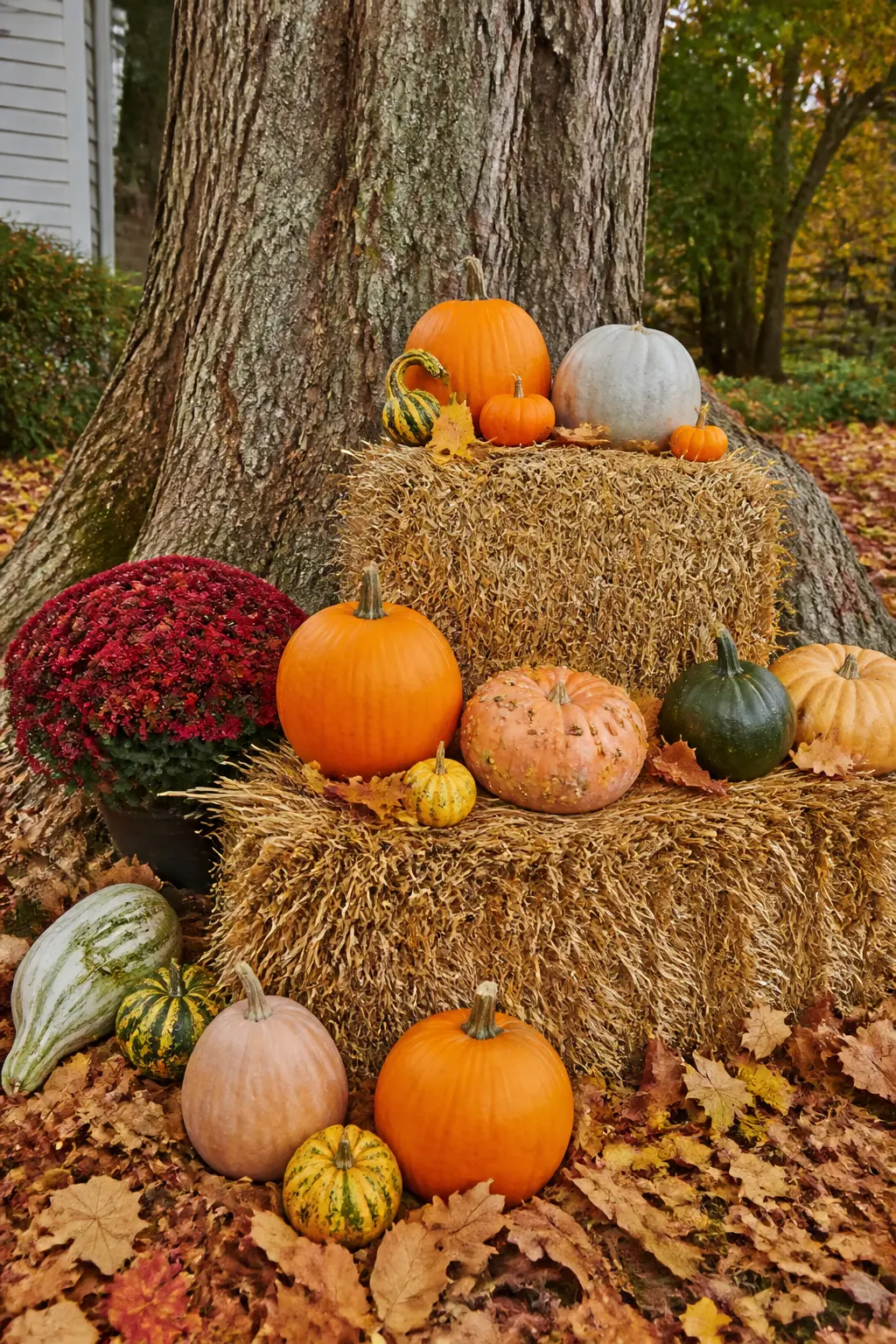
Hay Bale Grouping at the Base of a Tree
A grouping of two or three hay bales at the base of an existing tree turns the tree into a zone rather than just a tree. Stack one bale, leave one flat, and angle the third slightly to break the block shape.
Pile a few pumpkins and gourds on and around the bales to connect the moment to the rest of the yard.
Check the bales are compressed and dry before you buy them. Loose or damp bales shed constantly, mold quickly, and smell within a week in wet weather.
🛍 Shopping guide
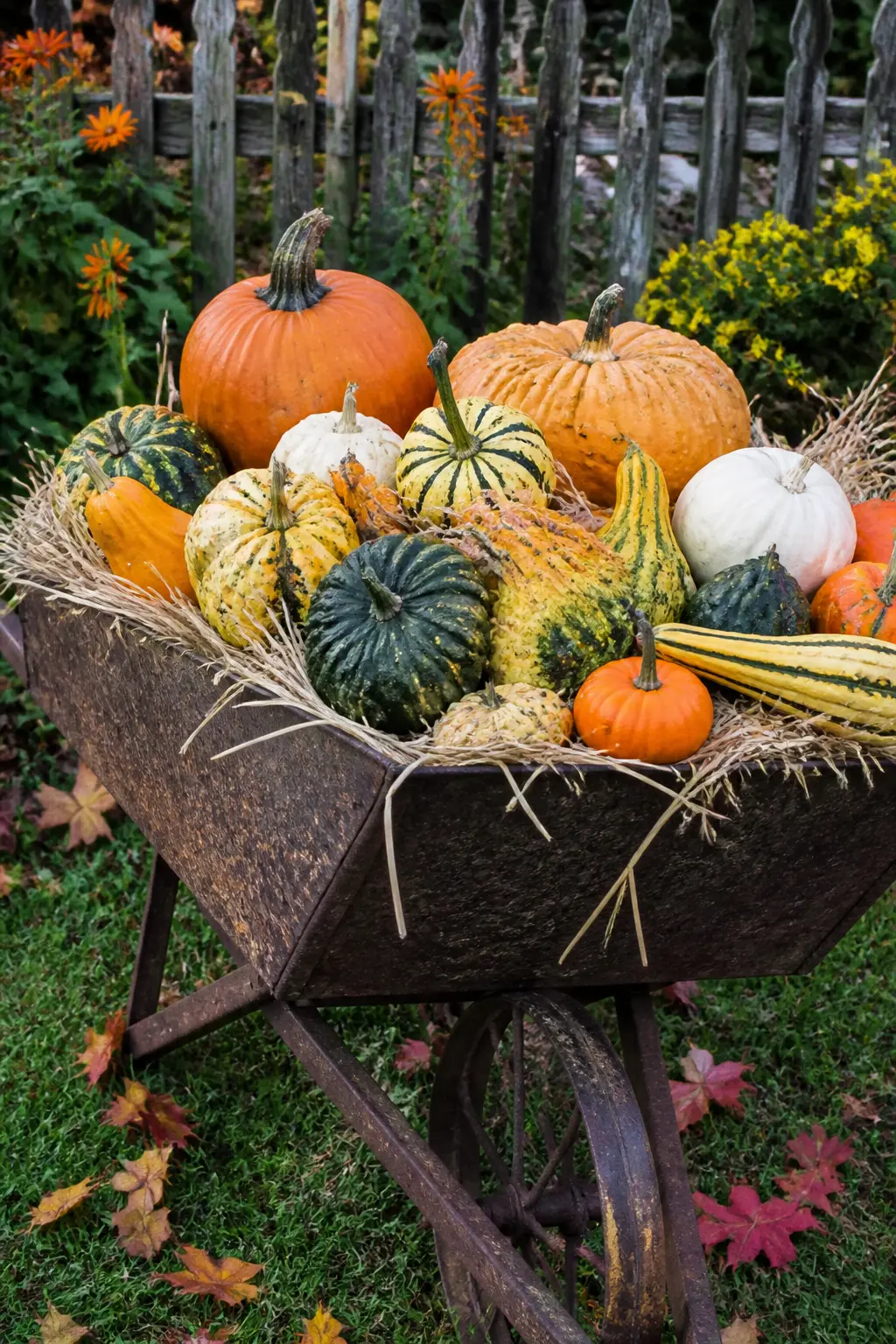
Wagon or Wheelbarrow Filled with Gourds on the Lawn
An old wheelbarrow or a wooden garden cart filled with gourds becomes a lawn focal point without needing any additional structure. Park it at a slight angle to the path rather than parallel to it, because the diagonal makes it look placed rather than abandoned.
Fill the base with straw first, then set the gourds on top. The straw elevates smaller gourds so they read from a distance, and it cushions the heavy pumpkins so the base does not get dented or stained.
🛍 Shopping guide
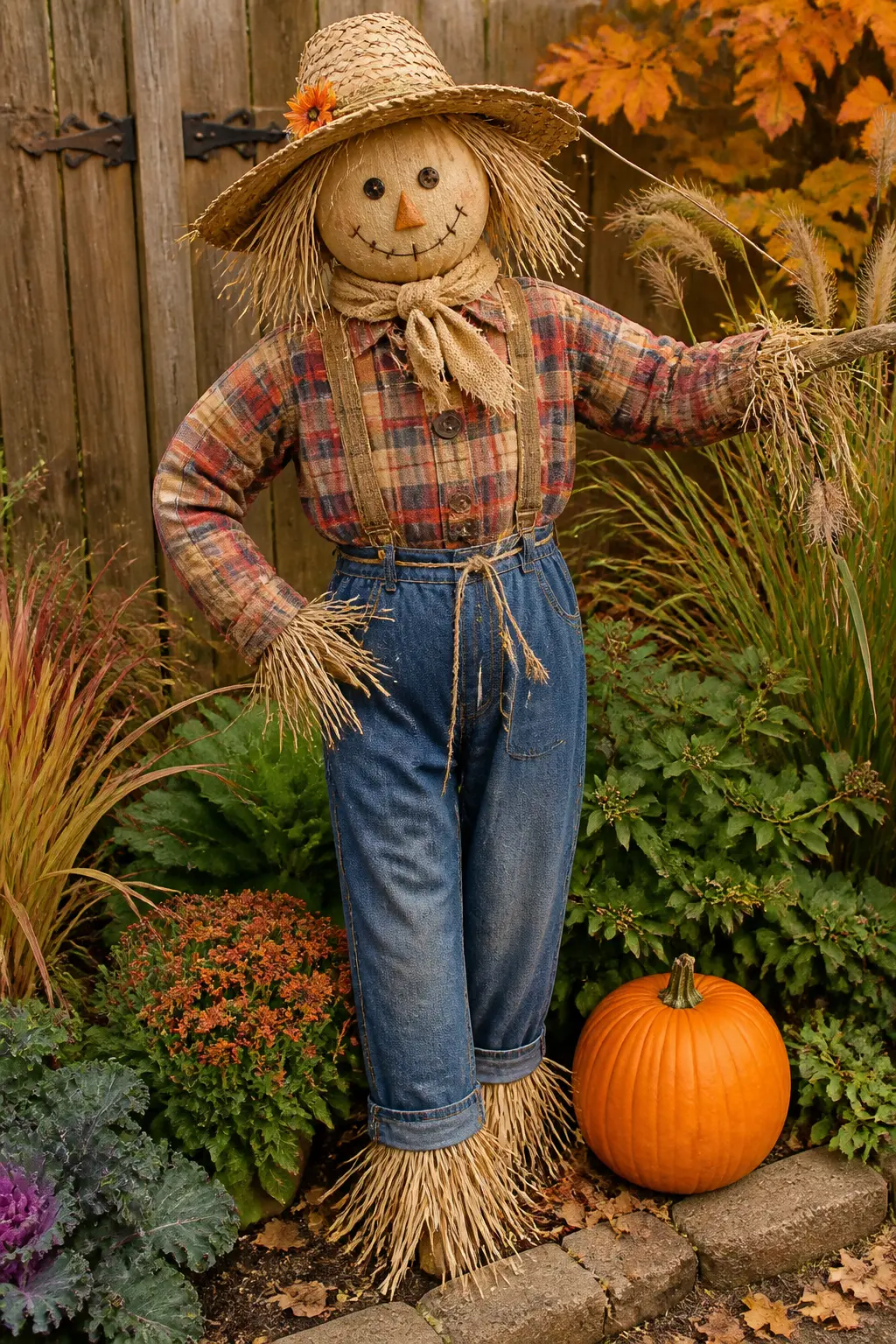
Scarecrow at the Garden Bed Edge
A scarecrow staged at the front corner of a garden bed gives the eye something to land on in the open lawn without requiring any permanent installation. The key is to dress it in actual fabric, a flannel shirt, denim jacket, a wide-brim hat, rather than a costume kit, so it reads as charming rather than cheap.
Stuff the body firmly so it holds its shape. A scarecrow that droops in the first rain looks sad rather than seasonal. Wire the hat to the head so autumn wind does not send it into the neighbor’s yard.
🛍 Shopping guide
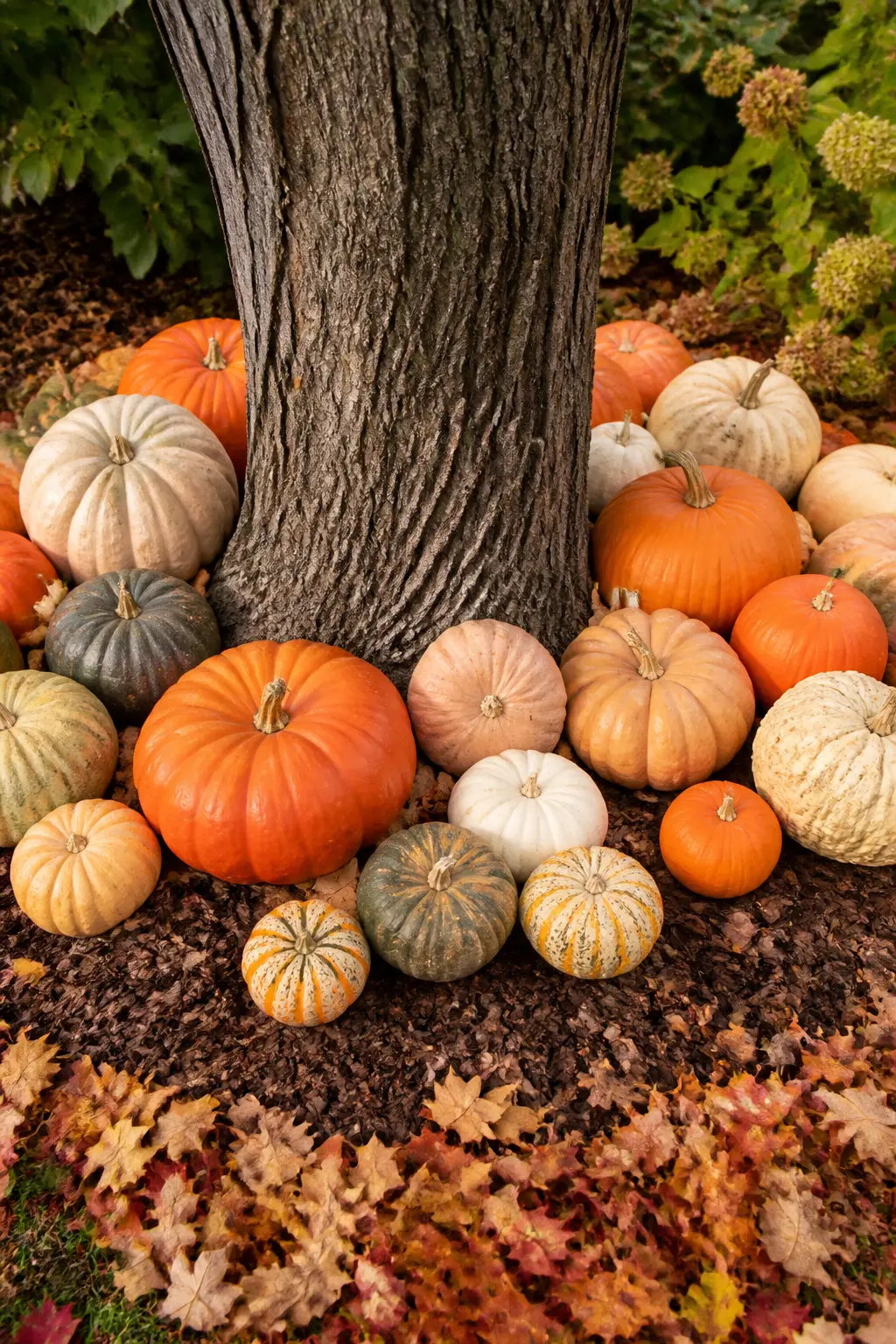
Tree Base Ringed with a Low Pumpkin Grouping
A ring of pumpkins around a tree trunk is one of the simplest high-impact moves in fall outdoor decor. Use a mix of shapes rather than sizes, some squat and flat, some tall and narrow, and vary the skin texture. Keep them close to the trunk so they read as a wreath at ground level rather than a scattered pile.
Nestle them into a thin layer of bark mulch or dried leaves at the base so they sit flush and stable. Anything that wobbles will eventually roll, usually downhill and into the path.
🛍 Shopping guide
Patio and Seating Area
The patio is where people linger, so it earns the most layering. A rug defines the floor, a runner and centerpiece dress the table, and swapped cushions shift the whole color story without a single nail. Add the fire pit radius and you have a room outside.
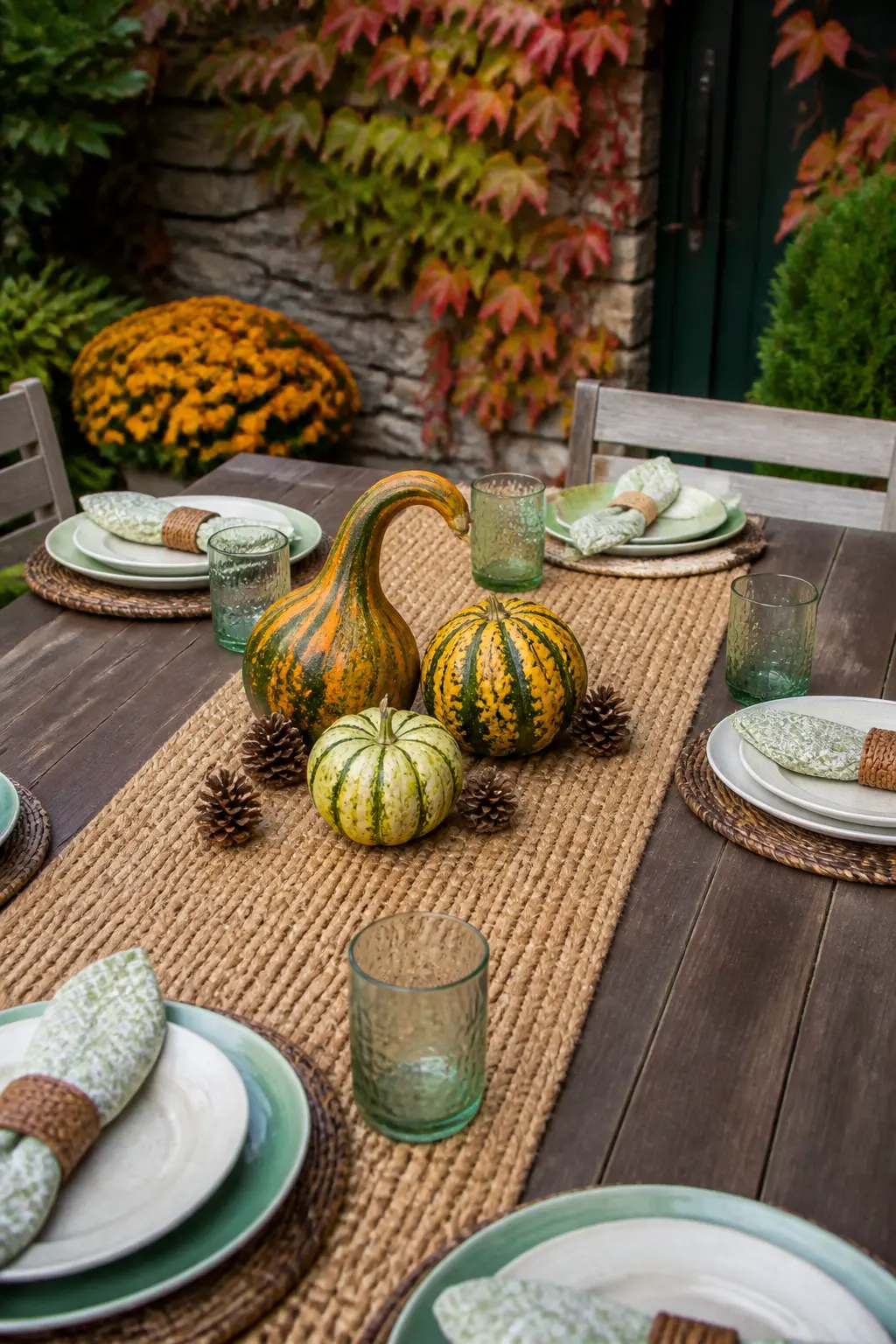
Patio Table with a Woven Jute Runner and Gourd Centerpiece
A jute runner down the center of an outdoor table does more than a tablecloth: it lets the table surface show, adds texture, and survives weather in a way that printed fabric cannot.
Lay a grouping of gourds, three to five in varied sizes, directly on the runner and fill any gaps with a few dried seed pods or small pine cones.
Keep the centerpiece low enough that people can see each other across the table. The whole point of outdoor entertaining is the view, and a towering arrangement defeats it.
🛍 Shopping guide
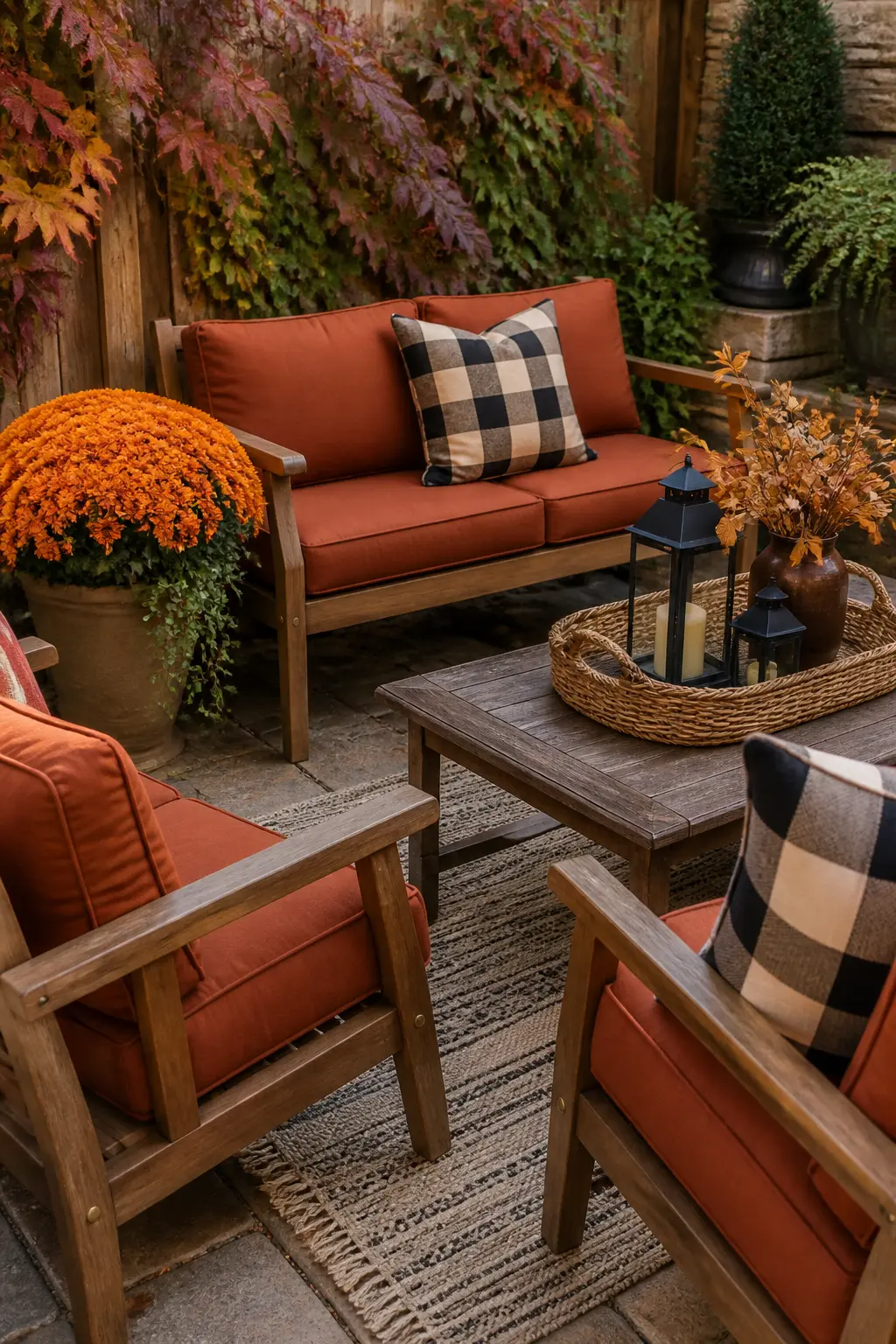
Outdoor Cushions Swapped to Rust and Check Covers
Patio cushion covers are the fastest way to shift a seating area into the season. Rust, terracotta, and deep check patterns in cotton or canvas all work outdoors and wash easily when the season ends. Pull out the existing inserts, slip them into new covers, done in under ten minutes.
Mix a solid rust with a buffalo check in a related tone, burnt orange with a brown-and-cream grid, and the seating area reads as layered rather than matchy. Keep the cushions in a covered bin when rain is forecast so the fabric stays sharp all season.
🛍 Shopping guide
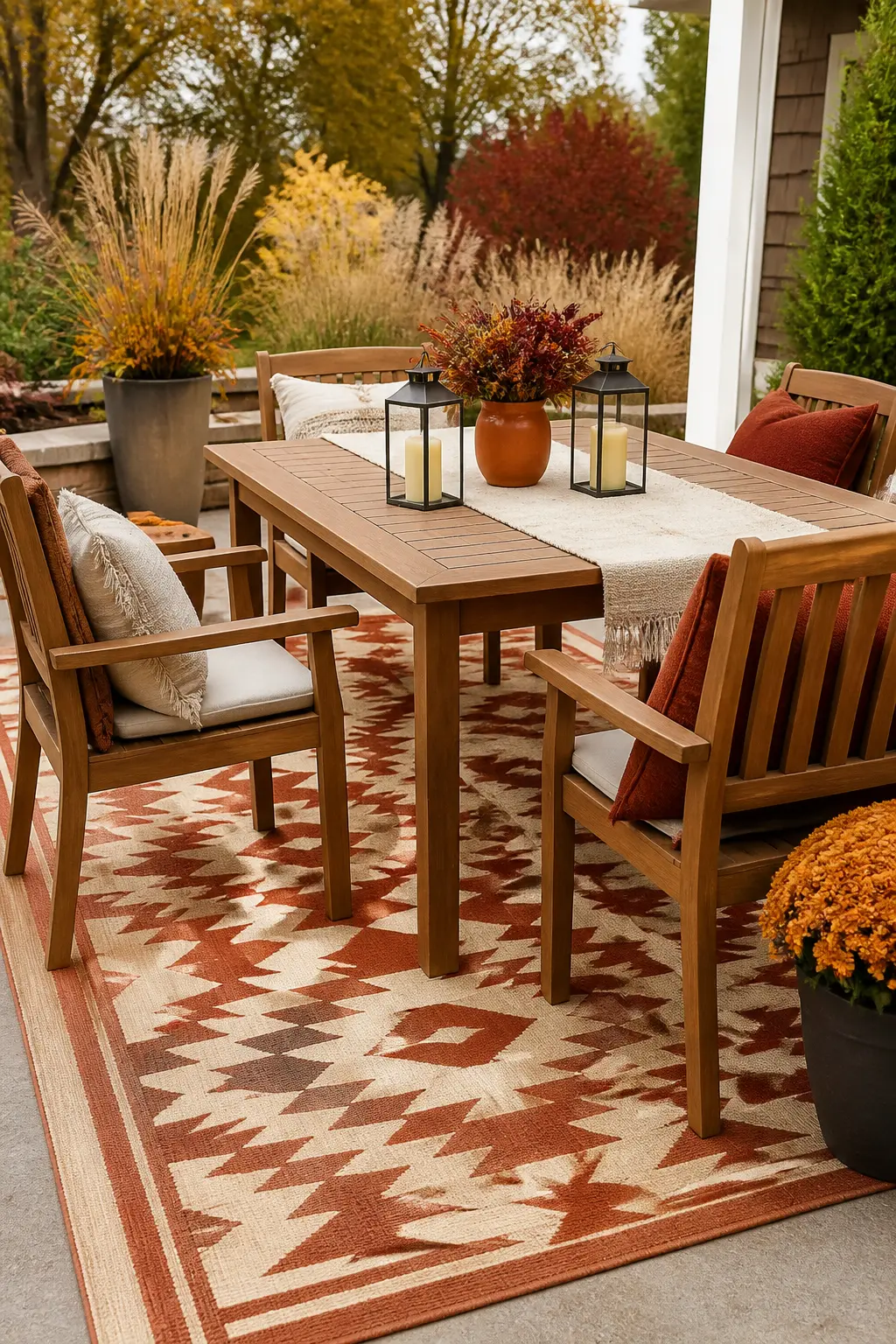
Outdoor Rug Defining the Patio Seating
An outdoor rug under the patio table and chairs turns a slab of concrete or a patch of pavers into a room. Size matters: the rug should extend at least twelve inches beyond the pulled-out chairs on all sides, otherwise it reads as too small and the space feels smaller, not larger.
Choose a flat-weave rug in a geometric pattern, something that reads from a standing height, in tones that echo the cushions. A pattern with deep red, brown, and cream disappears into the setting; a solid navy or rust stands out and gives the zone a clear center.
Fire Pit Area with Folded Blankets in a Basket
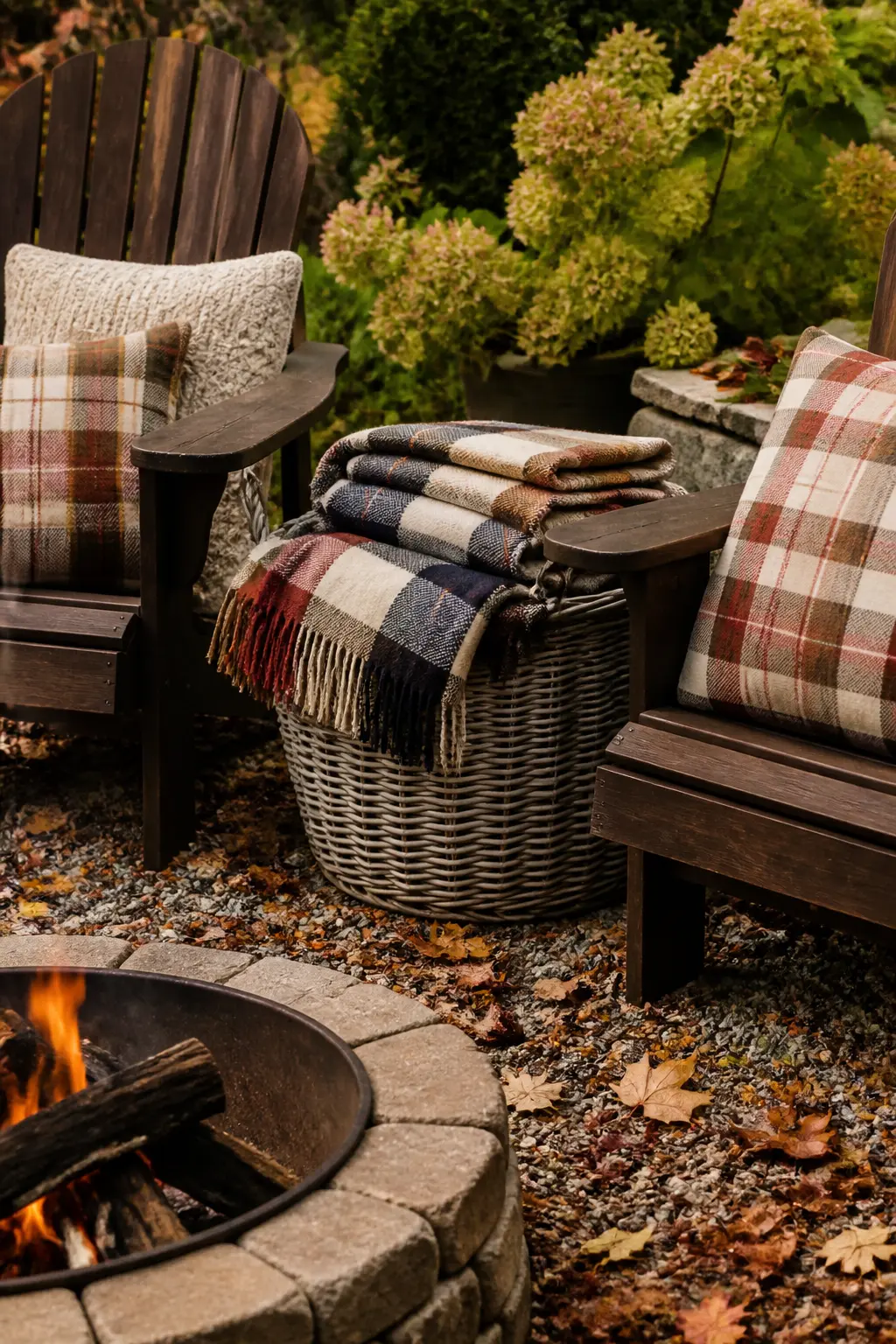
A large basket or galvanized tub filled with folded wool throws or fleece blankets tells guests they can stay as long as they want. Set it between two of the chairs so it is reachable from every seat.
Choose blankets in plaids and solid wools that coordinate with the cushion palette. Fold them neatly so the patterns face out when they are stacked in the basket, because that is the visual from across the patio.
🛍 Shopping guide
Wooden Crate Stacked with Pumpkins by the Garage
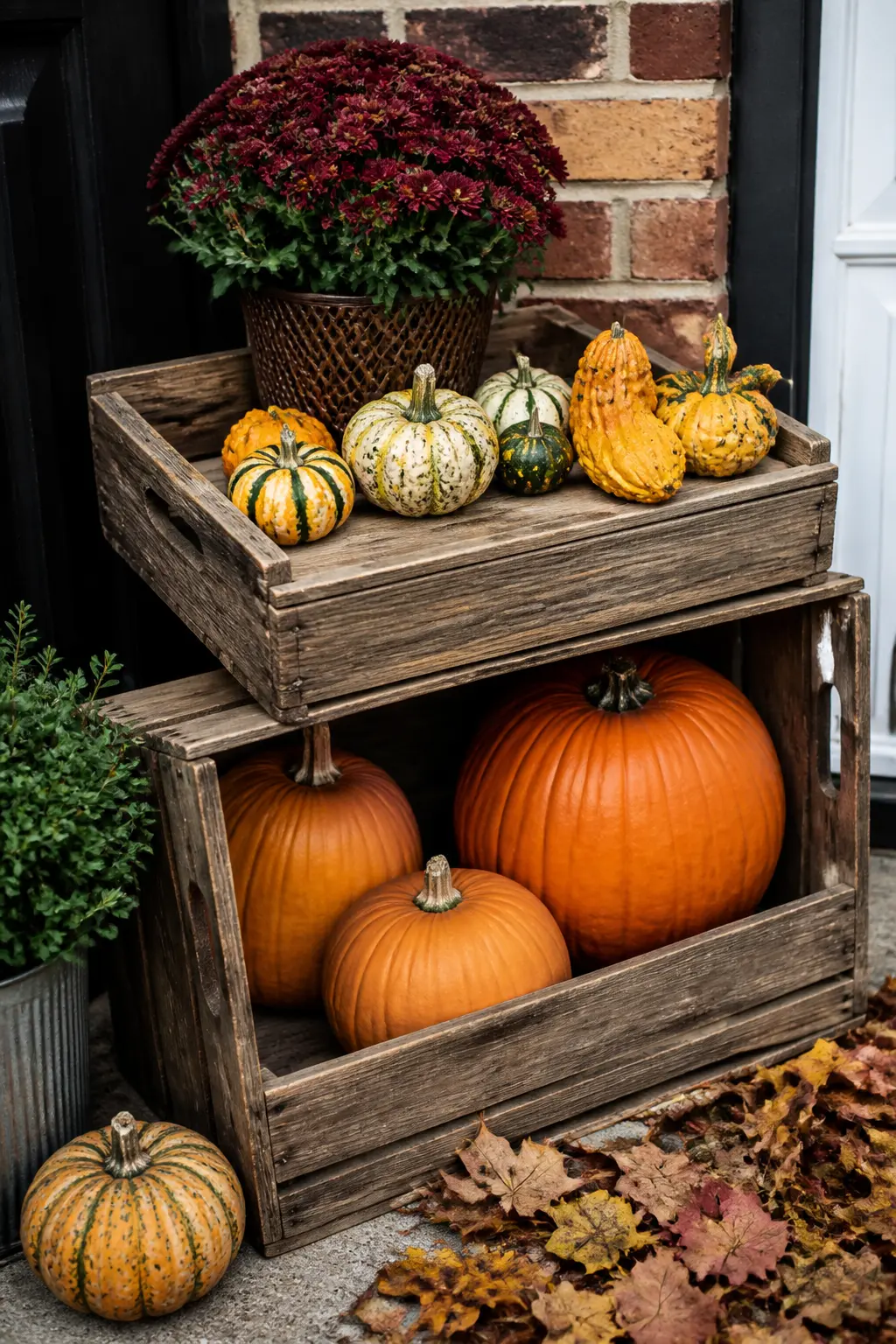
The garage corner is often a dead zone that collects hoses and rakes. A wooden crate or two, stacked at different heights and loaded with pumpkins, turns that corner into a deliberate display. Use a flat crate as the base and a smaller open crate on top, angled slightly, to create a tiered effect.
Fill the lower crate with larger pumpkins and the upper one with a mix of small gourds and a potted mum. The mum adds color and softness that the hard surfaces of pumpkin and wood do not provide on their own.
🛍 Shopping guide
Stacked Crates at the Garage Corner Holding Potted Mums
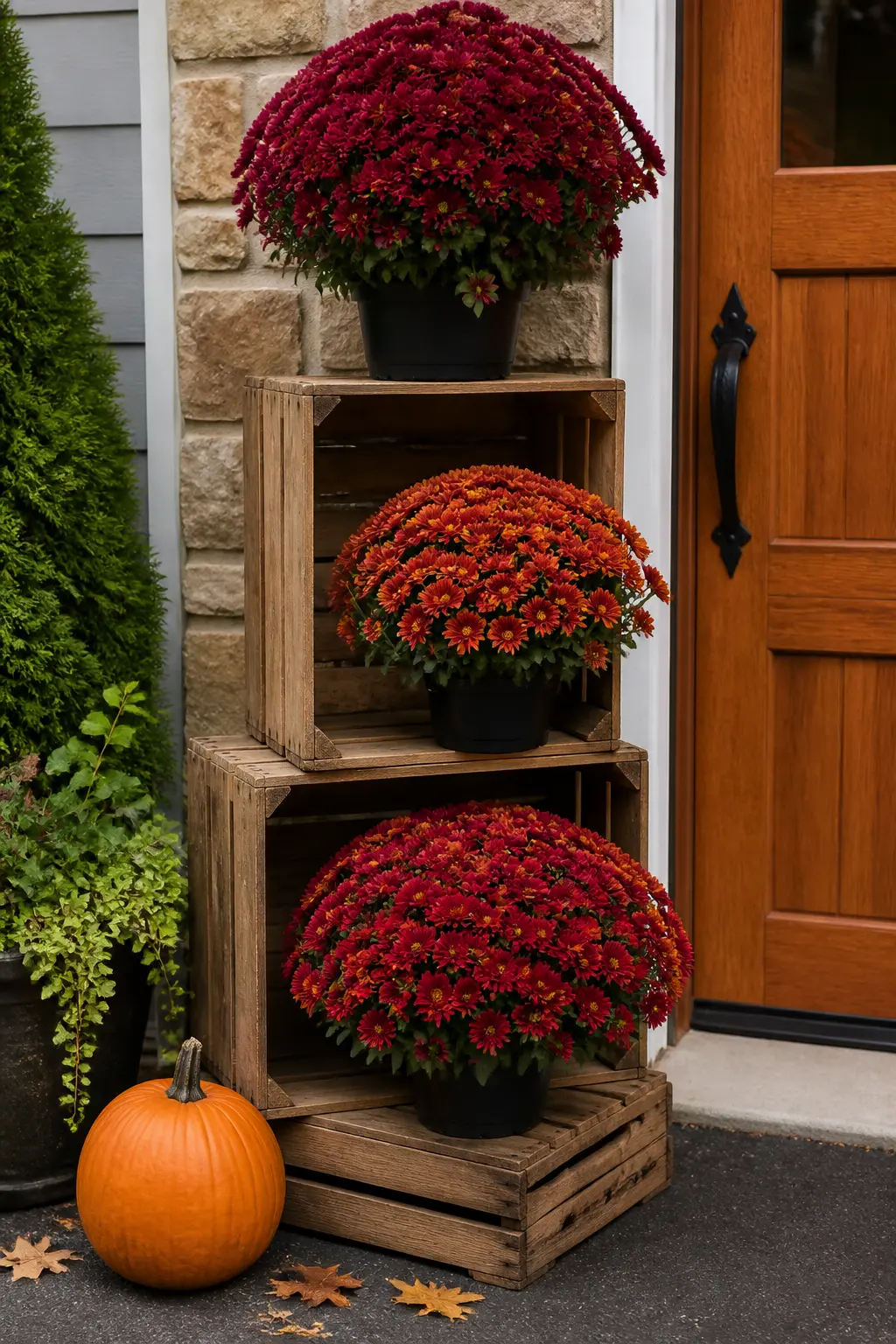
A second crate arrangement, this time featuring mums rather than pumpkins as the primary element, works at the opposite garage corner to frame the whole facade. Stack three crates in a staggered column and place a potted mum in each one at a different height, so the color rises like a column from the ground up.
Mix two mum colors in the column, one deep wine and one copper, repeating the pattern so the arrangement does not look random. A single small pumpkin at the base of the stack ties the mum column back to the pumpkin story running through the rest of the yard.
Trees and Garden Beds
Trees and beds are already doing structural work in the yard. A ring of pumpkins at a trunk base, a bundle beside the bird feeder, or grasses in large pots along the drive all borrow the bones that are already there. The decor lands better because it has a reason to be in that spot.
Bench Under a Tree with a Wool Throw
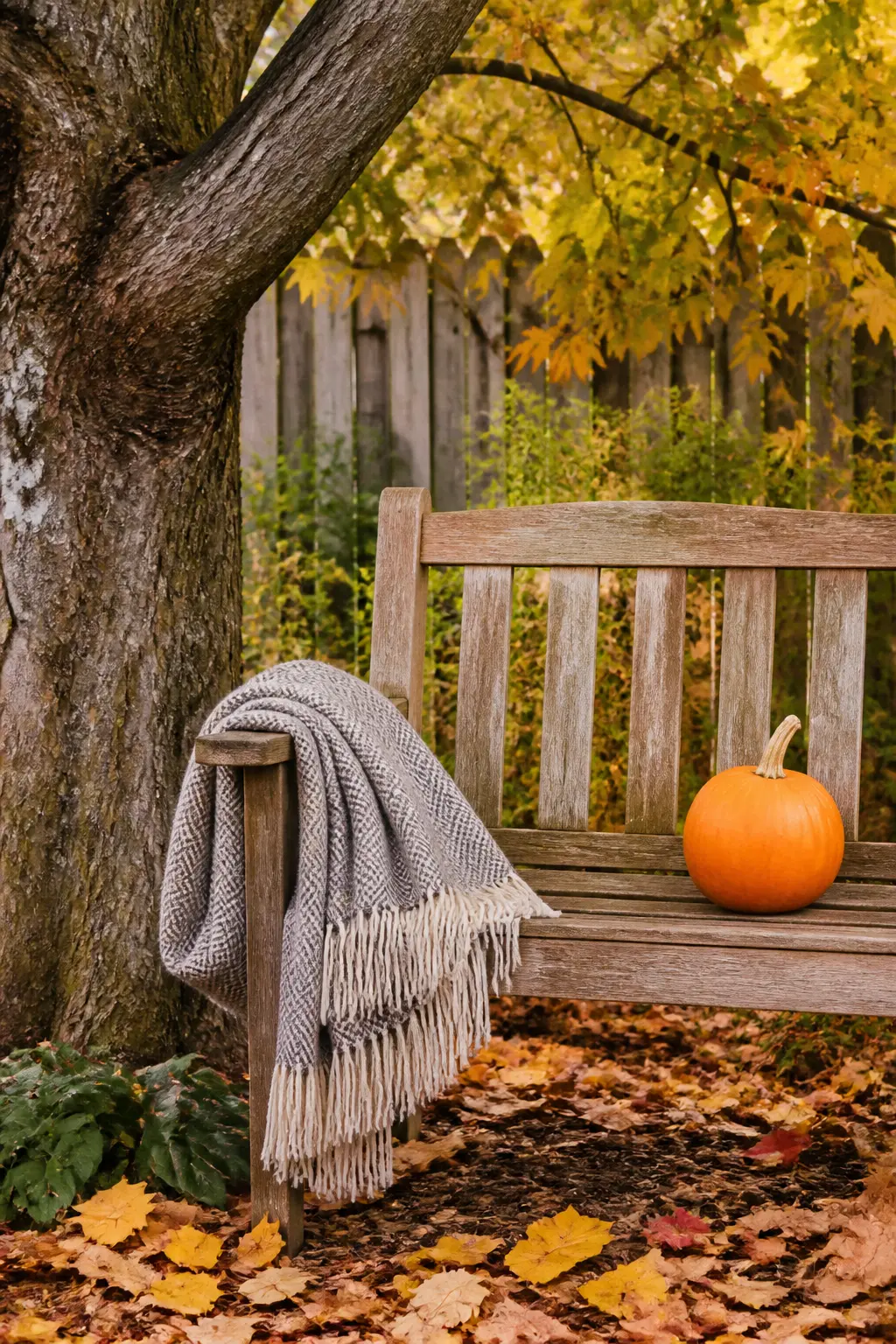
A bench that already lives under a tree needs almost nothing to become a seasonal moment. Drape a folded wool throw over one arm, set a small pumpkin on the opposite end of the seat, and the bench shifts from garden furniture to an invitation. People will actually sit there.
Choose a throw in a herringbone or houndstooth pattern in ochre, brown, or forest green rather than solid plaid, because the weave pattern reads at a distance and photographs well without looking staged.
🛍 Shopping guide
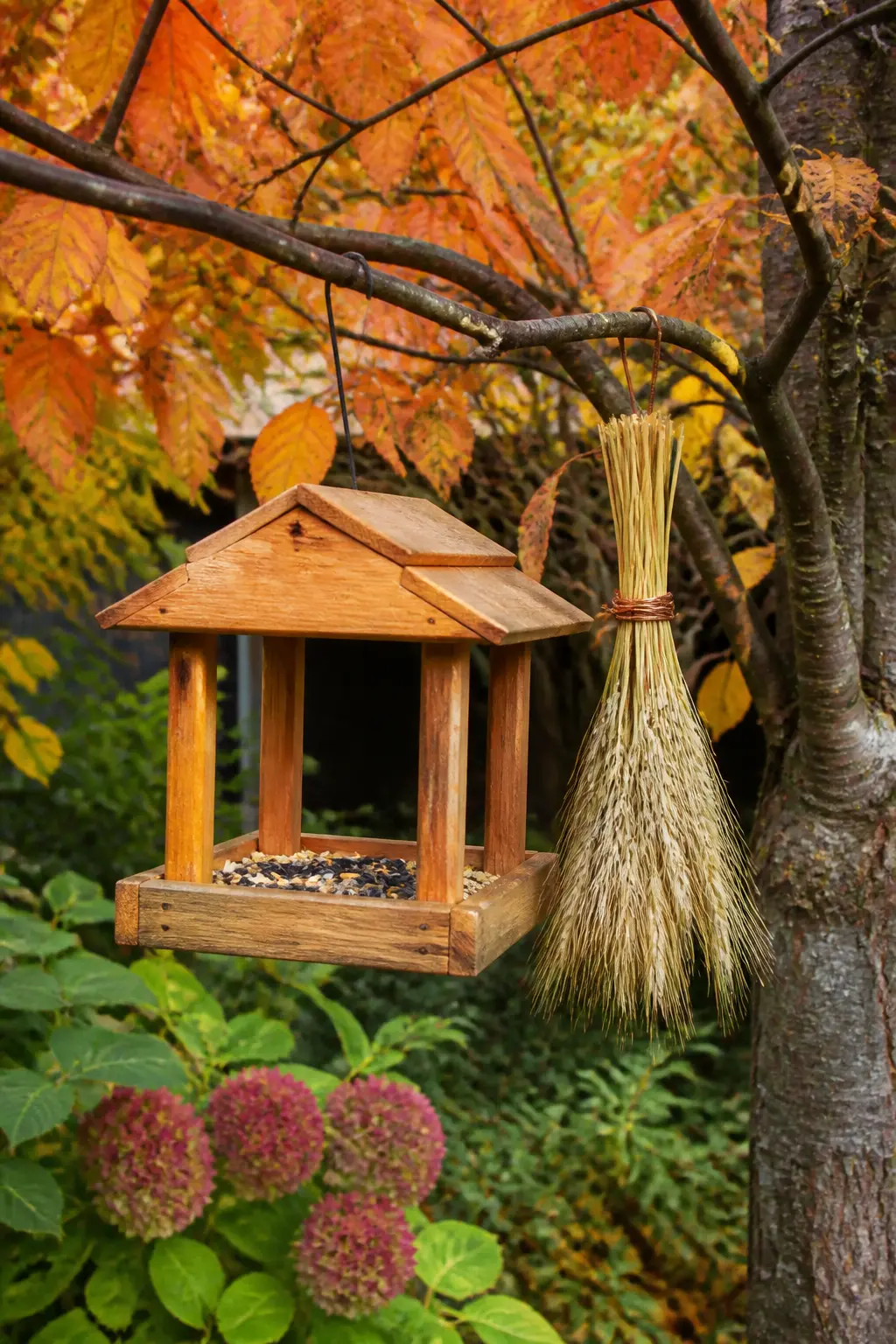
Bird Feeder with a Small Barley Bundle Beside It
A bird feeder already hangs in most yards and most people walk past it without thinking of it as a decor element.
Tie a small bundle of dried barley or millet directly to the feeder hook or the branch just beside it, and the feeder becomes part of the fall palette. The birds will pick at the barley anyway, which only adds to the effect.
Keep the bundle small enough that it does not block the feeder ports. Wrap the stems with copper wire rather than twine for a detail that will not go soft when it rains.
🛍 Shopping guide
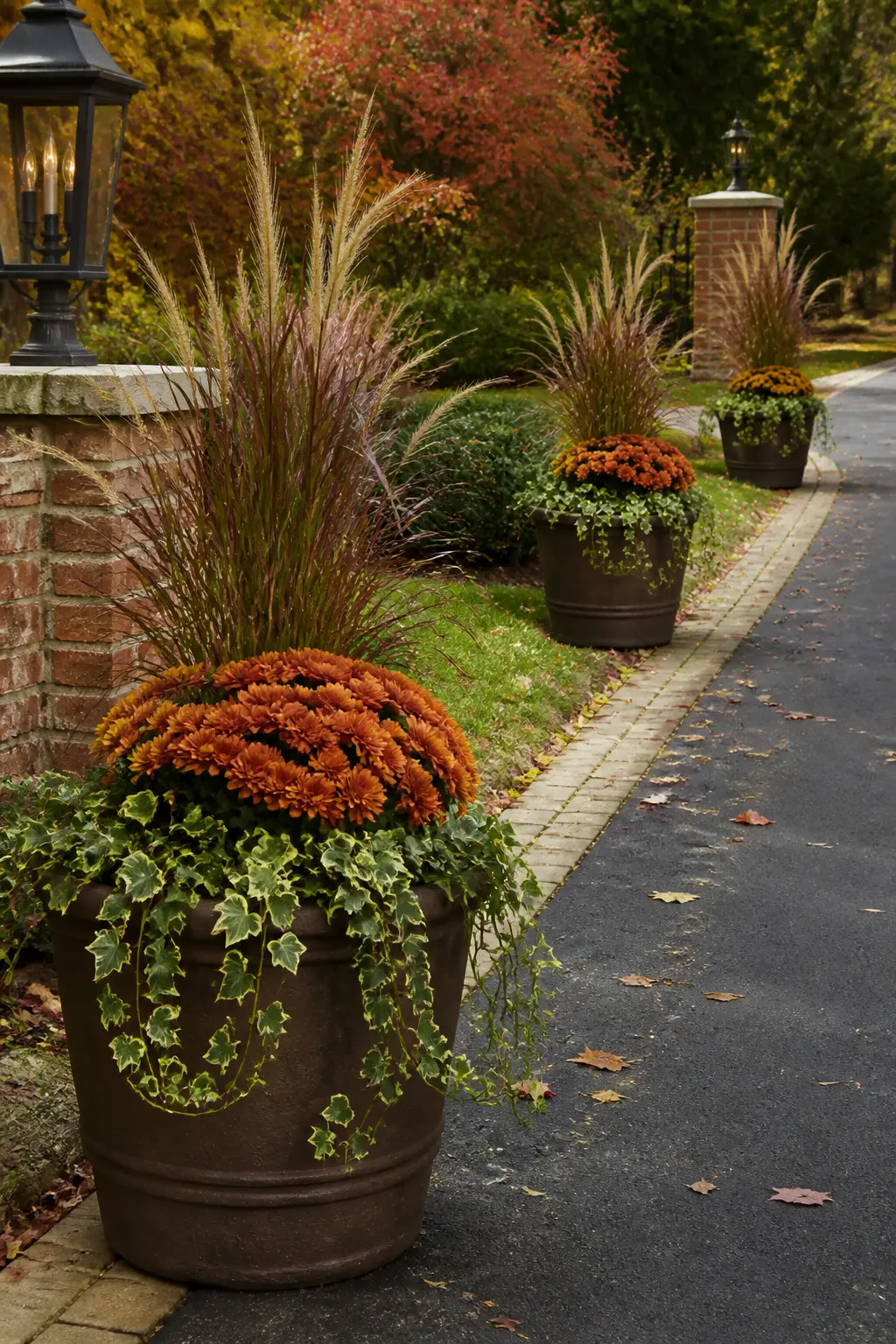
Layered Planters Repeated at Three Points Along the Drive
Repetition is the design principle that turns individual props into a cohesive yard. Plant three identical or near-identical layered planter arrangements and place them at the driveway entrance, the halfway point along the walk, and the front step. The eye picks up the pattern and the whole exterior reads as designed rather than decorated.
Each planter gets the same structure: a tall grass or upright conifer at the center, a trailing element at the edge, and a mid-height filler, mums, kale, or sedge. The slight variation in plant size from pot to pot is unavoidable and actually helps the repetition feel natural.
🛍 Shopping guide
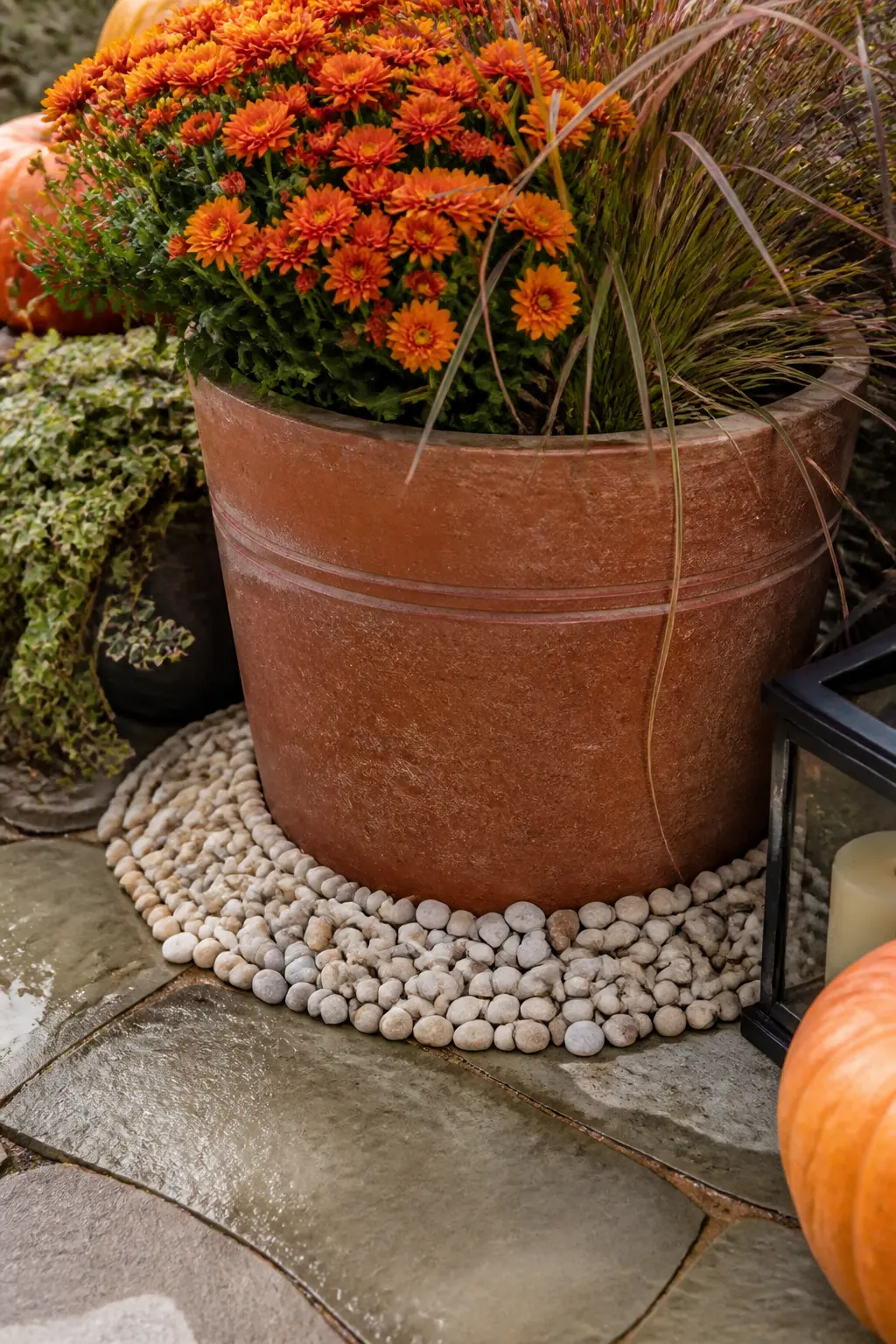
Gravel Base Under Planters So They Drain
This is not a prop, it is the reason your props survive. Placing a thin layer of pea gravel under each pot on a patio or drive lifts the drainage hole off the ground, keeps soil from compacting into the concrete, and prevents the ring stains that make fall planters look tired by the end of October.
A two-inch gravel layer also levels slightly uneven ground so pots do not rock. Spread the gravel in a shallow circle a few inches wider than the pot base, and the gravel itself becomes a clean visual border around the planter.
🛍 Shopping guide
Lighting
Battery-powered lanterns and solar string lights handle the whole yard without a cord in sight. Spacing matters more than quantity: push lanterns further apart than feels comfortable and the path reads as intentional rather than crowded. String lights from the house to a tree need one anchor point at each end and nothing else.
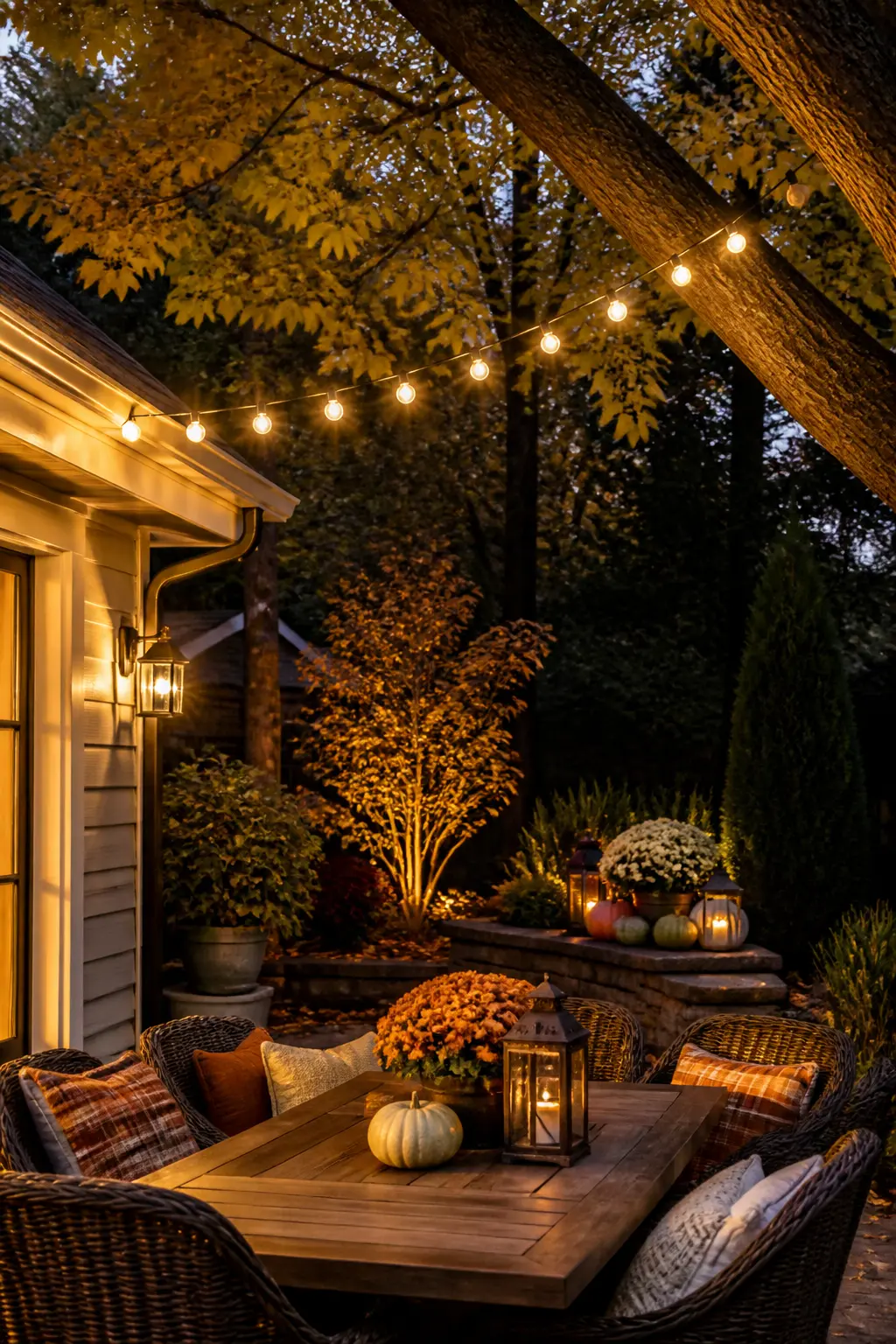
String Lights Running from the House to a Tree
Solar string lights strung from a hook on the eave to a branch in the nearest tree define the outdoor entertaining space at night without any wiring across the lawn. Hang them in a single gentle catenary arc rather than draping them in festoons, because the single arc looks architectural and the festoons look like a holiday sale.
Choose warm white bulbs in a larger globe size, G40 or G50, so the light source is visible and warm from a distance. The solar panel tucks behind a planter and charges all day for a full evening of light.
🛍 Shopping guide
Path Lit with Staked Lanterns Spaced Wider Than Feels Natural
The single most common lighting mistake in fall yard decor is spacing path lanterns too close together. Eight to ten feet between lanterns looks intentional and creates a rhythm of light and shadow that is far more atmospheric than a continuous lit corridor. Trust the darkness between the pools of light.
Use battery-operated candles with a timer set to come on at dusk and switch off at midnight. Set the timer once and forget it for the whole season. Metal lanterns in a flat black or oil-rubbed bronze finish hold up in rain and look better at the end of the season than they did at the start.
Finishing Details and Tone
Color, drainage, and weight are the three things that determine whether fall decor survives the season. Deep wine and brass hold their tone through six weeks of weather. A gravel base under every planter keeps roots healthy. Weighted urns stay upright when the wind picks up in late October.
For the indoor continuation of this palette, the fall chalkboard sign ideas on this site carry the same warm, non-Halloween tone from the porch into the entryway.
Deep Wine and Brass Tones Rather Than Bright Orange
Bright orange reads as fall for about two weeks before it starts reading as Halloween, and then it is over. Deep wine, burgundy, brass, and aged copper hold through the whole season and into early winter without a single prop change.
Apply the palette shift first to fabric, cushions, throws, and the rug, then to plants, wine-tone mums, ornamental kale, deep red sedge.
Brass shows up in the lantern finish, the pot hardware, the copper wire on stem bundles, and the glint of a metallic gourd tucked into a planter. It never dominates, but it connects every zone of the yard into one palette.

🛍 Shopping guide
Weighted Urns That Survive Autumn Wind
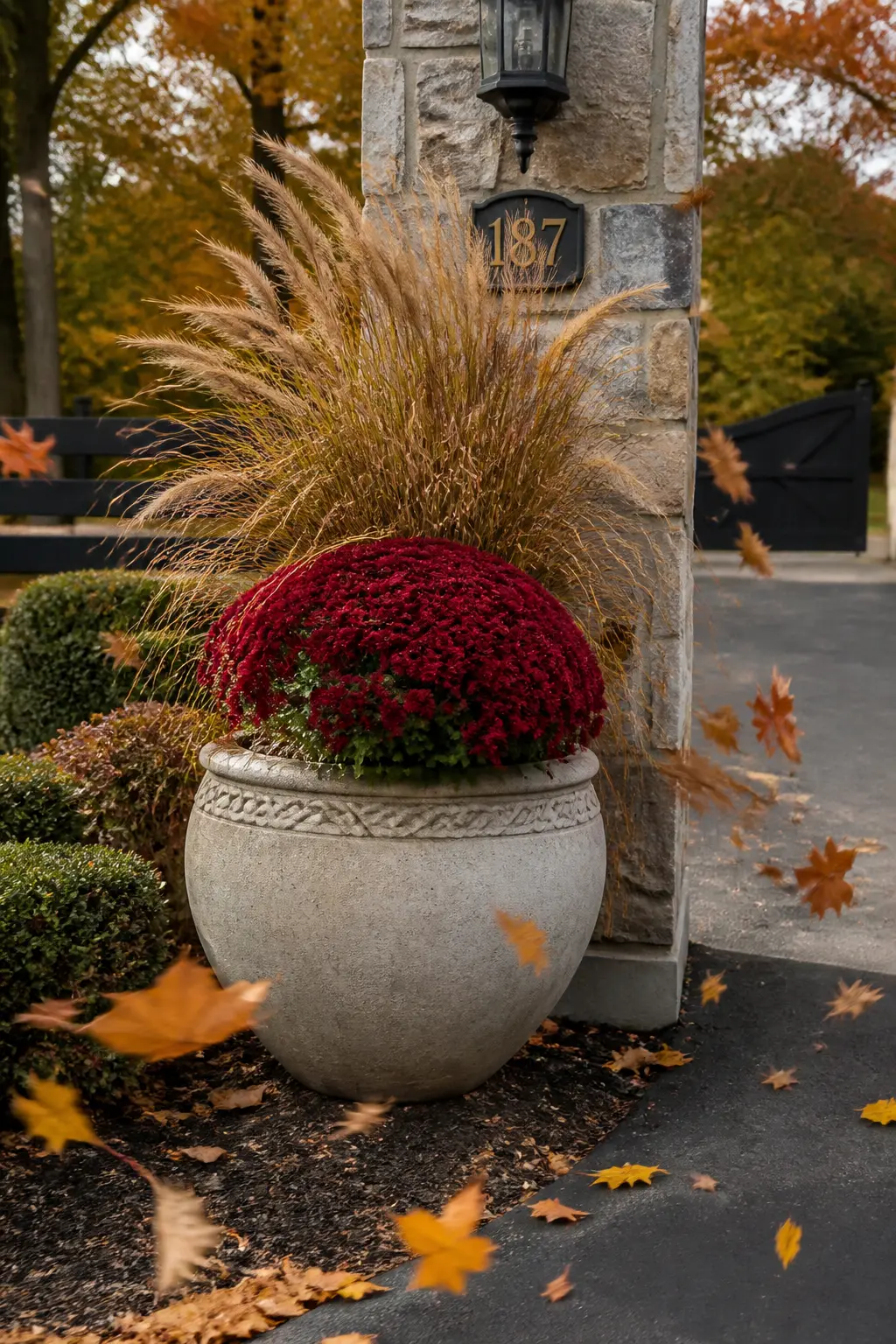
Any urn or tall planter that sits at the driveway entrance or along an exposed fence line will meet serious wind at some point in the season. A lightweight resin urn tips; a heavy concrete or cast-iron urn stays put.
If you already own resin urns, fill the base cavity with dry sand before planting and they will be stable in all but the worst weather.
Alternatively, set the urn inside a larger galvanized tub and pack the gap with gravel. The tub anchors the urn and the gravel layer adds drainage. The industrial material contrast between galvanized steel and a classical urn shape actually looks intentional.
🛍 Shopping guide
Fence Post Caps Topped with Small Gourds
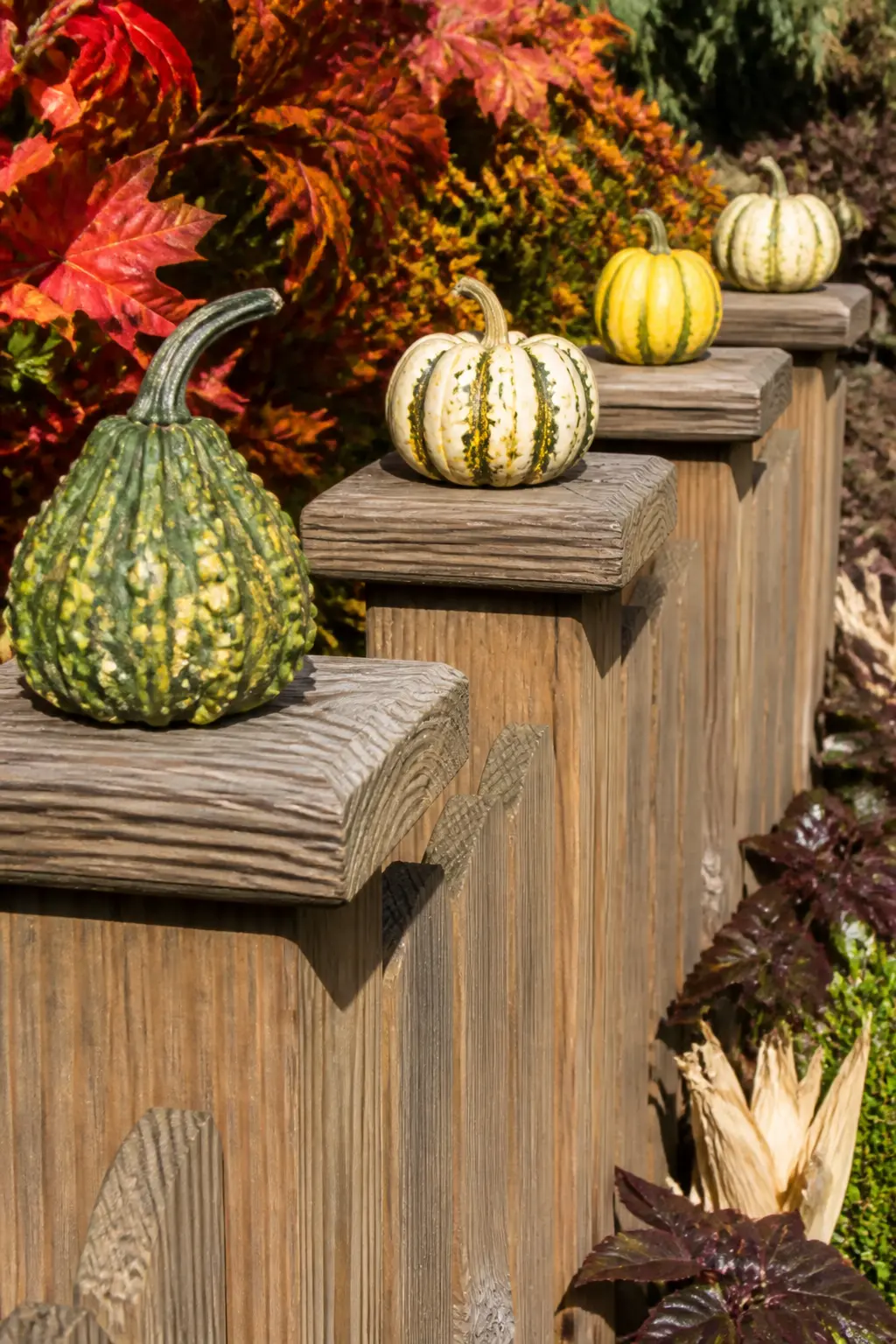
A close cousin to the pumpkin-on-post-cap idea, but executed with small ornamental gourds rather than pumpkins, this version works better on shorter posts and along interior fence lines where the scale of a pumpkin would be too much.
Tiny bottle gourds, warty gourds, or pear-shaped ornamentals in green and white sit flat on post caps without wobbling and last the full season without rotting.
Set them in a thin ring of florist foam or a small disc of craft foam to grip the surface. Replace any that soften with the spares you bought from the same batch.
🛍 Shopping guide
Garden Gate Dressed with a Dried Bundle Tied at One Corner
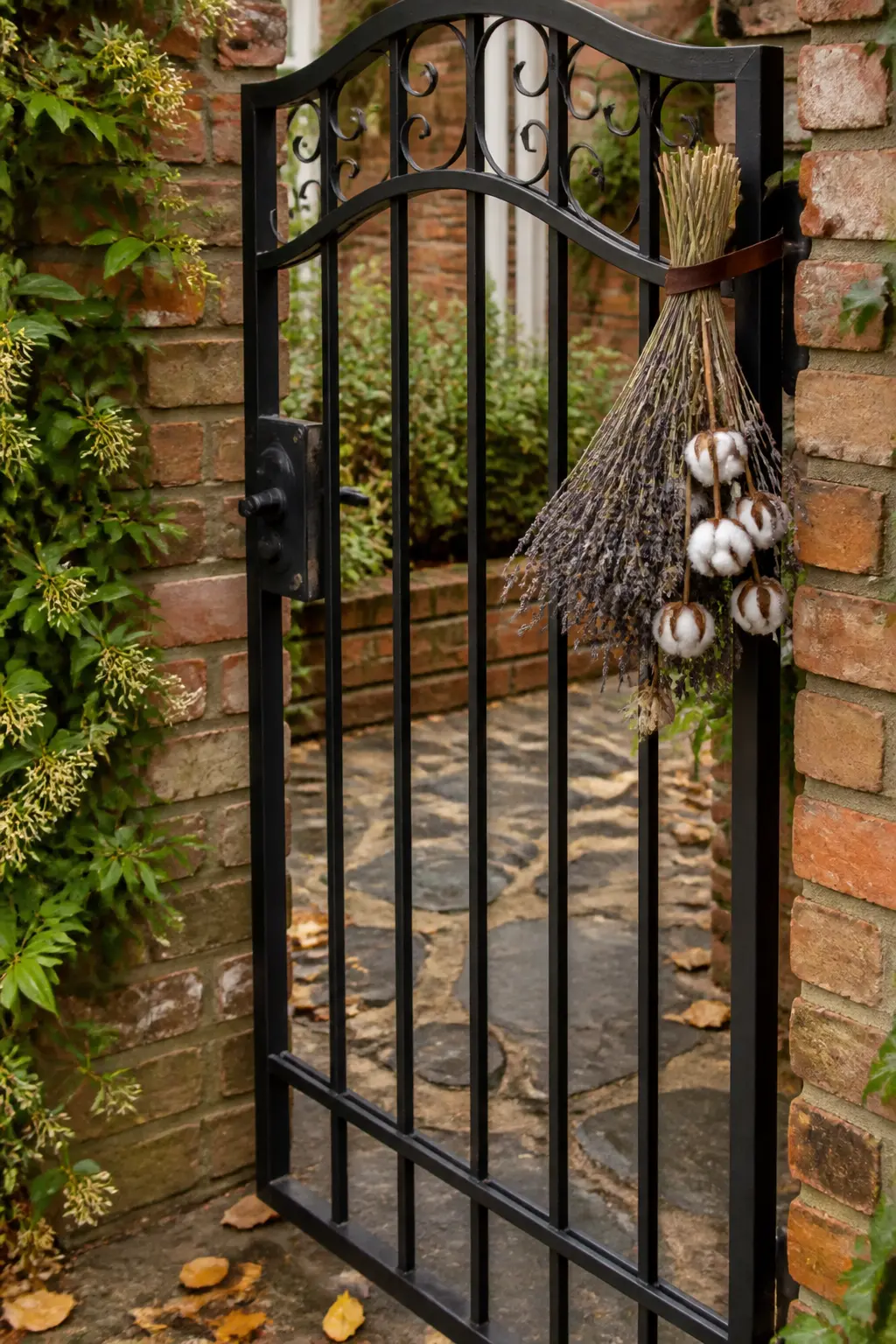
This entry applies the one-corner-only principle from the fence section to a different gate style, a metal or painted wooden gate that opens into a side yard or garden path rather than the property perimeter. The dried bundle at one corner marks the gate as a threshold without blocking it.
Choose stems that dry beautifully rather than crumbling, lavender, chamomile, lunaria, or cotton stems. Tie them with a leather cord rather than twine for a finish that does not go limp in damp weather.
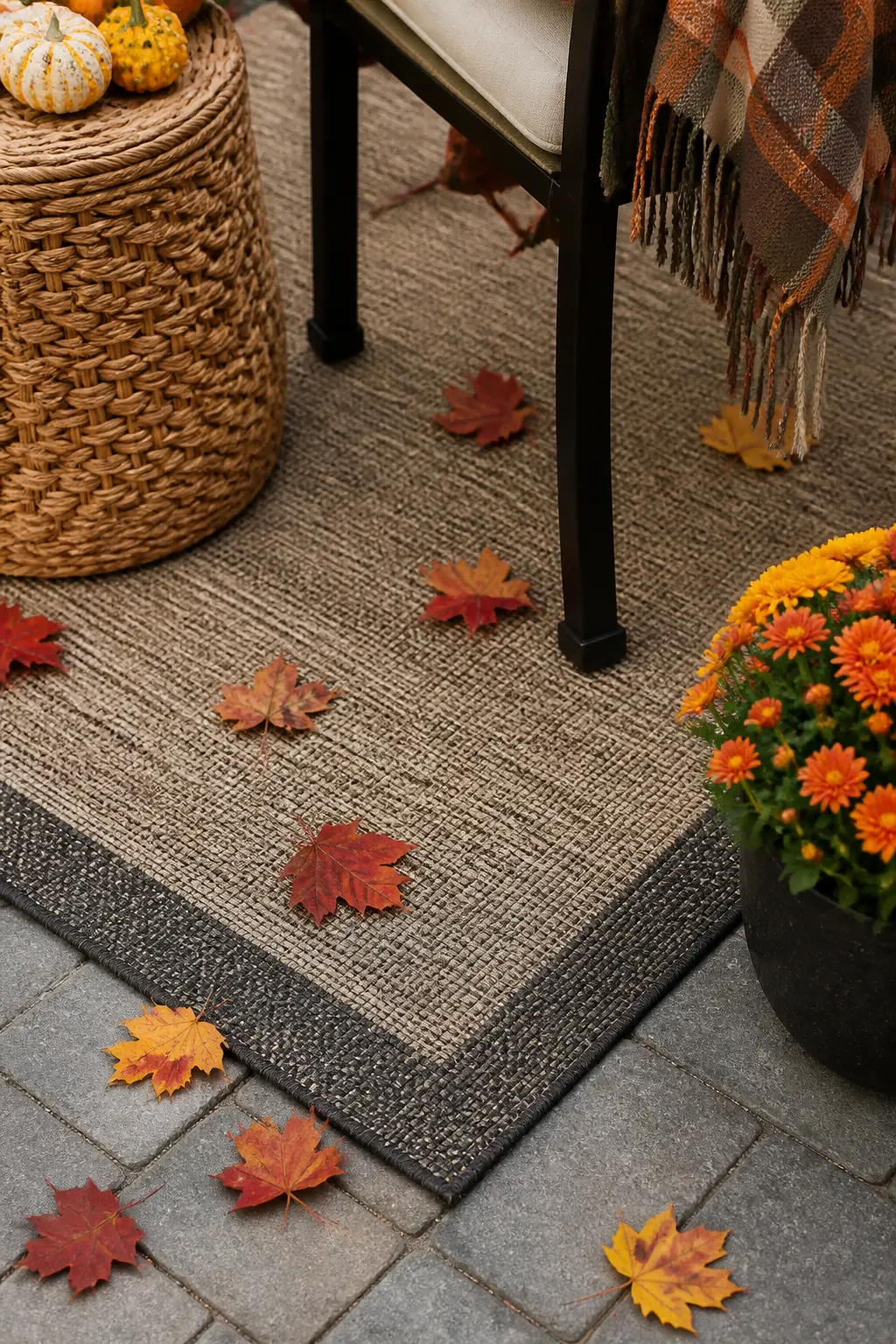
Outdoor Rug Defining the Patio Seating
Where the first outdoor rug entry covers size and color strategy, this entry is about placement and what to look for in a rug that will last the season.
The rug should sit flat within twenty-four hours of unrolling: if it stays curled at the corners after a day it is too light for outdoor use and will become a tripping hazard in wind.
Press-and-stick rug tape on the underside at the corners holds the rug to a paver or concrete surface and adds up to six months of outdoor life to even a moderately weighted rug. Peel it off at the season’s end before storing.
🛍 Shopping guide
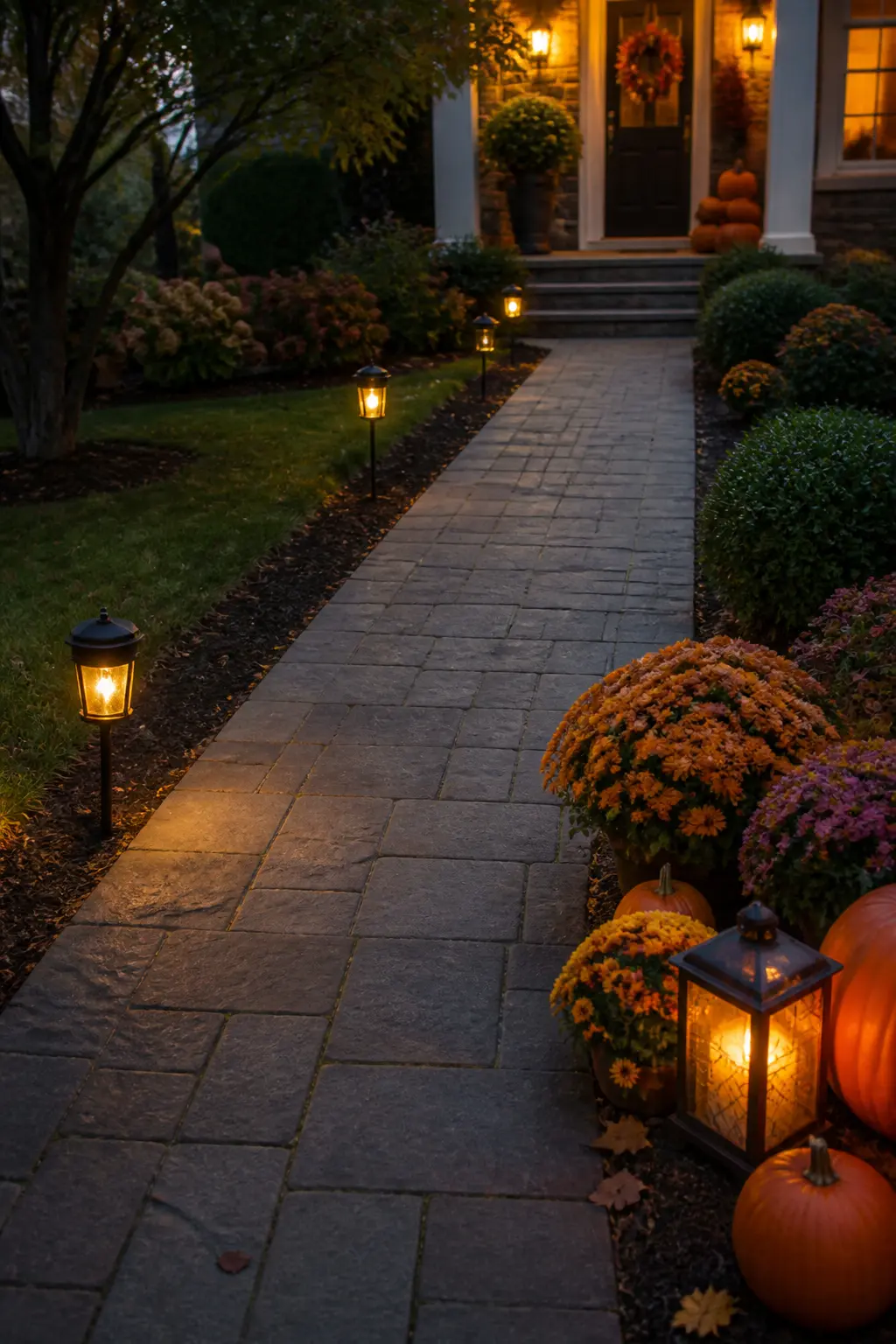
Path Lanterns Spaced Wider Than Feels Natural
This is the principle restated as a checklist for anyone who has already set their lanterns and is not sure if the spacing is right. Stand at the front door and look down the path.
If you can see every lantern clearly lit without any dark gap between them, they are too close. Reposition every other one to a different bed edge, a pot corner, or a step riser instead.
The goal is a path that guides without being lit up like a landing strip. Four lanterns on a thirty-foot walk means one every seven to eight feet, which feels sparse until the candles are lit and the evening light drops. Then it feels exactly right.
🛍 Shopping guide
Frequently Asked Questions
How early can you put out fall outdoor decor without it looking premature?
The first week of September is the practical floor in most climates: ornamental grasses and mums are in nurseries, the light has shifted, and no one is confused about what season it is. Corn stalks and gourds follow in mid-September.
Full pumpkin displays hold best when set out after the hottest weeks have passed, so mid-September to early October is the sweet spot for most yards.
How do you keep pumpkins and gourds from rotting outdoors?
Keep them off bare soil and off wet wood. A gravel base, a pot saucer, or a thin layer of straw under each pumpkin lets air circulate around the base and extends the life by two to three weeks.
Wipe them down with a diluted white vinegar solution when you first set them out to slow surface mold. Ornamental gourds with harder skins outlast soft-skinned carving pumpkins by a wide margin.
What is the best way to anchor tall corn stalks in a driveway entrance?
Drive a wooden stake or piece of rebar about eighteen inches into the ground, then wire the base of the corn stalk bundle to the stake in two places with heavy-gauge wire.
The stake carries the load; the wire keeps the stalks from fanning apart in wind. Lean the bundle against a post or mailbox pillar for extra stability if the ground is too hard to stake.
Can you leave galvanized metal tubs outdoors all season?
Yes. Galvanized steel handles frost, rain, and temperature swings well. The only thing that shortens the life of a galvanized tub is standing water inside with no drainage, so drill two or three holes in the bottom before planting, or set the potted plant inside the tub rather than planting directly in it so drainage is never an issue.
How do you style a yard that has no fence and no defined edges?
Create your own edges with repeating elements. A row of galvanized tubs along the walk edge acts as a soft boundary. Staked lanterns define a path even without a physical border.
Layered planters at three equidistant points along the drive give the eye a structure to follow. The zone logic still works: arrival, approach, destination. You build the zones with the decor itself rather than relying on existing fences or walls.
20 winter wreath ideas with snowy pine, silver berries and birch that outlast the tree and the tinse
18 January wreath ideas that swap out the Christmas look for something warm, wintry and cheap to mak
17 fall decor collections for every room, budget and skill level, from porch to mantle, so you can p
Leave a Reply