

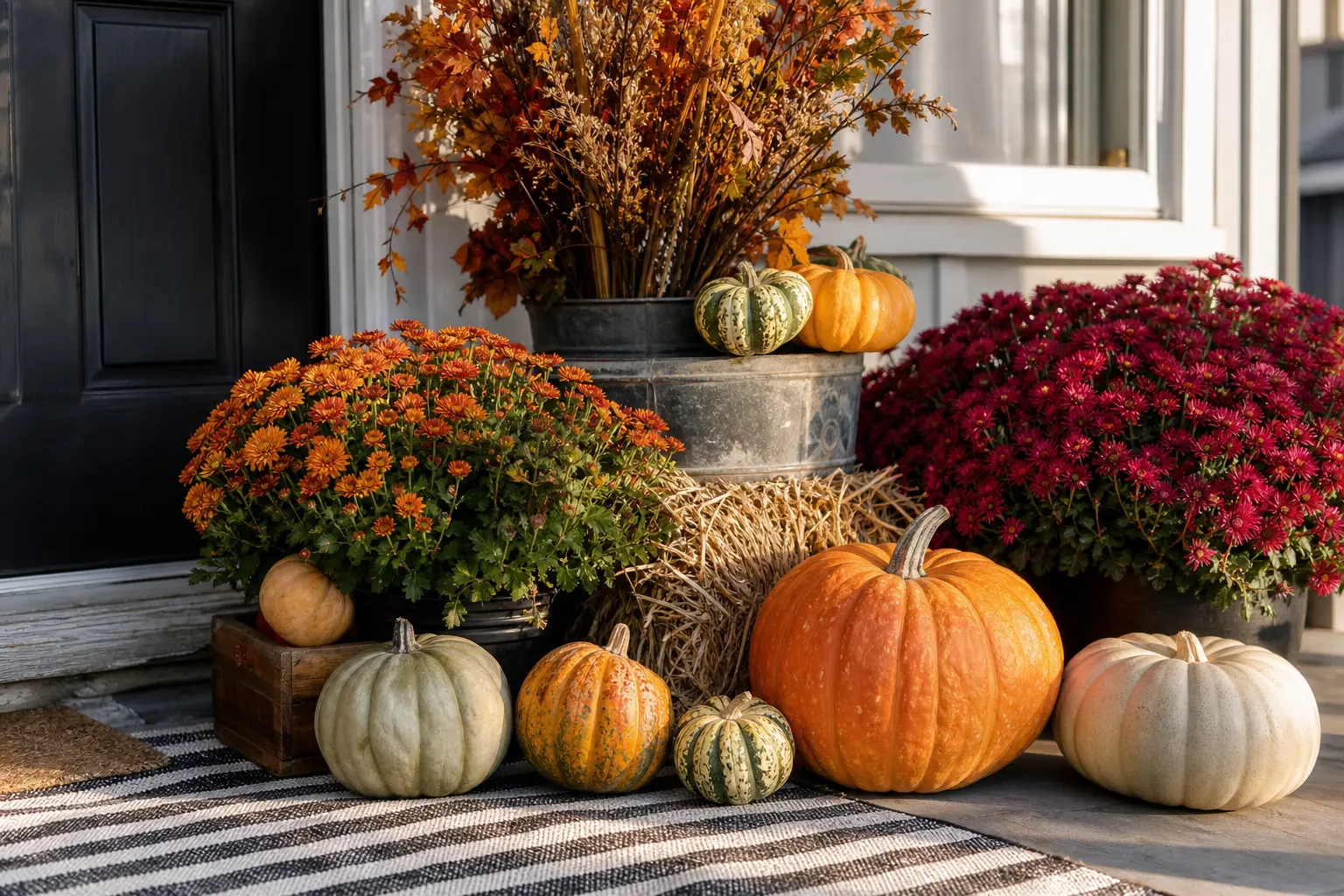
Most porch styling advice is written for the first Saturday of September. The mums are perky, the pumpkins are pristine, and everything photographs beautifully before real weather arrives. Six weeks later, half of it is a soggy mess and the other half has blown off the railing.
Every idea here is chosen on a single criterion: does it still look deliberate by the time the first frost settles? Dried botanicals, natural fibers, iron, wood and stone age in ways that feel intentional rather than neglected. Fresh-cut flowers and glitter do not make the list. If you want a porch that earns compliments in October and again in November, start here. For more autumn inspiration once the porch is sorted, the fall chalkboard signs guide is worth a look, and if the season runs straight into a Friendsgiving gathering, these apartment-friendly Friendsgiving decor ideas carry the same philosophy indoors.
The 32 ideas below are grouped by what they do on the porch: anchor the entry, build the seating corner, dress the vertical surfaces, handle lighting, and pull the whole thing into a palette that lasts. Pick five or pick twenty. The point is a porch that looks like someone thought about it, not one that looks like someone gave up.
This post contains affiliate links. If you buy through them, I may earn a small commission at no extra cost to you.
Anchor the Entry
The entry zone sets the first impression and takes the most weather. Everything here should be made of something that improves, or at least holds neutral, after a hard rain and a cold snap. Think gourds, dried stalks, natural fiber and iron. Avoid anything with a coating that peels.
Symmetry is reliable, but it is not the only option. Asymmetric groupings read as styled rather than builder-grade, and they are easier to refresh mid-season by swapping one element without rebuilding the whole arrangement.
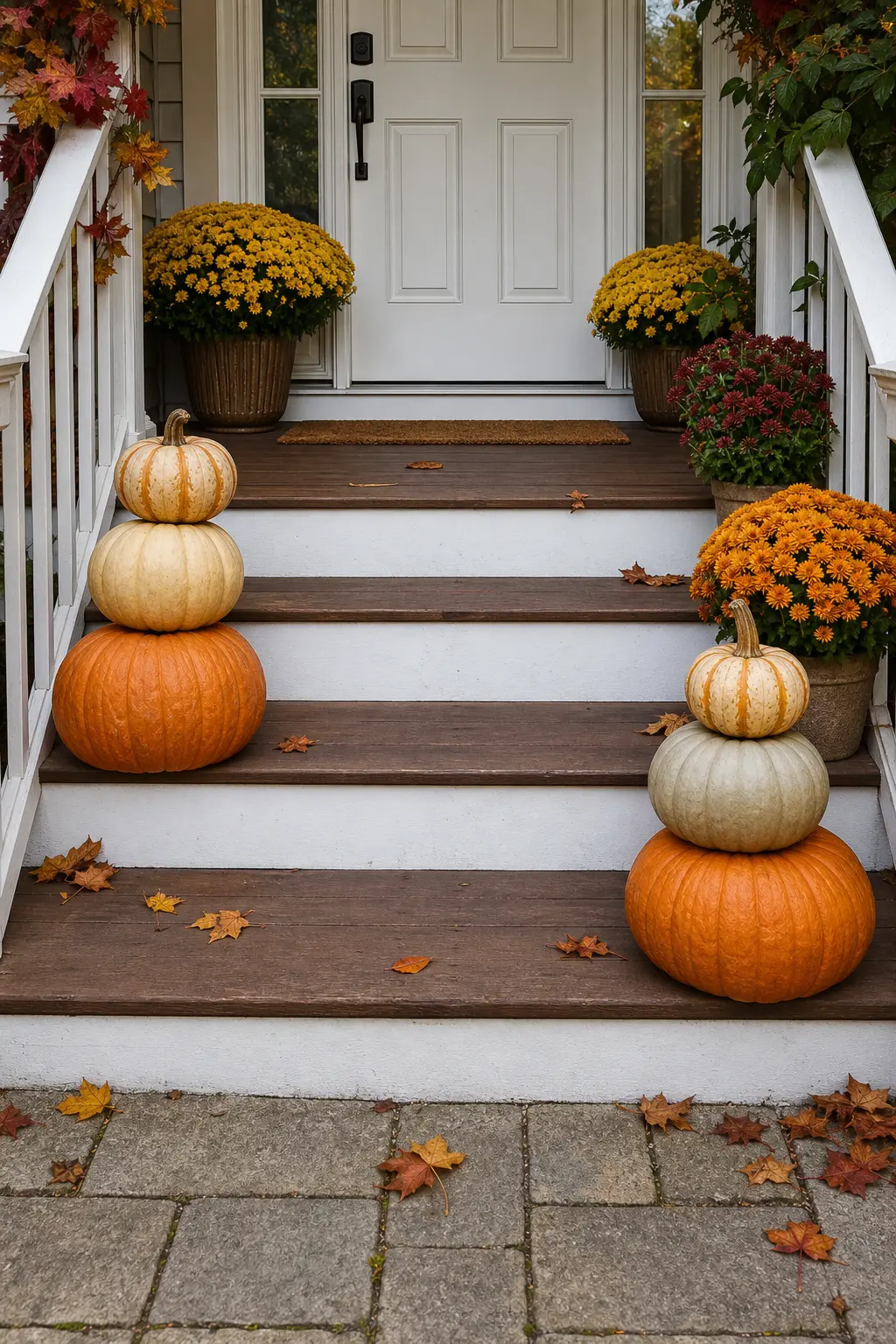
Layered Pumpkins in Graduated Sizes Flanking the Steps
Three pumpkins on each side of the steps, stacked or simply placed in descending height from post to ground, create a frame that holds its shape for the full season. Pumpkins kept dry and off the ground on a small wooden riser or brick last dramatically longer than ones sitting directly on damp concrete.
Vary the surface finishes: one smooth, one ribbed, one warty. That texture mix reads as collected rather than bought-as-a-set, and the variety holds the eye more than six identical globes would.
🛍 Shopping guide
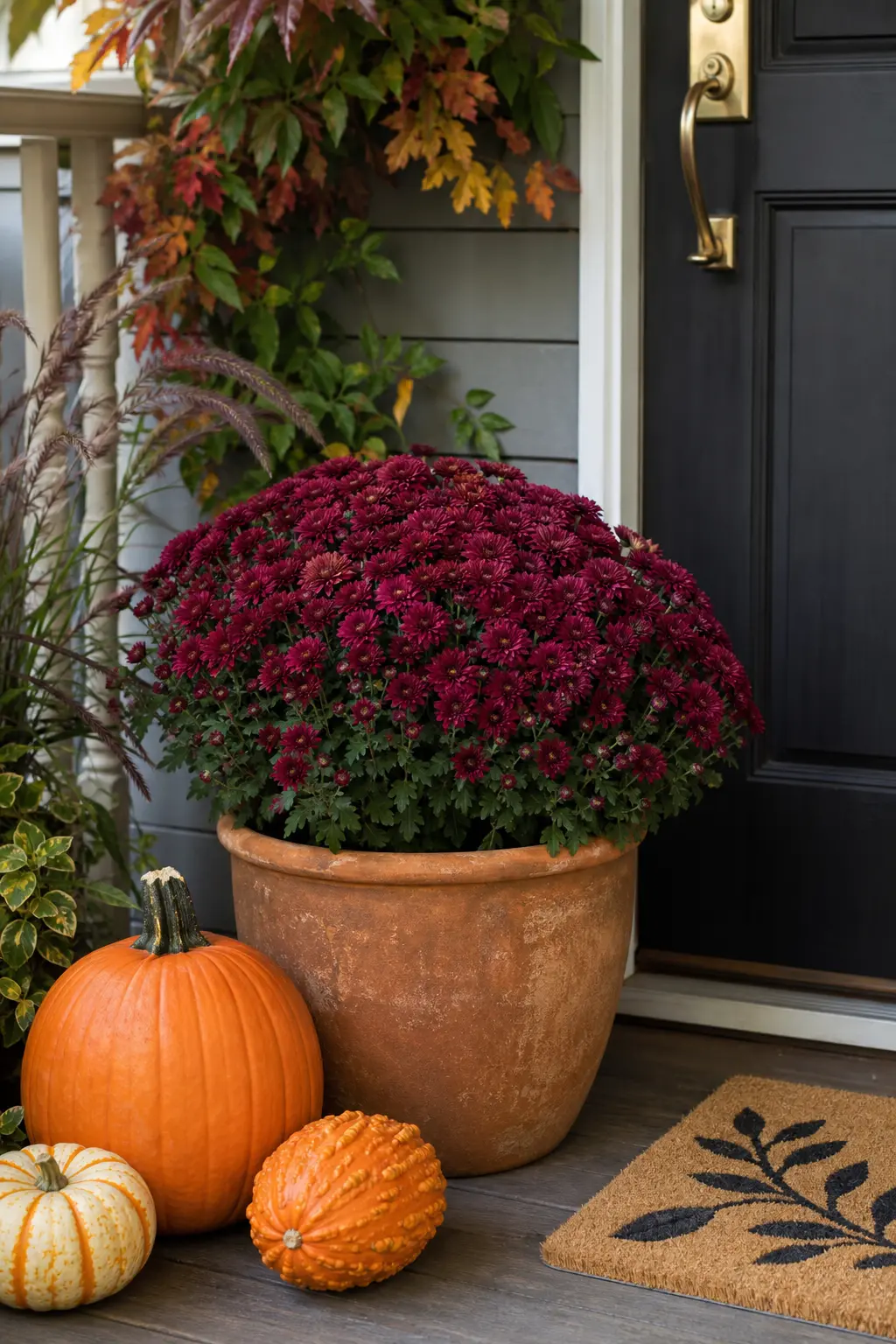
Potted Mums in Burgundy Instead of the Usual Bright Yellow
Burgundy mums sit in the same color family as dried oak leaves and rust-toned cushions, so they look intentional rather than accidental. Bright yellow, by contrast, fights with almost every other natural material and demands to be the center of attention from day one.
Plant mums in a proper outdoor container with drainage, not in the nursery plastic sleeve. Water at the soil line, never overhead. A mum kept this way can run six to eight weeks before it genuinely needs replacing.
🛍 Shopping guide
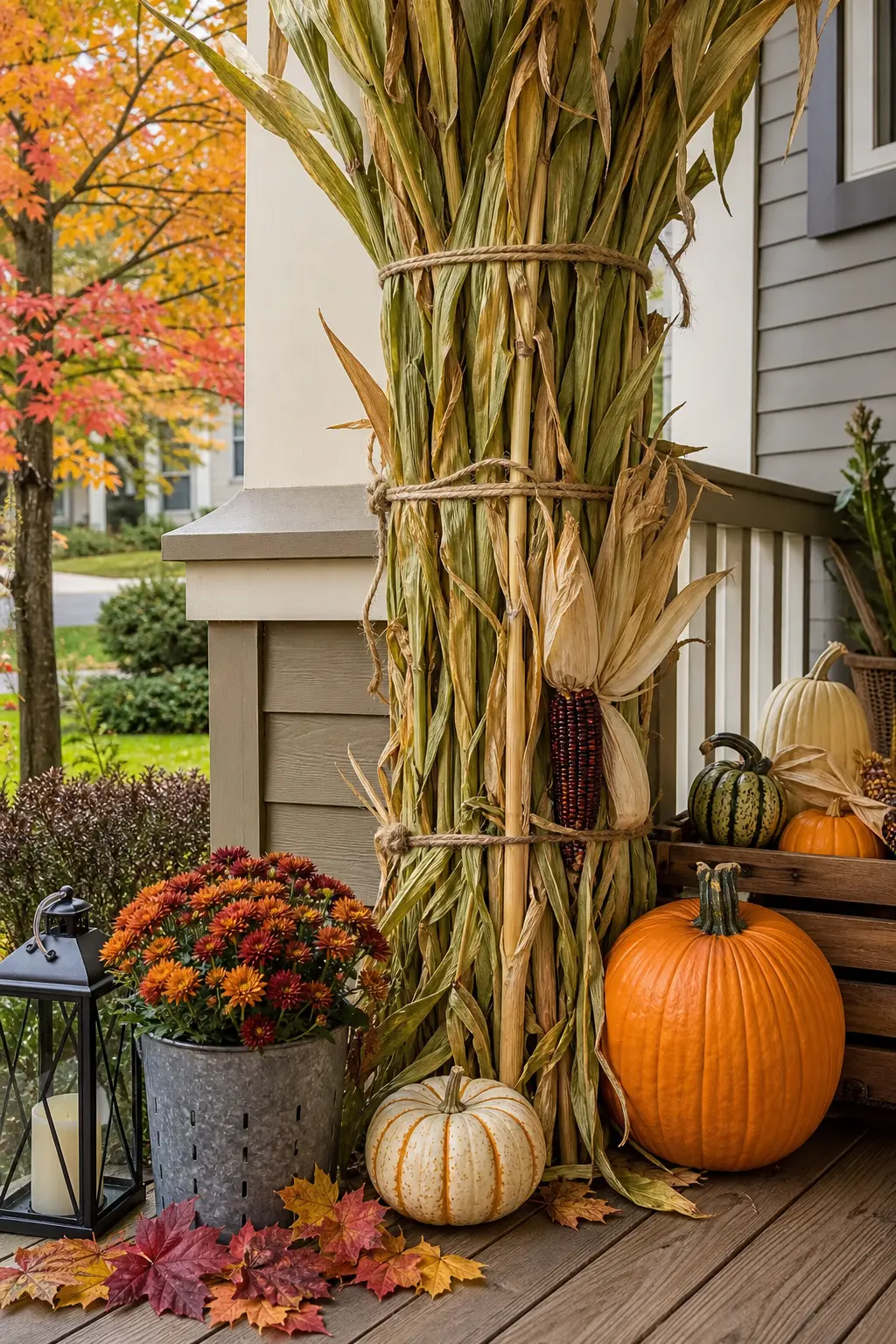
Corn Stalks Tied to the Porch Posts with Jute Twine
Dried corn stalks tied to a post give the porch a vertical anchor that no pumpkin or basket can replicate. They dry further as the season progresses and look, if anything, better in November than in September.
Use jute twine for tying: it weathers to a warm caramel tone that suits the stalks. Synthetic ribbon fades, shreds and looks cheap by week three. Tie at the top, the middle and the base so the stalks stay upright in wind without flattening against the post.
🛍 Shopping guide
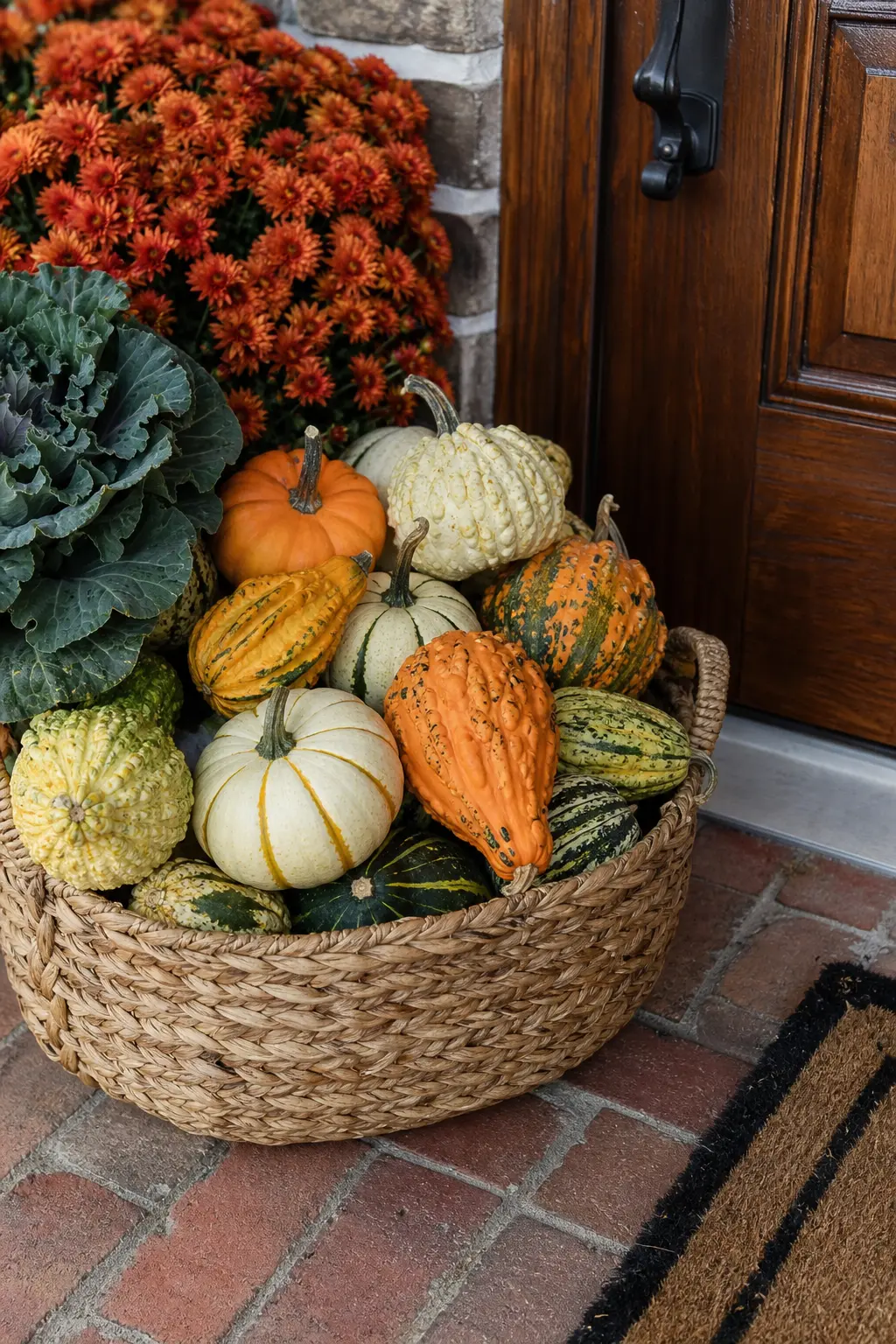
Woven Basket of Gourds Set Beside the Door
A wide, low basket filled with an assortment of gourds beside the door is the lowest-effort entry on this list and one of the most durable. Gourds last longer than pumpkins, the basket protects them from direct rain contact, and the whole thing can be refreshed mid-season by tucking in a few dried stems or pinecones.
Choose a basket with a flat base that will not rock in wind. A seagrass or rattan weave in a natural brown tone suits every palette and porch color.
🛍 Shopping guide
Build the Seating Corner
A porch with a seating corner reads as a room, not a doorstep. That shift matters for longevity: once the space has furniture logic, individual pieces can age or be swapped without the whole thing collapsing visually.
Outdoor-rated textiles and cushions in deep, muted tones show weather and pollen far less than pale or bright ones. A rug that anchors the seating area also keeps furniture from drifting and gives the eye a floor plane to rest on.
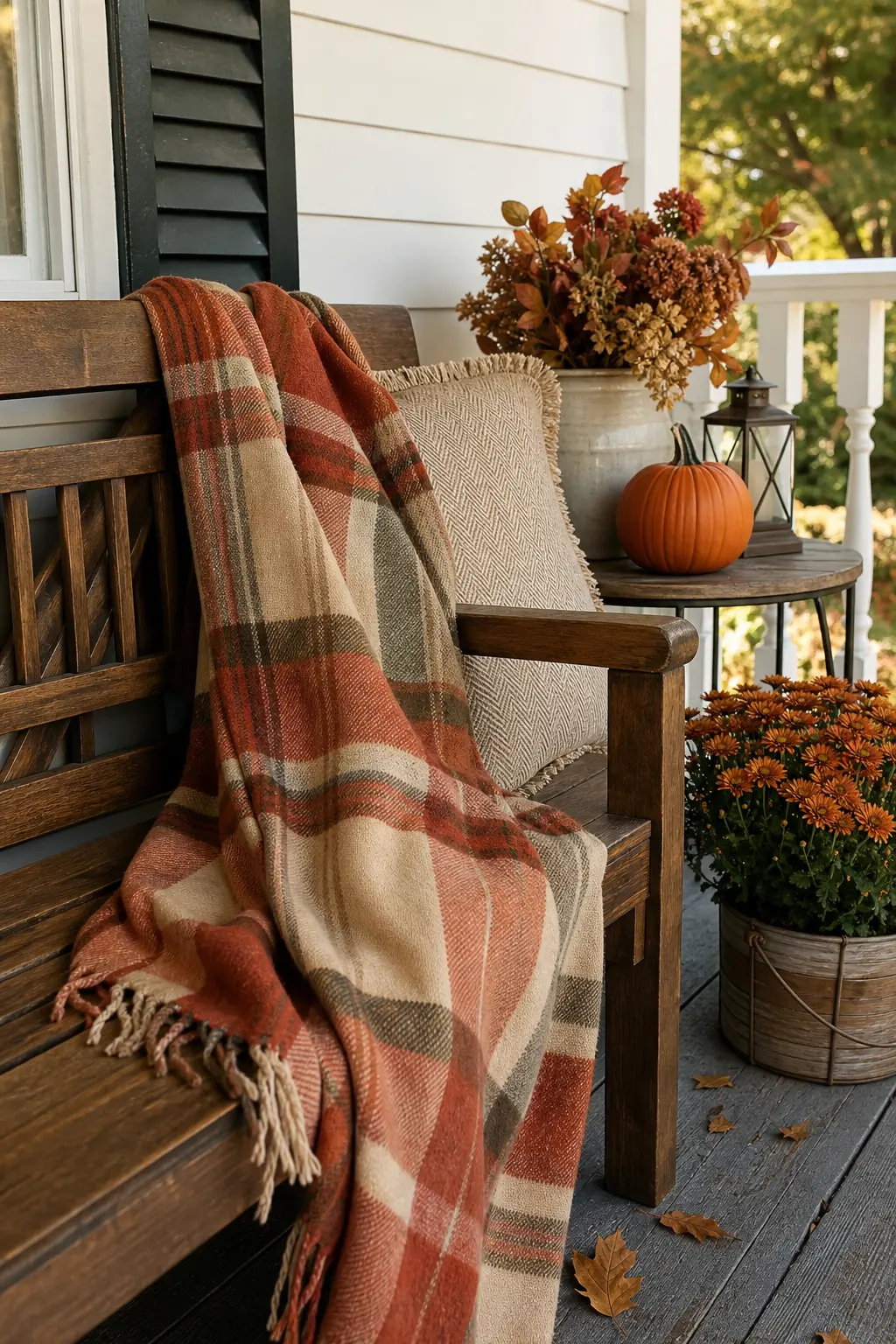
Plaid Blanket Draped Over the Porch Bench
A blanket draped casually over one arm of a bench signals that someone actually sits here, which is exactly the quality that makes a porch feel like a room. Choose a plaid in rust, cream and navy: it reads as autumn without being literally printed with leaves.
Outdoor-rated wool-blend throws hold their shape through light rain and dry quickly. A purely decorative indoor blanket left outside will pill and smell within two weeks. One useful, weather-tolerant blanket is worth three decorative ones that have to come inside every evening.
🛍 Shopping guide
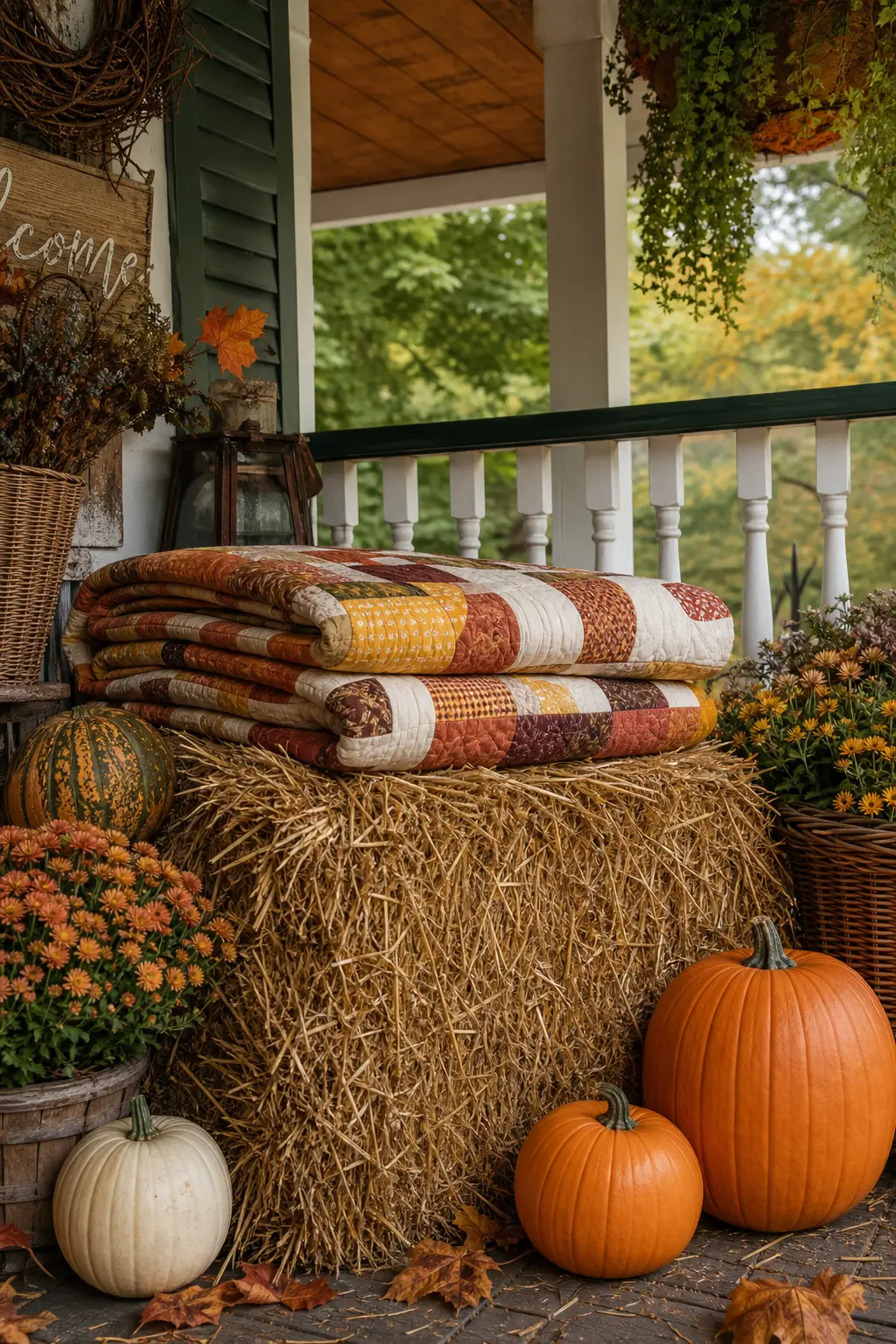
Hay Bale Seating with a Folded Quilt on Top
A hay bale does double duty as seating and as a structural element that gives the porch visual weight it cannot get from cushions alone. A folded quilt on top makes it look intentional rather than agricultural.
Keep the quilt folded, not spread open: a folded stack stays tidier through wind. When the bale starts to compress, add a flat board under the quilt. The bale itself lasts the full season on a covered porch.
🛍 Shopping guide
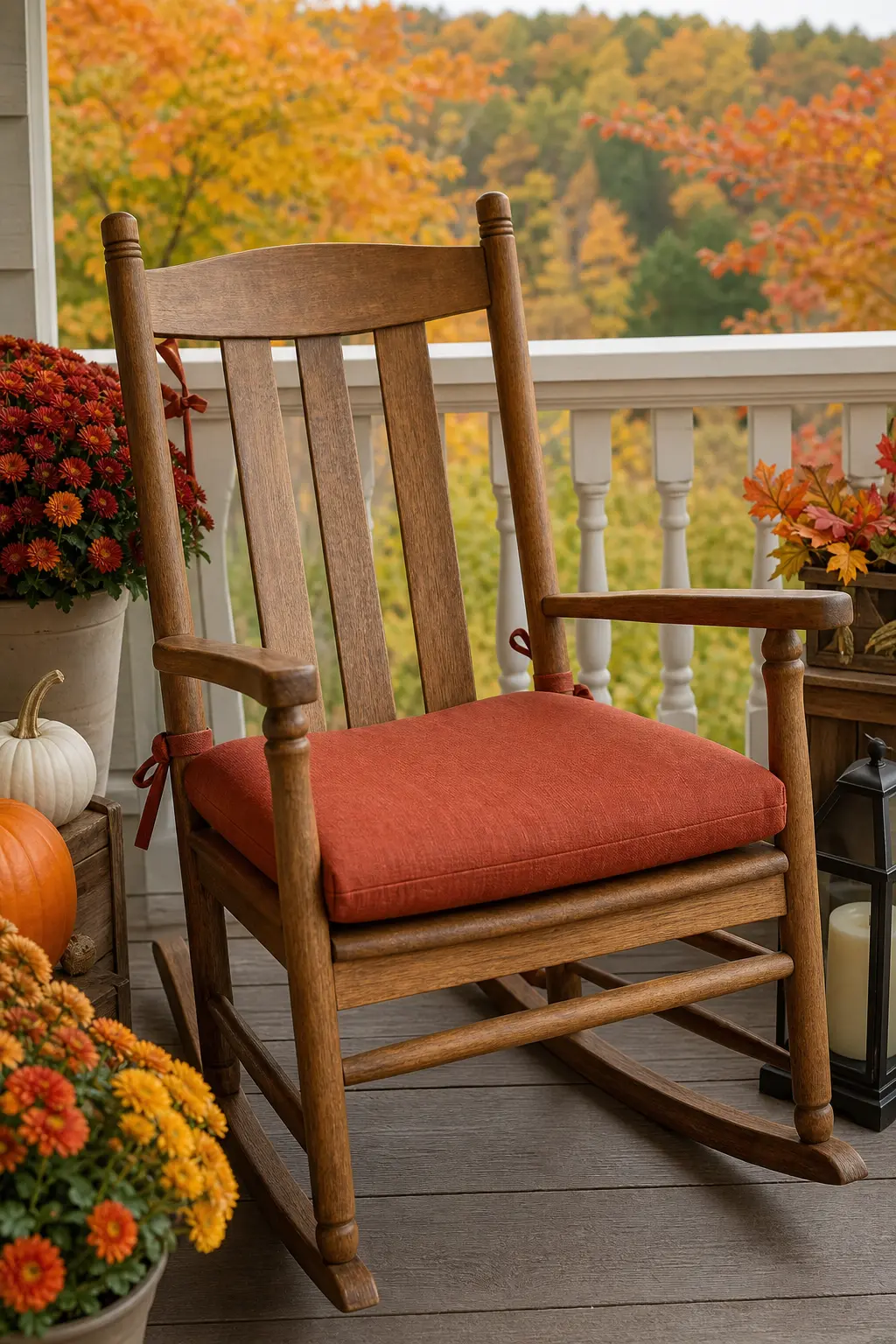
Rocking Chair with a Rust-Colored Cushion
A rocking chair needs only one good cushion to look finished. Rust, burnt sienna or deep terracotta work harder than orange: they suggest autumn without announcing it.
Choose a cushion filled with quick-dry foam and covered in a solution-dyed acrylic fabric. These do not fade or waterlog. A chair with a cushion invites sitting, and a porch that looks lived-in holds its appeal far longer than one that looks staged for a single afternoon.
🛍 Shopping guide
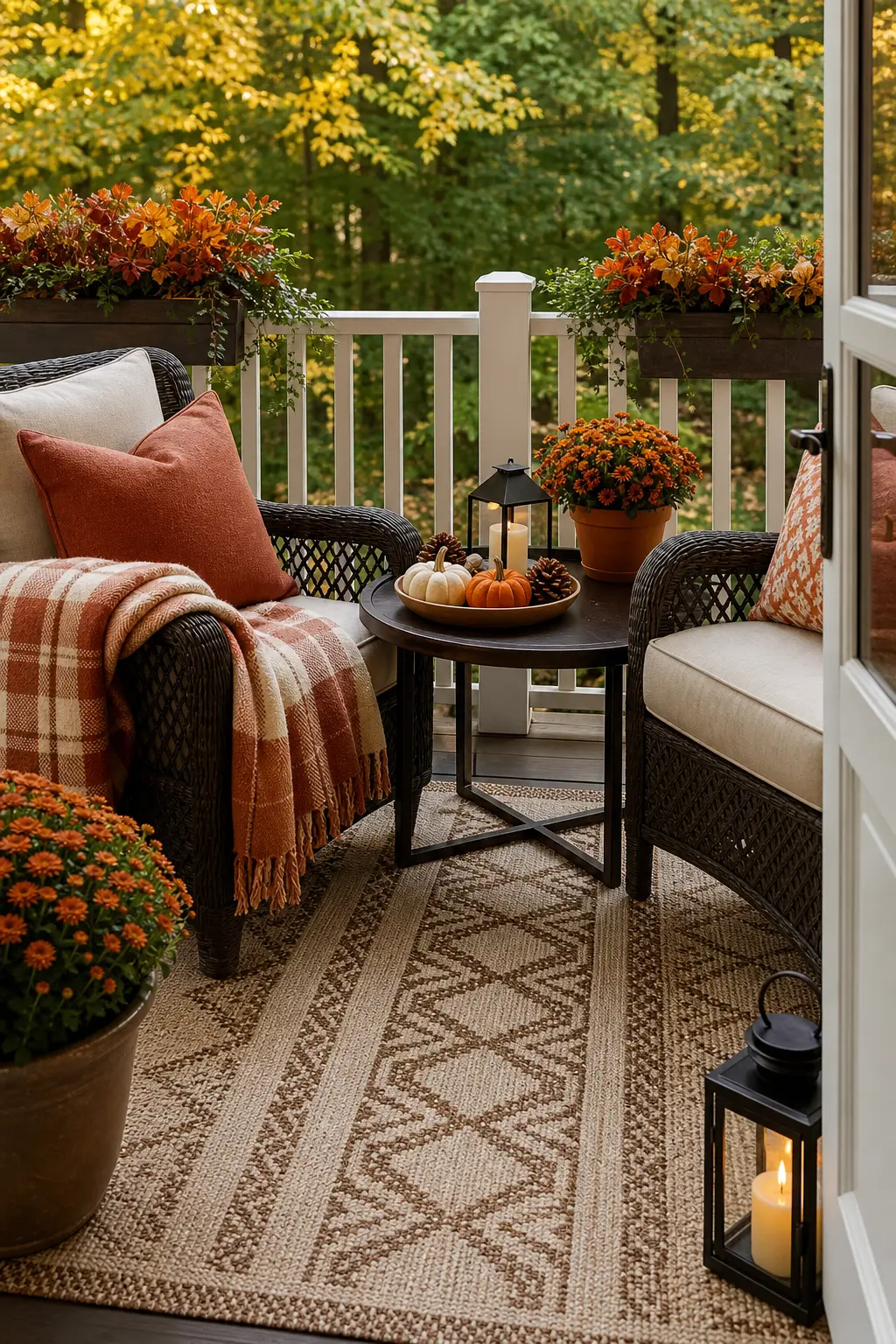
Porch Treated as a Room with a Rug Anchoring the Seating Area
The single move that upgrades a porch from a collection of objects to a composed room is placing a rug under the seating. Every piece of furniture reads as belonging together, the floor plane becomes visible, and the whole arrangement gains a logic it did not have without it.
Choose a flat-weave outdoor rug in a pattern with enough visual noise that dirt and pollen do not register between cleanings. Natural tones: jute print, block stripe, or a geometric in cream and brown. Size up: most people choose a rug too small for the furniture it anchors.
🛍 Shopping guide
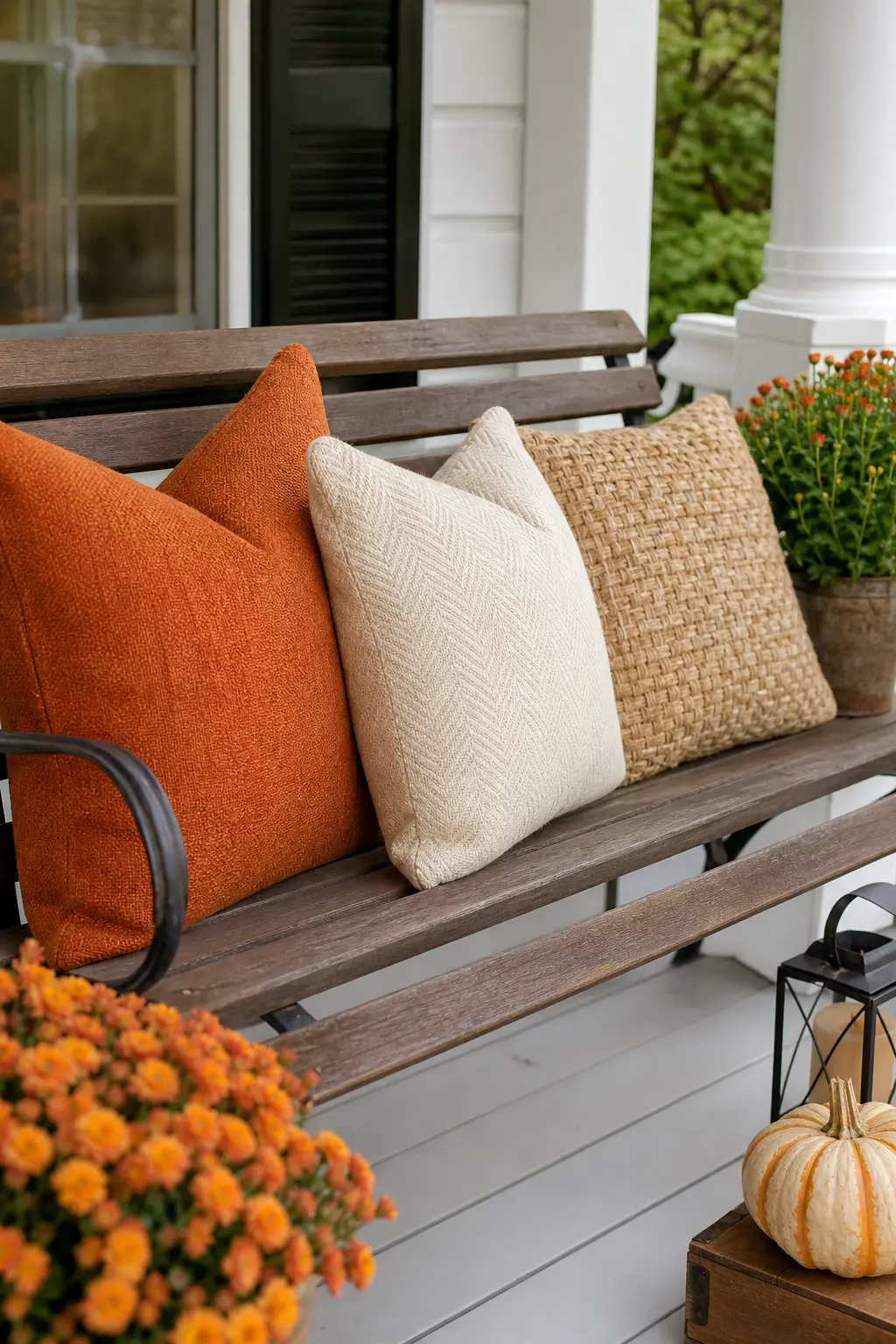
Bench Styled with Three Cushions Rather Than a Single Throw
Three outdoor throw pillows on a bench do more styling work than one blanket. Vary the size: one large lumbar, two square. Vary the pattern: one solid, one texture, one subtle print. Keep all three in the same color family.
Outdoor pillows filled with polyester fiberfill and covered in solution-dyed fabric survive rain without going flat or growing mold. Bring them in only if a prolonged storm is coming, not after every sprinkle.
🛍 Shopping guide
Dress the Vertical Surfaces
Walls, posts, railings and the door itself are the surfaces people see from the street. Vertical decor lifts the eye and makes a porch feel finished rather than just accessorized at ground level. Dried materials do better here than fresh ones: no watering, no wilting schedule.
Jute, burlap and natural rope weather slowly and honestly. They do not snap or crack in the first cold week the way synthetic ribbon does.
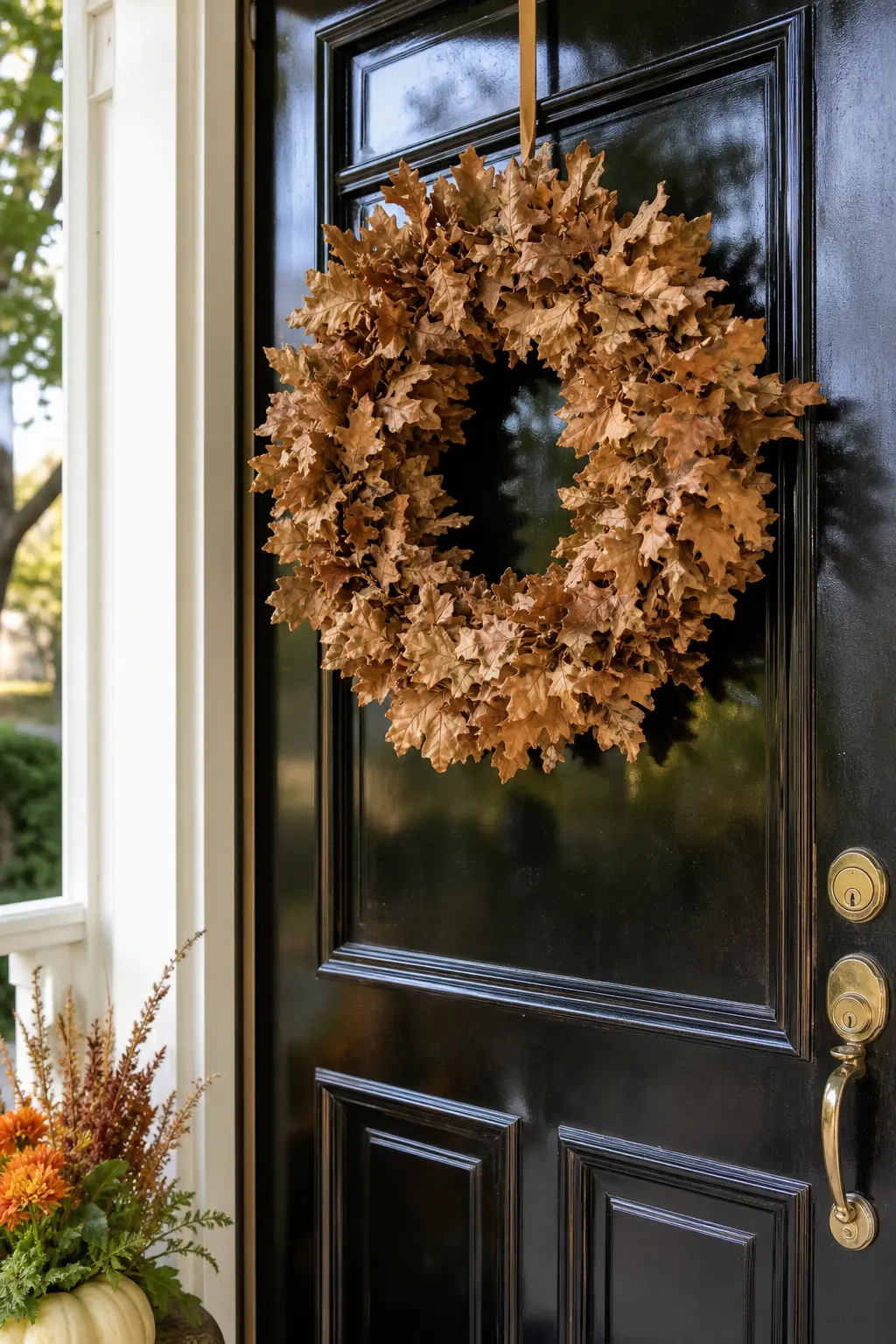
Wreath of Dried Oak Leaves on the Door
A wreath made of dried oak leaves outlasts any fresh greenery by weeks. The leaves hold their structure and color as they dry, shifting from deep green-brown to warm rust over the course of the season. That shift is a feature, not a flaw.
Hang it on a door hook rated for outdoor use. A suction-cup hook fails in cold weather; a metal over-the-door hook or a nail set at an angle holds all season without drama.
🛍 Shopping guide
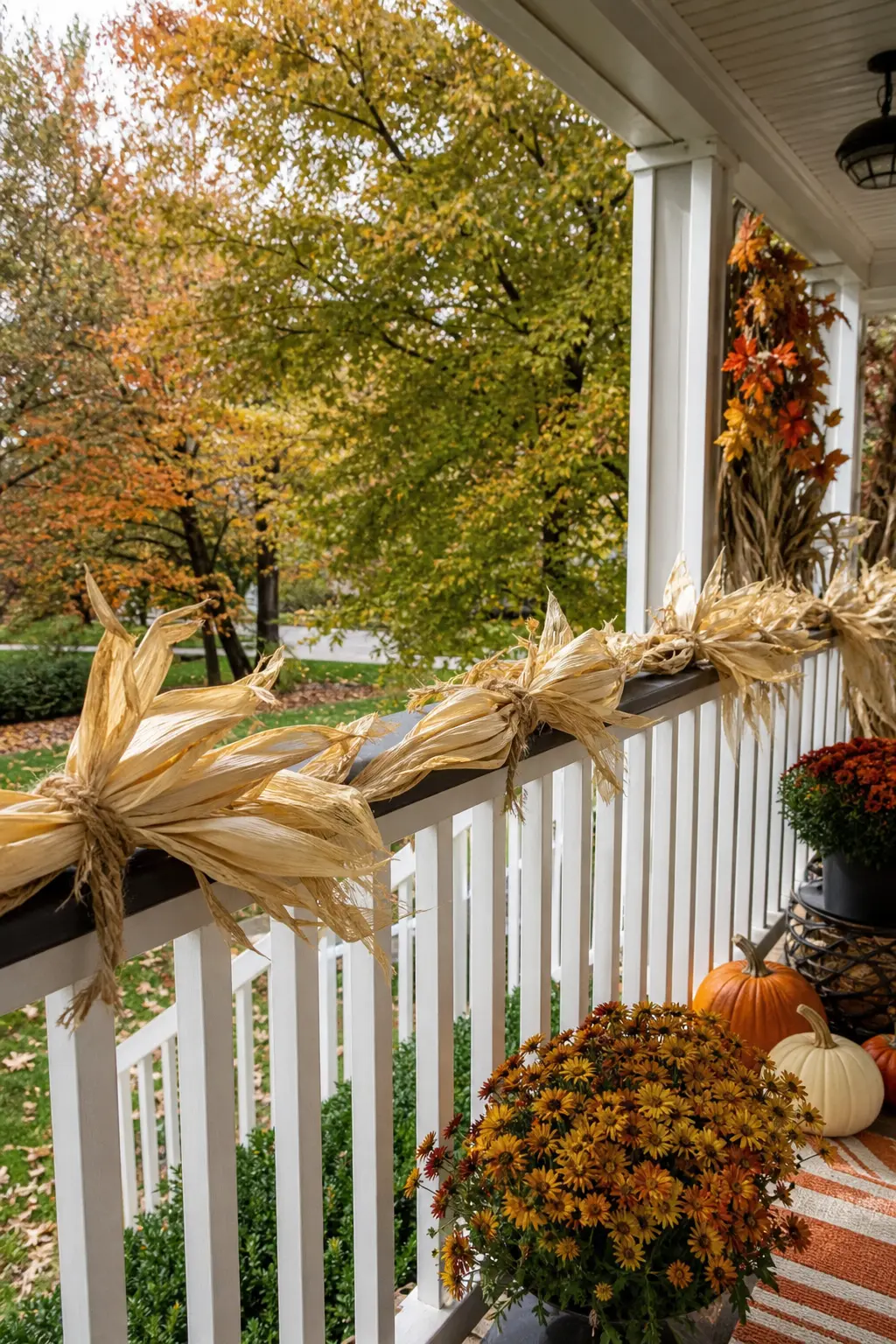
Cornhusk Garland Along the Railing Top
A cornhusk garland draped along the top rail of a porch railing gives a long horizontal line of texture that no wreath or basket can provide. It fills the railing span without obstructing the view through it.
Secure it every eighteen inches with a small loop of jute twine tied around a baluster. Loose garlands blow off in the first good wind. Properly secured, this piece asks nothing of you for the rest of the season.
🛍 Shopping guide
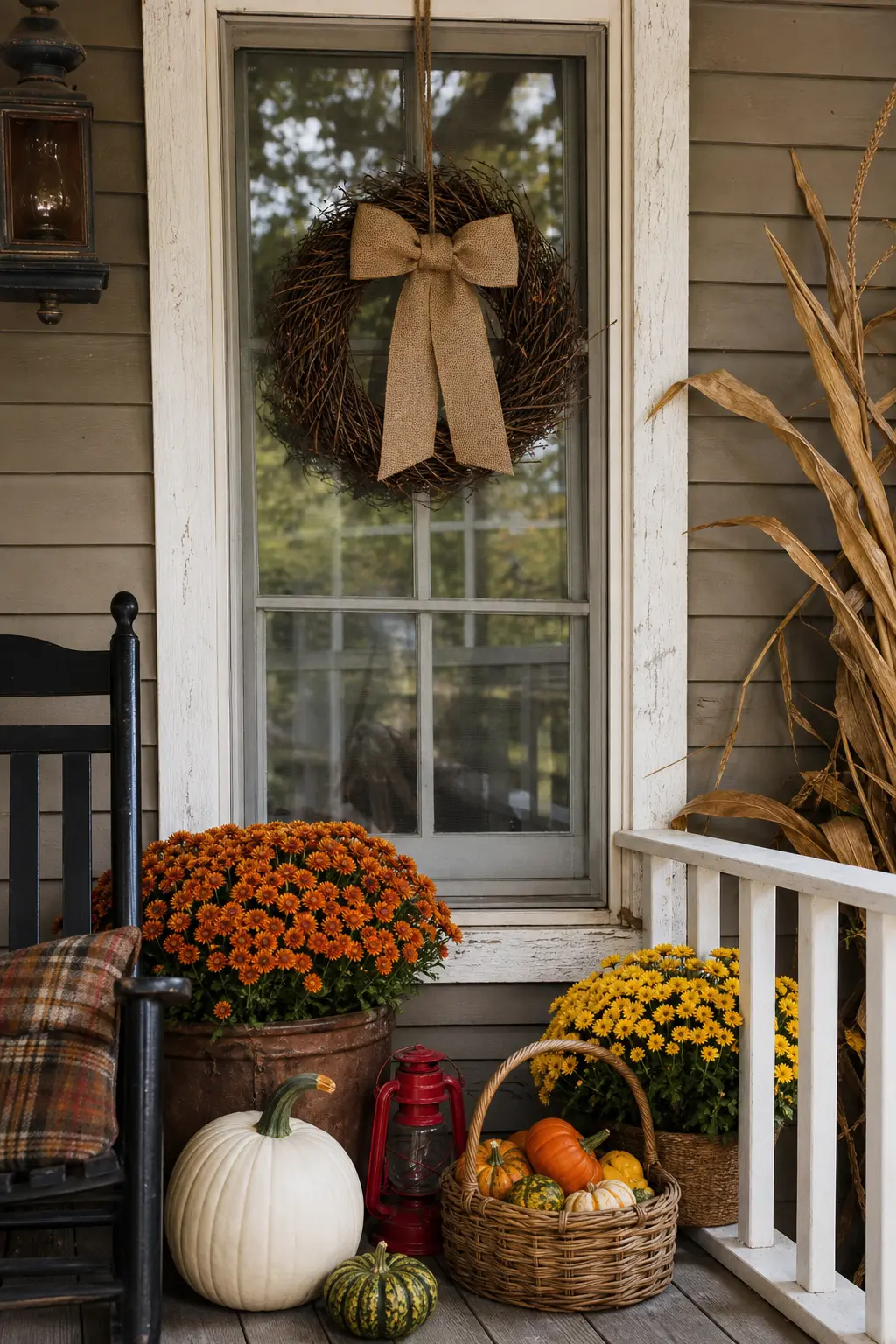
Twig Wreath with a Burlap Bow on a Side Window
A second wreath on a side window, slightly smaller than the door wreath, makes the porch feel considered from multiple angles. A twig wreath with a single burlap bow is intentionally understated: the bow does the seasonal signaling without demanding the same attention as the primary door piece.
Hang it from a simple cup hook screwed into the window frame. The hook is invisible from any distance and holds securely through wind and rain.
🛍 Shopping guide
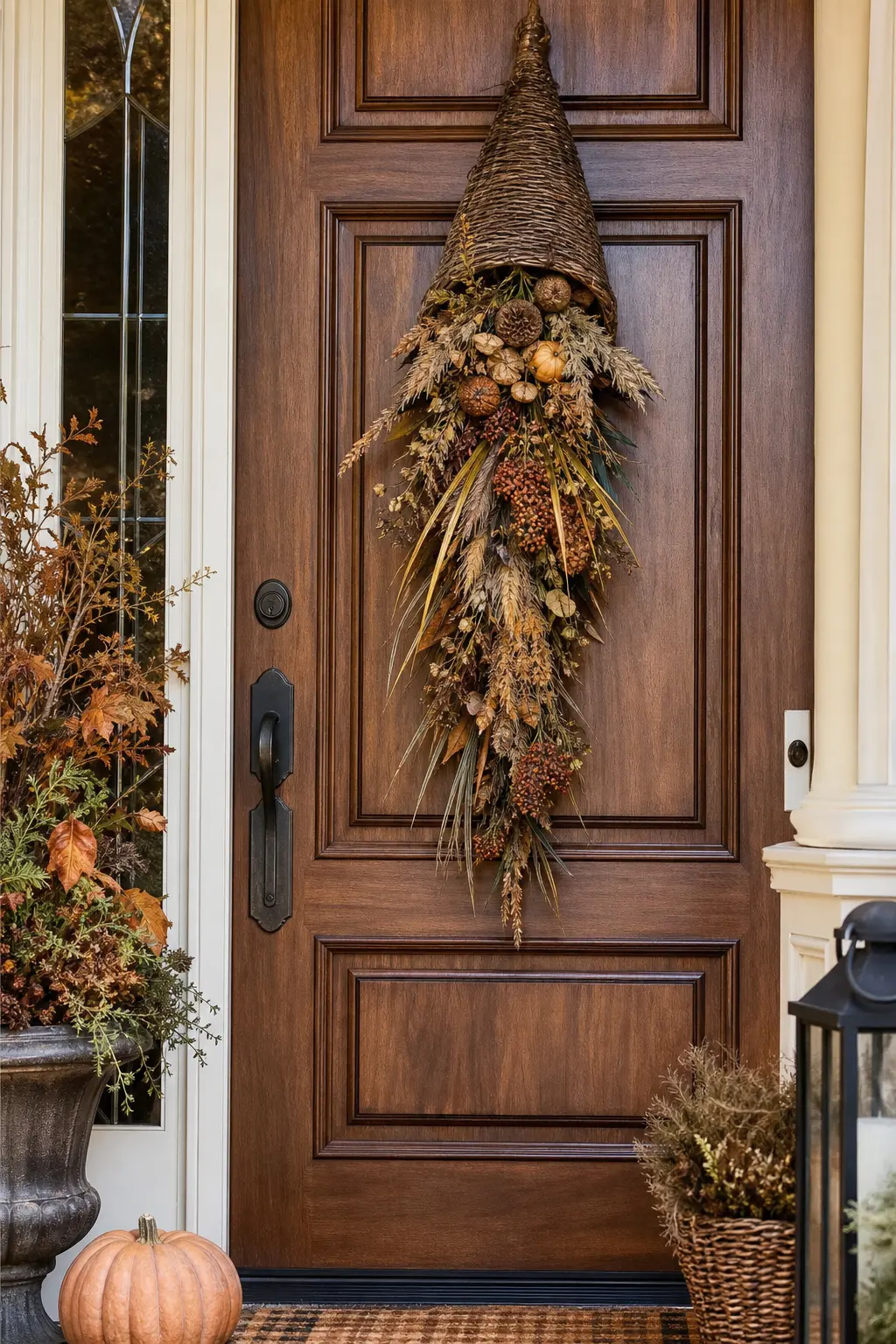
Dried Floral Cornucopia Hung Instead of a Round Wreath
A cornucopia made of dried botanicals, hung tip-upward so the contents spill downward against the door, reads as a vertical arrangement rather than a circle. It is unusual enough to earn a second look from the street without requiring any trend-chasing.
Look for one made with dried wheat, lotus pods, cotton stems and preserved leaves rather than painted foam pieces. The all-natural version ages beautifully. The foam version looks like a craft fair remnant by week four.
🛍 Shopping guide
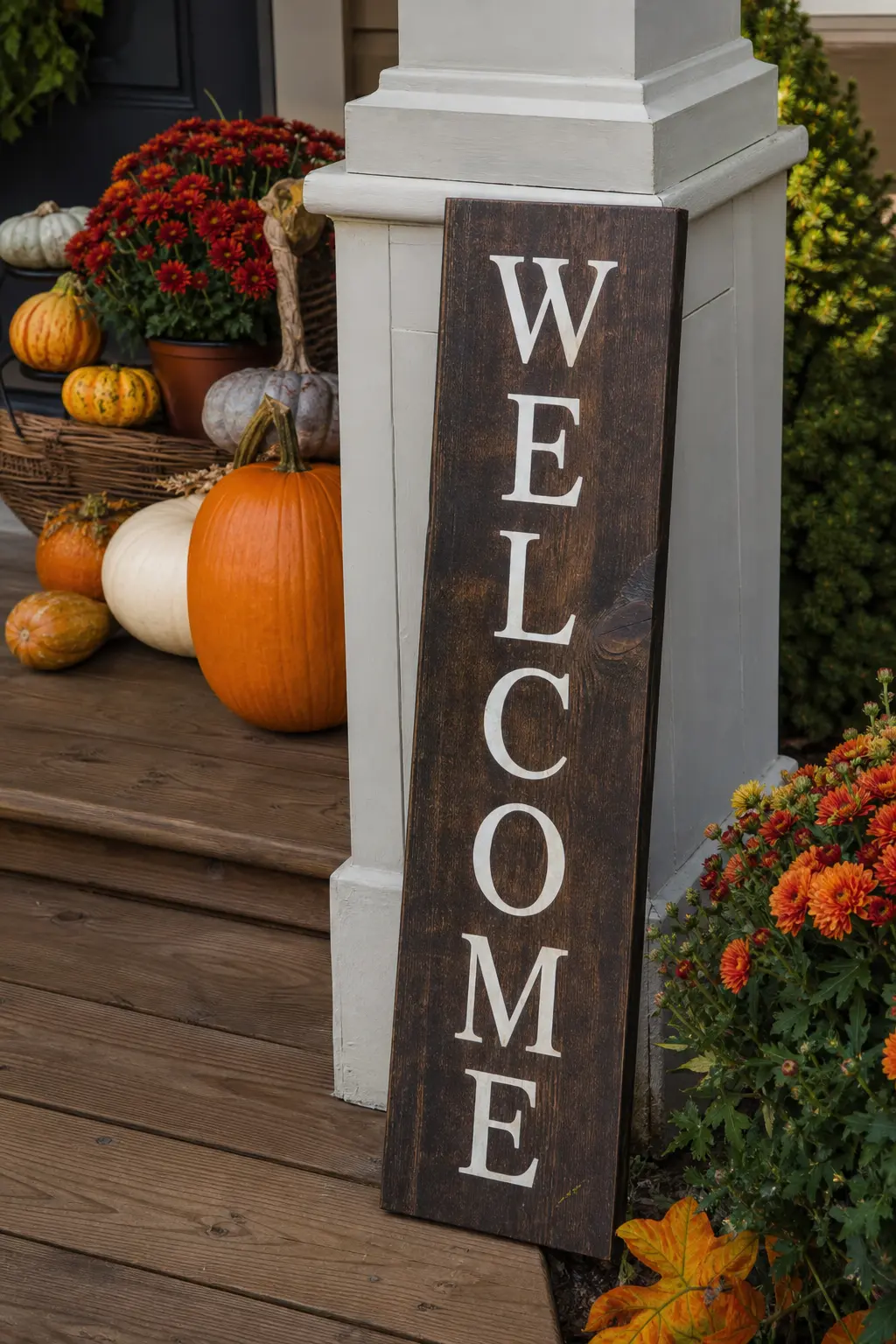
Wooden Welcome Sign Leaned Against the Post
A painted wood sign leaned against the base of a post rather than nailed to a wall reads as casual and considered at the same time. It can be repositioned mid-season, swapped for a Thanksgiving variant, or angled differently if the arrangement around it changes.
Choose a sign with simple routed letters in a dark stain rather than painted script. Painted script chips; dark stain weathers to a silver-gray that suits everything else on this list.
🛍 Shopping guide
Light It After Dark
Porch lighting that runs from dusk to ten o’clock does more for seasonal atmosphere than any number of pumpkins. Warm-toned bulbs (2200K to 2700K) make natural materials glow. Cool white makes them look institutional.
Solar or plug-in strings with a built-in dusk-to-dawn sensor require nothing after the initial hang. That is the whole maintenance schedule.
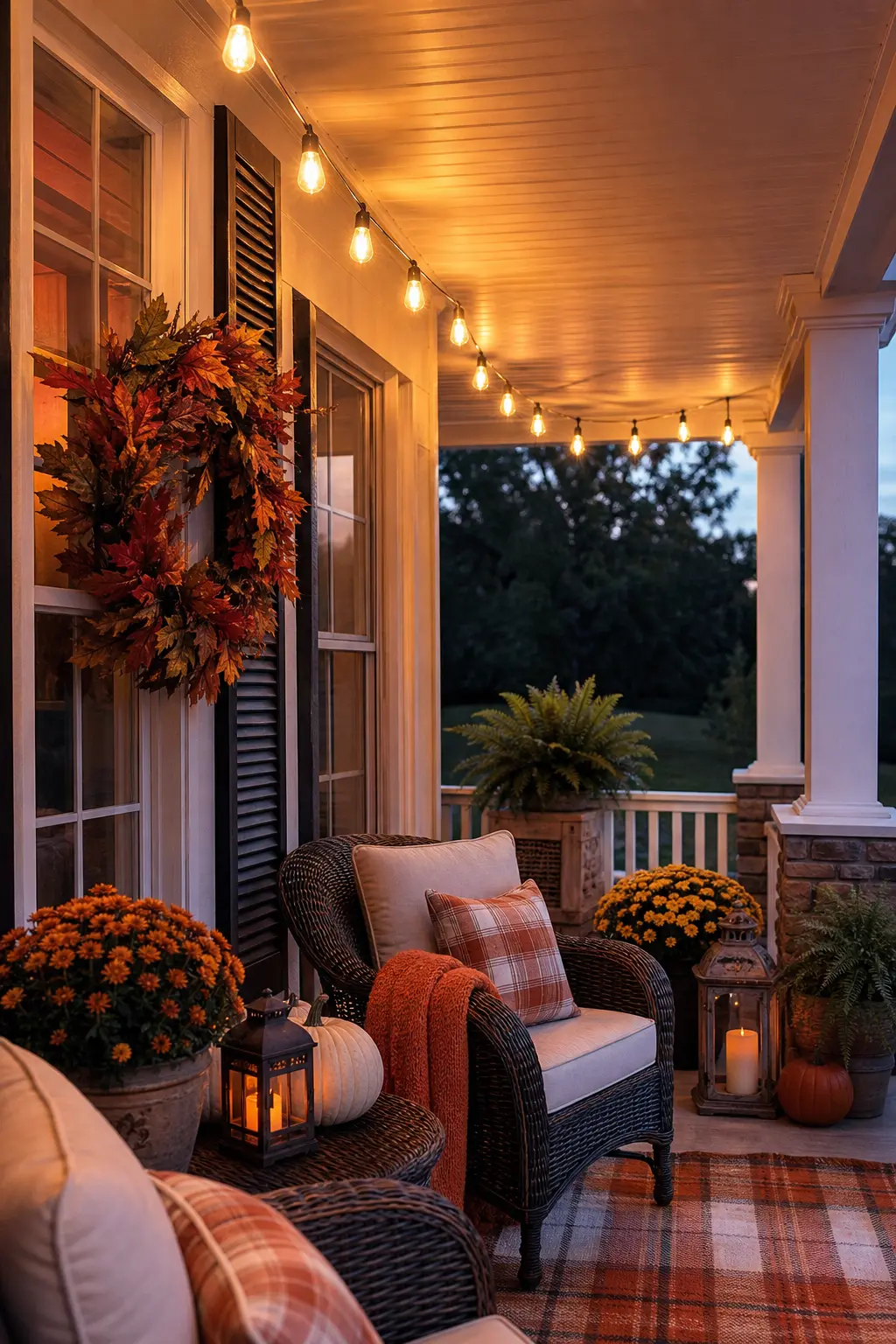
String of Warm Bulb Lights Along the Porch Roofline
Warm Edison-style string lights stapled to the porch roofline create an amber glow that makes every other element on the porch look better after dark. They work in September, October and November without reading as any particular holiday.
Choose a set rated for outdoor use with shatter-resistant bulbs. Connect to a dusk-to-dawn smart plug or a mechanical timer so they run without any daily input. One staple every twelve inches keeps the line taut through wind.
🛍 Shopping guide
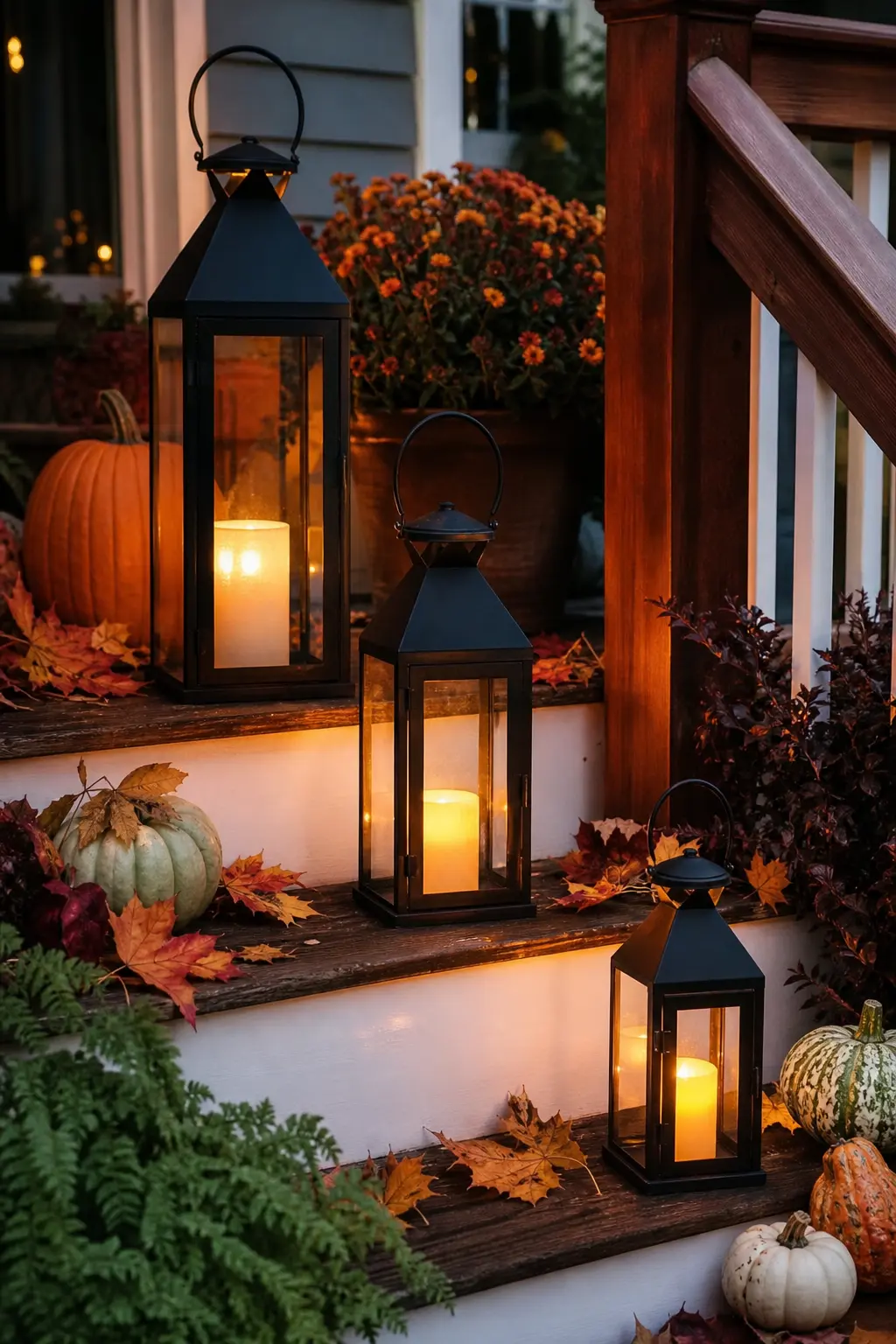
Lantern Trio on the Steps at Staggered Heights
Three lanterns in different heights set on the porch steps create depth and movement without requiring any installation. Use flameless pillar candles inside: real candles in a lantern on a public-facing step are a wind, rain and safety problem all at once.
Choose lanterns in black iron or aged bronze. Both read as architectural rather than seasonal and come back out the following year without looking dated. Avoid lanterns in orange, red or gold finishes: they commit to autumn in a way that limits their lifespan.
Work With Vessels and Containers
The container is doing as much work as what is inside it. A plastic nursery pot undercuts even beautiful plantings. Iron, stoneware, galvanized metal, woven rope and raw wood all improve the reading of whatever you put in them, and they hold up through rain cycles that would destroy a painted terra-cotta pot.
Mix the vessel materials deliberately: one iron, one woven, one wood. Matching everything tips into catalog-page and costs more money to achieve than casual layering does.
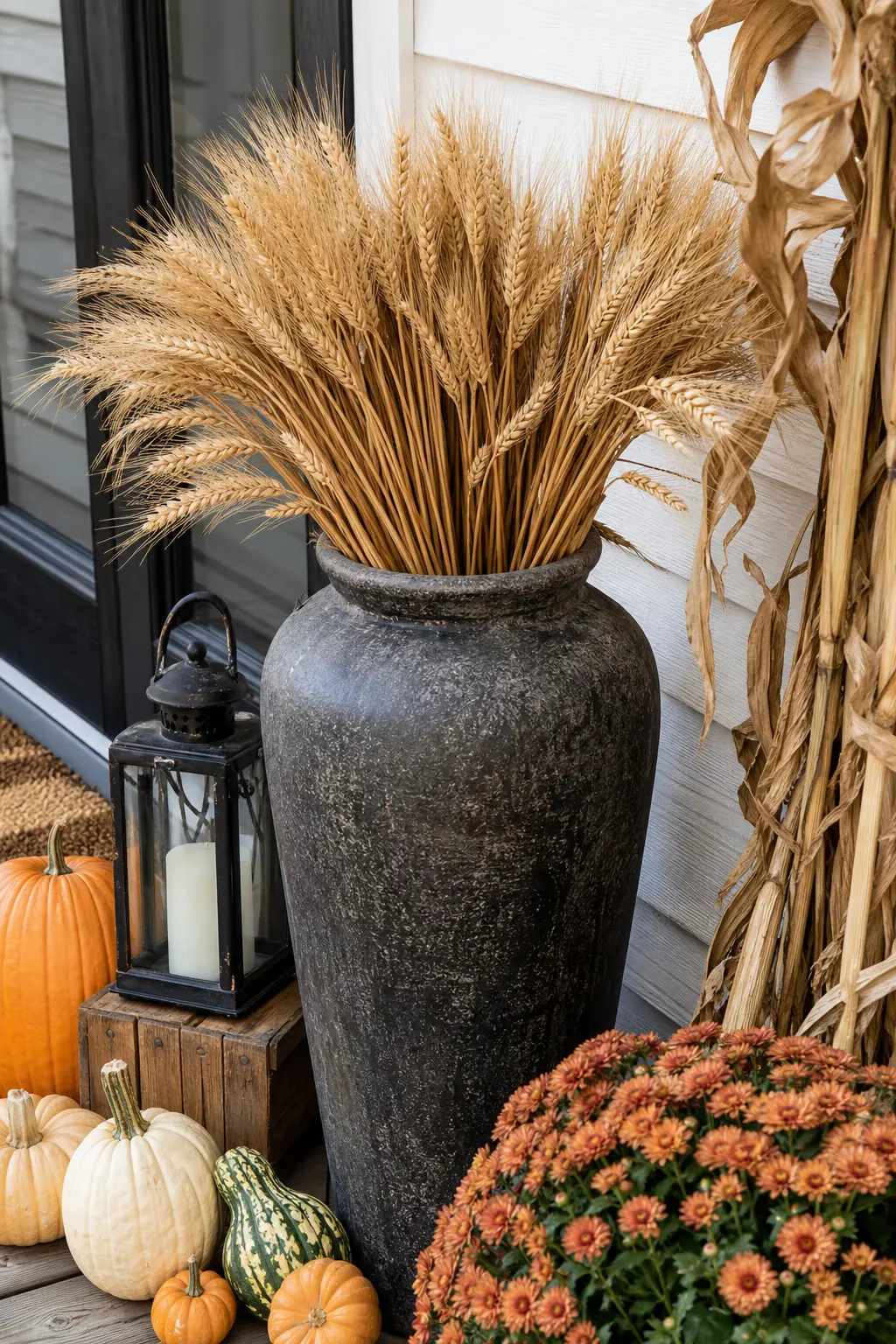
Dried Wheat Bundles in a Tall Floor Vase
A tall floor vase holding a loose sheaf of dried wheat is one of the simplest vertical statements on a porch. Dried wheat does not lose structure in cold weather, does not attract insects the way fresh botanicals sometimes do, and shifts from gold to warm straw as the season deepens, which is exactly the right direction of change.
Choose a vase in a material that handles outdoor temperature swings: glazed stoneware, iron or a well-weighted resin that reads as ceramic from any viewing distance. A lightweight vase blows over. Weight matters more than aesthetics on a porch.
🛍 Shopping guide
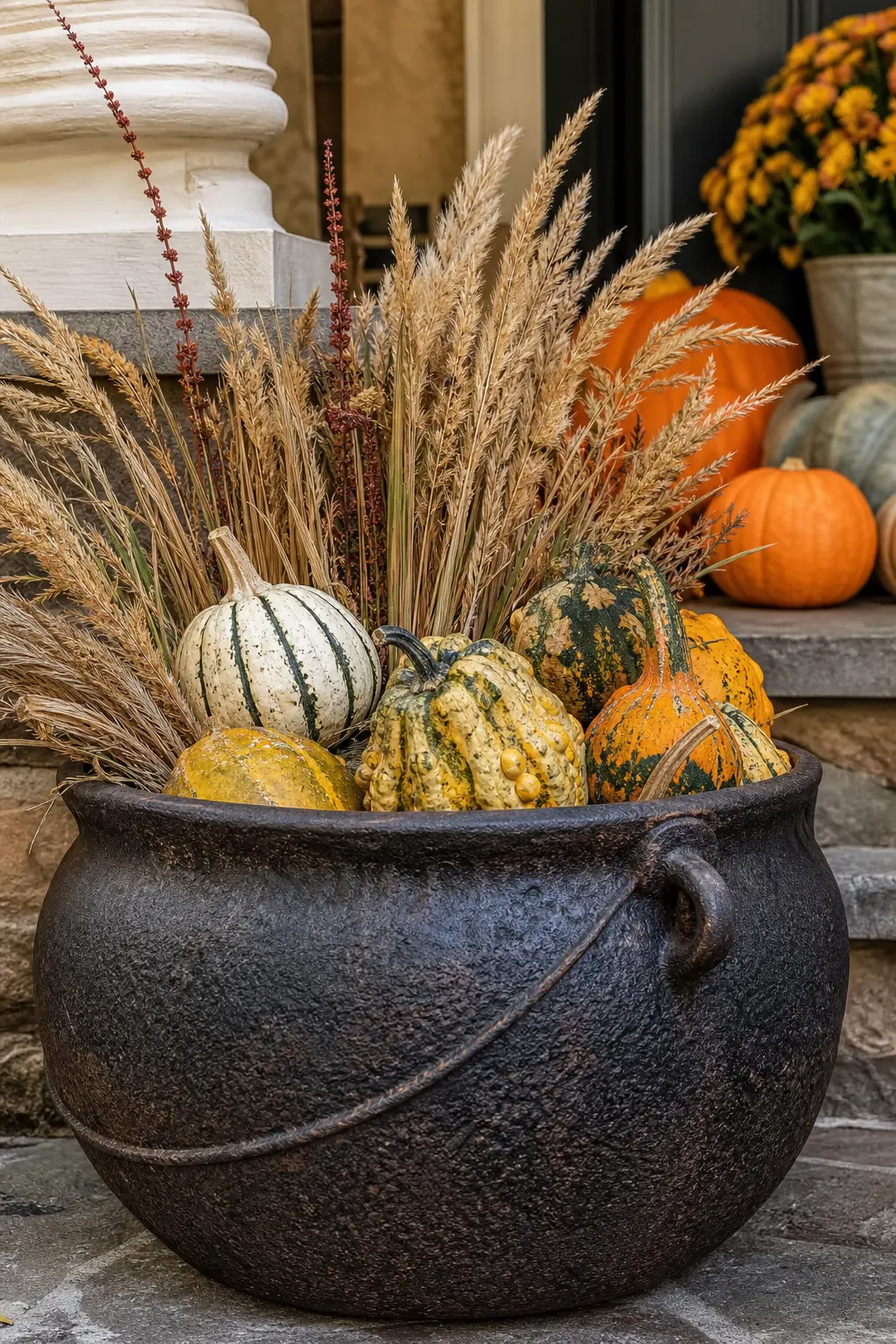
Cast Iron Pot Filled with Gourds and Dried Grasses
A cast iron pot is indestructible, weather-agnostic and improves its surroundings by virtue of pure material weight and honesty. Fill it with a loose mound of gourds and dried pampas or fountain grass stems cut short enough to rest inside.
The arrangement requires no water, no maintenance and no rethinking. If a gourd eventually softens, pull it out and replace it. Everything else in the pot is already dry and permanent.
🛍 Shopping guide
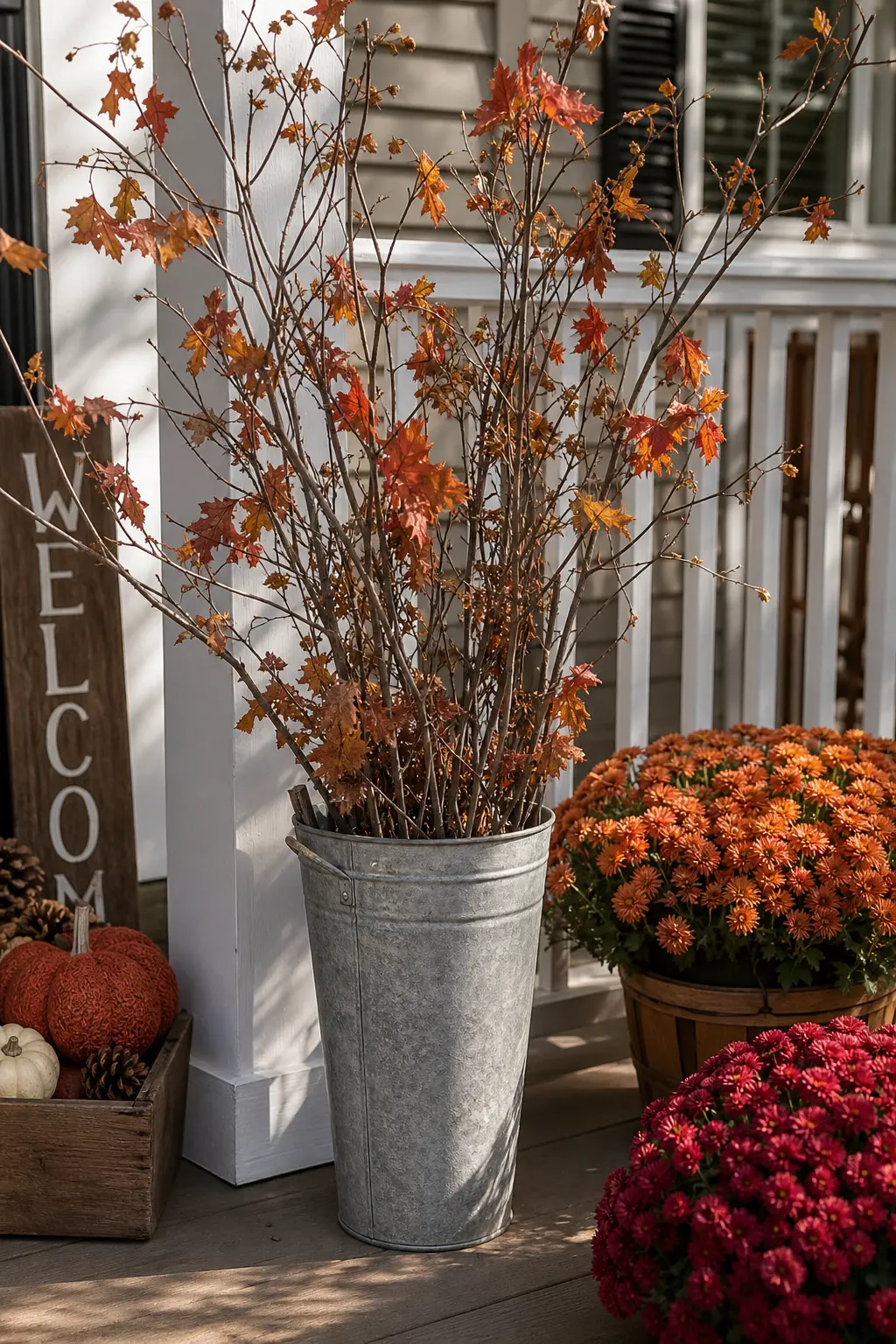
Galvanized Bucket of Branches by the Railing
A galvanized metal bucket, the kind sold in hardware and farm-supply stores, filled with bare or leafed branches by the railing is deliberately utilitarian. That is the appeal. It looks like it belongs to the house rather than to a shopping cart.
Use dogwood, birch, or oak branches. If they still hold dried leaves, even better. If the leaves eventually blow off, the bare branch structure still reads as intentional through November and into December.
🛍 Shopping guide
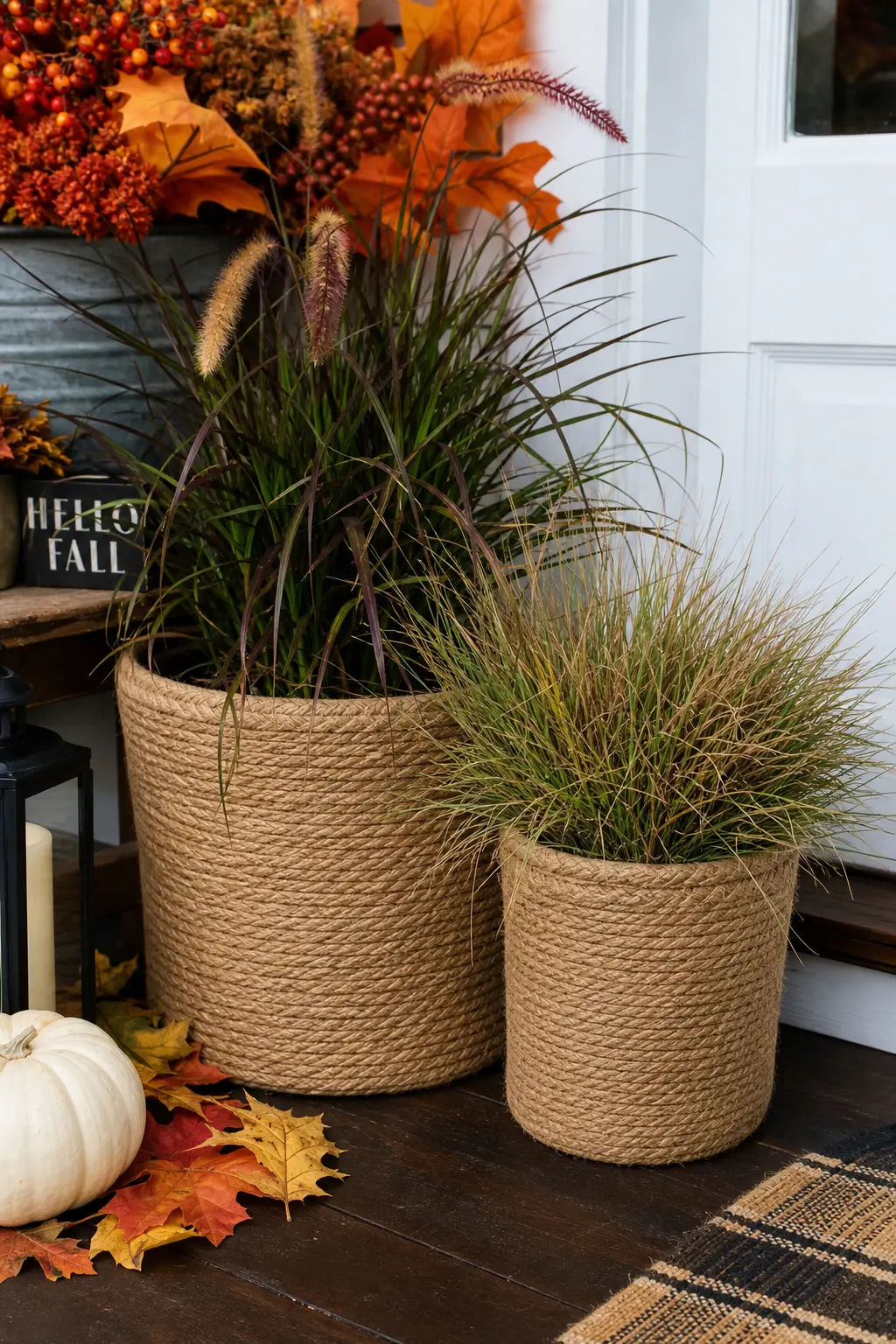
Rope-Wrapped Planters in Place of Plastic Pots
Rope-wrapped planters are the simplest upgrade to a porch that currently runs on black plastic nursery pots. The rope absorbs the visual noise of an ugly container and reads as a natural material that fits the rest of the palette.
Buy them already wrapped, or wrap a plain terra-cotta pot yourself with thick jute rope and a hot glue gun in one evening. The result survives outdoor conditions well. If the rope eventually loosens, a few new dots of exterior adhesive holds it.
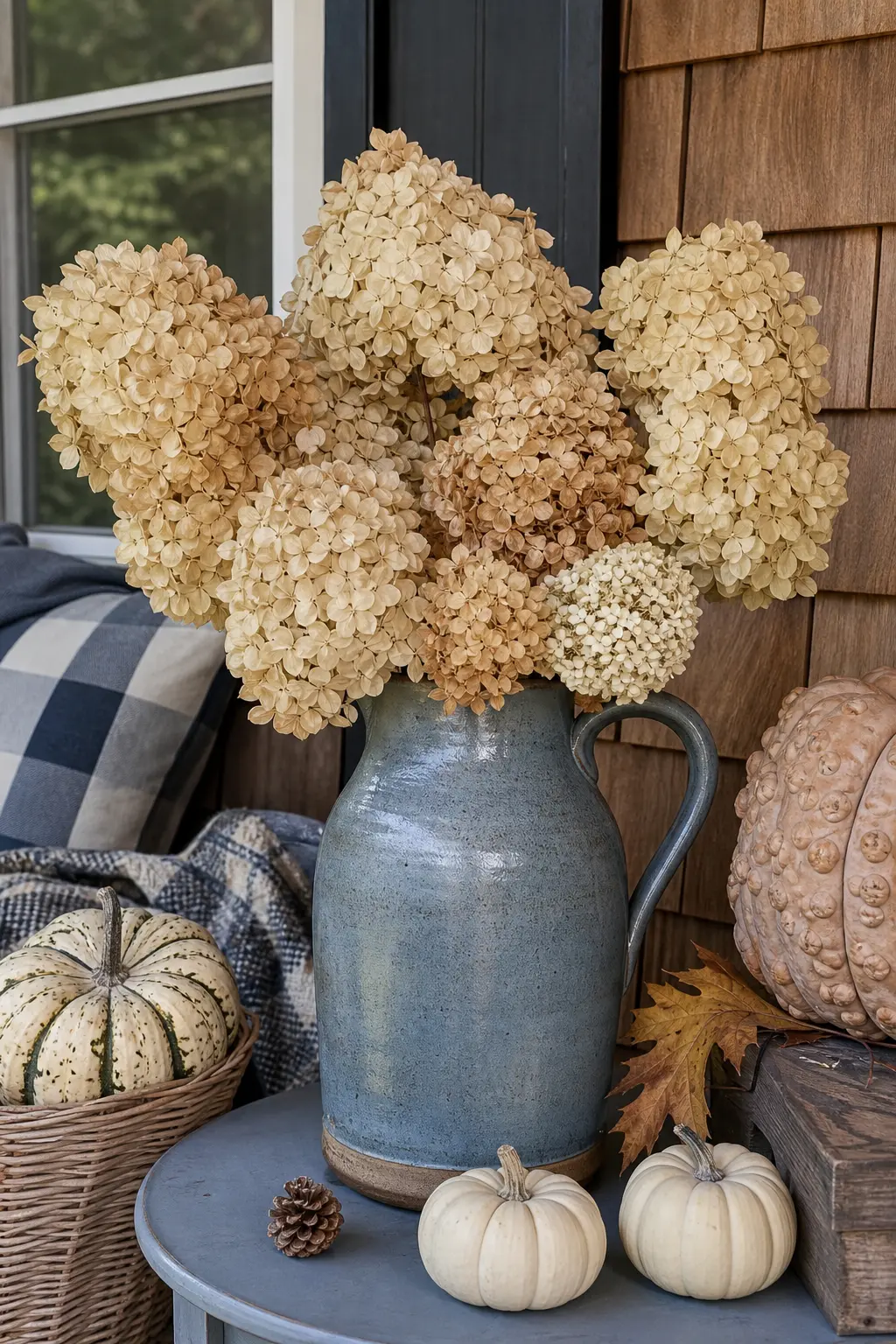
Dried Hydrangea in a Stoneware Pitcher
Dried hydrangea heads, left on the plant until they reach a papery, antique-cream state, then cut and arranged in a wide stoneware pitcher, hold their shape for months. They require nothing: no water, no misting, no schedule.
The pitcher does significant work here. A stoneware vessel in slate, cream or iron-brown elevates dried flowers from craft-room afterthought to editorial detail. Buy the pitcher before the flowers: the right vessel makes the whole thing work.
🛍 Shopping guide
Set a Palette That Carries the Season
A palette decision made once saves every later choice. The usual orange-and-black reads as Halloween-specific and needs to come down the moment November arrives. Burgundy, rust, warm gold, cream and slate gray are autumn-long colors that carry through to Thanksgiving without looking like you forgot to redecorate.
White pumpkins, dried wheat, stoneware and natural wood are neutral anchors that work inside any palette and do not read as a specific holiday.
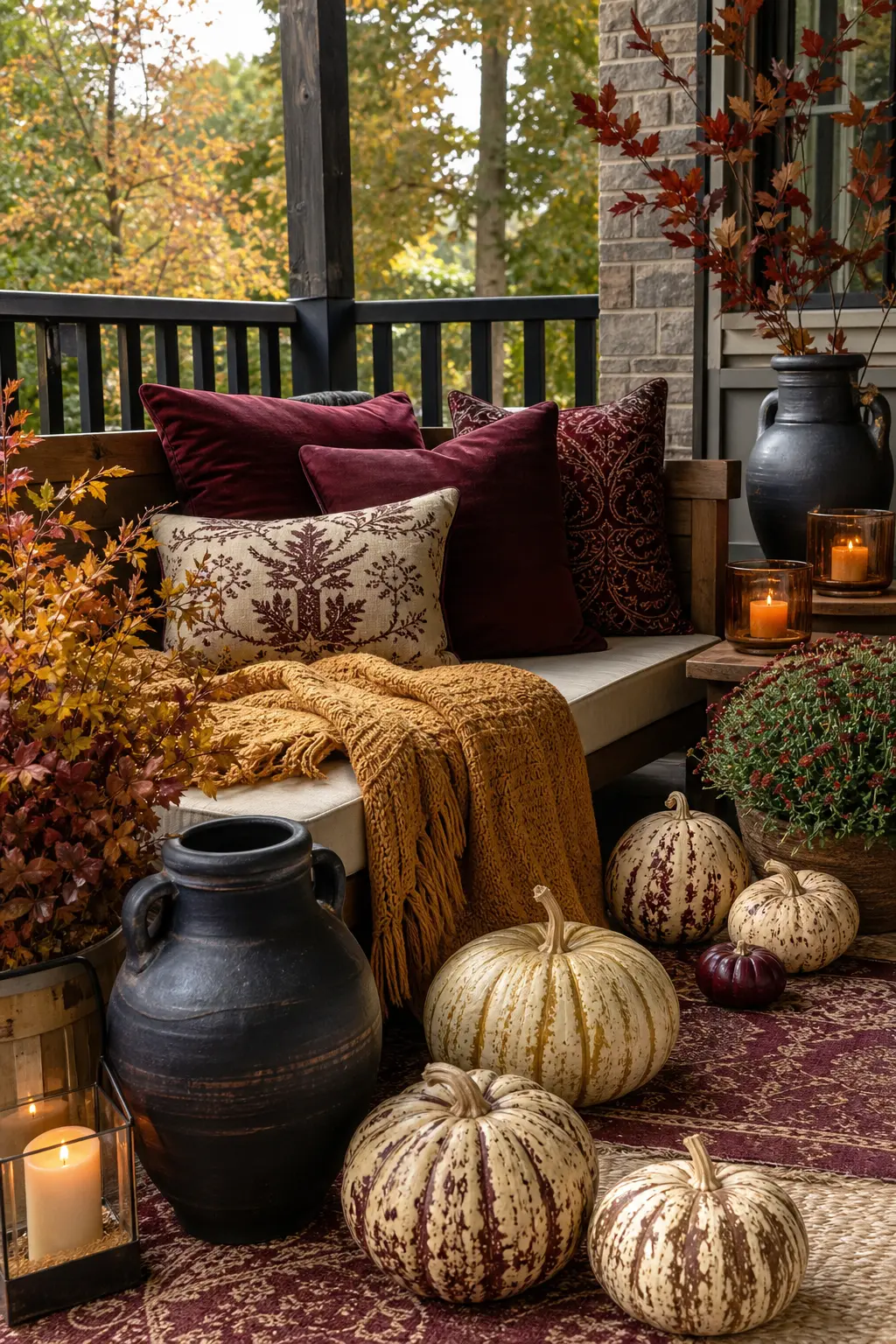
Deep Burgundy and Gold Palette Instead of the Usual Orange
Orange is the reflex choice for autumn and also the fastest to look tired. Burgundy, warm gold, cream and slate together create a palette that reads as autumnal from September through late November without shouting any particular holiday.
Apply the palette to the objects with the largest visual surface area first: the rug, cushions and blanket. Then carry it through the smaller pieces. One or two items outside the palette (a white pumpkin, a natural wood sign) act as breathing room and keep the arrangement from reading as a color theme rather than a composed space.
🛍 Shopping guide
Smart Structural Additions
Some of the longest-lasting fall porch elements are not decor at all: they are objects with a use that happen to look right. A stack of firewood, a wagon, a hay bale. They have visual weight, they are impervious to weather, and they feel gathered rather than purchased.
These are also the things that photograph well and invite a second glance from the street, because they suggest someone actually uses the porch rather than just styling it for pictures.
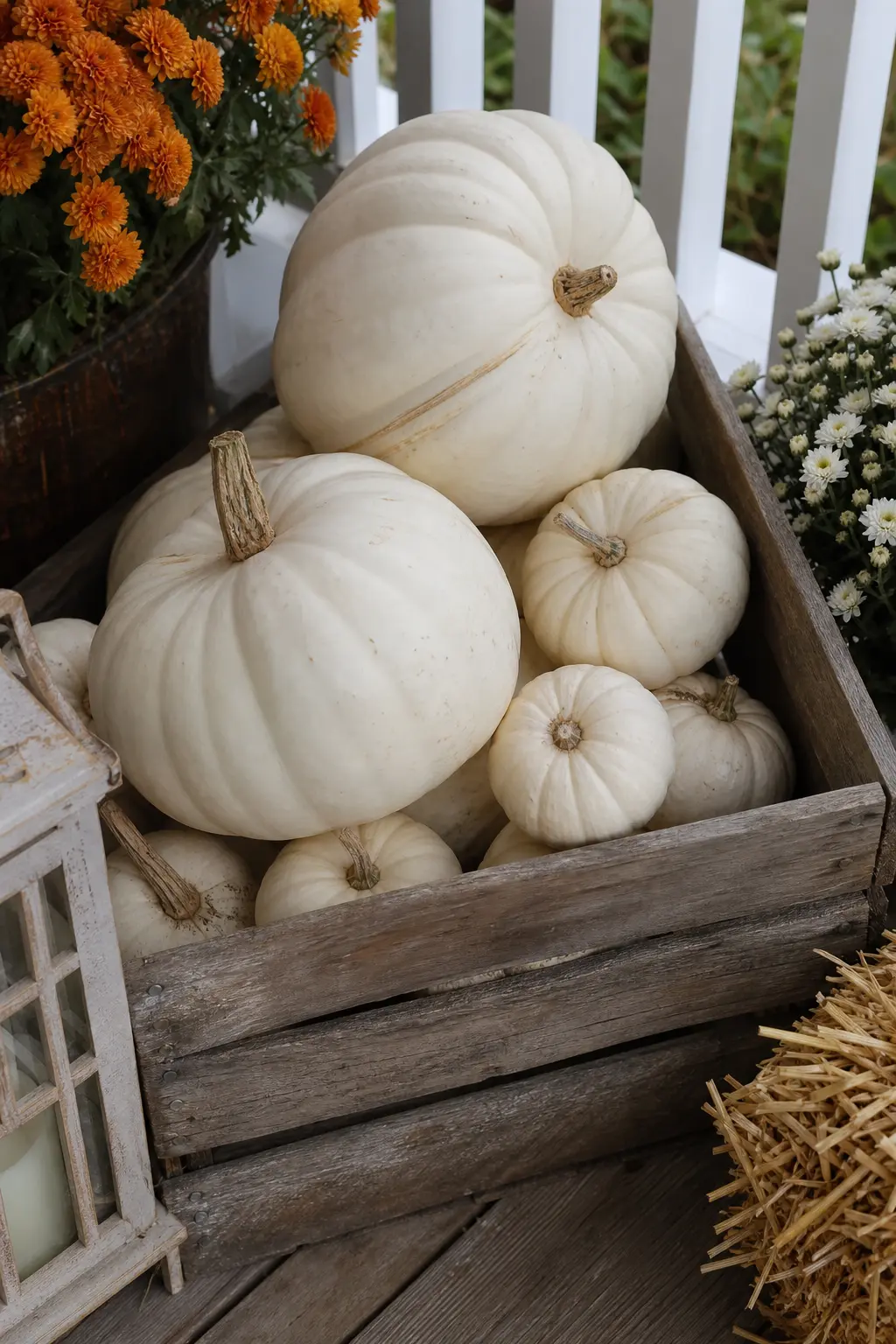
Wooden Crate Stacked with White Pumpkins
A weathered wooden crate turned on its side or stacked flat gives white pumpkins the elevation and framing they need to read as a composed grouping rather than a pile. White pumpkins hold their color longer than orange ones and suit any porch color from charcoal to sage to brick red.
Use an actual wood crate, not a box with applied stenciling. The real thing has honest wear that synthetic distressing cannot replicate, and it improves further with each season outside.
🛍 Shopping guide
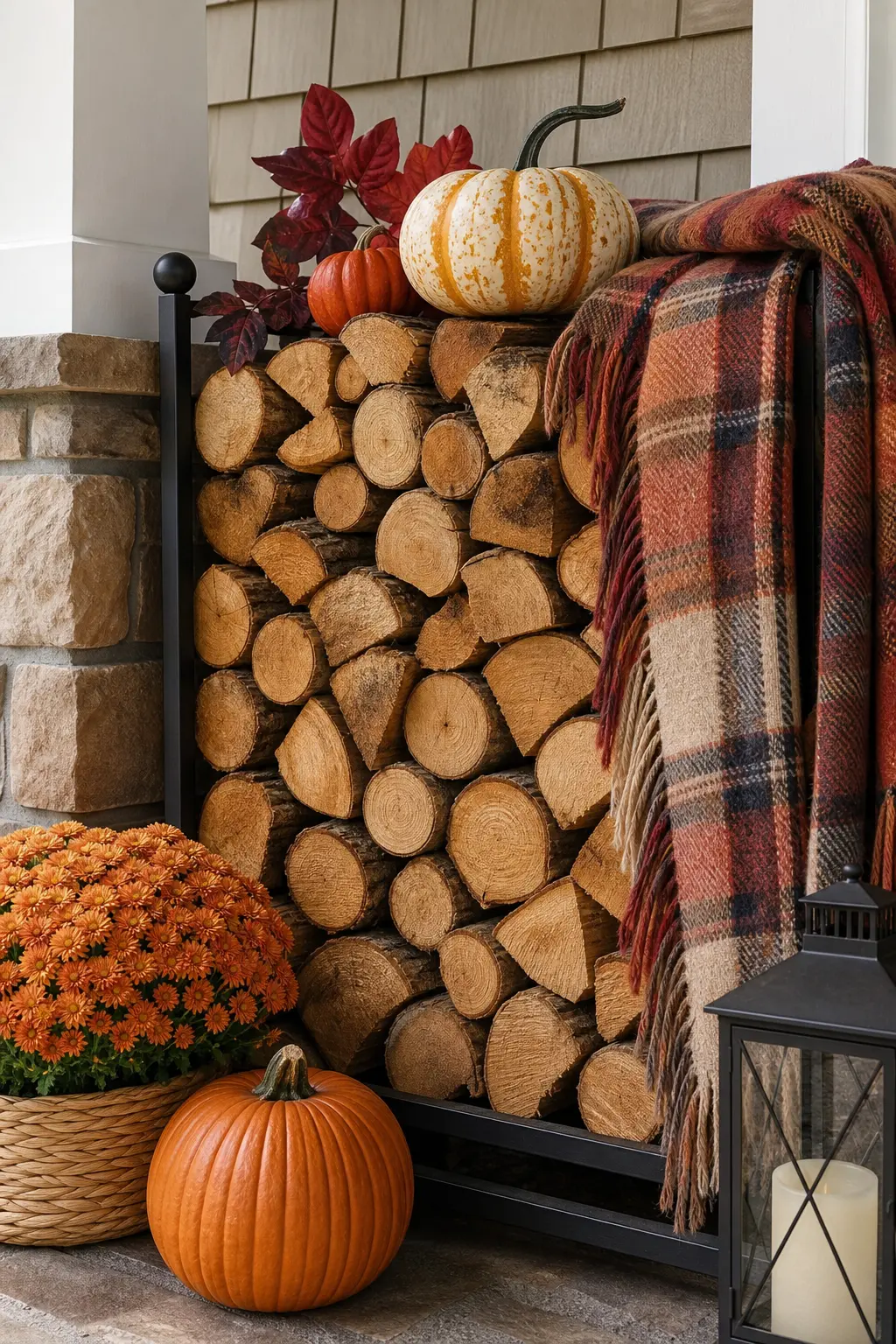
Firewood Stacked Neatly as a Decorative Element
A tight, neat stack of firewood beside the front door or along the porch wall is both practical and structurally interesting. The cross-section of log ends creates a repeating pattern that no purchased decoration can manufacture.
Stack it in a log rack or against a wall so it will not topple. Keep the top layer level. A wood stack that lists to one side reads as neglected; one that is plumb and level reads as architecture.
🛍 Shopping guide
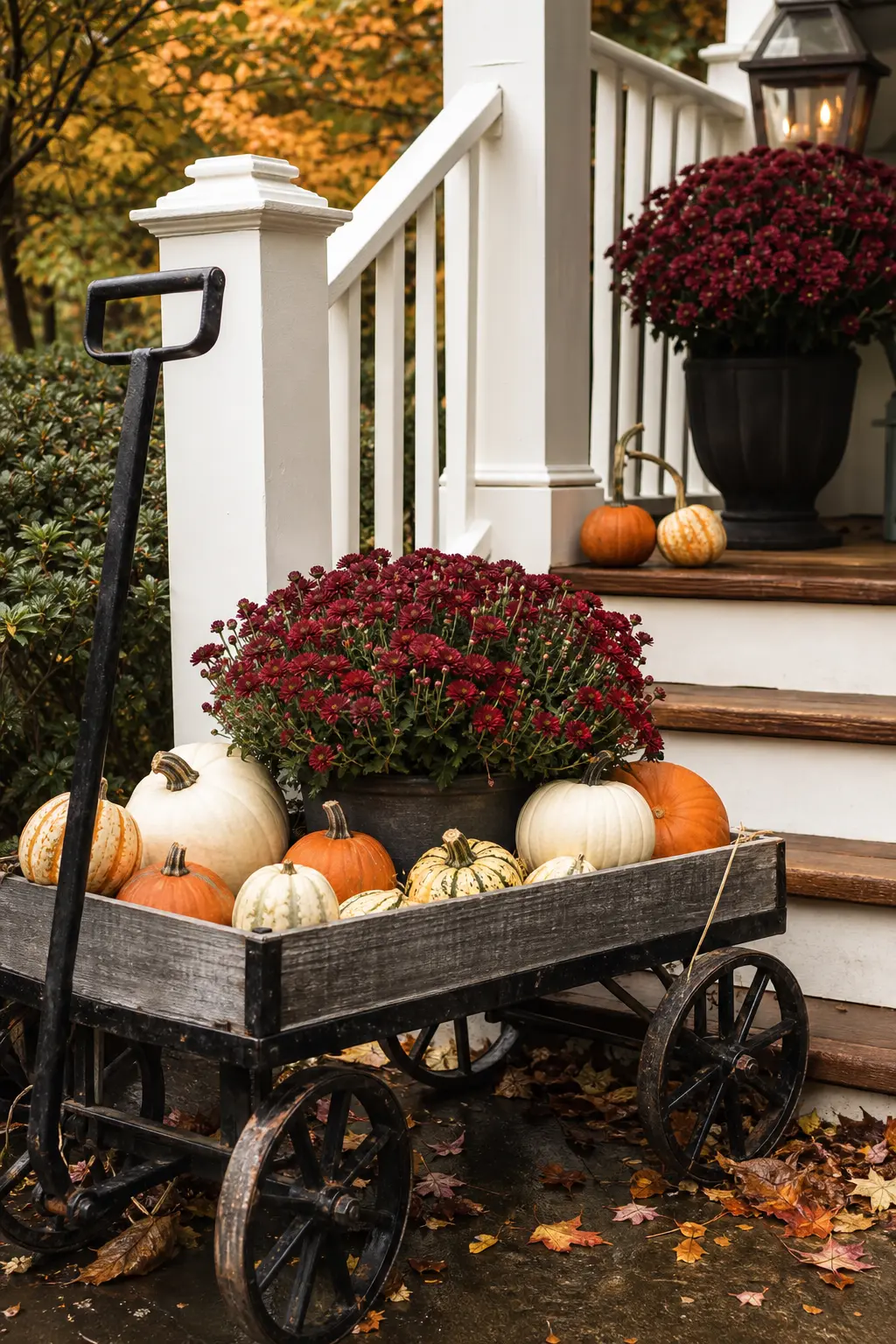
Wooden Wagon Parked at the Base of the Steps Holding Pumpkins and Mums
A wagon at the foot of the steps extends the porch’s visual territory down toward the path, which makes the whole entry feel more generous. Fill it with a mix of pumpkins and potted mums: the wagon holds the mums’ nursery pots inside it, which means they can be watered in place and replaced when they finish, without rebuilding the arrangement.
A metal or solid-wood wagon with sealed joints survives outdoor weather for the full season. A toy-grade wagon shows rust and flaking paint within two weeks of rain.
🛍 Shopping guide
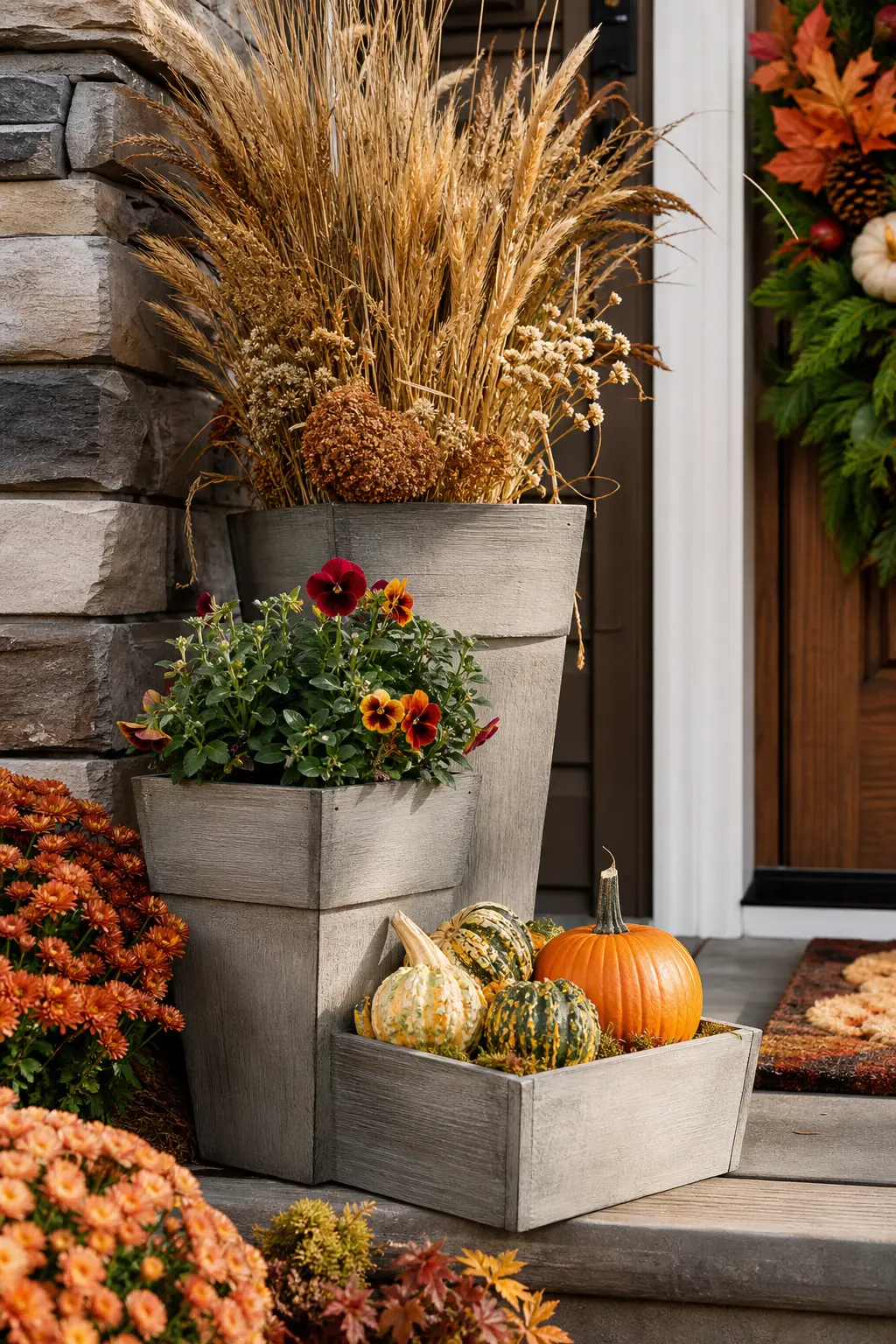
Layered Planter Built in Three Heights at the Top Step
At the top step, right beside the door, three containers at different heights function as a single layered planter without being a single container. The tallest holds dried grasses or wheat, the middle holds mums or ornamental kale, the lowest holds gourds or small pumpkins at ground level.
Heights can be created with a plant stand, a stacked brick, or a wood riser. The exact method is invisible; the effect reads as a composition built with intention.
🛍 Shopping guide
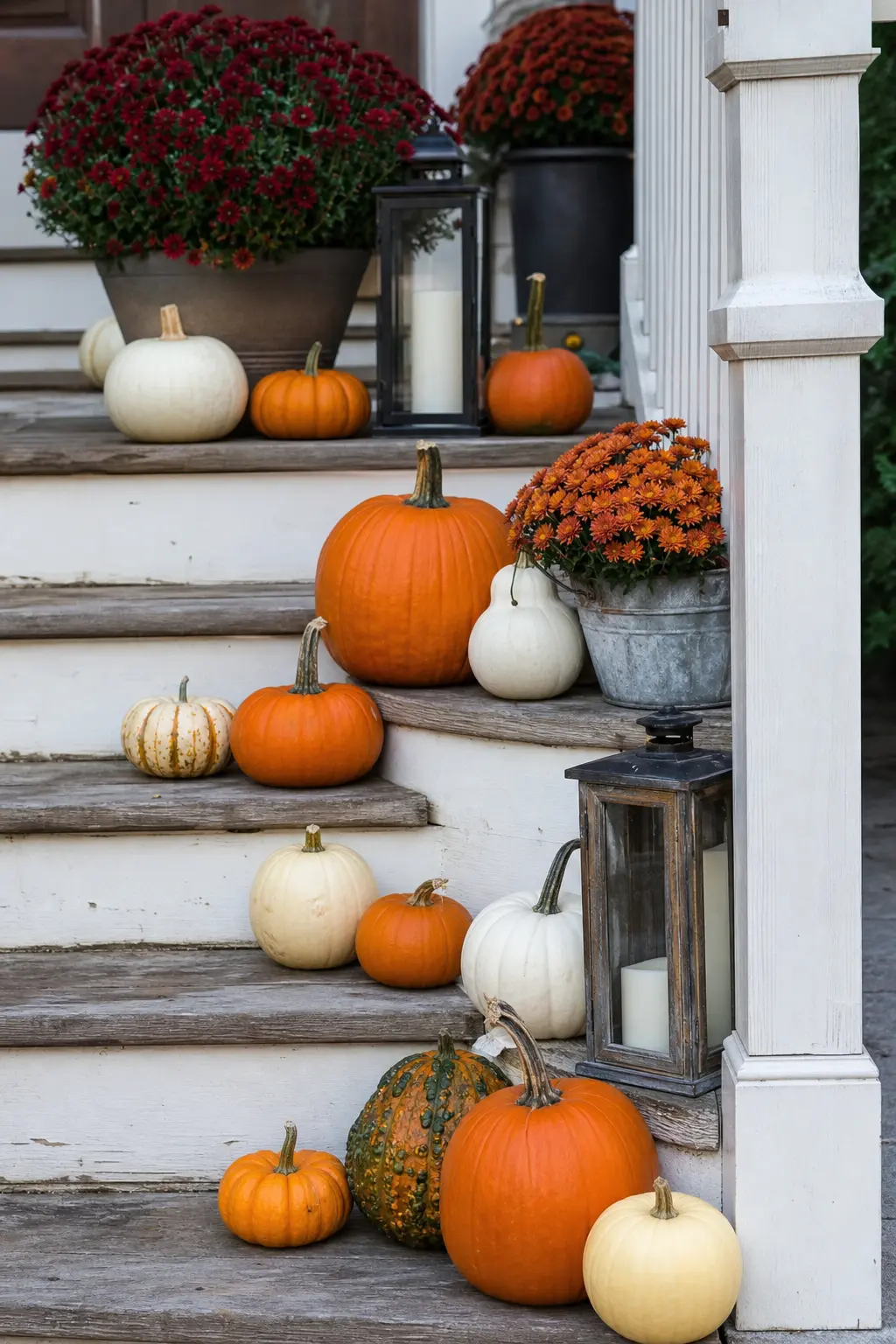
Pumpkins Scattered Unevenly Rather Than Lined Up in a Row
A row of evenly spaced pumpkins along a step edge is the default, and the default is usually the least interesting option. Cluster them instead: three together on one side, one alone on another, one raised on a crate, one at ground level. The eye travels, which holds attention longer.
Odd numbers (three, five, seven) are easier to arrange because they resist the visual temptation to split into equal halves. Start with the largest and work outward from there.
🛍 Shopping guide
Finishing Details That Earn Their Place
Small details read at close range, when a visitor is actually standing at the door. A coir mat, a copper pot, a pinecone bowl: none of these cost much, but each one signals that the porch was considered all the way to the edges, not just in the hero shot.
Keep the number of small details low enough that each one can be seen. Three well-chosen pieces beat ten competing ones every time.
Pinecone Bowl on the Side Table
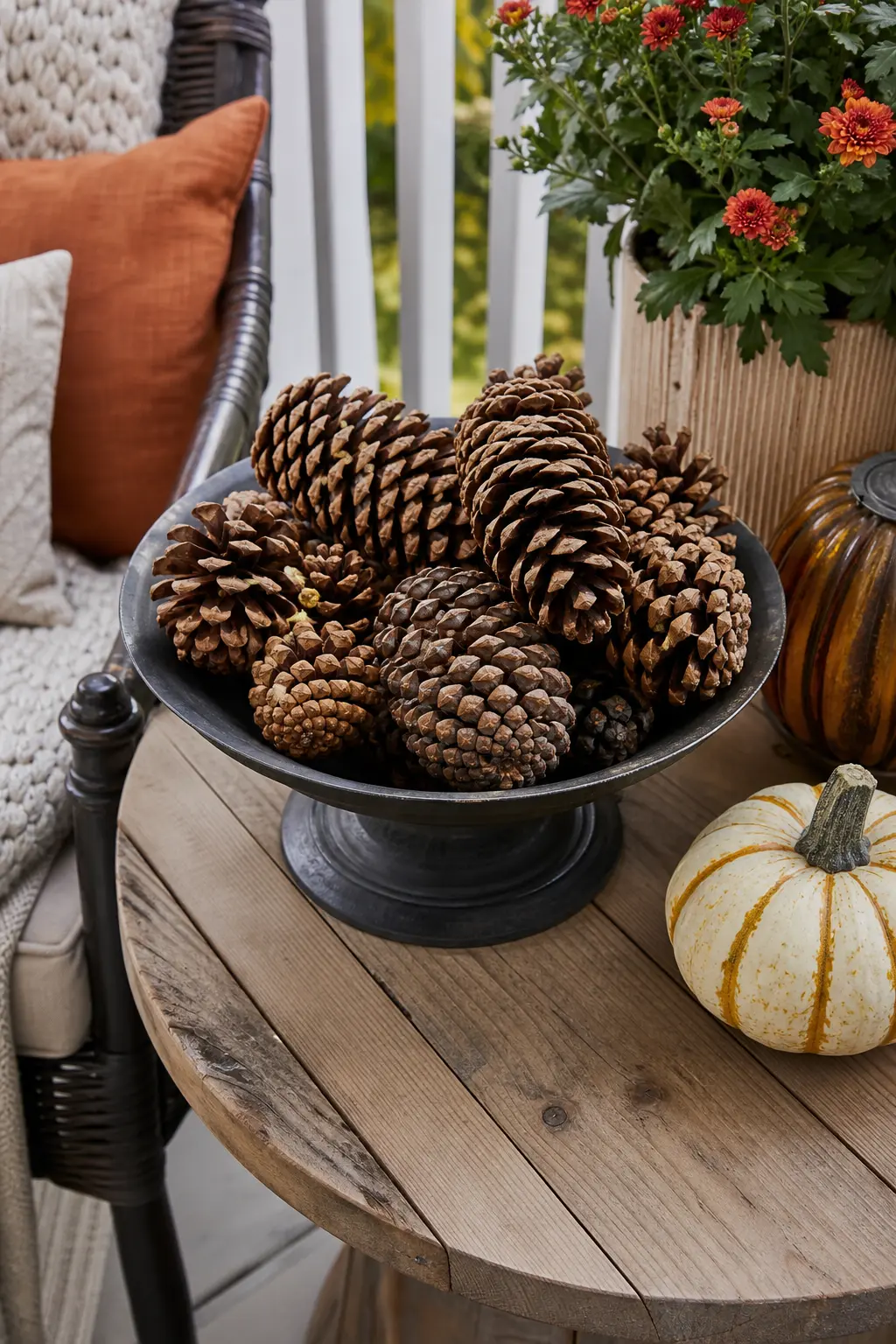
A wide, low bowl filled with pinecones on the porch side table is three seconds of effort and lasts indefinitely. Pinecones close in humidity and open in dry air: that movement is legitimately interesting, costs nothing and requires nothing.
Use a bowl in iron, stoneware or wood that can stay outside. A ceramic bowl in an indoor glaze chips at the rim from temperature fluctuations. Choose matte, thick-walled or natural-material vessels for anything that stays on a porch through the season.
🛍 Shopping guide
Doormat Swapped for a Natural Coir One
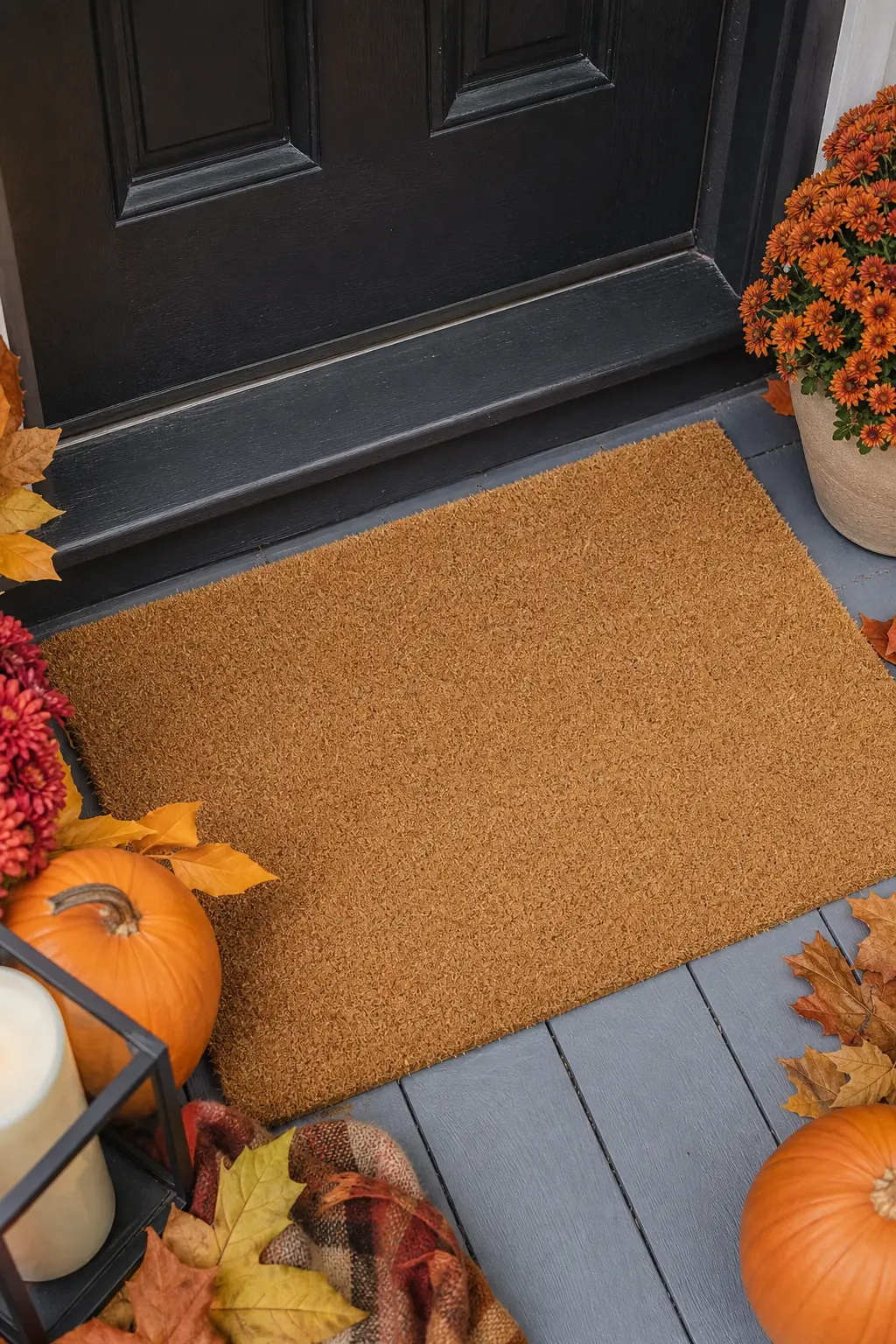
A coir doormat is the easiest single upgrade on this list. It costs less than most of the pumpkins, sits at exactly the right visual position for street-level reading, and lasts two to three seasons with nothing more than occasional shaking.
Choose a simple natural-fiber mat without printed graphics if the goal is longevity. A plain coir mat suits November and December as readily as September. A mat printed with ‘HELLO FALL’ requires replacing the moment Thanksgiving passes.
🛍 Shopping guide
Apple Crate Stacked with Small Pumpkins
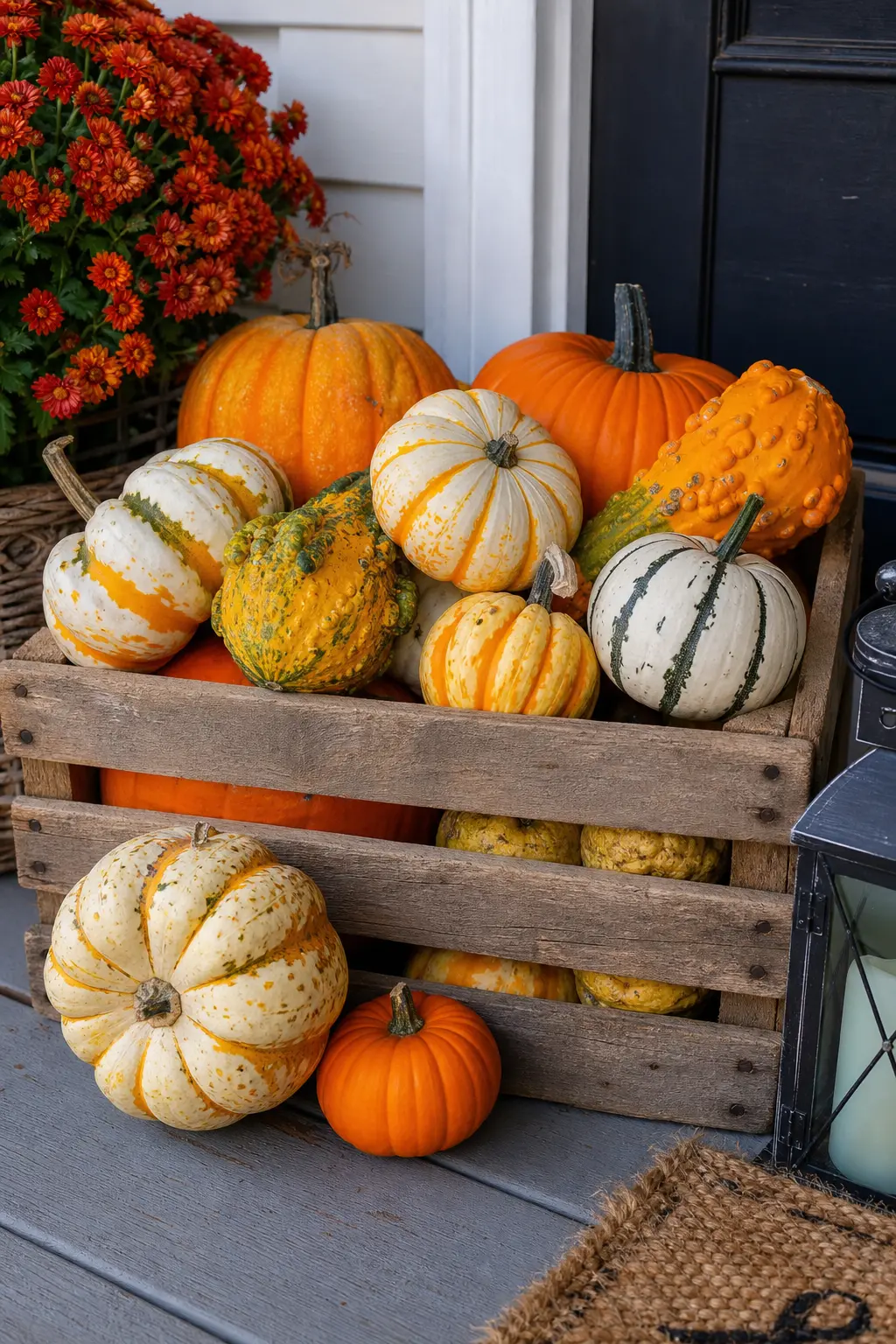
An apple crate, the kind with shallow slatted sides, stacked with small sugar pumpkins or gourds reads as effortlessly harvest-adjacent in a way that a purpose-built porch planner cannot achieve. The slats frame the contents; the pumpkins do not need anything else around them.
Stack two crates for height, or set one flat on the porch floor and let the pumpkins overflow the front edge slightly. The slight overflow is the detail that makes it look like someone placed them by hand rather than arranged them from a diagram.
🛍 Shopping guide
Copper Pot Planted with Ornamental Kale
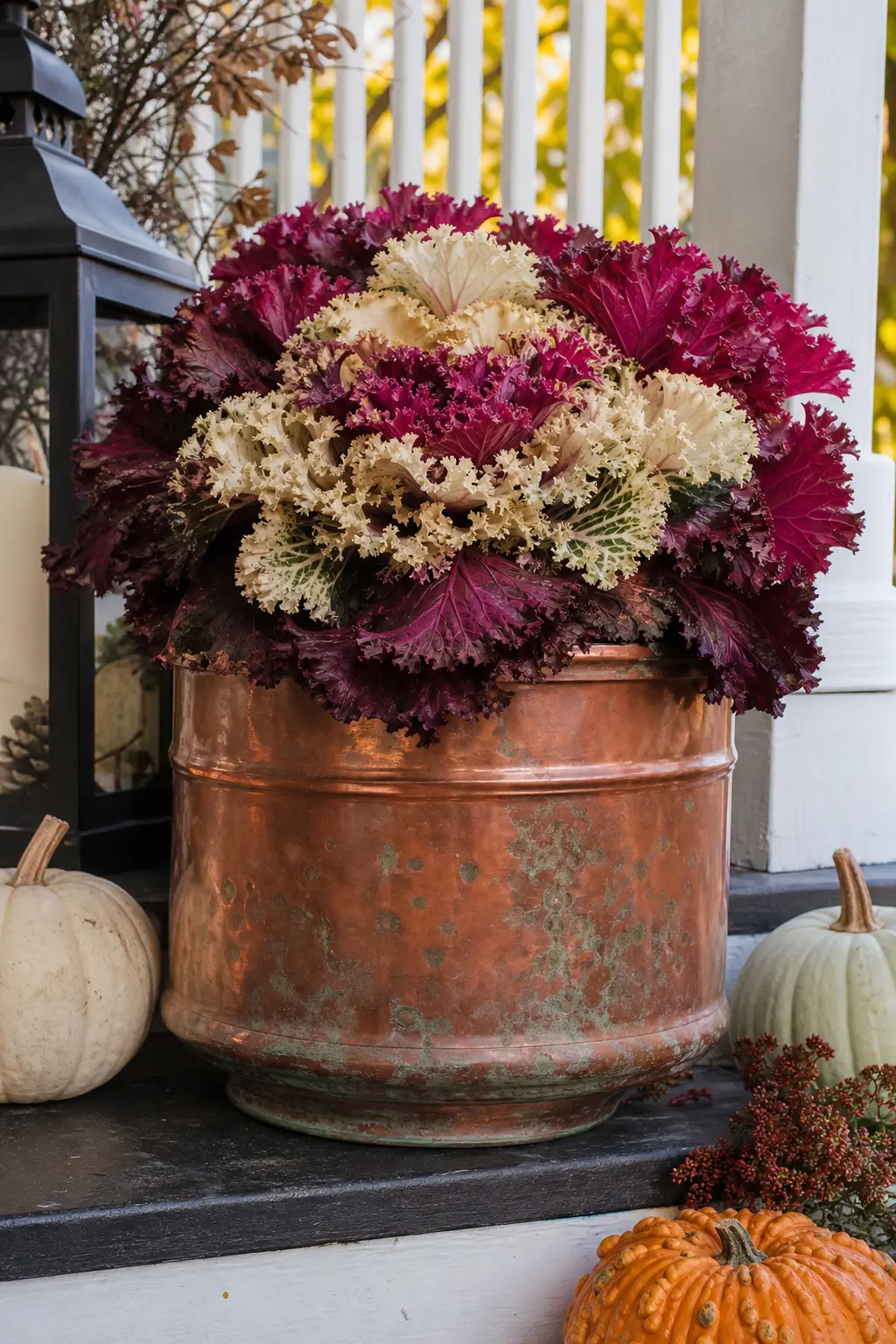
Ornamental kale is one of the few living plants that actually looks better after a frost. Cold temperatures intensify the pink and purple pigments at the center, and the outer leaves shift to blue-green. Plant it in a copper or aged-brass pot and it looks more expensive than it is.
Copper develops patina in the rain and that patina is the point. Do not seal it. The green-tinged surface that develops by week four is exactly the right finish for this combination of materials.
🛍 Shopping guide
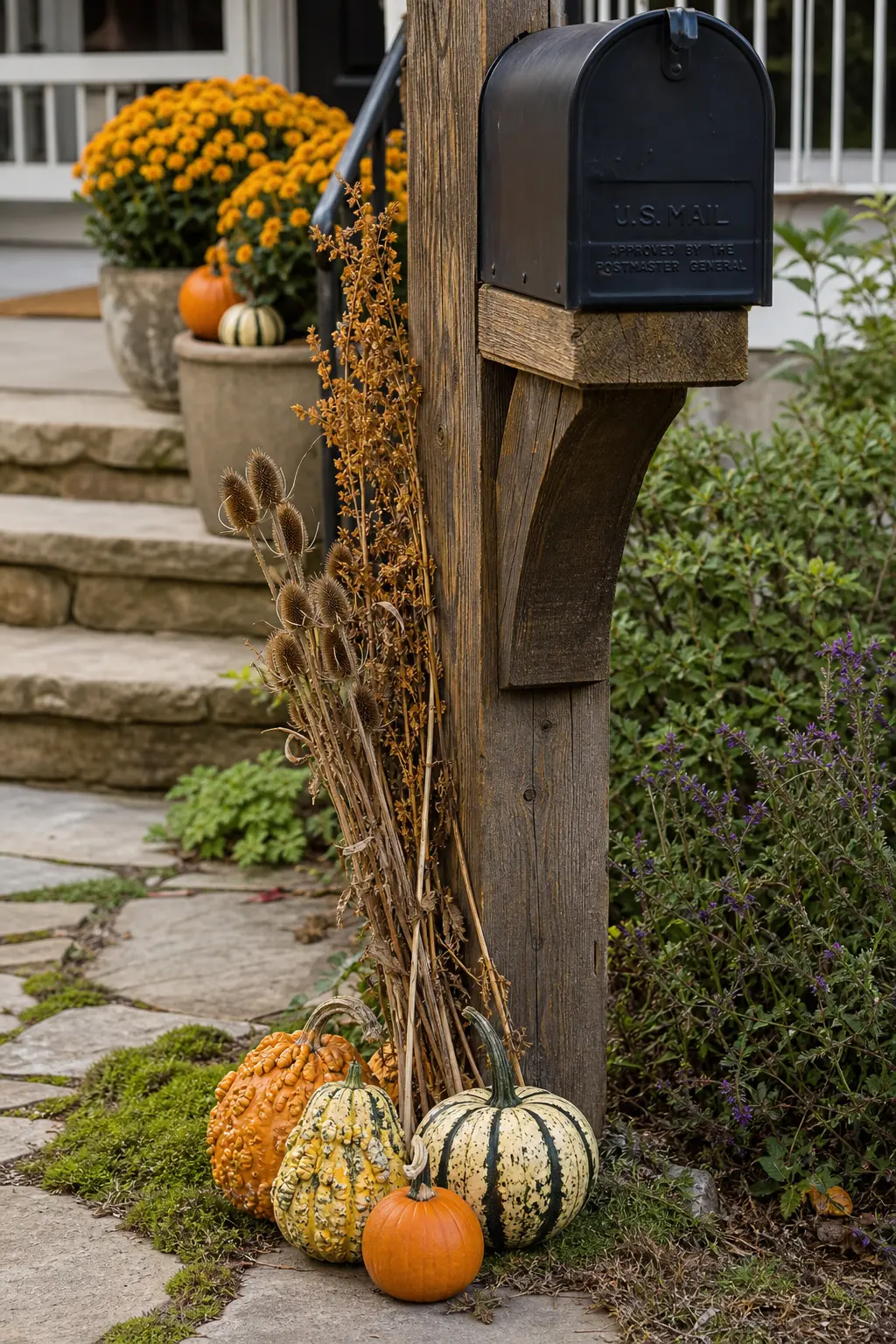
Mailbox Base Decorated with a Small Gourd Cluster and Dried Stems
The mailbox post is the first thing a visitor passes and usually the most ignored. A small cluster of gourds tucked at the base and a few dried stems leaned against the post extends the fall arrangement from door to street without adding work or expense.
Skip floral wire and glue guns. A simple grouping of objects that are too heavy to blow away holds without fastening. Three gourds of different sizes touching the post base, two dried stems leaned against it: done.
🛍 Shopping guide
One Last Thought Before You Shop
Buy the natural-fiber doormat, the rope-wrapped planter and the stoneware pitcher once, and they come back out next autumn without a second thought. Trend-specific decor bought for a single season rarely survives storage intact. The investment calculation runs differently when the item has a ten-year lifespan.
Frequently Asked Questions
How do I keep pumpkins from rotting on the porch?
Keep them off the ground by setting them on a wood riser, brick or small platform so air circulates underneath. Avoid setting them directly on damp concrete or wood. Uncarved pumpkins held this way last four to six weeks in cool autumn temperatures without treatment.
What fall porch decor materials last the longest outdoors?
Dried botanicals (wheat, corn stalks, oak leaves, hydrangea), cast iron, galvanized metal, stoneware, natural rope, solid wood and gourds all outlast fresh flowers and most synthetic materials. These are the elements worth investing in because they return each season.
Can I use indoor throw pillows and blankets on a covered porch?
On a fully covered porch with limited weather exposure, indoor textiles survive short stints. For anything left outside for weeks, choose outdoor-rated fabrics: solution-dyed acrylic for covers and quick-dry foam or polyester fill for cushions. Indoor fabrics mold, fade and flatten faster than the season runs.
How do I stop the porch from looking too Halloween-specific?
Avoid orange-dominant palettes, carved jack-o-lanterns and novelty items. Stick to uncarved pumpkins, dried botanicals, natural fiber and a palette in burgundy, rust, cream and warm gold. These read as autumn rather than as any single holiday, and they carry comfortably from September to Thanksgiving.
What is the easiest fall porch upgrade if I only do one thing?
Swap the doormat for a plain natural coir one. It costs very little, requires no arrangement skill, sits at the exact point every visitor looks first, and stays relevant through the entire season without adjustment.

Twelve named Thanksgiving decorating themes, each built around one hero object. Pick the look that f
12 Kitchen Counter Styling Ideas That’ll Make You Actually Want to Cook (Number 7 Is a Game-Changer)
Real talk: your counters can look good AND be functional. Here’s how. Okay, confession time. F
35 fall decor ideas organized by room so you can pick one zone, shop it, and stop. Porch to bathroom
Leave a Reply