

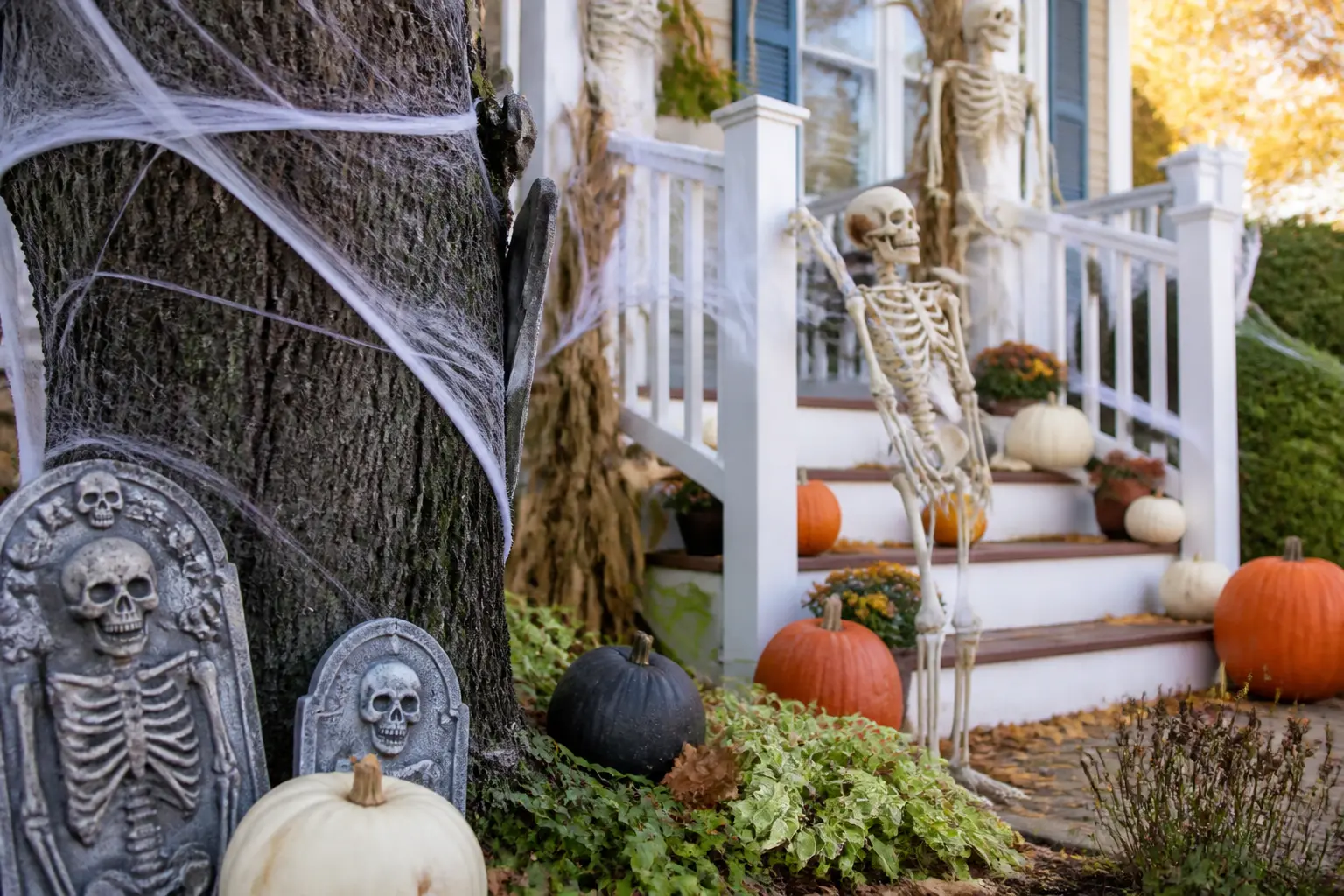
Props on a lawn are just stuff. A cauldron here, a skeleton there, a plastic crow on the porch rail: from the street it reads as clutter, not atmosphere. The fix is not more props. It is a story.
Every entry below is a complete scene with named objects, a light source, and one detail that does the storytelling. A passing car should be able to read it. A trick-or-treater at the gate should feel something happened here five minutes ago.
These scenes also survive a full October: weather-rated materials, nothing within two metres of the sidewalk so the scale registers, and one motion element per yard so the eye knows exactly where to land. If you are already throwing an outdoor gathering, 15 Spooky Outdoor Halloween Party Games pairs well with this.
This post contains affiliate links. If you buy through them, I may earn a small commission at no extra cost to you.
Abandoned Rituals
These scenes suggest someone was mid-task when something interrupted them. The power of each one is the unfinished gesture: a chair pushed back, a book left open, a tool set down in a hurry. That implied exit is what holds a viewer’s attention from the curb.
All three scenes in this group centre on a table or work surface raised off the ground, because ground-level arrangement disappears at street distance. Give every surface a dedicated light source so the objects cast shadows toward the viewer, not away.
The Interrupted Spell
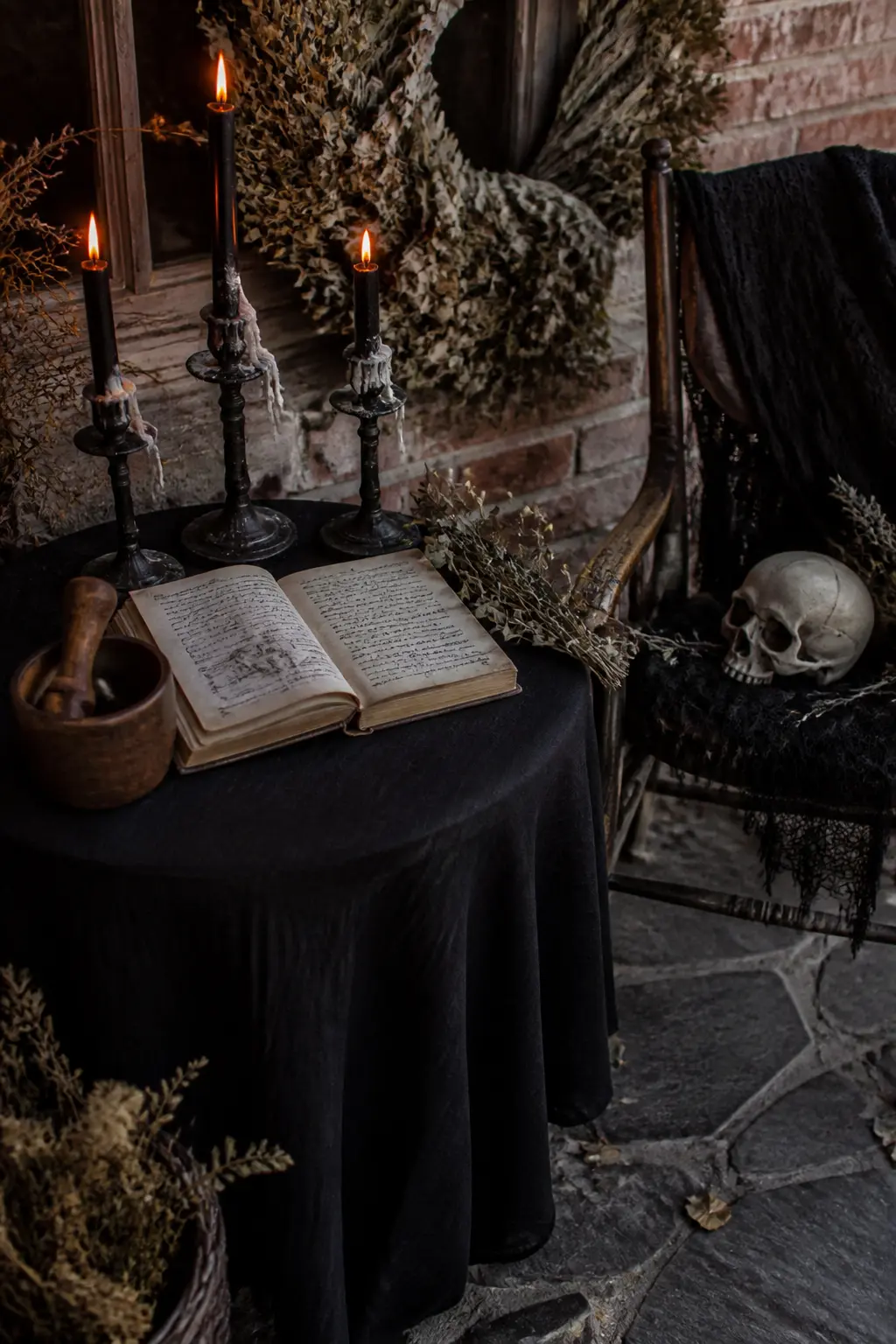
A round bistro table draped in black linen sits three metres back from the path. On it: an open grimoire weighted with a smooth river stone, three pillar candles in mismatched iron holders, and a mortar with dried herbs still inside it. A wooden chair is pushed back at an angle, as if someone stood up quickly.
The storytelling detail is the chair. Everything else could be a styled tablescap. The chair at that angle says someone left in a hurry, and the viewer’s brain fills in why.
Use a single battery lantern hung from a shepherd’s hook directly above the table. The downward light casts the candle holders as long shadows across the cloth and makes the open book page glow from the street.
🛍 Shopping guide
The Alchemist’s Workbench
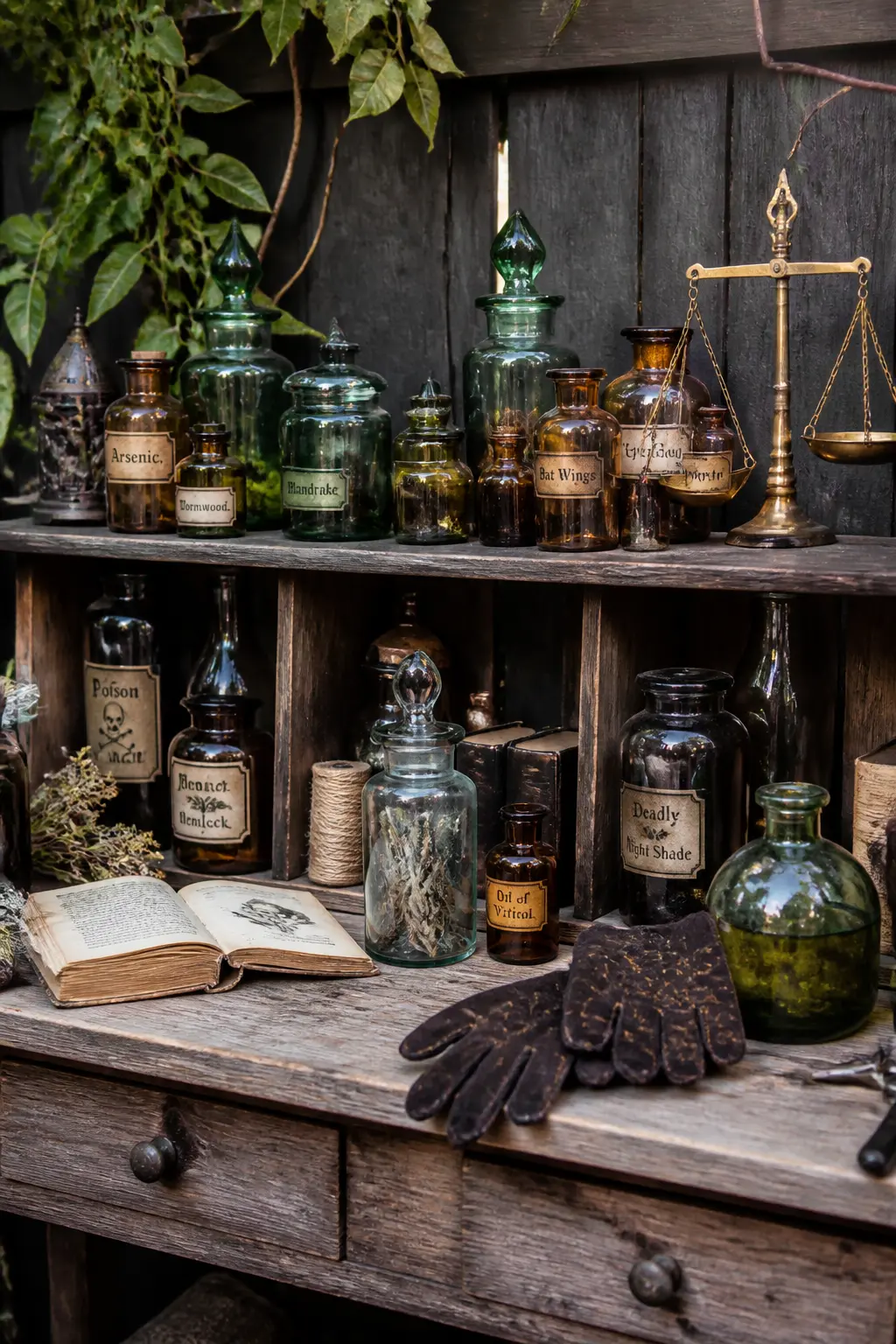
A potting bench or narrow console table against a fence becomes a laboratory mid-experiment. Line it with glass apothecary jars filled with coloured water (food dye keeps for weeks), add a brass scale tipped slightly to one side, and lay a pair of leather work gloves next to an unstoppered bottle.
The storytelling detail is the unstoppered bottle with a folded paper label tucked under it. It implies a decision being made, an ingredient measured out, a formula interrupted.
Angle a small solar spotlight up from below the bench surface so the coloured jars glow from inside. From the street the glowing amber and green bottles are visible before anything else, and the eye travels in to read the rest of the scene.
🛍 Shopping guide
The Map Left Behind
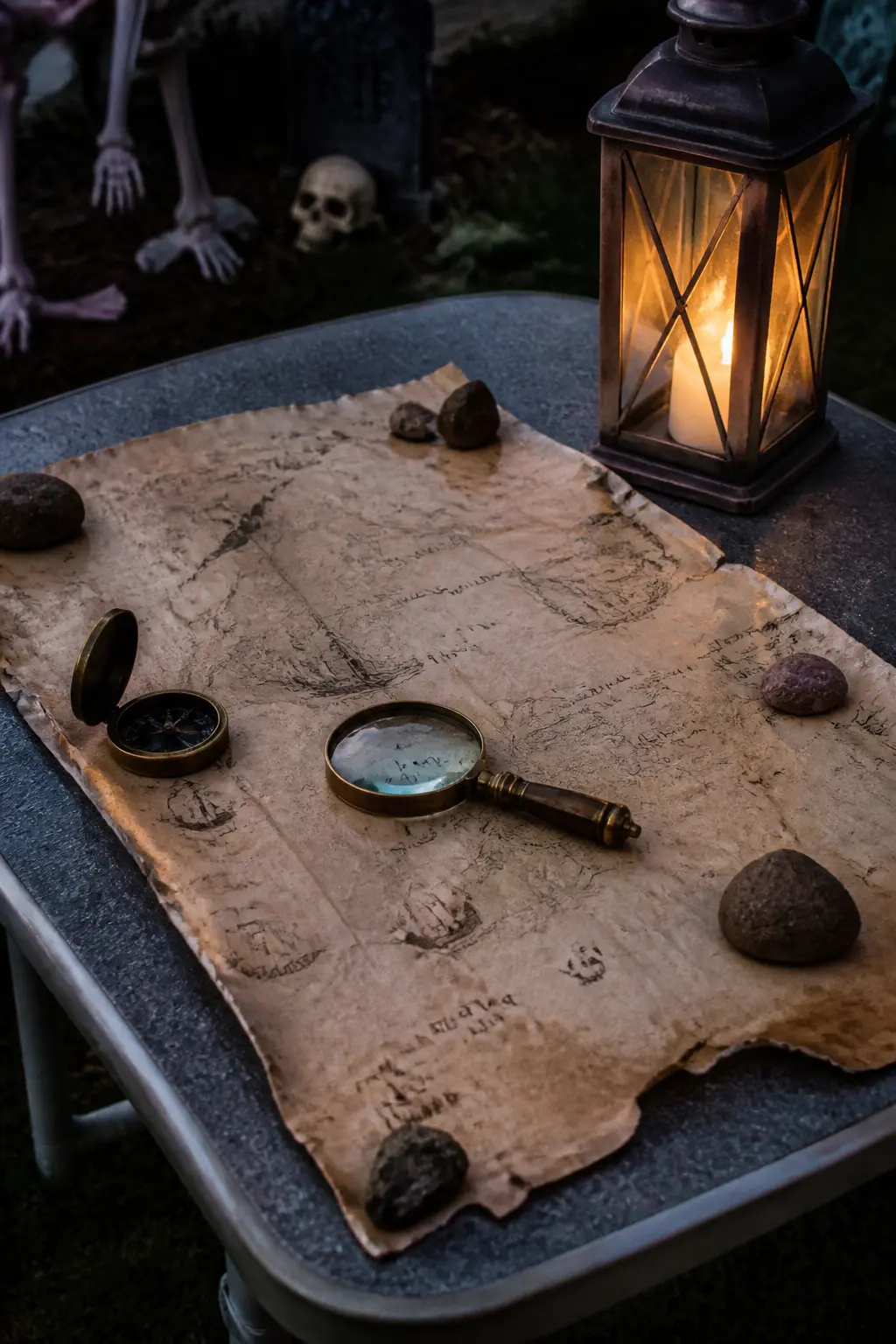
A folding camp table holds a large rolled parchment map (print any antique-style map on brown craft paper and tea-stain it), held open at the corners by four small stones. A magnifying glass rests on top. A lantern sits to the left of the map, its ring handle still swinging slightly. A compass lies face-up beside the stones.
The storytelling detail is the compass, because it implies orientation, a destination, a journey that stopped. Combined with the open map, it suggests someone was calculating a route moments ago.
This scene needs the motion element for the yard: hang a strip of dark cloth or a few crow feathers on a thin wire just behind the table. They move in any breeze and draw the eye without competing with the map itself.
🛍 Shopping guide
The Witches Were Here
A witch scene without a witch is more unsettling than one with a figure in a hat. The character is implied by what she left behind: her tools, her ingredients, her half-finished work. The viewer supplies the rest.
Use warm amber light for this group. Cold blue reads as ghost territory and muddies the botanical, apothecary feeling these scenes need.
The Cauldron Scene, Done Properly
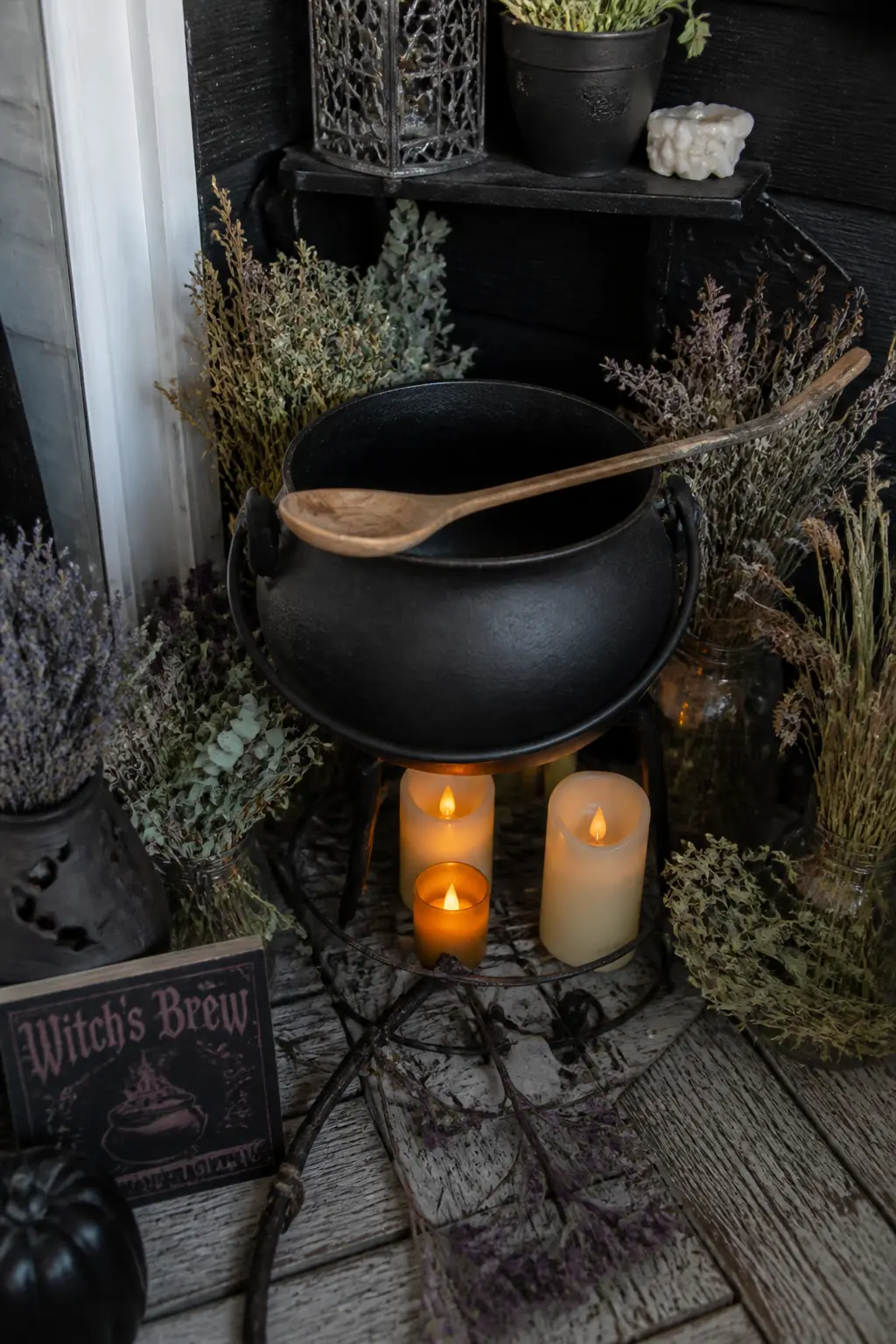
A cauldron is the most common prop in any yard and the most often wasted. Give it a context: set it on a low iron trivet over a cluster of electric pillar candles (never real flame outdoors for four weeks), surround the base with sprigs of dried rosemary and bay leaf, and place a long wooden spoon across the rim as if the stirring just stopped.
The storytelling detail is the spoon across the rim. That single horizontal line breaks the circle of the cauldron and says someone was here, actively, very recently.
Add a small chalkboard sign behind the cauldron with an ingredient list in cursive. From the street only the shape reads; up close the visitor gets a second reward. Never use readable text as the primary storytelling device, only as the bonus for the brave ones who come closer.
🛍 Shopping guide
The Herb Harvest
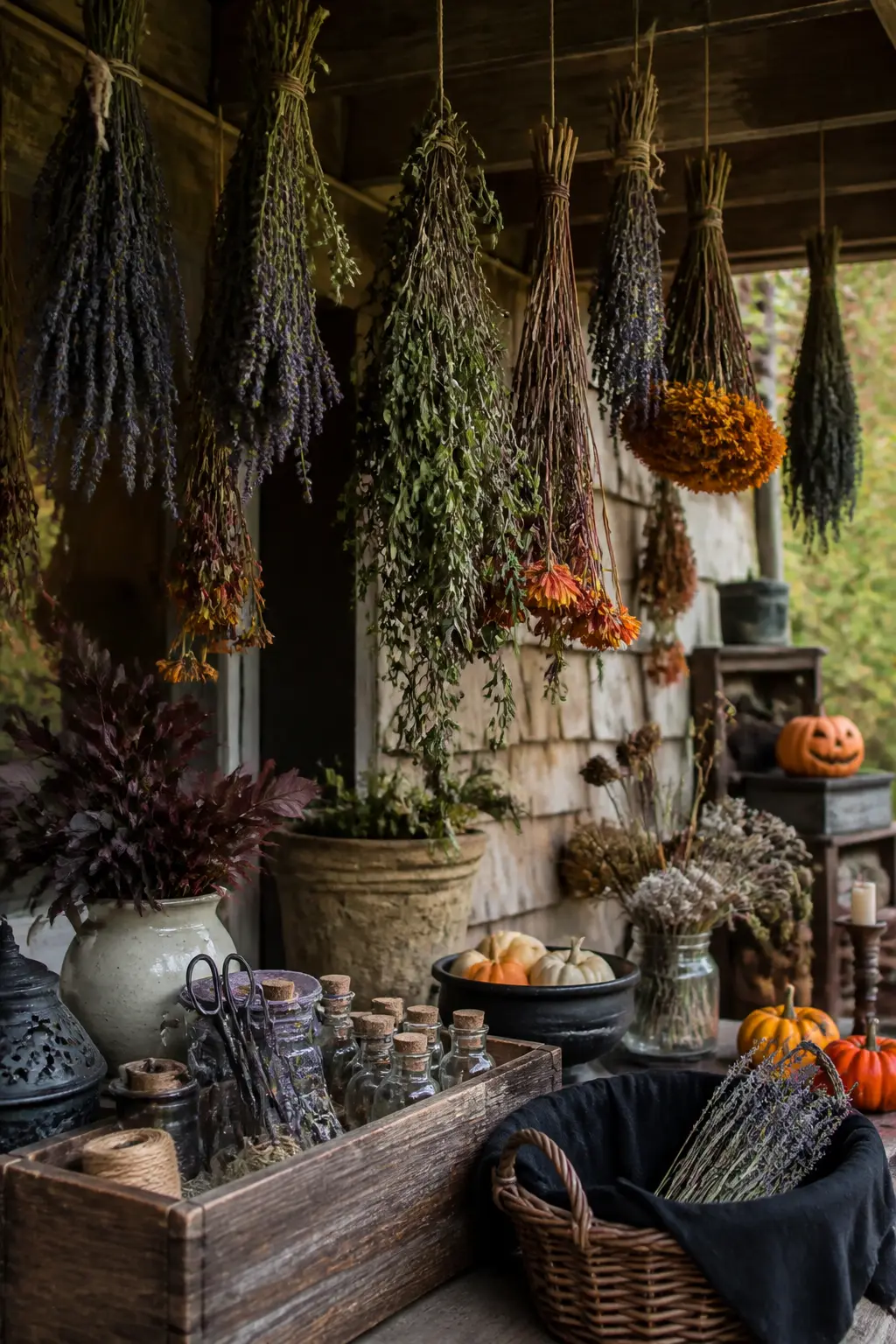
Bundles of dried herbs and flowers hang upside-down from a porch beam or low tree branch: lavender, rosemary, dried chillies, marigolds. Below them a wooden crate holds more bundled stems, a pair of scissors, and several small glass vials with cork tops. A wicker basket on the ground contains a dark cloth napkin as if something was just wrapped up and taken.
The storytelling detail is the basket with the cloth: the harvest is almost done, something was wrapped carefully and carried off. It reads botanical and slightly covert at the same time.
No artificial light needed for daytime. For evening, a single rope of warm Edison bulbs strung behind the hanging bundles silhouettes them beautifully and lasts the whole season.
🛍 Shopping guide
The Botanist’s Specimens
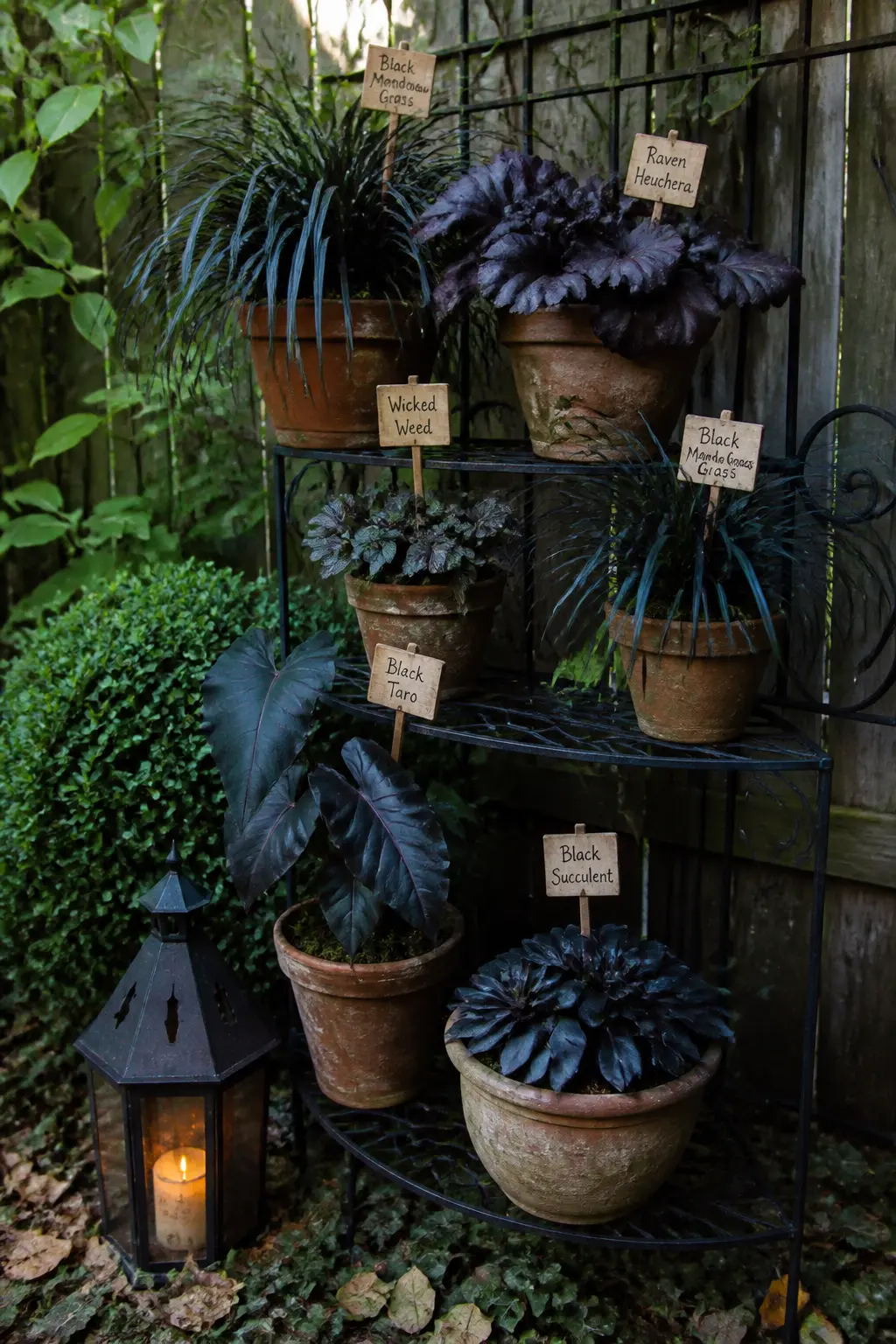
A tiered plant stand holds labelled terracotta pots of unusual-looking plants: black mondo grass, dark-leafed dahlias still going in early October, or ornamental cabbages sprayed lightly with black craft paint at the edges. Between pots, small hand-written tags on wooden stakes name each plant in Latin (invented or real, the viewer cannot tell).
The storytelling detail is the Latin name tags. They suggest a collector, a system, a knowledge that most people do not have. A plant stand alone is decoration; a categorised collection is a character trait.
This scene is weather-proof by design because it is plants. Replace anything that dies mid-October with ornamental kale, which thrives in the cold.
🛍 Shopping guide
Graveyard With Intention
A scatter of identical foam headstones reads as a garden centre display. A graveyard scene has hierarchy: a focal stone larger than the others, a fresh-turned mound of dark mulch, something left behind by a visitor. Depth matters more than quantity.
Keep the tallest stone at roughly chest height so it registers at fifty feet. Everything else steps down from there. One flickering lantern at the base of the focal stone is the only light this group needs.
The Remembered One
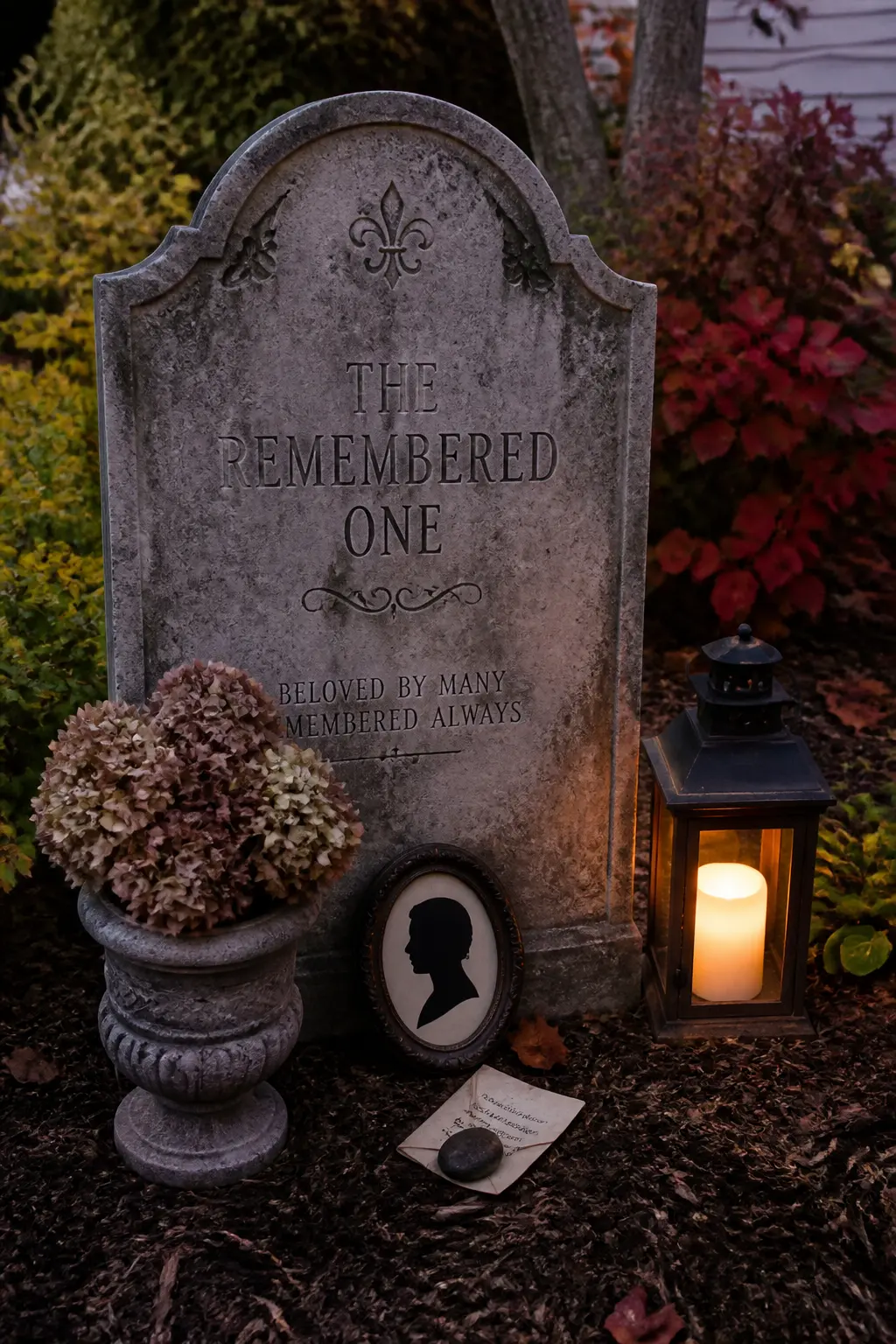
One large headstone prop stands centre-back of the plot, noticeably taller and older-looking than any others. At its base: a single dried flower arrangement in a stone-effect urn, a small framed oval portrait (a sepia-toned image of no one real, printed from a public domain archive and framed in black), and a folded letter weighted by a pebble.
The storytelling detail is the framed portrait. Suddenly there is a specific person remembered here, not a generic grave. The letter implies someone came and left something. The scene holds emotion rather than fear, and that contrast is more powerful than another skeleton.
Place a single flickering lantern at the left base of the headstone. The off-centre placement looks natural rather than theatrical.
🛍 Shopping guide
The Fresh Mound
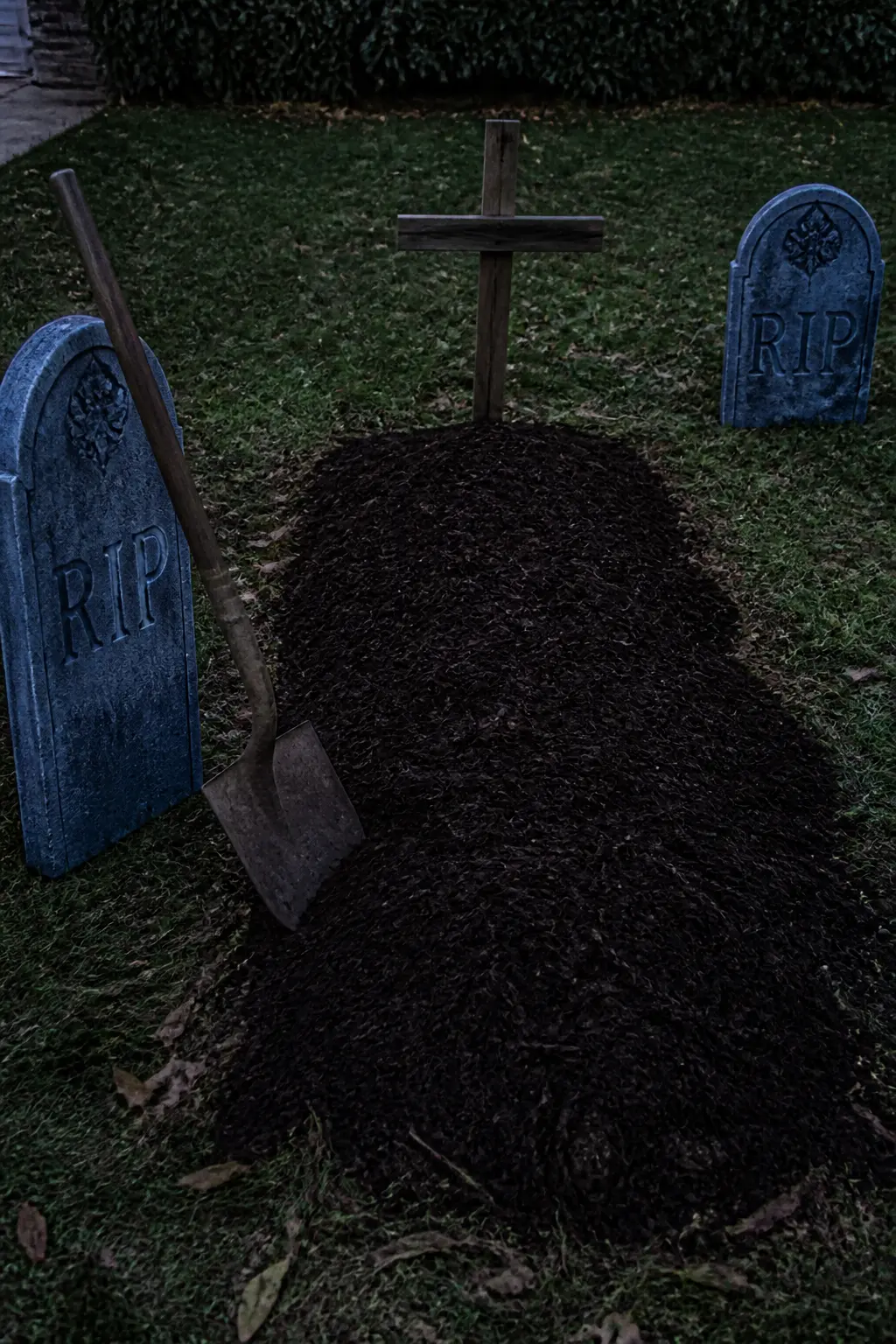
Between two smaller headstones, a raised mound of dark bark mulch about sixty centimetres long sits in a neat rectangle with a simple wooden cross at one end and a shovel leaning against the nearest stone. The mound is fresh: the mulch is dark and the edges are crisp. That is the whole scene.
The storytelling detail is the shovel. It has not been put away. Whoever dug here either left in a hurry or is coming back. The viewer decides which.
No lighting needed here: the dark mulch mound contrasts enough against lawn or pale gravel paths. Adding light to this one makes it theatrical. The restraint is the point.
🛍 Shopping guide
The Mourner’s Chair
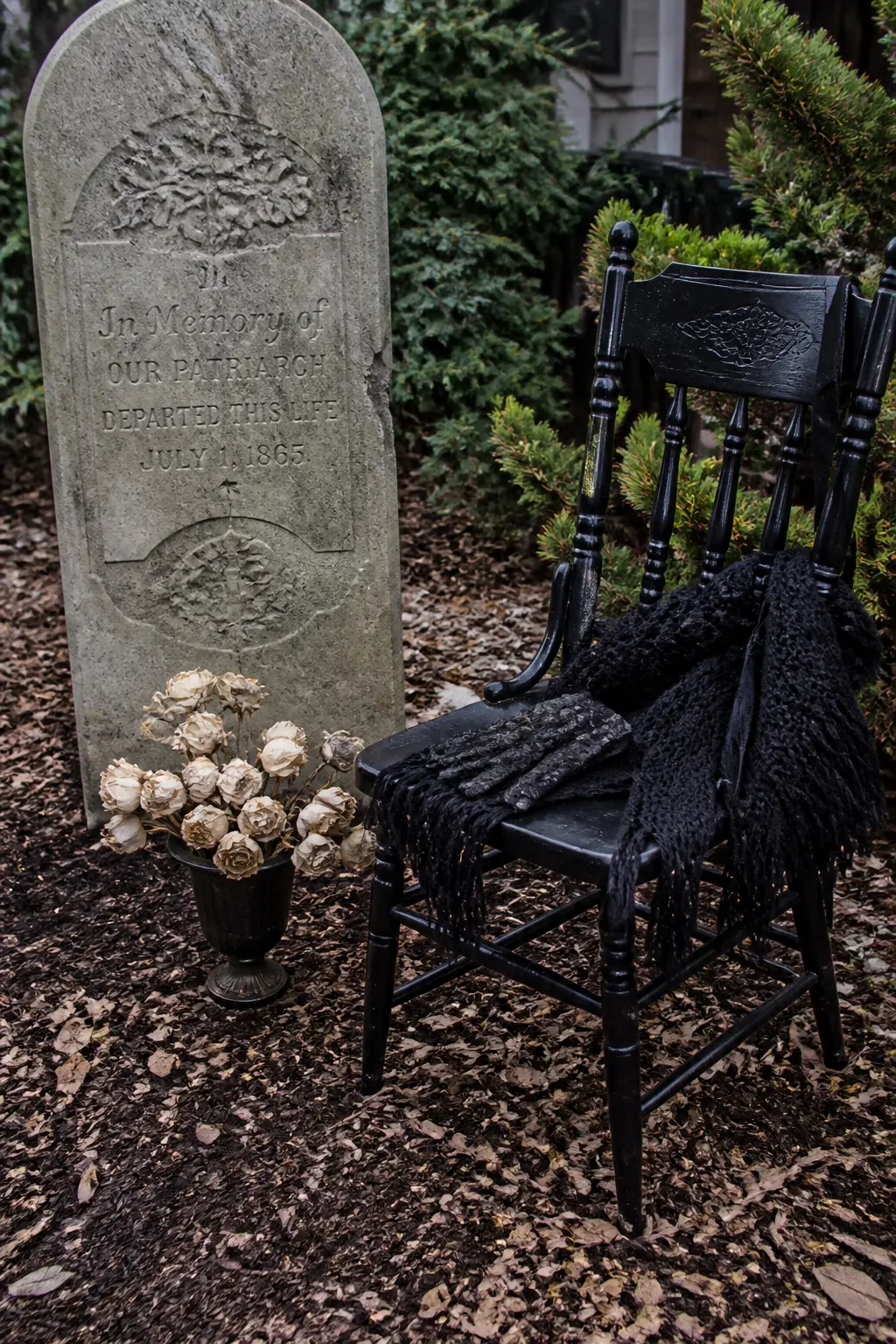
A single wooden chair, painted black, faces the largest headstone in the plot. On the chair seat: a folded black shawl and a pair of old leather gloves. Between the chair and the stone, a small arrangement of dried white roses in a low vase. The chair is not centred on the stone: it is slightly to the left, as if someone sat down and stayed a while, then moved to get a better look.
The storytelling detail is the angle of the chair. Dead-centre would be staged. Off-centre is human. That small shift is the difference between decoration and narrative.
🛍 Shopping guide
The Séance Table
A table scene belongs on a porch or in a bay window where it has a frame around it. Without architecture to contain it, it dissolves into the yard. The frame is what makes it read as a scene rather than furniture left outside.
This is the group where candles do real work, though they must be battery-operated outdoors. Cluster them at uneven heights and let the wax-drip LED variety earn their keep.
The Table Laid for Five
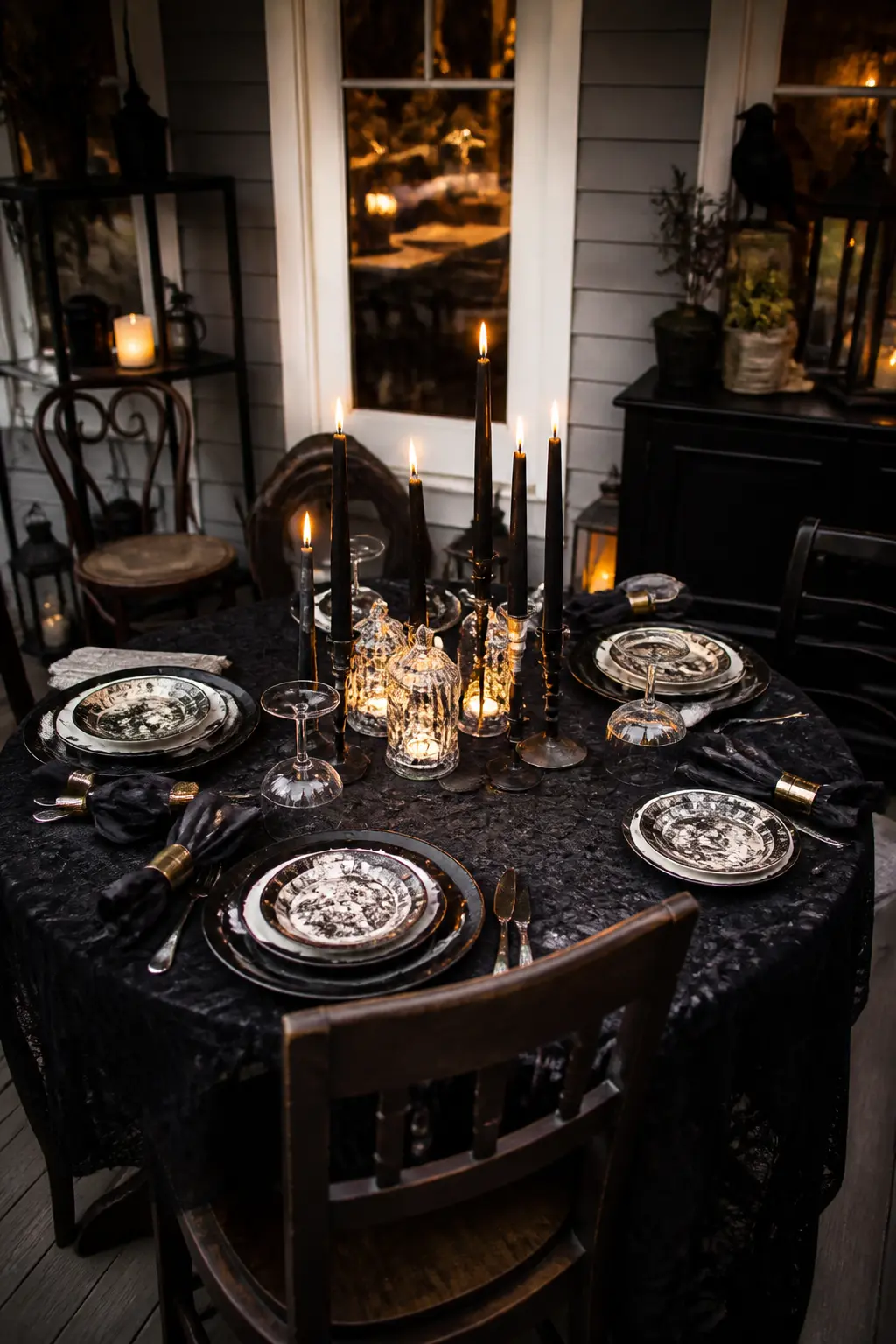
On a covered porch, a round table seats five. Five chairs, five place settings using mismatched vintage china (charity shops, all October), five black taper candles in varying heights, and one chair conspicuously without a plate. A centrepiece of three crystal glasses upturned over white tea light holders glows from the centre.
The storytelling detail is the empty setting: a chair present but no plate. The viewer counts to five and finds the gap. That moment of recognition is the whole scene. It does not need explanation.
Battery tapers on a porch with a roof are perfectly safe for four weeks. Group them so the tallest is at the back, the shortest at the front, and the eye reads the cascade toward the viewer.
🛍 Shopping guide
The Reading in Progress
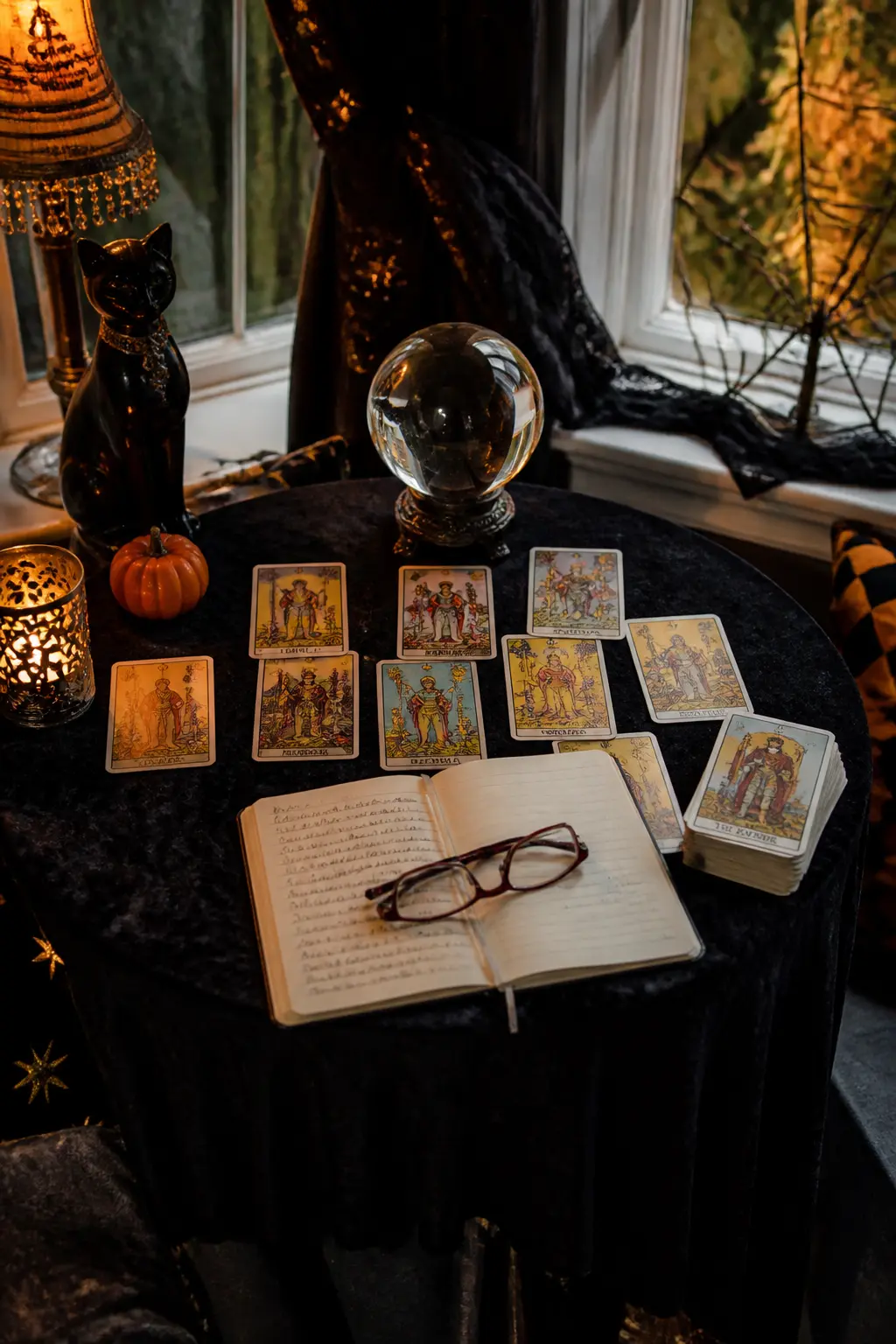
A small table inside a bay window or just inside an open front door holds a tarot-style card spread face-up on dark velvet, a crystal ball on a low stand at the far edge, and a pair of reading glasses resting on an open notebook with handwriting visible on the page. One chair is pulled up to the table.
The storytelling detail is the handwriting in the notebook. Visitors who come close enough to read it find whatever you want them to find: a name, a warning, a list of dates. The ones at the street see only the crystal ball catching the warm light, and that is enough.
🛍 Shopping guide
The Garden Gone Wrong
An overgrown, neglected corner of a yard is more believable than a theatrical set piece, and it ages beautifully over four weeks. Start with what is already dying back in October and build the story around it rather than fighting the season.
Texture is everything here: rough burlap, weathered terracotta, Spanish moss draped from a low branch. Nothing shiny, nothing plastic that still looks plastic.
The Overgrown Gate
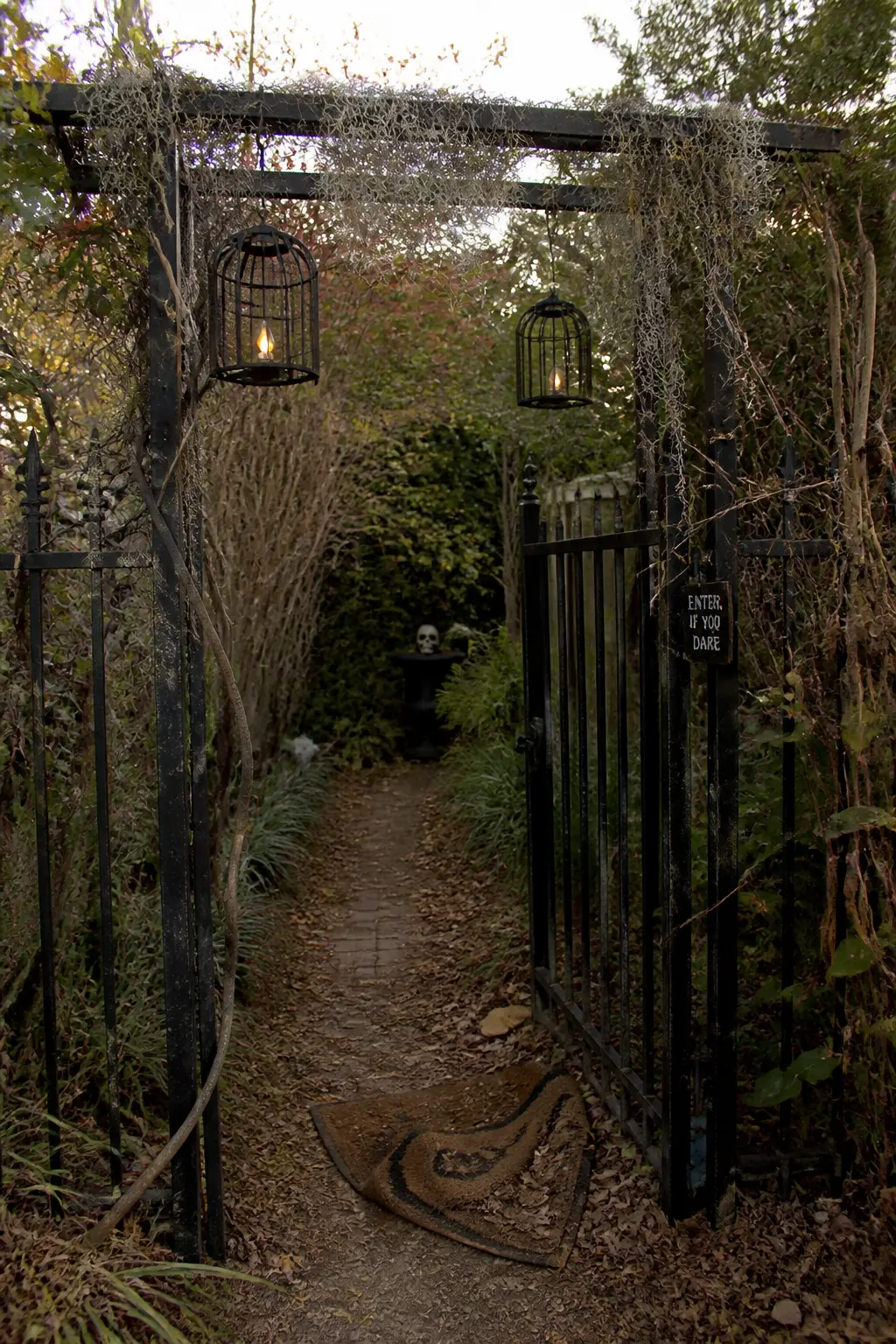
If the yard has a gate or arch, drape Spanish moss from the top bar and weave bare branches (gathered from any park in October) through the uprights so the entry feels narrowed and slightly blocked. Hang two small caged lanterns from the arch at uneven heights. Place a worn doormat just through the gate, face-down.
The storytelling detail is the face-down doormat. Someone turned it over deliberately, or fled through without looking, or arrived and found the house already unwelcoming. It takes one second to register and stays in the memory.
The bare branches and moss handle rain and wind well. Reposition any branch that falls after a storm; the rest will hold for the month.
🛍 Shopping guide
The Abandoned Garden Seat
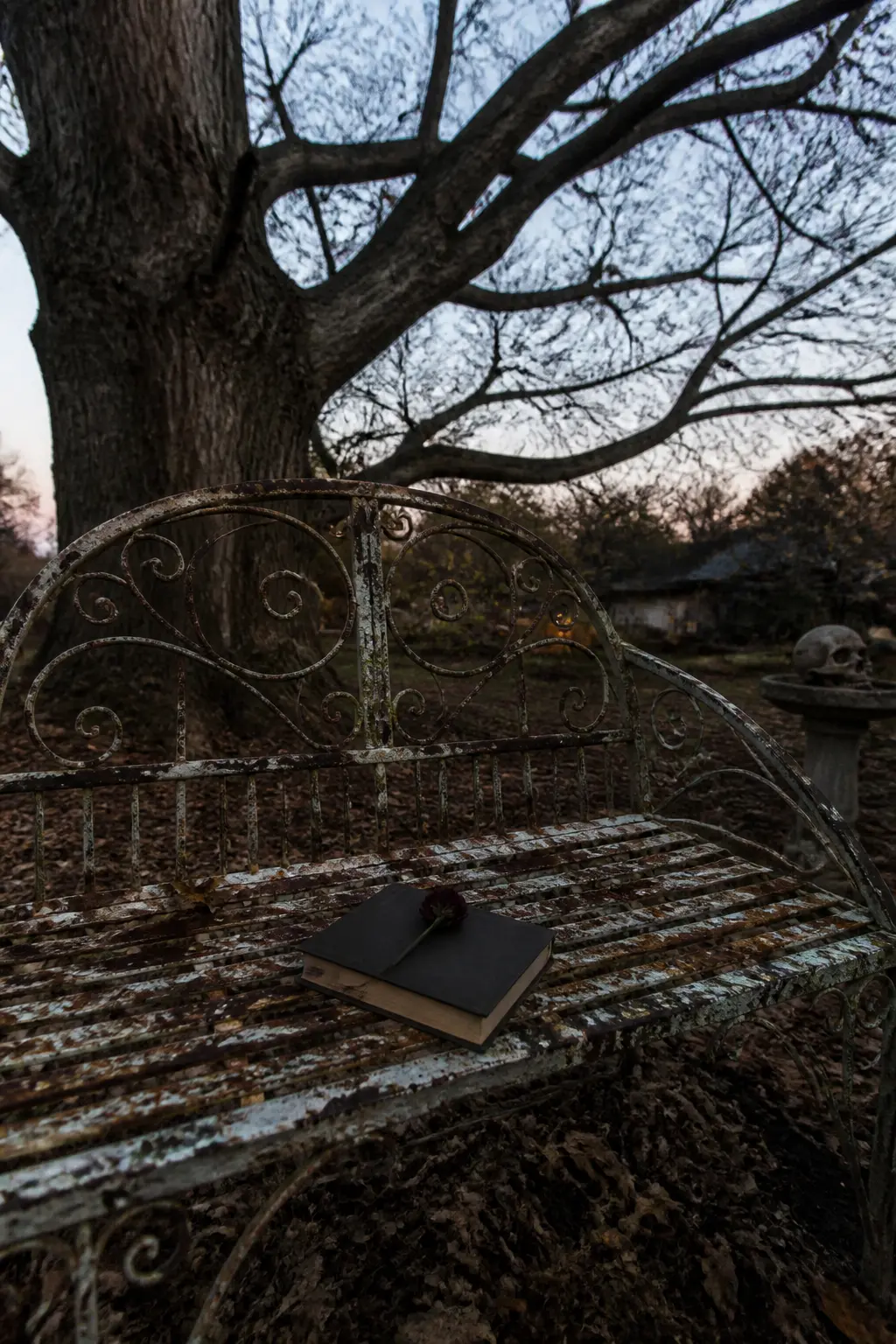
A wrought iron bench, ideally one that already has some rust, sits under a tree or beside a large shrub. On the bench: a closed book, face-down as if someone set it down to look at something, and a single dried flower, not a bunch, placed carefully on the book. The bench slats hold a thin scattering of fallen leaves left intentionally.
The storytelling detail is the flower on the book. A closed book alone is furniture. A book with a single flower on top is a message, an appointment kept, something left for someone who did not come.
No added light for this scene. Natural shadow under a tree at night does everything. Added light would explain too much.
🛍 Shopping guide
The Crow Council
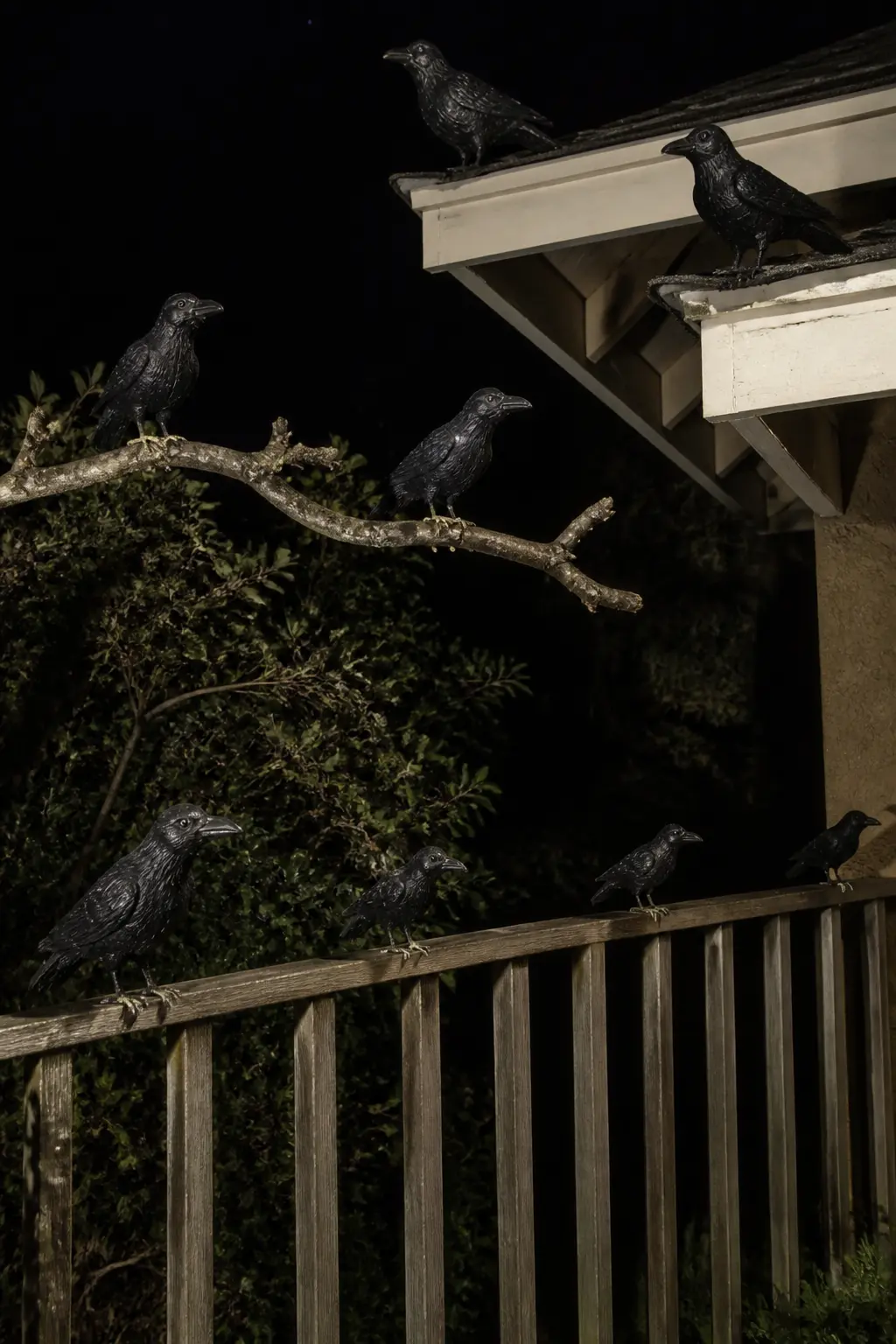
Five or seven crow props (always odd numbers) arranged on a fence rail, a low branch, and the peak of a porch roof, all facing the same direction. Not toward the viewer: toward something in the yard that only they can see. Place them at three different heights so the composition triangulates. Leave a gap of about forty centimetres between each bird.
The storytelling detail is the direction of their gaze. Crows looking at the viewer are decoration. Crows looking at something else in your yard are witnesses. The viewer follows their line of sight and finds nothing, which is considerably worse than finding something.
Crow props survive weather well. Secure each one with a cable tie through the foot mount so wind does not redistribute them.
🛍 Shopping guide
The Lantern Procession
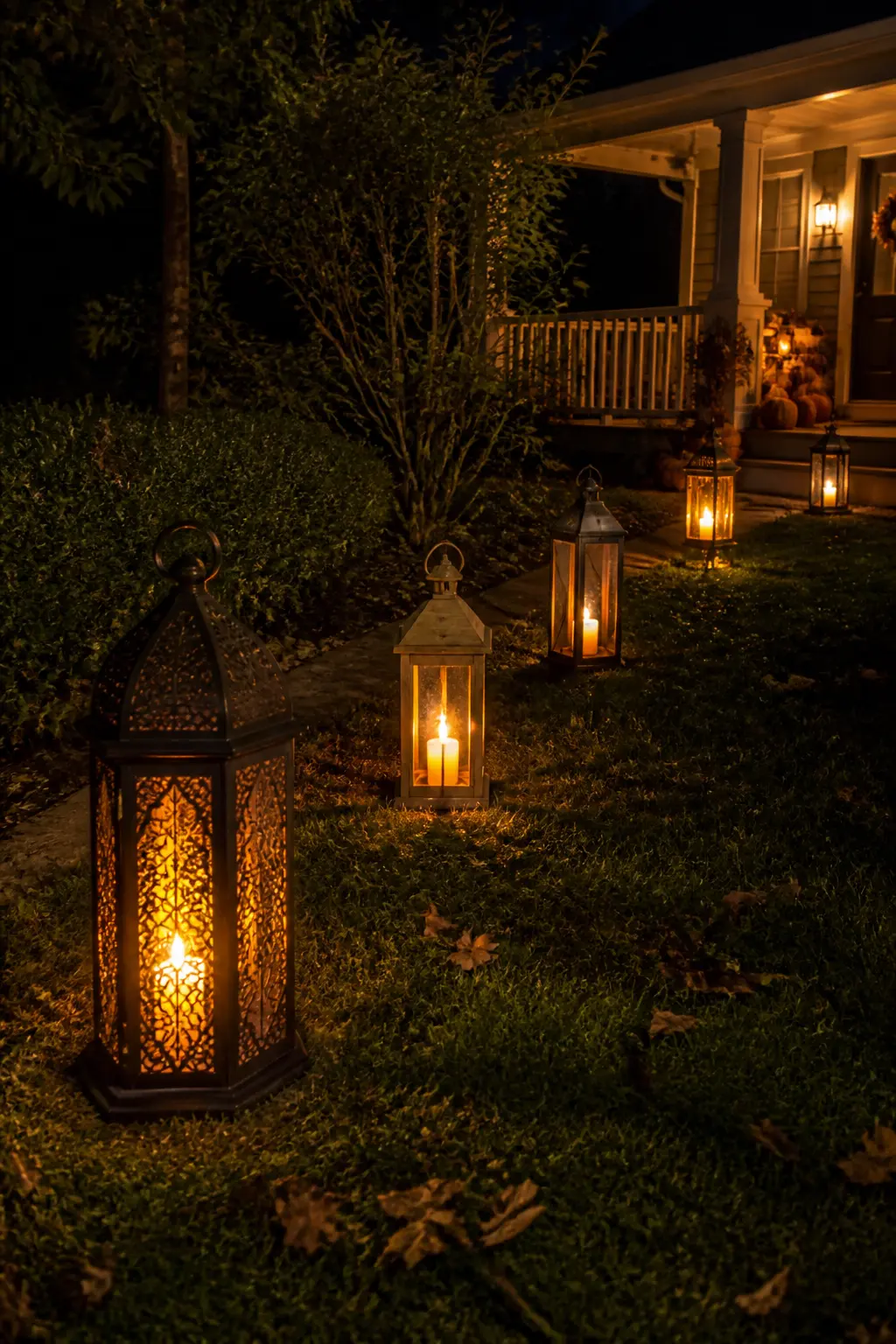
A series of five lanterns in varying sizes walks in a loose diagonal line from the far back corner of the yard toward the porch, as if someone was carrying them and set them down one by one along the path. Each lantern is a slightly different design: one caged, one wood-frame, one hurricane glass, one iron, one ceramic. All hold the same warm amber flame (battery).
The storytelling detail is the diagonal line. Straight rows say display. A diagonal line with varied spacing says someone walked here and stopped. The procession implies a route and a person who took it.
This is the one scene where ground-level works because the lanterns themselves are tall enough to read from the street, and the line composition gives them scale that a single lantern on the ground never achieves.
🛍 Shopping guide
Closing Thoughts: Sell the Story, Not the Props
Every scene above starts with one question: what was happening here just before the guests arrived? Answer that, and the arrangement follows. The props you already own are probably the right props. What they needed was a context, a light source, and a story-telling detail planted at eye level, not ground level.
Check the full yard from the street before October starts. Walk to the curb, turn around, and look for two things: a clear focal point in each scene, and dead space between scenes that you can fill with darkness rather than more props. Empty lawn between scenes reads as breathing room, not as a gap to fill.
When the outdoor display is set, bring the energy inside. 30 Unforgettable Halloween Party Ideas and Games covers everything from the front door to the last guest leaving, and 20 No-Cringe Adult Halloween Party Games gives the crowd something to do once they have admired the yard.
Frequently Asked Questions
How do I make my Halloween yard decorations read from the street?
Keep nothing within two metres of the sidewalk: at street distance, small detail disappears and the eye needs scale to register a scene. Use props at least knee height or higher, set one strong light source per scene, and arrange props so they triangulate (three points at different heights) rather than line up in a row.
What Halloween yard decorations survive a full month of October weather?
Iron, cast iron, sealed terracotta, treated wood, and resin weather well. Natural elements like Spanish moss, dried herbs and bark mulch actually improve with rain. Avoid anything with paper surfaces exposed to the sky, untreated foam, or unstable bases. Secure every prop with cable ties, garden stakes or tent pegs so wind does not rearrange your scene.
How many Halloween yard decorations are too many?
The problem is almost never quantity: it is organisation. Five props in a coherent scene read better than twenty props scattered individually. Group everything into two or three distinct scenes with clear negative space between them. The empty lawn between scenes is not a gap to fill: it is the frame that makes each scene legible.
What lighting works best for outdoor Halloween scenes?
Warm amber (2700K) reads as candlelight and suits witchcraft, graveyard and séance scenes. Use a single focused light source per scene rather than flooding the whole yard with one colour. Solar uplights, shepherd-hook battery lanterns and string Edison lights all survive the month. Never rely on real flame outdoors for a four-week display.
Can I use these scene ideas with props I already own?
Yes, and that is the point. Most of these scenes work because of arrangement, a detail that implies a story, and one light source: not because of expensive props. Audit what you already own, group similar pieces, pick one storytelling detail per group, and add light. The props you have are probably enough.

31 girly painted pumpkin ideas finished with bows, pearls, ribbon, lace and lettering. Every pumpkin

25 Halloween movie night ideas — printable tickets, snack signs, bingo, games & candy bag toppers

20 clever adult Halloween party games that are actually fun — active, printable & immersive. No fi
Leave a Reply