


Most outdoor Halloween decor is designed for a Pinterest photo taken on a dry afternoon in early October. Then the rain arrives, and the foam skulls swell, the paper lanterns pulp, and the burlap grows a fine coat of mould. You carry things in every night or you watch them disintegrate. Neither is acceptable.
This list is sorted by survival, not style. Some of these ideas hold up because of the material: stone, metal, sealed resin, waterproof LED.
Some hold up because of placement: a covered porch, a planting bed where water drains, a spot that a roof overhang protects.
And a few are the rare things that genuinely improve in wet conditions, looking more convincing in fog or rain than they ever did in sunshine.
Along the way, the list names what fails and why, so you stop spending money on it. No inflatables, no licensed characters, no real flame outside. Just the things that will still look intentional on the 31st.
If you want ideas for what to do once guests arrive, 15 Spooky Outdoor Halloween Party Games and 20 No-Cringe Adult Halloween Party Games are worth a look.
This post contains affiliate links. If you buy through them, I may earn a small commission at no extra cost to you.
- Resin and Stone: Materials That Do Not Care About Rain
- Metal: Rust Is a Feature, Not a Bug
- Weatherproof LED and Solar: Light Without Flame
- Covered Porch and Doorway: Where Almost Anything Works
- Planting Beds and Ground-Level Decor: Work With Drainage
- The Yard: Large-Scale Pieces That Anchor the Scene
- Things That Look Better Wet
- What to Stop Buying
- Frequently Asked Questions
Resin and Stone: Materials That Do Not Care About Rain
The first question to ask about any piece of outdoor Halloween decor is not “does it look good” but “what happens when it is soaked for three days straight.” Resin, cast stone, and concrete all pass that test. They do not swell, split, absorb dye from packaging, or grow mould on contact with moisture.
These are also the pieces worth spending real money on, because they come back out every year. Skip anything labelled “weather-resistant” without a material name: that phrase covers everything from proper resin to painted MDF, and MDF will be a swollen mess by week two.
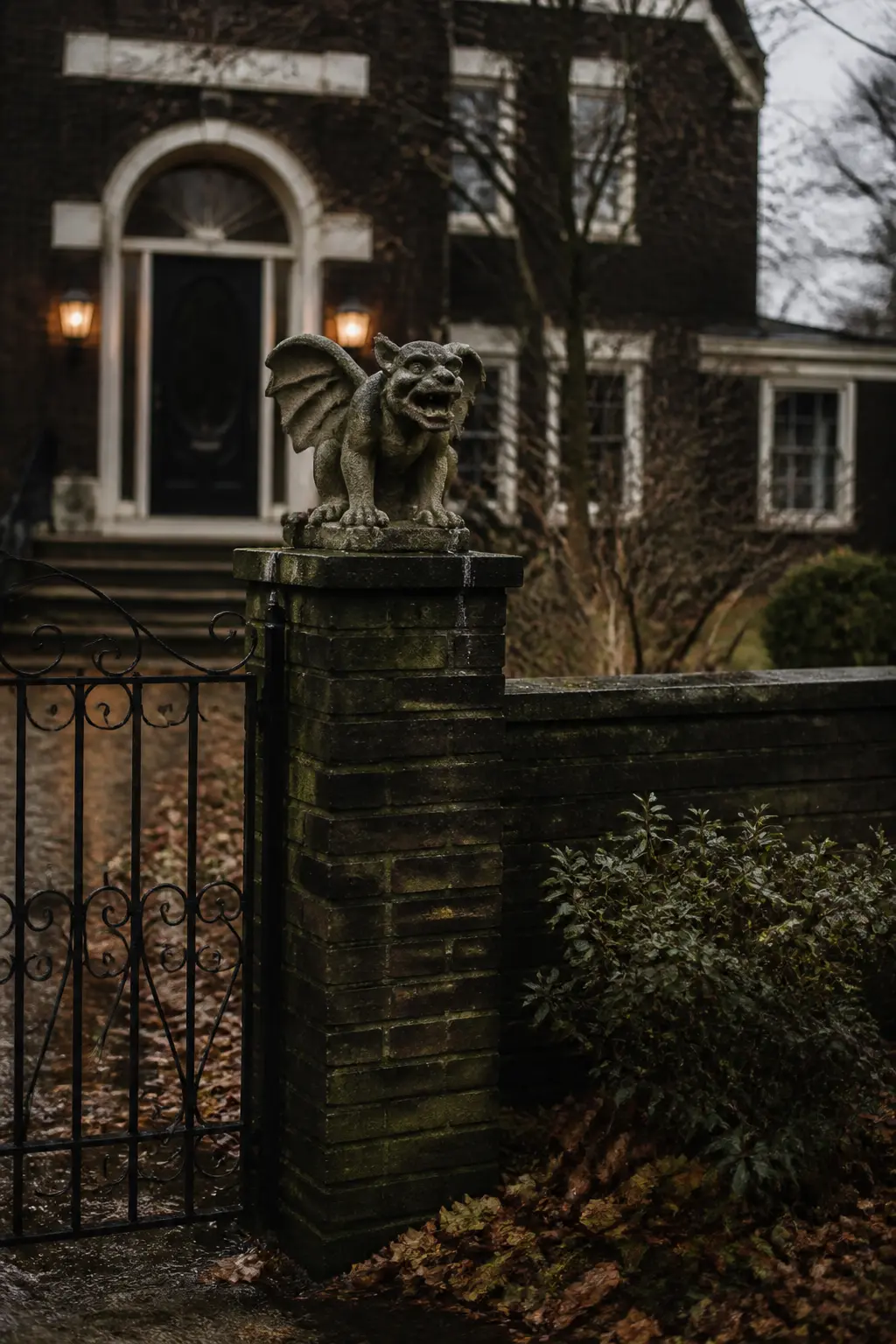
Cast-Stone Gargoyle on a Gatepost
A cast-stone gargoyle sitting on a flat-topped brick or stone gatepost is one of the few pieces of outdoor Halloween decor that genuinely improves with age and weather. Rain darkens the stone, moss grows into the crevices over the years, and it stops looking like a seasonal purchase and starts looking structural.
Buy from garden sculpture suppliers, not Halloween pop-ups: the wall thickness is greater, the drainage holes are properly positioned, and the finish weathers rather than flaking. Place it on a flat, stable surface so it cannot tip in wind. A toppled stone gargoyle is a safety issue, not just a mess.
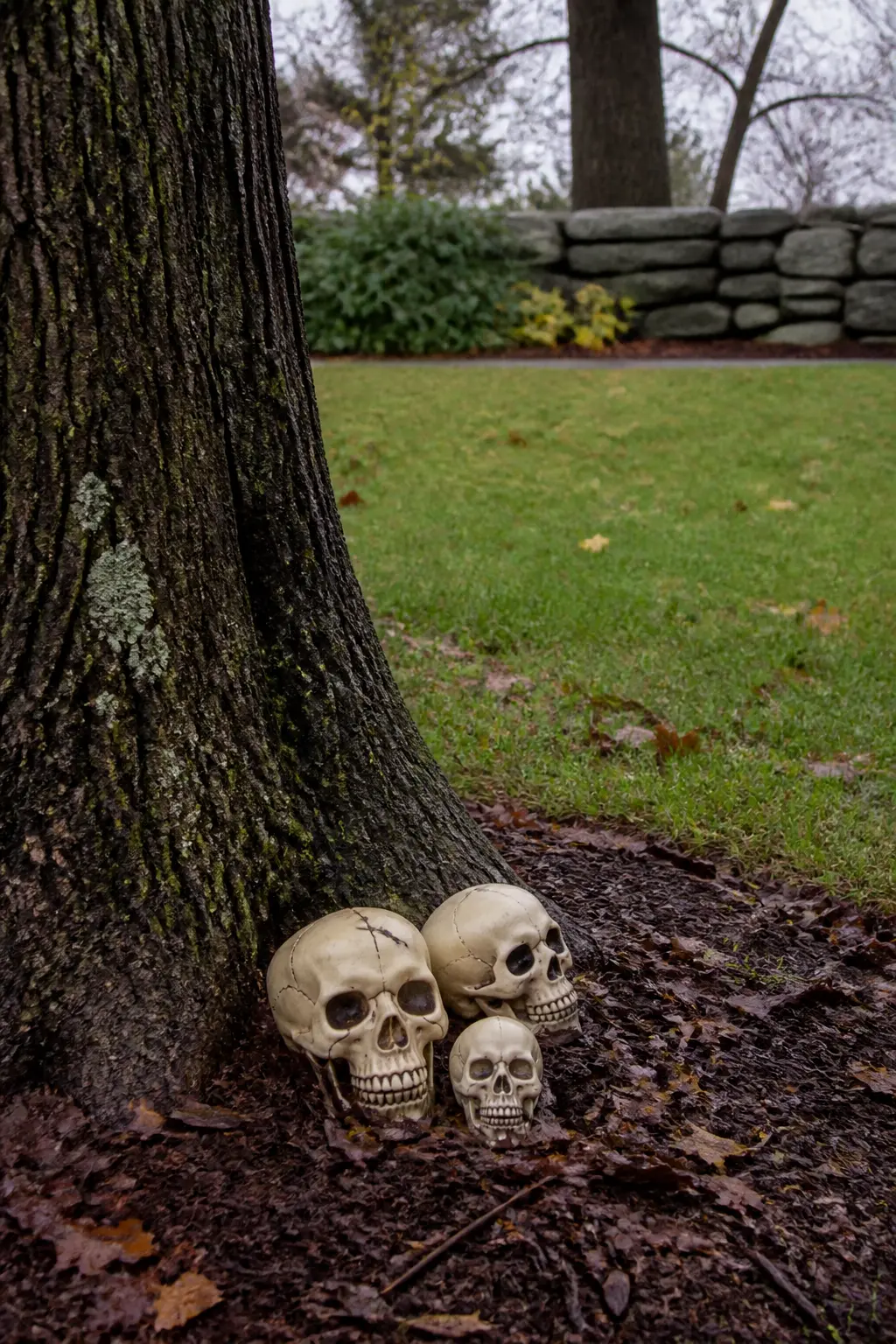
Sealed Resin Skull Cluster at the Base of a Tree
A group of three to five resin skulls arranged at the base of a large tree trunk reads as intentional yard art rather than a prop.
The key word is sealed: look for resin pieces with a smooth, non-porous surface finish and no seam where two halves are joined with adhesive. That seam is where water enters and eventually splits the piece.
Ground placement in soil or bark mulch means they stay in place in wind without any additional fixing. Slightly different sizes make the grouping look considered. Rain makes them gleam, which is the right effect.
🛍 Shopping guide
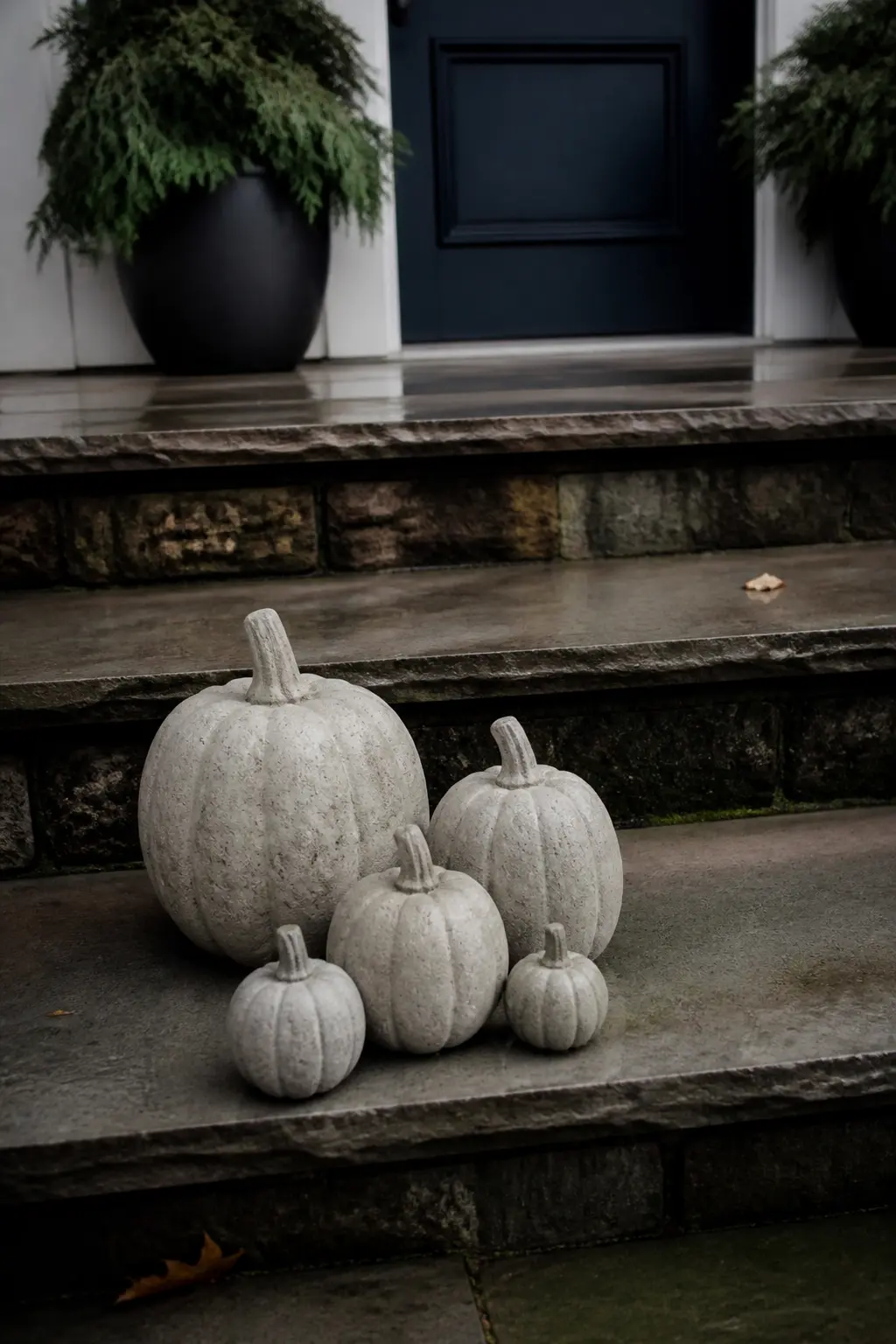
Concrete Pumpkins in a Tiered Group
Concrete pumpkins sold as garden ornaments cost more than foam versions and last indefinitely. Arrange three in decreasing sizes on porch steps or at the base of a planter for a grouped effect that looks heavier and more permanent than anything seasonal.
The flat-bottomed ones drain poorly: if yours have no drainage hole, drill one before the season starts. Staining them with a diluted dark exterior masonry paint before the season gives a more convincing aged look than the raw concrete finish, and the stain is rain-stable once dry.
🛍 Shopping guide
Metal: Rust Is a Feature, Not a Bug
Powder-coated steel and raw iron both survive rain. Raw iron develops a rust patina that looks exactly right for late October, so do not sand it off. Avoid cheap zinc alloy pieces sold as “metal”: they pit and corrode in an ugly way, especially where the coating has chipped at the edges during shipping.
Wrought-iron stakes, metal lanterns, and steel silhouette cutouts are the three metal formats worth buying. Anything that has a seam where two pressed-metal halves are glued together will leak water into the join and eventually split.
Rusted Iron Crow on a Fence Post
A raw iron crow silhouette mounted on a fence post develops an orange-brown patina in the rain that looks nothing like a prop and everything like something that belongs there. Buy one without any powder coating or paint if you want the patina: sealed finishes peel once the base metal begins to oxidise underneath.
Fix it properly: a wobbly crow that spins in the wind loses the effect immediately. A short section of rebar hammered into the top of a wooden post and inserted into the hollow base of the crow keeps it pointing the right way and surviving gusts.

🛍 Shopping guide
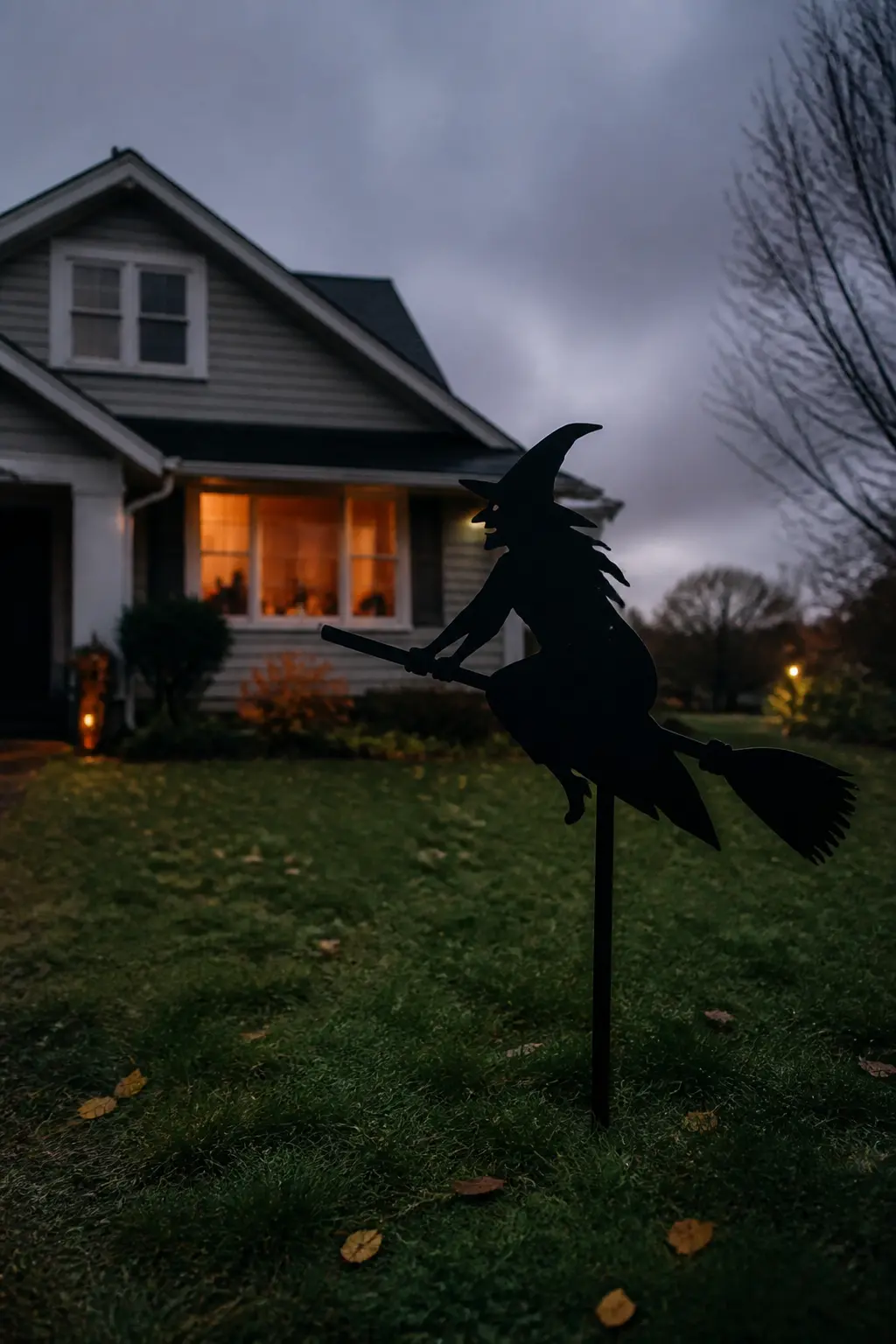
Steel Silhouette Witch on a Lawn Stake
Powder-coated steel silhouettes are the most wind-stable flat yard decor available: there is almost no surface area to catch the wind, and the stake keeps them planted in soft ground. A witch shape works at dusk in a way that foam or plastic never does, because the silhouette reads as a shadow rather than a prop.
Avoid the versions with fine bent-wire detail around the broom or hat edge: that wire corrodes at the joins and eventually snaps. A clean, bold cutout shape in heavy-gauge steel survives everything and reads clearly from the street.
🛍 Shopping guide
Wrought-Iron Lantern Cluster on Porch Steps
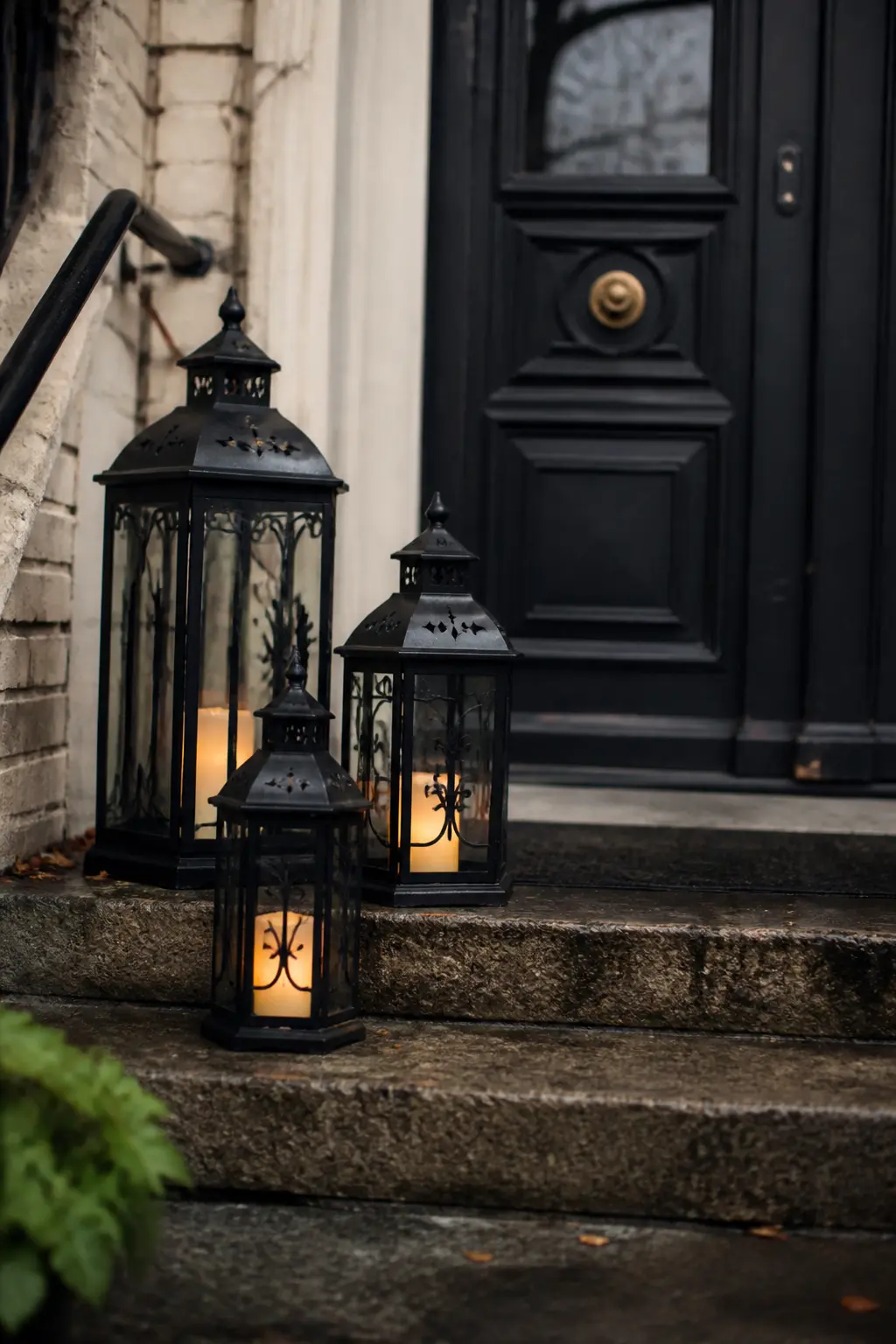
A grouping of three wrought-iron lanterns at different heights, each holding a waterproof LED pillar candle, solves two problems at once: the metal survives rain, and the sealed LED candle survives wind and water that would extinguish or flood a real candle. The combination looks exactly like real candlelight from ten feet away.
Place them on steps rather than a flat porch floor so the height variation is built in. Odd numbers always read as more intentional than even. Wrought iron lanterns are sold year-round at garden centres and home stores at non-Halloween prices, which means you pay less and get a heavier piece.
Weatherproof LED and Solar: Light Without Flame
Real flame outdoors in wind and rain is a fire risk and a mess, and candles in open lanterns simply will not stay lit. Weatherproof LED string lights (rated IP65 or above) and solar-powered path lights are the practical replacement. The IP rating is printed on the box: if it is not there, do not buy it for outdoor use.
Solar lights need direct sun to charge, which is in short supply in a wet October. Keep this in mind when choosing placement, or pick plug-in LED options for shaded spots. Either way, look for a warm amber tone rather than cool white: it reads as candlelight from a distance and suits the season.
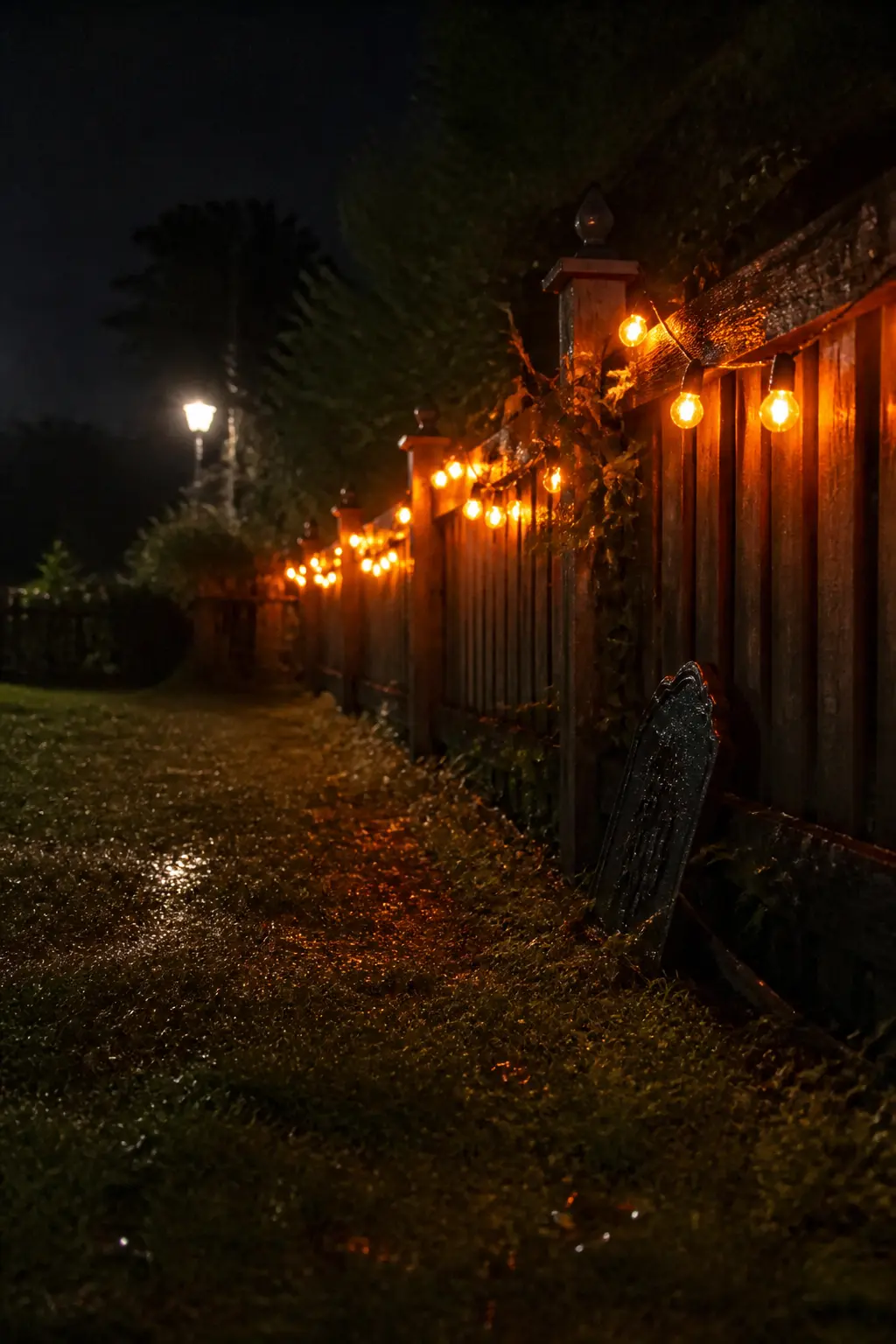
IP65 Orange LED String Lights Along a Fence
IP65 is the minimum rating for outdoor lights in a wet climate: it means the fitting is fully dust-tight and protected against water jets from any direction. Anything below that rating is not designed for extended rain exposure.
Check the connector seals as well as the bulb rating: the join between extension cable and light string is often the failure point.
Orange rather than warm white reads as Halloween rather than general festive lighting. Run the string along a fence line or through the branches of a bare-trunked shrub rather than draping it on the house facade, where wind causes the wire to work against any fixings and eventually pulls them free.
Solar-Powered Skull Path Lights
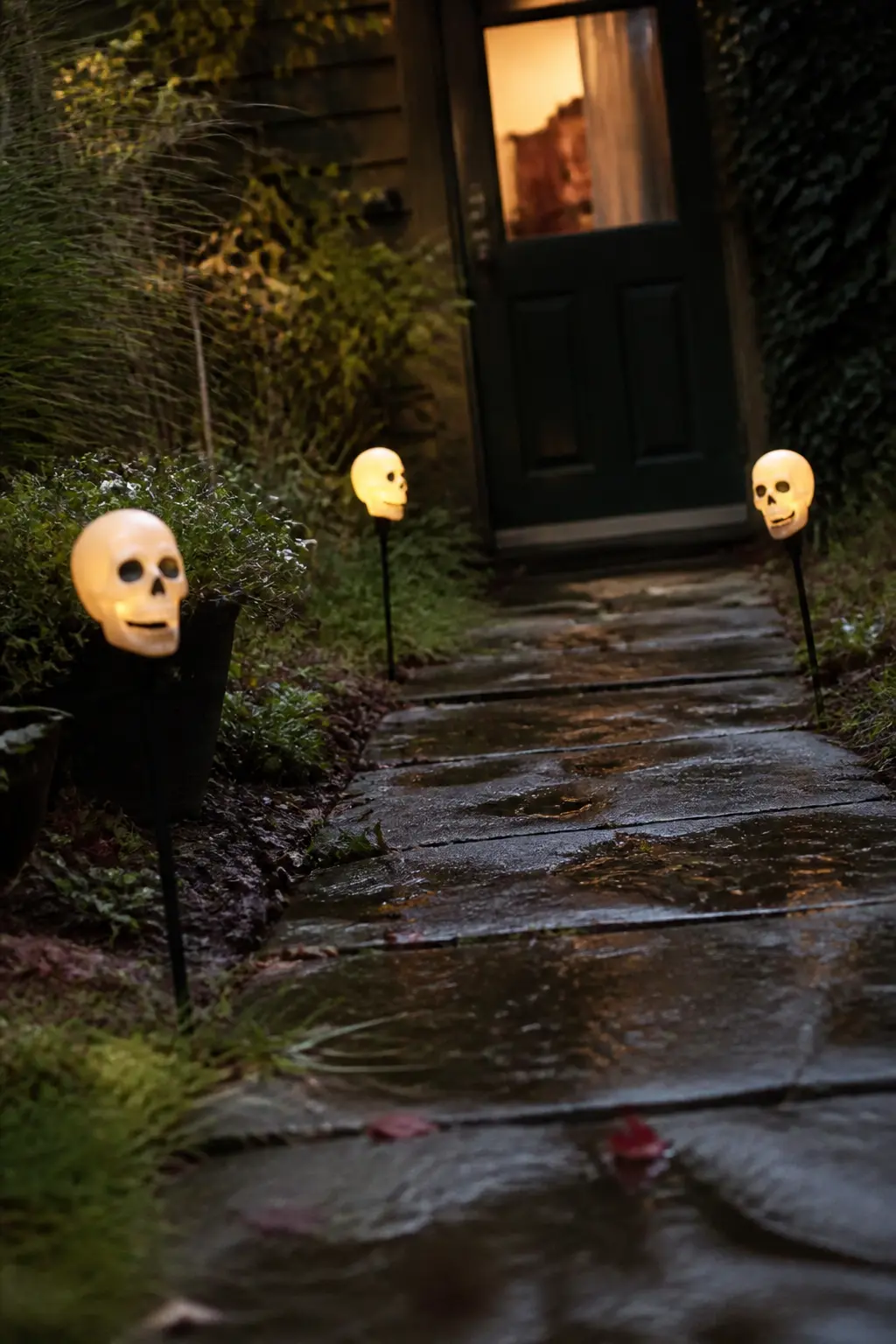
Solar skull path lights need one thing a wet October often cannot guarantee: direct sun for several hours to charge the battery. Position them on the sunniest stretch of the path, or in the one spot that gets afternoon sun. A full charge on a good day carries them through several cloudy ones.
Look for models with a separate solar panel on a short cable rather than the panel built into the top of the skull: the panel can be angled toward the sun while the skull sits at path level.
The skull glows from inside when lit, which is the right effect, but this only works if it is translucent resin rather than opaque plastic.
Colour-Changing LED Projector Aimed at the House Wall
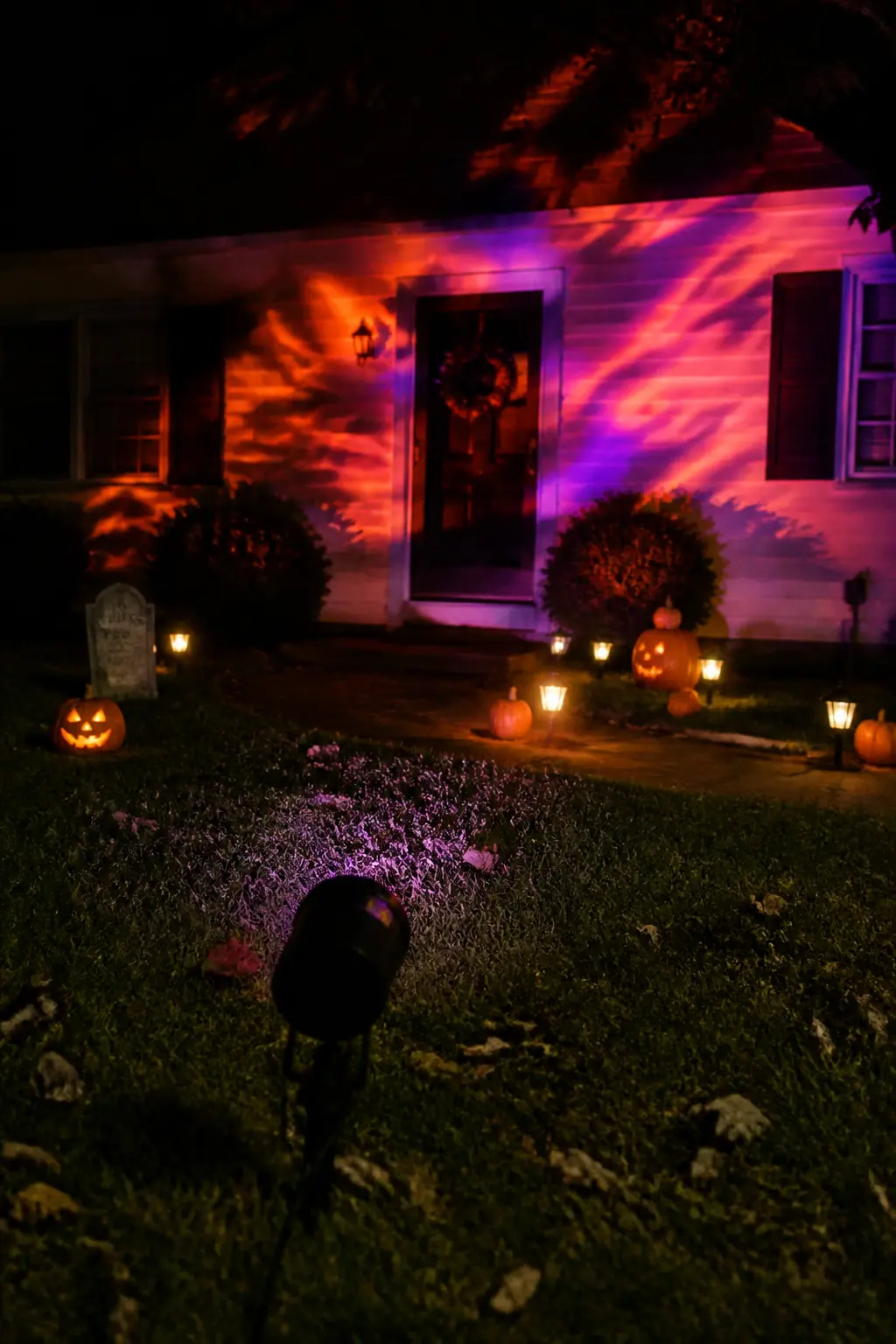
An IP65-rated LED projector staked in the ground and aimed at the front wall of the house creates an effect that is completely unaffected by wind or rain: the light source sits in a sealed housing, and the projection falls on a vertical surface that sheds water. Orange and purple rotating patterns read clearly from the street.
Keep the projector at least three metres from the wall so the pattern spreads wide. Closer than that and you get a small bright circle rather than a wash of colour. A timer plug on the power supply means it comes on at dusk automatically and you do not pay to run it all night.
Covered Porch and Doorway: Where Almost Anything Works
A covered porch changes the rules. Under a roof overhang, fabric stays dry, paper survives a full month, and delicate details hold up. The mistake is treating the covered zone as an extension of the open yard and buying everything to the same standard. Reserve your fragile pieces for here.
The doorway is also the highest-traffic viewing point: trick-or-treaters stand there at close range. Put your best detail here, not your most weather-hardy piece, because this is the one spot where it will stay dry enough to reward scrutiny.
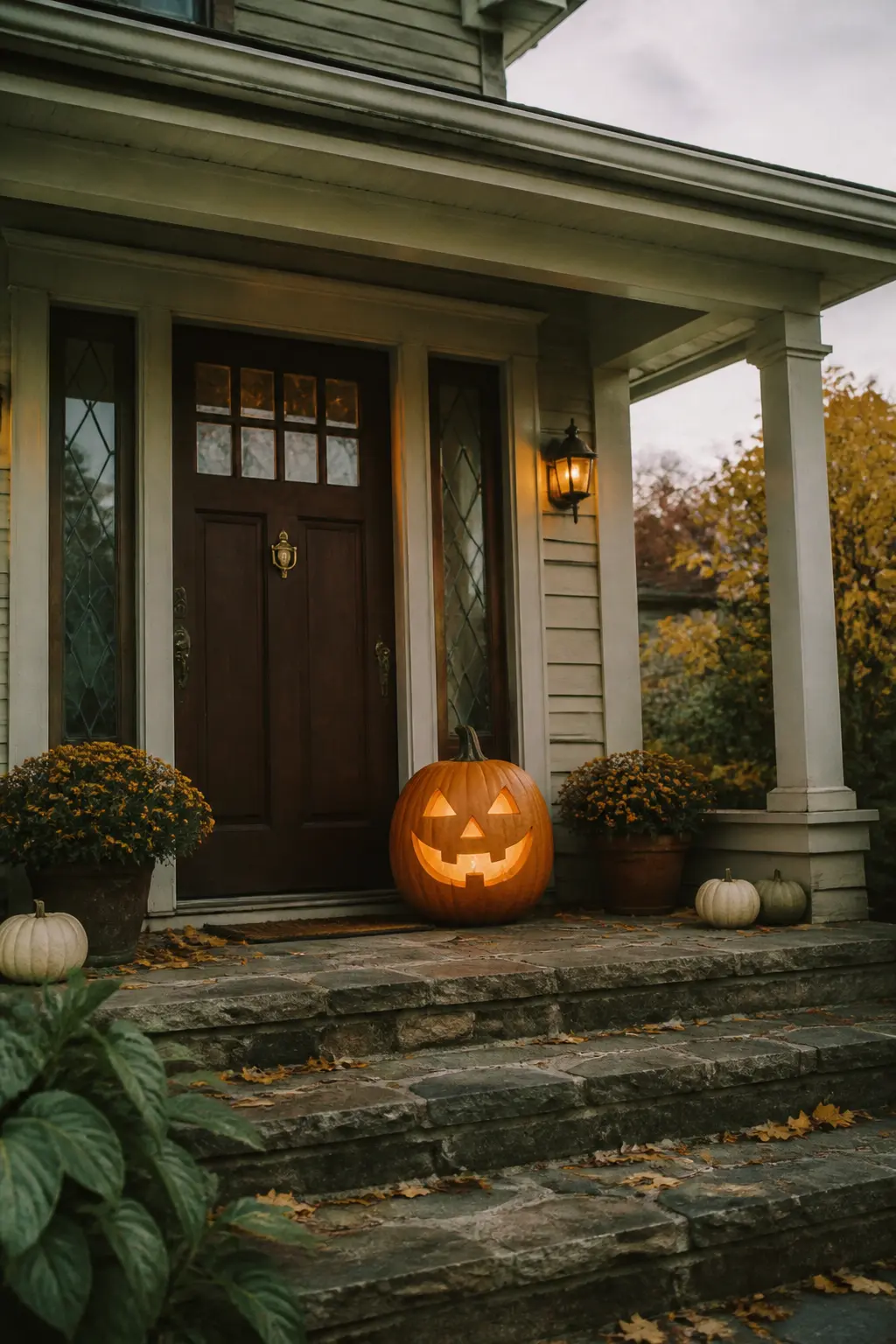
Oversized Resin Jack-o’-Lantern on the Doorstep
Under a covered porch, a large resin jack-o’-lantern with a battery-operated LED inside is the most reliably weather-proof version of the most classic piece of outdoor Halloween decor. The resin does not crack, the LED does not go out, and the sealed battery compartment keeps the mechanism dry.
Size matters here: a piece that is too small for the doorway scale reads as afterthought rather than statement. A diameter of 35 to 45 centimetres works for a standard front door. Add a timer to the battery pack if the model supports it, so it is lit every evening without any manual effort.
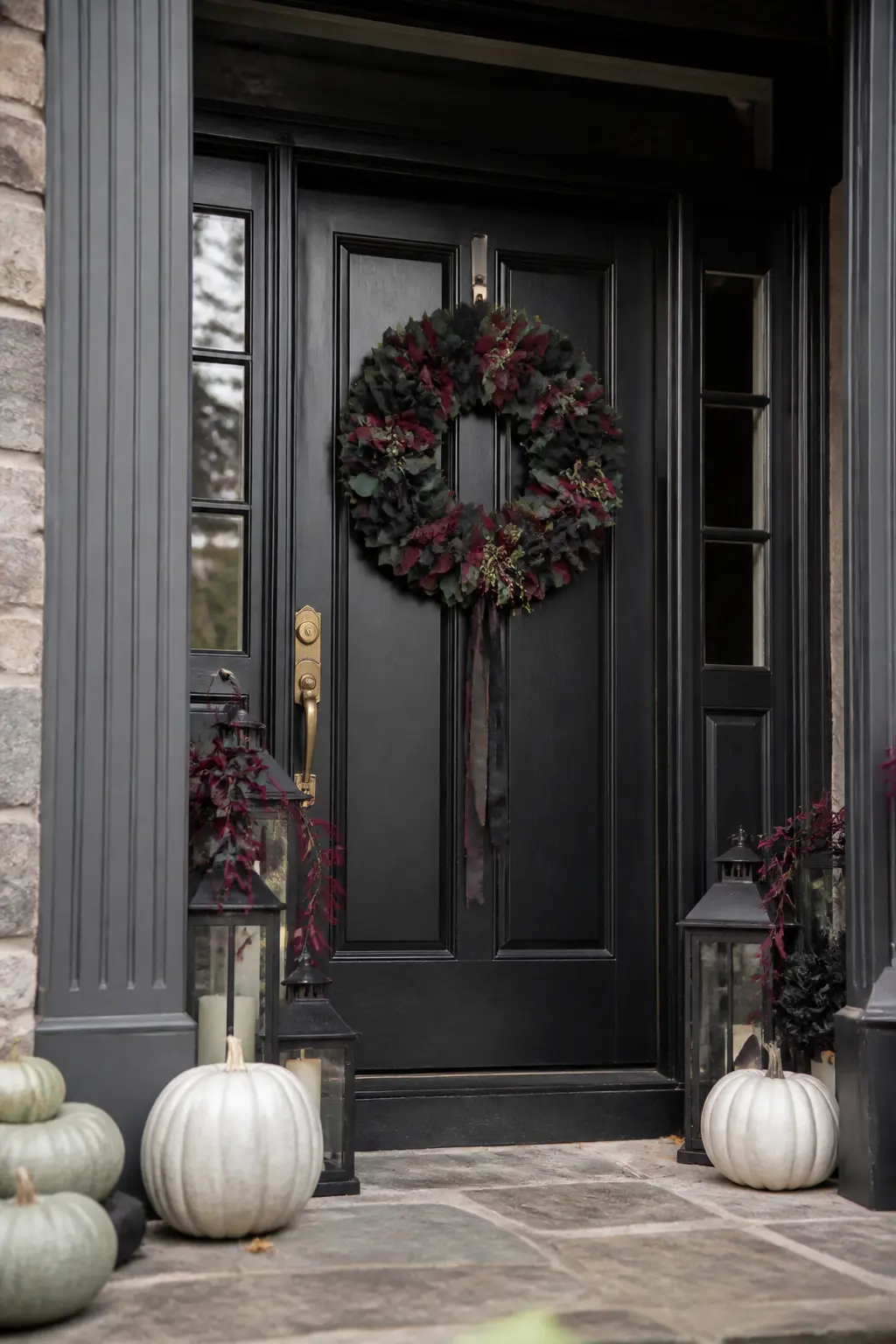
Waterproof Fabric Wreath on the Front Door
A covered porch is the only place a fabric wreath works outdoors in a wet climate. Even there, check the fabric specification: outdoor-rated synthetic velvet or UV-stable polyester ribbon holds colour and shape in damp air, while natural burlap absorbs moisture, sags, and mildews within two weeks. Avoid anything with paper ribbon, pressed flowers, or raw wood elements.
Black, deep burgundy, and forest green hold up better than orange, which fades quickly in UV even on a covered porch. A wreath with predominantly foliage and metal-finish elements rather than fabric pumpkins and bows survives the full season with no intervention.
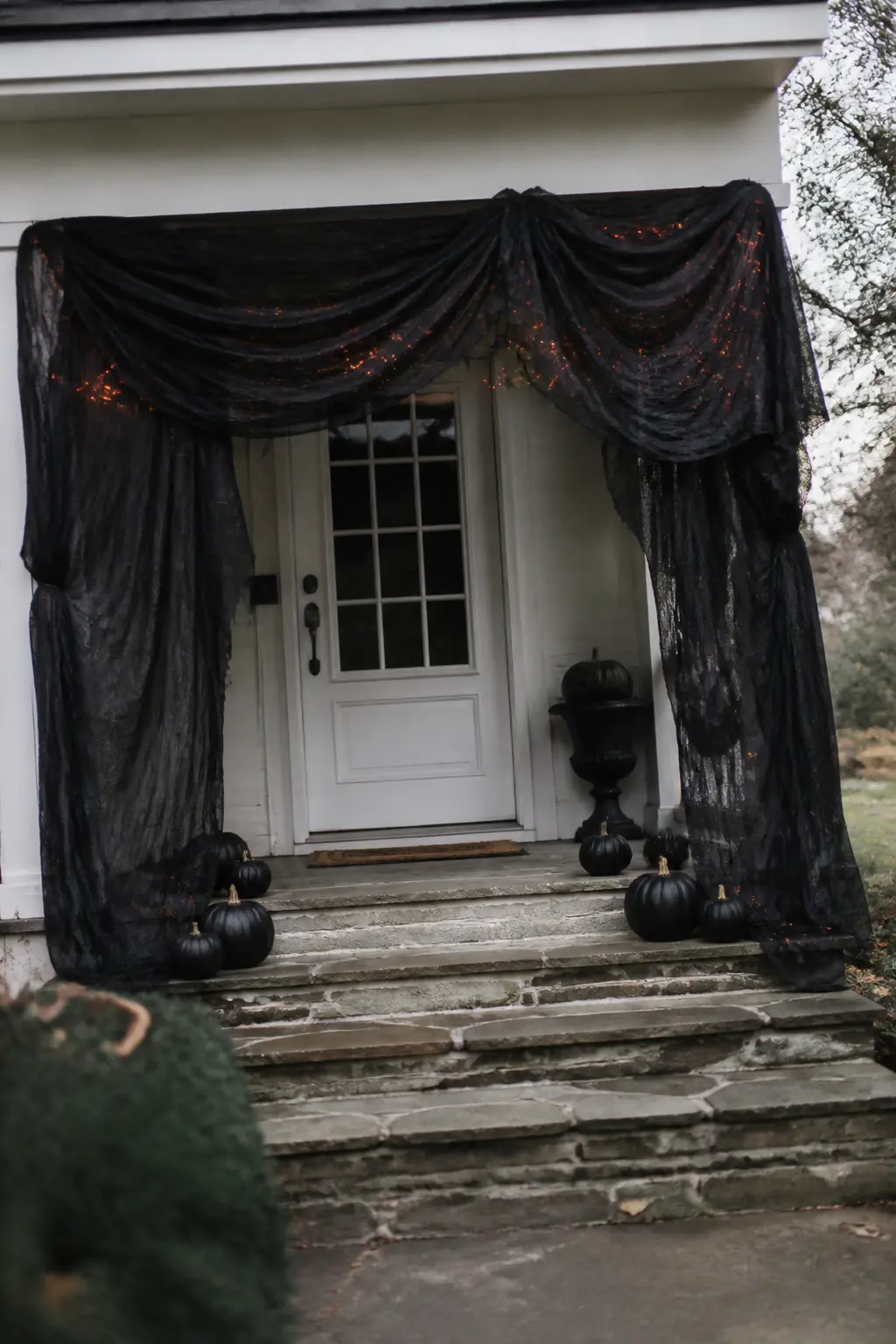
Black Draping Gathered Under a Porch Roof
Gathered black outdoor fabric draped from the porch ceiling edge creates a theatrical frame for the front door without any scaffolding or complex fixing. The fabric needs to be an outdoor-rated polyester: it will still get some splash-back from driving rain, so anything that mildews under damp conditions is wrong for this use.
Gather it in loose folds rather than stretching it flat. Flat black fabric reads as a bin liner. Folded and gathered, it reads as a curtain, which is the right reference. Use removable adhesive hooks on painted porch ceilings to avoid any damage on the way out in November.
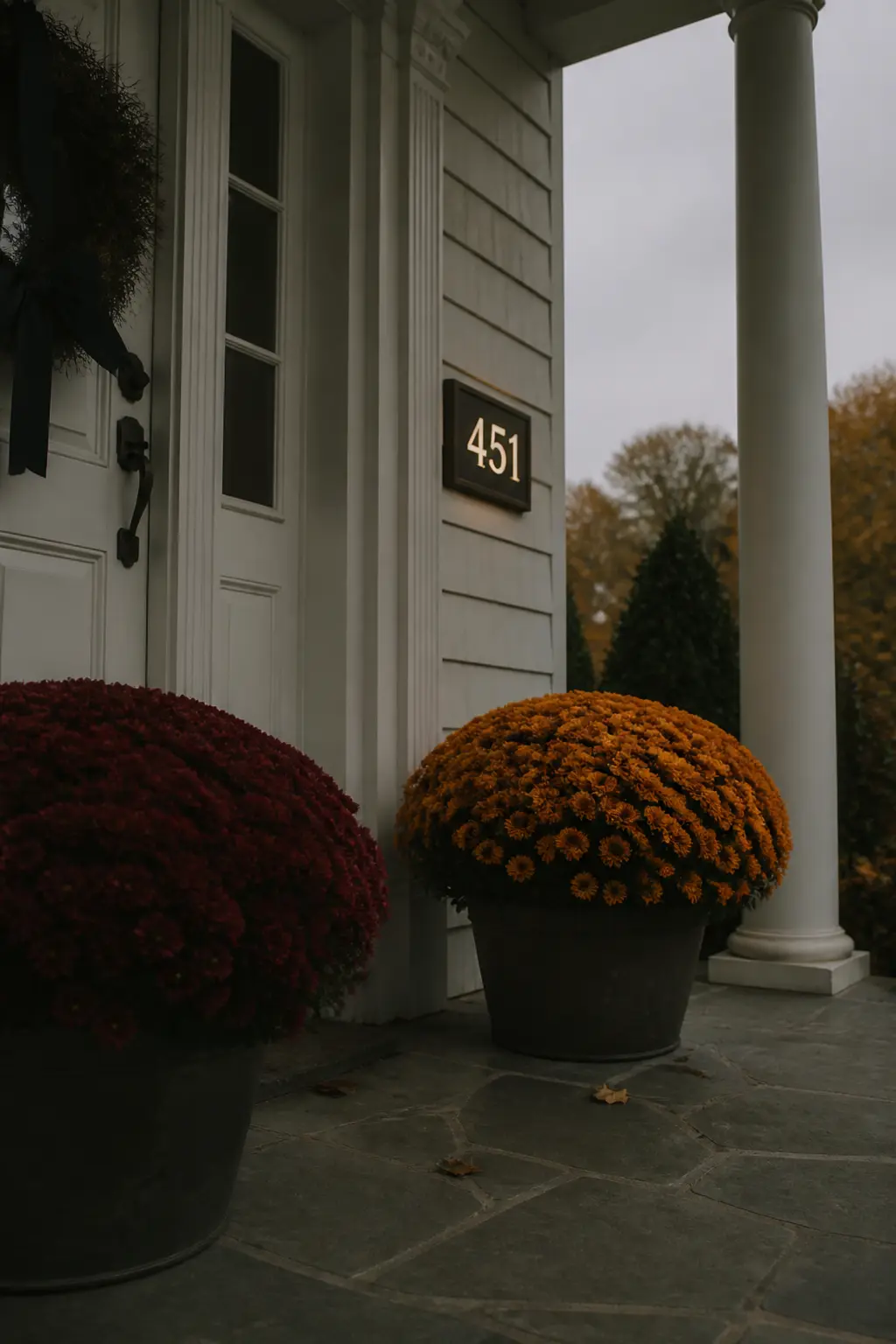
Illuminated Address Numbers Flanked by Mums
Hardy chrysanthemums (sold as “mums” at garden centres every autumn) in deep burgundy, burnt orange, and white are the most genuinely seasonal plant for a covered porch, and they survive frost and rain far better than most ornamental flowering plants.
Paired with a simple LED backlit address number plaque, they turn the most practical element of your front entry into a detail that looks deliberate.
Keep them in their nursery pots and simply drop the pots into decorative covers: that way they go into the garden in November and you do not lose the plant. Water them only from below in a tray so the flowers do not rot.
Planting Beds and Ground-Level Decor: Work With Drainage
Ground-level decor in a planted bed drains better than anything sitting flat on a hard surface. Stakes go directly into soil and stay put in wind. Smooth surfaces like patios pool water on top of flat-bottomed objects, accelerating damage and creating a tripping hazard.
What fails at ground level: hollow resin objects with no drainage hole fill with water and crack in a frost. Fabric pumpkins absorb soil moisture and mould from the bottom up. Hay bales look seasonal for about one week in the rain before they become a compacted soggy brick.
Bare Branch Bundle Staked Into a Planting Bed
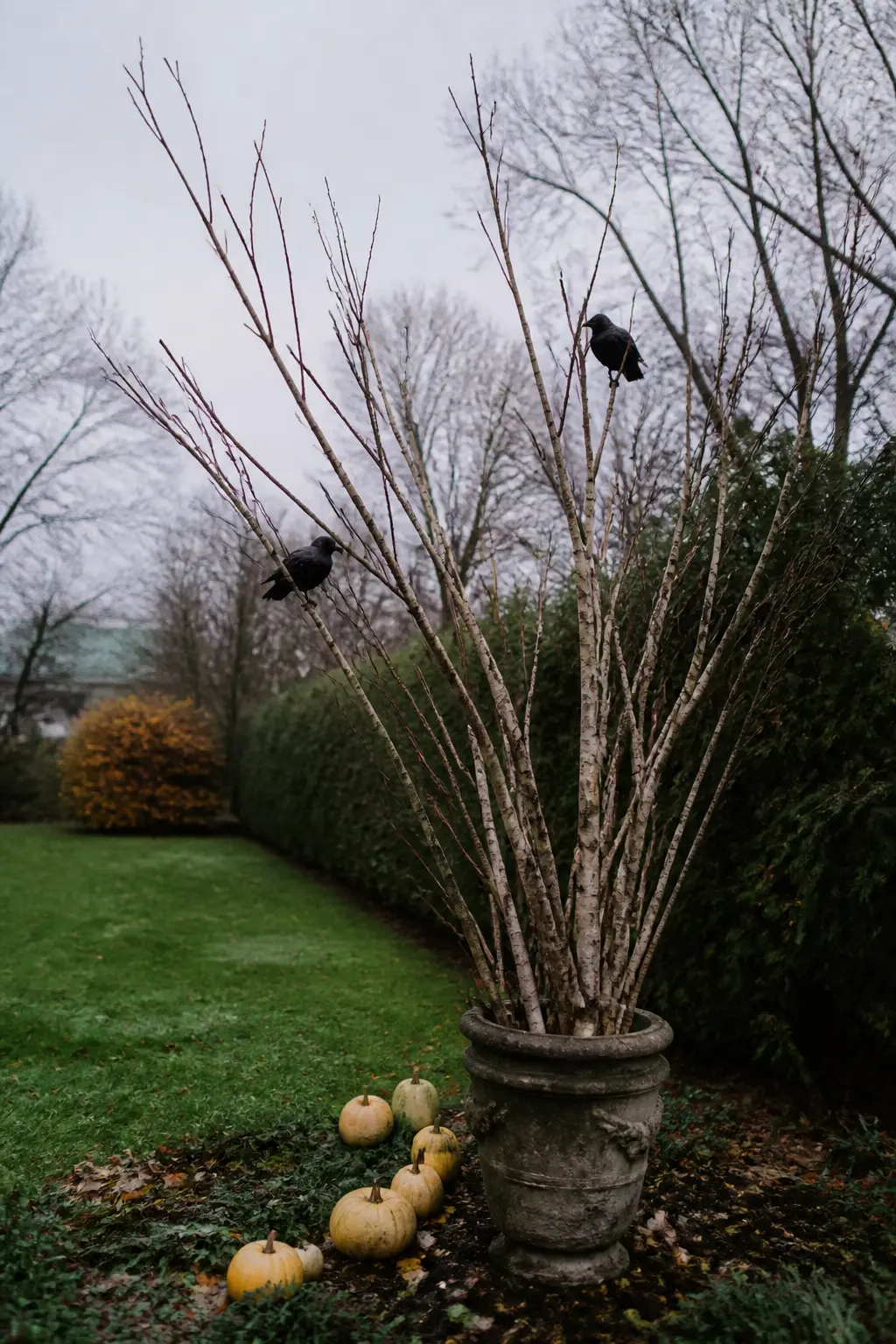
Bare branches cut from birch or hazel, stripped of any remaining leaves and bundled together in a terracotta or stone urn sunk into a border, are one of the cheapest and most effective pieces of October decor in a wet climate. Rain darkens the bark, making it look more dramatic, not worse.
The branches themselves cost nothing if you have a garden or access to a hedgerow. Five to seven branches in a tight bundle, all roughly the same height, reads cleaner than a sprawling loose arrangement. Add a few artificial black bird shapes wired onto the upper branches: weatherproof ABS plastic holds up, foam does not.
🛍 Shopping guide
Resin Mushroom and Toadstool Grouping in a Border
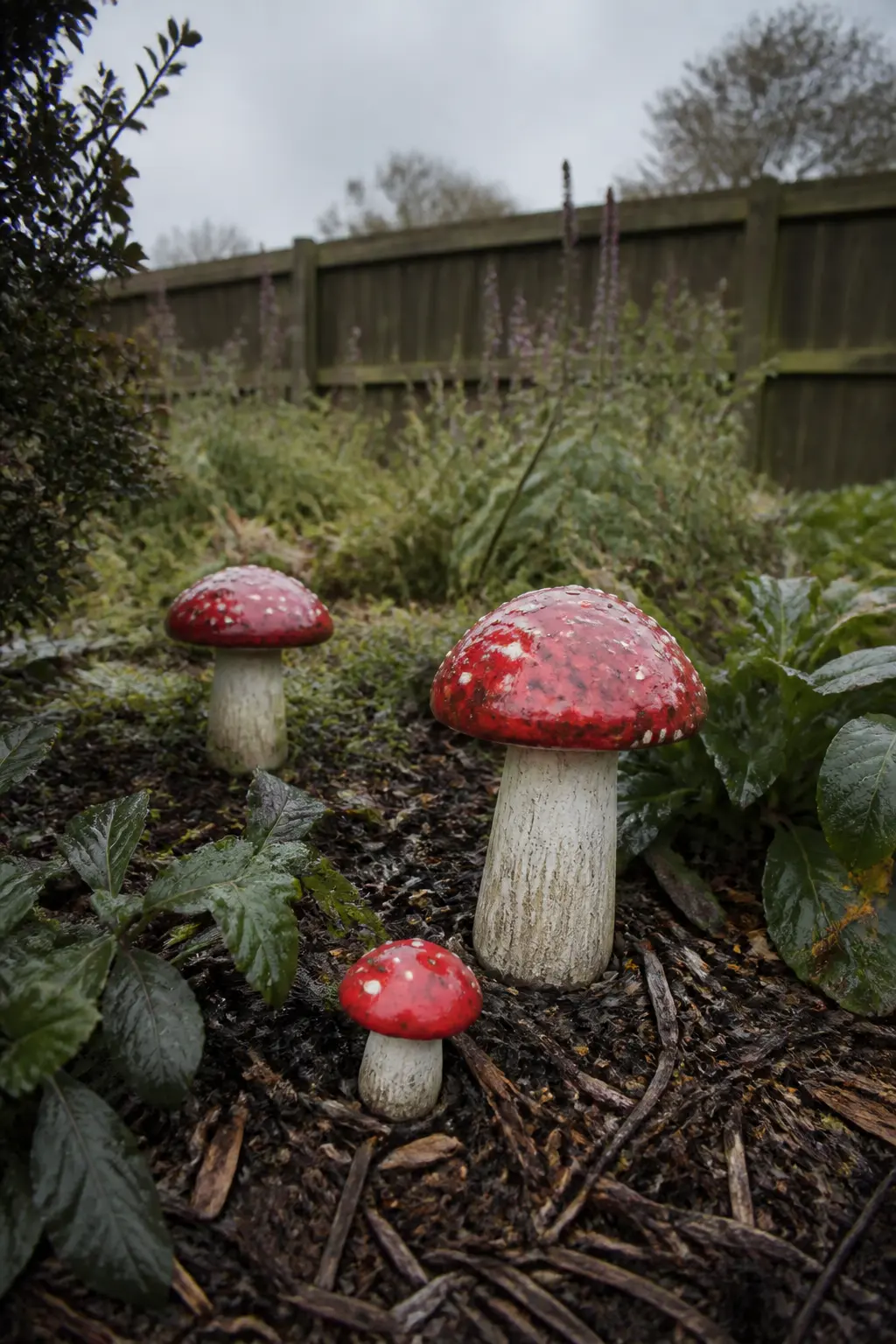
Resin toadstool and mushroom figures placed in a garden border among existing plants look both seasonal and eccentric in exactly the right way. Rain makes them look more convincing, not less: natural mushrooms appear after rain, so the context reinforces the effect.
Buy the ones with a spike base that pushes directly into soil rather than flat-bottomed ornaments that pool water underneath.
White-spotted red toadstools read as fairy-tale rather than horror, which is a valid choice for October. For a darker read, black-capped or grey-stone-finish resin mushrooms work better and suit a wet climate’s palette.
Real Pumpkins and Gourds in a Galvanised Metal Trough
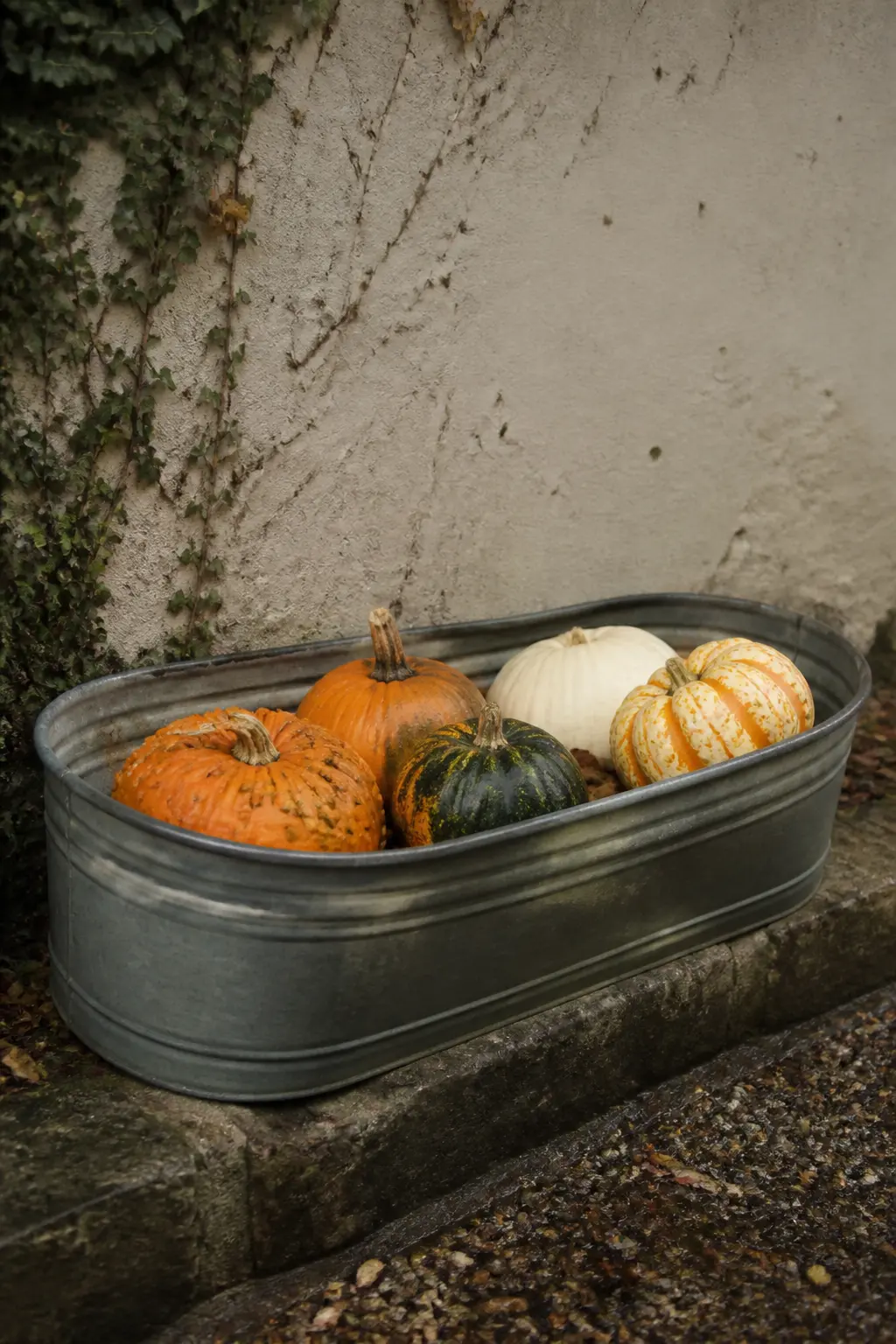
Real pumpkins and gourds are nature’s own outdoor container: they are built to sit in a field through October and they do it without rotting for three to five weeks.
The mistake is sitting them on a flat, non-draining surface where water pools under the base and accelerates rot from below. A galvanised metal trough with drainage holes keeps water moving past them.
Do not carve them until the final week if you want them to last. An uncarved pumpkin has an intact rind that resists water and mould.
A carved one is open to both and will collapse in ten days to two weeks outdoors in wet conditions. Variety is the thing here: mix green, white, orange, and warty varieties at different heights.
Aged Terracotta Pot with Black Mums at the Garden Gate
An aged terracotta pot beside a garden gate deepens in colour when wet, which is why it belongs in this climate rather than a dry one. Fill it with black or near-black Chrysanthemum “Black Magic” or similar dark-flowered mums and the result looks expensive and intentional with minimal effort.
Terracotta cracks in a hard frost, so it is worth bringing the pot under cover once October ends. For the season itself, it is the right material: it drains through the base, does not pool water, and gains rather than loses character in the rain.

The Yard: Large-Scale Pieces That Anchor the Scene
Large-scale yard pieces need to earn their place in two ways: they must be physically stable in wind, and they must look intentional at a distance because nobody walks up to inspect them. Silhouettes, large resin figures, and grouped planters all work at this scale. The detail does not need to be fine.
Avoid foam tombstones at yard scale. They are the single most common outdoor Halloween purchase and the single most common failure: foam absorbs water, swells, and the painted surface peels in sheets. Stone-effect resin tombstones cost more and last a decade longer.
Stone-Effect Resin Tombstones in Graduated Sizes
Stone-effect resin tombstones are the direct replacement for foam ones. They cost more. They survive the entire season and come out again for years, while foam tombstones typically collapse by week three in wet conditions: the surface paint lifts in sheets and the foam core swells at the base where it contacts wet soil.
Three tombstones in graduated sizes grouped slightly off-centre in a front lawn read as a family plot rather than a Halloween prop line. Use a metal stake through the pre-drilled hole in the base: do not rely on the tombstone being heavy enough to stand in wind on its own, because in a gust it will not be.

🛍 Shopping guide
Large Steel Cauldron as a Planter
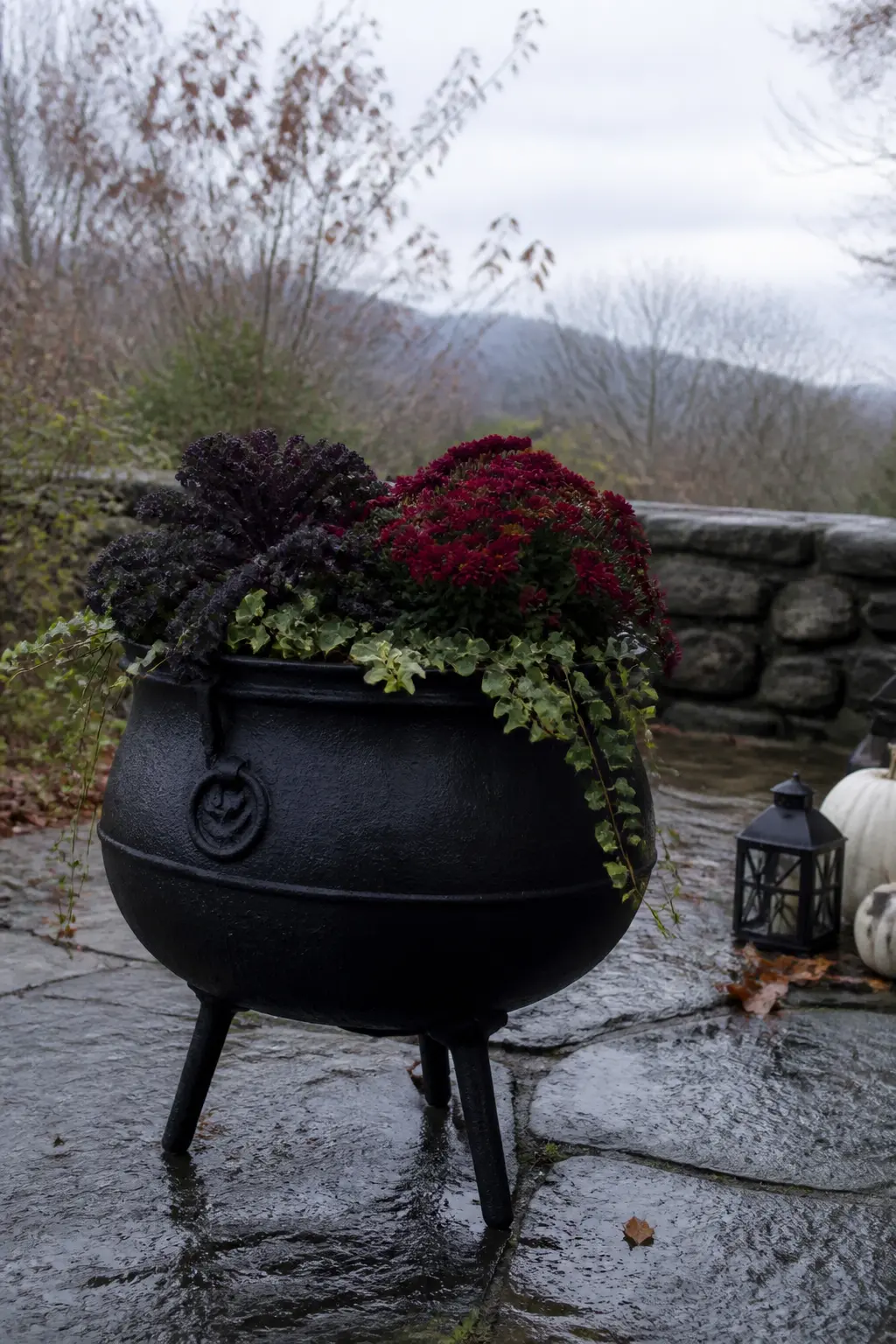
A large galvanised steel or cast-iron cauldron used as an oversize planter is functional all year and reads as a Halloween piece for October without any additional effort. Fill it with ornamental kale, trailing ivy, and small dark-toned mums: ornamental kale is a brassica and actively prefers cold, wet October conditions.
A cauldron on short legs drains cleanly. One sitting flat on paving does not: drill a drainage hole in the base before planting if the model lacks one. The combination of the vessel and the dark foliage does the work; you do not need to add anything else to this piece.
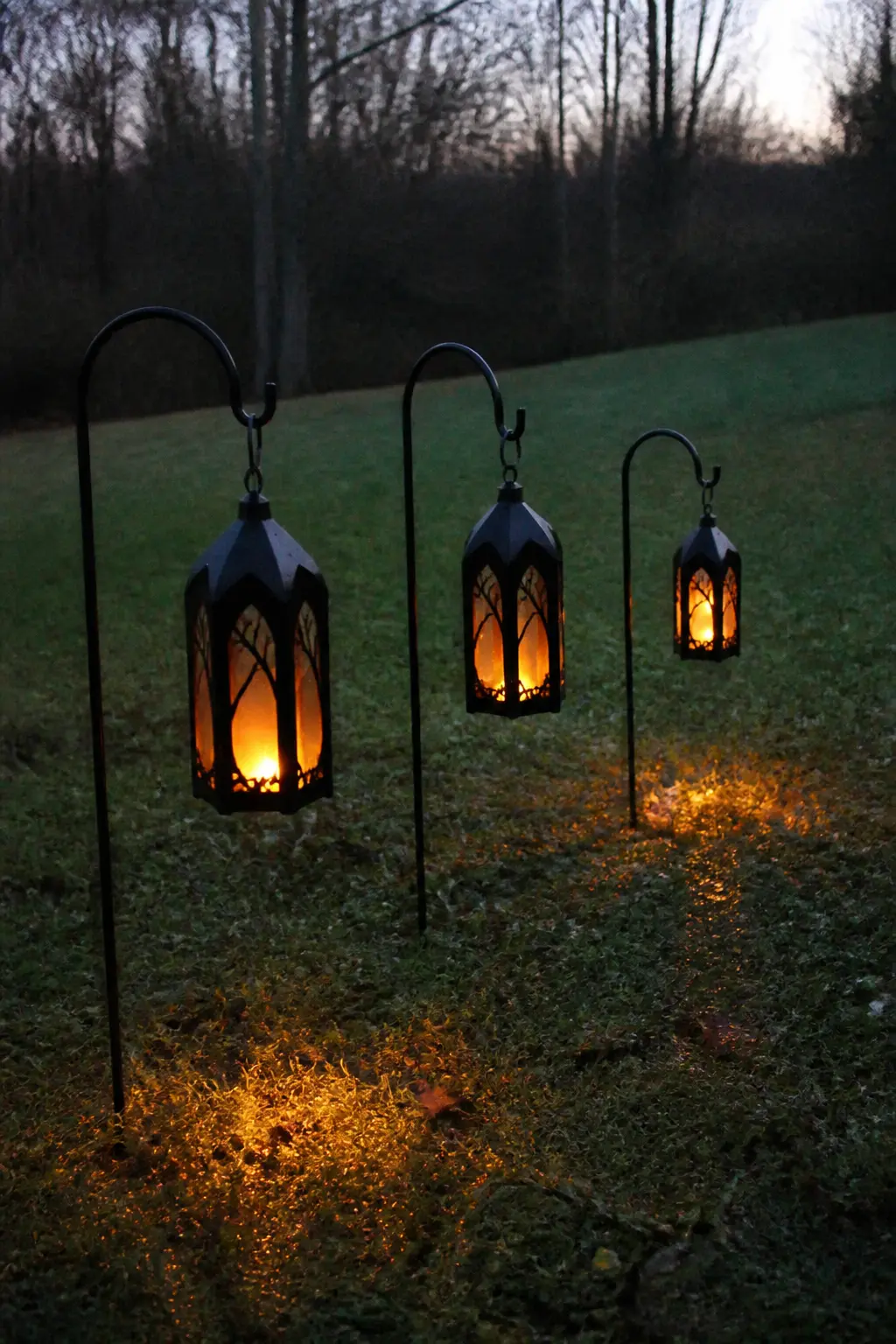
Black Garden Lanterns on Shepherd’s Hooks
A shepherd’s hook driven into lawn gives height without any structural fixing, and a powder-coated steel lantern hanging from it handles wind far better than any flat-sided yard sign or banner because it can swing freely rather than being pushed over.
Three hooks of different heights, each with a different lantern, creates a scene rather than a row of identical pieces.
Use waterproof LED pillar candles inside. The LED flame should be amber and should flicker: solid non-flickering LED reads as an electric light rather than a candle effect, and the whole point of a lantern at a distance is the living quality of the light.
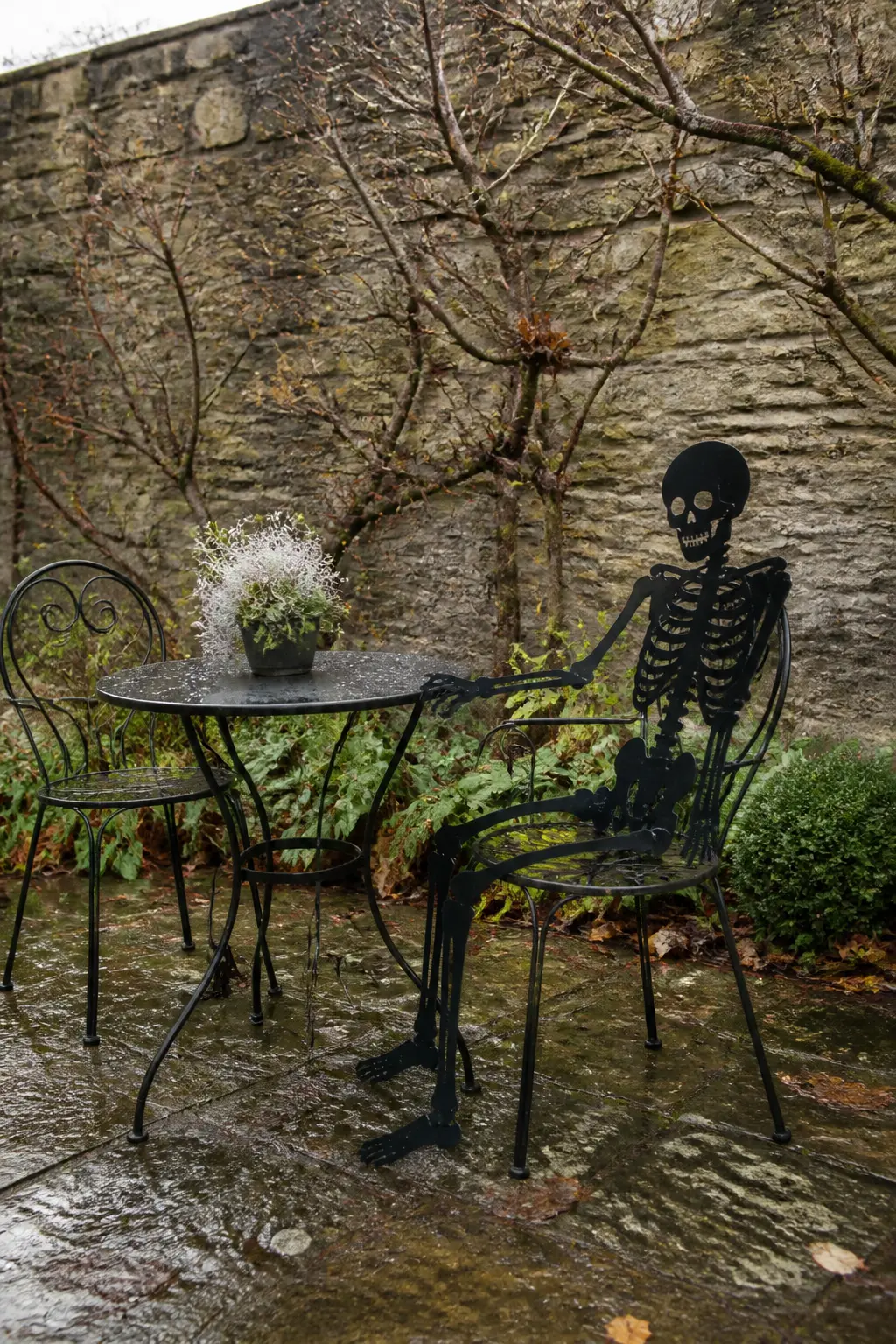
Iron Skeleton Silhouette Seated on a Garden Chair
A life-sized flat steel skeleton silhouette, powder-coated black, seated in a metal garden chair is the kind of yard piece that reads clearly from the street and requires zero maintenance through the month. The silhouette format means wind passes through it. The metal chair and metal figure are both rain-proof. Nothing about this arrangement requires any intervention.
Seat it in a chair that stays outside year-round anyway: a wrought-iron bistro chair, a metal Adirondack, or a powder-coated garden seat. The juxtaposition of the garden chair and the skeleton figure is the joke, and it lands from thirty feet away.
🛍 Shopping guide
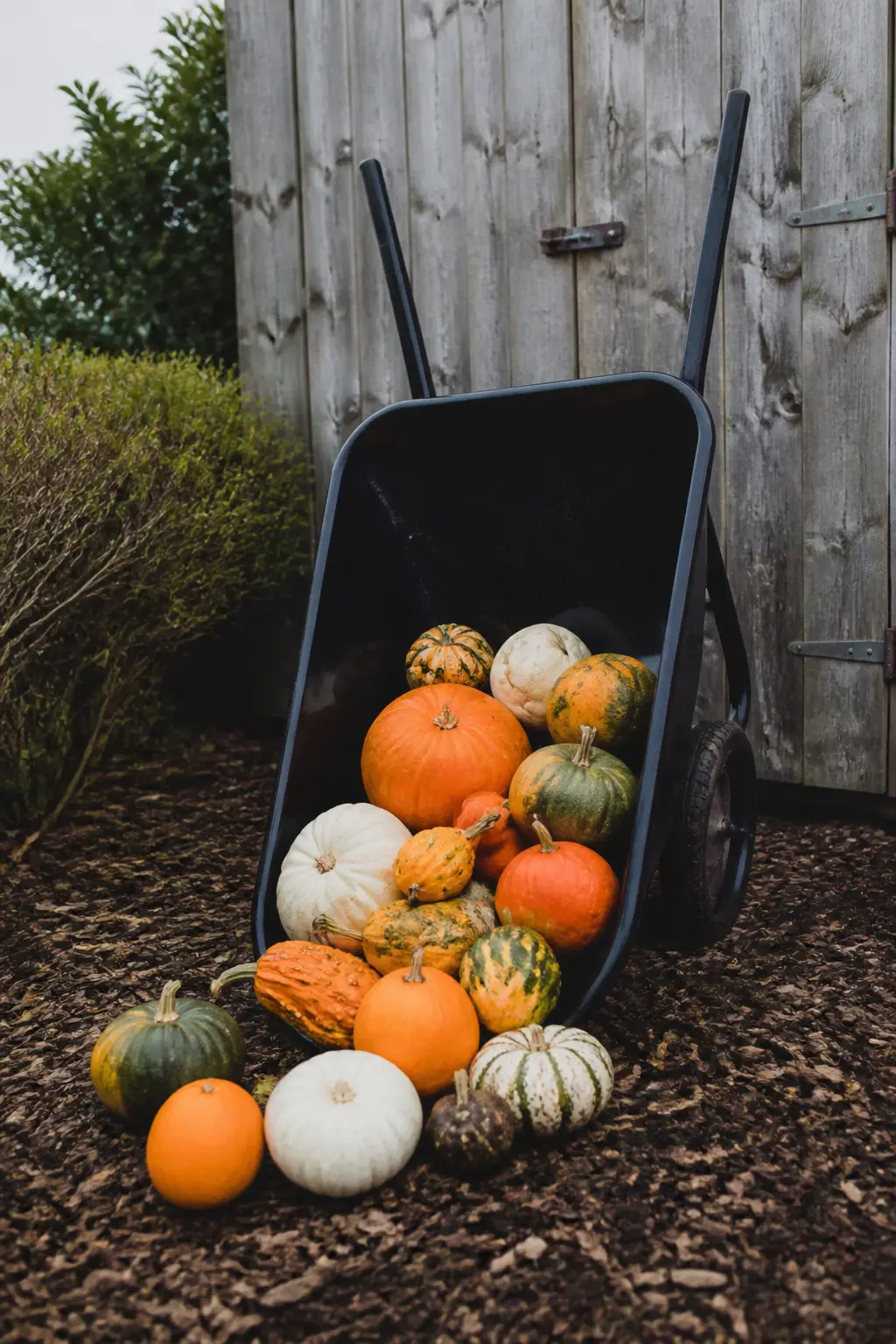
Black Wheelbarrow Spilling Pumpkins
An old metal wheelbarrow tipped at an angle with mixed real pumpkins and gourds spilling from it onto a gravel or bark-mulched area is a large-scale yard piece that costs almost nothing if you already have the barrow. The wheelbarrow itself is entirely weatherproof.
The pumpkins last three to five weeks in the rain as long as they are sitting on a draining surface rather than in standing water.
Tip the barrow so the handles face down and stake it lightly to stop it rocking in the wind. Add a few black resin skulls among the pumpkins for a harder edge. The asymmetry of the tipped barrow is the thing that reads as intended rather than accidental.
Things That Look Better Wet
This is a short and genuinely useful category. Certain materials and textures are more convincing in wet conditions than dry: bare branches look starker and darker when soaked, galvanized metal gleams, aged terracotta deepens in colour, and anything with a matte stone finish reads as more authentic in damp air than it ever does in direct sun.
Fog and low light also erase the “Halloween store” quality of many pieces that look cheap in daylight. If a piece looks better in a photo taken at dusk in the rain than it does in afternoon sun, it belongs in this category and in your yard.
Wet Bare Branches Hung With Black Glass Ornaments
A collection of bare branches from a large shrub or tree, installed in a stone urn or heavy ceramic pot near the front door, hung with black glass ball ornaments and small resin skull beads on UV-stable cord, looks genuinely unsettling in fog or rain.
The black glass catches reflected light in a way that flat black ornaments never do, and the moisture on the branches darkens them to near-black.
Use fishing monofilament or UV-stable nylon cord for hanging: natural twine absorbs moisture and rots within two weeks, and metal wire rusts and stains the branches. The weight of glass ornaments in wind is manageable on short cords; long drops will cause swinging that breaks the ornament against the pot edge.

🛍 Shopping guide
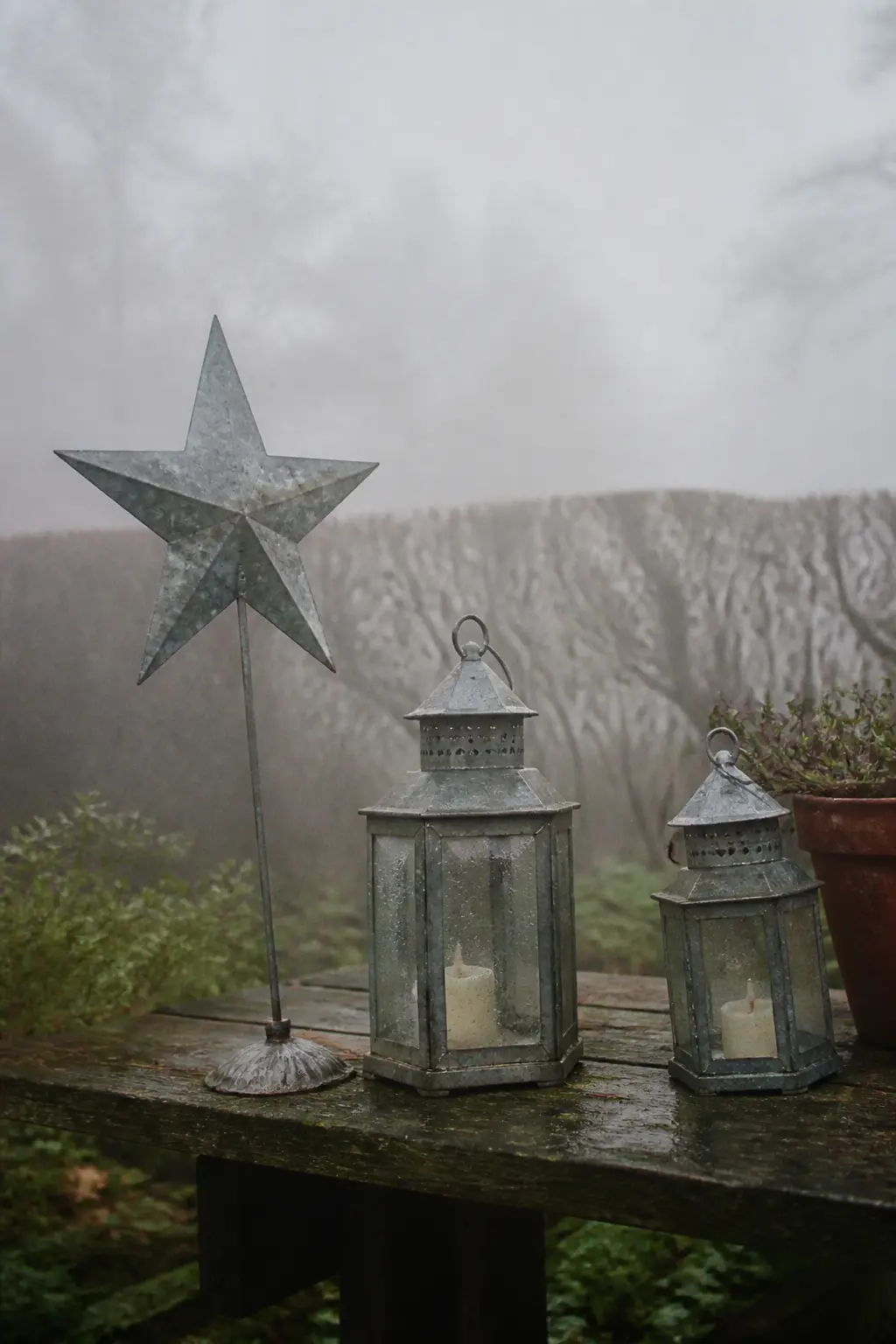
Galvanised Metal in a Misted Garden
Galvanised metal gleams in damp air and under overcast light in a way that it does not in sunshine. A galvanised tin bucket holding a small LED lantern, a galvanised star on a stake, or a galvanised-finish garden sign all gain something in the grey, misty light of a wet October morning that they entirely lack in direct sun.
This is worth knowing when you are shopping: if a piece looks slightly flat in the shop’s bright artificial lighting, take it outside or check a photo of it in overcast conditions before deciding. Galvanised finishes are among the materials that are systematically undervalued in lit showrooms and over-deliver outside.
🛍 Shopping guide
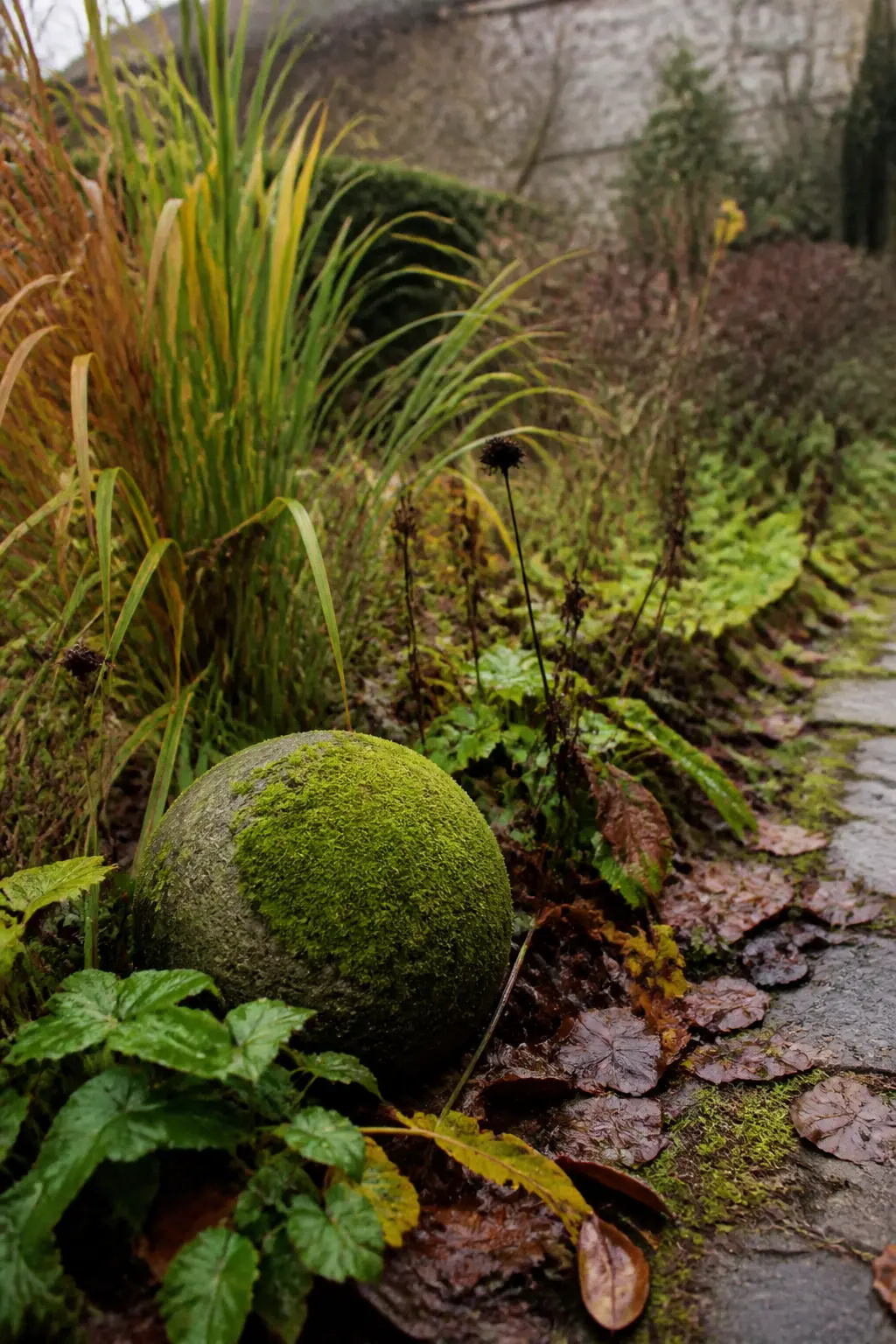
Moss-Covered Stone Sphere in a Border
A stone or concrete sphere in a planted border grows actual moss in a wet climate, and it does so faster than you expect. By mid-October in a damp garden, a sphere placed in August will have visible green patina that reads as ancient and uncanny in exactly the way a clean sphere from a garden centre does not.
If you want to accelerate the process, paint the sphere with a diluted live yoghurt mixture before September and keep it in a shaded, damp spot. The bacteria in the yoghurt seed the moss. The result by Halloween is a sphere that looks as though it has sat there for a hundred years.
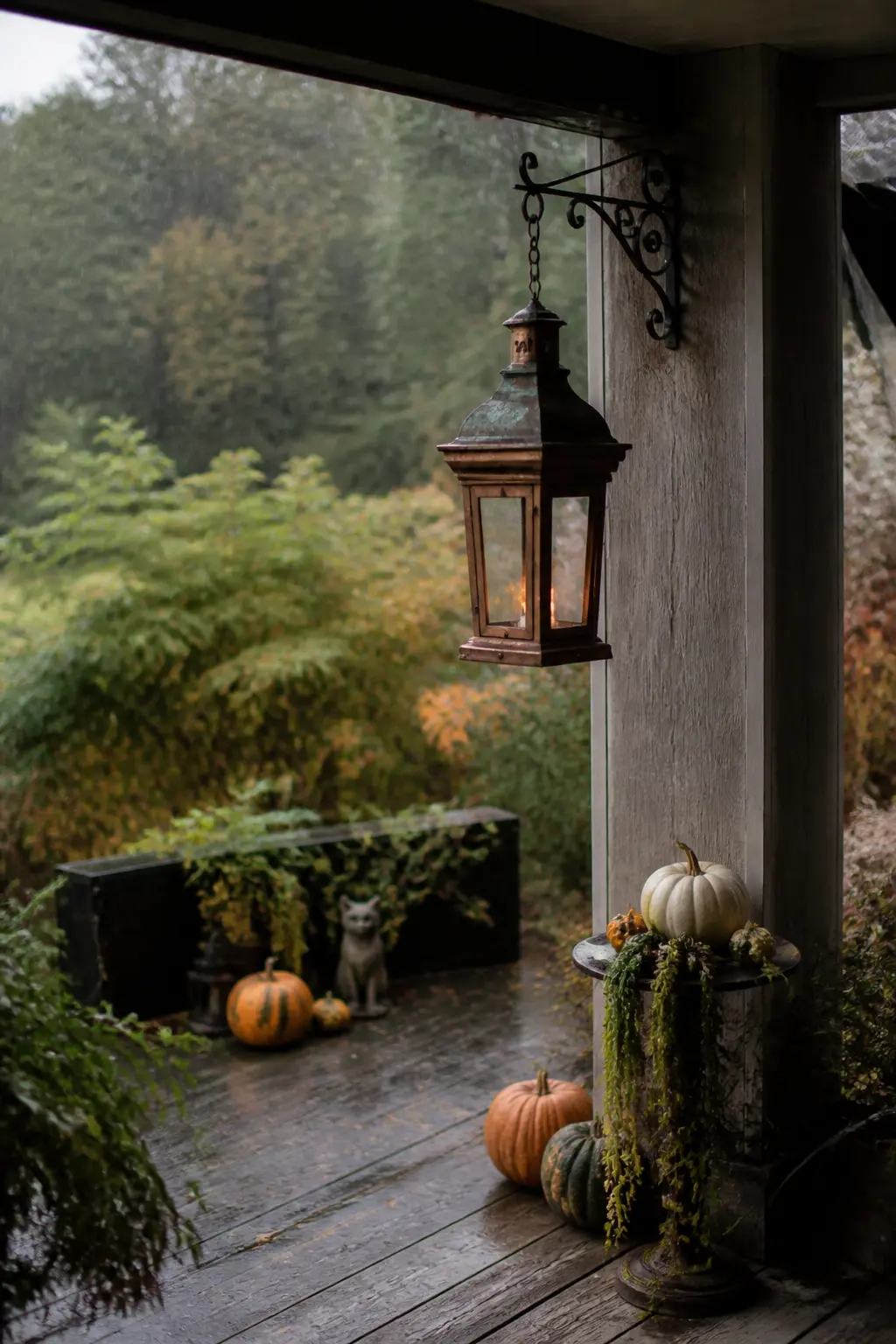
Aged Copper Lantern in Rain
Solid copper lanterns develop a verdigris patina over several seasons of outdoor use in a wet climate: the green-blue oxidation reads as genuinely antique and suits October light better than almost any other finish. If you buy a copper lantern specifically for this effect, do not seal or polish it: let the rain do the work.
In the first season, copper simply gleams when wet, which is also a good effect. By the second and third seasons, the patina develops. This is a piece that earns its cost over years, which is the right way to think about anything you put outside in a difficult climate.
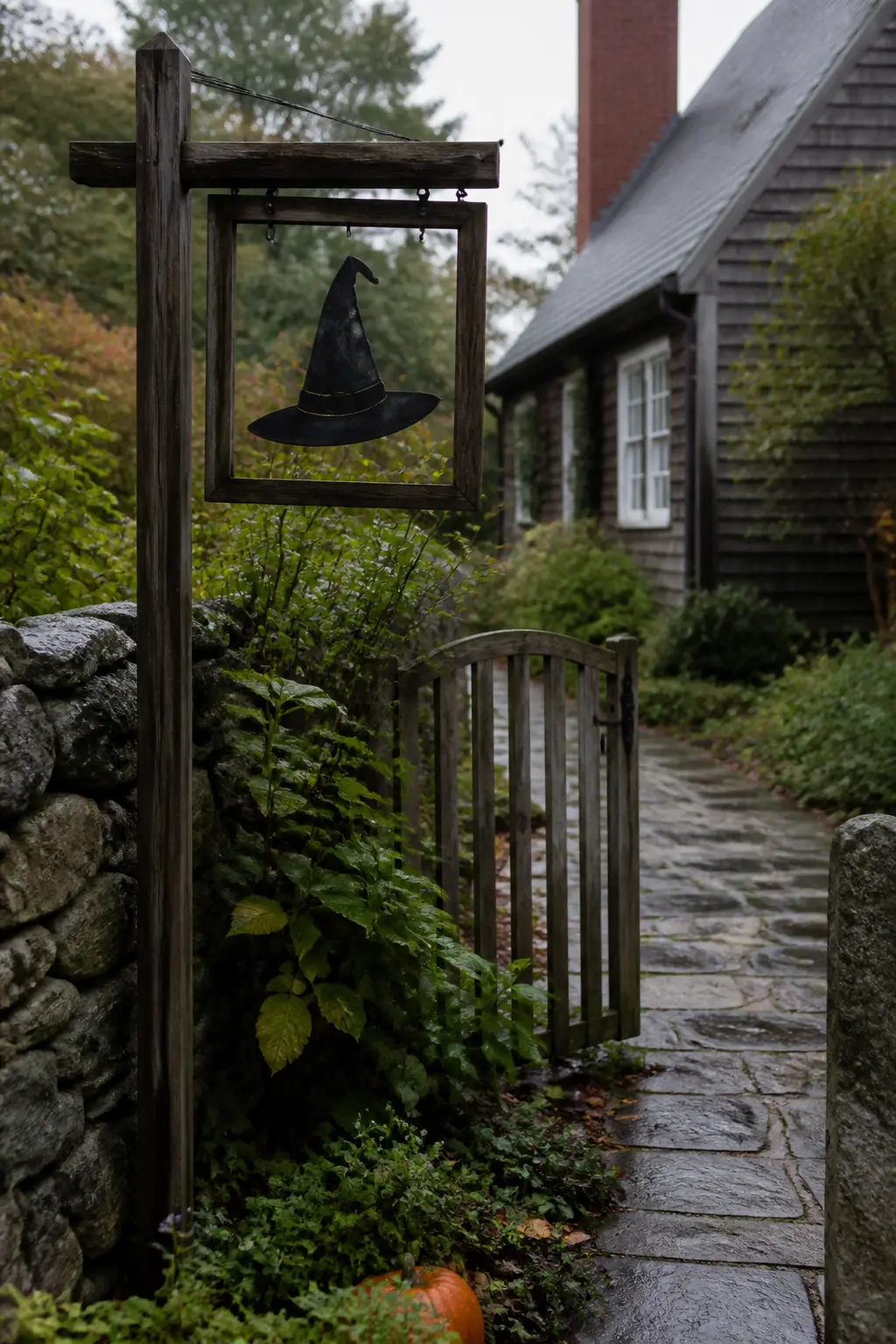
Timber-Framed Witch Hat Sign by the Gate
A simple timber frame with a laser-cut or hand-painted steel plate insert weathers in a way that adds rather than subtracts: the wood darkens and silvers in the rain, the steel plate develops an even patina, and the piece looks more established with each passing week. This is the opposite of a foam or paper sign, which degrades visibly.
The witch hat shape is one of the simplest laser-cut profiles and is sold by metal craft suppliers in powder-coated steel. Mount it in a timber frame with exterior-grade screws and hang the whole assembly from a gate post hook. The timber frame adds weight and stability that a metal plate alone on a hook lacks.
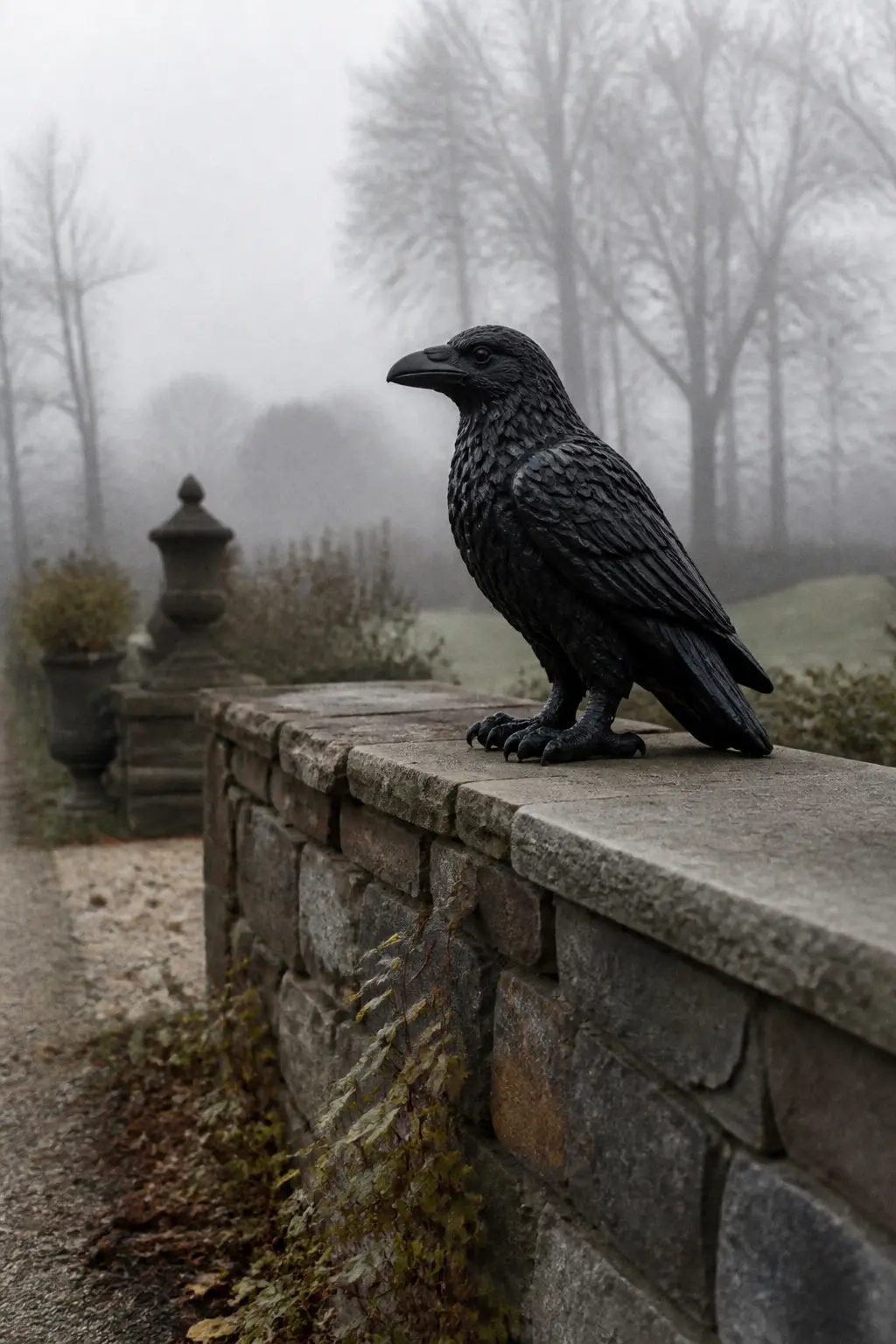
Resin Raven on a Stone Wall Cap
A resin raven, realistically finished in iridescent black, placed on the coping stone of a garden wall or fence post does something that most Halloween props cannot: it looks plausible. In the rain and low light of late October, from any distance over ten feet, it reads as a real bird. That is the effect you are after.
Look for a model where the feet have a slot that accepts a short wooden dowel or metal pin fixed into the stone: a freestanding raven on a round coping stone will blow off in the first real gust. A pinned one stays put.
The iridescent finish is important: flat black plastic reads as a toy, iridescent reads as a feather.
What to Stop Buying
Paper lanterns, even “weather-resistant” ones: they pulp. Foam in any form: it swells, peels, and breaks at the seams. Fabric banners without a waterproof coating: they hold moisture, sag, and mould. Anything with a battery compartment that is not sealed: the batteries corrode and the piece stops working by week two.
Hay bales and dried corn stalks look wonderful on a dry October day in a continental climate. In a wet one, they are a mould farm. Real pumpkins and gourds are the exception: they last several weeks outside in the rain because they are designed by nature to do exactly that, and they compost cleanly when they are done.
Frequently Asked Questions
What outdoor Halloween decor lasts the longest in rain and wind?
Cast resin, concrete, stone, powder-coated steel, and raw iron all survive a full wet month without intervention. Real pumpkins and gourds last three to five weeks uncarved. Weatherproof LED lighting rated IP65 or above is the right choice for any electrical element. Everything else: check the material name before you buy, not the phrase ‘weather-resistant.’
What Halloween decor should I stop buying for a rainy climate?
Foam tombstones and figures, paper lanterns, fabric banners without a waterproof coating, hay bales, dried corn stalks, and any battery-operated piece with an unsealed compartment. These all fail within two weeks of sustained rain. The foam absorbs water and the surface finish peels; paper simply pulps; fabric holds moisture and mildews; hay becomes a compacted mould block.
Can I use real pumpkins outdoors in wet weather?
Yes, uncarved ones. An intact pumpkin rind resists water and mould for three to five weeks outdoors. Place them on a draining surface, not a flat patio where water pools under the base. Carve only in the final week before Halloween: a carved pumpkin in wet conditions will collapse in ten days to two weeks.
How do I keep yard decor from blowing over in wind?
Use ground stakes for anything in a lawn or border. For hard surfaces, fill hollow bases with sand or small stones. Avoid flat-sided pieces on tall narrow bases: they catch the wind and topple. Silhouette designs in powder-coated steel are the most wind-stable flat yard pieces because air passes through them rather than pushing against a solid surface.
What Halloween decor actually looks better in fog and rain?
Bare branches, galvanised metal, aged terracotta, moss-covered stone, iridescent black resin ravens, and raw iron with a rust patina all improve in wet, low-light conditions.
These materials deepen in colour when wet and catch diffuse grey light in ways that look more convincing than they do in direct sun. They are also the pieces most likely to photograph well on an overcast October morning.

32 sealed, shelf-worthy glitter pumpkin designs from fully covered to a single sparkling detail, plu

21 paper bag Halloween crafts that actually work: monster treat bags, witch broom bags, painted tric

Find Halloween decorations for every room, budget, and effort level, from dollar store hacks to wrea
Leave a Reply