

10 Somatic Exercises To Reduce Cortisol (That Actually Work in 10 Minutes)

High cortisol levels create a vicious cycle: stress elevates cortisol, which makes you feel more anxious and tense, which keeps cortisol elevated. Traditional exercise can help, but intense workouts sometimes raise cortisol even higher—especially if you’re already chronically stressed.
Somatic exercises offer a different approach. Instead of pushing through discomfort or forcing your body to perform, somatic movement focuses on releasing tension stored in the nervous system through gentle, mindful movement.
These aren’t typical workouts. They’re therapeutic movements designed to calm the nervous system, discharge stored stress, and signal to your body that it’s safe to relax. Research shows they can significantly lower cortisol levels in just 10-20 minutes.
Here are 10 somatic exercises to reduce cortisol that work with your body’s natural stress-release mechanisms, not against them.
Quick disclosure: This post contains affiliate links. If you buy something through these links, a small commission may be earned at no extra cost to you. This is general information about movement and stress management—not medical advice. If you have injuries, chronic pain, or medical conditions, consult your healthcare provider before starting any new movement practice.
What Are Somatic Exercises?
Somatic exercises are gentle movements that increase body awareness and release tension held in the nervous system. Unlike traditional exercise that focuses on external goals (build muscle, burn calories, increase endurance), somatic healing exercises focus on internal experience—how movement feels, where you hold tension, and what helps release it.
The science: Trauma and chronic stress create patterns of muscular tension controlled by the nervous system. These patterns persist even when the stressor is gone. Somatic exercises retrain the nervous system to release these holding patterns, which directly lowers cortisol and activates the parasympathetic (rest-and-digest) nervous system.
How they differ from yoga or stretching:
- Yoga: Often holds poses, focuses on flexibility and strength
- Stretching: Elongates muscles through external force
- Somatic exercises: Small, slow movements that retrain the brain-muscle connection through sensation and awareness
Key principles:
- Movement is slow and mindful, never forced
- Focus is on internal sensation, not external appearance
- Breathwork is integrated throughout
- The goal is nervous system regulation, not fitness
These exercises work best as part of a comprehensive cortisol management approach that includes cortisol-reducing foods, stress-lowering hobbies, and proper nutrition from a low cortisol diet.
Why Somatic Exercises Reduce Cortisol
Nervous system regulation: Somatic movements activate the vagus nerve, which controls the parasympathetic nervous system. This directly lowers cortisol and shifts the body from “fight-or-flight” to “rest-and-digest.”
Tension release: Chronic stress creates muscular holding patterns—tight shoulders, clenched jaw, shallow breathing. These physical tensions send signals to the brain that danger is present, maintaining elevated cortisol. Somatic exercises release these patterns.
Trauma processing: Trauma and chronic stress get “stored” in the body as incomplete stress responses. Somatic movements complete these responses, allowing the nervous system to discharge stored activation.
Mindfulness without meditation: Many people struggle with seated meditation. Somatic exercises provide the same mindfulness benefits through gentle movement, making them more accessible.
Research: A 2018 study published in Complementary Therapies in Medicine found that somatic practices significantly reduced cortisol levels and improved stress markers. Another study showed that trauma-focused somatic therapy reduced PTSD symptoms and normalized cortisol rhythms.
When to Do Somatic Exercises
Morning (after waking): Gentle somatic movements help transition from sleep to wakefulness without spiking cortisol. Pair with a cortisol-balancing breakfast afterward.
Midday (stress break): 10 minutes of somatic release during lunch or breaks prevents cortisol from building throughout the day.
Evening (wind-down): Evening somatic practice signals to your nervous system that the day is done, helping cortisol drop naturally before bed. Combine with evening cortisol-lowering drinks.
After stressful events: Use somatic exercises immediately after difficult meetings, confrontations, or anxiety-provoking situations to discharge the stress response before it becomes chronic.
Consistency matters more than duration: 10 minutes daily produces better results than 60 minutes once a week.
10 Somatic Exercises To Reduce Cortisol
1. Body Scan with Breath (5-10 minutes)
This foundational somatic practice increases body awareness and releases tension through attention and breath.
How to do it:
- Lie on your back with knees bent, feet flat on the floor
- Close your eyes and take 3 deep breaths
- Starting at your feet, slowly scan your attention up through your body
- When you notice tension, breathe into that area for 3-5 breaths
- Imagine the tension releasing with each exhale
- Continue up through legs, hips, belly, chest, arms, shoulders, neck, face
- End with 3 full-body breaths
Why it works: Directing attention and breath to tense areas activates the parasympathetic nervous system and releases unconscious holding patterns.
Watch tutorial: Search YouTube for “body scan meditation for stress relief” for guided versions.
2. Somatic Shaking (3-5 minutes)
Shaking is how animals discharge stress after threats. This primal movement pattern releases cortisol and stored activation from the nervous system.
How to do it:
- Stand with feet hip-width apart, knees slightly bent
- Start bouncing gently on the balls of your feet
- Let the bouncing turn into shaking—start with legs, let it move up through your body
- Shake your arms, shoulders, hands
- Let your whole body shake and jiggle for 3-5 minutes
- Gradually slow down, then stand still and notice how you feel
Why it works: Shaking discharges excess activation from the sympathetic nervous system (fight-or-flight), allowing cortisol to drop.
Watch tutorial: Search YouTube for “somatic shaking TRE” or “trauma releasing exercises shaking.”
3. Pelvic Tilts and Circles (5 minutes)
The pelvis holds significant tension related to stress and trauma. Gentle pelvic movements release this tension and calm the nervous system.
How to do it:
- Lie on your back, knees bent, feet flat
- Slowly tilt your pelvis forward (arch lower back slightly)
- Slowly tilt pelvis back (press lower back into floor)
- Repeat 10 times, moving very slowly and breathing deeply
- Then make slow circles with your pelvis—5 in each direction
- Pause and notice any sensations
Why it works: The psoas muscle (hip flexor) is directly connected to the fight-or-flight response. Releasing pelvic tension releases stored stress.
Watch tutorial: Search YouTube for “somatic pelvic tilts” or “psoas release exercises.”
4. Shoulder Rolls and Figure-8s (5 minutes)
Shoulders carry stress and cortisol-driven tension. This exercise releases shoulder and neck tightness through gentle, exploratory movement.
How to do it:
- Sit or stand comfortably
- Slowly roll shoulders forward 5 times, then backward 5 times
- Lift one shoulder toward ear, then drop it. Repeat other side
- Move shoulders in figure-8 patterns—slow, smooth, exploratory
- Try different directions and speeds, noticing what feels releasing
- End with both shoulders relaxed, taking 3 deep breaths
Why it works: Shoulder tension signals danger to the brain. Releasing this tension through gentle movement tells the nervous system it’s safe to relax.
Watch tutorial: Search YouTube for “somatic shoulder release” or “neck and shoulder tension relief.”
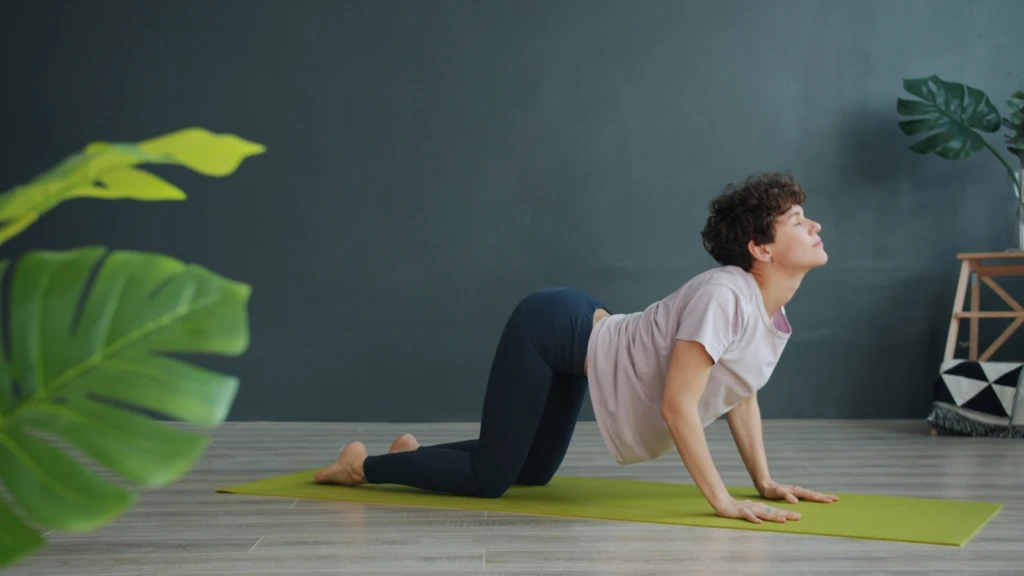
5. Spinal Waves (Cat-Cow Variation) (5-7 minutes)
This gentle spinal movement massages the nervous system and releases tension held along the spine.
How to do it:
- Start on hands and knees (tabletop position)
- Slowly arch your back (cow pose), lifting head and tailbone
- Slowly round your back (cat pose), tucking head and tailbone
- Move very slowly, letting the movement originate from different parts of your spine
- Try initiating the wave from your tailbone, then from your head, then from mid-back
- Make the movement smaller and slower, focusing on sensation
- Rest in child’s pose for 1 minute afterward
Why it works: The spine houses the central nervous system. Gentle spinal movement directly affects nervous system regulation and cortisol release.
Watch tutorial: Search YouTube for “somatic cat cow” or “spinal waves for nervous system.”
6. Grounding Through the Feet (5 minutes)
This standing practice reconnects you to your body and the present moment, lowering cortisol through embodied awareness.
How to do it:
- Stand barefoot if possible
- Shift your weight slowly from left to right foot
- Rock forward onto toes, then back onto heels
- Make small circles with your weight, exploring how your feet contact the ground
- Lift and spread your toes, then place them down one at a time
- Stand still, feeling the full contact of both feet on the ground
- Take 5 deep breaths, imagining roots growing from your feet into the earth
Why it works: Grounding exercises activate the parasympathetic nervous system and interrupt dissociation—a common response to chronic stress that keeps cortisol elevated.
Watch tutorial: Search YouTube for “grounding exercises for anxiety” or “somatic grounding techniques.”
7. Jaw and Face Release (3-5 minutes)
The jaw holds enormous tension related to stress (hence “grit your teeth”). Releasing jaw tension rapidly lowers cortisol.
How to do it:
- Sit comfortably, close your eyes
- Gently open and close your mouth 5 times, very slowly
- Move your jaw side to side, noticing any clicking or tension
- Make small circles with your jaw
- Gently massage your jaw muscles (masseter) with your fingertips
- Let your mouth hang slightly open, tongue relaxed
- Scrunch your whole face tight, then release completely (repeat 3 times)
- End with your face completely relaxed, breathing softly
Why it works: Jaw tension directly correlates with stress levels. Releasing it sends immediate signals to the nervous system to downregulate cortisol.
Watch tutorial: Search YouTube for “TMJ release exercises” or “jaw tension relief somatic.”
8. Pendulation (Tracking Sensations) (5-10 minutes)
This advanced somatic practice involves moving attention between areas of tension and areas of ease, teaching the nervous system to self-regulate.
How to do it:
- Sit or lie comfortably
- Notice an area of your body that feels tense or uncomfortable
- Notice the specific sensations (tight, hot, heavy, etc.)
- Now find an area of your body that feels neutral or pleasant
- Notice the sensations there (soft, warm, light, etc.)
- Move your attention back and forth between the two areas every 30 seconds
- Continue for 5-10 minutes, noticing if the tension area begins to soften
Why it works: This teaches the nervous system that it can move between activation and calm, reducing the stuck “on” state that keeps cortisol high.
Watch tutorial: Search YouTube for “somatic experiencing pendulation” or “trauma release pendulation exercise.”
9. Butterfly Hug (Self-Soothing Bilateral Stimulation) (3-5 minutes)
This simple technique uses bilateral stimulation to calm the nervous system and reduce cortisol.
How to do it:
- Cross your arms over your chest, hands on opposite shoulders
- Alternately tap your shoulders with your hands—left, right, left, right
- Tap slowly and gently, creating a rhythm like a heartbeat
- Breathe slowly and deeply while tapping
- Continue for 3-5 minutes
- End with hands resting on your heart, taking 3 deep breaths
Why it works: Bilateral stimulation (alternating left-right input) calms the amygdala (fear center) and regulates the nervous system, lowering cortisol.
Watch tutorial: Search YouTube for “butterfly hug EMDR” or “bilateral tapping for anxiety.”
10. Legs Up the Wall (Restorative Inversion) (10-15 minutes)
This gentle inversion activates the parasympathetic nervous system and signals deep rest to the body.
How to do it:
- Lie on your back with hips close to a wall
- Swing your legs up the wall, hips as close as comfortable
- Arms rest at your sides or on your belly
- Close your eyes and breathe naturally
- Stay for 10-15 minutes
- To come out, bend your knees and roll to one side
Why it works: Gentle inversion stimulates baroreceptors (pressure sensors) that signal the vagus nerve to activate rest-and-digest mode, lowering cortisol.
Watch tutorial: Search YouTube for “legs up the wall restorative yoga” or “viparita karani benefits.”
Creating a Somatic Workout Plan
10-Minute Daily Routine (Morning or Evening):
- Body scan with breath (3 minutes)
- Somatic shaking (2 minutes)
- Spinal waves (3 minutes)
- Grounding through feet (2 minutes)
20-Minute Stress-Release Session:
- Body scan (5 minutes)
- Pelvic tilts and circles (5 minutes)
- Shoulder rolls and figure-8s (3 minutes)
- Jaw and face release (3 minutes)
- Legs up the wall (10-15 minutes after the sequence)
Weekly Somatic Workout Plan:
Monday: Morning grounding + evening body scan Tuesday: Somatic shaking + spinal waves Wednesday: Full 20-minute session Thursday: Jaw release + butterfly hug Friday: Pelvic tilts + shoulder release Saturday: 30-minute session combining all exercises Sunday: Gentle body scan + legs up the wall (full rest day)
Pair with other cortisol management:
- Do somatic exercises before evening cortisol drinks
- Follow with cortisol-lowering herbal tea
- Integrate into your cortisol-reducing hobbies routine
What Somatic Healing Exercises Feel Like
Somatic exercises don’t feel like traditional workouts. Here’s what to expect:
Physical sensations you might notice:
- Tingling, warmth, or waves of sensation moving through your body
- Spontaneous yawning, sighing, or deep breathing
- Trembling or shaking (this is the nervous system releasing—let it happen)
- Sudden relaxation of tense muscles
- Feeling heavy, grounded, or “melting”
Emotional releases:
- Unexpected tears (not necessarily sadness—just release)
- Feelings of relief or lightness
- Memories or emotions surfacing briefly, then passing
- Laughter or giggles
Mental shifts:
- Racing thoughts slowing down
- Shift from anxious to calm
- Feeling more present and less dissociated
- Mental clarity or spaciousness
What’s NOT normal:
- Sharp pain (stop if this occurs)
- Feeling worse or more anxious afterward (try gentler movements or shorter sessions)
- Dissociation or feeling “checked out” (focus on grounding exercises instead)
If somatic exercises bring up overwhelming emotions or trauma responses, work with a somatic therapist rather than practicing alone.
Somatic Exercises vs. Traditional Exercise
Traditional exercise (running, HIIT, weightlifting):
- Can increase cortisol, especially if already stressed
- Focuses on external performance goals
- Often involves pushing through discomfort
- Best for: physical fitness, cardiovascular health, muscle building
Somatic exercises:
- Lower cortisol through nervous system regulation
- Focus on internal sensation and awareness
- Gentle, never forced
- Best for: stress relief, trauma processing, chronic tension release
The ideal approach: Combine both. Use somatic exercises for cortisol management and nervous system health. Use traditional exercise (in moderation) for physical fitness. Avoid intense workouts when cortisol is already high—this makes the problem worse.
Common Mistakes to Avoid
Rushing through movements: Somatic exercises require slow, mindful attention. Fast movements defeat the purpose.
Forcing or pushing: If a movement hurts or feels forced, you’re working against your nervous system, not with it. Go slower and gentler.
Expecting immediate dramatic results: Some people feel relief immediately; others need weeks of practice. Trust the process.
Skipping breathwork: Breath is essential for nervous system regulation. Don’t hold your breath or breathe shallowly.
Doing too much too soon: Start with 5-10 minutes daily. Building slowly creates sustainable nervous system changes.
Comparing to others: Somatic practice is deeply individual. How it looks doesn’t matter—how it feels does.
Ignoring emotional releases: If tears or emotions come up, let them flow. This is part of the healing process.
Beyond Movement: Complete Cortisol Management
Somatic exercises are powerful, but they work best as part of comprehensive cortisol management:
Sleep: 7-8 hours consistently. Poor sleep keeps cortisol elevated no matter how much somatic work you do.
Nutrition: Follow a low cortisol diet with cortisol-reducing foods.
Stress management: Set boundaries, practice saying no, limit news and social media.
Social connection: Regular positive social interaction lowers cortisol significantly.
Professional support: If you have trauma history or chronic anxiety, work with a somatic therapist or trauma-informed practitioner.
Finding Somatic Exercise Videos and Classes
YouTube channels for somatic exercises:
- Search “Irene Lyon somatic exercises” (trauma-informed nervous system work)
- Search “Somatic Experiencing exercises” (Peter Levine’s approach)
- Search “TRE exercises” (Trauma Releasing Exercises)
- Search “gentle somatic yoga” (combines somatic principles with yoga)
Apps and online programs:
- Insight Timer (free meditation app with somatic practices)
- Somatic Experiencing International (find certified practitioners)
- Local trauma-informed yoga or somatic movement classes
Books for deeper learning:
- Waking the Tiger by Peter Levine
- The Body Keeps the Score by Bessel van der Kolk
- Somatic Experiencing by Peter Levine
FAQ
How long does it take for somatic exercises to lower cortisol?
Some people feel immediate relief during or after a session. Consistent practice (daily or 5x weekly) produces measurable cortisol changes within 3-4 weeks. Long-term nervous system regulation takes 2-3 months of regular practice.
Can somatic exercises replace therapy?
No. Somatic exercises are powerful complementary tools but don’t replace trauma therapy, psychotherapy, or medical treatment for anxiety, PTSD, or other conditions. Use them alongside professional help, not instead of it.
Are somatic exercises safe for everyone?
Generally yes, but certain populations should work with professionals: people with PTSD, recent trauma survivors, those with chronic pain conditions, or anyone who dissociates frequently. Consult a somatic therapist or trauma-informed practitioner.
What if I don’t feel anything during somatic exercises?
This is common, especially for people who are disconnected from body sensations (dissociation). Start with gentler exercises, go slower, and be patient. Sensation awareness develops over time. Consider working with a somatic therapist.
Can children do somatic exercises?
Yes. Somatic practices are excellent for children, especially those experiencing stress or anxiety. Simplify the exercises and make them playful. Shaking, grounding, and body scans work well for kids.
How are somatic exercises different from stretching?
Stretching focuses on lengthening muscles through external force. Somatic exercises retrain the brain-muscle connection through slow, mindful movement and internal awareness. They release tension at the nervous system level, not just the muscular level.
What if somatic exercises make me feel worse?
This can happen if you’re moving too fast, pushing too hard, or if trauma is surfacing without proper support. Slow down, use gentler movements, and consider working with a trained somatic practitioner.
The Bottom Line
Somatic exercises to reduce cortisol work by addressing stress where it’s actually stored—in the nervous system and body, not just the mind.
These gentle movements retrain your body’s stress response, release chronic tension, and signal to your nervous system that it’s safe to relax. The result: measurably lower cortisol levels, improved sleep, reduced anxiety, and a greater sense of calm.
Start with 5-10 minutes daily. Pick 2-3 exercises that feel accessible. Practice consistently for at least 3-4 weeks before evaluating results.
And remember: healing happens at the pace your nervous system can handle. Slow, gentle, and consistent wins over intense and sporadic.
Related posts:
- Complete guide to how to lower cortisol naturally
- Cortisol-reducing hobbies backed by science
- 14-day low cortisol diet meal plan
- Evening drinks to lower cortisol before bed
- Best herbal teas for lowering cortisol
Scientific references:
- Somatic practices and stress reduction – NCBI
- Trauma releasing exercises and cortisol – PubMed
- Body-based interventions for trauma – Frontiers in Psychology
- Somatic Experiencing therapy efficacy – Somatic Experiencing International
YouTube tutorial searches:
- “Somatic exercises for stress relief”
- “Trauma releasing exercises (TRE)”
- “Somatic Experiencing exercises”
- “Nervous system regulation exercises”
- “Vagus nerve activation exercises”
Medical Disclaimer
This article provides general informational and educational content only and is not intended as medical advice. Always consult your physician, physical therapist, or mental health professional before beginning somatic exercises, especially if you have injuries, chronic pain, trauma history, or medical conditions.
In ‘The Psychology of Money,’ Morgan Housel masterfully breaks down the complex relation

Don't ignore these 7 red flags screaming your life needs a major overhaul before it's too late.

Want to fall in love with reading but struggling to make it stick? I get it – between Netflix,
Leave a Reply