

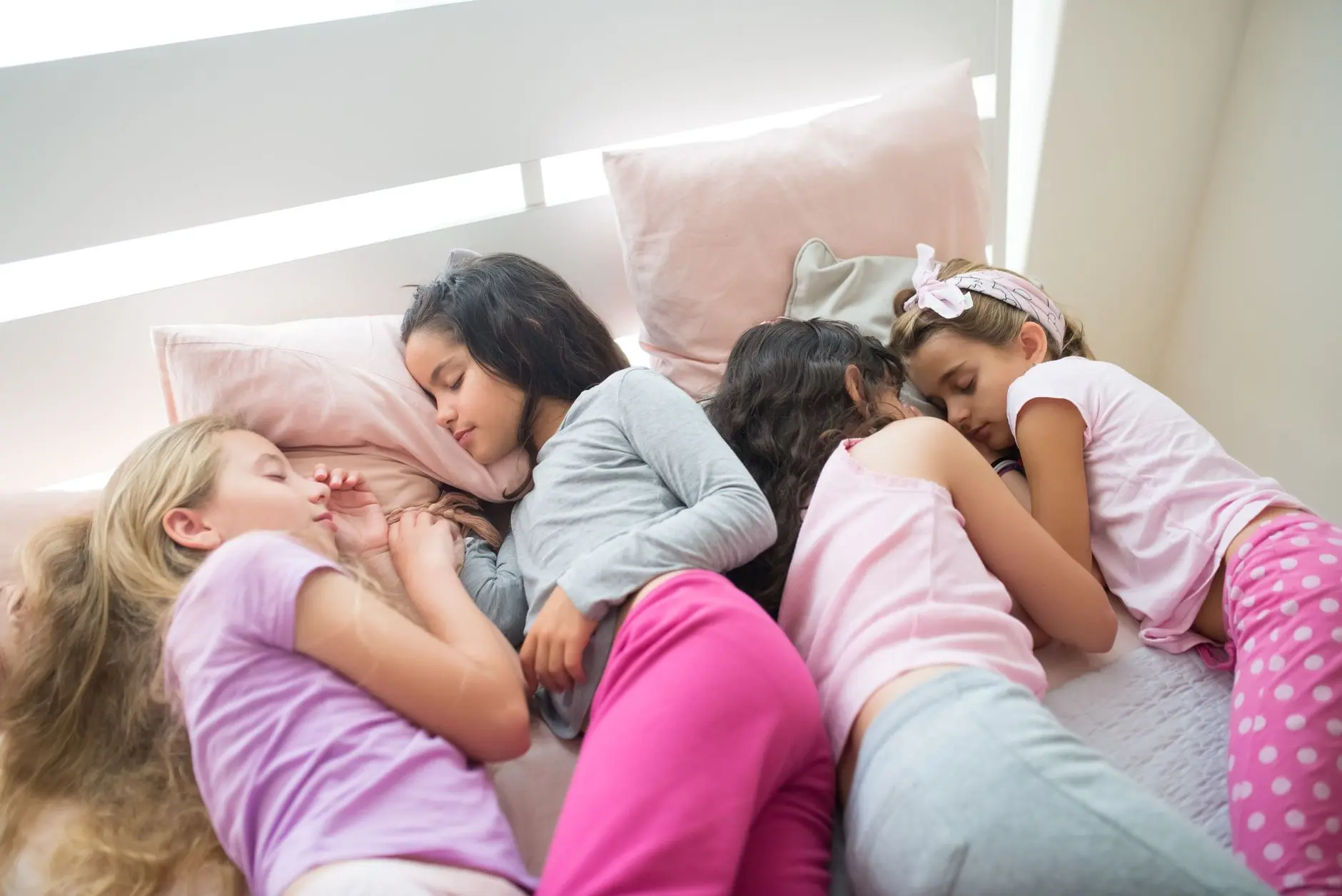
The pressure is real: you’ve got six kids in pyjamas, a pile of snacks, and approximately eight hours to fill before anyone’s parents show up.
The good news is that sleepovers are actually the easiest parties to host, because the magic ingredient — being together in the dark, a little giddy, a little overtired — does most of the work for you.
All you need is a solid game plan, and that’s exactly what this list is.
These 22 sleepover games for kids aged 7 to 11 are arranged roughly in the order you’d play them: energetic warm-ups to burn off early excitement, creative stations to settle things down, quiet games for the lights-out hour, and cosy wind-down activities when everyone’s finally ready to sleep.
Mix and match, skip what doesn’t suit your group, and keep a couple of extras in your back pocket for the inevitable “what do we do now?” moment at midnight.
This post contains affiliate links — if you buy through them, I may earn a small commission at no extra cost to you.
Table of Contents
- Truth or Dare Kids Edition
- Would You Rather – Sleepover Edition
- Flashlight Hide and Seek
- Pillowcase Decorating
- Sleepover Bingo
- Freeze Dance
- Story Chain in the Dark
- Guess the Snack Blindfolded
- Sleepover Scavenger Hunt
- Shadow Puppet Contest
- Nail Art Station
- Midnight Feast Menu Cards
- Emoji Pictionary
- Torch Trivia
- Pyjama Trivia for Kids
- My Dream Journal
- Sock Skating Relay
- Sleeping Lions
- Balloon Stomp
- Chinese Whispers Drawing Edition
- Indoor Mini Olympics
- Glow Stick Ring Toss
1. Truth or Dare Kids Edition
Print one sheet per player and place them face-down in a pile in the centre of the circle. The youngest player goes first, choosing either a “Truth” question or a “Dare” challenge from their card.
Truths are warm and funny — things like “What’s the silliest dream you’ve ever had?” — while Dares are active and totally non-embarrassing, such as “Do your best robot dance for ten seconds.”
Once a card is used, it goes to the bottom of the pile so questions cycle back around.
You need: the printed Truth or Dare Kids Edition sheets (one per child), a flat floor space for the circle.
Works brilliantly for 4 to 10 players and takes as long as you want — most groups play for 20 to 30 minutes before switching gears.
The printable format means every child has their own card to follow along, so no one feels put on the spot trying to invent a dare on the fly.
Host tip: Read through every prompt yourself before the party and pencil a small star beside your ten favourites. If the game stalls, call out a starred one to kick the energy back up without fumbling through the whole sheet.

🛍 Shopping guide
2. Would You Rather – Sleepover Edition
Each player takes a printed Would You Rather card and the group goes around the circle reading questions aloud, one at a time.
After each question — “Would you rather eat a bowl of spaghetti with your hands or drink a glass of orange juice with a fork?”
— everyone holds up one finger for Option A or two fingers for Option B simultaneously, so no one is swayed by what their neighbour picks. Then comes the best part: anyone who wants to can explain their choice, and the debate usually erupts instantly.
You need: the printed Would You Rather – Sleepover Edition sheets, one per player or one shared between two. Suits 3 to 12 kids and runs comfortably for 15 to 25 minutes.
Because every question is hypothetical and delightfully silly, there are no wrong answers and no child ever feels singled out or embarrassed — it’s purely about hearing each other’s reasoning.
Host tip: After everyone has answered a question, ask “Who wants to try to change someone’s mind?” — that one extra step turns a simple vote into a full giggle-fest and doubles the time the game naturally runs.

3. Flashlight Hide and Seek
This is the classic hide and seek everyone knows, transformed by darkness and torchlight into something genuinely thrilling. One child is the Seeker and gets the only flashlight (torch).
All the lights go off — or are dimmed as low as safely possible — and the other children scatter to hide within a pre-agreed zone of the house. The Seeker counts to 30 out loud, then hunts using only the beam of the torch.
Anyone the beam lands on is found and joins the Seeker for the rest of the round, helping to spot the remaining hiders.
You need: one good flashlight or torch, a defined play area (two or three rooms work well), and adult awareness of where children are allowed to hide. Perfect for 4 to 10 players; each round runs about 10 to 15 minutes.
Set clear rules before you start: no hiding in wardrobes that lock, no leaving the agreed zone, and no jumping out to scare the Seeker — the thrill should come from the torch beam, not from frights.
Host tip: Give every child a small glow stick to clip to their pyjama collar. It makes them slightly easier to find so rounds don’t drag, but more importantly it means you can spot everyone quickly if you need to do a safety head-count mid-game.
🛍 Shopping guide
4. Pillowcase Decorating
Each child gets a plain white pillowcase spread flat on a hard table and a set of fabric markers in bright colours.
Give them 20 to 25 minutes to draw whatever they like — their name in bubble letters, stars, their favourite animal, a portrait of their best friend. There are no rules and no templates, which is the whole point.
The finished pillowcases go home as a keepsake and, because they’ve slept on them, they’ll remember the party every time they see them.
You need: one plain white or light-coloured pillowcase per child (standard size works fine), fabric markers or fabric paint pens, scrap paper to stuff inside the pillowcase while drawing so the ink doesn’t bleed through, and a table covered with an old plastic tablecloth.
Works for any group size from 2 upward; the activity runs 20 to 30 minutes plus drying time. Fabric markers need at least an hour to set before the pillowcase is slept on, so run this activity early in the evening.
Host tip: Stuff each pillowcase with a folded bin bag before the kids start drawing — it’s smoother than newspaper, won’t leave ink shadows, and can be pulled out and reused. Label the opening of each pillowcase with the child’s name in pencil before you hand them out so they don’t get mixed up mid-project.
🛍 Shopping guide
5. Sleepover Bingo
Hand every player a printed Sleepover Bingo card — each card has a different arrangement of sleepover-themed images and words in a 5×5 grid, things like “someone trips over their sleeping bag,” “a phone buzzes,” “someone asks for more snacks,” or “the host’s cat wanders in.”
Players mark off squares as those things actually happen during the evening. This is a passive, ongoing game that runs in the background of everything else — kids can be mid-craft or mid-movie and still be watching for their next square.
You need: the printed Sleepover Bingo cards (one per player, each different), a pen or pencil each, and small counters or stickers to mark squares if you prefer not to write on the cards.
Works for 2 to 12 players; the game runs across the whole evening, typically 2 to 4 hours, with a winner emerging naturally. The host calls “check!” whenever someone shouts Bingo and verifies the squares before awarding a small prize.
Host tip: Secretly engineer a few of the harder squares yourself — announce a snack break right when someone needs the “snack time” square, or deliberately knock something over if “something gets spilled” is on the board. The kids will eventually realise you’re doing it on purpose, which makes it even funnier.

🛍 Shopping guide
6. Freeze Dance
Clear a space in the middle of the room, start a playlist of upbeat songs, and let everyone dance. The moment the music stops — controlled by the host on a phone or speaker — everyone must freeze in exactly the position they’re in.
Anyone who wobbles, takes an extra step, or can’t hold their shape is gently “out” and becomes a judge for the rest of the round, helping to spot anyone who moves.
The last dancer standing wins that round, and then everyone jumps back in for the next one.
You need: a phone or tablet with a music app, a Bluetooth speaker, and enough floor space that nobody elbows anyone during an enthusiastic spin.
Ideal for 4 to 15 kids; each round lasts about 5 minutes and you can play as many rounds as you like, making the total running time fully flexible.
This is the perfect high-energy game for straight after dinner when the kids are buzzing and need to burn it off before anything quiet begins.
Host tip: Pause the music at irregular intervals — sometimes after just four seconds, sometimes after a full minute. Kids who try to predict the pause and pre-freeze are much easier to spot and get a good-natured cheer from the rest of the group when they’re caught.
7. Story Chain in the Dark
Everyone sits in a circle in a darkened room with a single torch passed from player to player.
The first child shines the torch under their chin (for the classic spooky glow effect) and begins a story with one or two sentences: “One night, a group of friends found a mysterious glowing box at the bottom of the garden…” They pass the torch to the left.
The next child must continue the story with their own two sentences, and so on around the circle. The story can twist in any direction — funny, adventurous, or mildly mysterious — but nothing frightening.
You need: one torch, a darkened room, and a group of children who are comfortable with low light.
The game suits 3 to 10 players and a full circuit of the circle takes 10 to 20 minutes depending on how many wild tangents the plot takes.
Because every child contributes equally and no one is judged on their ideas, even shy players tend to open up once the torch is in their hands.
Host tip: Before the game, whisper a secret word to the host — something like “umbrella” or “purple penguin” — and tell players they must try to work that word into their part of the story naturally without anyone noticing. It adds a sneaky extra layer that keeps older kids especially engaged.
8. Guess the Snack Blindfolded
Set up a tasting station with six to eight small bowls of snacks — things like a mini marshmallow, a piece of pretzel, a grape, a cube of cheese, a segment of orange, a small square of plain cracker.
One player at a time is blindfolded and guided safely to the station by a friend. They pick up one piece of food, taste it, and call out their guess.
The crowd reacts and the player removes the blindfold to see if they were right before tagging the next taster.
You need: a blindfold (or a folded scarf), 6 to 8 small snack bowls, a table, and spares of each snack so every child gets a fresh piece. Before you start, check every single dietary requirement and allergy — this is non-negotiable.
Skip any ingredient you are not 100% certain is safe for every child in the room. Works for 4 to 12 players; each tasting takes about a minute, so the whole game runs 15 to 20 minutes.
Award a small point for each correct guess and crown a Snack Champion at the end.
Host tip: Include one “too easy” snack right at the start — almost everyone will guess a marshmallow instantly — because that first success gets even the shyest child laughing and loosens up the whole group for the trickier tastes that follow.
9. Sleepover Scavenger Hunt
Print and hand out the Sleepover Scavenger Hunt sheets, one per team (pairs work perfectly for this age group).
The sheet lists 15 to 20 items to find around the agreed play area — things like “something soft and blue,” “an object smaller than your thumb,” “something that makes a noise,” or “a book with more than 100 pages.”
Teams race to find and photograph or physically collect every item before the time runs out. Photographs taken on a host parent’s phone are the tidiest option since nothing actually leaves its place.
You need: the printed Sleepover Scavenger Hunt sheets, a pen per team, and either a shared device for photographing finds or a safe collection spot where items are returned after judging.
The game works for 4 to 12 players in teams; allow 20 to 30 minutes for the hunt, then 5 minutes to verify answers together. Define the boundaries clearly — which rooms are in play and which are off-limits — before the starting signal.
Host tip: Add two or three “bonus challenge” items at the bottom of the sheet that require the team to do something rather than find something — “do a ten-second group dance and get the host to film it” earns bonus points and creates a lovely video keepsake from the night.

10. Shadow Puppet Contest
Hang a white bedsheet on a wall or doorframe and shine a bright torch or desk lamp at it from about a metre away. One player at a time stands between the light and the sheet, making shadow shapes with their hands and body.
They perform a 30-second scene — a story, an animal, a made-up character — while the rest of the group watches from the other side of the sheet and tries to guess what they’re creating.
After every player has had a turn, the group votes (by clapping volume) for the most creative shadow scene.
You need: a white or pale bedsheet, a way to hang or prop it up, one strong torch or desk lamp, and a darkened room.
Works for 3 to 10 players; each performance is 30 to 60 seconds, making the whole game run 15 to 25 minutes. The audience side and the performer side of the sheet make it feel like a real little theatre, which children find surprisingly exciting.
Host tip: Practise three or four shadow shapes yourself before the party — a barking dog, a flying bird, a snapping crocodile — so you can give a quick demonstration at the start. Once children see what’s possible they immediately start experimenting with their own combinations and the creativity level rockets.
11. Nail Art Station
Set up a low table with a selection of child-safe nail polishes, nail stickers, dotting tools (the back of a bobby pin works perfectly), and a bowl of cotton wool with nail polish remover for corrections.
Children pair up and take turns doing each other’s nails, choosing their own colour combinations and patterns. Display a few simple design ideas on a card — stripes, dots, a simple flower — but make it clear that invented designs are just as welcome.
Everyone finishes with a personalised set of nails to admire for the rest of the night.
You need: child-safe nail polishes in several colours, nail stickers or rhinestone stickers, a dotting tool or bobby pin, cotton wool pads, and child-safe nail polish remover. A plastic tablecloth protects the surface.
Suits any group size, though a station for up to 4 kids at a time keeps it from getting crowded; allow 20 to 30 minutes and let children drift in and out at their own pace. Make sure the room is well ventilated.
Host tip: Buy a couple of colours that are already dry-glitter or shimmer so even the most hurried application looks impressive. Children who feel their freehand painting isn’t neat enough are instantly delighted when a glitter topcoat covers everything and makes it look intentional.
🛍 Shopping guide
12. Midnight Feast Menu Cards
Before the party, fill in the printed Midnight Feast Menu cards with the actual snacks you’ve prepared — give each item a wonderfully dramatic name. Plain crackers become “Moonrock Crisps,” grapes become “Enchanted Forest Gems,” mini sandwiches become “Midnight Club Squares.”
At the appointed snack hour (it doesn’t need to actually be midnight), hand each child their own Menu card and let them order their selections from the “kitchen.” Children take turns placing their order and collecting their tray, exactly like a real restaurant experience.
You need: the printed Midnight Feast Menu cards (filled in by the host beforehand), the actual snacks, small plates or trays, and enough space on a table for the spread.
Works for any group size; the ordering ritual itself takes 10 to 15 minutes, and then children eat at their own pace.
Check all allergies and dietary needs before finalising your menu — the cards should only list things every child in the room can safely eat.
Host tip: Let the children keep their Menu cards as a souvenir. Punch a hole in the corner and thread a small ribbon through it before the party so the cards look finished and special — kids treasure tiny printed mementos far more than you’d expect.

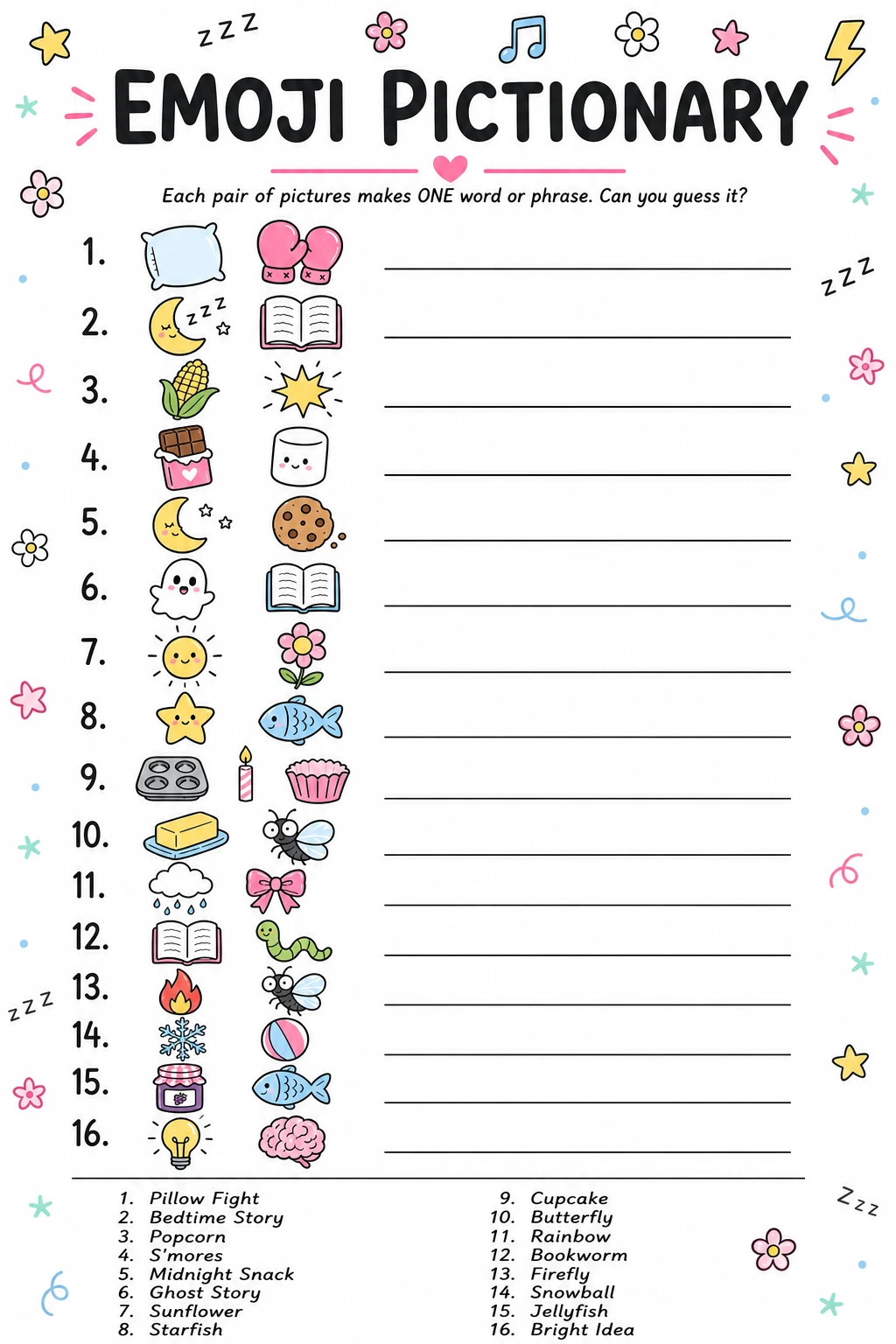
13. Emoji Pictionary
Print the Emoji Pictionary sheet and cut the cards apart along the dotted lines. Divide players into two teams.
One player from the first team draws a card and must draw the subject on a whiteboard or large paper pad — no talking, no writing words, no miming — while their team calls out guesses.
The card shows an image prompt (an animal, an action, an object) and the drawer’s job is to get their team to say the exact word in 60 seconds.
Teams alternate turns, and the team with the most correct guesses after all cards are used wins.
You need: the printed and cut Emoji Pictionary cards, a whiteboard or large paper pad, a marker, a timer, and a scoresheet. Works for 4 to 12 players in two or more teams; the full game runs 20 to 30 minutes.
Because each round is time-pressured and everyone on the guessing team shouts at once, this game is reliably very loud and very fun — save it for a moment in the evening when energy needs lifting.
Host tip: Sort the cards into two piles before the party: easier subjects for earlier rounds and trickier ones for later when players are warmed up and feeling confident. Starting too hard causes frustration; finishing with the hard cards feels like a satisfying challenge once the group is in full flow.
14. Torch Trivia
Seat everyone in a circle and place the printed Torch Trivia question sheets in a pile in the centre, face-down.
One player picks up the top sheet and reads the first question aloud to the group — covering topics like animals, geography, nature, sport, and pop culture pitched perfectly for ages 7 to 11. The first player to raise their hand gets to answer.
A correct answer earns a point marked on a simple tally; a wrong answer passes to the next raised hand. The question reader rotates after every five questions so everyone gets a turn.
You need: the printed Torch Trivia question sheets, a tally scoresheet or small whiteboard, and a pen. The game works for 3 to 12 players and a full set of questions runs 20 to 30 minutes.
Playing by torchlight in a dimmed room makes even a straightforward quiz feel like a special, slightly atmospheric event — it’s a surprisingly effective way to calm things down without the energy crashing completely.
Host tip: Award a bonus point whenever a player can explain why an answer is correct, not just shout it out. This slows the fastest players down slightly and gives children who think a little longer a genuine chance to score — and it tends to produce some wonderfully inventive “explanations” that make the whole group laugh.

15. Pyjama Trivia for Kids
Hand out the Pyjama Trivia for Kids answer sheets, one per player, and read each question aloud from your host sheet. Players write their answers in secret, no conferring allowed.
After all questions are read, everyone swaps papers with the person on their left for marking while you reveal the correct answers one by one.
Tally the scores, crown a Trivia Champion, and then go around the circle asking everyone to share the question they found hardest — the discussion afterwards is often more fun than the quiz itself.
You need: the printed Pyjama Trivia for Kids answer sheets (one per player), the host question sheet, pens or pencils, and a small prize for the winner if desired.
Works for 3 to 15 players; allow 20 to 25 minutes for a full round of 15 to 20 questions. This is a write-quietly game, which makes it ideal for scheduling about an hour before lights-out when you want energy to start naturally tapering.
Host tip: Before revealing the answers, ask players to award themselves one bonus point for any answer that is “close but not exact” — then let the group vote on whether it counts. This small moment of negotiation generates more laughter than almost anything else in the quiz and keeps every child invested right to the final score.

16. My Dream Journal
Just before lights-out, hand every child a printed My Dream Journal sheet and a pencil.
They fill in the prompts quietly on their own — favourite dream they remember, a dream destination they’d love to visit, a dream superpower, what they hope to dream about tonight — and then, optionally, share one answer with the group before tucking the sheet away.
The journal acts as a gentle, personal wind-down activity that signals to everyone that the night is moving into its quieter phase.
You need: the printed My Dream Journal sheets (one per child) and a pencil each. Works for any group size; the activity takes 10 to 15 minutes of quiet writing, plus another 5 to 10 minutes if you do a share-round at the end.
Children take their completed journal home as a keepsake — it’s a lovely way to end a sleepover because it gives kids something personal and calm to focus on as excitement winds down.
Host tip: Dim the lights slightly while everyone fills in their journal and play very quiet background music — instrumental or nature sounds work well. The shift in atmosphere is remarkably effective at bringing even the most energetic group down to a calm, sleepy level within minutes.

17. Sock Skating Relay
Clear a smooth hallway or section of wooden or laminate floor and lay two strips of masking tape across the floor — one start line and one finish line about six metres apart. Divide into two teams.
One player at a time from each team slides in their socks from the start line to the finish line, touches the wall or a cone, slides back, and tags the next team member.
The first team to get every player to the finish line and back wins. Because everyone is already wearing pyjamas and socks, zero preparation is needed.
You need: a smooth floor section (rugs and mats must be cleared out of the way first), masking tape for lines, and socks — which everyone at a sleepover is already wearing.
Works for 4 to 12 players in two roughly equal teams; each relay takes about 8 to 12 minutes.
Do a quick check of the route for any sharp corners, loose cables, or furniture before the first racer goes — a 60-second safety scan is all it takes.
Host tip: Make the relay more interesting by adding a simple challenge on the return leg — every player must slide back balancing a soft toy on their head. Dropping it means a stop-and-replace, but because the toy is soft and light no one gets hurt, and the laughter when it tumbles extends each race beautifully.
18. Sleeping Lions
One child is the Watcher. All other players spread out on the floor and lie as still and silent as possible — they are the Sleeping Lions.
The Watcher moves quietly around the room, crouching down and doing silly, funny things near each Lion to try to make them laugh, flinch, or move, without touching them at all.
Any Lion who moves or makes a sound becomes a Watcher too, until there’s only one Lion left: the winner. It’s genuinely hard to stay still when someone is pulling a series of increasingly creative funny faces two centimetres from your nose.
You need: absolutely nothing except floor space and the children. Works for 4 to 15 players; a full round takes 10 to 20 minutes depending on how good the Watchers are.
This is the ideal game for the winding-down portion of the night — players are already on the floor in the dark, the game naturally gets quieter as it goes on, and it often ends with several children genuinely dozing.
Host tip: Tell the Watchers right at the start that the best tactic is patience — hovering silently over a Lion for a long, slow count before doing anything is far more effective than rushing.
Children who figure this out quickly have a huge advantage, and watching them figure it out is half the fun for the adults in the room.
19. Balloon Stomp
Blow up one balloon per player and tie a 60 cm length of ribbon to each one. Every child ties their balloon loosely around one ankle. On “Go!”, everyone tries to stomp and pop everyone else’s balloon while protecting their own.
When a balloon is popped, that player sits out and cheers for whoever is left. The last player with an unpopped balloon wins the round. It’s chaotic, physical, and takes about three minutes per round, so you can easily play five rounds back-to-back.
You need: one balloon per player per round (buy plenty), a 60 cm length of ribbon or soft string per balloon, and a clear open space with no furniture corners at knee height.
Works for 4 to 15 players; each round lasts 2 to 4 minutes. Check the floor for sharp objects before you start and remind players that this is a stomp game — jumping on top of someone or pushing is not part of the rules.
Host tip: Blow the balloons up slightly under-full so they are a little softer and harder to pop — this makes each round last longer, means more attempted stomps, and reduces the ear-splitting bang factor considerably when you have a roomful of children.
🛍 Shopping guide
20. Chinese Whispers Drawing Edition
Each player gets a small stack of paper squares (about postcard-sized) and a pencil.
The first player secretly writes a simple phrase on their top square — something like “a cat eating birthday cake” — folds it back so it can’t be seen, then draws that phrase on the next square.
They pass only the drawing to the next player, who looks at the drawing and writes what they think it shows on a new square, folds the drawing away, then draws their interpretation, and passes it on.
The chain keeps going until it reaches the end of the line, when you unfold everything and reveal how the phrase mutated.
You need: a stack of small paper squares per player (10 per person is plenty), pencils, and a flat writing surface. Works for 4 to 10 players; one full chain takes 15 to 20 minutes.
The reveal at the end — laying each chain out in sequence and reading from the original phrase to the final bizarre drawing — is genuinely hilarious, especially when “a cat eating birthday cake” has become “a square monster near a fire.”
Host tip: Tell players to draw as quickly as they can without overthinking it — 30 seconds per drawing is enough. Fast, loose drawings mutate much more dramatically than careful ones, and a wildly mutated chain gets a far bigger laugh at the reveal than a chain where everyone drew carefully and the phrase stayed mostly intact.
21. Indoor Mini Olympics
Set up five quick challenge stations around the room and give each child a scorecard to carry from station to station.
Station ideas: a cotton ball blow (blow a cotton ball across a table using a straw), a paper plate javelin throw (how far can a paper plate fly?), a one-minute star jump count, a steady-hand marble roll (roll a marble along a ruler without dropping it), and a backwards alphabet race.
Each child attempts every station once, records their score, and the child with the highest total across all five wins the overall Mini Olympics gold.
You need: cotton balls, straws, paper plates, a ruler, a marble, and a watch or phone timer. Prepare the stations before the party so the transition between activities is immediate.
Works for 3 to 10 players; allow about 25 to 35 minutes for everyone to rotate through all five stations. Because every child completes every challenge, no one is ever sitting watching — participation stays at 100% throughout.
Host tip: Make your own simple gold, silver, and bronze “medals” out of circles of cardboard covered with gold, silver, and bronze card or foil, threaded on ribbon. Children aged 7 to 11 respond to a physical medal with extraordinary seriousness, and the ceremony at the end of the Olympics becomes an unexpectedly proud moment for whoever wins.
🛍 Shopping guide
22. Glow Stick Ring Toss
Bend and activate four to six glow sticks into rings by connecting each stick’s ends.
Set up a row of plastic bottles filled with a little water for stability — or use the cardboard tubes from paper towel rolls — at increasing distances from a throw line made with tape.
Players take turns tossing their glow rings at the targets in a darkened or dimmed room. Each successfully ringed target earns a point: closer targets are worth one point, further targets are worth two or three.
Play three rounds per person, tally scores, and crown the Glow Ring Champion.
You need: a multipack of glow sticks that can be connected into rings, four to six plastic bottles or cardboard tubes as targets, masking tape for the throw line, and a dimmed room.
Works for 2 to 10 players; the full game runs 15 to 20 minutes.
This is a wonderful choice for the later evening because the glow-in-the-dark element feels genuinely magical at that hour, it requires calm concentration rather than running, and the quiet focus naturally begins to settle the group toward sleep.
Host tip: Activate your glow sticks about 20 minutes before the game begins — they glow brightest in their first 30 minutes, so timing it right means you get the most vibrant, impressive ring toss experience right when the kids are playing, rather than halfway through when the glow has already started to fade.
🛍 Shopping guide
Frequently Asked Questions
How many games do I actually need for a full sleepover night?
For a typical sleepover from 6 pm to 8 am, you realistically need six to eight planned activities, plus a couple of backup options.
The secret is variety in energy level: one or two high-energy games, one creative station, one quiet group game, and a calm wind-down activity near the end.
You do not need to fill every minute — children are genuinely happy to chat, eat snacks, and hang out between games once the atmosphere is warm and relaxed.
What is the best age for these sleepover games for kids?
The games on this list are designed primarily for children aged 7 to 11.
Younger children (5 to 6) can join in most of the active and creative games with a little extra explanation, but the trivia and writing activities work best from about age 7 upward.
Children aged 12 and older will often find these games a little easy, and there are better-suited lists for the tween age group.
How do I handle a child who gets upset or homesick during the sleepover?
Homesickness is completely normal and happens at most sleepovers at least once.
The best response is calm, low-key reassurance rather than drawing attention to it — quietly sit with the child, offer a snack or a drink of water, and gently fold them back into a simple group activity.
Keeping the group busy with a game is genuinely the most effective distraction. Always have the child’s parent’s phone number easily to hand, and never make a child feel embarrassed for feeling upset.
How do I keep a sleepover from turning into chaos at midnight?
Build a deliberate wind-down sequence into your plan: roughly an hour before you want lights-out, switch from active games to quieter ones like Story Chain in the Dark, My Dream Journal, or Sleeping Lions.
Lower the room lighting, reduce the music volume, and stop offering sugary snacks. Children respond remarkably well to environmental cues — a darker, quieter room signals “sleep is coming” even to the most energetic group.
Having a film queued up as the final activity is a reliable last resort.
Which games on this list work without buying anything?
Freeze Dance, Story Chain in the Dark, Sleeping Lions, Shadow Puppet Contest, and Chinese Whispers Drawing Edition all need nothing beyond items you almost certainly already have at home. Sock Skating Relay needs only socks and a smooth floor.
For the printable games, all you need is a home printer and plain paper — they cost almost nothing to produce and are often the most popular activities of the whole night.
📌 Save These for Later
Loved these? Pin your favorite image below so you can find this list again when you’re planning.


16 gender reveal party games that build suspense all night — team pink vs blue, predictions, print
28 ombre balloon arch ideas for every occasion, plus four methods that stop the fade reading as stri
120 this or that questions game prompts split into 5 fun themes — perfect for icebreakers, road tr
Leave a Reply