


Hosting a party for 20 or more teenagers sounds exciting right up until the moment half the group retreats to a corner and the other half stands around staring at their phones.
The secret to avoiding that scenario is a game lineup that shuffles people together, gives everyone a clear role, and keeps the energy high enough that no one has time to feel awkward.
These 18 party games for teenagers are built specifically for large groups where cliques form fast and inclusion matters.
Every game here has been chosen because it works at scale, not just with eight friends around a kitchen table.
You will find printable sheets for the games that need them, physical challenges for the groups that need to burn energy, and creative rounds that reward the quieter players just as much as the loudest ones in the room.
Run two or three of these back to back and you will have a party people talk about long after the weekend is over.
This post contains affiliate links — if you buy through them, I may earn a small commission at no extra cost to you.
Table of Contents
- Human Bingo Icebreaker
- Team Trivia Rounds
- Group Charades Tournament
- Relay Race Teams
- Categories Elimination
- Scavenger Hunt Teams
- Most Likely To Group Round
- Balloon Stomp Battle
- Photo Challenge Teams
- Family Feud Style Rounds
- Musical Statues Elimination
- Picture Round Teams
- Emoji Decode Challenge
- This or That — Voting Wall
- Guess the Tally — Entry Card
- Two Truths and a Lie Tournament
- Wink Assassin
- Giants, Wizards, and Elves
1. Human Bingo Icebreaker
Before the party even officially begins, hand every guest a printed Human Bingo card as they walk through the door.
Each square contains a personal trait or experience — “has been on a plane,” “can say hello in three languages,” “has a younger sibling,” “has visited a theme park in the last year” — and players must circulate the room and find a different real person who matches each square, collecting that person’s first name as proof.
The first player to complete a full row, column, or diagonal shouts “Bingo!” and wins a small prize, but keep the game running until everyone has at least half their card filled so the mixing keeps happening.
All you need is the printed Human Bingo Icebreaker sheet — one per guest — and pens. This works perfectly for groups of 20 to 60 and takes roughly 15 to 20 minutes, making it the ideal opener while latecomers are still arriving.
The beauty is that every conversation has a built-in excuse: “Can you do a cartwheel? No? Okay, do you know anyone who can?” Nobody has to introduce themselves cold.
Host tip: swap the free center square for the most universally true statement you can think of — “has watched a movie in the last week” — so nobody feels singled out by a square they cannot honestly claim.
Also remind players they cannot use the same person’s name twice on their card or the whole point of circulating is lost.

🛍 Shopping guide
2. Team Trivia Rounds
Divide the group into teams of four to six players — give each team two minutes to pick a team name, which itself breaks the ice — then run five to eight trivia rounds covering categories teenagers actually care about: music, sport, geography, science, film, and a wildcard round of your own invention.
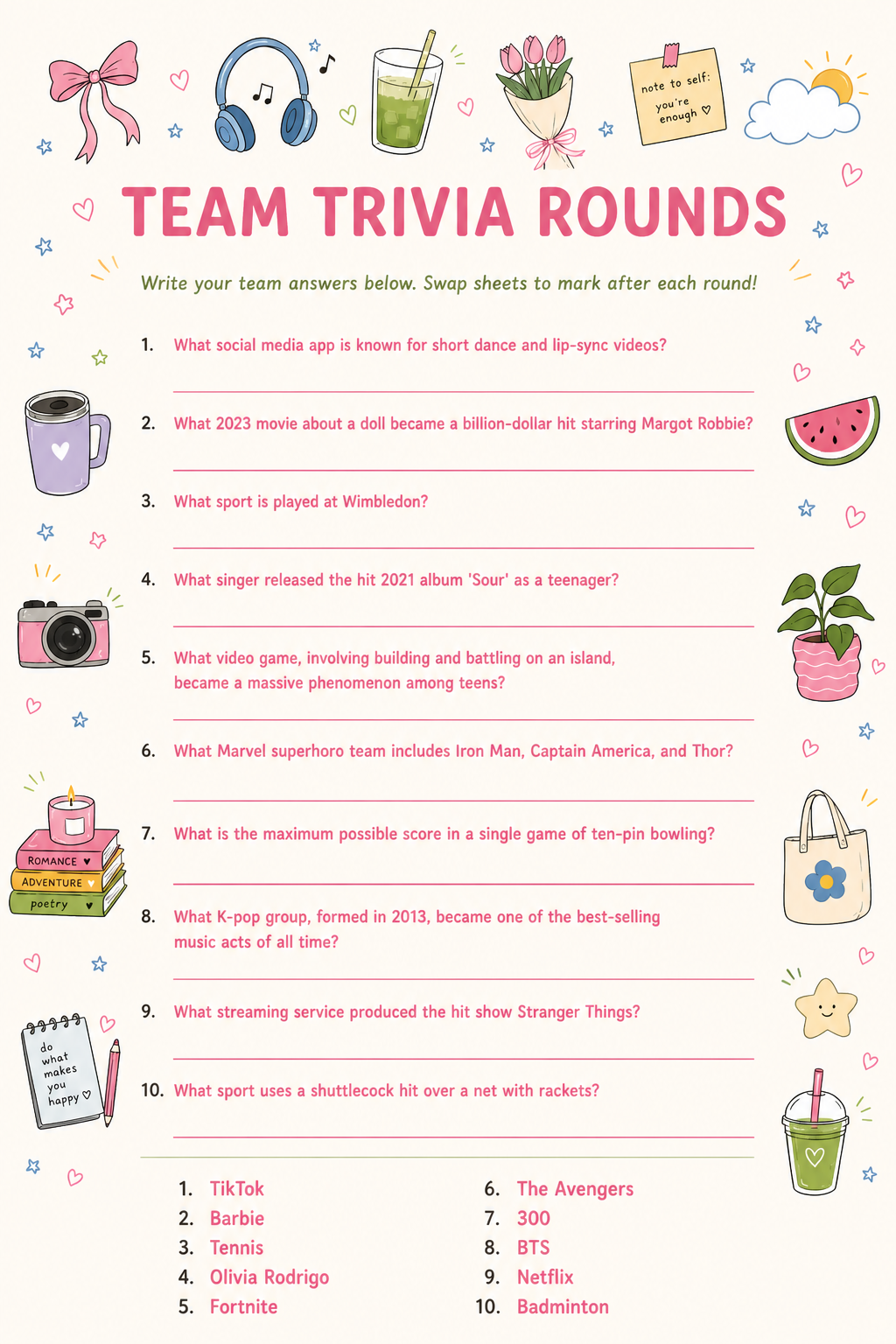
Read each question aloud to the whole room, give teams 30 seconds to agree on an answer, and have them write it on the Team Trivia Rounds Answer Sheet before time is called. No shouting answers across the room is allowed, which forces genuine teamwork.
You need one printed answer sheet per team per round — or a single multi-round sheet — plus a list of prepared questions and a host with a clear voice and a timer.
Ideal for 20 to 50 players, a full game of eight rounds takes about 40 minutes including score tallying. Award a point per correct answer and announce the running leaderboard after each round to keep the competitive tension alive throughout.
Host tip: include at least one hyper-local or event-specific question per night — something about the host’s street, the birthday person’s middle name, or the year the venue was built — because it rewards attentiveness and gets everyone laughing rather than just Googling facts they half-remember.
🛍 Shopping guide
3. Group Charades Tournament
This is charades scaled up for a crowd, run as a proper tournament bracket.
Split players into teams and give each team a stack of the Group Charades Tournament Prompt Cards, which are pre-printed with a mix of actions, films, books, and phrases suitable for teenagers.
One player from each team acts at a time while their own teammates guess; teams score a point for every correct guess within 60 seconds.
Rotate the actor each round so everyone gets a turn in front of the group, and run multiple heats until you have two finalist teams who go head to head in a dramatic final round.
You need the printed prompt card sheets — cut into individual cards before the party — and a timer. No other equipment is required.
This works for groups of 16 to 40 and a full tournament runs 45 to 60 minutes depending on how many rounds you play. Keep unplayed cards face-down in a central pile so no team can preview what is coming.
Host tip: seed the easiest prompts into the early heats and hold the trickiest or most physical ones for the final round. The audience energy skyrockets when the two best teams are struggling equally, and you avoid the embarrassment of a nervous first-time actor drawing something impossible in round one.

🛍 Shopping guide
4. Relay Race Teams
A classic relay race, rethought for a large indoor or outdoor teen party, becomes genuinely chaotic fun when each leg of the race is a different mini-challenge rather than a straight sprint.
Set up five or six stations around the space — bouncing a balloon to a line without using hands, stacking five plastic cups in a pyramid one-handed, walking heel to toe across a taped line while balancing a small object on your head — and divide players into equal teams.
Each player completes their station leg, tags the next person, and sits down. The first team to cycle through all players wins.
You need a clear indoor or outdoor space, masking tape to mark lanes and station boundaries, balloons, plastic cups, and any small props for the challenge legs. This works best for 20 to 50 players and takes 20 to 30 minutes including setup time.
Have a second set of props ready at each station because things break faster than you expect when teenagers are involved.
Host tip: make sure every team has the same number of players before starting — borrow a friend to stand in if numbers are uneven — because a team with even one fewer person finishes a full relay leg ahead, and teenagers will absolutely argue about it for the rest of the night.
🛍 Shopping guide
5. Categories Elimination
Every player stands in a circle or stands at their seat.
The host calls out a category — “things you find in a locker,” “capital cities in Europe,” “Olympic sports” — and then points to players one at a time around the circle, each of whom must shout a valid answer within three seconds without repeating anything already said.
The Categories Elimination Host Prompt Sheet gives the host a ready-made list of 30 or more categories ranked from easy to fiendish, so the game escalates naturally.
A player who hesitates too long, repeats an answer, or cannot think of one sits down and is eliminated.
You need only the printed host prompt sheet and a room full of players. The game runs with 15 to 60 players and a single full game, cycling through eight to ten categories, takes about 20 to 30 minutes.
Because eliminations happen quickly, keep a small side challenge running for players who are out so no one is standing alone watching for ten minutes.
Host tip: vary the category difficulty in an unpredictable order rather than always making it harder — throw in a very easy category after a brutal one, because the sudden relief makes everyone laugh, resets the energy, and gives the players who nearly went out a chance to breathe and stay engaged.

🛍 Shopping guide
6. Scavenger Hunt Teams
Divide players into teams of four to six and hand each team a Scavenger Hunt Teams Team Checklist printed with 25 to 30 tasks to complete around the venue or a defined outdoor area.
Tasks should mix physical finds (“bring back something blue that isn’t clothing”), skill challenges (“get a team member to do ten star jumps filmed on one phone”), and knowledge tasks (“find out the first name of someone at this party you have never spoken to before”).
Teams have 30 to 45 minutes to score as many points as possible, with harder tasks worth more points.
You need one printed checklist per team and — if the hunt includes photo tasks — at least one smartphone per team.
The game works brilliantly for 20 to 60 players across any space large enough to spread out, and the full activity including scoring takes about an hour. Assign point values clearly on the sheet itself so there is no disputing the score at the end.
Host tip: include two or three tasks that are only completable by interacting with a member of a different team, because this forces cross-group contact and breaks down cliques even between competitive rivals who would otherwise never speak during a game.

🛍 Shopping guide
7. Most Likely To Group Round
Every player receives a Most Likely To Group Round Ballot — a printed sheet listing 20 “most likely to” prompts such as “most likely to become a professional athlete,” “most likely to travel to every continent,” or “most likely to win a cooking competition” — and writes the name of a fellow guest they genuinely think fits each prompt.
The host then collects the ballots, tallies the votes for each prompt, and announces the results one by one to the whole group. The person whose name comes up most for each prompt takes a bow.
You need one printed ballot per player and pens. This is a seated, low-energy game that works as a calm interlude between more physical activities and suits groups of 15 to 50 players.
It takes about 25 minutes to fill in and 10 to 15 minutes to announce results, depending on how much crowd reaction each reveal gets — and there will be a lot of crowd reaction.
Host tip: read through all prompts yourself before the party and remove any that could embarrass a specific guest you already know will be there. Keep every prompt future-positive and aspirational rather than aimed at present quirks, and the game will generate warmth instead of awkwardness.

🛍 Shopping guide
8. Balloon Stomp Battle
Tie a balloon to every player’s ankle with a length of string — roughly 30 centimetres works well — and send everyone into a defined play area. On the signal, players try to stomp and pop other players’ balloons while protecting their own.
The last player with an intact balloon wins. The first round is a free-for-all; subsequent rounds can be played as team battles, where players protect their teammates and only target the opposition’s balloons.
You need one inflated balloon per player, pre-cut lengths of string, and a clear open space free of sharp objects and breakable items.
This game runs with 10 to 60 players and a single round lasts anywhere from 90 seconds to four minutes — short enough to run five or six rounds back to back before energy drops.
Inflate all the balloons before guests arrive or factor in a ten-minute inflation window with a pump.
Host tip: enforce a clearly marked boundary from the very start. Without a boundary, players naturally drift apart and the game drags on forever as the last few survivors jog away from each other around the room. A tight boundary creates brilliant, chaotic intensity.
🛍 Shopping guide
9. Photo Challenge Teams
Split players into teams of four to six and give each team a Photo Challenge Teams Challenge Card — a printed list of 20 photo missions to complete during a set time window, typically 30 minutes.
Missions range from recreating a famous painting as a group, to getting all team members to balance on one foot simultaneously in the same photo, to finding a stranger at the party willing to pull the funniest face on camera.
Teams photograph each completed challenge on a smartphone and return at the end of the window for the host to judge.
You need the printed challenge cards, at least one smartphone per team with camera access, and enough space — indoors or outdoors — for teams to spread out without interfering with each other.
The activity suits groups of 16 to 50 players and the full game, including judging and a quick slideshow of the best shots, takes about an hour.
Judging can be done by audience vote: display the photos on a screen and let everyone vote with their hands.
Host tip: award bonus points for creativity beyond the literal brief rather than just completion, and tell teams this upfront. It discourages the teams who race through every task as fast as possible and rewards the ones who put thought in, making the final slideshow genuinely entertaining for everyone watching.

🛍 Shopping guide
10. Family Feud Style Rounds
Before the party, survey a group of 20 or more people — classmates, family members, or anyone handy — asking questions like “Name something you always find in a school bag” or “Name a sport you can play indoors.”
Tally the most common answers and record them on the Family Feud Style Rounds Host Answer Sheet. At the party, split players into two competing teams. Two players face off at the front — one from each team — and the host reads the question.
The first player to buzz in (slap the table, ring a bell, or clap) gets to answer. If their answer is on the sheet, their team plays the round and tries to uncover all the top answers; if not, the opposing team steals.
You need the printed host answer sheet, a buzzer or stand-in noise maker, and a whiteboard or large paper to track revealed answers visually. This works for 16 to 40 players and a game of six rounds takes about 35 to 45 minutes.
You can project the answer board on a screen for bigger rooms, but a large sheet of paper on the wall works perfectly well.
Host tip: run your survey as close to the party date as possible and use people of a similar age to the guests. Adult survey responses produce different answers than teenage ones, and the whole fun of the game collapses if the “obvious” top answer is something nobody at the party would ever have said.

🛍 Shopping guide
11. Musical Statues Elimination
This is the childhood classic, updated for teenagers who would roll their eyes at the preschool version.
Play an upbeat playlist that the guests themselves helped choose before the party — ask for song suggestions in the invite — and everyone dances freely while the music plays. The moment the music cuts, everyone freezes completely: no wobbling, no giggling, no adjusting position.
The host and two designated spotters walk among the statues and eliminate anyone they catch moving. Last person standing wins.
You need a playlist and a speaker, plus enough clear floor space for the whole group to dance.
This works for 15 to 60 players and a full game down to a single winner takes 15 to 25 minutes depending on how strict the spotters are. Run it between more complex games as a palate cleanser when attention spans are flagging.
Host tip: let eliminated players become additional spotters as the game progresses. It gives them a role, stops them drifting off, and means the final few competitors are under enormous scrutiny from a whole panel of eagle-eyed former players who are very motivated to catch someone out.
12. Picture Round Teams
Before the party, compile a set of 20 to 25 printed images: close-up photos of everyday objects taken from unusual angles, silhouettes of recognizable shapes, maps with a country or region highlighted, famous landmarks photographed from ground level rather than the classic tourist angle.
Display them as a numbered slideshow on a screen or print them on large sheets of paper posted around the room. Teams study each image and write their answers on the Picture Round Teams Answer Sheet, with one sheet per team.
You need the printed answer sheets, the image set displayed clearly, pens, and a way to show images to the whole room at once.
This works for 16 to 50 players and a 20-image round takes about 25 minutes to complete plus 10 minutes for marking. It is a naturally quieter, more collaborative game that works well mid-party when everyone needs a mental challenge rather than a physical one.
Host tip: always include at least three images that are much easier than the rest, placed early in the sequence. They settle nervous teams into the rhythm, ensure nobody scores zero, and prevent the game from feeling like a test rather than a party activity.

🛍 Shopping guide
13. Emoji Decode Challenge
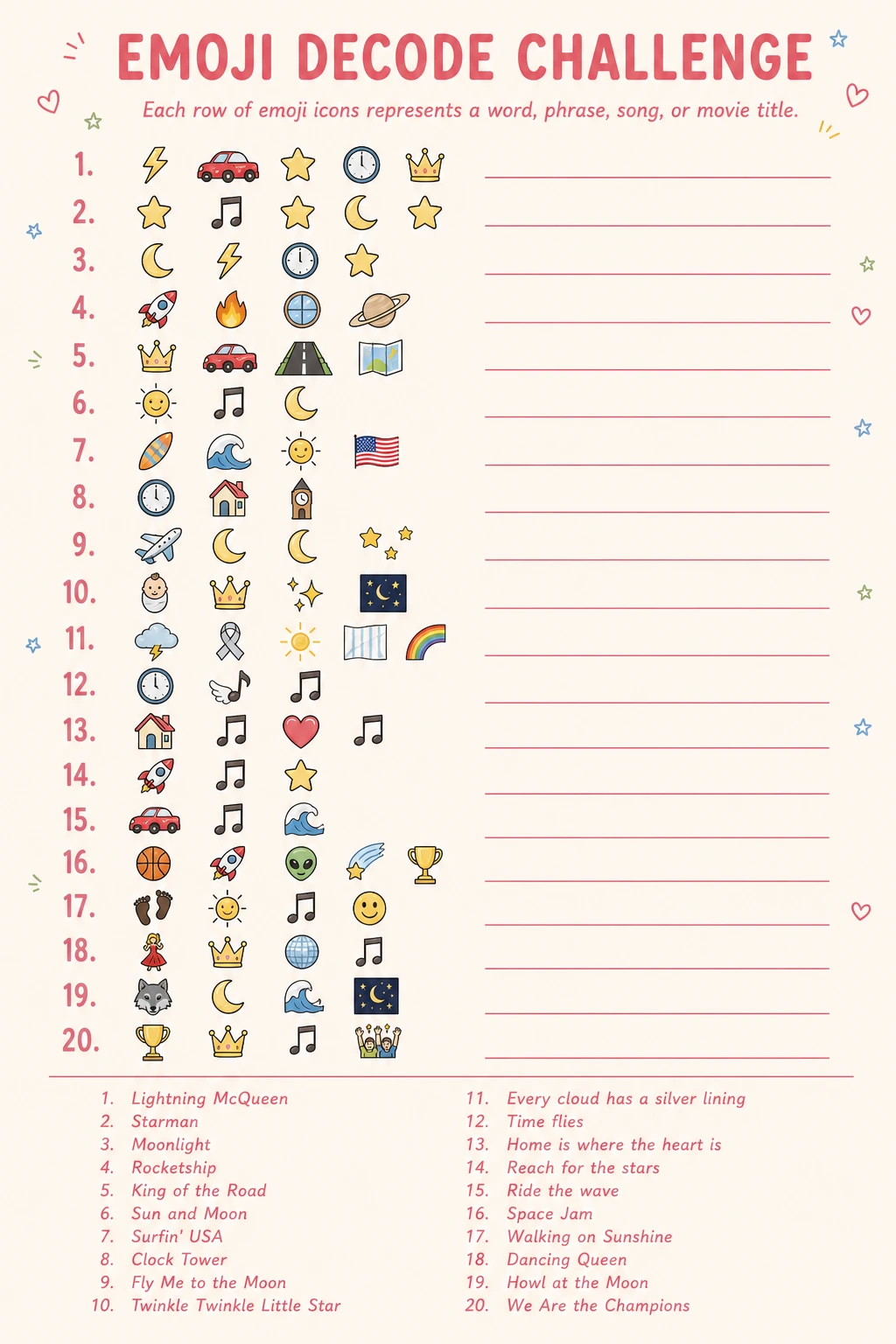
Teams receive the Emoji Decode Challenge sheet, which presents a series of sequences of real emoji characters.
Rather than asking teams to decode a rebus phrase, each sequence represents a category — for example, a sequence of sports-related emoji icons challenges teams to name every sport depicted in order, or a sequence of flag emoji challenges teams to name the countries.
Every answer is a single concrete, verifiable word or proper noun, not a invented phrase, so there is always a definitive right answer the host can confirm.
You need the printed challenge sheets and pens, with one sheet per team. The game works for groups of 16 to 50 players and a sheet of 15 to 20 sequences takes about 20 minutes to complete.
Reveal and mark answers as a group at the end, which sparks its own round of debate and laughter as teams defend their answers.
Host tip: include an answer key on a separate sheet kept face-down with the host throughout, and check it yourself before the party to confirm that every emoji depicted is standard and renders clearly when printed. An emoji that prints as a blank square turns a fun challenge into an argument, so test-print your sheet the day before.
🛍 Shopping guide
14. This or That — Voting Wall
Post the This or That Voting Wall sheet — a large printed board divided into pairs of options such as “mountains or beach,” “early riser or night owl,” “cook at home or eat out” — at a central spot in the party space.
Every guest gets a set of small sticky dots or uses a marker to place their vote next to their preferred option for each pair.
As the party progresses and more votes accumulate, the visual results become a talking point in their own right, sparking conversations between guests who discover unexpected common ground or surprising disagreements.
You need the printed voting wall sheet (ideally printed at A3 or larger for readability across the room), a roll of tape to fix it to the wall, and sticky dot stickers or a shared marker per option.
This is a continuous, drop-in activity rather than a timed game, working throughout the party for any group size from 15 to 80. It requires no host facilitation once it is on the wall.
Host tip: position the voting wall near the food or drinks table where guests naturally congregate and linger, not near the main game area.
Traffic past the wall happens organically when it is on the route people already take, and guests who arrive shy often find it the perfect low-pressure way to interact with someone they have not yet spoken to.

🛍 Shopping guide
15. Guess the Tally — Entry Card
Before the party, prepare a large jar filled with a countable item — wrapped sweets, small bouncy balls, folded slips of paper, whatever suits the occasion — and count them carefully, recording the number privately.
Every guest receives a Guess the Tally Entry Card and writes down their name and their best guess for the total. Entry cards are collected in a box throughout the night.
At the end of the party, the host reveals the true count and the guest whose guess is closest wins the jar and its contents.
You need the printed entry cards, pens, the filled jar, and a clearly visible display of the jar somewhere central.
This runs as a passive, ongoing activity for any group size — the more guests, the more fun the final reveal — and requires zero host facilitation during the party itself beyond collecting cards.
Plan ten minutes at the end to reveal the answer and crown a winner.
Host tip: do not reveal whether guesses are getting warmer or colder as the night goes on, even when guests ask. The suspense of the end-of-night reveal is exactly what keeps people invested in an activity that otherwise requires no effort from them, and hinting erodes the drama completely.

🛍 Shopping guide
16. Two Truths and a Lie Tournament
Every player writes down three statements about themselves — two that are true and one that is a convincing lie — on a small card or slip of paper.
Players then take turns reading their three statements aloud while the rest of the group votes by show of hands on which one they think is the lie.
Award a point to every player who successfully fools the group (more than half vote for a truth) and a point to every individual who correctly identifies the lie. After all players have gone, the highest scorers from both categories are declared winners.
You need small index cards or slips of paper and pens, plus a simple tally on a whiteboard to track points.
This works for groups of 12 to 40 players and the full game takes 30 to 40 minutes depending on group size and how long the debate runs after each reveal.
It is a fantastic mid-party game because it teaches players genuinely surprising facts about each other.
Host tip: give players five to seven minutes to write their statements privately before the game starts, and encourage them to make the lie plausible rather than outlandish. The funniest and most revealing moments happen when the lie is almost believable and the truths are genuinely unexpected — brief the group on this before writing time begins.
17. Wink Assassin
Every player draws a folded slip of paper from a hat. One slip is marked “Assassin” and all others are blank.
Players then mingle freely around the room — no sitting down allowed — and the Assassin tries to eliminate other players by making discreet eye contact and winking at them.
A player who is winked at must wait three seconds and then dramatically “die” and sit down. Other players can make an accusation at any point by calling “I accuse!”
and naming a suspect; a second player must second the accusation within ten seconds or it does not count. If the accused is the Assassin, the group wins; if they accuse an innocent player, that accuser is eliminated instead and the Assassin continues.
You need folded slips of paper — one marked, the rest blank — and a hat or bag to draw from. This requires no other equipment and works brilliantly for 15 to 40 players in a space large enough to move around.
A single round lasts five to fifteen minutes; run three or four rounds with a different Assassin each time.
Host tip: for larger groups, designate two Assassins per round working independently without knowing who the other is. Double the threat makes the mingling genuinely tense and dramatically shortens rounds that would otherwise drag on as the single Assassin becomes overly cautious after the first accusation is made.
18. Giants, Wizards, and Elves
This is a large-group, full-body version of rock-paper-scissors. Divide players into two equal teams who huddle separately and secretly choose one of three characters: Giants (arms raised, roar), Wizards (point a finger wand, shout “Zap!”), or Elves (hands on ears like points, squeak).
Both teams line up facing each other a metre apart; on a count of three, both teams simultaneously perform their chosen character. Giants beat Elves, Elves beat Wizards, and Wizards beat Giants.
The winning team chases the losing team back to their safe zone — a line at the back of the room — and any player tagged before reaching safety switches to the winning team. Play continues until one team captures everyone.
You need a clear, open space with two marked safe lines at opposite ends of the room — masking tape works perfectly — and nothing else. This works for 20 to 80 players and a full game typically takes 20 to 30 minutes.
The game is especially powerful with groups that do not yet know each other because it requires no individual skill, only team loyalty and fast running.
Host tip: give teams exactly 45 seconds to huddle and decide — no longer. Longer huddle times lead to indecision, argument, and eventual cheating as the team changes its mind at the last second. A strict timer keeps the game moving at the breathless pace that makes it so joyful for large groups.
Frequently Asked Questions
How many players do these party games for teenagers work best with?
Most games in this list are designed for groups of 20 or more, with several scaling comfortably to 60 or even 80 players.
Team-based games such as Team Trivia Rounds, Scavenger Hunt Teams, and Family Feud Style Rounds work by dividing the crowd, so the larger the group, the bigger and louder the teams get.
A few games like Wink Assassin and Two Truths and a Lie are better suited to 15 to 40 players and work well earlier in the evening before the full crowd arrives.
How do I stop cliques forming and make sure everyone mixes?
The single most effective strategy is to assign teams yourself rather than letting teenagers self-select.
Use a random method — draw names from a hat, assign numbers at the door, or sort by birth month — and announce it as the rule before anyone has a chance to group with their friends.
Human Bingo Icebreaker at the start of the night is specifically designed to force cross-group interaction before any team game begins, so running that first dramatically reduces clique formation for the rest of the evening.
Do I need to print all the sheets in advance?
Yes, and printing them the day before the party rather than the morning of is strongly recommended. Print extras — at least two more sheets than you think you need for each game — because pens leak, sheets get crumpled, and guests arrive unexpectedly.
Keep all printed materials in labelled envelopes or folders sorted by game order so you can hand them out instantly when each activity begins without rummaging through a pile mid-party.
How long should a party game session last for teenagers?
A good rule of thumb is 20 to 45 minutes per game including explanation, playing time, and any scoring or reveal.
Plan a two-hour block of games with three or four different activities, alternating between physical and seated formats so energy levels have a chance to reset.
Always have one extra game prepared that you have not announced, because some games end faster than expected and a sudden quiet gap is harder to recover from than running slightly over time.
What prizes work well for teenage party games?
Keep prizes small and universal rather than expensive or age-specific. Popular options include gift cards in small denominations, novelty items like oversized playing cards or fun stationery sets, bags of sweets, or simply bragging rights on a visible leaderboard posted on the wall.
Avoid prizes that only appeal to one gender or interest group — the point of a large group game night is that anyone could win anything, and a prize that half the room would not want undermines the motivation to compete.
📌 Save These for Later
Loved these? Pin your favorite image below so you can find this list again when you’re planning.


From flashlight hide and seek to nail art stations, these 22 sleepover games for kids will keep the
42 fall preschool activities built into a Monday-to-Friday arc where every day adds to one shared cl

18 toddler party games that are safe, simple, and fun for ages 1–3. No reading, no small parts, no
Leave a Reply