

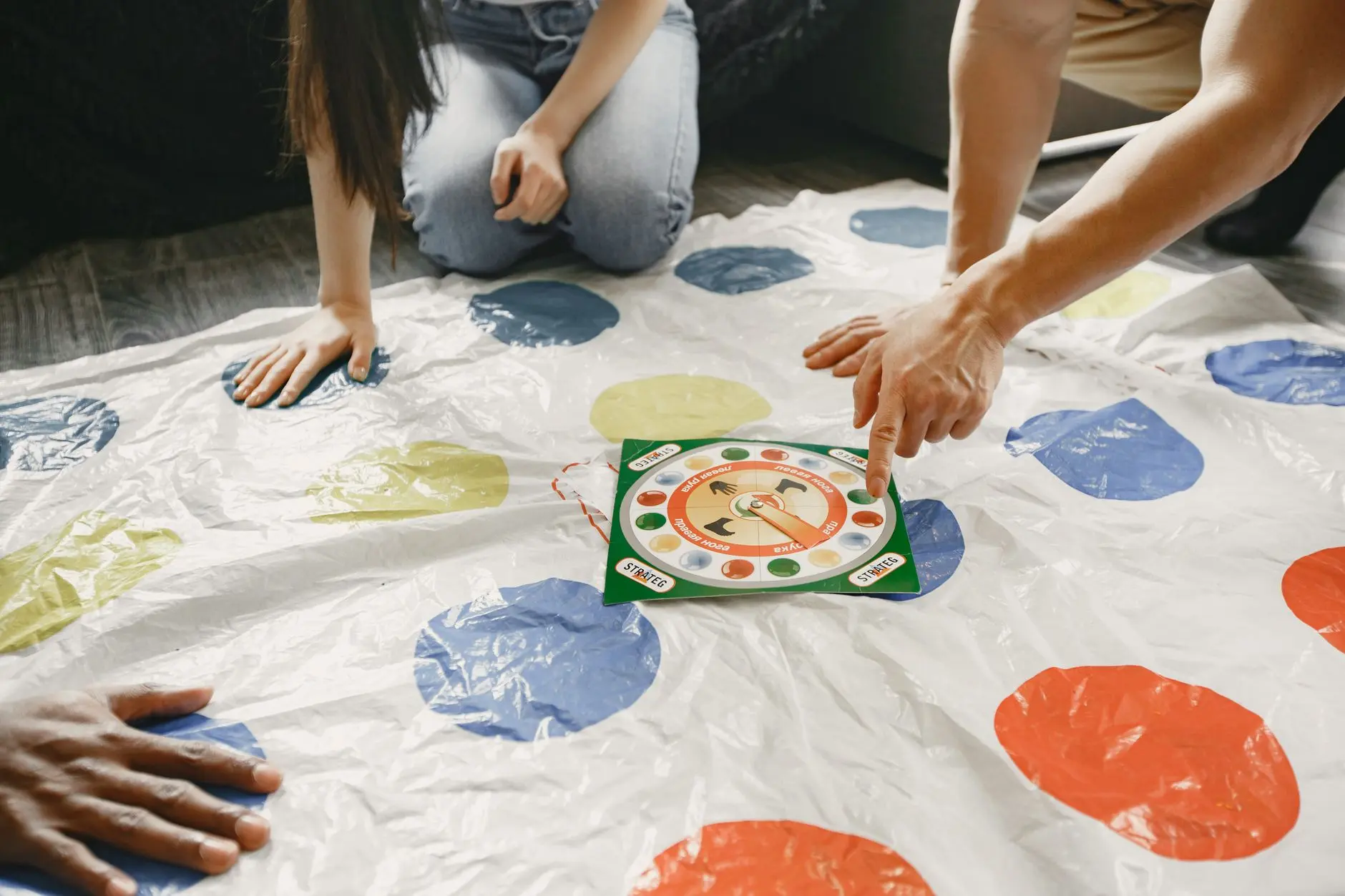
Finding family party games that genuinely work for a six-year-old, a sixteen-year-old, and a sixty-six-year-old at the same holiday party? That used to feel like finding a unicorn.
But tbh, after hosting way too many gatherings where grandpa quietly retreated to the kitchen and the toddlers melted down before round two, I finally cracked the code — and these 22 games are the result.
Every single one is built for multigenerational play, which means nobody gets benched, nobody gets bored, and nobody has to pretend they understand the rules.
Whether you’re planning a big Christmas bash, a Thanksgiving after-dinner hang, or just a chaotic holiday get-together where three generations collide under one roof, this list has you covered.
You’ll find a solid mix of active group games to get everyone off the couch, printable sheets you can download and play in minutes, and quiet keepsake-style games that’ll make grandma tear up in the best way.
So grab some hot cocoa, rally the crew, and let’s get this party started — because if you’re still looking for stocking stuffers too, the Christmas Gift Guide for everyone has your back on that front.
This post contains affiliate links — if you buy through them, I may earn a small commission at no extra cost to you.
- Family Feud
- Family Trivia Quiz
- Charades
- Family Bingo
- Heads Up!
- Would You Rather Family
- Guess the Guest Showdown
- Family Charades Card Deck
- Pictionary
- Guess the Baby Photo
- Guess the Song Intro
- Family This or That Sheet
- Telephone Pictionary
- Generations Q&A
- Family Jeopardy
- Family Talent Show
- Memory Lane Share
- Balloon Keep-Up
- Gratitude Circle
- Categories Clap
- Family Story Swap
- Balloon Volley Duel
- Frequently Asked Questions
1. Family Feud
This is the one that turns every holiday living room into a proper game show set — and honestly, the chaos is half the fun.
Split your crew into two mixed-age teams (pro tip: put a grandparent and a kid on every team so neither generation has an unfair edge), choose one brave soul to be the host, and fire off survey-style questions like ‘Name something people do on Christmas morning’ or ‘Name a holiday dish that nobody really likes.’
Each team races to buzz in and guess the top answers on the board, scoring points for every correct hit. First team to 300 points wins.
Setup is easier than it looks. You need a buzzer sound for each team — a free app on your phone works perfectly, or go full nostalgia and use a squeaky dog toy (don’t knock it until you’ve tried it).
Write your top answers on a poster board or display them on a laptop for the host to reveal dramatically. Prep 10–15 holiday-themed questions in advance and keep a tally on a whiteboard.
The ‘Fast Money’ lightning round at the end, where two players race to answer five quick questions in 20 seconds each, is absolutely the highlight of the whole evening.
The reason this works across every generation is that nobody needs reading skills or physical ability to play — just fast thinking and the courage to shout answers.
Adapt for the youngest players by giving kids a few extra seconds before the buzz-in counts, or let the little ones be the official ‘score keepers’ with a tally sheet of their own so they feel like full participants.
For grandparents who might have slower reaction times, let anyone shout answers during the team round rather than requiring a formal buzz-in — the energy stays high either way.
Pre-write holiday survey questions on index cards so the host can flip through them fast without losing momentum.
🛒 What you’ll need
2. Family Trivia Quiz
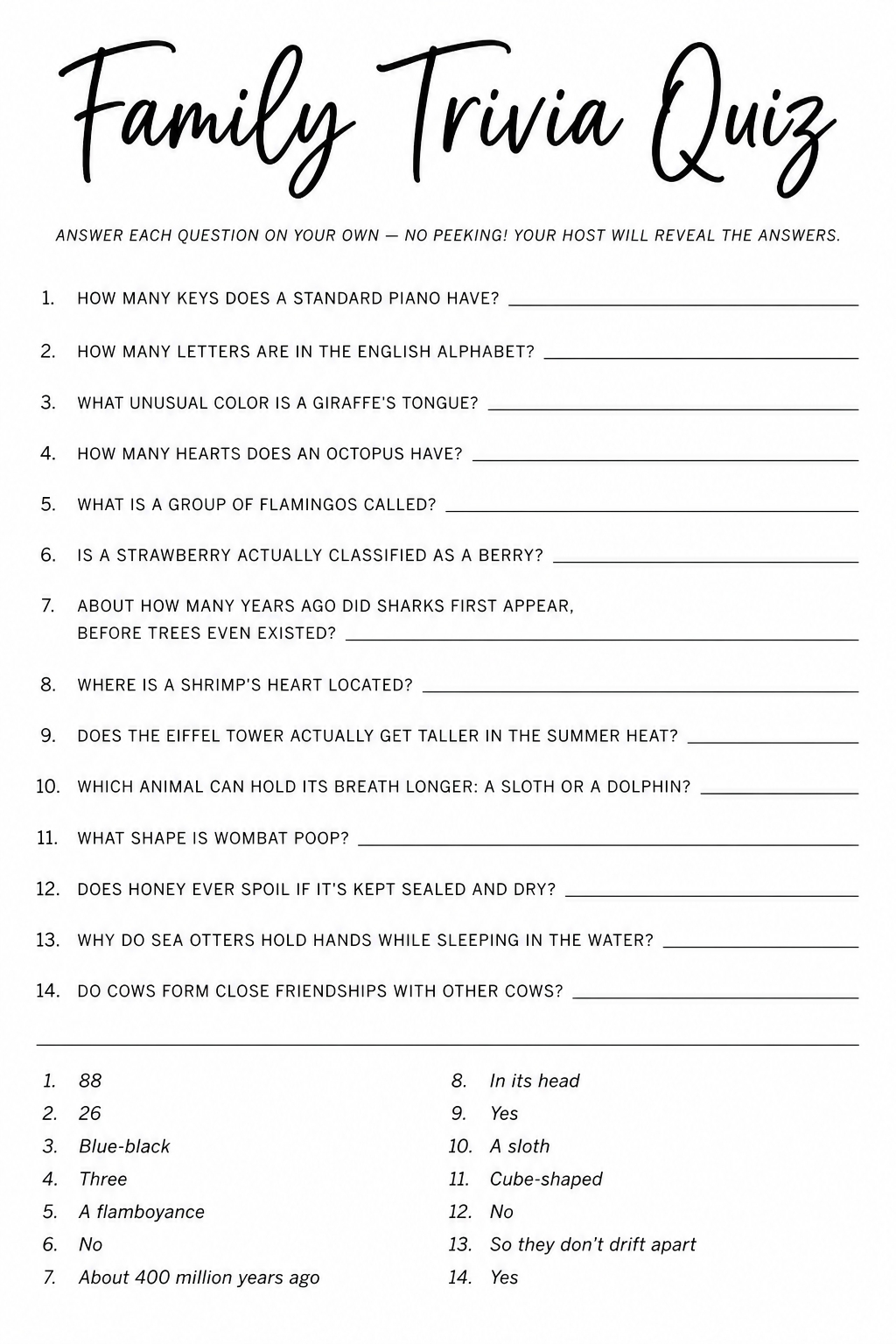
A good family trivia quiz is the great equaliser — it rewards decades of random knowledge just as much as it rewards growing up watching every cartoon ever made.
This printable sheet covers five categories designed so that every generation has at least one or two rounds where they genuinely shine: Holiday Classics (old movies and carols), Pop Culture (recent hits the kids know cold), History & Geography (grandpa’s moment to glow), Food & Traditions (everybody eats!), and Wild Card Family Facts.
Each player fills in their answers solo, then the host reads the answer key aloud and the person with the most correct answers wins a candy bar prize.
Print one sheet per player on regular cardstock — regular printer paper works fine too, though it’s more satisfying to write on something with a little weight.
Hand out pens, give everyone about eight minutes of quiet answering time, then go through the answers together as a group.
The ‘Family Facts’ category is where things get personal and hilarious: include one or two questions about your own family — like ‘What year did [family surname] first spend Christmas in this house?’
— and watch grandparents and parents argue cheerfully while the kids look on, confused and delighted.
Why it works: trivia that’s purely pop-culture or purely old-school almost always leaves somebody cold. Mixing categories means the eight-year-old shouts ‘I know this one!’ at least three times, and so does the seventy-year-old.
To make it even more inclusive, allow teams of two if you have very young readers — pair a small child with an older cousin or parent so they can whisper answers together.
The shared triumphant fist-pump when they get one right is peak multigenerational magic.
- Groups of 4–20
- Ages 7 and up (pair younger kids with a partner)
- Works great as a dinner-table game before the main event
🛒 What you’ll need
3. Charades
Charades is arguably the OG family party game, and for good reason — it needs zero supplies, zero prep, and creates the kind of unscripted moments you’ll be quoting for years.
For your holiday version, split into mixed-age teams and have each player draw a slip of paper with a holiday-themed prompt: think ‘wrapping a present,’ ‘reindeer,’ ‘the Grinch stealing Christmas,’ or ‘burning the turkey.’
The actor silently acts out the word or phrase while their team shouts guesses. Classic hand signals (one word, sounds like, movie, etc.) apply — though you might need a quick tutorial for the youngest players.
The real multigenerational magic happens when you create two tiers of prompt slips: easy ones (snowman, Santa, gift, star) for younger kids and older players who want a gentler challenge, and harder ones (holiday traditions, specific movies, or action phrases like ‘falling asleep during the Christmas sermon’) for the teens and competitive adults.
Colour-code the slips — say, green for easier, red for harder — and let each player choose their own difficulty before they act. This keeps the playing field genuinely fair without making anyone feel like they’ve been handed the kids’ version.
Seated players — grandparents or anyone who prefers not to stand — can absolutely play charades from their chair.
Upper-body gestures work just as well as full-body ones for most prompts, and honestly, watching grandma mime ‘wrapping a present’ seated at the dinner table might be the funniest thing that happens all evening.
Allow unlimited guessing time for rounds involving young kids, and cap rounds at 90 seconds for the competitive teams who want to keep things moving.
- Let kids whisper the prompt to a parent first so they understand what they’re acting out
- Allow one ‘pass’ per player per round so nobody gets stuck on an impossible prompt
4. Family Bingo
Bingo is one of those games where a four-year-old and an eighty-four-year-old are genuinely on equal footing, which is exactly why it earns a spot on this list.
This isn’t your standard number-call bingo, though — it’s a holiday family bingo where the squares are filled with festive moments, family in-jokes, and things that always happen at your gathering: ‘Someone falls asleep after dinner,’ ‘A gift gets returned,’ ‘Grandpa tells that one story again,’ ‘The WiFi goes out,’ ‘Someone burns the rolls.’
Each player gets a unique bingo card (print several different layouts), and they mark off squares as events happen organically throughout the party.
The beauty of running bingo as a living, throughout-the-party game rather than a sit-down round is that it keeps energy going across the whole event.
Tape a card to each person’s chair or prop it next to their plate, give everyone a pen or some candy pieces to use as markers, and watch the silent competitive side-eyes escalate beautifully as the evening unfolds.
Set a small prize for the first person to get a full row — a candy bar, the right to pick the next game, or simply the eternal glory of winning — and remind everyone to shout ‘BINGO!’
loud enough that the whole room hears it.
For the youngest players who can’t read yet, pair them with an older sibling or cousin who reads the squares aloud and lets the little one put the marker down.
That buddy system is genuinely sweet, and it keeps the toddlers invested in what’s happening without requiring any adult to step away from their own card.
Grandparents especially love this format because they can play entirely from their seat, at their own pace, without any time pressure whatsoever. It’s low-stakes, high-laughs, and the perfect throughline game for a long holiday evening.
Print 6–8 different card layouts so no two players have the same board — free bingo card generators online make this effortless.

🛒 What you’ll need
5. Heads Up!
If you haven’t played Heads Up!
at a family party yet, I’m genuinely excited for you — because the first time someone holds their phone to their forehead and starts wildly guessing while the rest of the room loses it, you’ll understand why this app-based game has become a holiday staple.
One player holds a phone face-out against their forehead. The screen displays a word or phrase. Their team shouts clues (no saying the word itself), and the player tilts the phone down when they guess correctly or up to pass.
The Ellen DeGeneres-designed app has built-in decks, or you can create a custom family deck with inside jokes and family-specific prompts for maximum chaos.
For your holiday party, download the free version of the Heads Up! app, then head into custom deck mode and type in holiday prompts (‘candy cane,’ ‘Rudolph,’ ‘ugly sweater’) alongside family-specific ones that will absolutely destroy the room.
The app automatically scores and times each round — usually 60 seconds — and saves a short video of each player’s guessing face, which is objectively the funniest thing you’ll watch after the party.
The whole setup takes about two minutes and works for groups of four to twenty with zero additional supplies needed.
This is a fantastic game for grandparents who are comfortable holding a phone, but if technology is a barrier, simply write the prompts on sticky notes and hold those up to foreheads instead — same game, same laughs, zero app required.
For children under about seven, let them sit in a partner’s lap and have the adult hold the phone while the child watches and yells guesses — they’ll feel like full participants and honestly they’re often better at this than the grown-ups, which is both humbling and hilarious.
- Heads Up! app (free download)
- OR sticky notes + marker for a no-tech version
- A timer if going app-free
6. Would You Rather Family
Would You Rather is one of those games that sounds simple until someone hits a truly difficult choice and the whole table erupts into a passionate ten-minute debate about whether you’d rather eat fruitcake for every meal in December or wear an ugly sweater every single day until New Year’s.
This printable sheet presents 20 holiday-themed ‘Would You Rather’ dilemmas — each one designed to spark genuine laughs and reveal surprisingly strong opinions from family members of all ages. Players circle their choice on the sheet, then the host polls the room: ‘Who chose A?
Who chose B?’ The fun isn’t the ‘right’ answer — it’s the reasoning people give out loud.
Print one sheet per person, pass them out with pens, and give everyone about three minutes to circle their choices before starting the group reveal.
You can play it fast and loose as a pure discussion game, or add a competitive twist: one designated ‘judge’ (rotate this role every few rounds) picks which answer they think is ‘best’ and anyone who matches the judge earns a point.
The player with the most judge-matches after all 20 questions wins. Either way, the conversation that erupts from ‘Would you rather host a 30-person Christmas dinner or attend someone else’s and be assigned dish duty?’ is worth the whole evening.
Younger kids adore this game because every question feels fair — there’s no reading comprehension required if a parent reads questions aloud, and their answers are just as valid as anyone else’s.
Grandparents tend to give the most historically-informed reasoning for their choices, which is genuinely delightful and sometimes turns into a spontaneous story about ‘the Christmas of 1987.’
To keep it moving, set a loose 30-second time limit before the host calls the room to vote — nobody needs to explain their answer if they don’t want to, though most people absolutely will.
No right or wrong answers means nobody loses — just endless debate and unexpected laughs from every generation at the table.

7. Guess the Guest Showdown
This is the party game that secretly tells you everything about how well your family actually knows each other — and the results are always either heartwarming or absolutely roasting.
Before the party, send every confirmed guest a short questionnaire via text or email: three to five questions like ‘What is your most embarrassing holiday memory?’, ‘What’s your secret guilty-pleasure Christmas song?’, and ‘What holiday tradition do you secretly hate?’
Collect the answers, read them aloud at the party one by one, and have everyone write down (or shout out) which family member they think gave each answer. Most correct guesses wins.
You can keep this entirely verbal — read the answers, let everyone shout their guess, tally a running score on a whiteboard — or give each player a small response card to write their guess on before the reveal, which slows things down in a good way and lets quieter family members play without getting talked over.
The scoring is simple: one point per correct guess. Run through all the collected responses, then crown the family member with the highest score as the Official Family Expert — a title they will definitely remind everyone about for years.
For the youngest players, simplify their questionnaire to two easy questions (‘What is your favorite holiday treat?’ and ‘What do you wish for this holiday season?’) so their answers are guessable and they feel genuinely included.
For grandparents who may not have received the questionnaire in advance, have the host collect their answer on the spot quietly before the game begins — just a quick whispered Q&A in the kitchen works perfectly.
The mix of generations’ answers is honestly what makes this game so unexpectedly moving: hearing grandma’s most embarrassing holiday memory next to a five-year-old’s favorite treat creates these wonderful, layered moments.
Send the questionnaire two days before the party so you have time to compile answers into a tidy reading list — last-minute texting mid-party is chaotic (ask me how I know).
8. Family Charades Card Deck
Think of this as a turbocharged, infinitely replayable upgrade to standard charades — a printable deck of 40 holiday-themed charades prompt cards that you cut out, shuffle, and draw from throughout the evening.
Unlike verbal prompt-giving, having physical cards means no disputes about what the prompt was, no whispered arguments about whether ‘the Christmas ham’ counts as two words, and no creative cheating.
Each card shows a clear holiday prompt on one side — everything from ‘building a snowman’ to ‘Christmas shopping on Christmas Eve’ to ‘pretending to like a terrible gift’ — so the actor draws a card, reads it silently, and acts it out immediately.
The team shouts guesses. Correct guess in under 90 seconds? That team keeps the card as a point.
Print the sheet on cardstock, cut along the dotted lines, and you’ve got a deck that lasts the whole party and can be reused year after year.
The cards are designed in a clear, large font so older players can read them easily without squinting, and a few cards have a small star symbol in the corner to mark them as ‘easy’ (intended for younger players).
If you’re playing in mixed-age teams, the host can offer any player a star-card swap if they draw something too abstract or complex — no shame, just keep the energy high and everyone moving.
Grandparents who prefer not to stand and act can absolutely stay seated and draw cards for their team, doing what they can from the chair — even exaggerated expressions and arm gestures get impressive mileage.
This deck also works beautifully as a backup game during lulls between bigger activities: just shuffle and pass a card around the table for quick one-off rounds.
It’s the kind of low-lift, high-return printable that pays dividends all season long, and if you laminate the cards, you’ll still be pulling them out next year.
- Cardstock paper for printing
- Scissors or a paper trimmer
- Optional: laminator for a reusable deck

🛒 What you’ll need
9. Pictionary
Pictionary is genuinely one of the most level multigenerational games in existence, because the ability to draw well is actually a disadvantage — stick figures and wild scribbles are often easier to guess than a beautifully rendered illustration.
Split into two mixed-age teams, set up a large whiteboard, a flip chart, or even a big piece of craft paper taped to the wall, and start drawing.
One player per round draws a holiday-themed prompt (written on a slip of paper or pulled from your Family Charades Card Deck) while their team guesses. 60-second timer, most correct guesses after 10 rounds wins.
The key to multigenerational Pictionary success is the prompt difficulty tiering — same approach as charades. Write some prompts on green slips (easy: ‘snowflake,’ ‘stocking,’ ‘reindeer’) and some on red slips (harder: ‘It’s a Wonderful Life,’ ‘holiday shopping anxiety,’ ‘Elf on a Shelf’).
Let each player choose their colour before drawing. This way, the six-year-old picks green and triumphantly draws a lopsided star, and Uncle Dave picks red and suffers through trying to illustrate ‘White Christmas’ in under a minute. Equitable chaos, essentially.
For players who have mobility or dexterity challenges that make standing and drawing difficult, seat them at a table with a large notepad and let teammates crowd around.
The results on a small pad are just as guessable as on a big board — sometimes more so because everyone’s leaning in.
Grandparents often turn out to be surprisingly excellent artists (all those years of drawing pictures for grandkids), which is a genuinely wholesome moment every time.
And if competitive spirits get intense, remind everyone that the real prize is the terrible drawings you’ll photograph and use as next year’s holiday card material.
- Whiteboard or large paper pad
- Markers (thick tip shows up best)
- Timer (phone works great)
- Prepared prompt slips in two difficulty colours
🛒 What you’ll need
10. Guess the Baby Photo
Ask everyone to send you their most adorable (or most ridiculous) baby or childhood photo before the party, and watch what happens when 20 family members stare at a grid of tiny faces trying to figure out who’s who.
This printable sheet lays out numbered baby photos in a grid — one photo per numbered slot — with a list of all family members’ names at the bottom. Players write the name they think matches each photo in the blank next to the number.
Most correct guesses at the end wins a prize. The reveal is done one by one, loudly, with the current adult standing next to their baby photo for the full comedic effect.
Collect photos digitally beforehand (a quick group text does the job), then arrange them in a numbered grid using any basic photo editing tool or even a Word document.
Print one sheet per player on regular paper — photo paper gives a nicer result if you have it, but standard printer paper works fine.
Number each photo clearly and include all guest names in a list along the bottom or side so nobody is guessing completely blind. Keep the actual answer key with the host only, and reveal answers one at a time for maximum drama and collective gasping.
This is one of the rare games where grandparents have a serious home-court advantage: they often recognize family features across generations that younger players miss entirely.
Kids, meanwhile, are absolutely baffled by the concept that adults were ever small, so the whole exercise is cosmically delightful to them.
For very young children who can’t read names yet, let them point to which photo they think is mom or dad — make it their own mini-game within the game.
Because you’re also quietly preserving family history in playful form here, it’s one of the most genuinely meaningful family party games on this list.
Ask guests to submit photos at least 3 days before the party so you have time to arrange and print the grid without a last-minute panic.

🛒 What you’ll need
11. Guess the Song Intro
This one is basically Name That Tune for the holiday season, and it is ruthlessly competitive in the best possible way.
One player (or the host) acts as the DJ, playing only the first 5–10 seconds of a holiday song from a curated playlist on their phone or laptop.
Everyone else races to be first to correctly name the song — hands slapped on the table (or a physical buzzer) determines who gets to answer. Correct answer earns a point; wrong answer passes the chance to the next hand up.
Mix in classic carols, pop hits from across the decades, and a few curveballs from holiday movie soundtracks to cover every generation’s musical memory.
Build your playlist beforehand — 20 to 30 songs is a solid round — and save it in a shuffle-ready format so you’re not fumbling with your phone mid-game.
Include obvious classics (Jingle Bells, White Christmas, Rudolph), mid-era pop (Mariah Carey, George Michael, Michael Bublé), recent hits, and a couple of sneaky instrumentals from holiday films. A free Spotify playlist builder works great for this, or use YouTube in a pinch.
Set the rule clearly: you must name the song title, not just hum along — otherwise grandpa will enthusiastically hum for 30 seconds and still not technically answer.
The generational knowledge gap here actually makes the game more fun, not less. Grandma will absolutely destroy everyone on the classic carols; the teenagers will pull ahead on recent releases; the parents hover somewhere delightfully in the middle.
To help younger kids participate meaningfully, include 3–4 songs from animated holiday movies they know well — hearing a six-year-old slam her hand on the table and shout a correct answer before any adult gets there is one of the great joys of this format.
Award bonus points for anyone who can also name the artist, and watch the competitive adults suddenly become very interested in their phone playlist knowledge.
- Groups of 5–20
- Works great right after dinner when energy needs a boost
- Especially good when your family spans 4+ decades of pop culture
🛒 What you’ll need
12. Family This or That Sheet
This or That is a faster, snappier cousin to Would You Rather — instead of lengthy dilemmas, players choose between two quick-fire holiday options in lightning speed.
The printable sheet has 30 pairs, each printed as a simple two-option row with a circle to fill in: ‘Eggnog OR Hot Cocoa?’, ‘Real Tree OR Fake Tree?’, ‘Christmas Eve opener OR Christmas Morning all-at-once?’, ‘Cozy at home OR Holiday travel?’, ‘Gift cards OR Wrapped surprises?’
Players fill in every choice solo in about two minutes, then the host goes through each one and the room sees who votes which way.
It’s less about debate and more about the surprise of discovering you’ve been surrounded by secret eggnog people your whole life.
Print one sheet per player and hand them out with pens at the same time.
Two minutes of solo filling, then hold the sheets up for a show-of-hands tally, or have the host read each pair aloud and ask players to call out their choice simultaneously.
The simultaneous version is louder and funnier; the show-of-hands version lets you actually count the room.
Either way, keep a running tally on a whiteboard of which option wins each round — you might be genuinely surprised to learn that your family is, definitively and democratically, a Hot Cocoa family. The tally itself becomes a fun little family record.
For small children, read the options aloud and let them shout their choice — no writing required, and their emphatic opinions are often the highlight of the round.
Grandparents tend to have wonderfully strong opinions on the classic questions (real tree versus fake tree sparks a reliable fifteen-second speech about their own childhood) and those spontaneous mini-stories are exactly the kind of connection this game is designed to spark.
No winner, no score — just 30 tiny windows into how different (and surprisingly similar) everyone at the table actually is.
No reading comprehension required — a parent can read options aloud, making this fully inclusive for all ages including early readers and non-readers.

13. Telephone Pictionary
If you’ve never played Telephone Pictionary (also known as Telestrations or the Eat Peas version) at a family party, please clear your schedule because this game will absolutely wreck everyone in the best way.
Everyone gets a small notepad and writes a holiday phrase at the top of the first page — something like ‘Santa getting stuck in a chimney’ or ‘reindeer on an icy rooftop.’
They pass the pad to the person on their left, who draws what they read, then folds the written page back so the next person can only see the drawing.
That person writes what they think the drawing depicts, folds the drawing back, and so it continues around the circle — alternating between writing and drawing.
At the end, each pad is revealed page by page to the whole group to trace the glorious evolution of the original phrase.
You need one small notepad (or a stack of folded paper) and a pen per player. Groups of 6–12 work best, though it scales up if you break into multiple circles.
Keep the room rules clear: fold the previous page completely back before passing, never look at more than the top sheet.
The game runs itself once it starts — plan for about 15 minutes of silent, focused drawing-and-writing, followed by 10 minutes of pure unhinged laughter during the reveal.
The reveal is ceremonial: each person holds their original pad, reads their starting phrase, and then you flip through the pages together to see how ‘Christmas shopping in a blizzard’ became ‘a penguin attacking a shopping cart.’
This is one of the most naturally age-inclusive formats around: drawing skill doesn’t matter (bad drawings are actually funnier), writing skill doesn’t matter because one sentence is all you need, and the game is 100% seated — ideal for grandparents, anyone with mobility needs, or a cozy after-dinner scenario where everyone is happily planted around the table.
For children who can’t write yet, let them just draw their interpretation and skip the written step — the pads that include a young child’s drawings tend to produce the wildest detours of all, which everyone will absolutely love.
Younger kids can draw-only — skip their writing step and pass straight to the next player’s drawing round so they stay in the game without frustration
🛒 What you’ll need
14. Generations Q&A
This is the quiet game that always ends up being the most talked-about moment of the whole party.
Generations Q&A is a facilitated conversation game where each round, a question is posed to the whole group that’s deliberately designed to draw out different answers depending on life experience and age.
Questions like ‘What was your favourite holiday gift as a child and why?’, ‘What holiday tradition did you think was embarrassing as a teenager that you now love as an adult?’, and ‘What does this holiday mean to you this year, honestly?’
Each person answers in their own time, and no answer is wrong. A soft moderator keeps things moving but nobody is ever put on the spot.
You can run this entirely verbally with the moderator reading questions from a phone or a card, or print a small keepsake card for each person so they can jot notes as others speak.
Aim for 5–7 questions over about 20–30 minutes, and position this game right after dinner when everyone is relaxed, fed, and in a naturally reflective mood — right before the more boisterous games kick back up.
The pacing should feel like a conversation, not a quiz show: give people time to think, allow silence, and resist the urge to fill every gap immediately.
This format is genuinely extraordinary for bridging generations in a meaningful way.
When grandchildren hear grandparents describe Christmas during a very different era of life, and when grandparents hear what matters to the youngest generation, something shifts in the room — in a very good way.
Keep it light enough that it doesn’t turn into a therapy session, but don’t be surprised if someone says something unexpectedly profound and the room goes quiet for a minute. That silence is the game working perfectly.
Adapt for youngest players by simplifying questions: ‘What’s your favourite part of today?’ is a perfectly valid version of ‘What does this holiday mean to you this year.’
- Post-dinner wind-down
- Groups of 4–12 (larger groups can split into two circles)
- Families who haven’t all been in one room for a while — expect some lovely surprises
15. Family Jeopardy
Family Jeopardy is the slightly more structured, brain-cell-requiring sibling of Family Feud — and the multigenerational angle is where it genuinely shines.
Set up a Jeopardy-style board with five holiday-themed categories and five dollar-value rows (say, $100 through $500): categories might include ‘Holiday Movies,’ ‘Christmas Traditions Around the World,’ ‘Our Family History,’ ‘Holiday Food,’ and ‘Wild Card.’
Free Jeopardy PowerPoint templates are everywhere online and take about 20 minutes to set up, or you can write clues on index cards arranged on a poster board. Players buzz in to answer in the form of a question — the classic ‘What is…’
format — and points accumulate across teams or individually.
The ‘Our Family History’ category is the secret weapon of this game.
Include five clues about your own family — things like ‘This family member once drove 14 hours through a snowstorm to make it home for Christmas’ or ‘This is the year Grandma’s famous pie recipe first appeared at the table’ — and watch the entire dynamic of the room shift.
Suddenly grandparents are the reigning champions of their own category, kids are giggling at family lore they didn’t know, and everyone is leaning forward during clue reveals. It personalises the whole game in a way that a purely general-knowledge format never quite does.
To adapt for the youngest players, include at least one category — ‘Holiday Characters’ or ‘Festive Animals’ — with clues accessible to an eight-year-old (think ‘Rudolph’s most famous feature’ or ‘Santa’s home workshop location’).
Young kids can team up with a parent or older sibling so they’re always part of an answer even if they can’t buzz in independently.
Grandparents who know their general knowledge and family history excel at the higher-value clues, and letting them pick the category and value independently keeps them fully in the driver’s seat.
Run a Final Jeopardy round at the end for maximum drama — everyone bets their points on one last all-in clue.
Search ‘free Jeopardy PowerPoint template’ and customise it in 20 minutes — much less work than building a board by hand, and the clicking reveal animations are genuinely fun.
🛒 What you’ll need
16. Family Talent Show
Hear me out: a family talent show sounds like a logistical nightmare until it’s the single funniest and most heart-melting hour of the whole party.
The format is simple — every willing person (or pair, or small group) gets 2–3 minutes to perform whatever they want: a holiday song, a terrible magic trick, a dramatic reading of a Christmas cracker joke, a comedy bit, a dance, an instrumental performance, a poetry recital, anything goes.
One family member acts as MC (preferably someone with natural stage presence and absolutely no shame), and the rest of the family is the audience-slash-supportive-judging-panel.
Give people a heads-up about the talent show a day or two before the party — not so much time that anyone over-prepares and gets nervous, just enough that they have a rough idea ready.
Set up a simple performance ‘stage’ area: move furniture to create a clear standing spot, maybe add a floor lamp for dramatic spotlight effect.
The MC introduces each act with as much game-show enthusiasm as they can muster, and the audience applauds loudly and generously after every performance regardless of, uh, technical skill level.
You can add humorous categories for prizes at the end: ‘Most Courageous,’ ‘Best Costume,’ ‘Most Unexpected,’ ‘Loudest Applause.’
Youngest kids are often the most enthusiastic performers (zero stage fright at age five — enjoy it while it lasts), so let them go early in the lineup while their energy is highest.
Grandparents often share something quietly extraordinary when given a low-pressure invite to perform: a song they sang as a child, a poem they memorised decades ago, a story they’ve never told in front of the whole family. These moments are genuinely irreplaceable.
For anyone who truly doesn’t want to perform, give them an official role: timekeeper, applause-o-meter judge, or MC assistant. Nobody is forced, and nobody sits completely outside the action.
Talent shows create unrepeatable family memories — and the performances you film on your phone will be watched and rewatched for years, especially the terrible ones.
17. Memory Lane Share
Memory Lane Share is the intentional, gently structured version of the organic reminiscing that always happens anyway when family gathers — except instead of it happening in scattered side conversations that not everyone hears, this game brings the whole group into the same story at the same time.
The host picks a rotating theme each round — ‘Your funniest holiday travel story,’ ‘A gift you gave or received that you’ll never forget,’ ‘The oldest holiday tradition in this family that you can remember’ — and each person who wants to share gets 60–90 seconds to tell their story while everyone else listens.
No phones, no interruptions, just the story.
The pacing is gentle and unhurried — there’s no timer pressure, no scoring, no competition.
The host can use a small talking-stick object (a candy cane, an ornament, a wooden spoon — whatever’s at hand) that the current speaker holds so everyone knows whose floor it is.
Two or three themes across 25–30 minutes is plenty; you don’t need to rush through the whole family’s memory bank in one sitting.
The magic is in the listening as much as the telling — you’ll notice people nodding, filling in details from their own memory, occasionally contradicting each other’s recollections in the most charming way.
This game belongs specifically at the quiet end of the evening when everyone is content, warm, and not trying to win anything. Position it after dinner and before anyone starts eyeing the coat rack.
For the youngest children, prompt them with something concrete: ‘Tell us your favourite thing we did together this year.’ Their answers are often the most genuine and unexpectedly moving ones.
For grandparents, this format is practically made for them — they have the richest well of stories to draw from, and finally having a structured moment for the whole room to really listen is something many of them have waited a long time for.
Prepare 5-6 theme prompts in advance so you’re not improvising mid-game — write them on small folded cards and draw one per round for a fun reveal element.
18. Balloon Keep-Up
The premise is devastatingly simple and always more difficult than anyone expects: keep as many balloons in the air as possible for as long as possible without letting any touch the floor.
Blow up 10–20 balloons (in holiday colours — red, green, gold, silver), toss them all into the room at once, and watch the chaos immediately become absolutely beautiful.
The whole group works cooperatively to keep every balloon airborne — every time one touches the floor, the whole team loses a point or gets a collective silly consequence.
Set a target time of 60 or 90 seconds, and see how many rounds you can clear before dissolving into laughter.
The cooperative format is what makes this perfect for multigenerational play: nobody is competing against anyone else, so the six-year-old who whacks a balloon to the ceiling and the grandparent who gently bats one from their chair are contributing equally to the team effort.
For seated players, position them near enough to the action that they can reach balloons drifting their way — the game naturally flows toward any active player nearby anyway.
Clear the floor of breakables first (shoes, ornaments, anything that’ll get knocked) and make sure the space is big enough for everyone to move without running into each other.
Add a competitive twist for older players if you need it: try to beat your own round time record, or add a rule that every player must touch every balloon at least once during the round — suddenly the strategy gets intense.
You can also add coloured balloon rules mid-game (‘gold balloons are worth double, red balloons can only be hit with your left hand!’) to create fun challenges that slow people down in a hilarious way.
Keep a spare bag of balloons handy because they will pop, especially when competitive uncles get involved, and half the fun is the chaos of starting over with a fresh cloud of colour.
- Balloons in holiday colours (red, green, gold, silver)
- Open floor space — move the coffee table first
- A timer app on your phone
🛒 What you’ll need
19. Gratitude Circle
A Gratitude Circle is the game that doesn’t feel like a game until it’s over and you realise everyone in the room is a little emotional in the best way.
The setup is beautifully simple: the group sits in a circle (or around the table), and a small object — an ornament, a candle, a wrapped candy — is passed around.
When you’re holding the object, you share one genuine thing you’re grateful for from the past year, directed at or about someone else in the room.
It can be funny, touching, brief, or elaborate — there are no rules about length or format, just that it’s sincere. Once you’ve shared, you pass to the next person.
The host can choose to do one full rotation — everyone shares once — or multiple rotations with different prompts: ‘Something this person taught me,’ ‘A memory with this person I want to hold onto,’ ‘Something I hope for this person in the coming year.’
Keep it optional: if someone wants to say ‘pass,’ they can, no questions asked, though in practice almost nobody does once they feel the warmth in the room.
Position this game near the end of the evening as a closing ritual — it lands best as a genuine send-off rather than a mid-party moment.
For young children, adapt the prompt to something concrete: ‘Tell us one thing you love about someone in this room.’
They’ll often say something unexpectedly specific and beautiful — ‘I love Grandma because she always gives the best hugs and her hair smells like flowers’ — and the named person’s face in that moment is worth everything.
Grandparents especially benefit from hearing the younger generation articulate appreciation directly and out loud; it’s something families feel constantly but don’t always say.
This is also an ideal game for families who don’t always make it to the same gathering, since the gratitude expressed tends to land extra deeply when time apart has made it feel overdue.
Have a tissue box nearby — not because this game is sad, but because it is genuinely moving and you’ll want to be prepared (speaking from personal experience here).
20. Categories Clap
Categories Clap is a rhythm-based memory game that’s more physically accessible than it sounds and more mentally demanding than anyone expects — perfect combination for a mixed-age group that wants something fast-paced but completely seated-friendly.
Everyone sits in a circle and establishes a clapping rhythm together: slap knees, clap hands, snap left, snap right — repeating continuously. On the snaps, one player names something in the chosen category (e.g., ‘Holiday Movies’) while staying in rhythm.
Each player continues around the circle adding a new item in the category without repeating. Miss the rhythm, blank on an item, or repeat one — you’re out. Last person standing wins the round.
Holiday categories work brilliantly for the seasonal vibe: ‘Christmas movie titles,’ ‘things you find under a Christmas tree,’ ‘holiday foods,’ ‘names of reindeer’ (that one gets brutal fast), ‘countries that celebrate Christmas,’ ‘holiday songs,’ ‘things you pack for a winter trip.’
The host calls the category before each round and cranks the pace of the rhythm up slightly as the round progresses, which ratchets up the pressure in a way that feels wildly unfair and completely addictive.
Start the rhythm slow for the first round so everyone can find the beat, then build speed from round two onward.
This game is 100% seated, needs zero supplies, and takes about two minutes to explain — ideal for the moment after dinner when you want to play something immediately without any setup.
For young children, slow the rhythm to give them extra time to think, and let them phone a friend (ask a nearby adult to help them if they freeze).
Grandparents often quietly excel at this because they have the most expansive general knowledge base, and there is nothing more satisfying than watching a grandparent outlast three teenagers in the ‘holiday movies’ category.
If the clapping rhythm is a barrier for anyone, simplify to a steady count of three instead — point to the next player as the signal to speak.
For very young kids, remove the rhythm requirement entirely and play as a straight circle pass — same categories, just no clapping pressure
21. Family Story Swap
Family Story Swap is collaborative storytelling at its most playful: one person begins a family-themed holiday story with a single sentence, and each player around the circle adds exactly one sentence to continue it. The story can go anywhere — and it will, spectacularly.
Start with something like ‘It was Christmas Eve, and the whole family had gathered at Grandma’s house when something very strange happened’ and then just let the room take it from there.
The only rule is that you must continue whatever the previous person established, no matter how absurd it’s gotten by the time it reaches you.
The game runs naturally for 2–3 full rotations, at which point the last person in the circle wraps up the story with a final ‘and that’s how’ sentence. Then you vote: funniest moment in the story, most unexpected plot twist, best single sentence.
Or skip the voting and just replay the whole story from the beginning — having the host retell the completed story at speed, with dramatic expression, is genuinely hilarious.
Run two or three rounds with different starting sentences for variety: ‘The turkey was missing, and someone in this family knew exactly where it had gone’ always produces something spectacular.
Story Swap is naturally inclusive across ages because there are no skill barriers: you can contribute one simple silly sentence (‘The reindeer sneezed’) or an elaborate plot development, and both are equally valued.
Young children’s contributions are often the funniest — they have zero narrative commitment to realism and will derail the story into pure chaos within two sentences, which everyone loves.
Grandparents often steer things back toward coherence with a well-placed plot-saving sentence, and the tension between those two forces is where the real comedy lives.
Fully seated, no supplies, no setup — this one works even if you’re sitting in someone’s kitchen at 11pm when the big games have wound down and nobody wants the evening to end.
No supplies, no setup, no skill required — just imagination, which every generation has in abundance even if it points in completely different directions.
22. Balloon Volley Duel
While Balloon Keep-Up is cooperative, Balloon Volley Duel brings out the competitive spirit in the most low-stakes, hilarious way possible.
Two players (or two small teams) face each other across a makeshift ‘net’ — a string of tinsel or a row of chairs works perfectly — and volley a balloon back and forth, keeping it from touching the ground on their side.
The team or player who lets the balloon hit the floor on their side loses the point. Best of seven points wins a round, then the next two players step in.
Run a short bracket so everyone plays at least twice, with a final championship round that gets properly dramatic.
You need almost nothing: balloons, a piece of tinsel or string as a divider, and enough floor space for two players to stand about six feet apart.
Set a consistent height rule for the ‘net’ — anything at chest-height works — and let players use any part of their body to volley.
For grandparents or anyone who prefers to stay seated, adjust the net lower and let them play from a chair: upper-body volleys from a seated position are completely viable, and a seated champion is still a champion.
For small children, pair them with an adult as a doubles team so they get the joy of competing without the pressure of playing solo.
The Duel format produces some of the most intensely funny moments of any party game — adults who have not exercised since last Christmas suddenly diving across the living room for a balloon, teenagers who are absolutely certain they’ll dominate and then lose to a grandmother in three straight points.
Double-up the balloon count for a chaotic doubles version where each side has to keep two balloons airborne simultaneously — complete bedlam, absolutely recommended.
If competitive energy is running hot, add a simple rule: no spiking (hitting downward hard) so grandparents and kids always have a chance to return the volley gracefully.
- Balloons (2-4 per match)
- Tinsel garland or string for the net
- Clear floor space — move furniture to the edges
🛒 What you’ll need
Frequently Asked Questions
What are the best family party games for a multigenerational holiday gathering?
The best family party games for multigenerational holiday gatherings mix formats so everyone has a moment to shine: team games like Family Feud and Family Jeopardy work for all ages, printable sheets like Family Trivia Quiz and Family Bingo keep things low-pressure, and quiet games like Gratitude Circle or Memory Lane Share bring genuine warmth to the evening.
The key is variety — active games to burn energy, seated games for grandparents and toddlers, and at least one keepsake-style quiet game that slows things down beautifully.
How do I keep games fun for both kids and grandparents at the same party?
Mix ages intentionally within teams rather than letting generations cluster together — when a six-year-old and a grandparent are on the same team, they cover each other’s blind spots and root for each other loudly.
Always offer a seated option for any active game (balloon games, charades, and clap games all adapt easily), and include at least one category or game tier that rewards older knowledge (holiday classics trivia, family history questions in Jeopardy) alongside categories the youngest players know cold.
How many family party games should I plan for a holiday party?
For a 3–4 hour holiday party, plan 4–6 games but have 2–3 more in your back pocket.
Start with a low-key opener like Family Bingo (which runs passively throughout), move into one big team game after dinner, then alternate a quiet game with an active one to manage energy levels.
Not every game on this list needs to be played in one evening — pick the ones that fit your crowd and energy, and save the rest for next year.
What family party games work for very large groups of 20 or more people?
Family Feud, Family Jeopardy, Guess the Song Intro, Family Bingo, and the Would You Rather and This or That printable sheets all scale beautifully to large groups because they use team formats or can be played individually by everyone at once.
For over 20 players, break into two parallel circles for games like Categories Clap or Telephone Pictionary, then bring everyone back together for reveals and scoring. Balloon Keep-Up is also surprisingly fun with a large group — just add more balloons.
Do I need to buy anything to run these family party games?
Most games on this list need very little — a phone, pens, and paper cover the majority. The printable games just need a printer and cardstock.
The only games that genuinely benefit from a small purchase are the balloon games (a pack of holiday balloons and a pump) and Family Feud or Jeopardy (a buzzer set makes the game show feel way more official).
Everything else — charades, story swap, gratitude circle, song intro, clap game — costs literally nothing.
What is a good quiet game for a holiday party that isn’t boring?
Generations Q&A, Memory Lane Share, Gratitude Circle, and Family Story Swap are all genuinely engaging quiet games that don’t feel like filler.
The trick is positioning: run them right after dinner when everyone is relaxed and full, rather than trying to insert them into the middle of a high-energy game streak.
Family Story Swap in particular tends to surprise people — it sounds gentle and then immediately becomes chaotic and hilarious as younger kids derail the plot within two sentences.
📌 Save These for Later
Loved these? Pin your favorite image below so you can find this list again when you’re planning.



48 sleepover game questions for teens in four printable rounds that warm up slow and get loud fast.
Soup party ideas that dress the table, load the pot and keep guests lingering long after the bowls a

Keep the party going all night with these 20 slumber party games for teens — from hilarious printa
Leave a Reply