

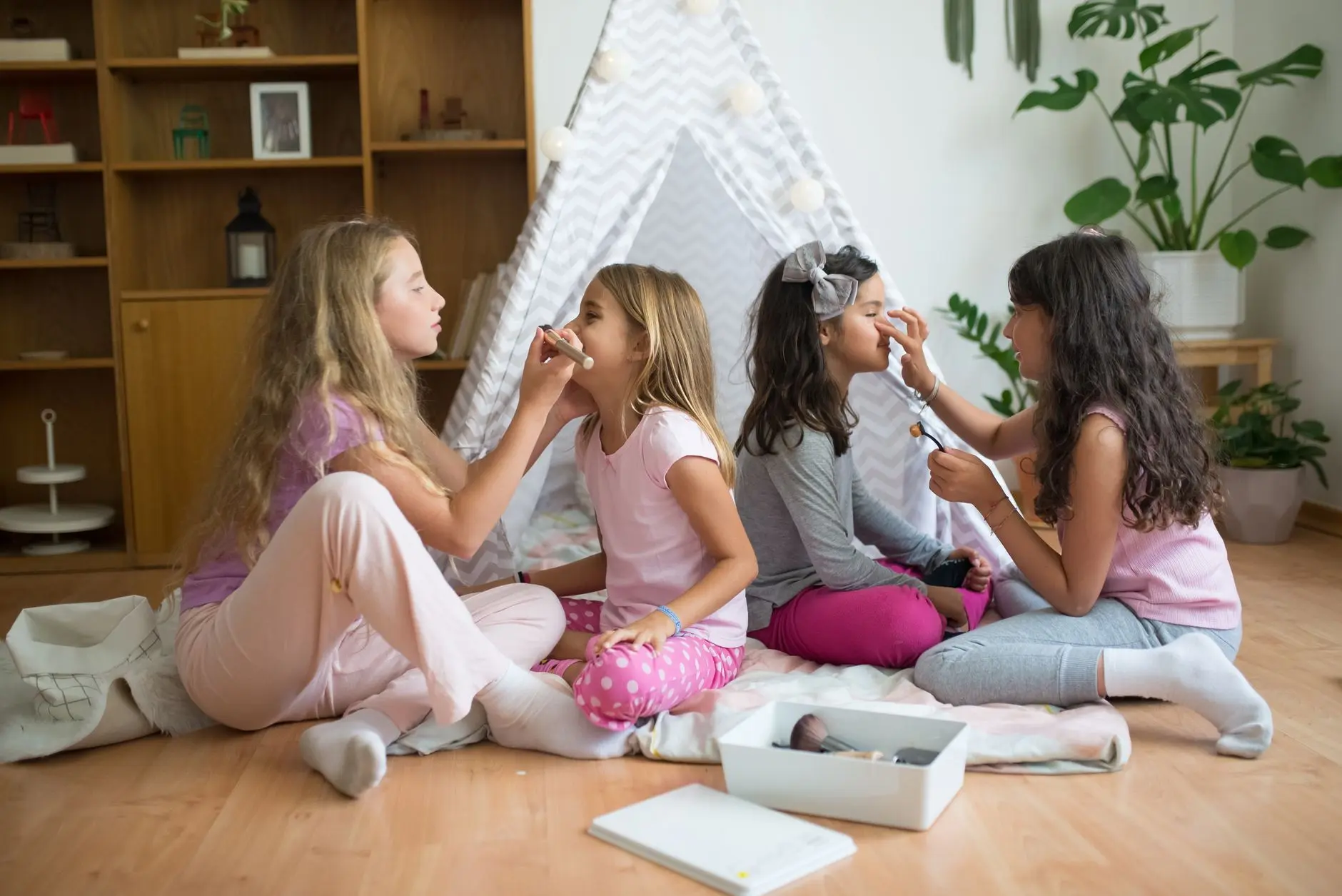
There’s a very specific kind of magic that happens after midnight at a sleepover — the snacks are half-gone, someone’s already in a face mask, and the group is officially too wired to sleep.
What you need in that moment isn’t a board game your little sibling owns. You need games built for teenagers: fast-moving, a little bit spicy, and guaranteed to produce the kind of stories people bring up for years. That’s exactly what this list delivers.
These 20 slumber party games for teens run the full night from the first awkward “okay what do we do now” to the 2am conversations that feel weirdly deep.
Some are printable rounds you can prep in ten minutes, some are physical challenges, and some just need your phone and a group of people who are ready to be embarrassed.
Print what you need, stack them on the coffee table, and let the night run itself.
This post contains affiliate links — if you buy through them, I may earn a small commission at no extra cost to you.
Table of Contents
- Truth or Dare Teen Edition
- Never Have I Ever — Clean Edition
- Most Likely To
- Would You Rather Teen Edition
- Photo Challenge Checklist
- Music Intro Speed Round
- Paranoia Question Game
- Face Mask Makeover Challenge
- Karaoke Bracket
- Two Truths and a Lie
- Sleepover Confessions Cards
- Movie Quote Battle
- Guess That Emoji Story
- Group Storytelling Mad Libs – Teen Edition
- Glow-in-the-Dark Freeze Dance
- Blind Drawing Relay
- Hot Takes Circle
- Wink Assassin
- Pillow Fortress Design Challenge
- Midnight Talent Show
1. Truth or Dare Teen Edition
This is the game that opens the night — and with a printable sheet, you skip the awkward silence where nobody can think of anything good.
Each player picks a number off the printed grid and gets either a truth or a dare assigned to it. Truths lean into the juicy stuff that actually matters to teenagers: crushes, embarrassing school moments, group secrets, and unpopular opinions.
Dares stay physical and social — think “send a voice note to your contact list in alphabetical order” or “let the group choose your phone wallpaper for the rest of the night.”
Print one sheet per session and have everyone sit in a circle. Go around clockwise, or let whoever just completed a dare point to the next person.
The game moves fast when questions are already written down — no one has to perform creativity on the spot, which means the good stuff comes out sooner.
Plan for 30–45 minutes with a group of 4–10 players, though rounds often run longer once everyone gets comfortable.
Host tip: scan the sheet before the party and mentally note which truths might hit too close to home for a specific friend group. It’s fine to swap one or two out with your own additions written in marker before you print — personalized questions always land harder than generic ones.

🛍 Shopping guide
2. Never Have I Ever — Clean Edition
Never Have I Ever is a slumber party classic, but the adult versions floating around online have no place at a teen sleepover.
This printable clean edition keeps everything relatable and funny without going anywhere inappropriate — think “never have I ever pretended to laugh at a joke I didn’t get” or “never have I ever sent a text to the wrong person and instantly wanted to disappear.”
Each player starts with ten fingers up, and the last person with any fingers still raised wins.
Read statements from the printed card aloud one at a time, rotating who reads. Everyone who has done that thing puts one finger down.
The beauty of the clean version is that the revelations are still genuinely surprising — you learn things about your friends you never knew, and the reactions are half the entertainment. Works brilliantly with 4–12 players and takes around 20–30 minutes for a full round.
Host tip: print two or three copies of the sheet so you can tape a fresh one to the wall for everyone to see simultaneously — it removes the bottleneck of one person reading and speeds the whole game up, which matters when energy is high and everyone’s trying to talk at once.

🛍 Shopping guide
3. Most Likely To
Every group has an unspoken ranking of who would do what — Most Likely To is the game that finally makes those rankings official and public.
The printable sheet contains a list of scenarios like “most likely to become famous,” “most likely to accidentally walk into the wrong classroom,” and “most likely to cry at a commercial.” On the host’s count, everyone points at whoever they think fits the category best.
Majority rules, and that person gets the title.
Ties — where the group splits evenly — go to a tiebreaker question answered by both nominees.
The game doesn’t have winners or losers in a formal sense; the entertainment is entirely in the pointing, the gasps, and the person who gets the same nomination five times in a row. Run it with 4–10 players for about 25–35 minutes.
No materials needed beyond the printed sheet.
Host tip: leave a few blank lines at the bottom of the sheet and fill them in before the party with categories specific to your friend group — inside jokes and real shared experiences will get ten times the reaction that generic prompts get.

4. Would You Rather Teen Edition
Would You Rather works because there’s no wrong answer — but everyone has an opinion about your answer, which is where the real conversation starts.
The printable teen edition is packed with genuine dilemmas that split the room: “Would you rather have your texts read aloud to the class or your search history projected on a screen?”
Every question is designed to make people think for exactly one second before shouting their answer, then argue about it for two minutes.
Go around the group, one person reading a question at a time. Everyone votes simultaneously — either by holding up a finger for Option A or two for Option B, or by physically moving to two sides of the room if there’s space.
After voting, anyone who wants to can explain their reasoning, which is where the chaos and laughter live. Best with 4–12 players; plan for 20–30 minutes though it regularly runs longer.
Host tip: the best moments happen when you ask follow-up questions after votes are cast — “okay but WHY would you rather have that” creates five minutes of entertainment from a single prompt, so don’t rush through the sheet just to finish it.

5. Photo Challenge Checklist
The Photo Challenge Checklist turns everyone’s phones into a scavenger hunt camera.
The printable sheet lists 20–25 photo missions that the group has to complete together — things like “a photo that looks like a movie poster,” “the funniest photo using only what’s in someone’s bag,” or “a posed photo where someone has to pretend to be a piece of furniture.”
Teams race to complete as many as possible in a set time window, usually 20–25 minutes.
Divide into two teams if the group is larger than six, or play as one group competing against the clock.
At the end of the timer, gather around one screen and scroll through the results together — judging, voting, and reacting to photos is genuinely its own second game inside the game.
Award a point per completed mission, bonus points for creativity, and a small prize for the winning team if you want to keep score.
Host tip: set a specific “no leaving the main room” boundary before you start, unless you’re okay with teams running through the whole house — which, at midnight, with tired parents nearby, you’re probably not.

🛍 Shopping guide
6. Music Intro Speed Round
Someone plays the first three to five seconds of a song — first person to shout the correct title and artist wins the point.
The printable sheet gives the host a pre-curated list of song intros organized by round — pop, throwbacks, viral sounds, movie soundtracks — so you’re not spending the whole game searching your phone for something good.
Each category is a mini-round of 10 songs, and you can mix and match categories depending on the group’s taste.
One person is the DJ for a round, playing clips from a pre-made playlist that matches the sheet. Everyone else sits in a circle or stands — either works — and calls out answers.
Keep a tally on the back of the sheet, and the overall winner after all rounds gets to pick the next game or claim a snack prize. Best with 4–10 players; each round runs 10–15 minutes.
Host tip: build your playlist in advance the afternoon of the party by matching it to the printed sheet — if you try to search songs on the fly in the dark at 11pm you’ll kill the momentum every single round, and the game will drag.

🛍 Shopping guide
7. Paranoia Question Game
Paranoia is the game people talk about for weeks afterward. One player leans over and whispers a question to the person on their left — something like “who in this room would survive the longest in the wilderness?”
or “who’s the most likely to become a CEO?” That person answers out loud with someone’s name. Everyone else only hears the answer, not the question, which means the group has to guess what on earth was asked.
The named person can flip a coin to reveal the question — heads it stays secret forever.
The tension of not knowing what the question was about you is genuinely addictive.
The printable sheet gives the first player a set of starter whisper questions so nobody has to invent them under pressure, and blank spaces to write in custom ones before the party.
Use it with 5–10 players, ideally after the group is already warmed up from earlier games. Rounds run 20–30 minutes easily.
Host tip: the coin flip mechanic is everything — don’t skip it. The possibility that the question stays secret is what makes people nervous in the best way, and nervousness is what makes the game worth playing at all.

🛍 Shopping guide
8. Face Mask Makeover Challenge
This one runs alongside other games rather than replacing them — everyone applies a face mask at the same time and has to keep it on for a set period while playing something else.
The challenge part kicks in when you add restrictions: no touching the mask, no making expressions that crack it, and if yours cracks or you touch it you lose. Last person with a reasonably intact mask wins the round.
Pick up a variety pack of sheet masks or clay masks so everyone gets something slightly different — comparing which one feels the weirdest is entertainment on its own.
This works great layered on top of a trivia round or a card game, with 4–8 players.
Total “game time” is however long the masks need to set — usually 15–20 minutes — but it adds a layer of comedy to whatever you’re playing at the same time.
Host tip: have makeup remover wipes and a mirror ready before you start — some masks are messier than expected, and letting people clean up immediately when time’s up keeps the night moving instead of stalling while someone hunts for the bathroom sink.
🛍 Shopping guide
9. Karaoke Bracket
Karaoke Bracket takes the usual everyone-sings-if-they-want-to format and adds structure and stakes. The printable bracket sheet works exactly like a sports tournament: everyone writes their name in the first round, gets matched against one other person, and the group votes after each head-to-head performance.
Winners advance, losers become the loudest hype section in the room. The final two performers go head-to-head for the title of the night’s karaoke champion.
You don’t need a karaoke machine — a lyrics video on a phone or laptop propped up works perfectly. Each performance should be one chorus minimum, no dropping the mic after four words.
A group of 6–8 fills a bracket beautifully; up to 12 works if you run double brackets. The whole tournament takes 45–60 minutes and is best saved for peak-energy time, usually around 10–11pm.
Host tip: assign someone the job of “hype person” for every performer — their only job is to cheer no matter what. It eliminates the awkward silence when someone finishes a slightly rough verse and makes even the shyest singer feel genuinely celebrated.

🛍 Shopping guide
10. Two Truths and a Lie
Each player writes three statements about themselves on their section of the printable sheet — two that are completely true and one that is a convincing lie.
The sheet gives formatting space for each person to keep their answers hidden until their turn, plus a voting tally grid for the group to use. One at a time, players read their three statements aloud, and everyone votes on which one is the lie.
Points go to the player for each person they fool.
The skill is in writing a lie that’s plausible and truths that sound made-up — the more surprising the real facts, the better.
Someone who has traveled to an unusual country, has a weird hidden talent, or has done something genuinely unexpected will win almost every time. Play with 4–10 people; a full round where everyone goes once takes about 30–40 minutes.
Host tip: give everyone five minutes of quiet writing time at the start — people who rush their statements default to boring lies that are immediately obvious, and the whole game becomes less interesting. Good statements need a little strategy.

11. Sleepover Confessions Cards
Sleepover Confessions Cards are a structured way to get to the conversations that usually only happen at 1am when everyone’s already tired and honest.
The printable deck contains prompt cards — not dares, not embarrassing tasks, just genuine confession-style questions like “something I’ve pretended to like so someone would think I was cool” or “a fear I’ve never told anyone about.”
Players draw a card and answer honestly, or pass once per round.
There’s no scoring and no winner — this is explicitly a connection game, not a competition. It works best later in the night when the group is already comfortable with each other and the early games have broken the ice.
Set a calm vibe: dim the lights a little, get everyone settled in their sleeping bags or on pillows, and just talk. Groups of 3–8 work best; the game runs as long as the conversations do, usually 30–60 minutes.
Host tip: go first yourself. Answering your own card genuinely and vulnerably sets the tone immediately — if the host skips or gives a surface answer, the rest of the group will do the same.

12. Movie Quote Battle
Movie Quote Battle is fast, loud, and immediately reveals who in the group has an embarrassing number of films memorized. The printable sheet contains a list of famous movie lines with the movie title and character name blanked out.
Players race to name the movie, the character, or both — different point values for each. Some rounds require the full quote to be recited back, which separates the people who vaguely recognize it from the ones who actually know it.
A rotating host reads each quote aloud with maximum dramatic delivery — the more committed the performance, the funnier the game gets. Tally points on the back of the sheet. Run 3–4 rounds of 10 quotes each, swapping the host each round. Best with 4–10 players; each round takes about 10–15 minutes, so the full game runs 40–60 minutes.
Host tip: include at least one quote from something extremely recent and one from something ten years old — mixed eras split the group in interesting ways and mean different people dominate different rounds, which keeps scores close and everyone engaged.

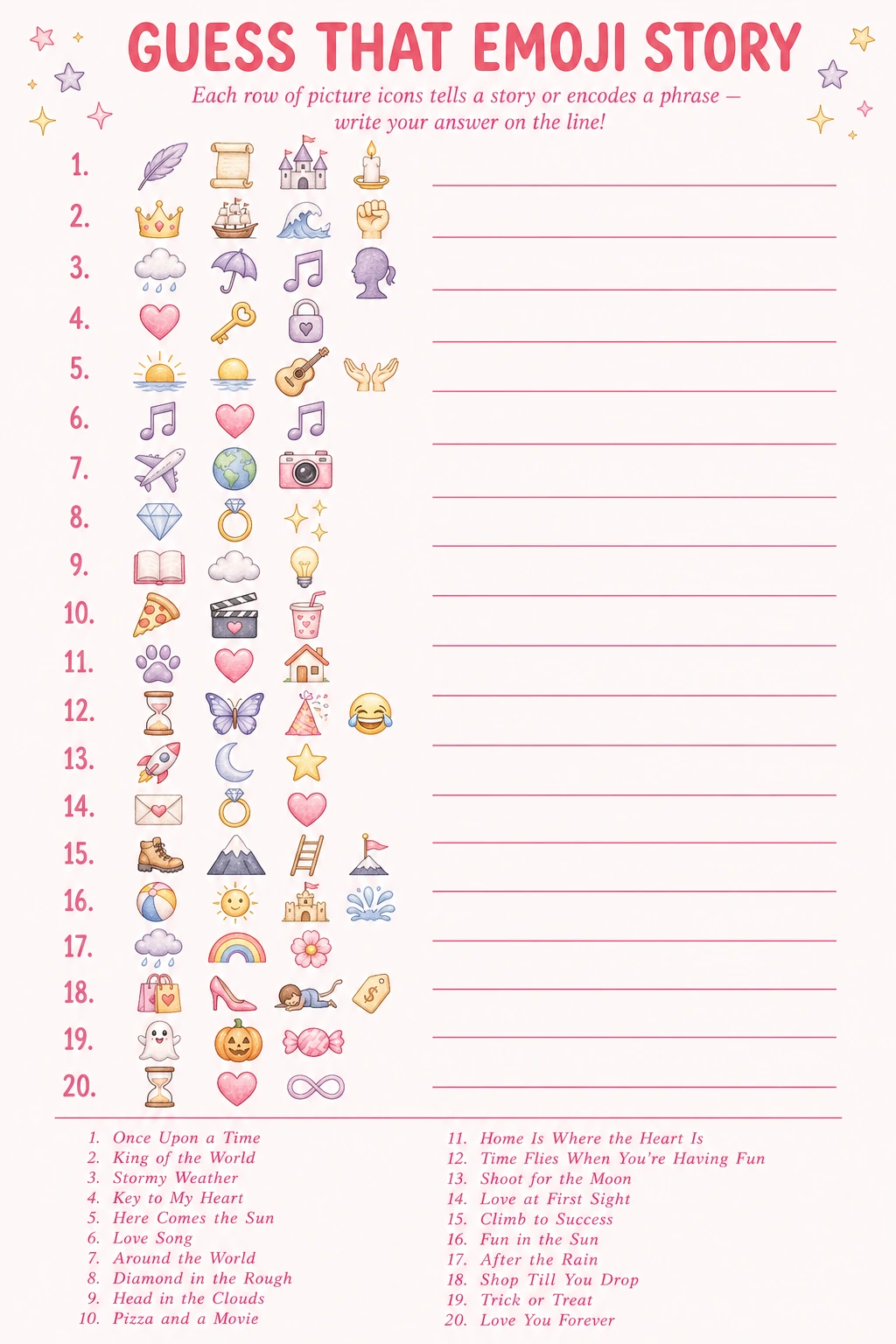
13. Guess That Emoji Story
Guess That Emoji Story takes a full narrative — a summarized plot of a well-known story, a famous event, or a relatable teen situation — and translates it into a sequence of emojis on the printable sheet.
Players have to read the emoji sequence and write down what story or situation they think it’s describing. These aren’t single-word answers or rebus puzzles; each answer is a complete story or scenario, and players write a sentence or two explaining their interpretation.
Score each round by awarding full points for the exact intended answer and partial points for creative interpretations that are genuinely close. Reading the wildly wrong answers aloud is honestly the best part — the game turns into a storytelling improv round without anyone planning it that way. Works with 4–10 players; plan for 20–30 minutes for a full sheet.
Host tip: after scoring, let players vote for the funniest wrong answer and award a bonus point for it — this keeps people invested even after they realize their answer was completely off, and it rewards creative thinking over pure trivia knowledge.
14. Group Storytelling Mad Libs – Teen Edition
Group Storytelling Mad Libs works by giving each player a printable sheet with a story already written — but every key noun, verb, adjective, and name is blanked out.
Players fill in their blanks without seeing the story, guided only by the category label (a celebrity name, a school subject, a sound you’d hear in a cafeteria).
Once everyone’s filled in their sheet, the stories get read aloud with all the substitutions in place, and the results are reliably unhinged.
The teen edition uses story templates built around scenarios that actually resonate — a first day at a new school, a group chat gone wrong, a talent show disaster — which makes the completed absurd versions even funnier because the frame is so familiar.
Works with 3–12 players; each story takes about five minutes to fill in and five minutes to read aloud, so a full session of four stories runs 35–45 minutes.
Host tip: have each person read their own completed story aloud rather than passing it to someone else — the person who wrote the blanks is already anticipating certain combinations, and when the actual result is nothing like they expected, their reaction is part of the entertainment.

15. Glow-in-the-Dark Freeze Dance
Glow-in-the-Dark Freeze Dance is a physical game that burns off the sugar rush and doubles as a photo opportunity. Everyone gets a set of glow bracelets and necklaces before the game starts.
One person controls a phone playlist, and when the music cuts everyone has to freeze instantly — any movement after the music stops and you’re out for that round.
The glow accessories mean you can play with the lights off, which makes spotting movement significantly harder and the atmosphere significantly cooler.
Keep rounds short — 90 seconds of music maximum — so eliminations happen fast and people aren’t standing frozen for too long. Winners from each round go head-to-head in a final, or play a “survivors only” round where everyone eliminated watches and judges.
Best with 5–12 players; the full game including finals takes 20–30 minutes. All you need is a phone, a playlist, and enough glow accessories for everyone.
Host tip: let the eliminated players become the judges who watch for movement — it keeps them involved and slightly mischievous, which means they’re watching much harder than you’d expect and calling out moves nobody else caught.
🛍 Shopping guide
16. Blind Drawing Relay
Blind Drawing Relay is exactly what it sounds like, and it produces results that are funnier than anything planned. Split the group into teams of three or four.
The first player on each team gets a secret subject — a person, an object, or a scene — and draws it on a large sheet of paper while everyone else on their team covers their eyes.
After 30 seconds, the first player stops and the second player draws what they think the first player drew, adding to it. The relay continues until the last player, who has to guess what the original subject was.
You need large paper or a whiteboard, markers, and a timer. The drawing degrades hilariously with each relay step — something that started as a bicycle often ends up being identified as a bowl of spaghetti by the final guesser.
Run five to six rounds with different subjects and swap who goes first. Works brilliantly with 6–12 players in groups of three or four; each relay takes about three minutes, so the whole game wraps in 25–30 minutes.
Host tip: photograph each relay chain side by side at the end and send the grid to the group chat — seeing the full progression of how the drawing fell apart is funnier in retrospect than it was during the actual game.
🛍 Shopping guide
17. Hot Takes Circle
Hot Takes Circle is the game for the part of the night when everyone has an opinion about everything and wants everyone to know it.
One player reads a “hot take” prompt from the pile — something like “which decade had the worst fashion,” “which popular movie is actually overrated,” or “which social media platform will be dead in five years” — and everyone has 20 seconds to form a strong opinion before defending it to the group.
The group then votes on whose argument was most convincing, and that person scores a point.
Write a stack of prompts on index cards before the party, keeping topics firmly in the realm of pop culture, school life, food, and entertainment. Avoid anything genuinely controversial — the game is about playful argument, not actual disagreement.
This is pure conversational energy with no materials needed beyond a timer on your phone and a stack of prompt cards. Best with 5–10 players; runs 30–40 minutes at full speed.
Host tip: add a “flip it” rule where after someone makes their argument, one other player gets 30 seconds to argue the exact opposite position — this teaches people how to steel-man an opposing view and generates way more discussion than a simple vote would.
🛍 Shopping guide
18. Wink Assassin
Wink Assassin is a social deduction game built entirely around eye contact, which makes it uniquely intense at a sleepover where everyone’s already reading each other’s faces.
Before the game, prepare a set of cards — one marked “assassin” and the rest blank — folded so nobody can see. Each player draws one without revealing it.
The assassin’s job is to “kill” other players by making eye contact and winking at them discreetly. A “killed” player waits five seconds, then dramatically announces they’re out.
The rest of the group tries to identify the assassin before everyone is eliminated. Each player gets one accusation per round — if they accuse the wrong person, they’re automatically out themselves.
The game runs on pure paranoia, and it’s genuinely tense even after people have played it before. Works perfectly with 5–12 players; each round takes 5–10 minutes, so play five or six rounds in a row for 45–60 minutes total.
Host tip: add a rule that players must maintain a conversation while playing — sitting in silence staring at each other makes the assassin’s job too easy. Forcing everyone to keep talking means accidental eye contact happens constantly and the wink is much harder to isolate.
🛍 Shopping guide
19. Pillow Fortress Design Challenge
This one lives in the sweet spot between a game and a creative project.
Divide the group into two or three teams and give them exactly 15 minutes to build the most impressive pillow fortress they can using only items already in the room — blankets, pillows, cushions, sleeping bags, and whatever else is fair game.
At the end of the build phase, the teams judge each other’s fortresses on three criteria: structural integrity (can it survive a light shake), size, and creativity of design.
No materials need to be bought — the whole point is using what’s already there, which is also why this game works especially well at midnight when you’re not going to run to the garage for supplies.
After judging, the group can decide to merge the fortresses into one mega-structure for the rest of the night, which is genuinely a very good outcome. Best with 4–10 players; the build takes 15 minutes and judging takes another 10.
Host tip: announce the judging criteria at the start so teams know what they’re building toward — if you spring “structural integrity” on them at the end, everyone just built for size and the category feels unfair. Knowing the rubric changes how creatively they design.
20. Midnight Talent Show
Midnight Talent Show is the finale game — saved for genuinely late in the night when inhibitions are low and everyone is in a good mood. Each person or pair has five minutes to prepare a one-minute talent performance.
The bar is deliberately undefined: it can be a real skill, something completely absurd, a joke told in a fake accent, an impression of someone in the group, or a dramatic reading of a random text message chain. The only rule is that everyone participates.
Assign three audience members as judges with a simple 1–10 scoring system on a notepad. Performances go in random order determined by drawing names.
After all acts, total the scores and crown a winner — but honestly the scoring matters less than the fact that everyone committed to something.
Run this with 4–10 players; each act is one minute, judging discussion is another two, so ten performers means about 30–40 minutes total.
Host tip: give people exactly five minutes of prep time and enforce it strictly — too much prep time and people overthink and get nervous, too little and nobody does anything. Five minutes produces the perfect balance of half-prepared chaos that makes every performance memorable.
Frequently Asked Questions
How many players do these slumber party games work best for?
Most of the games on this list are designed for groups of 4–10 players, which covers the typical sleepover size. A few — like Karaoke Bracket and Glow-in-the-Dark Freeze Dance — scale up comfortably to 12.
For smaller gatherings of three or four, the best picks are Two Truths and a Lie, Sleepover Confessions Cards, and Would You Rather, which all run well with a tight group and actually get more personal the smaller the circle is.
Do I need to buy anything or print anything before the party?
About half the games are printable and work best with a sheet prepared ahead of time — Truth or Dare, Never Have I Ever, Most Likely To, Would You Rather, and several others all have printable versions you can run off on regular printer paper or cardstock.
The other half need nothing at all beyond phones, pillows, and whatever snacks are already in the room. The games that benefit from a small purchase — glow bracelets, a karaoke mic, face masks — are noted in the shopping suggestions under each item.
What order should we play the games in?
A good slumber party arc goes: high-energy and social games early in the night to break the ice (Truth or Dare, Would You Rather, Most Likely To), physical games in the middle when energy peaks (Freeze Dance, Pillow Fortress, Karaoke Bracket), and quieter, more personal games late at night when everyone is comfortable and a little tired (Sleepover Confessions Cards, Two Truths and a Lie, Midnight Talent Show).
Following that arc makes the night feel like it has a natural shape rather than a random pile of activities.
What do you do if some people are shy and don’t want to play certain games?
Build in a “pass” option for every game that involves personal disclosure — Sleepover Confessions Cards and Paranoia Question Game especially.
Nobody should feel forced, and making the pass option low-key and judgment-free (not a big deal when someone uses it) means people are actually more likely to participate overall.
Games like Photo Challenge and Pillow Fortress Challenges are great equalizers because they’re team-based and nobody has to perform alone.
Are these games appropriate for 13-year-olds as well as 17-year-olds?
Yes — every game on this list is designed to work across the 13–17 range. The printable sheets for games like Truth or Dare and Never Have I Ever are specifically labeled “teen edition” and “clean edition,” which means the content is age-appropriate throughout.
If you’re hosting a younger end of the range, lean toward the team games, physical challenges, and creative rounds first, and save the more personal games like Sleepover Confessions Cards for groups that already know each other well.
📌 Save These for Later
Loved these? Pin your favorite image below so you can find this list again when you’re planning.

120 would you rather questions sorted by theme — funny, food, superpowers, travel & tricky. Perfec
120 charades ideas sorted by Movies, Animals, Actions, Occupations & Everyday Activities — plus fr
20 sleepover games for teens that are actually fun — active, printable card decks, and quiet vibes
Leave a Reply