


Planning a party for teenagers is one of those things that sounds easy until you realize half the “party game” ideas online were written for eight-year-olds or bachelorette weekends.
Teens want something competitive enough to feel real, social enough to be memorable, and cool enough that nobody rolls their eyes the moment you explain the rules. That’s exactly what this list is built for.
All twenty games below work for groups of eight to twenty-plus, most need nothing more than a printed sheet and a phone, and every single one has been chosen because teens actually enjoy playing it—not just tolerating it. Read through, pick five or six that fit your group’s energy, and you’re set.
This post contains affiliate links — if you buy through them, I may earn a small commission at no extra cost to you.
Table of Contents
- Photo Challenge Checklist
- Emoji Decode Rounds
- Music Intro Speed Round
- Most Likely To
- Would You Rather Teen Edition
- Charades Teen Edition
- Speed Drawing Duel Prompt Cards
- Trivia Head to Head
- Balloon Stomp Battle
- Categories Elimination
- Karaoke Bracket
- Scattergories
- This or That – Speed Vote
- Name That Tune Bingo
- Reverse Trivia
- Wink Assassin
- Two Truths and a Lie – Speed Edition
- Minute to Win It Relay
- Hot Take Tournament
- Freeze Frame
1. Photo Challenge Checklist
Print one checklist per team before the party and you’ve got an instant scavenger hunt that runs itself.
Each sheet lists twenty to thirty photo missions—things like “a human pyramid,” “everyone pointing at something nobody can see,” or “the most dramatic slow-motion fall”—and teams race around the venue snapping every shot on their own phones within a set time limit, usually thirty to forty-five minutes.
The team that completes the most challenges wins, but you can also award bonus points for creativity or presentation when you review the shots at the end.
Gather everyone back and do a slideshow review on a TV or projector: this is genuinely the best part, because the photos are always funnier than anyone expected.
Works brilliantly for groups of eight to thirty, and the whole thing from launch to awards takes about sixty to seventy-five minutes. You’ll need printed checklists, phones, and optionally a way to cast photos to a screen.
Host tip: Assign one adult or trusted older teen as a silent roving judge so teams can’t quietly skip challenges and claim they did them—it prevents every argument before it starts.

🛍 Shopping guide
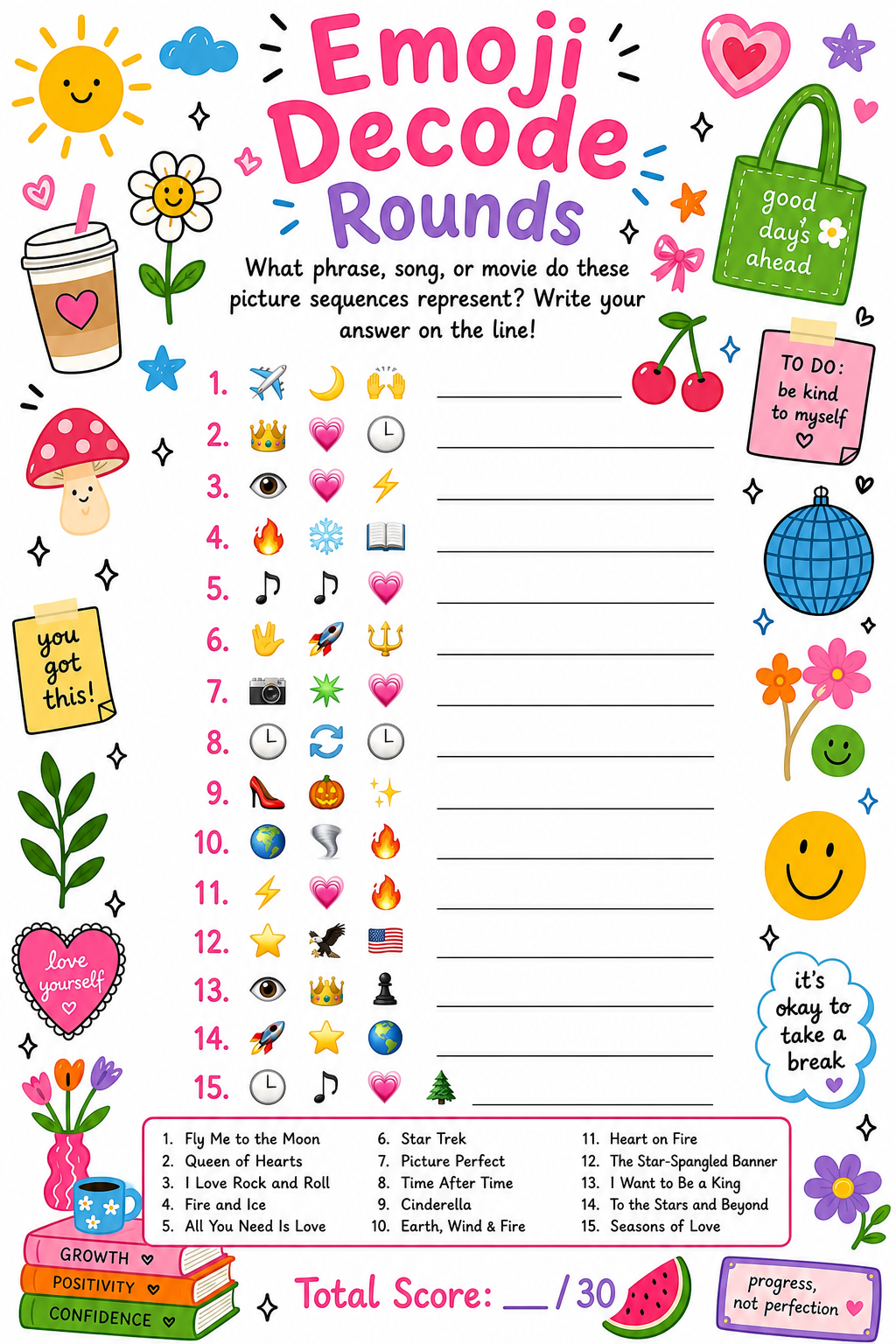
2. Emoji Decode Rounds
Hand each player or team a printed sheet packed with rows of emoji sequences, and they race to decode what each row represents—song titles, movie names, famous phrases, or teen slang, depending on which version you print.
Players write their guesses in the answer column and the team or individual with the most correct answers after a timed round wins. Unlike a passive quiz, the head-scratching moments and arguments over what three specific emojis obviously mean together are half the entertainment.
This works for six to twenty-four players split into teams of two to four, and a single round runs about fifteen to twenty minutes. All you need are the printed sheets and pens—phones should be face-down to keep it honest. You can run multiple themed rounds back to back (songs, then movies, then slang) to fill a longer time slot.
Host tip: Print an answer key and keep it with you rather than on display—teens will spot it across the room faster than you think, and having it hidden means the reveal at the end feels genuinely satisfying rather than anticlimactic.
🛍 Shopping guide
3. Music Intro Speed Round
Queue up a playlist of song intros—anywhere from three to ten seconds each—and the first player to shout the correct song title wins that point.
The printed sheet gives each player a score card and a set of answer columns so ties can be broken by written answers when two people shout at the same time. Run through twenty to thirty clips and tally the final scores for a champion.
Genre variety is key: mix current chart hits, classic throwbacks, and one or two curveballs to keep everyone on edge.
This game is best for eight to twenty players in a single room with a decent speaker. Total playing time is usually twenty-five to thirty-five minutes depending on how many clips you play. You need a prepared playlist (Spotify works perfectly), a Bluetooth speaker, and the printed score sheets.
Host tip: Pre-cut your playlist the night before and listen to each clip at the exact second it starts—some intros are recognizable in two seconds, others need five, and the difference completely changes the difficulty curve.

🛍 Shopping guide
4. Most Likely To
Every player gets a printed ballot sheet listing prompts like “Most likely to accidentally reply-all to the whole school” or “Most likely to become famous for something ridiculous.”
Players fill in a name for each category, the host collects the sheets, and the results are read aloud one category at a time—tallying who got the most votes for each.
The person with the most total mentions across all categories wins, but the real fun is the reactions when each result is announced.
This works for any group from eight to thirty players and takes about twenty to thirty minutes to complete. All you need are the printed sheets, pens, and a host willing to read the results with a straight face.
It’s a low-pressure game that works great as an icebreaker early in the party or as a wind-down activity near the end.
Host tip: Read out the vote counts slowly and pause for effect before revealing the winner of each category—rushing through it kills the energy, and those small dramatic pauses are what make everyone laugh.

5. Would You Rather Teen Edition
The printed sheet lists a series of increasingly difficult “would you rather” dilemmas written specifically for a teen crowd—nothing adult or embarrassing, just genuinely tricky choices like “Would you rather never use social media again or give up music forever?”
Players vote simultaneously by holding up an A or B card (or just raising hands), and then anyone who wants to defend their answer has thirty seconds to make their case before the group moves on.
The debate element is what separates this from a passive activity.
This game scales well from eight to thirty-plus players and a full sheet of twenty questions takes about twenty to thirty minutes. You only need the printed question sheets and a confident host to keep the debates moving.
It’s one of the best games to use when energy is dipping and you need something that gets people talking without requiring physical setup.
Host tip: Skip past any question that lands flat and move immediately to the next—forcing a dead question kills the vibe, and with twenty prompts on the sheet you’ll always have better ones waiting.

6. Charades Teen Edition
This is classic charades rebuilt with prompts teens actually recognize: viral moments, current slang terms used as concepts, popular music acts, relatable school situations, and everyday teenage experiences.
Players draw a card from the printed prompt deck, set a sixty-second timer on a phone, and act out the prompt without speaking while their team guesses. The team that guesses the most prompts correctly in equal rounds wins the game.
Best played with ten to twenty-four players split into two to four teams. A full game runs thirty to forty-five minutes depending on how many rounds you play. You need the printed and cut prompt cards, a phone timer, and a scoreboard on a whiteboard or paper.
Host tip: Shuffle the prompt cards and let players pick blind rather than choosing—when someone gets a prompt they find genuinely hard, the panicked acting is ten times funnier and the guessing gets more intense.

7. Speed Drawing Duel Prompt Cards
Two players face off at a time, each with a marker and a large piece of paper or a small whiteboard.
The host draws a prompt card and calls out the same word or phrase to both players simultaneously—they race to draw it while their respective teams guess. The first team to shout the correct answer scores the point.
Prompt cards cover everything from abstract concepts to specific actions to compound words that are genuinely hard to illustrate, which keeps the competition unpredictable.
This works for eight to twenty-four players split into two teams, and a full game of ten to fifteen rounds takes about twenty-five to thirty-five minutes. You need the printed and cut prompt cards, large paper pads or small whiteboards, and markers. A small whiteboard per team makes erasing between rounds faster and cleaner.
Host tip: Keep a few genuinely easy prompts mixed in with the hard ones—back-to-back impossible prompts stall the energy, but an easy one after a tough round resets the pace and keeps both teams feeling competitive.

🛍 Shopping guide
8. Trivia Head to Head
Players pair off in a bracket-style tournament: two competitors sit across from each other, the host reads a trivia question from the printed sheet, and the first person to buzz in (slap the table or ring a bell) and answer correctly advances.
The loser is eliminated, and the bracket continues until one champion remains. Questions cover general knowledge, pop culture, science, history, and teen-relevant topics so there’s something for everyone’s strengths.
A bracket of sixteen players takes about forty to fifty minutes including all rounds. You need the printed question sheet, something to serve as a buzzer (a bell, a phone buzzer app, or just a slap-the-table rule), and a bracket drawn on paper or a whiteboard. Works best for twelve to twenty players.
Host tip: Write every player’s name on the bracket before the party starts and display it on a wall—seeing their name on a bracket makes teens instantly more competitive, and eliminated players stay engaged because they’re watching the bracket update in real time.

🛍 Shopping guide
9. Balloon Stomp Battle
Every player ties one inflated balloon to their ankle with a short piece of string. On “go,” everyone tries to stomp and pop every other player’s balloon while protecting their own. Once your balloon is popped, you’re out.
The last player with an intact balloon wins the round. It sounds simple, but the chaos of twenty teenagers dodging and lunging in all directions makes it genuinely hilarious to play and watch.
Best played outdoors or in a large open indoor space with the furniture pushed back. Works for eight to thirty players and each round lasts only two to four minutes—run several rounds or introduce a team variant where teams defend a colour. You need one balloon per player per round and a roll of string or pre-cut ribbon.
Host tip: Use string that’s exactly thirty centimetres long for every player—if the string is too long the balloon drags on the floor and pops itself, and if it’s too short players can’t move properly. Consistency in string length keeps every round fair.
🛍 Shopping guide
10. Categories Elimination
The host names a category—”things you find in a school bag,” “countries in South America,” “words that rhyme with blue”—and players go around the circle rapidly naming one valid item each.
Hesitate for more than three seconds, repeat something already said, or give an invalid answer and you’re eliminated. The category keeps cycling until only one player remains, then a new category starts. The player who survives the most rounds is the overall winner.
This is great for ten to twenty-four players and requires zero equipment beyond the printed category prompt sheet for the host to draw from. A full session of six to eight categories takes about twenty to thirty minutes. It’s a perfect filler game that resets instantly between rounds and never needs explaining more than once.
Host tip: Start with a wide, easy category for the first round so newer or shyer players get a few turns before the game heats up—throwing a brutally narrow category first eliminates half the group in thirty seconds and leaves the rest of the session feeling one-sided.

11. Karaoke Bracket
Run a proper bracket-style karaoke competition where players are seeded randomly and face off two at a time, singing a thirty-to-sixty-second clip of their chosen song while a panel of three judges scores each performance on a printed scorecard.
Criteria can include confidence, crowd reaction, and hitting the notes—judges hold up score cards and the higher total advances. The printed bracket sheet keeps track of every matchup so the whole room knows who’s next and what’s at stake.
Best for twelve to twenty players and a full bracket runs sixty to ninety minutes including setup. You need a karaoke app or YouTube karaoke videos on a TV, a speaker, the printed bracket sheets, and score cards for judges. Assign judges from the group to keep everyone involved even when they’re not performing.
Host tip: Let players register their song choice on a slip of paper at the start of the night—if you ask them to choose in the moment right before they sing, half of them freeze up and the bracket grinds to a halt while everyone stares at their phone.

12. Scattergories
Roll a letter die (or use a random letter generator on a phone) to reveal the round’s letter, then set a two-minute timer while every player fills in their printed answer sheet.
The sheet lists twelve categories—things like “sports,” “things in a kitchen,” “names beginning with the letter”—and every answer must start with the rolled letter.
When time’s up, players read their answers aloud: any answer that another player also wrote scores zero, but a unique answer scores one point. Clever and unexpected answers win more than obvious ones.
This is a natural fit for eight to twenty players and three to five rounds take about thirty to forty-five minutes total. You need printed answer sheets, pens, and either a letter die or a phone app. It rewards creative thinking and quick recall equally, which means different players tend to win different rounds.
Host tip: Allow players to challenge any answer they think doesn’t fit the category, but require the group to vote on challenges immediately—drawn-out individual arguments slow the game down and create bad energy, but fast group votes feel fair and keep the pace tight.

🛍 Shopping guide
13. This or That – Speed Vote
The host reads out a rapid-fire “this or that” statement from the printed card deck—”mountains or beach,” “early bird or night owl,” “texting or calling”—and every player must immediately move to one side of the room or raise a coloured card for their choice.
No thinking, no hesitating: the whole point is the split-second decision. After each vote, anyone who wants to can have fifteen seconds to defend their side, then the host calls the next one and you go again.
The pace is relentless and that’s what makes it fun.
Works for any group from eight to forty players and fifty prompts take about twenty-five to thirty minutes at speed. You need the printed prompt cards and optionally two coloured card sets so votes across a large room are visually clear.
It’s one of the best games to run at the very start of a party when people are still arriving and the group isn’t fully warmed up yet.
Host tip: Throw in one or two genuinely divisive questions mid-game—something like “summer or winter”—because the rooms that end up exactly fifty-fifty split always generate the loudest arguments and the best energy spikes.

14. Name That Tune Bingo
Each player gets a printed bingo card filled with song titles from a pre-chosen playlist. The host plays three-to-five-second clips of songs in random order, and players mark off any title on their card that matches what’s playing.
First player to complete a row, column, or diagonal shouts “Bingo!” and wins the round—but they must correctly name the artist to confirm the win. Run multiple rounds using different bingo patterns (full card, corners only, X-shape) to keep it going.
This works brilliantly for ten to thirty players and three to four rounds take about thirty to forty minutes. You need the printed bingo cards (make sure each card has a different layout), something to mark squares with (coins, stickers, or pens), and a prepared song playlist. The more variety in the playlist, the more engaging the game.
Host tip: Print at least two more bingo cards than you have players and let people grab one randomly—if players have time to inspect and choose their card, they’ll all try to grab the same “lucky” layout and you’ll end up with arguments before the first clip even plays.

🛍 Shopping guide
15. Reverse Trivia
Standard trivia gives you a question and you find the answer—Reverse Trivia flips it completely.
The host reads out an answer from the printed sheet (say, “1969” or “the tallest mountain on Earth”) and players compete to write down the most creative, plausible question that could have produced that answer.
A panel of two or three judges scores each submitted question on creativity and accuracy, and points accumulate across ten to fifteen rounds. The player with the most points at the end wins.
This rewards lateral thinking and humor equally, which means it produces a different winner than a straight trivia game almost every time. Works well for eight to twenty players and a full game of fifteen rounds takes about thirty to forty minutes. You need the printed answer sheets, pens, and judges willing to make quick decisions.
Host tip: Brief your judges before the game starts on what “creative and plausible” actually means to them—if the judging criteria aren’t aligned from the first round, players will feel the scoring is random and start losing interest by round five.

16. Wink Assassin
One player is secretly designated the Assassin before each round—draw folded slips of paper, with one marked “A” and the rest blank, and everyone keeps their slip secret.
Players sit in a circle or mingle around the room, and the Assassin silently “kills” others by making eye contact and giving a single, discrete wink. A killed player must wait three seconds and then dramatically “die” in whatever way they choose.
Meanwhile, any living player who thinks they know who the Assassin is can point and accuse—but if they’re wrong, they’re out too.
This works for eight to twenty-four players and each round lasts three to eight minutes depending on how quickly the Assassin is caught. You need only slips of paper. Run back-to-back rounds so everyone gets a chance to be the Assassin, and the player who survives the longest total across all rounds is crowned champion.
Host tip: Encourage players to get up and move around the space rather than sitting rigidly—Assassins who can wink while passing someone in conversation are almost impossible to catch, and that tension is what makes the game genuinely thrilling rather than just awkward staring.
17. Two Truths and a Lie – Speed Edition
Every player writes three statements about themselves on a slip of paper—two true, one false—and hands it to the host.
The host reads each set aloud without revealing who wrote it, and every other player has ten seconds to vote on which statement is the lie by holding up fingers (one, two, or three for statement number).
Points go to the writer for every player they fool, and points also go to any player who correctly identifies the lie. The “speed” element means no long deliberation—gut instinct only.
This works for eight to twenty players and twenty sets of statements take about twenty to thirty minutes. All you need are slips of paper and pens collected at the start. It doubles as a brilliant icebreaker because players learn surprisingly real things about each other that they’d never volunteer in normal conversation.
Host tip: Collect all the slips before anyone reads theirs aloud, then shuffle them—if players read their own, they give themselves away with micro-expressions every time, and the game becomes “spot the nervous person” instead of actually thinking about the statements.
18. Minute to Win It Relay
Set up five to eight one-minute physical challenge stations around the space—things like stacking a tower of plastic cups one-handed, keeping a balloon in the air using only your breath, or transferring small objects from one bowl to another using a spoon held in your mouth.
Teams rotate through every station in relay format, with each team member attempting a station for sixty seconds and scoring points for every successfully completed rep or task. The team with the highest combined score across all stations wins.
This works for ten to thirty players split into teams of three to five, and the full relay takes forty-five to sixty minutes including setup and rotation. You need basic props for each station—plastic cups, balloons, spoons, bowls, and ping-pong balls cover most challenges. Rotate stations every ninety seconds so teams stay synchronized and no one is standing around waiting.
Host tip: Run one practice demonstration of each station before the relay starts, even if it’s just thirty seconds per station—teens who don’t understand exactly what counts as a successful rep will spend their whole sixty seconds arguing about it instead of competing.
🛍 Shopping guide
19. Hot Take Tournament
Each player writes one bold, debatable opinion on a slip of paper—something like “summer is overrated” or “lunch should be the biggest meal of the day”—and drops it in a bowl. The host draws two slips at a time and reads both hot takes aloud.
Players vote instantly for which take is more convincing, controversial, or just more interesting. The player whose take wins that head-to-head round earns a point. Keep drawing pairs until all takes have been debated, then crown the player with the most wins.
This works for eight to twenty players and a full tournament of twenty slips takes about twenty-five to thirty minutes. All you need are slips of paper, pens, and a bowl. Unlike a structured debate, no one has to speak unless they want to—the voting is what drives it—but it naturally sparks conversation every single round.
Host tip: Keep a veto card in your pocket as host so you can quietly swap out any slip that crosses a line before you read it aloud—reading it first silently before announcing it means you’re always one step ahead and the game stays fun rather than awkward.
20. Freeze Frame
One player is the Director and stands to the side with a list of scene prompts—”airport security,” “first day at a new school,” “an elevator with a stranger”—while everyone else mills around the space. The Director shouts “Scene!”
and names a prompt, and all players must immediately freeze in a physical pose that represents a character in that scene.
The Director then points to two or three frozen players at random and asks them to hold their position and say one line in character.
The most creative combination of poses and lines wins that round, with the Director awarding a point before rotating to the next.
This works for eight to twenty-four players and ten to twelve scenes take about twenty-five to thirty-five minutes. You need no equipment whatsoever beyond a list of scene prompts, which you can jot on a notecard. It’s the ideal high-energy game to run mid-party when sitting-down games have been going for a while and the room needs to physically move.
Host tip: Rotate the Director role every two scenes rather than every round—one Director for too long starts to play favorites without realizing it, and rotating keeps the judging feeling fresh and fair to everyone in the room.
Frequently Asked Questions
How many games should I actually plan for a three-hour teen party?
Plan four to six games for a three-hour party. That gives each game enough time to breathe without the night feeling like a forced schedule.
Pick a mix of high-energy physical games and seated games so the pace naturally rises and falls—starting with something social and low-stakes, hitting the loudest game in the middle, and finishing with something that winds the energy down works really well in practice.
What if some teens don’t want to play and just want to hang out?
Keep participation genuinely optional and frame everything as “who’s in?” rather than rounding everyone up. Games that work with uneven numbers—like Wink Assassin or Categories Elimination—mean players can drop in or out between rounds without breaking anything. Having a playlist, food, and a good seating area running alongside the games means non-players still have somewhere to be that isn’t awkward.
Do I need to buy prizes for the winners?
Not at all. Bragging rights genuinely matter to teenagers in a way they don’t for younger kids, and a well-run bracket displayed on a visible wall creates all the stakes you need.
If you want to offer something small, a first-choice pick from the snack table or a funny certificate printed on cardstock is more than enough—you don’t need to spend money on prizes for the games to feel competitive and worthwhile.
How do I handle it if a game falls flat?
Move on immediately and without drawing attention to it. Say “alright, next up—” and launch straight into the next game while the energy is still recoverable.
The worst thing a host can do is try to fix a failing game mid-round: it signals to the whole room that something went wrong, and teens will pile onto that feeling.
Having one backup game ready that you know always works is the single most useful preparation you can do.
Which games on this list work best as icebreakers for groups that don’t all know each other?
Two Truths and a Lie Speed Edition, This or That Speed Vote, and Would You Rather Teen Edition are the three strongest icebreakers because they reveal something real about every player without requiring anyone to perform or be put on the spot physically.
Run one of these in the first twenty minutes while people are still arriving and settling in, and the second game of the night will always feel easier because the room already has something to talk about.
📌 Save These for Later
Loved these? Pin your favorite image below so you can find this list again when you’re planning.

From flashlight hide and seek to nail art stations, these 22 sleepover games for kids will keep the
Twelve fall chalkboard signs styled by mood and month, from first harvest to winter threshold, with

25 bachelorette party games that are cheeky, fun, and easy to run at any venue. Print, play, and cel
Leave a Reply