

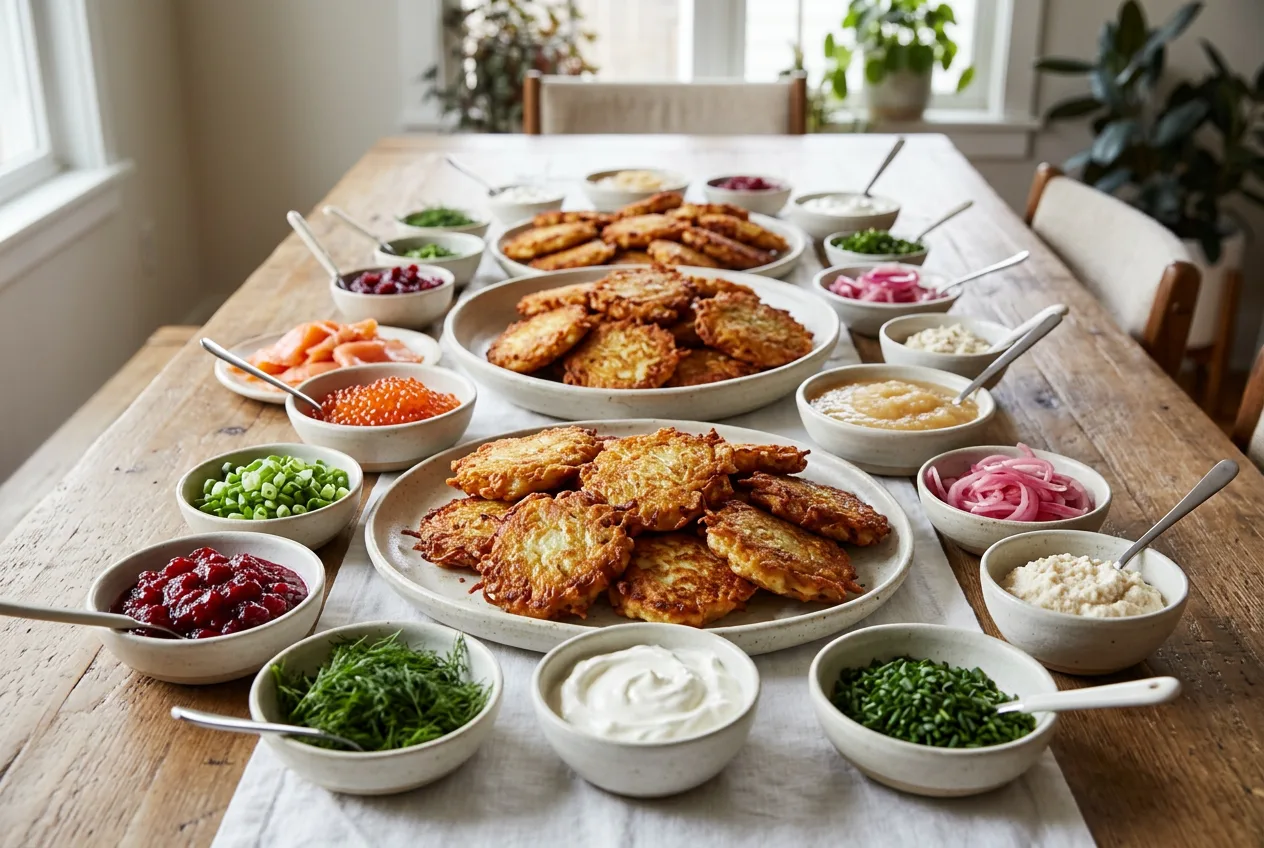
A latke bar is the one buffet nobody complains about standing in line for. One big platter of crisp, hot potato pancakes in the middle, a ring of small bowls around it, and every guest builds her own plate instead of waiting for you to hand her one. It reads generous without costing much more than a classic sit-down batch.
Count on three to four latkes per guest if the bar sits alongside other food, closer to six if it is the whole spread. Latkes disappear faster than you plan for, so buy the extra pound of potatoes; nobody has ever complained about leftover latke mixture the next morning fried into one giant pancake.
Crisp is the whole point and also the first thing to go wrong. Fry in batches so the pan never crowds, drain on a wire rack instead of paper towels (steam collects underneath paper and softens the bottom), and hold finished latkes in a low oven, around 200°F, for no more than 30 minutes before serving.
Dairy, egg, gluten, fish and tree nuts all turn up somewhere across this list, so read labels if anyone at the table avoids one. Most of the toppings swap easily: dairy-free yogurt for the herbed version, gluten-free flour in the batter, a nut-free crumble instead of pecans.
If the latke bar is really the opening act for a longer evening, pair it with something to do once plates are full; 10 Adult Party Games Lists for Every Kind of Night has options that need no setup beyond what is already on the table.
This post contains affiliate links. If you buy through them, I may earn a small commission at no extra cost to you.
Table of Contents
- Classic Potato Latkes With Applesauce and Sour Cream
- Smoked Salmon Latkes With Capers, Red Onion and Dill
- Caviar Latkes With Crème Fraîche
- Beet and Goat Cheese Latkes With Lemon Zest
- Sautéed Apple and Thyme Latkes
- Pomegranate Seed and Horseradish Cream Latkes
- Hard-Boiled Egg and Caper Latkes
- Pickled Red Onion and Herbed Yogurt Latkes
- Sweet Potato Latkes With Maple Crème Fraîche and Toasted Pecans
- Zucchini Latkes With Lemon-Dill Yogurt
- Frequently Asked Questions
Classic Potato Latkes With Applesauce and Sour Cream
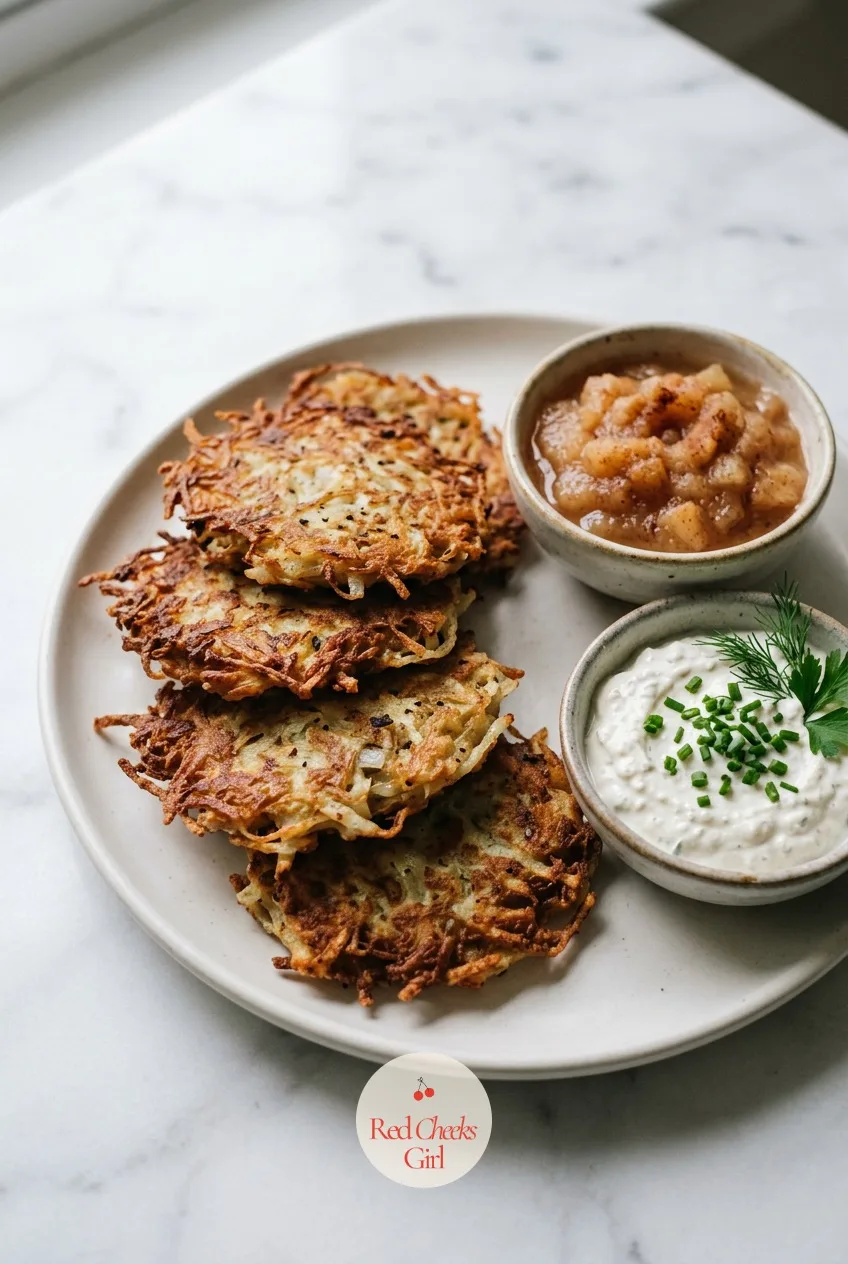
Somebody at the table wants a latke exactly the way her grandmother made it, no detour, no garnish she has to ask about. This is that plate, and it belongs dead center on the board because everyone eats from it first.
The applesauce needs real tartness to cut the fry, so skip the sweetened jarred kind if you can find a chunky, barely sweetened one instead. Sour cream goes on the other side of the same latke; the contrast of warm and cold, crisp and smooth, is the entire trick and it costs nothing extra.
Keep both bowls generous. The split-the-difference guest, half applesauce and half sour cream on one latke, is the most common order at this table and she deserves enough of each to do it twice.
Classic Potato Latkes With Applesauce and Sour Cream
Ingredients
- 2 pounds russet potatoes peeled
- 1 small yellow onion
- 2 large eggs
- 1/3 cup all-purpose flour
- 1 teaspoon kosher salt
- 1/2 teaspoon black pepper
- 1 cup vegetable oil for frying
- 1 cup chunky applesauce
- 1 cup sour cream
- flaky salt for serving
Instructions
- Peel 2 pounds russet potatoes and 1 small yellow onion, then grate both on the large holes of a box grater straight into a clean kitchen towel.
- Gather the towel around the shreds and twist hard over the sink until no more liquid drips out; this wringing is what keeps the latke crisp instead of soggy.
- Tip the dry shreds into a large bowl, crack in 2 large eggs, sprinkle over 1/3 cup all-purpose flour, 1 teaspoon kosher salt and 1/2 teaspoon black pepper, and stir with a fork until the mixture holds together when pressed.
- Pour 1 cup vegetable oil into a 12-inch heavy skillet and set it over medium-high heat until a shred dropped in sizzles instantly, about 350°F on a thermometer.
- Scoop a scant 1/4 cup of the potato mixture per latke, flatten it slightly between your palms, and lower it into the oil; work in batches of four so the pan never crowds.
- Fry 3 to 4 minutes per side, turning once, until the edges are deep golden brown and lacy and the latke slides freely when nudged with a spatula.
- Lift each latke onto a wire rack set over a baking sheet, not paper towels, and season immediately with a pinch of salt.
- Repeat with the remaining mixture, adding more oil as needed and skimming out any dark crumbs between batches so the next round fries clean.
- Slide the whole rack into a 200°F oven if the latkes need to wait, for up to 30 minutes, to keep every batch hot without further browning.
- Arrange the warm latkes on a large platter and set out 1 cup chunky applesauce and 1 cup sour cream in small bowls alongside for guests to spoon on themselves.
Good to Know
🛍 Shopping guide
Smoked Salmon Latkes With Capers, Red Onion and Dill
This is the plate people photograph before they eat it, and the one that goes first if you put it too close to the door. Pink salmon against a golden latke reads rich without anyone doing math on the cost; a modest 8 ounces covers a crowd once it is sliced thin.
Capers and red onion are not optional extras here, they are the whole point: without their sharpness the salmon just tastes like more fat on more starch. Dill does the same job in a softer key.
Build these close to serving time. Creme fraiche sliding off a cold latke is a small, avoidable sadness, so spread it only once the latke is warm enough to hold it.


Smoked Salmon Latkes With Capers, Red Onion and Dill
Ingredients
- 2 pounds russet potatoes peeled
- 1 small yellow onion
- 2 large eggs
- 1/3 cup all-purpose flour
- 1 teaspoon kosher salt
- 1/2 teaspoon black pepper
- 1 cup vegetable oil for frying
- 1/2 cup creme fraiche or sour cream
- 8 ounces sliced smoked salmon
- 1/4 cup capers drained
- 1/2 small red onion thinly sliced
- 1/4 cup fresh dill fronds
- 1 lemon cut into wedges
Instructions
- Peel and coarsely grate 2 pounds russet potatoes and 1 small yellow onion on the large holes of a box grater, dropping the shreds into a colander as you go.
- Press the shreds hard against the colander with the back of a spoon, then transfer them to a clean dish towel and twist until the towel stops releasing liquid.
- Mix the wrung shreds in a large bowl with 2 large eggs, 1/3 cup all-purpose flour, 1 teaspoon kosher salt and 1/2 teaspoon black pepper until it binds into a loose, scoopable batter.
- Heat 1 cup vegetable oil in a 12-inch skillet over medium-high heat until it reaches 350°F, testing with a pinch of the mixture that should bubble on contact.
- Drop level 1/4-cup mounds of batter into the oil, four at a time, flattening each gently with a spatula so it cooks evenly through the center.
- Fry 3 to 4 minutes per side until deep golden and firm enough to flip in one motion without breaking apart.
- Move finished latkes to a wire rack over a sheet pan and hold them in a 200°F oven while you fry the rest, up to 30 minutes.
- While the last batch fries, thinly slice half a small red onion, drain 1/4 cup capers, and pick 1/4 cup fresh dill fronds from their stems.
- Spread a scant teaspoon of creme fraiche onto each warm latke just before serving, so it does not slide off a cold one.
- Drape a ribbon of smoked salmon over the creme fraiche on each latke, then scatter capers, red onion and dill on top.
- Serve immediately with lemon wedges on the side, since smoked salmon latkes lose their contrast if they sit assembled for more than 15 minutes.
Good to Know
🛍 Shopping guide
Caviar Latkes With Crème Fraîche
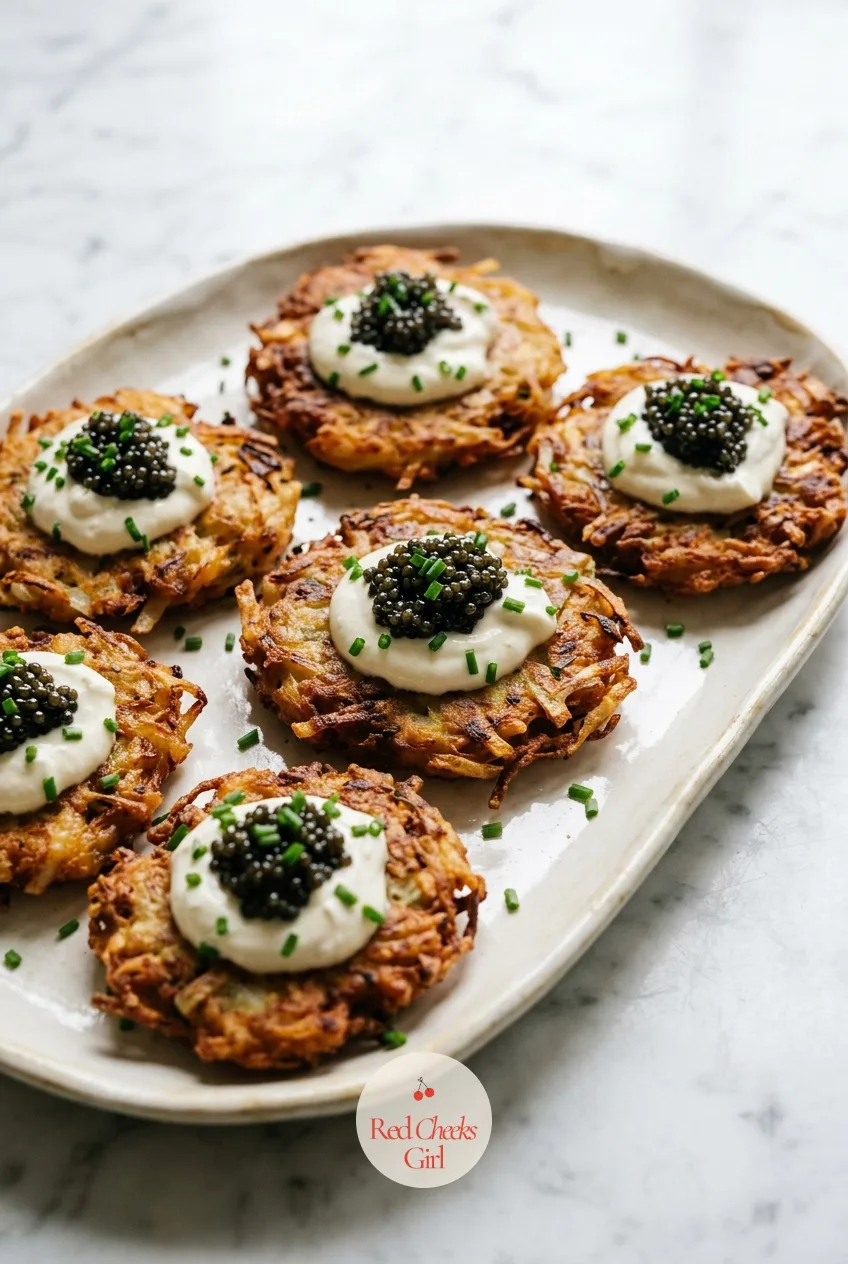
You do not need a special occasion to justify this one, just a tin of caviar and the nerve to put it on something as unglamorous as a potato pancake. The contrast is the whole appeal: salty little beads of roe against the mild, starchy crunch underneath.
A small 2-ounce tin goes further than it looks because each latke needs only a half teaspoon. This is the one bowl on the board you do not need to double.
Let the latkes cool for a minute or two before topping them. Caviar loses its pop fast on anything warm, and nobody wants the eggs to burst before they reach the table.
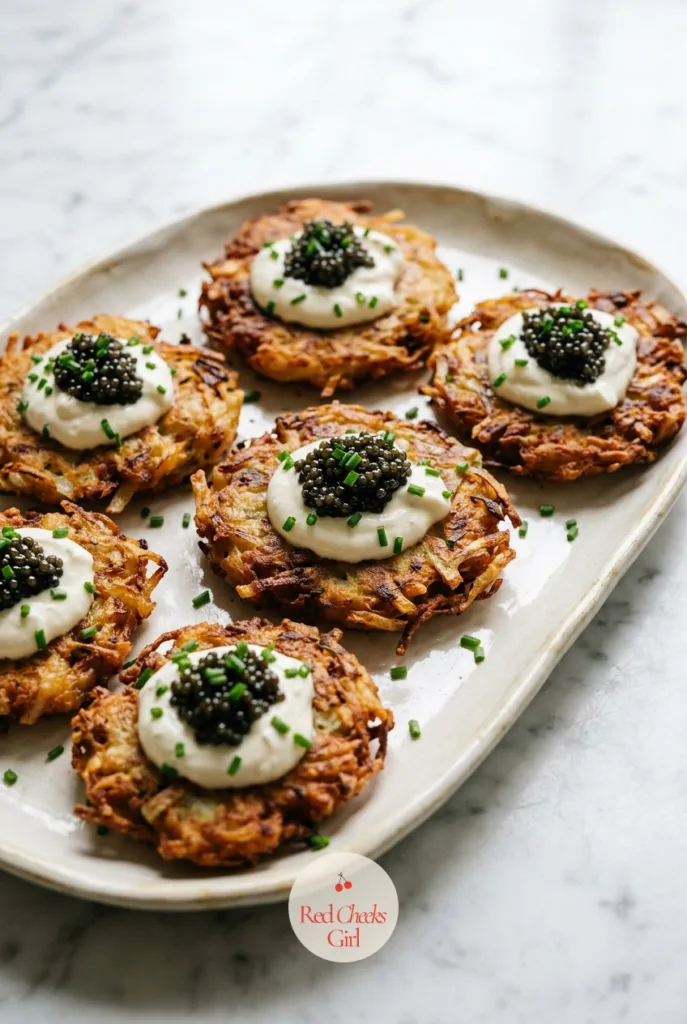
Caviar Latkes With Crème Fraîche
Ingredients
- 2 pounds russet potatoes peeled
- 1 small yellow onion
- 2 large eggs
- 1/3 cup all-purpose flour
- 1 teaspoon kosher salt
- 1/2 teaspoon black pepper
- 1 cup vegetable oil for frying
- 3/4 cup creme fraiche
- 1 2-ounce tin caviar
- 2 tablespoons fresh chives finely snipped
Instructions
- Grate 2 pounds russet potatoes and 1 small onion on the large holes of a box grater into a bowl of cold water, which keeps them from browning while you prep everything else.
- Drain the shreds, wrap them in a clean towel, and wring firmly until the towel comes away nearly dry.
- Combine the shreds with 2 large eggs, 1/3 cup flour, 1 teaspoon kosher salt and 1/2 teaspoon pepper in a large bowl, stirring just until it clumps when squeezed.
- Heat 1 cup vegetable oil in a 12-inch skillet over medium-high heat to 350°F.
- Fry heaping tablespoons of the mixture, four at a time, pressing each into a 2-inch round, for 3 to 4 minutes per side until deep golden and crisp at the edges.
- Drain on a wire rack set over a sheet pan and keep warm in a 200°F oven, up to 30 minutes, while you finish the batches.
- Let the latkes cool for 2 minutes on the counter; caviar melts and loses its pop on a latke straight from the pan.
- Spoon a small dollop of creme fraiche onto the center of each cooled latke.
- Top each with a scant 1/2 teaspoon caviar from the tin, using a small spoon rather than metal cutlery, which can give the eggs a metallic taste.
- Scatter the chives over the platter and serve within 10 minutes, before the caviar's liquid starts to run.
Good to Know
🛍 Shopping guide
Beet and Goat Cheese Latkes With Lemon Zest
If the board needs one plate that is not fried fish or cured anything, this is it. Beet against pale goat cheese looks like effort while actually asking almost nothing of you, especially if you buy the beets already cooked.
The lemon zest is not decorative, it is what keeps the whole thing from tasting flat against the richness of the cheese and the earthiness of the beet. A fine microplane does this in seconds.
Serve this one soon after assembling. Beet juice bleeds into whatever it touches, and a latke that sat too long under its beet slices turns pink all the way through, which is pretty for about ten minutes and then just looks tired.
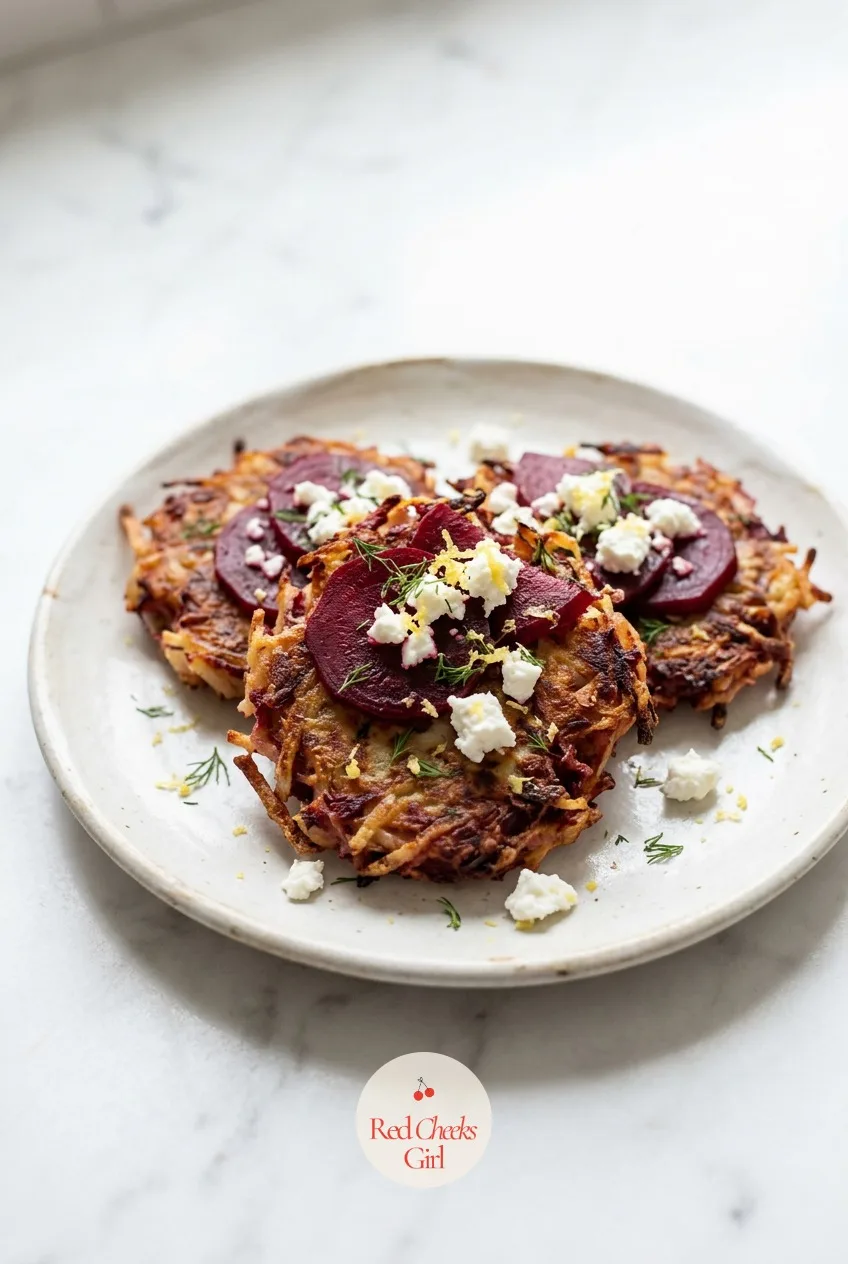
Beet and Goat Cheese Latkes With Lemon Zest
Ingredients
- 2 pounds russet potatoes peeled
- 1 small yellow onion
- 2 large eggs
- 1/3 cup all-purpose flour
- 1 teaspoon kosher salt
- 1/2 teaspoon black pepper
- 1 cup vegetable oil for frying
- 2 medium cooked beets steamed, roasted or vacuum-packed
- 4 ounces goat cheese
- 1 lemon zested
- a few small dill sprigs
Instructions
- Peel and grate 2 pounds russet potatoes and 1 small onion on the large holes of a box grater, then squeeze the shreds dry inside a clean towel until it stops dripping.
- Stir the dried shreds together with 2 large eggs, 1/3 cup flour, 1 teaspoon salt and 1/2 teaspoon pepper until the mixture holds its shape when pinched.
- Warm 1 cup vegetable oil in a 12-inch skillet over medium-high heat until it reaches 350°F.
- Fry 1/4-cup portions of the mixture for 3 to 4 minutes per side, in batches of four, until the surface is deep golden and firm to the touch.
- Transfer to a wire rack over a sheet pan and hold in a 200°F oven for up to 30 minutes while you fry the remaining batter.
- Slice 2 medium cooked beets into thin half-moons while the last latkes fry.
- Zest 1 lemon and crumble 4 ounces goat cheese into small, uneven pieces with your fingers.
- Lay two or three beet slices across each warm latke, letting the color bleed slightly into the potato.
- Crumble the goat cheese over the beets, then finish with a pinch of lemon zest and a few small dill sprigs on each.
- Serve right away on a platter, since beet juice will tint any latke it touches the longer it sits.
Good to Know
Sautéed Apple and Thyme Latkes
For the guest who finds smoked fish and roe a bit much, this plate is the gentle landing. Warm apple, a little butter, a little honey, thyme instead of anything sharp. It tastes like autumn even in the middle of winter.
Honeycrisp holds its shape best in the pan, but any firm, slightly tart apple works if that is what is in the bowl on your counter already. This is the cheapest bowl on the whole board.
Serve it while the apples are still warm. Once they cool they lose the softness that makes them worth putting on a hot latke in the first place.
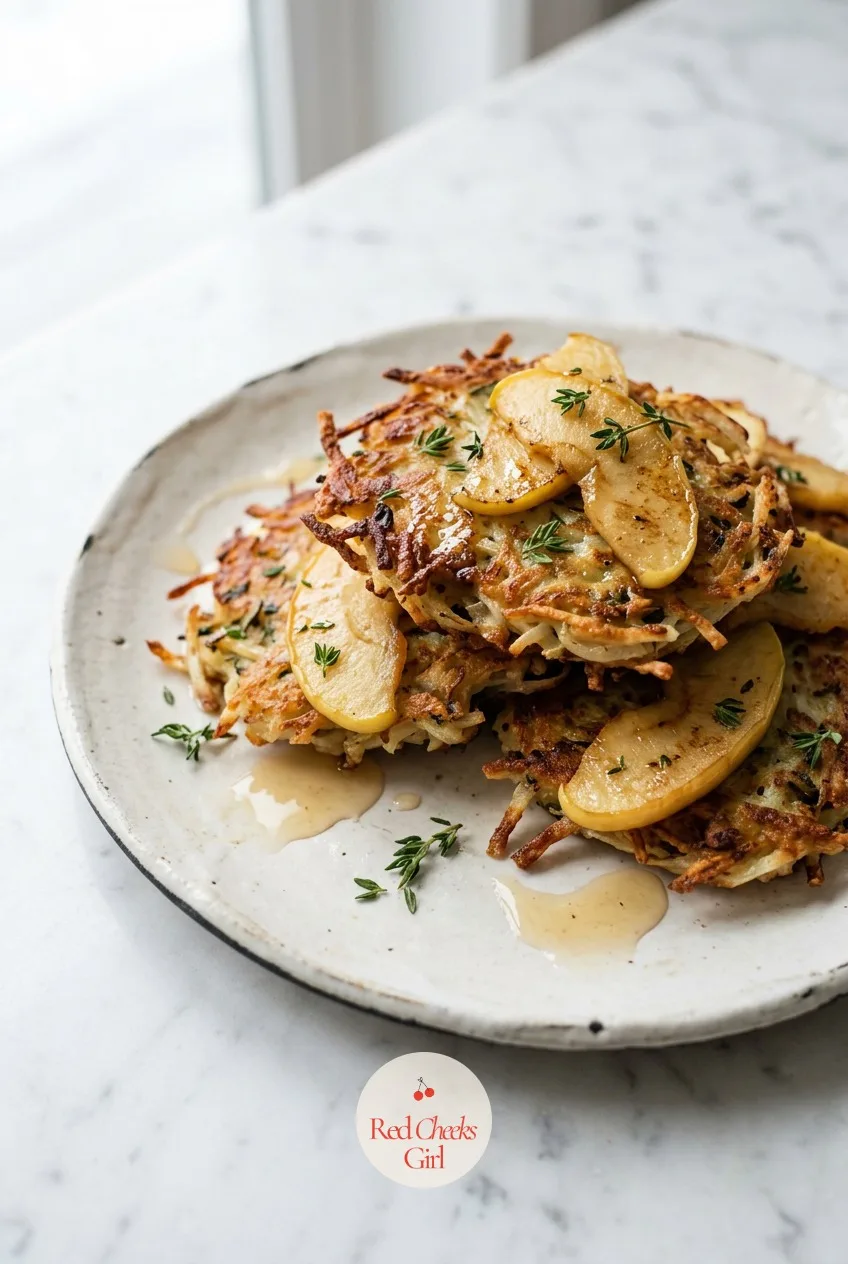
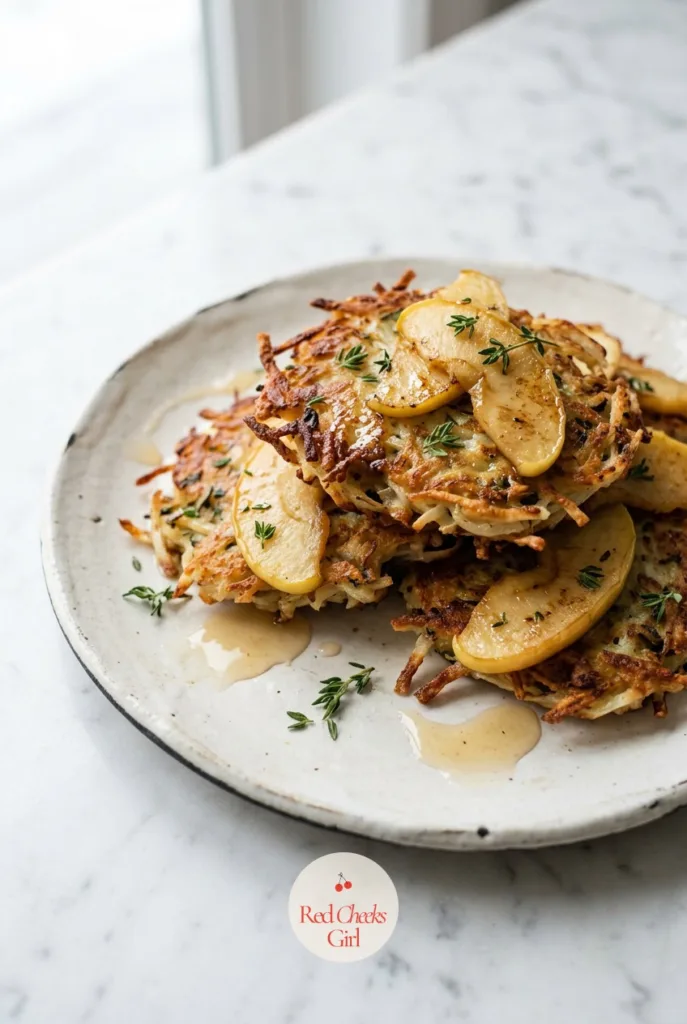
Sautéed Apple and Thyme Latkes
Ingredients
- 2 pounds russet potatoes peeled
- 1 small yellow onion
- 2 large eggs
- 1/3 cup all-purpose flour
- 1 teaspoon kosher salt
- 1/2 teaspoon black pepper
- 1 cup vegetable oil for frying
- 2 apples cored and thinly sliced
- 2 tablespoons butter
- 1 tablespoon fresh thyme leaves
- 1 tablespoon honey
- pinch of salt
Instructions
- Grate 2 pounds russet potatoes and 1 small onion on the large holes of a box grater, then wring the shreds dry in a clean kitchen towel.
- Mix the dried shreds with 2 large eggs, 1/3 cup flour, 1 teaspoon salt and 1/2 teaspoon pepper until the batter clumps together when pressed.
- Heat 1 cup vegetable oil in a 12-inch skillet over medium-high heat to 350°F.
- Fry heaping tablespoons of batter, four at a time, for 3 to 4 minutes per side, until the edges turn deep golden and crackle slightly when pressed.
- Drain on a wire rack over a sheet pan and keep warm in a 200°F oven for up to 30 minutes.
- Core and thinly slice 2 apples, then melt 2 tablespoons butter in a small skillet over medium heat.
- Add the apple slices and 1 tablespoon fresh thyme leaves to the butter, stirring often, and cook 5 to 6 minutes until the apples turn soft and golden at the edges.
- Drizzle 1 tablespoon honey over the apples with a pinch of salt, tossing once, then pull the skillet off the heat.
- Fan two or three warm apple slices across each latke and spoon a little of the buttery thyme syrup over the top.
- Serve immediately while the apples are still warm against the hot latke.
Good to Know
Pomegranate Seed and Horseradish Cream Latkes
This is the bowl that looks the most like a decoration and tastes the sharpest. Horseradish wakes up a latke in a way sour cream alone never quite manages, and the pomegranate seeds give you something to crunch between bites.
Start with two tablespoons of horseradish and taste before adding more; prepared horseradish varies a lot in strength from jar to jar, so the right amount for one brand might be too much of another.
Seed the pomegranate the night before if that is the kind of task you would rather not do with guests arriving in twenty minutes. The seeds keep well chilled in a sealed container.
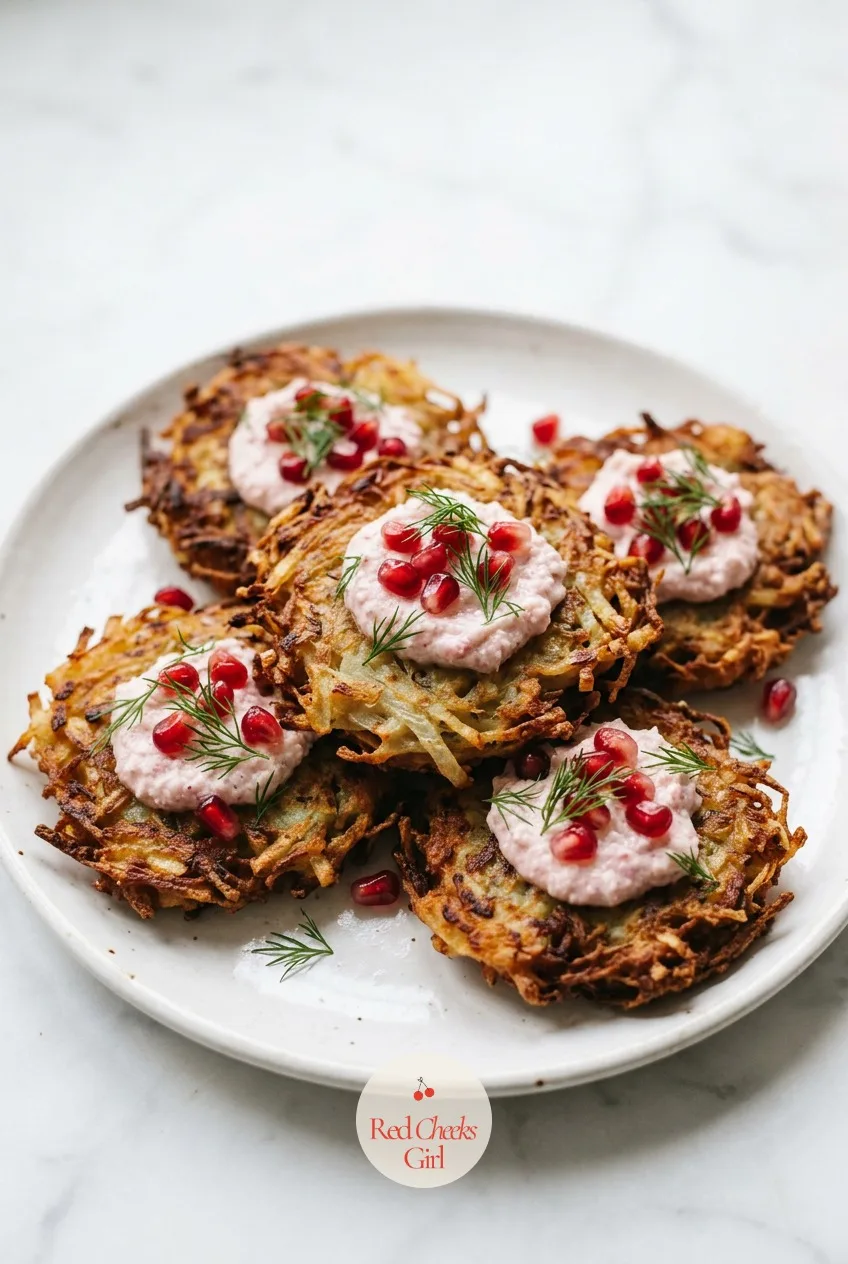

Pomegranate Seed and Horseradish Cream Latkes
Ingredients
- 2 pounds russet potatoes peeled
- 1 small yellow onion
- 2 large eggs
- 1/3 cup all-purpose flour
- 1 teaspoon kosher salt
- 1/2 teaspoon black pepper
- 1 cup vegetable oil for frying
- 3/4 cup sour cream
- 2 tablespoons prepared horseradish
- 1/2 cup pomegranate seeds
- a few small dill fronds
Instructions
- Grate 2 pounds russet potatoes and 1 small onion on the large holes of a box grater and squeeze the shreds dry in a clean towel until no more liquid comes out.
- Stir in 2 large eggs, 1/3 cup flour, 1 teaspoon salt and 1/2 teaspoon pepper until the mixture holds together in a loose ball.
- Heat 1 cup vegetable oil in a 12-inch skillet over medium-high heat until it reaches 350°F.
- Fry 1/4-cup portions, four at a time, for 3 to 4 minutes per side, until deep golden and crisp around the edge.
- Move to a wire rack over a sheet pan and hold in a 200°F oven for up to 30 minutes while the rest cook.
- Stir 2 tablespoons prepared horseradish into 3/4 cup sour cream until smooth, tasting and adding another teaspoon of horseradish if you want more bite.
- Spoon a dollop of the horseradish cream onto each warm latke.
- Scatter 1/2 cup pomegranate seeds over the cream, letting a few spill onto the platter for color.
- Finish with a few small dill fronds tucked into the cream on each latke.
- Serve within 15 minutes, before the pomegranate seeds start to bleed red into the cream.
Good to Know
Hard-Boiled Egg and Caper Latkes
This one is for the table that leans more old-fashioned deli counter than holiday party, and it happens to be the cheapest topping on the whole board after the classic. Egg, caper, parsley, done.
Slice the eggs with a sharp knife dipped in warm water between cuts; it keeps the yolk from crumbling and the slices looking clean on the plate rather than smeared.
Serve this one right away so the cool egg stays firm against the hot latke underneath. Left to sit, the egg warms through and loses the contrast that makes the whole plate work.
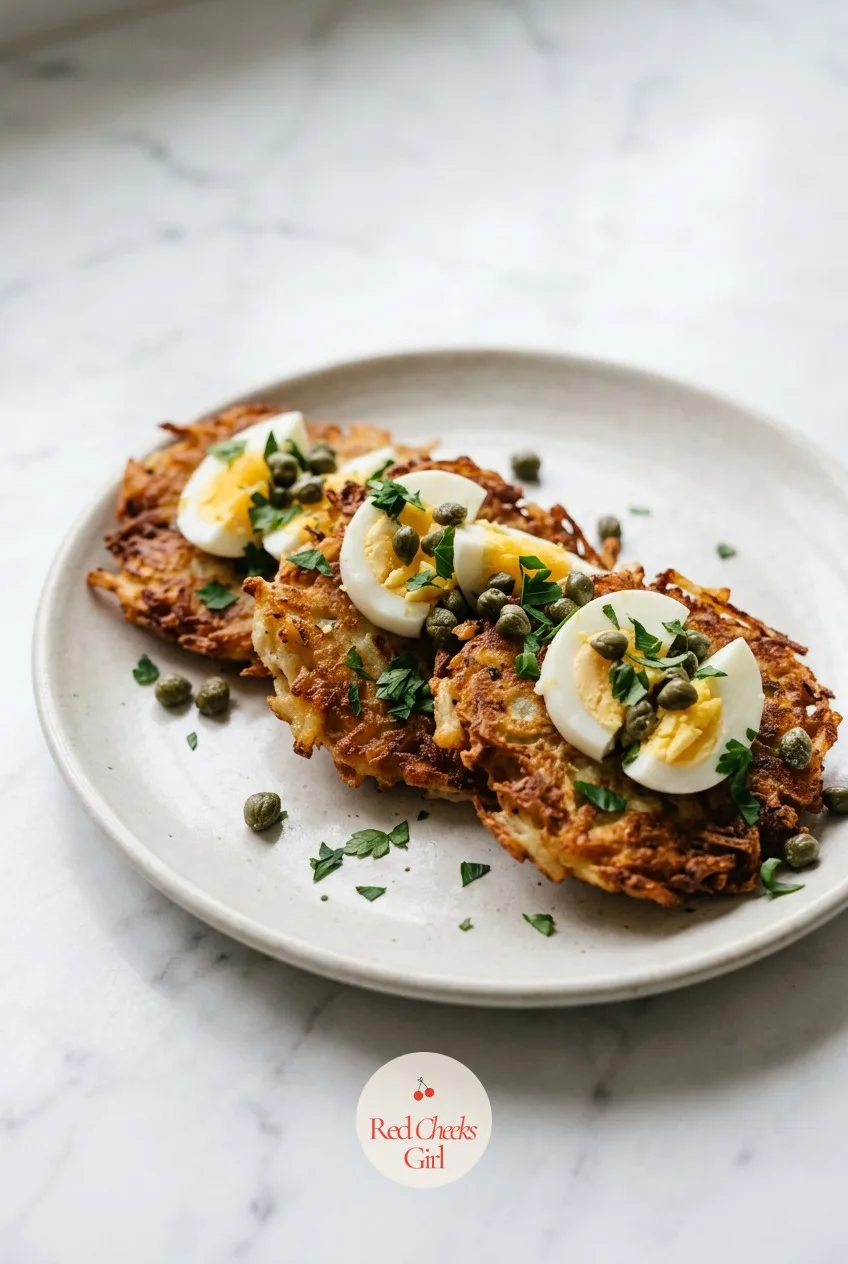
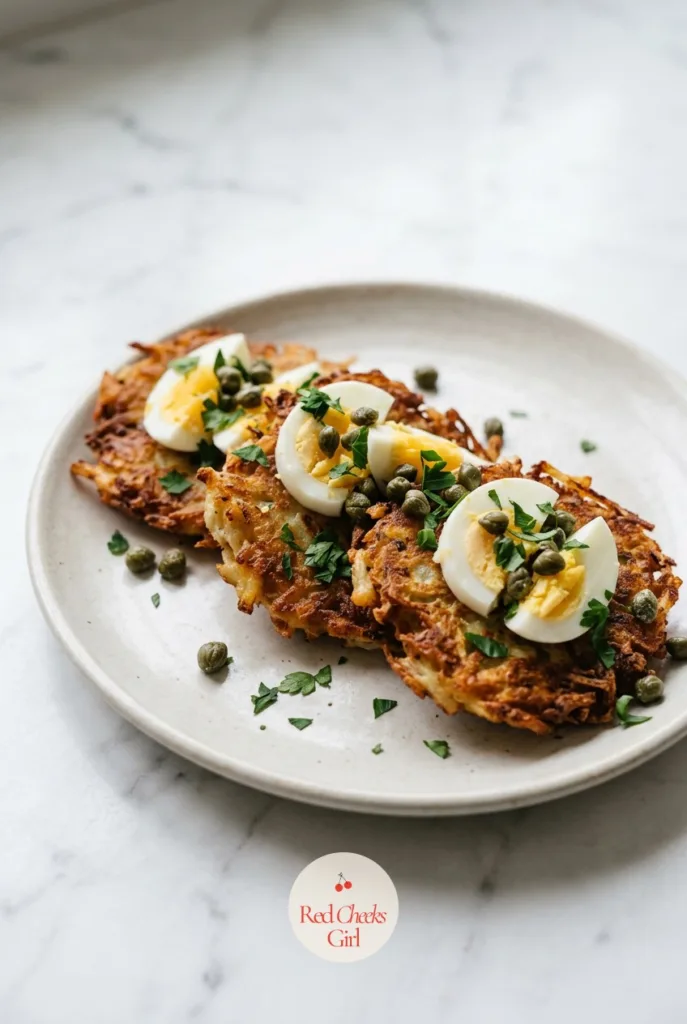
Hard-Boiled Egg and Caper Latkes
Ingredients
- 2 pounds russet potatoes peeled
- 1 small yellow onion
- 2 large eggs
- 1/3 cup all-purpose flour
- 1 teaspoon kosher salt
- 1/2 teaspoon black pepper
- 1 cup vegetable oil for frying
- 4 eggs for hard-boiling
- 1/4 cup capers drained
- 2 tablespoons fresh parsley chopped
- flaky salt and black pepper for finishing
Instructions
- Grate 2 pounds russet potatoes and 1 small onion on the large holes of a box grater, then wring the shreds dry inside a clean kitchen towel.
- Combine the dry shreds with 2 large eggs, 1/3 cup flour, 1 teaspoon salt and 1/2 teaspoon pepper, stirring until the batter clumps when squeezed.
- Heat 1 cup vegetable oil in a 12-inch skillet over medium-high heat to 350°F.
- Fry 1/4-cup portions for 3 to 4 minutes per side, in batches of four, until deep golden on both sides.
- Drain on a wire rack over a sheet pan and hold in a 200°F oven for up to 30 minutes.
- Lower 4 eggs into a small saucepan of boiling water, boil 9 minutes, then plunge them into ice water for 2 minutes before peeling.
- Slice each peeled egg into four rounds using a sharp knife dipped in warm water between cuts, so the yolk stays whole.
- Lay one or two egg slices on each warm latke.
- Scatter the capers and chopped parsley over the eggs, then finish with a pinch of flaky salt and black pepper.
- Serve right away so the egg stays cool and firm against the hot latke underneath.
Good to Know
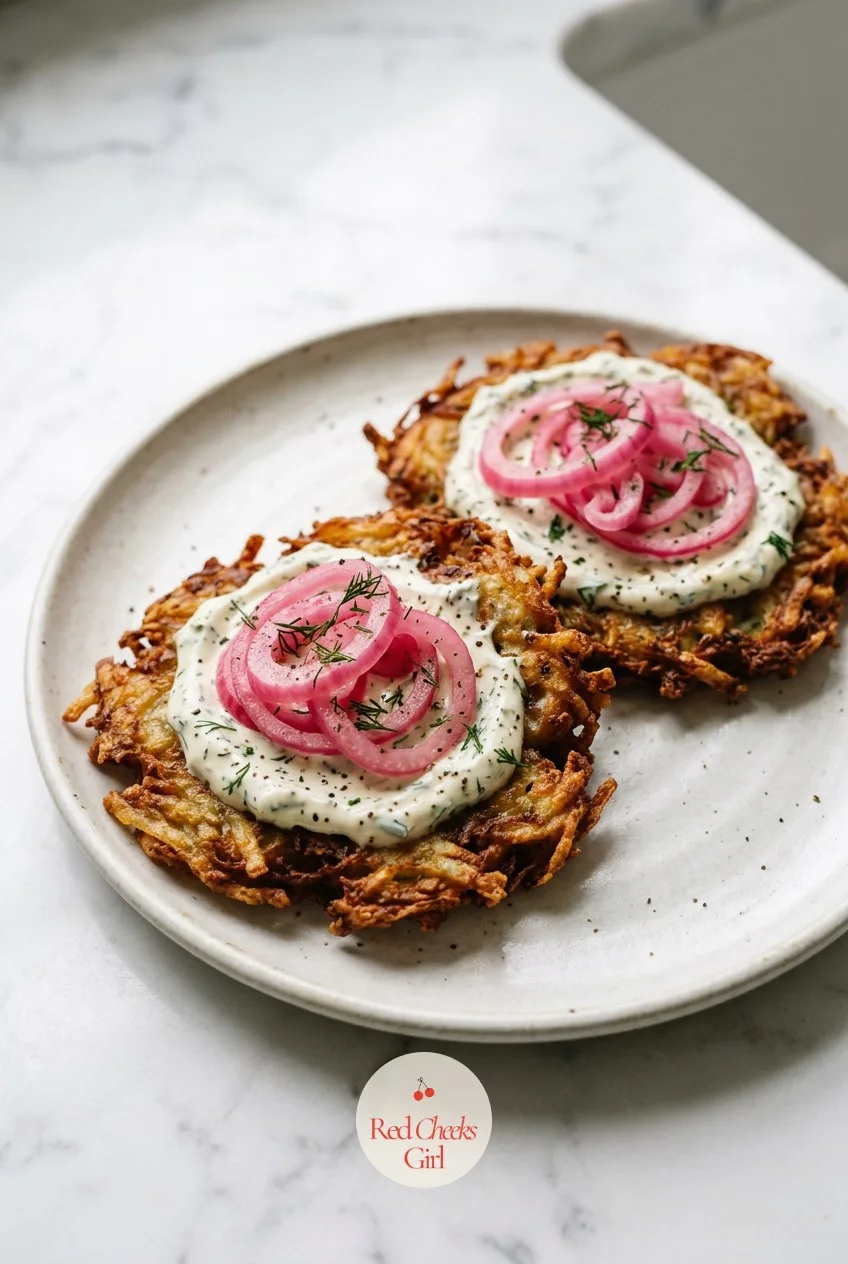
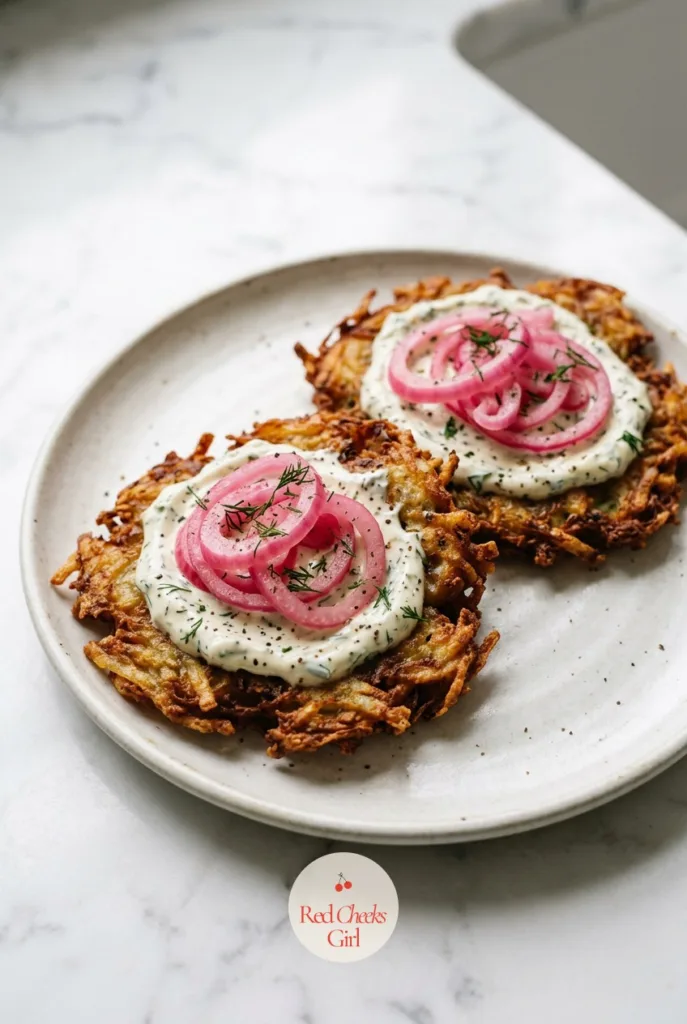
Pickled Red Onion and Herbed Yogurt Latkes
If the board is heavy on cream already, this plate gives you somewhere lighter to land. Tangy yogurt instead of sour cream, pink pickled onion instead of raw, and the whole thing tastes cleaner than anything else on the table.
The pickle takes thirty minutes and no special equipment, just a jar, vinegar and whatever is already in the pantry. Make a double batch; it keeps for weeks and turns any sandwich into something better.
This is also the easiest swap for a dairy-light table: plain coconut yogurt works in the same ratio if regular yogurt is off the list for someone.
Pickled Red Onion and Herbed Yogurt Latkes
Ingredients
- 2 pounds russet potatoes peeled
- 1 small yellow onion
- 2 large eggs
- 1/3 cup all-purpose flour
- 1 teaspoon kosher salt
- 1/2 teaspoon black pepper
- 1 cup vegetable oil for frying
- 1/2 cup red wine vinegar
- 1 tablespoon sugar
- 1/2 teaspoon salt
- 1 small red onion thinly sliced
- 1/2 cup plain Greek yogurt
- 2 tablespoons fresh dill or chives chopped
Instructions
- Combine 1/2 cup red wine vinegar, 1 tablespoon sugar and 1/2 teaspoon salt in a small jar, stirring until the sugar dissolves.
- Add 1 small red onion, thinly sliced, pushing the rings down until the vinegar covers them, then let the jar sit at room temperature for at least 30 minutes while you make the latkes.
- Grate 2 pounds russet potatoes and 1 small onion on the large holes of a box grater, then wring the shreds dry inside a clean towel.
- Stir the dry shreds with 2 large eggs, 1/3 cup flour, 1 teaspoon salt and 1/2 teaspoon pepper until the batter holds together.
- Heat 1 cup vegetable oil in a 12-inch skillet over medium-high heat to 350°F.
- Fry 1/4-cup portions for 3 to 4 minutes per side, four at a time, until deep golden and crisp.
- Drain on a wire rack over a sheet pan and hold in a 200°F oven for up to 30 minutes.
- Stir 2 tablespoons chopped fresh dill or chives into 1/2 cup plain Greek yogurt with a pinch of salt.
- Spoon the herbed yogurt onto each warm latke.
- Lift the pickled onion out of its vinegar with a fork, drain briefly, and pile a few rings on top of the yogurt on each latke.
Good to Know
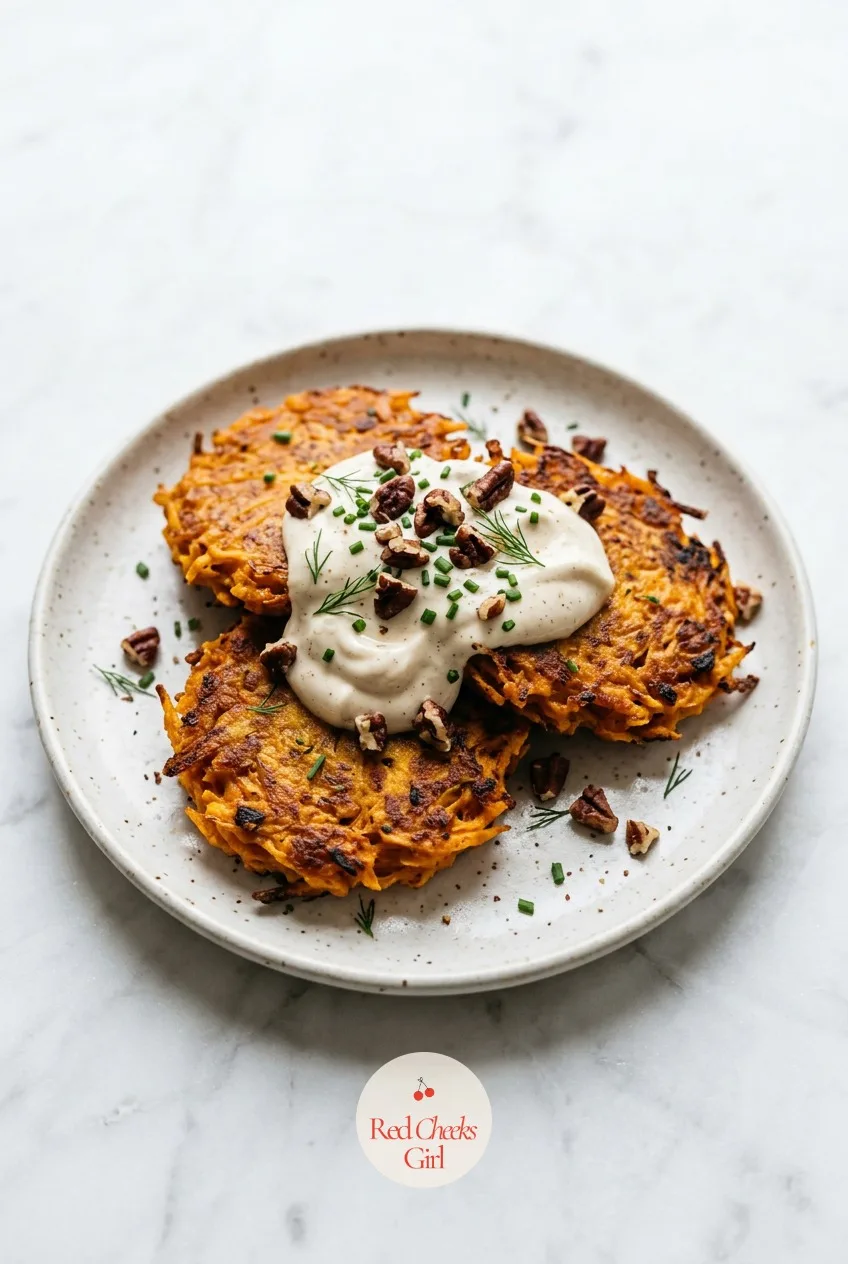
Sweet Potato Latkes With Maple Crème Fraîche and Toasted Pecans
If the board needs a sweeter note that still reads savory enough to sit next to smoked salmon, this is the plate. Sweet potato caramelizes faster than russet, so the edges turn a deeper brown while the center stays soft.
Watch the heat here more than you would for a classic latke; sweet potato sugars scorch before the inside finishes cooking if the pan runs too hot. A touch lower and a touch more patience fixes it.
Toast the pecans ahead and keep them in a sealed jar at room temperature. They lose their crunch fast once they touch anything damp, so add them only at the very end.

Sweet Potato Latkes With Maple Crème Fraîche and Toasted Pecans
Ingredients
- 2 pounds sweet potatoes peeled
- 1 small yellow onion
- 2 large eggs
- 1/3 cup all-purpose flour
- 1 teaspoon kosher salt
- 1/2 teaspoon black pepper
- 1 cup vegetable oil for frying
- 1/3 cup chopped pecans
- 1/2 cup creme fraiche
- 2 tablespoons maple syrup
Instructions
- Peel and grate 2 pounds sweet potatoes and 1 small onion on the large holes of a box grater, then wring the shreds dry inside a clean kitchen towel; sweet potatoes hold more moisture than russets, so twist longer than you think you need to.
- Stir the dry shreds with 2 large eggs, 1/3 cup flour, 1 teaspoon salt and 1/2 teaspoon pepper until it binds into a batter that holds its shape when pressed.
- Heat 1 cup vegetable oil in a 12-inch skillet over medium heat, slightly lower than for potato latkes since sweet potato sugars scorch faster, until it reaches 325°F.
- Fry 1/4-cup portions, four at a time, for 3 to 4 minutes per side, watching closely since sweet potato latkes darken faster than they crisp.
- Drain on a wire rack over a sheet pan and hold in a 200°F oven for up to 20 minutes, less than a standard potato latke needs.
- Toast 1/3 cup chopped pecans in a dry skillet over medium heat for 2 to 3 minutes, shaking often, until fragrant, then set aside to cool.
- Stir 2 tablespoons maple syrup into 1/2 cup creme fraiche until smooth.
- Spoon the maple creme fraiche onto each warm latke.
- Scatter the toasted pecans over the top just before serving, so they stay crunchy.
Good to Know
🛍 Shopping guide
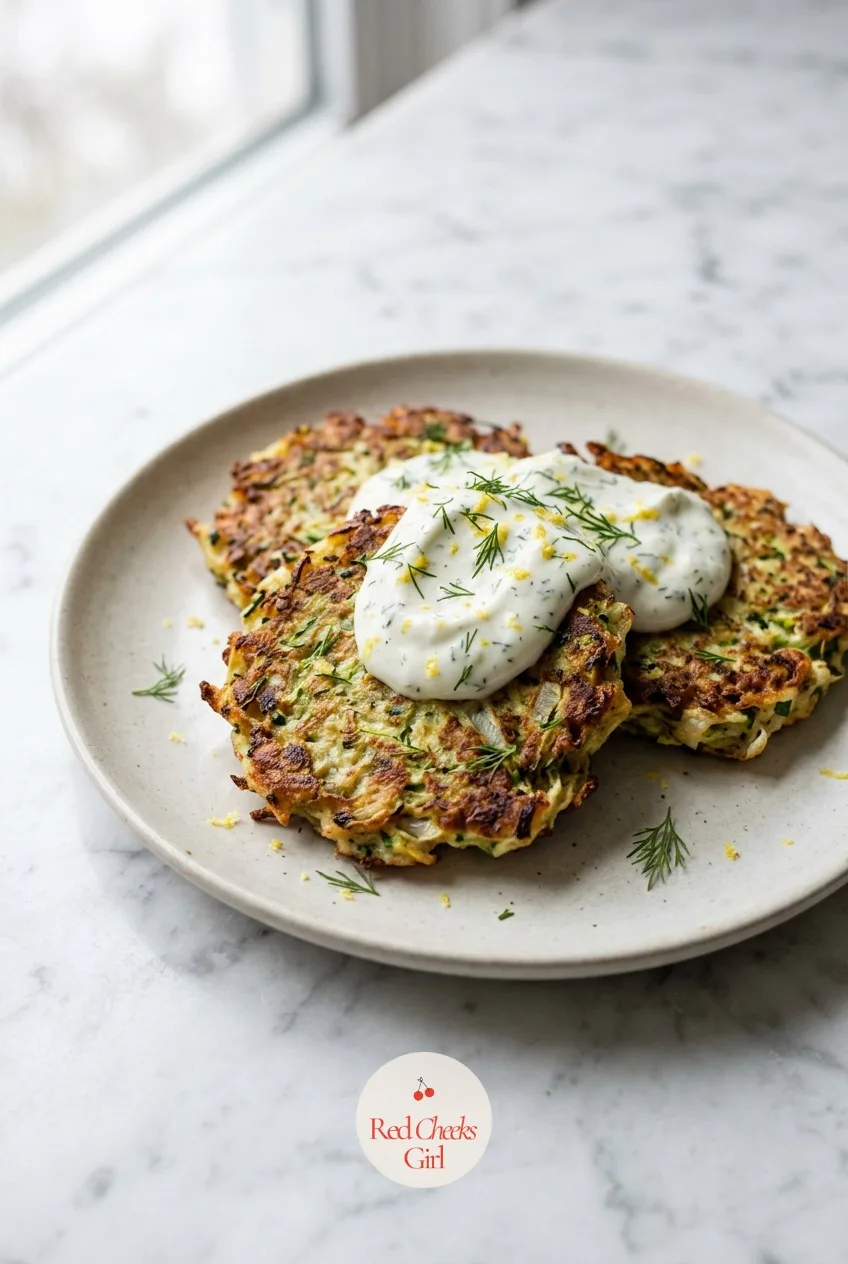
Zucchini Latkes With Lemon-Dill Yogurt
For the guest who would rather skip potato altogether, this keeps her in the latke bar without a substitute conversation. Zucchini fries up lighter and greener, and the lemon-dill yogurt on top tastes like the first warm week of spring.
Salt the zucchini first and give it real time to drain; skipped, this is the single fastest way to end up with a soggy pancake instead of a crisp one.
Serve it soon after plating. Zucchini holds less structure than potato, so a wet topping left sitting on it for too long will soften the latke faster than any other on this board.

Zucchini Latkes With Lemon-Dill Yogurt
Ingredients
- 2 pounds zucchini
- 1 teaspoon salt for draining
- 2 large eggs
- 1/4 cup all-purpose flour
- 1/4 cup grated Parmesan
- 1/2 teaspoon black pepper
- 1 cup vegetable oil for frying
- 1/2 cup plain yogurt
- 1 lemon zested and juiced
- 2 tablespoons fresh dill chopped
Instructions
- Grate 2 pounds zucchini on the large holes of a box grater, toss with 1 teaspoon salt, and let it sit in a colander for 10 minutes so the salt pulls out the water.
- Squeeze the salted zucchini by the handful over the sink, then wring it again in a clean kitchen towel until almost no liquid remains; skipped moisture here is the main reason zucchini latkes turn soggy.
- Stir the dry zucchini with 2 large eggs, 1/4 cup flour, 1/4 cup grated Parmesan and 1/2 teaspoon black pepper until it holds together.
- Heat 1 cup vegetable oil in a 12-inch skillet over medium-high heat until it reaches 350°F.
- Fry 1/4-cup portions, four at a time, for 2 to 3 minutes per side, slightly less than potato latkes need, until golden and firm enough to flip in one piece.
- Drain on a wire rack over a sheet pan and hold in a 200°F oven for up to 20 minutes.
- Stir the zest and juice of 1 lemon and 2 tablespoons chopped fresh dill into 1/2 cup plain yogurt.
- Spoon the lemon-dill yogurt onto each warm latke just before serving.
- Serve promptly, since zucchini latkes soften faster than potato ones once topped with a wet sauce.
Good to Know
Frequently Asked Questions
How many latkes should I make per person for a latke bar?
A reasonable serving is three to four latkes per guest when other food is on the table, and double that if the latke bar is the whole party. Guests reliably come back for seconds, so err toward extra.
How do you keep latkes crispy when serving them at a party?
Hold fried latkes on a wire rack inside a warm oven, around 375°F, instead of stacking them on a plate, since paper towels and stacking trap steam and soften the crust.
Can you make latkes ahead of time and reheat them?
Yes, fry them up to a day ahead, cool completely, then reheat in a single layer in a hot oven until the edges crisp again; they will be good, just not quite as crisp as fresh.
What is the difference between a latke and a hash brown?
A latke is bound with egg and a little flour or matzo meal and seasoned with grated onion, while a hash brown is usually just shredded or diced potato pressed into a crust with no binder.
Do I need a food processor to make latkes for a crowd?
No, a box grater works fine for a crowd, though a food processor’s grating disc speeds up shredding several pounds of potatoes if the guest list is long.
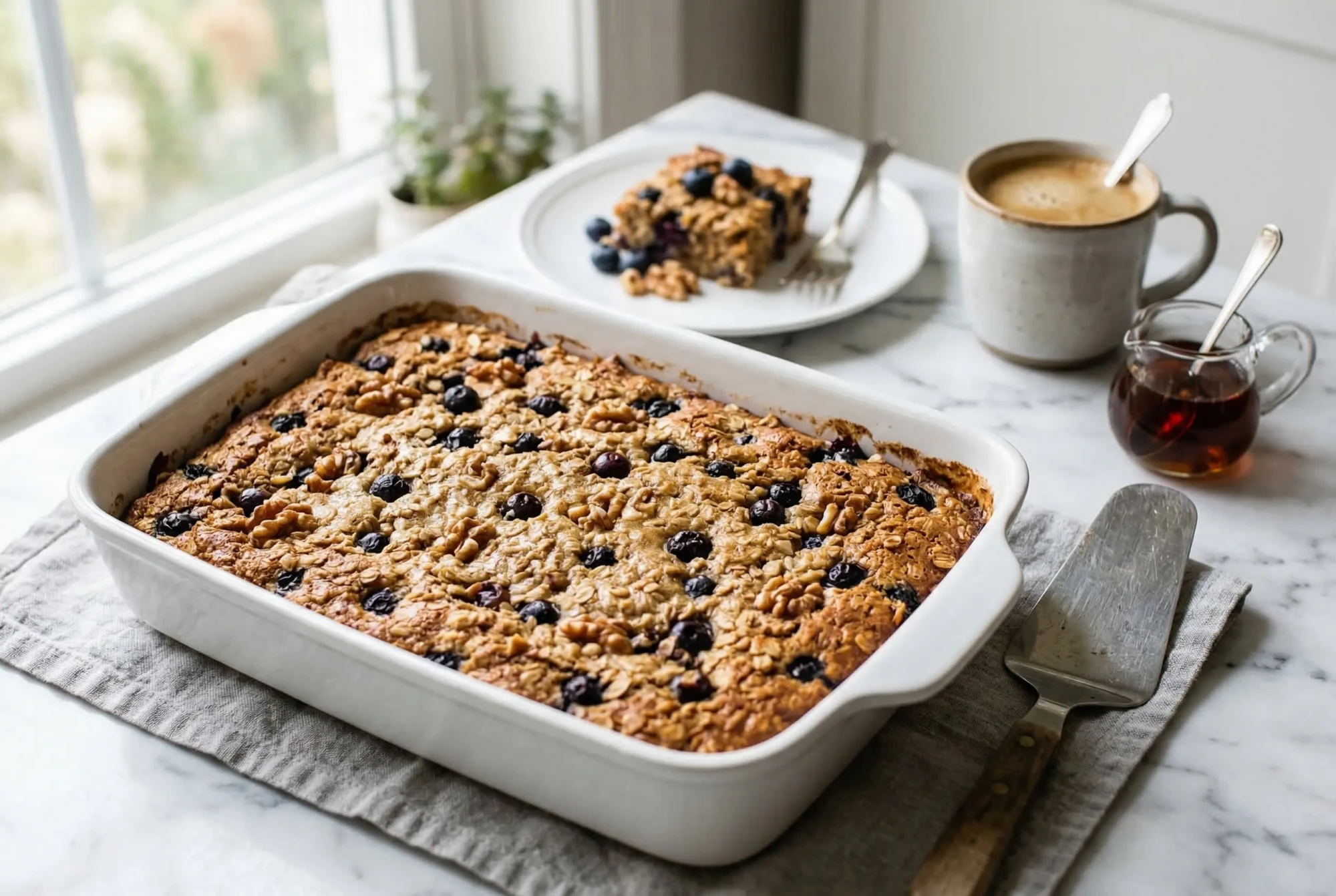
Overnight baked oatmeal casserole prepped the night before. Oats, Greek yogurt, banana, eggs. Sweet
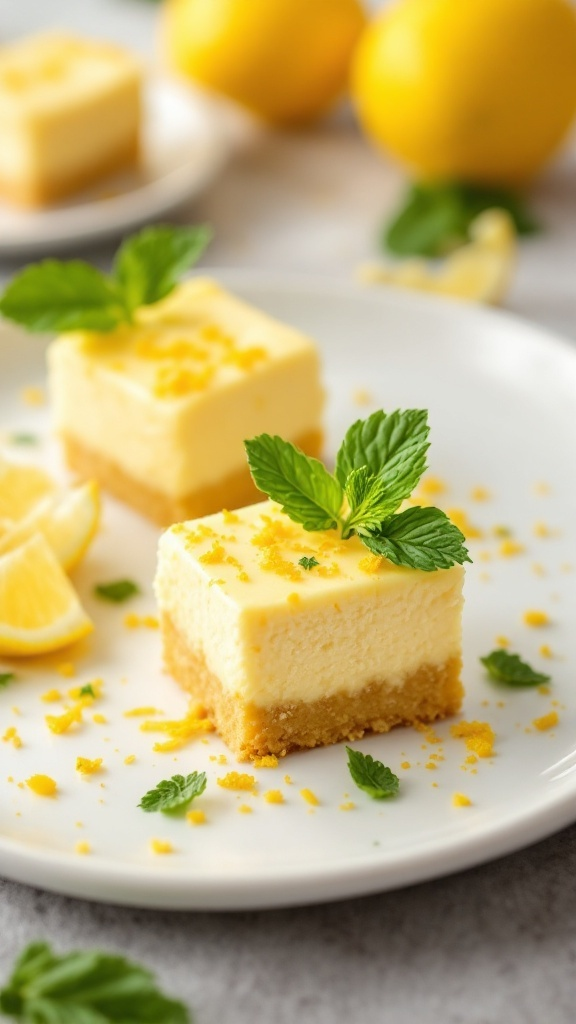
If you’re craving something sweet without the carbs weighing you down, you’re in for a t
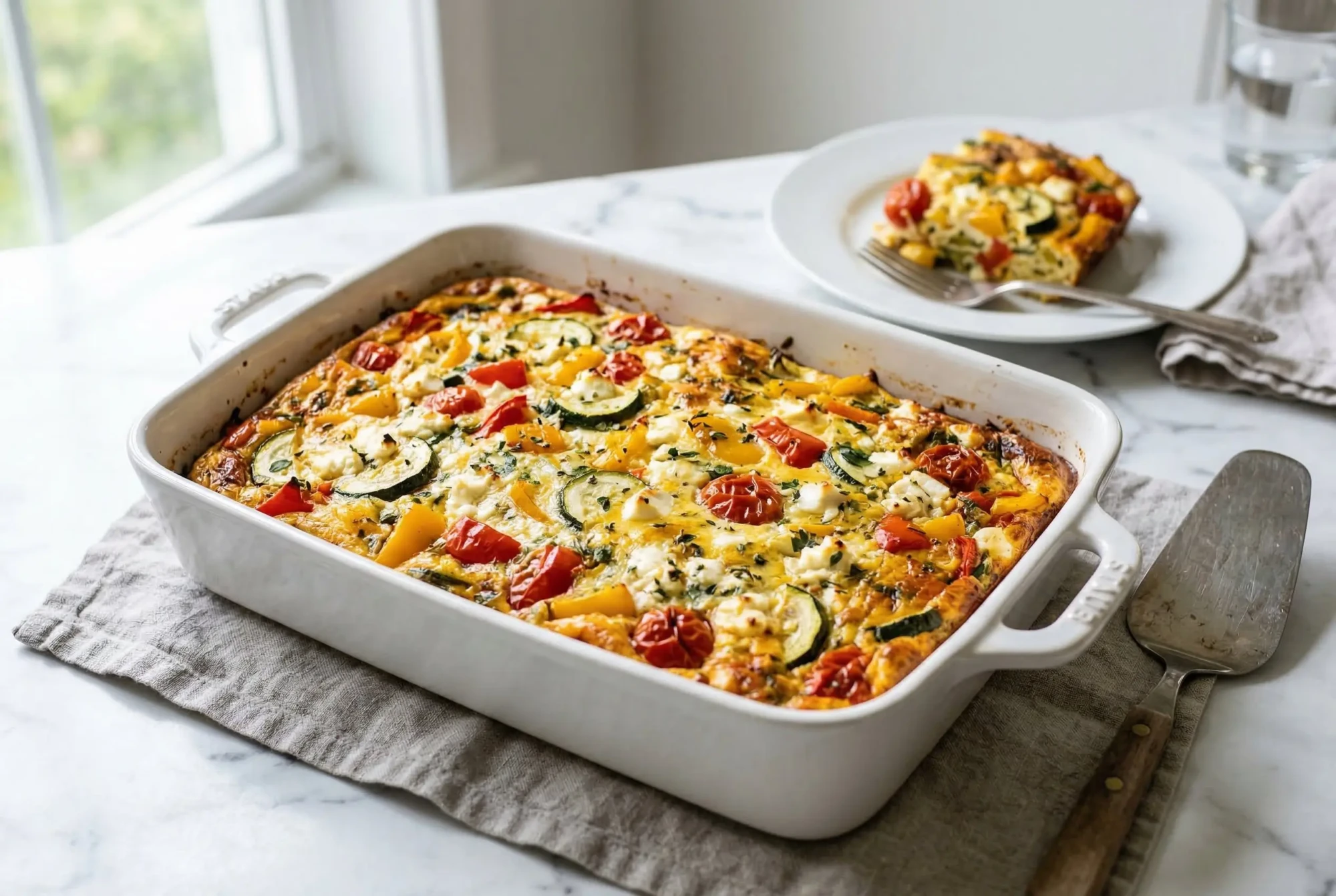
Low calorie veggie breakfast bake with egg whites, zucchini, peppers, tomatoes, spinach, feta. 165 c
Leave a Reply