

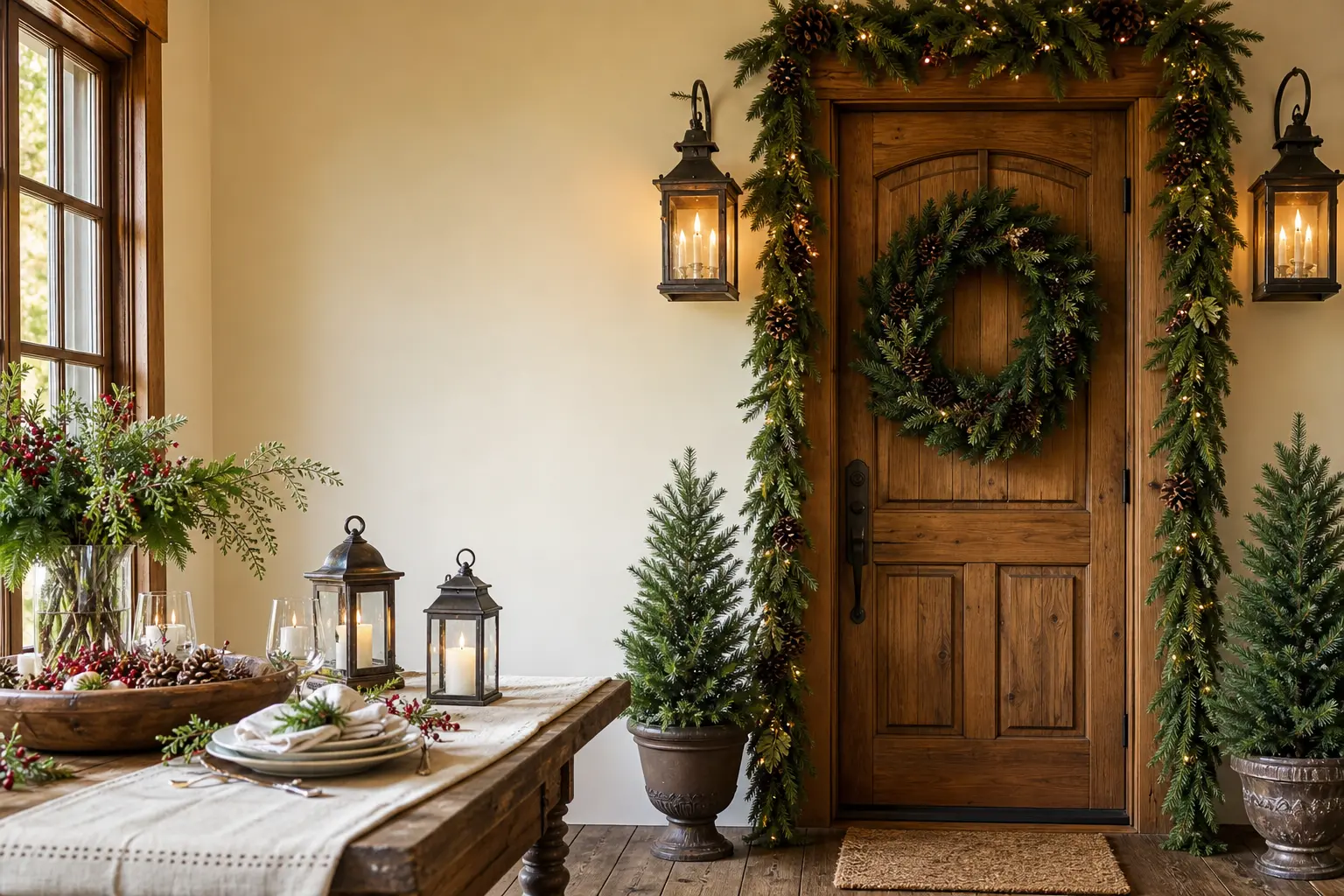
A christmas door reads as a whole frame from the pavement, not as a single hanging circle. Hang one wreath, step back, and the door still looks unfinished because the frame, the floor, the flanking space and the entry inside are all empty. That is the gap these 27 ideas close.
The list moves outward in layers: wreath first, then the frame around it, then the step and the flanking ground, then the porch rail, and finally the two metres just inside the door that guests notice before they reach the living room. The palette throughout is cedar green, oxblood, brass, cream and twilight blue. Nothing here requires a nail in the door or a real flame near dry greenery.
For the bigger picture of every room in the house, start with the guide to christmas decor. When you are ready for the fireplace and the entry hall together, the article on christmas fireplace decor fits directly alongside this one.
This post contains affiliate links. If you buy through them, I may earn a small commission at no extra cost to you.
The Wreath Layer
Most doors take a wreath between 24 and 30 inches. Measure your door panel before ordering, not after. The wreath should fill roughly half the door width so it registers from the street, not just from arm’s length.
Every idea in this section lives on or immediately attached to the door itself, with no hardware beyond an over-door hook.
Oversized Wreath Sized to the Door
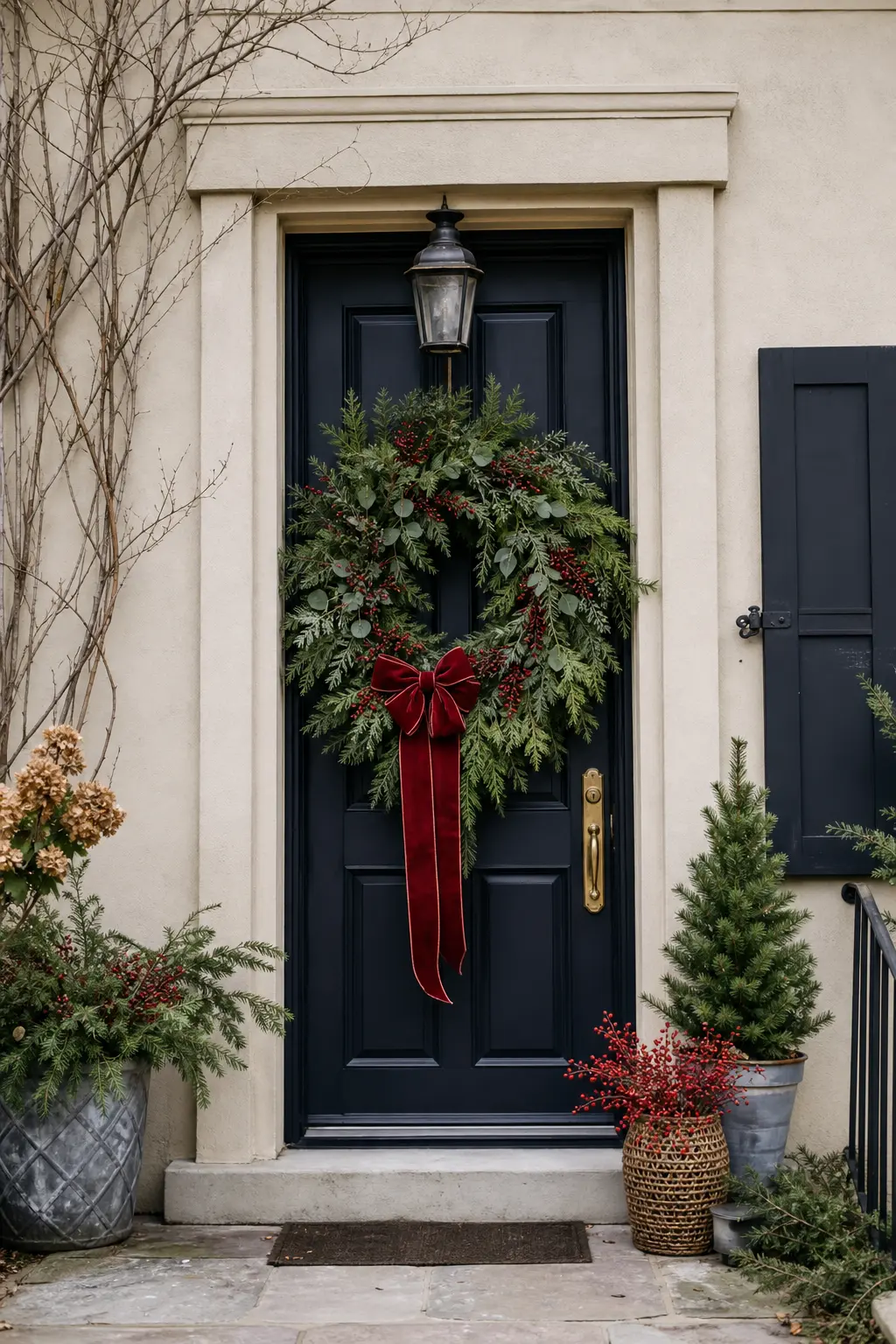
Measure the door panel height and aim for a wreath diameter of roughly one third of that. On a standard 80-inch door that means 26 to 28 inches minimum. Anything smaller floats and reads as an afterthought from the pavement.
Choose a base of noble fir or cedar rather than plastic pine: the difference in colour depth and texture is visible from ten metres away. Add oxblood velvet ribbon in a generous loop rather than a tight bow, and let the tails fall at least 20 centimetres below the wreath base.
🛍 Shopping guide
Ribbon Tail Hanging Below the Wreath
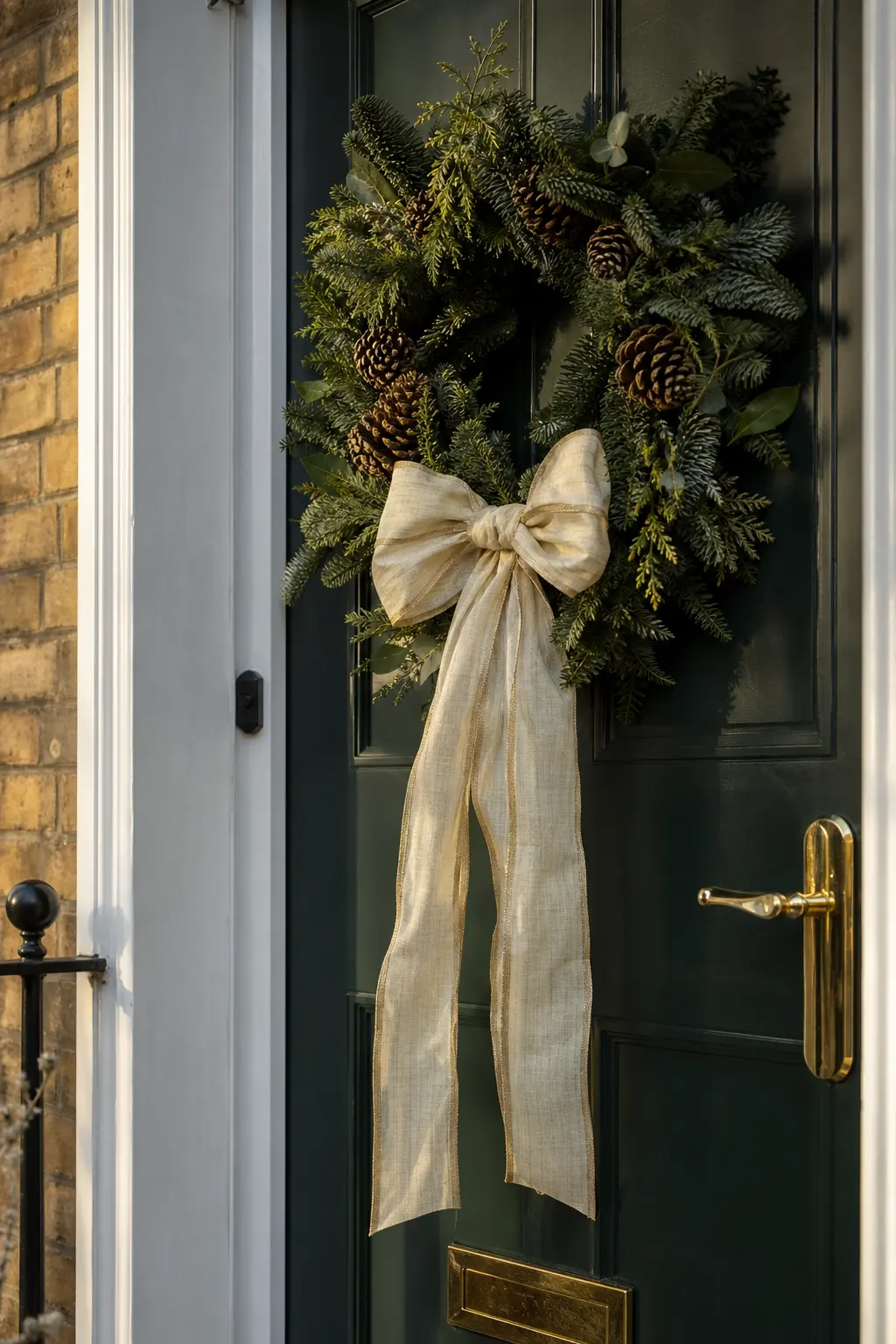
A ribbon tail is a single long piece of wired velvet or grosgrain ribbon attached at the wreath’s lower centre and allowed to hang freely, stopping a few centimetres above the door handle. It fills the blank lower half of the door without adding bulk.
Use a width of at least 4 inches so the tail reads from the street. A gentle knot at the midpoint, loosely tied, gives it movement. Cedar green or cream ribbon against a dark door is the most legible pairing from a distance.
🛍 Shopping guide
Doorknob Swag Instead of a Wreath
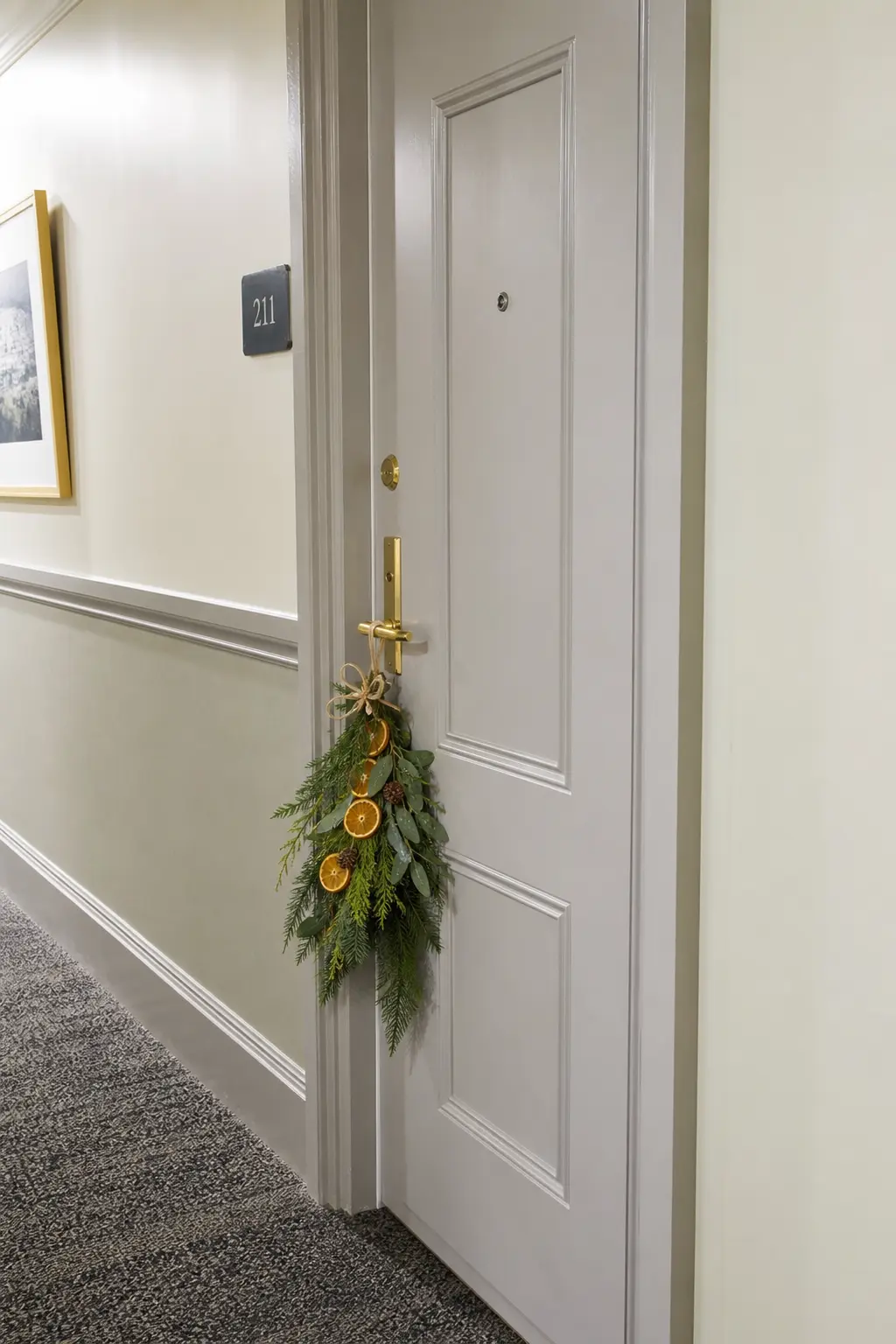
Where a full wreath feels like too much, or where the door panel is narrow, a small swag looped over the door handle does the same decorative work at a quarter of the size. A swag is simply a tied bundle of mixed greens, dried orange slices, cinnamon sticks and a short ribbon end.
Secure it through the handle with a piece of jute twine and let the greenery fall below the knob. Replace the bundle every ten days if the greens are fresh. This approach suits apartment doors and any door where an over-door hook is not permitted.
🛍 Shopping guide
The Frame Layer
The frame is the part most people skip entirely. Dressed well, it turns a plain door into an arch that reads like a shop front from the pavement.
These ideas sit on or against the frame: the top lintel, both vertical sides and the space just above the door. An over-door hook and removable outdoor clips are all the fixing you need.
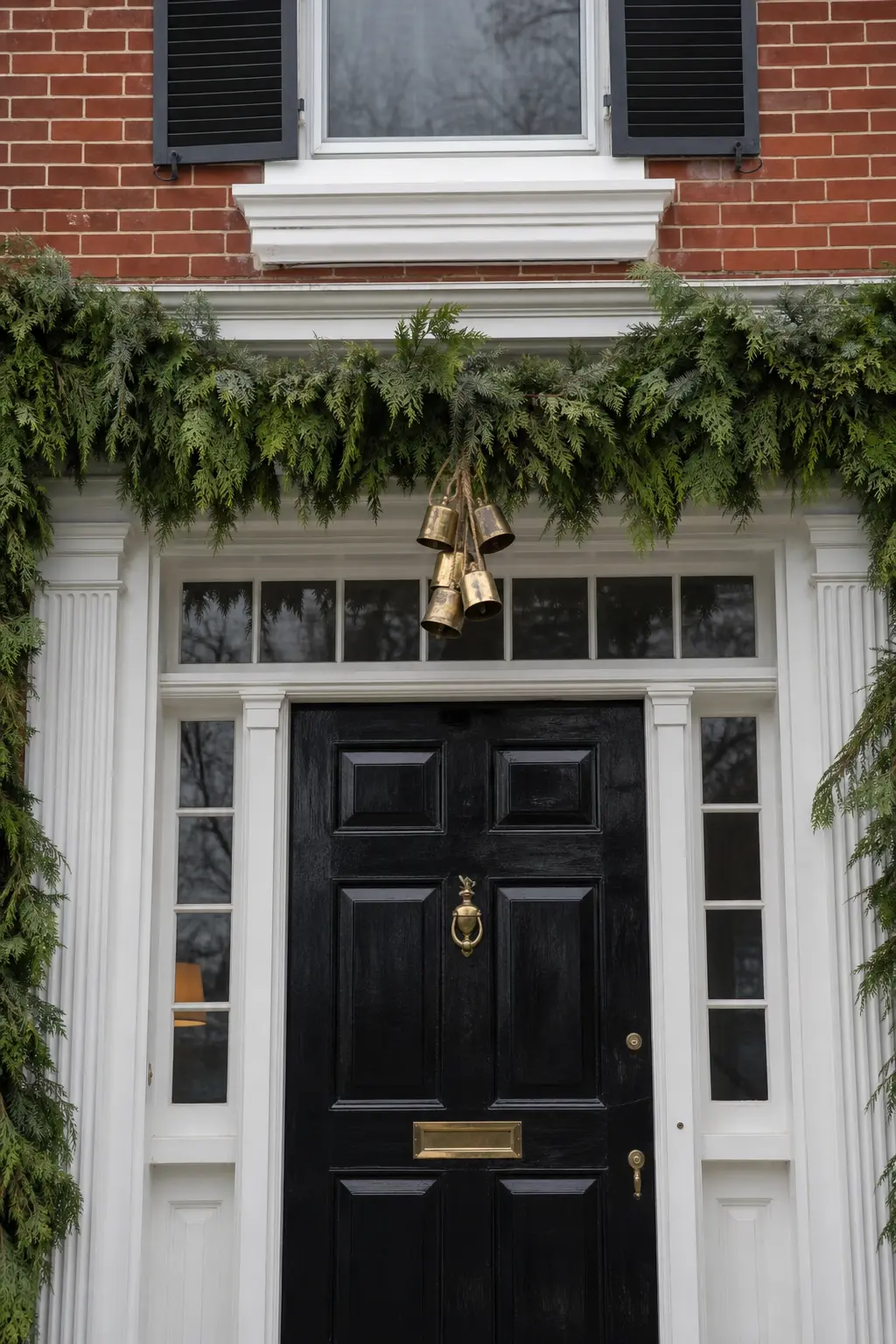
Swag Across the Top of the Frame Only
A top swag, also called a lintel swag, drapes only across the horizontal space above the door and finishes at the outer edge of the frame on each side. It gives the door an arched, almost theatrical silhouette without the weight of a full surround garland.
Use a pre-made swag or wire together three bundles of mixed green. Secure it to the frame with removable outdoor adhesive clips, not nails. Tuck in a few stems of brass-sprayed dried eucalyptus or small brass bells at the centre point where the swag loops down.
🛍 Shopping guide
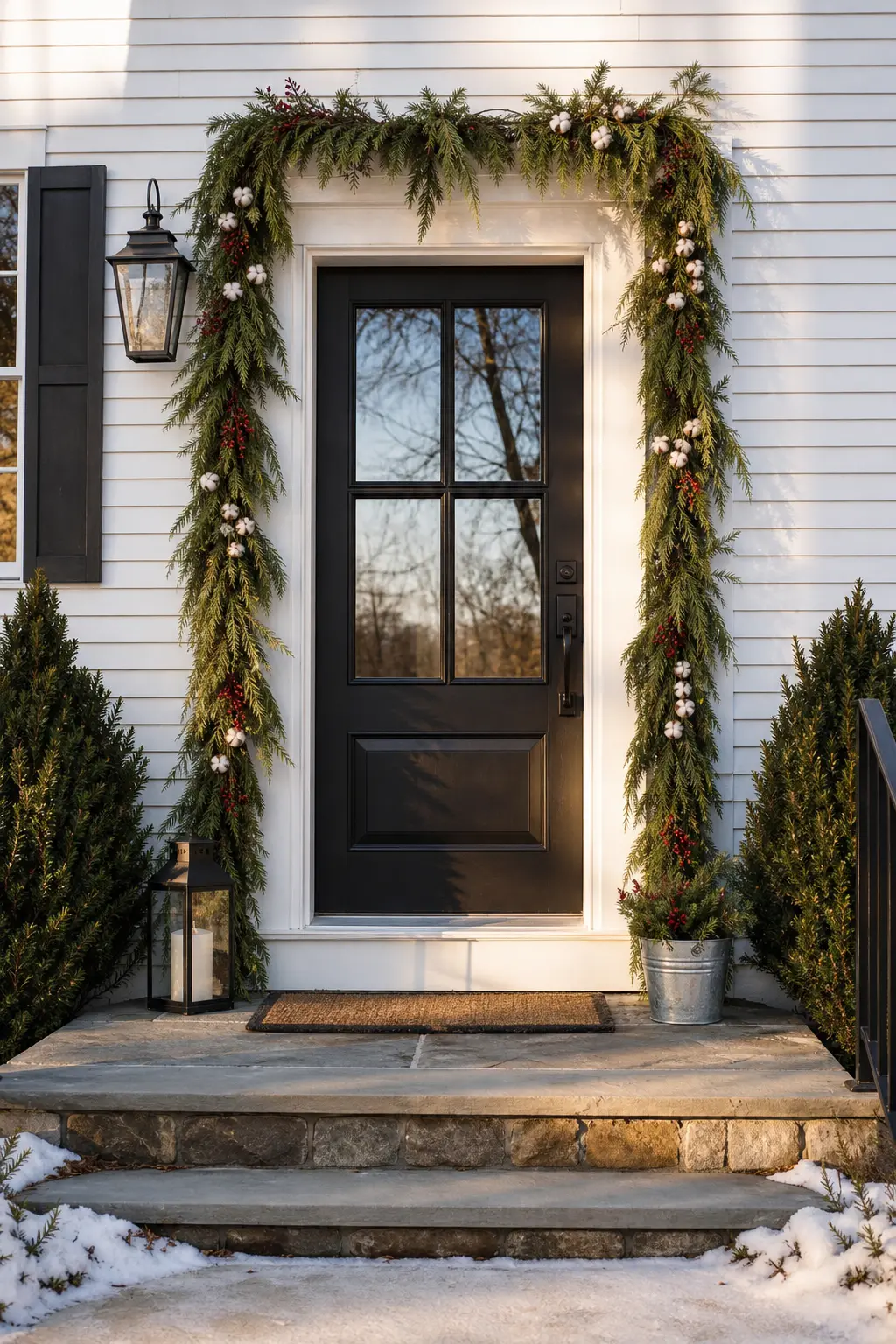
Garland Down Both Sides of the Frame
Two vertical runs of garland, one on each side of the frame from lintel to ground, create the full arch effect that reads as a proper entrance from the street. This is the single upgrade with the most visual impact per pound spent.
Buy garland by the foot rather than in pre-cut lengths so you can match it exactly to the door height. Fix it with removable outdoor clips every 30 centimetres. Add a few picks of oxblood berry clusters and cream dried cotton bolls at irregular intervals along each run to break the uniform green.
🛍 Shopping guide
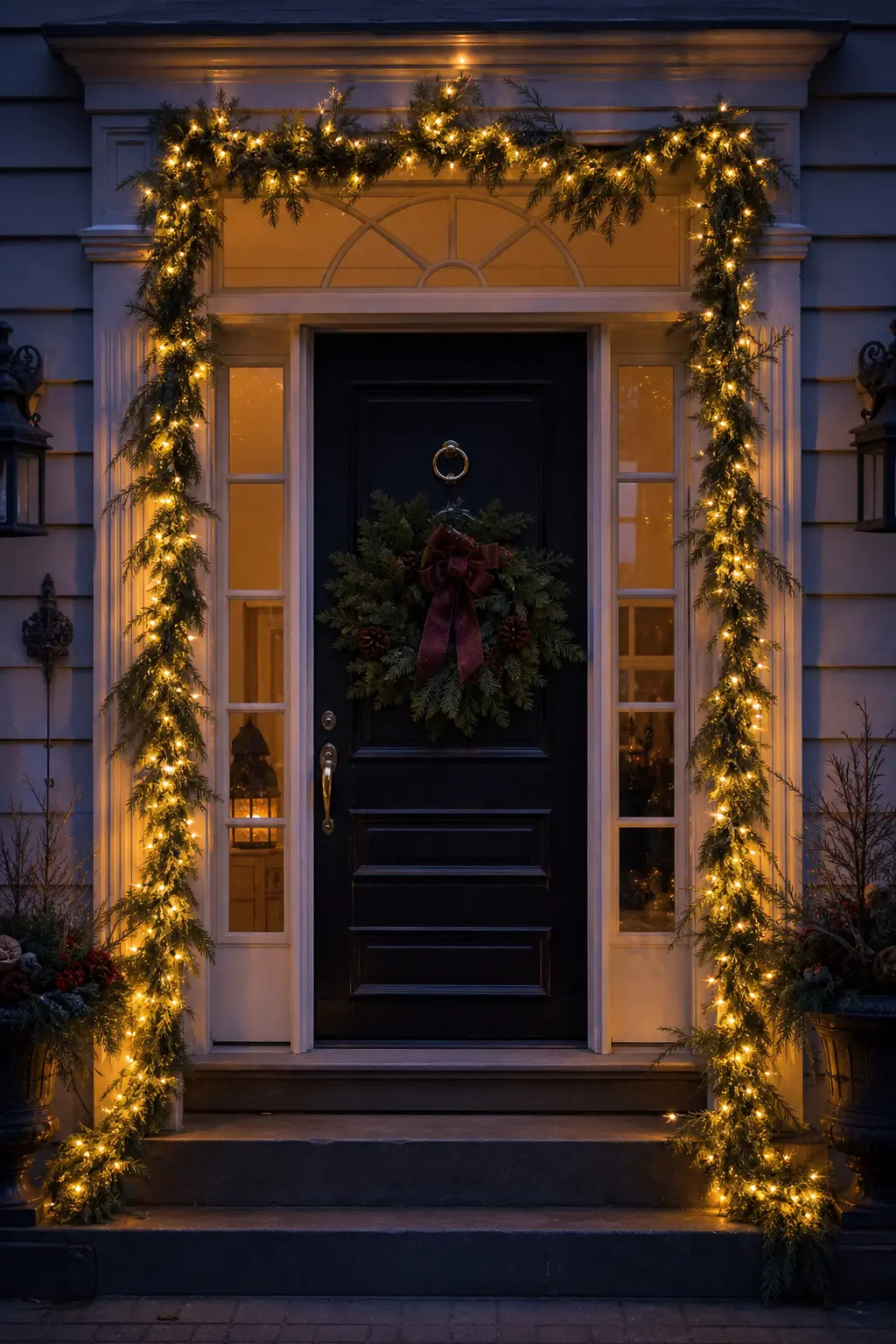
Warm White Lights Outlining the Frame
A run of warm white outdoor fairy lights tucked inside the garland or clipped along the bare frame turns the door into a lit outline at dusk, visible from the full length of the street. Use lights rated for outdoor use only, and run the cable down behind the garland to a weatherproof outdoor socket.
Warm white (around 2700K) reads as amber rather than cold blue against cedar green and oxblood, which suits the palette far better than bright white. A simple timer plug means the lights come on and off without any extra effort each evening.
🛍 Shopping guide
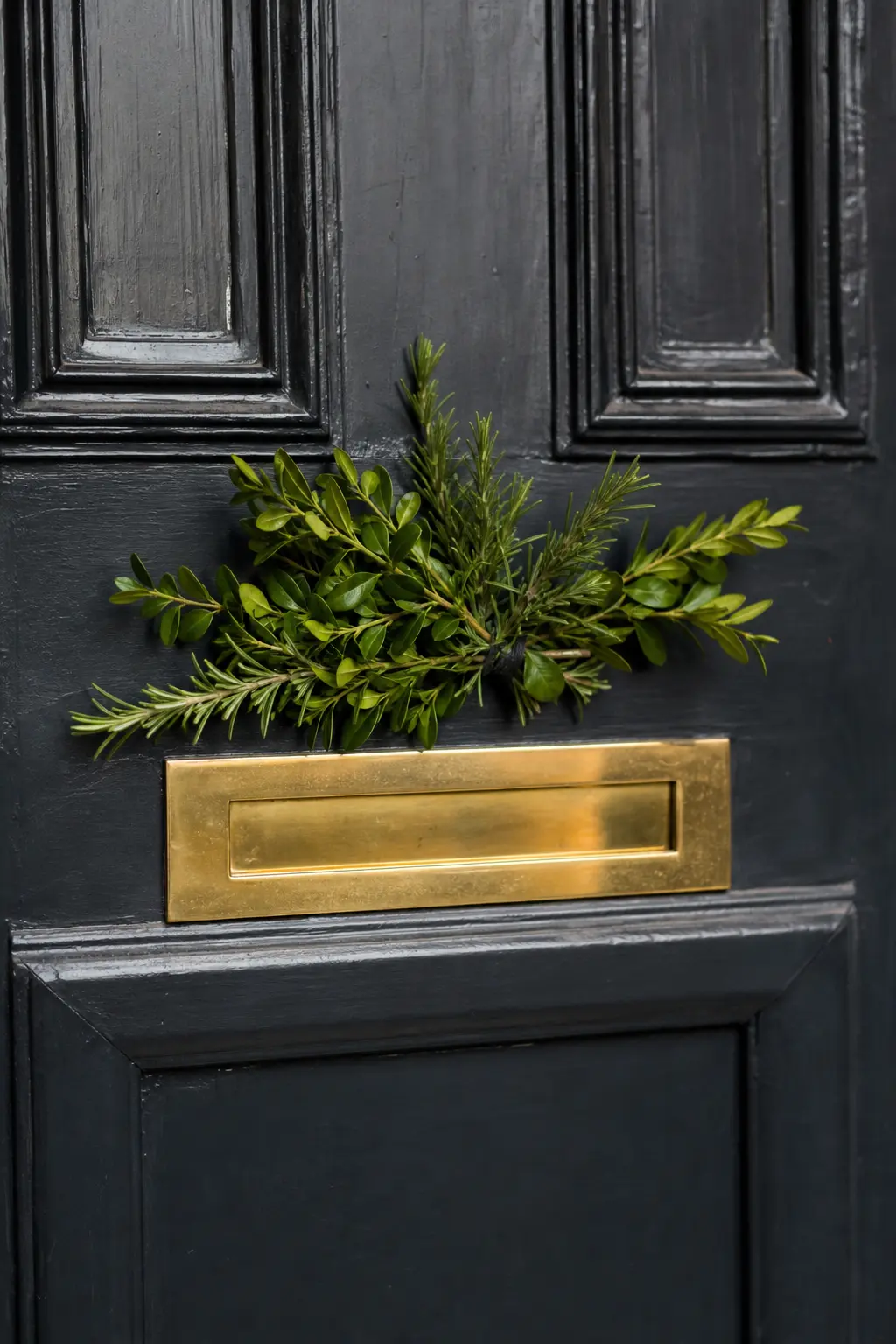
Greenery Over the Letterbox
A small spray of greenery fixed above or around the letterbox slot costs almost nothing and finishes a detail most decorated doors leave bare. Use a slim bundle of boxwood, rosemary and a few dried cranberry stems, wired together and attached with a strip of outdoor double-sided tape or a single adhesive hook behind it.
Keep it shallow so the letterbox still opens. Rosemary adds scent that arrives before the visitor even touches the bell, which is a detail worth having.
The Step and Ground Layer
The ground in front of the door is prime real estate and costs almost nothing to dress. Layered texture at foot level anchors the whole composition and gives the door visual weight it cannot get from hanging pieces alone.
Everything here sits flat or free-standing, with no fixing required.
Layered Doormats
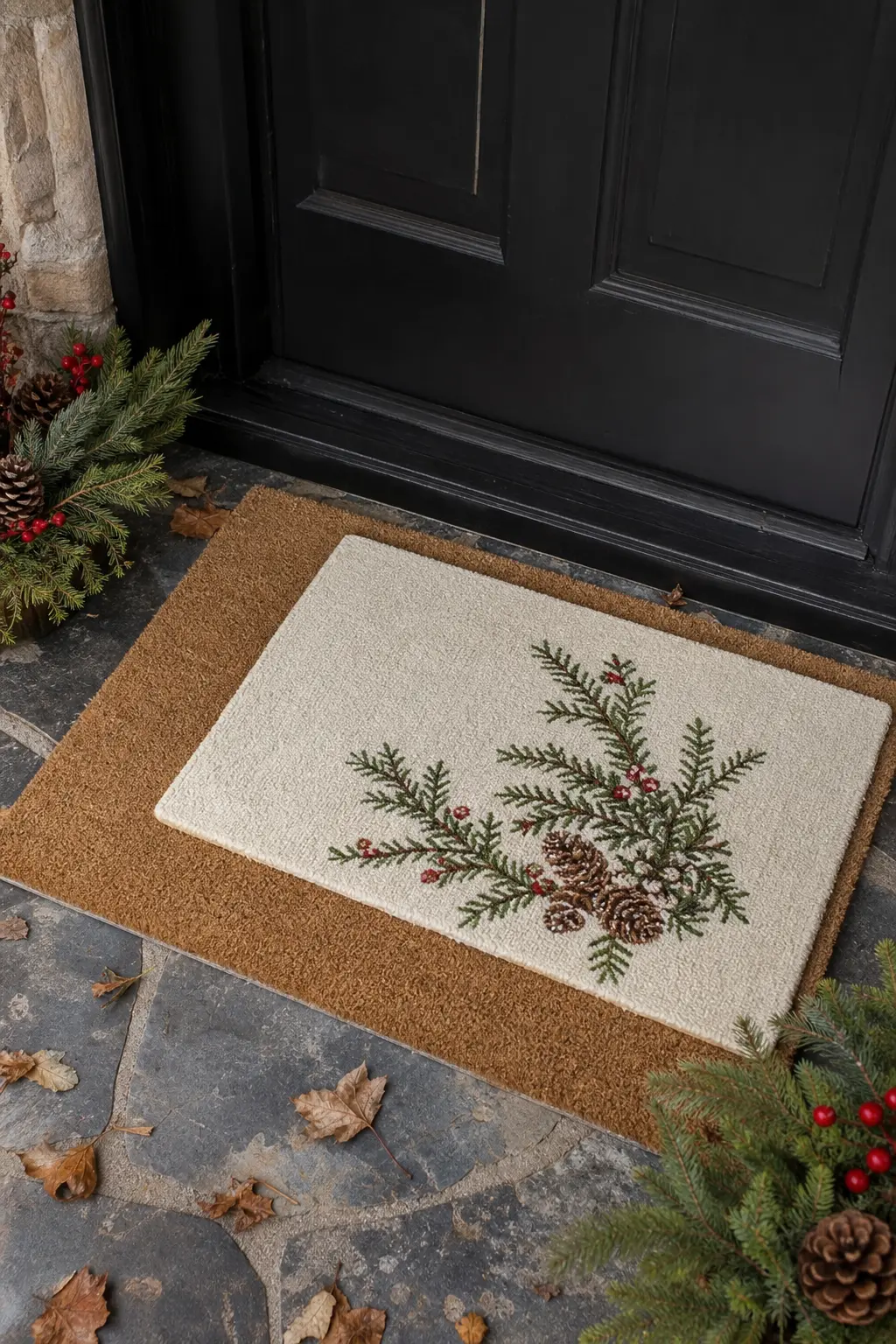
One mat looks functional. Two layered mats look designed. Place a large natural coir mat as the base, then layer a smaller printed or embroidered mat on top, offset slightly toward the door. The base mat adds 10 to 15 centimetres of border around the smaller one, which frames it the way a mount frames a photograph.
For this palette, a cream or oatmeal printed mat on a dark coir base reads beautifully. Avoid anything with “Welcome” in a Christmas font: it dates quickly and weakens the overall scheme.
🛍 Shopping guide
Basket of Logs Beside the Door
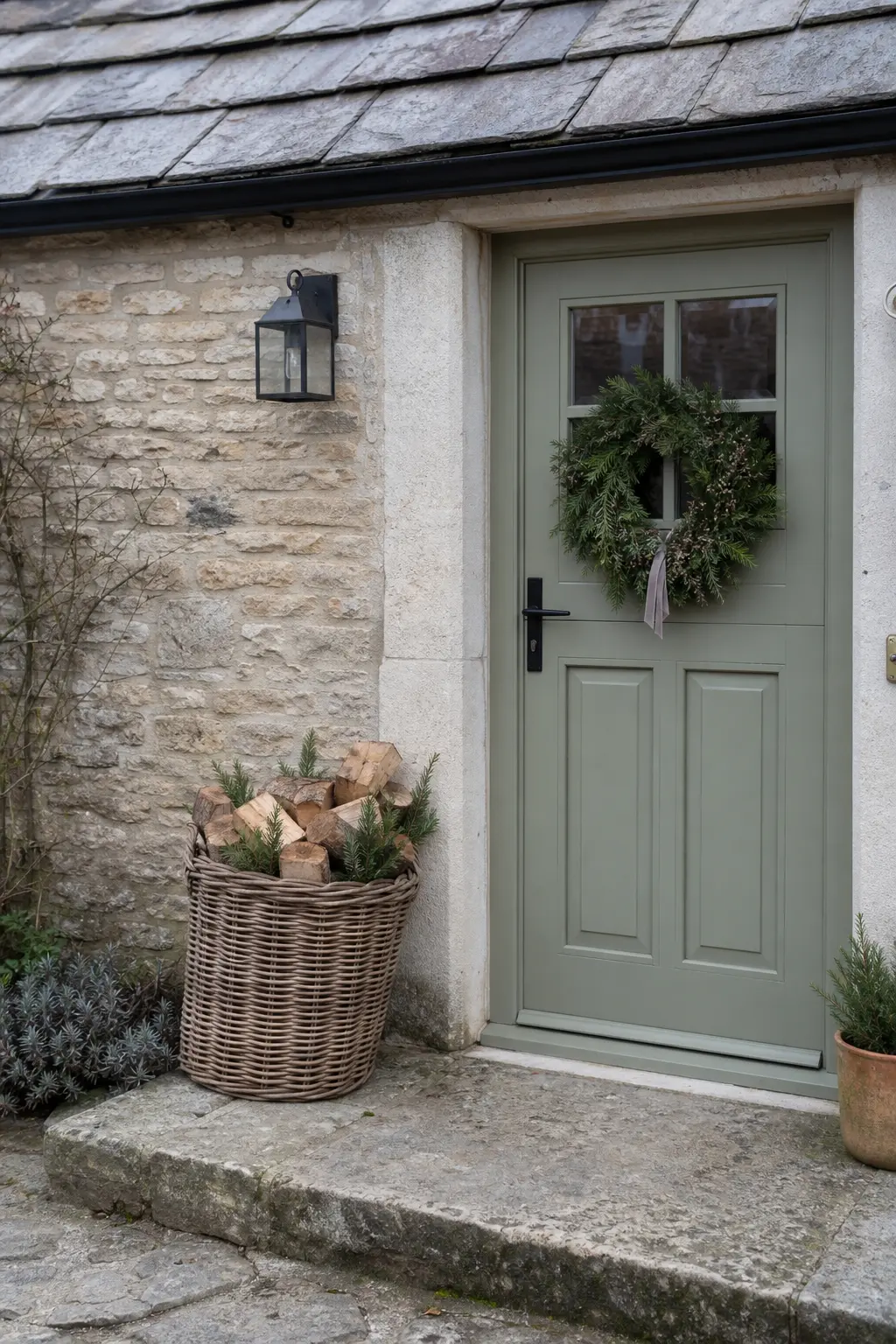
A wicker or galvanised trug stacked with split logs beside the door is the most quietly effective prop in this whole list. It looks purposeful rather than decorative, which gives it weight. Tuck a few stems of dried lavender or rosemary into the top of the stack for scent and a point of colour.
If the step is narrow, a tall basket takes less floor area than a wide flat one and still reads clearly from the pavement. Place it to one side only: symmetry at ground level is not required.
🛍 Shopping guide
Scented Sprigs at the Threshold
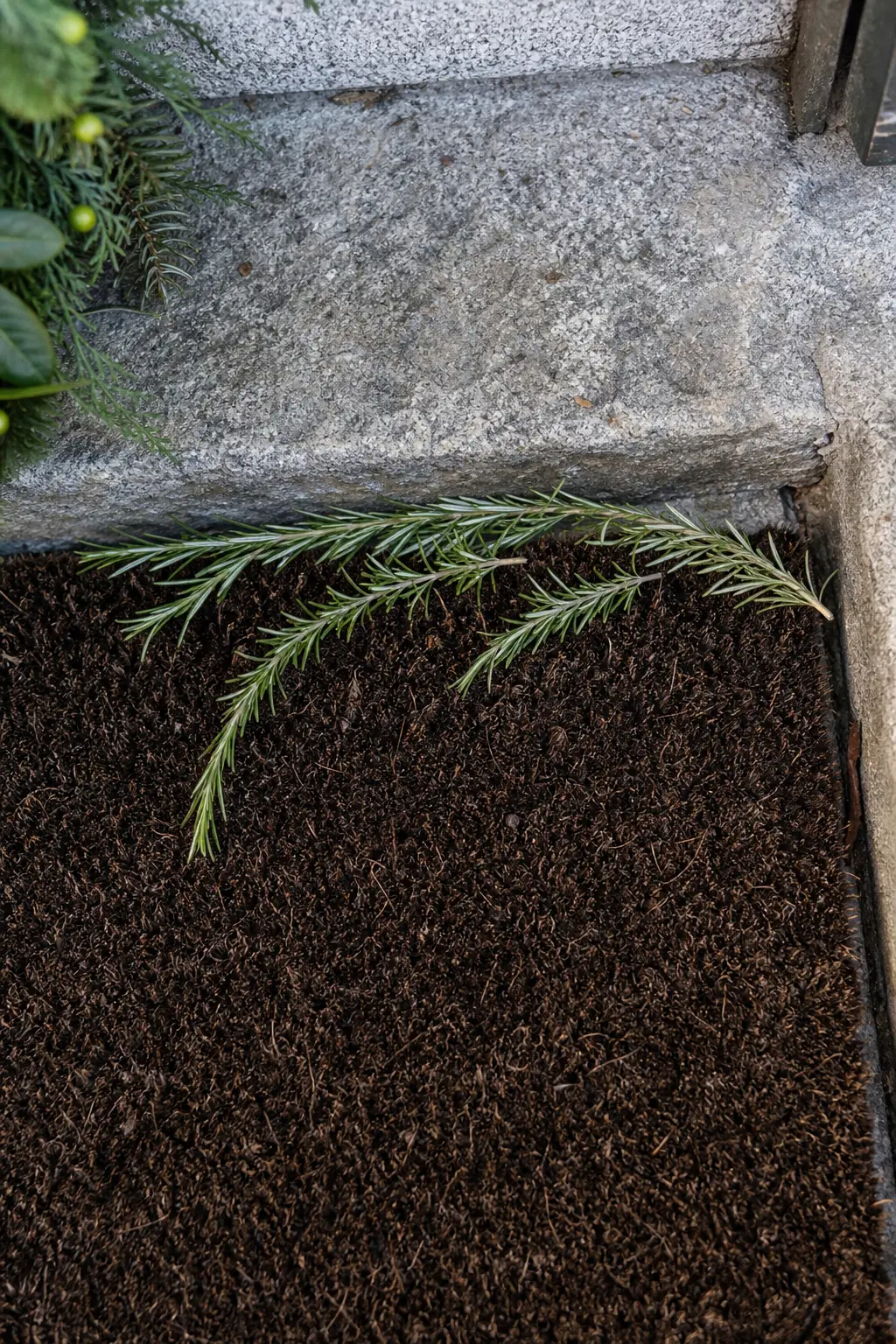
Lay a few loose stems of fresh rosemary or pine across the threshold mat so that anyone stepping onto the mat releases a faint scent. The effect is subtle enough that most guests will not identify it consciously, but it creates a sensory arrival moment that goes beyond anything purely visual.
Replace the sprigs every five days. A bundle of fresh rosemary from a grocery store costs less than a card and lasts longer in cold air than in warmth. Eucalyptus works equally well and holds its scent for slightly longer once cut.
🛍 Shopping guide
Painted Sign Leaning by the Step
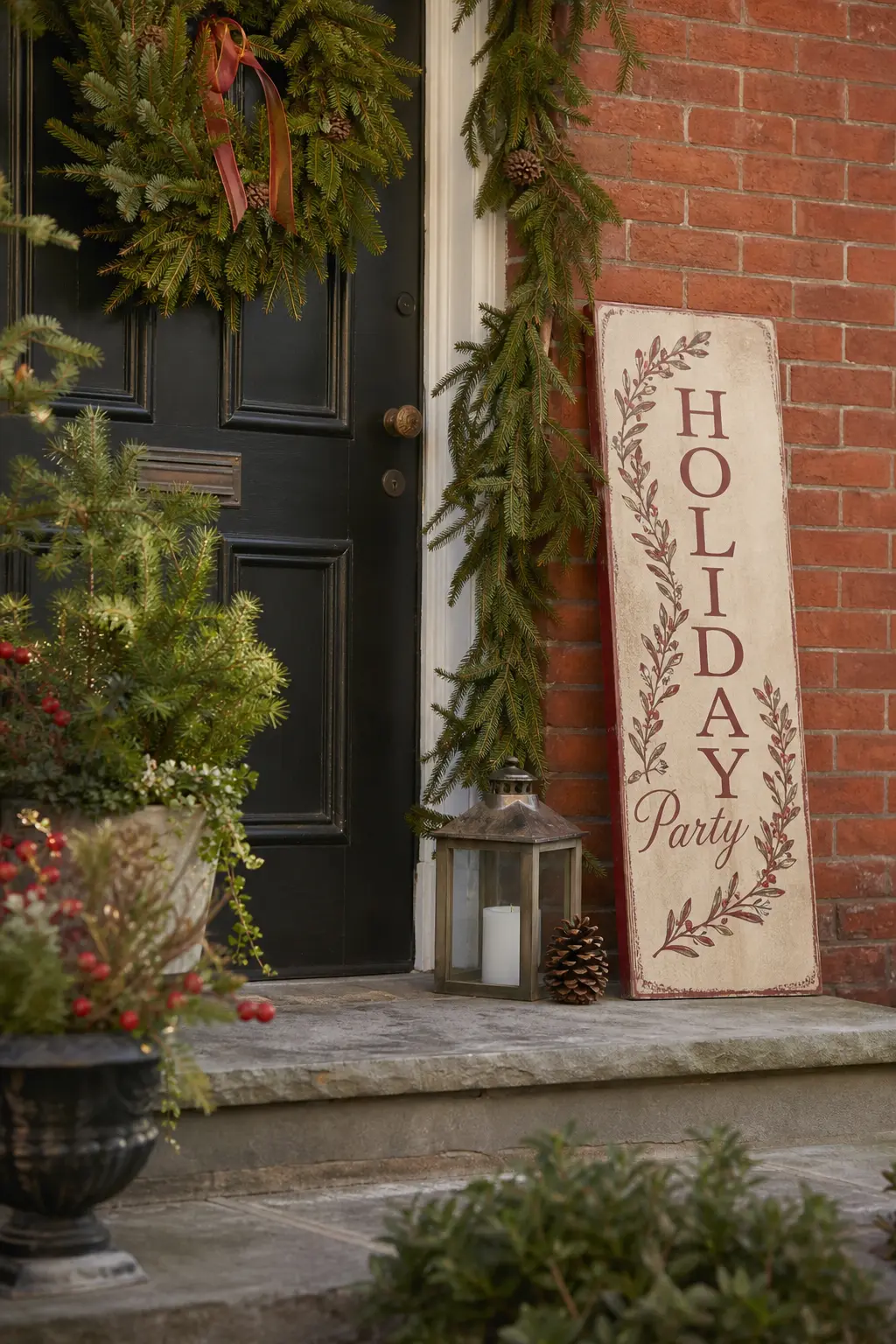
A wooden sign leaning against the wall beside the door adds a horizontal layer at a different height from the mats and logs, which gives the entrance composition three distinct ground-level planes. Choose a sign with a simple motif in the palette colours rather than a sentimental phrase: a sprig, a star or a single geometric pattern in oxblood and cream ages far better than seasonal text.
Lean it against the wall rather than hanging it, so it is easy to move indoors if the weather turns severe. A sign around 40 by 30 centimetres is large enough to read from the pavement without overwhelming the step.
🛍 Shopping guide
The Flanking Space
The metre either side of the door is where the entrance graduates from decorated to designed. Symmetry is not mandatory, but at least one flanking element on each side stops the door looking like a painting hung on a bare wall.
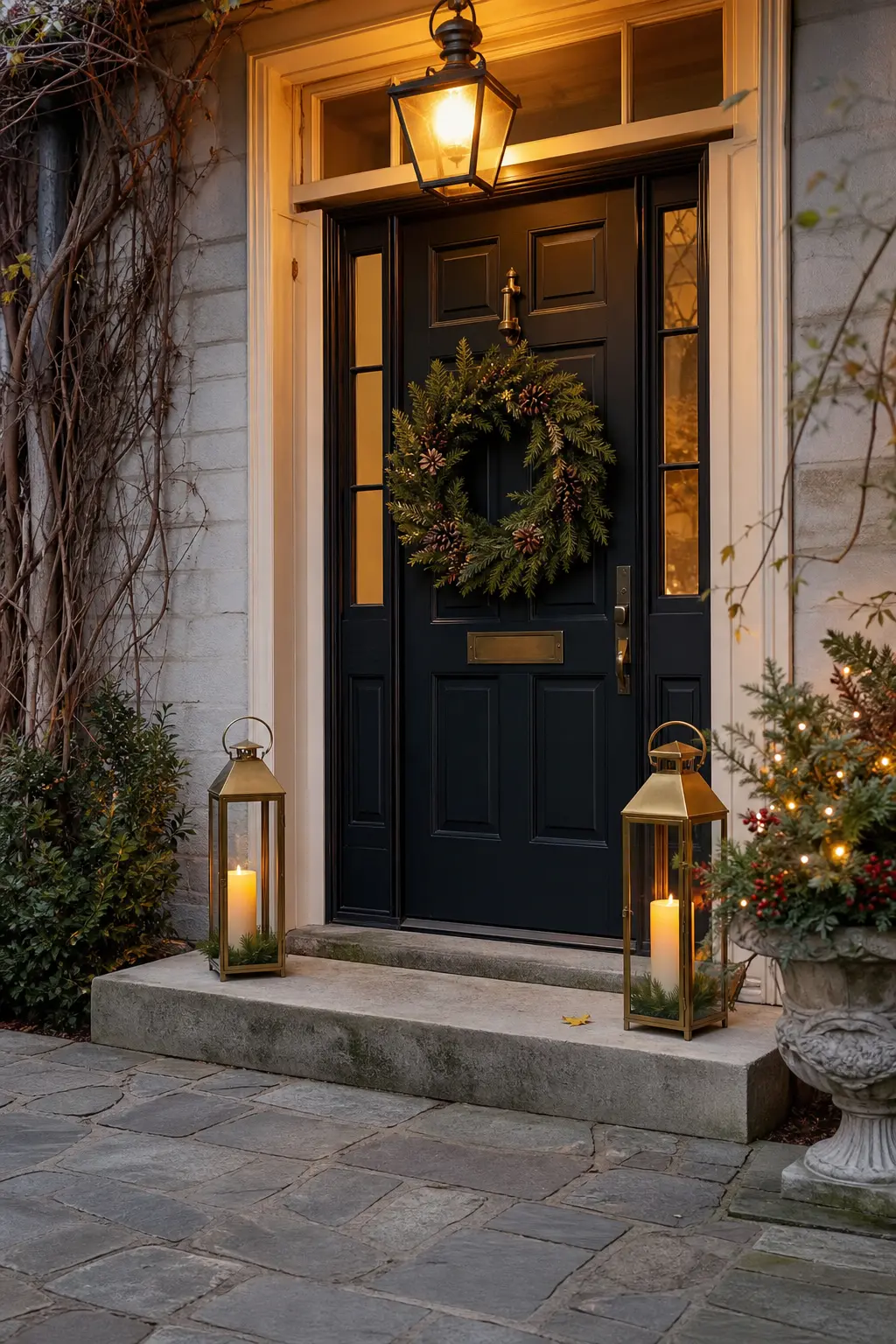
Lanterns Flanking the Step
Two lanterns placed one on each side of the step, at ground level or on a low wall, frame the entrance with vertical points of light. Use lanterns in brass or dark bronze rather than black: brass sits in the palette and catches the warm white light from above more generously.
Fill each lantern with a battery-operated pillar candle rather than a real one, so the flame-flicker effect is present without any fire risk near the greenery. Tuck a few sprigs of boxwood or pine into the lantern base around the candle for texture.
🛍 Shopping guide
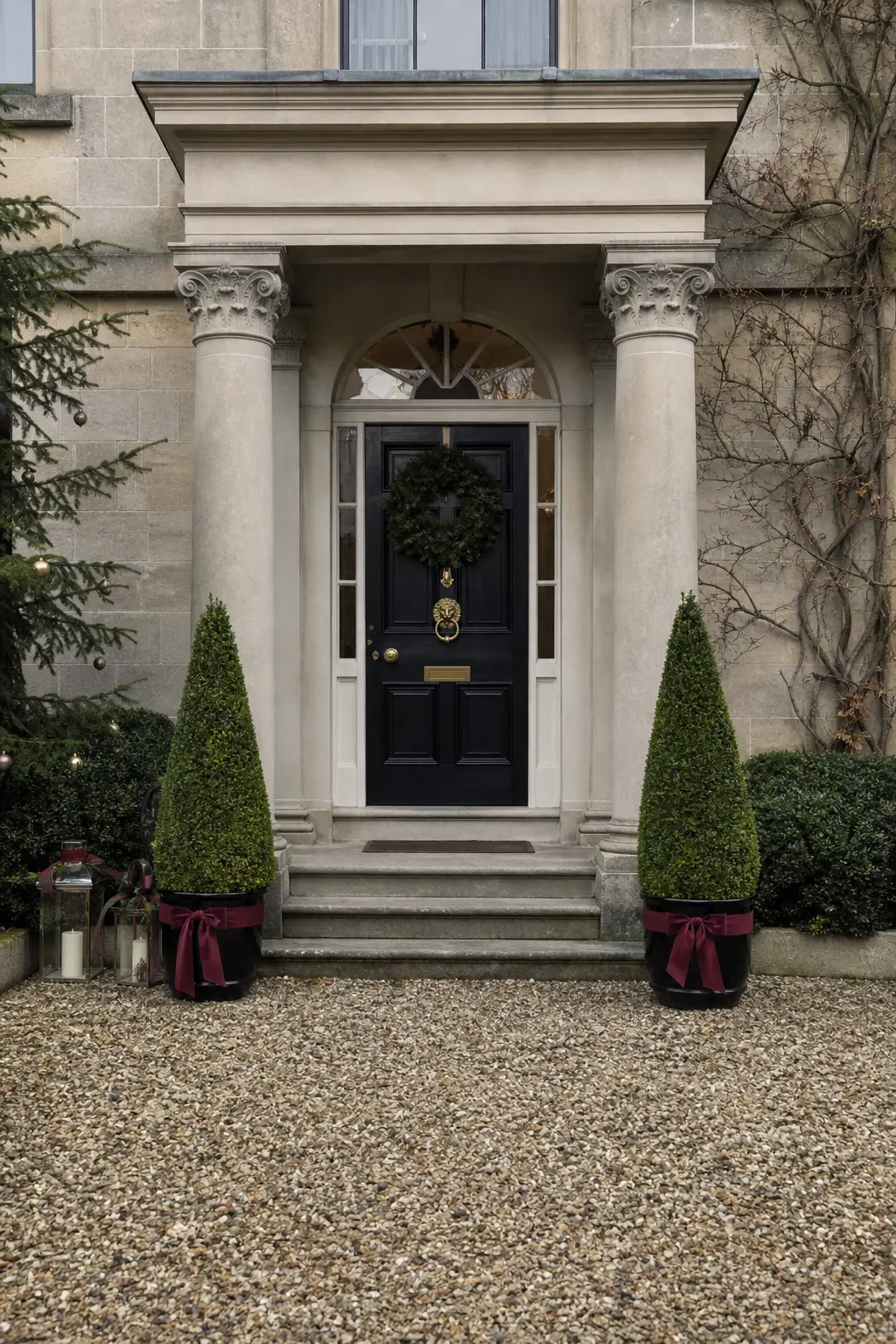
Potted Evergreens Either Side
A pair of potted evergreens flanking the door adds living structure that no garland or swag can replicate. Topiary balls or cone-shaped boxwood in matching terracotta or dark glazed pots are the most legible from the pavement. Wrap the pot rims in a single length of oxblood or cream ribbon for the season.
If the step is too narrow for two pots, place one to the side and use the lantern on the other side. A mismatched pair (one topiary ball, one cone) at different heights works well and looks considered rather than accidental.
🛍 Shopping guide
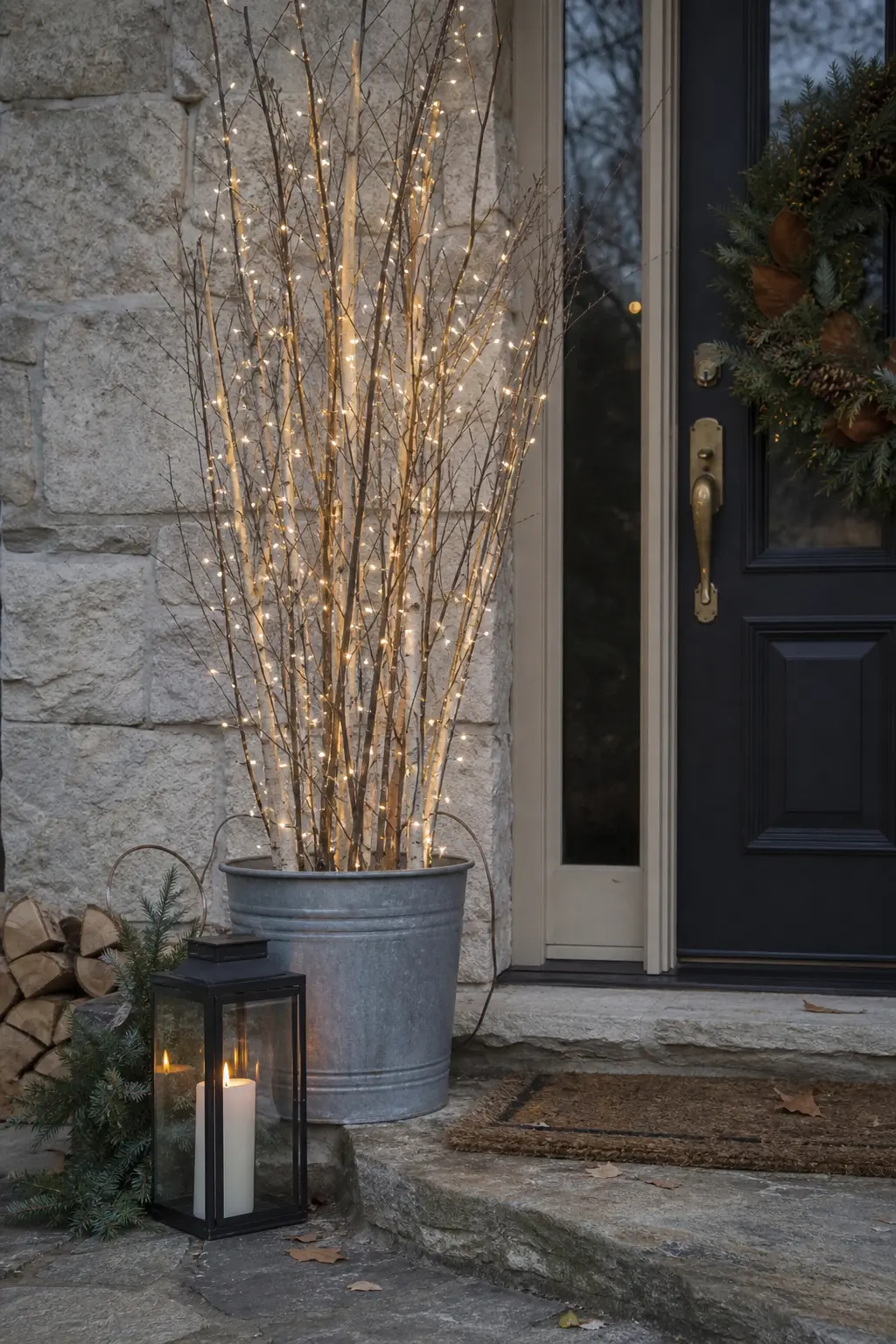
Pot of Branches with Lights
Fill a large pot or galvanised bucket with a bundle of bare birch or dogwood branches, then wind a set of warm white outdoor fairy lights through the branches. By day it reads as a sculptural bare-branch arrangement. After dark it becomes a lit column of light beside the door.
Weigh the branches in with gravel or dry floral foam so they stand without support. Dogwood in dark red or cream adds colour even before the lights come on, which means it earns its place all day.
🛍 Shopping guide
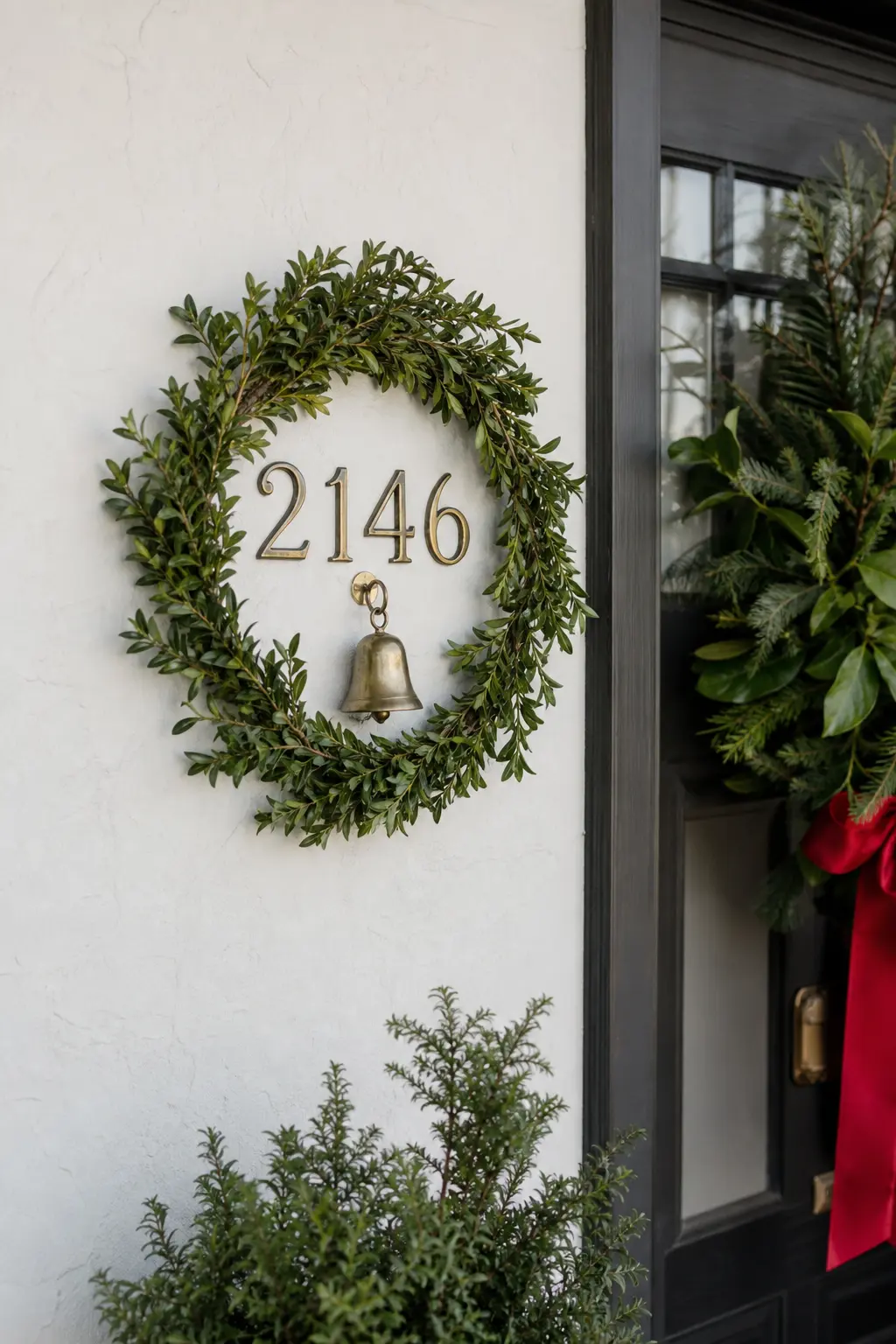
House Number Wrapped in Greenery
The house number is a fixed point most people never think to dress, which is exactly why dressing it registers as clever. Wind a small length of thin boxwood garland around the number plate or the surrounding wall space, securing it with a strip of fine florist wire looped behind existing fixings.
Add a single small brass bell or a stem of dried cotton at the midpoint. The number remains legible, which matters for deliveries and guests arriving after dark, but it now reads as part of the decoration rather than an afterthought on the wall.
🛍 Shopping guide
The Porch Rail and Storm Door
Porches with a rail or a storm door have two extra planes that most people ignore. Both take decoration without any drilling and both show up clearly in daylight and at night.
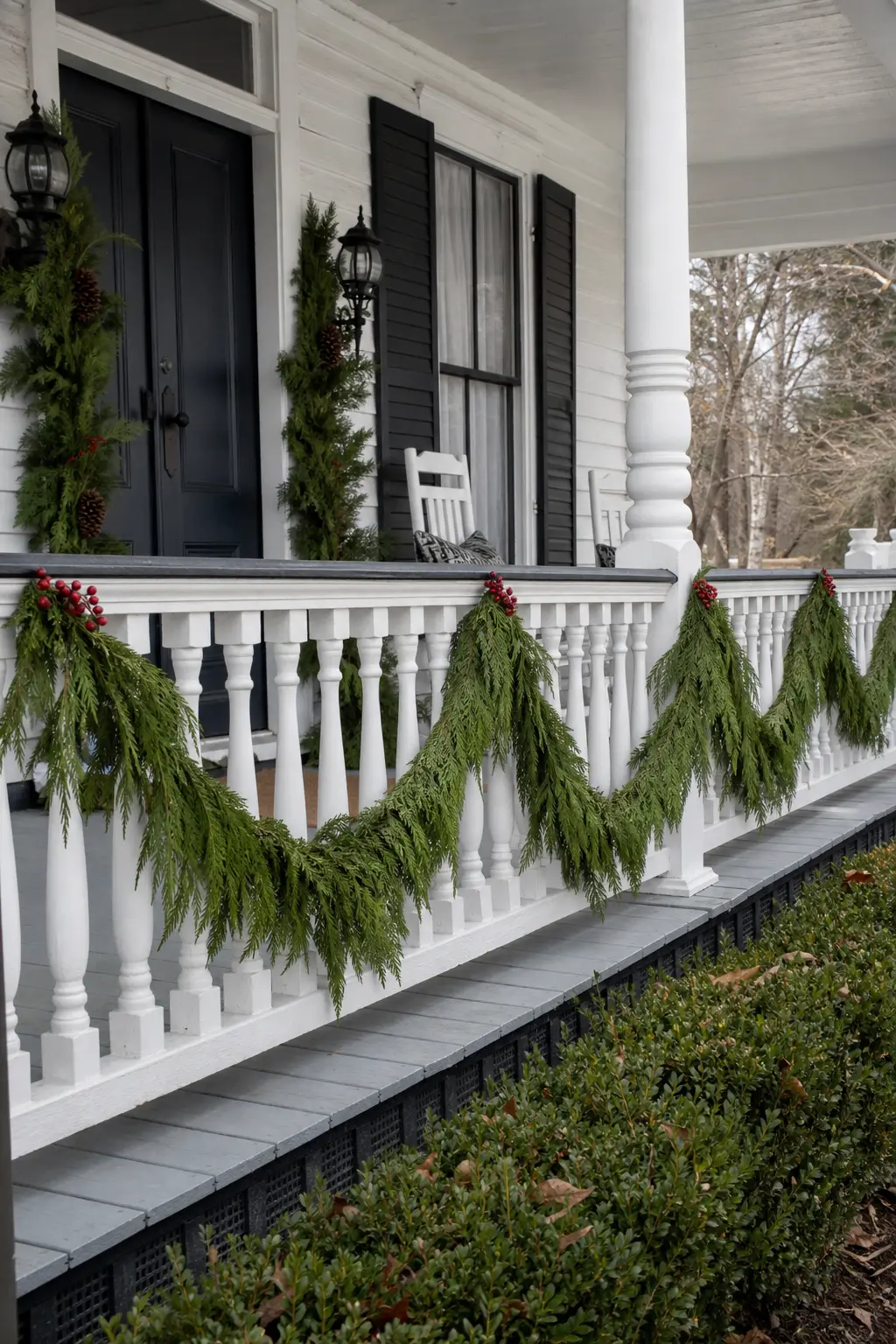
Garland on the Porch Rail
A porch rail is one of the easiest surfaces to dress in a way that shows clearly from the street: the horizontal length multiplies the visual impact of even a basic garland. Wind the garland loosely rather than pulling it tight, so it drapes in natural curves between each baluster.
Secure it with zip ties or garden twine at every other baluster so it does not shift in wind. Tuck small picks of oxblood berry and a few strands of brass-finish ribbon at the drape points for the same palette-tying effect used on the door frame above.
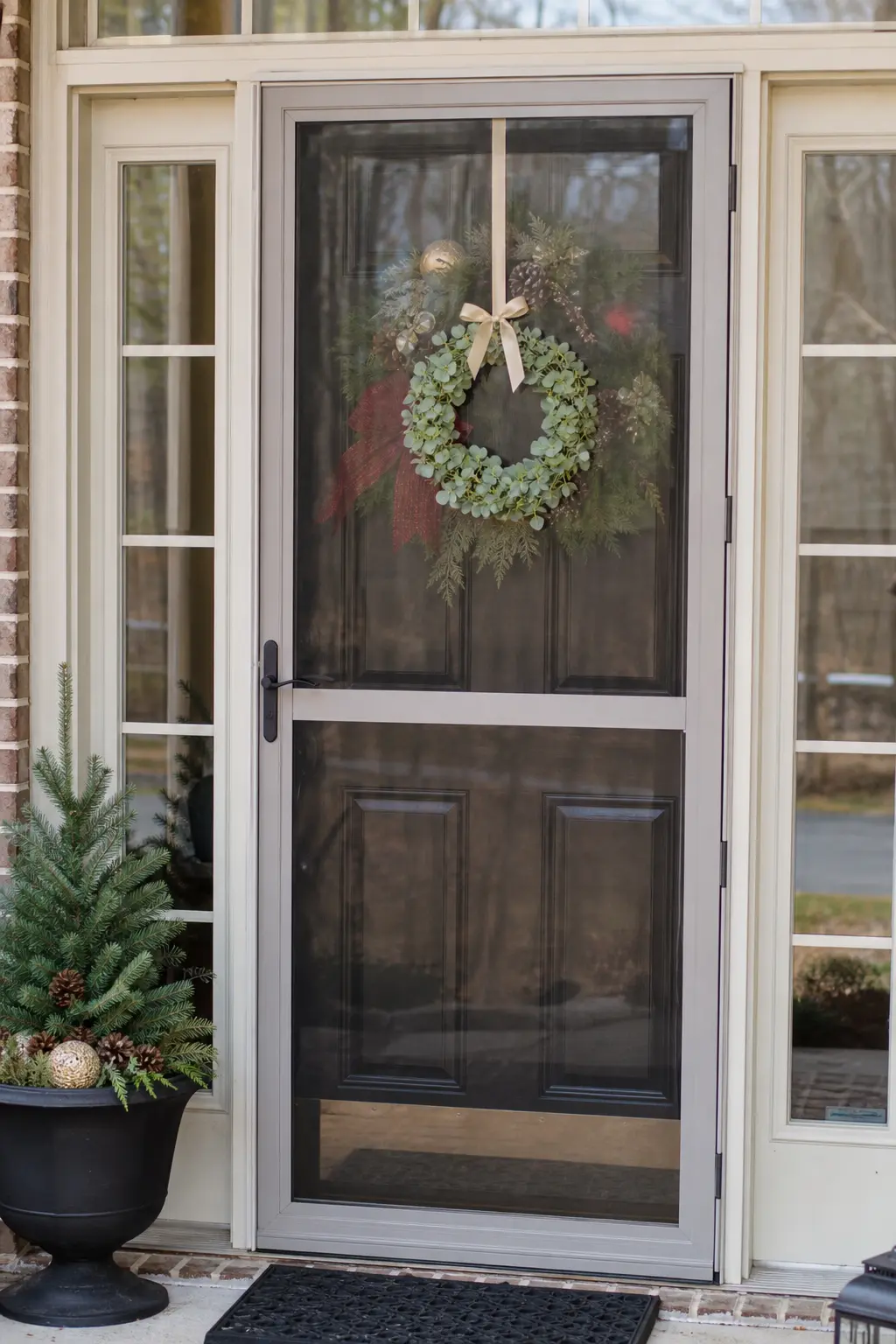
Second Small Wreath on the Storm Door
Where a storm door sits in front of the main door, a second small wreath on the storm door glass creates a layered, double-depth effect when both doors are viewed together from the street. Choose a wreath 6 to 8 inches smaller than the main one so the main wreath reads behind it without the two competing.
Attach it with a suction-cup hook rated for outdoor glass: these hold well in cold temperatures and leave no mark. A simple boxwood or eucalyptus circle with a single ribbon loop works better than a decorated wreath on this second layer, because simplicity lets the main wreath be the focal point.
Small Details That Earn Their Place
These are the pieces that reward anyone who walks right up to the door: the things guests notice at close range that pull the whole scheme together. None of them costs much or takes more than ten minutes to place.
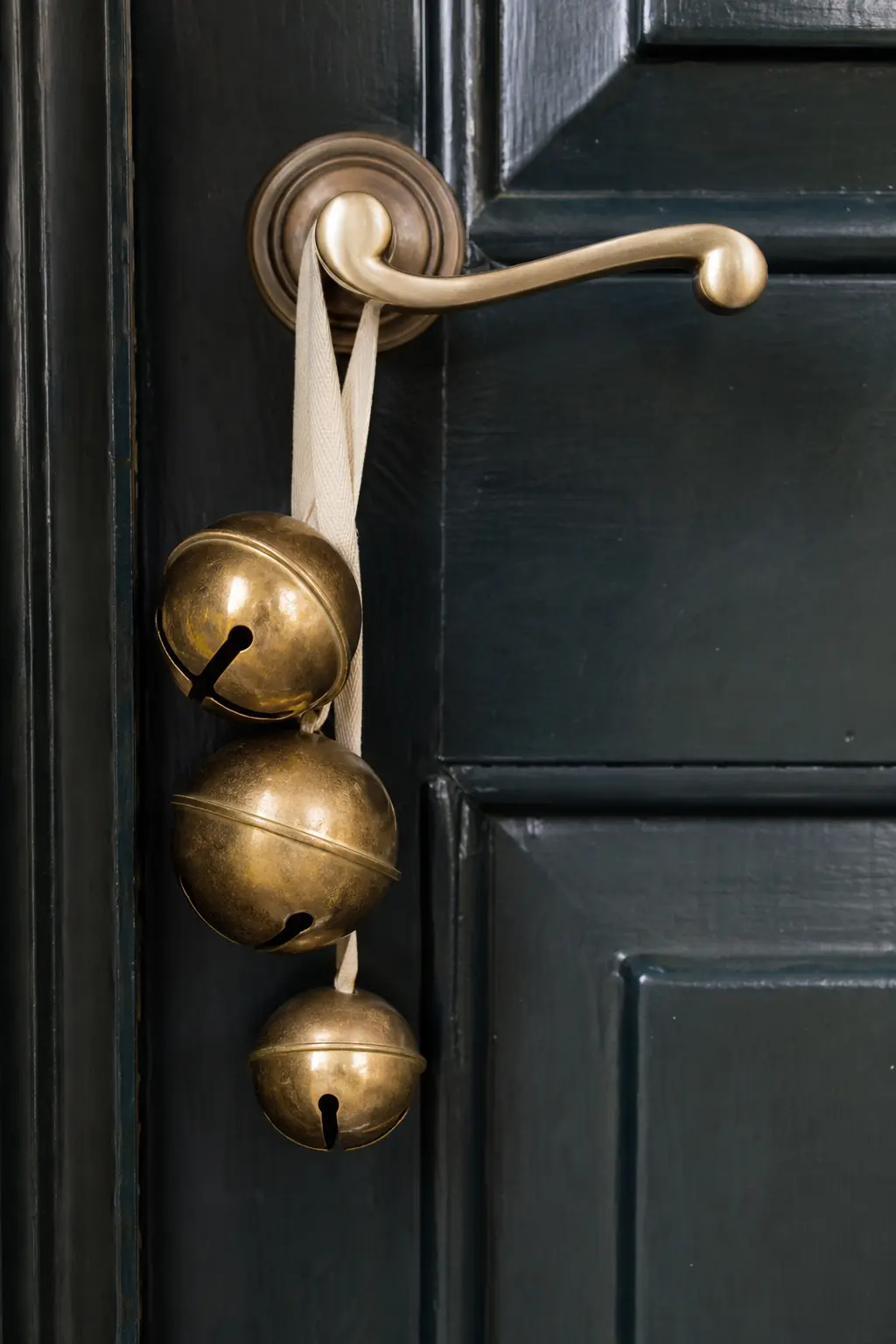
Bells on the Handle
A cluster of three or five jingle bells tied to the door handle with a short length of ribbon jingles each time the door opens, which is a sensory detail that costs almost nothing and delights everyone, including children arriving with adults. Use bells in brass or antique gold rather than silver to stay in the palette.
Tie the ribbon in a simple knot rather than a bow so the bells hang freely and ring clearly. A bow muffles them. Replace the ribbon if it gets wet and starts to fray: a ten-pence length of ribbon keeps this detail looking finished.
🛍 Shopping guide
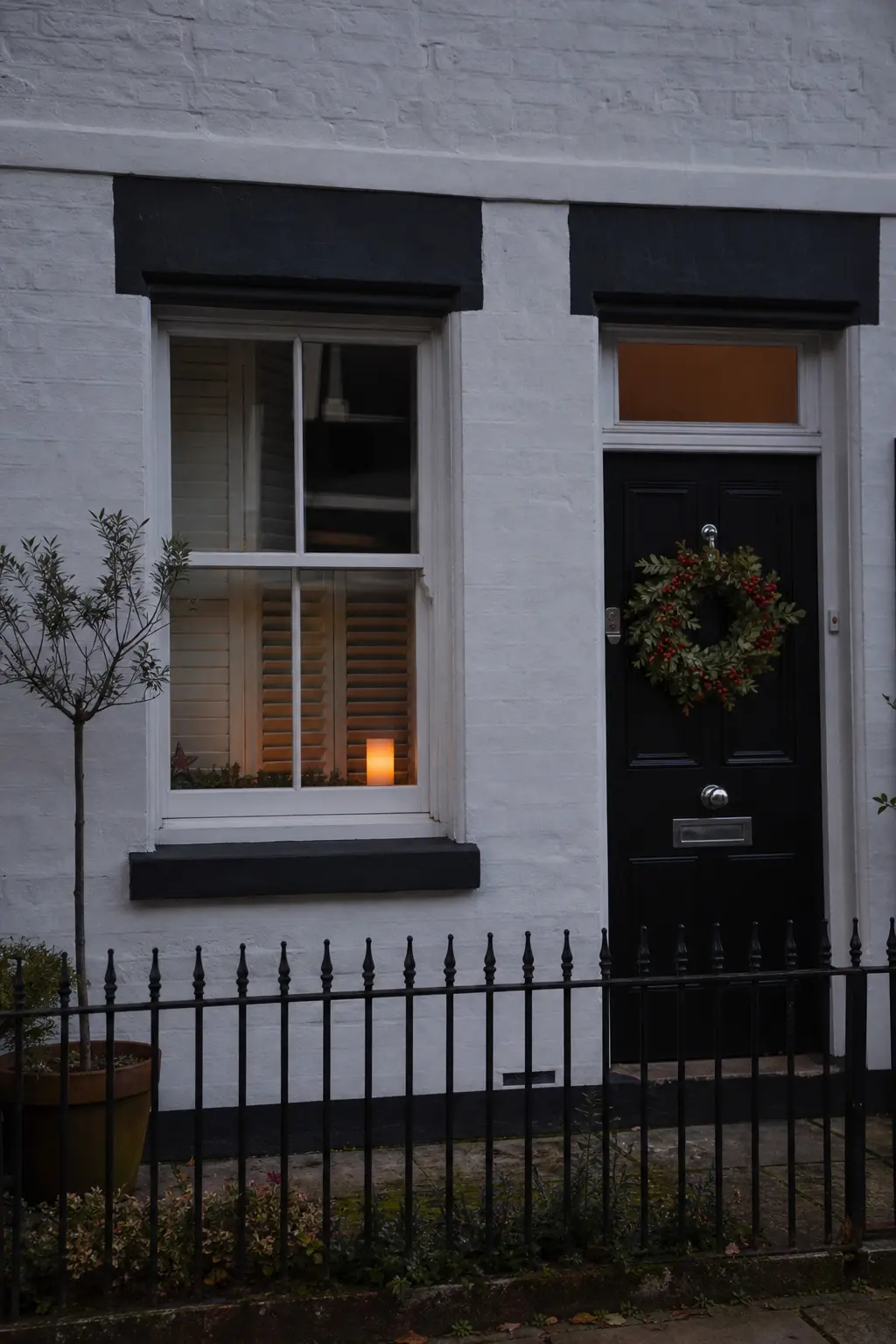
Candle in the Window Beside the Door
A single battery-operated candle in the window immediately beside the door, placed on the sill so it is visible from outside, extends the entrance into the facade of the house. From the pavement it reads as a warm occupied glow that no outdoor fixture replicates.
Use a flameless candle with a built-in timer, set to come on at dusk. A cream or beeswax-coloured candle in a simple glass holder reads better against the dark glass than a white one. If the window has a deep sill, place a small branch of pine or cedar in front of the candle to add depth.
The Inside of the Door and the Entry
The two metres just inside the door are the part everyone forgets, yet they form the first interior impression. A guest who steps in from a beautifully dressed threshold and meets a bare hall feels the drop immediately.
These ideas carry the exterior palette inward without duplicating it. For more ways to extend the look through every room, the article on diy christmas decorations easy has quick builds that suit this zone perfectly. And if you want the entry-hall candle moment to extend to the whole house, the guide to christmas candles decorations covers every safe option in detail.
Wreath Repeated on the Inside Face
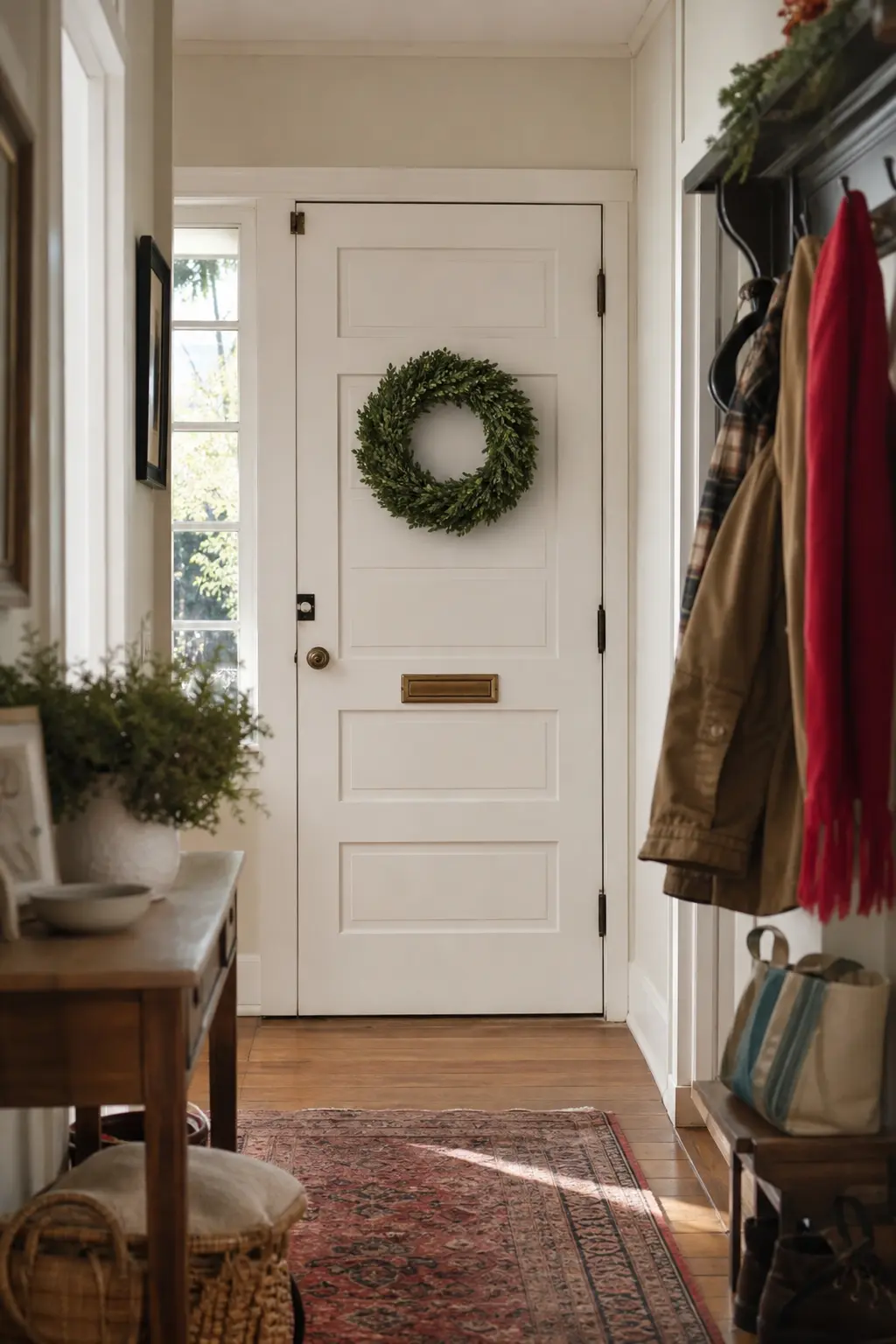
Hang a second wreath on the inside face of the front door so that anyone who opens it is greeted by greenery from both directions. The inside wreath can be smaller and simpler than the exterior one: a plain eucalyptus or boxwood circle with no ribbon is enough, because the main wreath is still the focal point from outside.
Hang it from the same over-door hook, run from the outside, so no additional fixing is needed. At the end of the season this inside wreath often dries beautifully and can serve as a year-round dried arrangement on an interior door.
🛍 Shopping guide
Console Tray Just Inside
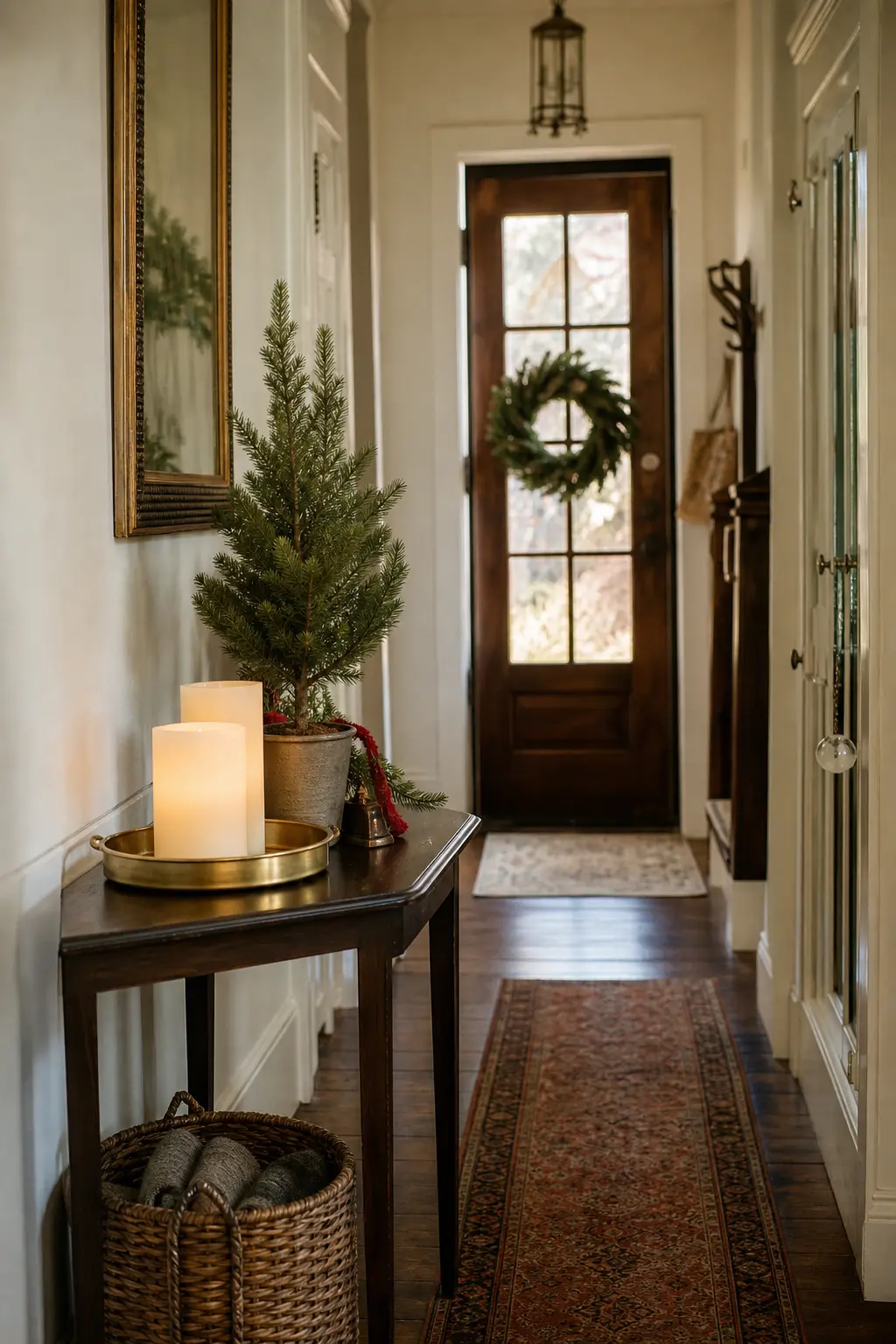
A console table or narrow shelf just inside the door is the entry’s equivalent of the step outside: the first interior surface a guest sees. Dress it with a tray in brass or dark wood, a small potted plant, a few pillar candles at different heights and a single stem in a bud vase.
The tray corrals everything so the surface reads as composed rather than cluttered. Keep the palette consistent with the door outside: a stem of cedar, a cream candle and a brass tray is all it takes to extend the entrance theme two metres into the house.
🛍 Shopping guide
Coat Hooks Dressed with Greenery
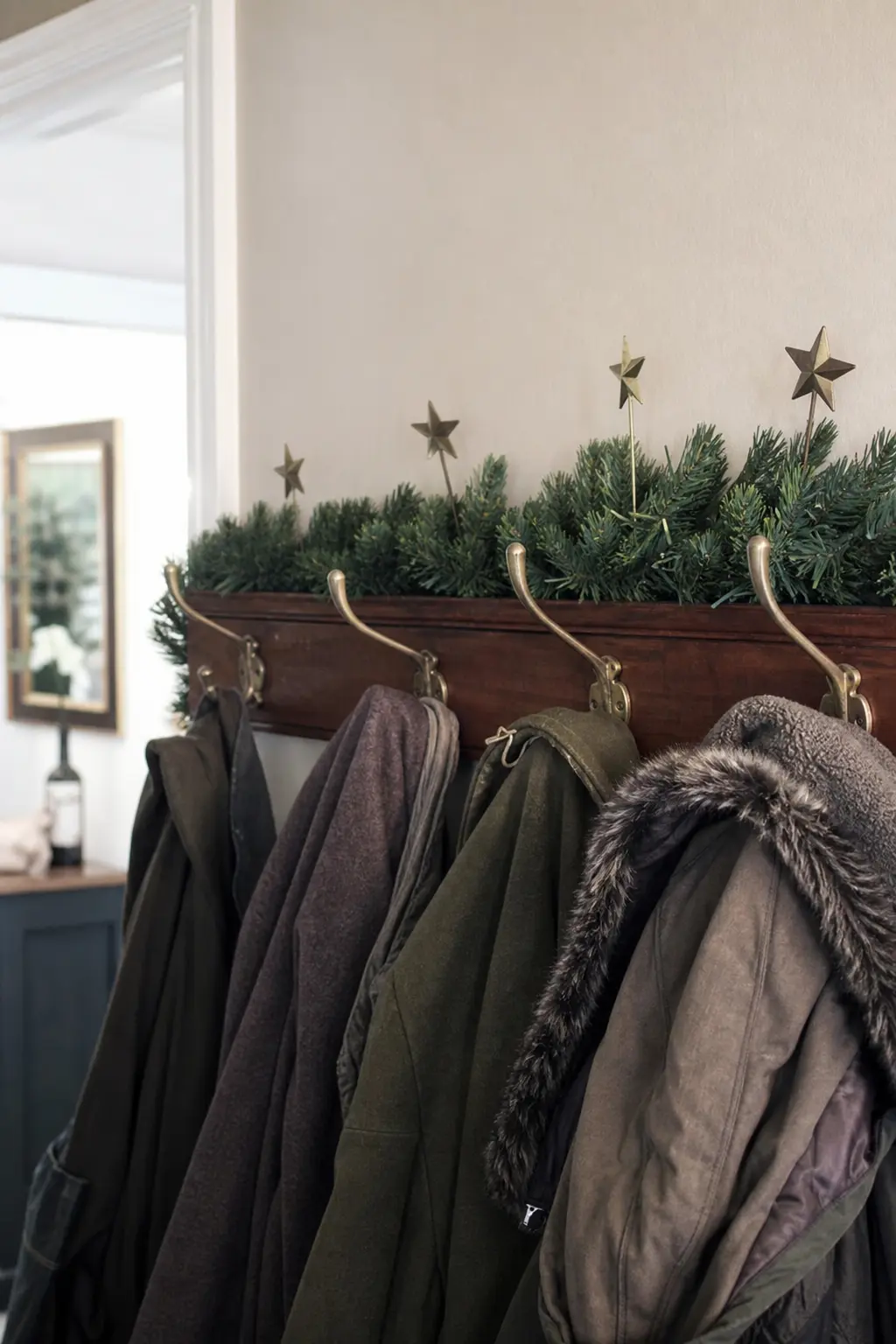
A row of coat hooks in the entry hall is usually buried under coats for the entire season, but the hooks themselves, or the rail between them, take a length of thin garland laid along the top in under two minutes. It shows above the coats and adds a green horizontal line at head height that ties the entry decoration together.
Use an artificial mini garland rather than fresh here: it sits flat, does not drop needles on the coats hanging below, and can stay in place for the full season. Tuck in a brass star pick or two at intervals for a detail that shows above the coats.
🛍 Shopping guide
Runner Rug Swapped Inside the Entry
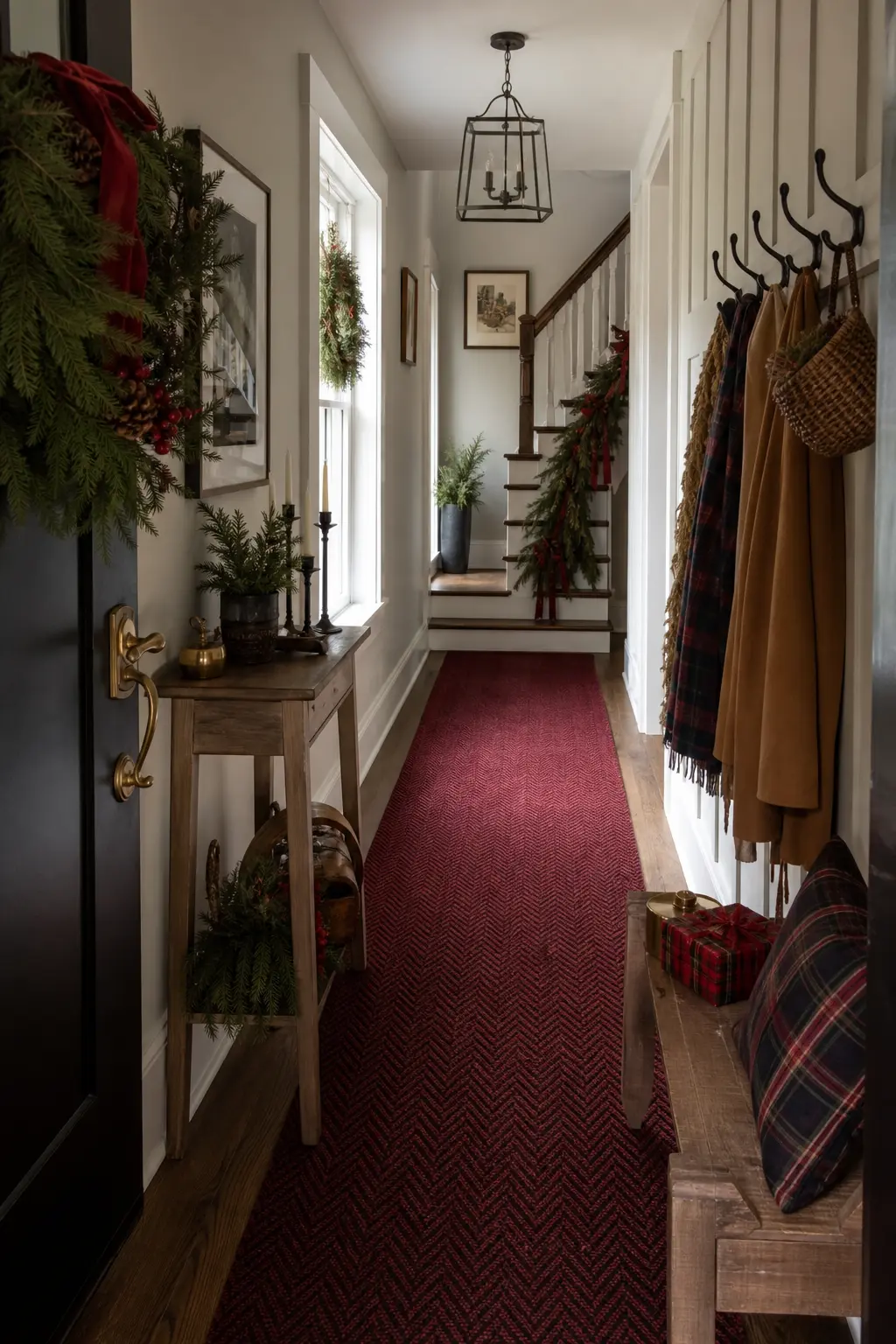
Swap the usual entry runner for one in a seasonal palette: a deep oxblood, a dark cedar green or a cream and charcoal geometric works within the scheme and transforms the floor in under a minute. The rug does not need to say anything festive: colour and texture are enough.
A jute or wool runner in a herringbone or block-repeat pattern in the right colour looks seasonal without looking temporary. Place an anti-slip pad underneath so it stays flat on hard floors: a rug that shifts underfoot is a hazard, particularly when guests are arriving wet from outside.
🛍 Shopping guide
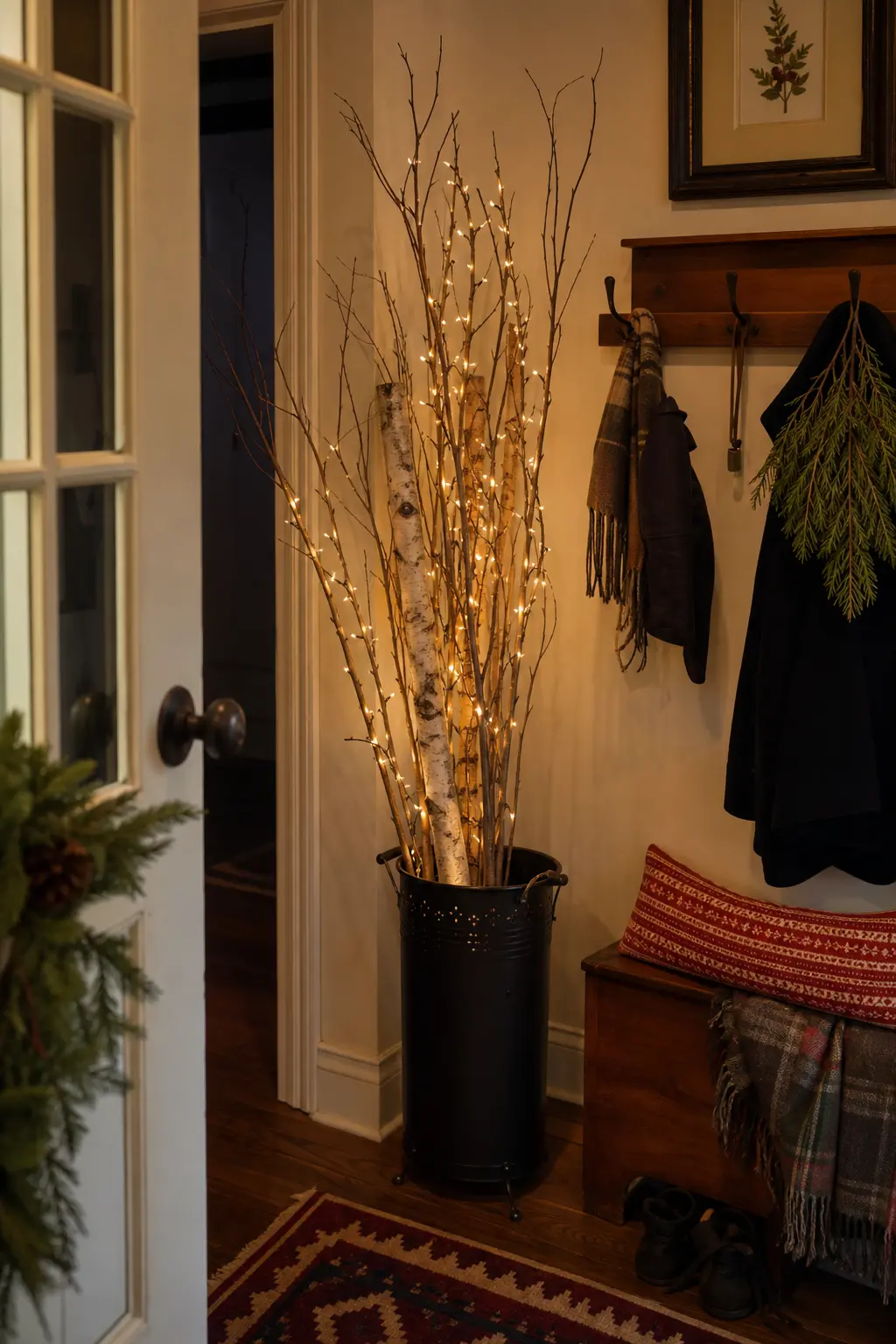
Umbrella Stand of Bare Branches
An umbrella stand in the entry corner, filled with a bundle of tall bare branches instead of umbrellas, is one of those ideas that looks like it took planning but costs almost nothing. Birch twigs, dried dogwood or forsythia branches all work. Wind a string of battery-powered fairy lights through the branches so the stand becomes a lit sculptural column by evening.
The stand reads as part of the entry furniture rather than as a Christmas decoration, which means it does not have the slightly desperate quality of things that are clearly only out for one month. Use a stand in dark metal or glazed ceramic to suit the palette.
🛍 Shopping guide
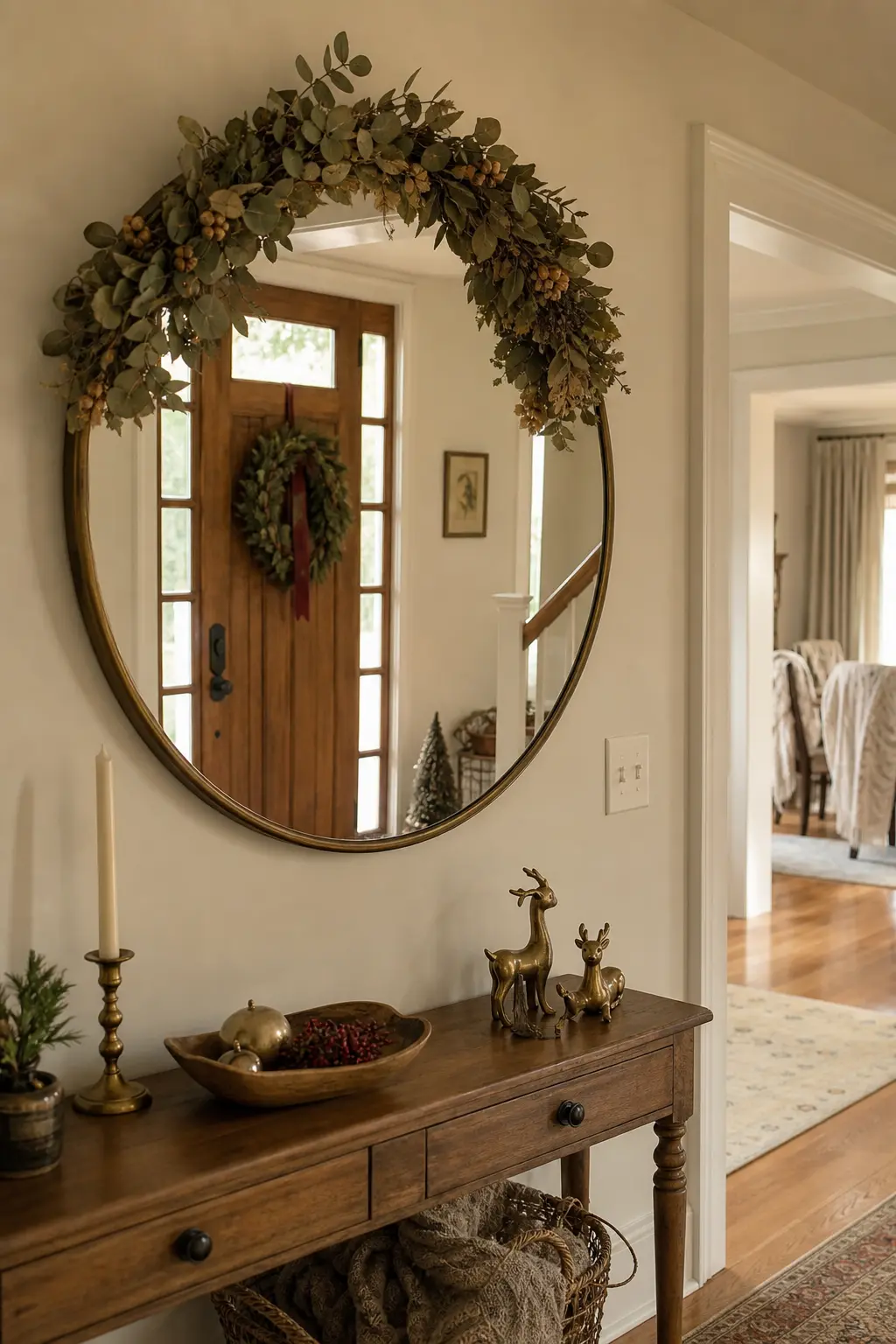
Mirror Wreath in the Hallway
Hang a small wreath over the hall mirror so the mirror reflects both the wreath and the entry behind it, doubling the decoration visually. A round mirror and a round wreath at the same scale look intentional. Choose a wreath slightly smaller than the mirror diameter.
Use a wreath in a single material, dried eucalyptus or preserved magnolia, rather than a mixed fresh one, because the mirror will be in use all season and a shedding wreath above it becomes annoying within a week.
🛍 Shopping guide
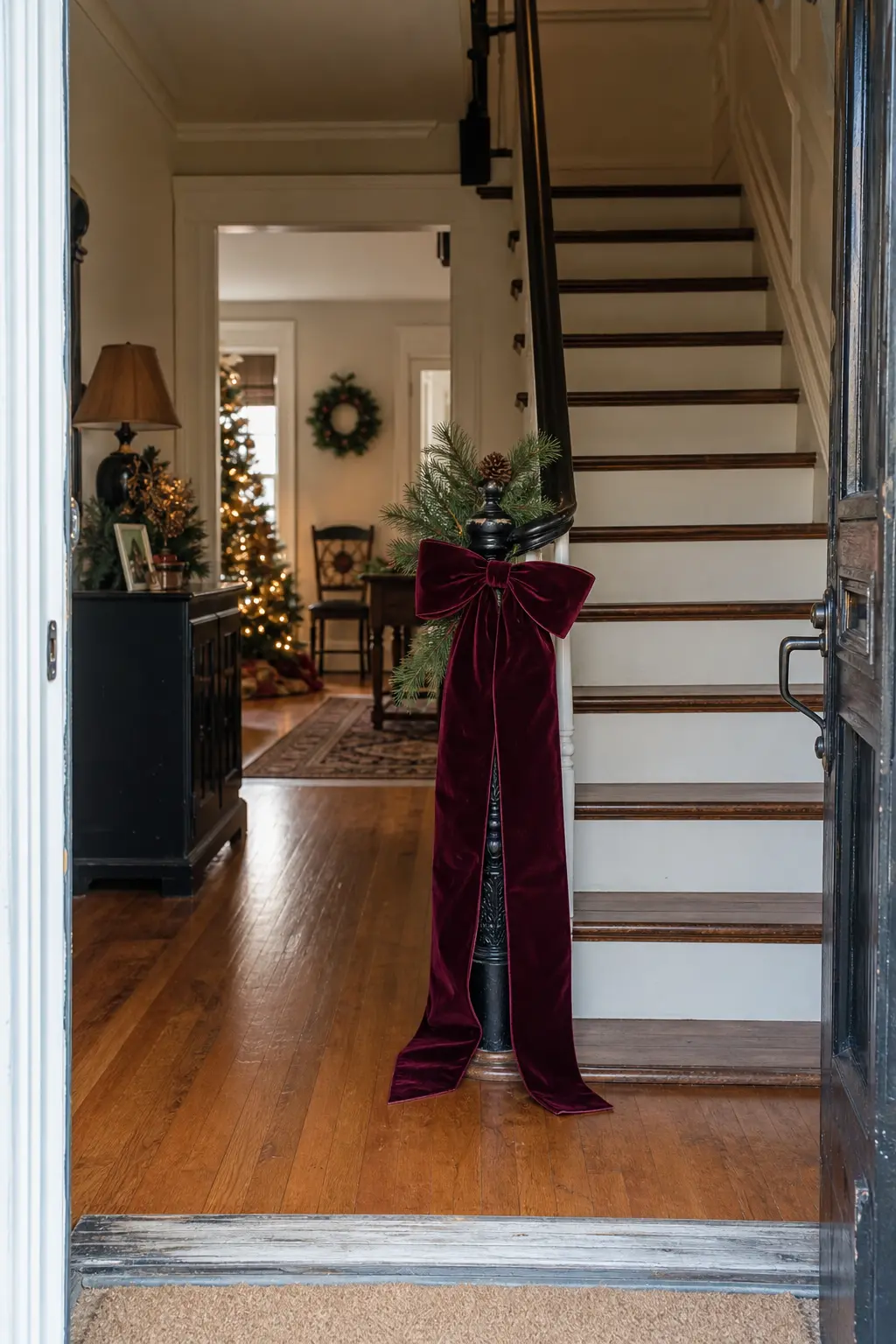
Stair Post Bow Visible from the Door
The newel post at the foot of the staircase is one of the first interior details visible from the open front door. A generous bow in oxblood or cream velvet ribbon tied around the post, with long tails falling to the step, draws the eye from the threshold into the house and makes the entry feel larger than it is.
Tie the bow with wired ribbon so it holds its shape throughout the season without being retied. Add a small spray of pine or cedar behind the knot if the post is wide enough to take it: the green against the oxblood is exactly the palette moment the entry scheme needs.
🛍 Shopping guide
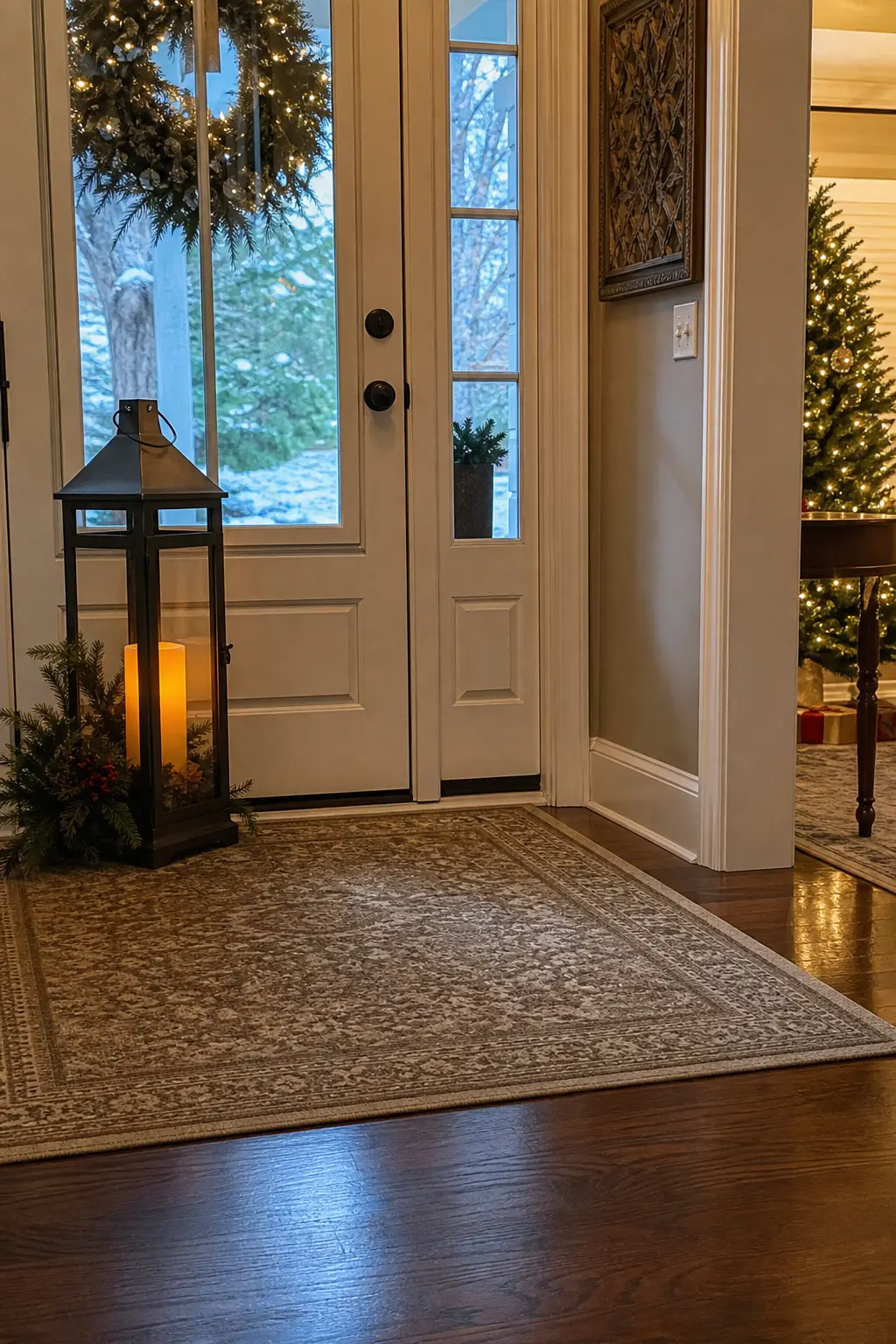
Flameless Lantern on the Inside Mat
A single large flameless lantern placed on the entry mat just inside the door, switched on for the duration of any gathering, creates a warm pool of light at ground level that no overhead fitting replicates. It also signals arrival: the glow is visible to anyone approaching the door if the glass panel or sidelights let any light through.
Choose a lantern in dark bronze, aged iron or brass to sit within the palette. A flameless candle with a timer means the lantern comes on automatically each evening. Place it to one side of the mat rather than the centre so it does not become a trip hazard for guests carrying coats and bags.
🛍 Shopping guide
Frequently Asked Questions
What size wreath should a front door have?
Measure the door panel height and choose a wreath diameter of roughly one third of that. On a standard 80-inch door, 26 to 28 inches is the minimum that reads from the pavement. Most shop-bought wreaths sold as ‘front door’ size are 22 inches, which is too small for anything but a narrow cottage door.
How do I decorate a front door without nails?
Use an over-door wreath hanger for the main wreath. Fix garland and lights to the frame with removable outdoor adhesive clips rated for exterior use. Suction-cup hooks work on storm-door glass. A handle swag ties directly to the door knob or lever with ribbon. None of these methods marks the door surface.
What goes on a front door besides a wreath?
The frame itself takes a top swag, vertical garlands down both sides and a run of outdoor fairy lights outlining the full surround. The handle takes a cluster of bells or a doorknob swag. The letterbox takes a small spray of greenery above it. A ribbon tail hanging below the wreath fills the lower door panel. Together these elements turn a single hanging circle into a full entrance scheme.
How do I light a front door for Christmas safely?
Use only lights rated for outdoor use on any exterior surface. Never use indoor fairy lights outside: they are not weatherproofed. Run cables to a weatherproof outdoor socket on a timer. For greenery near light sources, use flameless battery-operated candles in lanterns rather than real flames. Keep all electrical connections out of standing water.

Sabrina Carpenter Christmas Aesthetic: 20 Retro Glam Decor Ideas in Baby Pink, Satin Bows and Tinsel
Sabrina Carpenter Christmas aesthetic decor for a whole house: baby pink, cherry red and cream, sati

10 macrame Christmas ornaments DIY ideas in cotton cord, wood and glass, for a soft, textured tree t
31 christmas table decorations that work down the length of a too-long table, hide every seam, and u
Leave a Reply