

31 Christmas Table Decorations for a Table That Seats More Than It Should
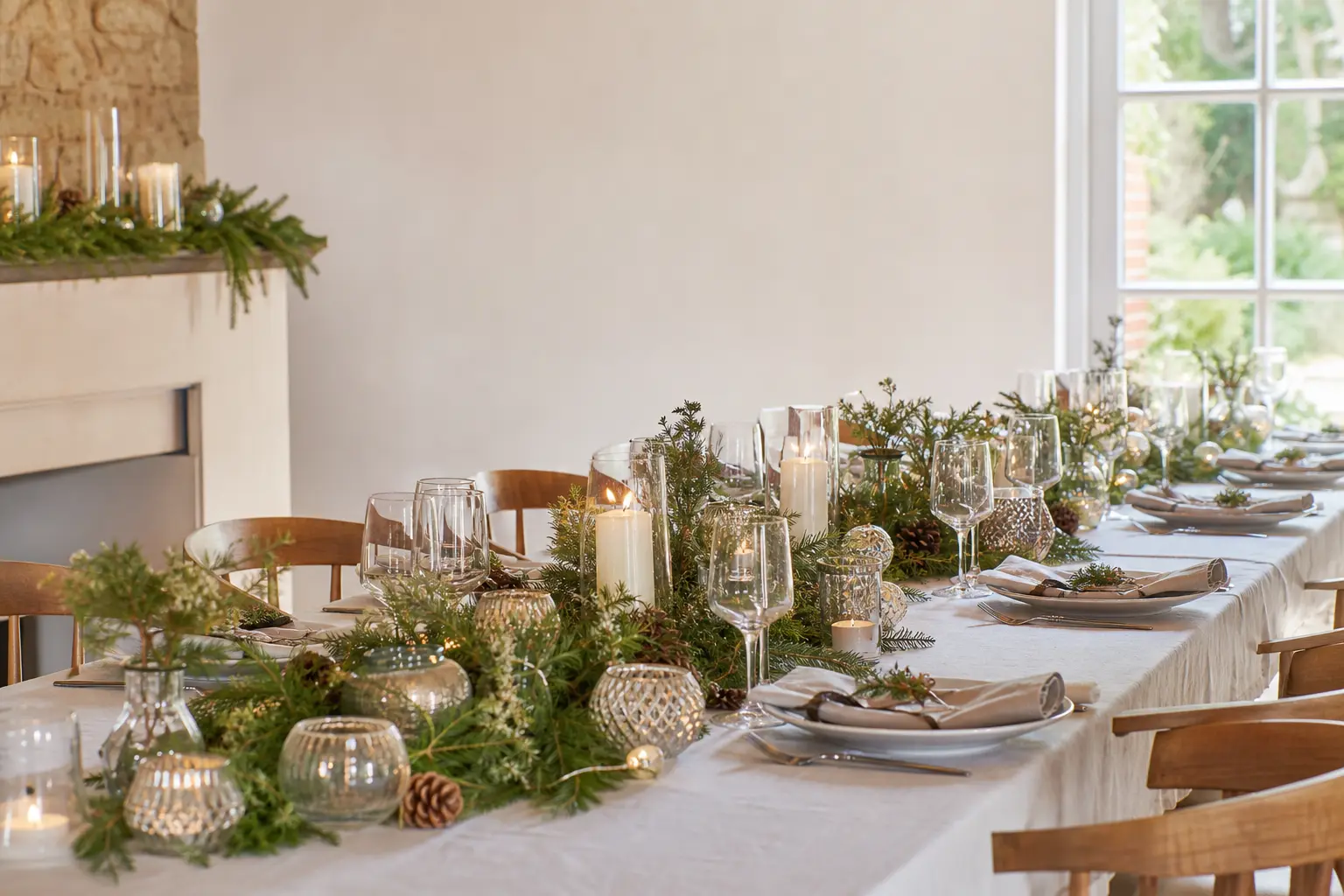
Christmas table decorations should solve problems, not create them. This collection is built for the host with a too-short table, borrowed chairs, and a seam where the extension leaf dropped in at the last minute. Every idea runs down the length of the table, not across it, because length is what you have too much of and a strong centre line pulls the whole thing together.
The season is already on your side. Layered textures, real greenery, and low scattered objects are exactly what disguise a join. The palette here is cedar green, oxblood, raw linen, twilight blue, and brass, nothing that requires a matching set, everything that looks deliberate even when it is improvised.
The twelve ideas below cover the full table from cloth to chair back. Each one tells you what to do at the seam, because that is the part no other guide bothers with. If you are also thinking about what goes in the middle, the Simple Thanksgiving Table Decor piece has transferable logic for non-matching setups, and the full Christmas games for large groups guide is worth reading before the meal begins.
This post contains affiliate links. If you buy through them, I may earn a small commission at no extra cost to you.
The Base Layer
Start with what covers the table, because that decision changes everything above it. A mismatched table needs a base layer that reads as a choice, not a compromise.
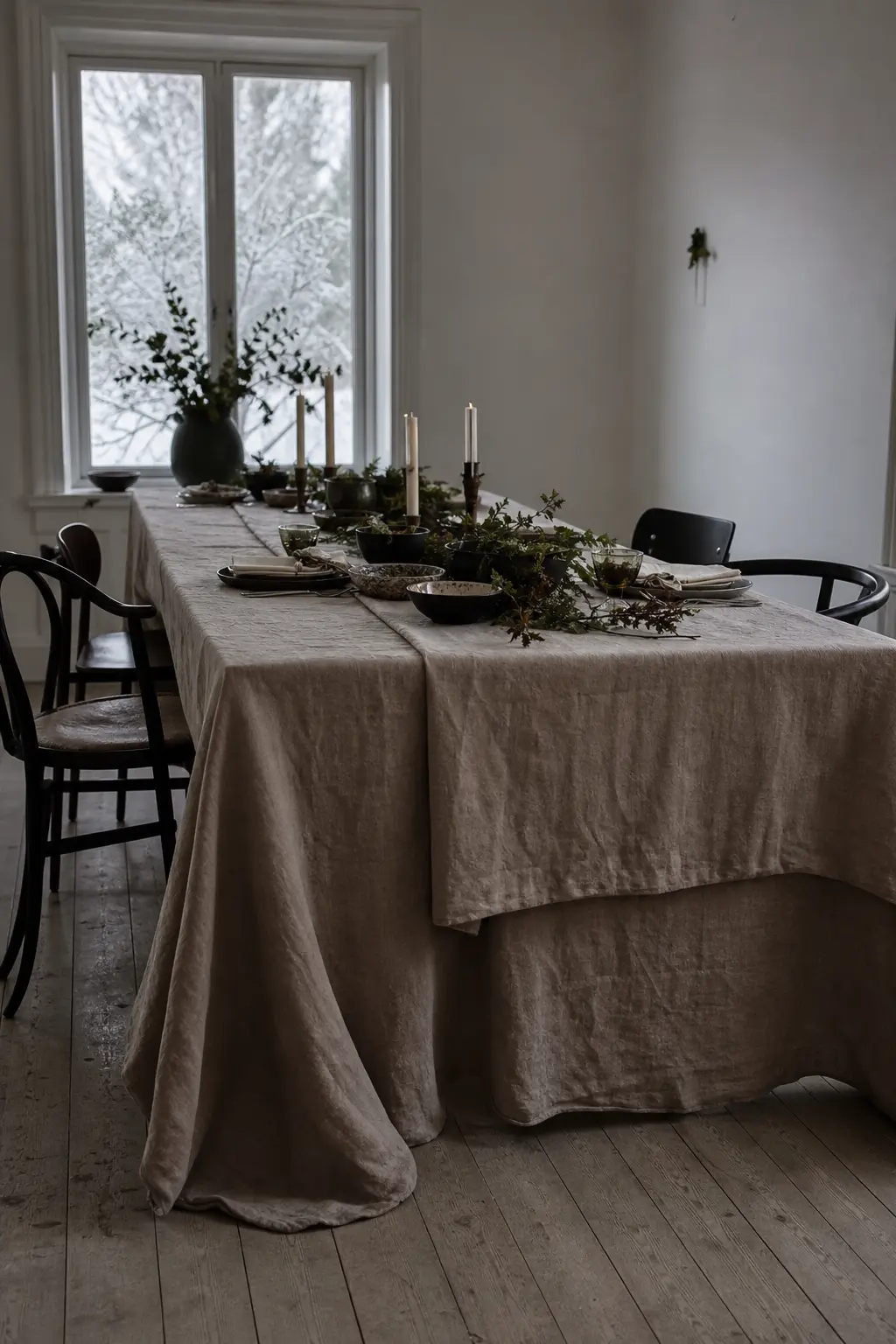
Two Overlapping Lengths of Linen
Buy two lengths of raw linen from a fabric shop, no hemming needed. Lay the first from one end, let the second overlap it by about twenty centimetres, and that overlap lands squarely on the seam. The double layer at the join looks intentional and adds enough bulk to mask any height difference between the leaf and the main table.
Tuck the raw edges under slightly if they bother you, or leave them to fray. Fraying on linen reads as texture, not neglect. Cedar green napkins or a strip of tartan laid on top makes the overlap look like a design decision rather than a measurement problem.
🛍 Shopping guide
Two Small Cloths Instead of One Long One
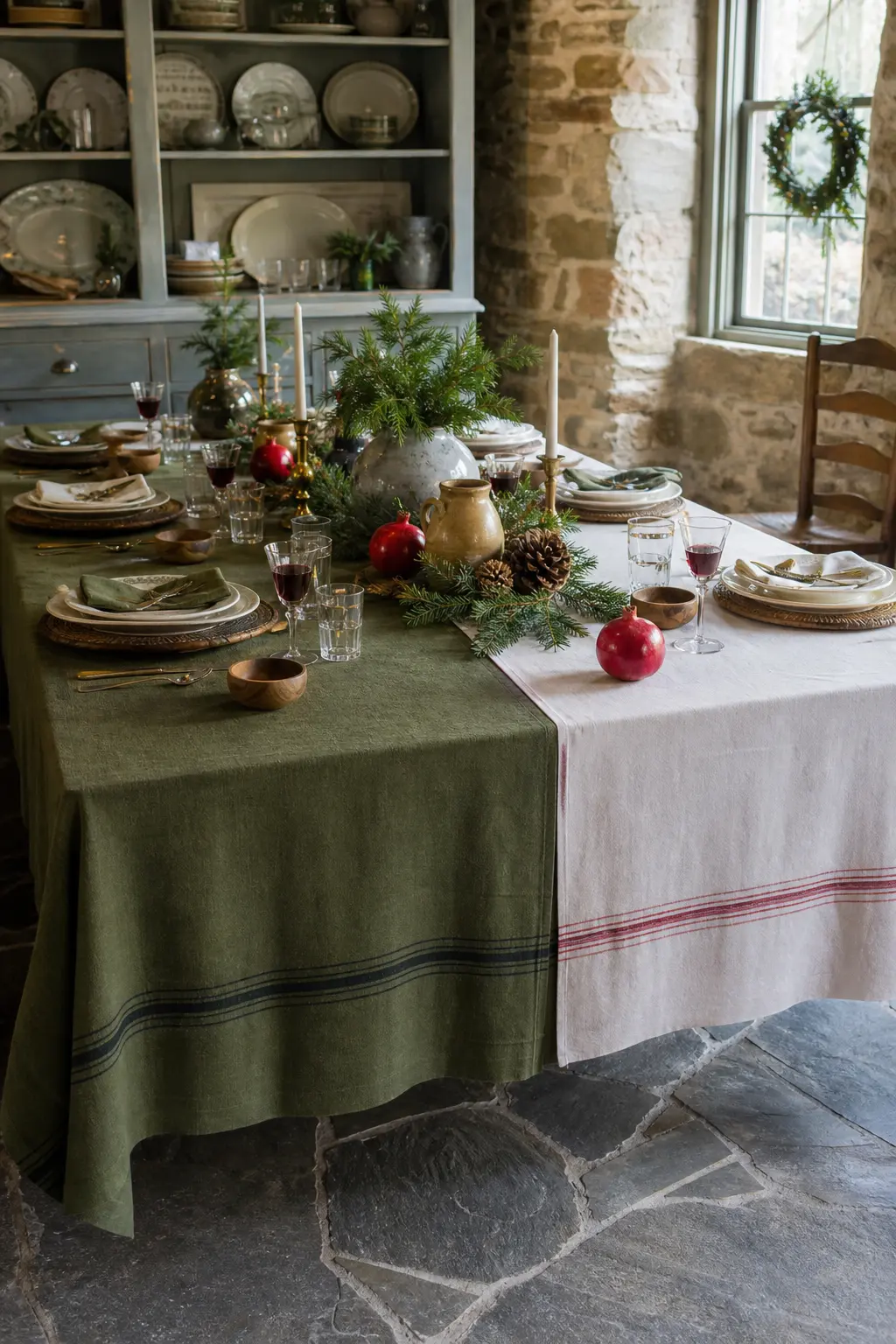
One tablecloth never fits a joined table properly. Two shorter cloths, each covering half, can. Lay them so they meet at the seam, then place something continuous on top, a runner, a line of greenery, a strip of tartan, so the join between the cloths disappears under the join of the decoration.
The cloths do not need to match each other. A white linen one at one end and a raw-linen-coloured one at the other reads as layering if the palette above them is consistent. Add a second cloth at a slight angle over the top half of the table and suddenly the whole arrangement looks considered.
The Centre Line
The centre line is where the decorating happens and where the seam hides. Run something continuous down it and the eye never stops to look for a join.
Greenery Laid Straight Down the Seam
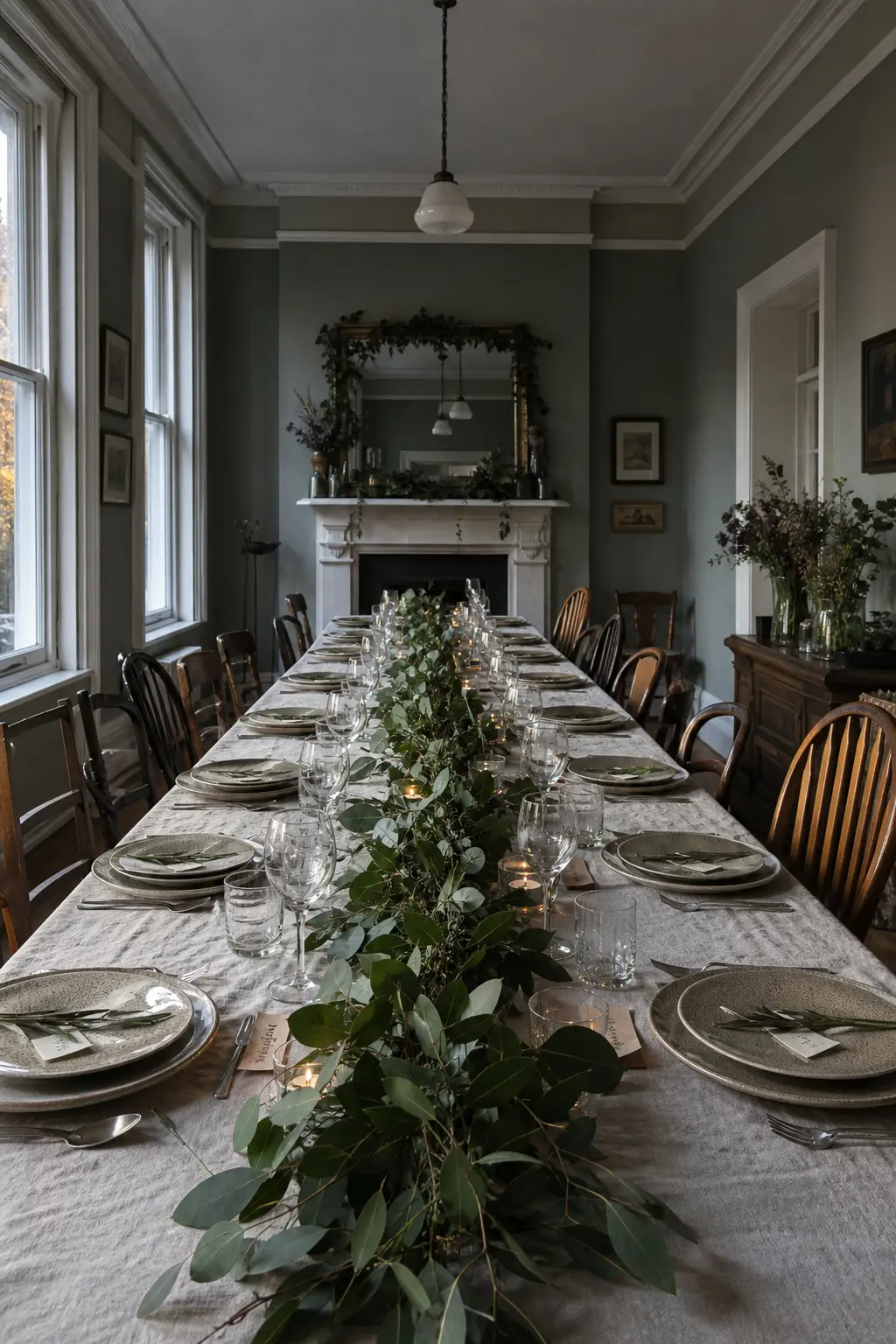
This is the most reliable seam trick on the list. Buy three or four bunches of eucalyptus, spruce, or bay, strip the lower stems, and lay them end to end down the centre of the table, right over the join. The stems overlap, the foliage fans out to either side, and the seam is gone.
Push low bowls or candlesticks down into the greenery at intervals to anchor it. Tuck dried seed heads or small pine cones in between. The greenery does not need to be perfectly arranged: messy is better than rigid, and the natural variation in leaf size and colour gives the table a depth that any florist arrangement would charge you for.
Keep every stem below eye level when seated. Spruce and bay both last several days without water in a cool room, which matters when you are setting up the day before.
🛍 Shopping guide
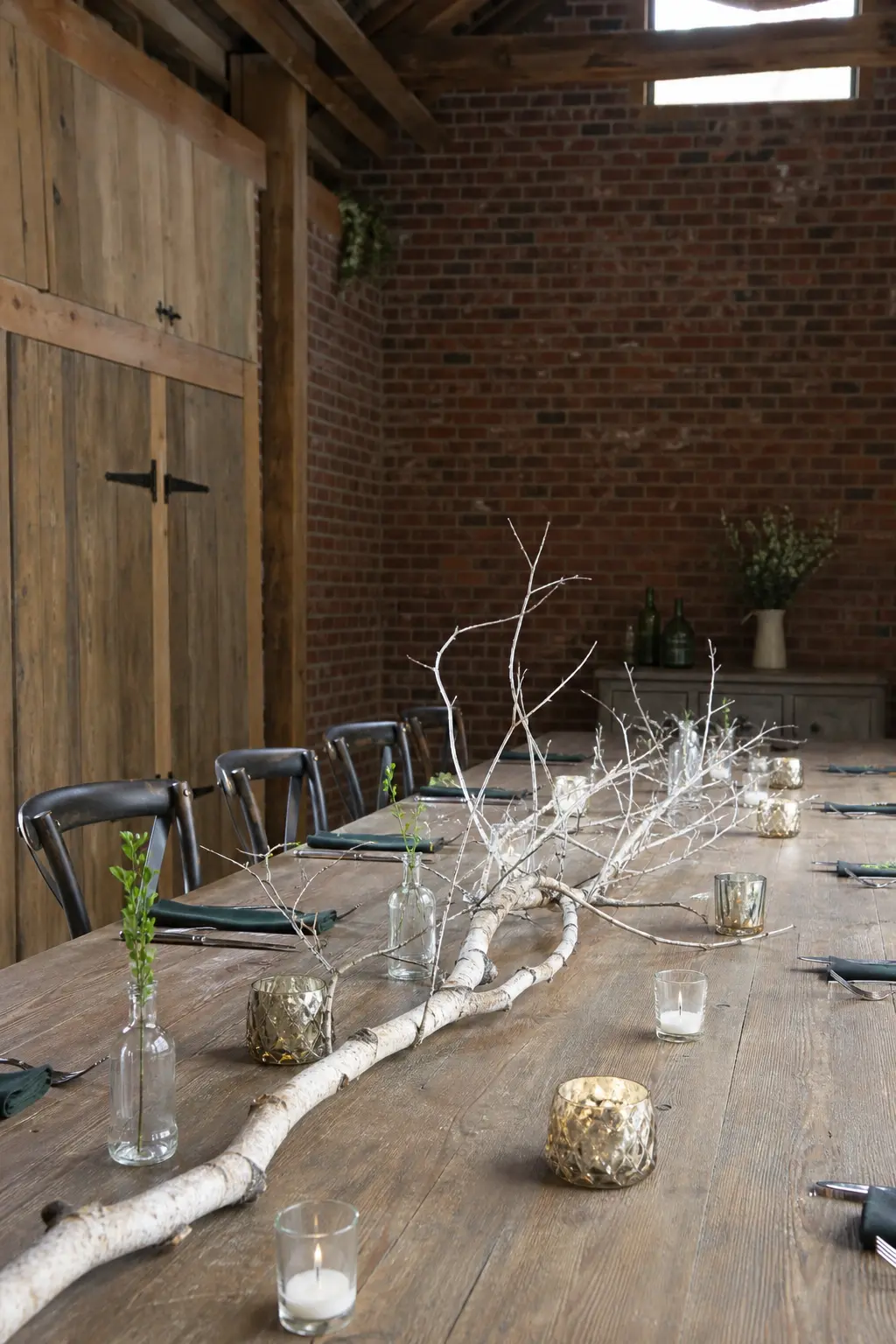
A Bare Branch Laid the Length of the Table
Find a branch from the garden, a silver birch offcut, or a hazel stem long enough to span most of the table. Lay it flat down the centre with its natural curves facing up. Hang small bundles of dried rosemary, a luggage tag, or a tiny glass bottle from its twigs.
The branch sits over the seam and covers it completely. Push tealights and pine cones around its base. At the join between two tables the branch acts as a bridge: it is the same object on both surfaces, so the eye reads continuity, not a gap.
This costs nothing if you have a garden. If you do not, florists and garden centres sell dried birch branches by the stem from autumn onward.
Paper Laid the Whole Length and Written On
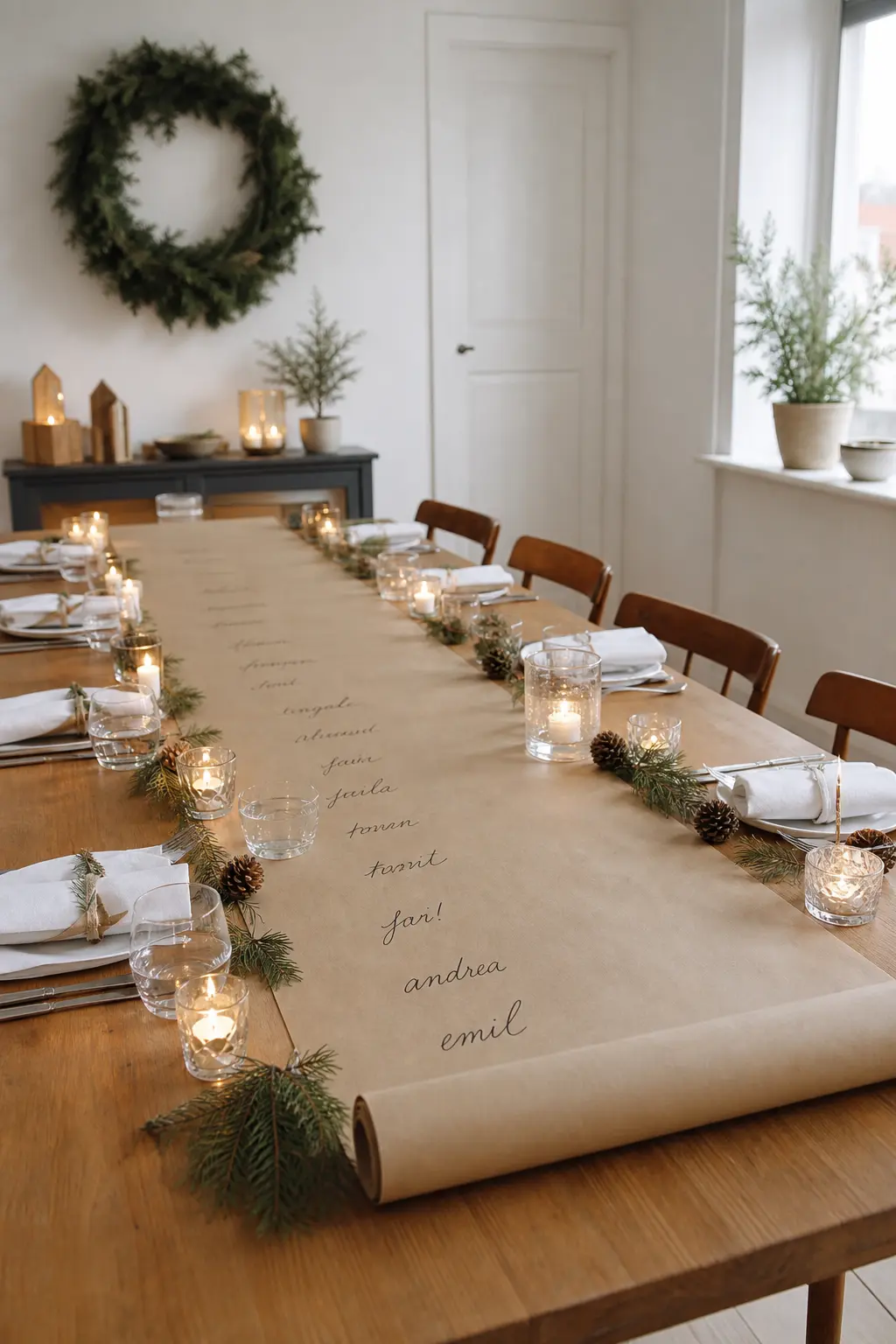
Roll out a length of white or kraft paper down the full centre of the table, from one end to the other, and lay it under the greenery and candlesticks. Before the meal, write guests’ names along it in the rough position of their seat. Write the menu down one side. Write the date. Leave space and put out a few pencils so guests can draw or write during the long middle of the meal.
The paper crosses the seam and makes it irrelevant. It also doubles as a place-card system when the table is too narrow for individual cards. When the meal is over, roll it up: some people keep them. Cut a section out and pin it on the kitchen noticeboard. It costs pennies and the table looks like a restaurant that knew what it was doing.
A Low Garland Pinned to the Table Edge
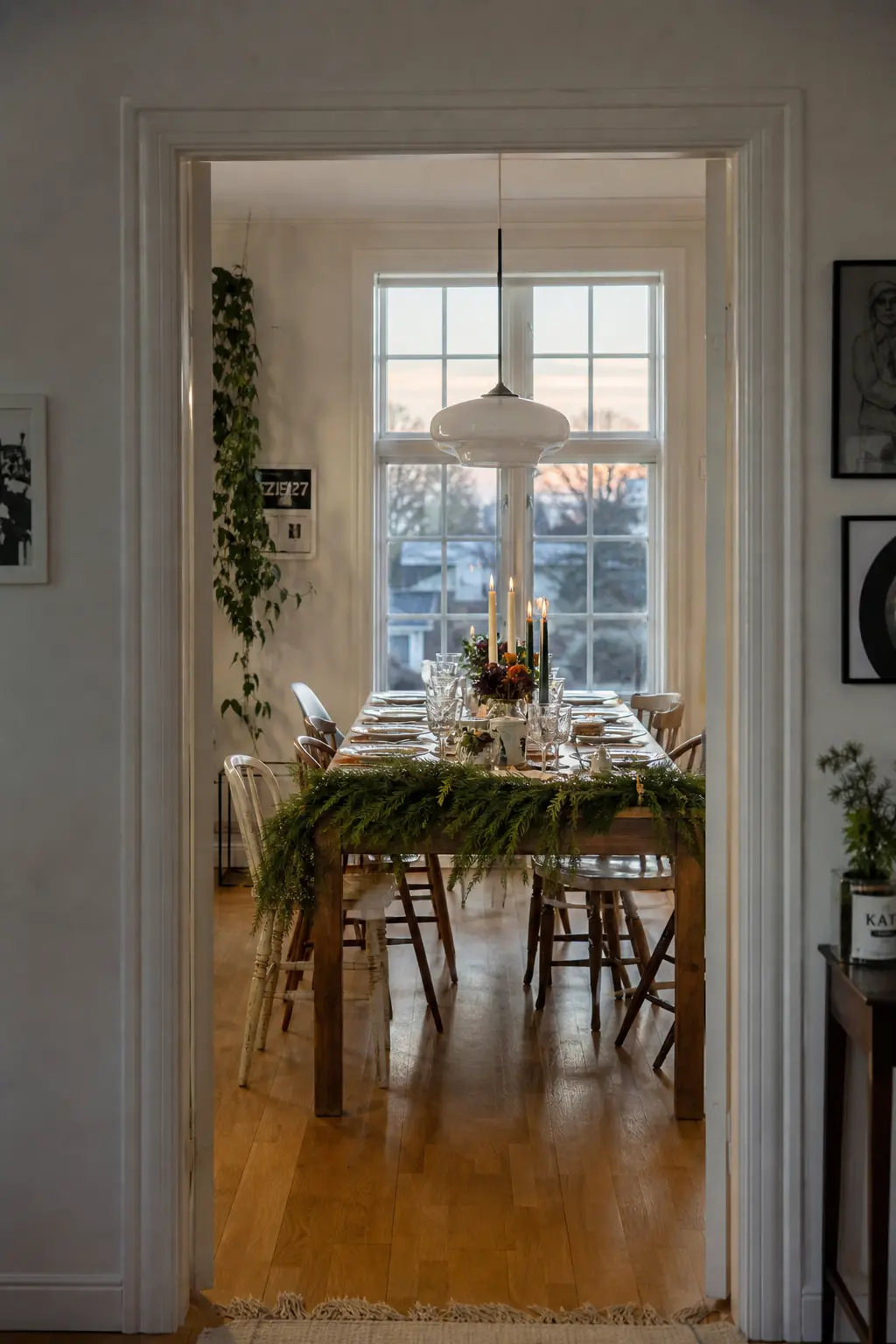
A garland does not have to go on the mantelpiece. Pin a low cedar or spruce garland along the long edge of the table with small bulldog clips or florist wire looped around the table leg brackets. It hangs just below the table surface and frames the whole length from the side.
At the join between two tables, the garland is continuous across both surfaces. That continuity is what makes two tables read as one. Add a few brass jingle bells or short lengths of oxblood ribbon at intervals along the garland for colour and sound.
This works especially well in a room where guests approach from one side. The garland-edged table reads as dressed from across the room, before anyone sits down.
🛍 Shopping guide
Light
Candlelight at Christmas is not optional. It also does more work than any other element: it warms mismatched china, softens a crowded table, and pulls focus away from any surface imperfection.
Brass Candlesticks at Uneven Intervals
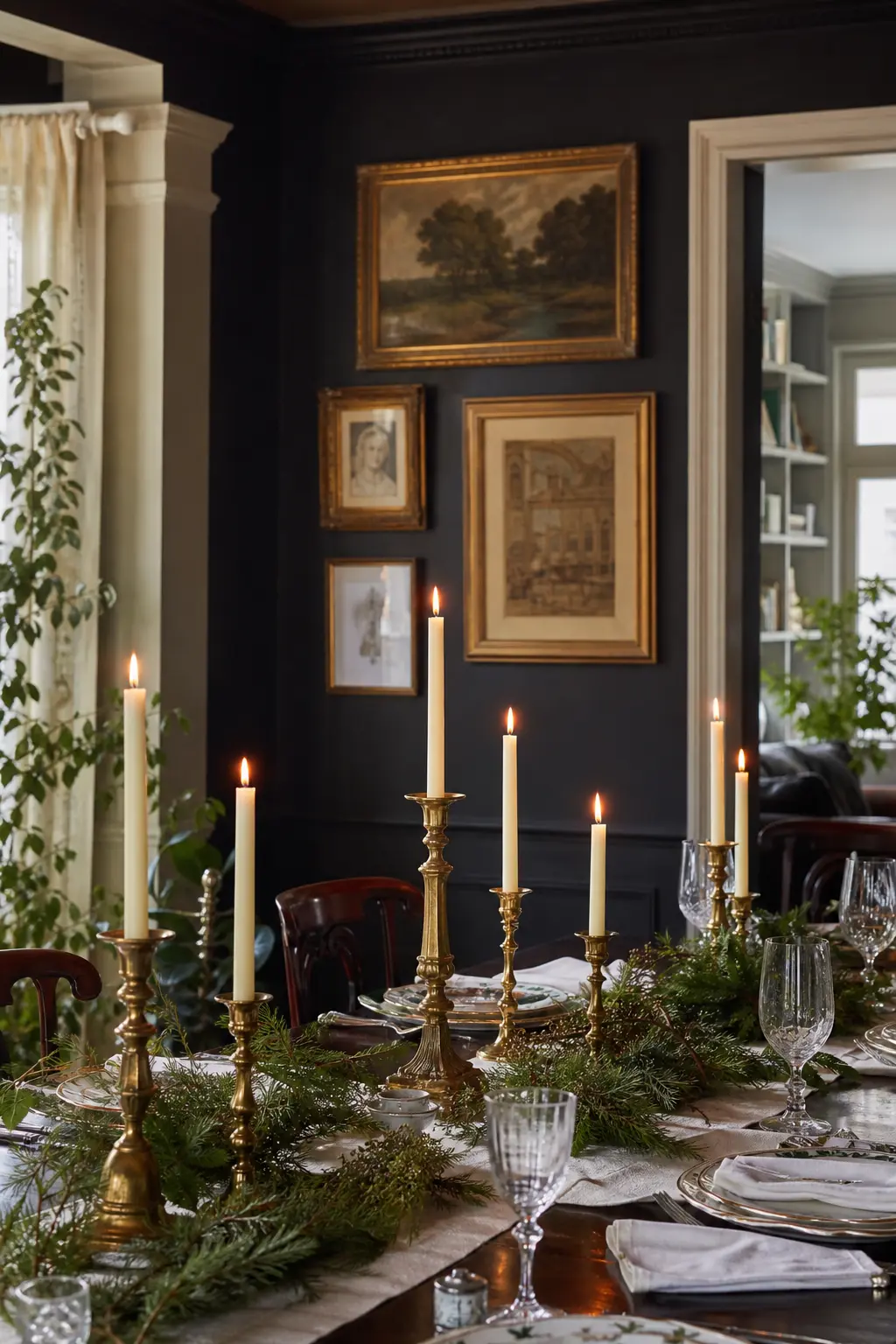
Even intervals are for people with matching sets. Uneven spacing looks collected rather than bought. Place a tall brass candlestick, then two lower ones, then a gap, then one tall one again. The rhythm is offbeat and that is the point.
Put one group of candlesticks directly over the seam. The cluster draws the eye and the seam disappears underneath the base plates. Brass reads warm against raw linen and cedar green, and it does not compete with oxblood or twilight blue at the place settings.
Mix genuine old brass with cheap new ones painted gold. In candlelight, nobody can tell the difference.
🛍 Shopping guide
Candles Raised on Books at the Crowded End
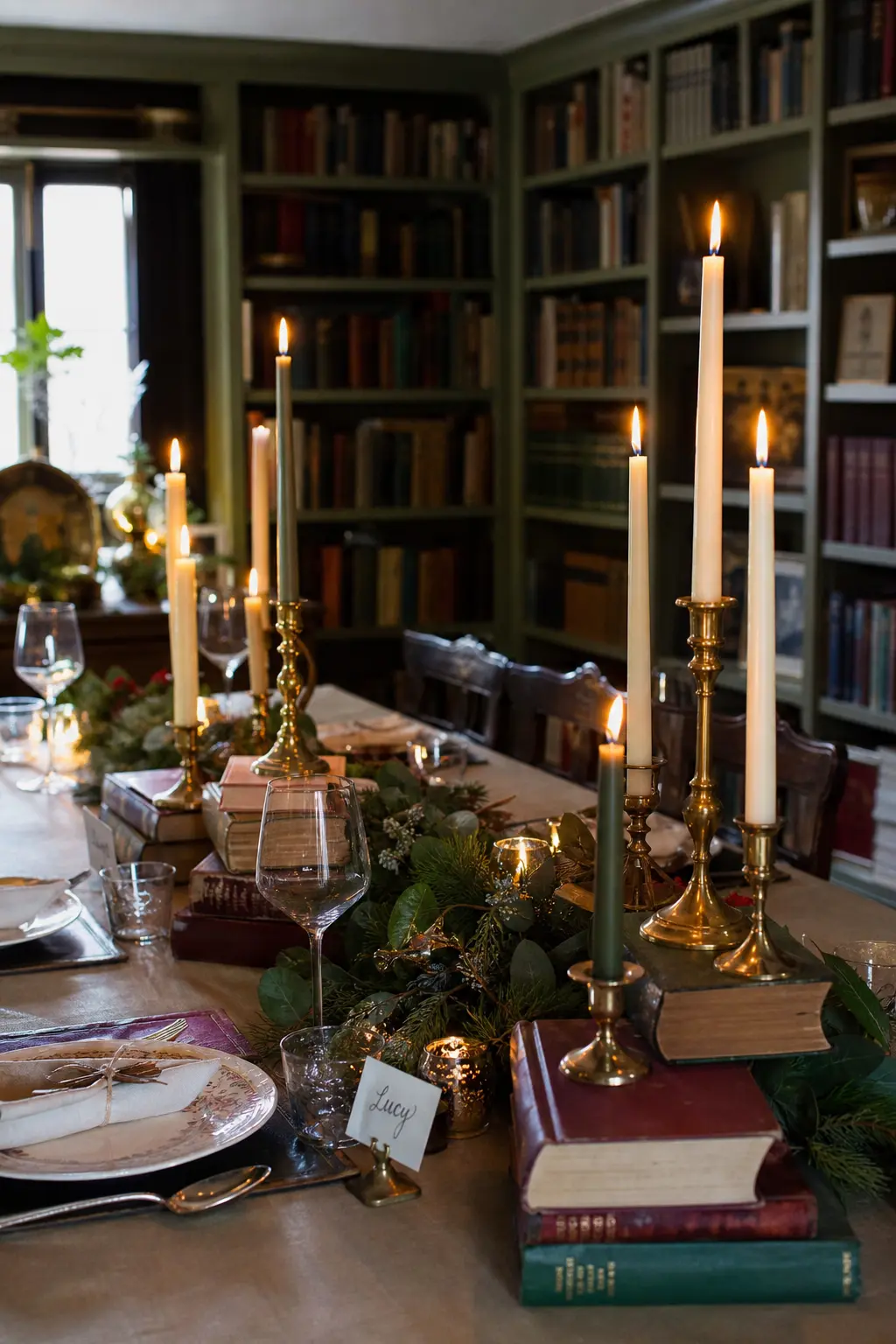
When one end of the table is more crowded than the other, the visual weight tips. Raise the candles at that end on stacks of hardback books wrapped in brown paper or left bare. Two or three books under a candlestick lifts the flame six or eight centimetres and restores the balance.
The books do not need to be hidden. Spines in oxblood, navy, or green add colour and the stacks look deliberate. This also solves the problem of a joined table where one surface sits fractionally lower than the other: a book under the candlestick base covers the discrepancy entirely.
🛍 Shopping guide
The Place Setting
When the china does not match, make the place setting itself the decorative element. A deliberately layered or tied setting reads as a style, not a shortage.
Charger Plates That Hide Chipped China
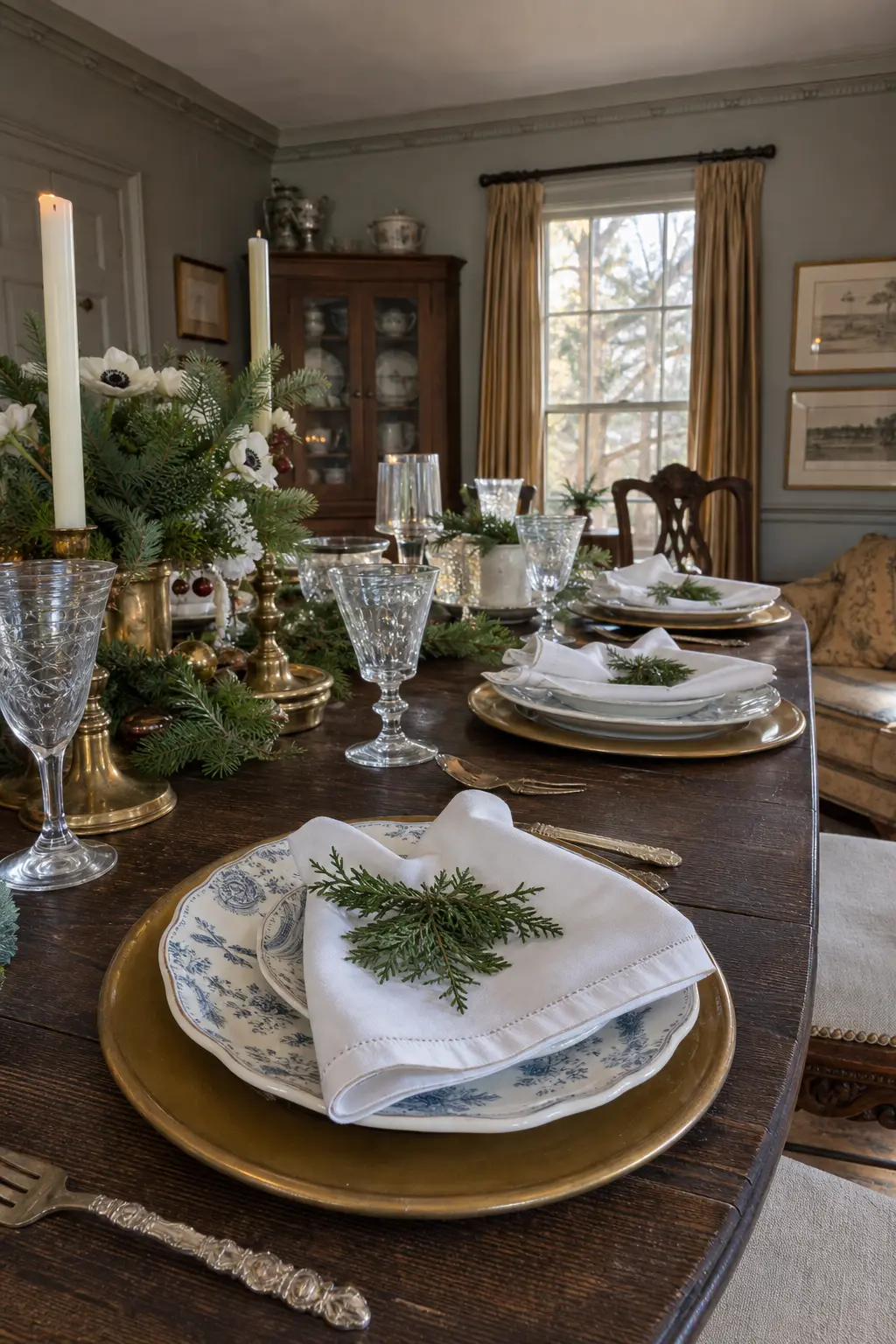
A charger plate goes under the dinner plate, never on top, and its job here is simple: it makes every plate look like it belongs to a set even when it does not. Brass, dark rattan, or slate-grey chargers unify whatever sits on them.
Stack the charger, then the dinner plate, then the side plate if you have one. The chipped rim of a favourite old plate faces down onto the charger and vanishes. Guests see a considered layer, not a mismatch.
Chargers also add visual weight at each place, which helps on a long sparse table where the settings risk looking lost. Choose one charger style and repeat it: the repetition is the order that makes everything else’s variety feel chosen.
Cutlery Bundled and Tied
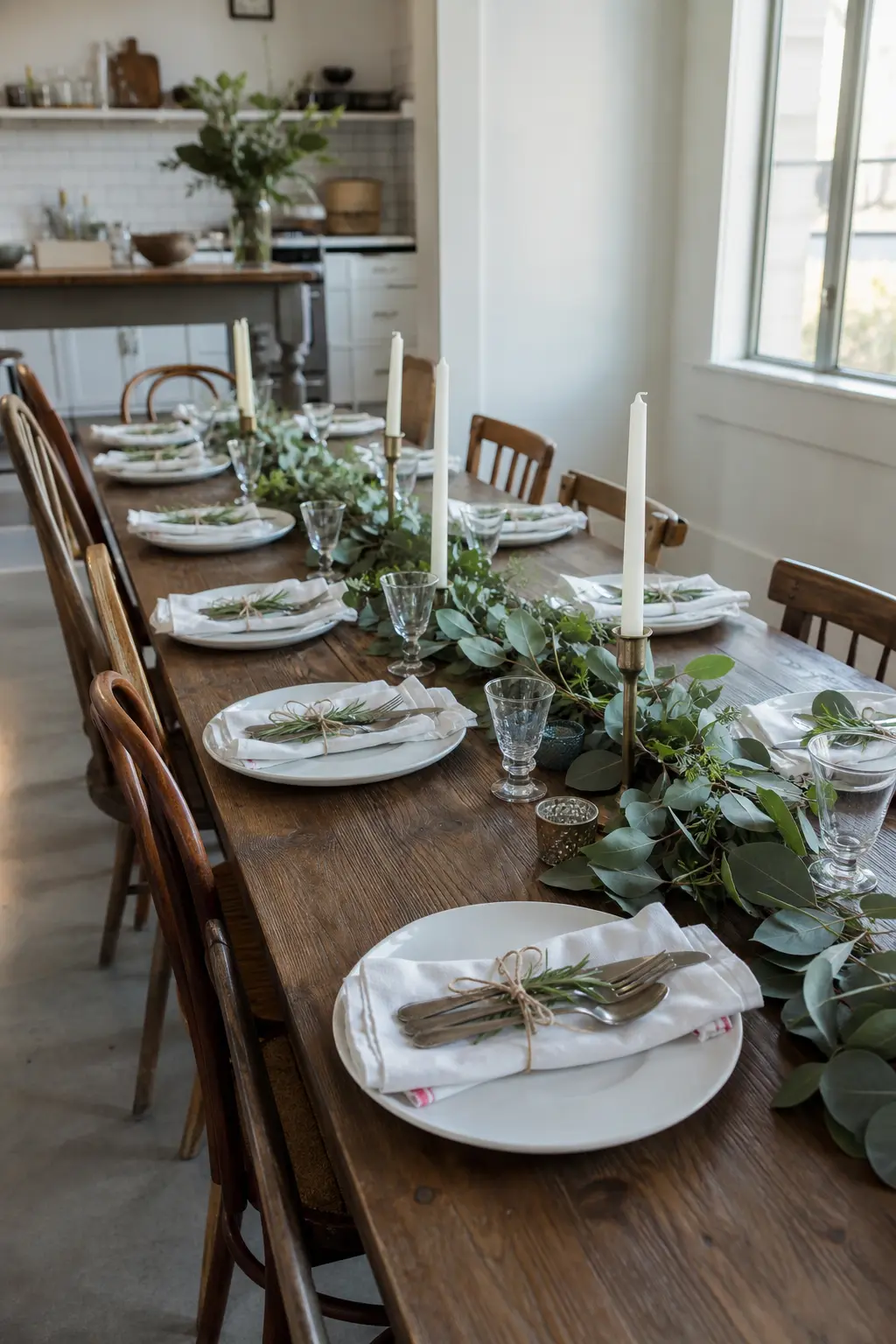
Lay the fork, knife, and spoon together in a bundle and tie them with twine, a strip of linen, or a short length of ribbon in oxblood or twilight blue. Set the bundle on top of the folded napkin or to one side of the plate.
This approach has a practical edge: when the table is crowded and the settings are close together, a bundle takes up half the horizontal space of a spread set. It also disguises the fact that the forks are from three different decades. Tied cutlery reads as a catering style, and that is a compliment.
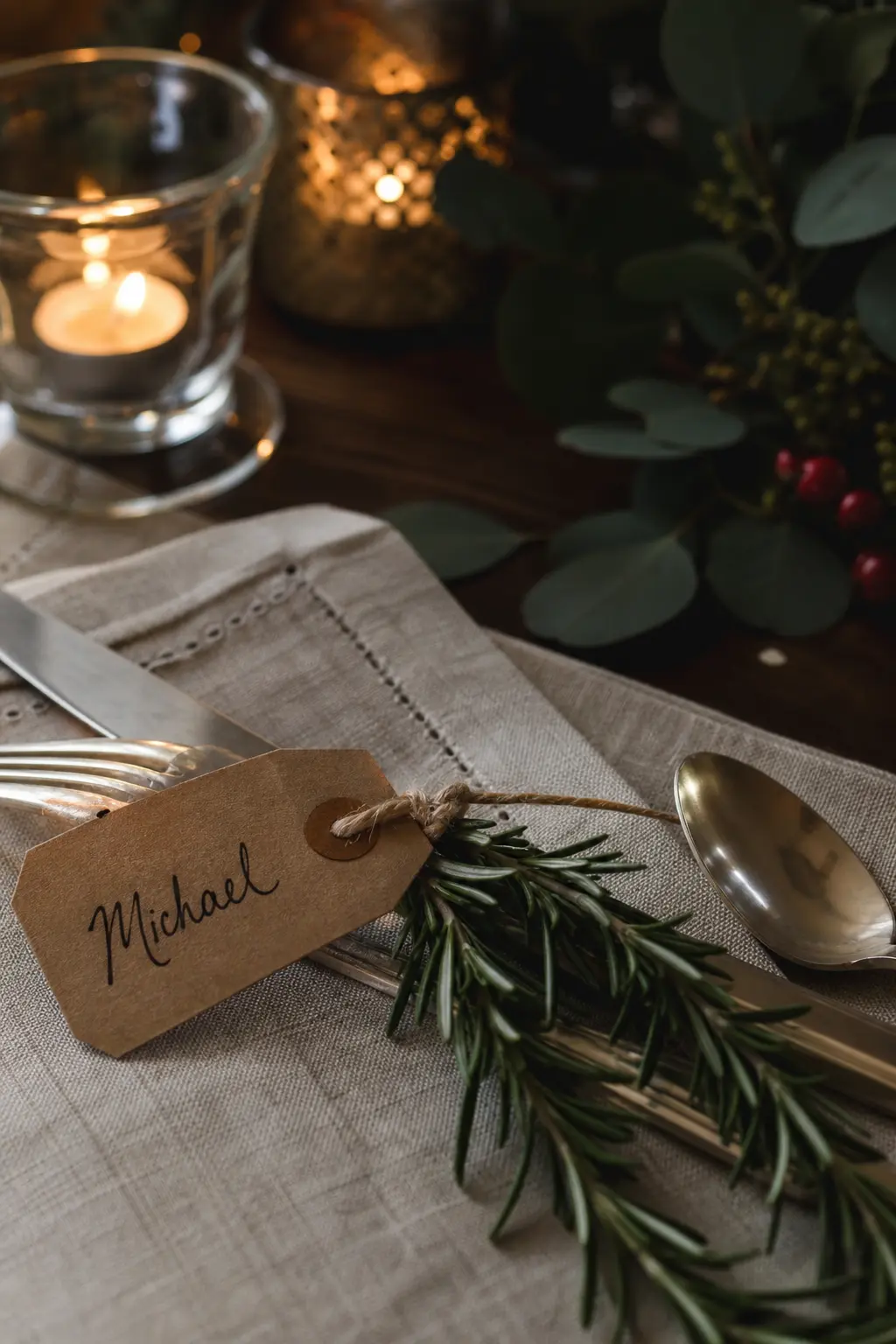
Tuck a sprig of rosemary or a dried seed head into the tie. That sprig is doing double duty as a name-card holder if you slip a luggage tag underneath the twine.
Mismatched Glassware Grouped by Colour
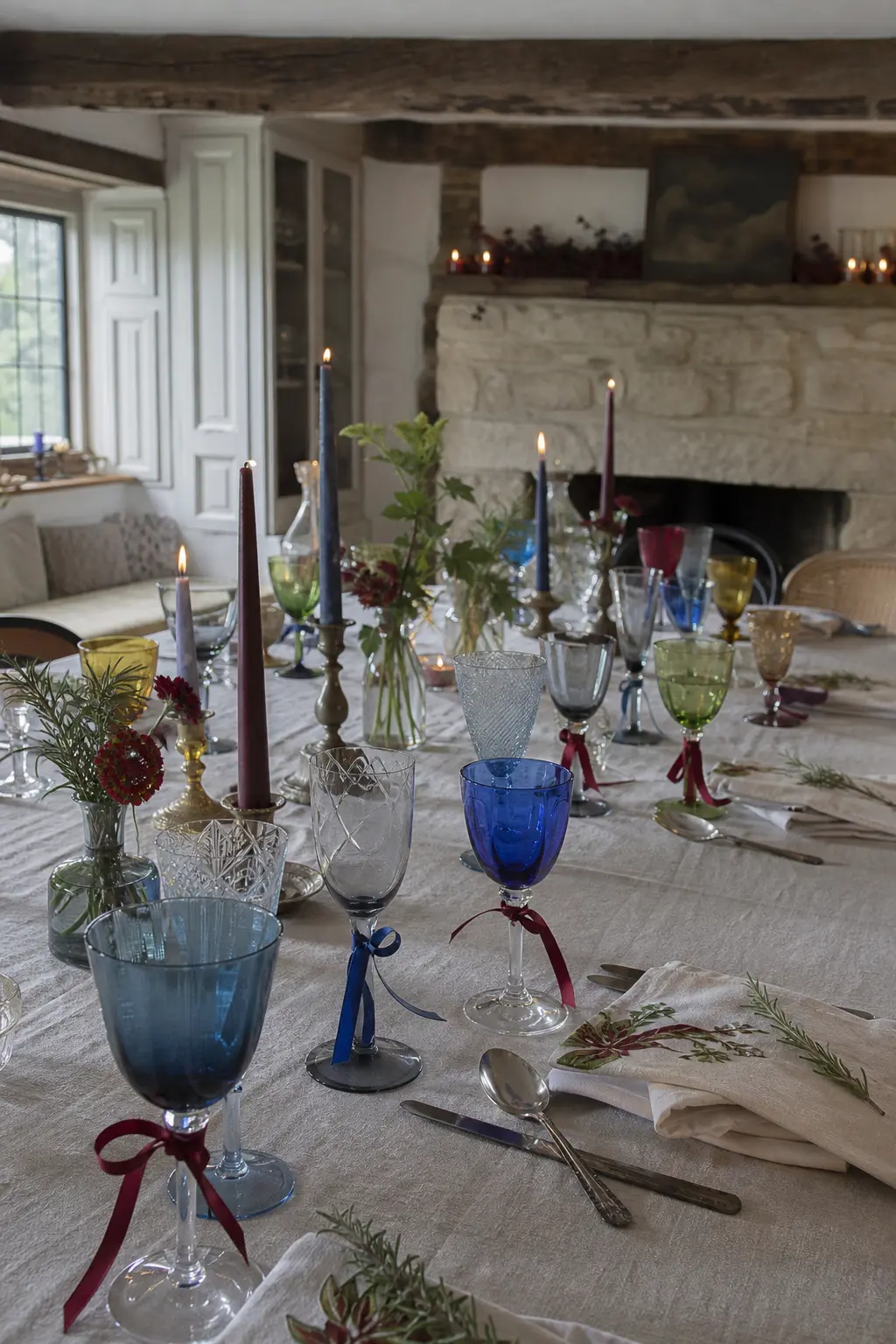
The glasses do not match. Fine. Group them by colour: all the clear ones at one setting, all the green-tinted ones at another, the blue ones together at the end where the borrowed chairs are. The grouping makes the variation look curated.
Mark each guest’s glass with a short length of ribbon tied around the stem in the palette colour nearest to their seat. This solves the age-old problem of whose glass is whose, and it adds a second stripe of colour at the place setting without any extra buying.
Ribbon on glass also photographs well at table height, which matters when the rest of the table is layers of texture that need a clean repeated element to stop the image reading as chaos.
Name Cards Written on Luggage Tags
Kraft luggage tags come with their own string. Write a guest’s name on each one in a thick pen, loop the string around the bundle of cutlery or around a napkin ring, and the place card is also the napkin holder and the cutlery anchor. Three jobs, one object.
At a crowded table where every centimetre counts, a luggage tag takes up no lateral space. It hangs from something rather than standing up, which means it cannot be knocked over during the inevitable reaching-across moment. It also looks handmade in the good sense: personal, not expensive.
Write something on the back. A table question, a fact about the guest, a prediction for next year. The tag becomes a conversation piece and those always earn their place at a table where people do not all know each other yet.
Christmas Table Decorations
Everything above is a starting point. The real trick with a stretched table is to commit to one palette and repeat it at every interval, so the borrowed chair at the far end still belongs to the same party as the good one nearest the door. Cedar green, oxblood, and brass do that work quietly. Raw linen and twilight blue stop it reading as too formal.
For more direction on flowers and foliage on a long table, the guide to christmas floral arrangements goes deeper on stem choices. The wider christmas decor hub covers every room if the table is part of a bigger brief. And if candles are doing most of the work this year, the christmas candles article covers every format from pillar to taper. For centre-table focal points, the christmas centerpieces guide pairs well with the low-bowl and branch ideas here.
Frequently Asked Questions
How do I decorate a long Christmas table?
Run one continuous element down the full length, greenery, a branch, paper, or a linen runner, so the eye travels from end to end rather than stopping at any individual setting. Place something deliberate over every seam or join. Repeat one colour, brass or oxblood or cedar green, at every third interval to create rhythm without requiring matching pieces.
What goes in the middle of a Christmas table?
Anything low and continuous works better than one central arrangement, especially on a long table. A line of greenery broken up by candlesticks, a bare branch with tealights around it, or a strip of paper that runs end to end all give the middle of the table a purpose without blocking the view across it. The rule is nothing taller than eye level when seated.
How do I set a table with mismatched plates?
Add one repeated element under or on top of every plate to unify them. A charger plate in a single style, a folded napkin in one colour, or a tied bundle of cutlery all create enough visual consistency that the variation in the plates reads as collected rather than incomplete. Group any colour families together so neighbouring plates share at least one tone.
How tall should a Christmas centrepiece be?
Below seated eye level, which is roughly thirty to thirty-five centimetres from the table surface for most adults. Anything taller blocks conversation across the table and makes the setting feel divided in half. Use height in candlesticks rather than in floral or foliage arrangements, since a flame above eye level is visible without being obstructive.

Plan an office christmas party with these 14 guides to themes, decorations, games and coworker gifts

12 Christmas pinecone crafts for the tree, the door, the table and the gift box, most of them free f

20 indoor winter games for kids — no yard, low mess, nothing breakable. Perfect for snow days, par
Leave a Reply