

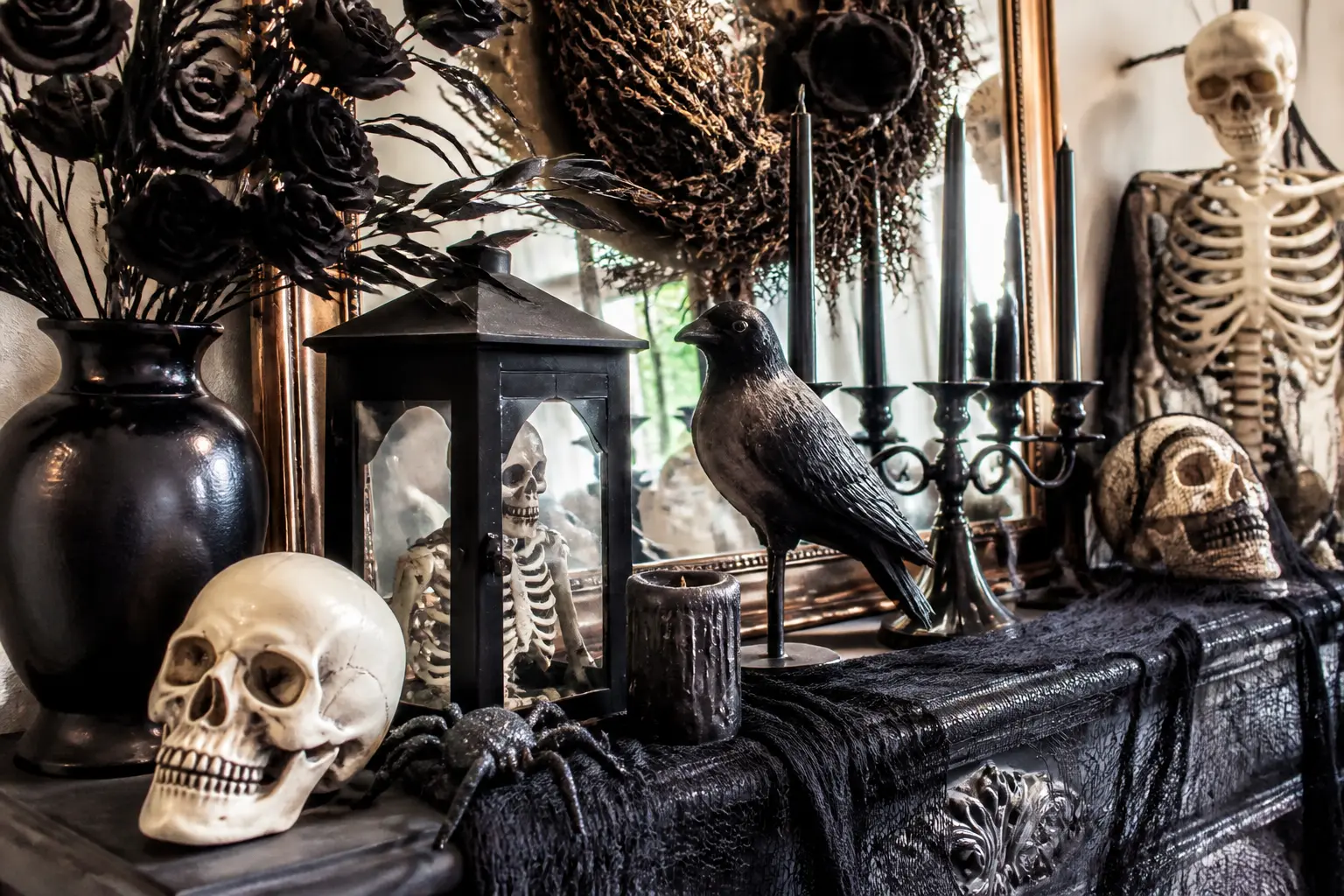
Scary halloween decorations do not require a fog machine the size of a suitcase or a motion-activated witch that shrieks at children.
The things that actually unsettle people are quieter: a suggestion of presence, an object slightly out of place, a light that goes off at the wrong moment. Dread lives in the gap between what you see and what you cannot explain.
Every idea here is built on three principles. First, restraint: one well-placed detail outperforms a cluttered yard every time. Second, staging: where a thing sits in relation to the viewer changes its entire meaning.
Third, lighting: the wrong source, the wrong angle, and a perfectly ordinary object becomes genuinely wrong. If you want people to feel something on the way to your door, this list is where to start.
And if you need something for guests to do once they get inside, these Halloween games for adults pair well with a disturbing atmosphere.
The 38 ideas below are grouped by where and how they work. None of them involve gore, costume characters, or anything the party-supply aisle would recognize as spooky.
This post contains affiliate links. If you buy through them, I may earn a small commission at no extra cost to you.
- The Yard: What They See Before They Decide to Come Closer
- The Windows: Framing the Interior for Outsiders
- The Porch: The Threshold Nobody Quite Wants to Cross
- Sound and Light: The Two Things Nobody Thinks to Use Well
- Interior: Rooms That Feel Recently and Wrongly Left
- Objects That Ask a Question
- Botanical and Organic: Living Things in the Wrong State
- The Last Detail: One Final Note Before the Door
- Frequently Asked Questions
The Yard: What They See Before They Decide to Come Closer
The yard is a wide, open read. Visitors take it in all at once, which means a single wrong detail lands harder than a dozen props competing for attention. The goal is one clear image that raises a question the eye cannot answer.
Placement matters as much as the object. Something at the far edge of the yard works differently from something at the center. Distance makes the brain fill in the blanks, and whatever the brain invents is worse than anything you could buy. Keep the rest of the yard bare and let the one thing do its work.
Fog Rolling Low with Nothing Visible Above It
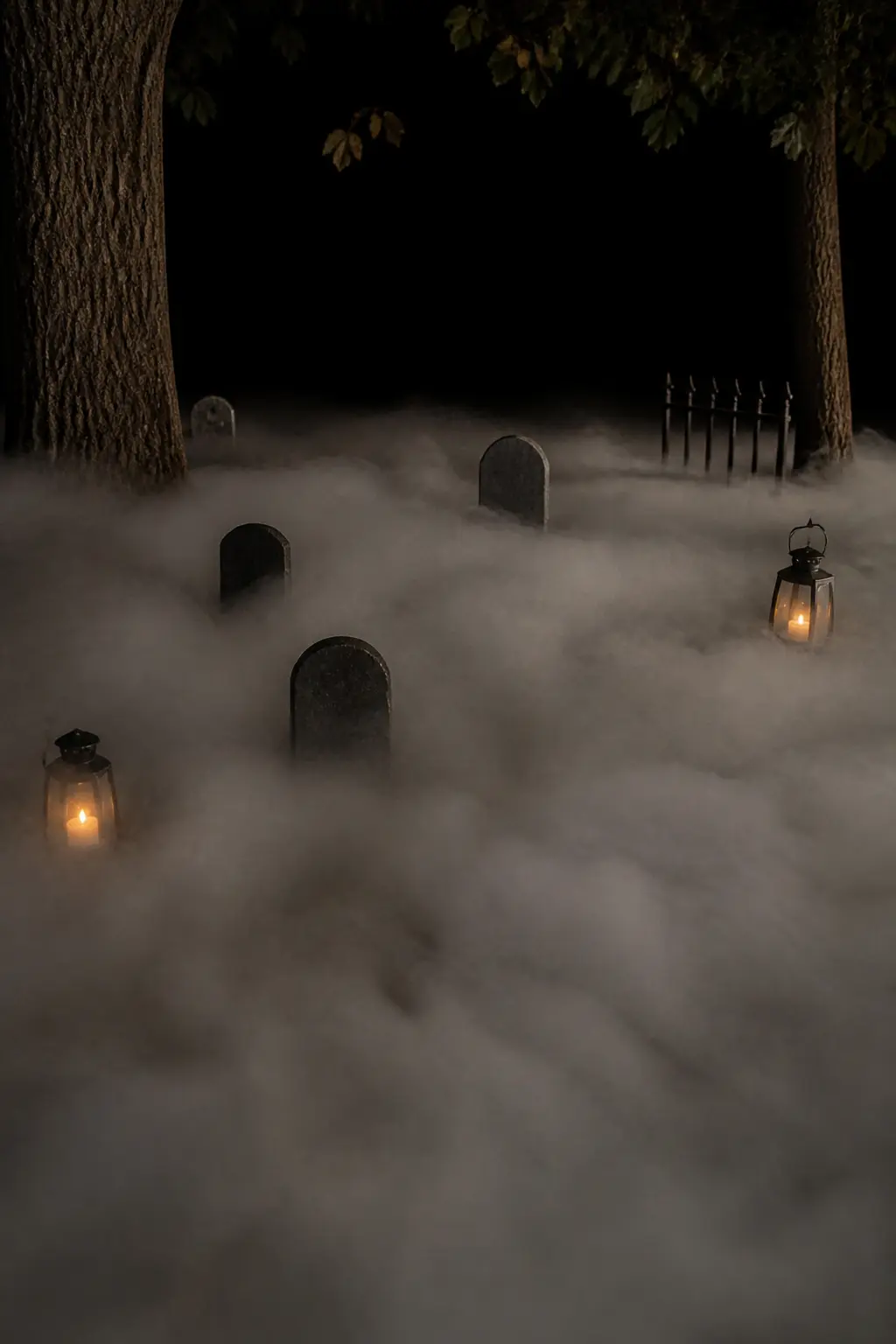
Standard fog machines push vapor at mid-height, which looks festive and dissipates fast. A chiller attachment, or dry ice in a bucket of hot water, drops the fog to ground level where it rolls across the lawn in a slow, dense layer. Ankles disappear. The path into the yard becomes uncertain.
The effect is strongest when the yard above the fog line is completely clear and quiet: no props, no lights aimed at it, nothing. The absence of anything visible above the ground layer is what reads as wrong. Keep the fog source hidden behind a shrub or a low wall so the source is never part of the image.
🛍 Shopping guide
Doll Parts Scattered in the Mulch Bed
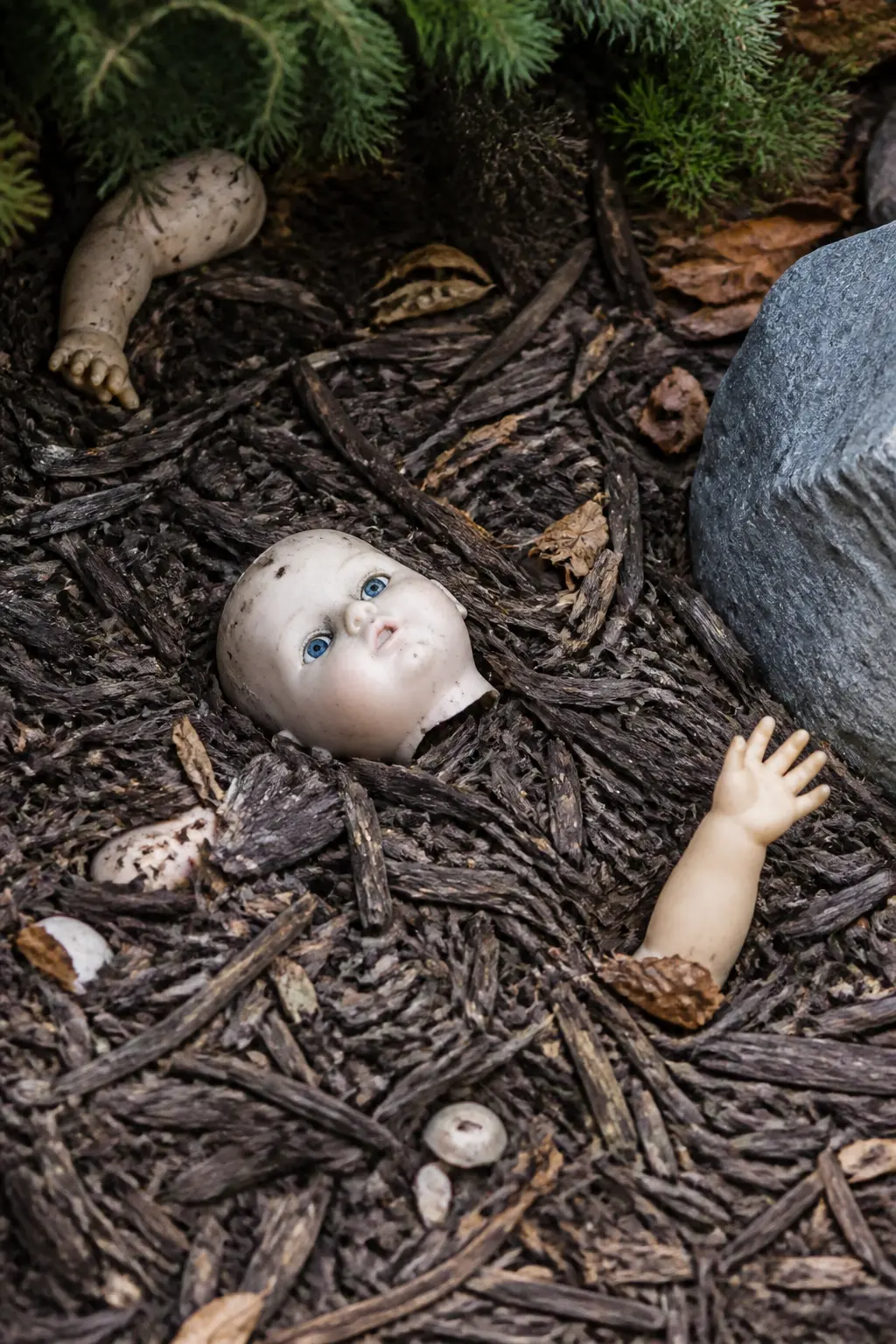
Thrift stores sell dolls for almost nothing. Pull them apart and distribute the pieces across a mulch or garden bed with no pattern or grouping: one arm here, a head half-buried there, a leg propped against a stone. The scatter is the point. An arranged display reads as decoration; a scatter reads as aftermath.
Leave some pieces partially buried so they seem to have been there a while. Weathering with a wash of diluted brown craft paint ages plastic convincingly in about ten minutes. Do not add anything else to the bed. The empty space around each piece is what makes each piece visible as a discrete wrong thing.
Skeleton Half-Buried in the Dirt, Only Ribs Showing
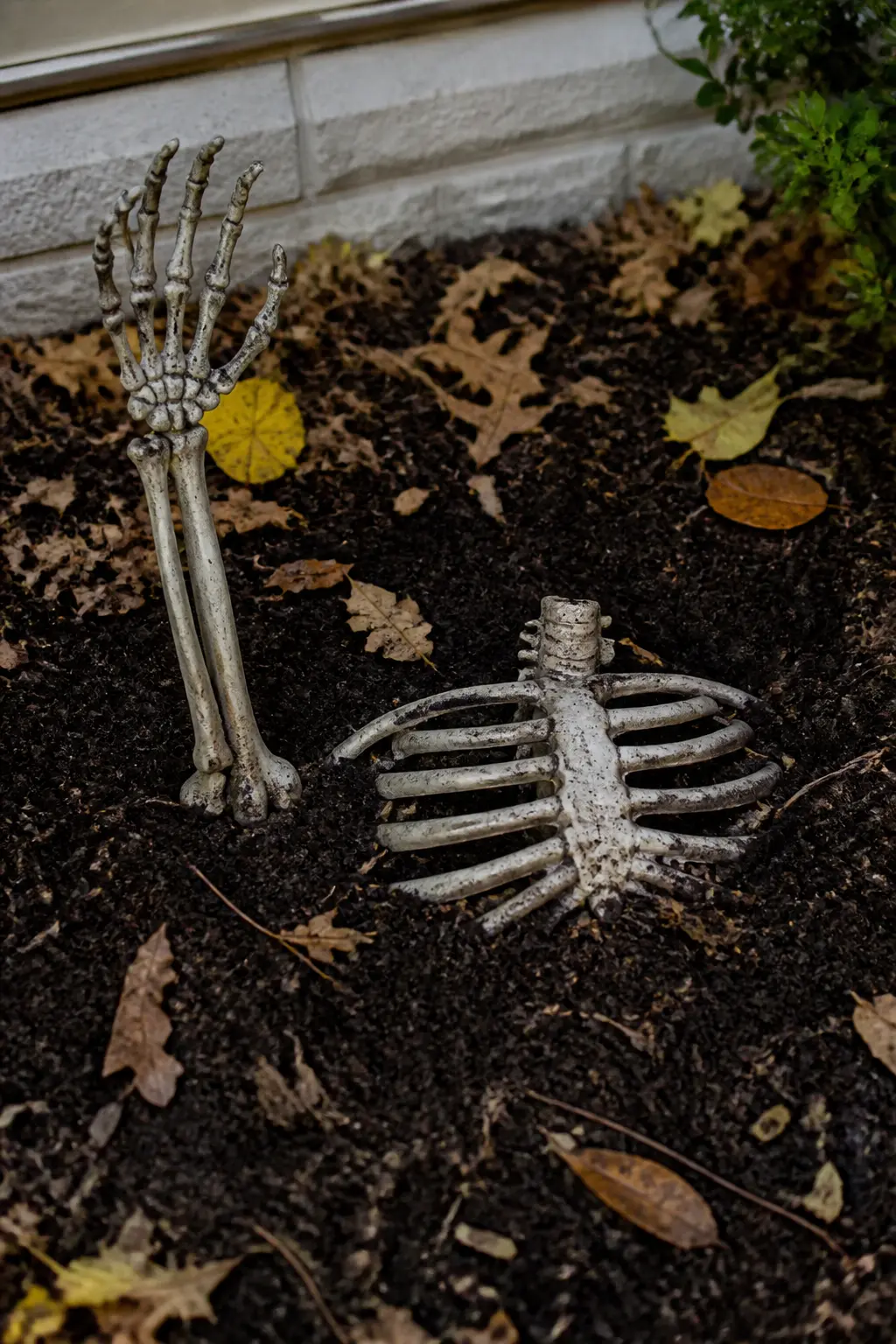
A full-size plastic skeleton, buried to the hip in a garden bed or bare patch of lawn with only the ribcage and one hand visible above the soil line, reads as something that has been there for a long time.
The partial concealment is what makes it read as real rather than prop: a fully visible skeleton is a decoration, a mostly buried one is a discovery.
Pack dark soil or mulch up around the bones and press it tight. Add a weathering wash of diluted brown paint to the exposed sections. Position one arm reaching slightly upward rather than flat, but keep it low, just enough to catch the eye.
🛍 Shopping guide
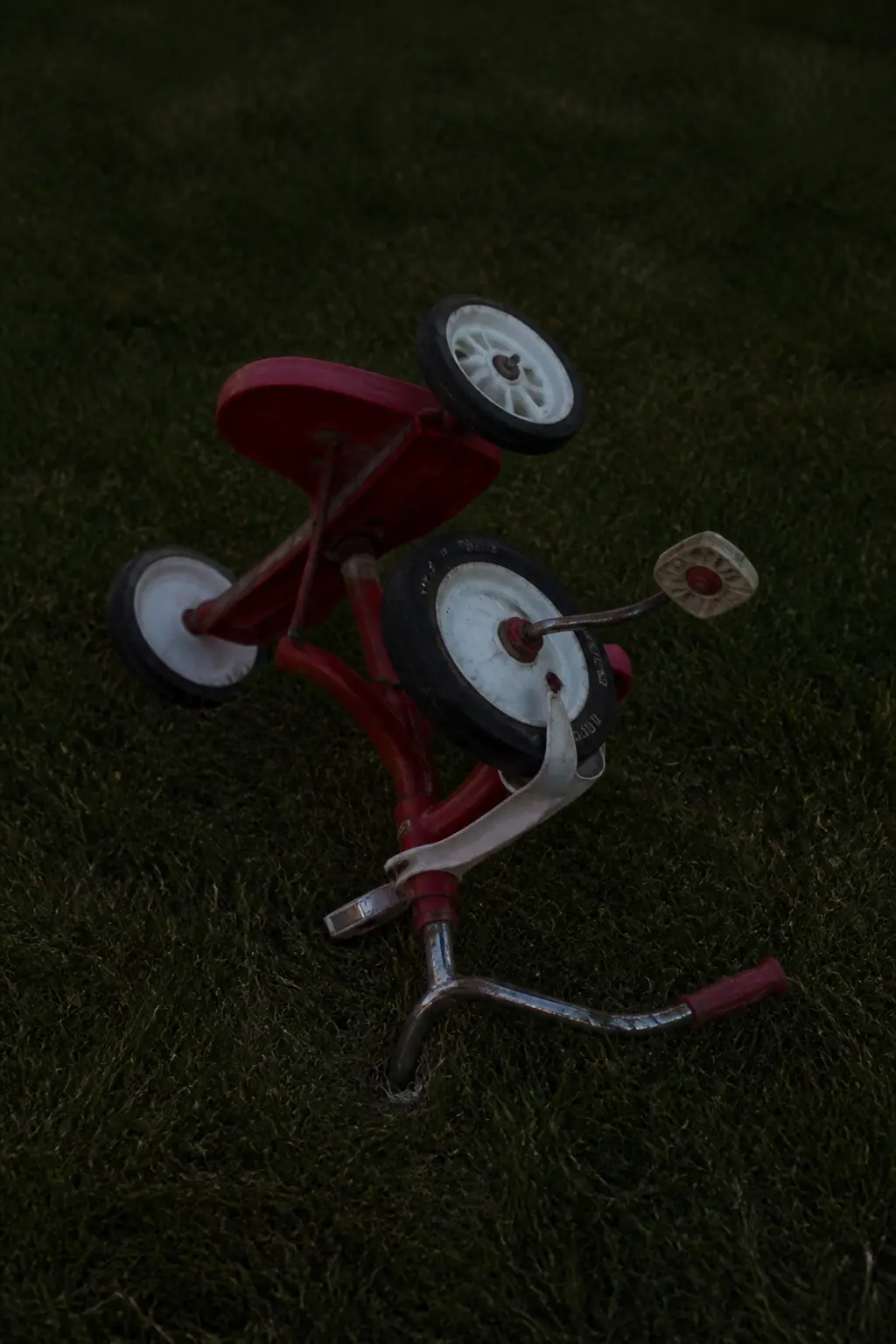
Overturned Tricycle on the Lawn with Nothing Near It
An overturned child’s tricycle, wheels in the air, sitting alone on an otherwise empty lawn, tells a story entirely through implication. No child is near it. No adult is near it. The event that tipped it over is not in the frame. The brain runs immediately to narrative, and narrative is always worse than prop.
Find one at a thrift store or garage sale. Red reads most clearly at a distance and picks up whatever ambient light is available. Do not weather or distress it: the bright color against a dark lawn is the contrast that makes it register. Leave a wheel or two still spinning if there is any breeze.
🛍 Shopping guide
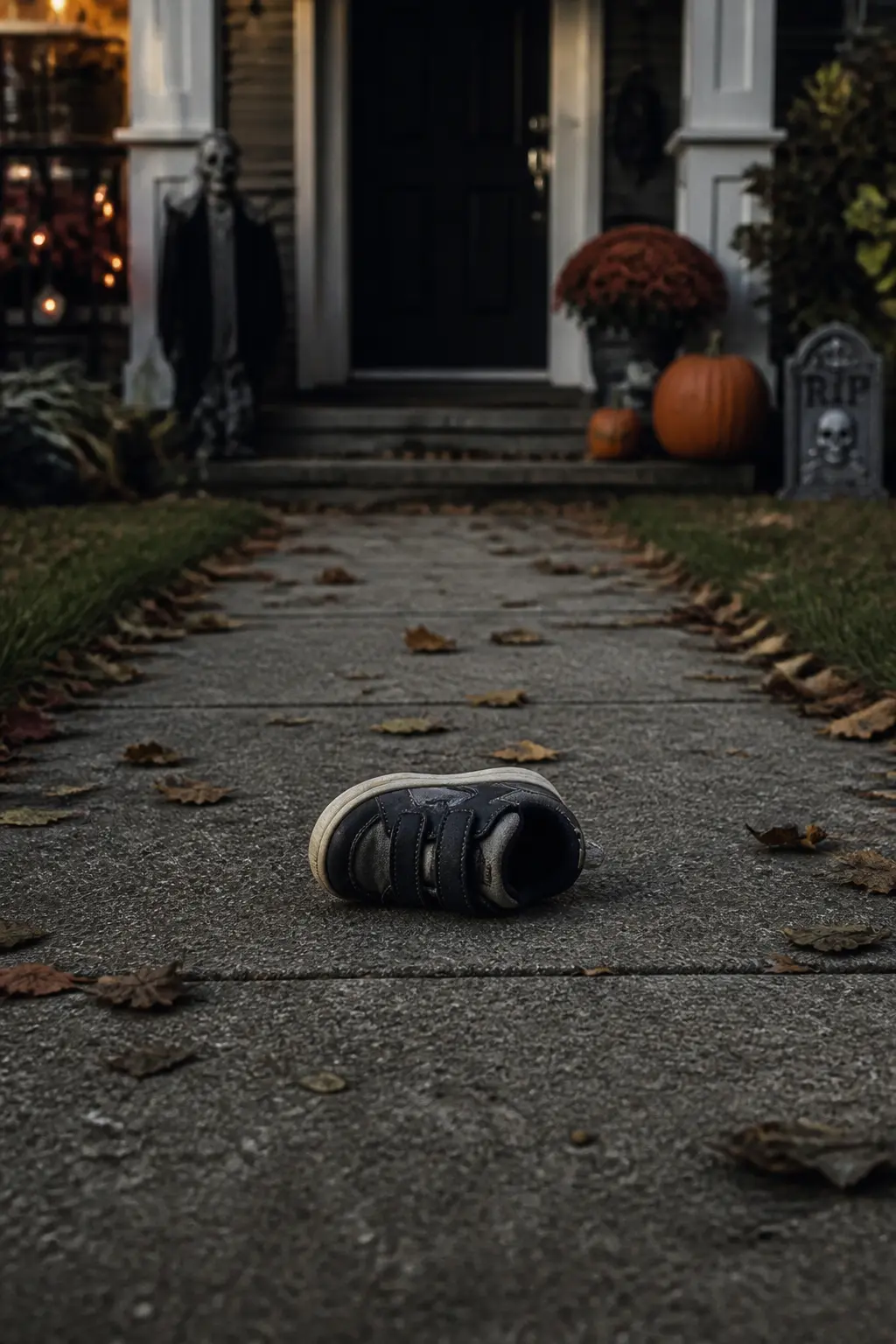
A Child’s Shoe on the Path Alone
A single small shoe, a sneaker or a Mary Jane, placed on the path leading to the house with nothing near it, not a second shoe, not a child, not any other object, produces a specific and deeply uncomfortable narrative reflex. The brain cannot help but construct a story, and no story it constructs has a cheerful ending.
Scuff and slightly muddy the shoe so it reads as recently worn rather than deliberately placed. Position it with the toe pointing toward the house, as though the direction of travel was inward. Leave it on its side rather than standing upright: a shoe that has fallen is more unsettling than one that has been set down.
🛍 Shopping guide
The Windows: Framing the Interior for Outsiders
A window is a stage. It has a frame, a light source, and a viewer who cannot enter. Whatever you place behind one immediately reads as a scene, and the fact that glass separates the viewer from the subject makes it feel more observed than invited.
Work from inside looking out: what shape, silhouette, or mark will register clearly at a distance of ten feet? Keep everything else in the room dark. The window is the only story you are telling.
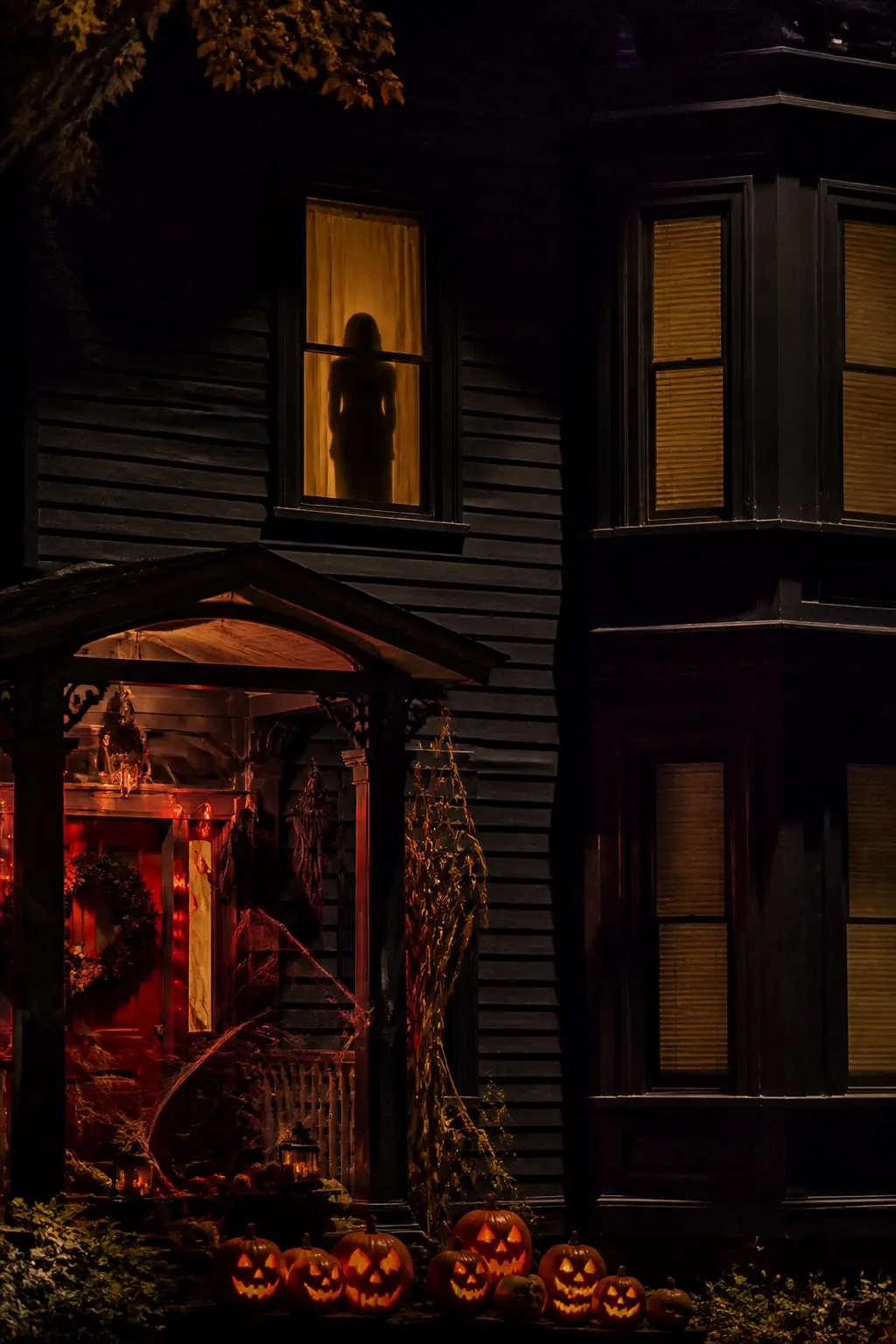
Single Figure Standing Motionless in an Upstairs Window
A mannequin, a dress form, or even a coat on a hanger: positioned at an upstairs window and backlit by a single dim lamp, it reads as a person. The fact that it does not move is the problem.
People expect figures to shift, glance away, notice them. One that simply stands becomes deeply wrong within about three seconds of being seen.
Turn off every other light in that room. The window should be the only bright rectangle on that side of the house. Face the figure away from the street so the viewer sees only a silhouette and cannot confirm what it is.
🛍 Shopping guide
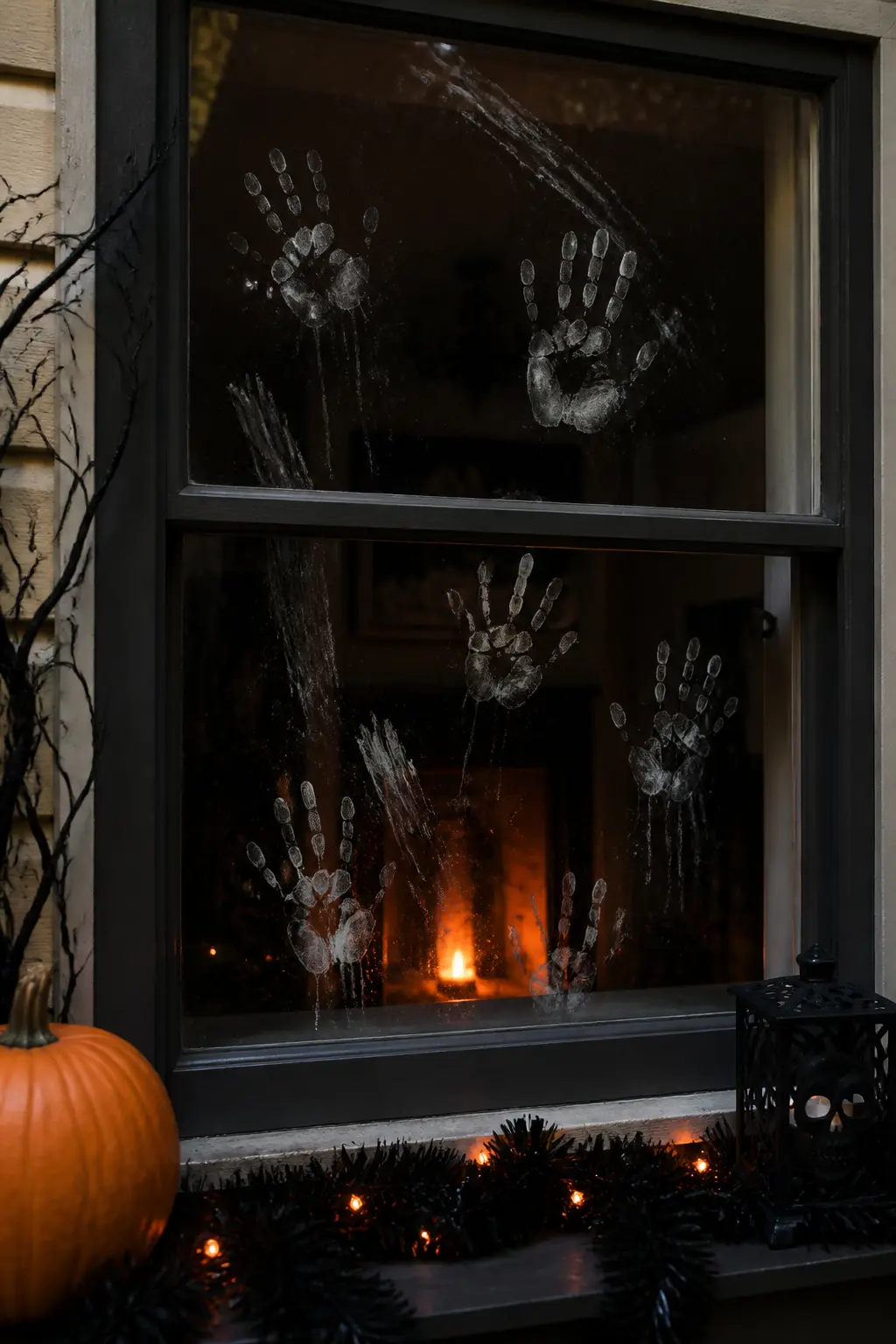
Handprints Smeared on the Inside of a Window
White or gray tempera paint applied to the inside of a window glass, pressed with open hands, and then partially wiped reads instantly as an attempt from inside to be seen. The smear matters as much as the print: a clean handprint is a craft project, a smeared one is a story.
Work from the lower third of the pane, where the scale suggests a smaller person or someone crouching. Backlight the window faintly so the prints are visible from outside but the room behind them stays dark. Tempera washes off with water after the event.
🛍 Shopping guide
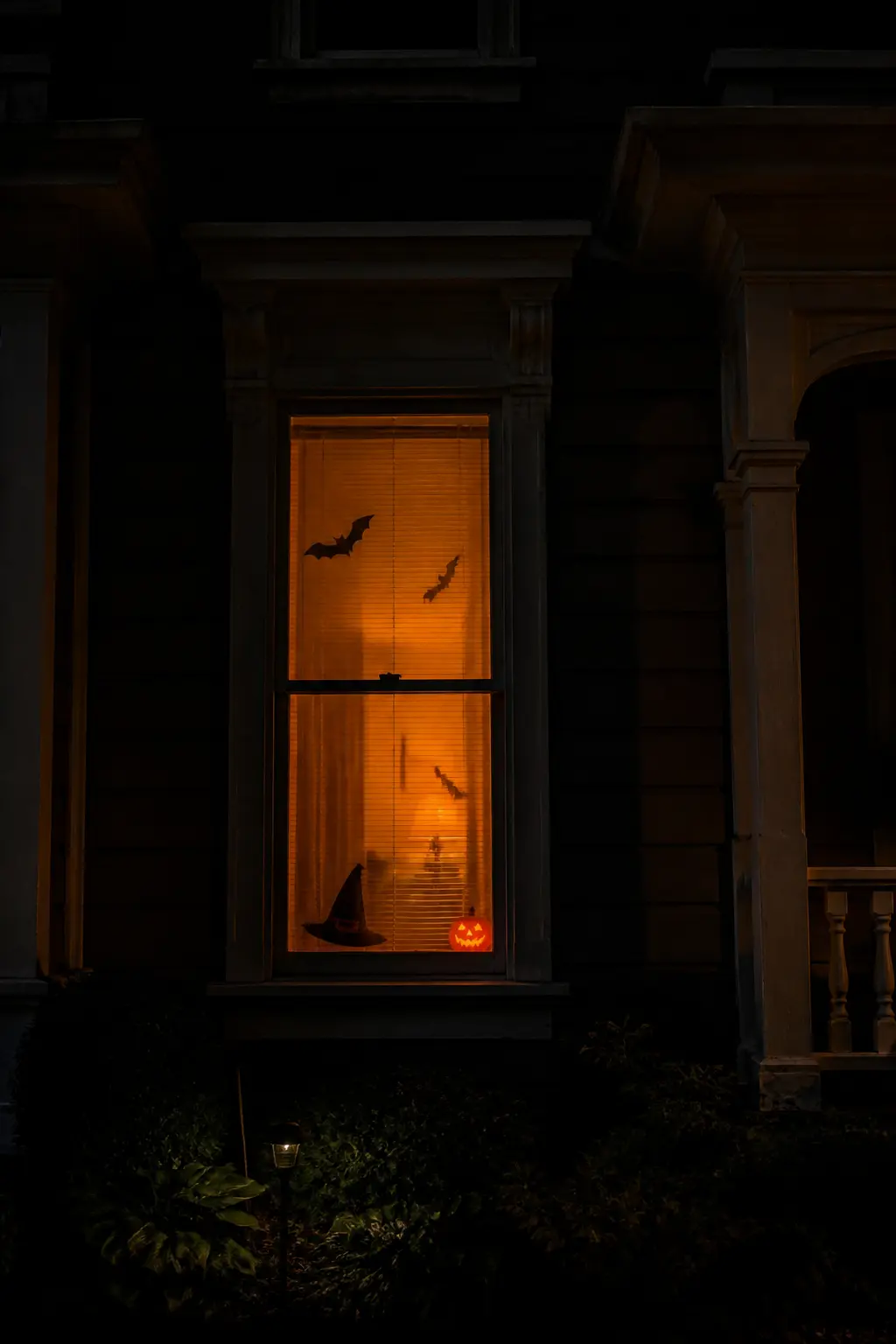
A Single Lit Window in an Otherwise Dark House
Turn off every exterior light and every interior light except one. That one window, glowing from inside while the rest of the house is dark, signals occupation in the most stripped-back way possible. The brain immediately asks who is in there and why only that one room is lit.
Choose the window carefully: a side window rather than a front one, or an attic window if the house has one, because the unexpected location of the light adds to the wrongness.
Put something behind it, a lamp on the floor rather than a table, so the light source is low and the top half of the window glows less than the bottom.
🛍 Shopping guide
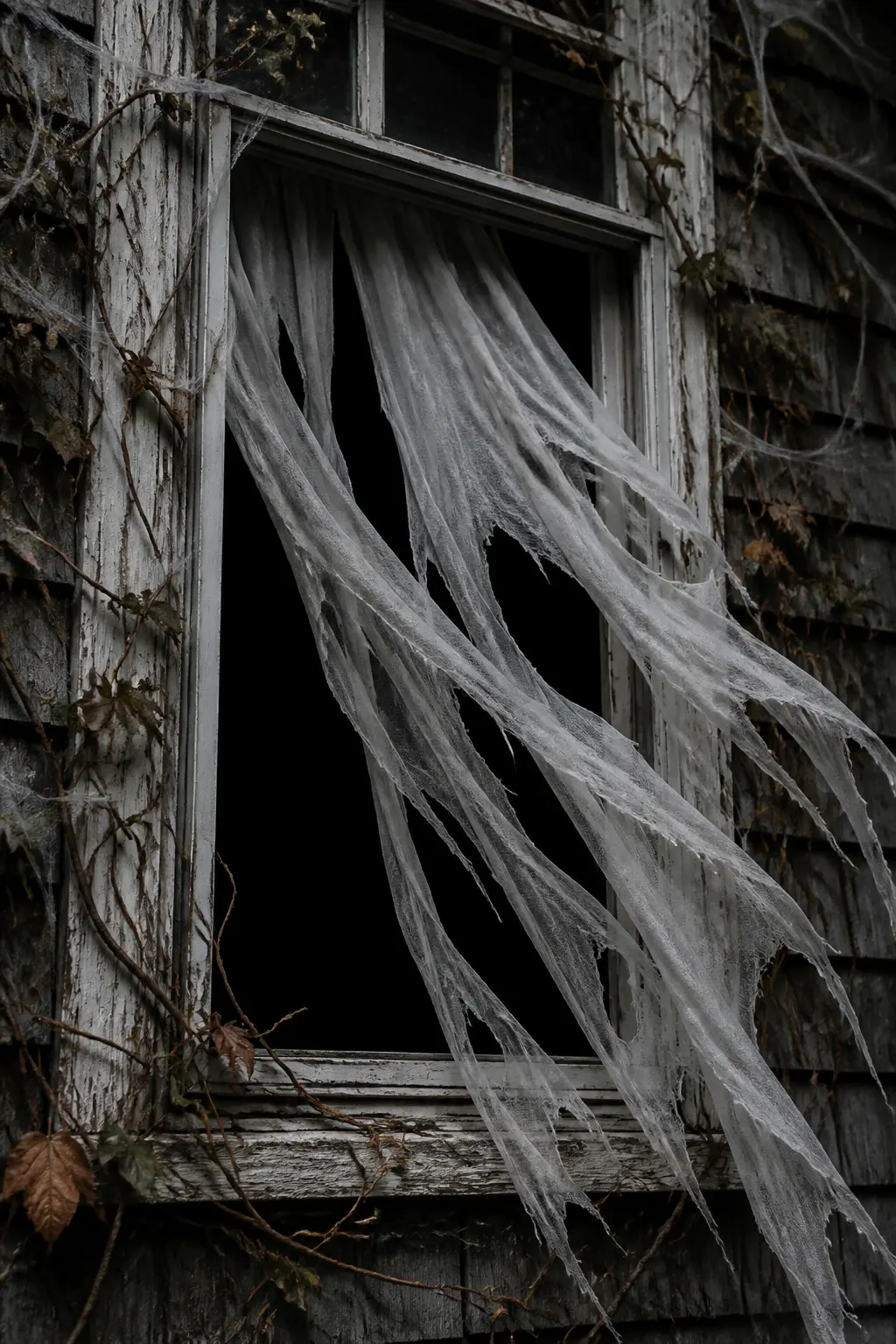
Torn Curtains Blowing Out an Open Window
An open window with fabric blowing outward signals that someone left in a hurry, or that something inside pushed the air. Hang sheer curtains with vertical tears cut into them and leave the window open so they billow. The tears read as damage, which is a different register from decoration.
Keep the interior of the room dark. The curtains should be the only thing moving, and the movement should be irregular rather than constant: this is why a window with actual airflow works better than a fan, which produces a steady predictable billow that looks staged.
🛍 Shopping guide
The Porch: The Threshold Nobody Quite Wants to Cross
The porch is where guests commit. They have left the pavement, they are at your door, and the decision to knock feels slightly less reversible than it did at the end of the path. Use that psychology. One detail here, correctly placed, is worth five things in the yard.
Stick to low, dim light on the porch itself. A single amber or green bulb, placed below eye level, changes every familiar object into something harder to read. Keep the door area uncluttered so that whatever you have placed there gets the full attention it deserves.
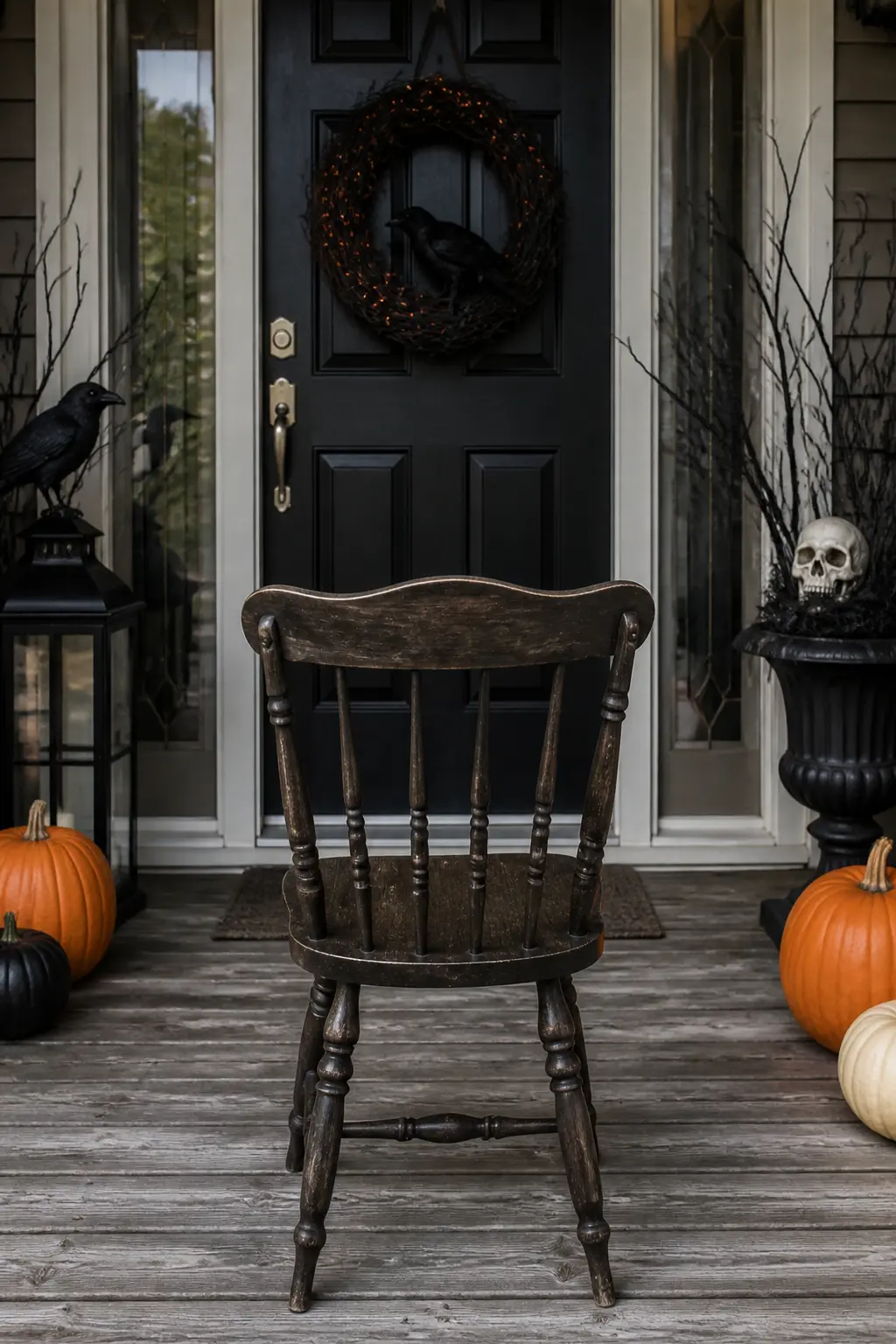
Chair Facing the Wrong Direction on the Porch
A porch chair facing outward toward the yard is normal. A porch chair facing the wall, or turned to face directly at the front door rather than toward the street, is not. The viewer’s brain runs through and rejects the ordinary explanations very quickly, which is where the discomfort begins.
Do not add a figure to the chair. The empty chair facing the wrong way is worse than one with something in it, because the viewer cannot stop asking who sat there and why it has not been turned back. Leave it completely bare: no cushion, no throw, nothing on the seat.
🛍 Shopping guide
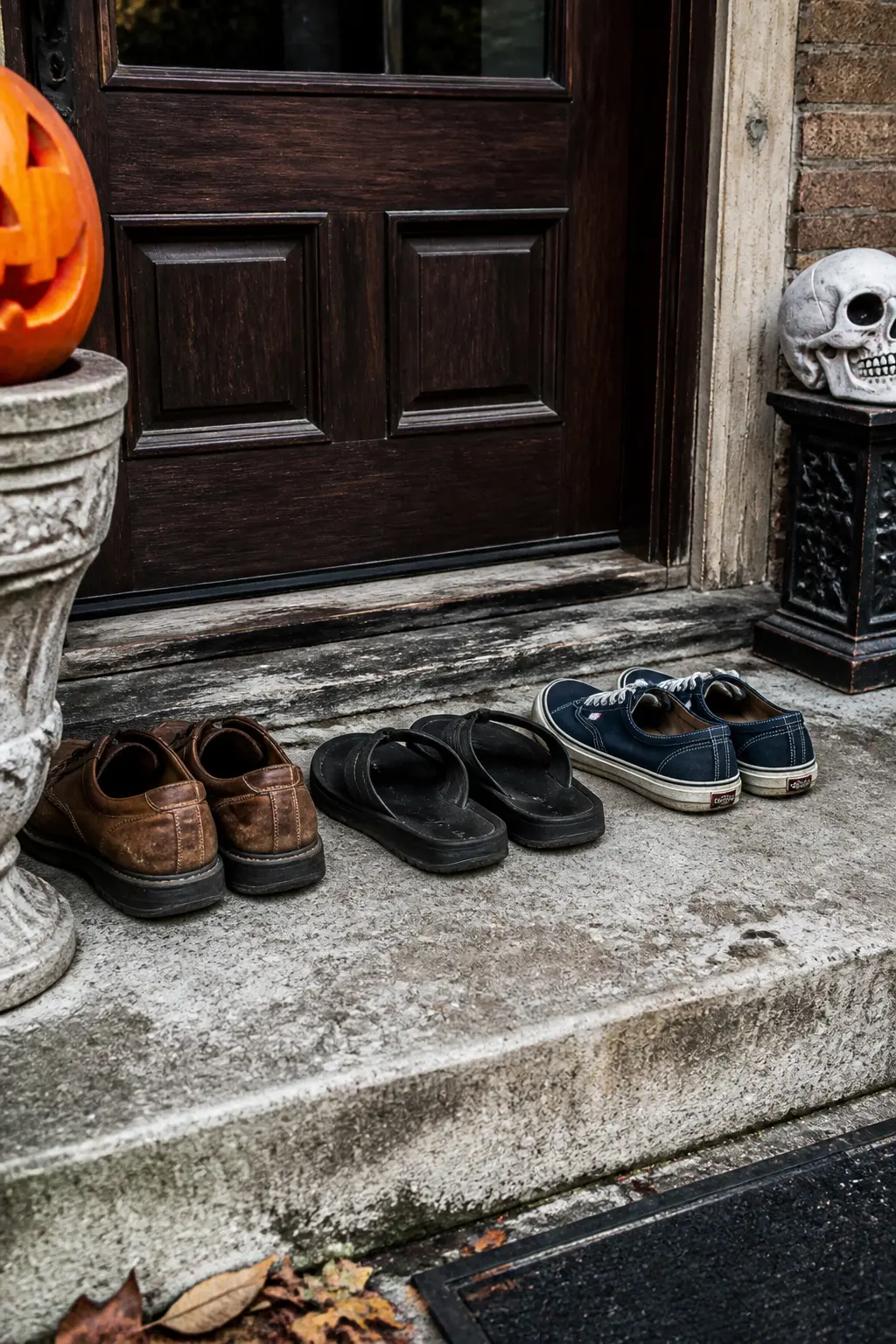
Empty Shoes Lined Up on the Front Step
Three or four pairs of adult shoes, arranged neatly in a line on the front step as though their owners stepped out of them and went inside, work because neatness signals intention. Someone placed these here carefully. The question is where those people are now, and the porch gives no answer.
Mix styles slightly so the shoes do not read as a set: a pair of work boots, a single flat, a weathered sneaker. Face them all toward the door, heels toward the visitor. The tidiness is the disturbing part; do not rough them up or scatter them.
🛍 Shopping guide
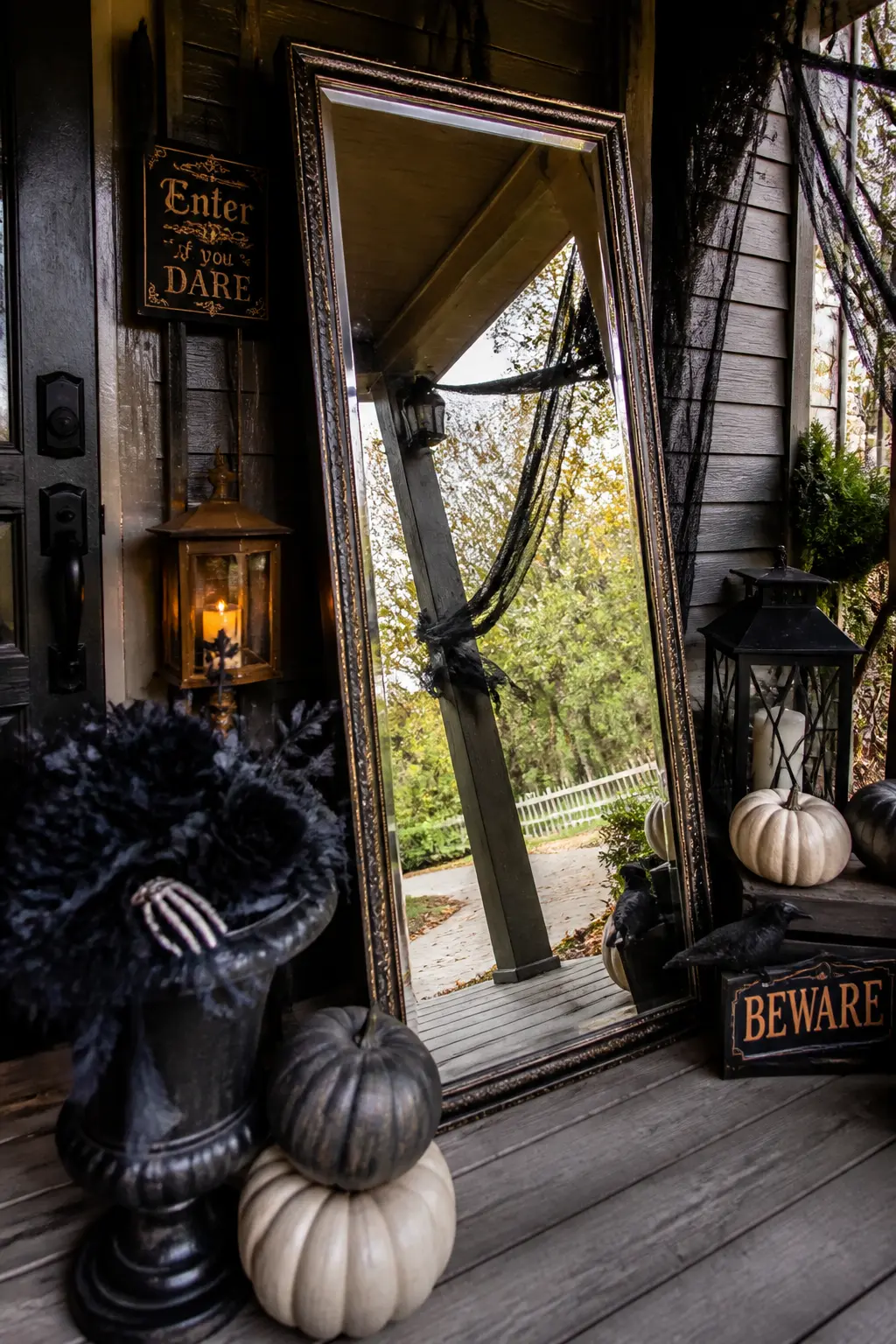
Mirror on the Porch Angled So Visitors Catch Their Own Reflection
A full-length mirror, positioned on the porch at an angle so that a visitor approaching the door catches a glimpse of themselves in peripheral vision, triggers a startle response every single time because the brain reads peripheral movement as other-presence before it reads it as self.
By the time the visitor realizes it is their own reflection, the pulse has already spiked.
Mount or lean the mirror so the angle of reflection shows the visitor at an unexpected distance or from a slightly unexpected position. Frame it simply, no decoration on the mirror itself. The cleaner the frame, the more the effect reads as architectural rather than decorative, which makes it land harder.
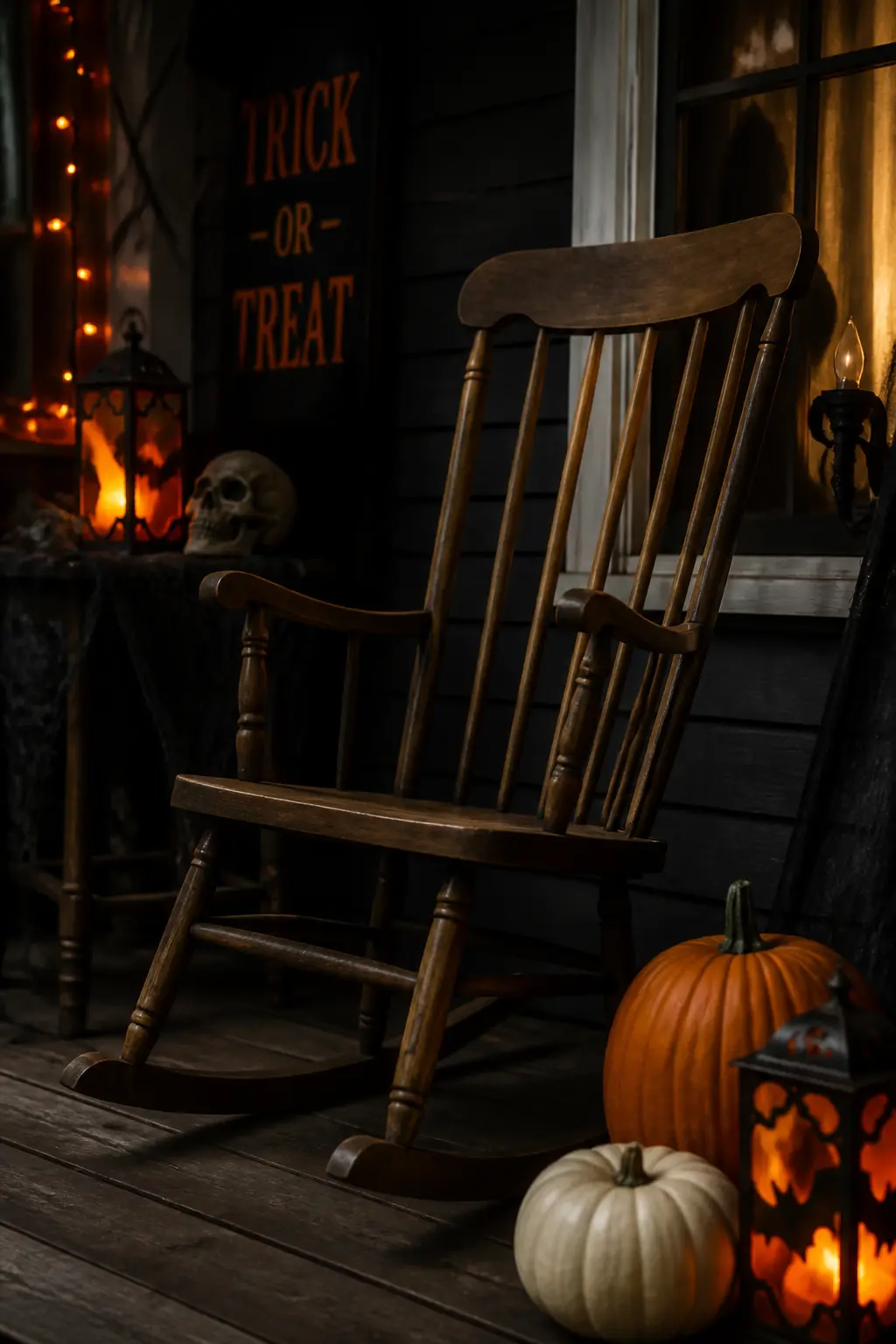
Rocking Chair Moving Slightly in the Wind
An empty rocking chair in motion on a porch is one of the oldest unsettling images in the visual language of horror precisely because the movement implies a presence that just left, or that is there and cannot be seen. The chair does not need a mechanism: a classic rocker on an outdoor porch will move with any light breeze.
Keep the chair completely empty. No blanket, no prop, nothing on the seat or armrests. Turn the porch light off above it and use only indirect ambient light from a neighboring window. The movement in the near-dark is the entire effect.
🛍 Shopping guide
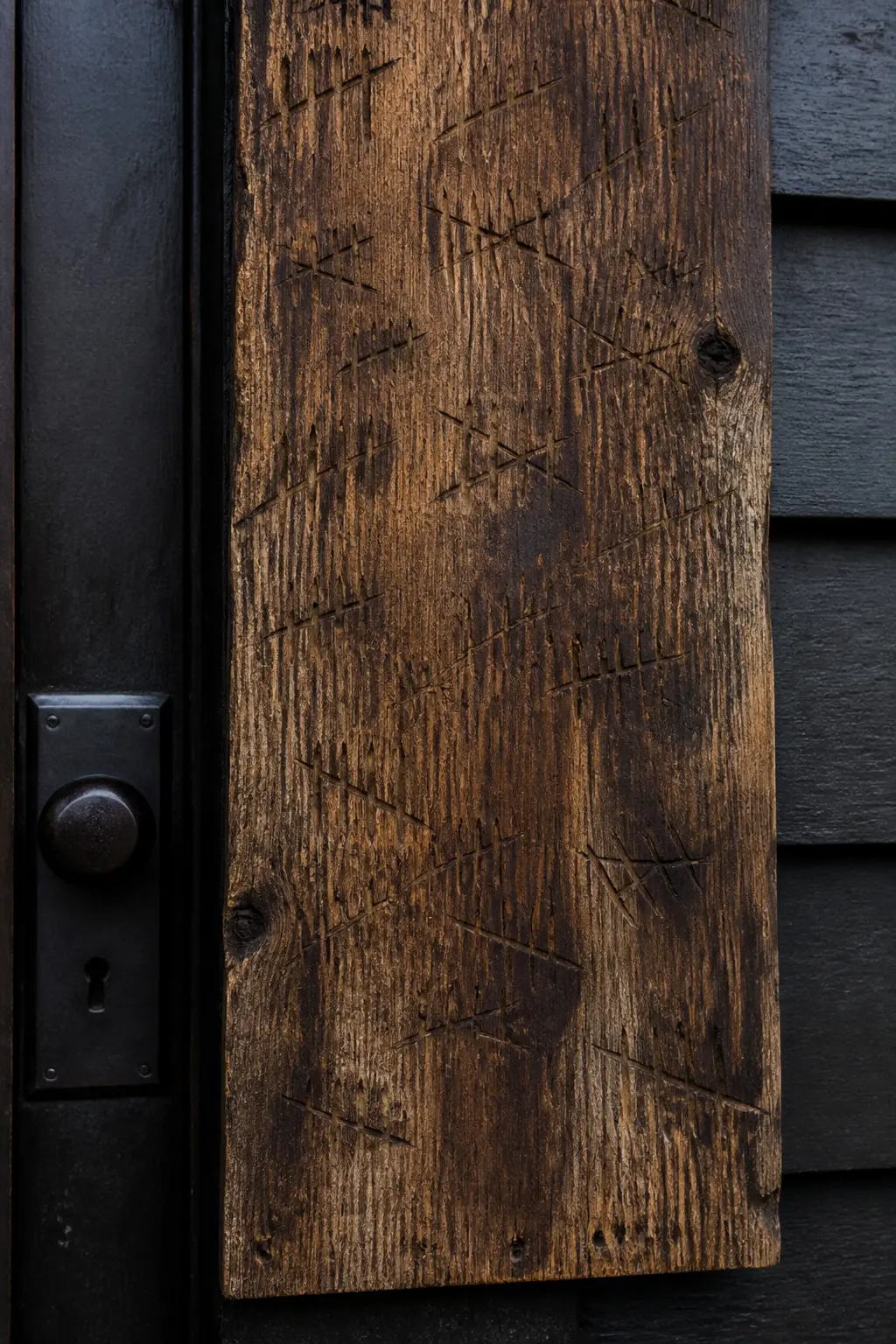
Tally Marks Scratched into a Wooden Board by the Door
A length of rough timber or an old pallet board, mounted beside the door, with tally marks scratched deep into the wood and grouped in sets of five, reads as a count of something: days, visitors, events not named. The viewer’s brain will supply the meaning, and it will not be cheerful.
Scratch the marks with a nail or a utility knife rather than drawing them, so they have the texture of genuine effort. Do not add any label or explanation. The mystery of what is being counted is the entire effect. Too many tallies, in the hundreds, reads as mania; 40 to 60 reads as a specific and recent record.
🛍 Shopping guide
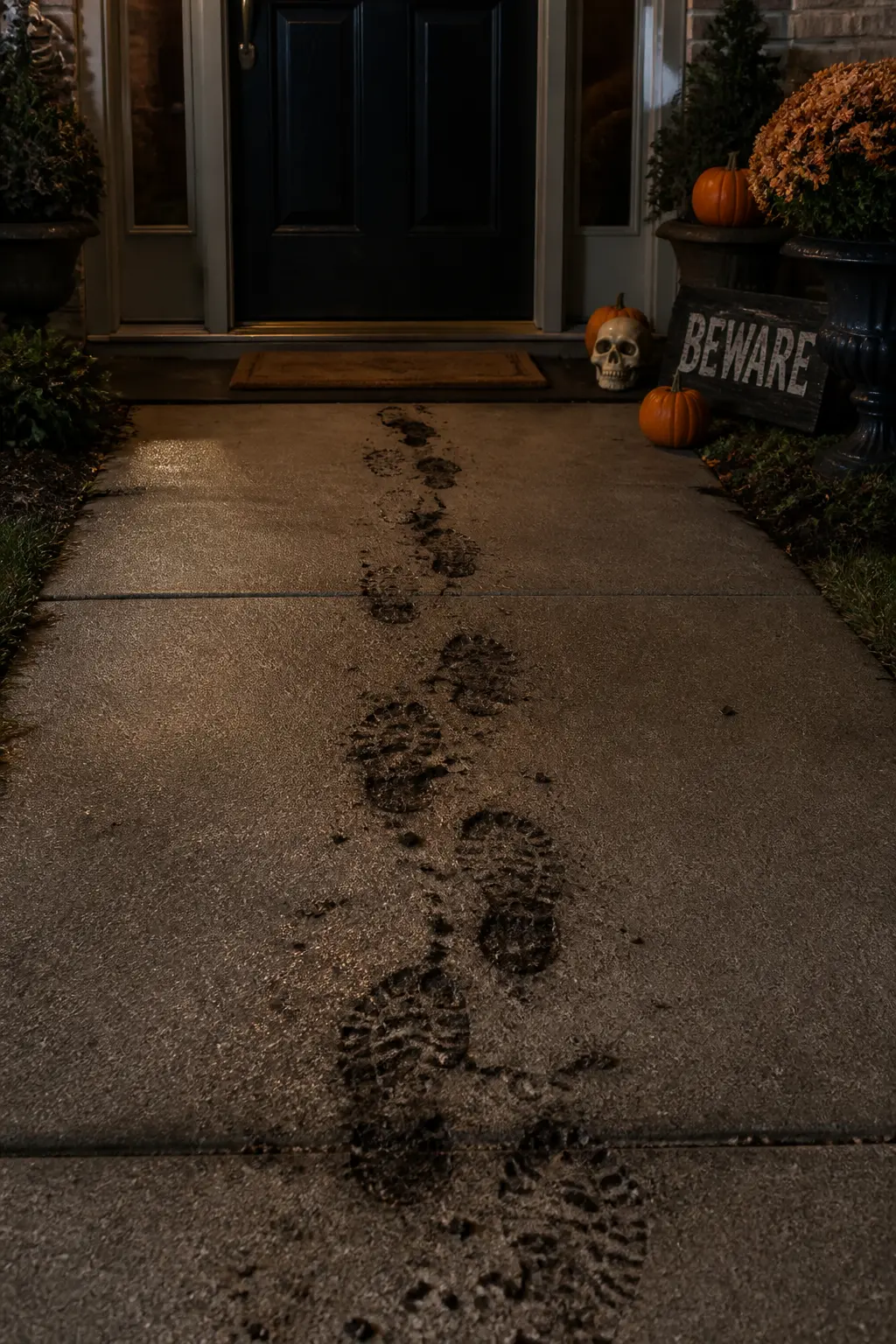
Trail of Muddy Footprints Leading Up to the Door and Stopping
A trail of footprints, pressed in mud or applied with brown paint, leading from the lawn or the pavement up the path to the front door and ending directly at the threshold, raises the oldest question a trail can raise: where did the person go? The door is closed. The footprints stop. The answer is inside.
Apply the prints with a boot or a bare-foot stencil cut from cardboard, using brown exterior craft paint or actual mud mixed with dark acrylic to help it hold. Make the prints inconsistent in pressure, as a real walking gait would be. The stride length matters: adult spacing feels more unsettling than a child’s, because it suggests purpose.
🛍 Shopping guide
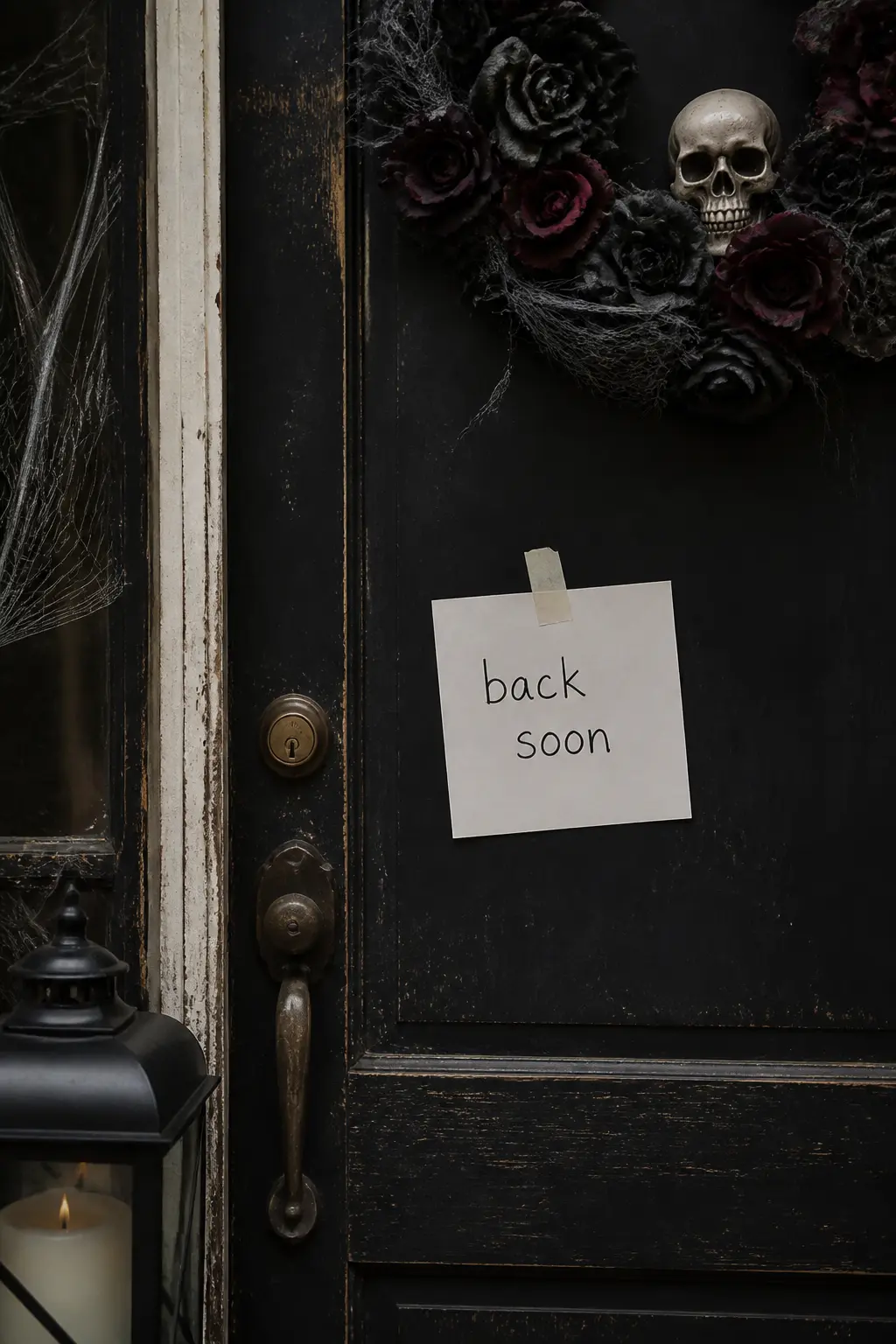
A ‘Back Soon’ Note Left on the Door
A handwritten note taped to the door reading only “back soon” with no name, no date, and no further information, is the most minimal possible narrative prop and one of the most effective. The note addresses nobody and commits to nothing. The “soon” has no referent. The house behind the note is presumably empty, but the note suggests otherwise.
Write it by hand in plain ink on unlined paper. Do not add any Halloween reference, any stylized font, or any visual decoration. The plainness is the point. Tape it slightly off-center so it reads as quickly placed rather than arranged. If the handwriting looks deliberate, write it with your non-dominant hand.
🛍 Shopping guide
Sound and Light: The Two Things Nobody Thinks to Use Well
Most amateur Halloween displays are silent except for a motion-triggered scream, and that is exactly why the scream no longer works. Ambient sound is a completely different tool: something low, repetitive, and sourceless unsettles in a way a jump-scare cannot, because it never resolves.
Light follows the same logic. The interesting choice is never “add more light.” It is where the light comes from, what color it is, and what it leaves dark. A single source, placed wrong, does more atmospheric work than a full lighting rig aimed at the obvious angle.
Sound of Faint Knocking Played on a Loop
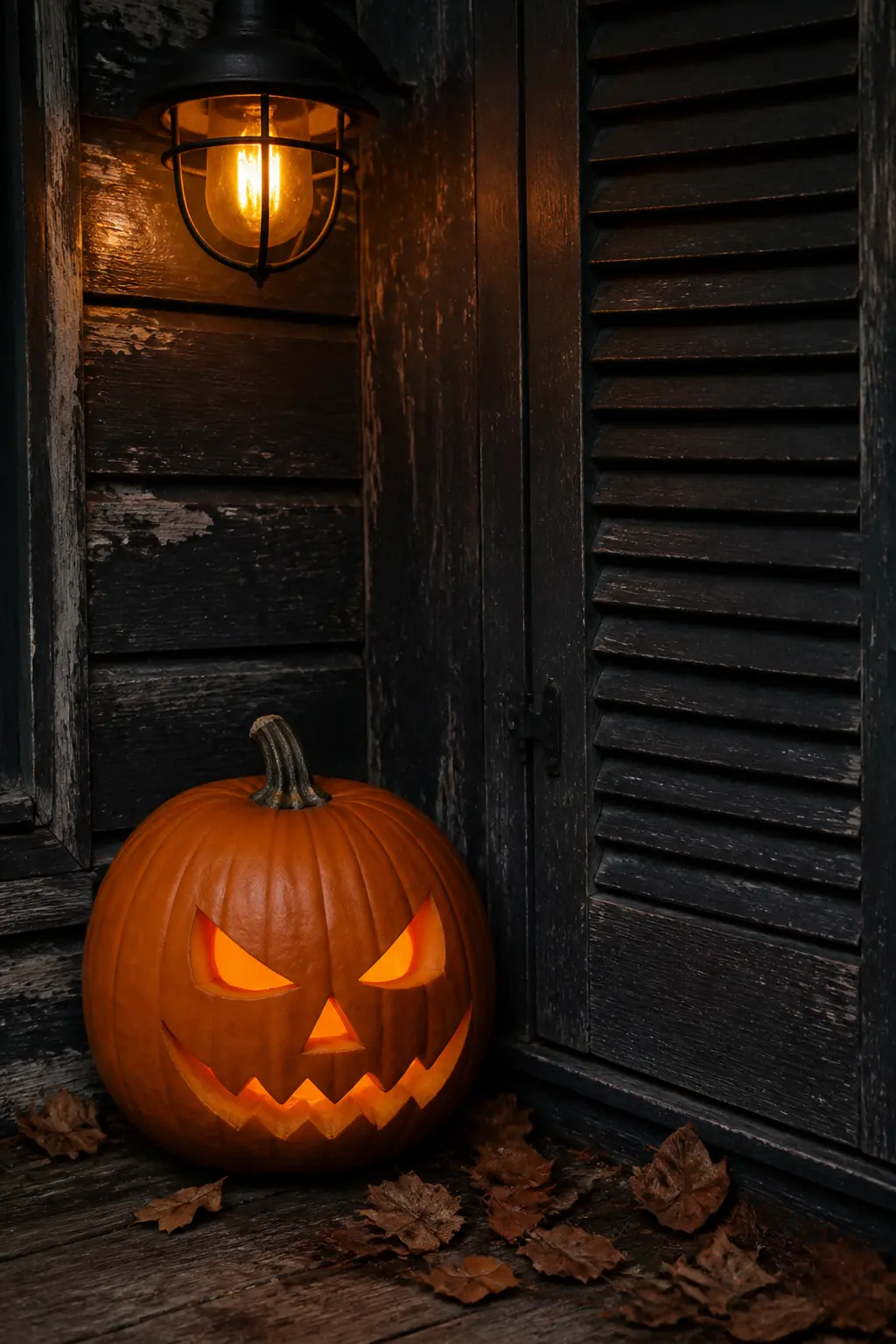
A single, slow knock, repeated at irregular intervals, played through a small Bluetooth speaker hidden inside a hollow pumpkin or behind a shutter, works on a neurological level that visual props cannot reach. The brain cannot stop tracking a repetitive sound for a source. When the source is hidden, the tracking loop runs indefinitely.
Irregular timing matters more than volume. A metronomic knock becomes background noise within a minute. A knock that comes every 11 seconds, then 7, then 14 stays active in the listener’s attention because the brain keeps predicting and being wrong. Keep the volume low: it should be audible from the path but require a moment to locate.
🛍 Shopping guide
Green Uplight from Below on a Single Tall Figure
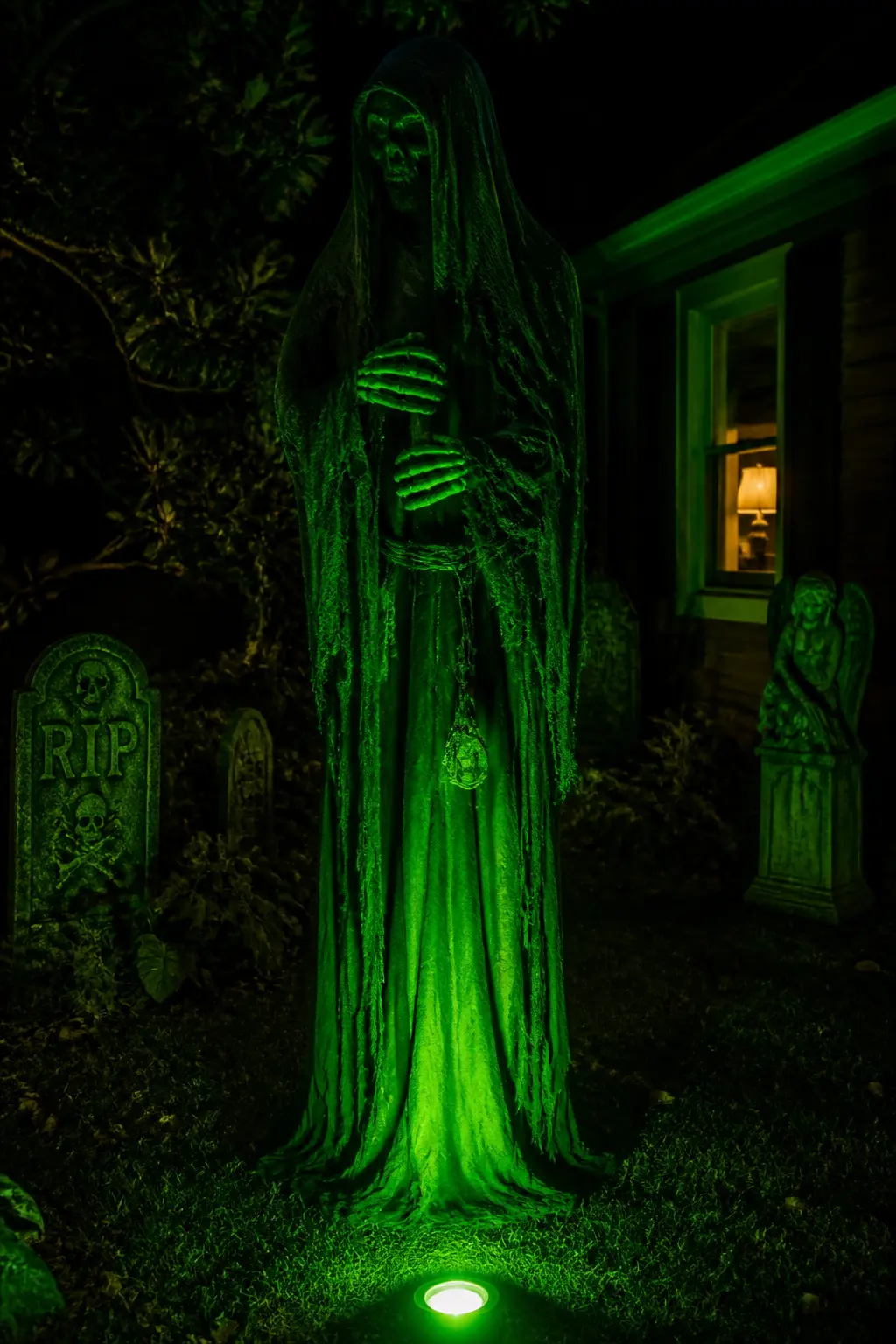
Uplighting from below is the most ancient theatrical trick for making a face disturbing, because it reverses the direction of shadows that the brain has been calibrated to read since childhood.
Apply it to a tall, thin figure, a full-length dress form or a cloaked garden statue, with a single green LED flood set on the ground directly in front of it, and the figure becomes genuinely hard to look at for long.
Green specifically reads as sickness and bioluminescence, the two most instinctively avoided associations in human color perception. Use no other light source within ten feet. The green should be the only color in that part of the yard.
🛍 Shopping guide
Long Shadow Puppets Cast on a Sheet from Behind
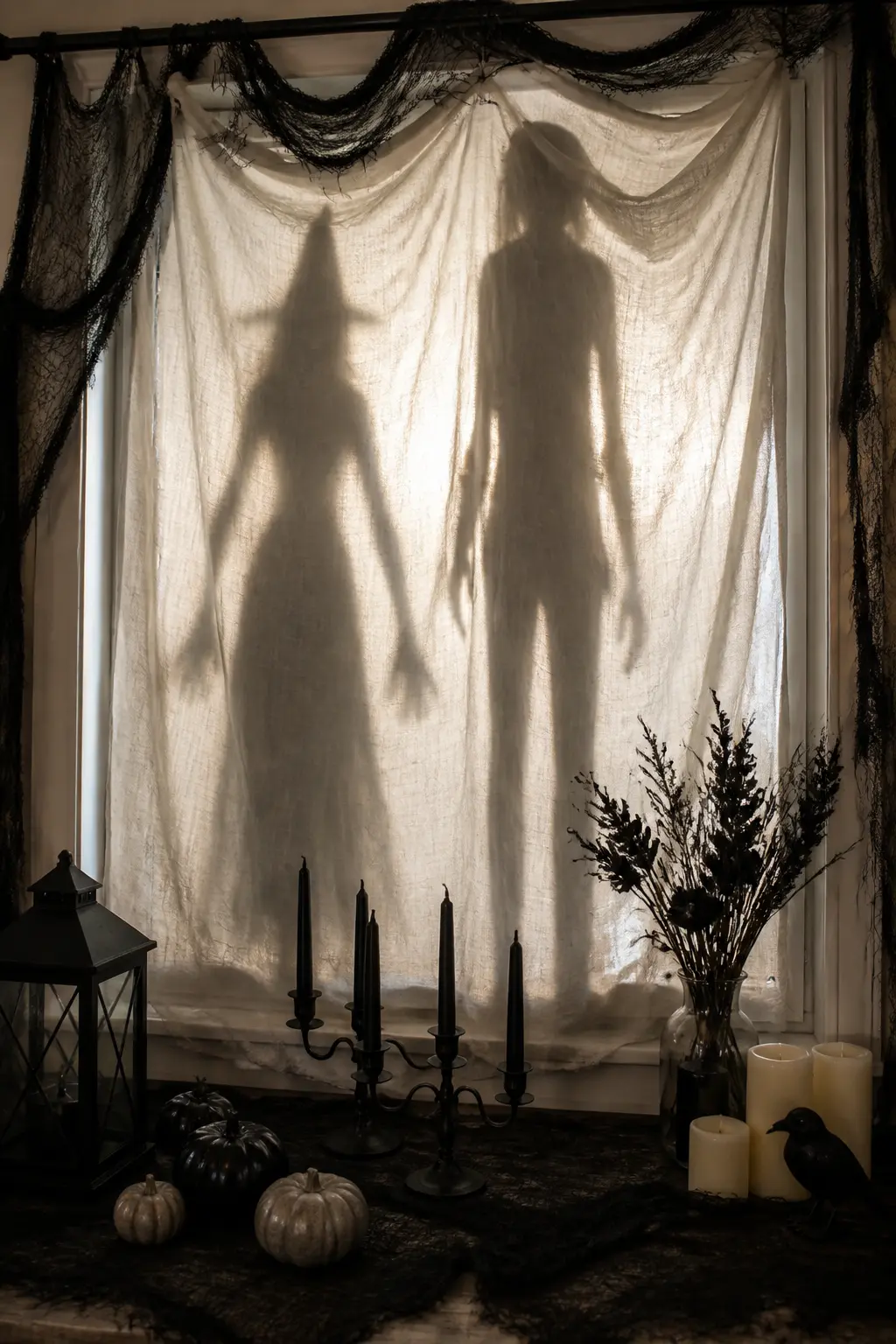
Hang a white sheet across a window or doorframe and position a bright lamp behind it, close to the fabric to maximize shadow sharpness. Cut silhouettes from black cardstock, thin elongated figures with slightly wrong proportions, and move them slowly against the light. The shadow reads at full size through the sheet from outside.
Slow movement is key. Fast motion reads as performance; slow, deliberate movement, a figure turning, an arm rising over several seconds, reads as something real happening just out of view. The sheet separating the viewer from the source is what gives the uncanny effect: almost seen, never quite confirmed.
🛍 Shopping guide
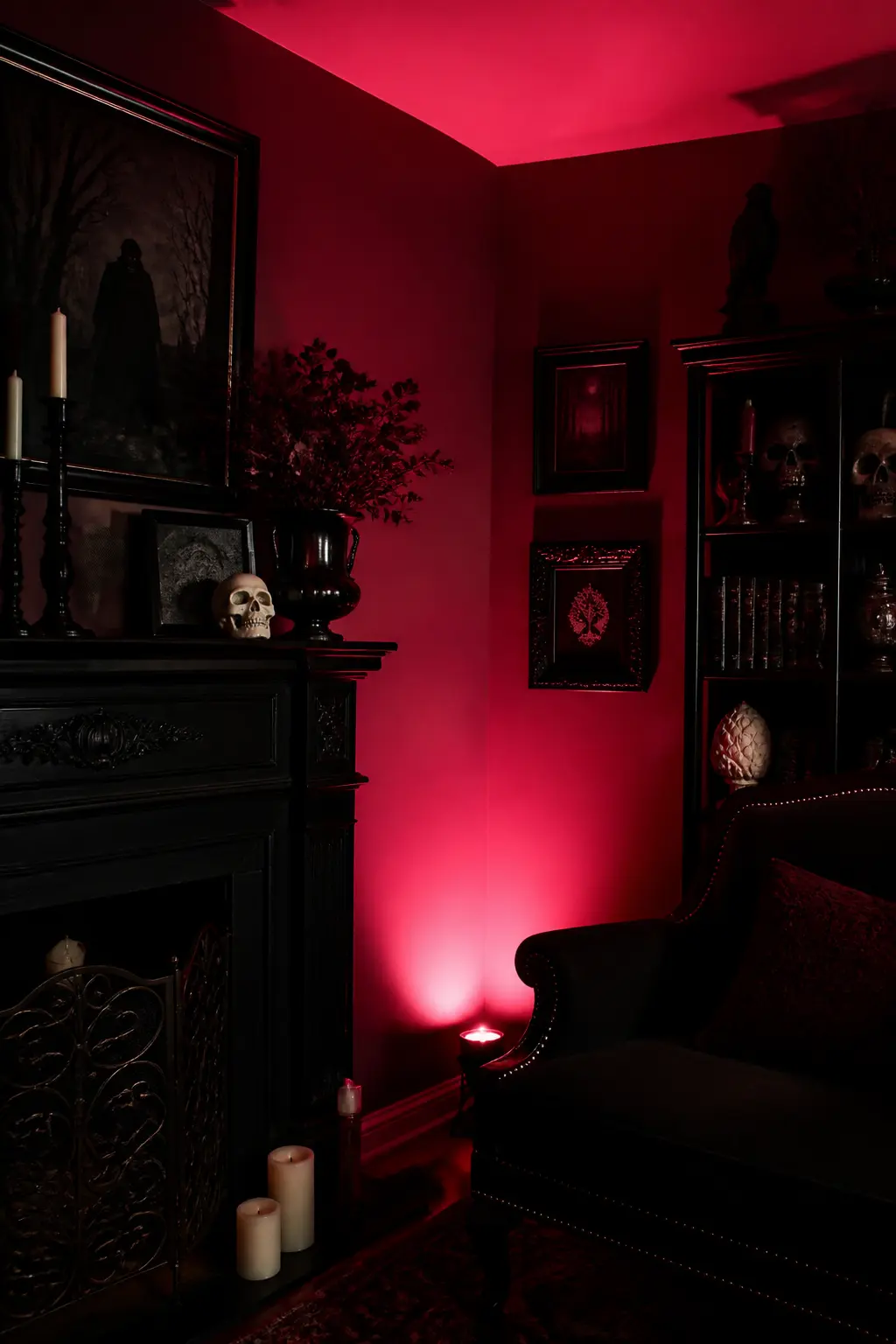
Deep Wine Light from a Single Low Source
Replace a single lamp in a room with a deep burgundy or oxblood red bulb and position that lamp on the floor rather than a table or ceiling fixture.
The upward-cast wine-colored light shifts the entire color temperature of the room into a register that reads as wrong: it is the color of emergency lighting, of fire from below, of environments in which ordinary rules do not apply.
One lamp, one color, on the floor. Leave everything else in that room unlit. The contrast between the wine-colored pool of light and the surrounding dark is more disturbing than a fully red-lit room, because the eye keeps trying to see what is in the darkness around it.
🛍 Shopping guide
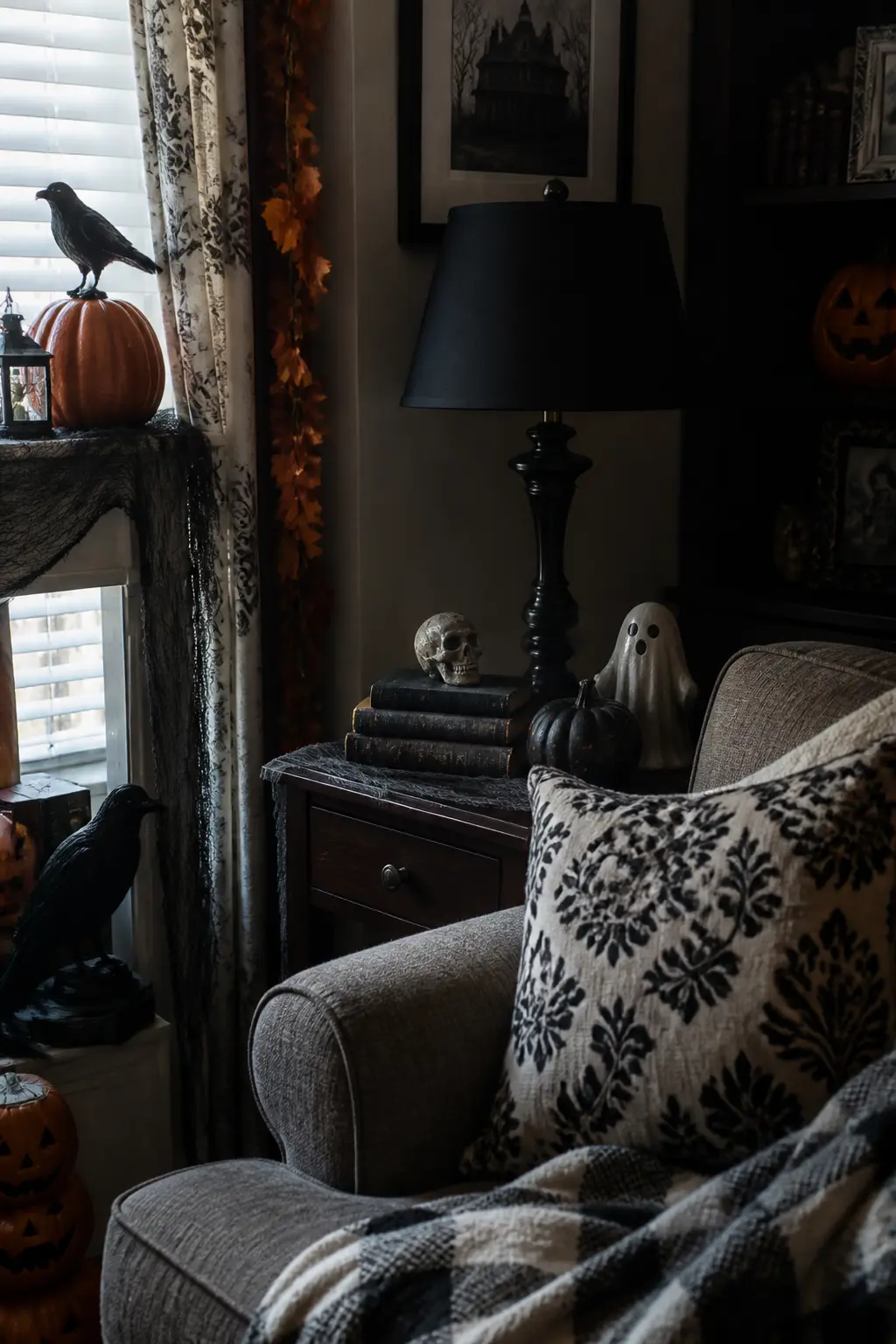
A Single Light on a Timer That Switches Off
Program a single lamp in the room where guests are gathered to switch off for 90 seconds every 25 minutes, on no predictable schedule that anyone has been told about. The first time it happens, people assume a power issue.
The second time, they look at each other. The third time, they have been waiting for it and the anticipation is its own discomfort.
Use a smart plug with a scheduling app rather than a mechanical timer, because mechanical timers click audibly before triggering, which removes the surprise. The lamp should be the only light source in that corner of the room so that when it cuts, a portion of the room goes genuinely dark.
🛍 Shopping guide
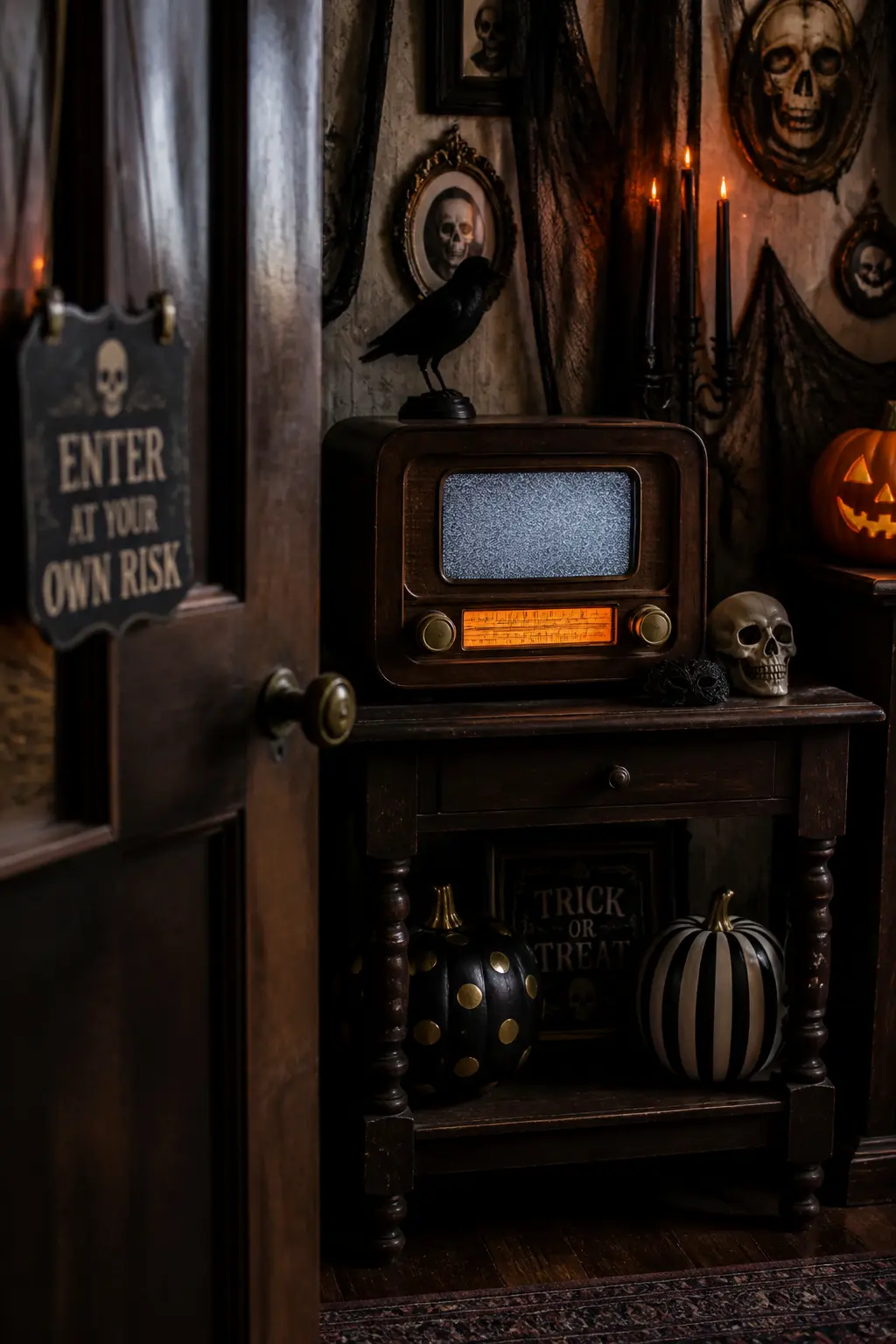
A Radio Playing Static in an Empty Room
Place a vintage or vintage-style radio in a room that guests can hear but not immediately enter, tuned to pure static at low volume. The static should be audible from the doorway but not loud enough to be the dominant sound in the house.
The brain registers radio static as signal-in-progress, as transmission that has not yet resolved, and keeps listening for the moment it does.
A room with the door mostly closed and the static coming through the gap is more effective than an open room, because the gap frames the sound as something happening in an enclosed space that the guest is not yet in.
The static should not cut out: loop it on a small device hidden behind the radio if the actual radio cannot sustain the effect.
For guests who are ready to move from atmosphere into games, the Halloween party ideas roundup has a full list of what works indoors at an adult gathering.
Interior: Rooms That Feel Recently and Wrongly Left
Interior staging works on a different instinct than exterior: the outside triggers caution, but the inside triggers the uncanny. Guests are already in your home, already past the threshold. The things that disturb here are the signs of ordinary life that have gone slightly off, objects in the wrong state, routines interrupted and not resumed.
The rule for every interior detail: it should look like someone was here very recently and left in a hurry, or never left at all. Keep the rest of the room tidy. Mess reads as mess; one displaced object reads as evidence.
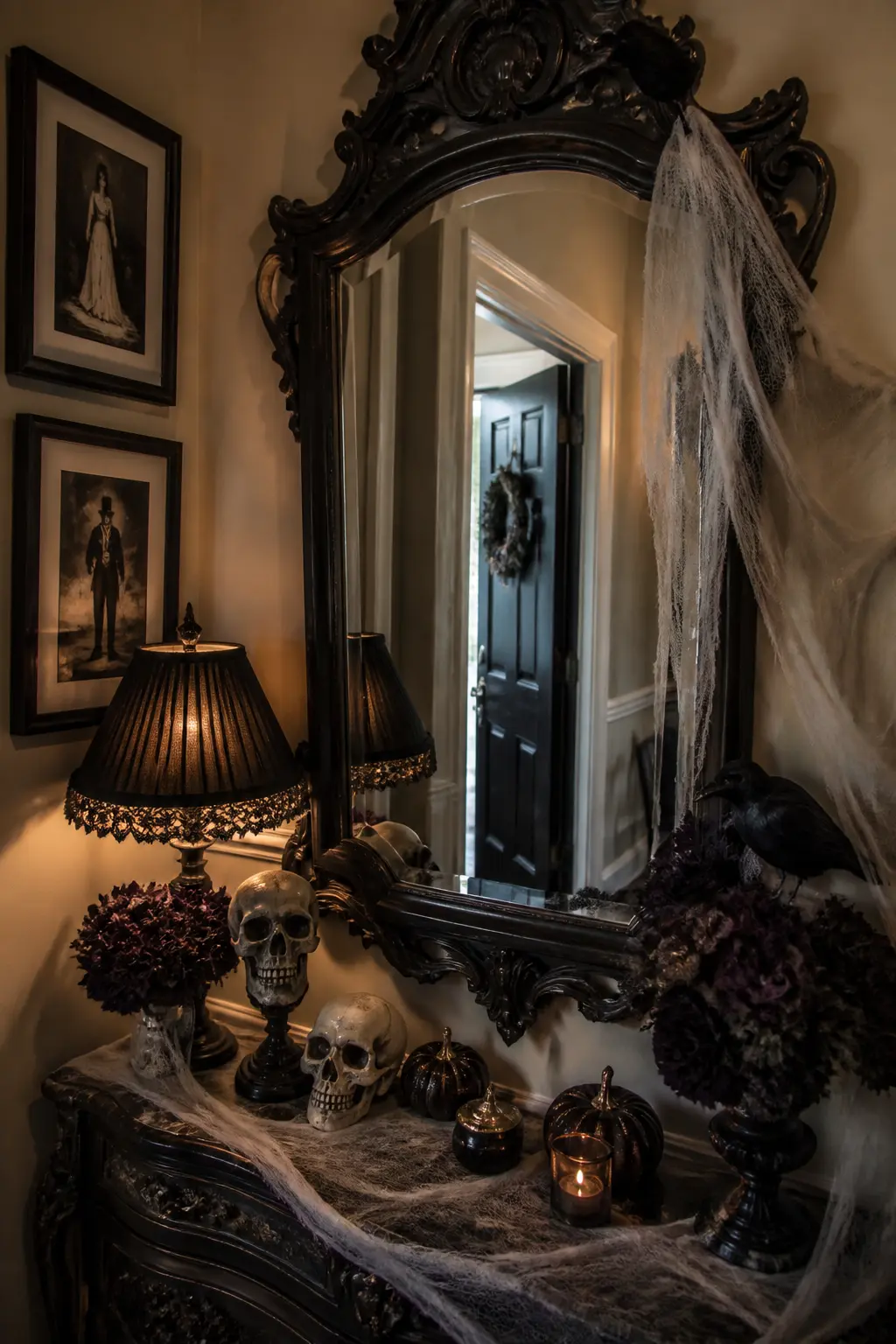
An Antique Mirror Angled So Guests See Themselves Before Anything Else
Position a large, dark-framed mirror in the entryway so that the first thing a guest sees on entering is their own face. Not as a vanity check: the room should be dim enough, and the mirror angled enough, that the reflection is slightly unexpected in timing, catching the guest mid-motion rather than when they are prepared to look.
An antique or aged mirror with some foxing in the glass adds to the effect because the reflection is slightly degraded, slightly off. The frame should be ornate and dark.
Place nothing else near the mirror that would read as decor; the surrounding walls should be bare so the mirror reads as a singular, weighty presence rather than part of a styled arrangement.
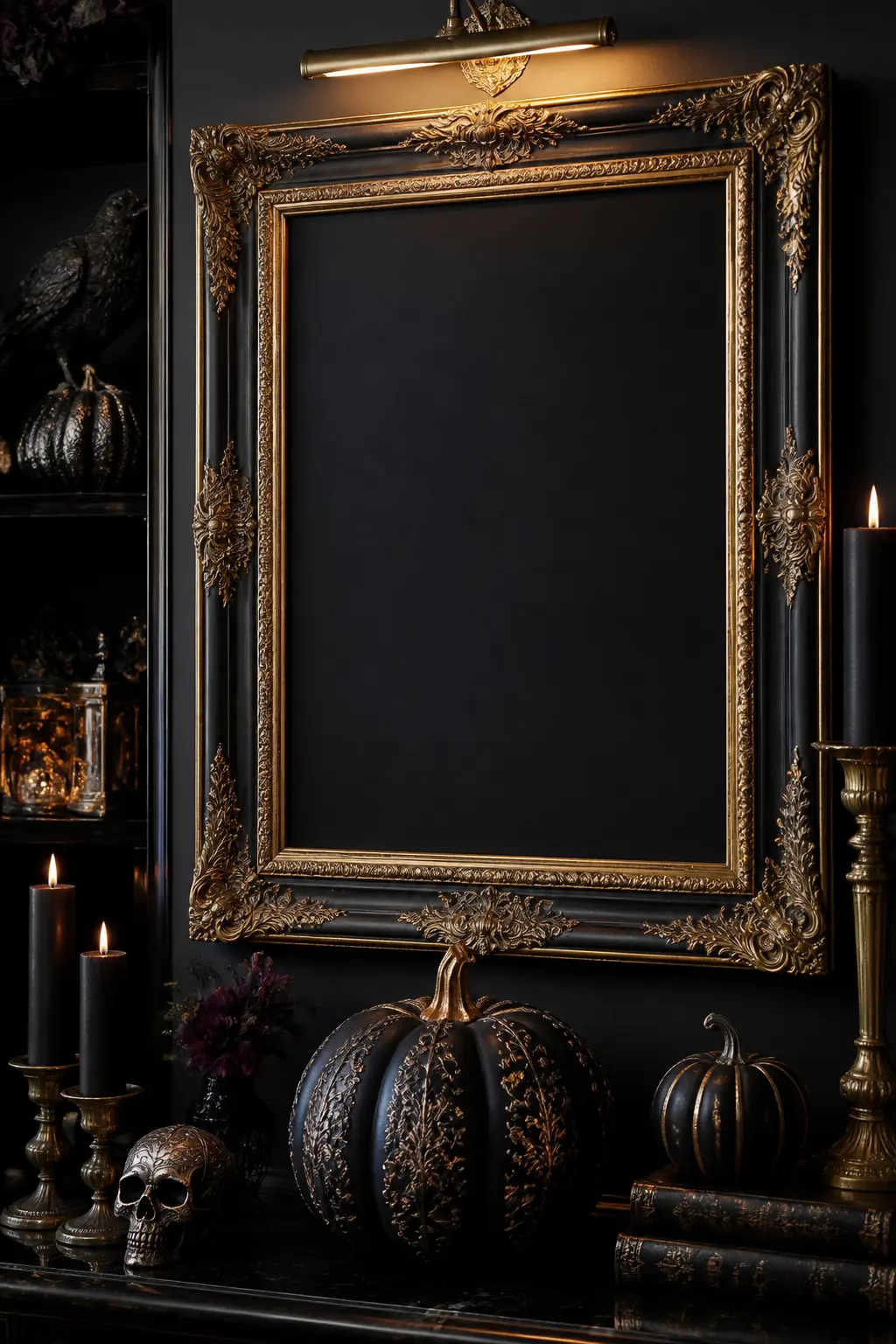
A Single Ornate Frame Holding an Empty Dark Canvas
A large, heavily gilded or dark-wood ornate picture frame, hung on the wall at portrait height, containing a canvas painted entirely flat black, works because the brain expects a painting to show something and keeps searching the black surface for a figure. The more elaborate the frame, the stronger the expectation, and the longer the search.
Hang it at eye level in a room with low light and position a single downlight directly above it, aimed at the canvas, so the frame is lit as though the painting matters enormously. The black canvas absorbs the light and gives nothing back.
That absence, presented as if it were content, is genuinely unnerving to look at for more than a few seconds.
🛍 Shopping guide
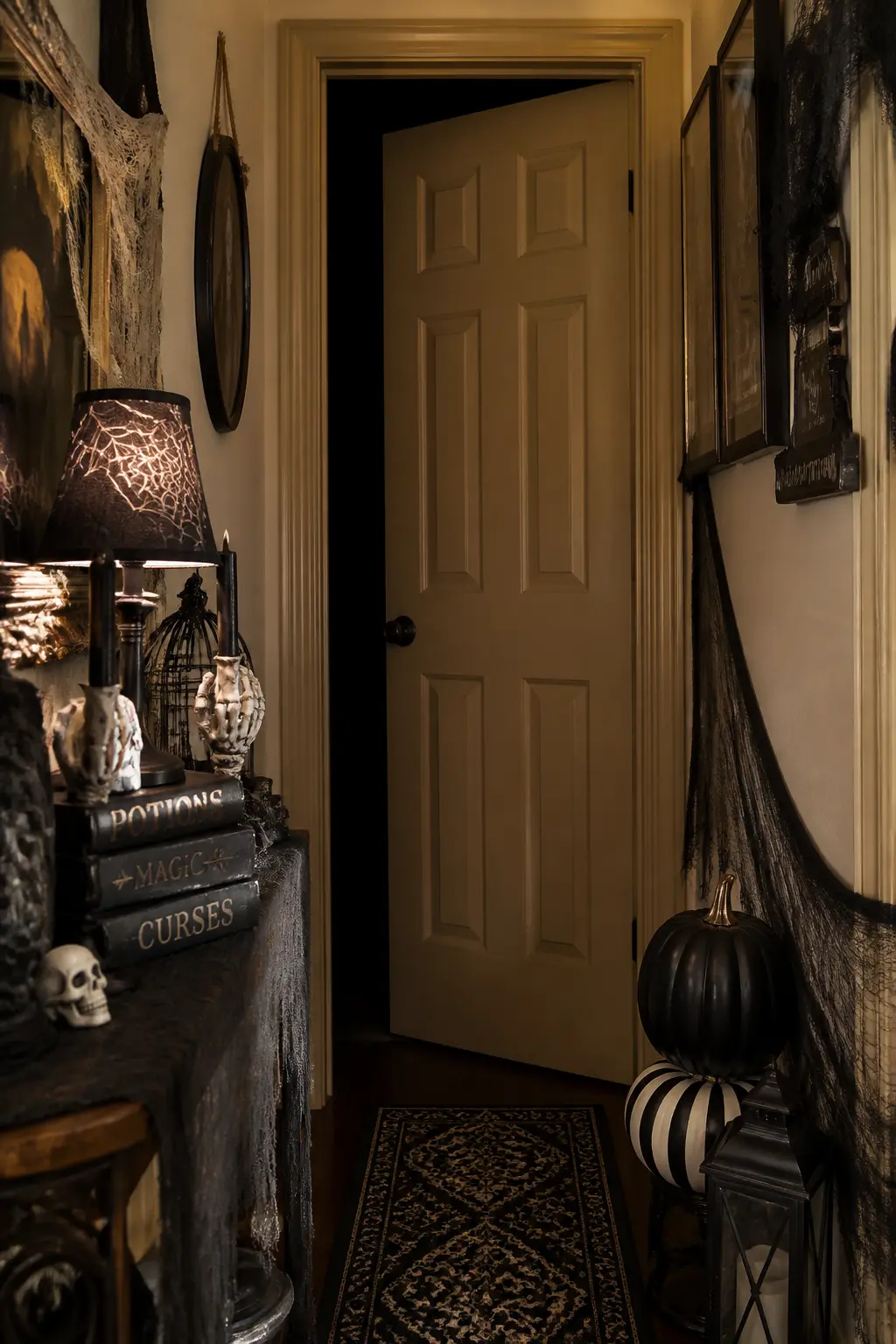
A Door Left Slightly Ajar with Darkness Behind It
A door left open three or four inches, with complete darkness behind it, is one of the most reliable unsettling images in existence because the darkness behind the gap is unknown and the brain refuses to stop trying to resolve it. Something could be in there. The gap is too narrow to see clearly. The viewer is never sure.
Turn off every light in the room behind the door. Block any window light with a dark curtain. The gap should show pure black. Position the door at the end of a corridor if possible, so the viewer sees it from a distance and must approach it to reach wherever they are going.
🛍 Shopping guide
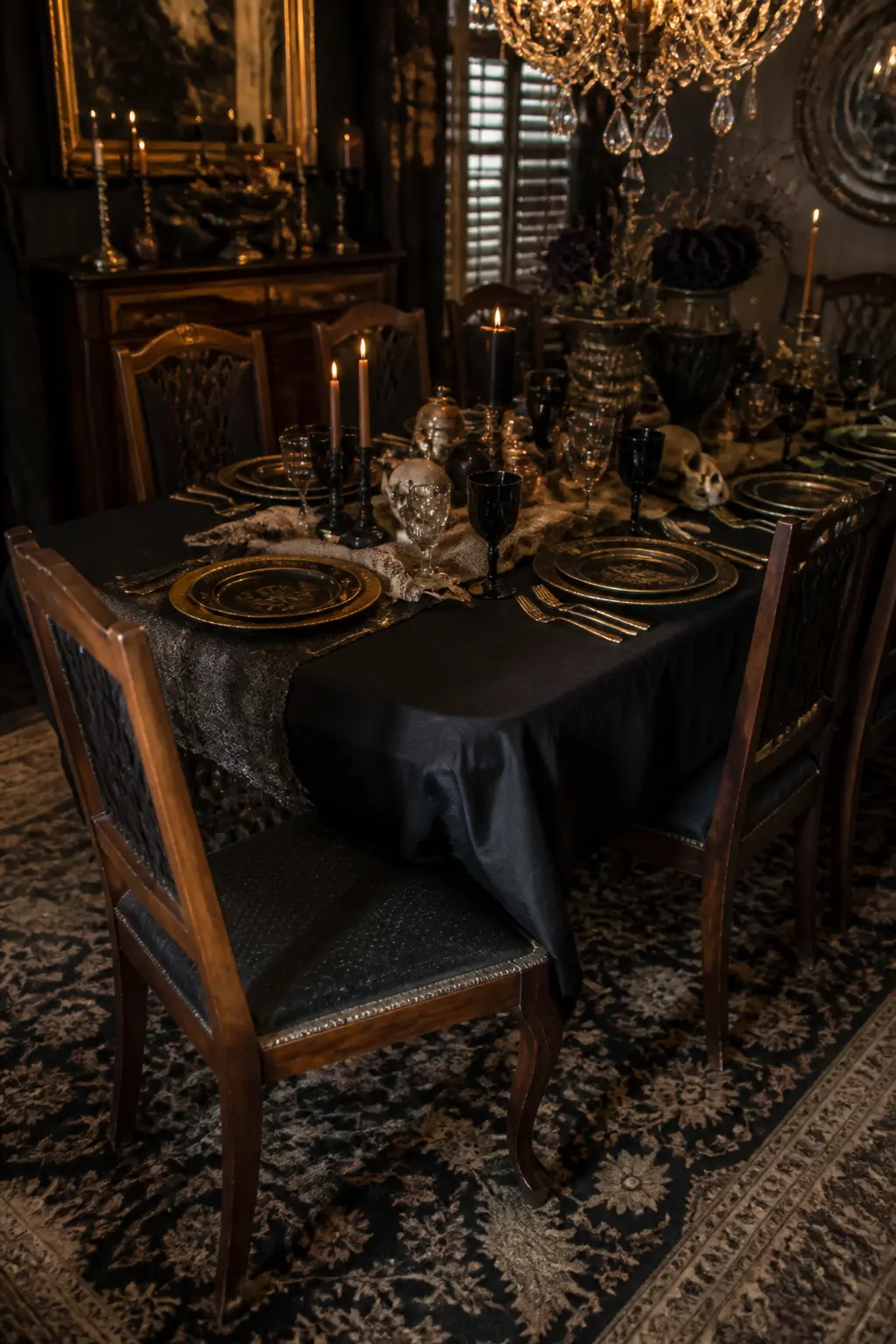
One Chair Pulled Out from a Set Table with Nobody There
Set the dining table fully: plates, glasses, cutlery, napkins, as if dinner is about to be served or has just been abandoned. Pull one chair out from the table at a slight angle, as though the person sitting there stood up quickly and did not push it back. Leave the place setting at that seat undisturbed.
The power is in the completeness of the setup combined with the one absence. A fully set table reads as normal.
A fully set table with one unoccupied chair pulled out reads as a scene, because the brain knows that chairs at set tables are occupied, and it cannot find the person who belongs in that chair.
For atmosphere at the table itself, guests who need something to do between courses might appreciate some of the ideas in this Halloween games for adults roundup.
🛍 Shopping guide
Objects That Ask a Question
These are the props that work entirely through implication. The object itself is ordinary. The context makes it wrong. None of them require assembly, paint, or a trip to a specialist store. Most require only that you find the right location inside your space and resist the urge to add an explanation.
The moment you explain the bit, you lose the bit. Put the object down, walk away, and trust the viewer to feel what they feel.
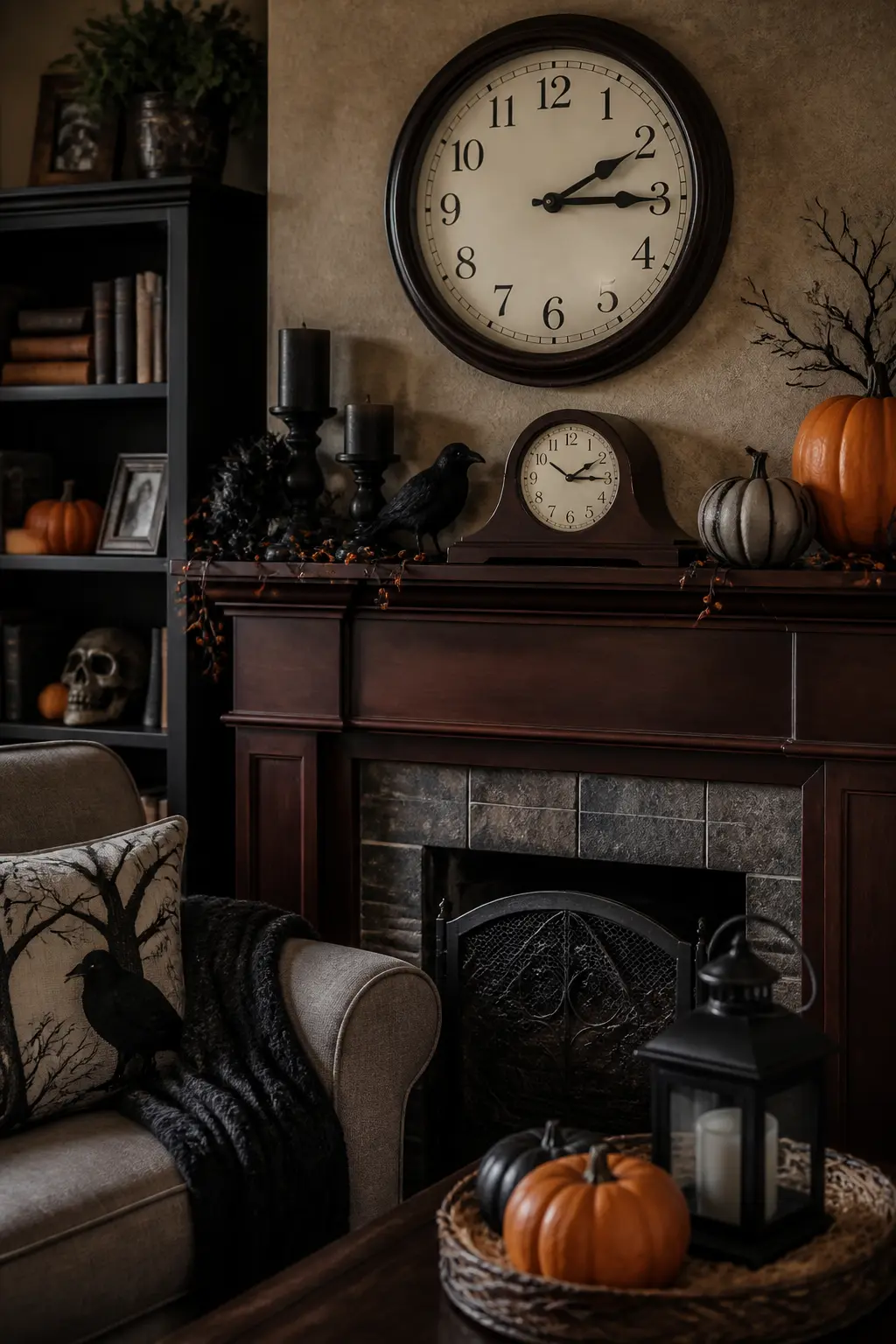
A Clock Stopped at the Same Time in Every Room
Set every clock in the house, wall clocks, mantel clocks, even visible digital displays, to the same time and stop them there. Guests will notice the first one and dismiss it. The second one will make them look again. By the third, they will be counting, and the counting is the point.
The time you choose is worth a moment’s thought: something specific and odd, 3:07 or 11:51, reads more deliberately than a round number. Do not explain it. Do not reference it in conversation. Let the guests surface it themselves and then look at each other.
🛍 Shopping guide
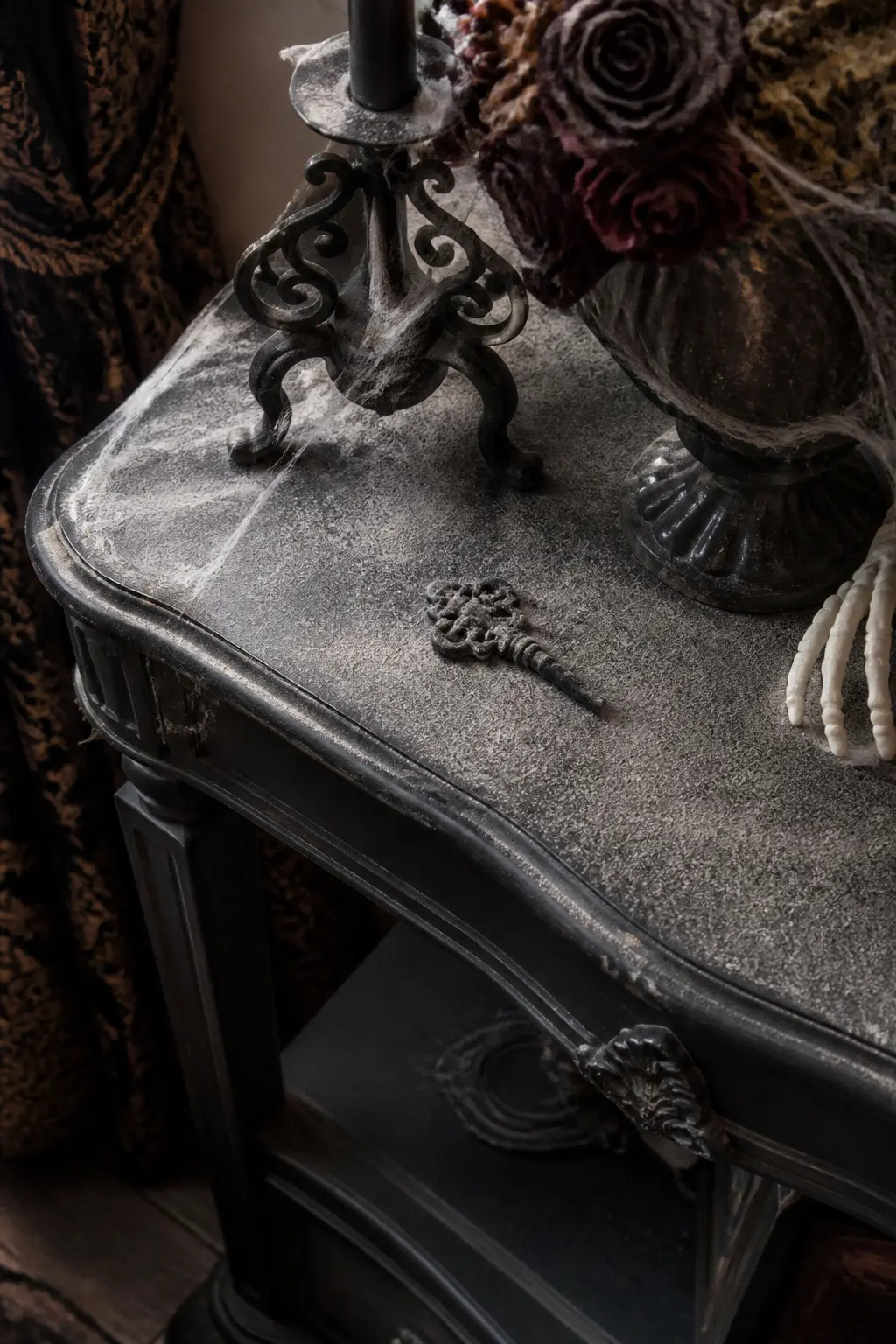
Dust Deliberately Left on One Surface
Choose one surface in an otherwise clean room, a shelf, a side table, the top of a piano, and leave it with a visible layer of dust while cleaning everything around it.
The contrast between the clean room and the single uncleaned surface reads as deliberate avoidance: someone cleaned everything except that, and the question of why hangs in the air.
If the natural dust in the space is insufficient, simulate it with gray or beige chalky paint powder, dusted lightly with a brush.
Place one object on the dusty surface, something personal and ordinary, a watch, a folded piece of paper, a single key, and leave it half-submerged in the dust as though it has been sitting there for a long time.
🛍 Shopping guide
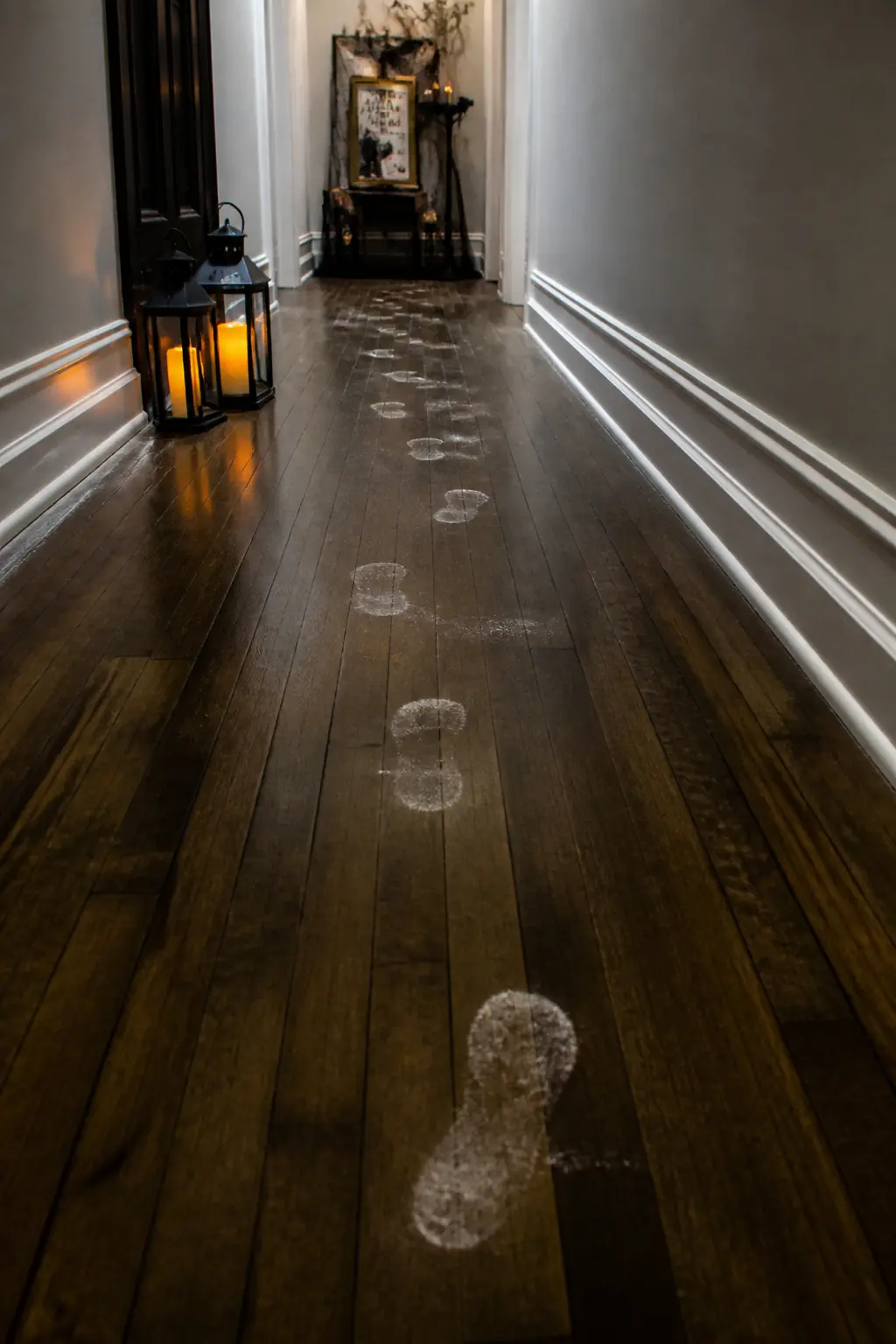
Footsteps in Dust Across a Hard Floor
A path of footprints pressed into a dusted floor, leading from one wall to another and stopping with no exit in sight, tells an immediate and unresolvable story. The prints go in one direction. They do not come back. There is no door at the far end.
Use the chalk-powder method from the dust surface idea: lay a thin base coat across a section of floor, then press footprints with a clean boot to displace the powder in the shape of a step. Work in one direction only and stop mid-stride, so the last print is a partial, as though mid-step.
🛍 Shopping guide
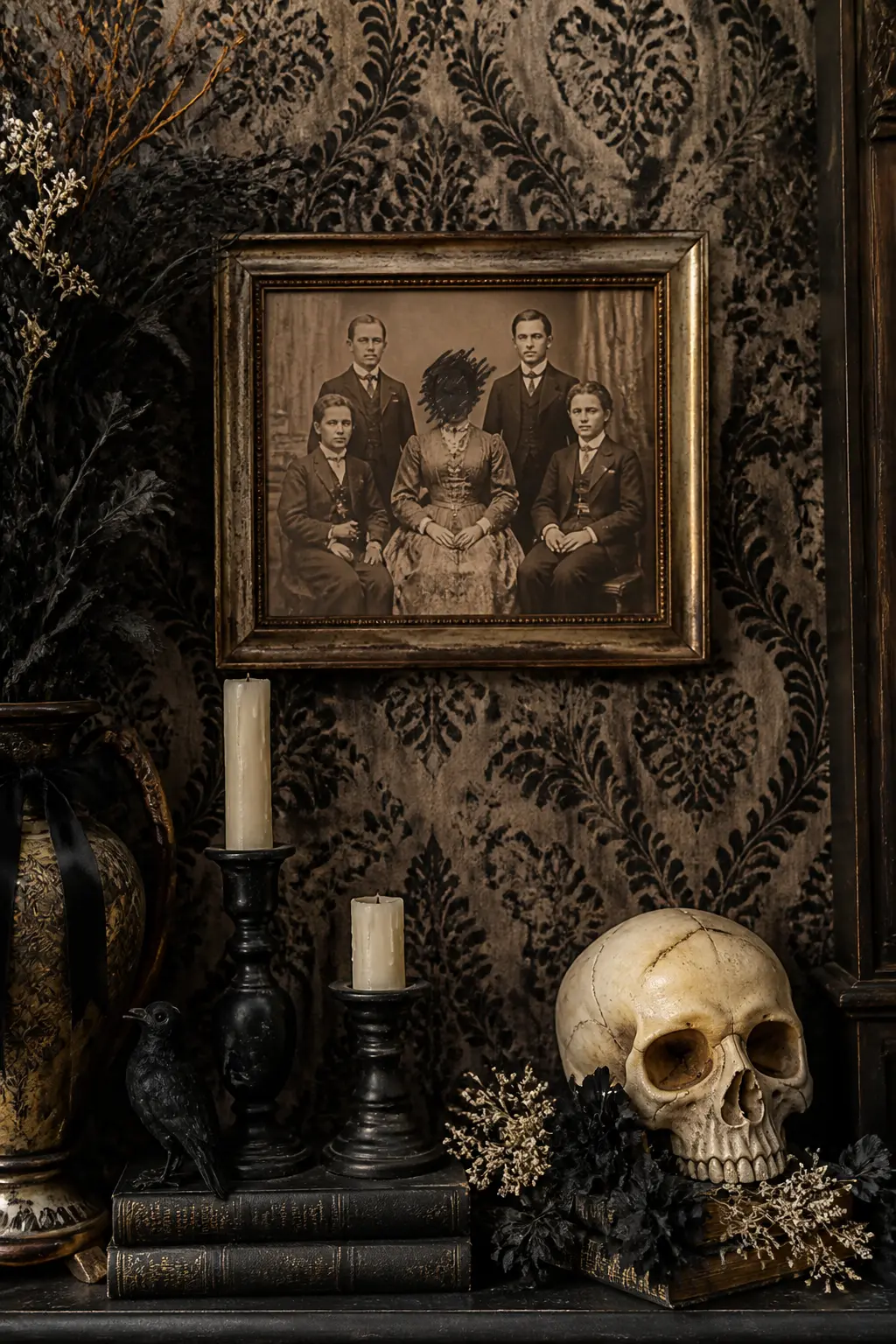
A Photograph with One Face Scratched Out
Frame an old-looking group photograph, sourced from a thrift store or printed in sepia tone, in which one face has been scratched or scribbled out with an ink pen or scored with a knife. Hang it at eye level in a hallway or near the bathroom, somewhere guests pass alone.
The obliteration of a single face in an otherwise normal image raises two questions simultaneously: who did this, and who was that person. Neither question has an answer the viewer can find in the room.
Print the image slightly degraded so it reads as genuinely old, and frame it in a plain or slightly tarnished frame so it reads as found rather than constructed.
🛍 Shopping guide
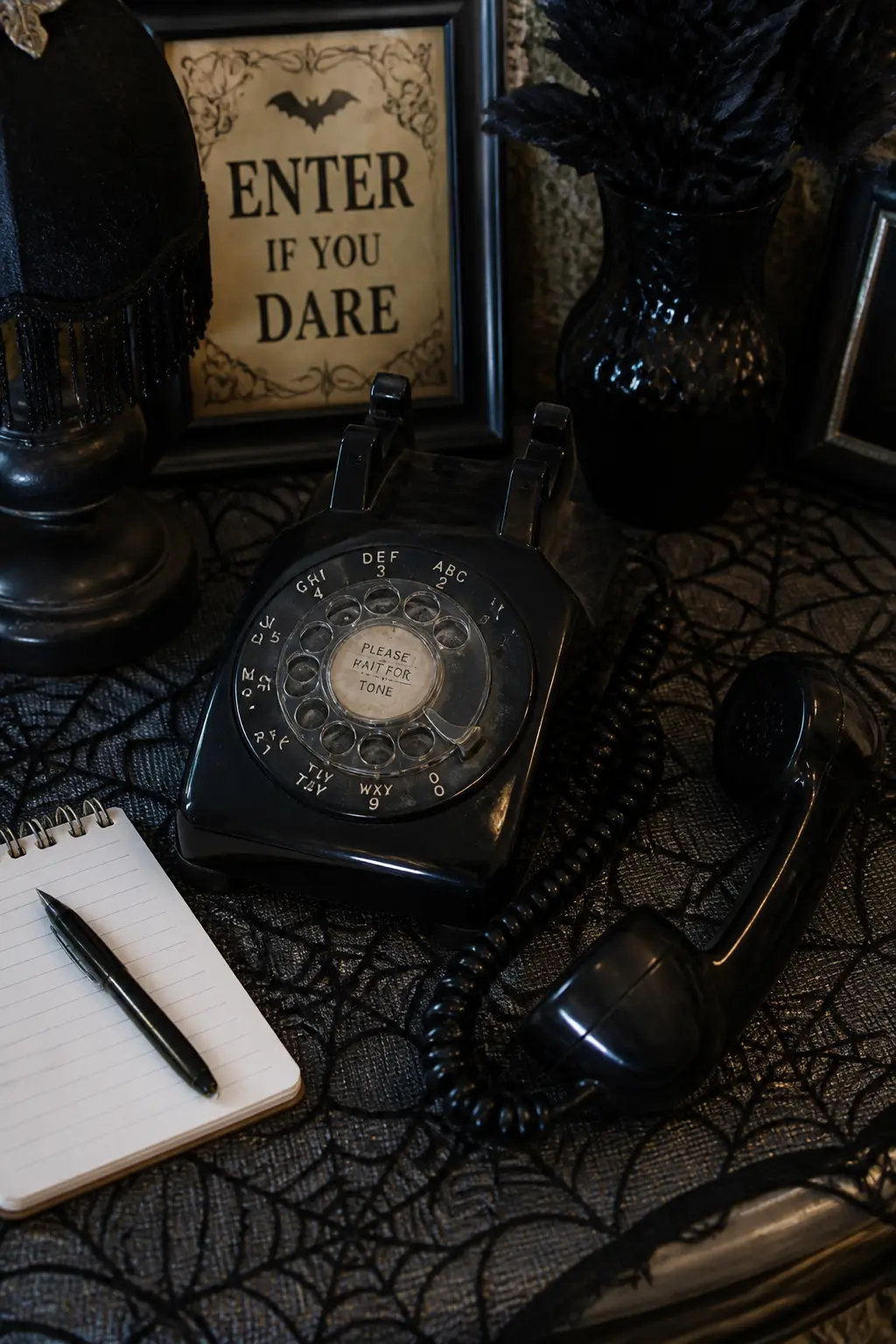
A Phone Left Off the Hook
A rotary or push-button landline telephone, handset lifted and set beside the base, plays on the instinct that a phone off the hook means an interrupted call. Someone picked up. Something happened. The call was not ended, it was abandoned.
Source a vintage phone from a thrift store. Position it on a small table in a corner with the handset beside the base, not dangling, specifically placed as though someone set it down carefully and did not return. Leave a notepad and pen nearby with nothing written on them.
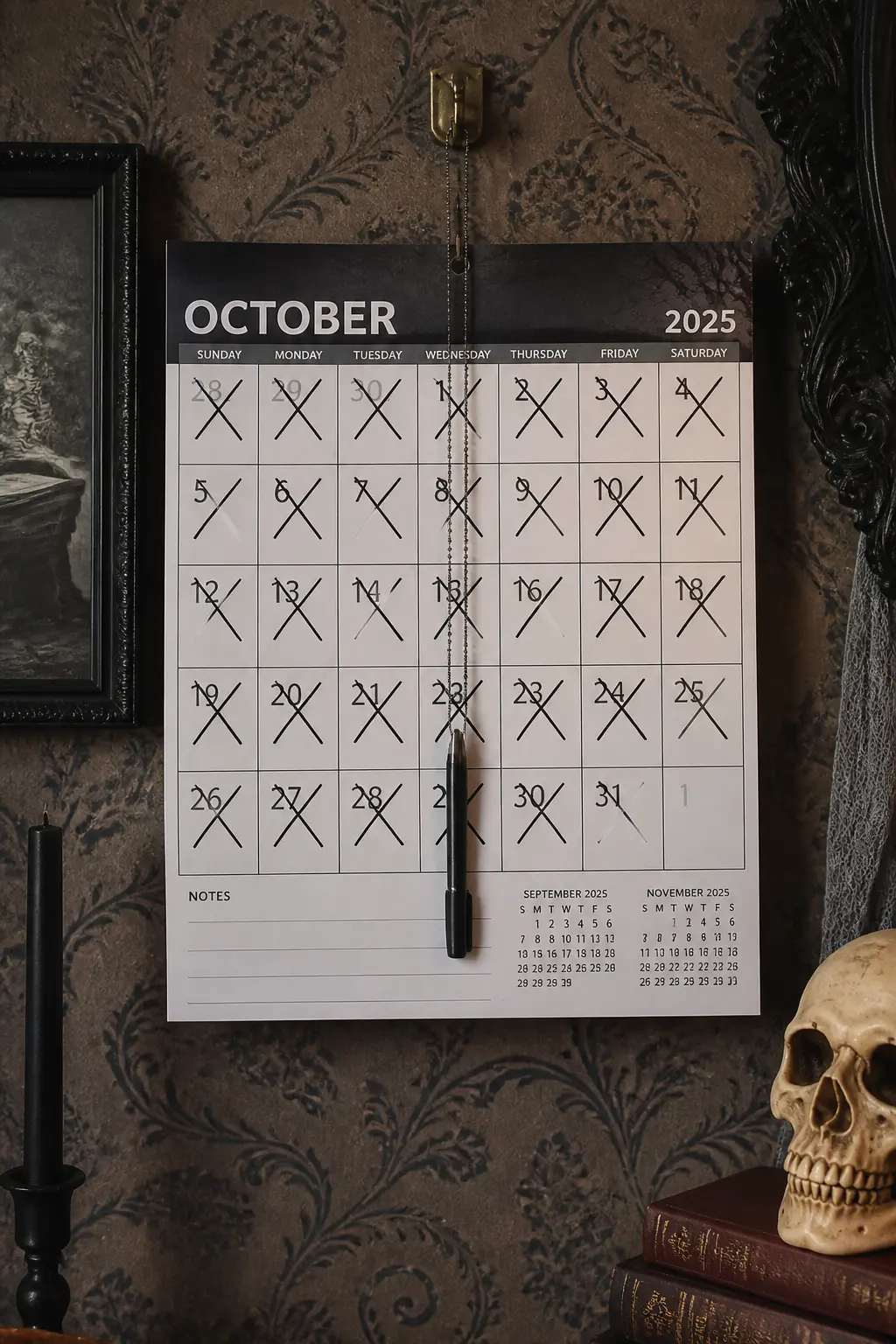
A Calendar with Every Day Crossed Out
Hang a paper wall calendar with every single date crossed out in red or black pen, including dates that have not yet passed.
The forward-crossing is what makes it wrong: this was not a record of time passing, it was a decision about time not continuing. The month shown on the calendar does not matter; pick one that does not name the current season.
The crossings should look urgent and inconsistent in pressure, some light, some heavy, as though made in different states of mind at different times. Leave a pen hanging nearby on a piece of string, as though the work is still ongoing.
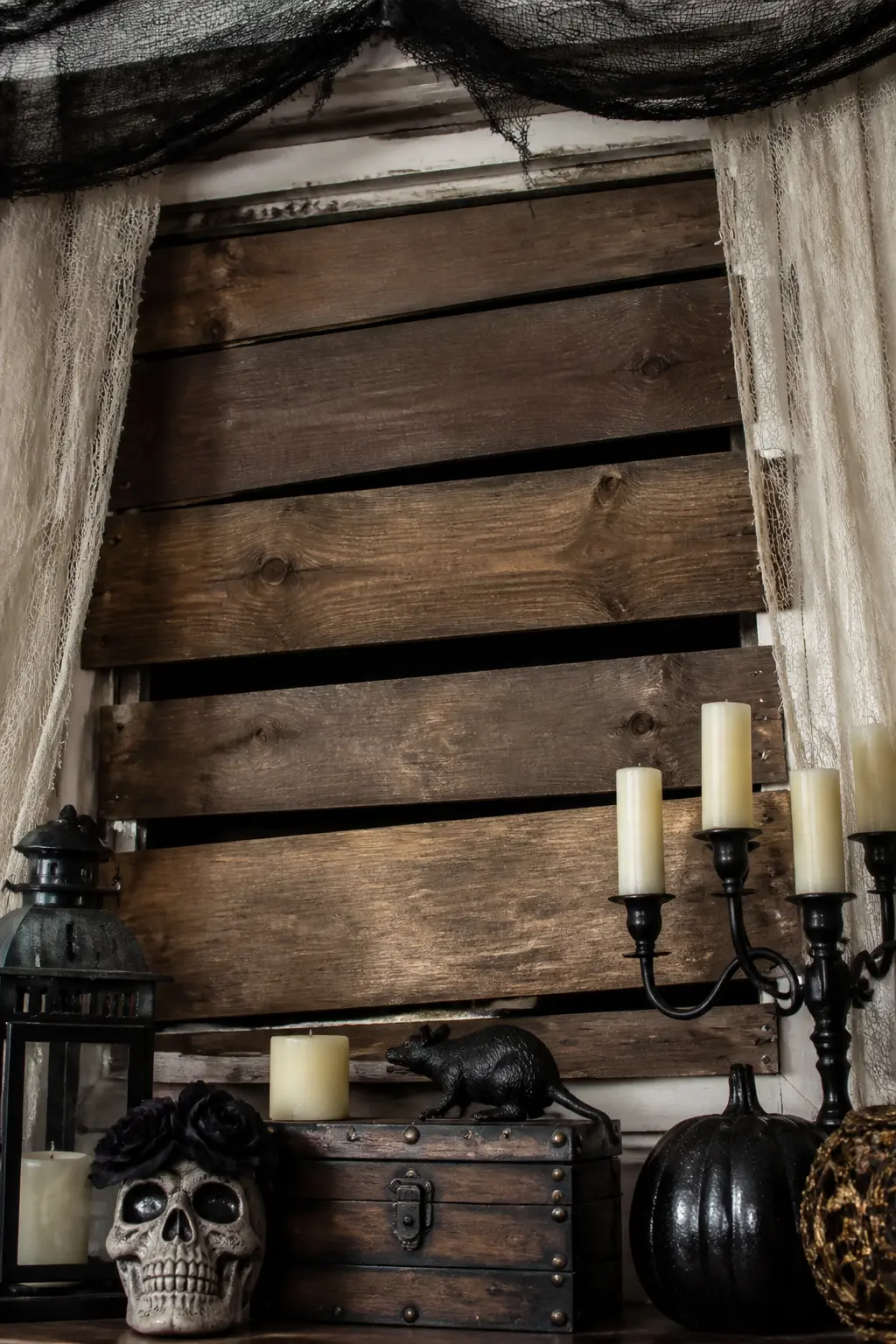
A Window Boarded from the Inside
A window covered with rough timber boards nailed from the interior reads very differently from one boarded on the outside. Outside boarding keeps things out. Inside boarding is someone trying to prevent an exit, or to stop something already in the room from being seen from the outside. The direction of the boards is the story.
Use actual timber planks in varying widths, not foam or printed paper. The planks do not need to be nailed into the actual window frame: temporary construction adhesive strips will hold them against the glass for an evening and remove cleanly.
Leave a gap between two boards just wide enough to suggest something could be seen through it, but angle the boards so nothing behind them is actually visible.
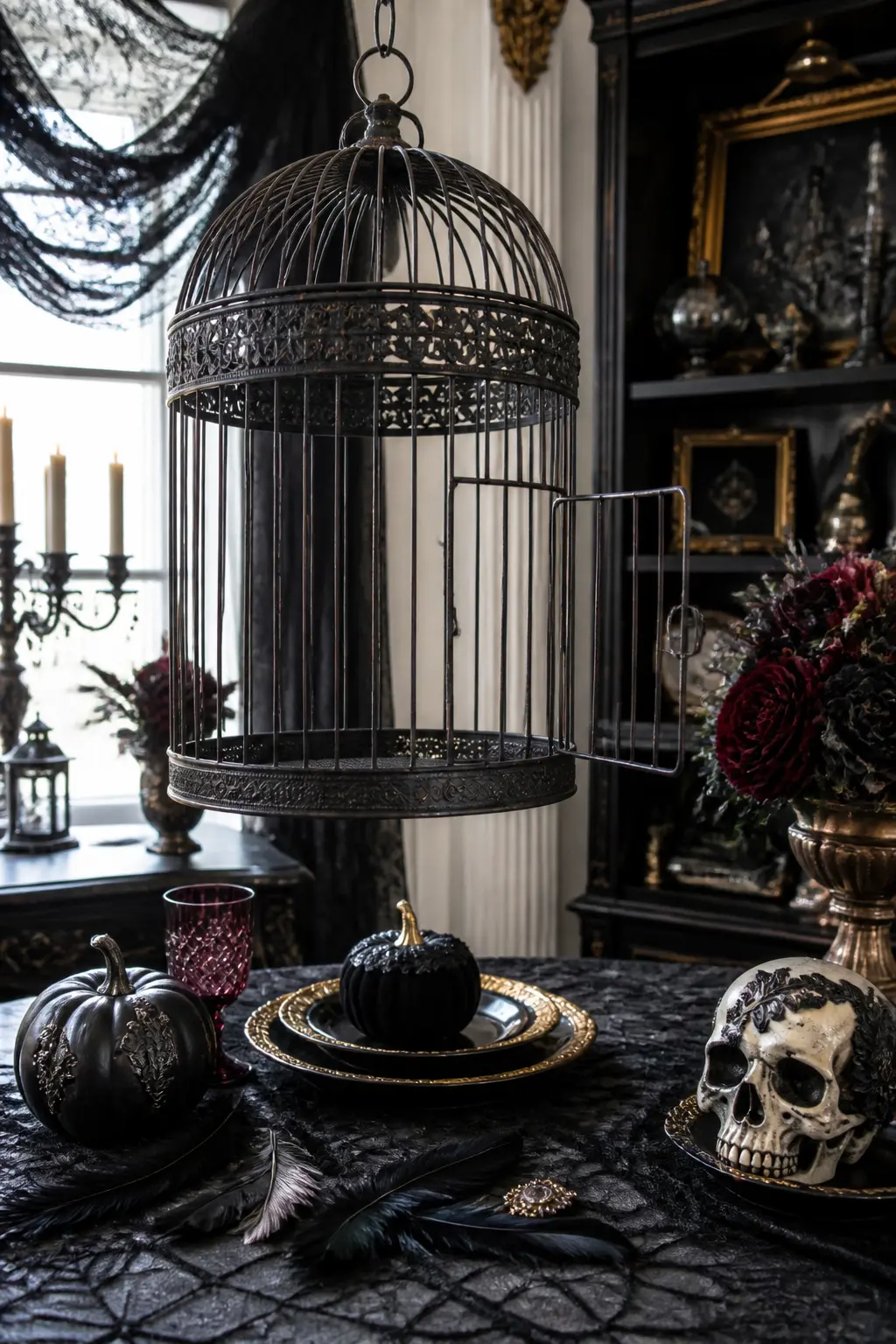
A Birdcage with the Door Open
An empty birdcage, door standing open, placed in a room or on the porch with no other context, communicates a departure that was not planned and was not gentle. The open door is the signal: this was not an empty cage waiting for a bird, it was a cage that used to contain something that is no longer in it.
A Victorian or ornate cage reads better than a plain modern one because the detail of the cage raises the question of value and care, which makes the emptiness and the open door more significant. Set it on a table or hang it at eye level. Leave a scatter of feathers on the surface below it.
Botanical and Organic: Living Things in the Wrong State
Cut flowers, feathers, and organic matter carry an emotional charge that plastic props simply cannot replicate, because they are actually decaying. A wilting flower is not a symbol of death; it is a thing genuinely in the process of ending. That specificity is what makes it work.
Buy organic elements at the end of market day when they are already going over. Use them within 48 hours. The impermanence is the point.
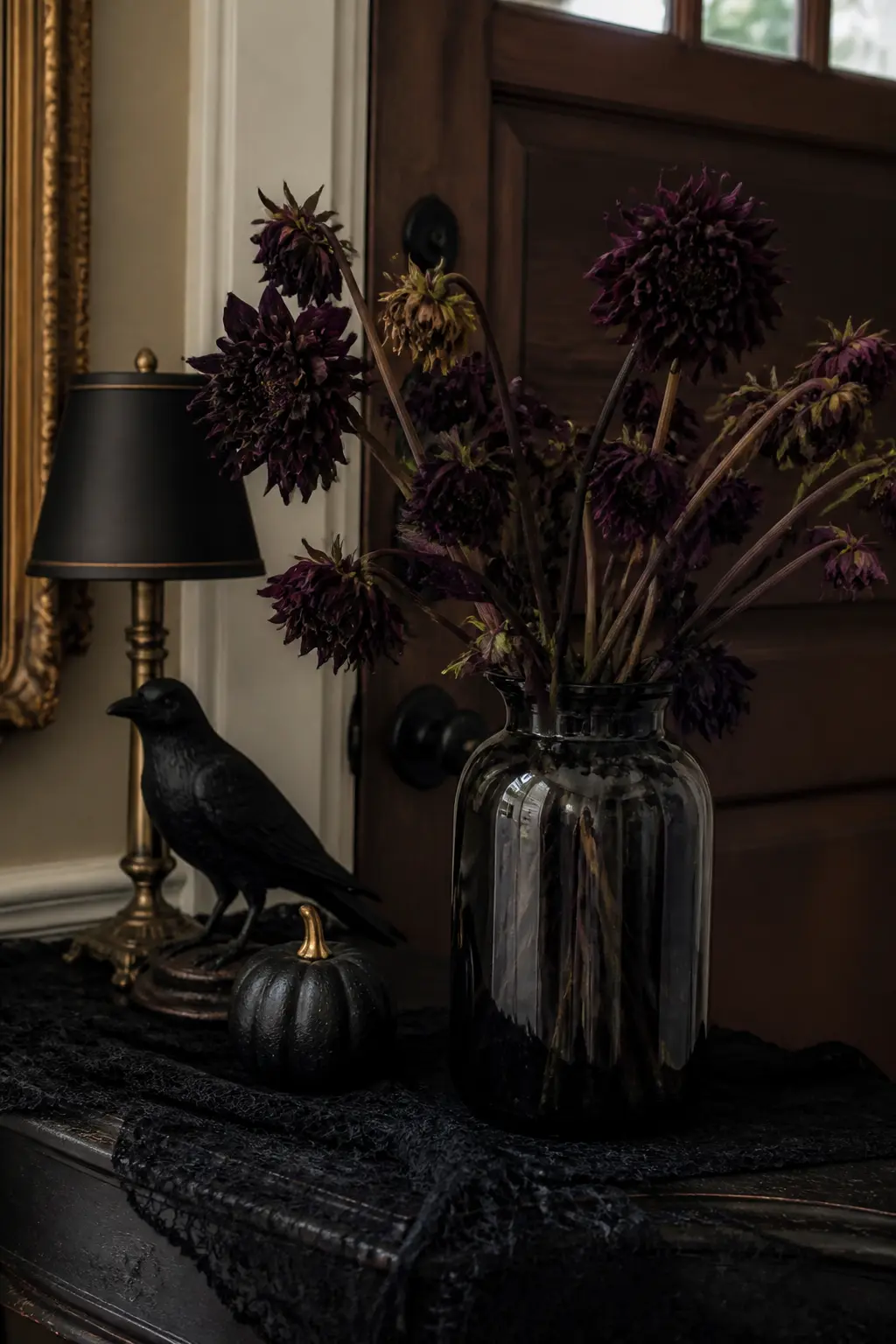
Dark Dahlias Left Wilting in a Vase by the Door
Dark burgundy or near-black dahlias, left in a vase with no water, wilting over the course of the evening, carry a specific kind of dread that artificial flowers cannot approach. They were living; they are in the process of no longer being living; the decline is visible and real.
Buy them two days before the event so they are already starting to droop. Set the vase near the entry so guests pass within arm’s reach.
The color is important: black dahlias, which are actually a very deep purple-burgundy, read as wrong in a floral context because the brain associates that color register with bruising. No other flowers in the arrangement.
🛍 Shopping guide
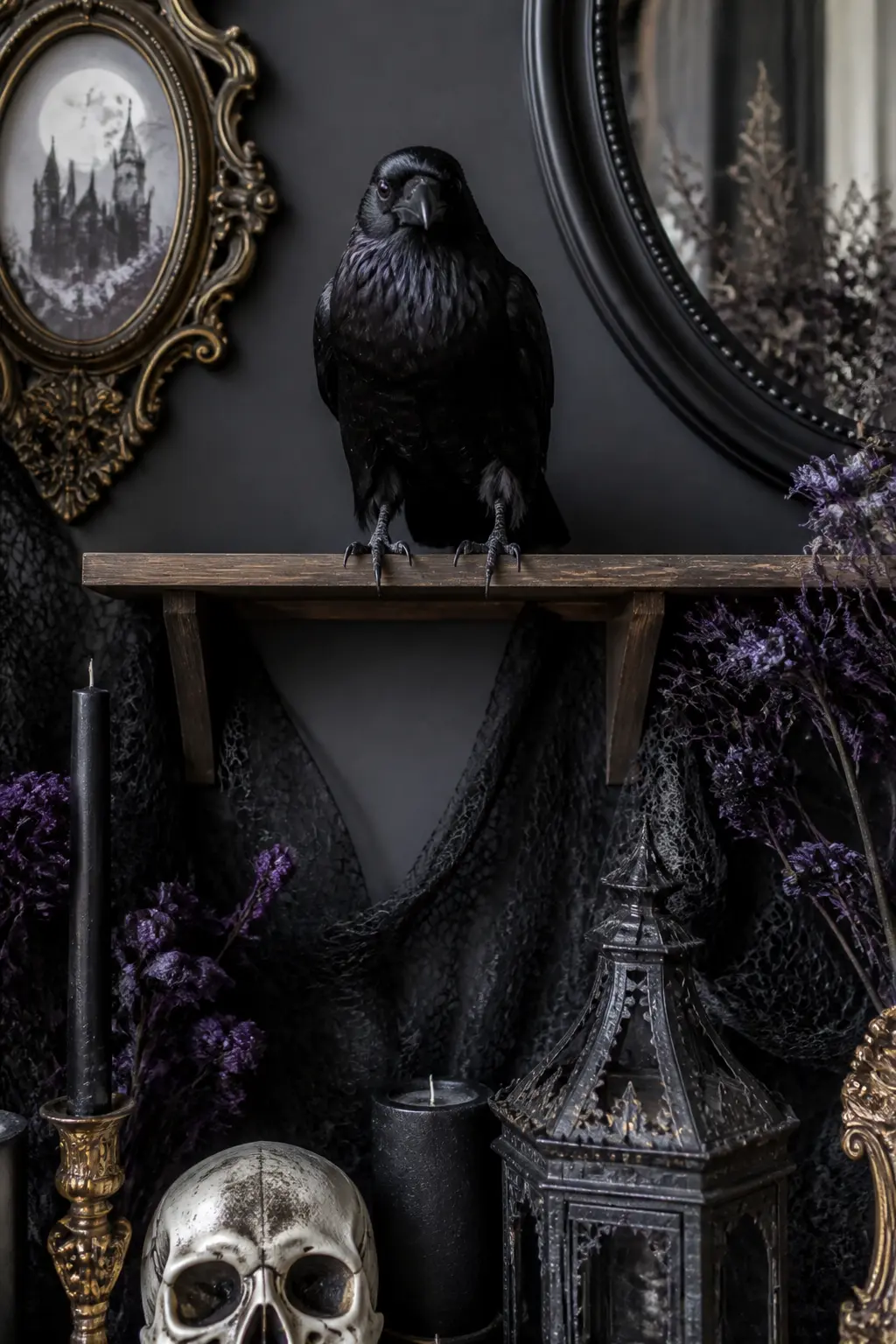
One Raven Placed Where the Eye Lands on Entering
A single taxidermy or high-quality faux raven, placed at exact eye level on a shelf, mantel, or narrow table directly in the sightline of the entrance, works because the raven returns the gaze. It faces the viewer. It does not move.
The eye-to-eye engagement with a creature that should not be indoors and should not be this still produces a low-frequency discomfort that accumulates throughout the evening.
One raven. Not three, not a flock. One, alone, in a position of slight height advantage over the viewer. Nothing else on the surface with it.
The Last Detail: One Final Note Before the Door
This closing section has no images. It is a note on the single decision that separates a display people remember from one they merely acknowledge.
Every great unsettling setup has one thing it does not show. A figure with no face visible. A door open to pure darkness. A sound with no source you can locate. The restraint is not laziness: it is the engine.
The human brain, given 90 percent of a threatening image, will complete the other 10 percent in the most personally disturbing way possible, because it draws on its own private archive of fear. No prop designer can beat that.
Your job is to hand the viewer just enough and then step back. The best scary halloween decorations are the ones that make guests feel briefly uncertain about what they actually saw, and that uncertainty is produced entirely by what you chose to leave out.
Frequently Asked Questions
What makes a Halloween decoration genuinely scary rather than just spooky?
The difference is implication. Spooky decorations show you the thing: a skeleton, a witch, a ghost. Genuinely scary ones show you the evidence that something happened and let your brain complete the story.
An empty rocking chair in motion, a trail of footprints that stop at the door, a single lit window in a dark house: none of these tell you what to feel, and that gap is where dread lives.
How important is lighting for scary Halloween decorations?
It is probably the single most important variable. The same object, lit from above with a white bulb, reads as a decoration. Lit from below with a green or amber source, or placed in near-darkness with only one dim source, it reads as a threat.
Focus on where the light comes from, what color it is, and what it leaves dark. Removing light sources is often more effective than adding them.
Can an apartment or small space pull off genuinely unsettling decorations?
Yes, and in some ways more easily than a large house. A hallway with a door at the end left ajar, a single lamp on a timer, a mirror angled to catch guests on entry: these are all small-footprint ideas.
The constraint of a small space actually helps because it limits how many details compete for attention, which increases the impact of each one.
How do I avoid the display looking like a Halloween store threw up on my lawn?
One rule: one idea per zone. The yard gets one prop, placed alone in empty space. The porch gets one detail. The entryway gets one. Each thing should be visible from a distance without competing with anything nearby.
Restraint is not a budget constraint, it is the technique. The moment you add a second prop next to the first, both lose power.
What is the easiest genuinely unsettling decoration for someone who has never done this before?
The ‘back soon’ note on the door requires no supplies beyond paper and a pen, no setup beyond writing and taping, and lands immediately because it uses the viewer’s existing understanding of social norms rather than any special prop.
Every person who reads it understands instantly that the house is supposedly empty, which means the lights on inside are a problem, and the brain starts working from there.

Pick the right Halloween kids crafts by age and effort, from toddler-safe paint projects to printabl

Boo basket ideas for boyfriends that feel personal and intentional: gourmet snacks, grooming picks,

72 Halloween would you rather questions sorted by round, plus free printable card decks. Perfect for
Leave a Reply