


These 130 family trivia questions are built for one purpose: a quiz night where a ten-year-old can beat a forty-year-old and nobody feels left out. The questions cover animals, science, food, geography, pop culture, history and more, so every person at the table finds a round where they shine. Print the sheets, grab a scorecard, and the game runs itself.
This post contains affiliate links. If you buy through them, I may earn a small commission at no extra cost to you.
- How to Play
- Round 1: Animal Kingdom Basics
- Round 2: Food and Drink Fun
- Round 3: Planet Earth and Nature
- Round 4: Books, Stories and Fairy Tales
- Round 5: Science and How Things Work
- Round 6: Movies and Animated Films
- Round 7: World Geography
- Round 8: History and the Past
- Round 9: Music and Musicians
- Round 10: Sport and the Games We Play
- Round 11: Science and Technology (Advanced)
- Round 12: History and Culture (Advanced)
- Round 13: The Expert Round
- Tie-Breaker Round
- Frequently Asked Questions
How to Play
Divide players into teams of two to four, or play individually if the group is small. The 130 questions are split across 13 rounds of ten questions each, and difficulty rises steadily from Round 1 to Round 13. A host reads each question aloud (or passes the question sheet around the table), teams write their answers privately, and the host reads from the separate answer-key sheet to score at the end of each round. Award one point per correct answer, tally scores on the included scorecard, and use the ten-question tie-breaker round to settle any dead heat at the finish. First team to the highest score after Round 13 wins, or the tie-breaker decides it.
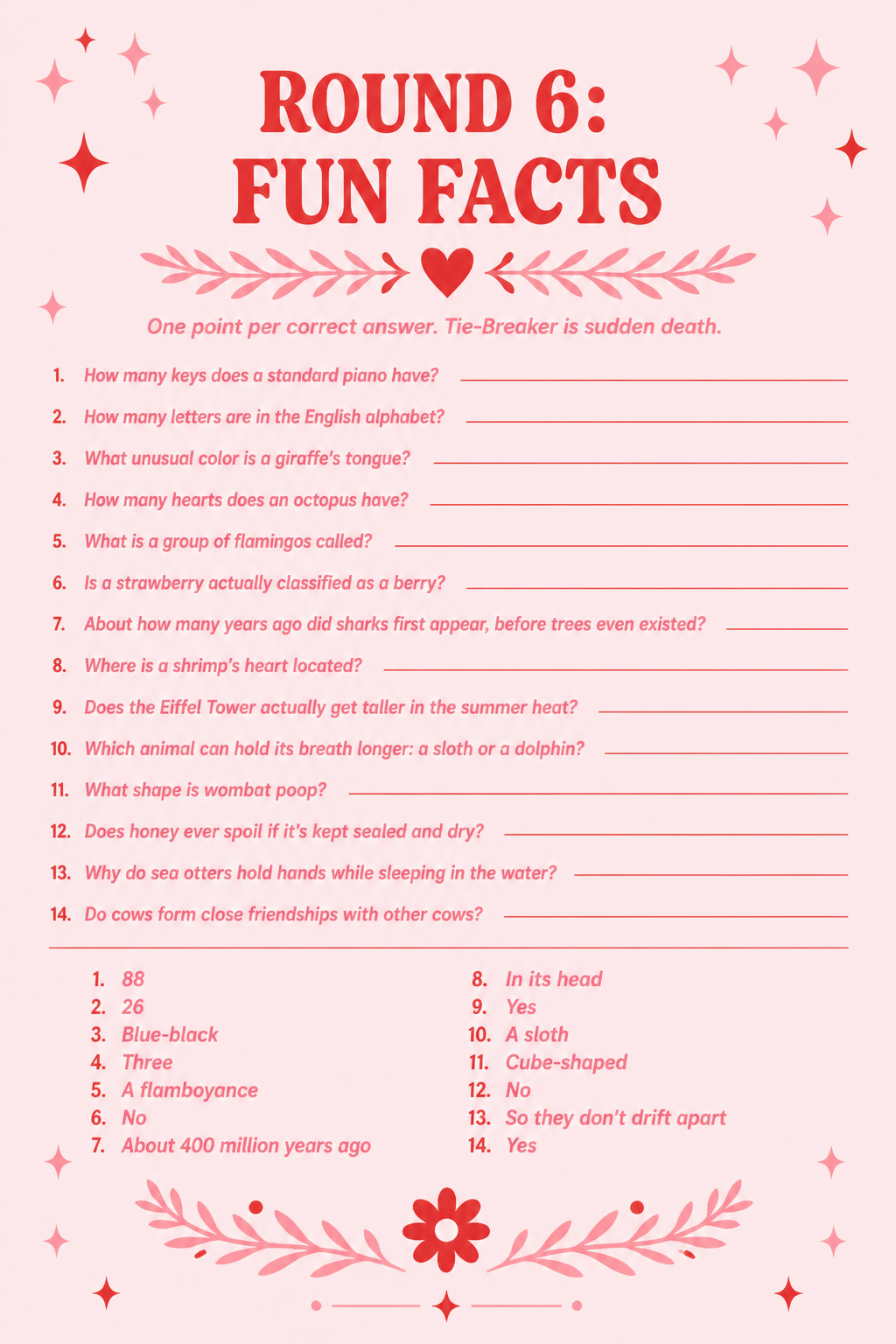
Round 1: Animal Kingdom Basics
These gentle opening questions about animals are perfect for younger players and ease the whole table into the game without pressure.
- What do you call a baby dog? Answer: Puppy
- Which animal is known as the King of the Jungle? Answer: Lion
- How many legs does a spider have? Answer: Eight
- What is the tallest animal on Earth? Answer: Giraffe
- Which bird cannot fly but can swim? Answer: Penguin
- What colour is a flamingo? Answer: Pink
- Which animal carries its home on its back? Answer: Snail (also accept tortoise)
- What do caterpillars turn into? Answer: Butterflies or moths
- Which is the fastest land animal? Answer: Cheetah
- How many humps does a Bactrian camel have? Answer: Two


🛍 Shopping guide
Round 2: Food and Drink Fun
Everyone eats, so everyone has a fighting chance in this round, from pizza toppings to world-famous dishes.
- What fruit is used to make guacamole? Answer: Avocado
- Which country is pasta originally from? Answer: Italy
- What is the main ingredient in hummus? Answer: Chickpeas
- What colour is a ripe banana? Answer: Yellow
- Which nut is used to make marzipan? Answer: Almond
- What type of pastry is used to make a croissant? Answer: Puff pastry (also accept laminated dough)
- What vegetable makes you cry when you chop it? Answer: Onion
- Which spice gives curry its yellow colour? Answer: Turmeric
- What is the outer layer of a pineapple called? Answer: Skin or rind
- Which country invented sushi? Answer: Japan


Round 3: Planet Earth and Nature
Rivers, mountains, weather and the natural world, this round rewards curious kids and geography-loving adults equally.
- What is the largest ocean on Earth? Answer: Pacific Ocean
- What gas do plants absorb from the air? Answer: Carbon dioxide
- How many continents are on Earth? Answer: Seven
- What is the name of the longest river in the world? Answer: Nile
- What causes a rainbow to appear? Answer: Sunlight passing through water droplets (refraction)
- What is the hardest natural substance on Earth? Answer: Diamond
- Which planet in our solar system has rings around it? Answer: Saturn (also accept Uranus, Jupiter or Neptune for extra credit)
- What do we call a scientist who studies earthquakes? Answer: Seismologist
- What is the name of the tallest mountain on Earth? Answer: Mount Everest
- How many bones does an adult human body have? Answer: 206


Round 4: Books, Stories and Fairy Tales
Classic stories that parents read and children live in, with questions that reward listening as much as reading.
- What is the name of the wooden boy whose nose grows when he lies? Answer: Pinocchio
- In which book does a girl fall down a rabbit hole? Answer: Alice in Wonderland
- What are the three little pigs afraid of? Answer: The Big Bad Wolf
- Who wrote the Harry Potter series? Answer: J.K. Rowling
- What is the name of the lion in The Chronicles of Narnia? Answer: Aslan
- In Cinderella, what does the glass slipper help the prince find? Answer: His true love, Cinderella
- What creature spins a web to save a pig in a famous children’s novel? Answer: A spider (Charlotte)
- Who is the author of Charlie and the Chocolate Factory? Answer: Roald Dahl
- In Sleeping Beauty, what causes the princess to fall asleep? Answer: Pricking her finger on a spinning wheel
- What is the name of the bear who loves honey and lives in Hundred Acre Wood? Answer: Winnie-the-Pooh


Round 5: Science and How Things Work
A little harder now, these science questions reward school knowledge and everyday curiosity in equal measure.
- What force keeps us on the ground? Answer: Gravity
- What is H2O more commonly known as? Answer: Water
- What part of a plant absorbs sunlight to make food? Answer: Leaves
- How many colours are in a rainbow? Answer: Seven
- What is the centre of an atom called? Answer: Nucleus
- What planet is closest to the Sun? Answer: Mercury
- What type of energy does the Sun produce? Answer: Solar energy (also accept light and heat)
- What instrument measures temperature? Answer: Thermometer
- What is the chemical symbol for gold? Answer: Au
- What is the boiling point of water at sea level in Celsius? Answer: 100 degrees Celsius


Round 6: Movies and Animated Films
From classic cartoons to blockbusters the whole family has seen together, this round is where the kids often pull ahead.
- What is the name of the toy cowboy in Toy Story? Answer: Woody
- Which Disney princess lives with seven dwarfs? Answer: Snow White
- In Finding Nemo, what type of fish is Nemo? Answer: Clownfish
- What is the name of the snowman in Frozen? Answer: Olaf
- Which superhero is also known as the Man of Steel? Answer: Superman
- What animal is Simba in The Lion King? Answer: Lion
- In The Incredibles, what is the name of the family’s baby? Answer: Jack-Jack
- What colour is Shrek? Answer: Green
- Who voices the character Dory in Finding Dory? Answer: Ellen DeGeneres
- In which animated film does a rat dream of becoming a chef in Paris? Answer: Ratatouille


Round 7: World Geography
Capitals, flags and landmarks, this mid-game round tests the geographical knowledge that adults often overestimate and kids sometimes surprise everyone with.
- What is the capital city of Australia? Answer: Canberra
- In which country would you find the Eiffel Tower? Answer: France
- What is the smallest country in the world? Answer: Vatican City
- Which country has a maple leaf on its flag? Answer: Canada
- What is the capital city of Japan? Answer: Tokyo
- In which continent is Egypt located? Answer: Africa
- What ocean lies between Europe and the Americas? Answer: Atlantic Ocean
- Which country is home to the Amazon Rainforest? Answer: Brazil (also accept Peru, Colombia)
- What is the capital city of Spain? Answer: Madrid
- How many stars appear on the American flag? Answer: 50


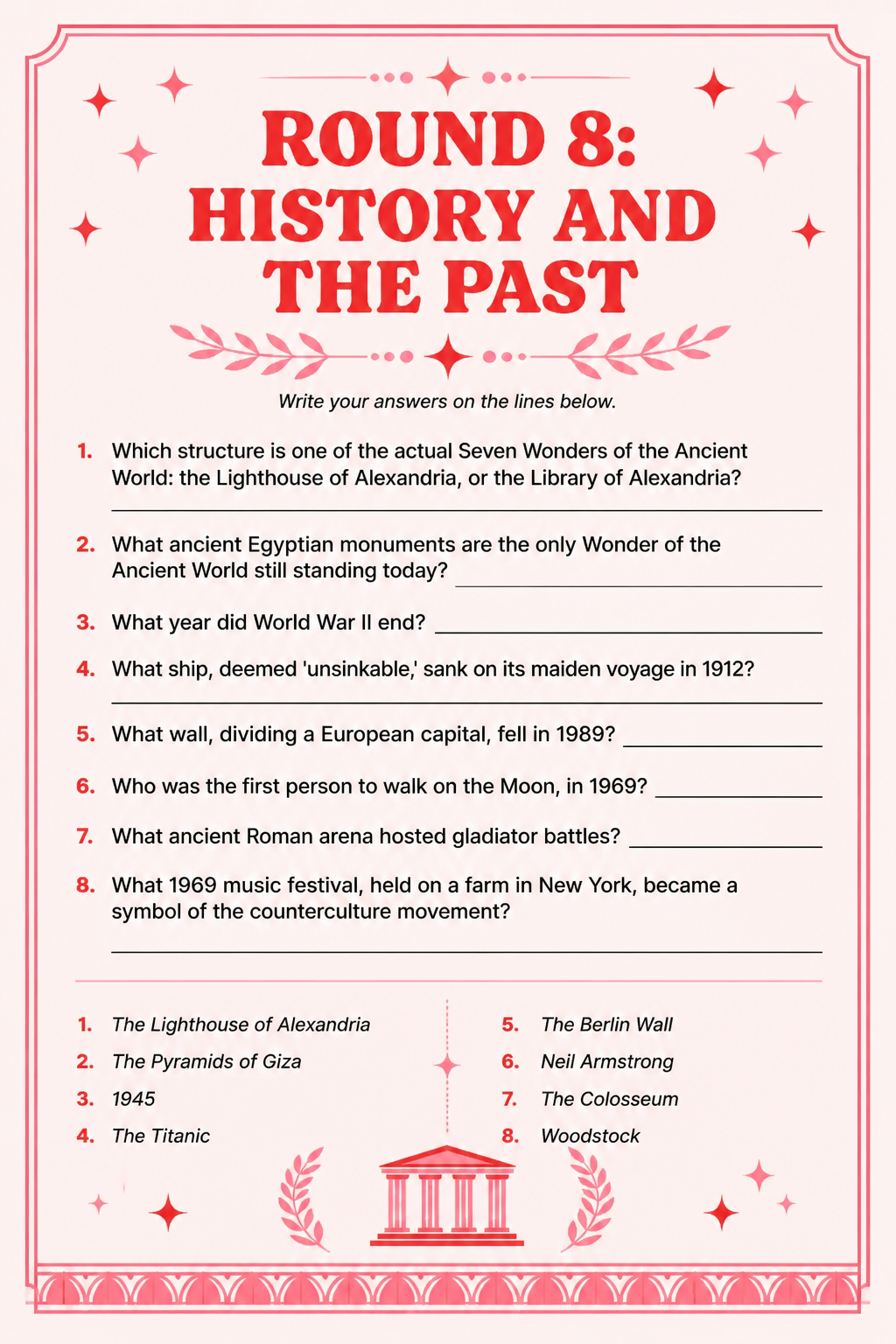
Round 8: History and the Past
The questions step up in difficulty here, rewarding adults while keeping the language clear enough for older children to follow along.
- Who was the first person to walk on the Moon? Answer: Neil Armstrong
- In which city was the Titanic built? Answer: Belfast
- What ancient wonder was located in Alexandria? Answer: The Library of Alexandria (also accept the Lighthouse of Alexandria)
- Which civilisation built the Great Pyramids? Answer: Ancient Egyptians
- Who was the first woman to win a Nobel Prize? Answer: Marie Curie
- What wall was built to divide East and West Berlin? Answer: The Berlin Wall
- Which empire was ruled by Julius Caesar? Answer: Roman Empire
- What were the ships Christopher Columbus sailed to the Americas? Answer: Nina, Pinta and Santa Maria
- Who painted the Mona Lisa? Answer: Leonardo da Vinci
- In which country did the Industrial Revolution begin? Answer: England (also accept United Kingdom)

Round 9: Music and Musicians
A mix of timeless classics and recent chart hits means parents and kids both have a shot at scoring here.
- How many strings does a standard guitar have? Answer: Six
- What is the name of the lead singer of Queen? Answer: Freddie Mercury
- Which instrument does a pianist play? Answer: Piano
- What word describes the speed of a piece of music? Answer: Tempo
- Which pop star is known as the Queen of Pop? Answer: Madonna
- What are the first three words of the song Twinkle Twinkle Little Star? Answer: Twinkle twinkle little
- Which band sang Bohemian Rhapsody? Answer: Queen
- How many keys does a standard piano have? Answer: 88
- What is the name of Taylor Swift’s debut album? Answer: Taylor Swift
- Which instrument is Yo-Yo Ma famous for playing? Answer: Cello


Round 10: Sport and the Games We Play
From the Olympics to the school playground, this round levels the field in a satisfying way because kids often know the rules adults have forgotten.
- How many players are on a standard basketball team on the court at once? Answer: Five
- In which sport would you perform a slam dunk? Answer: Basketball
- How many rings are on the Olympic flag? Answer: Five
- What is the highest score you can achieve with one dart in a standard dartboard? Answer: 60 (triple 20)
- Which country invented the game of cricket? Answer: England
- In tennis, what is the term for a score of zero? Answer: Love
- How many players are on a soccer team on the field? Answer: 11
- What colour is the centre bullseye of an archery target? Answer: Gold (yellow)
- In which sport do you perform a hat trick? Answer: Soccer, hockey or cricket (accept any)
- How long is a standard marathon race in kilometres? Answer: 42.195 kilometres


Round 11: Science and Technology (Advanced)
This is where adults reassert themselves, though science-mad children will give them a real fight.
- What does DNA stand for? Answer: Deoxyribonucleic acid
- Which planet has the most moons in our solar system? Answer: Saturn
- What is the speed of light in kilometres per second (approximate)? Answer: 300,000 kilometres per second
- What is the process by which plants make their own food using sunlight? Answer: Photosynthesis
- What is the name of the force that opposes motion between two surfaces? Answer: Friction
- How many chambers does a human heart have? Answer: Four
- What is the name of the galaxy that contains our solar system? Answer: The Milky Way
- What element has the atomic number 1? Answer: Hydrogen
- What is the term for animals that eat both plants and meat? Answer: Omnivores
- What is the name of the layer of gas that protects Earth from ultraviolet radiation? Answer: Ozone layer


Round 12: History and Culture (Advanced)
Harder history, literature and culture questions designed to challenge adults while keeping the window open for sharp teenagers.
- In which city is the Colosseum located? Answer: Rome
- Who wrote the play Romeo and Juliet? Answer: William Shakespeare
- What is the name of the currency used in Japan? Answer: Yen
- Which U.S. president appears on the penny? Answer: Abraham Lincoln
- What was the name of the ship that carried the Pilgrims to America? Answer: The Mayflower
- Who was the ancient Egyptian sun god? Answer: Ra (also accept Re)
- Which philosopher taught Alexander the Great? Answer: Aristotle
- What is the name of the Japanese art of paper folding? Answer: Origami
- In which city did the Renaissance begin? Answer: Florence
- What language did the ancient Romans speak? Answer: Latin


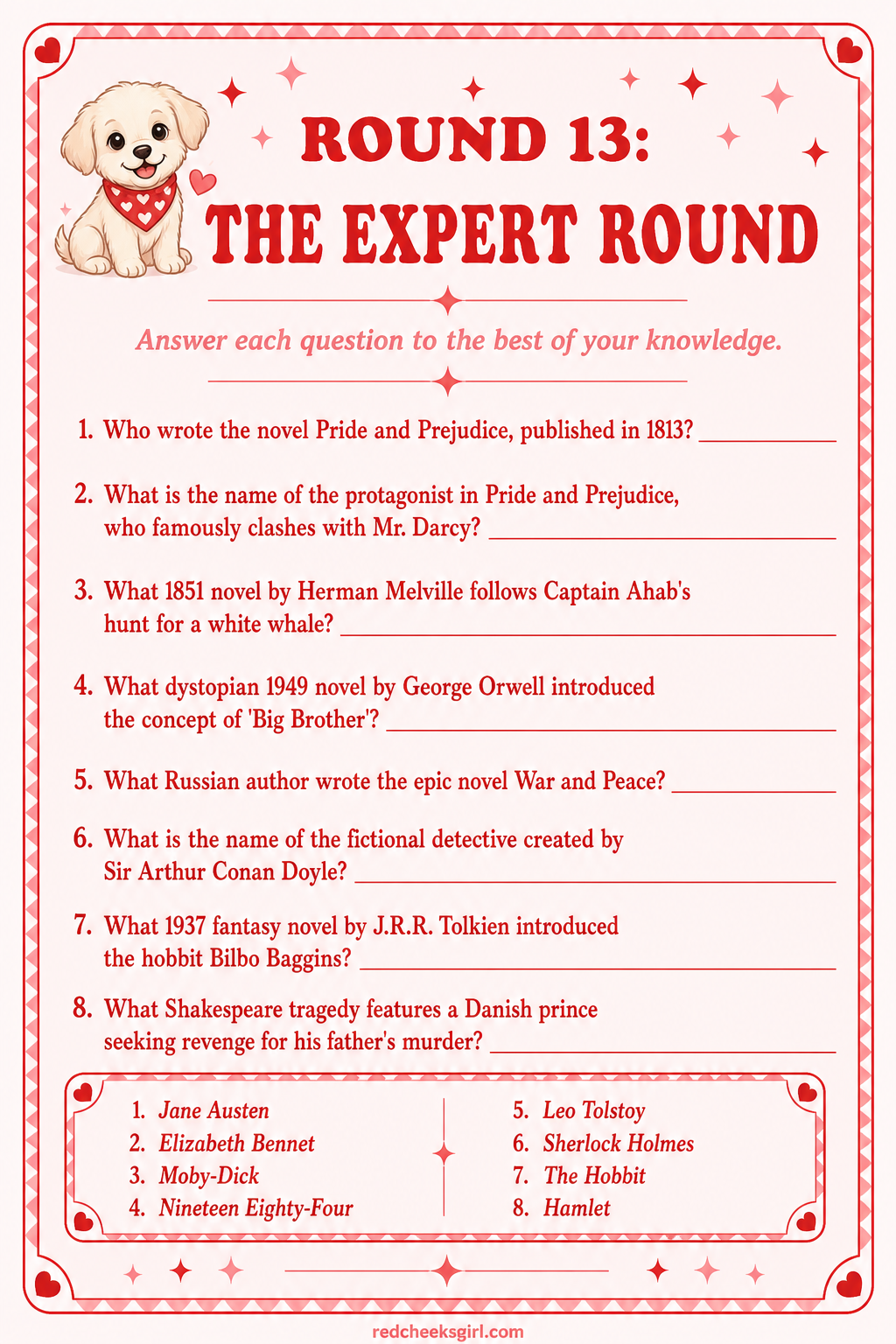
Round 13: The Expert Round
The final regular round pulls from every category at full difficulty; this is where the scores shake out before the tie-breaker.
- What is the name of the longest bone in the human body? Answer: Femur (thigh bone)
- Which scientist proposed the theory of general relativity? Answer: Albert Einstein
- What is the chemical formula for table salt? Answer: NaCl
- Who wrote Pride and Prejudice? Answer: Jane Austen
- What is the capital city of Canada? Answer: Ottawa
- How many players are on a rugby union team? Answer: 15
- Which element is represented by the symbol Fe? Answer: Iron
- What is the name of the deepest ocean trench on Earth? Answer: Mariana Trench
- Who painted the Sistine Chapel ceiling? Answer: Michelangelo
- What is the term for a word that reads the same forwards and backwards? Answer: Palindrome

Tie-Breaker Round
Hold this round in reserve and play it only when two or more teams finish on equal points; the first team to answer each question correctly wins the point, no writing required. If you want to pair this event with other games, these Christmas party games for family make a great follow-up activity, and for a completely different format on another night, this set of 150 Truth or Dare questions keeps the energy going.
- What is 12 multiplied by 12? Answer: 144
- Name the three primary colours. Answer: Red, blue and yellow
- What is the name of the fairy in Peter Pan? Answer: Tinker Bell
- Which ocean is the smallest in the world? Answer: Arctic Ocean
- What gas do humans exhale? Answer: Carbon dioxide
- How many sides does a hexagon have? Answer: Six
- What is the capital city of Brazil? Answer: Brasilia
- Who invented the telephone? Answer: Alexander Graham Bell
- What is the name of the pirate in Peter Pan? Answer: Captain Hook
- How many planets are in our solar system? Answer: Eight


Frequently Asked Questions
How many players do you need for a family trivia quiz night?
The game works with as few as two players competing individually and scales comfortably to four or five teams. Aim for two to four people per team so everyone stays involved and no one sits idle between questions.
Are these family trivia questions suitable for young children?
Rounds 1 through 6 are specifically designed for school-age children and cover animals, food, fairy tales, nature, basic science and animated films. Older children and adults pick up steam in Rounds 7 through 13. Mixing ages inside each team keeps the game fair and fun across the whole table.
How do you print the question cards and answer keys?
Print the question-only card sheets on standard cardstock, cut along the marked lines, and store each round in a labelled envelope or on a binder ring. Print the answer keys on plain paper and keep them face-down with the host until scoring time. A home laminator makes the cards reusable across multiple game nights.
When do you use the tie-breaker round?
Hold it in reserve and only play it if two or more teams end Round 13 on exactly the same score. In the tie-breaker, teams answer out loud rather than writing answers down, and the first team to call out the correct answer wins the point. The team with the most points after all ten tie-breaker questions wins.
Can you play this as a quick game rather than a full 13-round quiz?
Absolutely. Choose any four or five rounds that match the age range at the table, play them in order and use the tie-breaker if needed. Each round takes roughly five minutes, so a five-round game runs in about half an hour including scoring.
How do you stop older players from dominating the game?
Mix adults and children on the same team rather than separating them. Alternatively, award bonus points when a child under twelve answers correctly without help from a teammate. Both approaches keep younger players motivated and make the game genuinely competitive for everyone.

120 trivia questions and answers for seniors — 6 nostalgic rounds plus free printable question she

20 Christmas trivia games for a full quiz night with rounds, buzzers & printable sheets. Run it like

120 family trivia questions and answers for all ages — 6 rounds, free printable sheets, and an ans
Leave a Reply