

18 Christmas Trivia Rounds With Free Printables for People Who Take Quizzes Seriously

These christmas party trivia games are built for hosts who want a proper quiz night, not a casual flick through an app.
You get nine printable rounds covering films, music, history, food, carols, adverts, and more, plus a working tie-breaker, a master scorecard, and six no-print formats that keep the evening moving between rounds.
Print what you need, set the rules once, and let the competition do the rest.
This post contains affiliate links. If you buy through them, I may earn a small commission at no extra cost to you.
- Round One: Christmas Films
- Round Two: Christmas Number Ones
- Round Three: Christmas Around the World
- Splitting the Room Into Teams of Four
- Round Four: Food and Drink
- Marking Each Other’s Sheets Between Rounds
- Round Five: Carols and Hymns
- Round Six: Christmas History
- The Bonus Round Read Aloud
- Round Seven: Adverts and Television
- Round Eight: Picture Round
- The Half Time Break
- Round Nine: Anagram Free Word Round
- The Tie Breaker: Nearest Wins
- The Master Scorecard (Scorecard, One Per Team)
- The Quizmaster Running Order
- The Prize Nobody Expected
- The Grudge Round Between Two Families
- Frequently Asked Questions
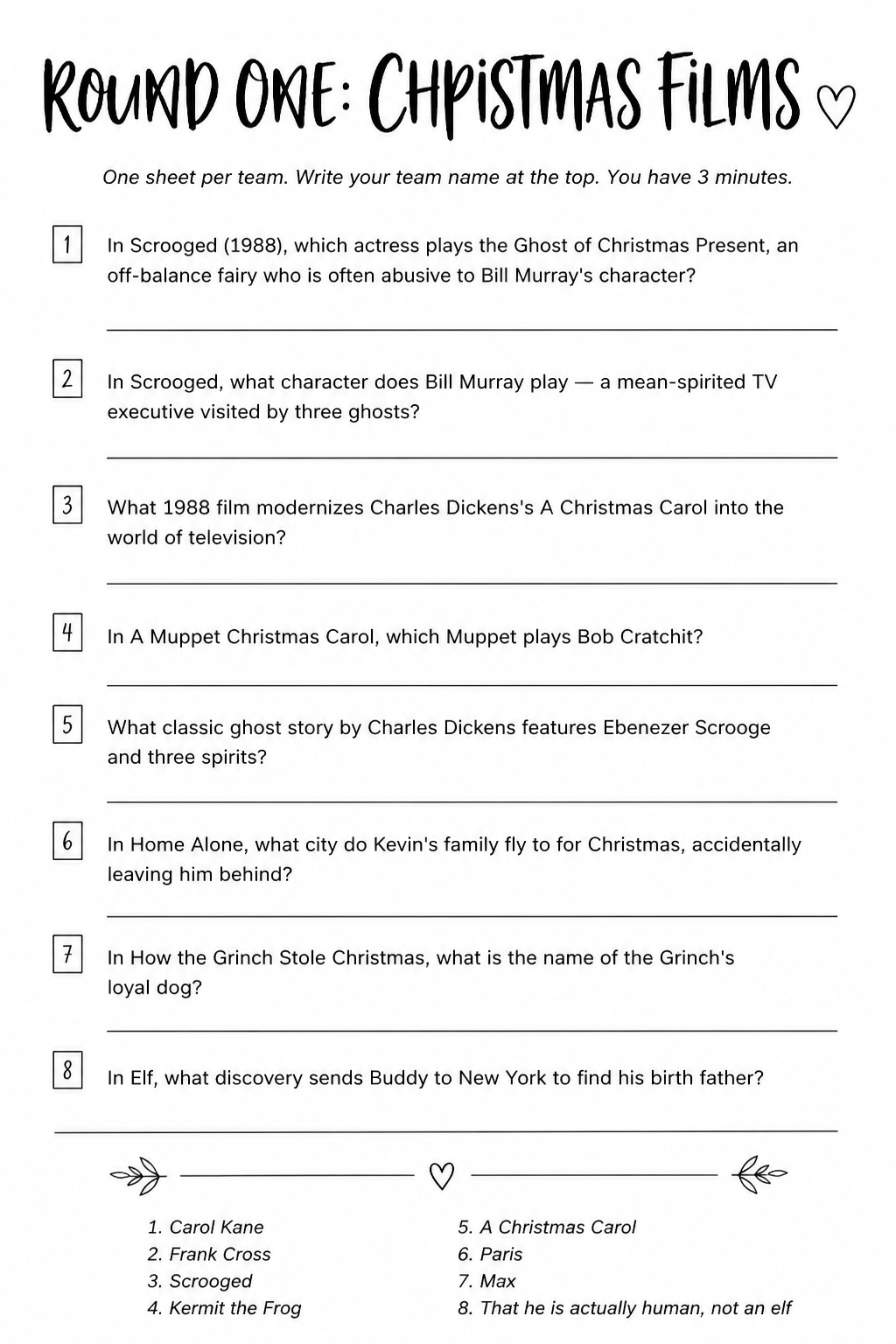
1. Round One: Christmas Films
Teams receive ten questions covering Christmas films from the 1940s to the present day.
Questions move from the easy end (naming the actor who plays the Ghost of Christmas Present in a specific adaptation) into genuinely tricky territory: directors, original release years, and lines of dialogue attributed to the wrong film.
The difficulty curve is intentional: the first three questions settle nerves, questions four through eight separate the casual viewers from the obsessives, and the last two are designed to cause arguments.
Print one sheet per team. Allow three minutes per round as a firm rule and announce it before the first question lands on the table. Teams write answers in the numbered boxes, fold the sheet, and pass it left for marking. The answer key prints separately so the quizmaster reads answers aloud and teams mark each other.
The most common failure here is a team confidently writing a character name instead of an actor name when the question asks for an actor. Add one spoken sentence before the round starts: “Write names exactly as asked.” That single instruction prevents half the disputes.
Read the answer key version out loud and accept clear phonetic equivalents of foreign names.
🛍 Shopping guide
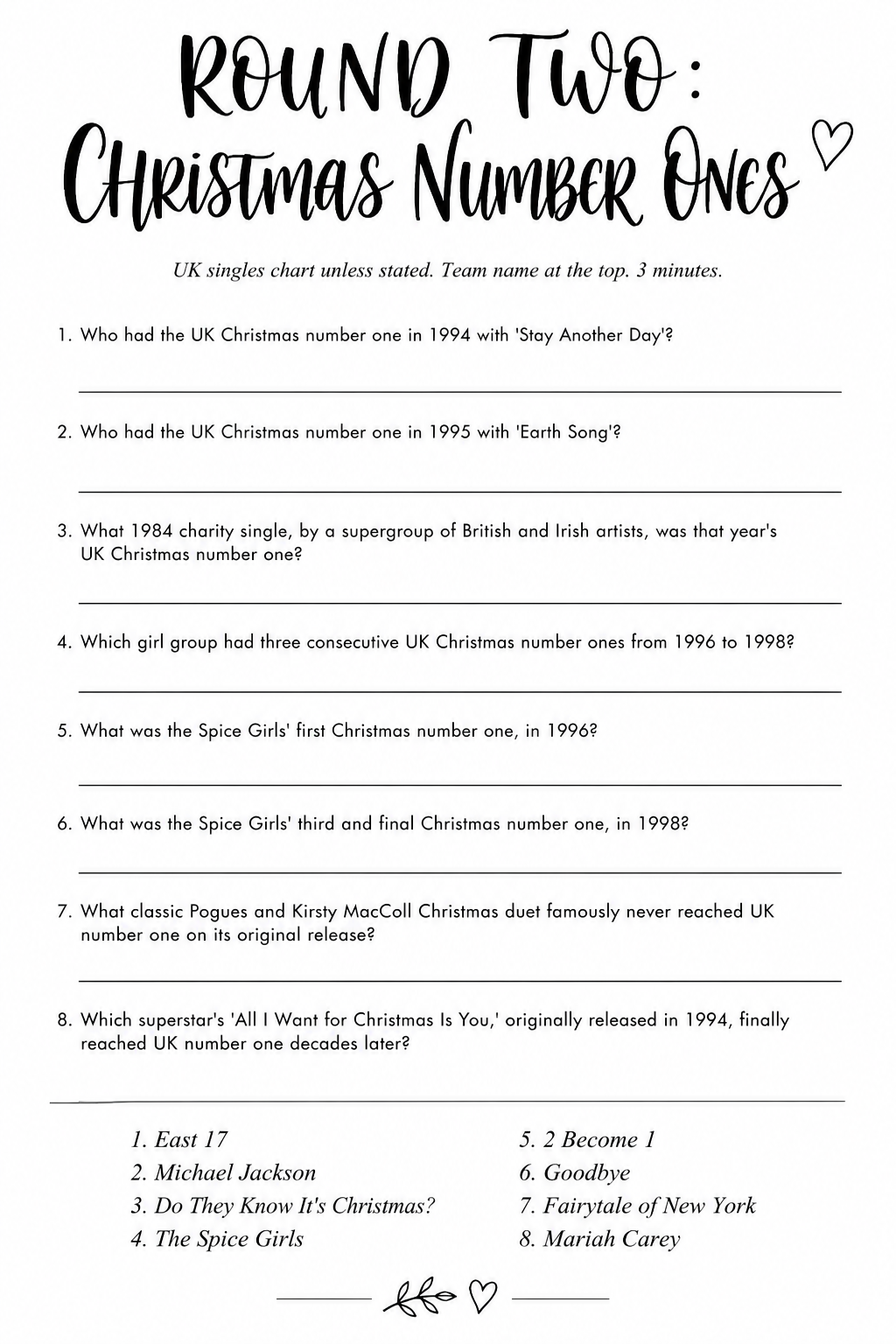
2. Round Two: Christmas Number Ones
Ten questions about UK and US Christmas number ones across the decades, testing whether teams know the year, the artist, or the exact title.
The format mixes direction: some questions give the year and ask for the song, others give the song and ask for the year, and two give a lyric fragment and ask for the title.
That variation stops teams with one music obsessive from running the table on pattern recognition alone.
Print one per team, same three-minute rule. This round works best placed second in the evening when teams have settled but are not yet tired. A bonus point available for naming the B-side on a specific single adds a talking point without changing the scoring structure.
The dispute risk is highest on songs that charted at number one in one territory but not the other. Write a single clarifying note at the top of the sheet: “All chart positions refer to the UK Singles Chart unless stated.”
That sentence will be read by nobody until someone argues, at which point it becomes the most important sentence in the room.
Groups with a strong age mix: the older decades skew to the 50s and 60s crowd, recent years give younger teams a fighting chance.
3. Round Three: Christmas Around the World
Ten questions on how different countries celebrate Christmas, covering gift-bringers, dates, foods, and customs that most guests will have never considered. The range runs from well-known (when does Orthodox Christmas fall?)
to genuinely obscure (which Scandinavian country hides a Christmas goat in its main square each year). This round reliably produces the biggest swing in team scores because knowledge here is either specific or non-existent, with very little middle ground.
One sheet per team, three minutes. Consider placing this round after the half-time break, when energy needs a jolt. The subject matter naturally generates conversation between rounds, which is exactly what a good quiz night needs.
Teams often conflate Nordic countries on this round. The question about the Yule Goat is asked with the country name as the answer, not the city, so the key must be specific. Accept Norway for questions about Jul traditions even where Sweden would also be defensible, but the Gavle Goat question has one answer and one only.
- A clear answer key with accepted alternatives noted
- One point for country, one bonus point for the capital if the question asks for it

4. Splitting the Room Into Teams of Four
Before a single sheet hits the table, the host needs teams that are balanced by age and knowledge, not self-selected by friendship group. The fastest method: number every seat from one to however many players you have, divide by four, and assign teams by number.
Nobody chooses their own team and every group ends up with a mixed range of decades and knowledge bases.
No printing needed for this one. It works with a simple spoken announcement and a marker pen on sticky labels if you want team names on scorecards. Allow five minutes maximum: a long sorting process kills momentum before the first question.
The social problem this solves is the dominant family or friend group that forms one team and wins effortlessly, draining the fun for everyone else. Splitting by number feels arbitrary enough that nobody takes it personally, which is the whole point.
Write team numbers on sticky labels before anyone arrives so the process takes ninety seconds flat.
5. Round Four: Food and Drink
Ten questions covering the food and drink of Christmas: the history of mince pies, the origin of the Christmas pudding tradition, wine pairings, the alcohol content of a standard Bailey’s, and which spices make up a classic mulled wine blend.
This round rewards genuine kitchen knowledge rather than pub-quiz trivia recall, so it tends to be won by a different team than the film and music rounds.
Print one per team. This round works extremely well immediately before or after the half-time break, when people are actually eating and drinking. Teams who are mid-mince-pie when the round starts perform no worse than those who are not, which has been proven repeatedly at events exactly like this one.
Accept spelling variations on spice names. The answer to the mulled wine spices question should accept any four from the canonical six: cinnamon, cloves, star anise, nutmeg, cardamom, orange peel. Print that note on the key, not on the question sheet.
Drop the alcohol content question for a mixed-age group and replace it with a question about the weight of the largest Christmas pudding on record.

6. Marking Each Other’s Sheets Between Rounds
At the end of each round, teams fold their answer sheet and pass it one place to the left. The quizmaster reads out the answers from the key, one at a time, pausing for marking.
Teams mark with a tick or cross, total the score at the bottom, and sign the sheet before returning it. That signature matters: it creates a moment of accountability that reduces disputes dramatically.
No printing needed. The system runs on the answer key the quizmaster already holds and the sheets the teams already have. What it requires is discipline from the quizmaster: read each answer at a steady pace, say it once clearly, and do not repeat it more than once or the round drags.
The problem that derails this system is teams forgetting to sign the sheet. Make it a spoken rule at the start of the evening and repeat it once after round one. A sheet returned unsigned goes back to the marking team for a signature before scores are logged.
Peer marking is faster than quizmaster marking and forces every team to engage with the answers, which adds a layer of learning that feeds the next round.
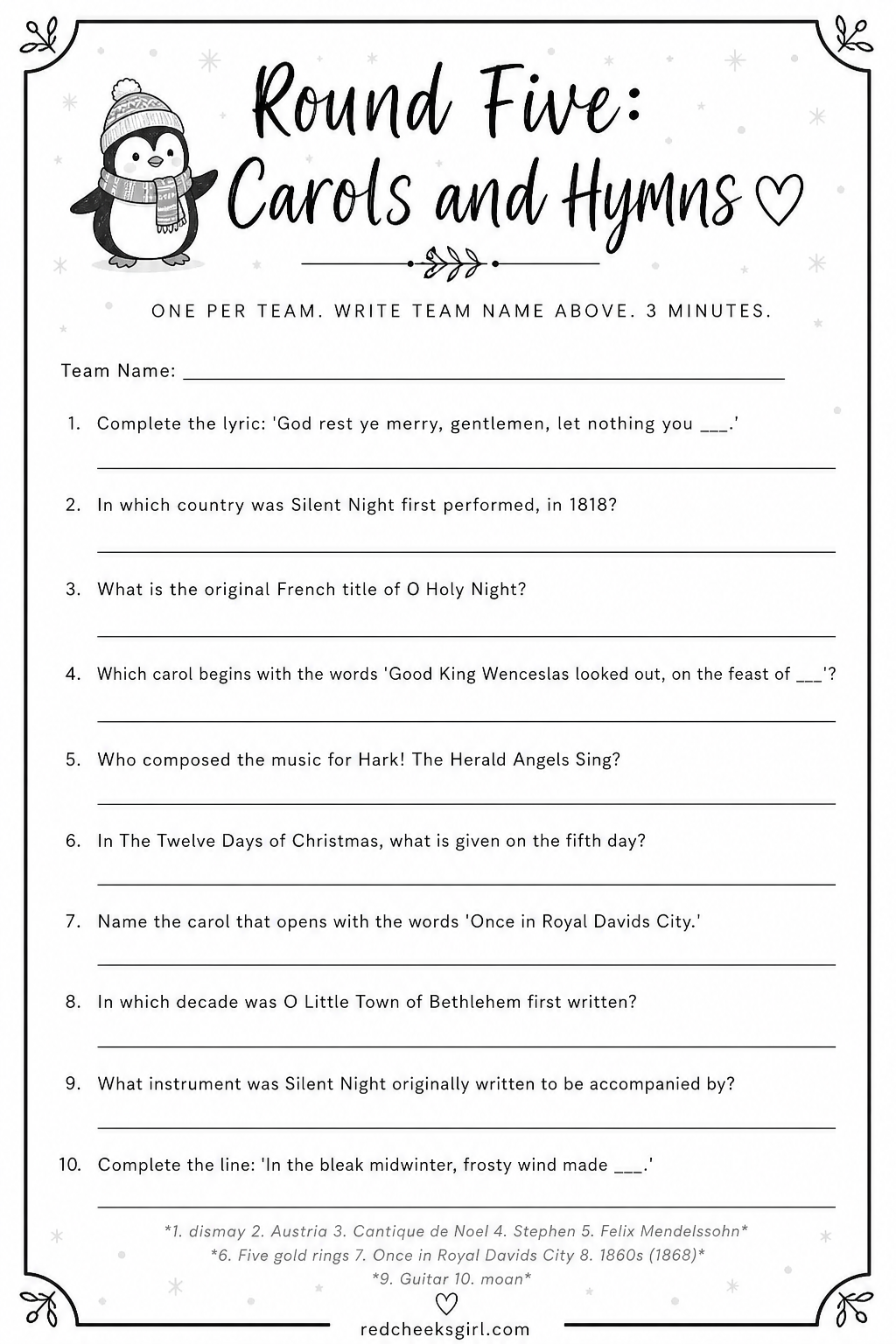
7. Round Five: Carols and Hymns
Ten questions on the words, history, and composers behind Christmas carols.
Not just the first verse: teams are asked to complete lines from the third or fourth verse of well-known hymns, identify the original language of a carol before translation, and name the year a specific carol was first published.
The average table will find this harder than they expect, which is exactly the point of a proper quiz night.
One sheet per team, three minutes. Consider playing a single piano note of a carol’s opening bars through a speaker just before the round starts: it sets the mood without giving anything away.
The perpetual dispute on this round concerns “O Holy Night” versus “Cantique de Noel.” Both are acceptable for the question about the carol’s original title: note that on the answer key and the quizmaster need not deliberate at the table.
- Answer key with original-language titles noted
- A rule that partial quotes score half a point
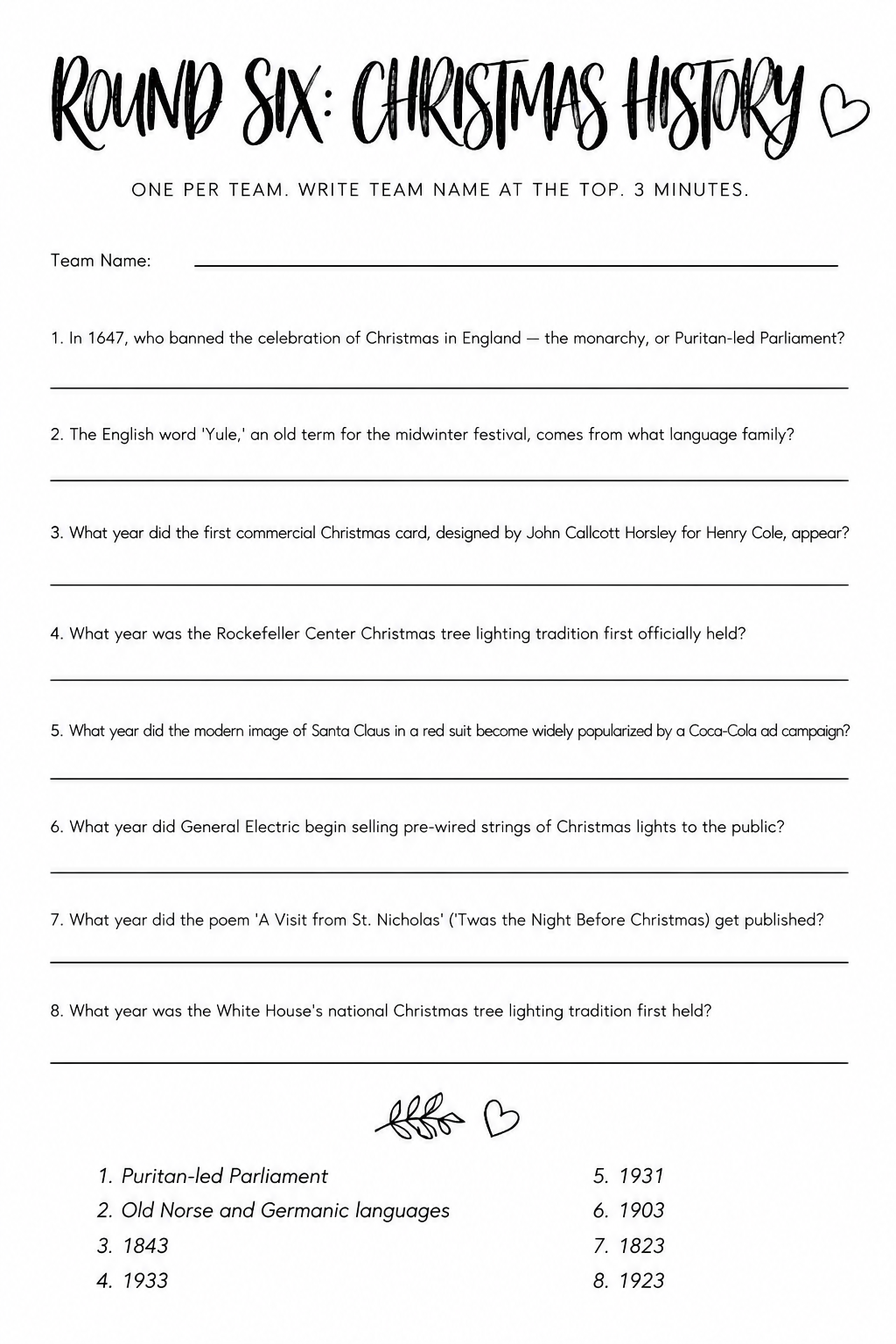
8. Round Six: Christmas History
Ten questions on the actual history behind Christmas traditions: when Queen Victoria popularised the Christmas tree, what the original colour of Santa’s coat was before Coca-Cola advertising, when Boxing Day became a public holiday, and which Roman festival Christmas absorbed some of its timing from.
This round rewards the guests who read widely and penalises the ones who repeat received wisdom as fact.
One per team, three minutes. Place this round after round five so the carol energy carries forward. This is the round most likely to generate a genuine argument about historical fact: have a phone set aside not for googling but for the quizmaster to reference a pre-loaded source if a team formally challenges an answer.
The Santa colour question is the one that causes the most noise. The answer is that Santa wore red long before Coca-Cola, and Coca-Cola standardised the image rather than invented it. Print that nuance on the key and be prepared to deliver it as a short statement, not a debate.
Prepare a one-sentence note on the Santa colour question before the evening. Reading it aloud ends the argument in ten seconds.
9. The Bonus Round Read Aloud
The quizmaster reads five questions aloud, one at a time, with no sheet involved. Each team has a small whiteboard or a folded piece of scrap paper. They write one answer and hold it up simultaneously on the count of three. No conferring after the quizmaster finishes reading: the answer goes up within ten seconds or it does not count.
No printing needed. This round requires only a spoken script the quizmaster prepares beforehand, plus whatever teams use to hold up answers. Mini whiteboards with markers are ideal: cheap to buy, reusable, and visible from across the room. Scrap paper and marker pens work fine.
The mechanic of simultaneous reveal matters. It removes the advantage of shouting first and creates a genuinely fair moment. The questions should be short, specific, and answerable in one or two words: “What do you call the knot of mistletoe’s white berries?” or “How many points on a snowflake?” Anything that requires a sentence-length answer breaks the pace entirely.
- Mini whiteboards or thick paper cards, one per team
- Marker pens or dry-erase markers
🛍 Shopping guide
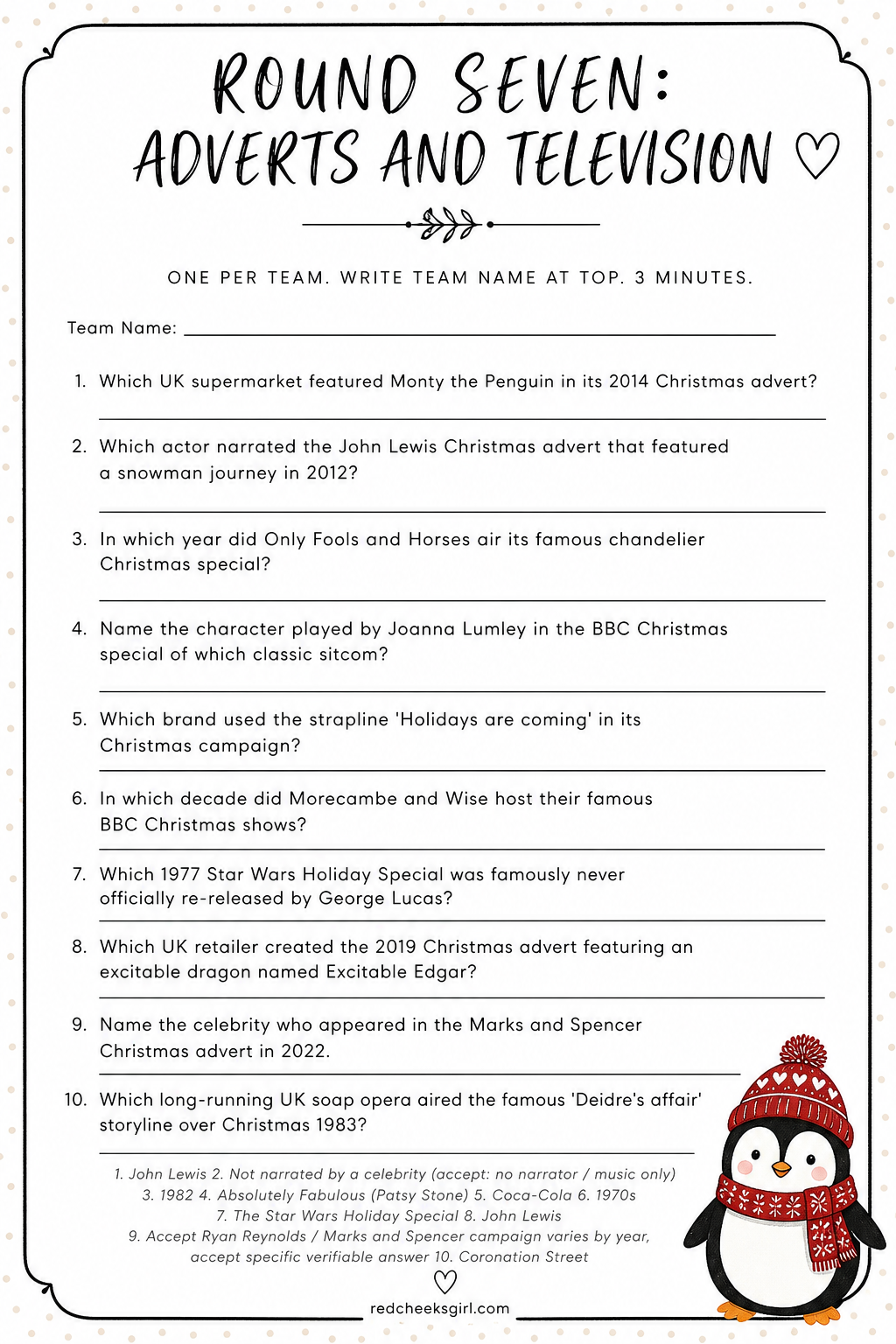
10. Round Seven: Adverts and Television
Ten questions covering Christmas television moments and advertising campaigns: the year a famous supermarket ad first aired, which celebrities appeared in specific festive commercials, and key moments from Christmas television specials going back to the 1970s.
This round is designed to be democratising: people who do not watch films or follow charts often have strong television memory, and this is their moment.
One sheet per team, three minutes. The round plays best after the half-time break when conversation has inevitably turned to Christmas television memories and the room is already primed. The questions about adverts benefit from a clue format: give the tagline and ask for the brand, rather than the other way around.
Teams sometimes try to guess brand names from vague memory and write generic answers. The question wording should be specific enough to make guessing costly: “Which UK supermarket released the Monty the Penguin advert?” has one answer. “Name a supermarket advert” does not belong on a quiz sheet at all.
Mixed-age groups: older guests dominate the 70s and 80s questions, younger guests have the recent campaigns locked down.
11. Round Eight: Picture Round
A grid of twelve images: close-up photographs of Christmas objects, film stills cropped to remove titles, portraits of famous Christmas figures without name labels, and detail shots of album covers. Teams name what they see in each numbered cell.
The round tests visual recognition rather than verbal memory, which reliably reshuffles the standings and gives teams that have been trailing a genuine route back into contention.
Print one picture sheet per team. This round needs slightly longer: allow five minutes because visual identification takes more discussion than factual recall. The quizmaster should circulate once during the round to confirm teams are writing in the numbered boxes and not on the back of the sheet.
The main setup mistake is printing the picture sheet too small. Print at 100% scale, not scaled to fit: the images need to be large enough to show the detail the question depends on. If your printer margins reduce the image, print borderless or trim the white edge after printing.
- Colour printer (greyscale loses too much detail)
- Cardstock for durability during a long evening

🛍 Shopping guide
12. The Half Time Break
After round four or five, the quizmaster calls a ten-minute break. No questions, no scoring, no announcements. Plates are refilled, drinks are topped up, and the quizmaster reads the cumulative scores from the Master Scorecard so every team knows exactly where they stand before the second half begins.
No printing needed. The break is a structural tool, not a game, and it requires nothing except the discipline to actually stop. The temptation is to press on while the energy is high: resist it. A quiz that runs seven rounds without pause loses concentration around round six and the final rounds get sloppy answers and half-hearted marking.
The practical move at half time is to restate one rule that has been broken. If teams have been calling out answers instead of writing them, say so once clearly. The break resets the room and the restated rule lands with more authority than it did at the start of the evening.
Post the half-time leaderboard on a piece of paper pinned somewhere visible so teams can study it while they eat.
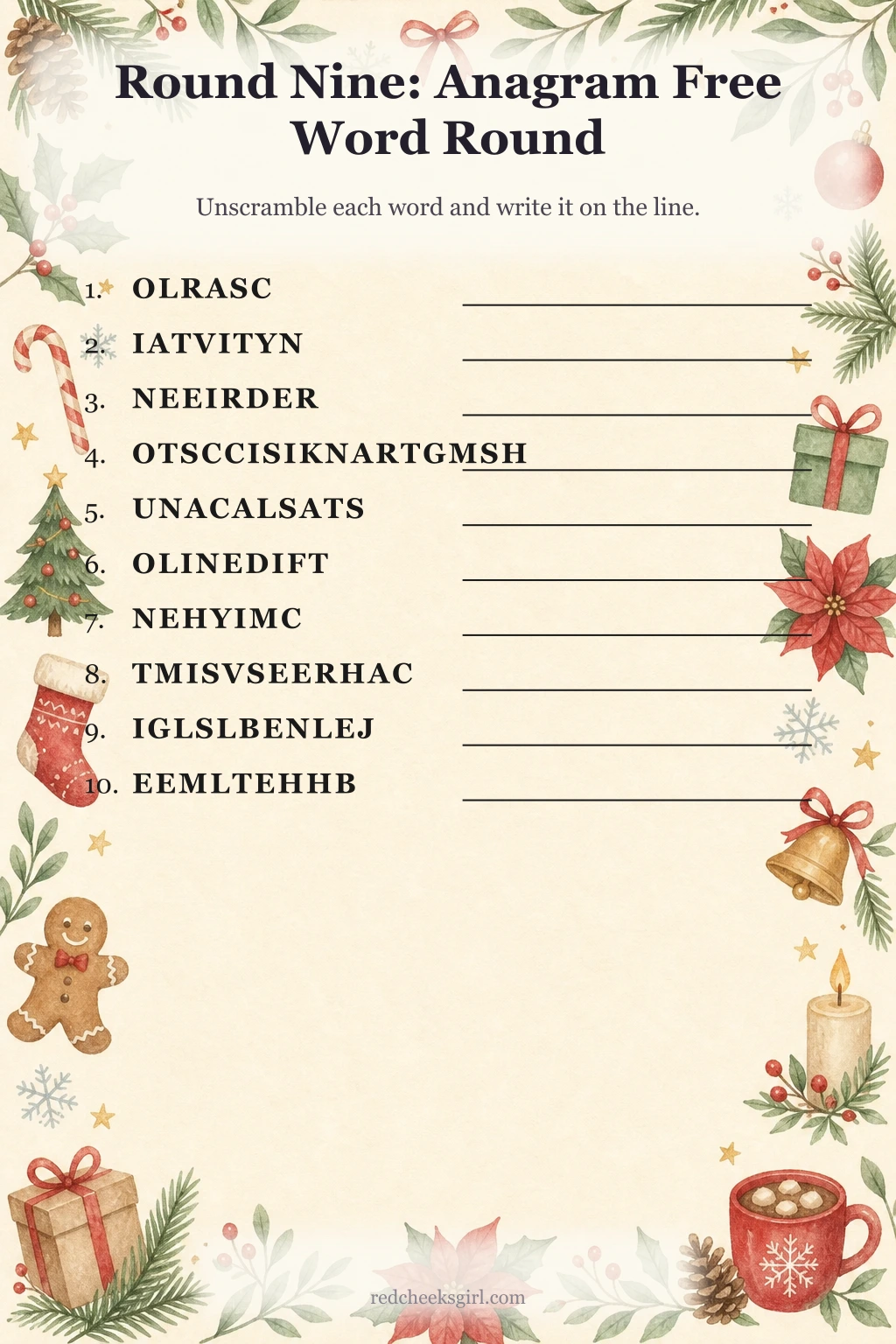
13. Round Nine: Anagram Free Word Round
Ten anagrams of Christmas-related words or phrases, printed clearly on the sheet. Teams unscramble each one and write the answer. The anagrams range from straightforward single words (SANTACLAS rearranged) to proper two-word phrases where teams must figure out the word boundaries themselves. That second category is significantly harder and should occupy positions seven through ten on the sheet.
One sheet per team, four minutes for this one because unscrambling takes longer than recall. No reading aloud by the quizmaster during this round: teams work in silence or at low volume from the sheet alone.
The rule against calling out matters more here than in any other round because a single word spoken loudly can give the answer to half the room.
The common error is printing anagrams that resolve to more than one valid word. Check every anagram against a word list before printing. If an anagram has two valid solutions, either fix it or note both as acceptable on the key and award the point for either.
Add a letter count in brackets after each anagram so teams know how many words to expect.
14. The Tie Breaker: Nearest Wins
When two teams finish the evening level on points, the tie-breaker is a single numerical question: one card per team, one answer written down simultaneously, no conferring. The team whose answer is closest to the real number wins.
Questions of this format include: how many Christmas cards are sent in the UK each year, the weight of the largest Christmas pudding ever made, or the number of mince pies consumed in the UK on Christmas Day.
Print one sheet with four cards on it, cut apart before the evening. Hand one card to each of the tied teams when the tie-breaker is called. They write their answer, fold the card, and hand it to the quizmaster simultaneously.
The quizmaster reads both aloud, states the real answer, and declares the winner. The whole process takes under two minutes.
Have the tie-breaker question and answer ready before the evening starts: looking it up mid-event is slow and risks a phone in the wrong hands. Write the real answer on a separate slip of paper sealed in an envelope.
Open it only when the tie-breaker is called, which adds a genuine moment of theatre to what is otherwise an administrative procedure.
A nearest-wins format is unchallengeable: there is no judgement call, no debate, just arithmetic. It ends the evening cleanly.

15. The Master Scorecard (Scorecard, One Per Team)
A single sheet that tracks every team’s score across all nine rounds plus the bonus round, with a running total column on the right. The quizmaster fills one in for the room and optionally each team captain holds their own copy.
Totals are updated after marking at the end of each round, which means the leaderboard is always current and the half-time announcement takes thirty seconds rather than five minutes of addition.
Print one per team if you want teams to self-track, or one for the quizmaster alone if you prefer to control the information. Both approaches work. The self-tracking version adds competitive tension because teams can see exactly how many points they need to close the gap.
The design detail that matters most on this sheet is column width. Round names should be abbreviated to three or four words so the columns do not crowd. Numbers need to be large enough to read across a table in dim lighting.
Use a pencil for running totals so corrections do not require a new sheet mid-evening.

16. The Quizmaster Running Order
A single reference sheet the quizmaster keeps throughout the evening. It lists the round order, the time allowed per round, the point value per question, the rules for marking disputes, and the tie-breaker procedure. Having it printed and visible means the quizmaster never has to hold all of this in working memory while simultaneously reading questions and managing the room.
Print one copy and keep it face down until needed. The sheet also serves as a script for the opening announcement: the quizmaster reads the rules aloud from it at the start of the evening, which takes about ninety seconds and prevents every common dispute before it starts.
The rules that need to be stated verbally and appear on the sheet: no phones, no calling out, answers must be written before time is called, the quizmaster’s decision on disputed answers is final. Four rules. Not eight, not twelve: four rules stated once clearly will actually be followed.
- Read the four rules aloud at the start
- State the point value per question before each round
- Announce scores after every round, not just at the end

17. The Prize Nobody Expected
The team that comes last wins a prize chosen specifically for them: something funny, generous, or both, wrapped and ready before the evening starts. The prize is announced at the same moment as the winner’s prize, with equal ceremony.
Last place gets a bottle of wine and the winner gets a trophy made of tinfoil and a paper star: the relative value of prizes matters less than the parity of the announcement.
No printing needed. The prize is the only prop required and it costs whatever you are willing to spend. A box of good chocolates, a silly game, a voucher for a local restaurant: the content is less important than the fact that it exists and is presented seriously.
The reason this works is structural. Teams that fall behind in round three stop engaging unless there is something to play for at the bottom of the table. A booby prize that is actually desirable reactivates those teams and keeps the energy even across the room for the second half.
Keeping last place competitive benefits the whole room. Teams that are fighting not to come last ask more questions, dispute fewer answers, and create more noise.
18. The Grudge Round Between Two Families
If two families or friend groups have been feuding across the scorecard all evening, the quizmaster calls an optional head-to-head at the end. One representative from each team stands up.
The quizmaster asks five rapid-fire questions: first to buzz in (slap the table, ring a bell, or call the quizmaster’s name) and answer correctly wins a point. Best of five wins the grudge match. The rest of the room watches and scores nothing.
No printing needed. The only prop worth having is a small bell or buzzer to make the buzz-in moment unambiguous. Without a physical signal, the first-to-shout format creates disputes about who spoke first. A bell costs almost nothing and eliminates the problem entirely.
Keep the questions in this round slightly easier than the main rounds: the spectacle comes from speed, not obscurity. A question that nobody can answer in a head-to-head is dead air, and dead air at the end of a long evening kills momentum at exactly the wrong moment.
- A small desk bell or buzzer
- Five pre-written rapid-fire questions the quizmaster keeps in reserve
🛍 Shopping guide
Frequently Asked Questions
How many rounds should a Christmas quiz have?
Seven to nine rounds is the sweet spot for an evening that runs about two to two and a half hours with a half-time break. Fewer than six rounds and the event feels thin; more than ten and concentration drops noticeably in the final rounds regardless of how good the questions are.
How do you stop people using their phones during a Christmas trivia quiz?
State the rule once clearly before round one, collect phones into a basket in the centre of each table, or seat someone at each table who you trust to enforce it socially. The basket method works best: it removes temptation rather than relying on willpower.
What is a good tie-breaker format for a Christmas quiz?
A nearest-wins numerical question is the most effective. Each team writes one number, hands it to the quizmaster simultaneously, and the closest answer wins. It is unchallengeable, fast, and produces a clear result without any subjectivity.
How difficult should christmas party trivia games be for a mixed group?
Build a difficulty curve within each round rather than making every question the same level. Questions one to three should be answerable by most guests; questions seven to ten should be genuinely hard. That structure means every team scores something in every round, which keeps engagement even.
How many people can play a Christmas quiz at home?
Teams of four work best for ten to forty players. Below ten, drop the team format and play individually. Above forty, add a runner to help collect and distribute sheets, because the logistics of nine rounds with ten-plus teams will slow the evening significantly without one.
Can you run these christmas party trivia games without a printer?
The quiz rounds are designed as printables, but you can read questions aloud if needed. Teams write answers on any paper. The printable format keeps the pace controlled and removes the advantage of the loudest voice, so printing is worth the effort if at all possible.

20 Christmas trivia games for a full quiz night with rounds, buzzers & printable sheets. Run it like

Find the right trivia questions and answers for your next party night, from family, kids, seniors, c

Free printable birthday trivia questions in five rounds, 12 each, with a full answer key. Perfect fo
Leave a Reply