


If you’ve been volunteered as host for this year’s Christmas trivia games night (congrats, by the way — you’ve been chosen), this is the only article you need to bookmark right now.
We’re talking a fully structured quiz night with 12 themed rounds, a lightning buzzer showdown, a tie-breaker, and eight more games to fill every gap between score tallies and mulled-wine refills.
Whether you’re hosting eight people around a dining table or thirty in a community hall, this lineup gives you a complete running order from first question to final winner.
The secret to a great Christmas quiz night isn’t just the questions — it’s the variety. Mix printable answer sheets with live audio rounds, keep teams guessing with a picture round, then flip the energy with a buzzer lightning sprint.
So pour yourself something festive, print your sheets, charge your speaker, and let’s do this properly. Your guests are about to have the best Christmas party they’ve been to all year (and yes, you can accept the credit).
This post contains affiliate links — if you buy through them, I may earn a small commission at no extra cost to you.
- Christmas Movie Round
- Carol Lyrics Round
- Christmas Around the World Round
- Festive Food and Drink Round
- Christmas Number Round
- Christmas Charades Relay
- Picture Round Ornaments
- Christmas Adverts Round
- Festive Emoji Decode Round
- Guess the Year Round
- Christmas Songs Intro Round
- Lightning Round Buzzers
- Tie-Breaker Guess the Weight
- Answer Key Sheets
- Christmas This or That
- Name That Christmas Scent Blind Test
- True or False: Christmas Edition
- Christmas Bingo — Festive Phrases
- Pass the Parcel Trivia
- Christmas Mad Libs Round
- Christmas Trivia Head to Head
- Frequently Asked Questions
1. Christmas Movie Round
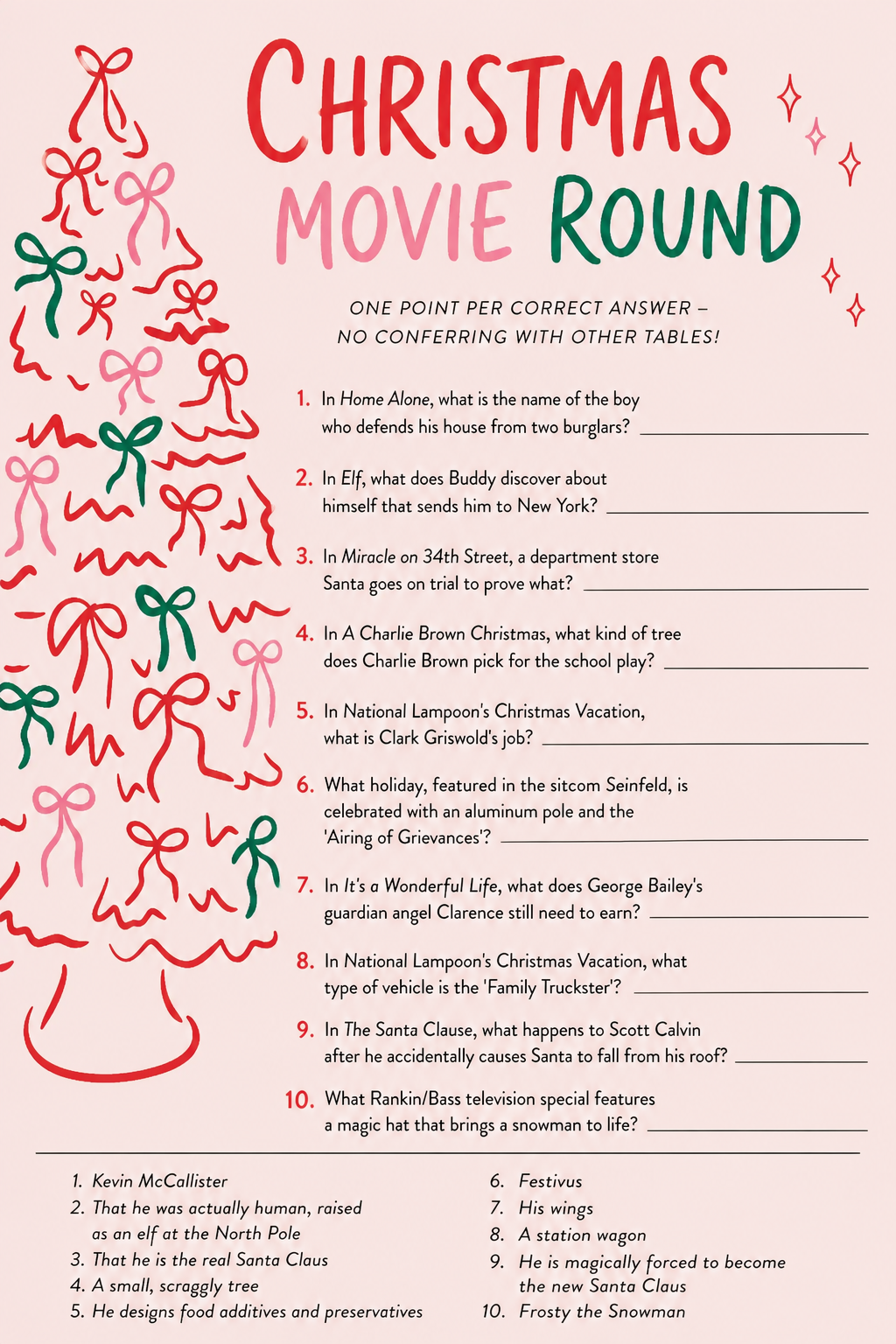
This is the crowd-pleaser opener that gets every table loudly debating whether a certain holiday film counts as a Christmas movie or not — and honestly, that debate alone is worth five minutes of entertainment before anyone writes a single answer.
Hand each team a printed answer sheet with ten numbered questions covering classic and modern Christmas films: plot details, character names, famous lines (paraphrased, never directly quoted for copyright reasons), and a couple of ‘which year did this come out’ stumpers to sort the casual watchers from the true devotees.
Read each question aloud, give teams 20 seconds to confer quietly and write their answer, then move on.
You’ll need one printed answer sheet per team, a question script for the quizmaster, and an answer key you keep firmly face-down until marking time.
Ten questions works perfectly for a 10-minute round — don’t stretch it, because you want teams hungry for more, not glazed over.
Score one point per correct answer and keep a running tally on a whiteboard or a big sheet of craft paper on the wall so everyone can see where they stand after each round.
Host tip from hard experience: include at least two questions that split the room — something like ‘Name the actor who plays the villain’ in a cult favourite that half the room has seen and half hasn’t.
That split creates the best noise of the night. Also, print one spare answer sheet per round for yourself in case a team drops one in the gravy.
Slip one deliberately easy question in at position three — it resets the energy just as teams start to feel the pressure and keeps everyone feeling capable.
2. Carol Lyrics Round
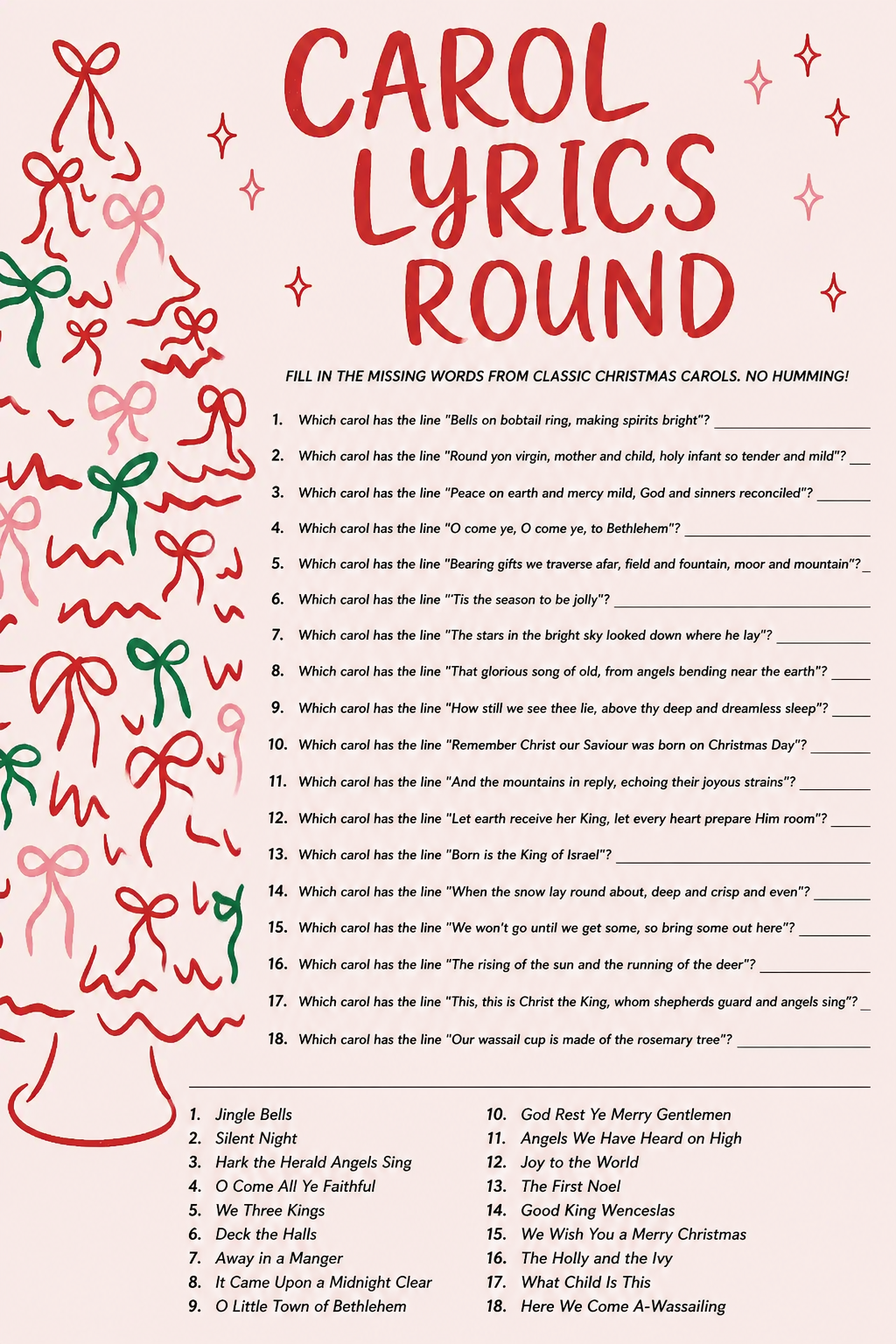
This round catches out even the most confident carol singers in the room, and it is glorious to watch.
The printed sheet gives teams the opening line of a carol with several blank spaces where key words have been removed — not the famous first line everyone knows, but the third or fourth verse that nobody has actually paid attention to since primary school.
Teams fill in the blanks from memory, no phones allowed, no humming allowed (enforce this with theatrical outrage when someone starts humming). It tests genuine lyric knowledge rather than just ‘can you name this song,’ which is a totally different skill set.
Print one sheet per team. Each sheet has 10 carol extracts, numbered continuously 1–10, with three to five blanked-out words per extract marked by a visible underline blank for each missing word.
Read the carol title aloud so teams know which song they’re filling in — this is a fill-in-the-blank exercise, not a name-that-carol exercise, which is a different round entirely.
Award one point for each correctly filled blank, giving a maximum of 30–50 points in this round depending on how many blanks you set per extract.
This scoring variance actually makes it great for catching up — a team in last place can close a big gap here.
Host tip: the single biggest mistake is making blanks too hard. Blanking out the word ‘the’ or a preposition is frustrating, not fun. Blank nouns and adjectives only — the specific, colourful, surprising words that people half-remember but can never quite pin down.
That sweet spot between ‘I almost know this’ and ‘I definitely know this’ is where the round lives.
- Groups of 3–8 teams, 10–15 minutes
- Mixed-age crowds — older guests often dominate this one beautifully
3. Christmas Around the World Round
This is the round that separates the seasoned travellers from the armchair globetrotters, and it never fails to produce at least one spectacular wrong answer that becomes the evening’s running joke.
The printed answer sheet presents ten facts or customs from Christmas celebrations across different countries, with teams identifying either the country, the tradition, or the name of a specific festive figure.
Questions range from genuinely accessible (which country is credited with starting the Christmas tree tradition in its modern form?) to genuinely tricky (in which country does a spider-web decoration on the tree bring good luck?).
Hand out one sheet per team before you start reading and give them 30 seconds per question — slightly longer than the movie round because some of these require a genuine memory-dig rather than a quick recall. Score one point per correct answer.
Ten questions, ten minutes maximum. The geographical spread should cover at least six different continents worth of countries to make it feel truly ‘around the world’ rather than just ‘around Europe.’
Host tip from experience: give a tiny geography hint in the question itself — ‘In this Scandinavian country…’ or ‘This Latin American tradition involves…’ — rather than making teams guess the continent on top of the custom.
That one small scaffold makes the round feel fair rather than random, and fair-feeling rounds keep the competitive energy alive rather than collapsing into ‘this is impossible.’
This round genuinely teaches guests something new about the world, which means people talk about it after the night is over — the hallmark of a question that earned its place.

4. Festive Food and Drink Round
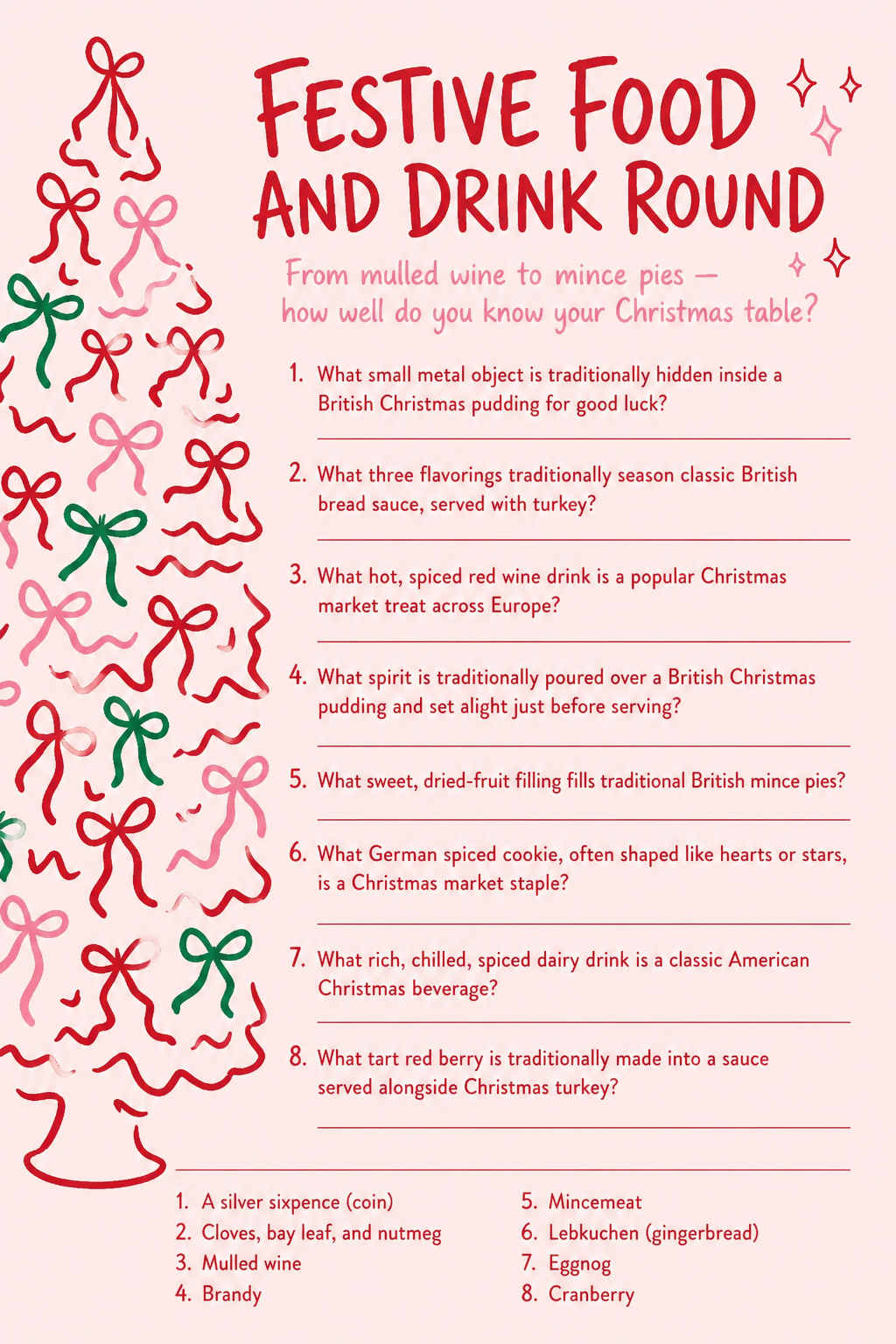
Every table suddenly becomes a team of very opinionated food critics the moment this round lands, and that is exactly the vibe you want mid-quiz.
The sheet covers Christmas food and drink traditions, ingredients, origins, and a few cheeky ‘how many calories’ style questions that get the competitive foodies fired up.
Think: which country gave the world eggnog, what is the main spirit in a traditional Christmas pudding, and which herb is considered essential in a classic bread sauce.
It sounds niche but it plays brilliantly because almost everyone has a strong food memory tied to Christmas.
Ten questions, one printed sheet per team, one point each. You can make this round interactive by having a small ‘taste station’ on the side — a few unlabelled biscuits or cheeses for teams to identify blind as a bonus question worth two points.
That element of physical tasting breaks up the sitting-and-writing rhythm perfectly and gets people out of their chairs briefly, which is good for energy management around question 40 of the evening.
(Not that I’ve ever watched a quiz night die a slow death around question 42. Not once.)
Host tip: run the bonus taste station as a sealed envelope question — teams write their guess on a scrap of paper, seal it, and hand it to you. Open them all at once at the end of the round for maximum drama.
It prevents copying and adds a lovely theatrical moment when you reveal which teams got the mystery flavour right.
Prep your taste station the night before and keep it covered — revealing it mid-round gets a much better reaction than having it sitting there all evening being sniffed.
5. Christmas Number Round
This is the maths-geek’s moment to shine and the humanities crowd’s turn to sweat, and that beautiful inversion of the usual quiz dynamic is what makes it so much fun.
The Christmas Number Round is a sheet of ten questions where every single answer is a number — teams must write the numeral, not the word, and exact answers score full points while ‘close’ answers score nothing (this keeps it honest and prevents the ‘we said roughly 12’ arguments that can drag a round out by ten minutes).
Questions range from how many days of Christmas are in the song, to how many reindeer pull Santa’s sleigh including the later addition, to how many candles are on an Advent wreath.
Print one sheet per team. Allow 25 seconds per question since numerical recall takes slightly longer for most people than word recall. Keep a calculator behind the quizmaster table for the one question where teams will absolutely argue about whether the answer should be rounded.
(There’s always one.) Score strictly: correct numeral only, no partial credit, no approximations. This round tends to produce very tight scores between teams and sets up a potential tie-breaker beautifully.
Host tip: add one deliberately obscure large number question — like the approximate year a particular carol was first published — and give it double points. Watching teams argue about whether to write 1818 or 1823 is peak quiz night content, and the double-point swing often reshuffles the leaderboard right before the halfway break.
For a more casual crowd, allow a margin of ±10% on any historical year question — it still rewards knowledge without punishing a 3-year memory slip.

6. Christmas Charades Relay
Right, stand up — everybody up. Christmas Charades Relay is the palate-cleanser your quiz night desperately needs between printed rounds five and seven, and it brings an energy surge that no amount of mince pies can replicate.
One player from each team stands at the front of the room facing their team, back to the quizmaster.
The quizmaster holds up a card with a Christmas-themed word or phrase — a carol title, a character name, a festive object — and the standing player acts it out silently.
First team to shout the correct answer wins the point for that relay slot, and a new player rotates forward. Run ten rounds of this in about eight minutes and you have a perfectly energetic interlude that doesn’t require printing a thing.
You’ll need a stack of prepared cards (about 30 is comfortable so you never repeat), enough floor space for one person per team to stand at the front simultaneously, and a quizmaster with good eyesight and fast reflexes for calling which team shouted first.
Group size works brilliantly for 3–8 teams of 3–5 people. If you have buzzer sets, use them here to settle the ‘who called it first’ arguments that inevitably arise when three teams shout the same answer at the same volume.
Host tip: have a deputy scorekeeper designated for this round specifically, because the pace is fast and the main quizmaster will be too busy managing the cards and the shouting to also tally points in real time.
A simple tally chart on a clipboard passed to a trusted guest works perfectly — just make sure they’re not on a competing team, or you’ll hear about it for the rest of the evening.
- 30 prepared Christmas charades cards
- Clear floor space at the front of the room
- A buzzer set or a designated deputy scorekeeper
7. Picture Round Ornaments
This is the round that looks deceptively simple until everyone realises they cannot name a single ornament style they haven’t personally hung on a tree.
The printed sheet shows twelve close-up photographs or detailed illustrations of Christmas ornaments from different eras and countries — a Blown-glass German kugel, a traditional Shaker star, a Norwegian straw goat, a Polish spider ornament, and so on — and teams must match each numbered image to the correct name from a numbered list printed at the bottom of the sheet.
It’s a matching format, which means partial knowledge is rewarded and total guessing is at least educated.
Print one sheet per team, double-sided if you need extra image space, and project the same images on a TV or projector if you have one so teams can see the detail clearly (photo-printing twelve tiny images can sometimes lose the texture that makes them distinguishable).
Allow three minutes total for the round — teams scan, discuss, and fill in their matches. Score one point per correct match, maximum twelve points. No partial points for ‘close’ answers on matching rounds.
Host tip: the single best trick for this round is to include one ornament that almost everyone owns — a classic glass ball in a specific colour — and make its label something more specific than teams expect, like naming the regional origin of that style.
The moment teams realise the ‘easy one’ was actually the tricky one is the moment this round earns its reputation.
- Groups of 2–10 teams
- Works brilliantly as a visual break after two text-heavy rounds
- Especially fun for guests who love crafts or decor

8. Christmas Adverts Round
Oh, this round. This is the one that makes grown adults feel genuine emotions over a 90-second clip of an animated penguin finding love, and it is the most British thing about this entire quiz night.
(Non-UK audiences love it too, tbh — the format travels brilliantly.)
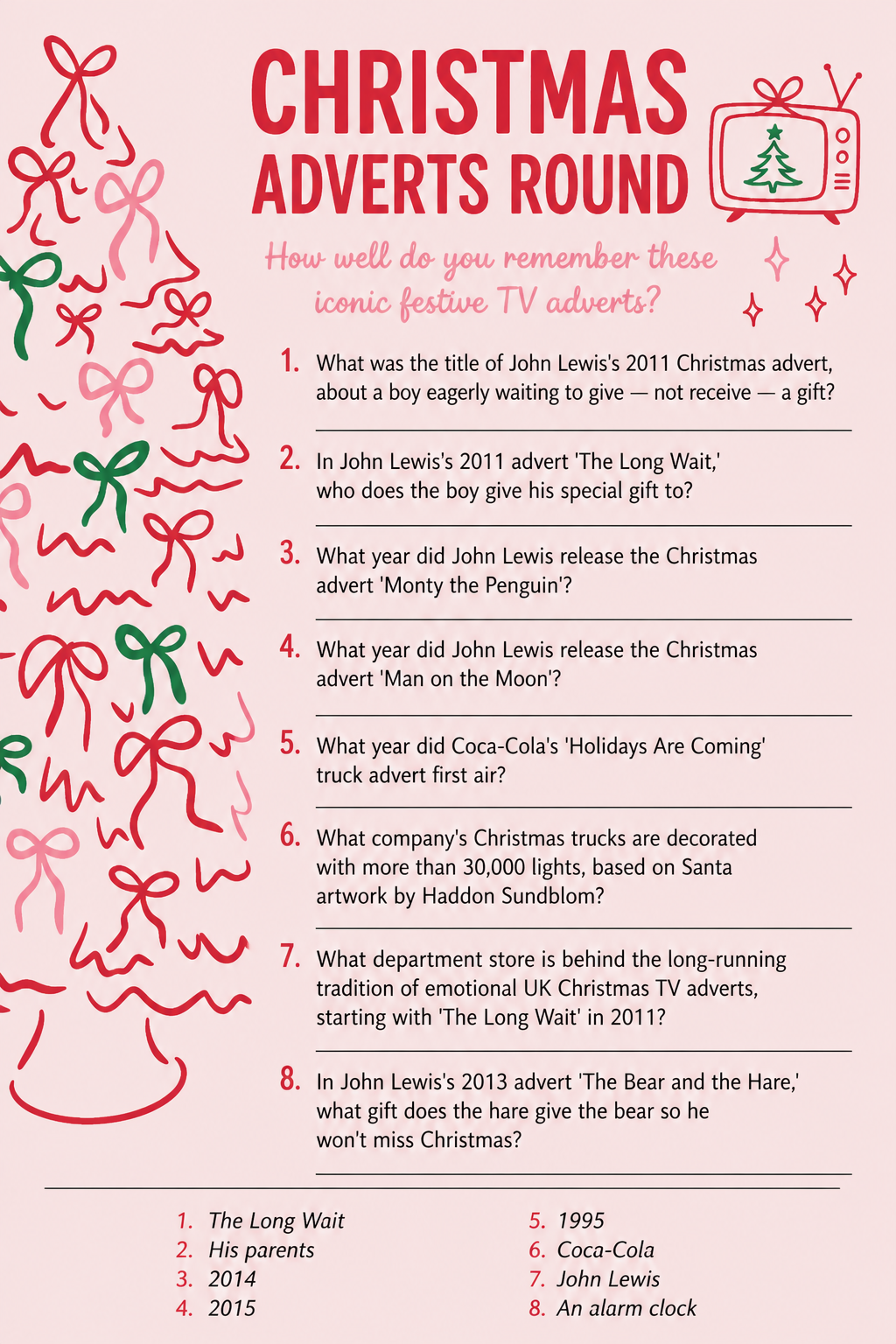
Each team gets a printed answer sheet with ten questions about famous Christmas television adverts from different years and retailers, covering details like which animal featured, which song was used, which year it aired, and what the emotional twist was.
This tests both memory and observation, and it rewards the person at the table who watches way too much television (we see you, we appreciate you).
The sheet has ten questions numbered 1–10, each with a single answer line.
If you have a TV or projector, enhance this round by showing a brief 5-second silent clip of each advert (muted, no audio clues) as you read the corresponding question — it adds a visual trigger that makes the round feel more like a pub quiz than a home game.
Allow 25 seconds per question. Score one point per correct answer. If you’re showing clips, keep the total running time including clips to under 15 minutes.
Host tip from personal experience: make very sure your questions are about the advert itself, not about real-world brand sales data or production budgets — those questions kill the energy because they feel like a business exam rather than a Christmas game. Stick to what was on screen: characters, songs, storylines, and emotional beats. That’s what people actually remember.
- Printed answer sheets (one per team)
- Optional: laptop and TV/projector with 5-second silent clips cued up
- Question script with answers for the quizmaster
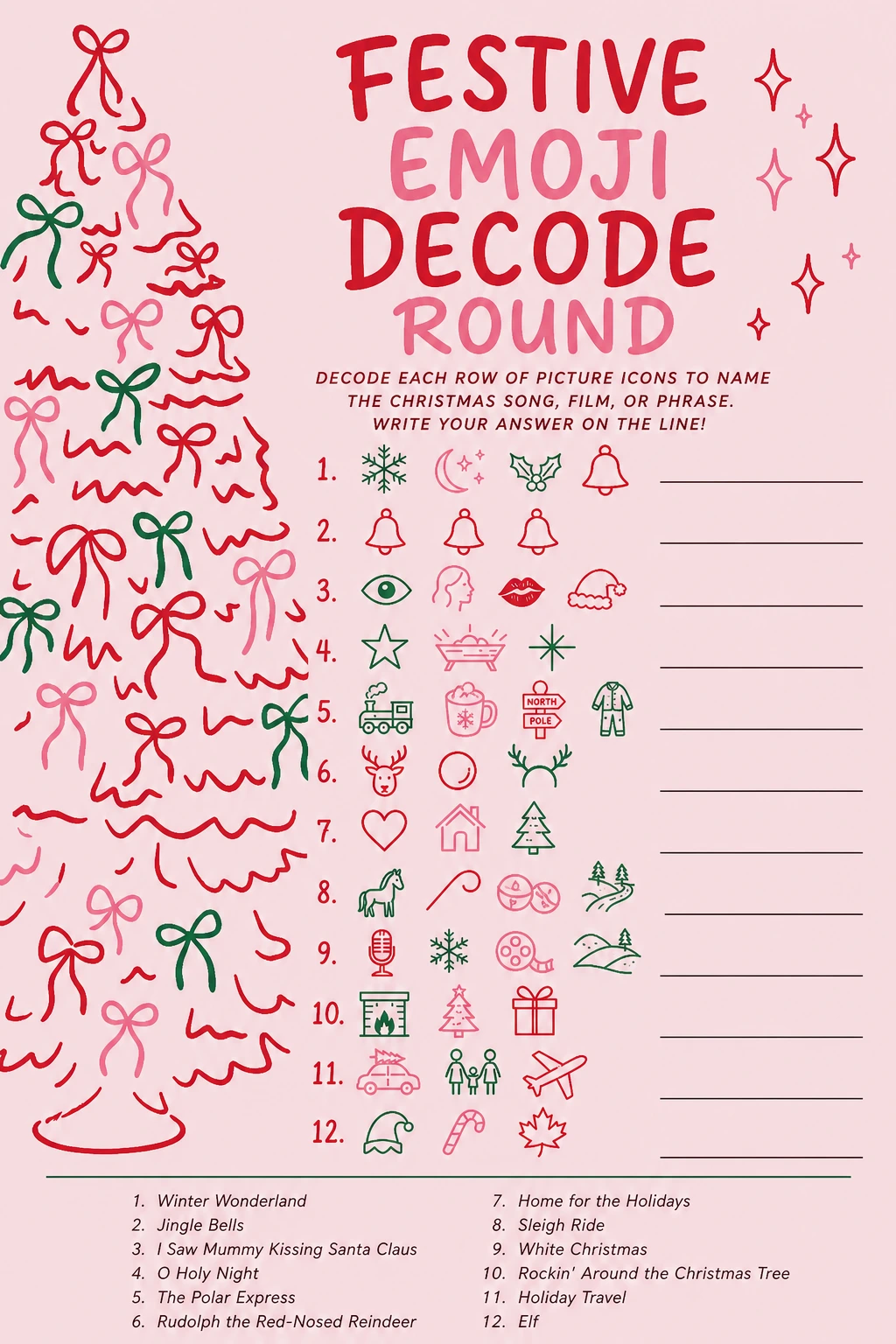
9. Festive Emoji Decode Round
Right, here’s where things get genuinely chaotic in the best possible way.
The Festive Emoji Decode Round gives each team a printed sheet where every question is a row of small picture icons — actual drawn symbols, not text — representing a Christmas song title, a Christmas movie, or a well-known festive phrase.
Teams decode what the sequence of icons is trying to say and write their answer on the blank line beside it. A tiny snowflake icon, a night-sky icon, a holly icon, and a bell icon together might decode to ‘Winter Wonderland.’
It sounds simple until you realise the icon for ‘holy’ and the icon for ‘holly’ look startlingly similar when drawn small.
Print one sheet per team with 12 emoji-decode clues numbered 1–12. Each clue is a row of 3–5 small hand-drawn picture symbols, followed by a long blank answer line.
Give teams four minutes total to work through all 12 — the time pressure is what makes it fun.
Score one point per correct decode, with the quizmaster’s decision on close paraphrases being final and non-negotiable (announce this before you start, with a smile, and you’ll avoid 95% of the arguments). Running time including marking: about eight minutes.
Host tip: the icons that decode titles with double meanings — like a sun icon and a glasses icon decoding to ‘I Saw Mummy Kissing Santa Claus’ — get the biggest laughs when you reveal the answer.
Deliberately include two or three of those ‘wait, that’s so obvious in hindsight’ decodes because the collective groan followed by laughter is genuinely one of the best sounds a quiz night can produce.
This round is completely accessible to every age at the table — emoji-style picture thinking is intuitive regardless of how much Christmas trivia knowledge someone has, which means even the least-quizzy guest feels useful.
10. Guess the Year Round
This is the round that makes every table sound like a history documentary for about eight minutes, with wildly confident wrong answers delivered by people who absolutely should know better.
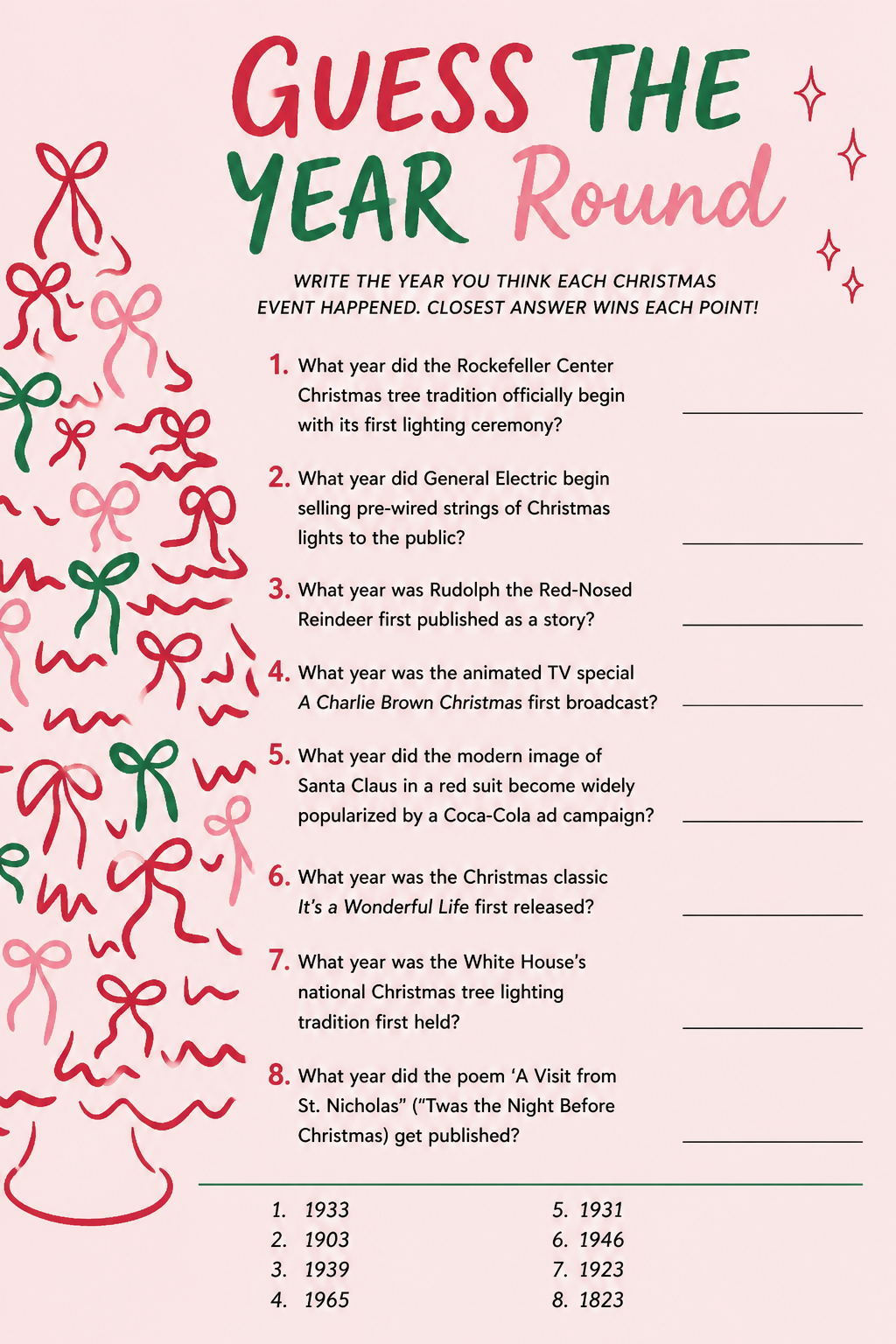
The Guess the Year Round presents ten Christmas-related events, records, song releases, or firsts — and teams must write down the year they think each one happened. Closest answer wins the point for that question, which means no team is ever completely out of it.
That ‘closest wins’ mechanic is crucial: it keeps even last-place teams engaged because their 1979 guess might beat the first-place team’s 1983 guess if the answer is 1981.
Printed sheet has ten questions numbered 1–10, each with a single short answer box for the year. Read questions aloud and give teams 20 seconds per question.
After all ten, go through the answers one by one, asking tables to call out their guesses before you reveal — this creates the best noise of any round in the quiz because everyone can hear how wildly different the guesses are.
Award one point per question to the team closest to the correct year; in the event of a tie on distance, both teams get the point. Total running time: 15 minutes including the reveal.
Host tip from running this more times than I can count: always include one question where the answer is a specific year that feels ‘too recent’ to be as long ago as it actually is — that collective ‘wait, that was HOW many years ago’ moment of mild generational horror is pure quiz-night gold, and it gets people talking between rounds.
- Teams write the year they think each event happened
- Closest answer wins — no need to be exact
- Call out answers aloud before the reveal for maximum drama
11. Christmas Songs Intro Round
The Christmas Songs Intro Round is where your Bluetooth speaker earns its keep.
Play just the opening three to five seconds of a well-known Christmas song — the very first notes before any lyrics kick in — and the first team to buzz in (or shout, if you haven’t got buzzers) with the correct song title wins the point.
This format rewards both musical ear and quick reflexes simultaneously, which creates an interesting inversion of the usual quiz dynamic: the person at the table with the fastest recall, not necessarily the deepest knowledge, tends to lead this one.
It is chaotic, loud, and absolutely brilliant.
You’ll need a curated playlist of 20 songs cued up to their opening second on your device, a speaker loud enough for the whole room to hear clearly, and a clear system for buzzing in — either physical buzzers, a hand-raise system, or the honest honour system where the quizmaster picks who shouted first.
Play 15 songs in the main round, with 5 held back as potential tie-breaker material. Award one point per correct song title; bonus half-point if a team can also name the original recording artist.
Total running time: about 12 minutes for 15 songs including the buzz-in drama.
Host tip: always include at least two instrumental versions of well-known carols in this round — arrangements without the famous vocal melody, just the supporting instrumentation.
They produce the most spectacular implosions of confidence at tables that were absolutely certain they’d ace this round, and the reveal moment when you tell them what it was gets a huge reaction every single time.
- Bluetooth speaker with good volume
- Curated playlist of 20 Christmas song intros (3–5 seconds each)
- Buzzer set or clear hand-raise system
- Bonus point for naming the original artist
🛍 Shopping guide
12. Lightning Round Buzzers
This is the round where your polite quiz night briefly becomes a TV game show and everyone absolutely loves it.
Lightning Round Buzzers is a rapid-fire single-player sprint: one representative from each team steps forward, and the quizmaster fires questions at them individually at pace — roughly one every five seconds.
Players answer immediately or pass (one pass per player allowed); no conferring with the team is permitted. The quizmaster keeps firing until the player has either answered 10 questions or used their pass and run out of time.
Every correct answer is a point; no penalties for wrong answers, which keeps it fun rather than nerve-wracking.
Run each team’s representative in sequence — so if you have six teams, six players take turns at the front while their teams watch and (quietly — enforce this) cannot help.
The competitive element of watching your teammate either triumph or dramatically blank on the word ‘mistletoe’ under pressure is peak quiz-night entertainment. Allow two minutes per team representative, and keep a strict timer.
Total running time for six teams: about 15 minutes including transitions and applause.
Host tip: seat the players facing away from their own teams during the lightning round so they can’t lip-read help from teammates. I learned this the hard way when a very enthusiastic team in the back row managed to mime ‘REINDEER’ across a crowded room with remarkable accuracy. The quizmaster thought it was hilarious. The other teams did not.
Seat the active player facing away from their own team — it removes the temptation to lip-read help and genuinely levels the playing field.
🛍 Shopping guide
13. Tie-Breaker Guess the Weight
When two teams finish level on points after all the rounds — and with a well-designed quiz, this happens more often than you’d think — you need a tie-breaker that is fast, fair, and requires zero additional preparation from the host.
Guess the Weight delivers all three. Before the night starts, fill a large glass jar or a wrapped Christmas hamper with a known quantity of something festive: wrapped chocolate coins, clementines, wrapped candy canes, or small ornament balls.
Weigh it precisely beforehand and write the answer on a sealed card. When the tie-breaker moment arrives, bring out the jar with theatrical drama, and ask each tied team to write their best guess for the total weight in grams on a slip of paper.
Closest guess wins. Done. Champion crowned.
You’ll need a kitchen scale accurate to 5g, a clear jar or decorated box, your chosen filler item, and the answer written and sealed before any guest arrives.
If you want to add extra drama, open the guesses from furthest-away to closest rather than chronologically — it builds the tension beautifully.
Group size is technically two teams, but you can run it as a whole-room bonus if everyone submits a guess and the winner of the jar’s contents is the closest overall guesser, regardless of which team they’re on.
Host tip: use chocolate coins rather than regular sweets because the metallic shine makes the jar look impressively festive on the table all evening, building curiosity before the tie-breaker even happens. People will ask about it throughout the night, which builds anticipation organically — and that’s genuinely good hosting, not just good snack choices. (Though it’s also good snack choices.)
- Large clear glass jar or decorated festive box
- Chosen filler item (chocolate coins, clementines, candy canes)
- Kitchen scale accurate to 5g
- Sealed answer card prepared before guests arrive
🛍 Shopping guide
14. Answer Key Sheets
Every quiz night lives or dies by its marking accuracy, and nothing derails an otherwise brilliant evening faster than a disputed answer that the quizmaster can’t definitively settle because their handwritten notes are a mess.
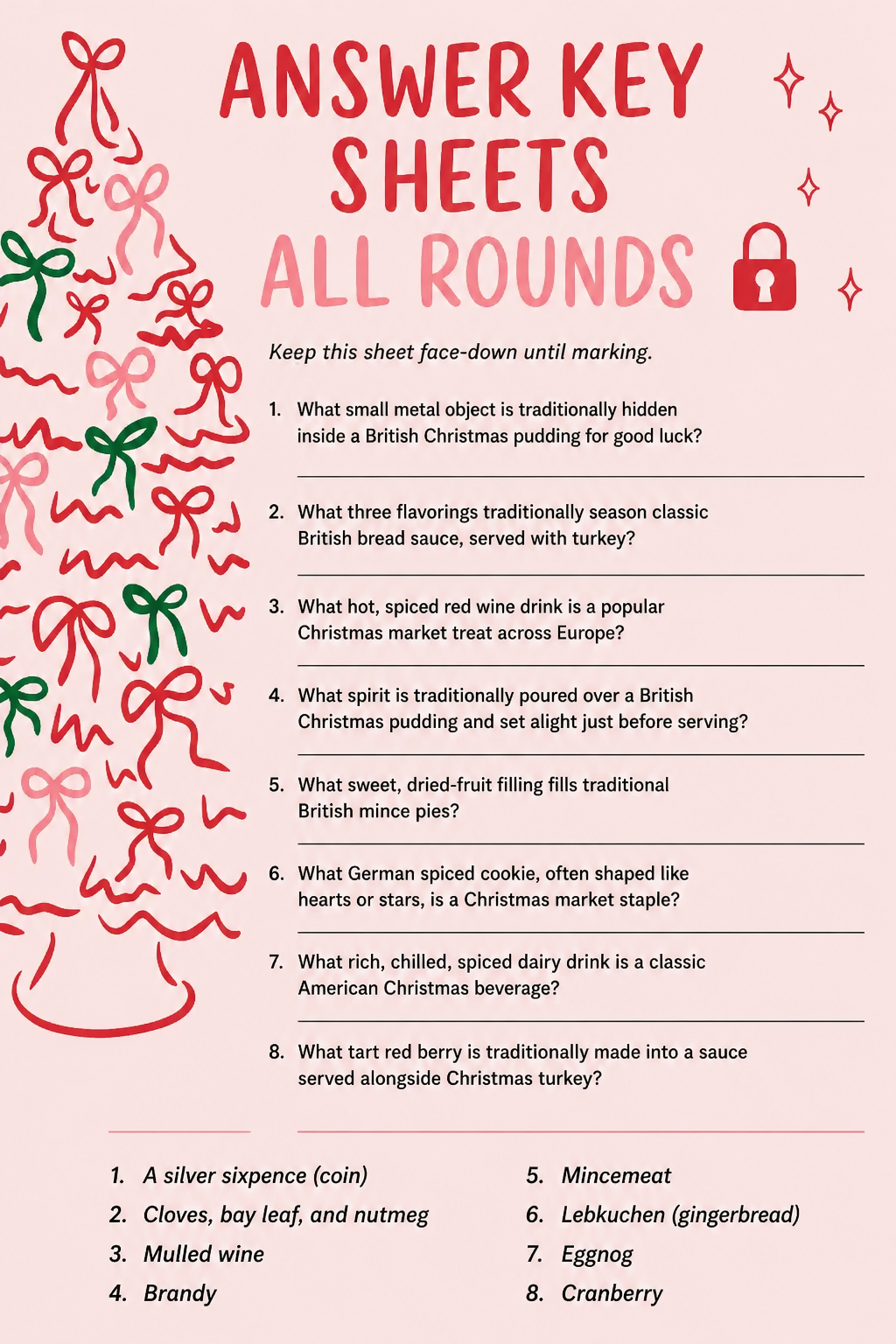
The Answer Key Sheets solve this entirely: a single clean printed document, kept face-down in the quizmaster’s folder throughout the night, listing every question number from every round in continuous order with the definitive correct answer beside it.
No ambiguity, no ‘I’m pretty sure it’s this’, no five-minute Googling breaks that kill the energy. The quizmaster’s answer sheet is as important a piece of printed material as any team’s playing sheet.
Print two copies — one for the quizmaster and one for the deputy scorekeeper, if you have one. The sheet should list rounds by name (not just by number) and use the same question numbering as the team sheets throughout, so cross-referencing is instant.
Add a small ‘accept also’ column beside any question where a near-synonym or alternative phrasing should be accepted as correct — this prevents arguments before they start and signals to both scorekeepers that the quizmaster has already thought through the edge cases.
Host tip from bitter experience: laminate your answer key sheet, or at minimum put it in a plastic sleeve. One glass of mulled wine tipped across the quizmaster’s table and the entire authority of the evening dissolves into a soggy, wine-coloured mess. Laminating takes three minutes and saves your dignity. Worth it every single time.
Laminate your answer key or sleeve it in plastic — one spilled drink and your entire authority as quizmaster evaporates with it.
15. Christmas This or That
This or That: Christmas Edition flips the pressure of trivia entirely — there are no objectively wrong answers here, which makes it the perfect round to schedule right after a particularly brutal numbers or lyrics round that left some tables deflated.
Each team gets a printed sheet with 15 festive ‘this or that’ dilemmas: real choices with no right answer, just preference. Would you rather eat only Brussels sprouts for Christmas dinner, or only stuffing?
Is Die Hard a Christmas film — yes or no, commit to it. Turkey or goose? Advent calendar chocolate or advent calendar beauty products?
Teams vote as a group and write their answer, then scores are awarded not for the ‘correct’ answer but for matching the majority — so the team that best predicts what the room will say overall wins the most points.
Print one sheet per team with 15 numbered this-or-that dilemmas, each formatted as ‘Option A vs Option B’ with a clear box to circle or tick.
Give teams 90 seconds to work through all 15 — fast enough that they can’t overthink, which is the whole point. After everyone has submitted, go through each one asking tables to reveal their choice by a show of hands.
Tally which option the majority picked, and teams who matched the majority get a point for that question. Maximum 15 points, minimum zero. Running time: about 10 minutes including the reveal and the inevitable argument about sprouts.
Host tip: always include the ‘is that film a Christmas movie’ question — it generates more passionate debate per square foot of room than any factual trivia question ever will.
Schedule it for the second-to-last dilemma so the room is already warmed up, and then let the debate run for exactly 60 seconds before calling time. The controlled chaos of it is the highlight of the round.
No knowledge required — pure preference and prediction, which means every single person at every table feels equally capable and equally invested from the first question.

16. Name That Christmas Scent Blind Test
Okay, this one goes down as the most surprisingly brilliant round of the entire night — I mean it.
The Name That Christmas Scent Blind Test passes around small numbered jars or cotton-wool pads soaked in different festive scents: cinnamon, cloves, orange peel, pine resin, gingerbread essence, peppermint, frankincense, vanilla, nutmeg, and mulled wine spices.
Teams smell each sample blind, write what they think it is on their answer sheet, and the closest correct identification wins the point. No labels, no peeking, just noses and instinct.
It is the most viscerally Christmas-feeling two minutes of any party I have ever hosted.
You’ll need 8–10 small identical numbered jars (baby food jars work perfectly, or small ramekins covered with foil), your chosen scent samples in individual cotton-wool or tissue paper pads, and a clean answer sheet where teams write the scent name against each number.
Pass jars around table by table rather than leaving them all out at once — this controls the time and prevents teams from comparing notes mid-round. Give each table 45 seconds with each jar before passing it on. Score one point per correct identification.
Running time depends on team count but typically 12–15 minutes for 8 scents with six tables.
Host tip: wear disposable gloves when prepping the scent pads and don’t tell anyone what scents you’ve chosen until after the round — obvious preparation tip, yes, but I once left the cinnamon jar label visible on my prep table and two very alert guests spent the first question trying to read it upside down from across the room.
Learn from my mistake.
- 8–10 small numbered identical jars or ramekins
- Cotton-wool pads soaked in festive scents (cinnamon, clove, pine, peppermint, orange, ginger, frankincense, nutmeg)
- One printed answer sheet per team with 8–10 numbered blank answer lines
17. True or False: Christmas Edition
True or False rounds are the great equaliser of quiz nights — they look simple, they feel accessible, and then suddenly everyone at the table is arguing about whether candy canes were actually invented in Germany or America, and nobody is quite as certain as they were 30 seconds ago.
This printable gives each team a sheet of 15 Christmas-themed statements, and they mark each one as True or False.
Statements should be a genuine 50/50 split of truths and myths, with the myths being the kind that sound entirely plausible — the believable false ones are the best ones.
‘Santa Claus’s red suit was designed by a soft drink company’ is a classic example of a statement that sounds true to some people but is actually contested.
Print one sheet per team. The format is simple: statement number, statement text, and two clear boxes or circles labelled T and F for the team to mark.
Give teams 90 seconds to work through all 15, then go through the answers one by one, asking tables to hold up T or F with their hands as you reveal each answer before moving on.
This live-reveal format generates fantastic noise — especially on the statements where roughly half the room gets it right and the other half absolutely did not see that coming. Score one point per correct T/F. Running time: about 12 minutes.
Host tip: include one statement that has a genuinely surprising true answer — something that sounds completely made up but is real — and one that sounds exactly like a verified fact but is false. These two outliers produce the best reactions of the entire round and are worth spending extra prep time getting right.
- All group sizes — works brilliantly as a round-opener or a post-dinner energy reset
- Especially good for mixed-knowledge groups because the 50/50 format gives everyone a fighting chance

18. Christmas Bingo — Festive Phrases
A single bingo variant belongs in any quiz night because it gives people something to do with their hands during the in-between moments — and this one is custom-built for Christmas.
Instead of numbers, the bingo cards are filled with festive phrases, traditions, and single words: things like ‘nativity’, ‘Boxing Day’, ‘chestnuts’, ‘Midnight Mass’, ‘crackers’, ‘Advent’, ‘yule log’, ‘partridge’, ‘stocking’, ‘carol’, and so on.
The quizmaster calls out clues rather than the words themselves — a short description or a one-line riddle — and teams dab off the matching word on their card when they hear a clue that matches. First table to complete a full row shouts ‘Christmas!’
instead of ‘Bingo!’ to win a small prize.
Print one unique bingo card per guest (not per team — this is an individual round for variety) using a 5×5 grid with a free centre square. Run 25 calls in total, which typically produces at least three winners in a room of 20+ people.
Award a small prize for the first full row win, and run through all 25 calls regardless so you can also crown a ‘full house’ winner at the end.
Keep this round to 15 minutes maximum — it’s a palette-cleanser and a social moment, not a centrepiece.
Host tip: the free centre square becomes contentious if teams claim it counts toward any row in any direction. Announce before you start which rows count — horizontal, vertical, and the two diagonals — and mime them physically so there’s no dispute mid-game. The mime looks ridiculous. Do it anyway. It saves you five minutes of rules argument later.
For smaller groups of under 12, use a 4×4 grid instead of 5×5 so winners emerge faster and the round stays energetic rather than dragging.

19. Pass the Parcel Trivia
This is Pass the Parcel rebuilt from the ground up as a proper competitive trivia game rather than a children’s prize lottery — and it is dramatically more fun than the original version at a Christmas party for adults.
Wrap a small prize in multiple layers of wrapping paper; between each layer, tape a folded card with a Christmas trivia question on it.
When the music stops and a player unwraps a layer, they must answer the trivia question on that layer’s card correctly to keep the layer removed. If they get it wrong, they re-wrap that layer and the music restarts.
Correct answer means the layer stays off and they stay in the hot seat for a brief moment of glory before the music restarts.
You’ll need the multi-layered parcel (aim for at least 15 layers for a group of 20), a music device the host controls by pausing, and a stack of printed or handwritten trivia cards — one per layer.
The Christmas trivia questions on the cards should scale in difficulty as you get deeper into the parcel, so the innermost layers (closest to the prize) have the hardest questions. This naturally produces a dramatic finish where the prize feels genuinely earned.
Running time: 15–20 minutes for a group of 20.
Host tip: the host who controls the music has enormous power in this game, and I highly recommend using it mischievously.
Pause the music the moment it hits someone who just answered wrong and looks mortified — the second chance to redeem themselves in real time is the most emotionally dramatic two seconds in any Christmas party game. Completely legal. Completely worth it.
- One multi-layered wrapped parcel (15+ layers)
- One trivia question card between each layer (difficulty increases toward the centre)
- Music device with pause control
- A small but desirable prize at the centre
20. Christmas Mad Libs Round
Mad Libs is one of those games that sounds too silly to work at an adult party until someone reads their completed story aloud and the entire room collapses laughing — and a Christmas-themed version is, if anything, even better than the original because the festive context makes the absurdist combinations even more ridiculous.
Each team gets a printed story card: a short Christmas story (Santa’s annual journey, a nativity scene, a family Christmas dinner) with 12–15 words blanked out and replaced by category prompts: ‘noun’, ‘adjective’, ‘animal’, ‘body part’, ‘verb (past tense)’, ‘a number’.
Teams fill in their choices without seeing the full story, then pass the completed card back to the quizmaster who reads each team’s version aloud.
There are no winners in the traditional sense here — unless you want to do an audience-vote for the funniest story, which works brilliantly as a light-touch scoring system.
Print one card per team with a different story template so no two teams produce the same skeleton structure (three different story templates for the room covers it nicely).
Give teams two minutes to fill in their blanks, then spend five minutes having the quizmaster dramatically read each completed story. Total running time: about 12 minutes including the laughter breaks, and there will be laughter breaks.
Host tip: for maximum comedy, the quizmaster should read each completed story with complete deadpan seriousness, no laughing, no commentary — just straight-faced delivery of ‘Santa adjusted his enormous turnip and climbed up the luminous kneecap of the chimney.’
The contrast between the absurd content and the dignified delivery is where the humour lives. Trust the material. Keep a straight face. It is harder than it sounds.
This round requires zero Christmas knowledge — it rewards creativity and silliness equally, which means late arrivals, non-quiz people, and the one guest who clearly hasn’t seen a Christmas film since childhood all get to shine.

21. Christmas Trivia Head to Head
This is the face-off round that every quiz night needs for its penultimate slot, just before the final scores are revealed — a head-to-head duel between two players from different teams, live at the front of the room.
The quizmaster asks a Christmas trivia question, and both players race to buzz in with the correct answer. Correct answer scores a point for their team; incorrect answer passes the question to the other player.
Best of five questions decides the duel, and you run as many duels as you have time for — typically four to six in a 15-minute window.
Teams send their most confident trivia player (or their bravest, which is not always the same thing) to the front for each duel.
You’ll need two buzzers or two clearly designated buzzing methods (slapping a table, raising a hand — the quizmaster must be decisive about who was first), and a prepared set of 30+ head-to-head Christmas trivia questions you haven’t used in any earlier round.
Questions should be single-answer, unambiguous, and solvable in under three seconds — this is a speed format, not a thinking format. Score duel wins as two bonus points for the winning team, zero for the losing team.
Running time: 15 minutes for five or six duels.
Host tip: never pit partners, spouses, or siblings against each other in the first duel — always pair strangers or casual acquaintances first. Once the format is established and people are laughing, the ‘would you like to challenge your spouse?’
offer lands as a delightful moment rather than a source of genuine domestic tension. (Learn from others’ mistakes here. Just trust me.)
- 5–8 teams of 3–6 players
- Best scheduled as the penultimate round to build to a dramatic final scoring reveal
- Especially good with physical buzzers — the buzz sound alone doubles the excitement
🛍 Shopping guide
Frequently Asked Questions
How many rounds should a Christmas quiz night have?
Most successful Christmas quiz nights run 8–12 rounds for a 2–2.5 hour evening. That’s enough variety to keep energy high without running into the ‘everyone is tired and just wants dessert’ zone around the two-hour mark.
A good structure is 8–10 themed trivia rounds, one or two active games for energy breaks, and a tie-breaker on standby.
If you’re running all 20 games from this list, split them across two halves with a 20-minute interval and you’ll have a genuinely full-scale quiz night event.
How do you score a Christmas trivia quiz night fairly?
The simplest fair system is one point per correct answer, totalled at the end of each round and announced on a visible scoreboard. For Guess the Year rounds, award the point to the closest answer.
For True or False and This or That, announce at the start whether you accept close paraphrases (you shouldn’t — keep it strict for speed).
Appoint a dedicated deputy scorekeeper who isn’t competing, and have the quizmaster read the answer key rather than rely on memory. Disputed answers go to the quizmaster’s printed key — never to a phone search, which opens a whole other debate.
What is a good team size for a Christmas trivia night?
Teams of 3–5 people hit the sweet spot for Christmas trivia games. Fewer than three and there’s not enough range of knowledge to cover all the different round topics — the music expert can’t also be the food history expert and the geography specialist.
More than six and you get passengers who disengage because they can’t get a word in.
For large groups of 40+, teams of up to 6 are fine as long as you have a system for keeping everyone involved rather than letting the loudest person answer every question.
How long does a Christmas quiz night take to run?
A 10-round quiz night with 10 questions per round runs roughly 90 minutes to 2 hours including marking breaks and scoreboard updates. Add active rounds like the Songs Intro Round or Lightning Buzzers and budget another 30–45 minutes.
Always build in 15–20 minutes of buffer for argument resolution, bathroom breaks, and the inevitable ‘wait can we change our answer’ negotiation.
What do you need to print for a Christmas trivia quiz night?
At minimum you need: one answer sheet per team per round (so 10 rounds × 6 teams = 60 sheets), one quizmaster answer key (print two copies), and one bingo card per individual guest if you’re running the bingo round.
Print on 80lb cardstock rather than regular paper if you can — it survives the evening without going limp, which matters more than it sounds when there’s mulled wine involved.
Print everything the day before and organise by round so you’re not shuffling papers under pressure when guests arrive.
How do you keep energy up during a long Christmas quiz night?
Interleave your active rounds — the Charades Relay, Songs Intro Round, and Head to Head duels — between the seated printable rounds so people get out of their chairs regularly. Build in one formal halfway interval of 15–20 minutes.
Vary the emotional temperature of rounds: something silly (Mad Libs, This or That) after something demanding (Numbers Round, Guess the Year). Keep individual rounds under 15 minutes. And honestly?
Good snacks on the table throughout help enormously — nobody flags during a quiz when there are gingerbread biscuits within arm’s reach.
📌 Save These for Later
Loved these? Pin your favorite image below so you can find this list again when you’re planning.

Free printable birthday trivia questions in five rounds, 12 each, with a full answer key. Perfect fo

120 family trivia questions and answers for all ages — 6 rounds, free printable sheets, and an ans

120 NYC and fashion trivia questions for girls night — 6 rounds, printable sheets and answer keys
Leave a Reply