

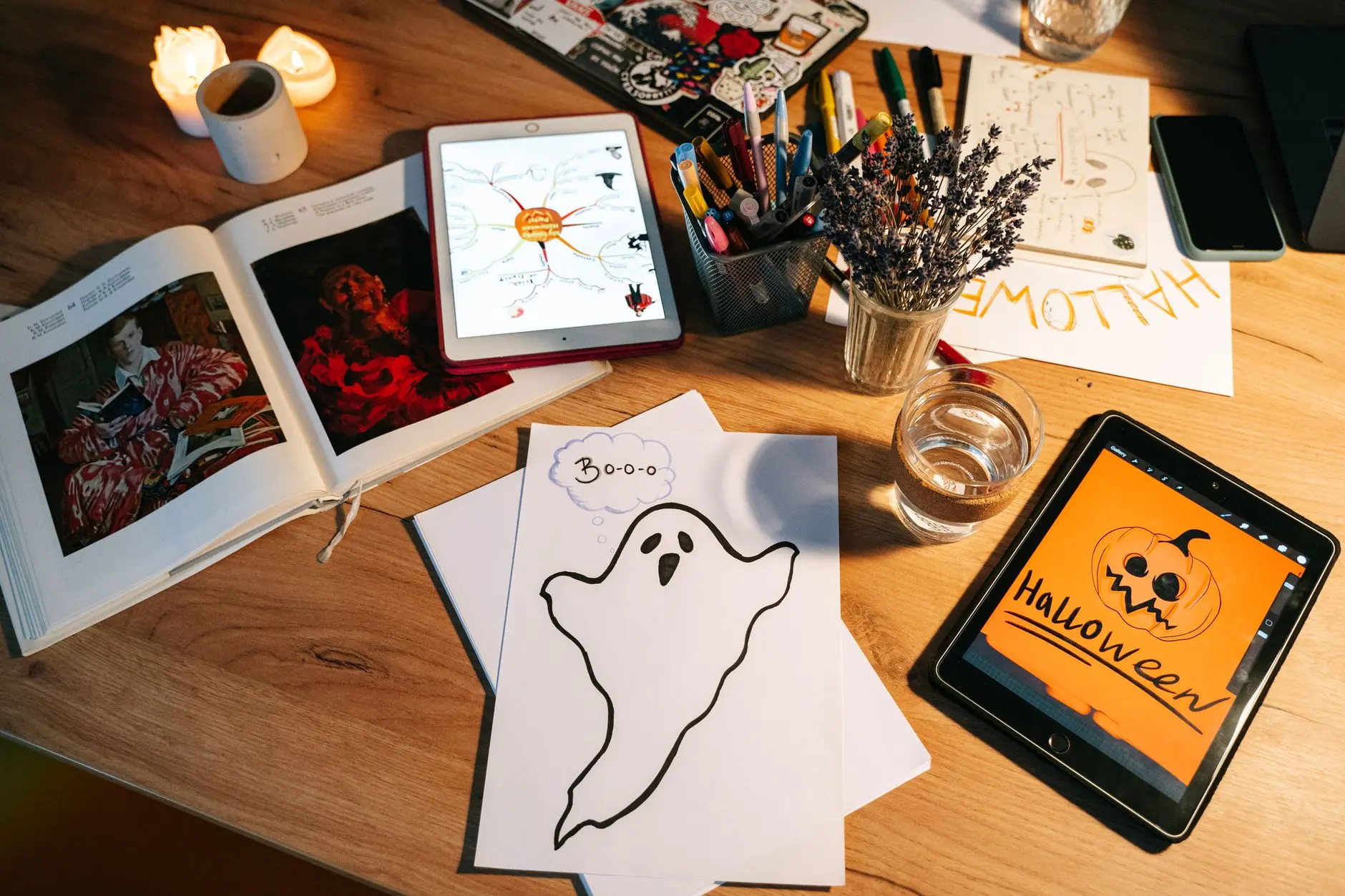
If you’ve ever tried to host Halloween trivia games and ended up just shouting questions over a playlist while everyone argued about the answers, this one’s for you.
A proper Halloween quiz night — with printed answer sheets, themed rounds, a quizmaster mic moment, and a dramatic tie-breaker — is honestly the most fun you can have at an adult Halloween party, and it takes way less effort than you’d think once you have everything laid out in front of you.
I’ve been running these for a few years now and the format below is the one that keeps guests glued to their seats all night, costumes and all.
Most come with a printable sheet you can download and hand out, a few get everyone off their chairs, and a couple are quieter team moments that keep the energy from peaking too early.
Print everything out in advance, split your guests into teams of three to five, and you’ve got yourself a two-hour Halloween quiz night that people will genuinely beg you to run again next year.
This post contains affiliate links — if you buy through them, I may earn a small commission at no extra cost to you.
- Horror Movie Round
- Halloween Origins Round
- Candy and Sweets Round
- Spooky Forbidden Words
- Monsters and Myths Round
- Picture Round Costumes
- Halloween Songs Intro Round
- Spooky Science Round
- Guess the Year Round
- Lightning Round
- Tie-Breaker Pumpkin Weight
- Team Name Ballots
- Answer Key Sheets
- Spooky Charades Relay
- Halloween Emoji Decode Round
- This or That: Horror Edition
- Dead or Alive Folklore Bluff
- Halloween Mad Libs Round
- Frequently Asked Questions
1. Horror Movie Round
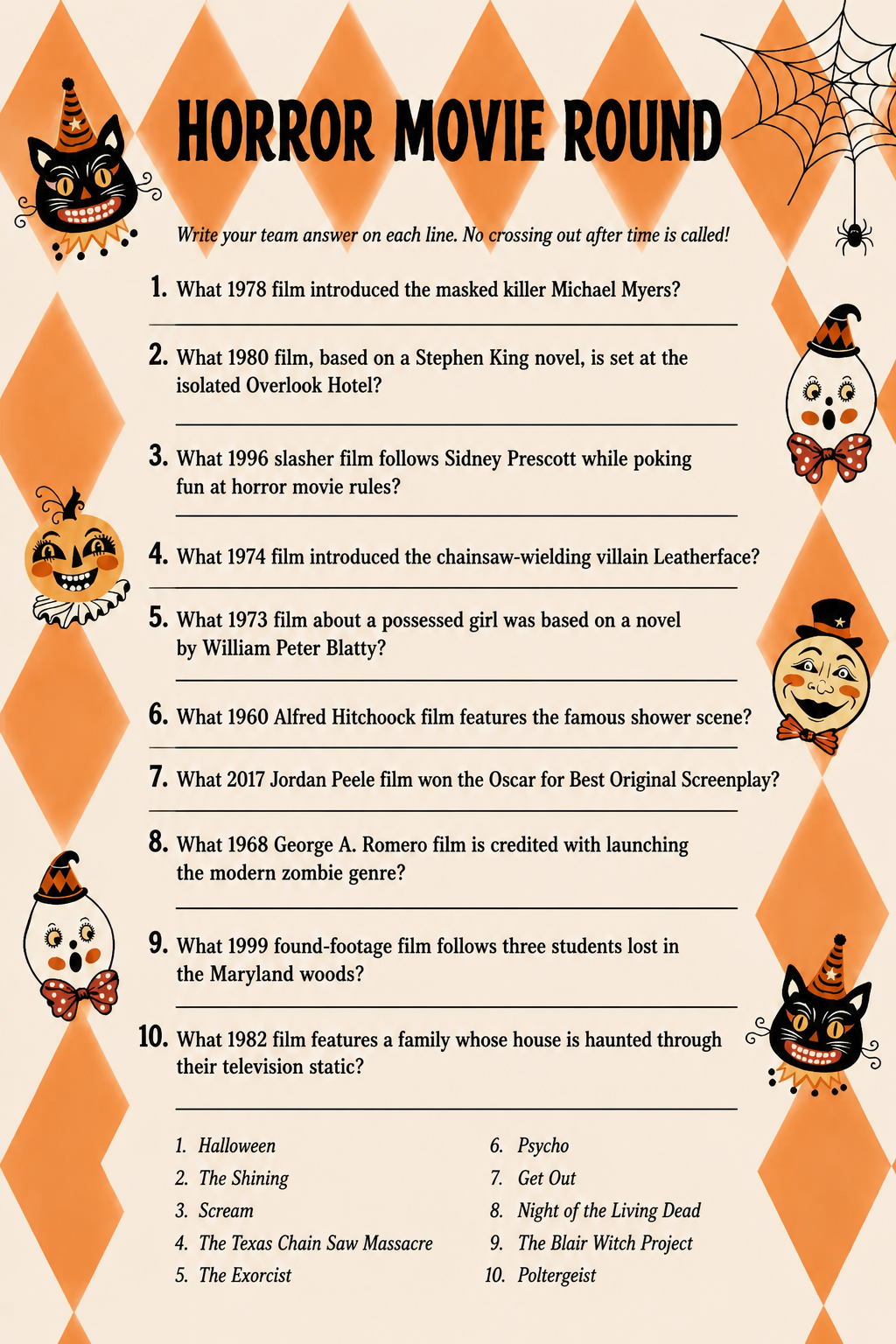
This is your opening salvo — ten questions that separate the horror obsessives from the people who just watched one scary film in 2004 and called it done.
Each team gets a printed answer sheet with numbered blank lines, and the quizmaster reads questions aloud at a steady pace, giving teams about 30 seconds per question to confer quietly and write their answer.
Questions range from classic slashers (year of release, director, iconic location) through psychological thrillers and creature features, so even the guest who ‘doesn’t really do horror’ can contribute something. It sets a competitive but laugh-heavy tone right from the off.
You’ll need one printed answer sheet per team, plus your question list on a separate host sheet. Ten questions works perfectly for a 10-12 minute round.
Read each question clearly twice — once while people are still settling, and again after a short pause — and keep a timer running so teams can’t drag out their deliberations.
A small bell or horror sound effect cue between questions goes a long way for atmosphere (a free app will do it).
The single best host tip for this round: order the questions easy-to-hard and slip a genuinely obscure one in at position seven.
By that point teams are confident and will almost always over-commit to a wrong answer with great enthusiasm, which gets a brilliant reaction when you reveal the correct one. Trust the process — position seven is where the real comedy lives.
Read every question exactly twice — once while pens are still being found, and once after a short pause. It sounds slow but it prevents the endless ‘can you repeat that?’ interruptions that derail the whole round.
🛍 Shopping guide
2. Halloween Origins Round
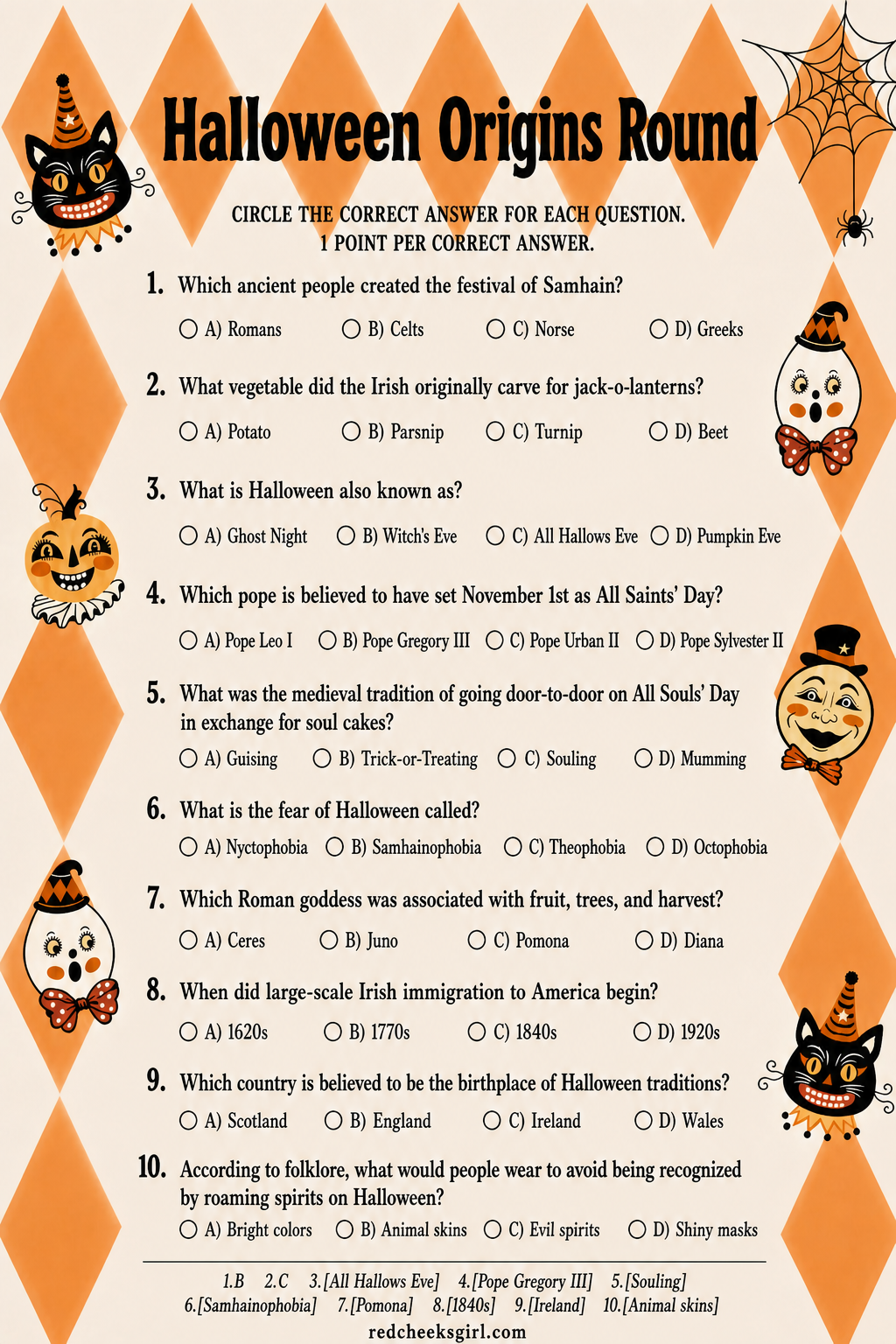
This is the round that surprises everyone — even the people who roll their eyes at ‘educational’ trivia end up utterly gripped once they realise how genuinely wild the real history of Halloween is.
The sheet covers ten questions on the Celtic festival of Samhain, the Roman influences, the Catholic church’s role in shaping All Hallows’ Eve, the Irish origins of jack-o’-lanterns (spoiler: turnips), and how trick-or-treating evolved from medieval souling practices.
Each question is multiple choice — four options per question — so the sheet feels less like a history exam and more like a fun vote on which answer sounds most believable.
Print one sheet per team and set a 15-minute timer for the round.
Because it’s multiple choice, teams don’t need to write anything from scratch — they just circle A, B, C, or D — which actually speeds up deliberation and ratchets up the friendly arguing. As the quizmaster, read the question first, then all four options slowly.
Don’t rush: half the fun of a multiple-choice Halloween history round is watching people waver between two plausible answers before committing.
Here’s something that only clicks after you’ve run this round a few times: the questions about pre-pumpkin jack-o’-lanterns and the origin of ‘trick or treat’ almost always generate a genuine ‘wait, seriously?’ moment from the entire room simultaneously. That communal ‘huh!’
reaction is pure quiz-night gold. Lean into it — after revealing those answers, give a five-second fun-fact elaboration rather than rushing on. It rewards curious guests and makes the trivia feel alive rather than mechanical.
- Groups of 3–6 per team, 15–20 guests total
- Anyone who loves history but pretends they don’t
- Running second in the night, right after the Horror Movie Round warm-up
3. Candy and Sweets Round
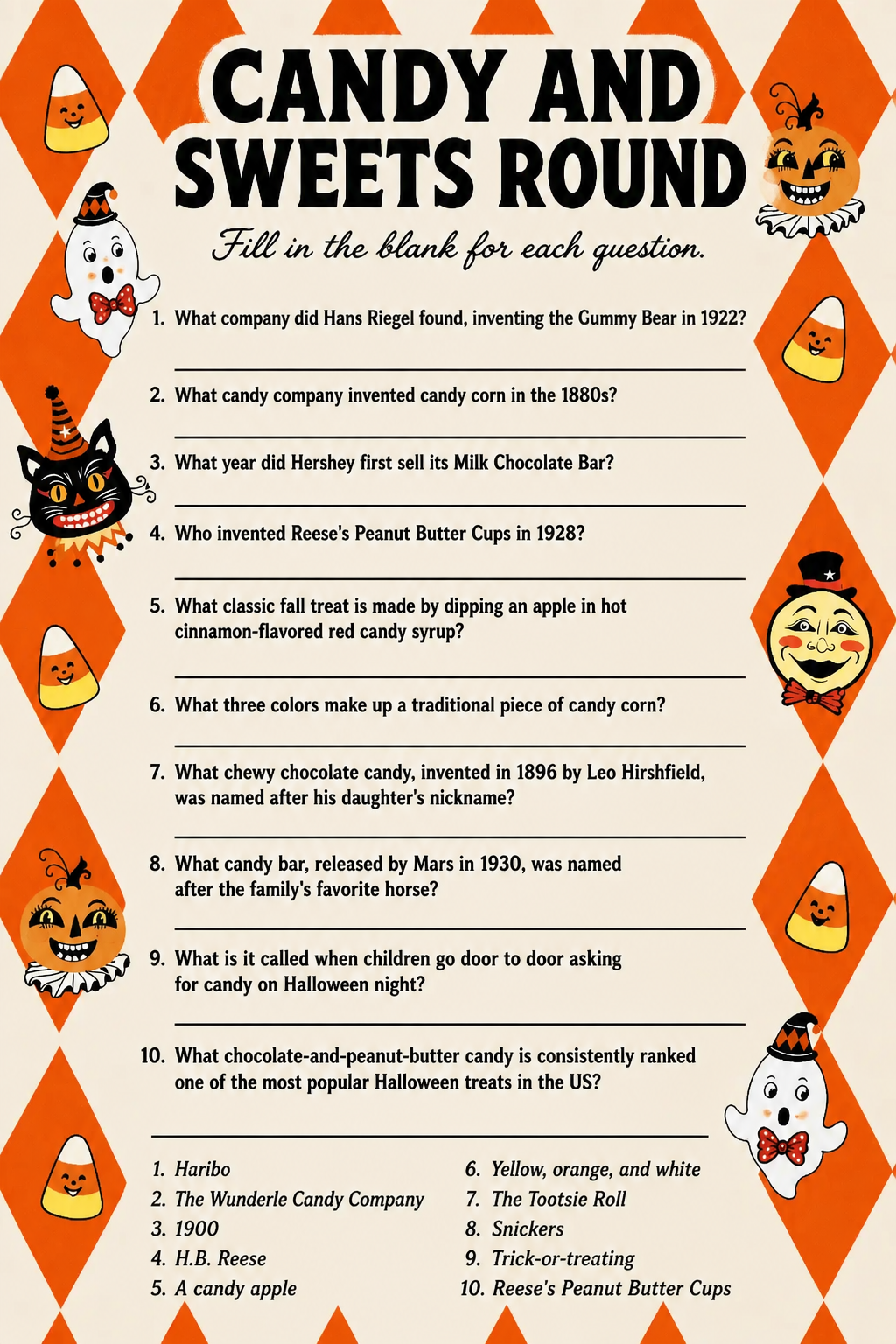
Every quiz night needs a round that makes people feel clever without really trying too hard, and this is it.
Ten questions all about Halloween candy and sweets: which candy was originally called ‘chicken feed,’ which country introduced chocolate bars to American trick-or-treaters, how many candy corns are produced each year, and which candy is consistently ranked the most hated in each US state.
It’s lighthearted, it’s nostalgic, and it almost always produces at least one heated table debate about whether candy corn is actually good (it isn’t, but let them fight).
The sheet is a fill-in-the-blank format: each question has the question text above a long writing line where the team writes their answer. One sheet per team, same 10-question, 10-minute format as the other main rounds.
As a nice touch, put a small bowl of mixed Halloween candy in the centre of each team’s table before this round starts. It’s not a prop — it’s a bribe.
People loosen up when they’re eating, their guard comes down, and the chatter gets funnier. You can thank me later.
A pro tip from bitter experience: avoid any question that hinges on a specific brand name or trademark, because you’ll get teams writing near-miss answers that are technically correct and you’ll spend ten minutes arguing about it.
Keep questions tied to the candy type or flavour rather than the manufacturer, and your marking will go smoothly.
This round also works brilliantly as the last one before a short break — it ends on a high, everyone’s laughing about candy opinions, and they naturally drift to the snack table, which is exactly where you want them.
Put a small bowl of mixed Halloween candy on each table before this round. People automatically relax when they’re snacking, and relaxed guests are funnier guests.
4. Spooky Forbidden Words
This is the round that gets everyone out of their chairs between the printed-sheet rounds, and it is absolute chaos in the best possible way. Inspired by the classic party taboo format, each team sends one person to the front.
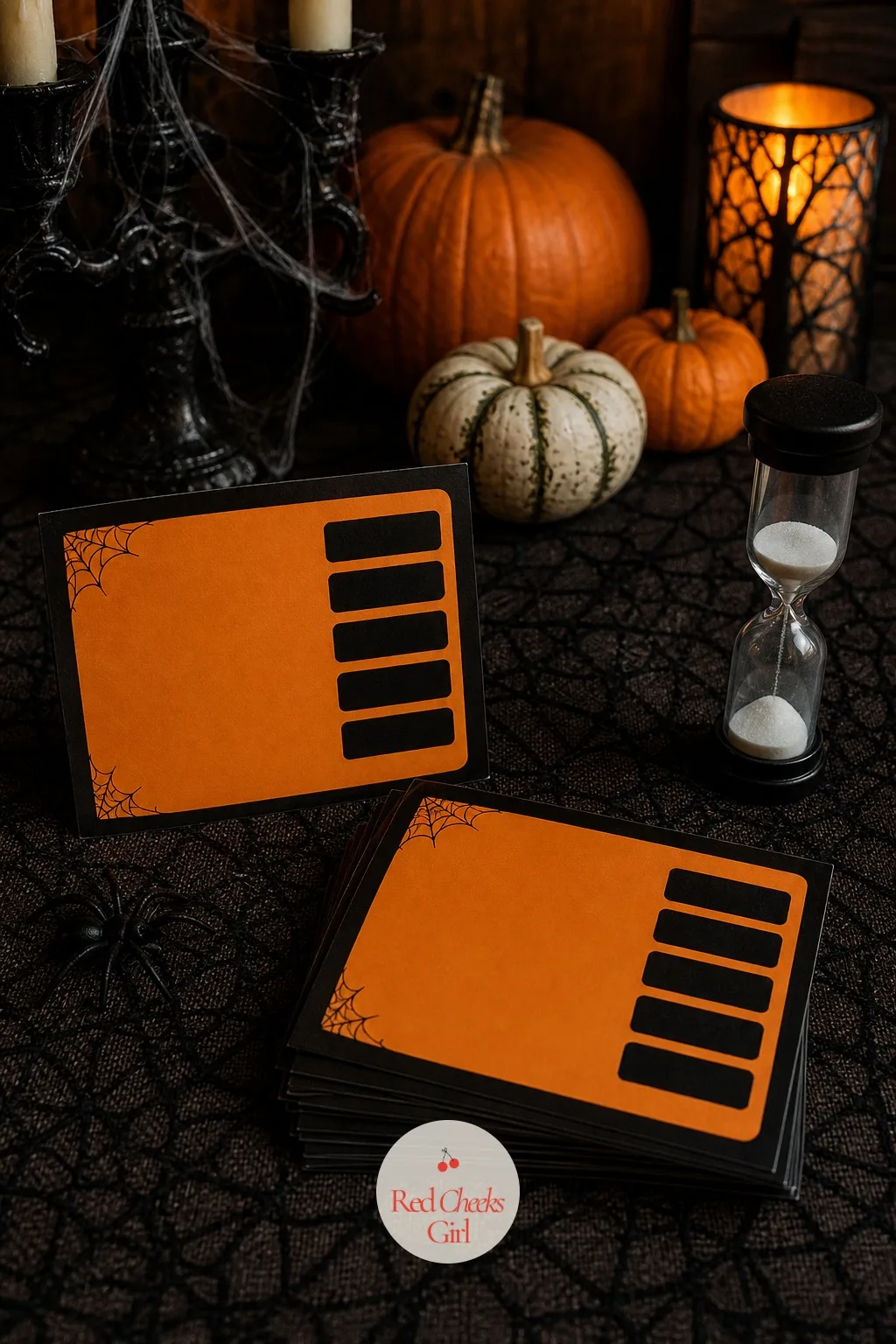
That person draws a Halloween word card and must get their team to say the word — without using any of the five forbidden clue words printed on the card.
The forbidden words are chosen to block all the obvious routes, so ‘vampire’ might ban the words coffin, blood, bite, Dracula, and cape.
Watching someone try to describe a vampire to their team while gesturing wildly in a costume is, tbh, the highlight of the entire evening.
You’ll need a stack of Halloween-themed word cards prepared in advance — aim for 30 to 40 cards so there’s no repetition. Each team gets 90 seconds on the clock and scores one point per correctly guessed word.
A quizmaster or neutral judge watches for forbidden word slips — if the clue-giver says a forbidden word, the card is skipped. Run two or three rotations so everyone gets a turn at the front.
Teams of three to five work best because there are enough people on the guessing side to create real energy.
The thing that separates a good run of this game from a great one is the card difficulty. Make a third of the cards genuinely easy (witch, ghost, pumpkin), a third medium (banshee, cauldron, séance), and a third delightfully brutal (samhainophobia, ossuary, ectoplasm).
The easy cards let nervous players get on the board; the brutal ones are where the best stories come from. I once watched someone spend 45 full seconds describing ‘ossuary’ with increasingly desperate hand gestures. No one got it. It was perfect.
- 30–40 Halloween word cards with 5 forbidden words each
- A 90-second sand timer or phone timer
- A neutral judge to catch forbidden-word slips
🛍 Shopping guide
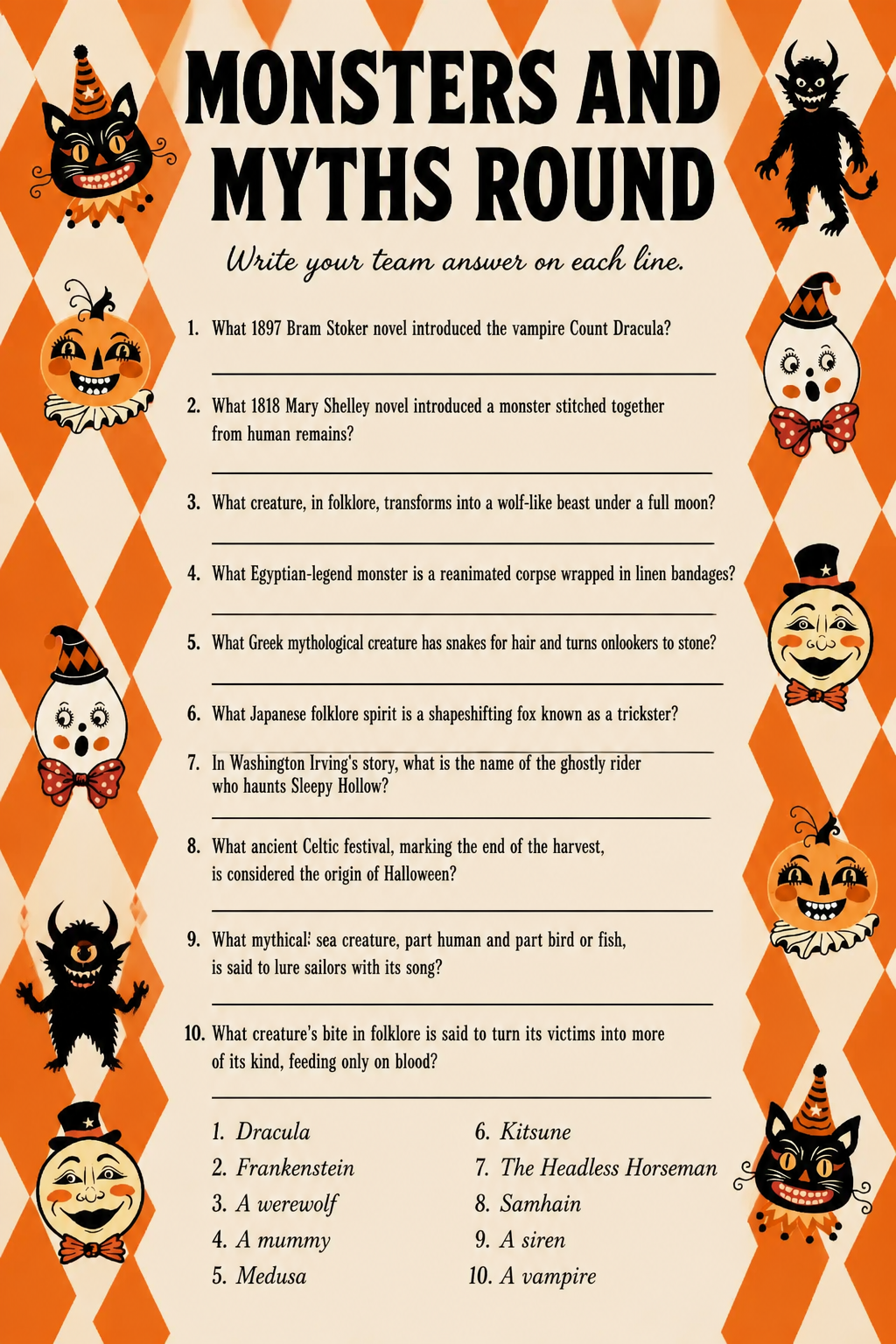
5. Monsters and Myths Round
Here’s where things get properly nerdy — and the guests who’ve been quietly confident all night suddenly find themselves sweating.
This ten-question round covers classic monsters and the folklore they come from: what the word ‘werewolf’ literally translates to, which culture originated the concept of the vampire, how many heads the Greek monster Hydra had, what a kelpie is, and what you’re supposed to do if you encounter a will-o’-the-wisp.
It’s the kind of round where someone who studied mythology in college will finally feel vindicated for that life choice, while everyone else scrambles.
The sheet is a trivia answer format — numbered questions with a blank writing line under each. One sheet per team, ten minutes on the clock.
What makes this round particularly fun to host is that the questions reward breadth of knowledge across cultures: Celtic, Norse, Japanese, and Caribbean folklore all appear, so no single team member can dominate.
If you’ve got a team where one person usually carries everyone through the horror movie questions, this is the round that levels the playing field beautifully.
A host tip that genuinely changes the round: after you reveal each answer, add a single dramatic sentence of context. ‘A kelpie lures you onto its back, then drags you underwater.’ Three seconds of silence. The table erupts.
You’re not padding the quiz — you’re giving people something to talk about when they’re comparing notes at the bar later. That kind of storytelling is what separates a quiz night from just a quiz.
It rewards the whole team rather than just the horror-movie buff, because the folklore questions pull from Norse, Celtic, Japanese, and Caribbean traditions — so everyone has a shot at contributing.
6. Picture Round Costumes
This is the round people talk about on the drive home. The printed sheet shows ten grayscale silhouette images of famous Halloween costume archetypes — each one carefully described in the image so teams must identify the character type from the shape alone.
Is that a classic Frankenstein’s monster silhouette or something else? Is that a mummy or a ghost?
The twist: some silhouettes are iconic but have subtle details deliberately changed (a witch with the wrong hat brim angle, a vampire with no cape), and teams who correctly name both the character AND the deliberate wrong detail earn a bonus point, making this a potential 20-point round for sharp-eyed teams.
Print the sheet in greyscale — it actually looks better that way since the silhouettes read more cleanly without colour confusion. Give teams 12 minutes for this one because there’s a lot of looking, pointing, and debating.
The quizmaster doesn’t read questions aloud for this round — just say ‘you have 12 minutes, your sheets are face down, flip them over now’ and let the room do the rest. The noise level immediately doubles, which tells you it’s working.
The bonus-point mechanic is the thing that separates good teams from great ones, and here’s why it matters operationally: it means even a team that gets all ten silhouettes right can still be beaten if another team spots all the deliberate errors.
It keeps the leaderboard unpredictable well into the second half of the night, which is exactly what you want for maximum tension going into the Lightning Round. Run this one fifth — after four written rounds the room is ready for something visually different.
For a shorter event, skip the bonus-point deliberate-error mechanic and just score 1 point per correctly identified silhouette — it’s still a great round and cuts marking time in half.

7. Halloween Songs Intro Round
This is the round that has the highest ‘I didn’t know I knew that’ energy of the whole night.
The quizmaster plays the first ten seconds of ten Halloween-adjacent songs — think classic horror soundtracks, spooky pop anthems, and one genuinely obscure deep cut to keep the music nerds humble — and each team writes down the song title and artist on their standard answer sheet.
You’re not testing whether people like the music; you’re testing whether the opening note of a famous horror theme is burned into their brain (it is, for everyone, whether they admit it or not).
The moment someone hears those opening bars and whips around to stare at their teammates is one of the best things to witness as a host.
You’ll need a playlist queued up in advance with exactly ten tracks and the clips trimmed to ten seconds each. A Bluetooth speaker loud enough to fill the room is essential — this round completely falls apart if people at the back can’t hear.
Run the clip, give 20 seconds for teams to confer and write, then move to the next track without revealing the answer yet. Reveal all ten at the end of the round for maximum drama.
Include a mix: recognisable horror film themes, classic spooky pop songs, and one older track from the 1960s or 70s that nobody under 45 will know.
The host tip that makes this round legendary rather than just good: after you reveal the answer to each track, play five more seconds of it. Not the whole song — just five more seconds.
The room almost always sings or hums along involuntarily, and the combination of competitive scoring and shared music experience makes this the most socially warm moment of the entire quiz night. It’s the palate-cleanser the evening needs right before the tougher second half begins.
- A pre-built playlist of 10 Halloween-adjacent tracks trimmed to 10-second intros
- A loud Bluetooth speaker or sound system
- Standard answer sheets with numbered lines 1–10
- A phone or laptop with reliable audio playback
🛍 Shopping guide
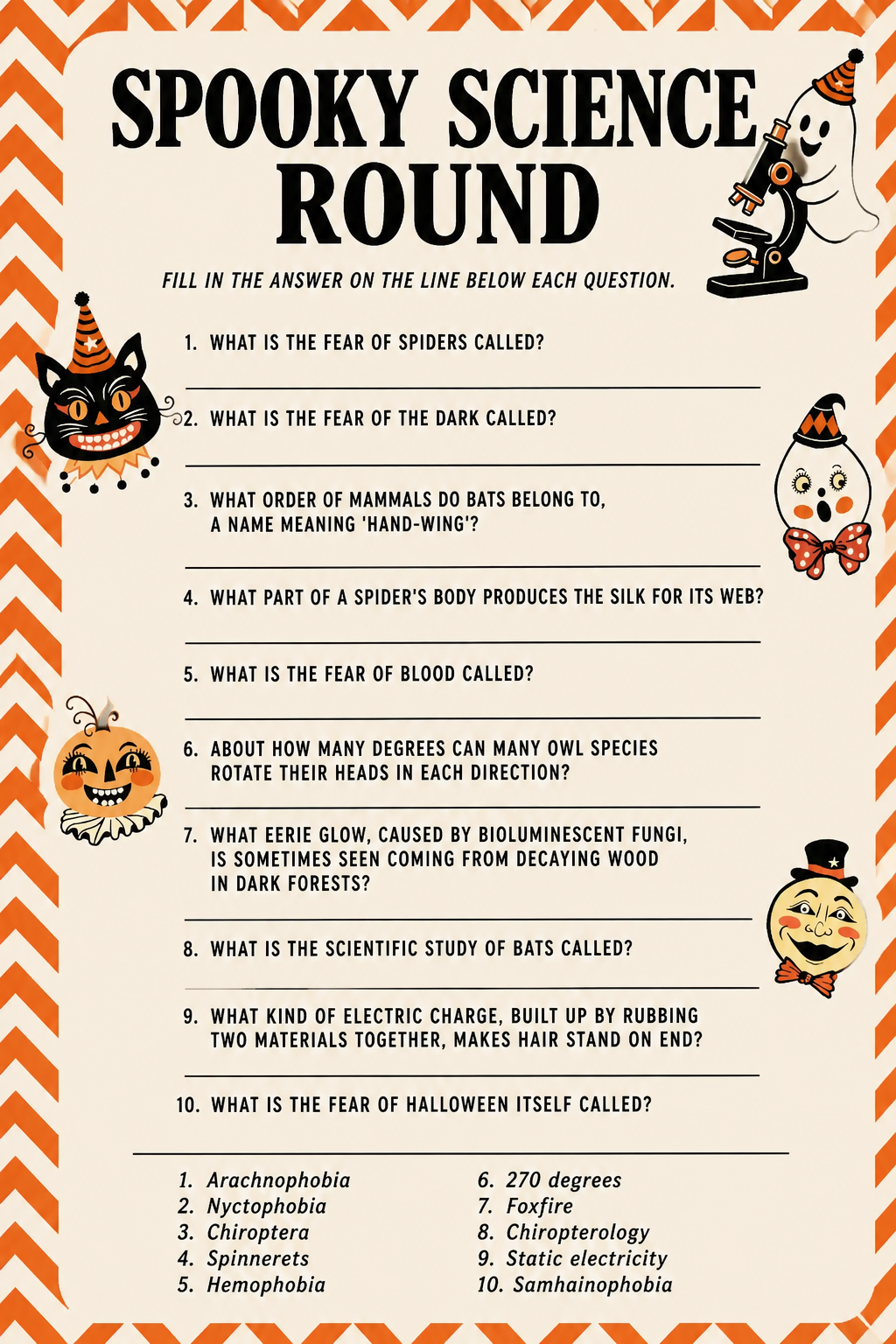
8. Spooky Science Round
This one gets a raised eyebrow when you announce it, and then complete silence as soon as the first question lands.
The Spooky Science Round is ten questions about the real science behind Halloween phenomena: why does the brain generate fear responses, what is bioluminescence and which creatures produce it, what causes ‘ghost lights’ in swamps (methane combustion, since you asked), how many calories are in the average Halloween haul, and what sleep scientists say about nightmares versus night terrors.
It sounds like a school lesson but plays completely differently in a competitive team setting — people are desperate to look smart in front of their friends, and that desperation is the engine of great trivia.
Format this as a fill-in-the-blank sheet — the question is printed above a long writing line, and teams write their answer. Ten questions, 12 minutes on the clock. The quizmaster reads each question aloud once (this isn’t a silent reading round) and teams write.
You can offer half-points for near-miss scientific answers at your discretion, which is a nice way to reward genuine knowledge even when the exact phrasing doesn’t match your answer key.
Something that only becomes obvious after you’ve run this round: the guests who go quiet and look intensely concentrated during Spooky Science are usually either scientists or people who watched a lot of documentary television. Both groups are worth having at a quiz night.
The round also tends to generate great post-quiz conversation — people want to know the story behind the swamp gas answer, or to argue about the calorie count.
Print a brief fun-fact note on the back of the host answer key sheet and read out two or three after scoring. It turns the quiz into an experience rather than just a competition.
It balances the pop-culture and history rounds with something unexpected, and guests who felt left out during the horror movie questions suddenly have their moment to shine.
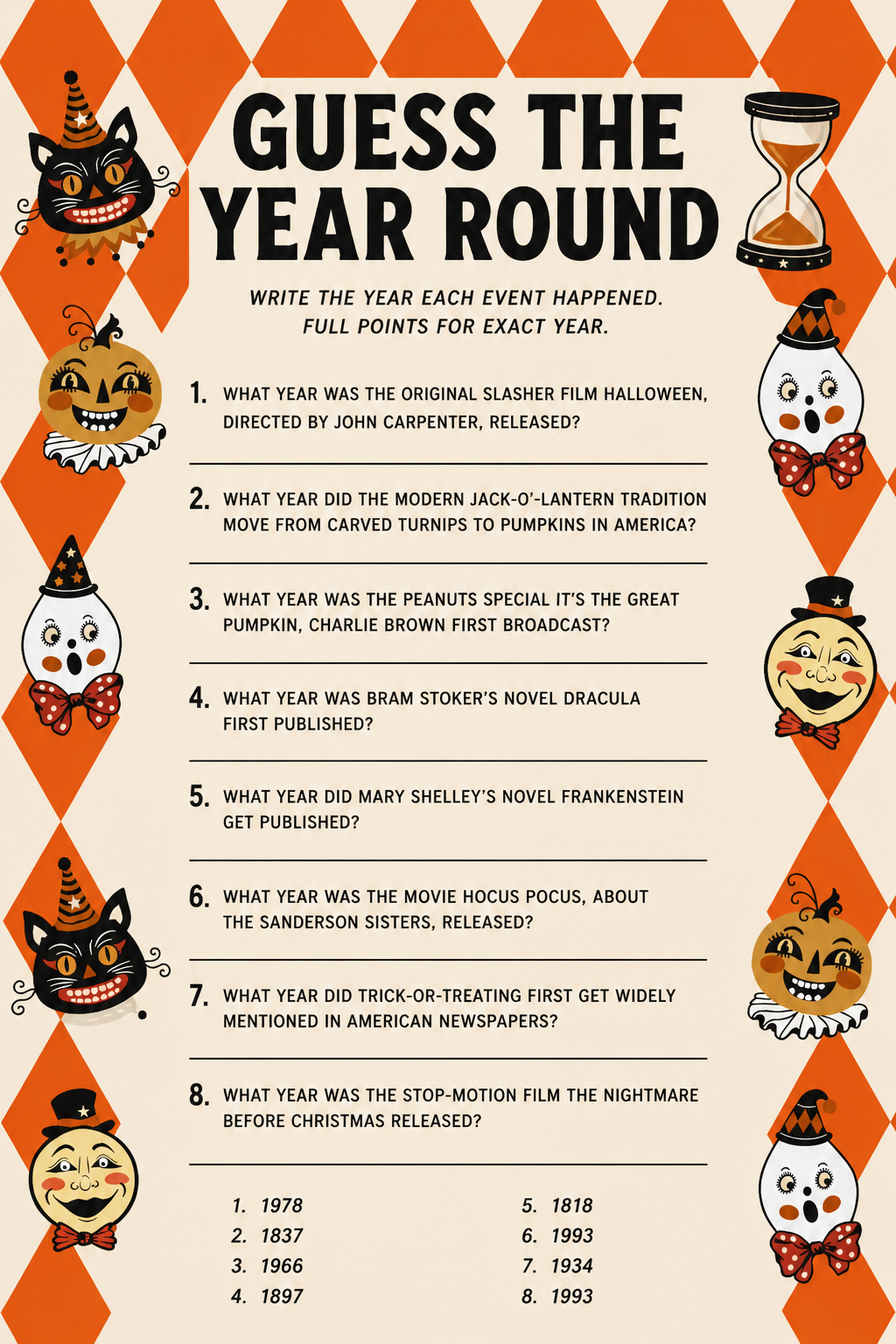
9. Guess the Year Round
Ten Halloween-related events, one answer required: the year it happened.
Classic horror film releases, the year trick-or-treating was popularised in the United States, the first recorded use of the phrase ‘trick or treat’ in print, the year a famous real-life haunted attraction opened, the year a notable Halloween-related world record was set — all of it requiring teams to triangulate their collective historical knowledge and land on a four-digit number.
The genius of this format for a quiz night is that partial credit is genuinely possible: a team that writes 1977 instead of 1978 still knew the right era, and you can award half a point for answers within two years if you want to encourage thoughtful guessing over wild stabs.
The sheet lists ten prompts, each above a dedicated answer line. Twelve minutes on the clock — slightly longer than a standard round because year-guessing requires deliberation and mental arithmetic as teams try to triangulate from context clues.
As the quizmaster, read each prompt slowly and with a bit of theatrical suspense (‘The year… the most famous horror film of its decade terrified audiences for the first time was…’).
The slow dramatic delivery isn’t for effect — it genuinely gives teams time to process before they start arguing.
Here’s the host tip that changes this from good to great: on the reveal, always announce whether the correct year was before or after the most common wrong answer the room gave.
‘Most of you said 1969 — the answer is actually 1966, so the earlier half of the room had it.’ That comparative reveal feels like a mini-lesson and makes teams immediately trust the next round more.
Also, the within-two-years half-point rule is completely optional, but in my experience it keeps teams invested right up to the last question rather than giving up when they feel out of their depth.
Award half a point for answers within two years of the correct date — it keeps teams engaged on the trickier questions instead of writing ‘no idea’ and checking out.
10. Lightning Round
The Lightning Round is where the leaderboard blows up and everything gets wonderfully chaotic. One team at a time takes the hot seat. The quizmaster fires rapid-fire questions — one every five seconds — and a nominated spokesperson from that team shouts answers aloud instantly.
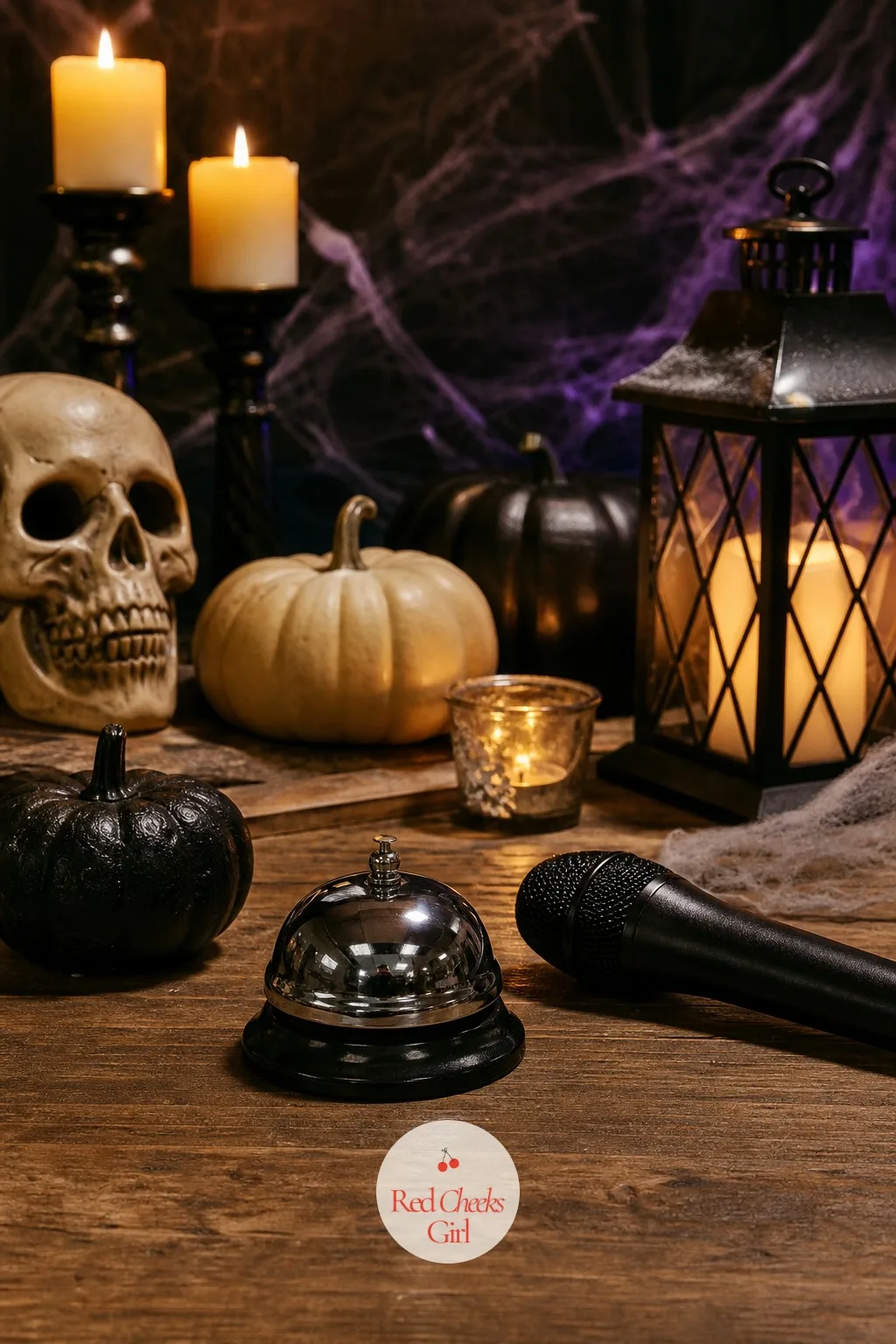
No conferring, no deliberation, no crossing out. If they hesitate for more than five seconds, the quizmaster calls ‘NEXT’ and moves on. The team scores one point for every correct answer they get in 60 seconds.
Every other team watches in (hopefully) stunned silence, tracking how many the hot-seat team gets. This keeps the whole room engaged even when it’s not their turn, because everyone’s scoring the performance.
You need a separate question bank for the Lightning Round — at least fifteen questions per team, all short-answer and Halloween-themed, so even the largest group of six teams won’t exhaust the pool. Keep questions short: ‘What colour is Frankenstein’s monster?’
not ‘In Mary Shelley’s novel, what is the physical characteristic most associated with the creature assembled by Victor Frankenstein?’ The shorter the question, the faster the round moves and the higher the energy climbs.
Keep a visible timer — a projected countdown or a loud sand timer — so the watching teams feel the pressure alongside the hot-seat team.
The one thing that separates a great Lightning Round from a messy one is the ‘no going back’ rule: once the spokesperson says anything out loud, that’s the answer, right or wrong. Teams will try to self-correct mid-word, or claim they said something different.
Have the rule written on a big piece of card near the quizmaster’s table so you can point to it silently rather than getting into an argument. The rule isn’t harsh — it’s what keeps the energy at the speed it needs to be.
And when a team rattles off eight correct answers in a row, the room goes genuinely wild.
- A bank of 15+ rapid-fire Halloween questions per team
- A 60-second countdown timer visible to the room
- A clear ‘no going back’ rule posted near the quizmaster
- A loud bell or buzzer for the NEXT signal
11. Tie-Breaker Pumpkin Weight
So: you’ve run eight rounds, the scores are impossibly close, and you need a winner. This is the tie-breaker, and it is perfect in its simplicity.
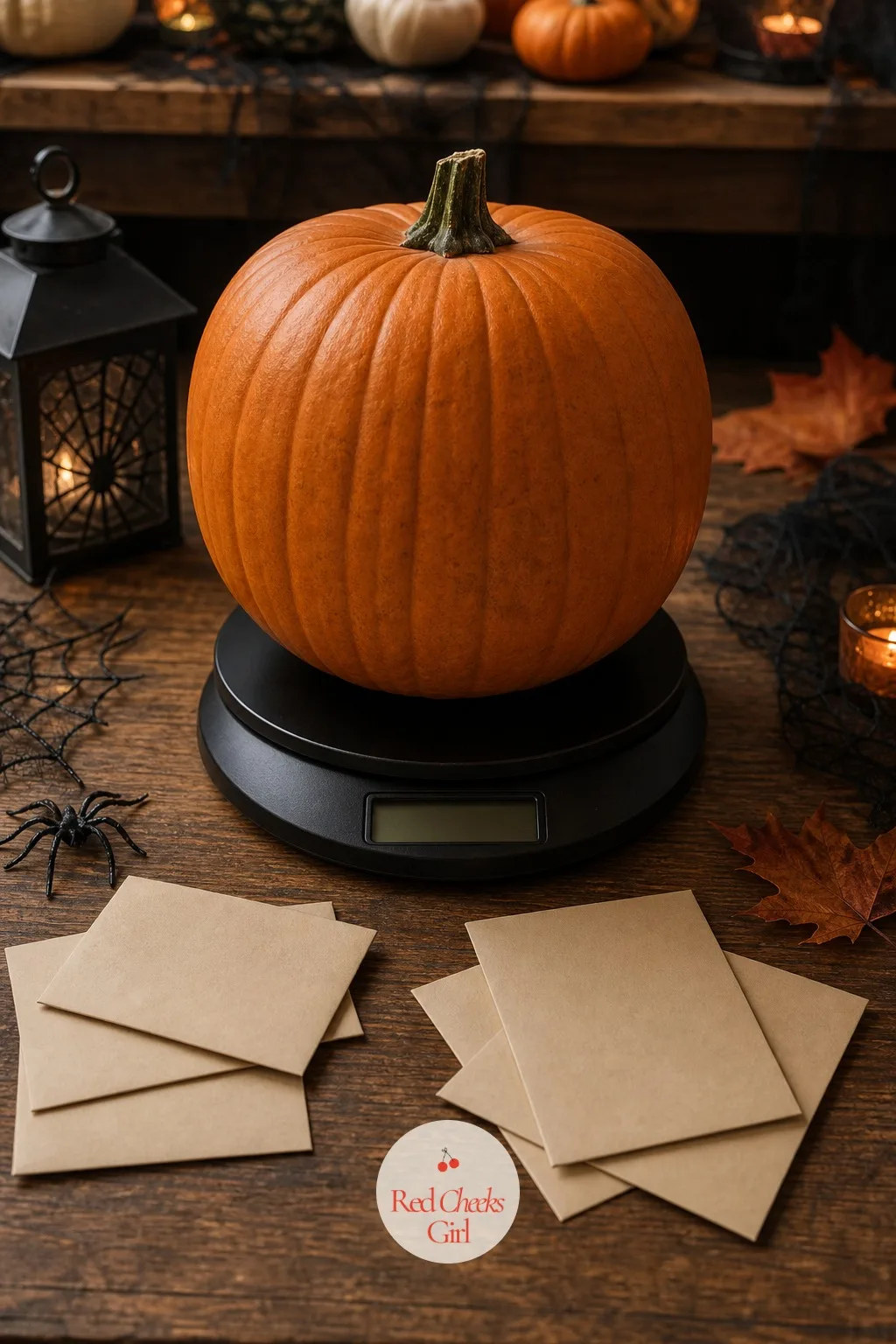
Before the night starts, you weigh a whole, uncarved pumpkin — exactly, to the nearest gram or ounce — and keep the number secret.
At tie-breaker time, you bring the pumpkin out and each tied team submits one sealed guess (written on a slip of paper) for the pumpkin’s exact weight. Closest guess wins.
If only one team remains tied after the main quiz, they can face off against the runner-up. The whole room votes on which team’s guess they think is closest before the reveal, which adds a delicious layer of audience participation.
Operationally: weigh the pumpkin in advance on a kitchen or postal scale, write the weight on a card and seal it in an envelope which you keep visibly on the quizmaster table all night.
Making the sealed envelope visible from the start is a nice theatrical touch — it says ‘something important is in there’ without explaining what. Give tied teams three minutes to confer and write their weight guess on a folded slip of paper.
Collect the slips, open the sealed envelope for the room, and reveal which team was closest. If there’s an exact match, that team wins instantly and dramatically.
The host tip: choose a pumpkin that looks deceptively average but is actually denser than it appears — a slightly smaller, thicker-walled variety rather than the classic tall carving pumpkin. This widens the spread of guesses and makes the closest-guess drama more likely.
Also, weigh it on the day of the party, not the day before — pumpkins lose measurable water weight overnight, and the last thing you need is a confused argument about why your scale says something different. (Ask me how I know.)
Weigh the pumpkin on the day of the party, not the day before — pumpkins lose real water weight overnight and you do not want that argument at 10pm.
🛍 Shopping guide
12. Team Name Ballots
This isn’t just an admin task dressed up as a game — it’s a genuine contest that runs as a warm-up before the quiz starts, gets people laughing immediately, and sets the tone for the whole night.
When guests arrive, each team is given a Team Name Ballot sheet and five minutes to come up with the most creative, Halloween-appropriate team name they can.
After five minutes, every team reads their name aloud to the room, and then all non-team-members vote anonymously for their favourite on the same ballot sheet.
The team with the most votes wins a small bonus point added to their quiz score — not enough to decide the night, but enough to make the naming process feel genuinely competitive.
The ballot sheet has a top section where the team writes and decorates their chosen name (there’s a large blank box for this), and a lower voting section with numbered lines where voters write their favourite team name from the ones they’ve heard.
Collect the voting sections after the reveal, tally quickly, and announce the winner before Round One starts.
The whole process takes about ten minutes and is completely worth it — a great team name gets referenced by the quizmaster all night (‘ten points to Scream If You Know The Answer, bringing them level with…’) and becomes part of the evening’s running jokes.
The bit that makes this land: tell teams upfront that the quizmaster will use their team name every single time they score a point.
This means a long or punny team name becomes increasingly funny as the night goes on, while a boring name like ‘Team 4’ quickly feels like a missed opportunity.
You’ll find teams spend disproportionate energy on this ‘warm-up’ task, which is exactly the kind of creative investment that gets everyone emotionally bought into the quiz before a single trivia question has been asked.
A great team name gives the quizmaster material for running commentary all night, which transforms score announcements from dry admin into genuine comedy moments.

13. Answer Key Sheets
The Answer Key Sheet is what stands between you and a full-scale diplomatic incident at the scoring table.
After each round, teams pass their answer sheets one team to the left, and the quizmaster reads out the correct answers while the team holding the sheet marks it.
Every mark must be done in a different pen colour to the one the answering team used — this is non-negotiable, so specify it at the start of the night and hand out red pens or orange pens at each table for marking only.
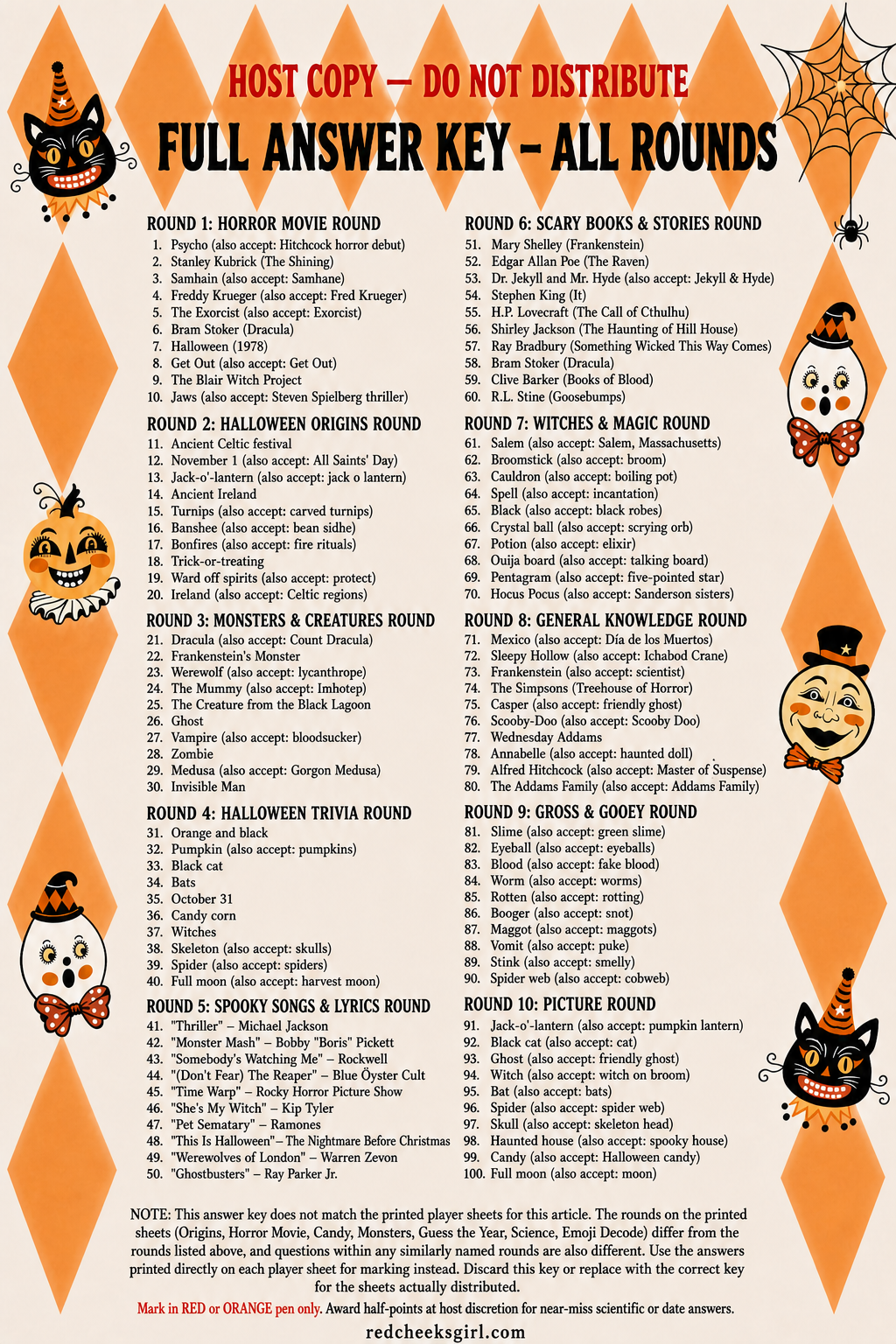
The Answer Key Sheet you (the host) hold contains all answers across all ten rounds, formatted in the same numbered structure as the answer sheets, so there’s no fumbling or cross-referencing mid-reveal.
Print one master Answer Key Sheet set for yourself and, optionally, one for a co-host if your group is large. The sheet lists all ten rounds, their questions, and the accepted correct answers — including any ‘also accept’ variations noted in italics.
Keep the key sealed in an envelope until the game starts (teams love seeing it on the table, knowing answers are already locked in).
Having the answers printed rather than read from a phone means you never accidentally reveal the next question by scrolling too far, which is a real and slightly embarrassing thing that happens more than quizmasters admit.
Here is the host tip that will save your evening: add a short ‘also accept’ note next to any answer that has a plausible alternative spelling or phrasing. If the answer is ‘Samhain’ and someone writes ‘Samhane’ — is that close enough?
Decide in advance and write it on the key. Disputes at the marking stage slow everything down and cool the room’s energy.
A good answer key is the unsung hero of any quiz night: nobody notices it when it works perfectly, but everyone notices when it doesn’t. Print it on a different colour paper from the team sheets so it’s impossible to mix up.
Print the host answer key on a different coloured paper — bright orange or green — so it is physically impossible to accidentally hand it to a team instead of their answer sheet.
🛍 Shopping guide
14. Spooky Charades Relay
Regular charades but with a relay twist that keeps everyone in the room at maximum engagement: teams line up, and one person at a time from each team runs to the quizmaster to collect a folded Halloween-themed charade card (think: ‘a ghost falling through the floor,’ ‘a vampire trying to get invited inside,’ ‘someone discovering they’ve been turned into a zombie’).
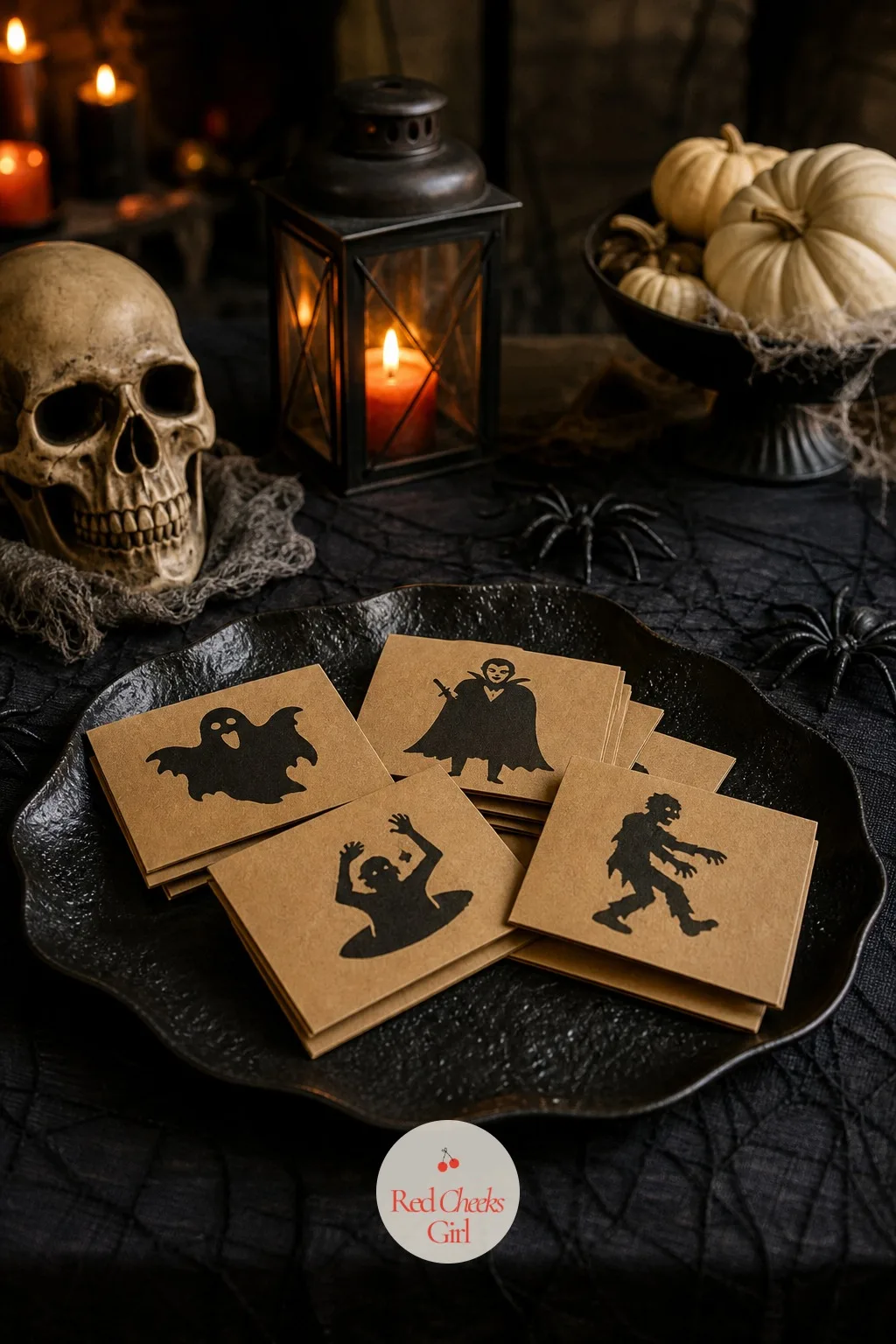
They have 60 seconds to act it out for their team, who must guess the exact phrase. If the team guesses correctly within the time, the actor sprints back, tags the next person, who runs up for their card.
Teams score one point per correctly guessed card, and the relay runs for five minutes total — whoever has the most points at the end wins the round.
You need a stack of at least 30 folded charade cards prepared in advance, all Halloween-themed and aimed at adults (skew them slightly absurd rather than genuinely scary — ‘aggressively haggling with the Grim Reaper’ is funnier to act out than ‘a ghost’).
Tape a running order on the table so the relay is organised and people aren’t bumping into each other.
Set up a clear acting space — push chairs back — because people in Halloween costumes acting out charades need more room than you’d expect, especially anyone in a full-length cape.
The relay element is what separates this from standard charades and makes it legitimately exciting: there’s real physical movement, real time pressure, and the possibility of a comeback if a fast team hits a lucky run of easy cards late in the round.
Run this between the heavier trivia rounds as a physical reset — the ideal placement is right after the Spooky Science Round, when brains are tired and legs need to move.
The room temperature goes up by about three degrees during this round and that is a scientific fact (approximately).
- 30+ folded Halloween charade cards, adult-themed phrases
- A clear acting space with chairs pushed back
- A 5-minute countdown timer visible to the room
- A separate collection of cards for each team to avoid repeats
🛍 Shopping guide
15. Halloween Emoji Decode Round
This is the round where the table immediately divides into the people who live on their phones and the people who genuinely cannot identify a single emoji illustration, and both groups are absolutely essential for the team dynamic.
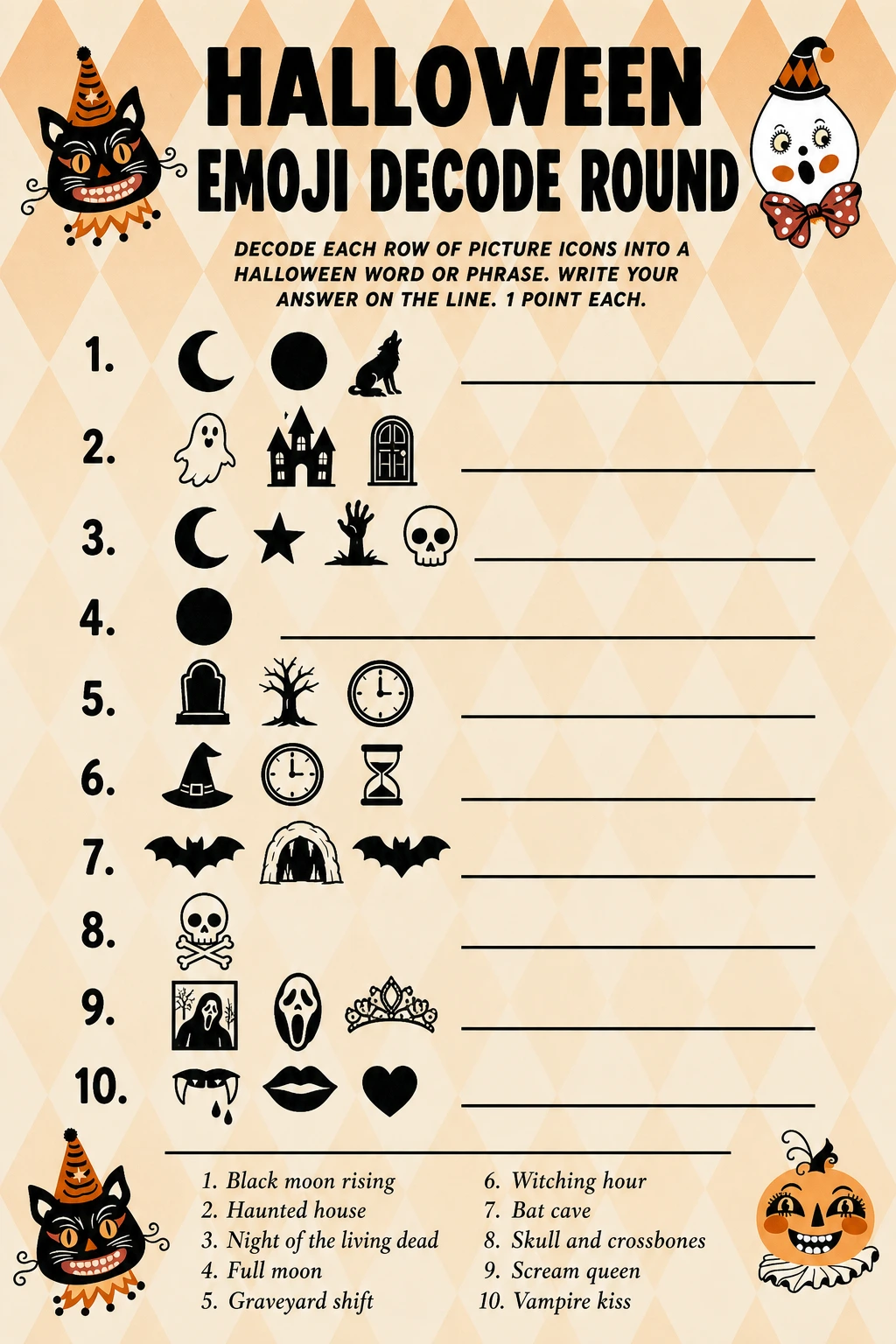
The printed sheet shows ten rows of illustrated emoji-style picture icons in sequence — tiny drawn symbols representing objects, actions, and feelings — and teams must decode each row into a Halloween word, phrase, or horror-adjacent title.
For example, a tiny moon icon + a tiny star icon + a tiny howling wolf silhouette = ‘Werewolf Night.’ The icons are drawn pictorially, never written as words, so the solving process is genuine lateral thinking rather than reading.
Give teams 12 minutes and one sheet per team. Remind them at the start that the icons represent sounds and concepts, not just objects — some rows work phonetically, some work conceptually, and the best ones work both ways at once.
The quizmaster doesn’t read anything aloud for this round; it’s entirely visual. Put on a soft Halloween-themed background playlist during the silence to keep the atmosphere from feeling too much like an exam.
The emoji-decode format works brilliantly as a printed round because every team member can contribute an interpretation simultaneously rather than waiting for one person to speak.
Host tip from hard experience: test every single row yourself by showing it to someone who hasn’t seen the construction process. It is absolutely possible to design an emoji sequence that makes perfect sense to you and baffled sense to literally everyone else.
I once made a sequence I was extremely proud of that turned out to have three plausible correct answers, none of which was mine. That was an interesting scoring conversation. Test them. All of them. Then test them again on a different person.
For a mixed-ability group, add a tiny letter hint beneath each emoji sequence — the first letter of the answer — to prevent anyone getting completely stuck and losing interest.
16. This or That: Horror Edition
This one is the perfect interlude between the heavy competitive rounds — low stakes, fast-moving, and quietly revealing about your guests’ personalities.
The quizmaster calls out a pair of Halloween-or-horror-adjacent choices and every player in the room must immediately commit: stand up for option A, stay seated for option B. No fence-sitting, no abstentions, no ‘it depends.’ Examples: ‘Zombies or vampires?’ ‘Haunted house or haunted forest?’
‘Die first in a horror film or survive but lose everyone you love?’ ‘Spend a night in a real haunted location or watch 24 hours of horror films back to back?’
The split decisions are always more interesting than the unanimous ones, and the shouted justifications from each side are where the real entertainment lives.
No materials needed — this round is completely improvised and flows entirely from the host’s energy. Prepare a list of 15 to 20 this-or-that pairings in advance so you’re not scrambling, but deliver them like you’re making them up on the spot.
Move fast: one pairing every 20 seconds. Don’t score this round — it’s not competitive, it’s connective. It’s the round that reminds everyone that these are real people with actual opinions, not just opposing team uniforms. Run it for about five minutes as a palate-cleanser.
Here’s the thing that makes This or That disproportionately effective as a party moment: the one-pairing that lands unexpectedly.
There’s always one question that produces a completely lopsided split — maybe 90% of the room chooses vampires over zombies — and then the 10% on the zombie side has to defend their position to a room of vampire fans in Halloween costumes.
It’s brief, it’s funny, it requires no setup, and it is the reason you run this between the Guess the Year Round and the Lightning Round rather than skipping it to save time. Don’t skip it to save time.
Prepare 20 pairings but plan to use only 10 — that way you can read the room and skip anything that feels flat, and always finish on your strongest pairing for maximum energy.
17. Dead or Alive Folklore Bluff
This is the bluffing game that makes smart people look foolish in the most enjoyable way.
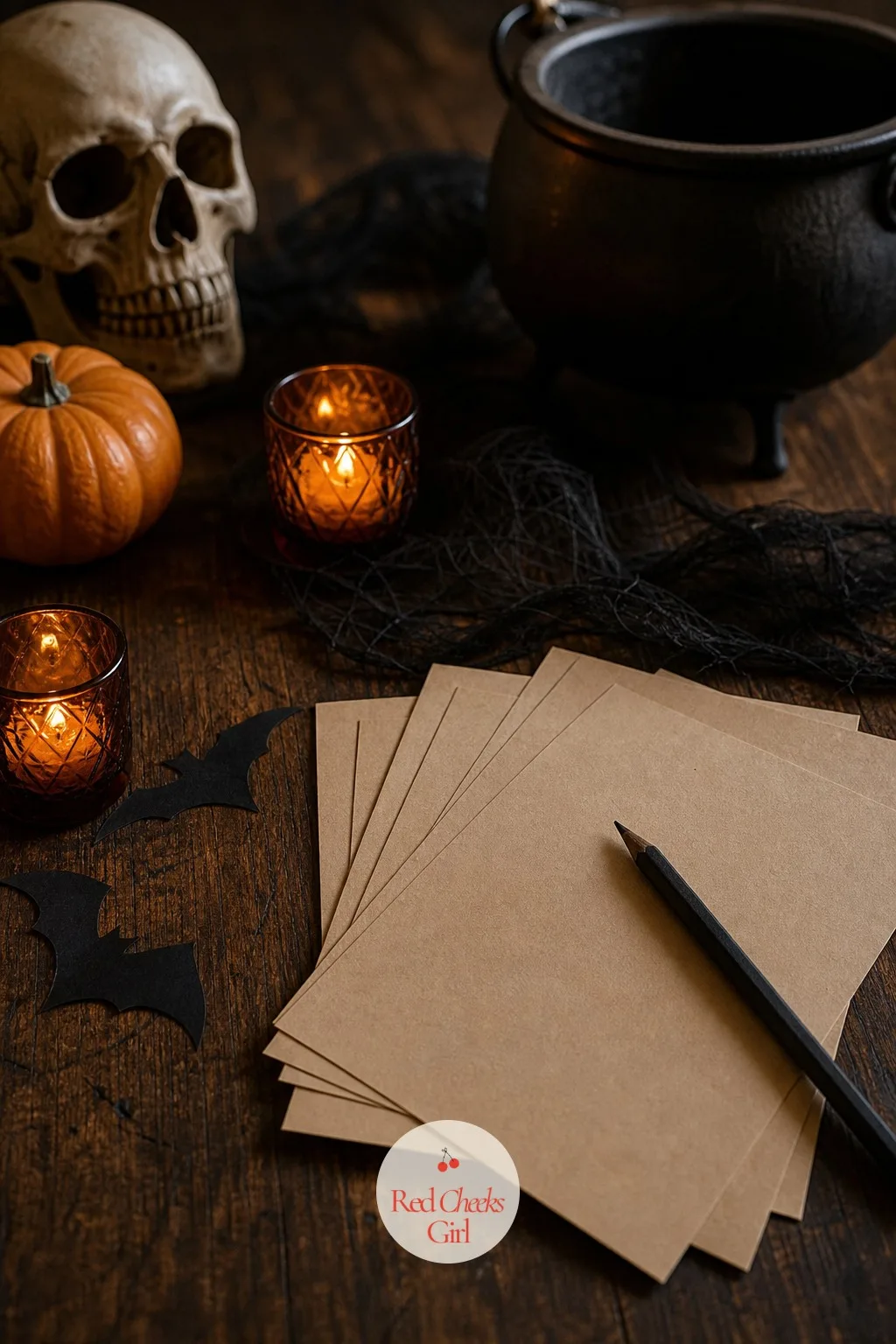
The quizmaster reads out a short description of a supposed Halloween or horror folklore creature — some are real entries from genuine folklore traditions around the world, some are completely invented on the spot by the host — and each team must secretly vote: real or made up?
Teams write ‘REAL’ or ‘BLUFF’ on their scratch paper, hold it up on the count of three, and score a point for each correct call.
The quizmaster then gives a brief (genuine) explanation of each real creature, which means even when teams get it wrong, they learn something fascinatingly strange.
Prepare a list of 20 creature descriptions before the night: ten real folklore creatures from around the world (the odder the better — think Japanese, Slavic, West African, and South American traditions rather than the obvious European ones) and ten invented ones written to sound plausibly folkloric.
The invented ones should be specific enough to sound real: ‘The Glinsk, a Scandinavian spirit that enters houses only through keyholes and removes the warmth from sleeping people’s hands’ sounds entirely believable.
Keep the real ones equally specific, because the details are what make them convincing or suspicious. Each team needs a whiteboard paddle, folded card, or even just a piece of paper they can flip to REAL or BLUFF simultaneously.
The host tip that is absolutely critical: never run this round if you haven’t personally verified every ‘real’ creature’s existence from a reliable source before the night.
Nothing deflates this game faster than an audience member with a folklore degree politely but firmly explaining that the creature you just called ‘real’ is actually from a 2009 horror film. That has never happened to me. (It has happened to me.)
Double-check every entry and keep your sources to hand in case of dispute.
- A list of 20 creature descriptions — 10 real folklore, 10 invented
- Scratch paper or small whiteboards for REAL/BLUFF voting
- A way for all teams to reveal simultaneously (countdown from 3 works)
🛍 Shopping guide
18. Halloween Mad Libs Round
Right — we’ve had sharp competition, physical relay chaos, and bluffing games, so now it’s time for something that produces loud, involuntary laughter without anyone trying to be funny. Halloween Mad Libs is the move.
Each team gets a printed sheet with a short spooky story — about ten to twelve sentences — with key words removed and replaced with blank lines labelled by word type (noun, adjective, verb, famous person’s name, an animal sound).
Teams fill in the blanks without seeing the story first, just prompted by the labels. When the quizmaster collects one filled-in sheet per team and reads the completed story aloud, the results are always, always funnier than anything anyone could have written intentionally.
The sheet has two sections: the top half is a column of prompts (labelled blank lines where teams write their chosen words without context), and the bottom half is the story printed in full with numbered gaps matching the prompts.
Teams fill the top half in first, then the quizmaster reads the full story aloud using their words. Do not let teams see the story before they fill in the prompts — it completely defuses the joke.
Collect the sheets after the top section is filled and do the reading yourself for best comic effect. Use a dramatic voice. Pause at the punchlines. Commit fully to whatever word they’ve put in there, no matter how alarming.
The detail that makes this a quiz-night game rather than just a casual game: score it. Ask the whole room to vote for the funniest completed story by applause, and award the winning team two bonus points.
This turns a comedy interlude into competitive comedy, which is a completely different and more energising experience.
It also means teams invest actual creative energy into their word choices rather than writing the first thing that comes to mind — and paradoxically, the deliberately weird choices are almost always less funny than the earnest ones.
The person who writes ‘my uncle Gerald’ for ‘a famous person’s name’ is the real MVP of this round.
- Running mid-quiz as a mood reset after three or four straight trivia rounds
- Groups of adults who like wordplay and are comfortable being silly
- Any party where the energy needs lifting without stopping the quiz format

Frequently Asked Questions
How many people do you need to run Halloween trivia games as a quiz night?
Honestly, anywhere from 10 to 60 guests works well. The sweet spot is 20 to 40 people split into teams of three to five. Below ten people, the team competition element loses its tension.
Above 60, you’ll want a second quizmaster or a microphone and PA system to keep everyone engaged. The format scales beautifully in the middle range — team sizes stay manageable, the leaderboard stays interesting, and the Lightning Round generates real crowd energy.
How long does a full Halloween quiz night take?
Plan for about two to two-and-a-half hours including scoring breaks between rounds.
The ten trivia rounds at roughly 10-12 minutes each account for about 90 minutes; the active rounds (Lightning Round, Spooky Charades Relay, This or That) add another 20 minutes; scoring and reveal time adds another 15-20 minutes on top.
Build in a 15-minute break around the midpoint for drinks and snacks — it keeps energy levels up for the second half and gives you time to tally the scores to that point.
Do guests need to know a lot about horror films to enjoy Halloween trivia games?
Not at all — that’s exactly why the multi-round format works so well.
The Horror Movie Round will suit the genre fans, but the Candy and Sweets Round, Halloween Origins Round, Spooky Science Round, and Halloween Mad Libs Round reward completely different kinds of knowledge and creativity.
A team that knows nothing about horror films can absolutely win the night if they’re strong on history, science, and wordplay. The variety of rounds is what makes everyone feel useful rather than left out.
What’s the best way to handle disputes over answers during scoring?
Print your Answer Key Sheets in a different colour paper from the team answer sheets, and note any ‘also accept’ alternatives for every question that has a plausible near-miss answer.
When a team challenges a mark, refer to the printed key rather than making a judgment call on the fly — it keeps the host impartial and stops the argument from dragging.
For the Guess the Year Round, decide before the night whether you’ll accept answers within two years, and print that rule clearly on the host key so it’s settled before anyone asks.
Can you run these Halloween trivia games in a bar or pub setting?
Absolutely — the format was essentially designed for that environment.
You’ll want a PA system or loud speaker for the Halloween Songs Intro Round and the Lightning Round, a projector or TV screen is helpful for the Picture Round Costumes, and you’ll need to print enough answer sheets for all teams in advance.
The Team Name Ballots work especially well in a bar setting because the competitive naming energy feeds into the overall atmosphere. Make sure each team has a hard surface to write on — clipboards or hardback books work if tables are small.
What prizes work well for a Halloween quiz night?
Keep prizes spooky and low-key: a bottle of something nice for the winning team, Halloween candy hampers for second and third place, and a novelty gag prize (something intentionally terrible, like a single piece of candy corn presented in a velvet box) for last place.
The Team Name Ballot winner can get a small first-round bonus point rather than a physical prize. Avoid anything too valuable — the competitive energy of a pub quiz actually works better when the prize is about bragging rights rather than high-stakes reward.
📌 Save These for Later
Loved these? Pin your favorite image below so you can find this list again when you’re planning.

20 Christmas trivia games for a full quiz night with rounds, buzzers & printable sheets. Run it like

120 music trivia questions and answers spanning every era — free printable question sheets and ans
Free printable birthday trivia questions in five rounds, 12 each, with a full answer key. Perfect fo
Leave a Reply