

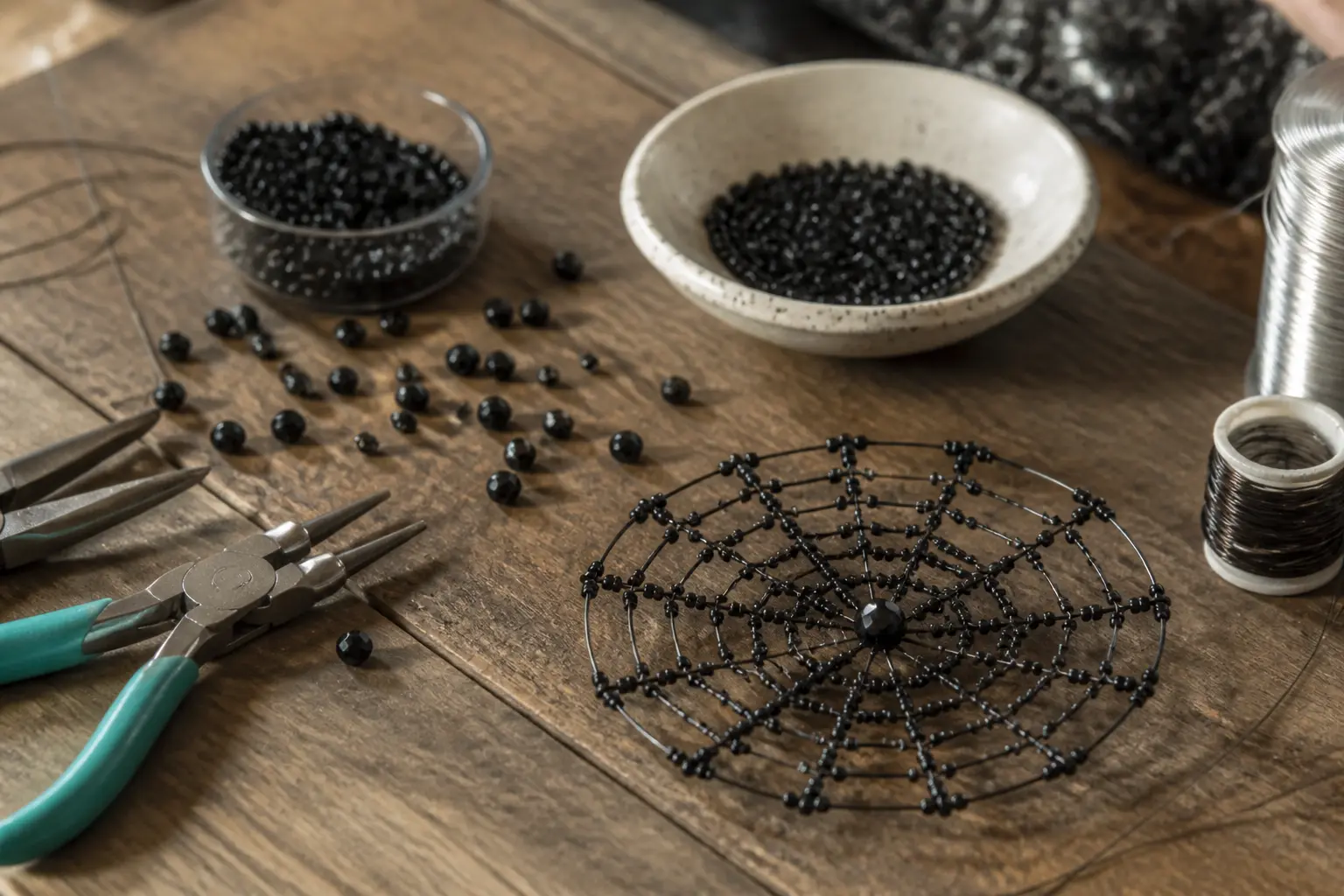
Bead spider web work is one of those crafts that looks technically impossible and is actually just patient. The webs in these ideas are all worked flat on a continuous thread, which means no loom, no specialist frame, and no more equipment than a beading needle, a spool of thread and a bag of seed beads.
The 24 designs below are sorted by where they end up: hanging at a window, sitting on a table, worn on a body, tucked into a gift. Each one suits an adult aesthetic, the kind of thing you would keep long after October ends or display year-round without explanation. For more ideas about dressing a room for a party, the fall room decor guide and the Halloween games roundup work well alongside this one.
Supplies and finished-piece suggestions appear under each design, and the shopping links point to exactly what you need, not a vague category.
This post contains affiliate links. If you buy through them, I may earn a small commission at no extra cost to you.
Window and Wall Hangings
These are the designs that earn a gasp when someone walks into the room. Hung against glass, they catch daylight and throw tiny prisms across the wall. Hung against a painted surface, they read as flat jewellery scaled up to architectural size.
All six designs in this section use a dowel, a tension rod or a curtain ring as the anchor. The web itself is the feature, so the hardware stays minimal.
Clear Crystal Dowel Suncatcher
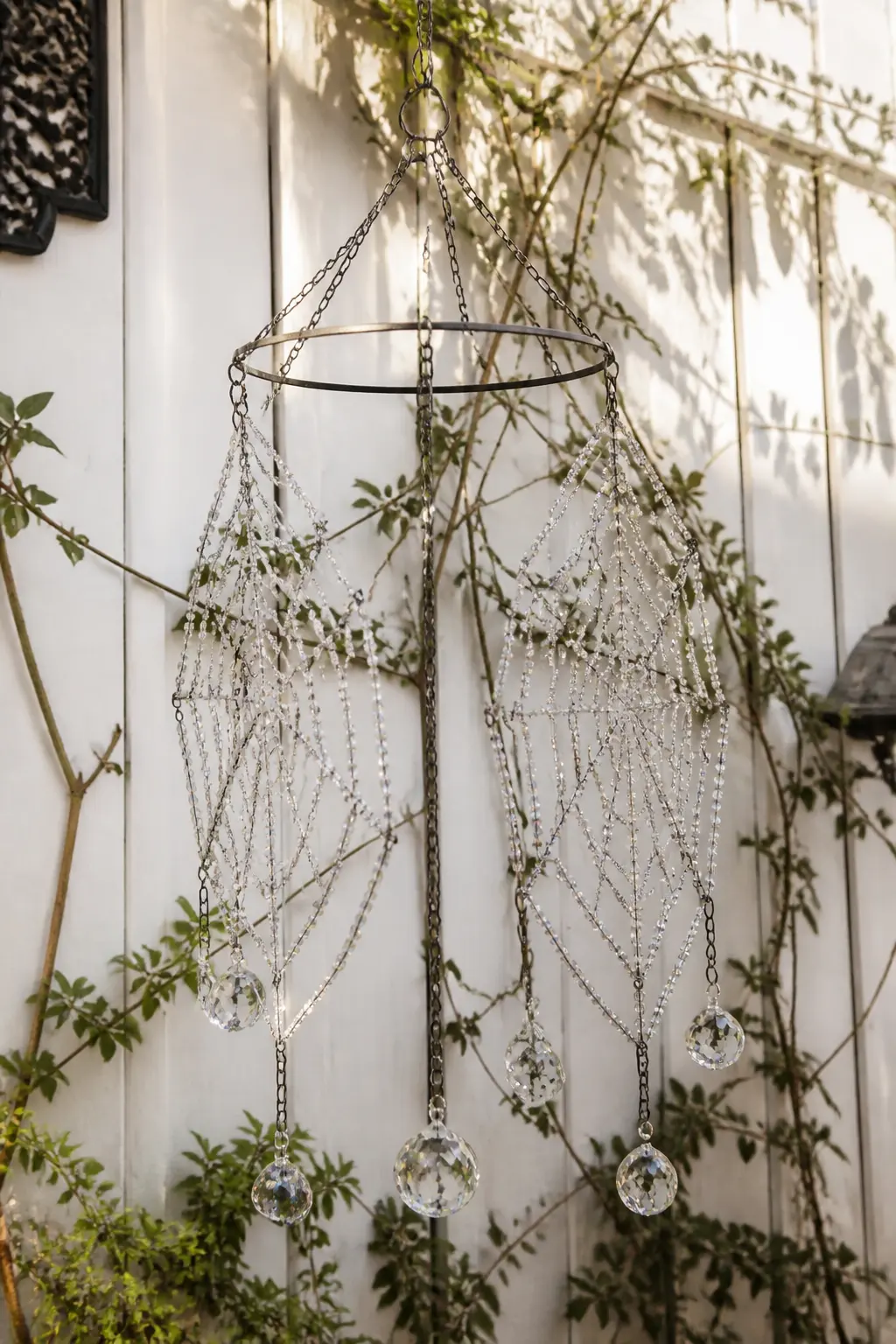
Three webs hang from a single stained walnut dowel on thin silver chain, each worked in size-11 clear AB seed beads on monofilament. The outermost webs are slightly smaller than the centre one, which gives the piece the silhouette of a chandelier without the weight of one.
Crystal ball drops, about 14mm, dangle from the lowest point of each web and from each beaded spider body. In direct sun the whole thing throws rainbows. In ambient indoor light it reads as frosted silver.
Work each web as a five-round flat spiral, then join the dowel connection chains before you attach the drops, or the weight pulls the outer rounds out of shape while you work.
🛍 Shopping guide
Gunmetal and Jet Black Hanging Panel
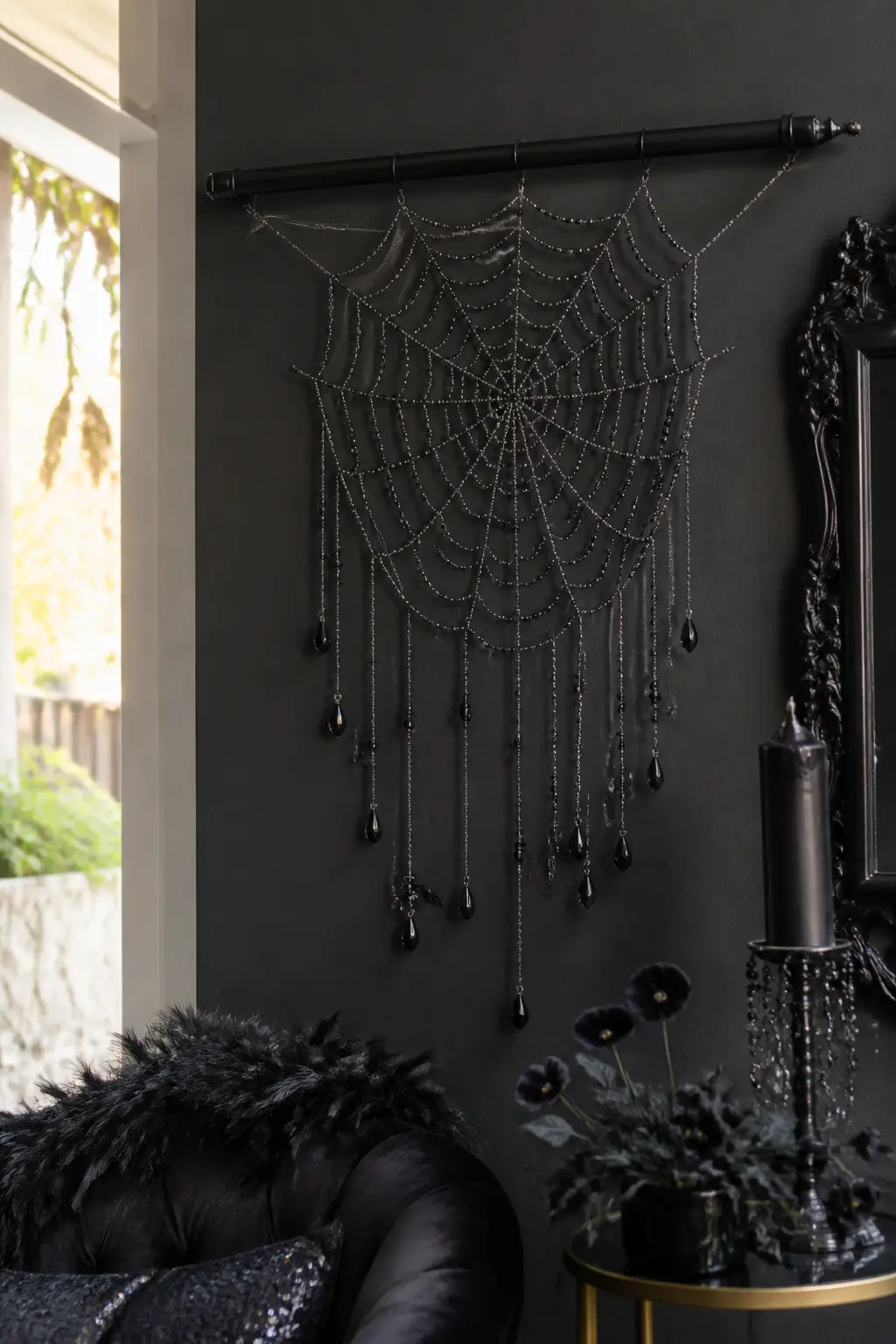
This design uses opaque matte black size-11 beads for the radial spokes and gunmetal metallic beads for the spiral rounds, which creates a two-tone web that reads almost like wrought iron at a distance.
The panel hangs from a black iron tension rod using four evenly spaced loops of heavy beading wire. At the bottom, teardrop-shaped jet black acrylic beads hang at irregular lengths, giving the lower edge a stalactite quality.
This one suits a dark wall far better than a pale one. Against deep navy, forest green or charcoal, the contrast is striking without being costume-like.
🛍 Shopping guide
Champagne Gold and Pearl Window Web
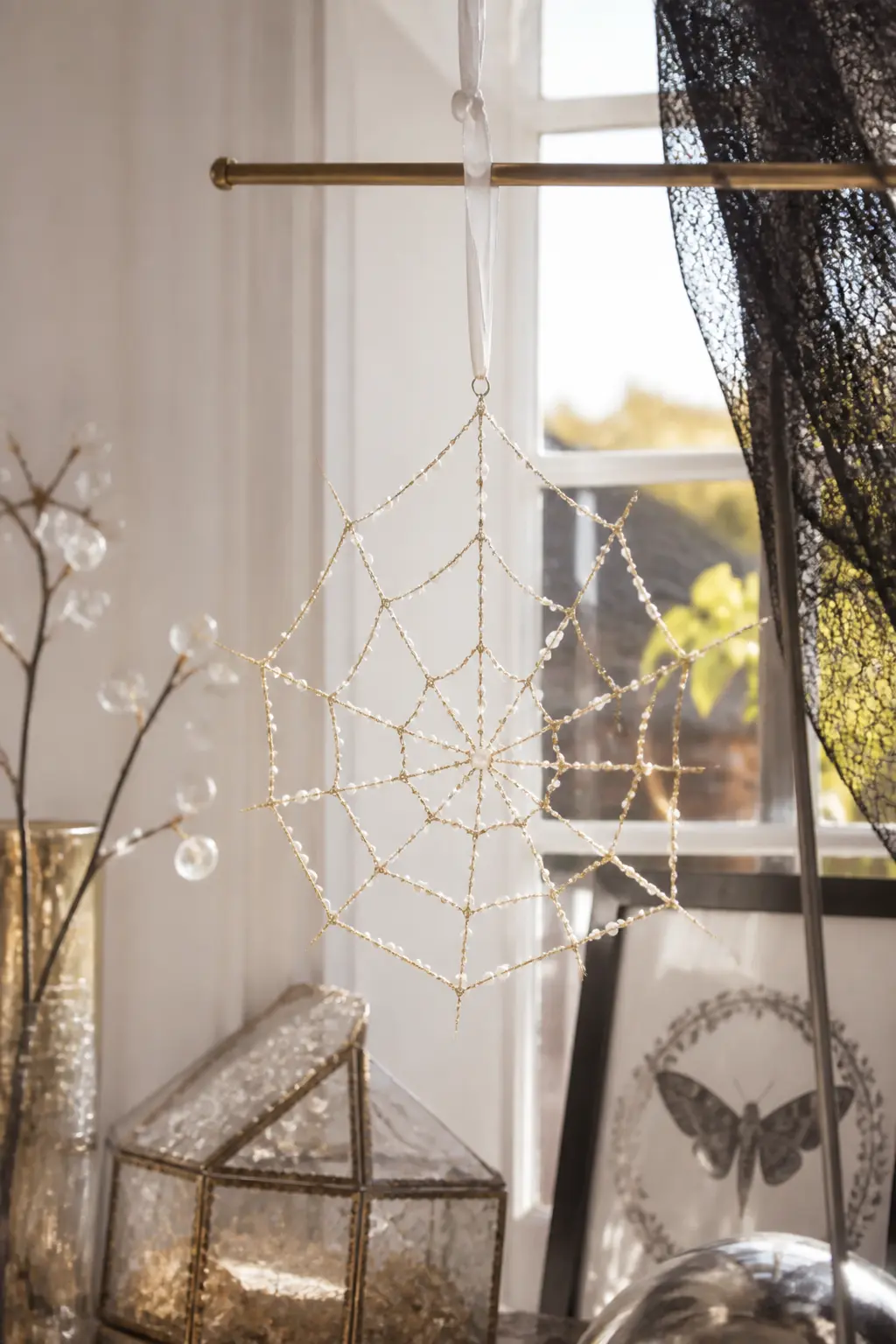
Champagne gold metallic seed beads form the spokes and 3mm ivory glass pearls fill every intersection of the spiral rounds. The result reads warm and almost bridal, the kind of web you could leave at a window all winter without it looking seasonal.
Hang it from a brass cafe rod with two loops of narrow ivory satin ribbon, not chain. The ribbon softens the whole piece and adds about two inches of visual height, which helps in rooms with low ceilings.
The pearls add weight, so use a heavier thread, size-D nylon or FireLine 6lb, and pre-condition it with beeswax before you start.
🛍 Shopping guide
Iridescent Lavender Solstice Web
Size-8 iridescent lavender beads worked on silver-plated wire give this web a slightly chunky, jewelled quality rather than the fine lace look of smaller beads. The gauge of the wire holds the web rigid enough to hang without a frame.
Six wire-formed spider bodies, each about 2cm across, sit at different points on the web. Their abdomens are a single 8mm amethyst-coloured faceted bead, and their legs are eight short lengths of wire twisted outward.
Because the wire holds its own shape, this web can also be bent slightly to fit into a curved niche or the inside of a lantern shade.

🛍 Shopping guide
Copper Chain and Rock Crystal Web
The spokes of this web are lengths of raw copper rolo chain, anchored at the centre with a copper jump ring and spread to the edge of an invisible monofilament outer hoop. The spiral rounds are worked in faceted rock crystal chips threaded on copper wire.
The mix of materials, chain for structure and natural stone chips for fill, gives this piece a mineralogical, almost geological quality. It suits a room with natural textures: linen curtains, plaster walls, unfinished wood.
Raw copper will oxidise over time toward a brown-green patina. If you want to keep the warm copper tone, seal all chain sections lightly with clear nail varnish before assembly.

🛍 Shopping guide
Silver Seed Bead Web with Pressed Glass Drops
This is the most classically elegant design in the section. Silver-lined clear size-15 seed beads, the smallest standard size, make a web so fine it reads almost like silverwork filigree. Six pressed glass teardrop drops in pale aqua hang from the outermost round.
Work six rounds of spiral net stitch, adding a drop bead at every sixth intersection of the final round. The aqua drops are the only colour in the piece, and they land like full stops on an otherwise monochrome composition.
Hang from a single silver chain at the topmost spoke. The asymmetry of a single-point hang makes the web feel organic rather than decorative.

🛍 Shopping guide
Table and Surface Pieces
Flat-worked bead webs do not have to hang. Laid across a dark tablecloth or draped over a candle ring, they function as textile, and that changes everything about how a table reads.
The four designs here sit rather than swing, so the thread tension matters less and even a beginner finishes something genuinely presentable.
Black Velvet Cloth Web Centrepiece
A large flat-worked web in matte black and silver seed beads is laid directly on a piece of black velvet cut to the size of a dinner plate. The velvet stops it sliding, holds it perfectly flat, and makes every bead read as a tiny point of light.
Work the web to about 25cm diameter, seven or eight rounds of spiral net stitch. Place a single tall black taper candle in a simple glass holder at the centre, so the flame sits at the heart of the web.
This reads as a centrepiece, not a craft project. Keep everything else on the table minimal: plain plates, black or white linens, no other patterns.

🛍 Shopping guide
Candle Ring in Smoky Topaz
A small bead web, about 12cm diameter, worked in smoky topaz and dark bronze seed beads, is shaped into a shallow ring rather than a flat circle. The ring sits around the base of a pillar candle, replacing a conventional candle ring entirely.
To form the ring shape, work the web flat and then ease the centre opening over the candle before the thread sets. The bead work will conform to the candle’s circumference and stay there without glue.
Use unscented pillar candles in ivory or smoke grey. Scented candles with essential oils can soften synthetic thread over time, so choose beeswax or paraffin if you want the piece to last multiple uses.

🛍 Shopping guide
Place Setting Web on Slate
A web about 10cm across, worked in silver and white seed beads, is laid on a small square of natural slate and used as a place marker. A tiny wire spider sits at the centre, and a small luggage tag threaded through one of the outer beads carries the guest name in ink.
Work these ahead, tuck them in a box between sheets of tissue, and pull them out on the day. They take about thirty minutes each once you have the pattern memorised, which happens after the second one.
After the event, guests can take the webs home. They are small enough to sit in a shadow box or on a bookshelf and weighty enough that they do not feel like disposable party favours.

🛍 Shopping guide
Dried Botanicals and Bead Web Tray
A wide, shallow wooden tray holds a bed of dried smoke bush, black peppercorns and silver-grey eucalyptus. Over the top of the botanicals, one large flat-worked bead web, about 30cm, in silver and charcoal seed beads is draped so it follows the contour of the dried material beneath.
The web is not glued, just resting, so after the event you can lift it, shake the botanicals out, and store both components separately for next time. Nothing is damaged, nothing is wasted.
Work the web loosely, with two or three extra beads between each intersection, so it has enough give to drape without pulling into a dome shape.

🛍 Shopping guide
Wearable Webs
Bead webs scaled to jewellery size are not a novelty: they sit in a long tradition of tatted and netted ornaments. The ones here are sized for a pendant, an earring drop or a hair comb, all finished to a standard that reads as intentional craft, not fancy dress.
Fine thread and size-15 seed beads keep the scale convincing. If you have not worked at this scale before, start with the comb, which forgives a slightly loose tension far better than an earring does.
Pendant Web on Oxidised Silver Chain
A five-round web worked in size-15 silver-lined grey seed beads becomes a pendant about 3cm across when finished. An oxidised sterling silver cable chain, 45cm, threads through the topmost spoke loop without any clasp needed on the pendant itself.
The finished piece reads as serious jewellery rather than costume. The oxidised chain and grey beads sit in the same tonal family, which is what makes the scale convincing.
Size-15 beads at this scale can feel fiddly on the first attempt. Work with good light and a magnifying visor if needed: the investment in comfort pays back in tension consistency across the web.

🛍 Shopping guide
Earring Drops in Midnight Blue
Two matched webs, each three rounds and about 1.5cm across, worked in midnight blue and silver size-15 seed beads, hang from gold-filled lever-back ear wires. A single 4mm sapphire-blue crystal drop hangs from the centre of each web.
Matching the two webs in tension and size is the real skill here. Work them side by side on the same thread, alternating one bead on the left web and one on the right, so the thread tension stays consistent across both.
At this scale, the webs weigh almost nothing, which makes them comfortable for long evenings and convincing as actual fine jewellery rather than craft earrings.

🛍 Shopping guide
Hair Comb Web in Bronze
A flat web about 5cm across in bronze and dark amber seed beads is stitched directly to the top bar of an antique brass hair comb using the same thread used to work the web. No glue, no findings, just thread passing through the comb teeth and back into the bead work.
Work the web first as a free piece, then, before cutting the thread, use the tail to lash the lower edge of the web to the comb bar. Work through every other tooth for security, then weave the tail back in.
This scales beautifully for an autumn wedding, a birthday dinner or any evening where the goal is to look as if you made no effort at all.

🛍 Shopping guide
Lapel Pin Web on Black Felt
A three-round web in silver and crystal clear beads, about 2.5cm across, is stitched to a small circle of black wool felt. A bar pin finding glued and stitched to the back of the felt makes it wearable as a lapel pin or a collar accent.
The felt backing stabilises the bead work completely, so even a very loose tension produces a flat, wearable result. This makes it the ideal starting project for anyone who has not worked bead webs before.
Cut the felt circle with a punch rather than scissors to get a clean edge. An 18mm punch from a leather-working set is the right size for a three-round web.

🛍 Shopping guide
Gift Toppers and Wrapping Accents
A bead web stitched onto a gift tag or wired around a bottle neck takes about twenty minutes and makes the packaging the thing people talk about. These four designs are deliberately small, so a single evening produces several at once.
Wine Bottle Neck Web in Garnet
A small flat web in garnet red and black seed beads, about 8cm across, is wired at the centre to a coil of black millinery wire that grips the neck of a wine bottle. The web fans out from the bottle neck like a flat collar, face-forward.
Work the web first, then thread a 30cm length of soft black millinery wire through the centre round and twist it into a collar loop sized to the bottle neck. No glue, no tape, entirely reusable.
Garnet and black on a dark glass bottle is one of those combinations that looks expensive in a way that takes no explaining.

🛍 Shopping guide
Gift Tag Web on Vellum
A tiny two-round web, about 3cm across, in silver metallic seed beads is stitched directly onto a square of translucent vellum card. The vellum is punched at one corner and threaded onto the gift ribbon, so the web floats on the surface of the package like a wax seal made of light.
The stitching on the back of the vellum is visible, and that is fine. Use a contrasting thread colour on the back, a deep indigo or forest green, so the reverse has its own graphic quality when the tag is handled.
Print the recipient name on the vellum before you stitch, not after. Ink on vellum smears once the card has been handled, and needle holes make the surface fragile at the edges.

🛍 Shopping guide
Bead Web on Kraft Box Lid
A four-round web in cream and pale gold seed beads is stitched around a 2mm jute cord circle the same diameter as the top of a small round kraft box. The cord circle is glued flat to the box lid, and the web is then stitched to the cord as its outer anchor point.
The result is a box lid that functions as its own decoration. No ribbon, no tissue, no topper needed. The box itself is the gift wrapping.
Round kraft gift boxes come in standard sizes. An 8cm diameter box lid suits a four-round web at standard size-11 bead scale almost exactly, which removes all the guesswork from sizing.

🛍 Shopping guide
Ribbon-Tied Sachet with Bead Web Label
A small muslin sachet filled with dried lavender is gathered at the neck with a double loop of dark green velvet ribbon. A tiny two-round bead web in forest green and black seed beads is threaded onto the ribbon loop at the front before the bow is tied.
The web slides onto the ribbon and is held by the bow knot. When the recipient unties the bow, the web comes free as a separate keepsake, and the sachet still functions perfectly as a sachet.
Make these in batches of twelve or twenty. They are genuinely useful, they smell wonderful, and the bead web component takes about fifteen minutes each once you have the two-round pattern by heart.

🛍 Shopping guide
Dream Catcher Frames
The dream-catcher format, a metal ring with the web worked inside it, suits bead spider web technique perfectly. The ring holds the outer thread taut while you work inward, which is actually easier than building a free web from a dowel.
All five designs here use a brass or silver macrame ring as the frame, available at any craft supplier. The ribbon, chain and charm details at the bottom are what separate them from each other.
Brass Ring Web with Rust Linen Ribbon
A 20cm brass macrame ring anchors a web worked in warm cream and rust orange seed beads, referencing the autumnal palette of the ring’s linen ribbon tail. Three lengths of rust linen ribbon hang from the bottom of the ring, each about 25cm, with a small amber teardrop bead knotted at the tip.
The warm palette removes any spookiness from the spider web format and replaces it with something closer to a textile wall piece. It reads as folk art or artisan decor rather than holiday decoration.
Hang from a single nail on a plaster wall. The brass ring needs nothing more elaborate than a picture hook to look intentional.

🛍 Shopping guide
Silver Ring Web with Chain Fringe
A 25cm silver macrame ring holds a web in silver-lined crystal and pale grey size-11 seed beads. Instead of ribbon tails at the bottom, seven lengths of fine silver cable chain hang at slightly different lengths, each tipped with a small clear faceted crystal ball.
The chain fringe moves in air currents and catches light in a way ribbon cannot, making this design particularly good near a door or an open window where it will shift slightly.
Attach each chain tail through the lowest point of the outer web round with a jump ring. This distributes the weight cleanly and makes the tails replaceable if you want to change the finish later.

🛍 Shopping guide
Black Ring Web with Velvet and Bone Charms
A 20cm ring spray-painted matte black holds a web in matte black and white seed beads, making the beads almost disappear into the ring and creating an optical illusion where the web reads as negative space rather than solid structure.
Three black velvet ribbon tails anchor at the bottom. To each ribbon, a small bone or resin skull bead is knotted at intervals along the length, giving the tails a vertical rhythm that continues the web’s geometric pattern downward.
This is the most overtly Gothic design in the section and the one most likely to read as intentional art direction. Keep the wall behind it plain and pale.

🛍 Shopping guide
Rose Gold Ring Web with Crystal and Leather
A 20cm rose gold macrame ring holds a web in dusty rose and crystal clear seed beads. A 40cm length of tan suede lacing is folded in half and knotted at the top of the ring to make a hanging loop, with the two tails hanging down the sides of the ring and being trimmed on the diagonal.
A single large rose quartz point bead, about 4cm, hangs at the centre bottom on a short length of rose gold chain. No other tails, no additional charms.
The restraint is the design. One beautiful stone, one material, one frame. Nothing competes with the web.

🛍 Shopping guide
Window Corner Installations
Corner-anchored webs, fixed to the wall at two or three points and left to span the angle of a room, are the most dramatic format and the most forgiving structurally. Because the wall holds the tension, slight irregularities in the beading read as texture rather than error.
These last five designs all anchor in the upper corner of a window or doorway and cascade down and outward. Chain sections alternate with beaded thread sections, which is what gives them their metallic, jewellery-like quality.
Copper Corner Web Across a Doorway
Five copper chain spokes radiate from a copper jump ring anchored in the upper corner of a doorway with a small cup hook. The spiral rounds between the spokes are worked in faceted clear crystal beads threaded on copper wire, exactly as the window hanging design uses, but at three times the scale.
The finished web spans about 50cm along each wall from the corner, and the lowest point drops about 60cm. Three wire-formed spiders, each with an 8mm copper-coloured glass bead abdomen, sit at different points on the web.
Cup hooks make installation genuinely reversible. When the party ends or the season changes, unscrew the hooks and roll the web loosely for storage.

🛍 Shopping guide
Silver and Crystal Corner Web for a Window Angle
This web fills the angle where a window meets the adjacent wall, anchored at three points: the top of the window frame, the adjacent wall, and a ceiling hook at the inner corner. Fine silver cable chain forms the spokes and size-11 silver-lined crystal seed beads are threaded onto silver wire for the connecting rounds.
Chandelier-style crystal AB drops are clipped to the lowest spoke of each round, so the bottom edge of the web drips with prisms. In a sunny room, this generates light effects across the floor and the opposite wall from mid-morning onward.
Install the ceiling hook before you measure the spoke lengths. The angle of the corner determines the geometry of the web, and there is no useful template that fits every room.

🛍 Shopping guide
Frequently Asked Questions
What thread should a beginner use for a bead spider web?
FireLine or S-Lon size D are both forgiving choices for a first project. FireLine is more resistant to abrasion from glass beads and easier to tension consistently. Use a single thread rather than doubled thread for flat web work, and wax it with beeswax before you start to reduce tangling.
How long does a flat bead spider web take to make?
A five-round web in size-11 seed beads takes most people between forty minutes and two hours, depending on experience and bead size. Size-15 beads at pendant scale take longer because the needle passes are smaller and more numerous. The second web you make takes about half as long as the first.
Can bead spider webs be left outdoors?
Briefly, yes. Crystal and glass beads tolerate outdoor conditions well, but synthetic beading thread weakens in prolonged UV exposure and nylon tangles in wind. For a patio party lasting a few hours, a bead web hung under cover is perfectly fine. For a permanent outdoor installation, use Fireline and UV-resistant monofilament and bring the piece inside at the end of the season.
What is the easiest bead spider web design for a complete beginner?
The lapel pin web on black felt, listed in the wearable section, is the most forgiving starting point. The felt backing absorbs uneven tension, the three-round scale is fast to complete, and the result looks finished even if the rounds are not perfectly even. Work this one first before attempting any of the hanging formats.
How do you store a finished bead spider web without it tangling?
Lay it flat between two sheets of acid-free tissue in a shallow box, never fold or roll it. For smaller pieces like pendants or earrings, a small zip-lock bag works well. Keep stored pieces away from humidity, which can soften thread and tarnish metallic beads over time.
Can you use regular sewing thread for bead spider web work?
Technically yes, but it is not recommended for any piece that will be worn or handled regularly. Standard sewing thread has too much stretch and frays against glass bead edges. Use a purpose-made beading thread such as FireLine, Nymo or S-Lon for any project you want to last beyond a single use.
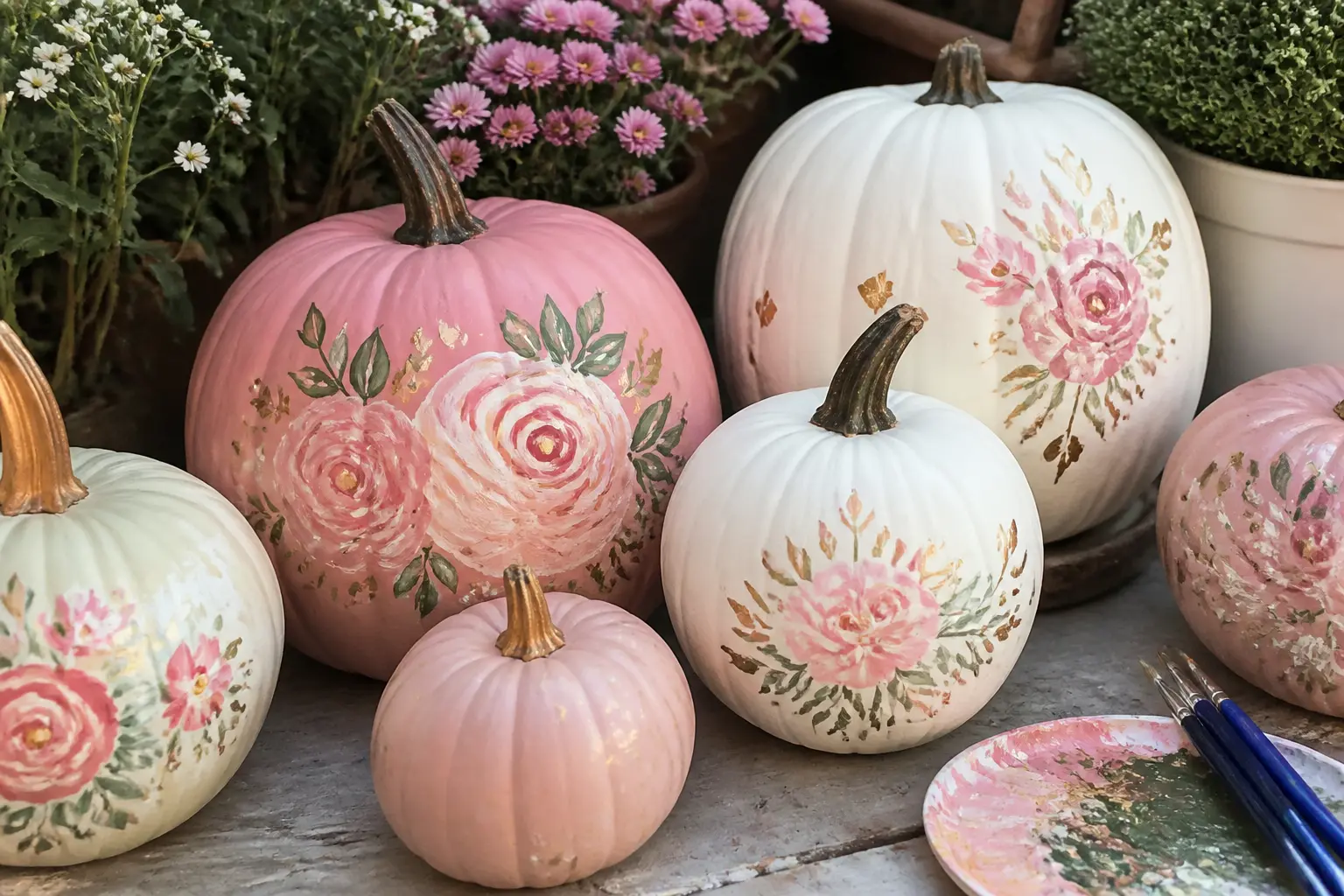
31 girly painted pumpkin ideas finished with bows, pearls, ribbon, lace and lettering. Every pumpkin

Boo basket ideas for boyfriends that feel personal and intentional: gourmet snacks, grooming picks,

Halloween activities for kids classroom that print on plain paper, run at desks, and wrap up in thir
Leave a Reply