

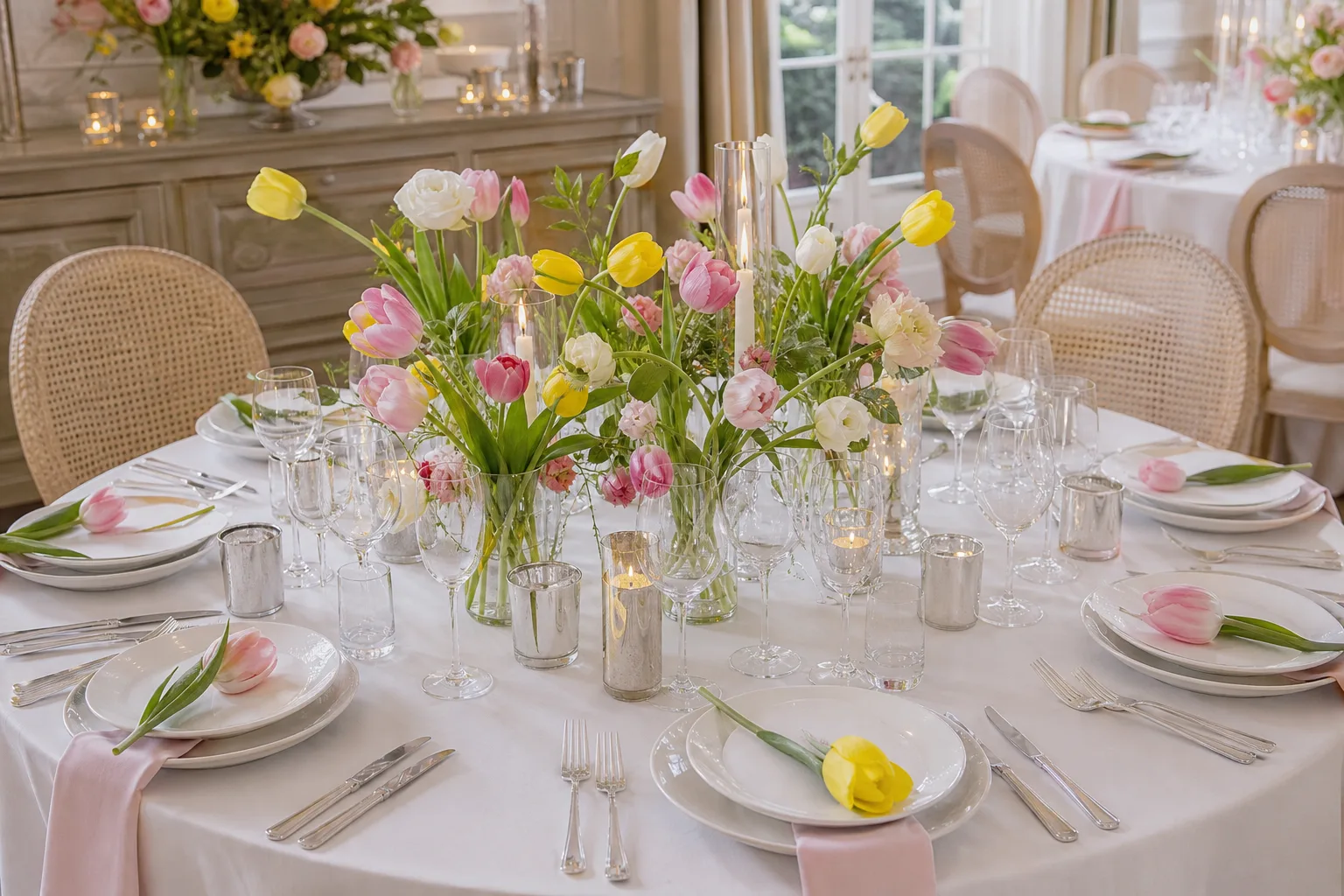
Picture a wedding that reads as fresh rather than themed: tulips in soft pink, butter yellow and white, loose in the hand rather than wired into submission, with just enough silver (a cup, a cart’s trim, the cutlery) to keep the pastel from turning sugary.
The flower does the talking everywhere it shows up, and it never repeats the same shape twice.
This one suits a spring or early summer wedding best, since that is when tulips are cheapest and at their peak, though a good florist can source them further into the year if the date will not move.
It reads just as well in a glasshouse, a barn with good light, or a garden terrace with trees behind it, and it scales down happily for a bridal shower or an engagement lunch too.
If your own taste runs more rose than tulip, the same blush and cream bones carry an English garden wedding theme just as easily, so keep that in your back pocket.
This post contains affiliate links. If you buy through them, I may earn a small commission at no extra cost to you.
Table of Contents
The Ceremony Setting
This is the first thing every guest sees, so it carries the heaviest bloom count of the day. Everything here stands at full height: an arch, a pair of tall urns, an aisle underfoot, and the bouquet that walks through the middle of it.
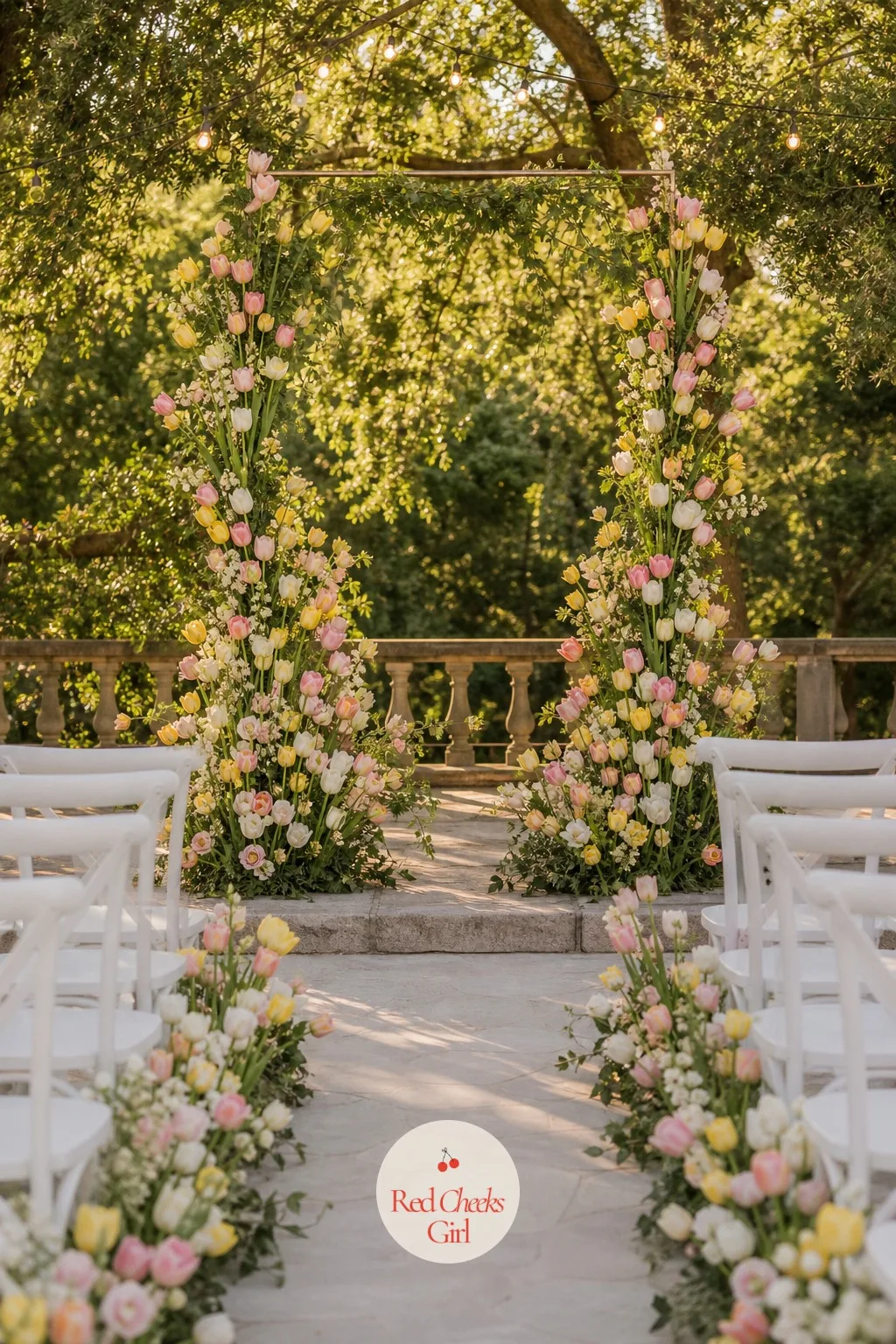
Tulip Arch That Looks Like It’s Growing There
A floral arch can look like a florist’s invoice standing upright. This one is built to look like it simply happened: tulips packed thick at the base in soft pink, butter yellow and white, thinning out as the eye travels up so the top rail shows a little wood or iron through the last few stems.
Start with a plain rectangular or arched frame in wood or black iron. Wire floral foam cages onto the base and the lower third, then work tulips straight into the foam in small bunches of three or four so no stems show, tucking in a little trailing ivy where the blooms thin out higher up.
Tell the florist you want a rectangular arch, base heavy in soft pink, butter yellow and white tulips with trailing ivy, left sparser toward the top rail.
Tulips start wilting after just 2-3 hours without water, so this one gets built on site the morning of, never the night before: order it rather than attempt it yourself unless someone in the bridal party has done florals before.
If the full arch is not in the budget, dress only the lower third of a borrowed frame, or look at wedding arch flowers that frame the ceremony for a lighter version of the same move.
🛍 Shop this look
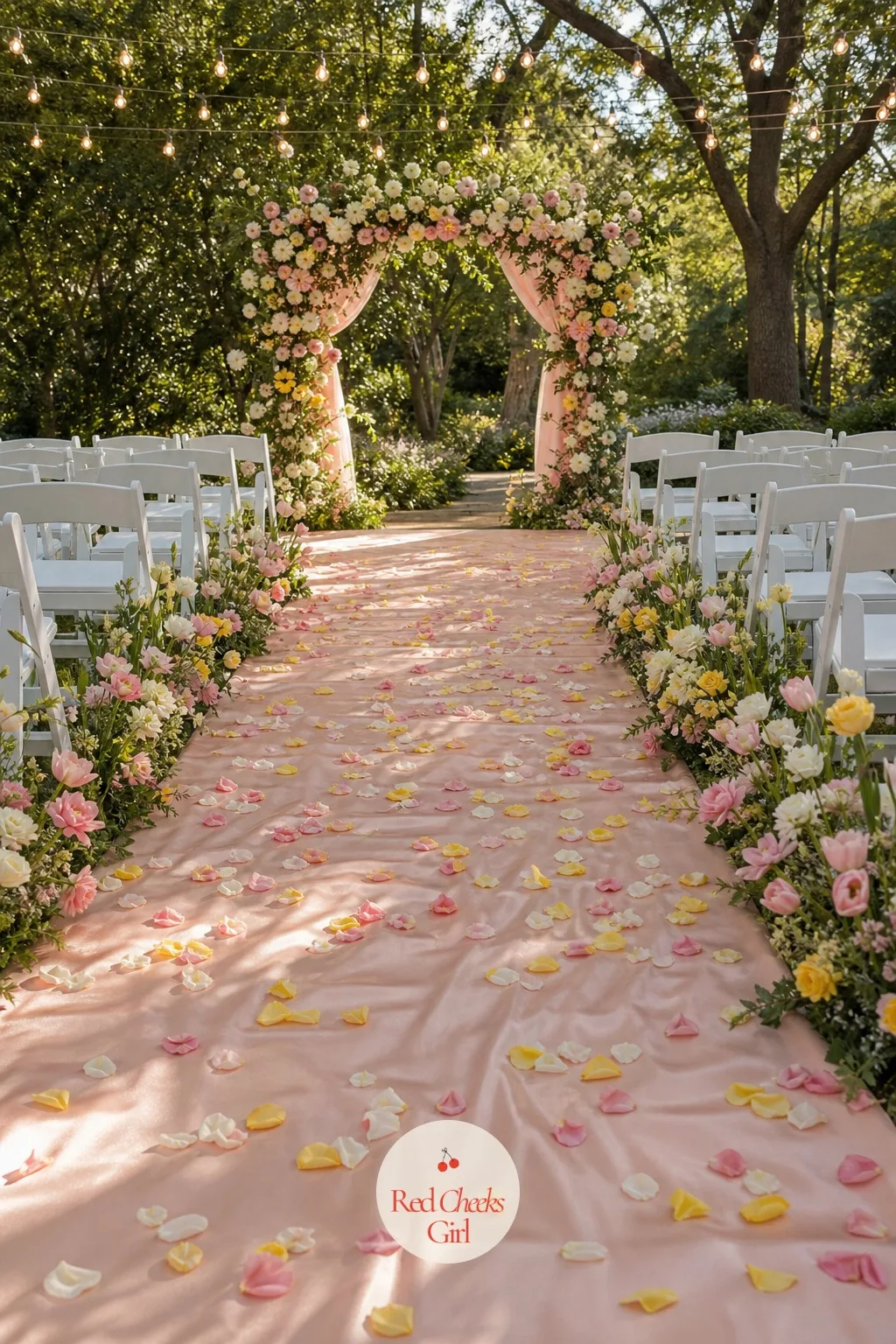
Petal Strewn Aisle in Pink, Butter Yellow and White
A bare aisle runner always looks like it is waiting for something. This one has already arrived: a smooth satin runner underfoot, scattered the length of it with loose tulip petals in the three tones, never piled in one spot, never left in a straight line.
Lay a pressed satin or cotton runner first, blush or ivory works best as the base colour. Scatter the petals by hand in small irregular clusters as you walk backward down the aisle, mixing all three colours in every handful rather than taking it in colour blocks.
Ask whoever is setting up to scatter, not pour, the petals, since a dumped bag reads as careless rather than easy. This part is genuinely a ten minute job for a bridesmaid: buy the runner, buy the petals, do it yourself.
If petals feel like too much mess on a windy day, line the aisle edge instead with a few low urns of white tulips and skip the scatter entirely.
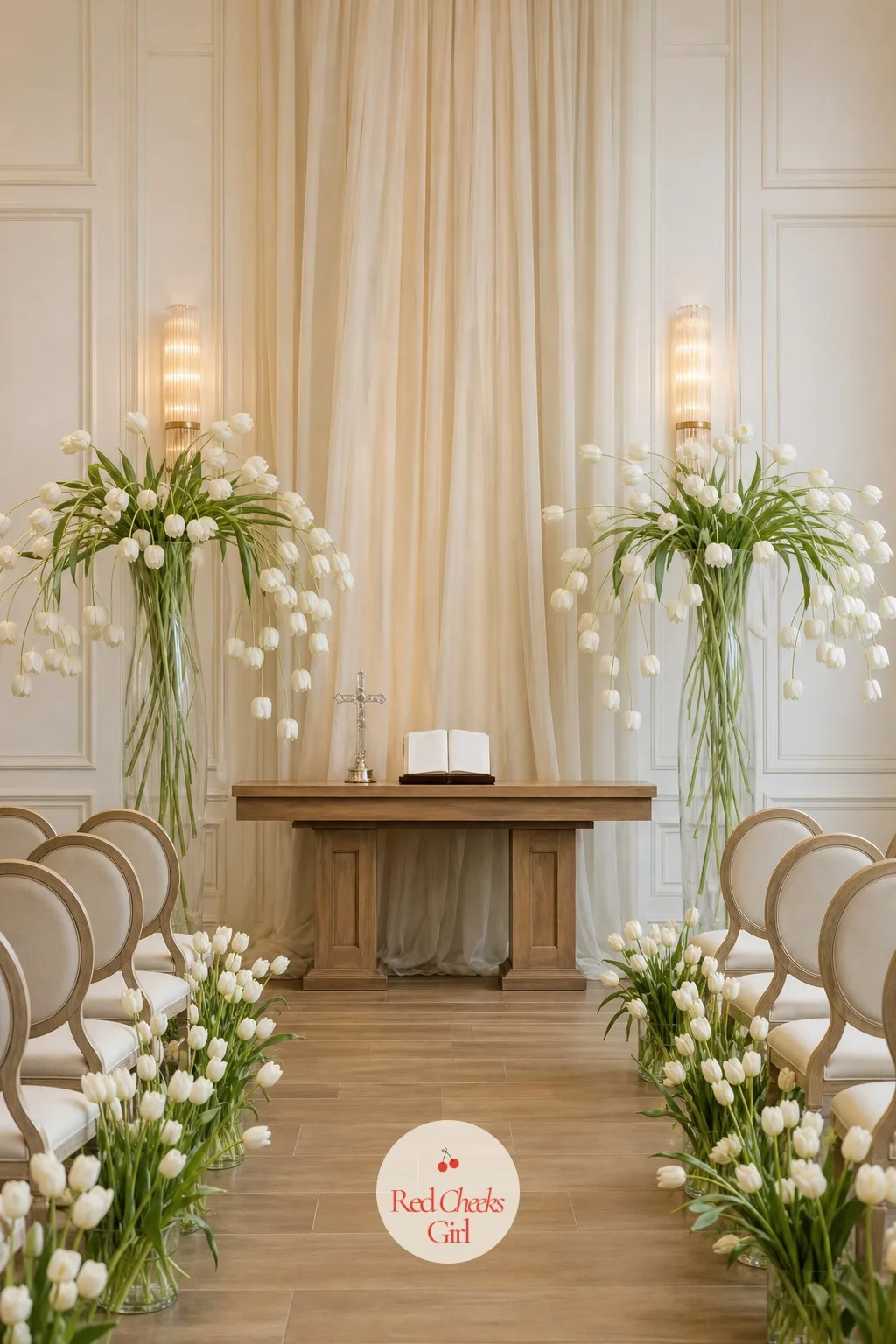
Cascade of White Tulips Flanking the Altar
A ceremony backdrop can feel flat if it is only the arch. A pair of tall arrangements either side of the altar table fixes that: white tulips with long curved stems left uncut, spilling over the rim of the vase rather than standing stiffly inside it.
Each arrangement starts with a tall glass or ceramic floor vase, weighted at the base so it will not tip near a crowd. White tulips go in at varying stem lengths, some left at their full curving length so they trail over the lip and down the side of the vase, with no filler flower competing for attention.
Ask the florist for a pair of floor standing arrangements, white tulips only, long curved stems left trailing over the vase edge rather than trimmed straight.
Real stems need water changed the morning of, so this one is built last and delivered close to start time. Faux long stem tulips in the same vases hold up just as well for an outdoor ceremony in heat and can go up a day early.
🛍 Shop this look
The Bouquet: Tulips Only, Stems Left Long
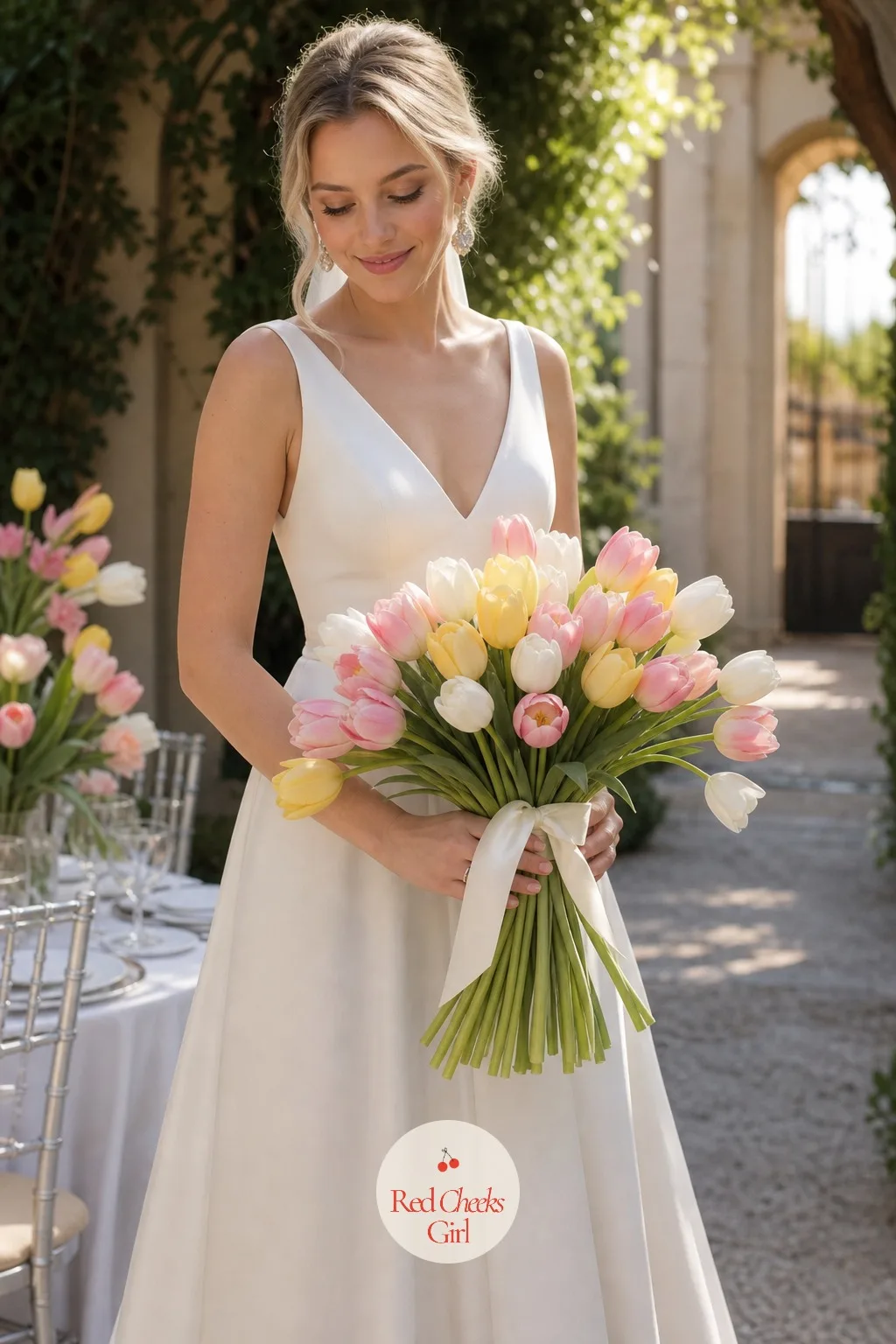
A bouquet crammed into a tight round ball can swallow a simple dress. This one stays loose: tulips only, in soft pink, butter yellow and white, hand tied so the stems show below the ribbon rather than being clipped flush.
Thirty to forty stems is enough for a full handheld bouquet. Gather them loosely by hand rather than in a formal spiral, let a few stems sit slightly longer than the rest so the bottom edge looks a little uneven, then wrap the stems in a wide satin ribbon in butter yellow, leaving two long tails.
Give the florist this line: a hand tied, all tulip bouquet in soft pink, butter yellow and white, stems left visible under a wide satin ribbon.
Trim stems on the diagonal just before arranging and use cool rather than warm water, since warm water speeds up unwanted stretching in tulip stems. This one is worth ordering fresh for the day itself; a faux version in the same mix makes a good stand in for the rehearsal photos.
The Reception Room
Once the vows are done, the room itself has to do some work before anyone sits down. A cart, a canopy and a sign at the door tell guests they have walked into the same wedding, just a different chapter of it.
Dutch Style Flower Cart as the Welcome Moment
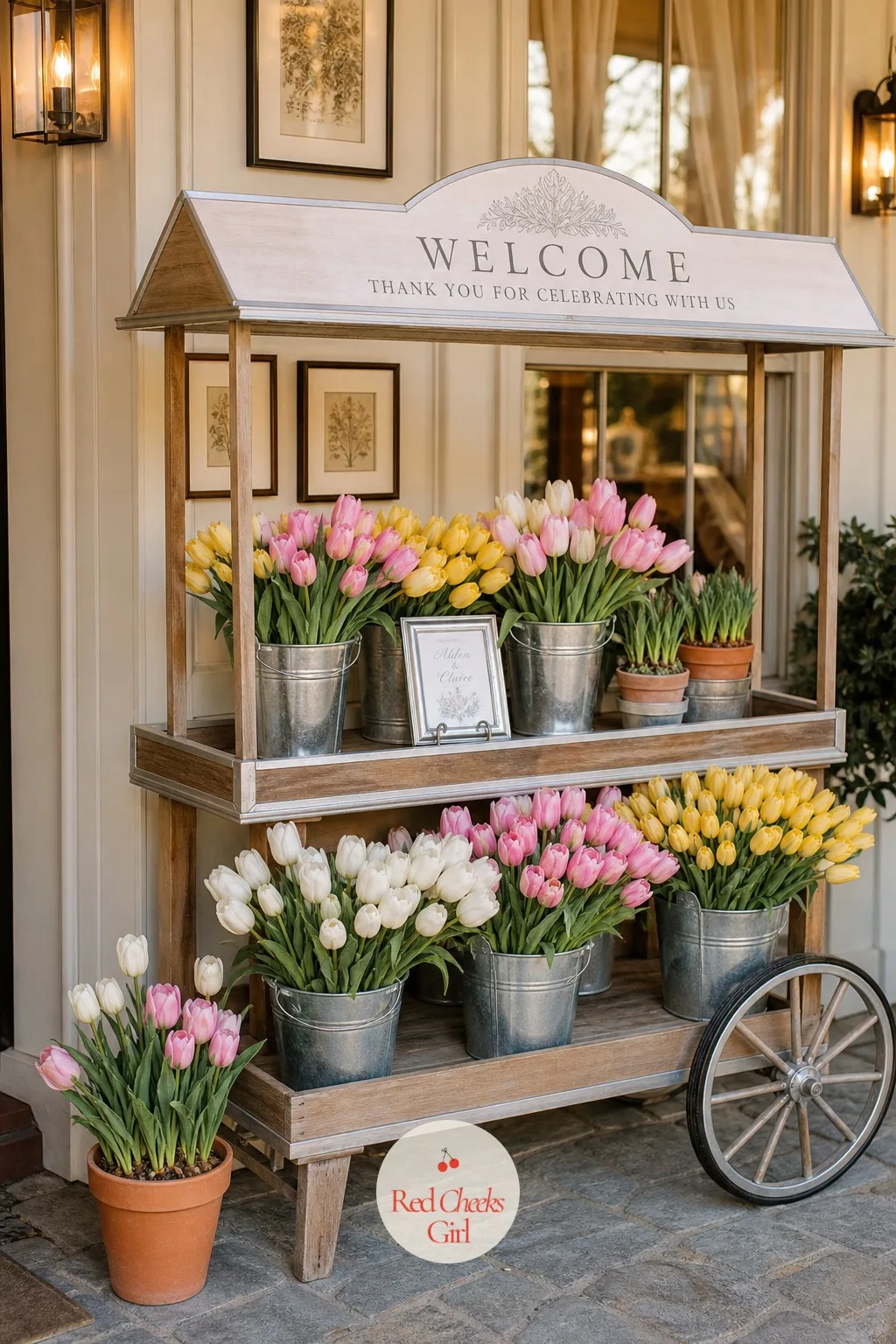
A folding table at the entrance says nothing. A proper flower cart says everything in one glance: a small wooden cart, painted or left natural wood, stacked with buckets and pots of tulips, parked wherever guests first arrive.
The cart itself is the whole structure, nothing hangs off it. Fill its shelves and the ground around its wheels with galvanized buckets of loose cut tulips and a few small potted tulips still in bloom, mixing the three colours across the buckets rather than sorting them by shade.
Rent a wooden flower cart if the venue does not already have one, and ask whoever styles it for a mixed display of cut and potted tulips in soft pink, butter yellow and white across the shelves.
This is easy to build yourself the morning of with buckets from a hardware store; the only thing worth paying a florist for is keeping the cart stocked through a long reception, since cut stems droop by evening.
Hanging Tulip Canopy Over the Dance Floor
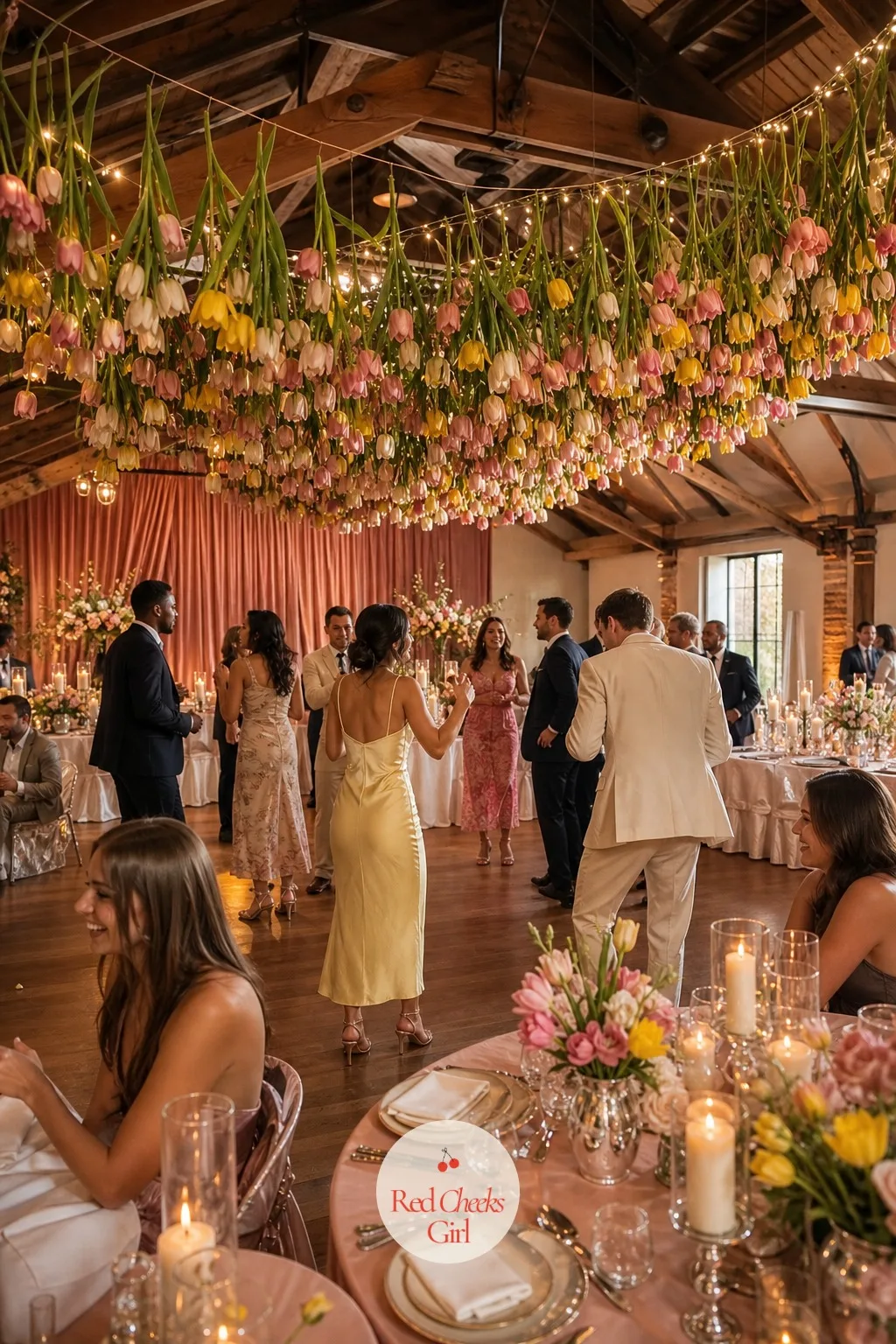
A dance floor under a bare ceiling feels unfinished the moment the lights go low. A loose canopy fixes it: clusters of tulips wired along a wire or ribbon garland, strung between beams or a simple frame directly above the floor.
Run a thin wire or chain the length of the ceiling first, anchored at each end. Wire small bunches of tulips (fresh or good faux, since fresh will not survive a full reception overhead) directly onto the wire at intervals, leaving gaps of bare wire between clusters rather than a solid wall of flower.
Tell the stylist you want a loose garland canopy, clustered rather than continuous, in soft pink, butter yellow and white tulips with a few trailing ribbon tails. Faux stems are the sensible choice here since the display has to hold through hours of dancing underneath it; save the real flowers for anything a guest will stand close to.
🛍 Shop this look
A Tulip Painted Welcome Sign at the Door
Guests need to know within three seconds that they are in the right place. A sign on an easel does that, and a painted one does it with more warmth than a printed one ever manages.
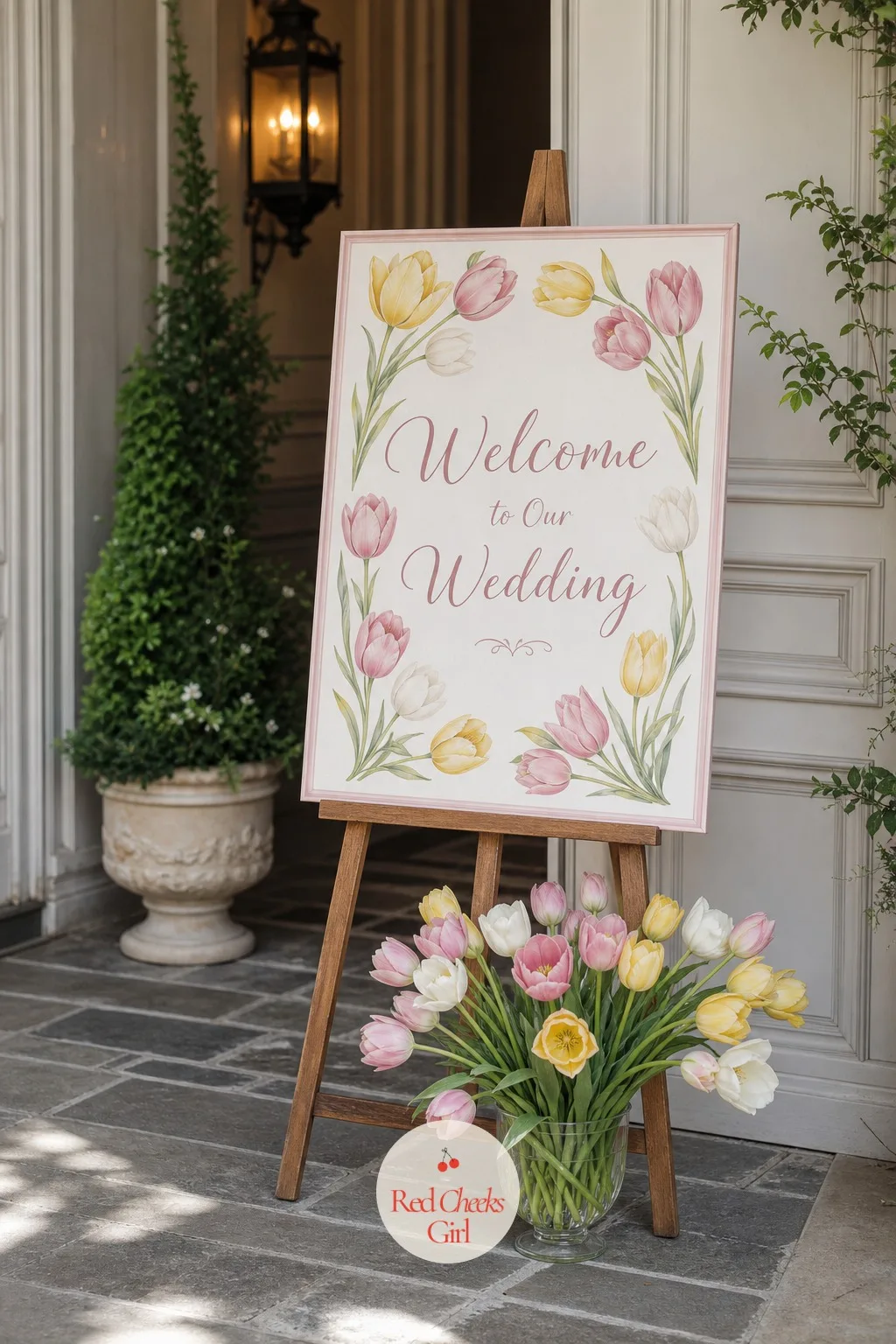
Start with a wood or acrylic board on a simple easel. Paint or have printed a loose watercolour tulip border in the three tones around the edge, with the welcome line lettered by hand or in a soft script font in the middle, and set a small vase of tulips at the foot of the easel.
Give the sign maker this wording exactly: ‘Welcome to Our Wedding’, set inside a loose watercolour border of pink, butter yellow and white tulips. A local calligrapher can hand letter this in an afternoon for not much more than a printed version, and either one gets propped on the same easel with the same little vase at its base.
The Tables
Here the scale drops right down to what a guest can touch: the cup in front of her, the napkin under her fork, the card with her name on it. Small and repeated is the whole point.
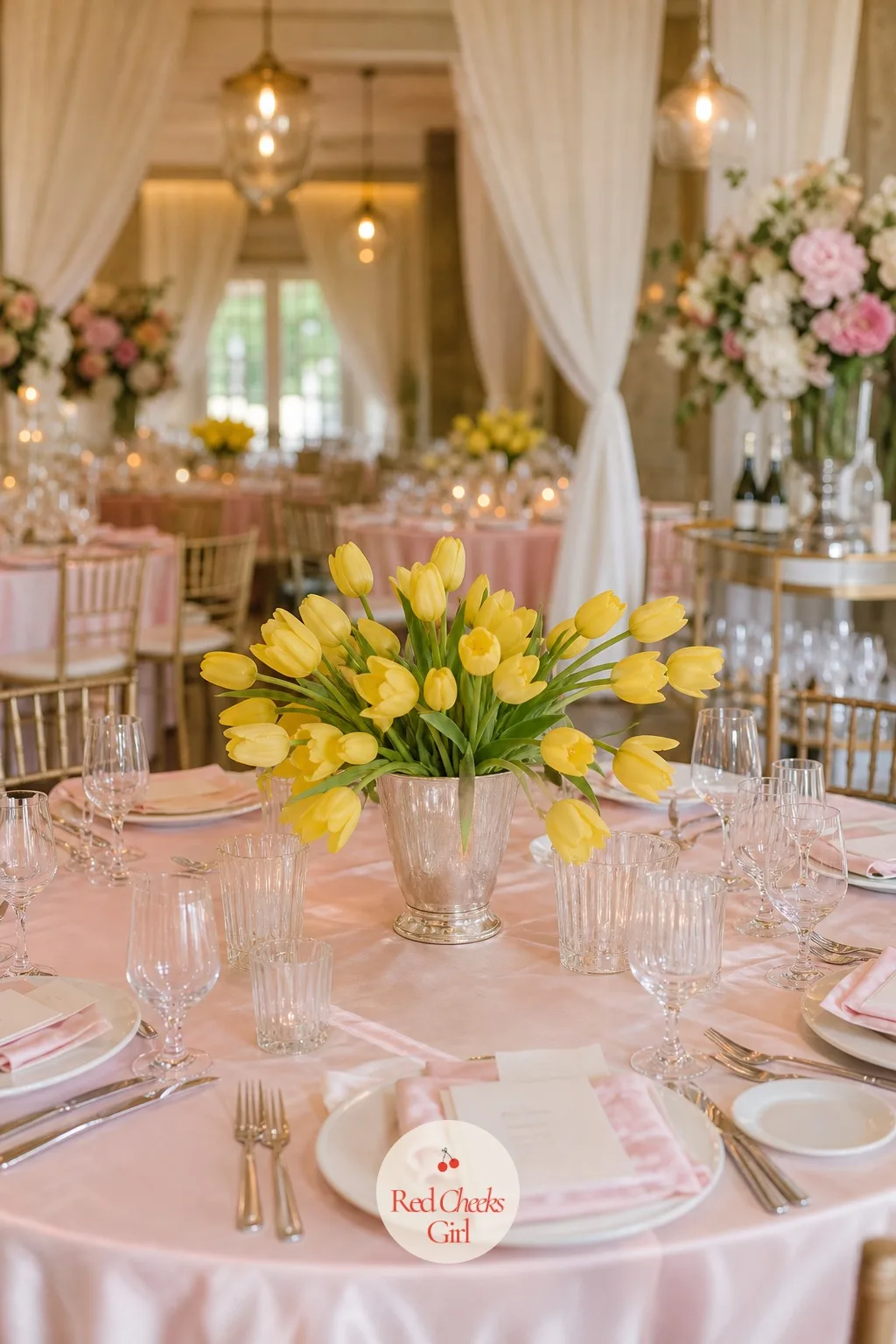
Single Variety Tulip Bunches in Silver Julep Cups
A centerpiece that towers over the table stops two people from talking across it. This one does not: a single silver julep cup per table, holding one colour of tulip only, so each table reads as its own small note in the same chord.
Set one polished silver julep cup at the centre of each table, filled with ten to twelve stems of a single tulip colour, either all pink, all butter yellow or all white depending on the table. Leave the stems a little uneven in height rather than trimmed flush, so the cup looks gathered rather than arranged.
Tell the florist you want single colour tulip bunches, one shade per table, loose in silver julep cups rather than foam mounted.
These are genuinely easy to do yourself the morning of, since a julep cup needs no mechanics beyond water and stems. For a fuller table, pair this idea against the layered options in wedding centerpieces with fresh flowers, candles and fruit.
🛍 Shop this look
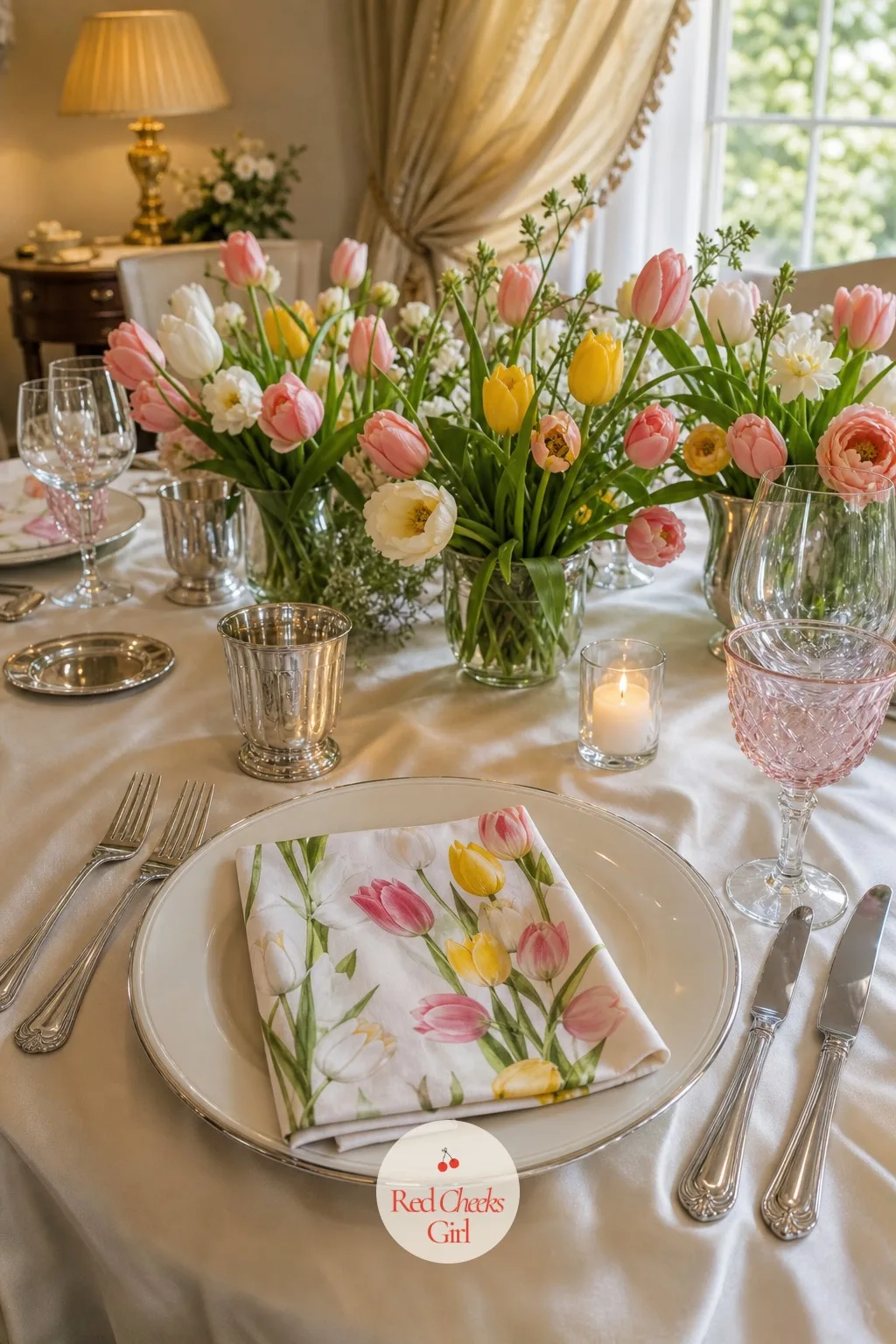
Tulip Print Napkins at Every Place
A plain napkin disappears the moment it is set down. A printed one keeps working even after the flowers on the table have been photographed and forgotten: a loose tulip print across smooth cotton, folded simply at each place.
Order napkins in a pressed cotton or cotton sateen, printed with a scattered tulip motif in the same pink, butter yellow and white, or in a single tone if the budget prefers simpler printing. Fold them in a plain rectangle rather than anything fussy, so the print stays visible rather than hidden in folds.
Ask the linen company for cotton sateen napkins, a scattered tulip print in soft pink, butter yellow and white, twenty inch square. If a full custom print is too much, plain butter yellow cotton napkins tied with a single real tulip stem under the knot does the same job for less.
🛍 Shop this look
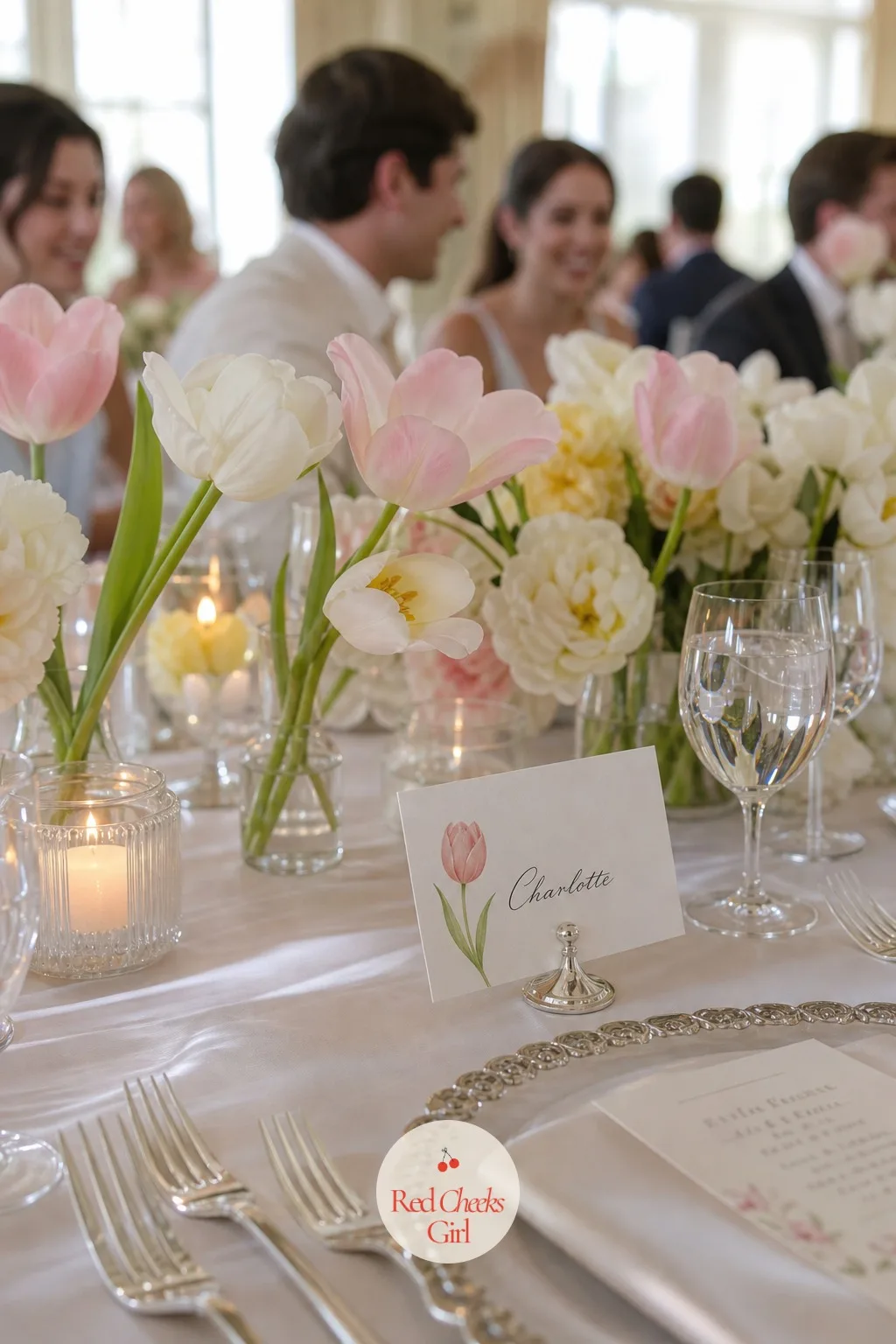
Place Cards with One Painted Tulip Each
A typed name card gets glanced at once. A hand painted one gets picked up and kept, which is exactly what you want from something sitting that close to a plate.
Each card is a simple folded or flat cardstock rectangle, ivory or soft white, with one small watercolour tulip painted in the corner, either pink, yellow or white depending on which table it belongs to, and the guest’s name lettered below in plain script.
Give the calligrapher this brief: blank ivory place cards, one small single colour tulip painted in the top corner, name lettered beneath in a simple script.
These are a genuinely good project for the bride or a crafty bridesmaid to paint over a few evenings; a printed version with the same watercolour tulip works just as well if time is the problem rather than money.
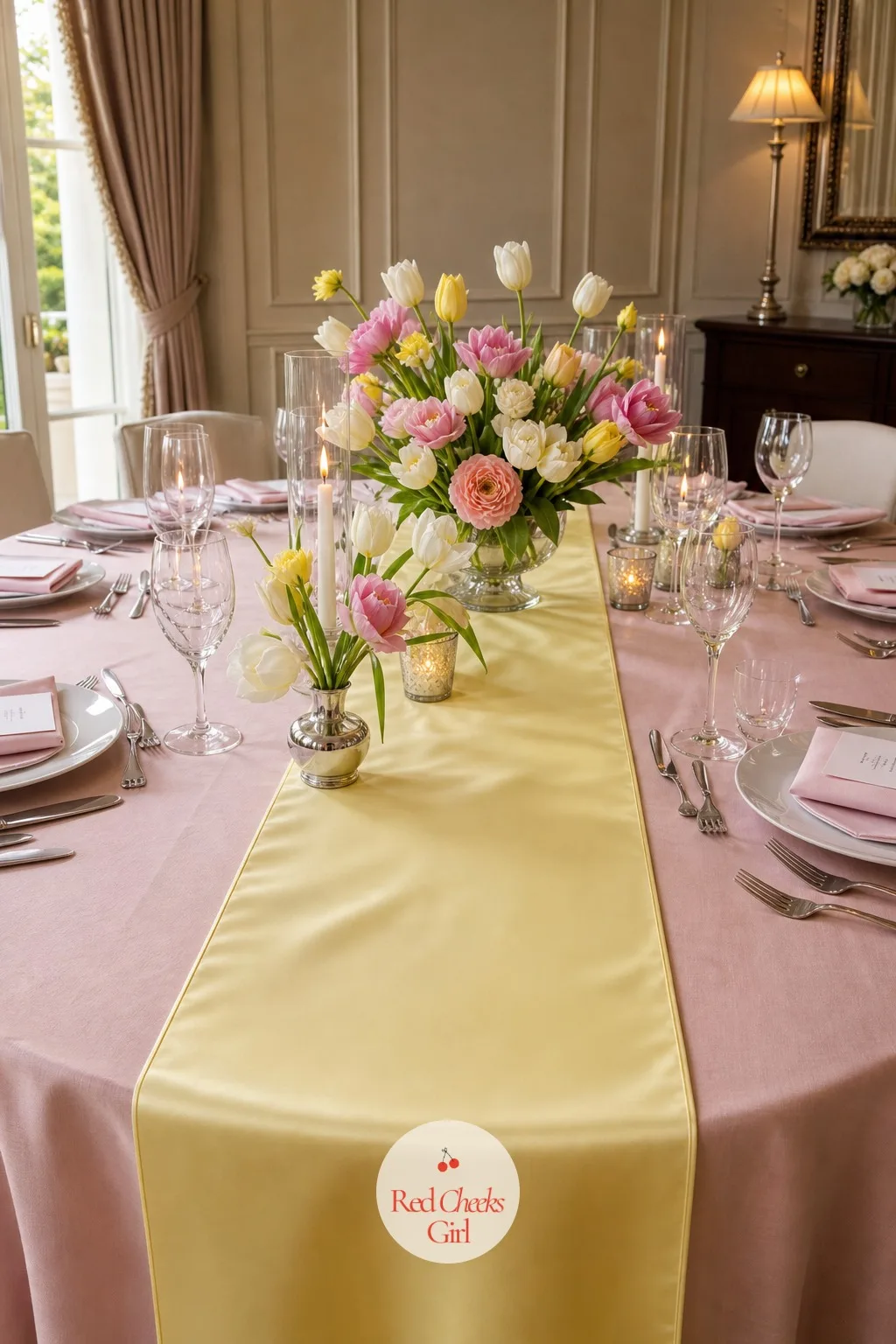
Pressed Satin Table Runner in Butter Yellow
A tablecloth alone can look a little bare down its length. A runner breaks that up without adding another pattern to compete with the napkins or the cards: one solid colour, pressed smooth, laid straight down the centre.
Lay a pressed white or soft pink cotton tablecloth first, then run a butter yellow satin runner down the centre line, pressed flat with no visible creases. Nothing else sits on the runner except the julep cup, so it reads as a clean stripe of colour under the centerpiece.
Order a butter yellow satin runner, twelve inches wide, pressed and ironed rather than steamed, to lay over a soft pink or ivory base cloth.
This is an easy one to iron and lay yourself the morning of; renting both the cloth and the runner from the same linen company is worth the small extra cost if the wedding is large, since it guarantees every table matches exactly.
🛍 Shop this look
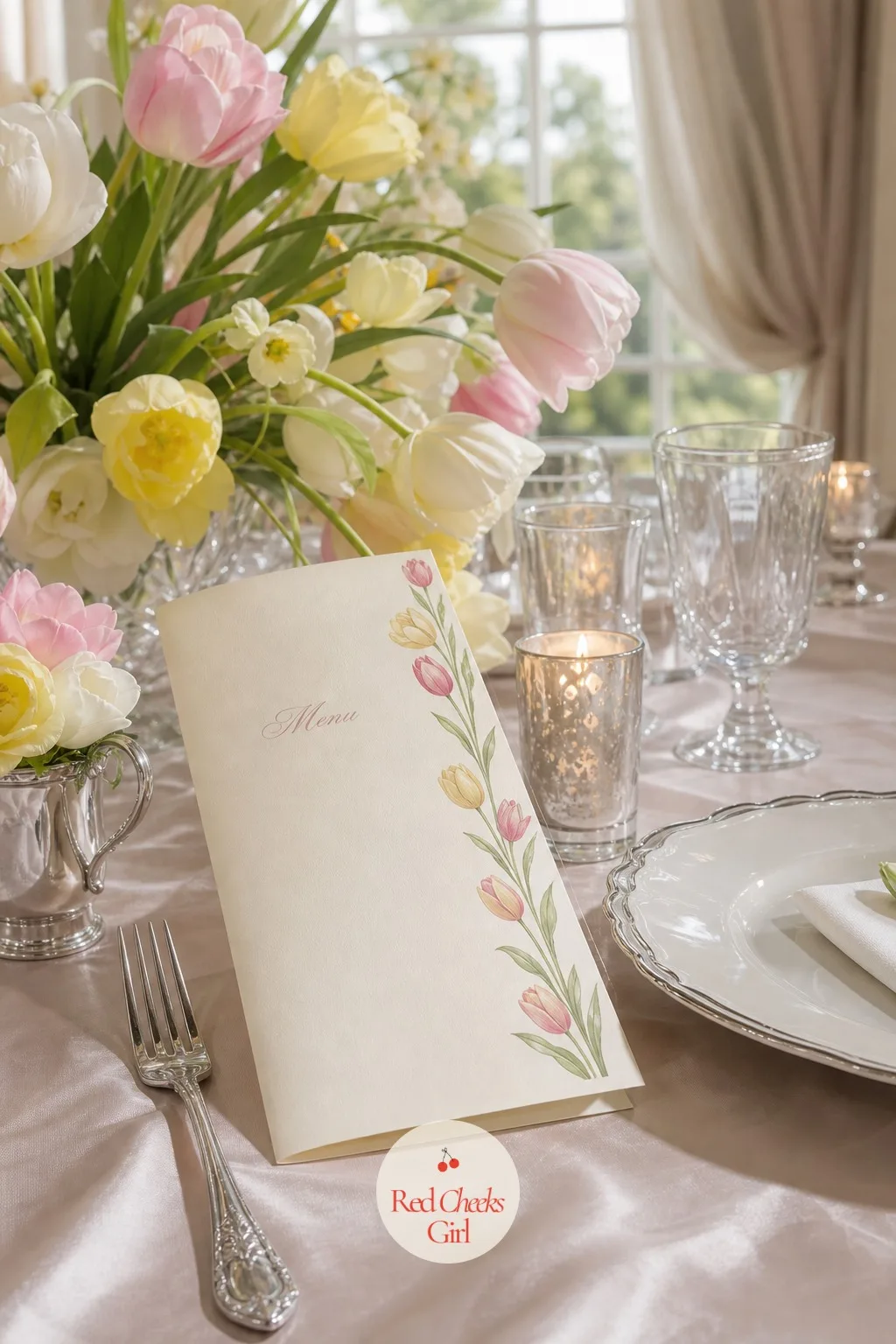
Menu Cards with a Tulip Border
A menu card with nothing on it but text looks like it came from a printer at the last minute. A bordered one looks like it belongs to the rest of the table: a thin line of painted or printed tulips running down one edge, the food listed plainly inside it.
Each card is a single sheet of ivory cardstock, printed with a narrow tulip border along the left edge in the same pink, butter yellow and white, with the courses listed in a simple typeface so the border stays the only decorative element.
Give the stationer this exact brief: ivory menu cards, a narrow painted tulip border down the left edge only, courses set in a plain serif. A print-at-home template with the same border costs almost nothing and looks identical once it sits on the table next to the julep cup and the napkin.
🛍 Shop this look
The Food and Drink
The cake, the cookies and the welcome drink are where the palette gets to look edible rather than just decorative, and where a guest gets to taste the theme rather than only look at it.
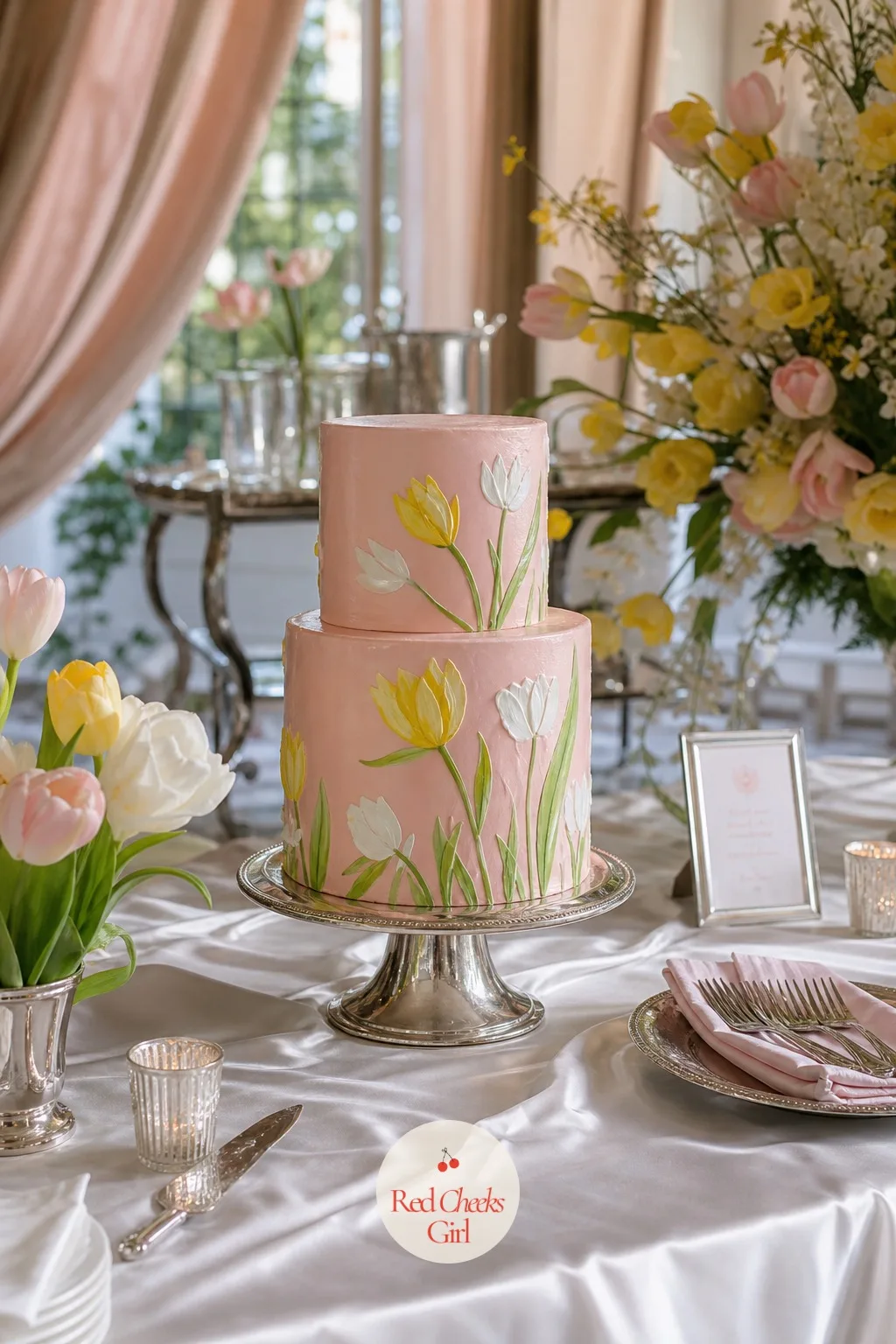
Pink Glazed Cake Hand Painted with Tulips
A plain white cake can feel like it forgot to dress for the occasion. This one has not: a soft pink glaze over every tier, with tulips painted directly onto the icing in butter yellow and white rather than piped as separate sugar flowers.
Each tier is iced smooth in a pale pink glaze, then hand painted with simple tulip shapes using food safe edible paint, the lines loose rather than botanically exact, climbing up from the base of the bottom tier the way real tulips grow from the ground.
Tell the baker you want a two or three tier cake, smooth pink glaze, hand painted butter yellow and white tulips climbing from the base rather than scattered evenly.
This one belongs to the baker, not to the kitchen at home, though a single tier version makes a fine groom’s cake or dessert table centrepiece for anyone willing to try the painting themselves with a steady hand and gel food colour.
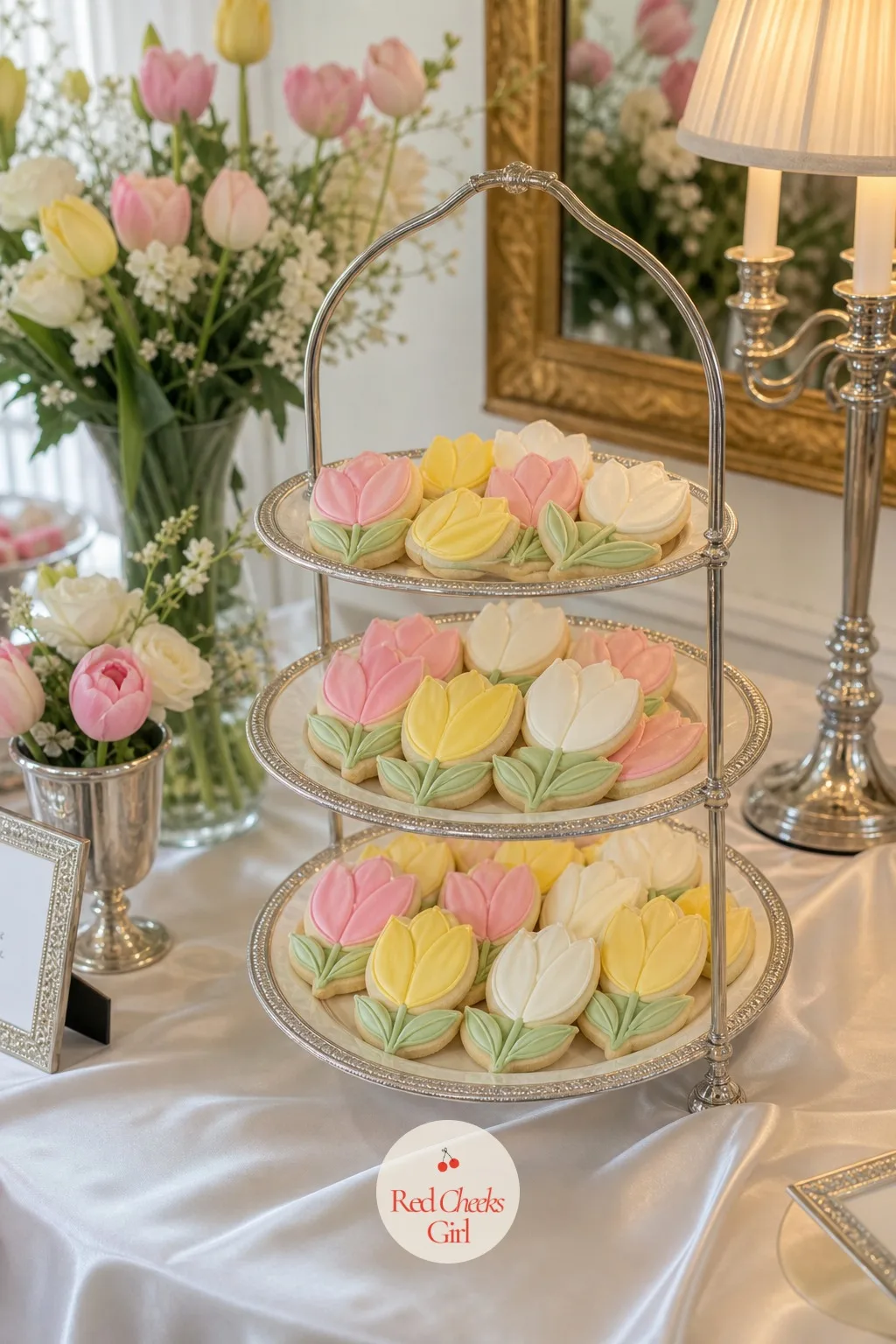
Tulip Shaped Sugar Cookies on the Dessert Table
A dessert table with only the cake on it looks unfinished once the plates start emptying. A tray of tulip shaped cookies fills that gap without competing with the cake for attention, since they sit lower and smaller on the table.
Bake a simple sugar cookie base, cut in a tulip shape, then flood each one in royal icing in soft pink, butter yellow or white, with a thin outline piped in a slightly darker shade of the same colour to mark the petal lines.
Ask the baker for tulip shaped sugar cookies, flooded in the three tones with a simple outline, no sprinkles or extra decoration. These are genuinely doable at home with a cookie cutter and a piping bag if someone enjoys baking, and they freeze well a week or two ahead, which takes the pressure off the final week entirely.
🛍 Shop this look
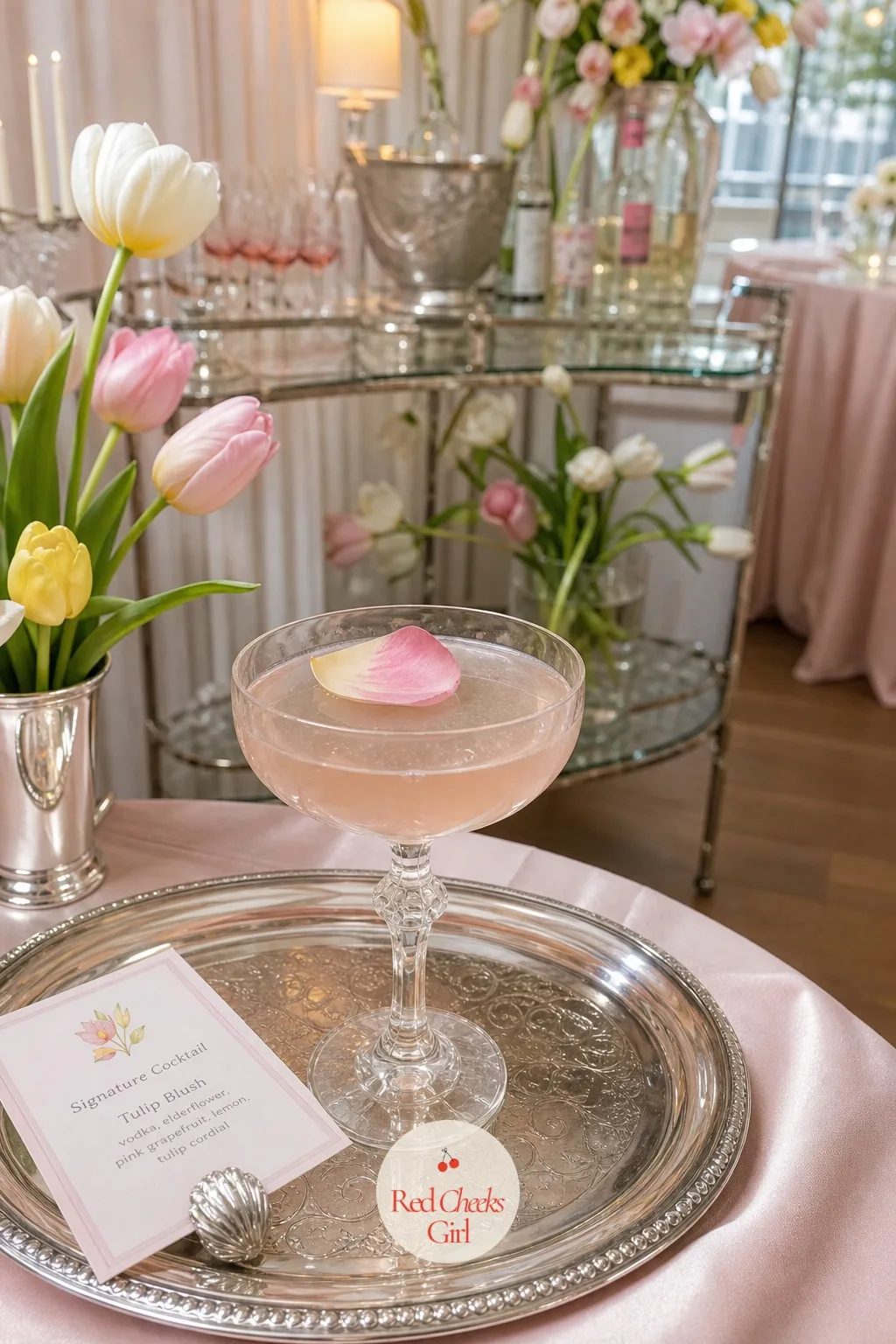
Signature Cocktail with a Tulip Petal Garnish
A welcome drink without a garnish looks like something poured in a hurry. A single edible flower petal floating on top fixes that instantly, and it costs almost nothing per glass once bought in bulk.
Build the drink in a coupe glass: a pale pink or clear base liquid, finished with a single edible pink or yellow flower petal laid flat on the surface rather than dropped in whole, so it sits like a small flag on top of the drink.
Give the bartender this line: a soft pink signature cocktail in a coupe glass, garnished with a single edible flower petal, no straw.
Edible flowers are an order-ahead item from a specialty grower, not a supermarket purchase, so place that order a week out; a twist of candied lemon peel is the easiest swap if edible petals are not available locally.
What They Take Home
The last things a guest touches are the smallest: a bulb, a handful of petals, the invitation she kept on her fridge for months beforehand. These are worth getting right precisely because they are so small.
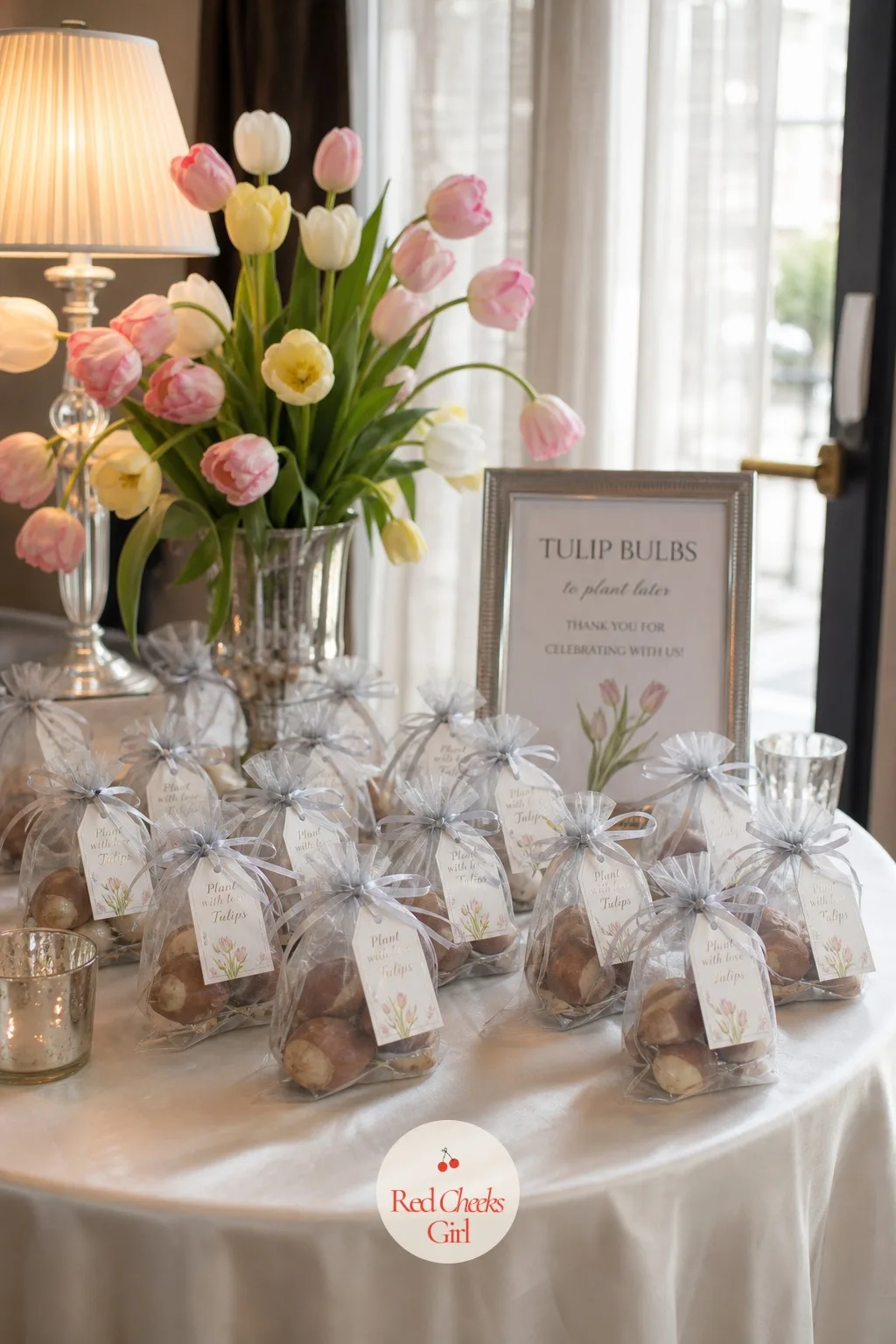
Tulip Bulb Favors to Plant Later
A favor that gets eaten on the drive home is forgotten by the next morning. A bulb is not: it sits on a windowsill through the rest of the season and turns back into a tulip the following spring, which is a nice thing for a wedding to promise.
Each favor is one or two tulip bulbs, tucked into a small silver organza bag, tied with a narrow ribbon and a small tag giving the variety name and a one line planting instruction, set out on a table near the exit or at each place setting.
Order bulbs from a bulb supplier rather than a florist, since florists sell cut stems, not planting stock, and ask for the same soft pink, butter yellow and white varieties used elsewhere in the day.
This is an easy one to bag and tag yourself over a quiet evening; if the wedding falls outside bulb planting season in your climate, swap in a small packet of tulip seeds or a tiny potted bulb already in growth instead.
🛍 Shop this look
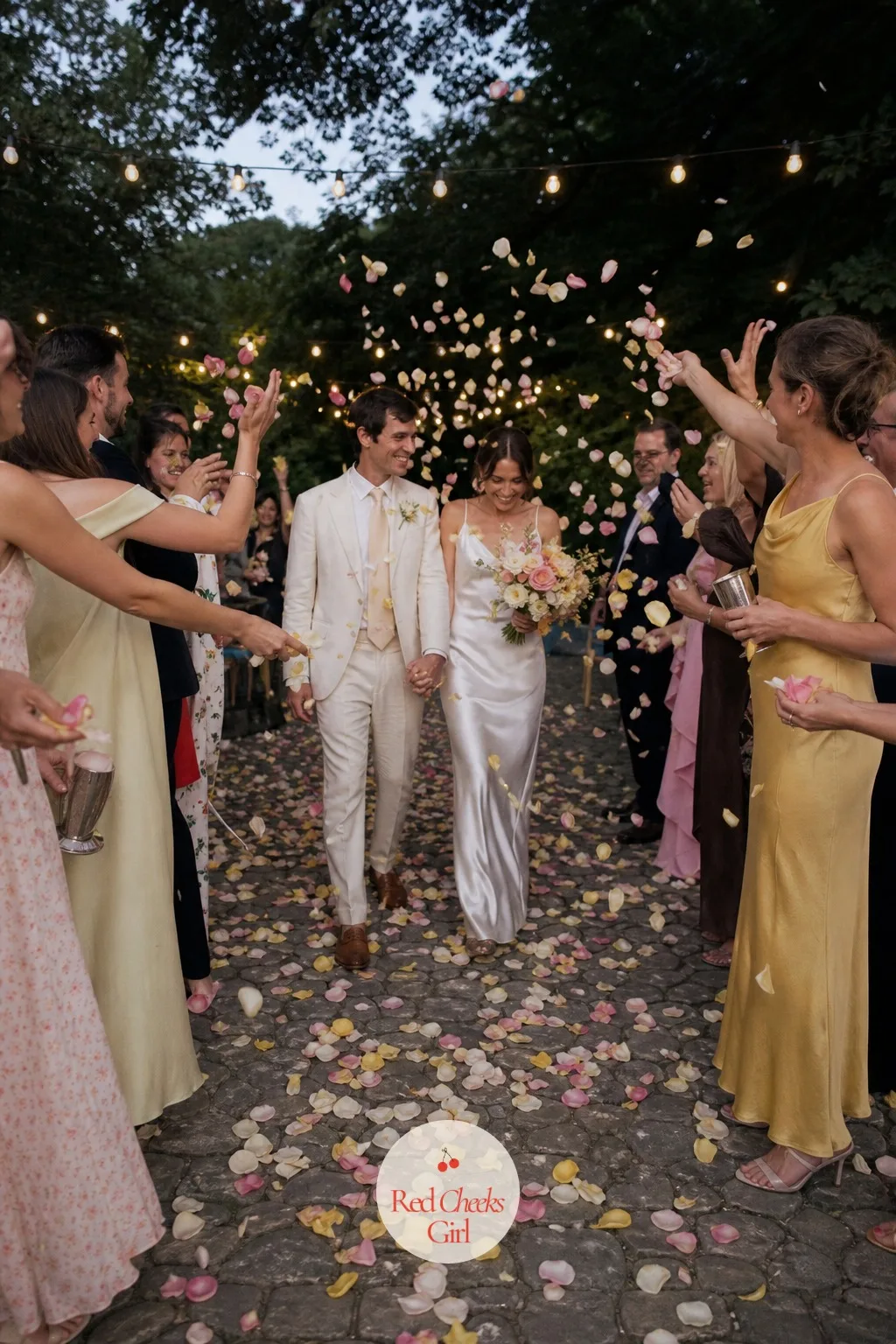
A Petal Send Off Instead of Confetti
Paper confetti leaves a mess that someone has to sweep up by hand. A petal send off leaves almost nothing behind and photographs better in the air, drifting down in soft colour rather than scattering as sharp little dots.
Fill small paper cones, one per guest, with loose silk or dried tulip petals in the three tones, stacked in a basket or a low crate near the exit for guests to grab as they line up. The couple walks through the centre of the line at the very end of the night while petals are thrown, not before.
This one runs itself once it is set out: baskets by the door, a quiet word from the planner or a sign telling guests to help themselves, and the couple’s exit as the single cue to throw. Ask the venue first whether fresh petals are allowed outdoors only, since fresh ones can stain indoor flooring; silk petals solve that everywhere.
🛍 Shop this look
The Invitation That Sets Up the Palette
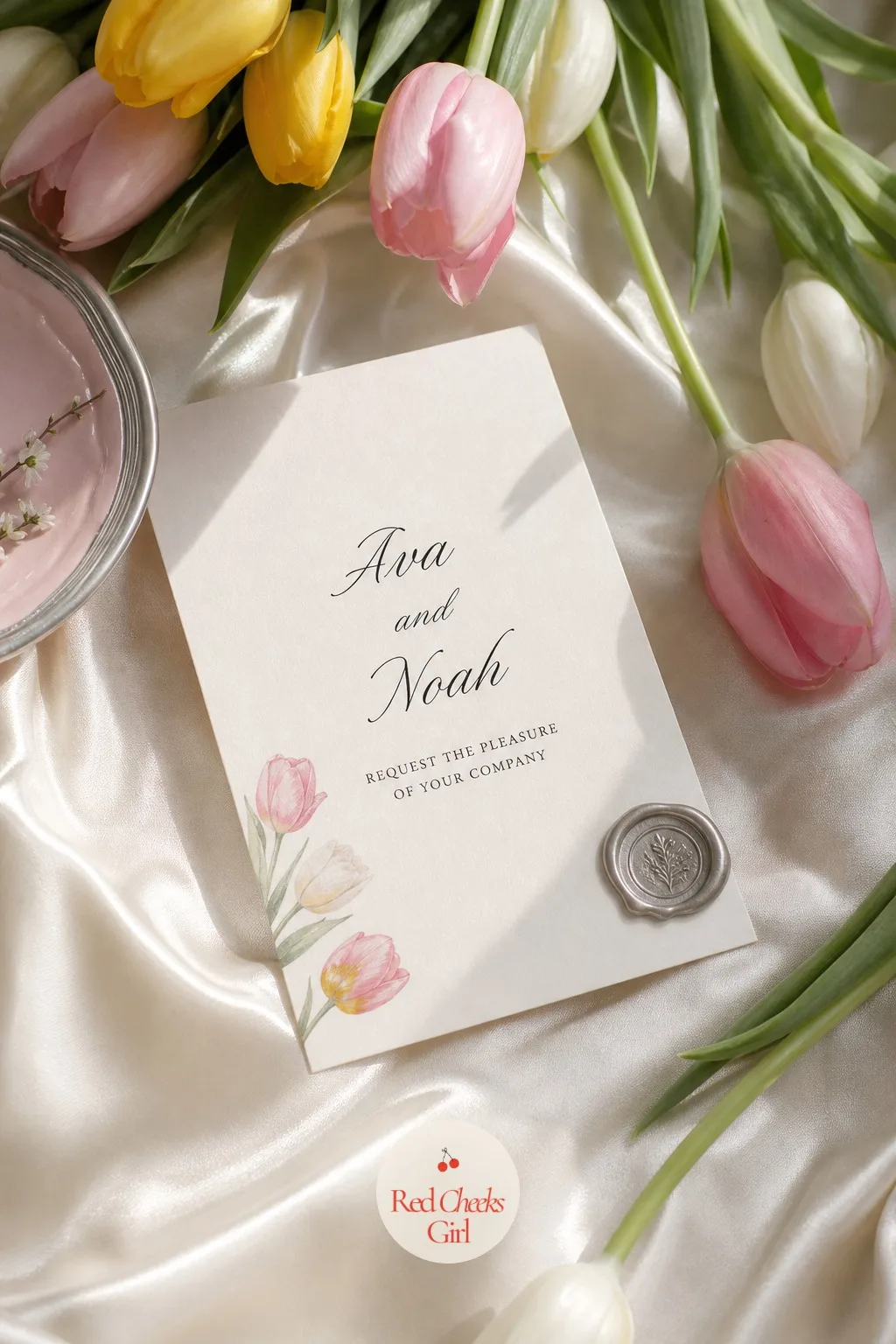
An invitation is the first thing a guest holds from this wedding and often the last thing they keep from it, tucked into a drawer or pinned to a board for months. It is worth making sure it already looks like the day it is promising.
Each suite is a single card or small flat set, printed on soft ivory or pale pink cardstock, with a loose watercolour or line drawn tulip motif in the corner or along one edge, the wording set in a simple script or serif rather than anything heavily decorated.
Give the stationer this exact wording for the main line: ‘Ava and Noah, Request the Pleasure of Your Company’, set beneath a small corner motif of pink, butter yellow and white tulips.
A good print at home template gets this close enough for most budgets; a letterpress or hand painted version is worth the extra cost only if the couple plans to frame one afterward.
🛍 Shop this look
Frequently Asked Questions
What season is best for a tulip wedding theme?
Spring is the natural fit, since tulips are seasonal and read as a spring wedding signal, not usually a fall or winter choice unless a florist sources them specially.
Do tulips wilt quickly at a wedding?
Yes, noticeably so: delicate tulips start wilting after just 2-3 hours without water, which is why arrangements get built and watered close to the start time, not the night before.
What colors do tulips come in for a wedding?
A very wide range: tulips come in a wide range of colours, including pastel, vibrant, crisp white, and even blue, so a soft pink, butter yellow and white palette is easy for any florist to source.
What flowers pair well with tulips in a bouquet?
Roses, baby’s breath, anemones, lilies and peonies all work well with tulips, since flower options that pair well with tulips include roses, baby’s breath, anemones, lilies, and peonies.
Can a bridal bouquet be made of tulips only?
Yes, and it reads as deliberate rather than unfinished: monochrome tulip bouquets create a striking statement, with single-color bouquets exuding elegance and sophistication.
What do tulips symbolize at a wedding?
Tulips are a traditional symbol of love, since tulips have long been a symbol of love, their elegant simplicity blending into the romantic ambiance of the big day.
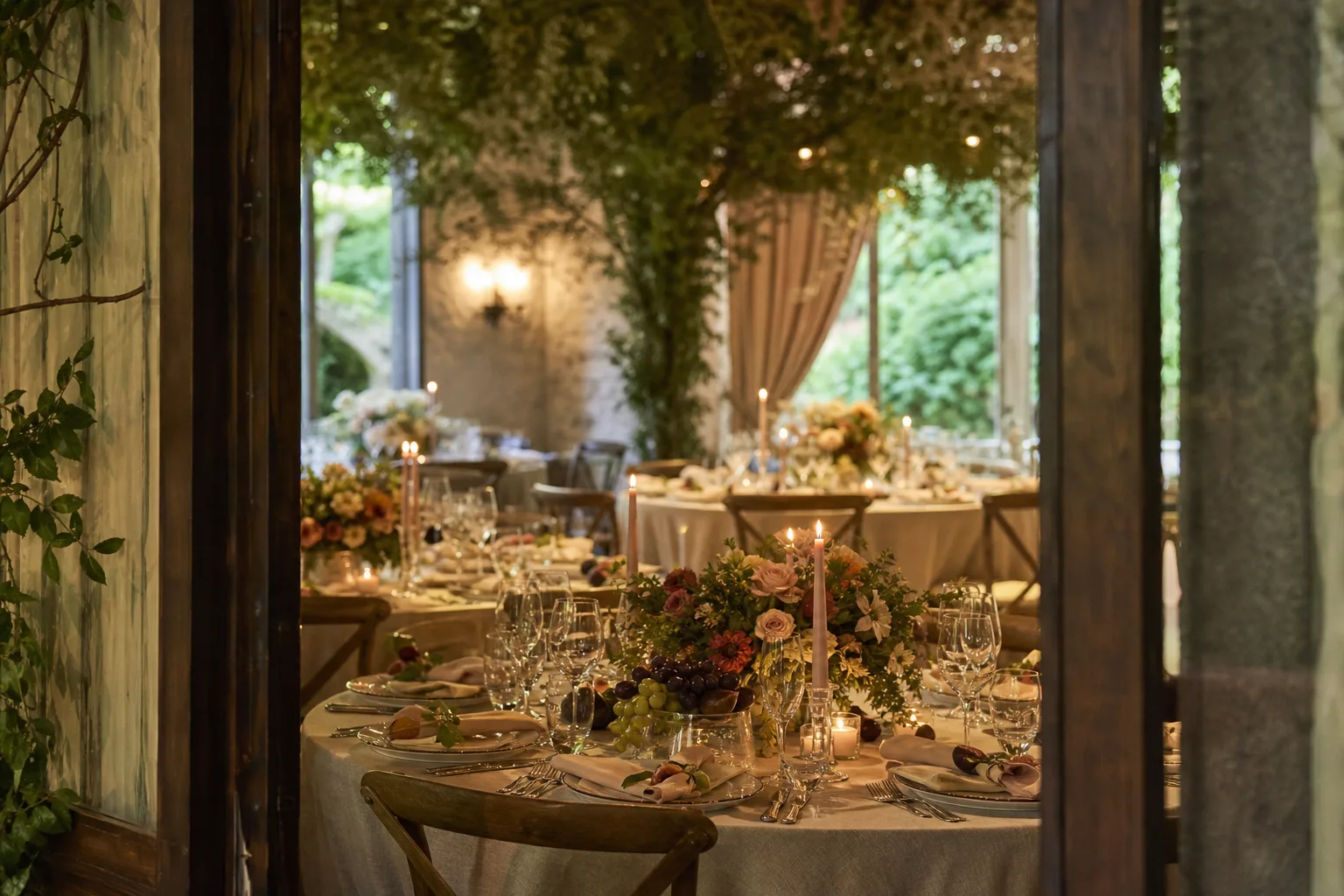
36 wedding centerpieces built from garden roses, hydrangea, citrus and candlelight, grouped by style
26 candle wedding centerpieces, from mixed brass tapers to floating glass bowls and mercury glass vo
17 fall bridal shower ideas with a pumpkin backdrop, cider bar, caramel apples and apple butter favo
Leave a Reply