


Couples game night has a way of revealing things you never expected to learn about people you thought you knew completely — including your own partner.
The right mix of games keeps the energy moving: something competitive to get everyone fired up, something personal to spark real conversation, and something silly enough that nobody takes the final score too seriously.
Whether you are hosting two couples at your kitchen table or ten couples spread across the living room floor, the games in this list scale easily and require almost no setup time.
Twelve of the twenty games below come with dedicated printable sheets, so you can print and play within minutes of guests arriving.
The remaining eight need nothing more than items most hosts already have on hand — a whiteboard, some index cards, a timer on your phone. Read through the full list before your event and pick six to eight games that suit your crowd’s energy.
A good rule of thumb: open with something low-stakes and personal, build toward the louder team games in the middle, and close with something warm and a little sentimental so everyone leaves in a good mood.
This post contains affiliate links — if you buy through them, I may earn a small commission at no extra cost to you.
Table of Contents
- Newlywed-Style Question Round
- How Well Do You Know Your Partner?
- Couples Trivia Rounds
- Two Truths and a Lie — Couples Edition
- Guess Your Partner’s Answer
- Charades — Couples Teams Edition
- Most Likely To — Couples Edition
- Would You Rather — Couples Edition
- Speed Drawing Duel
- Memory Lane Timeline
- Categories — Couples Round
- Compliment Roulette
- Emoji Love Story
- Our Love Story — Couples Mad Libs
- Couples Pictionary Relay
- Scavenger Hunt for Couples
- Story Spine Couples Round
- Wink Assassin — Couples Edition
- Debate Club — Couples Edition
- One-Word Story Circle
1. Newlywed-Style Question Round
This is the classic “how well do you really know each other” format, rebuilt for a mixed group of couples at any stage of their relationship.
Before the round begins, one partner from each couple steps out of the room — or simply faces away and puts on headphones — while the other partner answers a set of questions about their relationship on the printable sheet.
Questions range from “What did your partner order on your first date?” to “What is your partner’s most irrational fear?” When the absent partners return, they try to match those answers, and every mismatch is worth a groan and a story.
The printable sheet provides twenty pre-written questions with answer blanks for both the “answering” partner and the “guessing” partner, plus a running score column on the right. You need one sheet per couple and pens.
The game works for two couples up to about eight; beyond that, the reveal portion gets long, so split into two simultaneous heats. Plan for about thirty to forty minutes including the reveal discussion, which is always the funniest part.
Host tip: the questions that generate the most laughter are almost never the dramatic ones — they are the mundane ones, like “What side of the bed does your partner sleep on?”
Print a spare sheet for yourself, fill it out about a couple you know well, and read your answers aloud if the group needs a warm-up example to understand the format.

2. How Well Do You Know Your Partner?
Similar in spirit to the Newlywed-Style round but structured differently: here, both partners answer the same questions simultaneously without consulting each other, and points are scored for matching answers rather than for guessing correctly.
Think of it as a compatibility test that happens to be a competition. Questions on the sheet lean toward preferences and opinions — “Would your partner rather vacation in the mountains or at the beach?”
— so there are no objectively right or wrong answers, only agreements and delightful disagreements.
The printable sheet has thirty questions printed in two mirrored columns, one for Partner A and one for Partner B, so couples can write simultaneously and then flip their sheets to compare.
You need one sheet per couple, pens, and a way to total the match score at the end. Group sizes from two couples to ten work well; the game is largely self-contained, so couples can score themselves while you move the conversation along.
Budget twenty-five minutes for a full round.
Host tip: read a few questions aloud before couples start writing so everyone understands they should answer for themselves, not predict their partner. The first time you run this game, at least one couple will misread the instructions and answer differently from everyone else — getting ahead of that saves five minutes of confusion mid-round.

3. Couples Trivia Rounds
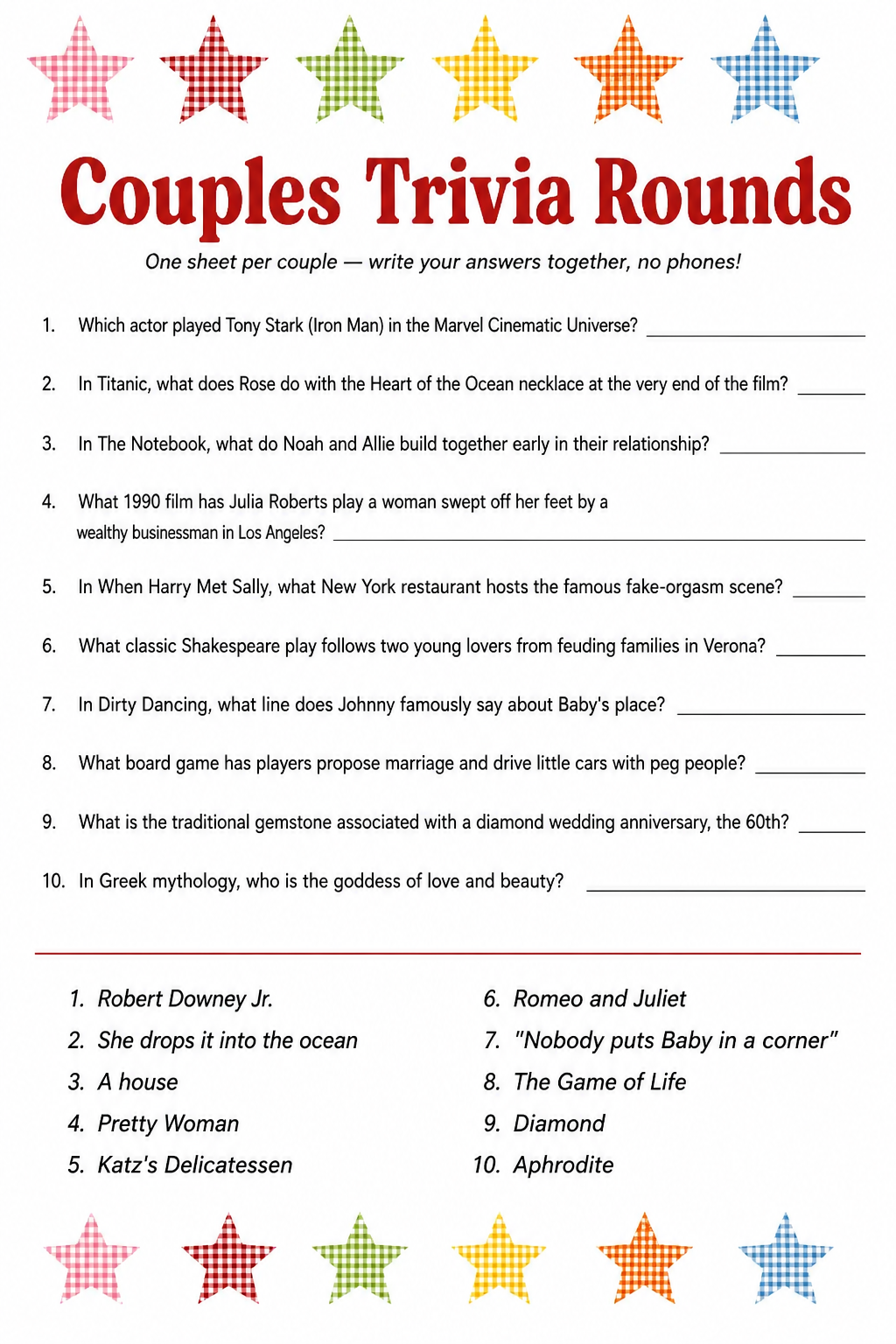
Standard trivia gets a couples-night twist here: questions are organized into themed rounds — pop culture, history, food and drink, travel, and a “relationships and romance” wild-card round — and couples compete as a team.
Each team huddles, agrees on a single answer, and writes it on the answer sheet before time is called.
The printable sheet provides the answer grid; the host reads questions from a separate list included in the same printable file, so you do not need to source content from anywhere else.
You need one answer sheet per couple-team, pens, and a host willing to read questions at a steady pace. The game works for two couples minimum and is genuinely more fun with six or more because the points race gets tighter.
Each round contains ten questions and takes about twelve minutes; with five rounds you are looking at roughly an hour of play including scoring pauses. You can easily stop after two or three rounds if the group wants to move on.
Host tip: do not read the answers after every single question — collect a full round’s worth of answers first, then go through them all at once. Announcing answers one at a time kills the momentum and turns a lively game into a classroom exercise. Batch the reveals and the energy stays high.
4. Two Truths and a Lie — Couples Edition
Everyone knows the basic game, but the couples version adds a layer that makes it genuinely tricky: each person writes two truths and one lie specifically about their relationship or their partner, not just about themselves.
Statements like “My partner proposed to me in an airport” or “We once got lost together for three hours in a foreign city” force the other couples at the table to weigh in, and they are almost always wrong in entertaining ways.
Even longtime friends are surprised by what they did not know about each other’s relationships.
The printable sheet gives each player a structured card with three labeled blanks and a “confess” section at the bottom where you reveal the lie after voting. You need one sheet per player, pens, and nothing else.
The game scales beautifully from four players (two couples) to twenty or more; simply go around the table one player at a time.
Allow about three to four minutes per player for voting and revelation, so a group of eight couples should budget roughly forty-five minutes for everyone to have a turn.
Host tip: encourage players to write their statements in the same neutral tone so the lie does not stand out grammatically. If someone writes the truth in confident full sentences and the lie in hesitant fragments, the tell is instant and the game loses its fun. Remind everyone before they start writing: make all three statements sound equally convincing.

5. Guess Your Partner’s Answer
The host asks a question — something like “Name your partner’s favorite way to spend a Sunday morning” or “What would your partner say is the most overrated travel destination?” — and each player secretly writes what they think their partner will say.
Then each partner writes their own actual answer. Points go to players whose prediction matches their partner’s real response word-for-word or close enough that the group votes it acceptable. The “close enough” vote from the group is usually the funniest moment of each round.
The printable sheet includes forty pre-written questions sorted by category — daily habits, opinions, memories, and dreams — so the host never has to improvise.
Each player uses one sheet for the whole game, filling in predictions on the left column and then, after their partner reveals, writing the real answer on the right. You need one sheet per player and pens.
Two to ten couples work fine; beyond ten, consider splitting into separate tables playing simultaneously. The game runs about thirty-five minutes for a full forty-question sheet, though most groups stop at twenty and declare a winner.
Host tip: the “dreams” category questions — bucket list items, dream jobs, fantasy vacations — almost always produce the biggest surprises and the longest sidebar conversations. Save those for the second half of the game when the group is warmed up and people are more willing to be openly vulnerable.

6. Charades — Couples Teams Edition
Charades with a couples-night spin means every prompt on the printable card deck relates to relationships, romance, or shared experiences: things like “a first date that went wrong,” “meeting the parents,” or “renewing a passport together.”
Couples are paired against each other in teams, and one partner acts while the other guesses — then they swap roles for the next card.
The familiar silent-miming format needs no explanation, but the prompts being relationship-themed means even the acting is more personal and funnier than standard charades.
The printable sheet is a cut-apart card deck — sixty prompts on four pages that you print, cut, and drop into a bowl or box. You need scissors, a bowl, and a one-minute timer (a phone works perfectly).
Two couples is the minimum for real competition; six to ten couples is the sweet spot where the audience energy keeps actors motivated.
Each full rotation through the bowl takes about forty minutes, but you can stop when the bowl is half empty and still have a satisfying winner.
Host tip: actors almost always mime the literal meaning of a prompt when they panic, and the guesser almost always shouts variations of the same wrong answer.
Tell couples before the round starts that they are allowed to do sound effects — not words, just sounds — because this rule alone breaks logjams and keeps the clock from running out in painful silence on every third card.

7. Most Likely To — Couples Edition
A prompt is read aloud — “Most likely to fall asleep during a movie they insisted on watching” or “Most likely to get emotionally attached to a houseplant” — and every player simultaneously points at whoever in the room they think fits best, including their own partner.
The person with the most fingers pointed at them earns a point, and the pointing partner also earns a point if their pick wins. It is democratic, fast, and produces the kind of affectionate ribbing that couples game nights are built for.
The printable sheet contains sixty pre-written prompts in a two-column layout, designed so the host can read straight down the page at pace. No answer grid is needed; a simple tally on any scrap of paper works for scoring.
The game is ideal for four to twenty players and runs at whatever pace the host sets — a brisk round of thirty prompts takes about twenty minutes. You can use the full sheet or stop whenever the energy peaks.
Host tip: the game gets noticeably more fun after the third or fourth prompt, once people realize it is socially safe to point at themselves or at the host.
Prime the pump by pointing at yourself on the very first prompt even if you are not the best fit — it signals to the group that self-deprecation is welcome and loosens everyone up immediately.

8. Would You Rather — Couples Edition
Each prompt presents two scenarios and players must choose one — no “both” and no “neither” allowed.
The couples-night version keeps things PG-13 but meaningfully personal: “Would you rather always know what your partner is thinking, or have your partner always know what you are thinking?”
and “Would you rather plan every vacation or never plan any vacation for the rest of your life?” After everyone commits to an answer, the real fun is the reasoning, which the host should prompt with a pointed “Explain yourself” before moving on.
The printable sheet has fifty pre-written dilemmas arranged so that each couple-team can circle their answer and compare, then compare with the other couples at the table. You need one sheet per couple and pens.
This game works for any group size from two couples to ten and is genuinely flexible — you can play through the whole sheet or cherry-pick your favorite prompts. A full fifty-question round takes about forty minutes; a curated twenty-question highlight reel takes under twenty.
Host tip: skip any prompts that land flat with your specific crowd — you will sense it immediately when a question produces silence rather than immediate arguing — and move on without dwelling. The game’s momentum lives entirely in the speed of the disagreements, so never let a lukewarm prompt eat more than thirty seconds of group time.

9. Speed Drawing Duel
Two teams race to draw and correctly guess relationship-themed prompts before the one-minute timer runs out. Each team gets an easel, whiteboard, or just a large notepad.
One team member draws while their teammates shout guesses; when someone shouts the right answer, the next card is drawn immediately.
The printable sheet doubles as a score tracker and a prompt card deck — cut apart the bottom half for prompts, keep the top half for tallying points. Prompts include things like “a honeymoon suite,” “a road trip argument,” and “cooking dinner together.”
You need markers or pens, paper or a whiteboard, scissors to cut the prompt cards, and a timer. The game works best with three or more people per team, which means six players minimum (three couples split into two teams of three).
Up to sixteen players works well at one table. Rounds of ten prompts take about fifteen minutes; play three rounds to fill roughly forty-five minutes. Teams rotate who draws so no one person carries the team all night.
Host tip: keep a hard rule that the drawer cannot write any letters or numbers on the paper — this sounds obvious but someone always tries to sneak in a letter when they are stuck. Enforce it with a buzzer sound effect from your phone and the group will police themselves cheerfully after the first or second infraction.

🛍 Shopping guide
10. Memory Lane Timeline
Each couple writes down ten significant moments from their relationship — first date, first trip together, first argument they laugh about now, and so on — each on a separate slip or in the pre-labeled boxes on the printable sheet.
Then, without looking at their own sheet, they try to arrange the events in chronological order.
This is harder than it sounds: couples who have been together for years are often startled to discover they remember the sequence of early events completely differently from each other.
The printable sheet provides ten labeled event boxes and a numbered timeline strip at the bottom where couples record their agreed-upon order. You need one sheet per couple and pens.
This is a couples-only activity — other couples at the table cannot help or interfere — so it works for any group size since each pair plays their own version.
Budget twenty to twenty-five minutes for the writing and ordering phase, then ten minutes for couples to share their most surprising disagreements with the group.
Host tip: the sharing portion at the end is where this game earns its place on the schedule. Ask each couple to share the one event whose placement surprised them most — not the whole timeline — because asking for everything turns into a ten-minute monologue per couple and loses the room’s attention fast.

11. Categories — Couples Round
The host calls out a category — “Things you would find in your partner’s nightstand,” “Songs that were popular when you two first got together,” “Restaurants you have been to on a date” — and every player races to write down as many entries as they can in sixty seconds.
When time is called, players read their lists aloud, and any item that appears on more than one player’s list is crossed off. Only unique answers score a point. It rewards both genuine knowledge and creative lateral thinking.
The printable sheet provides twenty pre-selected categories with a timed answer grid for each, plus a final scoring summary at the bottom. You need one sheet per player and pens.
The game works for four players to twenty or more; the larger the group, the more valuable genuinely unusual answers become. A full twenty-category sheet takes about forty-five minutes. You can comfortably stop at ten categories if the group is ready to move on.
Host tip: the category “Songs that were playing when something important happened in your relationship” sounds romantic but almost always produces a genuinely competitive round because couples have wildly different musical associations with shared memories. Save it for round two when people are playing harder.

12. Compliment Roulette
Each player writes their name on the printable sheet, which is then passed clockwise around the table.
Every person who receives the sheet writes one genuine, specific compliment about the named person in the blank provided — not a generic “you are so fun” but something observed and particular, like “you always remember exactly what someone said they were worried about three weeks ago.”
The sheet travels the full circle and returns to its owner, who reads their compliments aloud to the group.
The printable sheet has space for up to ten compliment entries per person and a “from the table” header so recipients know these came from the whole group. You need one sheet per player and pens.
The game works for four to twenty players, though the emotional payoff is highest with six to twelve because everyone knows each other well enough to write something genuine.
The full round takes fifteen to twenty minutes and works beautifully as a closing game when the competitive energy of the night has already been spent.
Host tip: if your group is new to each other or includes couples meeting for the first time, run this game later in the evening — after at least two or three other games — rather than at the start.
Compliments written by near-strangers tend to be polite but thin, while compliments written after two hours of playing together together are specific, funny, and often surprisingly moving.

13. Emoji Love Story
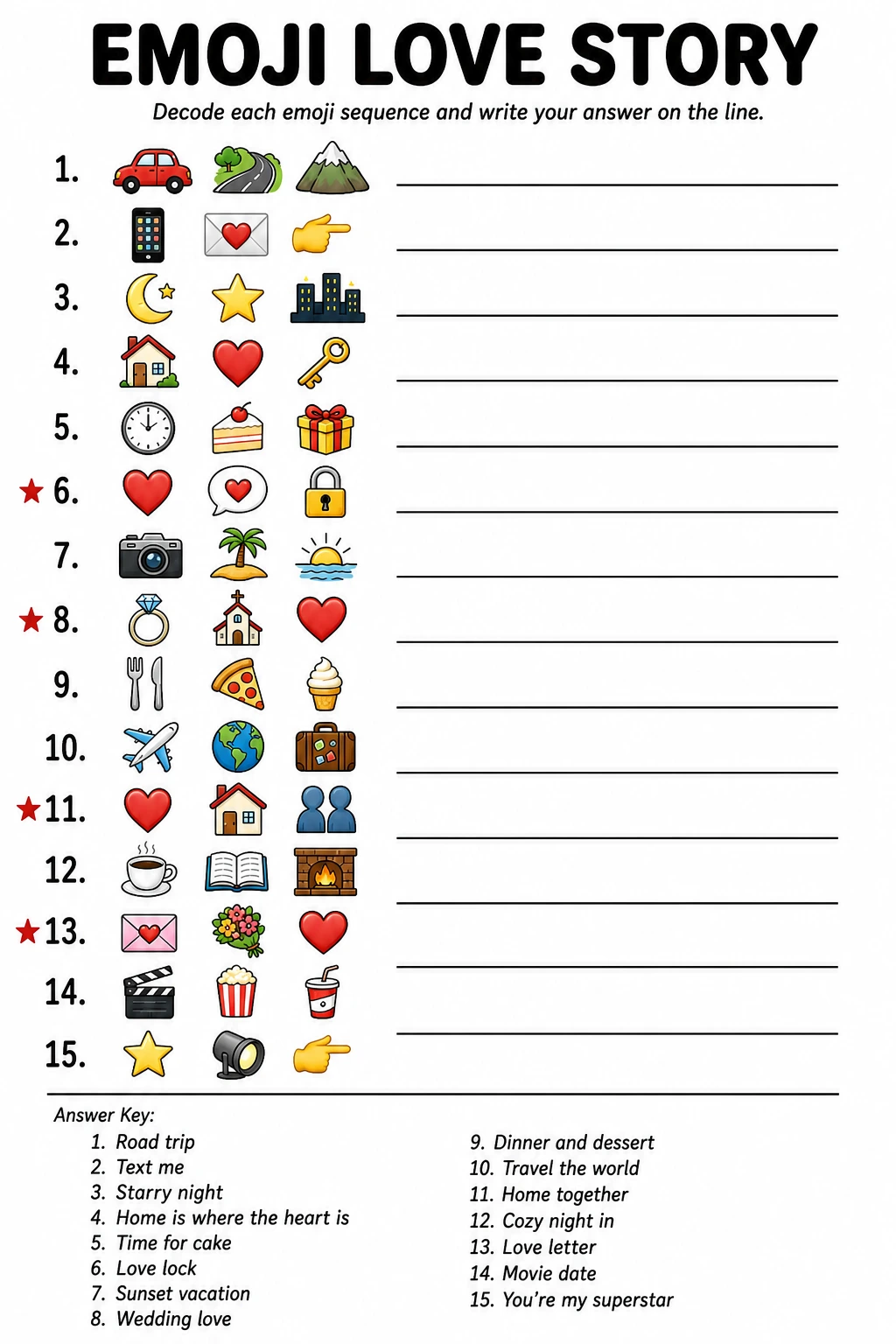
Each couple receives a strip of emoji sequences printed on the sheet and must narrate the story those emojis represent — not as a puzzle with a single correct answer, but as an improv storytelling exercise where the emojis are prompts, not codes.
A row of a plane, a ring, a champagne glass, and a house might become “we flew to Paris, got engaged, celebrated, and moved in together” for one couple and a completely different adventure for another.
The humor comes from how differently couples interpret the same sequence, and how confidently they argue their version is correct.
The printable sheet has eight emoji story strips per page, with a blank “your version” line beneath each strip. You need one sheet per couple and pens for the writing phase, then the game shifts to verbal storytelling as couples read their interpretations aloud.
Two to eight couples works well; beyond eight, reading all interpretations aloud gets long. Budget about twenty-five minutes for a full eight-strip round. This is a relaxed, low-stakes game that pairs well after a more intense competitive round.
Host tip: resist the urge to declare one interpretation “right” — the whole point is that there is no right answer, and the moment you start adjudicating correct readings the game collapses into a puzzle contest rather than a storytelling celebration. Judge instead on delivery, creativity, and how convincingly a couple commits to their narrative.
14. Our Love Story — Couples Mad Libs
Mad Libs for couples works exactly like the classic format: one partner calls out parts of speech — “give me an adjective,” “give me a place,” “give me something you find in a kitchen” — and the other partner supplies words without knowing the story being built.
When all the blanks are filled, the first partner reads the completed love story aloud and the result is almost always absurd, occasionally poetic, and usually hilarious. The printable sheet provides four different story templates so couples can play multiple rounds.
The printable sheet has four pre-written story templates with clearly labeled blanks for nouns, verbs, adjectives, locations, and names. You need one sheet per couple and pens.
The game is perfectly self-contained — each couple runs their own game simultaneously — so it scales to any group size. Each story takes about five minutes to fill in and read aloud; a full four-story sheet takes twenty minutes per couple.
The best moment of the night is always when the host asks each couple to read their favorite story to the whole group.
Host tip: ask couples to fill in words at real pace rather than deliberating — the funniest results come from the first word that comes to mind, not the cleverest one someone labored over. If a couple is going slowly, call a thirty-second limit per blank and enforce it cheerfully. Speed produces better comedy than careful thought almost every time.

15. Couples Pictionary Relay
This is a relay-race version of the classic drawing game, designed specifically for couple-teams. Both partners draw, but they alternate rather than drawing at the same time.
Partner A draws for thirty seconds on a shared sheet of paper, then hands the marker to Partner B, who continues the drawing for thirty seconds — neither partner can erase the other’s work. The opposing couple tries to guess the prompt the whole time.
The constraint of building on someone else’s lines without a plan is what makes this game consistently funny.
You need large paper or a flipchart, markers, a timer, and a bowl of prompts — write fifty relationship-themed things on index cards: “a proposal,” “a traffic jam,” “Sunday brunch,” “packing for a trip.”
Two couples is the minimum; up to six couples works well when split into pairs competing in heats. Each prompt takes about two minutes including the guess; a twenty-prompt session runs forty minutes.
Keep the prompts visible to guessers only by having the host hold the card low so drawers cannot see it again once they have read it.
Host tip: the handoff moment — when Partner A passes the marker — is consistently the funniest second of every round, because Partner B almost always looks baffled by what their partner has drawn and has to improvise wildly.
Encourage players to narrate their confusion aloud before they start drawing; it keeps the audience engaged and laughing even when the drawing itself is unreadable.
🛍 Shopping guide
16. Scavenger Hunt for Couples
Rather than searching the venue, couples race to complete a list of relationship-themed social challenges within a time limit.
Items on the list might include: “find something in this room that reminds you of your first date and explain why,” “take a photo where you and your partner re-create your first couple photo,” or “get another couple to tell you how they met in thirty words or fewer.”
Points go to the couple who completes the most items accurately and creatively before the timer ends.
The host writes or prints a list of fifteen to twenty challenges on index cards or a single printed page — one page per couple.
You need a list, a timer set for twenty to thirty minutes, and a phone per couple for any photo challenges.
Three couples minimum makes the social challenges work; six to eight couples creates a genuinely dynamic energy where couples cross paths and interact with each other mid-hunt. Budget thirty-five to forty minutes including the debrief where couples share what they found.
Host tip: include at least two challenges that require couples to interact with a specific other couple in the room — “ask the couple sitting farthest from you to teach you a handshake” — because these cross-couple moments create memories that outlast the game itself and make the whole evening feel more connected rather than siloed into separate pairs.
🛍 Shopping guide
17. Story Spine Couples Round
Story Spine is an improv storytelling game where players build a collaborative story by completing a series of sentence starters in order.
The classic structure goes: “Once upon a time… Every day… Until one day… Because of that… Because of that… Until finally… And ever since then…” In the couples version, each sentence in the chain is completed by a different person at the table, and the story must be vaguely romantic or relationship-themed.
The results range from surprisingly coherent romances to wonderfully unhinged plots involving raccoons and international espionage.
You need nothing — this game runs entirely verbally — though the host may want to write the sentence starters on a whiteboard or card so players can see the structure.
Four players minimum (two couples); up to twelve players keeps each individual’s wait time short enough to stay engaged. One full story takes about four minutes; playing five to six stories fills a satisfying twenty-five-minute slot.
Couples can compete for funniest story, voted on by the group, or simply play for the shared experience.
Host tip: the game breaks down when someone ignores the previous player’s contribution and takes the story somewhere completely unrelated. Gently enforce the rule that each new sentence must follow logically — or at least comedically — from the sentence before it.
A light “connect it to what Priya just said” reminder is usually all it takes to keep the narrative chain intact.
18. Wink Assassin — Couples Edition
One player is secretly dealt the role of “assassin” at the start of each round. The assassin eliminates other players by making eye contact and giving a subtle wink; eliminated players count silently to three and then dramatically announce they have been “got.”
The remaining players must deduce who the assassin is before everyone is eliminated.
In the couples version, each assassin is also secretly assigned a “save” — they must wink at their own partner last so that couple finishes the game together, adding a second layer of strategy.
You need a standard deck of playing cards to deal roles — one joker for the assassin, one ace to designate the save target, and number cards for everyone else. Alternatively, write roles on folded slips of paper.
The game works for six players minimum (three couples); ten to sixteen players is the sweet spot for sustained tension. Each round lasts three to six minutes; play five rounds so the assassin role rotates. Total playing time for five rounds is about thirty minutes.
Host tip: remind players that bad actors — people who wink theatrically and wait for a reaction — make the game trivial. The best assassins wink during ordinary conversation, mid-sentence, while maintaining a completely straight face. Demonstrate a good wink versus a bad wink before the first round and the whole game immediately improves.
🛍 Shopping guide
19. Debate Club — Couples Edition
Couples are assigned absurd but defensible positions to argue for two minutes each: “Pineapple absolutely belongs on pizza,” “The passenger seat is superior to the driver’s seat,” “Arriving fifteen minutes early is the only respectful way to show up anywhere.”
After each two-minute argument, the opposing couple gets ninety seconds to rebut. The group votes on who argued more convincingly — not whose position is correct, but whose argument was most entertaining and persuasive. This rewards delivery and humor over actual belief.
The host prepares twenty to thirty debate topics on index cards in advance and draws one card per round. You need the topic cards, a timer, and a loose judging system — a show of hands from non-debating couples works perfectly.
Three couples minimum keeps the judging pool meaningful; six to eight couples is ideal. Each debate takes about five minutes; six rounds fill a satisfying thirty-minute slot. Rotate which couple debates each round so everyone argues at least twice.
Host tip: the most important thing you can do as host is prohibit debaters from saying “I know this is silly but…” or otherwise pre-apologizing for their position.
Making fun of the premise before you argue it is a defense mechanism that undercuts the game’s energy entirely. Set the rule clearly at the start: commit to the bit, no disclaimers, no breaking character.
🛍 Shopping guide
20. One-Word Story Circle
Players sit in a circle and build a story one word at a time, each person contributing exactly one word before the next player takes over.
The host announces a romantic or relationship-themed opening — “Tonight’s story begins with: ‘She'” — and the circle continues from there.
The rule that each person says only one word means no single player can steer the narrative, which produces sentences that are simultaneously grammatically surprising and oddly moving. Players are eliminated if they pause longer than three seconds or break the flow.
You need nothing except a circle of chairs or a table where everyone can hear each other clearly. Four players is the workable minimum; up to sixteen keeps the circle moving fast enough to stay exciting.
Each story runs until the group reaches a natural ending or someone is eliminated for hesitating; a single story takes three to seven minutes depending on how long it survives. Play four to six stories per session for a twenty-five-minute game.
The group votes on the best line from each story to record on a scrap of paper as a souvenir.
Host tip: the game dies fast if the circle is too large and people wait two minutes between turns. For groups of more than ten, split into two circles running simultaneously and then reconvene to share the best story from each group.
Parallel circles keep every player’s attention engaged because the wait between turns is never long enough to check a phone.
Frequently Asked Questions
How many couples do you need for a couples game night?
Two couples is enough to play almost everything on this list — most games are designed with a four-player minimum in mind, and several work with just two players per team.
The sweet spot for energy and variety is four to six couples (eight to twelve people), where there are enough participants to form real teams, run head-to-head competitions, and keep the room lively without the logistics becoming overwhelming for the host.
For groups larger than eight couples, consider splitting into two parallel game rooms running the same games simultaneously.
Do couples game night games have to be competitive?
Not at all. Many of the best games on this list — Compliment Roulette, Memory Lane Timeline, Our Love Story Mad Libs — are cooperative or simply social, with no winner declared at the end.
A well-planned evening usually mixes competitive games with non-competitive ones so the energy shifts throughout the night. Start with something warm and personal, build to a competitive peak in the middle, and close with something collaborative or sentimental.
That arc tends to produce the evenings people talk about for months afterward.
How do you keep couples game night from feeling like a dinner party that ran long?
Pacing and variety are everything. Choose six to eight games rather than trying to play all twenty in one night, and keep each game to its suggested time limit — a phone timer enforced cheerfully by the host is your best tool.
Mix formats: one verbal game, one drawing game, one printable question round, one team challenge. Rearrange the furniture so people are not sitting in the same spots all evening.
And serve snacks during games rather than before them so people have something to do with their hands while they think. The physical act of moving, drawing, or writing keeps energy up in a way that purely conversational games cannot.
What printables do I need for this couples game night?
Fourteen of the twenty games use dedicated printable sheets: Newlywed-Style Question Round, How Well Do You Know Your Partner, Couples Trivia Rounds, Two Truths and a Lie Couples Edition, Guess Your Partner’s Answer, Charades Couples Teams Edition, Most Likely To Couples Edition, Would You Rather Couples Edition, Speed Drawing Duel, Memory Lane Timeline, Categories Couples Round, Compliment Roulette, Emoji Love Story, and Our Love Story Mad Libs.
For a group of six couples, print two to three copies of each sheet you plan to use — one per couple for individual sheets and one per team for team sheets — plus one host copy of any question or prompt list.
Print everything the day before so you are not scrambling ten minutes before guests arrive.
What is a good order for playing games throughout the evening?
Open with a low-pressure printable like How Well Do You Know Your Partner or Would You Rather, which people can work on while they settle in and get drinks.
Move into a social game like Most Likely To or Two Truths and a Lie once everyone has arrived and the room is warm.
Save the loudest team games — Charades, Speed Drawing Duel, Couples Pictionary Relay — for the middle of the evening when energy is highest.
Wind down with something reflective and positive, like Compliment Roulette or Memory Lane Timeline, so the night ends on a genuinely warm note rather than a competitive one.
📌 Save These for Later
Loved these? Pin your favorite image below so you can find this list again when you’re planning.

72 hilarious would you rather questions for adults that hit close to home. Six themed rounds, free p
72 funny truth or dare questions sorted by round, with free printable cards. Every prompt lands absu

72 truth and dare questions for friends, sorted into six escalating rounds with free printable card
Leave a Reply