

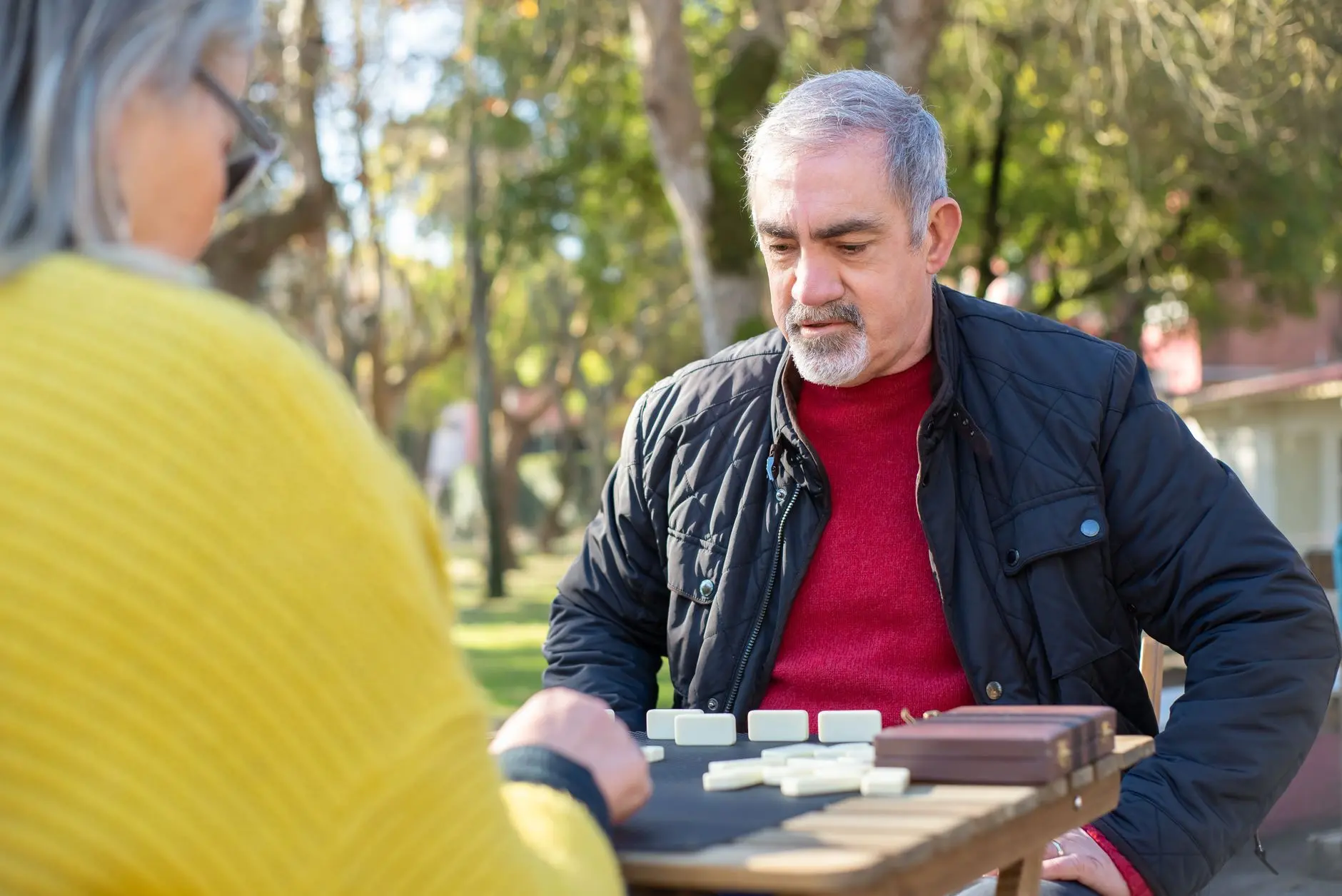
Finding games for seniors that feel genuinely engaging rather than infantilising is harder than it sounds. Too many activity guides reach for oversimplified puzzles or children’s formats dressed up in larger font, which does nobody any favours.
The eighteen games collected here treat older adults exactly as they are: people with rich life experience, sharp opinions, and a healthy appetite for laughter and friendly competition.
Everything on this list works in a seated group setting — a village hall, a care home lounge, a day centre, or a private living room. Most need nothing more than a printed sheet and a willing host.
Several come with ready-to-use printable sheets so you can walk in prepared. Whether you have six players or sixty, you will find something here worth running tonight.
This post contains affiliate links — if you buy through them, I may earn a small commission at no extra cost to you.
Table of Contents
- Memory Lane Trivia
- Name That Tune Their Era
- Guess the Year Photo Round
- Word Association Circle
- Bingo Rounds
- Reminiscence Prompt Cards
- Categories Round
- Picture Round Vintage Items
- Balloon Volley Seated
- Guess the Proverb Ending
- Table Quiz Rounds
- Story Sharing Cards
- This or That: Life Decisions
- Newspaper Headlines Quiz
- Desert Island Choices
- True or False History Statements
- Paired Connections Round
- Around the World in Questions
1. Memory Lane Trivia
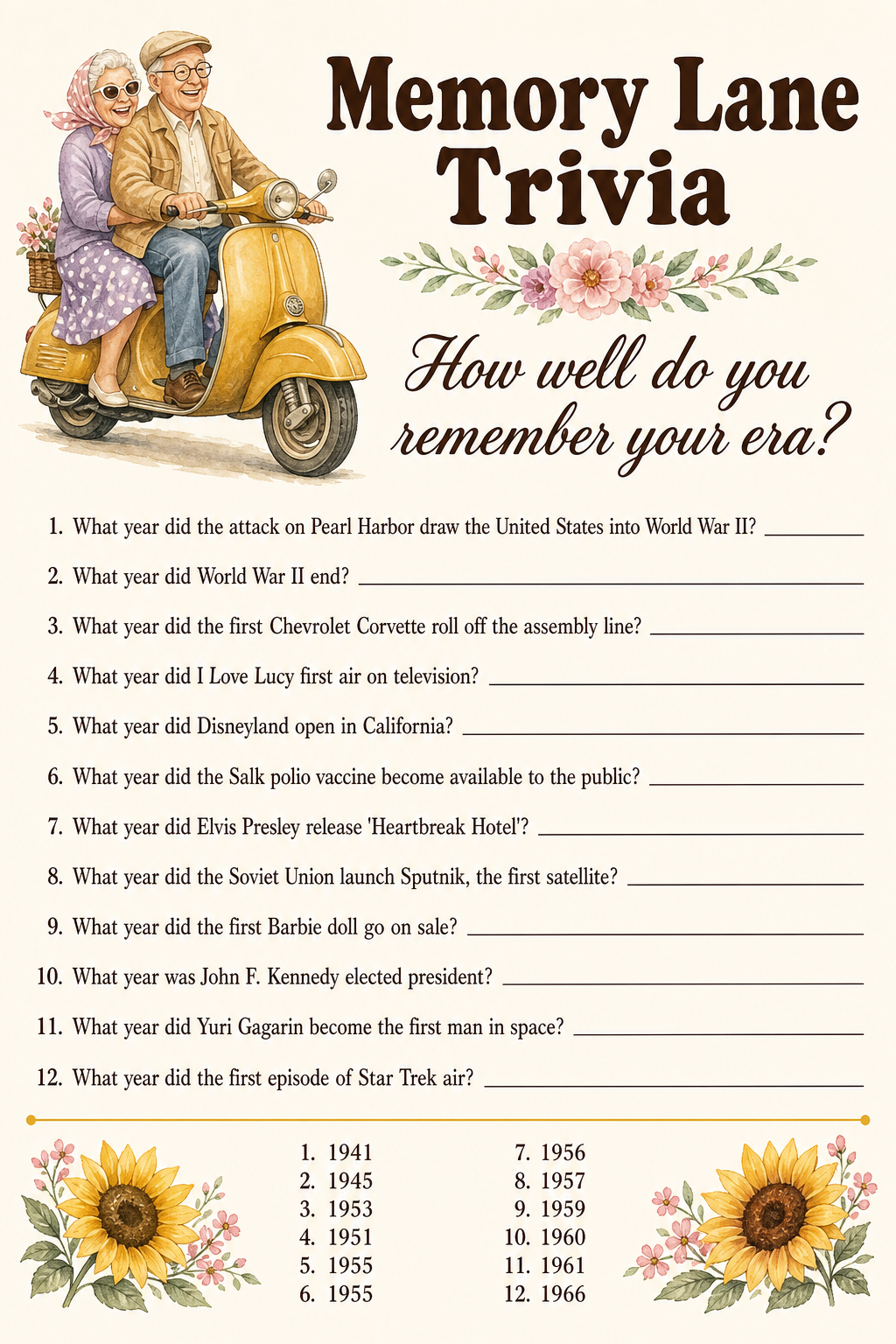
Memory Lane Trivia is a general-knowledge quiz built entirely around the decades your players actually lived through — the 1950s, 60s, 70s, and beyond. Questions cover world events, hit songs, television firsts, and famous faces from eras the group remembers personally rather than historically.
That personal connection is everything: a question about the moon landing or the first colour television broadcast lands very differently when half the room watched it happen.
Print the Memory Lane Trivia sheet and hand one to each table or team of two to six players. Read questions aloud at a comfortable pace, giving players time to discuss their answers before writing them down.
A full round of twenty questions takes roughly thirty minutes, and you can split it into two halves with a natural break in between. Teams tally their own scores, then swap sheets with a neighbouring team for marking when you read out the answers.
Works well for groups of six to forty players, divided into teams. One host tip that only experience teaches: read each question twice, then move on. Waiting too long creates pressure; moving too fast creates frustration. A steady, unhurried rhythm keeps everyone comfortable and the room buzzing.
🛍 Shopping guide
2. Name That Tune Their Era
Name That Tune Their Era is exactly what it promises: short instrumental or vocal clips from the players’ own musical era, played aloud while teams race to name the song and, for a bonus point, the original artist.
The key word is “their” — every clip should come from roughly 1940 to 1985, covering big band, early rock and roll, Motown, folk revival, and classic pop. When the music is genuinely familiar, the room transforms.
People who have barely spoken suddenly start humming along or debating whether that is Doris Day or Vera Lynn.
You will need a device with a speaker loud enough for the whole room, and a playlist prepared in advance. Free streaming services work perfectly well. Play between ten and fifteen seconds of each track, then pause and invite teams to write their answer.
Keep a printed answer sheet handy so you can confirm titles and artists without any dispute. A round of twelve clips runs about twenty-five minutes including deliberation time.
Best for groups of four to thirty. Host tip: line up a few extra tracks as tiebreakers and keep them secret until needed. Tiebreaker rounds during Name That Tune are often the most animated moment of the whole session, so do not waste them by picking songs nobody recognises.

3. Guess the Year Photo Round
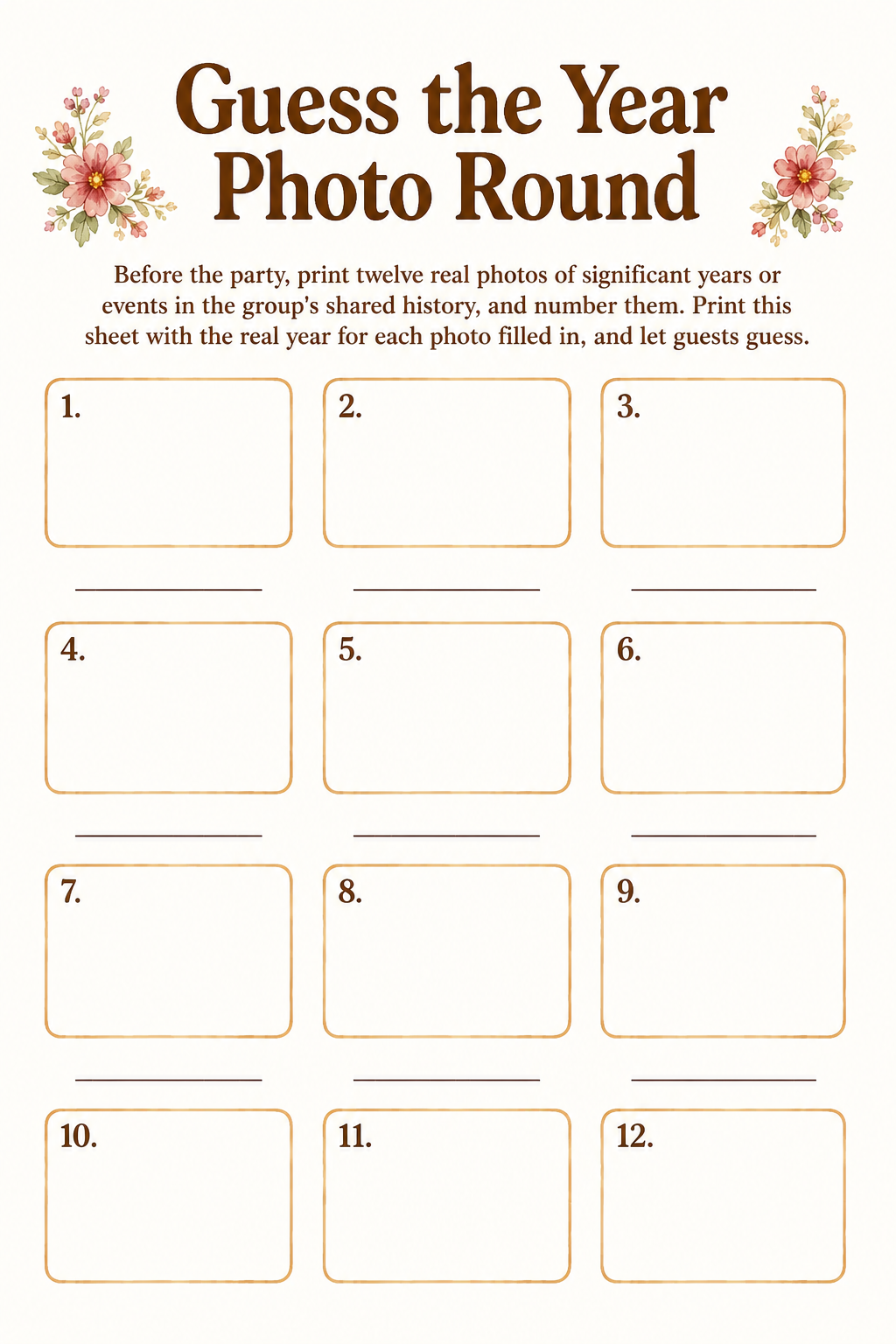
Guess the Year Photo Round presents participants with a series of photographs — vintage street scenes, old advertisements, fashion shots, or news images — and asks them to estimate the year each one was taken.
There is no single correct answer to argue about; instead, the closest guess wins, which means every player is competitive without anyone feeling embarrassed for being wrong.
The conversation that erupts around each image — “that is definitely before decimal currency” or “look at those car fins, that must be the late fifties” — is as valuable as the game itself.
Print the Guess the Year Photo Round sheet, which lays out the images clearly with a numbered answer line beside each one. Players work individually or in pairs, studying each photograph and writing their best estimate.
After all answers are recorded, reveal the actual years and award points on a sliding scale: exact year scores five points, within five years scores three, within ten years scores one. A sheet of ten images takes around twenty minutes to complete.
Ideal for groups of any size from four upward. Host tip: choose images that span a wide range of decades rather than clustering everything in one era, as variety keeps everyone engaged and stops the round feeling repetitive. Avoid images that rely solely on pop-culture references — everyday life scenes prompt far richer discussion.
🛍 Shopping guide
4. Word Association Circle
Word Association Circle is a spoken, no-equipment game that works beautifully as an opener or a palate-cleanser between heavier rounds.
The host calls out a starting word — say, “seaside” — and each player around the circle says the first associated word that comes to mind, building a spontaneous chain.
The rule is simple: your word must connect logically to the word just spoken, not to the original prompt. When someone hesitates for more than three seconds or accidentally repeats a word, they sit out that round and the circle continues.
No materials are needed whatsoever. The host simply needs a list of good opening words to keep several rounds flowing — concrete nouns work better than abstract ones, so “garden,” “kitchen,” “railway,” and “dance hall” all make excellent starting points.
A single round with twelve players lasts about four minutes, so you can easily run five or six rounds in a twenty-minute slot, swapping in players who sat out as the game progresses.
Works for four to twenty players seated in a circle or horseshoe. Host tip: seed the circle thoughtfully.
Placing more confident speakers at intervals around the group ensures no single stretch of the circle goes quiet and no one feels put on the spot by following an especially fast talker. A little quiet stage management before you start pays dividends throughout.
5. Bingo Rounds
Bingo needs no introduction, but this version is worth running well rather than running lazily. Print the Bingo Rounds sheets, which give each player a unique five-by-five grid of numbers, and call numbers at a pace that allows everyone to check their card without rushing.
Traditional bingo calls add warmth and humour — “two fat ladies, eighty-eight” and “legs eleven” are instantly recognised and always raise a smile.
Offer three winning conditions across a session: a line, two lines, and a full house, so there are multiple chances to win and multiple moments of genuine excitement.
You will need the printed sheets, a pen or dauber per player, and a set of numbered balls or a digital caller. Groups of eight to sixty players are all manageable with a single caller.
A full session covering three prize rounds runs comfortably in forty-five minutes, though you can extend it by adding a bonus “pattern” round — such as the four corners — between the main games.
Host tip: keep a duplicate of every number called written on a notepad in front of you. When someone calls “house,” you will need to verify their card against your list, and doing it confidently and quickly — without fumbling through memory — keeps the energy of the winning moment alive rather than deflating it during a slow check.

🛍 Shopping guide
6. Reminiscence Prompt Cards
Reminiscence Prompt Cards are a structured conversation game that uses printed question cards to draw out personal memories and shared stories. Each card poses an open, gentle question: “What was the first home you remember living in like?”
or “Tell us about a journey that surprised you.” Players draw a card in turn, read it aloud, and share their own answer.
Others are welcome to respond if the question prompts their own memories, but no one is ever obliged to share more than they wish. The atmosphere is warm and unhurried, closer to a good fireside conversation than a competition.
The Conversation Starter Cards / Memory Question Cards sheet provides a ready set of prompts. Print and cut them into individual cards before the session, then shuffle and place the deck face-down in the centre of the table.
Groups of four to eight work best for this format, as larger groups mean some voices get lost. Allow thirty to forty-five minutes, though conversations will often run longer if the group is engaged — which is entirely the point.
Host tip: participate yourself rather than sitting back as a pure facilitator. When the host shares a brief, genuine response to a prompt, it signals that the game is a mutual exchange, not an interview, and players who might otherwise hold back become noticeably more forthcoming. Your presence in the circle matters more than your neutrality.

7. Categories Round
Categories Round asks players to name as many items as they can within a given category inside a set time limit.
Call out a category — “types of hat,” “things you would find in a fishmonger’s,” “British prime ministers” — start a sixty-second timer, and let each team shout out answers while one person writes them down.
Points are awarded for each valid answer, with disputed answers put to a quick group vote. The competitive rhythm of the timer creates genuine energy without any physical demands.
Print the Categories Round sheet ahead of time, which lists the categories for the session and provides a writing grid so each team can record their answers neatly. You will also need a timer — a phone works perfectly — and a pen per team.
Four to eight players per team is ideal; groups of up to forty can play across multiple teams simultaneously, all working on the same category before comparing totals. A ten-category round runs about thirty minutes.
Host tip: mix the difficulty of categories deliberately. Alternate a very open category (“things you find in a kitchen”) with a narrower, more challenging one (“words that rhyme with ‘light'”) to create a rhythm that prevents any single team from dominating throughout. The variety keeps every team feeling competitive right up to the final scores.

🛍 Shopping guide
8. Picture Round Vintage Items
Picture Round Vintage Items shows players photographs or line drawings of everyday objects from the past — a mangle, a radiogram, a ration book, a slide rule — and asks them to name each one.
This is not a test of obscure trivia; for many players, these are objects they used personally or watched their parents use daily.
That recognition produces a particular kind of delight: the pleasure of knowing something that younger generations have no frame of reference for at all. It is, quietly, a round that celebrates the players’ own life experience.
The Picture Round: Vintage Items sheet provides a set of clearly reproduced images numbered in order, with a space beside each for the team’s written answer.
Print one sheet per team, hand them out face-down, and give players five minutes to work through all images together before you reveal the answers.
Groups of any size from six upward can play, with two to six players per sheet being the sweet spot for lively team discussion. The round itself runs about fifteen minutes including the reveal.
Host tip: after the answers, invite the group to share a quick story about any object they actually used. “Who had a mangle in their house? What was washing day like?” transforms a quiz round into a genuine reminiscence moment and gives the activity a second layer of enjoyment that no scoring system can match.

9. Balloon Volley Seated
Balloon Volley Seated is the one physically active game in this collection, and it is gentle enough for almost everyone.
Players remain in their chairs, arranged in a circle or across from one another, and the aim is simply to keep an inflated balloon in the air using only their hands.
No standing, no stretching dangerously far — if the balloon drifts out of reach, someone lets it fall and a new round begins.
The game sounds almost too simple, but the combination of light movement, laughter, and collective effort makes it reliably one of the most joyful activities in any session.
All you need is one or two standard round balloons inflated to a comfortable size — not so hard that a tap sends them rocketing, not so soft that they droop. Groups of six to sixteen seated in a reasonably tight circle work best.
A single rally can last anywhere from thirty seconds to five minutes depending on the group’s coordination. Play for ten to fifteen minutes in total, counting how long each rally lasts and trying to beat the previous record.
Host tip: use a pale or brightly coloured balloon rather than a dark one. In a room with varied lighting, a navy or dark green balloon is surprisingly hard to track for people with any degree of visual difficulty, while a yellow or white one stays visible to everyone and keeps the energy inclusive rather than accidentally excluding anyone.
🛍 Shopping guide
10. Guess the Proverb Ending
Guess the Proverb Ending reads the first half of a well-known proverb aloud and asks players to complete it. “A stitch in time saves…” or “Every cloud has a…”
are familiar enough to trigger instant recall for most older adults, while a handful of slightly less common examples keep sharper players on their toes.
The game works beautifully as a team activity — the gentle disagreements about whether the answer is exactly right are part of the charm, and debating the precise wording of a proverb everyone half-remembers is quietly very entertaining.
Print the Guess the Proverb Ending sheet, which lists the opening halves with a blank line for the completion. Teams work through the sheet together, writing their answers before you read out the correct endings.
Award one point per correct completion, with the option to award half a point for answers that convey the right meaning but differ in exact wording — a host judgement call that sparks just enough friendly argument to keep everyone engaged.
A sheet of twenty proverbs takes about twenty minutes.
Groups of four to forty play well, in teams of two to six.
Host tip: include at least two or three proverbs with regional or cultural variations — for instance, Scottish, Welsh, or Northern English versions of familiar sayings — and acknowledge both versions as correct.
It is a small gesture, but players who recognise the variant from their own upbringing light up noticeably.

11. Table Quiz Rounds
Table Quiz Rounds is a structured multi-topic quiz run in the classic pub-quiz style: teams answer questions across several distinct subject rounds, recorded on a printed answer sheet, then swap papers for marking while the host reads out the answers.
The subject matter spans history, geography, sport, music, science, and popular culture from the group’s era — nothing so recent that lived experience counts for nothing.
The format rewards broad general knowledge and rewards teamwork, since a varied team will naturally cover more subject ground than a single player.
The Table Quiz Rounds Answer Sheet gives each team a clean grid to record their answers, one numbered line per question, with round headings printed clearly.
You will need a set of prepared questions — ten per round, four to six rounds — which you read aloud at a steady pace. Groups of eight to fifty players, seated at tables of four to six, work best.
A full four-round quiz with a break after round two runs approximately fifty minutes and feels like a proper event rather than a casual filler.
Host tip: always prepare three or four tiebreaker questions and keep them in your back pocket.
In a well-matched group, ties are common, and a ready tiebreaker that you deliver confidently — rather than scrambling to think one up — keeps the final reveal sharp and satisfying.
Read the tiebreaker to tied teams simultaneously and accept the first written answer handed to you.

12. Story Sharing Cards
Story Sharing Cards invite players to tell a short personal story prompted by a card they draw from a central deck.
Unlike Reminiscence Prompt Cards, which ask reflective questions, Story Sharing Cards set a specific storytelling frame: “Tell us about a time something went completely wrong but turned out fine in the end,” or “Describe a place you visited that surprised you.”
The frame gives even reluctant speakers a clear shape to follow, which lowers the barrier to participation considerably. What emerges is rarely just a story — it is a window into a life fully lived.
Print and cut the Storytelling Conversation Prompt Cards sheet before the session. Place the deck face-down at the centre of the table. Each player draws a card, takes a moment to gather their thoughts — thirty seconds or so — then shares their story.
No timing pressure beyond gentle host nudging if someone speaks at length. Groups of four to eight are ideal; beyond ten the pace slows too much for players waiting their turn. Allow forty-five minutes for a full round.
Host tip: resist the urge to fill silences immediately when someone finishes speaking. A short pause of three or four seconds invites others to respond naturally, and those spontaneous responses — when one person’s story triggers a memory in another — are the most genuine connections the game produces. Jumping in too quickly closes those moments before they can open.
13. This or That: Life Decisions
This or That: Life Decisions presents players with a pair of choices and asks them to pick one and briefly explain their reasoning. The options are not trivial (“tea or coffee”) but genuinely reflective: “Would you rather have travelled more or stayed close to home?”
or “Would you choose to relive your twenties or your forties?” Each question invites a glimpse into how a person thinks about their own life, and the answers — even between people who have known each other for years — frequently surprise.
The game is part quiz, part conversation, and entirely social.
The This or That: Life Decisions printable sheet provides a set of paired options laid out clearly, with space for players to tick their choice and jot a quick note before sharing aloud.
You can run it as a group discussion with everyone responding to each prompt in turn, or as a more structured round where players mark all their answers privately first, then compare.
Groups of four to twelve work beautifully; the format becomes too slow for much larger groups unless you break into smaller tables. Allow thirty minutes.
Host tip: start with a lighter, less personal prompt to warm the group up before moving into more reflective territory. Jumping straight into a question about life’s biggest regrets before the group has found its conversational rhythm tends to produce short, guarded answers. Build trust gradually and the depth of sharing follows naturally.

14. Newspaper Headlines Quiz
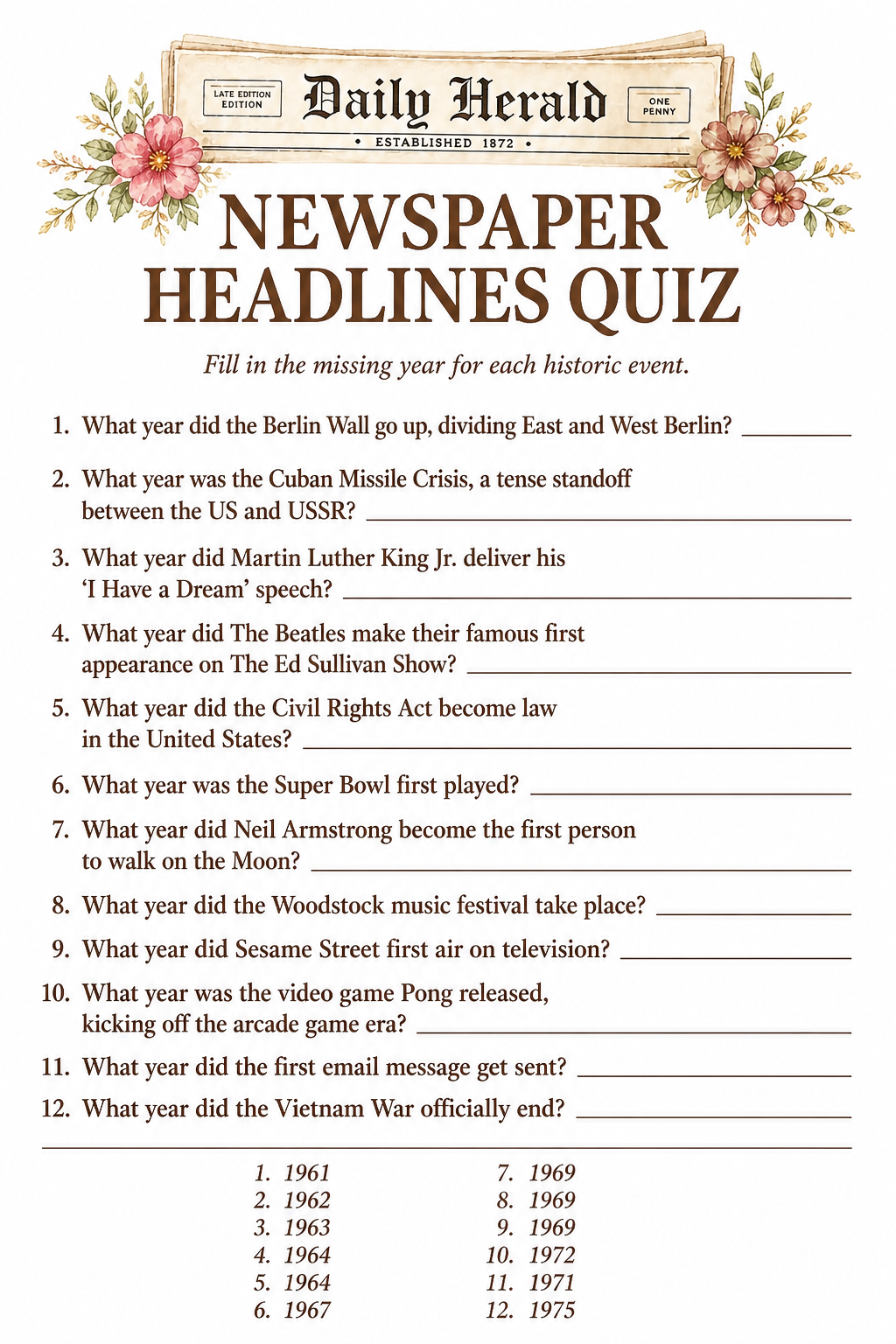
Newspaper Headlines Quiz presents players with real front-page headlines stripped of their dates and asks them to place each headline in its correct decade, identify the event it describes, or name the key figure involved.
“Man Walks on Moon” is too obvious; but “Premier Signs Historic Agreement” or “City Stunned by Shock Result” with supporting details requires genuine recall and discussion. The format rewards players who followed the news throughout their lives, and almost everyone in the room qualifies.
It also sparks rich debate — two people with different political memories of the same event will often have entertainingly different takes.
The Newspaper Headlines Quiz printable sheet presents a set of headlines with numbered answer lines for decade, event, and key name where applicable. Print one per team and allow teams to discuss each headline before writing their answers.
A round of fifteen headlines takes about twenty-five minutes including answer reveal. Groups of six to forty play comfortably in teams of two to six.
Award points for each correct element independently, so a team that gets the decade right but misremembers a name still scores something.
Host tip: include at least two or three lighter, more cheerful headlines among the more serious historical ones. An unexpected sporting triumph or a famously peculiar royal occasion breaks the tone pleasantly and prevents the round from feeling like a history lesson. Variety in tone keeps energy consistent all the way to the final question.
15. Desert Island Choices
Desert Island Choices is a structured group discussion game in which each player is given the classic premise — you are stranded on a desert island and can bring only a limited selection of items, pieces of music, or books — but the conversation is what matters, not the answer itself.
Each player announces their choices and gives a brief reason, then the group responds with questions or gentle challenges: “Why that record above all others?” or “Wouldn’t you want something practical rather than sentimental?”
The format is instantly familiar because the premise has been part of British cultural life for decades, which means very little explanation is needed.
No printed materials are required, though a host with a prepared list of prompting follow-up questions will keep the conversation moving if it stalls.
Groups of four to ten work best for round-the-table sharing; with larger groups, split into smaller clusters and have one person per cluster report back the most interesting choice.
Allow five to seven minutes per player for a full round, or ten minutes of free discussion across the group. Thirty to forty minutes total is a comfortable session.
Host tip: give players two or three minutes of quiet thinking time before anyone speaks.
The richest answers come from genuine reflection rather than the first thing that pops into mind, and a brief silence at the start signals that thoughtful responses are welcome rather than quick ones.
Write a question on a whiteboard or flip chart so players have something to focus on during that thinking time.
16. True or False History Statements
True or False History Statements presents players with a series of historical claims — one sentence each — and asks them to decide whether each one is true or false.
The claims are drawn from the living memory of the group: events, inventions, laws, and cultural milestones from the twentieth century.
Some are straightforwardly true but sound implausible (“The NHS was founded in 1948”); others are beautifully crafted false statements that match the era so closely that confident players second-guess themselves. The format is fast, clear, and reliably generates strong opinions.
No elaborate equipment is needed. The host reads each statement aloud and players — individually or in teams — hold up a card marked “True” on one side and “False” on the other, or simply call out their answer.
Prepare twenty to twenty-five statements in advance, mixing genuine facts with carefully constructed false claims at a roughly even split. A round of twenty statements takes about twenty minutes.
Groups of six to fifty all work well; the larger the group, the livelier the collective reaction when an answer surprises people.
Host tip: after revealing the answer to any particularly contested statement, take thirty seconds to share one extra detail about the real fact. “And do you remember when that happened?” is often enough to open a brief reminiscence exchange that enriches the session without derailing it. Keep those details ready alongside your answer list so you are not improvising mid-game.
🛍 Shopping guide
17. Paired Connections Round
Paired Connections Round gives each team a list of sixteen names, places, or things and asks them to sort them into four groups of four that share a hidden connection.
For example, four things that were rationed during the war, four famous Elizabeths, four things associated with a particular city, four words that follow “post.”
The connections are discoverable by reasoning and shared knowledge rather than specialist expertise, which makes the round accessible while still feeling genuinely satisfying when a group cracks a tricky grouping.
Discussion within each team is the engine of the game — the moment someone spots a connection the others missed is a reliable source of delight.
Print a sheet listing the sixteen items clearly, one sheet per team, with space to write the four group headings and their members.
Teams work through the sheet together for ten to twelve minutes before you reveal the intended groupings and award points — one point per correctly identified complete group, with a bonus point for any team that names the connection precisely.
Groups of four to forty play well across tables of three to six. A single round including reveal and discussion runs about twenty minutes.
Host tip: always build in at least one connection that initially looks obvious but is actually a red herring designed to pull items away from their true group.
The misdirection is the best part of the game for alert players, and the collective groan-and-laugh when it is revealed that they separated the wrong four items is one of the most enjoyable moments a host can engineer.
🛍 Shopping guide
18. Around the World in Questions
Around the World in Questions is a geography-based quiz in which every question has a location as its answer — a country, a city, a river, a mountain range, or a famous landmark.
Questions are framed around memory and lived experience as much as textbook fact: “Which country did rationed goods come from when they finally arrived after the war?” or “Name the European capital where a historic summit took place in 1961.”
Players who travelled, who read widely, or who simply paid attention to the news over sixty-plus years find themselves on genuinely equal footing, and the variety of location scales — from a specific street in a famous city to an entire continent — prevents any single player from monopolising the answers.
Prepare twenty questions in advance, printed or simply read aloud, and have teams record their answers on a plain sheet of paper or a printed answer grid.
A world map displayed at the front of the room — a large printed poster or a projected image — adds a visual element that makes the reveal more satisfying: players can watch their answers being pointed out.
Groups of six to fifty play comfortably in teams of three to six. A full round takes roughly thirty minutes including answer reveal.
Host tip: weight the questions toward Europe, the Commonwealth, and the United States rather than globally even coverage, because those are the geographies most likely to be familiar to your players from their own travels, news reading, and family connections.
A question about a capital city your players have actually visited produces a far warmer response than one about a place no one in the room has any personal connection to.
🛍 Shopping guide
Frequently Asked Questions
How long should a games session run for seniors in a group setting?
Most facilitators find that sixty to ninety minutes is the sweet spot for a group session. Within that window, aim for two or three different games with natural breaks in between rather than playing one game continuously.
Varying the format — a quiz round, then a spoken discussion game, then something with a physical element like Balloon Volley — keeps energy up without overextending anyone’s concentration or comfort.
Do all players need to be able to read and write to participate?
Not necessarily. Many of the games here — Word Association Circle, Name That Tune Their Era, Desert Island Choices, and True or False History Statements — are entirely spoken.
For printable rounds, a host or volunteer can act as the team scribe, allowing players to contribute answers verbally without needing to write anything themselves. The important thing is to frame this naturally so no one feels singled out.
What is the best way to handle players with hearing difficulties?
Speak clearly and face the group directly when reading questions. For larger rooms, a simple portable speaker connected to a microphone makes a significant difference.
For printable rounds, having the questions printed on the sheet as well as read aloud means players who miss a word can read it themselves without having to ask for a repeat, which many find more comfortable.
How do you keep competitive games from becoming excluding for less confident players?
Team formats help enormously — when answers come from a group discussion rather than an individual, no single person feels exposed by not knowing.
Awarding points for partial answers (getting the decade right even if the exact year is wrong, for instance) keeps more players scoring throughout the session.
And framing the host’s role as celebratory rather than judgmental — praising good reasoning even when the answer is technically wrong — sets a tone that keeps everyone glad they played.
Can these games work for players with mild cognitive difficulties?
Several of them work very well indeed. Reminiscence Prompt Cards, Story Sharing Cards, and This or That: Life Decisions draw on long-term autobiographical memory, which often remains more intact than short-term recall. Balloon Volley Seated provides gentle physical engagement without cognitive pressure.
For players with more significant difficulties, adapting games so that there is no wrong answer — treating every contribution as valid — keeps the experience positive and participatory.
📌 Save These for Later
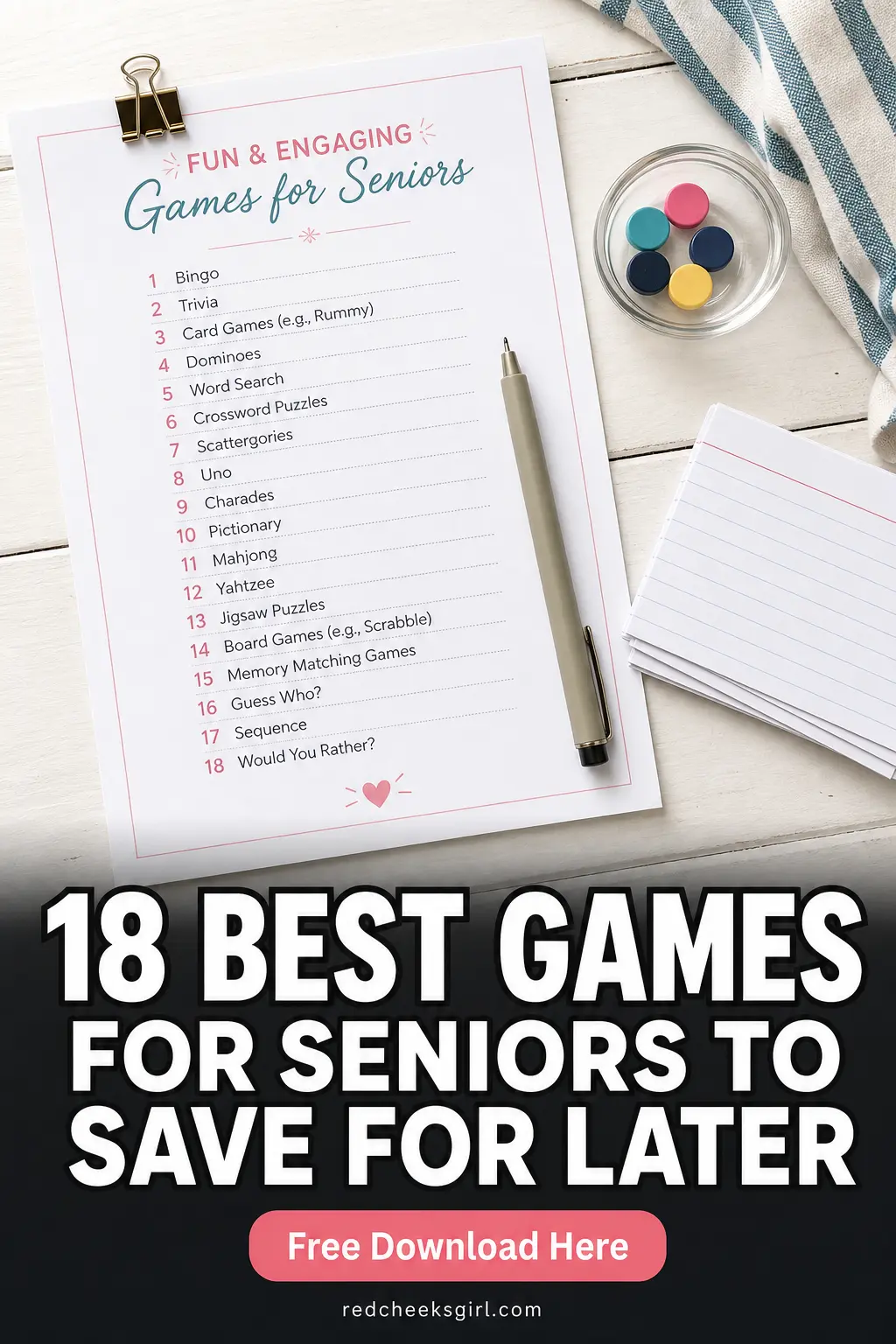
Loved these? Pin your favorite image below so you can find this list again when you’re planning.
Friendsgiving games for adults that work while everyone's still eating. 9 free printables plus 11 no

72 difficult would you rather questions where both options cost something. Six escalating rounds, ba
Laugh harder with 72 funny truth or dare questions for teens: absurd hypotheticals, group dares, imp
Leave a Reply