

20 Friendsgiving Games for Adults Who Hate Icebreakers, With Free Printables
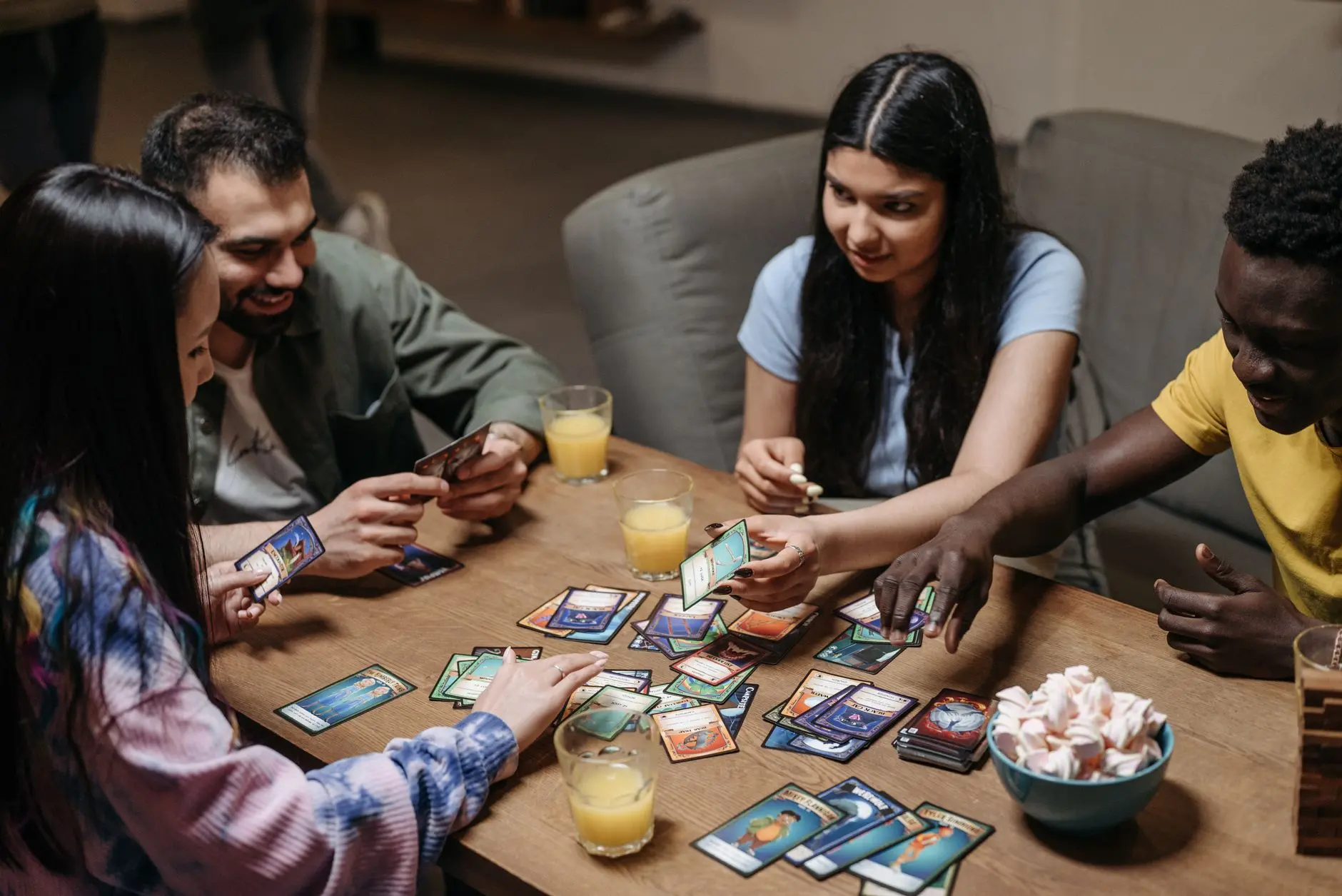
The best friendsgiving games for adults are the ones nobody has to announce. They live on the table, they start themselves, and by the time the green bean casserole is gone, people who arrived as strangers are finishing each other’s sentences. This list runs 9 printable sheets first, each ready to cut and place before guests arrive, then 11 games that need nothing but the people already in the room.
This post contains affiliate links. If you buy through them, I may earn a small commission at no extra cost to you.
- Friendsgiving Trivia
- Who Said It at the Table
- Guess the Dish
- Two Truths About This Year
- Thankful or Not
- Table Topics Deck
- Predictions for Next Year
- Friendsgiving Bingo
- Group Scorecard
- Pass the Compliment
- Name That Side Dish With Eyes Closed
- The Toast Relay
- A Story Built One Sentence at a Time
- Rank the Pies
- Phone Photo Challenge
- Who Brought What, Memory Round
- Categories, Autumn Edition
- Last One Laughing
- The Gratitude Chain
- The Unpopular Opinion Round
- Frequently Asked Questions
1. Friendsgiving Trivia
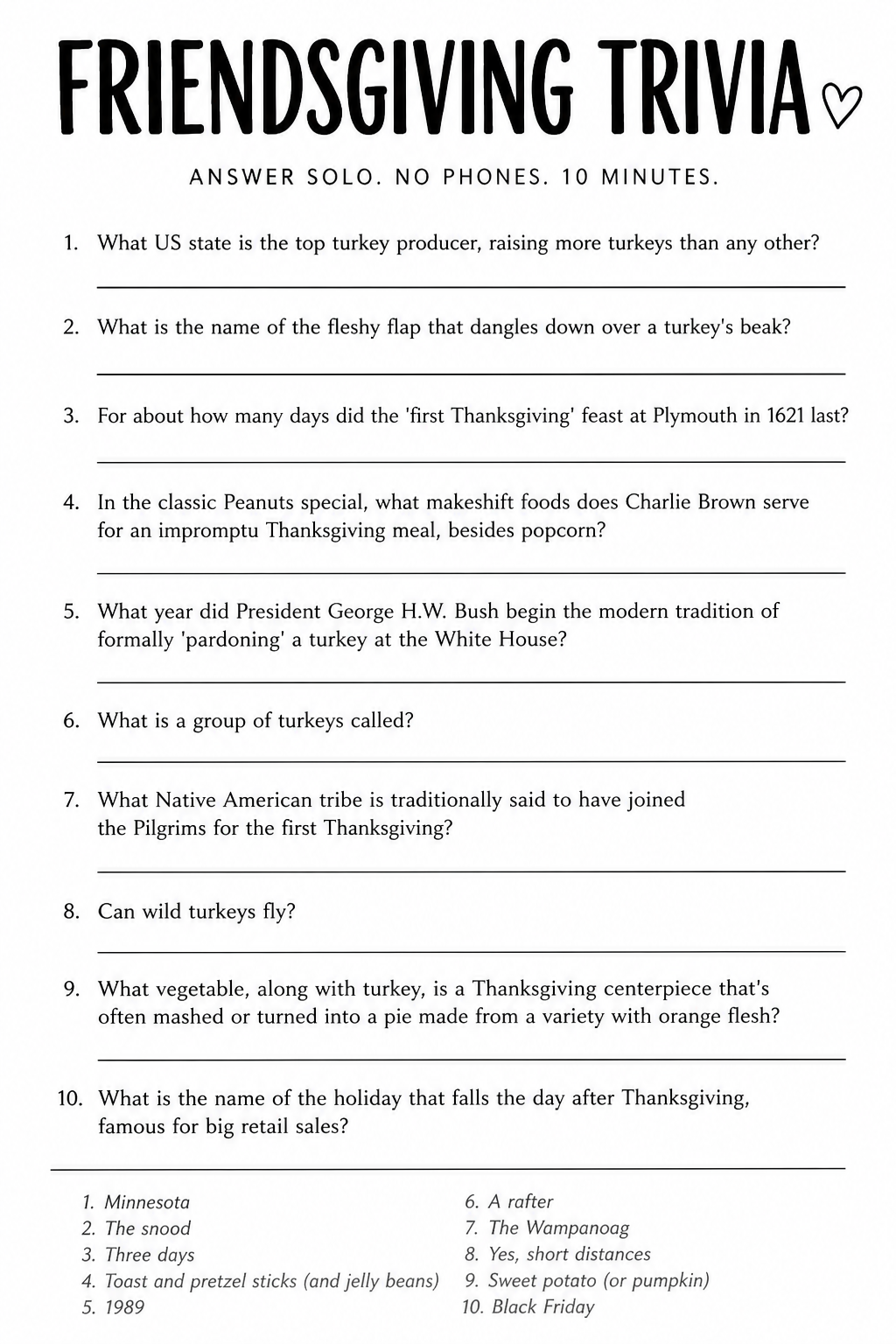
Each guest gets a quiz sheet face-down at their place setting. When the host flips them over, everyone answers solo, pencil on paper, no phones. Questions cover the actual history of Thanksgiving, wild food facts, and pop-culture moments every adult at this table probably knows: the WKRP turkey drop, the Friends couch-pivot episode, the year cranberry sauce was first canned.
Twenty questions fit on one sheet. Allow ten minutes during the appetizer course, then read the answer key aloud with commentary. The host scores by show of hands and marks a shared tally on the Group Scorecard poster. One question per round tends to spark a three-minute argument, which is exactly the point.
The most common snag: someone finishes in four minutes and starts coaching their neighbor. Print a note at the bottom of the sheet reminding guests to keep answers covered until time is called. A kitchen timer on the table removes the need to nag.
Read the answer key out loud and let wrong answers get argued: that is where the conversation starts.
🛍 Shopping guide
2. Who Said It at the Table
Before the party, the host texts every guest one question: ‘What is the most Thanksgiving thing you have ever said or done?’ Guests reply by message, and the host types all responses anonymously onto the quiz sheet. At the table, everyone tries to match quote to person. It sounds simple and plays like a revelation.
Print one sheet per guest. Allow five minutes to fill in their guesses, then go around the table so each person claims their own quote. Tally correct matches on the Group Scorecard. The game works with as few as six guests and scales easily to a table of twenty because the sheet is already printed.
The setup risk is that two guests send nearly identical answers. If that happens, combine them into one entry and note ‘said by two people’ so both still get a moment. Give the host a pen at the table to add a last-minute quote from someone who forgot to reply.
- Guest quotes collected by text before the party
- One printed sheet per guest
- Pencils at each place

🛍 Shopping guide
3. Guess the Dish
Six cards per sheet, each with the name of a dish in large type and three blanks below: ‘Who made it:’, ‘Main herb or spice:’, ‘Secret ingredient:’. Guests pick up a card for each dish on the table and fill in their best guesses before tasting. After the meal, the cook of each dish reads out what actually went in. The person closest on all three fields wins a point.
Cut and place one card per dish. The cards are small enough to prop against serving bowls. This game runs itself during the meal with zero hosting required, which is the whole point when she is also in the kitchen.
If two people made the same dish (two stuffing camps is a classic Friendsgiving situation), give each dish a number and label the cards accordingly. The rivalry this creates is its own entertainment.
- Tables where multiple people cooked
- Potluck-style Friendsgivings with 6+ dishes

🛍 Shopping guide
4. Two Truths About This Year
A grownup twist on the classic format, anchored to the calendar year. Each card prompts: ‘Write two true things that happened to you this year and one that did not.’ Guests fill their cards during the appetizer course, then cards are collected, shuffled, and read aloud one at a time. The table votes on which statement is the lie.
Six cards per sheet means one sheet covers a small table. For larger groups, print two sheets. Cards are small enough to sit at each place with a golf pencil tucked under them. The whole reading round takes about fifteen minutes and works perfectly as a dessert-course game.
The real problem to solve: some people write three equally plausible truths by accident. Add a note on the card: ‘Make the lie at least a little tempting.’ That single line dramatically improves the guessing quality.
Put a golf pencil under each card before guests arrive so there’s no hunting for a pen mid-dinner.

🛍 Shopping guide
5. Thankful or Not
Cards listing twenty things that might or might not deserve gratitude: pumpkin spice season, daylight saving ending, the family group chat, working from home, sports that interrupt dinner, unsolicited cooking advice. Guests circle T (thankful) or N (not) for each one, then compare with their neighbors. No right answers, maximum disagreement.
Six cards per sheet, one per guest. This one plays itself: guests pick it up, start circling, and immediately start pointing at each other’s answers. It is the lowest-lift game on this list because the host does nothing after printing.
Keep the list honest, not saccharine. One or two genuinely divisive entries, like ‘the friend who always brings the same dish every year’, will get audible reactions. That is the game working exactly as intended.
No teams, no timers, no instructions needed. Guests pick it up and it starts itself.

6. Table Topics Deck
Two sheets, twelve cards each, twenty-four questions in total. These are not icebreaker questions. They are specific, slightly uncomfortable, genuinely interesting: ‘What is the most expensive meal you have ever eaten, and was it worth it?’, ‘What tradition did you quietly drop this year and why?’, ‘What is the one food you pretend to like for social reasons?’ Anyone at the table can pull a card and read it aloud at any point during the meal.
Print both sheets on cardstock and cut. Stack the deck and leave it in the center of the table in a small bowl or under a chalkboard sign that says ‘pull one any time.’ No host direction needed, no rounds, no scoring. The deck runs on its own rhythm.
The variation that works especially well for tables with strangers: pull a card, answer it yourself first, then invite anyone to respond. It removes the pressure of being put on the spot without losing the intimacy.
Write ‘PULL ONE ANY TIME’ on a small chalkboard and set it next to the deck so guests self-serve without being directed.

🛍 Shopping guide
7. Predictions for Next Year
One card per guest, left at their place setting. Each card has six prompt lines: a trip they predict they will take, a food they will finally learn to cook, a habit they will actually keep, a person at this table they predict will have the biggest news, the worst thing that will happen in pop culture, and one thing about next Thanksgiving they cannot see yet. Guests fill them out, seal them in a provided envelope with their name on the front, and the host keeps the stack to open at next year’s Friendsgiving.
This is a one-per-guest sheet, not a 6-up card set. Print as many as you have guests. The envelopes are the critical supply: without them the ritual falls apart. Small coin envelopes from a craft store work perfectly and cost almost nothing.
The reading-aloud moment next year is the payoff. But even if the group never meets again, the cards are a genuine keepsake. People tend to keep them.
- One printed card per guest
- One small envelope per guest
- A pen at each place

🛍 Shopping guide
8. Friendsgiving Bingo
Four different bingo cards per sheet, each with a 5×5 grid of things that will almost certainly happen at this table: ‘someone mentions their diet’, ‘a dish arrives cold’, ‘a political opinion escapes’, ‘someone falls asleep on the couch’, ‘the turkey is called dry’. Guests mark squares as events unfold over the course of the evening. No caller needed. The table self-polices.
Print one sheet and cut into four cards, or print multiple sheets for a larger group. Guests keep their card all evening. The first person to get five in a row announces bingo and wins whatever the host has designated as a prize, even a leftover roll works as a joke prize.
The winning tweak: put one extremely unlikely square on every card (‘the host sits down for more than five minutes’) so the game never ends too fast. It keeps people watching each other all night.
- Groups of 8 or more
- Long evenings where people drift between the table and the couch

🛍 Shopping guide
9. Group Scorecard
A single large poster that hangs or props near the table, with a column for each guest’s name and a row for each scored game: Trivia, Who Said It, and any others the host chooses to track. Points accumulate across the evening. No individual score matters much, but having a visible running total keeps people engaged between games.
Print on the largest paper available, ideally 11×17, or tile two Letter sheets. The host updates it with a marker after each game result. A small chalkboard works as a substitute if printing feels like too much effort.
The scorecard has a second function: it forces the host to learn every guest’s name before the party, which solves the plus-one problem more efficiently than any icebreaker.
- 11×17 paper or two taped Letter sheets
- A thick marker for scoring
- Painter’s tape or a small easel to display it

🛍 Shopping guide
10. Pass the Compliment
No printing needed. Someone starts by turning to the person on their left and giving them one specific, genuine compliment, not ‘you look great’ but something observed: ‘you always remember what I told you last year’, ‘you make this table feel easy.’ That person then turns to their left and does the same. The round travels the whole table.
This works best right before dessert, when the meal has loosened everyone up but the evening still has momentum. It takes about four minutes for a ten-person table and leaves the room noticeably warmer. No timer, no prizes, no host management required.
The one thing to avoid: announcing it as a gratitude exercise. Frame it as a game. ‘We’re going to pass a compliment around the table’ lands better than anything involving the word ‘share.’
Start the round yourself with a specific, non-generic compliment: it sets the tone for everyone who follows.
11. Name That Side Dish With Eyes Closed
One volunteer closes their eyes or puts on a sleep mask. The host spoons a small amount of a side dish onto a tasting spoon and the volunteer identifies it by smell and taste alone. The table watches, calls out hints if the host allows, and places side bets on whether the volunteer will get it. Three volunteers per round keeps it moving.
This works mid-meal when the dishes are still out and warm. It needs no prep beyond a sleep mask or a folded napkin over the eyes, a spoon, and the food already on the table. Allow thirty seconds per guess before the table can give one clue.
The game gets exponentially funnier when two versions of the same dish are on the table. Two stuffings, two cranberry sauces, or two gravies become an instant blind taste-off that the cooks take very seriously.
- A sleep mask or folded napkin
- A tasting spoon
- At least 4 different side dishes on the table
🛍 Shopping guide
12. The Toast Relay
The host raises a glass and makes a toast that ends on a specific word or name, then points to the next person who must immediately continue with their own toast that picks up from that word. The chain travels around the table. No preparation, no notes. Just the pressure of a glass raised in your direction and a table watching.
One full circuit of a ten-person table takes about six minutes and generates at least two toasts someone will quote for years. Keep the relay moving fast: if someone pauses for more than five seconds, the table counts down from five out loud.
The variation for shy guests: allow any person to ‘pass’ by simply toasting ‘to the person next to me’ and pointing. It lowers the barrier without breaking the chain, and the passed-to person usually rises to the moment.
- Tables where at least a few people are naturally funny or verbose
- The moment right after the main course is served
13. A Story Built One Sentence at a Time
The host opens with one sentence of a completely absurd Thanksgiving story: ‘The turkey had been missing for three days, and everyone suspected Gerald.’ Each person around the table adds exactly one sentence, picking up wherever the last person left off. The only rule: no ending the story. It can get as strange as the table allows.
This one runs for about eight minutes for a ten-person table and works best once drinks have been refilled. The host simply listens and lets it go wherever it goes. No judging, no steering, no prizes.
For a table with quieter guests, let people write their sentence on a napkin instead of saying it aloud, then the host reads the collected sentences as one continuous story. The written version is often wilder than the spoken one.
It pulls in the plus-ones who have been listening quietly because their sentence is just one line, not a speech.
14. Rank the Pies
Every pie on the dessert table gets a number card. Each guest ranks them privately on a napkin or scrap of paper: 1 for favorite, descending from there. The host collects all rankings, adds the scores (lowest total wins), and announces the winner. The baker of the winning pie gets to leave with the best leftovers container.
This works as a dessert-course game with zero setup beyond the number cards, which can be torn pieces of paper. It takes about twelve minutes including eating time. Tie-break: sudden-death re-taste.
One honest warning: if someone brought a pie that ranks last, they will know. Keep the individual ballots anonymous and only reveal the final tally, never whose ballot said what. This protects feelings while still crowning a winner.
Keep individual ballots secret. Announce totals only, not who ranked what.
🛍 Shopping guide
15. Phone Photo Challenge
The host calls out a category and everyone has sixty seconds to find the best photo on their phone that fits it. Categories: oldest photo on your phone, most embarrassing food photo, a trip that did not go as planned, a photo that explains your year without words. The table votes by pointing at the person whose photo wins each round.
A kitchen timer running keeps the sixty seconds honest and stops people from scrolling endlessly. Five rounds take about twelve minutes. No app, no shared album, no tech setup: people just hold up their phones and the table judges.
Warn guests in advance that they will be showing their screens. This is not about posting anything, just showing. That distinction matters to some people and removing the confusion upfront prevents hesitation during the game.
- A kitchen timer
- 5 category prompts written on a card or called out by the host
🛍 Shopping guide
16. Who Brought What, Memory Round
After dinner, once the dishes are cleared or covered, the host asks rapid-fire questions about the meal: ‘Who brought the green beans?’, ‘What was in the stuffing?’, ‘How many dishes had cheese in them?’ Guests answer by shouting or raising a hand. First correct answer gets a point on the Group Scorecard.
This takes zero prep because the game content is whatever was just on the table. Run about fifteen questions in eight minutes. The host needs to know all the answers, which means a quick chat with cooks during setup.
The round works especially well for surfacing the plus-ones as experts: if someone came with a baker, that person knows their partner’s dish cold. Suddenly they are winning rounds in a room full of strangers. That dynamic is worth engineering.
Ask a few cooks quietly before dinner what went into their dish: you need the answers ready before the round starts.
17. Categories, Autumn Edition
The host names a category and everyone takes turns calling out items in it without repeating or hesitating. Autumn categories: things you can do with a pumpkin, things sold at a farmers market, movies set in autumn, reasons people are late to Thanksgiving dinner, excuses for a second helping. Anyone who hesitates for more than three seconds or repeats an answer is out.
One round per category, three to five categories per game, and the whole thing runs in about ten minutes. It is loud, fast, and keeps the energy up after the food coma threatens to set in. A kitchen timer for the hesitation rule removes any argument about what counts as too long.
For a table that does not know each other well, use easier categories first: things on the table right now, things you are grateful for that are not people. Save the harder categories for when the room is warm.
- The post-dinner lull
- Waking up a table that has gone quiet after dessert
🛍 Shopping guide
18. Last One Laughing
One person keeps a completely straight face while the rest of the table tries to make them laugh using only words, not touching, not physical comedy, just talking. They have sixty seconds. If they crack, they take a point against them. The person with the fewest points after everyone has had a turn wins.
This is pure chaos for about fifteen minutes and works especially well once the table has relaxed and people know each other’s pressure points. The host sets the timer and tracks points on the Group Scorecard. No other equipment needed.
The rule about words only matters. Physical comedy makes it too easy and tends to escalate. Keeping it verbal is what makes the game clever rather than just loud. If someone touches the straight-faced player, the round resets.
- One person keeps a straight face for 60 seconds
- Everyone else talks, jokes, or stares: no touching
- First to laugh loses the round and takes a point
- Lowest total points after all rounds wins
🛍 Shopping guide
19. The Gratitude Chain
Starting with the host, each person says one thing they are genuinely grateful for this year and then names the person across or beside them who they predict will have the most interesting answer. That named person goes next and does the same. The chain is not sequential around the table: it jumps, which keeps everyone paying attention.
This runs in about eight minutes for twelve people and works at any point in the evening, but lands best right before the toast relay or immediately before dessert. No materials, no prep. The host simply starts it and then stays out of the way.
The naming mechanic is the design move that makes this work: people stay alert because they might be called on at any moment, and the plus-ones get called by name by someone who just heard their gratitude. That is a better introduction than any icebreaker on the market.
Calling someone by name after hearing their gratitude is the fastest warmth-builder at a table of strangers.
20. The Unpopular Opinion Round
Each person states one food or holiday-related opinion they know is unpopular but hold anyway. The table votes thumbs up (they secretly agree) or thumbs down (genuinely shocked). The person who gets the most thumbs-down votes wins the round. The person who gets the most thumbs-up despite calling it unpopular wins the meta-round, because it turns out they are not alone.
Allow one pass per player for anyone who genuinely cannot think of anything controversial. But in practice, the hard part is stopping people from going twice. Run the round in under ten minutes by keeping it to one opinion per person per circuit.
Suggested openers to get it started: ‘Stuffing is filler and should not have its own dish’, ‘Pumpkin pie is the worst pie on this table’, ‘Thanksgiving should skip straight to Christmas.’ Any of those will ignite the room immediately.
Go first with a genuinely spicy opinion. A host who hedges produces a room that hedges.
Frequently Asked Questions
What friendsgiving games work while people are still eating?
Anything that lives on the table and does not require standing up or paying full attention. Bingo cards, Thankful or Not, and Guess the Dish all run themselves during the meal. The Table Topics deck works throughout dinner because guests pull a card whenever there is a lull, no host direction needed.
How do you include plus-ones nobody knows without making it awkward?
Games that give strangers something to do with their hands help: filling in a bingo card or a Two Truths card removes the pressure of eye contact. The Gratitude Chain is specifically designed to pull in new people by calling them by name, which is the fastest social integration trick at a dinner table.
How many games should you actually plan for a Friendsgiving?
Three to five across the evening is plenty. One table game during dinner (bingo or Thankful or Not), one group game before dessert (toast relay, categories), and one closer (gratitude chain or unpopular opinions). Having more printed and ready is fine: you will not use everything, and that is a success, not a failure.
What is a good Friendsgiving game for a large group?
Friendsgiving Bingo scales to any size because each guest holds their own card and marks it independently. Phone Photo Challenge and Categories both work for large tables because they are fast, loud, and do not require everyone to be heard at once. The Group Scorecard keeps the evening tied together regardless of group size.
Do you need prizes for Friendsgiving games?
Not really. Bragging rights and a running tally on the Group Scorecard carry most games just fine. If you want a prize, keep it one: a good bottle of something, the best leftovers container, or the right to skip dish duty. Multiple prizes slow down the evening and shift the tone toward a game show.
What paper and supplies do you need to print these games?
Cream or kraft cardstock in standard 8.5×11 prints sharper than regular copy paper and holds up through a long dinner. A paper trimmer cuts cards cleaner than scissors. For writing on the cards, golf pencils or fine-tip black markers work best. The Group Scorecard ideally prints on 11×17, but two taped Letter sheets work just as well.

72 would you rather questions for friends that split every room. Six rounds, printable card sheets,

20 icebreaker games for adults that actually work — perfect for work groups, with printable questi

Fresh good Never Have I Ever questions sorted into 6 rounds. Skip the tired ones and play 72 stateme
Leave a Reply