


Let’s be honest: most icebreaker games for adults make everyone want to slide slowly under the conference table.
You know the ones — ‘go around the room and share a fun fact about yourself’ while twelve people visibly panic and someone says ‘I like pizza’ so they can get it over with. Been there. Survived it. Vowed to do better.
That’s exactly why this list exists: twenty genuinely fun icebreaker games for adults that skip the cringe, spark real conversation, and actually get a work group talking instead of just tolerating each other until the coffee arrives.
Whether you’re kicking off a team day, welcoming new hires, or just trying to make a staff meeting feel less like a hostage situation, there’s something here for every group size and comfort level.
Best of all, thirteen of these come with a printable question pack or game sheet you can download and print on cardstock tonight — because the best parties (and the best meetings) are the ones where someone came prepared. Let’s go.
This post contains affiliate links — if you buy through them, I may earn a small commission at no extra cost to you.
- Two Truths and a Lie
- Never Have I Ever (Work-Safe)
- Guess the Coworker
- Human Knot
- Speed Networking Round
- Human Bingo Sheet
- Would You Rather (Work) Cards
- This or That Sheet
- Conversation Starter Cards (Deep)
- Find Someone Who Sheet
- Get-to-Know-You Question Sheet
- Two Truths and a Lie Sheet
- Question Dice Sheet
- Team Name Sheet
- Icebreaker Trivia Sheet
- Guess the Coworker Sheet
- Introduce Your Partner Sheet
- Name Tag Templates
- Win of the Week Share
- One Word Check-In
- Frequently Asked Questions
1. Two Truths and a Lie
Two Truths and a Lie is the icebreaker game for adults that basically everyone has heard of — and yet it still delivers every single time, because people are endlessly surprising.
Each person shares three statements about themselves: two that are completely true and one that is an absolute lie. The rest of the group debates, argues, and tries to sniff out the fake.
Spoiler: the quiet person who ‘seems so normal’ is almost always hiding the wildest truth.
No supplies needed whatsoever — just people and a few minutes of thinking time. Give everyone 90 seconds before you start to jot down their three statements on a scrap of paper so they’re not put on the spot.
Go around the group one at a time; after each person reveals their lie, open it up for reactions. That moment of ‘WAIT, that was TRUE?!’ is where the actual conversation starts and the ice genuinely breaks.
The reason this one has stuck around since the dawn of team-building time is that it does two things at once: it teaches people something real about their coworkers, and it gives everyone permission to be a little theatrical and playful.
For a fun variation at larger events, have people write their statements on index cards and mix them all up — then read them aloud and vote as a whole room on who wrote what before revealing the author. Chaos, laughter, connection.
Your work group will thank you.
Give 90 seconds of quiet writing time before starting — it takes the pressure off and leads to much more creative lies.
2. Never Have I Ever (Work-Safe)
Never Have I Ever has a reputation for being a party game that gets a little too real a little too fast — but the work-safe edition is genuinely one of the best icebreaker games for adults in a professional setting when it’s done right.
Players take turns saying something they’ve never done (work- and life-appropriate, of course), and anyone who has done it raises their hand or holds up a finger.
It surfaces shared experiences you’d never discover in a normal introduction round, like the fact that four people on your team have all slept through an international flight connection.
Set the tone right at the start: keep prompts professional and inclusive — think ‘Never have I ever presented to a room of 100+ people,’ ‘Never have I ever accidentally replied-all,’ or ‘Never have I ever eaten lunch at my desk every single day for a full week.’
You can use a show-of-hands format for big groups or the classic ‘hold up ten fingers and put one down’ version for smaller circles. Either way, you’ll get audible gasps and laughter within the first three rounds, guaranteed.
What makes this format secretly brilliant for work groups is that it reveals who people are without anyone having to give a rehearsed self-introduction.
When you see six hands shoot up for ‘never have I ever started a job and realized it was nothing like the description,’ that shared moment of solidarity does more for team culture than any offsite could.
Keep a list of backup prompts handy — the game picks up momentum fast once people get comfortable.
- Teams of 8–25
- New hire orientations
- Department kick-off meetings
- Any group that groans at the words ‘let’s go around the room’
3. Guess the Coworker
Guess the Coworker is exactly what it sounds like, and it is SO much fun.
Before the event, you collect one surprising, funny, or little-known fact from each participant via a quick email or Google Form — think ‘I once won a regional pie-eating contest’ or ‘I taught myself to juggle during a particularly slow quarter.’
On the day, you read the facts aloud one by one and the group tries to guess which coworker submitted it. The more unexpected the facts, the better the game.
Prep is simple: send a one-question prompt a few days ahead (‘What’s one thing your coworkers would never guess about you?’) and collect responses anonymously.
During the game, read each fact aloud and give the group 30 seconds to discuss and submit their guess — raise of hands, a sticky note, or a quick shout-out all work fine. Reveal the answer after each round with maximum dramatic pause for effect.
The person with the most correct guesses wins a small prize (think: first pick of the snack table, which is a serious incentive tbh).
This game is especially powerful for teams that have worked together for a while and think they already know each other.
They almost always don’t — and discovering that the most soft-spoken person on your team once backpacked solo across three continents completely rewrites how you see them. That’s the magic.
It also works brilliantly as a hybrid format: remote colleagues submit facts too and everyone guesses on screen together, no one left out.
Send the fact-collection form at least 3 days early so you’re not chasing people down the morning of the event.
4. Human Knot
Human Knot is the icebreaker game that sounds mildly alarming when you describe it but becomes the highlight of the morning the second everyone gets tangled together.
Everyone stands in a circle, reaches both hands into the middle, and grabs two different hands belonging to two different people across the circle — crucially, not the people standing directly next to them.
Within about fifteen seconds the group is a spectacular tangle of arms and bodies that looks completely unsolvable. The challenge: unravel yourselves back into a clean circle without anyone letting go of a single hand.
Group size matters here — eight to twelve people per knot is the sweet spot. Bigger than that and the puzzle becomes genuinely chaotic in a non-fun way, so split larger teams into competing groups of ten and race to see who untangles first.
The only rule besides ‘don’t let go’ is that participants shouldn’t grab the hands of the people immediately beside them, or the knot is too easy.
Give a clear demo before you start, and keep a mental note of the opt-out option: a length of rope can substitute for hand-holding for anyone with mobility needs or personal space preferences.
Here’s why Human Knot earns its spot on every serious list of icebreaker games for adults: it forces real-time problem-solving communication in a way that no question prompt ever could.
You cannot untangle a knot while ignoring the person on the other end of your arm — and that’s the entire point. The debrief afterward (‘What strategies worked? Who took the lead? When did you get stuck?’)
links directly to how the team collaborates back at work. Plus, someone always ends up face-to-face with their boss in an extremely awkward pose, and that shared laugh is priceless.
Offer a rope-loop variation for anyone who prefers not to hold hands — the game works identically with each person holding a section of loop instead.
5. Speed Networking Round
Speed Networking Round is basically speed dating for professional conversation, and once you run it once you will use it at every single event forever.
Participants pair up face-to-face (think two concentric circles or two rows of chairs facing each other), get a timed two-minute window to chat using a prompt you provide, and then one row rotates so everyone meets someone new.
You move through the whole room in 20–30 minutes and everyone walks away having had an actual conversation with every other person in the group. No awkward hovering near the drinks table required.
The secret ingredient is the prompt card. Generic ‘tell me about yourself’ does not work here — give each round a specific question: ‘What project are you most proud of from the past year?’
followed by ‘What’s one skill you wish you’d learned earlier in your career?’ followed by ‘What’s your most-used shortcut, app, or system that makes your work life easier?’
Rotate questions each round by posting them on a screen or handing out a printed card so every conversation has a fresh starting point. A timer app with a loud bell keeps the energy high and stops any one pairing from monopolizing the floor.
Speed Networking works especially well at the start of an all-day event or retreat, because it means that by the time the ‘real’ sessions start, everyone has already had a one-on-one with everyone else. The room feels warmer, smaller, less intimidating.
Vary it for virtual teams by using Zoom breakout rooms rotated every two minutes — it’s slightly less seamless but genuinely still works, and remote colleagues will be genuinely delighted that someone tried.
- A timer or bell app set to 2-minute intervals
- Prompt questions displayed on a screen or printed on cards
- Two rows of chairs or two concentric circles of people
🛍 Shopping guide
6. Human Bingo Sheet
Human Bingo is one of those icebreaker games for adults that sounds simple but is actually a masterclass in getting an entire room of people to talk to strangers without any of them realizing that’s what’s happening.
Each person gets a printed bingo card packed with 25 squares, each containing a different characteristic or experience — things like ‘has worked in more than two industries,’ ‘can speak a second language,’ ‘has given a presentation to 50+ people,’ or ‘joined this company in the last six months.’
Players circulate the room, asking each other questions to find someone who matches each square, and get that person to sign their initials in the box. First to complete a row, column, or full card calls BINGO.
Print one card per guest on standard cardstock — the slightly heavier paper makes it feel like a real game card rather than a flimsy handout, which matters more than you’d think. Give everyone a fine-tip marker or pen so initials are easy to write.
Set a 15-minute timer and let the room roam freely; the energy in the space will jump immediately because people have a mission.
For large groups (40+), you can play until someone completes a line rather than a full card to keep things moving and avoid a winner emerging too quickly.
The beautiful thing about Human Bingo is that it smuggles genuine discovery into what looks like a simple game.
When someone seeks out ‘has taken an online course in the last year’ and finds three people who have, they’ve just made three connections with a built-in follow-up topic.
And because everyone is approaching everyone else with a clear, non-threatening opener (‘I just need someone who has traveled for work more than five times — is that you?’), the whole thing feels low-stakes and breezy even for the most introverted people in the room.
Print a few extra cards for latecomers.
- Groups of 15–80
- Mixed departments or cross-functional teams
- Kick-off events and orientations
- Anyone who freezes up at open-ended networking

🛍 Shopping guide
7. Would You Rather (Work) Cards
Would You Rather cards are one of those icebreaker games for adults that work in almost any format — at a table, in a circle, as a warm-up before a meeting, or spread across a room at a networking event.
The work edition keeps things professional but makes the choices just spicy enough to spark a real conversation.
The trick is that the best Would You Rather questions have no obviously correct answer: both options have real appeal and a real downside, which means people immediately want to justify their choice and hear what others picked.
Print the sheet on cardstock and cut along the dashed lines to create a deck of individual cards.
Shuffle the deck and place it face-down in the center of the table, or hand two to three cards to each participant and let them choose their favorite to read aloud.
Each person reads their card, declares their choice, and gives a one-sentence reason — then the table votes on which option they’d choose. Great work-appropriate prompts include: ‘Would you rather always work in a loud open office OR always work alone in total silence?’
and ‘Would you rather give a speech to 500 people OR write a 10,000-word report by tomorrow?’ The debate that follows each card is where the magic happens.
This format works brilliantly as a five-minute warm-up before a longer meeting because it requires zero setup beyond printing and cutting, gets everyone talking immediately, and reveals personality in a lighthearted way that a formal introduction never could.
A fun variation: after everyone answers, tally up the results — if 80% of the room picks the same option, ask the 20% to defend their choice.
Those minority-opinion moments are almost always the most interesting conversations of the day and the ones people remember weeks later.
Cut the cards before the event and keep them in a small box or bowl — it makes the whole thing feel more like a real game and less like a worksheet.

8. This or That Sheet
This or That is Would You Rather’s faster, snappier cousin — and it is absolutely perfect for icebreaker games for adults who are short on time or energy.
Instead of full scenario sentences, each prompt is just two options separated by a bold ‘OR’: ‘Early bird OR night owl,’ ‘Spreadsheet OR whiteboard,’ ‘Overcommunicator OR radio silence.’ Players circle their choice on the printed sheet, then compare answers with the people around them.
It sounds almost too simple, but the speed of the format is exactly why it works — within ninety seconds, you’ve already got people laughing and asking each other follow-up questions.
Print one sheet per person and hand them out as guests arrive, with instructions to fill it out and then find someone whose answers differ from theirs on at least five prompts. This turns the sheet into a built-in conversation starter: ‘You circled whiteboard?
I am a devout spreadsheet person, please explain yourself.’
The categories on the sheet can be broadly themed around work habits, communication style, personality, and fun personal preferences — a mix that keeps things light while revealing genuinely useful things about how people think and operate.
This one is also fantastic as a recurring meeting warm-up, not just a one-time event.
Print a fresh sheet with new prompts each month for team meetings and watch how quickly people start looking forward to the first five minutes of what used to be the most dreaded calendar block of their week.
It takes five minutes to complete and costs nothing to run — and it generates real conversation.
If you want to level it up, tally the whole room’s results on a whiteboard after and see where your team lands as a collective on things like ‘structure vs. spontaneity’ or ‘lone wolf vs. pack mentality.’ Genuinely revealing and slightly hilarious.
Lightning-fast to fill out (under 3 minutes), which means zero awkward silence and immediate conversation — perfect for tight agendas.

9. Conversation Starter Cards (Deep)
Shallow small talk is basically everyone’s least favorite professional sport — and these Conversation Starter Cards are specifically designed to skip it entirely.
Unlike quick-fire icebreaker formats, the Deep edition is built around thoughtful, open-ended prompts that invite genuine reflection: ‘What’s one professional belief you hold that most people in your field would disagree with?’
or ‘What’s the best piece of career advice you’ve ever received, and did you actually take it?’ These questions create real conversation because there’s no right answer, no performance required — just an honest response and the curiosity to hear someone else’s.
Print the sheet on cardstock, cut the cards along the dashed lines, and pile them in the center of the table — one stack per table at a team lunch, or one set per breakout group during a workshop.
Each person draws a card, reads it aloud, and either answers first or opens it to the table. There’s no timer here — let the conversation breathe.
These cards work especially well during a catered team lunch or a team retreat where you have longer blocks of unstructured time and want them to feel purposeful rather than awkward.
The ‘deep’ format sounds intimidating on paper but almost always produces the best response of any icebreaker game format — because adults at work are genuinely interesting people who almost never get asked interesting questions.
Giving someone permission to talk about what actually drives them at work, or what they wish they’d known five years ago, is a gift.
Pro tip: leave a card face-up on each chair before guests arrive so they can read it and mentally start forming an answer before the session even begins. By the time you call everyone to attention, the room is already buzzing.
- Small groups of 4–12
- Team retreats and all-day workshops
- Leadership development sessions
- Any group ready to go deeper than ‘what do you do for fun’

10. Find Someone Who Sheet
Find Someone Who is the printable cousin of Human Bingo — but instead of a grid, it’s a checklist-style sheet of prompts where guests circulate the room to find real people who match each description and collect their signature or initials next to the matching line.
Prompts are conversation-igniting mini-facts: ‘Find someone who has changed jobs more than twice,’ ‘Find someone who has a plant on their desk,’ ‘Find someone who has taken a course or certification this year.’
It gets people moving, gives everyone a built-in conversation opener, and takes exactly zero social confidence to start because the sheet does the work for you.
Print one sheet per guest on regular copy paper — this is a high-energy activity so fancy cardstock isn’t necessary. Give everyone a pen and set a 10–15 minute timer.
The goal is to collect as many different signatures as possible, with one rule: each person can sign your sheet only twice across the whole sheet, so you’re incentivized to talk to as many different people as possible rather than just chatting with the one person you already know.
First person to fill every line wins; or just celebrate whoever has the most filled lines when the timer goes off.
What makes Find Someone Who shine as an icebreaker game for adults in work settings is the organic quality of the connections it creates.
Nobody is performing a rehearsed intro — they’re just answering a specific yes-or-no question and, if the answer is yes, signing a line. But those tiny ‘yes! that’s me!’ moments are the exact points where genuine rapport starts to form.
The follow-up conversations that happen naturally — ‘wait, you also have a sourdough starter at home?’ — are the actual icebreaker. The sheet just gave them an excuse to start talking. Sneaky and effective.
- Circulate the room and ask people if they match each prompt
- Collect their initials or signature next to the matching line
- One rule: each person can sign your sheet no more than twice
- Most signatures filled when the timer ends wins!

11. Get-to-Know-You Question Sheet
A Get-to-Know-You Question Sheet is a low-pressure, quietly brilliant format that gives introverts and reflective thinkers a real chance to shine in icebreaker activities.
Instead of putting people on the spot in front of the group, each person gets a printed sheet with a set of open-ended questions and fills it out individually first — then pairs up or shares with a small group.
The written step removes the performance anxiety of real-time answering and means everyone has something thoughtful to say when it’s their turn. Questions span work habits, career moments, and fun personality prompts to give a well-rounded picture.
Hand out sheets at the start of the session with five minutes of quiet fill-in time, then pair people up to share their answers with a partner for five minutes, then optionally open two or three questions to the whole room.
The questions work best when they mix the light and the meaningful: ‘What was your first-ever job?’ sits next to ‘What’s one thing your team doesn’t know about you that you wish they did?’ — and that contrast is exactly what sparks conversation.
The sheet also doubles as a keepsake that people can actually refer back to after the event when they want to remember something a new colleague mentioned.
This format is especially valuable in cross-functional or newly assembled teams where people genuinely know very little about each other.
It sidesteps the awkward ‘go around the room and introduce yourself’ format — which produces approximately the same amount of retained information as reading aloud from a phone book — and replaces it with something that actually sticks.
Plus, it’s reusable: laminate a set and use them with dry-erase markers for team events all year round without reprinting. Efficient and genuinely sustainable hosting right there.
The written-first format lets reflective thinkers and introverts prepare a real answer instead of panicking under group spotlight pressure.

12. Two Truths and a Lie Sheet
Yes, Two Truths and a Lie also gets a printable version — because writing your three statements down instead of blurting them out on the spot results in dramatically better, more creative, and funnier answers.
This sheet walks each person through crafting their two truths and one lie with a bit of structure: there’s a dedicated space for each statement, a line to note which one is the lie (for the facilitator’s reference only), and a fun ‘confidence rating’ box where they rate how convincing their lie is from 1 to 5.
It turns a classic spoken game into a shareable, collectible card format.
After everyone fills out their sheet, collect them all, shuffle, and read them aloud one by one without revealing the author.
The room guesses which statement is the lie by a show of hands or a quick group vote, then you reveal both the lie AND the person who wrote it.
The element of mystery about who wrote each set makes it even more engaging than the standard ‘go around the circle’ version, because people are simultaneously trying to identify the lie AND the author — double the cognitive load, double the laughs.
Keep a tally of who stumped the most people for a light competitive angle.
The printable format also solves the classic Two Truths problem of people forgetting what they were going to say by the time it’s their turn (which, honestly, happens every time with groups larger than eight).
Everyone has their statements written down, so the facilitator can move quickly through the deck without waiting for people to remember or improvise.
As a bonus, collect all the sheets at the end of the session and post them on a team bulletin board — it becomes a fun getting-to-know-you display that people reference for weeks after the event and is genuinely one of the best things you can put on an office wall.
Collect all sheets face-down before starting — reading them anonymously means the group has to guess both the lie AND the author, which doubles the fun.

13. Question Dice Sheet
Question Dice is one of the most tactile and genuinely fun icebreaker games for adults — the kind where people forget they’re doing a ‘team building activity’ and just have a good time.
The printable sheet is a set of paper dice nets that guests cut out and fold into actual cubes, each face printed with a different conversation question. Roll your die, land on a face, answer the question. Pass the die to the next person.
No app, no technology, no host required once the dice are assembled — the game runs itself. It’s endlessly replayable because different people give completely different answers to the same prompt.
Print on cardstock, not regular paper, so the folded cubes hold their shape through a full session of rolling and handling. Each sheet produces two dice, so print enough for one die per pair or per table of four.
You’ll need scissors and clear tape or a glue stick to assemble — take about ten minutes before the event to pre-fold them, or make cube-folding itself the first activity (it’s a surprisingly good warm-up in its own right, especially if you race to see who assembles theirs fastest).
Questions are printed directly on each face so there’s no separate reference card needed.
The physical act of rolling a die adds just enough randomness and game-feel to make answering a question feel exciting rather than obligatory. There’s something about the ‘what will I land on?’ suspense that makes people lean forward rather than check their phones.
Use the dice at table centerpieces during a team lunch, pass one around during a meeting warm-up, or set them out at a workshop registration table for people to play with while they wait for everyone to arrive.
A set of six beautifully folded Question Dice on a conference table looks intentional and thoughtful — and it is.
- Cardstock paper for sturdy foldable dice
- Scissors to cut out the net shapes
- Clear tape or a glue stick to seal the edges

🛍 Shopping guide
14. Team Name Sheet
This one is sneakily one of the best icebreaker games for adults in a workshop or training setting, because the activity of creating a team name is itself the icebreaker.
Small groups of four to six people use the printed brainstorming sheet to come up with a team name and a two-line team tagline together — and in doing so, they reveal exactly how they collaborate, who takes the lead, who throws out the wild ideas, and who quietly steers everything toward a decision.
All of that happens in about seven minutes, before anyone has had to introduce themselves formally. The result is a named team with a shared identity, which makes everything that comes after feel more cohesive.
The sheet walks each group through the process with prompts: first, each person writes one word that describes how they work best; then the group combines words or plays with them to land on a name; then they write a two-line team tagline.
There’s also a space for each team member to sign their name (the world’s fastest team introduction), and a box for a quick team symbol or logo doodle.
When all groups are done, each team stands up and presents their name and tagline to the room — thirty seconds each, maximum drama, maximum laughs, instant group memory formed.
The mini-presentation at the end is the real magic move here. By the time every team has stood up, said their team name with commitment, and delivered their tagline with the appropriate amount of theatrical flair, the energy in the room is completely transformed.
People are laughing, they’re invested, they’re already inside a shared story.
Use these team names for the rest of the day’s activities and watch how much more engaged people stay — it turns out that being ‘Team Spreadsheet Wizards’ makes you fight a lot harder for the win than being ‘Table 3.’
- Each person writes one word describing their work style
- Group combines or riffs on the words to build a team name
- Write a 2-line team tagline together
- Every team member signs the sheet — instant introduction done!
- Present to the room: name + tagline in 30 seconds

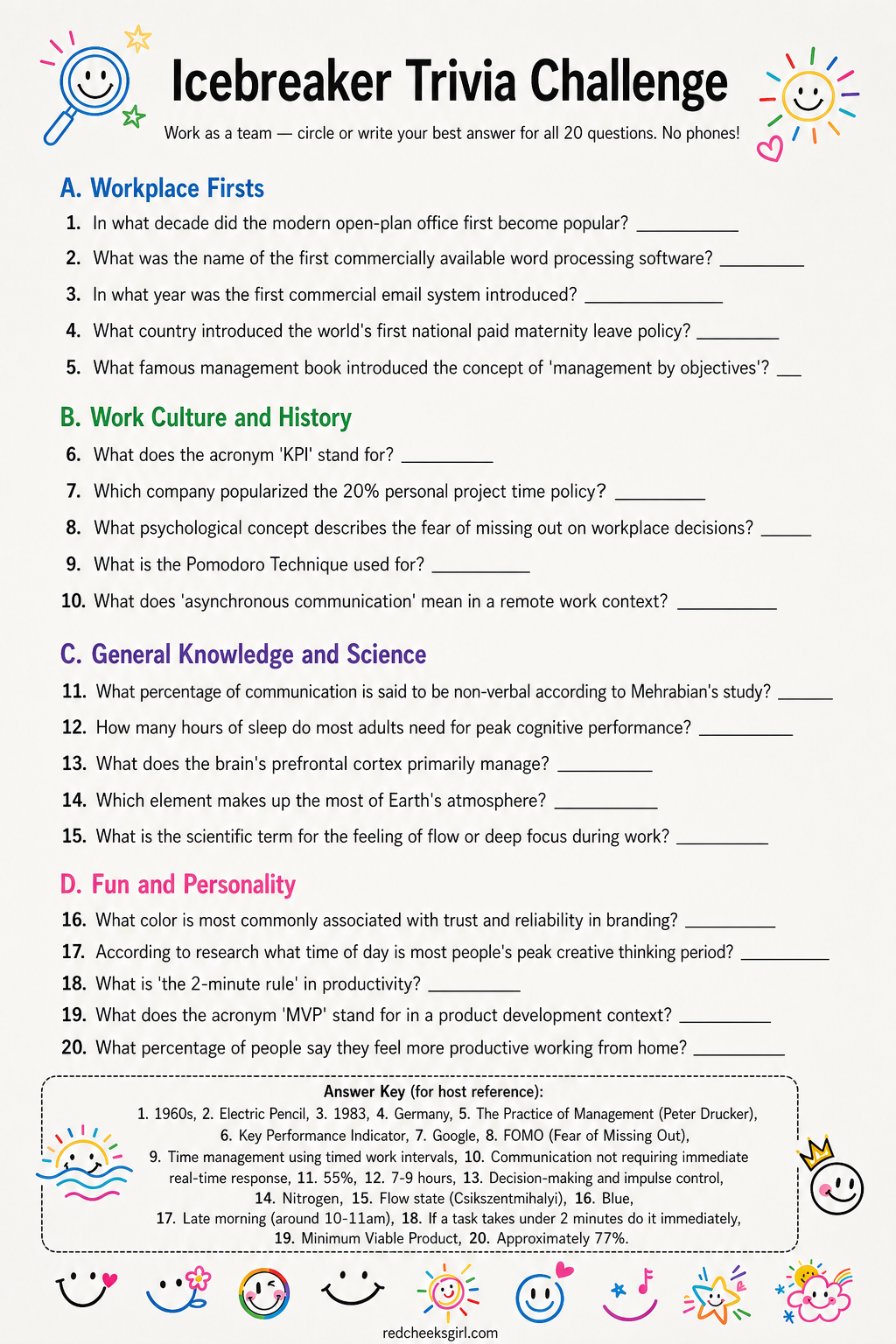
15. Icebreaker Trivia Sheet
Trivia is one of those rare icebreaker game formats that works across every age, every personality type, and every industry — because the competitive element does all the social heavy lifting.
The Icebreaker Trivia Sheet is specifically designed for work groups: questions cover workplace culture, professional history, general knowledge, and fun pop-psychology prompts that make people think without making them anxious.
Teams of three to five compete to answer all twenty questions, but the real game is the debate that happens within each team as they decide on their answers together. That’s where the ice is actually broken.
Print one sheet per team (not per person), so everyone has to lean in and look at the same paper — it’s a subtle forcing function for collaboration.
Appoint one person per team as the answer-writer, set a 12-minute timer, and let teams work through all twenty questions.
Questions are organized into four categories of five questions each, numbered continuously 1 through 20: Category A covers Workplace Firsts (Q1–5), Category B covers Work Culture and History (Q6–10), Category C covers General Knowledge and Science (Q11–15), and Category D covers Fun and Personality (Q16–20).
The answer key is printed in small italic gray text at the very bottom of the sheet for the host to reference during the reveal round.
The reveal round — where teams swap sheets, the host reads the answers aloud, and everyone marks each other’s work — is reliably the best five minutes of any team event.
There’s something about scoring a rival team’s sheet that produces a very particular brand of competitive glee that immediately dissolves any remaining awkwardness in the room.
Use this as a standalone warm-up before a longer workshop, or run it as a full lunchtime event with a small prize for the winning team. Either way, people will ask to do it again next time, which is really the only review you need.
- Teams of 15–60 (split into competing groups of 3–5)
- Workshop and training day warm-ups
- Competitive teams who need a reason to collaborate
- Any event where you want immediate energy and engagement
16. Guess the Coworker Sheet
The printable version of Guess the Coworker takes the spoken game and gives it a whole new layer of engagement — because now everyone has a sheet to fill in their guesses, tally their scores, and keep as a record of all the surprising facts they discovered about their colleagues.
Before the event, collect one fun or surprising fact from each team member via email or a quick form. Type each fact anonymously onto the sheet, numbered 1 through however many participants you have.
On the day, everyone gets the printed sheet and writes their guess for who submitted each fact in the corresponding blank next to each number. Then you reveal the answers and everyone scores themselves.
The sheet works best with 10–20 facts — enough to be genuinely challenging but not so many that it becomes overwhelming.
Leave generous space next to each numbered fact for guests to write their guess, and include a small scoring section at the bottom where people tally their correct answers and see how well they actually know their coworkers.
For extra drama, turn the reveal into a ceremony: read each fact aloud, pause for pens to stop moving, then reveal the person. That pause is everything — it gives people time to second-guess themselves, which produces the best reactions.
What makes this printable format particularly clever is that it turns a one-time activity into a conversation reference. After the event, people keep their sheets and come back to them: ‘Wait, that was YOU who climbed a mountain in Patagonia? Tell me everything.’
Those follow-up conversations — sparked by the sheet days or weeks after the event — are the ultimate proof that a good icebreaker game does its work long after the timer goes off.
Print a few blanks with space for facts so you can re-run this one with new facts every quarter. Different facts, same team, completely different experience every time.
- Host collects one surprising fact per person before the event
- Facts are typed onto the sheet anonymously, numbered 1 to N
- Guests write their guess for each fact in the blank beside the number
- Host reveals answers — guests score themselves at the bottom
- Highest score wins the title of ‘Knows Everyone Best’

17. Introduce Your Partner Sheet
Introduce Your Partner is one of those icebreaker game formats that sounds slightly elementary school until you actually do it — at which point everyone immediately agrees it’s the best icebreaker they’ve done all year.
Pairs are assigned (or chosen) and given five minutes to interview each other using the structured question prompts on the printed sheet. Then each person introduces their partner to the larger group in sixty seconds or less, based on what they just learned.
It sidesteps the self-conscious ‘tell us about yourself’ terror entirely because you’re talking about someone else, which is almost always easier and more fun.
The printable sheet is what makes this work so smoothly — it’s a guided interview form with eight prompts on one half (for your notes while interviewing your partner) and eight matching prompts on the other half (blank, so your partner can take notes about you simultaneously).
Prompts include: ‘What’s one thing you’re really good at that might surprise people?’ and ‘What’s a current project you’re genuinely excited about?’ and ‘What’s one weird or fun fact the team should know?’
Having the structure on paper means neither person is guessing what to ask, the conversation doesn’t stall, and no one forgets the interesting bits by the time it’s introduction time.
The sixty-second introduction is where the energy peaks. Give people a countdown and a gentle bell — and watch how creative the intros get once people realize they have permission to be enthusiastic and funny about their partner.
This format builds an instant alliance between each pair, which is especially valuable if you’re mixing departments or disciplines who don’t normally interact.
By the time the introductions are done, the room has ten or twelve little partnerships scattered through it, and those partnerships tend to be the ones people actually lean on when the real work begins. Worth every minute of prep.
Talking about someone else is dramatically less stressful than talking about yourself — this format removes the ‘tell us about you’ anxiety completely.

18. Name Tag Templates
Name tags might seem like the world’s most boring printable — but these are not your standard ‘HELLO my name is’ sticky rectangles.
The Name Tag Templates in this pack turn the badge into its own mini icebreaker game by adding three small prompts below the name field: ‘Ask me about:’, ‘I’m really good at:’, and ‘Best recent discovery:’.
So instead of a name badge that gives people exactly one piece of information and then sits ignored on someone’s lapel, this one actively invites conversation.
Guests fill in their prompts as they arrive, and suddenly every badge is a conversation starter that does the work even when the wearer is just standing near the drinks table.
The sheet is designed to print eight name tag cards per page on standard cardstock, with a clean die-cut or scissors-cut outline.
Hole-punched at the top, they slide into a standard badge lanyard holder — or just fold and stand them as table tent cards if you’re working in a smaller workshop setting.
Leave pens at the registration table with a clear sign: ‘Fill in your name tag before you grab coffee!’
Most people will complete it while waiting in line, which means the first five minutes of mingling are already structured without anyone having to officially ‘start’ the icebreaker.
The three prompts are deliberately chosen to surface practical information (‘I’m really good at’ connects people with complementary skills), fun conversation hooks (‘Ask me about’ removes the social pressure of figuring out what to say to someone), and a touch of personality (‘Best recent discovery’ can be anything from a podcast to a parking spot near the office).
Collectively, they turn a name tag from a logistics tool into a relationship-building tool — which is a pretty remarkable upgrade for something that costs one sheet of cardstock and sixty seconds to fill out.
Print a few extras for latecomers and keep spares at the registration table all day.
- Cardstock paper for sturdy badges
- Badge lanyard holders or a hole punch
- Fine-tip markers or pens at the registration table

🛍 Shopping guide
19. Win of the Week Share
Win of the Week Share is the quietest game on this list and, honestly, the one that might do the most lasting good.
It’s simple: each person takes sixty seconds to share one professional or personal win from the past week — something they’re proud of, something that went better than expected, or something small they accomplished that deserves a moment of acknowledgment.
No slides, no structure, just one minute per person and a room full of people actively listening. It sounds almost too simple, and then someone shares something that makes the whole room smile, and you remember why this kind of thing matters.
Run this as a standing circle to keep the energy up and the time moving — seated rounds tend to drag, but standing ones feel crisp and intentional.
Give each person exactly 60 seconds (a gentle phone timer works perfectly), and after each share, the rest of the group gives one brief group acknowledgment — a round of applause, a thumbs up, or a simple ‘nice work’ from the facilitator.
The cumulative effect of going around a circle and hearing fifteen different people describe a genuine win, no matter how small, is a quietly powerful morale moment that most teams never give themselves permission to have.
This one is especially valuable at the start of a cross-functional team meeting or an all-day event, because it immediately establishes that this is a space where people’s actual work and experiences are seen and valued — not just their job titles.
It also tends to surface skills and accomplishments that colleagues didn’t know about each other, which makes it a stealth icebreaker game as well as a morale boost.
If you want to pair it with a simple self-concept affirmations practice for your team culture toolkit, this is the format that slots in most naturally — because celebrating wins, even small ones, is one of the most evidence-backed ways to build a confident, high-trust team.
Run this as a standing circle — it keeps energy up and naturally limits each person to 60 seconds without you having to play timekeeper.
20. One Word Check-In
One Word Check-In is the icebreaker for adults who are convinced they hate icebreakers. There are no stories to tell, no facts to reveal, no pressure to be interesting or funny.
Each person simply says one word that describes how they’re showing up today — ‘focused,’ ‘caffeinated,’ ‘hopeful,’ ‘chaotic,’ ‘curious’ — and that’s it. No explanation required (though anyone who wants to add a sentence can).
It takes less than two minutes for a group of twenty and it does something remarkable: it takes a room of people who are all pretending to be fine and gives them permission to be honestly present instead.
Run it as a literal go-around — starting with yourself to model that honest, slightly vulnerable one-word answer (if you open with ‘overwhelmed,’ the room immediately relaxes, because now they know honesty is welcome here).
The facilitator can optionally jot all the words on a whiteboard as they’re shared, which creates a kind of group emotional weather map for the session.
It’s a small act but it visually shows that the whole group’s state has been seen and acknowledged before the ‘real’ work begins. That matters more than most people expect.
The One Word Check-In is also a brilliant bookend: use it at the start of a session and again at the end (‘what’s one word for how you’re leaving today?’) and the before-and-after comparison is almost always heartening.
People who opened with ‘anxious’ often close with ‘connected’ or ‘energized,’ and having the whole group witness that shift together is genuinely moving.
Pair it with a morning routine that helps people arrive grounded — something like one of these cortisol-lowering breakfast ideas before a big team day can make a real difference in how ready people feel to connect. Simple, zero-prep, quietly transformative.
It gives every person in the room a moment of being genuinely heard before the agenda starts — which makes everything that follows feel safer and more collaborative.
Frequently Asked Questions
What are the best icebreaker games for adults in a work setting?
The best icebreaker games for adults at work are the ones that feel purposeful rather than forced.
Top picks for work groups include Two Truths and a Lie (great for any size group), Human Bingo (perfect for large rooms), Speed Networking Round (ideal for events where everyone needs to meet everyone), and the One Word Check-In (brilliant for meetings that need a warm, low-pressure opener).
The key is to match the game’s energy level and vulnerability level to your group’s comfort — new teams need lighter, more active formats; established teams can handle deeper conversation prompts.
How long should an icebreaker game last?
Most icebreaker games for adults should run between 5 and 20 minutes — long enough to create a real shift in the room’s energy, but short enough that it doesn’t cut into the main event.
Quick warm-ups like One Word Check-In or Would You Rather cards work in under 5 minutes. Games like Human Bingo or Speed Networking need 15–20 minutes to reach their full effect.
If you’re running an all-day event or retreat, you can afford a 30-minute game like Icebreaker Trivia or Human Knot with a debrief. Always have a shorter backup ready in case time runs short.
What icebreaker games work for large groups of 50 or more people?
Large groups of 50+ do best with icebreaker games that don’t require individual speaking time, since going around a room of 50 people takes forever and everyone checks out by person 12.
Great options for large groups include Human Bingo (everyone circulates simultaneously), Find Someone Who Sheet (same idea, different format), Icebreaker Trivia (run in competing teams of 4–5), Speed Networking Round (everyone meets everyone in parallel pairs), and the Guess the Coworker format (whole-room voting works beautifully at scale).
Printable formats shine in large groups because everyone is active at the same time.
Are there icebreaker games for introverts who hate being put on the spot?
Absolutely — and honestly, designing for introverts makes your whole event better for everyone. The best icebreaker games for adult introverts are the ones that give people time to think before they have to speak.
The Get-to-Know-You Question Sheet (written first, then shared), the Two Truths and a Lie Sheet (write your statements before anyone reads them aloud), and Conversation Starter Cards (read a card, think, then answer) all give introverts that crucial buffer.
One Word Check-In is also perfect: one word is genuinely all anyone has to say. Avoid cold-call formats and games that require improvised storytelling in front of large groups without warning.
Do I need to buy anything special to run these icebreaker games?
Most of these icebreaker games for adults need nothing more than a printer and some pens — which you probably already have. The printable games (Human Bingo, Would You Rather Cards, Conversation Starter Cards, etc.) work best on cardstock, which is inexpensive and widely available.
The only games that genuinely benefit from a small purchase are ones with physical props: the Question Dice need cardstock and tape to fold, Speed Networking works better with a proper timer and name badges, and Human Knot has an optional rope variant for accessibility.
Everything else — Two Truths and a Lie, Never Have I Ever, One Word Check-In, Win of the Week — costs literally zero dollars to run.
Can these icebreaker games work for virtual or hybrid teams?
Many of them work great online with minor adjustments. Two Truths and a Lie, Never Have I Ever, Would You Rather, One Word Check-In, and Win of the Week all translate directly to video calls with no changes.
Speed Networking works in Zoom breakout rooms rotated every two minutes. Guess the Coworker is actually seamless virtually — facts are collected via form and read aloud on screen. Printable games can be shared as PDFs that participants fill out digitally or print at home.
The only format that doesn’t translate is Human Knot, which needs everyone in the same physical space — for virtual groups, Speed Networking is the best equivalent energy-builder.
📌 Save These for Later
Loved these? Pin your favorite image below so you can find this list again when you’re planning.


72 this or that questions for girls night in, split into six escalating rounds with free printable c

72 never have i ever questions for seniors, sorted into 6 themed rounds with free printable card she

72 truth or dare questions for FaceTime that actually work on camera. Six rounds, printable card dec
Leave a Reply