

Looking for the best thanksgiving games that actually work for your whole crew — from the five-year-old cousin who won’t stop running laps to the grandpa who insists on watching the parade? You’ve officially found your one-stop list.
I’ve sorted all 40 of these into the moments when they hit hardest: before dinner when everyone’s restless, after pie when no one can move, and the any-time classics that are great no matter where you are in the day.
Consider this the only tab you need open on Turkey Day. (You’re welcome, and also, maybe bookmark it now before the chaos starts.)
Whether you’re hosting a crowd of 30 or just your immediate family of five, there’s something on this list for every energy level, every age group, and every amount of prep time you actually have.
We’ve got trending 2026 party games, laugh-out-loud active classics, printable game sheets you can grab right now, and quiet heart-warming moments that’ll make everyone feel a little more grateful.
And hey — if you’re already thinking ahead to the holidays after Thanksgiving, don’t miss this guide to saving money on Thanksgiving so you have more budget left for the fun stuff. Now let’s get into it!
- Thanksgiving Guess-the-Price Showdown
- Thanksgiving Crossword
- Turkey Call Contest
- Thanksgiving Trivia Cards
- Cranberry Cup Toss
- Harvest Logic Puzzle
- Thanksgiving Family Feud
- Thanksgiving Pictionary Cards
- Gravy Boat Balance Walk
- Thanksgiving Sudoku
- The Floor (Guess the Thanksgiving Image)
- Thanksgiving Memory Match Sheet
- Pass the Gourd Relay
- Pie Recipe Scramble
- Thanksgiving Heads Up
- Guess the Side Dish Sheet
- Corn Hole (Fall)
- Thanksgiving Word Scramble
- Thankful Toast Round
- Harvest Trivia Live
- Turkey Occupation Guess Who
- Flag Football
- Family Story Swap
- Turkey Bowling
- Thanksgiving Mystery Box Challenge
- Stuffing Spoon Duel
- Highs and Lows of the Year
- Corn Husk Toss
- Cousins vs Aunts Trivia Showdown
- Pie Tin Frisbee
- Best Dish Poll
- Wishbone Tug Duel
- Napkin Fold Race
- Guess the Spice Sniff Test
- Harvest Basket Sort
- Two-Word Toast Challenge
- Duck Duck Turkey
- Guess How Many Kernels
- Turkey Trivia
- Thanksgiving Pictionary
- Frequently Asked Questions
1. Thanksgiving Guess-the-Price Showdown
This one is a 2026 trending favorite and honestly? It earns that title. The Thanksgiving Guess-the-Price Showdown is basically your very own Price Is Right, Turkey Day edition.
The host collects 10–12 actual Thanksgiving grocery items — think a whole turkey, canned pumpkin, a bag of stuffing mix, a pie crust, dinner rolls, and a can of cranberry sauce — and players compete to guess the real retail price of each item (pre-tax, just like the show).
Everyone writes their guess on a slip of paper or small whiteboard, the host reveals the true price, and whoever is closest without going over scores a point.
The player with the most points at the end wins a prize, or at minimum, a ridiculous amount of bragging rights.
Setup is genuinely easy: buy your Thanksgiving groceries as normal, keep the receipts, and bag the items so no one can peek at the price stickers. Give each player a notepad and pen.
For a more dramatic reveal, display items one at a time and read a fake infomercial-style description of each one (trust me, doing a full dramatic read of ‘a 15-pound Butterball, fresh from the farm’ never gets old).
Aim for a mix of items people will wildly underestimate — organic butter, a premium pie — and simple ones they might nail. This keeps the scores close and the tension high right up to the last round.
What makes this game genuinely brilliant for Thanksgiving specifically is that it doubles as a sneaky economics lesson that sparks real conversation.
Someone’s grandma will confidently declare that a pumpkin pie costs $1.50 (bless her heart), and someone’s teenager will somehow nail the price of free-range turkey to the dollar. The generational gap in grocery knowledge alone is worth the price of admission.
Host tip: if you end up with a tie, break it with a single bonus item and have tied players guess the exact price — closest wins, no ceiling rule needed.
- 10–12 real Thanksgiving grocery items (bagged so prices are hidden)
- Printed receipts or a price list for the host only
- Notepads or small whiteboards + markers for players
- A small prize for the winner
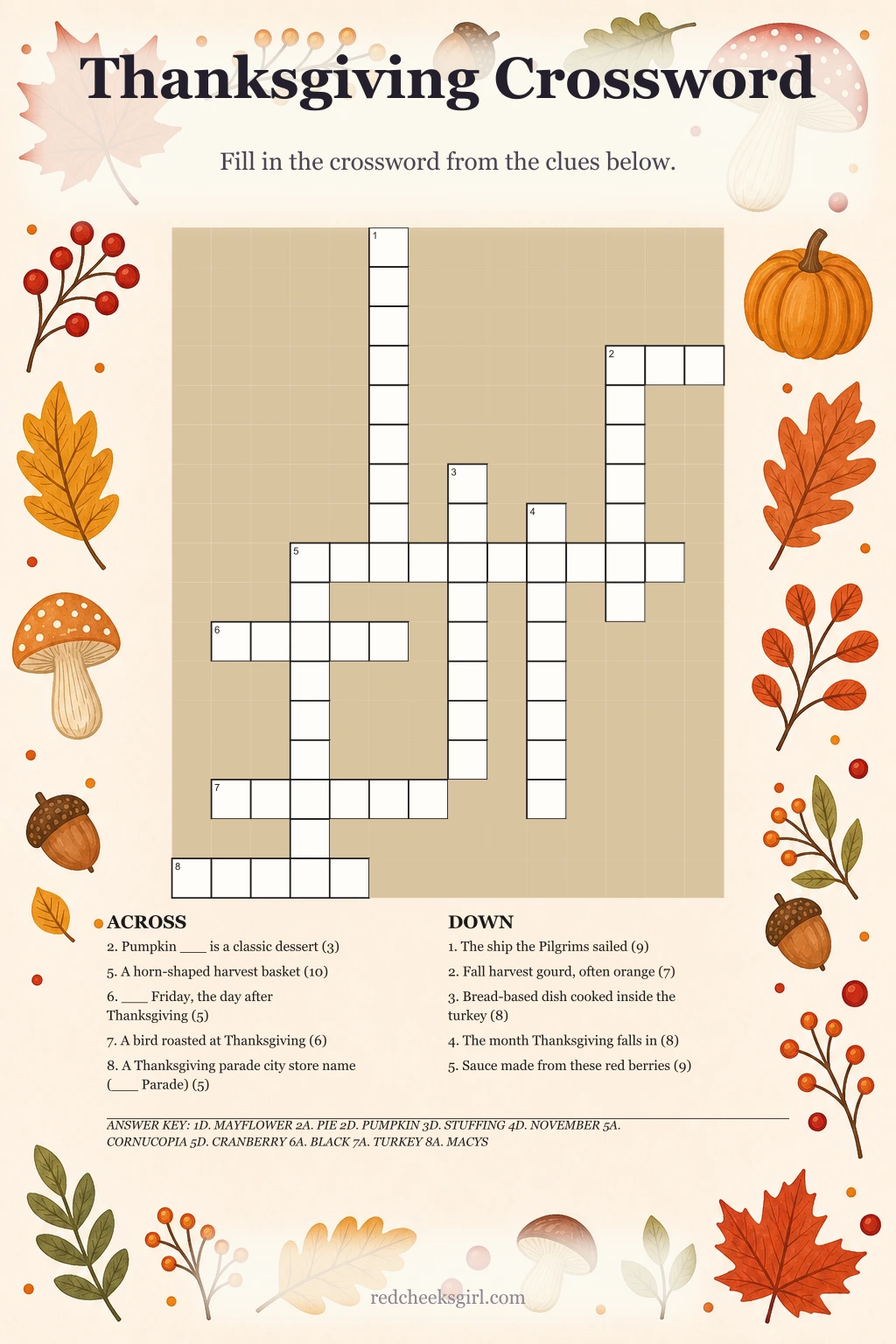
2. Thanksgiving Crossword
Nothing says ‘cozy holiday morning’ like a Thanksgiving crossword puzzle spread out on the kitchen table while the turkey is still in the oven.
This printable game features 18 Thanksgiving-themed clues — across and down — covering everything from side dishes and Pilgrim history to NFL traditions and fall harvest words.
It works brilliantly as a solo warm-up activity for early arrivals, but it’s even more fun when you let two or three people tackle it together.
Nothing brings family members together quite like arguing over whether ‘cornucopia’ is 14 letters or 13 (it’s 11, by the way).
Print one sheet per player or one per team — both work great. Each player fills in the grid using the numbered clues provided.
The answer key lives in tiny italic text at the very bottom of the sheet so it’s there if you need it, but doesn’t spoil the fun.
This is a zero-supply, zero-setup game beyond printing: no markers, no dice, just pencils and a little friendly competitiveness. It’s a fantastic option to leave on the table as guests arrive so there’s something to do before the first appetizer comes out.
Pair it with some cheap Thanksgiving appetizers that look expensive and you’ve got the perfect low-key arrival experience.
Why it works: crosswords are one of the few games that genuinely work across a huge age range without anyone feeling left out.
Younger kids can help with the simple across clues (‘a bird we eat on Thanksgiving: T-U-R-K-E-Y’) while the adults battle over the trickier historical ones. You can even make it a group competition — first table to complete the whole puzzle wins a pie slice.
Host tip: print a few extra copies because someone will definitely make a mistake in pen and need a fresh sheet.
- Early arrivals and pre-dinner downtime
- Ages 8 and up (younger kids can team up with an adult)
- Groups of 2–20 (print one per person or pair)

3. Turkey Call Contest
Okay, don’t scroll past this one — the Turkey Call Contest is an absolute chaos generator in the best possible way, and I say that as someone who has watched a 74-year-old grandfather make a sound that genuinely alarmed a neighbor’s dog.
The premise is delightfully simple: everyone takes a turn attempting their most convincing (or most creative) turkey gobble, and the group votes on a winner. You can judge by realism, volume, creativity, or pure comedic value.
Crown a Turkey Call Champion and maybe give them first dibs on the wishbone.
No materials needed whatsoever — this is a pure human-powered activity. For structure, give players 10 seconds to prepare their call and 15–20 seconds to perform.
Run it in rounds if you have a big group: heats of four or five contestants each, with the top vote-getter from each heat advancing to a grand finale. Designate a judge or let the whole group vote by applause.
Add categories like ‘Most Realistic,’ ‘Most Dramatic,’ and ‘Best Kid Under 10’ to make sure everyone has a chance to win something.
This game works at literally any moment in the day — it takes three minutes, requires zero setup or cleanup, and produces a truly unreasonable amount of laughter.
It’s especially perfect for that awkward 20-minute window before dinner is actually ready but after everyone has gotten restless. Pro tip: record the performances on your phone. Those videos will be reshared every Thanksgiving for the next decade, guaranteed.
It’s also a wonderful icebreaker if you have guests who don’t know each other well — there is no faster way to bond with a stranger than both of you absolutely butchering a turkey gobble in front of the family.
Record everyone on your phone — the replay during dessert gets just as many laughs as the original performance.
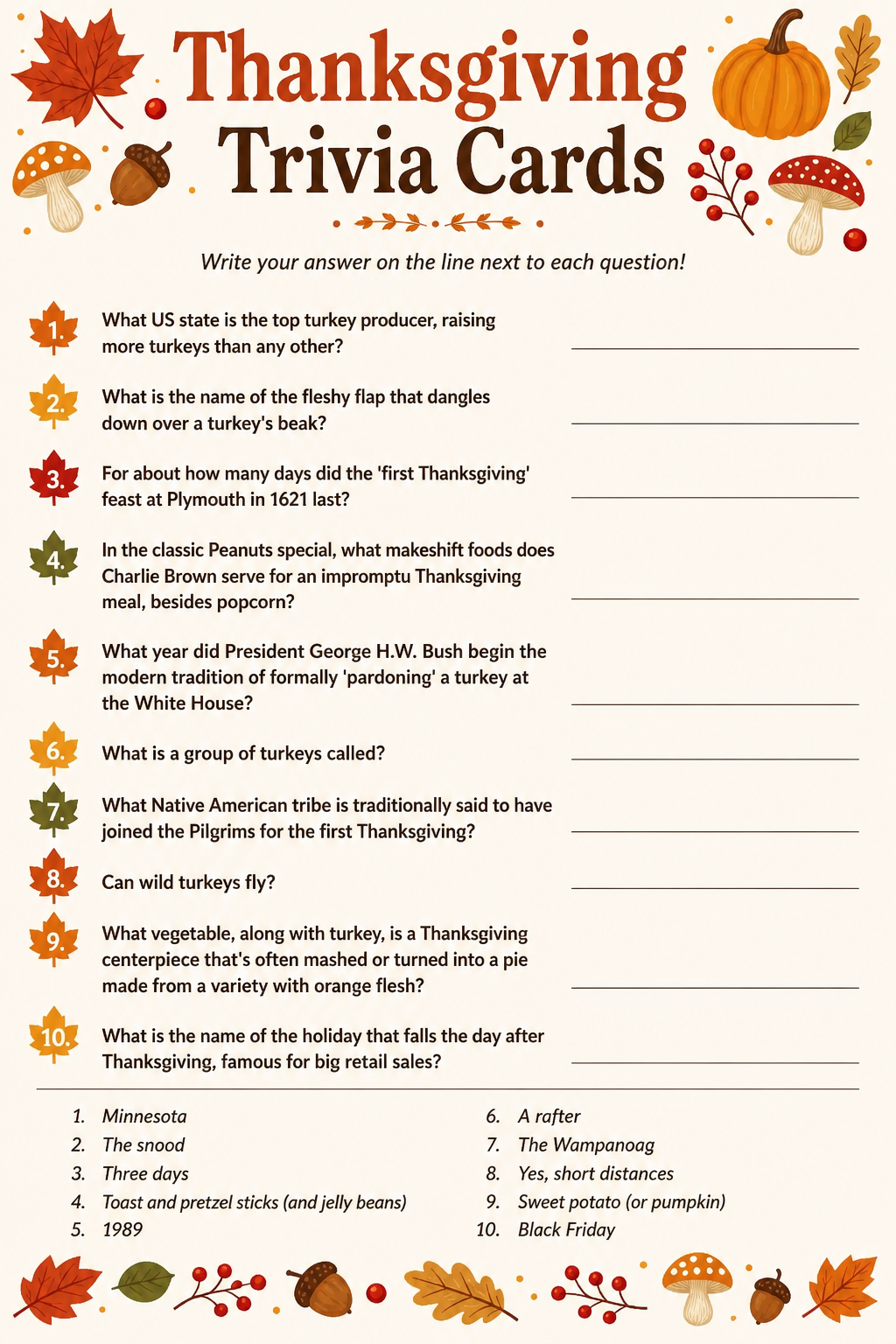
4. Thanksgiving Trivia Cards
Trivia cards are the MVP of any Thanksgiving table because they can be played literally anywhere — at the kids’ table, in the living room waiting for the parade to start, or passed around while the turkey rests.
This printable sheet gives you 20 ready-to-cut Thanksgiving trivia question cards covering history, food, football, Macy’s Parade facts, and pop culture.
Each card has a question on the front and the answer printed on the back (or tucked in the answer key at the bottom of the sheet if you want to keep the mystery going).
Divide into teams, appoint a question reader, and go head to head.
Print the sheet, cut along the dotted lines, and you’ve got a full deck of cards ready to go. For table play, one person acts as the host and reads cards aloud while teams confer and write their answers.
For a more casual vibe, just pass a card around and anyone who knows the answer shouts it out — first correct answer gets the point.
You can adjust difficulty on the fly by skipping cards that feel too hard or too easy for your specific crowd. For a quick game, pick 10 cards and first team to 7 wins.
Why trivia works so well for Thanksgiving specifically: everyone at the table thinks they’re the most knowledgeable person there, and the trivia card gently, hilariously proves otherwise. The question ‘Which president officially made Thanksgiving a national holiday?’
reliably stumps at least half the table every single time (it’s Lincoln, if you want to quietly impress someone). Host tip: save the hardest cards for after dinner when everyone is full, relaxed, and just competitive enough to care. It’s the sweet spot.
- Cut cards apart along dotted lines
- Divide into 2 teams or play individually
- Read question aloud — first correct answer scores a point
- First to 10 points wins

5. Cranberry Cup Toss
Cranberry Cup Toss is the kind of game that sounds too simple to be exciting — until it’s the fourth round, the cups are getting farther apart, Grandma is trash-talking, and two cousins are nearly in tears over a disputed point.
The premise: line up a row of plastic cups on a table or the floor, assign point values to each one, and take turns tossing real dried cranberries (or candy corn if you want a backup) into the cups from a set distance.
The cup farthest away is worth the most points. First to 50 wins, or play a set number of rounds and tally totals.
Materials are genuinely minimal: a bag of dried cranberries from the pantry (which costs almost nothing and can be eaten after — efficient!), a set of plastic or paper cups, and a strip of tape on the floor to mark the throw line.
Arrange cups in a straight line or a triangle formation, about an inch apart. For kids, put the throw line closer. For competitive adults, move it back until it’s genuinely difficult.
You can also go head-to-head: two players toss simultaneously and the first to fill all five cups wins the round.
This game is perfect for the pre-dinner stretch when you need something active that doesn’t require leaving the house or a lot of space — a kitchen counter or dining room table works just fine.
It also scales beautifully for big groups: run it as a tournament bracket with a whiteboard to track scores, or play it casually as a drop-in game people return to throughout the afternoon.
The tiny size of cranberries makes it way harder than it looks, which means even skilled adults will miss constantly and everyone gets to feel equally bad (and equally entertained).
- 1 bag dried cranberries or candy corn
- 5–8 plastic or paper cups
- Tape for the throw line
- Paper to track scores
6. Harvest Logic Puzzle
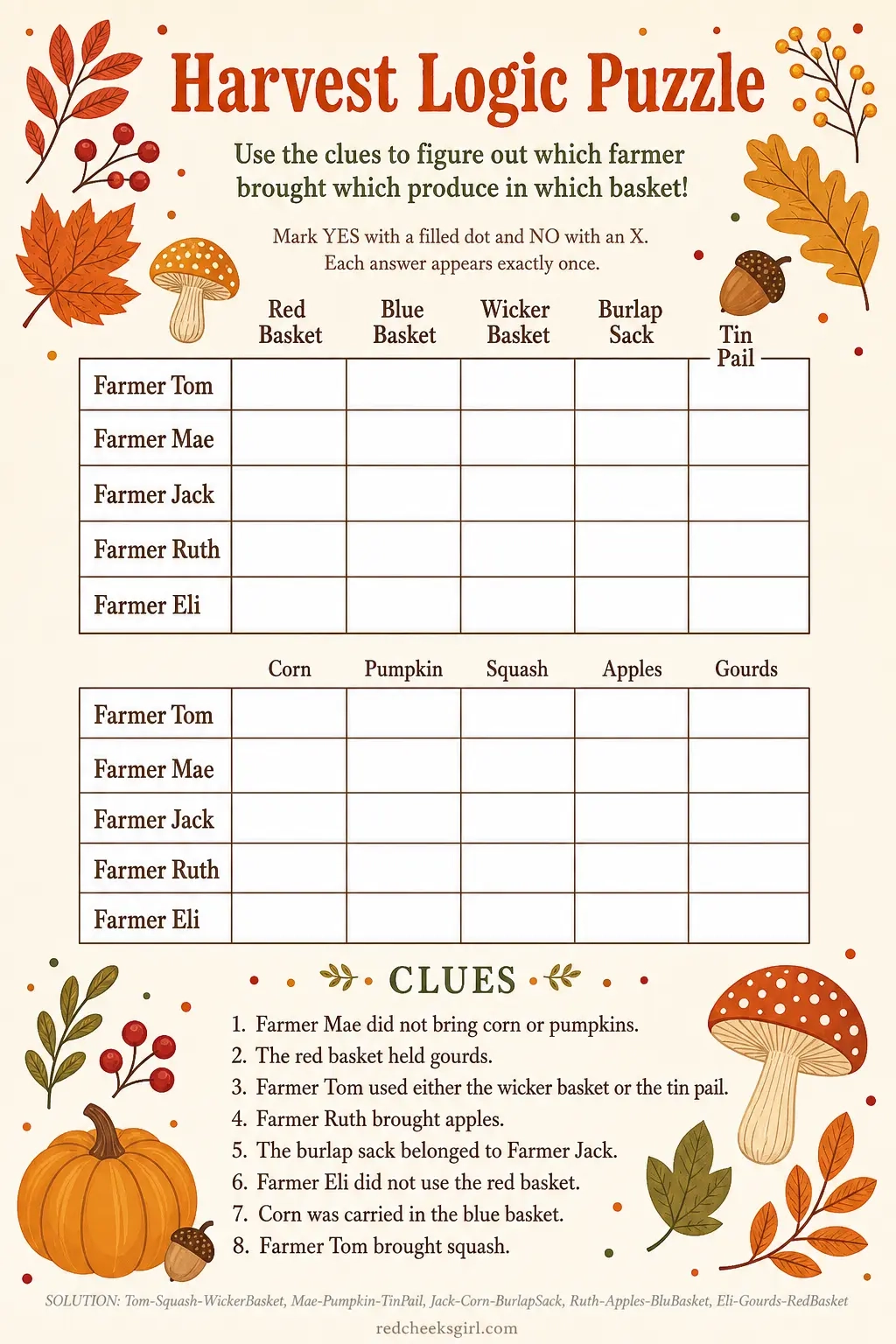
If you have someone at your Thanksgiving table who always finishes the crossword in pen and needs something harder — this is for them. The Harvest Logic Puzzle is a classic grid-based deduction puzzle, fully dressed in Thanksgiving theme.
Players are given a set of clues and must use logical elimination to figure out which harvest item belongs to which farmer, which basket it came from, and which day it was delivered — or a similarly themed arrangement with fall produce and fictional family names.
It’s the kind of puzzle that feels impossible for the first five minutes and then suddenly clicks all at once in an incredibly satisfying way.
The printable sheet includes the full 5×5 deduction grid, all 8 written clues, and clearly labeled rows and columns for marking YES (filled circle) or NO (X).
No prior logic puzzle experience is needed — there’s a quick one-sentence instruction at the top explaining how to use the grid. Print one per player for a solo challenge, or let two people work through it together for a collaborative experience.
This is a wonderful quiet-game option for people who don’t love performative games but still want something engaging to do.
Why it works at Thanksgiving: logic puzzles have a natural built-in timer of social pressure — people want to finish before someone else does, which creates low-key competitive energy without any actual confrontation.
It’s also a genuinely satisfying activity that gives people something to focus on during that post-arrival, pre-food lull when conversations have been had and the TV is losing the room.
Host tip: print two extra copies for any kids who beg to try; kids between 9–13 often love these more than the adults expect and will be quietly occupied for a long stretch.
- Ages 12 and up (or younger with a partner)
- Solo or pairs
- Pre-dinner quiet time or after-pie wind-down

7. Thanksgiving Family Feud
The Thanksgiving Family Feud is basically a guaranteed hit — and I say that with the confidence of someone who has seen a perfectly civilized family absolutely lose their minds arguing over whether ‘pumpkin pie’ or ‘turkey’ is the most iconic Thanksgiving food.
The format mirrors the classic TV game show: two teams face off, a question is read aloud (previously surveyed from 100 people, or you invent plausible answers yourself), and teams compete to name the most popular answers on the board.
Thanksgiving-themed questions make this especially fun — think ‘Name something people argue about at the Thanksgiving table’ or ‘Name a dish that someone always burns.’
You can run this with a projected slideshow if you’re tech-savvy, or just use a whiteboard to write out the revealed answers as teams name them.
Divide your group into two teams of any size — Family Feud actually plays better with bigger groups because everyone gets to buzz in and help.
One person from each team faces off at the start of each round; the team with the most points at the end of all rounds wins. Classic rules: three strikes and the other team gets to steal. Steal correctly and you take all the points.
Steal incorrectly — the points stay. The tension on a steal attempt is absolutely unmatched.
What makes this version sing for Thanksgiving specifically is leaning hard into family-specific surveys. If you have a few days’ notice, text everyone attending beforehand: ‘Quick survey — what’s the most overrated Thanksgiving side dish?’
Compile the top answers and use your actual family’s responses as the ‘board.’ Now you’re not playing Family Feud, you’re playing Your Family’s Feud, and the answers will be both funnier and more pointed.
(Someone will definitely say ‘green bean casserole’ and someone else in the room made the green bean casserole. You’ve been warned.)
Text guests a short survey 2–3 days before Thanksgiving to collect real family answers — it makes the game 10x funnier than generic answers.
8. Thanksgiving Pictionary Cards
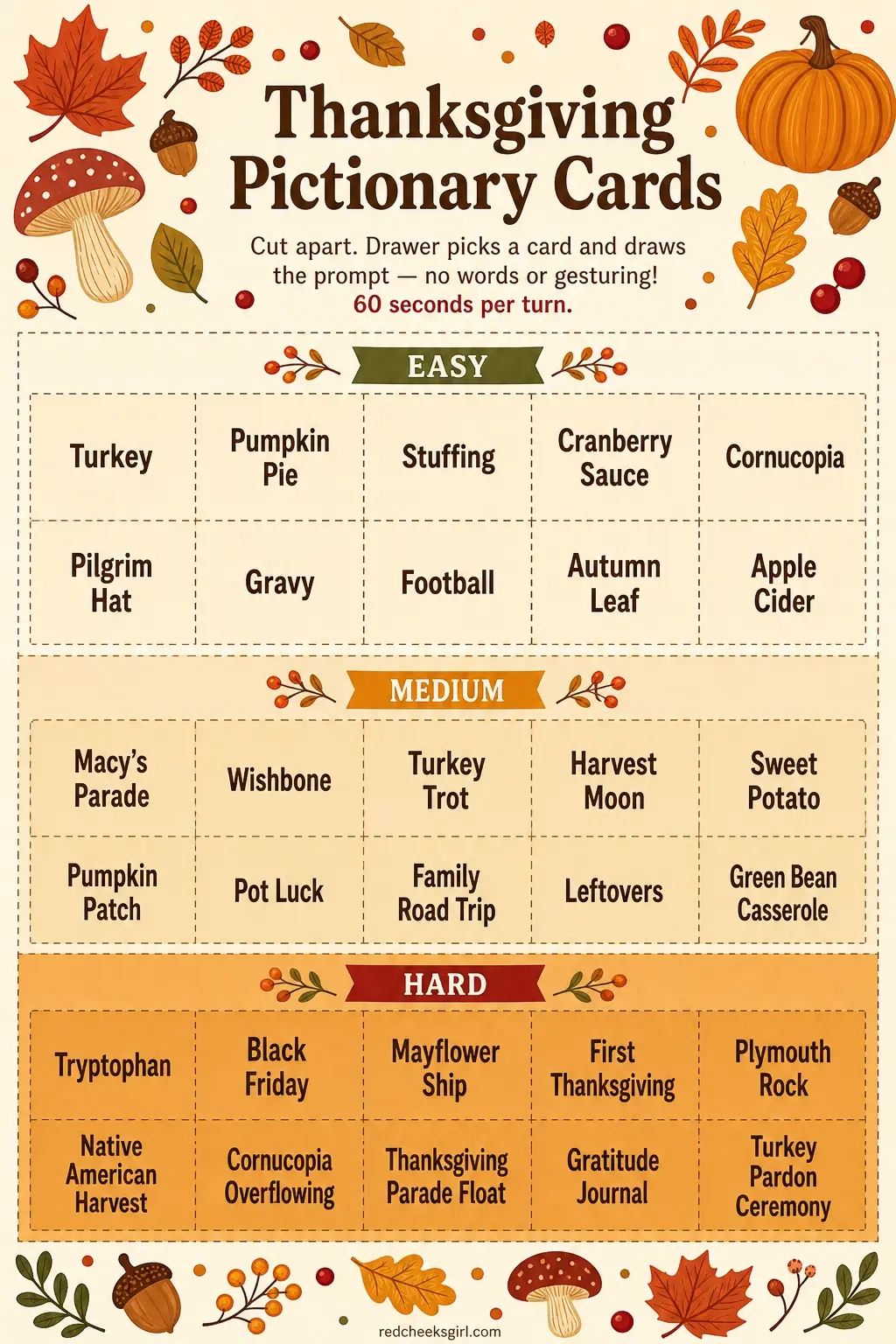
Thanksgiving Pictionary Cards take the chaotic energy of classic Pictionary and load it up with harvest-season prompts so you’re not sitting there blankly wondering what to draw.
This printable sheet gives you 30 cut-apart prompt cards organized into three difficulty tiers: Easy (turkey, pumpkin pie, stuffing), Medium (Macy’s Parade, wishbone, cornucopia), and Hard (tryptophan, the first Thanksgiving, Black Friday stampede).
Each card shows only the prompt word or phrase — no illustrations, no hints — and whoever is drawing has 60 seconds to get their team to guess it.
Print and cut the cards before guests arrive (takes about two minutes). Divide into two or more teams.
One player draws a card from the pile without showing their team, then draws on a whiteboard, large notepad, or even just a sheet of paper propped up on a chair. Their team has 60 seconds to guess. Correct guess = 1 point.
No talking, no gesturing, no writing letters — pure drawing only. Rotate drawers each round so everyone gets a turn. First team to 15 points wins, or play until the deck runs out and tally totals.
Why Pictionary Cards beat plain Pictionary: having pre-written Thanksgiving prompts eliminates the awkward ‘okay what word do I use’ setup delay, and sorting them by difficulty means you can match the challenge level to your players in real time.
Stuck with a table full of six-year-olds? Pull only Easy cards. Have a competitive group of adults who just crushed the crossword? Go straight to Hard.
The cards also mean you can pause and restart the game across the day — just leave the deck on the table and let people pick it back up whenever the mood strikes.
Host tip: laminate the sheet before cutting if you want to reuse it next year.
- Cut cards into 3 stacks by difficulty: Easy, Medium, Hard
- Drawer picks a card, does NOT show their team
- 60 seconds to draw — no talking or gesturing
- Correct guess = 1 point. First to 15 wins.

9. Gravy Boat Balance Walk
The Gravy Boat Balance Walk is equal parts relay race and pure slapstick entertainment — and it is one of those games where the adults somehow make it funnier than the kids.
Each player must walk a set course (driveway, hallway, backyard — whatever you have) balancing a ladle filled with water (or actual cold gravy, if you’re brave and own a washing machine) without spilling.
First player to complete the course hands off the ladle to the next teammate, and the team that finishes the relay first without spilling wins. Spills add a five-second penalty per drip. The tension in those final steps is genuinely theatrical.
Set up the course with a start line and a turnaround cone or chair — about 15 to 20 feet is plenty for the drama to unfold. Use a regular kitchen ladle filled about three-quarters of the way.
For indoor play, use a small amount of water and put down some towels at the turnaround point. For outdoor play, go ahead and use more water — the suspense of a full ladle is worth it.
Run it as a pure relay with two teams, or time individual runs and rank everyone on a leaderboard. Bonus rule: if you drop the ladle, you must restart from the beginning.
This game is phenomenal for the before-dinner window when kids and adults alike need a physical outlet and the oven is doing its thing. It requires minimal supplies, generates maximum laughter, and — crucially — it ends before anyone gets too tired or too competitive.
The variation that always kills: make it a timed walk-backwards relay. The concentration faces people make walking backwards while balancing liquid are worth a thousand holiday card photos.
Host tip: keep a dry towel and a change of clothes option in mind if playing with young kids who absolutely will not hold back.
- Use a wider spoon or small bowl for younger kids
- Shorten the course to 8 feet for ages 4–6
- Allow two hands on the ladle for the under-7 crowd
10. Thanksgiving Sudoku
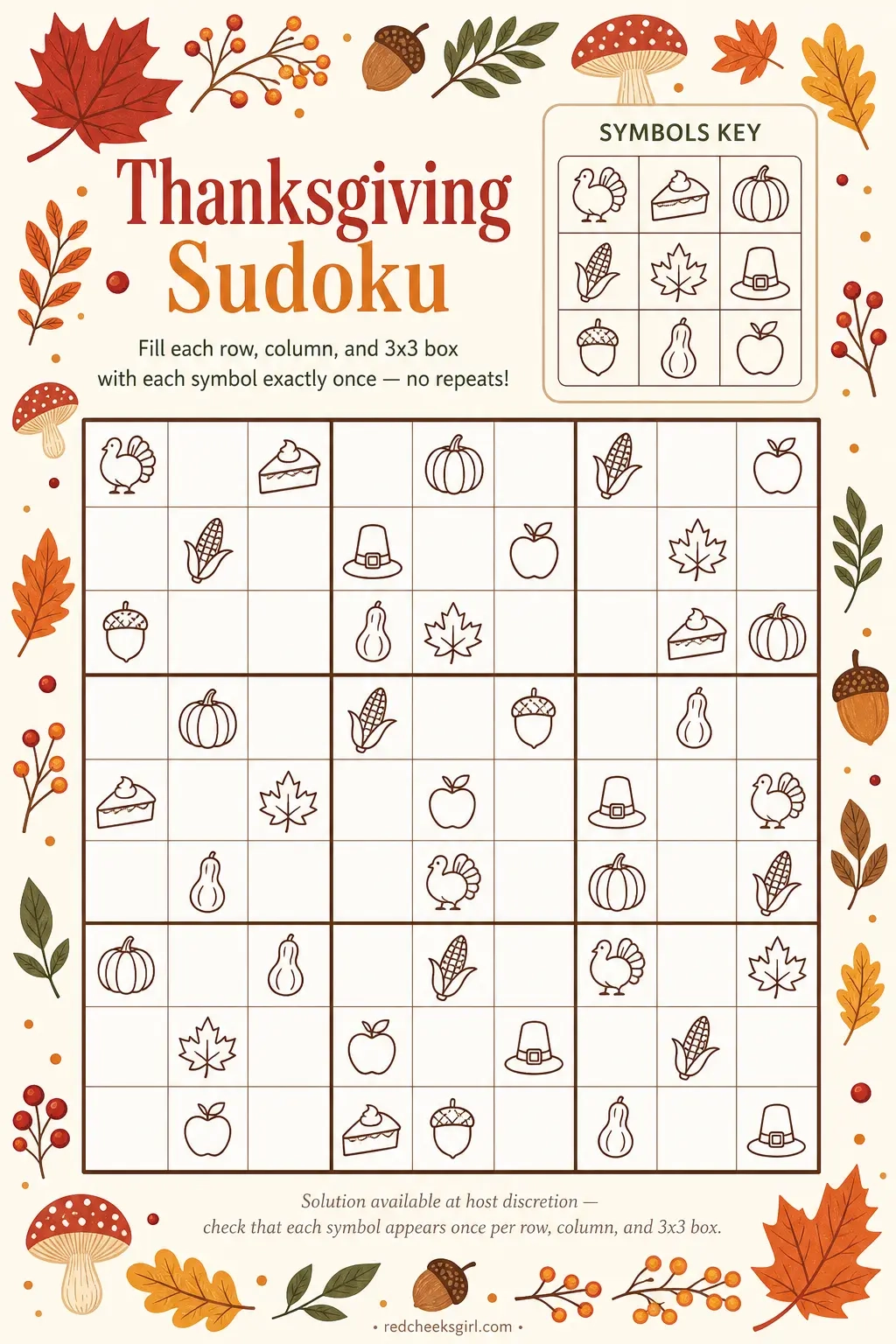
Before you say ‘but we have a number-phobic family’ — this version replaces numbers with Thanksgiving icons, making it instantly more approachable and visually adorable.
The Thanksgiving Sudoku uses nine fall symbols (turkey, pie, pumpkin, corn, leaf, hat, acorn, gourd, apple) arranged in the classic 9×9 Sudoku grid. The same rules apply: each symbol appears exactly once in every row, every column, and every 3×3 box.
A portion of the grid is pre-filled to give players a starting point, and the rest is left blank for the player to complete with pencil.
Print one sheet per player — this is truly a solo game best enjoyed with a warm cup of cider nearby.
The difficulty level sits at a comfortable medium, making it accessible for anyone who’s done a Sudoku before but challenging enough to be genuinely satisfying.
You can also offer it as a cooperative challenge: two people sharing one sheet, taking turns filling in squares, with the rule that you can’t undo your partner’s answers. That cooperative version generates surprisingly fun problem-solving conversations.
Each symbol in the grid is a small, clean icon line drawing, so the visual ‘noise’ stays low and the puzzle remains easy to read.
Why Sudoku at Thanksgiving? It’s the perfect game for early-arriving introverts who want something to do while the extroverts are doing the Turkey Call Contest in the other room.
Leave a stack of printed sheets near the coffee station and let people drift in and out of it throughout the morning. Host tip: if you have competitive puzzle people, time them and post finishing times on a ‘leaderboard’ sticky note on the fridge.
Suddenly the Sudoku becomes a silent tournament and people are casually speed-solving between food prep tasks.
- Ages 10+ (icon version makes it more accessible than number Sudoku)
- Solo play or a cooperative pair
- Pre-dinner quiet time, perfect for early arrivals

11. The Floor (Guess the Thanksgiving Image)
The Floor is one of the hottest trending Thanksgiving games of 2026 and it’s wild how simple the concept is: players stare at a zoomed-in or partially revealed image of a Thanksgiving-related item projected on a screen or TV, and they have to guess what the full image is before it fully reveals itself.
Think: is that a close-up of turkey skin, a pumpkin pie surface, a kernel of corn, or a cranberry? The image slowly ‘unzooms’ or more of it gets revealed in timed stages, and players shout out guesses. Whoever guesses correctly first wins the round.
It’s fast, it’s loud, and it is genuinely hard — even obvious Thanksgiving items become unrecognizable at extreme zoom.
The easiest way to run this: pull 15–20 macro or zoomed-in Thanksgiving food images from Google Images beforehand and build a simple slideshow with reveal animations (PowerPoint or Google Slides works perfectly). Alternatively, use apps designed for this format.
The host controls the pace of the reveal; if no one is getting it, zoom out a little more. Give 10 seconds at each zoom level before revealing further.
Award 3 points for a correct guess at full zoom, 2 points at partial reveal, and 1 point at nearly full reveal. Tally points across all images and crown a winner at the end.
What makes The Floor so perfect for mixed-age Thanksgiving groups is that it requires zero reading, zero trivia knowledge, and zero physical ability — it’s completely visual and lightning-fast.
Young kids, elderly guests, and competitive adults are all on a level playing field because it comes down entirely to pattern recognition and confidence. The game also has a natural ‘ohhh!’
moment when the full image reveals — which gets a crowd reaction every single time regardless of who guessed it.
Host tip: include at least two images that are so obvious you’d think anyone could guess them (like a close-up of a turkey), just to lull people into confidence before the brutal pumpkin-skin close-up destroys them.
- A TV or projector connected to a laptop
- 15–20 zoomed Thanksgiving images in a slideshow
- Pen and paper for scoring (or a whiteboard)
12. Thanksgiving Memory Match Sheet
This isn’t your childhood memory card game — or at least not exactly.
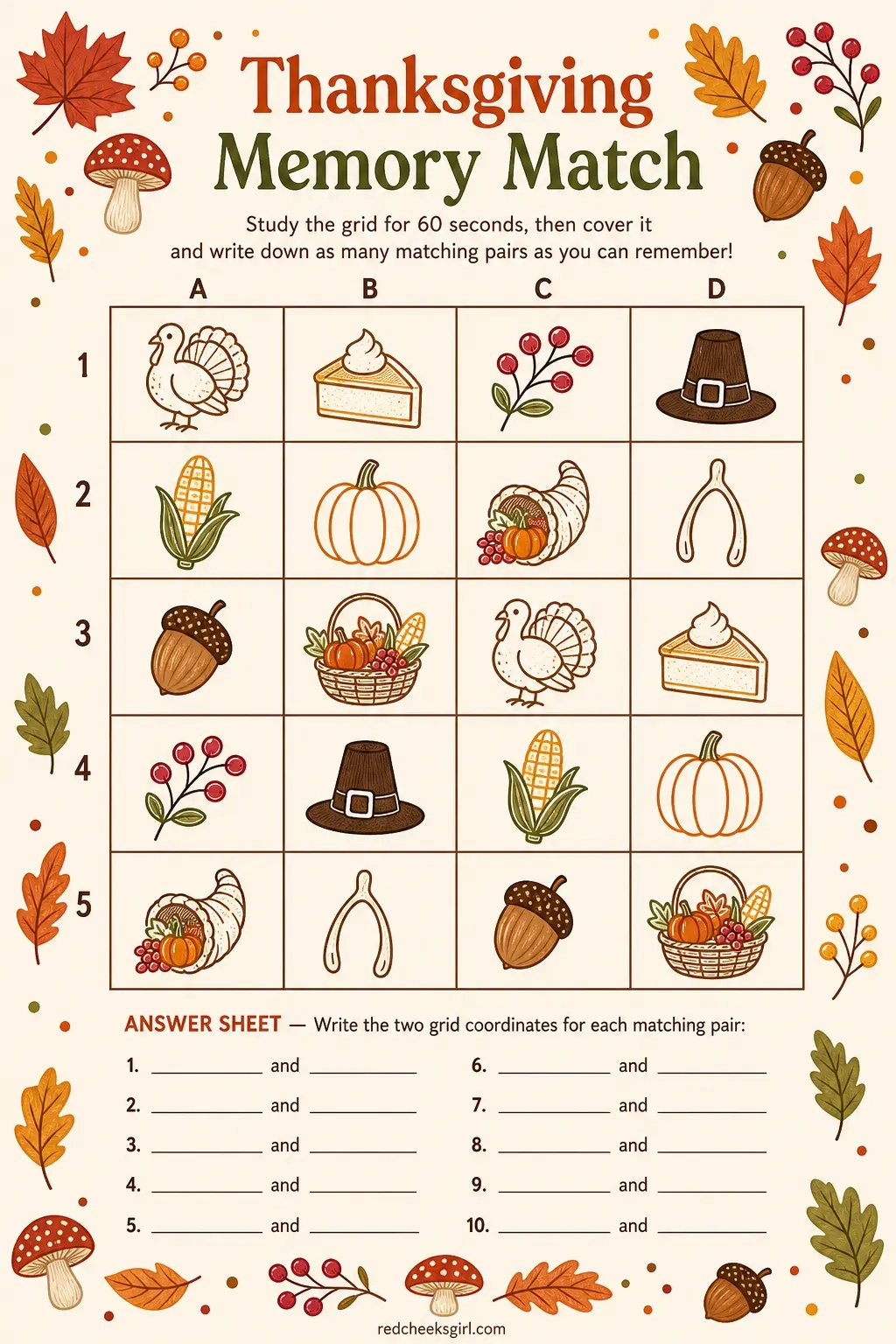
The Thanksgiving Memory Match Sheet is a printable grid of 20 Thanksgiving image pairs that players study for exactly 60 seconds, then the sheet gets flipped over (or a blank cover sheet placed on top), and players have to write down as many matching pairs as they can remember from memory.
Whoever correctly recalls the most pairs wins. It tests pure visual memory and plays beautifully as both a solo challenge and a head-to-head competition between two players using the same sheet.
The printable sheet shows a 4×5 grid of small illustrated Thanksgiving icons — turkey, pie, cranberries, pilgrim hat, corn, pumpkin, gourd, wishbone, acorn, and harvest basket — with each icon appearing twice somewhere in the grid, positioned in different rows and columns.
Players study the grid, then on a separate answer sheet (or the back of the page), write the grid coordinates of each matching pair. Scoring: one point per correctly identified matching pair. A perfect score is 10 pairs.
For kids, reduce the grid to 3×4 (6 pairs) to keep it fun and achievable.
Memory Match works wonderfully as a table game while guests are waiting for dinner because it keeps people quiet and focused without requiring any group coordination.
But it also makes a fantastic head-to-head showdown between two players who think they’re the sharpest person in the room — and I’ve seen it settle longstanding sibling rivalries in the most satisfying way.
Host tip: run two rounds back to back; scores almost always improve in round two as people develop strategies, and the improvement arc makes everyone feel smart enough to want a round three.
- Study the icon grid for exactly 60 seconds
- Cover the sheet
- Write down as many matching pairs as you remember
- 1 point per correct pair — 10 pairs total

13. Pass the Gourd Relay
Pass the Gourd Relay is one of those games that starts normal and descends into beautiful mayhem within about 45 seconds.
Each player on a team must pass a decorative gourd (or a small pumpkin, or a potato — you’re working with what Thanksgiving actually provides) down the line using only their elbows — no hands allowed.
If the gourd hits the ground, the team must start their pass from the beginning. First team to get the gourd from one end of the line to the other wins the round. Simple, physical, ridiculously funny.
You need exactly: one gourd or small squash per team, and enough floor or yard space to make a line of however many people are playing. Teams should have equal numbers; if you’re uneven, one person on a smaller team goes twice.
For indoor play, clear a hallway or living room strip. For outdoor play, this is even better — line up across the backyard and let nature do its thing. Run three rounds for best-of-three stakes.
Add a tiebreaker rule: if both teams drop the gourd in the final round, the team that drops it fewer total times across all three rounds wins.
This game is gold before dinner when everyone needs to burn off some arrival energy, but it’s honestly just as good after pie when people need an excuse to move.
The elbow-only rule means that body types, heights, and ages all create wildly different passing challenges — a tall teenager and a short aunt trying to coordinate a gourd transfer is peak holiday entertainment.
For a harder variation, use a rounder, less stable gourd and eliminate the restart rule — just let the chaos build and see who gets it furthest.
Host tip: do a quick safety check for any guests with shoulder or elbow issues and have them be the official judge instead.
- 1 small gourd or squash per team
- Open floor space (hallway, yard, or cleared living room)
- Equal team sizes
14. Pie Recipe Scramble
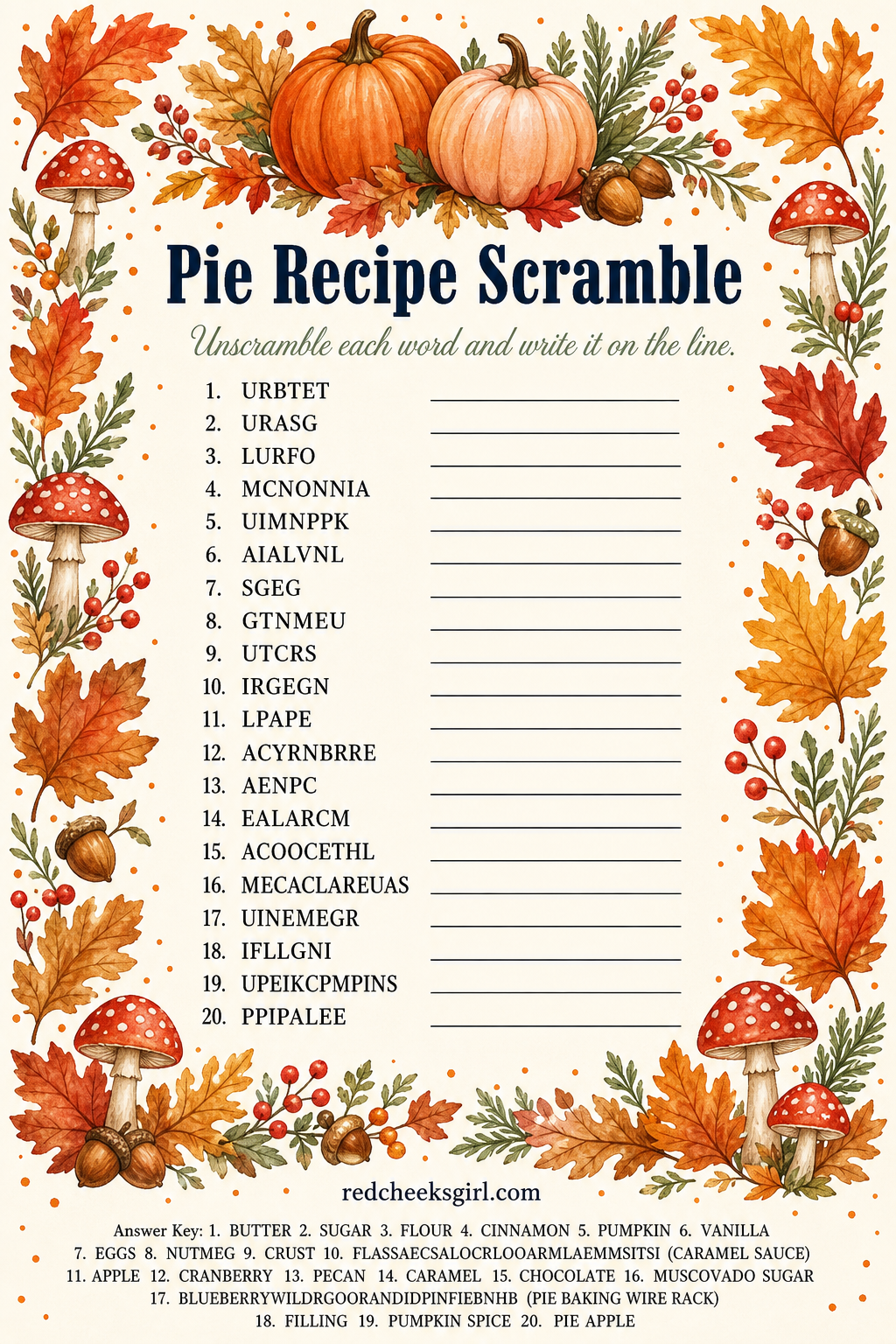
Pie Recipe Scramble is a word-unscramble game dressed up in the best possible holiday clothes. Each entry is a scrambled version of a Thanksgiving pie ingredient or pie-related baking term, and players race to unscramble all 20 entries as fast as possible.
The words range from easy (TERUBT → BUTTER) to satisfyingly tricky (ONAMNNCI → CINNAMON) to downright diabolical (RACLM DUCS → CARAMEL SAUCE).
It’s a quiet, solo puzzle but it has real competitive energy when you run it timed — announce ‘go,’ and let people scratch and scribble their way down the sheet as fast as they can.
Print one sheet per person. Players work individually and silently — this is not a team game, which makes it a nice contrast to the louder group games elsewhere in the day.
When someone finishes, they raise their hand but don’t say the answers aloud yet — everyone gets to keep going until a full two minutes has elapsed. Then compare sheets.
Award one point per correct answer, and yes, the answer key is at the very bottom in tiny light-grey text so the host can check quickly. For a competitive version, eliminate that key from player copies and keep the host’s copy separate.
Why this one is especially perfect for Thanksgiving: it activates the bakers and food-obsessed guests who dominate the kitchen all morning.
Suddenly the cousin who spent four hours making a lattice-top apple pie is absolutely obliterating everyone on the scrambled ingredient round — and they deserve that win. It’s also a lovely option for the table-sitters who prefer a quiet challenge over anything physical.
Host tip: time the round at exactly 2 minutes on your phone timer and announce when you start — the ticking clock makes even simple unscrambles feel urgent in the best way.
- Give younger players (under 10) only the first 10 words (Easy section)
- Allow teams of two for kids who struggle with spelling

15. Thanksgiving Heads Up
If you’ve ever played the Heads Up app at any party in the last decade, you already know this format — and the Thanksgiving version is every bit as chaotic and fun.
One player holds their phone (or a printed card) to their forehead showing a Thanksgiving-themed word or phrase they can’t see: STUFFING, CORNUCOPIA, MACY’S PARADE, WISHBONE, TRYPTOPHAN, SARAH HALE (the woman who lobbied for Thanksgiving to be a national holiday — put that one in for the trivia nerds).
Their teammates have 60 seconds to give clues, act out hints, or do whatever it takes to get the player to say the word — without saying the word itself. Correct guesses score a point. Tilt the phone/card down to pass.
For the digital version, the Heads Up app by Ellen DeGeneres has a Thanksgiving deck that’s ready to go.
For the analog version (which honestly works just as well), write 30 Thanksgiving words on index cards, shuffle them, and have the guesser hold each card to their forehead while teammates give clues.
Run it in 60-second rounds per player, tally the correct guesses, and the player with the highest score wins. Or play team-style: two teams alternate turns and the team with the most points at the end wins. Either format flies.
Heads Up is perfect for any moment in the day but absolutely shines after dinner when everyone’s a little full and a little silly and no one wants to do anything that requires standing up or going outside.
The short rounds keep energy up, the stakes feel real but low, and the inevitable moment where someone gives a clue that is somehow more confusing than the original word is the comedic highlight of every round.
Best crowd-pleaser variation: mute the clue-givers and let them only act it out (pure charades mode) — the faces people make trying to physically embody ‘cornucopia’ are genuinely art.
- Heads Up app OR 30 Thanksgiving words written on index cards
- A timer (phone works great)
- At least 4 players for the best energy
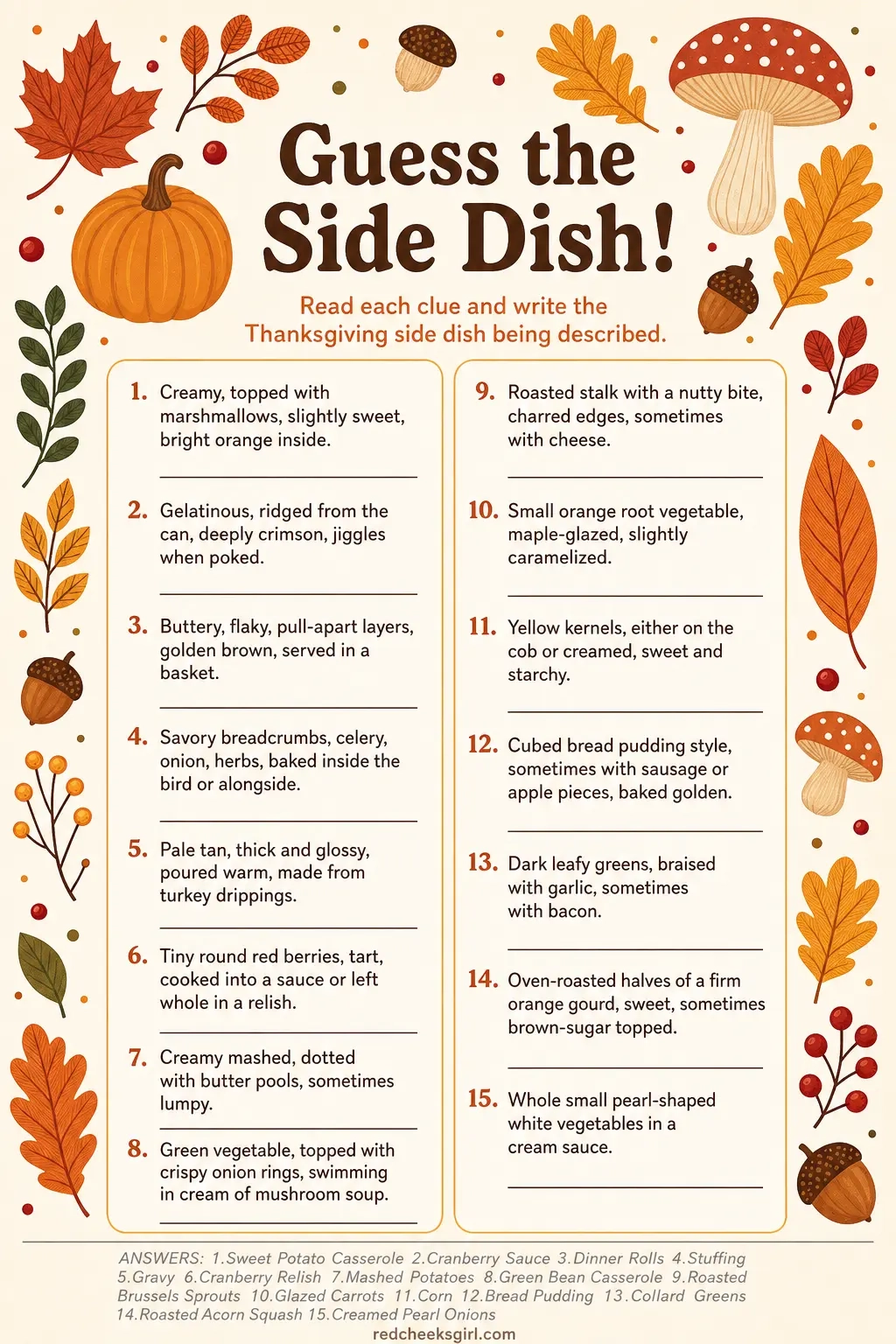
16. Guess the Side Dish Sheet
Guess the Side Dish Sheet is a printable food-identification challenge that is much sneakier than it looks.
Players are given a sheet with 15 close-up or cross-section descriptions of classic Thanksgiving side dishes — no photos, just written sensory clues — and they must identify which dish is being described. Sample clue: ‘Creamy, topped with marshmallows, slightly sweet, bright orange inside.’
Answer: sweet potato casserole. Another: ‘Gelatinous, jiggles when moved, ridged from the can, deeply crimson.’ The room will be divided on that one. The descriptions get progressively more obscure, and players write their guesses in the blank provided next to each clue.
Print one per person and hand them out right before the meal — it’s the perfect activity that occupies people while the host is doing final food prep. Players work independently and silently.
Collect sheets after 5 minutes (or when dinner is announced), check answers against the key at the bottom of the sheet, and whoever correctly identified the most dishes wins.
For a team version, read the clues aloud and let teams confer before writing — this version plays faster and generates more debate, especially over the ambiguous ones.
What makes this game so specifically Thanksgiving-brilliant is that it turns the very food you’re about to eat into the content of the game.
People start thinking about and anticipating each dish while they’re playing, which is basically the world’s greatest priming technique for appetite and appreciation.
Plus it subtly rewards the actual cooks in the room — whoever made the green bean casserole will nail that clue immediately while the person who ‘doesn’t cook’ stares at it blankly. Poetic justice, honestly.
Host tip: include at least one easy gimme clue so even young kids can get a point on the board.
Hand out sheets right as guests arrive — it gives early birds something to do and doubles as a dinner anticipation builder!

17. Corn Hole (Fall)
Yes, corn hole is on this list — because pretending it isn’t the actual most-played outdoor Thanksgiving game in America would be a lie, and this is a judgment-free zone.
Fall-edition corn hole means swapping out the standard bean bags for orange and brown corn-pattern bags, setting up on the back lawn or driveway, and playing the classic format: two boards, two teams of two, take turns tossing bags at the hole.
Bag through the hole = 3 points. Bag on the board = 1 point. Score cancels out (cancellation scoring). First team to exactly 21 wins. That’s it. That’s the game. And yet somehow it consumes four to five hours of Thanksgiving afternoon without anyone complaining.
If you already own a corn hole set, brilliant — just drag it out. If you don’t, you can DIY one with two pieces of plywood, a jigsaw, and some fall-colored spray paint in about two hours the day before.
Alternatively, buy a foldable travel set (they’re inexpensive and store flat). Set the boards 27 feet apart for official play, or closer for kids and casual play. Run a tournament bracket if you have enough players: four teams of two, two semifinal matches, one final.
Write the bracket on a chalkboard or piece of butcher paper and let people watch and heckle from the sideline.
The reason corn hole makes every outdoor Thanksgiving game list ever written is the same reason it works: it’s genuinely fun for every skill level, runs in parallel with other activities so people can drift in and out, requires zero explanation beyond the first throw, and generates a light ongoing competitive hum that makes the whole backyard feel alive.
It’s also one of the few outdoor games where a 65-year-old and a 12-year-old are playing on genuinely equal footing, which makes for surprisingly competitive rounds.
Host tip: keep a list of who has already played on the bracket sheet so nobody gets called to play twice before everyone’s had a first round.
- Corn hole board set (or DIY with plywood)
- Fall-themed corn hole bags (orange/brown)
- Chalk or whiteboard for tournament bracket
- 27 feet of flat outdoor space
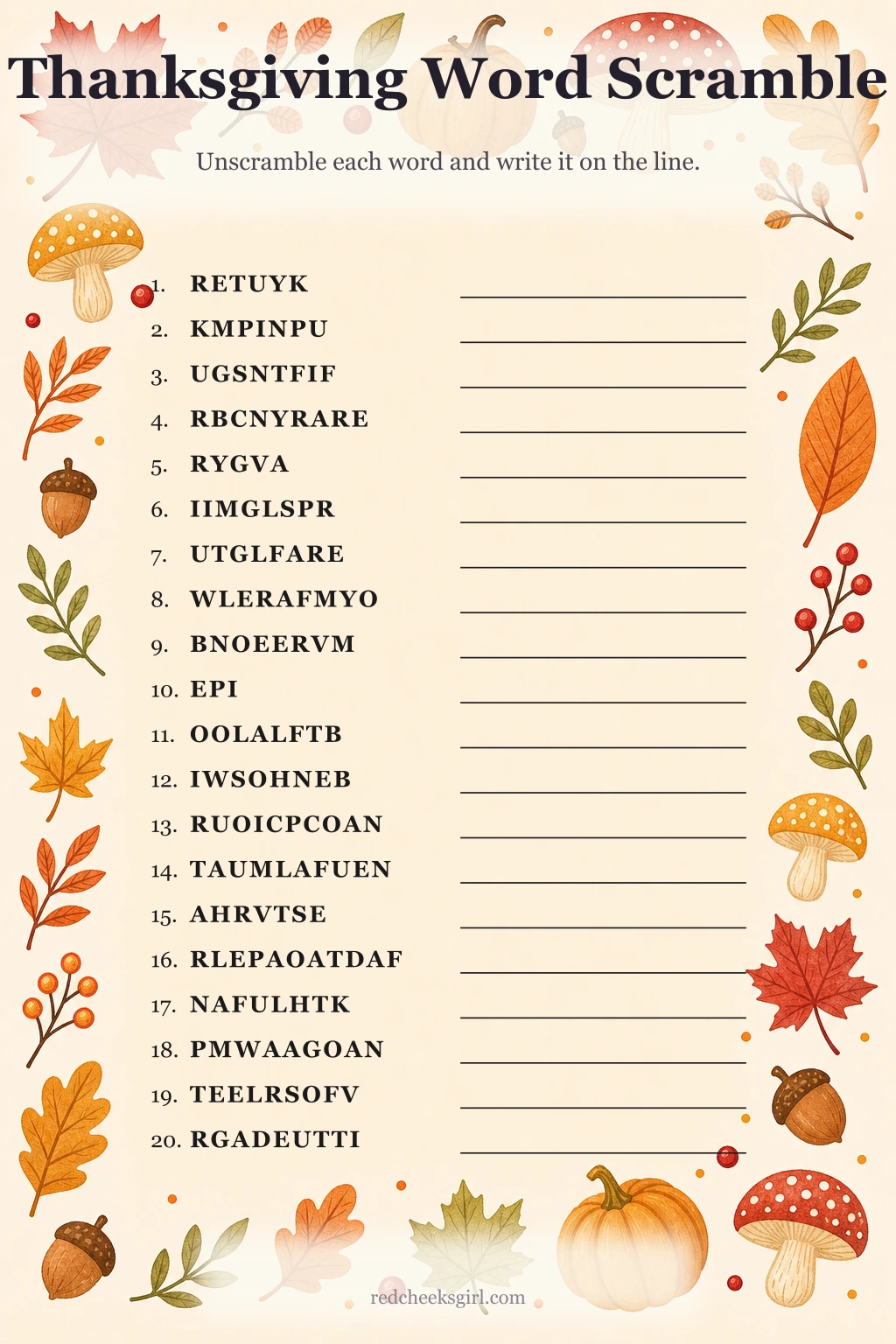
18. Thanksgiving Word Scramble
The Thanksgiving Word Scramble is the printable game that absolutely everyone can play — kids, grandparents, non-native English speakers, and people who haven’t technically sat down yet but are hovering near the table.
Each word on the sheet is a scrambled Thanksgiving-related term: food, traditions, history, and seasonal words all jumbled together. Players unscramble as many as they can in two minutes, working individually.
It’s a timed race against the clock (and, let’s be honest, against whoever is sitting next to them and very conspicuously already halfway done).
Print one per person. Words range from easy (RYTEKU → TURKEY) to medium (PMUINKP → PUMPKIN, GINSTFUF → STUFFING) to head-scratchers (AINOROCPCU → CORNUCOPIA).
There are 20 words total, and the sheet is designed so that younger kids can pick off the first five while adults sweat through the back half.
When time is called, everyone puts pens down and the host reads out the answers — the answer key lives in small grey text at the very bottom. One point per correct answer, highest score wins.
For a group version, allow teams to confer quietly — this loosens the game up nicely and gets people talking about autumn vocabulary, which is delightfully wholesome.
What the Thanksgiving Word Scramble does better than almost any other printable: it functions as a natural icebreaker without feeling like one.
People lean over to each other, compare progress, whisper hints, and laugh at the ones they couldn’t figure out — and those small moments are the actual fabric of a great holiday.
Host tip: print extras and let people keep their sheets — kids especially love taking home a ‘scored’ activity sheet as a little souvenir of the day.
And if you’re already printing, grab the crossword and trivia cards at the same time and build yourself a full Thanksgiving game packet. Your guests will be thrilled and you’ll look extremely prepared (the best kind of flex).
- For kids under 8: circle just the first 8 words on their sheet as their version
- Allow 3 minutes instead of 2 for mixed-age tables

19. Thankful Toast Round
The Thankful Toast Round is exactly what it sounds like — and it is more powerful than any fancy game in this list.
Before the first bite is taken, the host kicks things off with a short personal toast of genuine gratitude (30 seconds max), then passes the torch clockwise around the table.
Each person raises their glass and shares one thing they are genuinely thankful for this year, in whatever form feels natural to them — a sentence, a name, a feeling, a memory. Nobody is obligated to cry, but nobody is stopping you either.
Every voice at the table is heard before anyone picks up a fork.
No supplies needed. No prep.
The only requirement is that the host goes first with real warmth and specificity — not ‘I’m thankful for this food and this family’ (nice but forgettable) but something honest and particular, like naming a person or a moment from the year.
That specificity gives everyone permission to do the same. Keep a soft rule that phones are down during this round — it takes maybe five to ten minutes for a table of twelve, and it reframes the whole meal.
Have glasses filled with whatever people are drinking (sparkling cider works beautifully for the younger crowd) so everyone can genuinely clink at the end.
Why this one matters among all these thanksgiving games: the research on gratitude practices is thorough and consistent — verbally expressing gratitude in front of people you love deepens relationships and elevates mood in measurable ways.
But science aside, practically speaking, it is the moment people remember most when they talk about Thanksgiving years later. Not the most points scored or the best corn hole game — it’s the toast. Start there.
Host tip: if your group includes people who are shy or introverted, give them a heads-up before everyone sits down so they have a moment to think — it removes the deer-in-headlights anxiety and makes their toast feel considered rather than panicked.
Go first with something specific and heartfelt — your vulnerability sets the tone for the whole table.
20. Harvest Trivia Live
Harvest Trivia Live is the trending 2026 upgrade to your basic trivia round — and the key word is ‘live,’ meaning it’s designed to be hosted with energy, pacing, and a little bit of showmanship rather than just reading questions off a sheet in a monotone.
The host becomes the emcee: questions are read with drama, wrong answers get a theatrical buzzer sound (or just the host going ‘OHH, SO CLOSE’), and the live audience energy is part of the game.
Questions cover the full spectrum of Thanksgiving and autumn knowledge — history, food science, football trivia, Macy’s Parade stats, and pop culture — divided into five rounds of five questions each.
Divide into teams of two to four players. Give each team a small whiteboard or notepad and a marker.
The host reads each question aloud with a 20-second answer window — teams write their answer and hold it up simultaneously (this prevents one fast team from shouting over everyone).
Award 1 point per correct answer per round, with a bonus ‘Double Harvest’ question at the end of each round worth 2 points if the team can answer it correctly. Running scores are announced after each round by the emcee to keep competitive tension alive.
After 25 questions, the team with the most points wins.
The reason Harvest Trivia Live works better than just reading trivia cards is the format: simultaneous answer reveal means every team is engaged on every question, no one gets left out by a fast shouter, and the emcee’s energy keeps the room’s energy up.
It’s also a game that scales perfectly — whether you have 6 players or 36, the team format keeps it manageable.
Host tip: prepare the question list ahead of time and organize it from easiest (Round 1) to hardest (Round 5) so energy builds naturally rather than front-loading the brutal questions and deflating people early.
For an extra touch, print each team a custom team name card — the ‘Turkey Legs’ vs. the ‘Pie Destroyers’ hits different than Team A vs. Team B.
- 25 Thanksgiving trivia questions in 5 rounds of 5
- Small whiteboards or notepads + markers for teams
- A host willing to bring the emcee energy (you’ve got this)
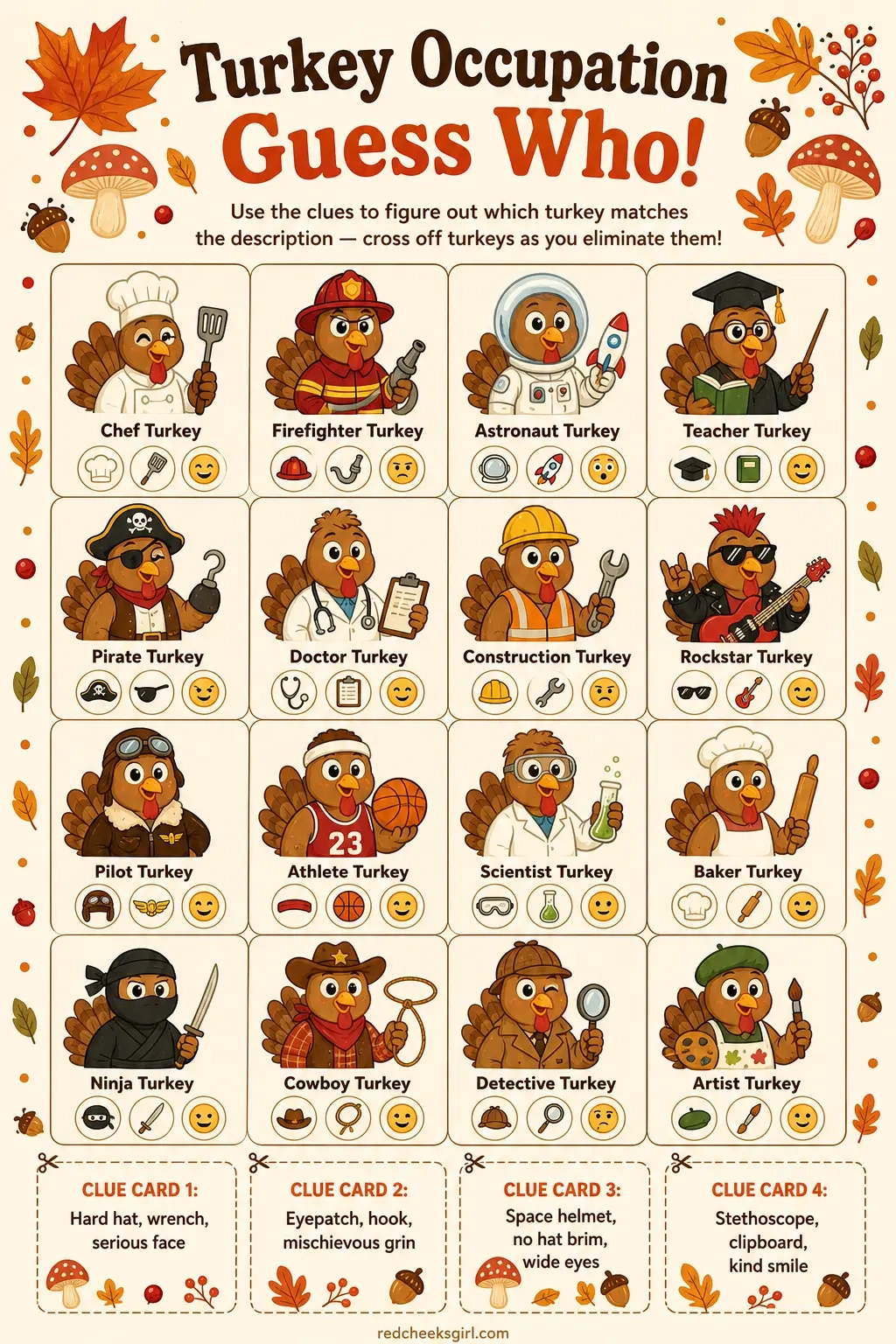
21. Turkey Occupation Guess Who
Turkey Occupation Guess Who is a printable deduction game with a genuinely delightful premise: a grid of cartoon turkeys dressed in different professions (firefighter turkey, chef turkey, astronaut turkey, teacher turkey, pirate turkey, doctor turkey, construction turkey, rockstar turkey, pilot turkey, athlete turkey, scientist turkey, baker turkey, ninja turkey, cowboy turkey, detective turkey, and more) and players must identify which specific turkey matches a set of yes/no clue cards.
It’s a direct riff on the classic Guess Who? board game format but completely self-contained on a printable sheet — no separate boards needed.
The sheet contains the full grid of 16 illustrated career turkeys, each with a name and three visible traits (hat type, accessory, expression).
A separate set of 16 small clue cards at the bottom of the sheet are cut apart by the host; each clue card describes one turkey using three clues (e.g., ‘This turkey wears a hard hat, carries a wrench, and has a serious expression’).
Players cross off turkeys on the grid as they eliminate possibilities from the clue card. First to identify the correct turkey wins that round.
The host draws a new clue card for each round and players reset by uncrossing their grids on a fresh printed sheet.
This game earns its place as a print-and-play favorite because it plays just as well with a seven-year-old as it does with a curious adult — the visual grid keeps everyone engaged and the deduction logic scales naturally with age.
Younger kids focus on the obvious visual cues (the hat, the color of the accessory) while older players use more systematic elimination.
It’s also genuinely replayable: with 16 clue cards and a fresh printed sheet per round, you can run the game six or seven times before anyone has seen every card.
Host tip: let a kid be the ‘clue reader’ for a round — they take the responsibility very seriously and it is extremely cute.
- Ages 5 and up
- Small groups of 2–6 players
- Quiet table time during pre-dinner or post-pie

22. Flag Football
If corn hole is the laid-back outdoor Thanksgiving game, flag football is the one that actually gets the competitive juices flowing — and nearly 53% of Americans watch football on Thanksgiving, so channeling that energy into a backyard game of your own is peak holiday synergy.
Flag football removes all the contact of regular football (no tackling, no blocking) and replaces it with flag belts or just ribbon strips tucked into waistbands: pull someone’s flag to ‘tackle’ them.
Divide into two teams of four to eight players, set up yard markers with cones or lawn chairs, and play for two 20-minute halves or until dinner is called. No pads, no problem.
You need a football, some space (a standard backyard works, a park is even better), and flag belts or ribbon strips — dollar store ribbon tied loosely around waists is completely fine.
Standard flag football rules: the offense gets four downs to advance the ball 10 yards for a first down, touchdown is worth 6 points, and the defense ‘tackles’ by pulling a flag. No-contact rules mean kids, teens, and adults can genuinely play together.
Designate someone as quarterback who can read the room and adjust the game’s intensity: slower passes for mixed-age groups, more competitive for the all-adult team.
The beautiful thing about flag football on Thanksgiving is that it gets everyone outside after spending all morning in the kitchen, burns off pre-meal energy in kids, gives sports fans a physical outlet for the game-day excitement buzzing through the house, and creates one of those big collective outdoor memories that becomes part of your family’s holiday story.
Host tip: announce it early in the day (‘we’re playing flag football at 2 PM before dinner’) so people can dress for it and the game doesn’t get pushed to ‘maybe later’ and never happens.
And just FYI — if you’re already buying sports gear as gifts this holiday season, the 2025 Christmas Gift Guide has some solid ideas for the sporty people in your life.
- A football
- Flag belts or ribbon strips (one per player)
- Cones or lawn chairs for yard markers
- At least 8 players (4 per team minimum)
23. Family Story Swap
Family Story Swap is the quiet game that gets louder as it goes — because once you open the floodgates of old family stories, the laughter and interruptions and competing versions of the same memory take on a life of their own.
The format is simple: someone draws a prompt card (or the host reads a prompt aloud) and everyone around the table shares their version of that story.
Prompts are things like: ‘Tell about the most chaotic Thanksgiving dinner you remember,’ ‘Describe a family member who made everyone laugh,’ or ‘Tell about a holiday tradition that didn’t survive past one year.’ Each person gets two minutes max, then the next person goes.
No supplies required beyond a printed or handwritten list of 10–15 prompts.
For a seamless version, write prompts on folded slips of paper in a bowl — the bowl gets passed around and whoever draws the slip shares first, then everyone at the table adds their own answer to the same prompt before moving to the next one.
Keep the energy warm and inviting: the host establishes early that partial memories, wrong details, and family myths are all welcome. There are no wrong stories here, only funnier ones.
This works beautifully as a post-dinner activity when bellies are full and no one is in a hurry to move.
The stories that come out of Family Story Swap — especially across generational lines — are the ones that get told again and again for years. Grandparents get to shine in these rounds in a way that trivia and relay races don’t always allow.
Host tip: if your family has any long-distance or virtual guests this year, this game Zooms beautifully — each person can share their story from wherever they are, and the virtual format actually equalizes voices in a way that feels generous and inclusive.
This is also one of those moments that reminds you to check in on your family’s finances before the holiday rush — if you haven’t yet, this Christmas budgeting guide is worth a quick read so December doesn’t hit harder than expected.
Start with the funniest, lightest prompt first — once the laughter is flowing, deeper or more emotional prompts land beautifully.
24. Turkey Bowling
Turkey Bowling is exactly what the name promises: bowling, but with a frozen turkey as the ball.
If you have never watched a full-grown adult crouch down, grip a 12-pound frozen bird by the legs, and send it sliding across the kitchen floor toward a row of two-liter soda bottles — you have not lived.
This game is a Thanksgiving cult classic for a reason: it’s absurd, it’s physical, it’s hysterical, and it requires almost no setup beyond having a turkey in the house, which you already do.
Setup: clear a long flat surface — a hallway, a cleared kitchen floor, or a smooth driveway works perfectly. Set up 10 two-liter plastic bottles (partially filled with water or sand for stability) in standard bowling pin formation at one end.
Mark a foul line about 10 to 15 feet back. Players take turns sliding the frozen turkey underarm toward the pins. Knocked pins = points. Play two frames per round per player and tally scores.
The turkey does need to be still sealed and frozen for this — don’t use the one you’re cooking. Keep a backup smaller turkey or use a pumpkin if you only have one bird.
The reason Turkey Bowling transcends novelty and becomes a genuine Thanksgiving tradition in families that try it: it is perfectly calibrated physical comedy. The turkey is awkward, heavy, and completely unpredictable. It will veer wildly off course. It will knock one pin and stop completely.
Someone will get a strike and act like they won the Super Bowl. Someone else will release too early and the turkey will just sit at the foul line, immovable, going nowhere. The entertainment writes itself and literally every age can play.
Host tip: set this up in the morning so guests arrive to the Turkey Bowling setup already waiting — the anticipation builds all day and the late-afternoon reveal when the game finally starts is peak Thanksgiving energy.
- 1 frozen turkey (still sealed — NOT the one you’re cooking!)
- 10 two-liter bottles, partially filled for stability
- A long flat floor or driveway surface
- Tape for the foul line
25. Thanksgiving Mystery Box Challenge
The Thanksgiving Mystery Box Challenge is inspired by cooking competition shows and it delivers the same delicious tension: players reach into a covered box (or pillowcase) and must identify the Thanksgiving item inside by touch alone — no peeking.
Items could be a raw potato, a can of cranberry sauce, a raw drumstick, a bunch of sage, a butternut squash, an apple, a bag of flour, a whole onion, a pie tin, or a dried corn cob.
Players get 15 seconds to feel around and write their guess. Reveal happens simultaneously after each round. Most correct guesses across 10 items wins.
Setup is genuinely simple: gather 10–12 Thanksgiving kitchen items, place them in a large box or bag with a hole cut for a hand, and keep the item list secret.
For a competitive group version, run it as a relay — each team sends one player per item and competes for fastest identification across the full lineup. For a more relaxed version, pass the box around the table and everyone guesses independently.
You can make it family-friendly or more daring: include items with unusual textures (a whole raw turkey neck is a legendary choice) for maximum screaming.
This trending 2026 Thanksgiving game format works because it taps into genuine surprise — nobody knows what they’re about to touch, and the combination of concentration face, nervous laughter, and the occasional shriek creates a rolling wave of entertainment from the first player to the last.
The reveal moment — when someone confidently announces ‘that’s definitely an apple’ and it was in fact a whole onion — is the kind of thing your family will be imitating at Thanksgiving for years.
Host tip: dry off any moist items before putting them in the box, and keep a napkin nearby for the inevitable ‘I don’t want to know what that was’ moments.
Also, maybe warn guests with sensory sensitivities beforehand — easy opt-out for anyone who’d rather judge than play.
- A large box or bag with a hand-sized hole
- 10–12 Thanksgiving kitchen items (varied textures!)
- Paper and pens for guesses
- Napkins — trust us
26. Stuffing Spoon Duel
The Stuffing Spoon Duel is a one-on-one relay challenge that works as both a standalone game and a knockout tournament: two players face off at a time, each balancing a wooden spoon loaded with a small ball of foil (or a ping-pong ball) as they race a course, return to the start, and tag the next teammate.
The team that completes all members first without dropping their ball wins. It’s simple, fast, and the moment-to-moment drama of watching someone speed-walk while desperately trying to keep a ball on a spoon never gets old.
Materials: one wooden serving spoon per team (the big kind used for serving stuffing — hence the name), one ping-pong ball or a tightly rolled ball of foil per spoon, and a clear course.
The course can be as simple as down a hallway and back, or as elaborate as an obstacle course with turns around chairs and under a table.
Run teams in heats of two-on-two for the bracket structure, or play it as individual time trials and rank everyone by their fastest clean run. ‘Clean’ means no drops — any drop requires returning to the start of your leg.
What makes Stuffing Spoon Duel a step above a regular spoon race is the Thanksgiving-specific framing and the two-at-a-time head-to-head format. Running against a direct opponent adds pressure that solo time trials can’t match, and the simultaneous racing means everyone else is watching and cheering.
It’s ideal as an after-dinner game when energy needs a physical jolt — just wait the recommended 20–30 minutes post-meal before sprinting through the living room.
For a harder version, use an actual boiled egg on the spoon (yep, some families really commit) and run it outdoors where the stakes of a drop are lower and the laughter at drops is much higher.
- Use a deep spoon for kids so the ball sits more securely
- Shorten the course to 8 feet for ages under 7
- Allow two hands on the spoon for the very youngest players
27. Highs and Lows of the Year
Highs and Lows of the Year is one of those Thanksgiving table traditions that looks simple on paper and somehow punches well above its weight in terms of emotional payoff.
The format: going around the table, each person shares their biggest high of the past year — a moment, an achievement, a relationship milestone, anything — and their most significant low — a challenge, a loss, a hard stretch. No judgment, no rushing.
Two minutes per person. The table listens. The host models the format by going first with genuine vulnerability.
No materials needed.
The only setup is intention: the host announces the game at the start of the meal or just before dessert, explains the format in one sentence (‘share your best moment and your hardest moment from this year’), and makes it clear that there is no wrong answer and no required depth — a high can be ‘I finally finished that puzzle’ and that is beautiful and valid.
The silence between one person’s low and the next person’s high is where the real magic lives. Let it breathe. Resist the urge to immediately fill it.
Highs and Lows works across every family configuration — it works for twelve people or four, for families that see each other every week and families that only gather once a year.
It generates the conversations that don’t happen in the regular course of life, and it gives everyone at the table a chance to be witnessed — which is, underneath all the turkey and cornhole and laughter, what Thanksgiving is actually about.
Host tip: if you have kids at the table who are old enough to understand the concept (roughly 7 and up), including them in this round — and actually listening to their answers — is one of the most meaningful things you can do for them this holiday season.
Their highs and lows will surprise you.
Go first and be genuinely honest — your authenticity creates the safe space everyone else needs to share their own truth.
28. Corn Husk Toss
Corn Husk Toss is a natural, harvest-themed twist on ring toss that uses dried corn husks twisted into ring shapes as the projectiles and a series of sticks, bottles, or wooden dowels as the targets.
Players take turns tossing husks from a marked line, trying to land them around the targets for points (closer targets = 1 point, farther = 3 points, smallest target = 5 points).
It’s an excellent outdoor game with a genuinely autumnal look — if you’ve gone the effort of having harvest decorations anyway, this game literally uses them.
Preparing the corn husk rings: buy dried corn husks (widely available at grocery stores, especially in the Latin foods aisle) and soak them briefly in warm water to make them pliable, then twist and tie them into loops about six inches in diameter.
Let them dry slightly before play. Set up your target stakes in the ground or in a weighted base (upside-down pots with dowels work beautifully). Mark a throw line about 10 feet out for adults and 6 feet for kids.
Play to 25 points per player, or run tournament-style rounds.
Why Corn Husk Toss earns a spot on this list: it’s a game that feels native to the season in a way no plastic ring toss set ever could.
It uses real harvest materials, has a satisfying physicality, and occupies the outdoor space before dinner in a beautiful way. It’s also an activity that requires almost no explanation — watch someone make one toss and you immediately understand and want to try.
The natural variability in husk size and weight means even experienced players can’t perfectly predict the outcome, which keeps it balanced across skill levels.
Host tip: make the husk rings a few days before the holiday and let kids help — it becomes a pre-Thanksgiving craft that doubles as game prep.
- Dried corn husks (soaked and twisted into rings)
- Wooden dowels or stakes for targets
- Pots or soil to anchor the stakes
- A marked throw line
29. Cousins vs Aunts Trivia Showdown
The Cousins vs. Aunts (and Uncles) Trivia Showdown is exactly the kind of generational battle that Thanksgiving was made for. Two teams: the cousins (the younger generation) vs. the aunts and uncles (the older generation).
Questions are split equally between things the young people should know (current pop culture, recent sports, trending topics) and things the older generation should dominate (Thanksgiving history, classic TV, prices of things in 1985, that sort of thing).
Each round, teams alternate — cousins get their pop-culture category, aunts get their history category — and points are tallied across eight rounds of four questions each.
You can run this with a printed question sheet (the host reads them aloud) or project a simple slideshow. Teams confer quietly for 20 seconds per question, write their answer, and reveal simultaneously.
The beauty of alternating question categories is that the scores tend to stay close — which creates real tension.
Add a ‘wildcard’ category in the final round that neither generation has an edge on (Thanksgiving food science, Macy’s Parade balloon history, or something equally specific and obscure) and watch everyone suffer together as nature intended.
This game works so well because it’s structured around a natural family dynamic that already exists — there is always some gentle generational competition at a family Thanksgiving, and this gives it a safe, fun container to live in. The Cousins vs.
Aunts format means kids who might feel overwhelmed by mixed-trivia games can compete confidently on their own turf, while the older generation gets to shine on theirs. The whole table watches and it becomes a spectator sport.
Host tip: let the grandparents serve as judges — they’re delighted to be included in a role that doesn’t require speed or pop-culture knowledge, and their commentary on both teams’ answers is usually the funniest part of the game.
- Extended family gatherings (8+ people)
- After dinner when everyone is settled
- Groups with at least 2 kids and 2 adults per team
30. Pie Tin Frisbee
Pie Tin Frisbee repurposes the humblest Thanksgiving supply — a cheap aluminum pie tin — into a surprisingly legit outdoor game.
Players toss pie tins frisbee-style toward a target (a hula hoop laid on the ground, a basket, or just a marked circle in the grass) and score points based on accuracy.
Closest to center = 1 point, inside the inner ring = 3 points, landing flat in the hoop = 5 points. Aluminum pie tins have a satisfying wobbling flight that makes them both funny and genuinely skill-based.
Run it as a knockout tournament or a friendly casual toss.
Materials: a pack of standard 9-inch aluminum pie tins (they cost almost nothing), one hula hoop or a rope circle laid in the yard, and a distance marker. Start at 15 feet for casual play, 25 feet for a competitive round.
Each player gets three tosses per turn, scores are tallied, and the player with the most points across five rounds wins.
Pie tins fly differently depending on the wrist release, which means there’s a learning curve that keeps it interesting — players who’ve played frisbee their whole life are often initially humbled by the pie tin’s unpredictable flight path.
This game earns bonus points for the cost ($3 for a pack of pie tins) and the thematic perfection — Thanksgiving revolves around pie, and here you are literally throwing the pie tins.
Kids love the novelty, adults love the surprisingly technical challenge of getting the tin to fly flat, and the whole thing packs up in about 30 seconds.
For the competitive variation, set up multiple target distances simultaneously (easy, medium, hard rings) and let players choose their difficulty before each toss — the higher the ring, the more points.
Host tip: if it’s windy, move the target closer and lean into the chaos — wind-assisted pie tins flying sideways are half the entertainment.
- Pack of 9-inch aluminum pie tins (inexpensive, craft stores or grocery stores)
- 1 hula hoop or rope circle for the target
- Outdoor space with at least 25 feet of clearance
31. Best Dish Poll
The Best Dish Poll is delightfully controversial and I am here for every second of it. The premise: before dinner, each person votes privately on their top three Thanksgiving dishes from the full spread being served.
Votes are collected anonymously, tallied secretly, and the results are revealed during dessert — with a dramatic countdown from fifth place down to the winner. Whoever made the winning dish takes a victory lap. Whatever lands in last place gets gently roasted.
It’s a conversation starter, a recipe for gentle drama, and an unexpected way to appreciate the effort that went into every pot on the table.
Setup: write the dish names on a ballot sheet (one per person), pass them out before the meal with specific instructions: ‘Rank your top 3 dishes — they must be dishes being served today.’
Collect the ballots in a bowl, have a designated tallier quietly add up the scores during dinner, and build the reveal into the post-pie moment before games resume.
You can also add a ‘Most Underrated Dish’ category which often produces a dark horse win for something like roasted Brussels sprouts that nobody expected to place.
Why it works: food is the language of Thanksgiving, and this poll turns the table spread into a shared experience rather than a passive backdrop. The cooks feel seen (especially when their dish places highly), and the voters feel like they have agency and voice.
The reveal moment — especially when the green bean casserole unexpectedly comes in first or the ‘fancy’ dish nobody’s heard of fails to place — is one of those Thanksgiving memories that sparks spirited discussion for years.
Host tip: if any dish is made by someone who’d be genuinely hurt by a last-place finish, quietly bump them to an automatic honorable mention before the reveal — no game is worth tears on Thanksgiving.
Reveal results at dessert time for maximum dramatic effect — build suspense by announcing from 5th place up to 1st.
32. Wishbone Tug Duel
Wishbone Tug Duel is both a Thanksgiving tradition and a competitive elimination bracket — if you lean into it. After the turkey is carved and cooled, the wishbone (furcula) is distributed to the first two players.
Each person hooks a pinky around one side and pulls on a count of three. Whoever ends up with the larger piece wins that round and their ‘wish’ — and advances in the bracket.
Run it as a single-elimination tournament with multiple wishbones (if you have enough turkey — or use craft store fake wishbones for a reusable set) and crown an overall Wishbone Champion of the Year.
For a single-turkey household, you get one wishbone and one head-to-head matchup — classic and simple.
For a larger event or a family that takes their turkey very seriously, you can use a set of plastic replica wishbones (sold inexpensively at party supply stores) to run a full 8-person or 16-person bracket.
Draw matchups randomly from a hat, run all the first-round duels simultaneously, advance winners to the next round, and run the finals with full ceremony and audience observation. Keep the bracket on the whiteboard or fridge so everyone can track the competition across the afternoon.
The Wishbone Tug Duel holds a special place among all these thanksgiving games because it connects to genuine folklore and family ritual — the wish tradition goes back centuries, and framing it as a tournament gives it both competitive energy and reverence.
Even guests who think they’re too cool for party games will hold out that pinky finger. The snap of the wishbone and the moment of winner determination is a genuinely tense two-second experience that the whole room watches.
Host tip: if you have young children who desperately want to win, let them go against each other in their own bracket — it keeps the competition age-appropriate and gives every kid a real shot at being champion.
- The turkey wishbone (or plastic replica wishbones for a tournament)
- A bracket sheet on paper or whiteboard
- A crown, sticker, or silly prize for the champion
33. Napkin Fold Race
The Napkin Fold Race is a speed-based craft competition that uses the very supplies already on your Thanksgiving table — cloth or paper napkins — and tasks players with completing a specific napkin fold as fast as possible.
The host demonstrates the target fold (a turkey fan, a bishop’s hat, a lotus, or a simple diagonal pocket) and then says go. Players race to replicate the fold. First one to complete it correctly and hold it up wins the round.
Run five rounds with five different fold styles, tally wins per player, and crown the Napkin Fold Champion.
Instructions for each fold should be prepared ahead by the host — either a quick printed reference sheet per player, a projected visual, or a host-live demonstration at the start of each round.
For a party-appropriate set of folds: Round 1 is a basic triangle fold (easy, quick), Round 2 is the classic fan fold, Round 3 is the turkey tail fan (Thanksgiving specific and the crowd favorite), Round 4 is the pocket fold, and Round 5 is a free-choice speed round where players choose their best fold from the previous rounds.
Judging is done visually — the host calls who finishes and holds up a valid fold first.
Napkin Fold Race works brilliantly as a pre-dinner game because it uses the table setup as its materials and doesn’t create any mess or cleanup.
It also subtly results in beautifully folded napkins on the table by the time dinner is served, which is a hidden win for any host.
The competition element makes a mundane craft surprisingly tense — people get unreasonably focused on a triangle fold under time pressure, which is the funniest thing about it.
Host tip: the turkey tail fan fold is the one everyone will want to master — have a reference video ready on your phone for anyone who wants to prep beforehand, because the person who walks in with a pre-practiced turkey fan and wins every round will be the most entertaining competitor of the day.
- Cloth or paper napkins (one per player per round)
- A visual reference for each fold style (printed or projected)
- A timer for each round (30–60 seconds per fold)
34. Guess the Spice Sniff Test
The Guess the Spice Sniff Test is both a game and a surprisingly educational sensory experience — and it will absolutely humble the person in your family who claims to be the best cook.
Eight to ten small cups or folded paper packets are filled with individual Thanksgiving spices: cinnamon, nutmeg, cloves, allspice, sage, thyme, rosemary, paprika, ginger, and black pepper.
Blindfolds go on (or just honor system — eyes closed, no peeking), and players take a sniff of each cup and write down what spice they think it is. Reveal at the end. Most correct answers wins.
Prepare the cups ahead of time: small paper cups or folded foil squares each holding a pinch of one dried spice work perfectly.
Smell-testing spices in jars can mix up the scent, so keeping them in separate sealed packets until the moment of the sniff is important. Number each cup 1–10 and keep a master answer list. Players write their guesses in a numbered list, sniffing in order.
Encourage sniffing deeply then pulling back — lingering too long on one scent ‘poisons’ the nose for the next one. This is a real sensory challenge, not just trivia.
What makes Guess the Spice Sniff Test such a Thanksgiving hit is that these are the exact aromas wafting through the kitchen all day — cinnamon in the pie, sage in the stuffing, rosemary on the roasted vegetables — and yet when isolated in a cup, even experienced cooks struggle to name them precisely.
The sage vs. thyme showdown eliminates at least half the table every time, and the moment someone confidently announces ‘that’s definitely paprika’ and it’s allspice is a forever memory.
Host tip: run this as the first game of the day, right when guests arrive, before kitchen aromas have thoroughly saturated everyone’s nose — it’s genuinely harder to smell cinnamon in a cup when the whole house smells like cinnamon pie.
- 8–10 small cups or foil packets with individual spices
- A numbered master answer list (host only)
- Pen and paper for each player’s guesses
- Optional: blindfolds
35. Harvest Basket Sort
Harvest Basket Sort is a timed sorting relay game that transforms your Thanksgiving decor into competitive materials.
The host creates a pile of mixed harvest items — small gourds, fake fall leaves, dried corn cobs, apples, acorns, pine cones — and players must sort them into labeled baskets as fast as possible.
Each item sorted into the correct basket in the correct time wins a point for the team. Fastest team with the fewest errors wins. It’s tactile, fast-paced, and surprisingly competitive when you’re running it as a team relay under a 60-second clock.
Setup: gather your Thanksgiving decor or buy a mixed bag of craft-store fall items. Set up four labeled baskets or bins: GOURDS, FRUITS, LEAVES, SEEDS/NUTS. Dump the full pile on the floor between the baskets.
Teams of two take turns racing the clock — both team members sort simultaneously. After 60 seconds, count correctly sorted items (deduct one point per incorrectly placed item). Run three rounds per team with a fresh mixed pile each time, and compare scores.
For very young kids, simplify to just two categories (round things vs. flat things) and remove the time pressure entirely.
Harvest Basket Sort is a game that works on a physiological level: it gets people physically moving and bending and picking things up, which shakes off that ‘I’ve been sitting in a car for three hours’ stiffness that pre-dinner guests often arrive with.
It’s also completely non-threatening — even guests who don’t like competitive games feel comfortable doing a physical sort because the skill ceiling is low and the fun ceiling is high.
Host tip: after the game, all the sorted decor goes right back into your fall display arrangement, so there’s no cleanup penalty. You literally end up with a better-organized centerpiece as a side effect of playing the game.
- Mixed pile of harvest items (gourds, leaves, acorns, apples, pine cones)
- 4 labeled baskets or bins (GOURDS, FRUITS, LEAVES, SEEDS/NUTS)
- A timer (60 seconds per round)
- Paper for scoring
36. Two-Word Toast Challenge
The Two-Word Toast Challenge is the most elegantly constrained game on this list — and that constraint is the whole point. Each person at the table must describe their Thanksgiving, their year, or their gratitude in exactly two words. Not three. Not one. Two.
Those two words get written on a card, read aloud, and then explained (that’s the actual game — listening to why someone chose exactly those two words). Examples: ‘Survived beautifully.’ ‘More love.’ ‘Finally here.’ ‘Still standing.’ ‘New chapter.’
The limitation forces people to distill something big into something precise, and precision is surprisingly emotional.
The mechanics: give everyone a small notecard and a pen. Give them two minutes of silence to think. Then go around the table, each person reveals their two words and explains them in 60 seconds or less.
Applause follows each one — this is not a competitive game, it’s a celebratory one. Nobody wins, everybody shares, and the collective two-word portrait of your table in this specific year is something truly worth keeping.
(Collect the cards at the end and save them in a jar or envelope labeled with the year — this is the quietest, most powerful tradition on this entire list.)
Two-Word Toast Challenge works as both an opener to the meal and a closing ritual after dessert — try it both ways in different years and see which lands better with your specific family.
As an opener, it sets an intentional tone before food and noise take over. As a closing, it distills the whole day into its emotional essence.
The two-word format is also perfectly accessible: young kids, shy guests, and grandparents who ‘don’t do speeches’ can all participate because the constraint removes the intimidation of open-ended expression.
Host tip: read your own two words last, not first — this gives everyone else the safety of going before you, and your two words become the emotional bookend of the whole ritual. Make them count.
Save everyone’s two-word cards in a labeled envelope each year — reading them back years later is one of the most moving Thanksgiving traditions you can build.
37. Duck Duck Turkey
Listen, if you have anyone under the age of ten at your Thanksgiving, Duck Duck Turkey is non-negotiable. It’s the classic Duck Duck Goose — but the ‘Goose!’ is now ‘Turkey!’ and the chase that follows is three times louder.
For the uninitiated: everyone sits in a circle. One person walks around the outside tapping heads and saying ‘duck… duck… duck…’ until they tap someone and yell ‘TURKEY!’ That person leaps up and chases the tapper around the circle.
If the tapper makes it back to the empty spot without being tagged, the ‘turkey’ becomes the new tapper. If tagged, the tapper goes again.
No setup, no materials, no prep. Clear a small circular floor space or play outside in the yard (outdoor Turkey is louder and better, tbh).
The only rule update: when someone is called ‘Turkey,’ they must gobble as they chase — this is non-negotiable and makes the whole game five times funnier. Play until every kid has had at least two turns as the tapper.
For a mixed-age version, pair young kids with an older sibling or parent who can coach them on when to run without it becoming overwhelming.
Duck Duck Turkey is on this all-ages Thanksgiving games list for a specific reason: it is the number-one way to redirect the ‘we’re bored and dinner isn’t ready yet’ energy in children ages 3–9 toward something productive, physical, and laughably joyful.
It also gives adults permission to be ridiculous alongside the kids — and the adult who does the most dramatically panicked ‘Turkey!’ sprint around the circle is always the highlight of the pre-dinner hour.
Host tip: play this right before seating everyone for dinner — it burns the last of the running-around energy, and kids settle at the table much more calmly afterward. You’re welcome, parents.
- Ages 3–10 (though adults are welcome to absolutely dominate)
- Pre-dinner energy burn — perfect timing right before you call everyone to the table
- Groups of 6–15 kids or mixed kids and adults
38. Guess How Many Kernels
Guess How Many Kernels is the Thanksgiving version of the classic ‘guess how many candies in the jar’ game — and it is one of those deceptively simple guessing games that keeps a whole table of mixed ages simultaneously engaged without anyone feeling left out.
Fill a clear jar or glass bowl with corn kernels (dried, from a bag or scraped from a dried corn cob), display it prominently, and have every guest write their best guess on a slip of paper.
Reveal the actual count at the end of the day. Whoever is closest wins. It really is that simple, and somehow that simplicity makes it deeply satisfying.
Prepare the jar before guests arrive. Count the kernels as you fill it (or weigh and use kernel-per-gram math to estimate — there are about 800 kernels per 100 grams of dried corn).
Keep the actual count written down in a sealed envelope that gets opened at the end of the day.
Give every arriving guest a slip of paper and a pen as soon as they walk in — ‘write your name and your guess for the jar!’ This turns the jar into a conversation piece that occupies the whole day.
Collect slips throughout the afternoon, not all at once.
The reason Guess How Many Kernels earns its spot: it’s the only game on this list that literally everyone can play in under 30 seconds with zero rules explanation.
Young kids, elderly guests, people who hate games, people who have only been here five minutes and don’t know anyone — everyone can look at a jar and make a guess.
And the overnight slow-burn nature of the game (guessing early in the day, finding out the answer later) creates a through-line of mild excitement across the full Thanksgiving gathering.
Host tip: if you can’t count exact kernels, do it by weight and share the math when you reveal — watching an analytical family member immediately go ‘ah, so density times volume divided by…’ while everyone else stares is quality entertainment.
- A clear jar or glass bowl
- Dried corn kernels (1–2 cups)
- Slips of paper and pens for guesses
- A sealed envelope with the actual count written inside
39. Turkey Trivia
Turkey Trivia is what it says on the tin — a focused, all-turkey trivia game where every single question is specifically about the bird itself: turkey biology, turkey farming statistics, wild turkey vs.
domestic turkey differences, how turkeys are raised, what a group of turkeys is called (a rafter, for the record — not a flock), and of course the cultural history of the Thanksgiving turkey tradition.
It sounds niche, but in practice it’s one of the most engaging Thanksgiving trivia formats because everyone thinks they know everything about turkeys and nobody actually does.
Run it as a quick-fire oral round: the host reads questions, the first person to buzz in (hand raise or slap the table) gets to answer for a point. Or run it as a written simultaneous-reveal round for teams.
Suggested question set of 15: includes easy gimmes (‘What is the large flap of skin on a turkey’s forehead called?’), medium-difficulty questions (‘What percentage of American households eat turkey on Thanksgiving?’), and hard brain-busters (‘What is the top turkey-producing state in the US?’).
Mix across difficulty to keep the scores competitive.
Why Turkey Trivia specifically works as a standalone game rather than just being absorbed into general Thanksgiving trivia: the hyper-specific single-subject format creates a fun sense of expertise — halfway through the game, everyone in the room knows weird turkey facts they didn’t know 10 minutes ago, which makes people feel slightly smarter and significantly more interested in the bird currently sitting on the counter.
There is also something deeply right about knowing the name for a group of turkeys (‘rafter!’) on the day you eat one. Host tip: end the game with the question ‘What is a baby turkey called?’
(answer: a poult) — absolutely nobody ever knows that and the collective blank stares followed by the answer reveal is the perfect game-ender.
End with the hardest question last (‘What is a baby turkey called? Answer: a poult’) — the collective blank stares are priceless.
40. Thanksgiving Pictionary
Classic Thanksgiving Pictionary deserves its place on every list, every year, and I will not be taking questions on that.
This is the full-group drawing-and-guessing game: split into two teams, one player draws a Thanksgiving-themed word or phrase while their team tries to guess it within 60 seconds, alternating teams until the round is over.
Thanksgiving-specific words make it simultaneously easier (everyone knows what a turkey looks like) and harder (try drawing ‘tryptophan’ or ‘Plymouth Rock’ with a marker in 30 seconds).
The gap between what you intended to draw and what you actually produced is where all the comedy lives.
You need a whiteboard or large notepad, a marker, and a list of Thanksgiving Pictionary words — which you can pull directly from the printable Pictionary Cards game earlier in this list, or just write 40 words on slips of paper and go.
Divide into two teams. Each team sends one drawer per round who picks a word/phrase from the pile without showing their team. Timer starts; drawing starts. No letters, no numbers, no speaking, no gesturing — pure visual representation only.
If the team guesses correctly within 60 seconds, they score a point. Teams alternate, and the first team to 15 points wins the match.
Thanksgiving Pictionary is the rare game that is genuinely better the worse your art skills are — someone confidently drawing what is supposed to be ‘mashed potatoes’ but looks like a cloud being attacked by a fork, while their team desperately guesses ‘pancake?’ ‘smoke?’
‘ghost food?’ is the kind of moment that becomes a story retold at every Thanksgiving for the next 20 years.
It’s also a game that kids can contribute to meaningfully because drawing doesn’t require any knowledge base — a five-year-old drawing a turkey is as valid as an adult drawing one (and usually more recognizable). Host tip: if the game slows down between rounds, add a ‘lightning round’ where both teams draw simultaneously and race to get their team to guess — it cranks the energy back up immediately.
- Whiteboard or large notepad + marker
- A list of 40 Thanksgiving words on slips of paper
- Timer (phone works)
- 2 teams of any size
Frequently Asked Questions
What are some fun Thanksgiving games to play with family?
The best thanksgiving games for families mix active, printable, and quiet formats so everyone has something they love.
Top picks from this list include Thanksgiving Family Feud (great for big laughs), Thanksgiving Heads Up (phones make it easy), Corn Hole for outdoors, the Thankful Toast Round for a meaningful moment, and Turkey Bowling if you’re ready for absolute chaos.
For mixed ages, interleave a physical game like Duck Duck Turkey for the kids with a trivia round for the adults and a printable like the Thanksgiving Word Scramble that anyone can attempt solo.
What games can you play at the Thanksgiving dinner table?
Thanksgiving table games need to work in a small, seated space — so think oral and card games over anything physical. Great dinner-table options from this list: the Thankful Toast Round (a guided gratitude share before eating), Cousins vs.
Aunts Trivia Showdown (competitive but seated), Thanksgiving Heads Up (one player holds a card to their forehead while teammates give clues), and the Two-Word Toast Challenge (everyone describes their year in two words).
The printable Thanksgiving Trivia Cards also work perfectly at the table — just pass the deck around and let someone read questions aloud between courses.
What are the best outdoor Thanksgiving games for adults?
For adults outdoors on Thanksgiving Day, you want games with some competitive edge and enough physical challenge to be satisfying. Corn Hole (Fall edition) is the undisputed champion — it’s social, competitive, and runs all afternoon. Flag Football gives you real athletic engagement.
Pie Tin Frisbee is a hilarious low-cost option using aluminum pie tins as frisbees toward a target. Turkey Bowling (a sealed frozen turkey slid toward bowling-pin soda bottles) is the most dramatic outdoor option on the list.
Corn Husk Toss and the Cranberry Cup Toss work well as secondary stations while the main outdoor game runs.
What Thanksgiving games are good for kids?
For kids, the best thanksgiving games are physical, fast, and require minimal rules. Duck Duck Turkey (classic circle game with a gobble), Pass the Gourd Relay (elbow-only passing), Turkey Bowling, and the Gravy Boat Balance Walk all burn energy brilliantly before dinner.
For quieter moments, the printable Thanksgiving Word Scramble, Thanksgiving Pictionary Cards, and Turkey Occupation Guess Who are kid-friendly options that can be played at the table.
For the littlest guests (ages 3–5), Corn Husk Toss and the Harvest Basket Sort give them something tactile and physical that doesn’t require reading or complex rules.
What are some easy Thanksgiving games that require no supplies or prep?
The zero-prep thanksgiving games on this list include: Turkey Call Contest (everyone makes their best gobble — literally no materials needed), Duck Duck Turkey (classic circle game), the Thankful Toast Round (just raise your glass and share), Highs and Lows of the Year (go around the table and share a high and low from the year), and Turkey Trivia (host reads questions aloud, no paper required).
The Cousins vs. Aunts Trivia Showdown and Thanksgiving Heads Up with index cards instead of an app are also very low prep. Family Story Swap needs only a list of prompts that takes two minutes to write.
What are good Thanksgiving party games for large groups?
Large group thanksgiving games need to scale without losing momentum.
The best options from this list: Thanksgiving Family Feud (the team format works for 6–40 players), Harvest Trivia Live (team-based, simultaneous answer reveal keeps everyone engaged), The Floor (Guess the Thanksgiving Image) projected on a TV so the whole room plays at once, Flag Football outdoors (scales to any number), Turkey Bowling (works as a tournament with spectators), and Thanksgiving Pictionary (two large teams of any size).
For large groups with mixed ages, the Guess How Many Kernels jar is perfect — everyone can participate in under 30 seconds whenever they arrive throughout the day.
What are some fun Thanksgiving drinking games for adults over 21?
Several games on this list adapt beautifully into adult drinking games when everyone is of legal age. Thanksgiving Family Feud: take a sip if your team’s answer isn’t on the board. Thanksgiving Heads Up: the guesser drinks if time runs out without getting it.
Turkey Trivia: wrong answers get a sip. The Thanksgiving Mystery Box Challenge: flinch, scream, or pull out early and you drink. The Thankful Toast Round becomes a cocktail toast tradition.
For a gentler approach, set up a ‘forbidden words’ rule at the start of the day — anyone who says ‘turkey,’ ‘pie,’ or ‘stuffing’ takes a sip. Drink responsibly and always make sure there are non-alcoholic options for everyone who wants them.
What games can you play while waiting for Thanksgiving dinner to be ready?
Pre-dinner thanksgiving games need to fill time (usually 60–120 minutes), work for arriving guests who show up at different times, and not require a full group to start.
Perfect options: Guess How Many Kernels (the jar is just sitting there — anyone can guess when they arrive), the Guess the Spice Sniff Test (set up on a counter and let guests drift through), Corn Hole or Flag Football outdoors, Turkey Call Contest (takes three minutes, restart any time), the Thanksgiving Crossword left on the table for solo players, and Duck Duck Turkey for the kids.
Harvest Basket Sort and Napkin Fold Race are also great because they run in short bursts and reset instantly.
What are the best Thanksgiving trivia questions and games?
Thanksgiving trivia games work best when questions span multiple categories: Thanksgiving history (Mayflower, Plymouth, the Wampanoag people), food and cooking (ingredients, cooking times, classic recipes), football and sports (NFL Thanksgiving games, famous moments), Macy’s Parade history, and turkey biology.
From this list, the Thanksgiving Trivia Cards printable gives you 20 ready-to-use questions. Harvest Trivia Live runs a full 25-question emcee-hosted game in rounds. Turkey Trivia narrows in on bird-specific facts (a rafter of turkeys! baby turkeys are called poults!). Cousins vs.
Aunts Trivia Showdown splits questions generationally for maximum competitive fairness. Strong sample questions: ‘Which president officially designated Thanksgiving a national holiday?’ (Lincoln, 1863). ‘What is a baby turkey called?’ (A poult). ‘What NFL team plays every Thanksgiving?’ (Detroit Lions).
What are some Thanksgiving games you can play over Zoom or virtually?
Several thanksgiving games on this list work naturally over video call for families celebrating remotely. The Floor (Guess the Thanksgiving Image) is excellent — share your screen with the slideshow and everyone guesses on chat or via voice.
Thanksgiving Heads Up works over Zoom (hold the card to your forehead and let the group give clues). Thanksgiving Family Feud runs over video if the host shares a screen with the ‘board.’
Harvest Trivia Live and Turkey Trivia both translate perfectly — everyone types answers simultaneously in chat for a fair simultaneous reveal.
The quiet games shine virtually too: Family Story Swap, Highs and Lows of the Year, the Thankful Toast Round, and the Two-Word Toast Challenge all work beautifully over Zoom — arguably even better, because the video format naturally gives each person an uninterrupted voice.
There you have it — 40 thanksgiving games to carry you from the moment the first car pulls into the driveway all the way to the last slice of pie.
Whether you start with the Guess the Spice Sniff Test while the turkey’s in the oven, run a chaotic Turkey Bowling tournament in the afternoon, gather everyone for a round of Thanksgiving Family Feud before dessert, and close out the night with the Two-Word Toast Challenge — this is the lineup that replaces every other list you were going to look at.
Print the game sheets, queue up the trivia questions, and go forth and host the most unforgettable Turkey Day your table has ever seen. And hey — while you’re in full holiday planning mode, you might as well get a head start on December too.
Check out these tips for saving money on Thanksgiving so your budget is still intact, and then peek at the 2025 Christmas Gift Guide for everyone on your list — because you know December comes for all of us faster than we expect.
Happy Thanksgiving! 🦃
📌 Save These for Later
Loved these? Pin your favorite image below so you can find this list again when you’re planning.
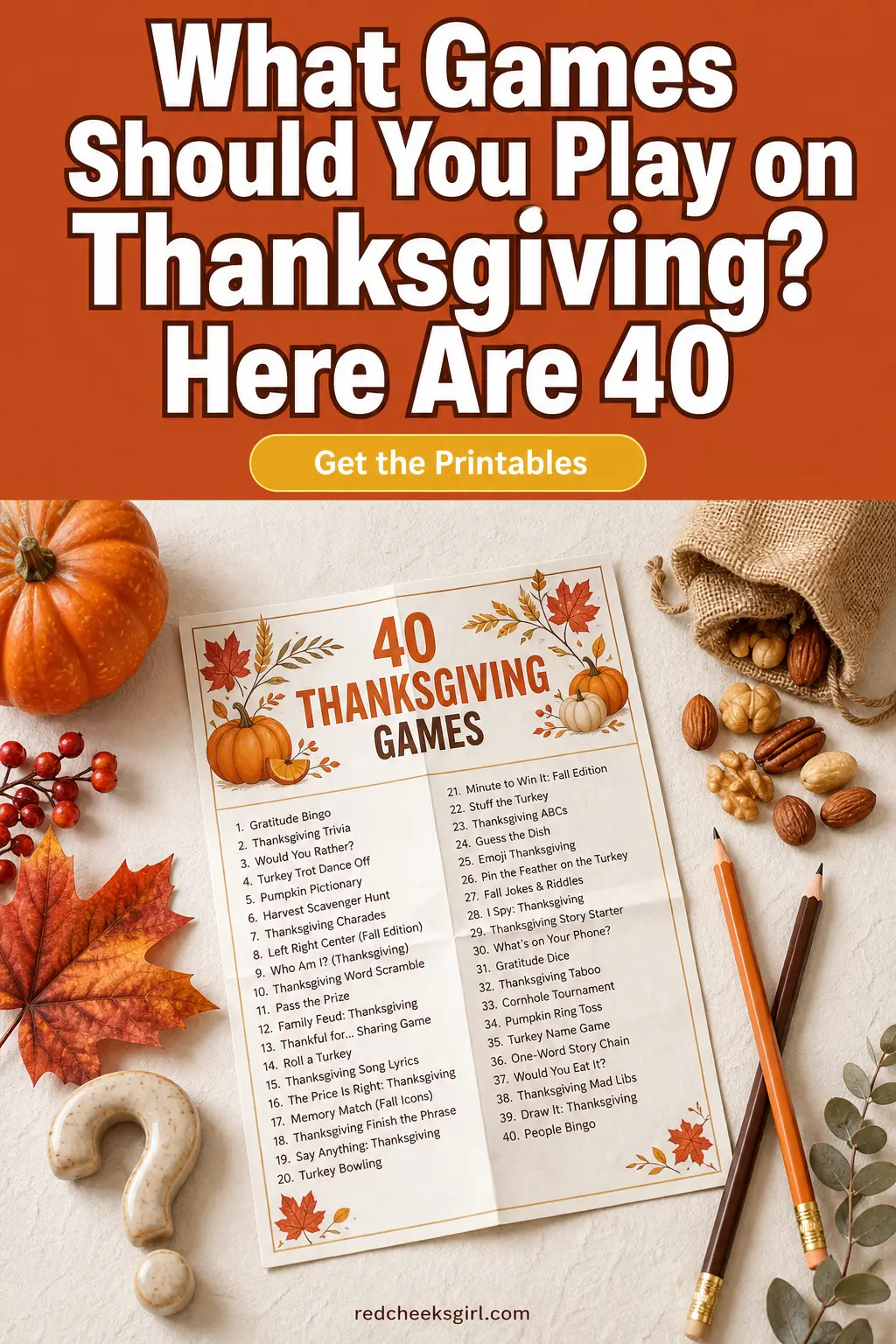
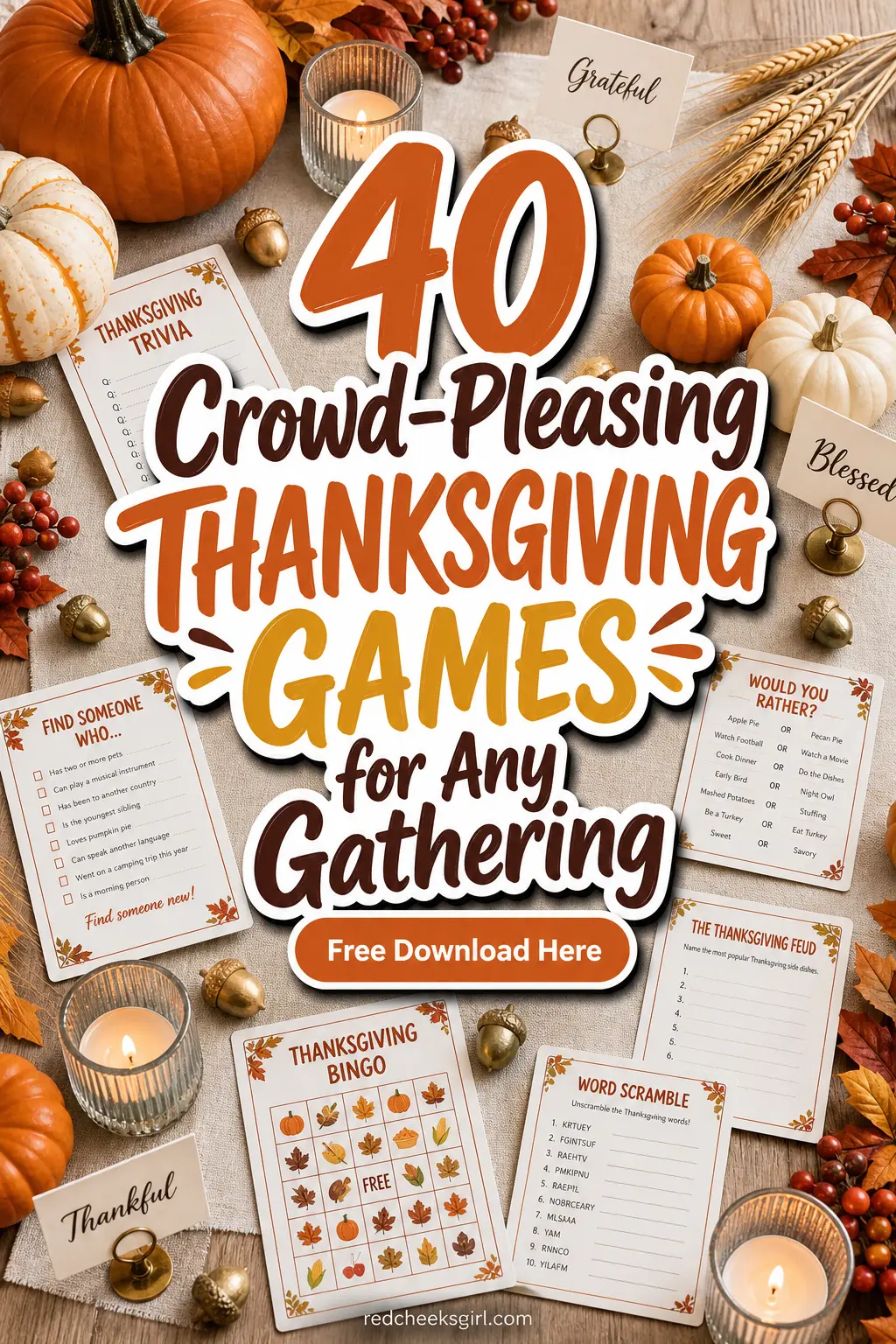
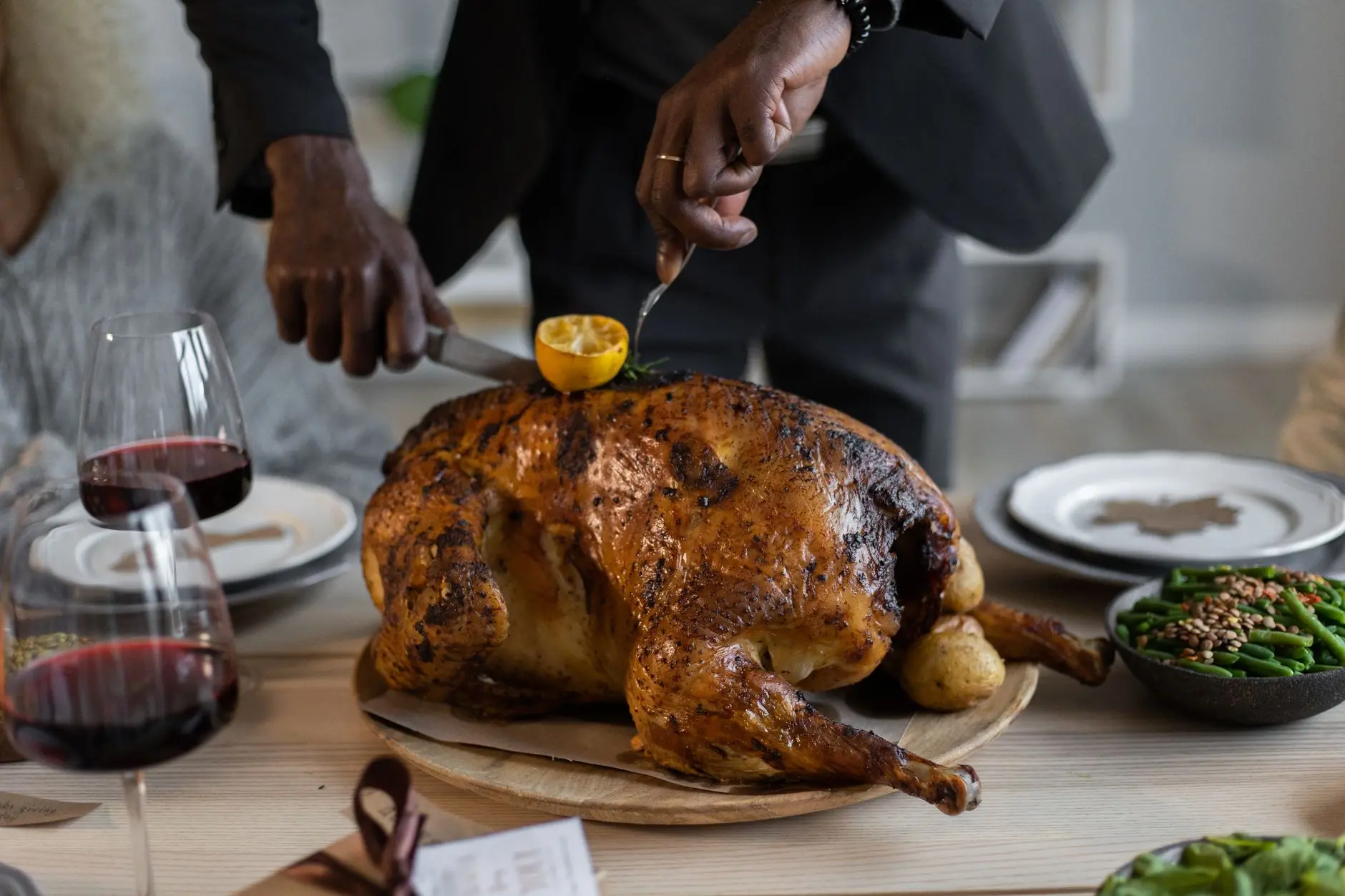
24 thanksgiving games that work from age 8 to 80, with free printables you print today and no-setup
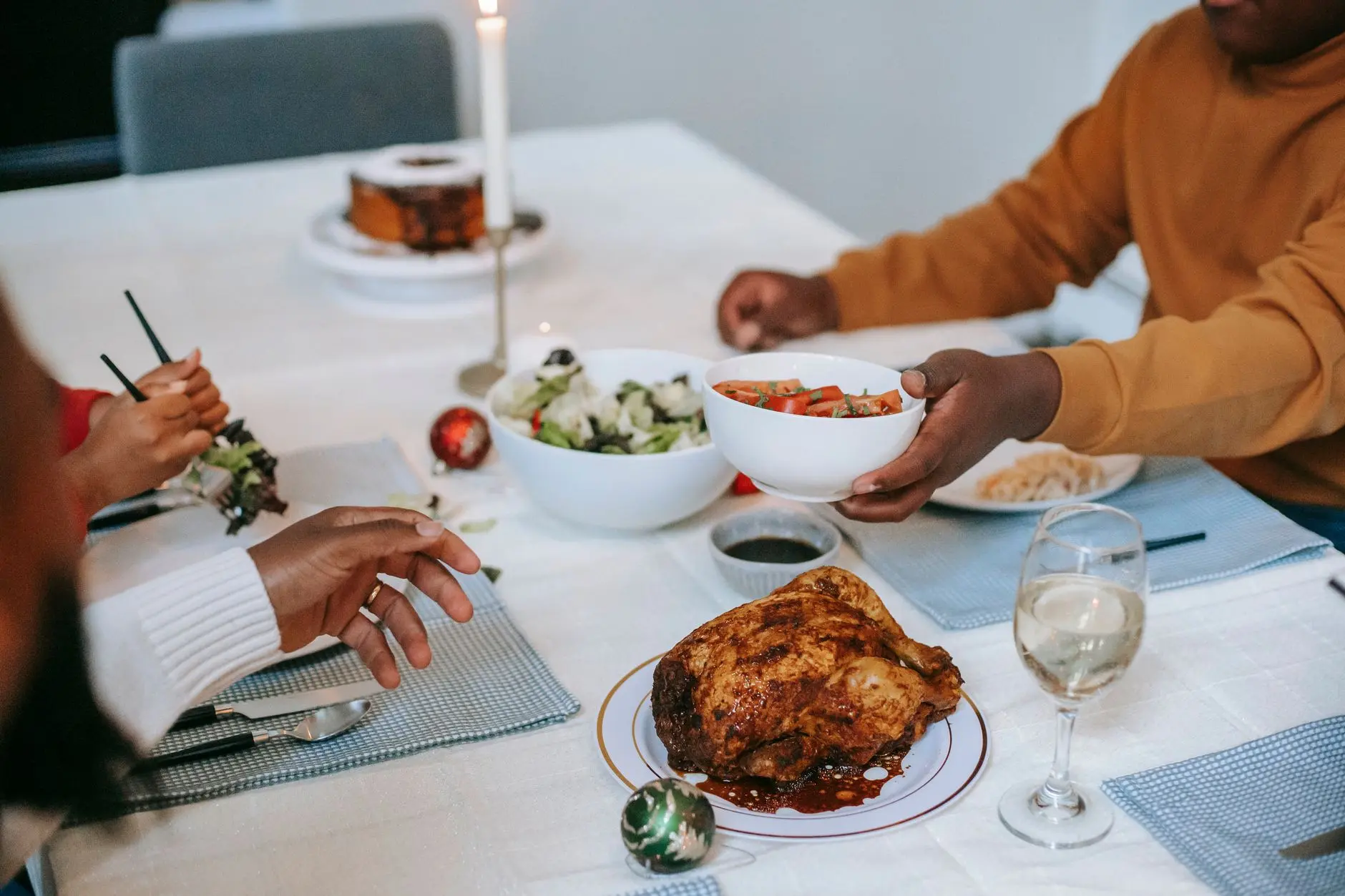
These 14 Thanksgiving side dishes can be prepared ahead, from green bean casserole and stuffing to r
16 thanksgiving veggie tray ideas that actually get eaten: wreath, turkey shape, pumpkin dip bowl, w
Leave a Reply