

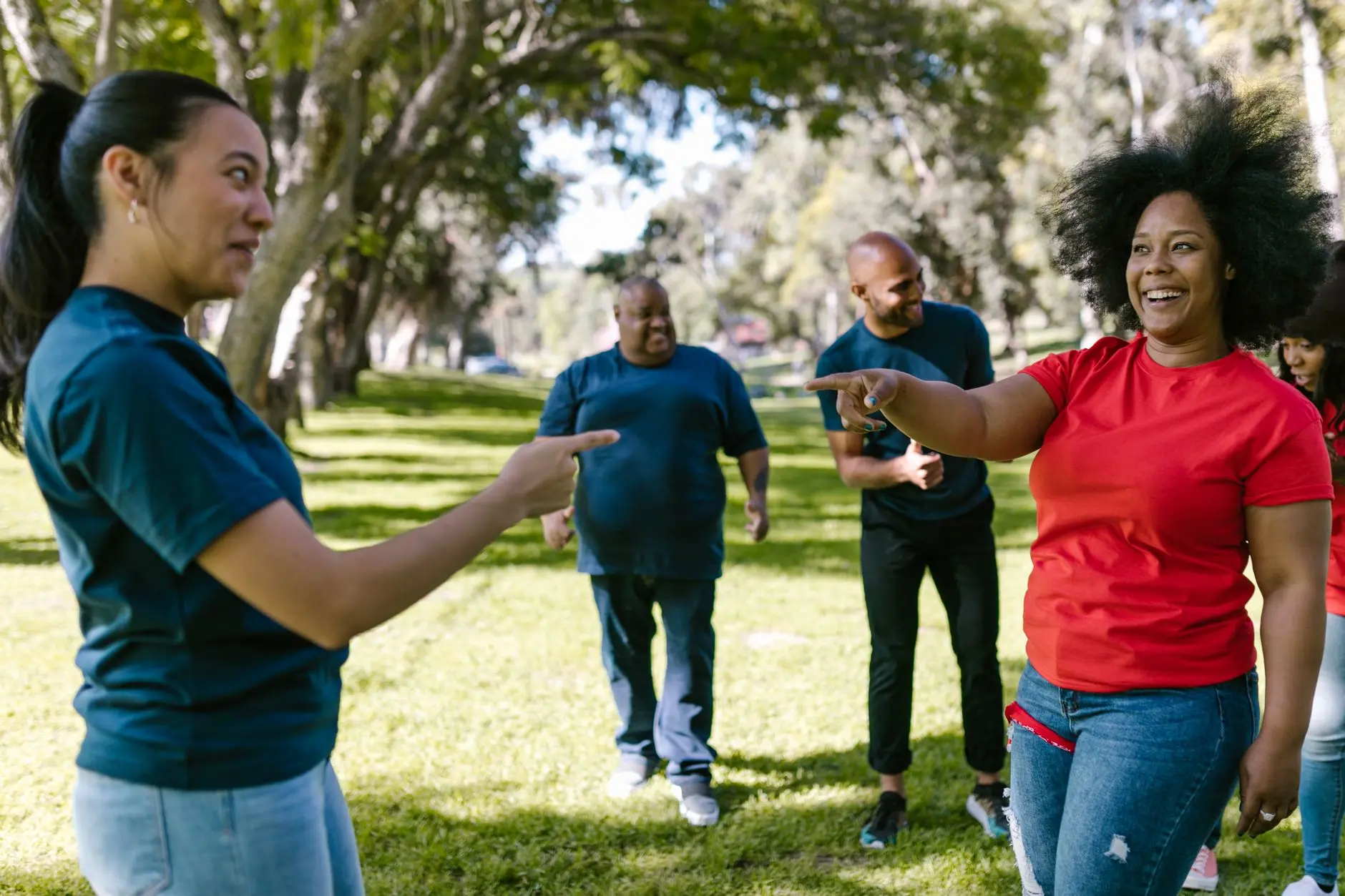
Let’s be honest — the words ‘team building games’ have sent a chill down many a spine. You picture forced trust falls, awkward silence, and someone definitely crying in the parking lot afterward (not naming names).
But here’s the thing: the best team building games don’t announce themselves. They just look like a really good time — and the trust, communication, and inside jokes sneak up on everyone when they’re too busy laughing to notice.
That’s exactly what this list is about.
Whether you’re planning an office party, a company retreat, an end-of-quarter bash, or just a regular Friday that needs a serious upgrade, these 20 team building games for adults cover every vibe: high-energy icebreakers that get people off their phones, printable sheets you can download and play in minutes, and quiet low-key activities that even the introverts in the room will genuinely appreciate.
Print the sheets, gather your people, and let the good stuff happen naturally. (And if you want to fuel the fun right, a big batch of Amish Breakfast Casserole for a morning session never hurts.)
This post contains affiliate links — if you buy through them, I may earn a small commission at no extra cost to you.
- Human Knot
- Escape Room Challenge
- Team Trivia Live
- Marshmallow Tower Build
- Blindfold Maze Guide
- Team Trivia Sheet
- Human Bingo Sheet
- Would You Rather (Work) Cards
- This or That Sheet
- Team Challenge Cards
- Team Score Sheet
- Problem-Solving Puzzle Sheet
- Two Truths and a Lie Sheet
- Team Name Sheet
- Awards Certificates
- Icebreaker Question Cards
- Find Someone Who Sheet
- Team Reflection Sheet
- Team Win Share
- One Word Check-In
- Frequently Asked Questions
1. Human Knot
Human Knot is the classic team building game that’s been making groups laugh — and argue — since forever, and it earns its reputation every single time.
Everyone stands in a circle, reaches across and grabs the hands of two different people (not the person directly beside them), and then the whole tangled mess has to work together to form a clean circle again without ever letting go. Sounds simple.
Is absolutely not simple. Is absolutely hilarious.
You need at least eight people for a good knot; the sweet spot is around ten to twelve per group.
If your crowd is bigger, split into two teams and race — nothing accelerates the chaos quite like a ticking clock and a rival group untangling faster than you. No materials needed at all, which makes this the easiest opener in the book.
Clear a decent amount of floor space, remind everyone to be gentle with wrists, and let them figure it out.
What makes Human Knot such a reliable opener is that it forces instant, physical collaboration before anyone’s had time to retreat into their comfort zone.
People who’ve never spoken end up face-to-face, mid-duck, negotiating whose elbow goes where — and that shared silliness cracks the ice faster than any formal introduction round.
Pro tip: once the group solves it, try a silent round (no talking allowed) and watch the non-verbal communication skills explode.
Offer a ‘coach’ role for anyone who’d rather not join hands — they stand outside and give directions, which is honestly just as chaotic and fun.
2. Escape Room Challenge
You don’t need to book a venue or spend a fortune to run an escape room — you just need a host who’s willing to do a little prep.
The idea is simple: split the group into teams of four to six, give each team an envelope of clues, riddles, and mini-challenges, and set a 30-minute timer. The first team to solve the full sequence and crack the final code wins.
The subject matter can be totally workplace-flavored (solve the mystery of the missing quarterly report!) or completely random — both work brilliantly.
To set it up, write five to seven interconnected clues where each answer unlocks the next.
You can hide physical objects around the room, use combination locks from a dollar store, or keep it fully paper-based with sealed envelopes labeled ‘Open only when you solve clue 3.’
The key is that every team member needs to contribute — the puzzles should require different skills (logic, wordplay, memory, observation) so no single person can bulldoze through alone.
The escape room format is one of the most powerful team building games for adults because it reveals how a team naturally organizes under pressure — who leads, who listens, who goes rogue and opens the wrong envelope (every group has one).
It’s a genuine mirror of workplace dynamics, and because everyone’s too focused on escaping to feel observed, the real personalities come out. Run a quick debrief afterward — ‘What worked? What didn’t?’
— and you’ve just done 30 minutes of team development that felt like pure fun.
- Groups of 12–30 (split into competing teams of 4–6)
- Retreats, offsite days, or end-of-project celebrations
- Teams that love puzzles, strategy, or mild competitive chaos
3. Team Trivia Live
Team Trivia Live is basically pub trivia at your party — fast, loud, and deeply satisfying when your team knows the answer and the other table doesn’t.
Divide everyone into teams of four to six, grab a host (or rotate the host role each round), and run five to eight rounds of themed trivia questions: pop culture, workplace history, general knowledge, food and drink, whatever fits your crowd.
Teams huddle, whisper their answers, and hold up a whiteboard or folded card — no shouting out allowed until the reveal.
The beauty of the live format is the energy in the room: the gasps when someone gets a surprising right answer, the groans when the obvious one slips away, the very serious debate about whether a certain film came out in the year everyone thinks it did.
You can run this with nothing but a printed question sheet and sticky notes, or go full game-show mode with a projector, background music between rounds, and a running scoreboard on a whiteboard.
Award points per correct answer, bonus points for closest guess on number questions, and a joker round where one team can double their score.
What makes this one of the best team building games for adults is that it levels the playing field completely — the quiet analyst who never speaks in meetings suddenly knows every answer in the science round and becomes the team MVP.
Use the downloadable Team Trivia Sheet below (game #6 in this list) to run the whole thing on paper, or combine both for the full experience. Either way, your team’s collective genius — and blind spots — will be on delightful display.
Add one round of ‘About Our Team’ trivia — questions about colleagues’ fun facts shared in advance — and watch people realize they know each other way less (and way more) than they thought.
🛍 Shopping guide
4. Marshmallow Tower Build
The Marshmallow Tower Build — sometimes called the Marshmallow Challenge — is a timed engineering showdown where teams use a small set of materials to build the tallest freestanding structure that can support a marshmallow on top.
Each team gets 20 spaghetti sticks, one meter of tape, one meter of string, and one marshmallow. The catch: the marshmallow goes on top, it must stay up, and you have exactly 18 minutes. Ready, set, build.
The prep is laughably easy: pre-bag the supplies per team, clear a table or floor space for each group, and set a loud kitchen timer everyone can hear. The magic is in watching how different teams approach the challenge.
Some dive in immediately and prototype fast. Others spend ten minutes planning and two minutes panicking. (Spoiler: the fast-fail-and-iterate teams almost always win.)
Keep an eye out for the moment someone suggests the marshmallow goes on last and everyone realizes they’ve been building around the wrong assumption.
This is one of those team building games that doubles as a masterclass in how your team actually functions — how they handle ambiguity, whether they test assumptions, and who naturally steps up as a builder versus a strategist.
It’s a genuinely fun competition that generates real insight without a single slide deck. Debrief with one question: ‘What would you do differently with five more minutes?’ The answers are almost always illuminating.
And if anyone stress-eats their marshmallow before the timer’s up, no judgment here.
- 20 dry spaghetti sticks per team
- 1 large marshmallow per team
- 1 meter of tape per team
- 1 meter of string per team
- A loud timer visible to all teams
🛍 Shopping guide
5. Blindfold Maze Guide
Blindfold Maze Guide is one of those team building games that sounds simple until you’re the one blindfolded and your ‘guide’ has just told you to take three steps forward into what is very obviously a chair.
The setup: lay out a simple obstacle course on the floor using soft objects — foam cups, cushions, rolled-up towels, cones — and pair people up.
One person is blindfolded and must navigate from start to finish using only the verbal instructions of their partner, who cannot touch them. Switch roles after each round.
The guide can only give directional instructions (‘two small steps left,’ ‘duck slightly,’ ‘stop — now turn 45 degrees right’) — no pointing, no physical steering. The whole group watches, which adds just enough gentle pressure to make it interesting.
For a team version, run it as a relay: each pair completes a section of the maze and hands off to the next duo, keeping the blindfold on throughout. Fastest team wins.
You can make the maze as simple or as devious as your space allows.
The debrief moment after this one is genuinely valuable: ask the blindfolded players what helped and what was confusing about the instructions they received.
Guides often discover they were giving directions from their own perspective, not the blindfolded person’s — which is a surprisingly direct parallel to how miscommunication happens at work.
It’s one of those team building games where the ‘lesson’ lands naturally without anyone having to announce it. (And yes, the person who walked directly into the table despite being told to stop will absolutely be reminded of it for weeks.)
- Use a simple straight path with only 4–5 obstacles for first-timers
- Allow the guide one ‘rescue word’ they can say to pause the blindfolded player immediately
🛍 Shopping guide
6. Team Trivia Sheet
The Team Trivia Sheet is a self-contained trivia quiz that teams can play simultaneously without a live host — perfect for a rotation station, a lunch-break game, or a warm-up before a bigger event.
Each team gets a sheet, huddles for 15–20 minutes, writes their answers, and then compares results against the printed answer key at the end.
The sheet covers five themed categories with four questions each, for 20 questions total — enough to produce a real winner without dragging on.
Print one sheet per team on standard cardstock, grab a pen per table, and you’re done.
The categories are deliberately mixed — a round of general knowledge, a round of workplace-adjacent fun facts, a pop culture round, a logic puzzler round, and a ‘about the group’ wildcard round (you fill in those four before printing, based on real team fun facts shared ahead of time).
The answer key appears in small italic text at the very bottom of the sheet so teams can self-score honestly without peeking mid-game.
This is one of those team building games that earns its keep precisely because it requires zero facilitation once it’s printed — you can run four tables at once and focus on being a good host instead of a quiz master.
The mix of categories is intentional: someone on every team will shine in at least one round, which means the score is genuinely up for grabs until the end.
Transfer scores to the Team Score Sheet (game #12 in this list) to track across multiple rounds.
Fill in the ‘About the Group’ wildcard questions with real fun facts collected via a pre-event survey — it makes teammates feel seen and sparks great conversations.

7. Human Bingo Sheet
Human Bingo — sometimes called People Bingo — is the icebreaker that gets even the most reluctant networker off their chair and talking to actual humans.
Each player gets a bingo card with 25 squares, and every square contains a trait or experience (‘Has worked in more than two industries,’ ‘Can speak a second language,’ ‘Has presented to a group of 50+ people,’ ‘Learned a new skill in the past year’).
The goal is to find real people in the room who match each square, get their signature in the box, and shout ‘Bingo!’ when you fill a row.
Print one card per person — and make sure the squares are shuffled so no two cards are identical (the sheet design handles this with a randomized grid). Set a timer for 15–20 minutes and let people circulate freely.
The rule is one signature per person per card, so you can’t just get your best friend to sign off every square. A ‘blackout’ (fill the whole card) wins the grand prize; a five-in-a-row wins a runner-up prize.
Even if nobody wins, everyone’s had a dozen real conversations by the time the timer goes off.
Human Bingo earns its spot among the best team building games for adults because it gives introverts a structured reason to approach strangers (the bingo card is basically a social permission slip) and gives extroverts a challenge to actually listen and learn, not just talk.
The traits on the sheet are all professional and inclusive — nothing too personal, nothing that requires revealing private information. It’s warm, it’s easy, and it reliably produces the ‘wait, I didn’t know that about you!’ moments that build real team connection.
Pair it with the Find Someone Who Sheet (game #18) for a double icebreaker hit.
- Onboarding new team members into an existing group
- Large parties of 20+ where people don’t all know each other
- Opening a retreat or all-hands event before the main agenda

8. Would You Rather (Work) Cards
Would You Rather cards are one of those team building games that sounds almost too simple — and then twenty minutes in, everyone’s in a heated debate about whether they’d actually rather have a four-day work week with longer days or a five-day week with flexible hours.
The Work edition keeps every prompt workplace-adjacent and totally inclusive: no awkward personal territory, no trick questions, just genuinely interesting dilemmas that reveal how people think, what they value, and what their working style really looks like. And yes, there will be strong opinions.
Print the card deck, cut along the dotted lines, and deal three cards to each person.
Going around the table, each person reads their card aloud, picks their answer, and briefly explains their reasoning (that last part is the key — the ‘why’ is where the real conversation lives).
You can play it as a full group discussion, a pairs activity, or a speed round where everyone reveals simultaneously and you tally the split. No right answers, no wrong answers, just glorious insight into how your colleagues’ brains work.
The work-themed angle makes this one of the sneakiest team building games in the set because it surfaces real preferences and values in a completely low-stakes context. Does your team skew toward autonomy or structure? Deep work or collaboration? Presentations or written reports?
You’ll know by the end of the deck. Bonus: the cards work brilliantly as a conversation starter at the beginning of a meeting, not just at a party. Print a set and keep them in the break room for ongoing use.
And if all that spirited debate has everyone stress-hungry, a slice of Low Calorie Veggie Breakfast Bake at the snack table is genuinely crowd-pleasing.
Revealing work style preferences in a low-stakes, fun context builds genuine understanding between teammates faster than a personality test ever could.

9. This or That Sheet
This or That is Would You Rather’s quick-fire cousin — faster, snappier, and with zero explanation required.
The sheet presents 30 work-and-life paired choices in two columns (‘Early bird OR Night owl,’ ‘Spreadsheet OR Whiteboard,’ ‘Zoom call OR In-person,’ ‘Data OR Gut instinct’) and each person simply circles their answer on their own sheet.
Then comes the fun part: everyone reveals their answers simultaneously and you tally the group splits on a shared board. The 60-40 splits generate laughs; the 95-5 splits generate genuine surprise.
Print one sheet per person, hand out pens, and give everyone two minutes of silent circling time before the reveal.
You can run it as a full-group activity with a tally chart on a whiteboard, or as a pairs activity where two colleagues compare their sheets and count how many they agree on — a simple ‘compatibility score’ that’s surprisingly revealing.
Either format takes under ten minutes, which makes this one of the most time-efficient team building games in the whole list.
The beauty of This or That is how much texture it adds to how people see their colleagues. The person you assumed was a rigid early-bird planner turns out to be a chaotic night-owl creative. The quiet analyst is secretly obsessed with whiteboards.
These small revelations don’t just make people more interesting to each other — they genuinely help teams assign work better, communicate more effectively, and stop accidentally scheduling brainstorms at 8am for a group of confirmed night owls. Fun and functionally useful? That’s the dream.
- Everyone circles their answers silently (2 min)
- Host tallies each pair on a whiteboard as a group reveal
- Discuss the biggest splits — those are the most interesting ones

10. Team Challenge Cards
Team Challenge Cards are a deck of mini-challenge prompts that teams draw and complete in real time — think of them as a scavenger hunt, a creativity sprint, and a party game all shuffled into one deck.
Each card gives a team a specific challenge to complete within three minutes: ‘Build the tallest structure you can using only items currently on this table,’ ‘Come up with five alternative uses for a stapler in 90 seconds,’ ‘Write a 30-second elevator pitch for a product that doesn’t exist yet.’
Points are awarded by a host or by peer vote, and the team with the most points after ten rounds wins.
Print the sheet, cut along the dotted lines, and shuffle the deck face-down in the center of the table. Teams take turns drawing a card, reading it aloud, and executing the challenge while everyone watches.
The host can award one to three points based on creativity, speed, or accuracy depending on the card type. Some challenges are competitive (fastest wins), some are creative (peer vote wins), and some are collaborative (the whole group wins or loses together).
That variety keeps the energy unpredictable and the game genuinely exciting from round to round.
What sets Team Challenge Cards apart from other team building games is the sheer range of skills they activate: lateral thinking, physical speed, creative pitch-making, memory, improvisation.
Different people shine in different rounds, which means the leaderboard shifts constantly and nobody’s written off after a bad start. It also means the team naturally discovers who’s secretly a brilliant improviser, who has an engineering brain, and who can sell literally anything.
Use the Team Score Sheet (game #12) to track points across rounds for maximum drama.
Rotating challenge types activate different skill sets each round, so a different team member shines every few minutes — the natural equalizer for any group.

🛍 Shopping guide
11. Team Score Sheet
Every great competition needs a great scoreboard, and the Team Score Sheet is the printable that pulls the whole event together.
It’s a clean, running tally sheet where the host (or a designated scorekeeper) records team names, tracks points round by round, and calculates totals at the end — no app, no whiteboard chaos, no arguing about who had 47 points going into round six.
One sheet, one source of truth, full transparency. It’s the kind of organizational tool that makes your event feel genuinely well-run.
The sheet is designed for up to six teams across up to ten rounds, with a row per team and a column per round, plus a running total column on the right.
Fill in the team names at the top (use names from the Team Name Sheet, game #15, for maximum cohesion), and update the score after each game.
There’s also a ‘bonus points’ column for spontaneous awards — best team cheer, most creative answer, funniest moment of the day — which keeps energy high even for teams that are trailing on pure points.
Honestly, the Team Score Sheet is the unsung hero of team building games events. Without it, scores get disputed, energy drops between games, and the final announcement feels anticlimactic. With it, there’s a visible leaderboard creating gentle tension across the whole day.
Post it somewhere everyone can see it (stick it to a wall or hold it up between rounds), and you’ll notice teams start paying much more attention to the gap between first and second place.
A little competitive tension, it turns out, is very good for engagement.
Announce the running scores between every game — a visible leaderboard keeps energy high all day and motivates even the team in last place to mount a comeback.

12. Problem-Solving Puzzle Sheet
The Problem-Solving Puzzle Sheet is a team-played logic and lateral thinking challenge — not an answer-at-the-back quiz, but a genuine collaborative puzzle experience on paper.
The sheet presents five distinct puzzle types that teams work through together: a logic grid, a sequence-completion challenge, a ‘spot the flaw in the plan’ scenario, a quick math reasoning problem, and a visual pattern recognition task.
Teams have 20 minutes to work through all five, and the answer key at the bottom lets them score themselves honestly at the end.
Print one sheet per team, assign a ‘scribe’ to write the answers, and let the group work through it collaboratively.
The puzzles are deliberately calibrated to require different thinking styles — the logic grid rewards methodical thinkers, the lateral sequence stumps the overly logical and rewards the creative, and the ‘spot the flaw’ scenario produces the best arguments of the day.
No one person can power through the whole sheet alone, which is exactly the point.
This is one of the team building games that most closely mirrors actual workplace problem-solving — ambiguous information, multiple possible approaches, time pressure, and the need to reach consensus on an answer before committing.
Teams that communicate well sail through; teams with one bulldozer and five passengers learn something useful. It’s also a surprisingly accurate predictor of how a team handles real project roadblocks, which makes the debrief (‘What slowed you down? What sped you up?’) genuinely worth having.
And if the puzzles unlock an appetite for more brain-stretching, the reflective side of self-concept work might just be the next rabbit hole your team goes down.
- Teams of 3–5 per sheet for best collaboration
- Groups that enjoy puzzles, logic, or problem-solving
- A focused 20-minute mid-event challenge between high-energy games

13. Two Truths and a Lie Sheet
Two Truths and a Lie is already one of the most beloved team building games ever invented — and the printable sheet version makes it even better because everyone writes their statements simultaneously, which means less groupthink and more genuine surprises when the reveals happen.
Each person gets a card with three labeled lines: Truth 1, Truth 2, and Lie. They write all three, fold the card over, and pass it to the host, who reads them aloud one by one while the group guesses which is the lie.
The written format also means you keep a record of everyone’s statements for a fun ‘callback’ moment later in the day.
Print one card per person, hand them out at the beginning of the event, and give everyone five quiet minutes to think and write.
The lie should be believable — not ‘I can fly’ — so encourage people to keep their truths interesting enough to seem implausible.
The best rounds happen when a genuinely wild truth gets mistaken for the lie by almost everyone (‘Wait, you really did train as a pastry chef before this job??’).
Run the reveal as a group, take a quick vote before each answer, and award a point to everyone who correctly identified the lie.
The sheet version of this classic adds one extra layer: a ‘Did you guess right?’ self-score box at the bottom, so everyone tracks how well they ‘read’ their colleagues. It’s light, it’s fast, and it reliably produces the best ‘I had no idea!’
moments of any team event. The printable format also means you can laminate the filled-in cards and pin them to a ‘Know Your Team’ board long after the event, which doubles as a rather charming piece of office decor.
Remind people that the best lies are slightly boring-sounding — outrageous lies are too easy to spot. The goal is to make the group genuinely debate all three statements.

14. Team Name Sheet
Before any team can compete, they need a name — and the Team Name Sheet transforms what’s usually an awkward two-minute silence into a genuinely fun mini-activity.
The sheet gives each group a structured brainstorm framework: three prompts to spark ideas (a mashup of team members’ names, a workplace in-joke theme, an animal that represents the team’s energy), space to list five candidate names, and a simple dot-voting section where each person marks their top pick.
The name with the most dots wins, and the team now has an identity they actually chose together.
Print one sheet per team and give them five minutes at the very start of the event before any games begin. The facilitated format means no one person dominates the decision, introverts have an equal vote, and the outcome feels genuinely democratic.
Teams that name themselves well tend to rally around that name all day — you’ll start hearing ‘The Spreadsheet Sultans need to answer Question 14’ and feel the energy shift noticeably from ‘colleagues’ to ‘team.’
It sounds like a small thing, but a shared name is one of the fastest ways to build in-group identity, and in-group identity is the foundation of real team cohesion.
This is one of those team building games that works entirely in the background — nobody’s thinking ‘this is a trust exercise,’ they’re just arguing passionately about whether ‘Pivot Table Panthers’ or ‘The Synergy Squad’ better captures their collective spirit.
(The answer is always Pivot Table Panthers, tbh.) Record the winning names on the Team Score Sheet to complete the full competitive setup.
- Distribute sheets at the very start — before any games
- Give 5 minutes for silent brainstorm, then 3 for dot-voting
- Announce team names aloud before the first game to cement identity

15. Awards Certificates
The Awards Certificates sheet is the grand finale closer that sends everyone home feeling seen, celebrated, and genuinely valued — and it costs exactly one sheet of cardstock to print.
The sheet contains six individual award certificates, each with a bold award title, a line for the recipient’s name, a line for the reason, and a date line.
Award titles include classics like ‘Most Valuable Team Player,’ ‘Best Creative Solution,’ ‘Funniest Moment of the Day,’ ‘Most Enthusiastic Participant,’ ‘Unsung Hero Award,’ and ‘The Comeback King/Queen’ — a mix of competitive, creative, and character-based recognition so every personality type gets a moment.
Print the sheet, cut out the certificates, and fill them in during the final ten minutes of the event while teams are doing the One Word Check-In (game #20).
Assign one per standout person or moment from the day — and here’s the move: don’t limit awards to the team that won on points. The certificates are specifically designed to recognize effort, personality, and contribution, not just performance.
Hand them out at the closing with a brief word about why each person earned theirs.
Awards Certificates might seem like a small touch, but the psychological impact of a physical, named, specific recognition is genuinely significant. People keep these. They photograph them. They pin them up.
A group of adults who just spent a day playing team building games together and who each leave with a personalized certificate walk away feeling like they were part of something — which is, at the end of the day, exactly what great team building is supposed to do.
Make it ceremonial, make it sincere, and watch the room light up.
Write in the reason with a specific, genuine observation from the day — ‘for somehow knowing every answer in the logic round’ lands way better than just ‘great teamwork.’

🛍 Shopping guide
16. Icebreaker Question Cards
Icebreaker Question Cards are the printable equivalent of having a brilliant party host in your pocket.
Each card carries a single open-ended, work-appropriate question designed to spark a real conversation — not a surface-level exchange, but the kind of answer that makes people say ‘oh, I never knew that about you.’
Questions range from reflective (‘What’s a skill you have that surprises people?’) to fun (‘If your working style were a weather pattern, what would it be?’) to future-focused (‘What’s one thing you’d love to learn in the next year?’).
No right answers, no performance pressure, just genuine curiosity.
Print the sheet, cut the cards along the dotted lines, and place them in a bowl or fan them out face-down on the table.
At the start of a meal, a break, or a game rotation, each person draws a card and answers it — either to their table or to the whole group, depending on your setup.
You can also use them as a ‘table conversation starter’ left at each place setting, or as a regular meeting opener where one card is drawn and answered in a two-minute round before the agenda begins.
The key design choice in these cards is that every question is forward-looking, curious, or celebratory — none of them ask people to share something uncomfortable or self-critical.
That intentionality matters: team building games work best when they create psychological safety, and a question deck that rewards openness without demanding vulnerability is exactly the right tool for a mixed group of colleagues.
Keep a set in the break room and rotate a new card each week for ongoing team connection that doesn’t require scheduling a whole event.
- Table conversation starters at team lunches or dinners
- Meeting openers to replace ‘any updates?’ small talk
- Ongoing break-room use long after the event ends

17. Find Someone Who Sheet
Find Someone Who is the active, walking-around printable that gets everyone mingling without it feeling forced — because they have a mission and a clipboard and a reason to approach literally anyone in the room.
The sheet lists 20 short statements (‘Find someone who has worked in three or more different industries,’ ‘Find someone who can say hello in four languages,’ ‘Find someone who has started a side project’) and players circulate through the room collecting real signatures from colleagues who match each statement.
First to fill all 20 lines wins; everyone who makes it through the event having had 10+ genuine conversations wins at life.
Print one sheet per person with a clipboard or hard surface to write on — this is one of the team building games that works best when people are on their feet and moving.
Set a timer (15–20 minutes works well) and let the room turn into a buzzing network of two-second conversations that often turn into five-minute ones.
The one rule: each person can only sign the same sheet once, so everyone has to actually diversify their conversations instead of clustering with friends.
What makes this printable particularly powerful is the statement design — every item on the list is something achievable, positive, and specific enough to spark a real follow-up conversation. ‘Find someone who has started a side project’ leads to ‘Oh really, what kind?’
and suddenly two people who’ve shared office space for two years are having their first genuinely interesting conversation. The sheet is the excuse; the connection is the point.
Pair it with Human Bingo (game #7) for a double icebreaker session that fills the first 30 minutes of any event beautifully.
- Hand out sheets at the door as guests arrive
- One signature per person per sheet — no repeats allowed
- Award a small prize to the first person to fill all 20 lines

🛍 Shopping guide
18. Team Reflection Sheet
The Team Reflection Sheet is the thoughtful closing printable that gives the whole event meaning beyond a fun day out.
It’s a structured individual reflection exercise — not a feedback form, not a survey, but a personal prompt sheet that each person fills out quietly at the end of the event and then optionally shares one answer with the group.
The prompts guide people through what they noticed, what they appreciated, what they want to do differently, and what one commitment they’re taking away from the day.
It takes about five minutes to complete and produces a room that feels genuinely grounded rather than just hyped-up-and-dispersing.
Print one per person, distribute during the final quiet section of the event, and give people five minutes of genuine silence to reflect and write.
The sheet has six prompts with generous write-in space under each: ‘Something that surprised me today,’ ‘A colleague strength I noticed that I didn’t know about,’ ‘Something I want to do more of in our team,’ ‘Something I appreciated about how we worked together,’ ‘One thing I’ll do differently after today,’ and ‘My one-word summary of the day’ (which connects beautifully to the One Word Check-In that follows as the final activity).
Each answer is personal and belongs to the person — they decide what, if anything, to share.
The Team Reflection Sheet is the quiet powerhouse of the set — it’s the printable that transforms a fun event into a meaningful one.
Team building games are at their most effective when they include structured reflection, because insight without reflection tends to evaporate by Monday morning.
This sheet asks people to name what they observed while it’s fresh, which dramatically increases the chance that those observations become actual behavior change.
It’s also, quietly, one of the most stress-reducing things you can build into a high-energy day — a little like the way intentional reflection practices support overall wellbeing. Five minutes of honest writing, and you’ve done something that matters.
Structured reflection after team building games dramatically increases the chance that insights become real behavior change back at work — don’t skip it.

19. Team Win Share
Team Win Share is the quiet, go-around activity that closes out a session by giving every single person a moment to be recognized — not just the winners of the competitive games, but everyone.
The facilitator goes around the room and each person takes 30–60 seconds to share one win from the day: something they’re proud of, something they did well, something they noticed themselves doing that they wouldn’t usually do.
It’s deliberately low-stakes and celebratory — not a post-mortem, not a feedback session, just a round of genuine acknowledgment.
No materials required.
The host simply introduces the concept, sets the one-rule expectation (‘Your win can be as small as you like — ‘I actually talked to someone I’ve never spoken to before’ is a perfect win’), and kicks it off by sharing their own first.
The whole round typically takes ten to fifteen minutes for a group of twenty, which is just long enough to feel meaningful without losing the room’s attention. Encourage people to applaud after each win — the cumulative effect of twenty small celebrations is surprisingly powerful.
This is one of those team building games — or rather, team building moments — that works because it reframes the whole day’s experience. When people verbalize what they did well in public, they reinforce it neurologically.
When they hear their colleagues celebrate small personal wins, they bond over shared vulnerability and growth in a way that no competitive game can replicate.
It’s the emotional landing pad after all the energy of the day, and it’s the activity people most often mention when asked what they remember about a team event weeks later. Simple, free, and genuinely powerful.
Go first yourself and share a genuinely modest win — it sets the tone that no win is too small, and it gives permission for people who struggle with public self-praise to participate comfortably.
20. One Word Check-In
One Word Check-In is the simplest, most elegant closer in the team building games toolkit — and it works every single time.
At the very end of the event, the host goes around the room and each person says exactly one word that captures how they’re feeling or what they’re taking away from the day. Just one word.
No explanation required, no elaboration necessary — though a brief nod of acknowledgment from the host after each one goes a long way. Words like ‘energized,’ ‘surprised,’ ‘connected,’ ‘grateful,’ ‘motivated,’ and occasionally the deeply honest ‘tired’ all count equally.
The host simply introduces it: ‘We’re going to close with a one-word check-in. What’s one word that captures your experience of today? Take five seconds to think, and we’ll go around the room.’ That’s it. No setup, no materials, no scoring.
The whole round for a group of twenty takes under three minutes. You can write the words on a whiteboard as they’re said, which creates a beautiful collective snapshot of the group’s experience — a word cloud made of real, unfiltered reactions.
The One Word Check-In earns its place as a closing ritual because it gives the quietest person in the room the same amount of space as the most outspoken one — exactly one word, no more. There’s no performance, no pressure, no wrong answer.
And hearing twenty different words land in the same room, each representing a real human response to a shared experience, is genuinely moving in a way that’s hard to engineer with anything more complicated. End with this, and people leave feeling heard.
That’s the whole goal of team building games, after all — and it lands beautifully in one word.
The one-word constraint is the whole trick — it forces people to distill a complex experience into something precise, which requires genuine reflection and produces surprisingly honest answers.
Frequently Asked Questions
How long should a team building games event last?
For most adult groups, two to four hours is the sweet spot.
That’s long enough to play five to eight games from this list, include a meal or snack break, and end with a closing activity like One Word Check-In — without tipping into the territory where people start checking the time.
Half-day formats (three to four hours) work especially well for office parties, retreats, or end-of-quarter events. If you’re running a full-day session, build in genuine downtime — a proper lunch break with no agenda — so energy is sustainable across all your team building games.
How do I choose the right team building games for my group?
Start with your group’s size, physical comfort level, and energy. For groups under fifteen, almost any game on this list works.
For larger groups (twenty-plus), games that split into competing teams — like Escape Room Challenge, Team Trivia Live, or Marshmallow Tower Build — work better than whole-group activities.
Mix active games (Human Knot, Blindfold Maze Guide), printable games (Trivia Sheet, Bingo, Challenge Cards), and quieter moments (Team Win Share, One Word Check-In) so everyone finds their comfort zone somewhere in the day.
Do team building games actually work, or are they just cringe?
The cringe reputation comes from poorly designed activities that feel forced, irrelevant, or condescending. Well-designed team building games — ones that prioritize genuine fun, equal participation, and real connection — produce measurable improvements in communication, trust, and morale.
The key is choosing games where the team-building outcome is a natural side effect of having a good time, not the stated goal announced awkwardly at the start. (Hence the ‘games that don’t feel like team building’ angle of this whole article!)
How many people do I need for these team building games?
Most of the games in this list work for groups of eight to fifty. The printable games (Trivia Sheet, Bingo, Challenge Cards) scale easily to any size — just print more sheets.
The active games (Human Knot, Marshmallow Tower Build) work best in groups of eight to fifteen; for larger crowds, run them simultaneously in parallel teams.
The quiet games (Team Win Share, One Word Check-In) work beautifully for any size, though for groups over thirty you may want to split into smaller circles for the closing round.
Can I run these team building games remotely or on Zoom?
Several games on this list translate beautifully to remote settings. Team Trivia Live works via a shared screen and breakout rooms. Would You Rather and This or That run perfectly in a chat-reveal format (type your answer before the host counts down).
Icebreaker Question Cards work as a rotating breakout prompt. The One Word Check-In is arguably even more powerful on video calls than in person. Physical games like Human Knot and Blindfold Maze Guide are in-person only — save those for your next in-person day.
What’s the best icebreaker to start a team building games event?
Human Knot is the gold standard physical opener — it forces instant collaboration and produces shared laughter in under twenty minutes.
For groups where physical contact isn’t ideal, Human Bingo Sheet or Find Someone Who Sheet are equally effective and get everyone circulating and talking within the first fifteen minutes.
If your crowd skews more introverted, start with Icebreaker Question Cards at the tables while people settle in — it lowers the barrier to conversation before any high-energy game begins.
📌 Save These for Later
Loved these? Pin your favorite image below so you can find this list again when you’re planning.

12 thanksgiving drinking games for a Friendsgiving crowd, with free printables. Every game works wit
20 icebreaker games that warm up any group fast — no cringe, just laughs. Includes 13 free printab

72 would you rather questions for teenagers that work for big groups. Six rounds, printable cards, a
Leave a Reply