

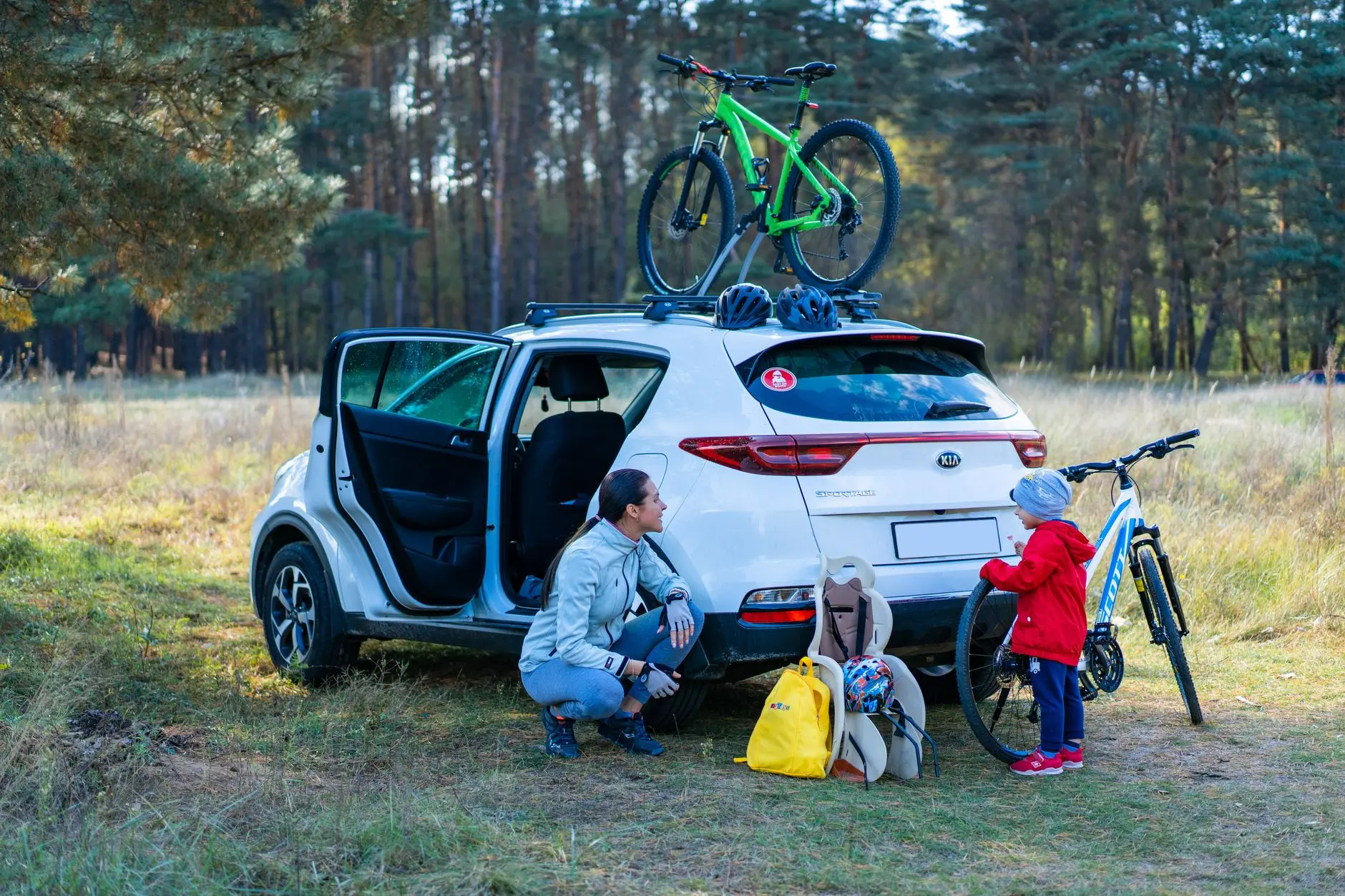
Road trip games for families are hands-down the secret weapon between a peaceful, memory-making drive and an hour of ‘Are we THERE yet?’ on repeat (we’ve all been there, tbh).
Whether you’ve got a toddler who needs something shiny to look at, a tween who thinks car games are ‘cringe,’ and two grandparents riding shotgun who just want everyone to get along — this list has something for literally every single person in that car.
No screens required. No squabbling over who gets the aux cord.
Just 20 genuinely fun games that bridge every age gap so nobody feels left out, plus a massive set of 13 printable sheets you can download, print, and stuff into a folder before you even back out of the driveway.
I’ve road-tested pretty much every game on this list with my own crew (full disclosure: the Story Chain got a little chaotic, and I’m still not sure the toddler understood the rules of 20 Questions, but she had a blast anyway).
What I love most about these picks is that they work on a 20-minute grocery run just as well as a two-day cross-country haul.
So scroll through, grab the printables that speak to you, and maybe pack a hearty road-trip breakfast casserole to fuel the fun before you hit the road. Let’s go!
This post contains affiliate links — if you buy through them, I may earn a small commission at no extra cost to you.
- 20 Questions
- The Alphabet Game
- Punch Buggy Spotting
- Family Road Trip Bingo
- License Plate Game Sheet
- Name That Tune
- Family Scavenger Hunt
- Family Story Chain
- I-Spy Travel Sheet
- Family Would You Rather Cards
- This or That Family Sheet
- Travel Tic-Tac-Toe Sheet
- Family Travel Journal Page
- Travel Trivia Sheet
- Color the Route Sheet
- Travel Riddles Sheet
- Matching Travel Cards
- Travel Mad Libs Sheet
- Family Trip Bucket List
- Best Family Trip Memory Share
- Frequently Asked Questions
1. 20 Questions
If there is one road trip game for families that has survived every generation without needing a single update, it’s 20 Questions — and honestly, it deserves its legendary status.
One player thinks of a person, place, or thing (any thing; the sky is the limit), and everyone else takes turns firing yes-or-no questions to narrow it down. Is it alive? Is it bigger than a car? Can you eat it?
You get exactly 20 questions to crack the code. Simple, zero-supply, and genuinely gripping once someone picks something devious like ‘the smell of sunscreen’ or ‘Grandma’s recliner.’
The beauty of 20 Questions is that the driver can play hands-free without taking eyes off the road, which makes it a rare car-safe winner.
Set a house rule before you start: agree on categories (animals only for the little ones, or ‘anything in the universe’ for the brave), and decide whether fictional characters count.
Kids under five do better as questioners rather than pickers, so let them pepper the guesses while an older sibling or parent holds the secret. The person who guesses correctly gets to be ‘it’ next.
For a fun variation with older kids and adults, try Speed 20 Questions — everyone gets only 10 questions instead of 20, which ramps up the pressure and forces smarter, more strategic asking.
Another crowd-pleaser: ‘Famous People Only’ mode, where the mystery thing must be a real or fictional person. You’ll be amazed how quickly a quiet car turns into a lively debate when someone picks a character from a show only half the car has seen!
- All ages — toddlers ask questions, older kids and adults pick the mystery
- Zero supplies needed — perfect for any stretch of highway
2. The Alphabet Game
The Alphabet Game is the kind of road trip game that sounds simple but gets surprisingly intense once you hit Q, X, and Z — ask any family who has driven through the middle of nowhere with zero billboards.
The goal is to find each letter of the alphabet, in order from A to Z, on road signs, license plates, storefronts, trucks, or any text visible from the car window. First player (or team) to reach Z wins bragging rights for the whole trip.
You’ve got a couple of ways to run it: cooperative (the whole car works together to find the letters, celebrating as a team) or competitive (each person scans their own side of the road and races to Z).
For younger kids who are still learning their letters, cooperative mode is the way to go — it turns the game into a gentle learning moment instead of a frustrating race.
And a solid pro tip worth repeating: agree before you start whether license plates count for every letter (they do in our car, because otherwise Q is basically impossible and someone will melt down).
To make it work for really little ones, try the Rainbow Variation instead: rather than letters, everyone hunts for items in rainbow order — something red, then orange, then yellow, and so on. It scratches the same ‘spot-and-shout’ itch without needing any reading skills.
For a spicy twist with older players, ban license plates entirely and require road signs only. Suddenly even A feels like a challenge, and everyone in the car is glued to the window. Which is exactly the goal!
- For non-readers: swap letters for rainbow colors (red → orange → yellow…)
- For competitive families: ban license plates so only road signs count
3. Punch Buggy Spotting
Punch Buggy is a road trip classic that’s been causing delighted shrieks (and the occasional light elbow to the arm) in back seats since VW Beetles ruled the highway.
The traditional rules are beautifully simple: the first person to spot a Volkswagen Beetle shouts ‘Punch Buggy!’ followed by the color — ‘Punch Buggy red!’ — and taps (gently, please) the nearest person.
No-punch-backs is a sacred rule that must be declared at the start, or chaos will ensue within the first ten minutes.
Because classic VW Beetles are genuinely rarer on the road these days, a lot of families have evolved the game into a broader ‘Spot It and Shout It’ format.
You can add other hard-to-find vehicles — electric cars, vintage trucks, cars in your family’s favorite color — and assign different point values to each.
Keep a running tally on a scrap of paper or in the notes app on your phone, and the player with the most points at your destination wins a say in where the family stops for lunch. That’s serious motivation.
For a totally no-contact family-friendly version (especially important with littles in the car who take the ‘punch’ part very literally), swap the tap for a silly sound effect instead. Whoever spots the buggy first has to make their best car-horn noise — ‘Beep beep!’
— before calling the color. It gets ridiculous fast, the laughter is real, and your kids will request it every single road trip for years.
Host tip: If you’re traveling somewhere with lots of EVs or hybrids, add those to the list for easy points and a bonus geography conversation starter.
Swap the ‘punch’ for a funny sound effect so younger kids can fully join in without it getting rowdy.
4. Family Road Trip Bingo
Road trip bingo is the printable game that basically every family road tripper swears by — and for very good reason.
Each player gets their own bingo card loaded with things you might actually spot from a moving car: a red barn, a horse trailer, a rest-stop welcome sign, a construction cone, a double-decker truck, a bridge, a field of sunflowers, a tollbooth.
As you cruise down the highway, everyone watches out their window and marks off squares when they see a match. First to complete a full row across, down, or diagonally shouts ‘BINGO!’ and wins the round.
Print one card per passenger before you leave — or print a few extras so you can play multiple rounds on a long haul.
Each card in the set uses a slightly different arrangement of the same pool of images, so no two cards are identical (goodbye, simultaneous bingo that causes a three-way argument).
For little ones who can’t read yet, cards with simple picture illustrations instead of words work beautifully and keep them just as engaged. Pack a small bag of bingo daubers or a box of crayons in the seat pocket to mark squares.
The real magic of bingo on a road trip is how it keeps every single age genuinely absorbed in the landscape outside — which means fewer screens, more ‘Oh wow, look at that!’ moments, and a back seat that is, dare I say it, peaceful.
Run multiple rounds for a longer trip, and rotate who gets to shout what the prize is for the next round. (Our family’s current prize is choosing the next podcast episode, which is apparently extremely coveted.)
- Printed bingo cards (one per player)
- Bingo daubers or crayons to mark squares
- A small prize or reward for each round winner

🛍 Shopping guide
5. License Plate Game Sheet
The License Plate Game is a bona fide road trip institution — families have been playing it for decades, and it genuinely does not get old. The mission: spot license plates from as many different U.S.
states (and Canadian provinces, if you’re feeling ambitious) as possible during the trip, and check them off on your tracking sheet as you go. It sounds low-key, but the moment someone shouts ‘ALASKA!’ from the back seat, the whole car loses its collective mind.
It is so much more exciting than it has any right to be.
This printable version gives every player their own sheet with all 50 states listed in alphabetical order, plus a small checkbox next to each one to tick off as you spot it.
Play it competitively — each player marks only the plates they personally spot first — or play as a team where anyone can call it out and the whole car celebrates the find together.
The cooperative version is especially great for mixed-age families where a four-year-old can’t necessarily read ‘Massachusetts’ but can absolutely spot a different-looking plate and yell about it excitedly.
For a learning twist that sneaks in geography without anyone noticing, challenge older kids to also write down the state’s abbreviation or capital as a bonus point.
You can also introduce ‘Unicorn Plates’ — Hawaii, Alaska, and any Canadian province — worth double points just because of how rare they are.
Keep the sheet clipped to a travel clipboard and you’ve got an activity that can run quietly in the background for hours, popping back to life every time a new state rolls into view.
Play cooperatively with younger kids — anyone can call a plate and the whole family celebrates. Save the competitive version for older crews!

6. Name That Tune
Name That Tune turns your car’s music into a proper game, and it is absolutely one of those road trip games for families that gets everyone involved no matter the age gap — because music is truly universal.
One player controls the playlist (or the radio) and lets a song play for just a few seconds before pausing it. Everyone else races to shout out the song title, the artist, or both.
Whoever gets it right earns a point, and play rotates so everyone gets a turn as the DJ. Simple, loud, and ridiculously fun.
The secret to making this work brilliantly across ages is building a playlist in advance with a wild mix of eras and genres: a kids’ favorite, a pop hit, a classic-rock anthem, something from a movie soundtrack your family loves.
This way, the six-year-old crushes the round when a Disney song comes on, and the parents redeem themselves during the classic rock section. Equal opportunity humiliation for everyone, which is honestly what family togetherness is all about.
You can build this playlist on any streaming app and let it run on shuffle.
For a variation that gets even sillier, try Hum That Tune: the DJ person hums or whistles the melody (no words, no instruments) and the rest of the family guesses.
Younger kids who don’t know as many songs can still participate as hummmers, and the guessing table gets a LOT harder — plus the car fills with increasingly terrible humming noises, which is its own kind of entertainment.
Keep a simple tally in the notes app and declare a grand champion when you arrive at your destination.
Build a multi-era playlist before you leave: kids’ songs, pop hits, classic rock, movie soundtracks — so every age group gets their moment to shine.
7. Family Scavenger Hunt
A road trip scavenger hunt takes the classic ‘spot something outside the window’ impulse and gives it a structured, satisfying checklist format that kids absolutely devour.
Every player (or team) gets a sheet with a list of things to find from the car window: a yellow school bus, a dog hanging its head out a window, a water tower, a horse, a fast-food drive-through, a tractor, a person wearing a hat, a red sports car.
Tick them off as you go, and whoever completes the most items by the time you reach your destination wins.
The key to making this printable genuinely fun for a mixed-age crew is to include a range of difficulty levels right on the sheet — easy things that will show up in the first hour (a gas station, a semi-truck), medium things that might take a few hours (a covered bridge, a billboard for a hotel), and hard ‘bonus’ items that may or may not appear at all (a rainbow, a helicopter, a car with a Christmas tree on the roof).
Younger kids stay happy ticking off easy wins, while older players hunt for the bonus points. Everyone is playing the same game but at their own level.
Print one sheet per passenger for a competitive round, or print one shared family sheet for a cooperative version where the whole car works together. A travel clipboard makes it easy to mark off items without everything sliding around the back seat.
And here’s a host tip worth its weight in gold: laminate the sheet and use dry-erase markers so you can reset and play multiple rounds on a long trip — or reuse the sheets on your next adventure.
- Mixed ages — tiered easy/medium/hard items mean toddlers and teens both stay engaged
- Long highway drives with varied scenery

🛍 Shopping guide
8. Family Story Chain
Family Story Chain is a collaborative storytelling game that requires zero supplies, zero prep, and produces some of the most genuinely hilarious content your family will ever create together.
One person starts a story with a single sentence — something like ‘The family was driving through the desert when they spotted a giant purple mailbox’ — and then the next person adds one sentence to continue it.
You go around the car, each person adding one line, building the most gloriously chaotic, nonsensical, wonderful story imaginable. No wrong answers, no bad ideas, just full creative chaos.
The genius of Story Chain for a family road trip is that absolutely everyone can play, from a toddler who contributes ‘and then a dinosaur came!’ to a grandparent who plots an elaborate plot twist involving a detective and a missing pie.
The driver can participate too — it’s entirely verbal, no props needed, and the story naturally fills a surprising amount of miles.
Set a loose theme to get started if the group freezes up: ‘This story has to involve our car and something we’d never normally see on this road.’
For older kids and adults who want a bit more structure, add a rule that each sentence must include one word chosen by the previous person — so if your kid ends their sentence with the word ‘cheese,’ you have to use ‘cheese’ somewhere in your next line.
It’s a surprisingly hard constraint that sends the story into wild, creative territory very fast.
When the story feels like it’s reached a natural end (or a completely unresolvable disaster), the group votes on a title for it, and someone types it into the notes app as a memory to read back later.
Trust me: you’ll be quoting these stories for years.
Every age contributes something — toddlers add random nouns, older kids build plot, adults can’t help steering the story somewhere hilarious. Everyone feels like the story’s best part.
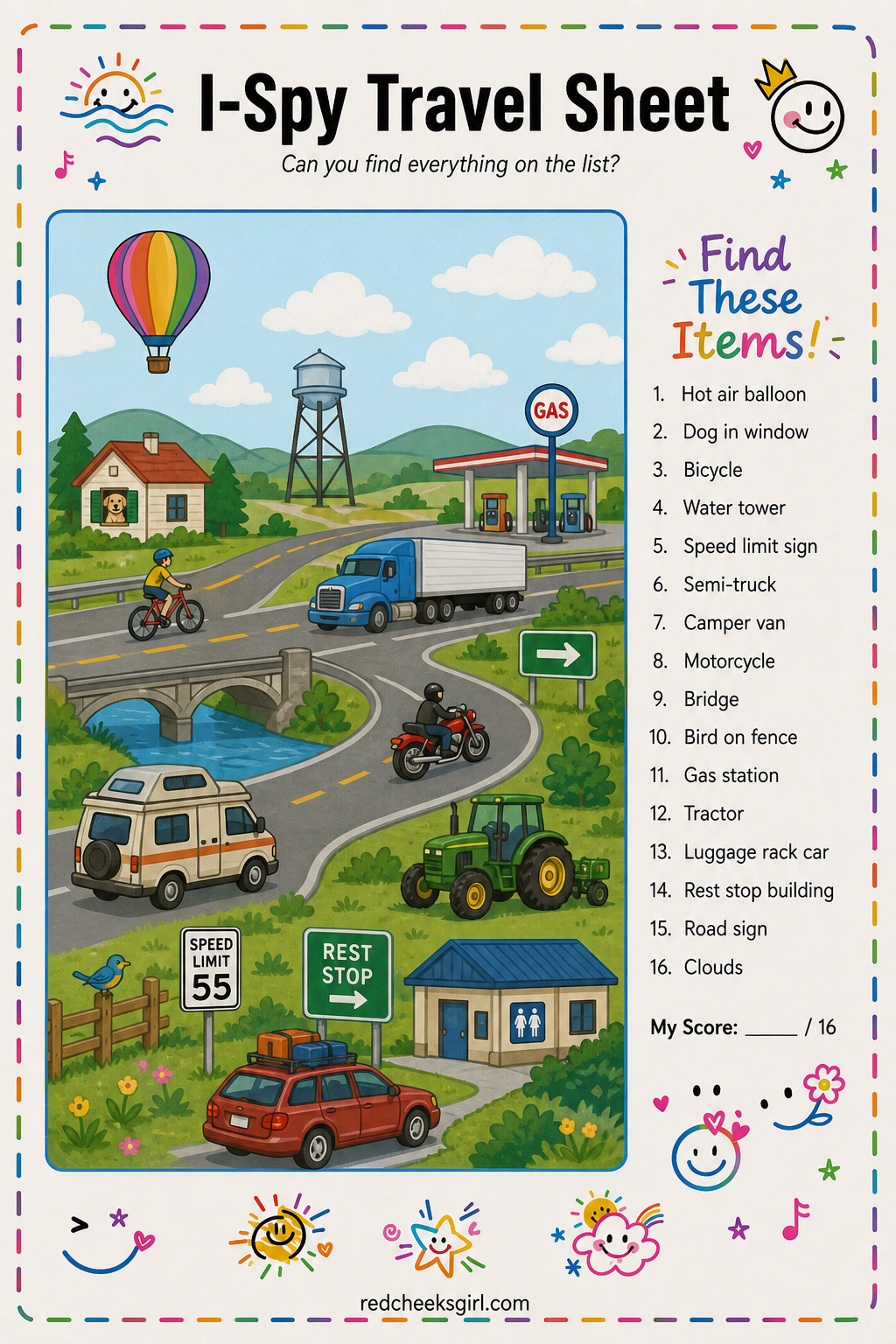
9. I-Spy Travel Sheet
I Spy is one of those road trip games for families that is genuinely ancient — parents have been playing it with kids in carriages, probably — but it absolutely slaps in its printable form.
Instead of one person describing something and everyone guessing, this sheet gives every player a personal illustrated scene crammed with hidden objects to find.
There’s a detailed road-trip-themed illustration — a busy highway scene full of vehicles, signs, animals, and landscape details — and a list of items to hunt for inside the picture. The challenge is spotting all of them.
The printable format is particularly magical for the back seat because it keeps kids quietly and independently busy for solid stretches — no one needs to manage the game, referee a dispute, or repeat the clue eleven times.
Just hand it over and let the focused silence wash over you. (Parents, you’re welcome.)
Print one sheet per child, and if you have different-aged kids, let older ones time themselves to find all items and see who gets the fastest completion time on their sheet.
Add a fun layer by including a blank ‘Design Your Own I-Spy’ section at the bottom of the sheet where kids draw their own hidden-object scene at a rest stop and challenge a sibling to find ten things in it on the next leg of the drive.
It turns a solo activity into a cooperative creative game and stretches the engagement across much more of the trip. Combine it with the scrapbooking ideas for a fun way to preserve the drawings as a trip keepsake later.
- Younger kids who need an independent, self-contained activity
- Rest-stop downtime — kids can complete it quietly while adults decompress
10. Family Would You Rather Cards
Would You Rather is one of those deceptively simple conversation games that starts with a funny question and somehow ends with the whole family having the most engaged, opinionated discussion you’ve had in months.
The printable card format gives you a ready-made deck of questions to pull from — no one has to come up with them on the spot, which is a relief when you’re the driver trying to keep things moving.
Each card poses a dilemma: ‘Would you rather eat only pizza for a year OR never eat pizza again?’ — and everyone shares their answer and, crucially, their reasoning.
The questions on these cards are designed to work for every age in the car: some are silly and kid-focused (‘Would you rather have a dragon as a pet OR be able to fly?’), some are travel-themed (‘Would you rather visit the mountains OR the beach on every vacation?’), and some spark genuine family discussion (‘Would you rather always know where you’re going OR always be surprised by the destination?’).
Cut the cards apart before you leave, stack them in a small bag or rubber-banded bundle, and let passengers take turns drawing and reading one aloud.
The reason Would You Rather works so brilliantly on a road trip is that there are no right answers — which means no one loses, no one feels left out, and the conversation can be as long or as short as the group wants.
Quieter family members who wouldn’t normally jump into a game find it easy to participate because all they have to do is pick one option and say why. And honestly?
You’ll learn more about your family members’ personalities from ten rounds of Would You Rather than from a year of regular dinner conversations.
No right or wrong answers means nobody ‘loses’ — perfect for mixed ages and personality types who might not love competitive games.

11. This or That Family Sheet
Think of This or That as Would You Rather’s quick-fire, high-energy cousin — it moves faster, it’s easier to play with very young kids, and it generates rapid-fire banter that fills a surprising number of miles.
This printable sheet gives every player a list of 20 paired choices, each one travel- or road-trip-themed, and they circle their pick for each pair. Mountains or ocean? Window seat or aisle? Rest stop or drive-through? Pack light or bring everything?
Once everyone’s done, compare sheets and see where the family agrees (and where they hilariously do not).
The individual sheet format means each person can fill it out at their own pace and then share answers, which is great for different age levels — the five-year-old can circle pictures or have a parent read the choices aloud, while the twelve-year-old blazes through it in two minutes and then tries to guess everyone else’s answers before they reveal them.
It’s also a genuine conversation starter: ‘I can’t believe you picked drive-through over a proper sit-down meal, DAD’ is exactly the kind of loving family argument that makes a road trip memorable.
Laminate the sheets so you can use them with dry-erase markers and reset for another round — or use a new printed sheet on the return trip and see if any answers have changed after the adventure.
This or That also works beautifully as a way to make actual trip decisions: if the whole family is genuinely torn between a detour to a waterfall versus pushing on to the hotel, run a quick This or That vote and let the sheet decide.
Democratic, fast, and argument-ending. Mostly.
Use This or That to settle real trip decisions — where to stop for lunch, which detour to take — so it does double duty as a game AND a family democracy tool.

12. Travel Tic-Tac-Toe Sheet
Tic-Tac-Toe is the all-time backseat game — two players, a 3×3 grid, and approximately zero learning curve, which makes it the perfect activity for pairs of kids or a kid and a parent riding shotgun.
The printable Travel Tic-Tac-Toe sheet gives you a full page of pre-drawn grids (think 12 to 16 grids per sheet) so you can play round after round without anyone having to re-draw the board on a foggy window or the back of a receipt.
Best of three, best of five, best of however many grids are on the sheet — you decide the rules.
To keep it fresh and road-trip-specific, the printable uses travel-themed markers instead of plain X and O: one player marks their squares with a tiny car icon, the other marks theirs with a tiny road sign.
It’s a small detail that makes kids feel like they have a proper game rather than a hastily scrawled doodle.
Print multiple copies so each pair of passengers gets their own sheet, or fold one sheet in half and let two separate pairs play their own tournament simultaneously in different parts of the back seat.
For a variation that works for older kids and adults, try Ultimate Tic-Tac-Toe — the full sheet becomes one giant meta-board where each individual small grid is a ‘zone,’ and winning a zone earns you that square in the larger overall grid.
It sounds complicated but takes about 30 seconds to explain and is genuinely strategic enough to keep a ten-year-old completely focused for 45 uninterrupted minutes. Which, on a long drive, is basically a miracle.
- Pairs of passengers — great for keeping two kids busy together without requiring adult supervision
- Short attention-span stretches between bigger activities

13. Family Travel Journal Page
A Family Travel Journal Page is a quiet, cozy keepsake activity that turns the hours in the car into something genuinely meaningful — not just time that passed, but time that got documented.
Each family member gets their own journal page to fill in during the trip: where you started, where you’re headed, what you saw out the window today, the funniest thing that happened, the best snack you ate at the last rest stop, one thing you’re looking forward to at the destination.
At the end of the trip, you’ve got a beautiful, kid-written record of the whole adventure.
The printable page is designed so that younger kids can draw in the large blank ‘sketch box’ (label it ‘Draw something you saw today!’) while older family members fill in the written prompts around it.
Nobody is forced to write a full essay — the prompts are short and specific, which makes it easy even for reluctant writers.
Sliding a completed page into a sheet protector when you arrive at each night’s stop keeps them safe and flat, and by the end of a multi-day trip you’ve got a full mini-journal without anyone having to do any extra work.
The keepsake value of these pages is genuinely special — especially the drawings from little ones who are documenting their first big road trip. If you’re a scrapbooker or memory-keeper, these pages slip straight into a trip album.
For families who love creative projects, this pairs perfectly with the kind of memory-keeping ideas in our junk journal ideas guide — repurpose ticket stubs, gas station receipts, and roadside-attraction brochures right alongside your journal pages for a truly tactile trip record.
The large blank sketch box means non-writers and pre-readers contribute just as meaningfully as older kids — this is one keepsake activity with zero age barrier.

🛍 Shopping guide
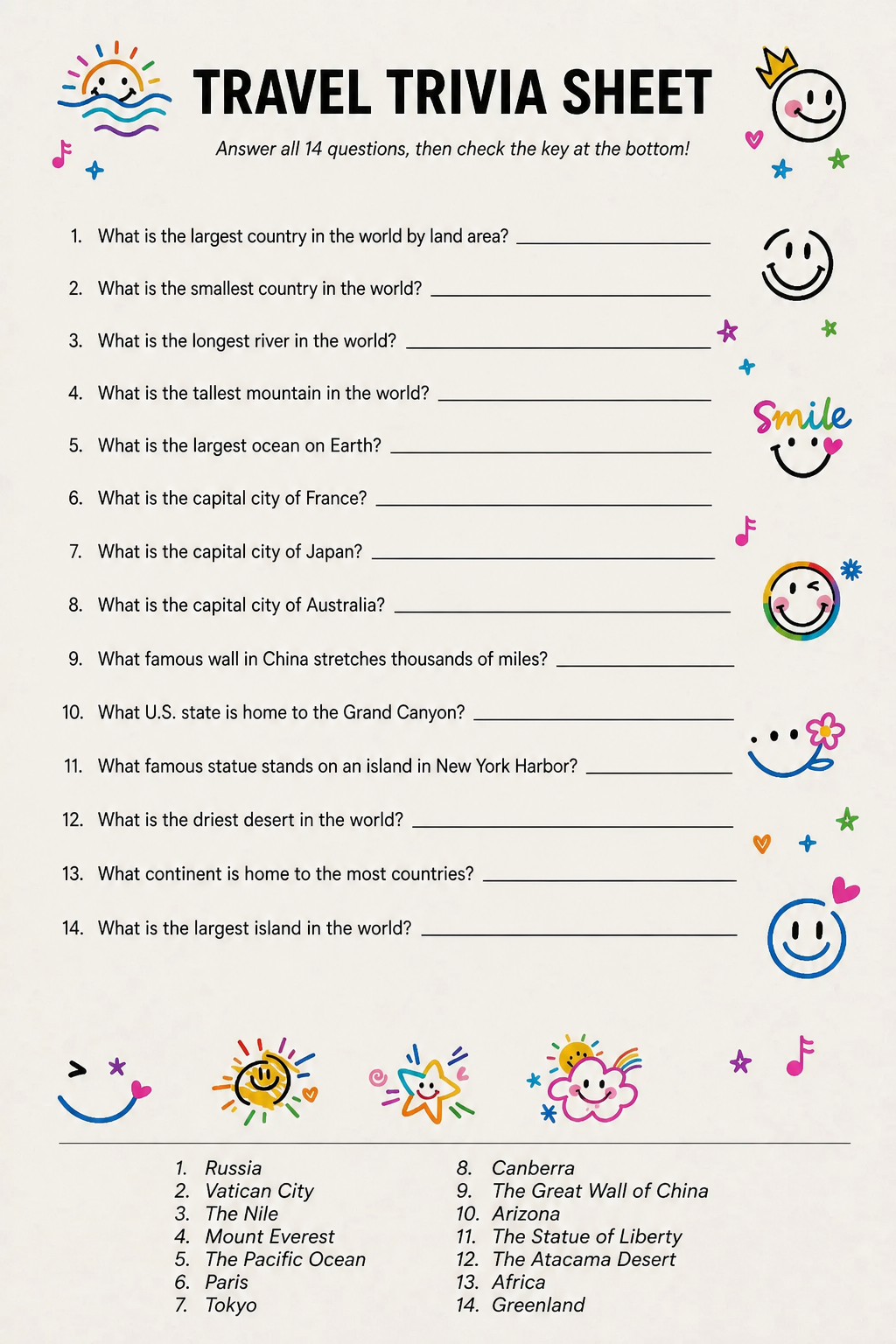
14. Travel Trivia Sheet
Travel trivia is one of those road trip games for families that levels the playing field in the best possible way — younger kids get fun, straightforward geography questions they can actually answer, older kids tackle a bit more, and adults suddenly realize they’ve forgotten which ocean is the largest (the Pacific, by the way).
This printable sheet features 20 travel and geography trivia questions organized into two rounds of 10, with space to write answers and a complete answer key printed discreetly at the very bottom of the page.
To play, hand a sheet to each passenger, set a timer for 10 minutes, and let everyone answer independently — no shouting answers across the car, no peeking.
When time is up, read the answers aloud from the key, everyone marks their own sheet, and whoever gets the most correct is crowned the Road Trip Trivia Champion.
Or, skip the competitive format entirely and do it as a team: the whole car discusses each question out loud and tries to agree on an answer before moving on. The team discussion version is louder, funnier, and equally good for everyone.
The questions are tiered so they genuinely work across age ranges: Q1–5 are accessible enough for a confident ten-year-old (which U.S. state has the longest coastline? How many continents are there?), Q6–15 require a bit more knowledge (what is the capital of Canada?
What is the world’s longest river?), and Q16–20 are proper stumpers for the adults (what country has the most time zones? Which is the smallest country in the world by area?).
No one gets shutout, everyone contributes, and you’ll probably learn something interesting before you even reach your first rest stop.
Do it in team mode on the drive out and individual mode on the drive home — two completely different games from one printed sheet!
15. Color the Route Sheet
Color the Route Sheet is a coloring-page-meets-travel-activity that keeps younger kids creatively occupied while giving the whole family a visual way to track where they’ve been.
The sheet features a simplified outline map of the contiguous United States with major interstates and highways clearly marked but not colored in.
As the family drives, kids color in the stretch of road you’re traveling, mark the state borders you’ve crossed, and draw a little star on your starting point and destination.
It’s a tactile, low-key way for even a four-year-old to understand the scale of a trip.
Beyond the map, the sheet includes small blank boxes around the edges for kids to sketch or note down the name of each state they pass through — a bit like a mini passport stamp system.
Older kids can challenge themselves to also label state capitals as they cross state lines, turning the coloring activity into a quiet geography lesson (that doesn’t feel anything like school because it involves crayons).
The sheet works best clipped to a clipboard with a good set of colored pencils within reach.
What makes this printable especially great for a long multi-day road trip is that it becomes a living document of the whole journey — it starts blank and ends up as a colorful, personalized record of everywhere the family has been.
When you get home, it makes a wonderful piece to save in a trip scrapbook or stick to the fridge.
Pair it with the Family Travel Journal Page for a full documentation kit that even the littlest travelers can contribute to independently, and you’ll have a trip record that’s way more heartfelt than any Instagram post.
- Ages 3 and up — younger kids color freely, older kids add labels and capitals
- Multi-day trips where the map fills in gradually as a living trip record

🛍 Shopping guide
16. Travel Riddles Sheet
Riddles are a spectacular car-game format because they work both as a printed independent activity AND as a read-aloud game where the driver can participate fully without anyone needing to see a sheet.
This Travel Riddles printable features 16 clever, family-friendly riddles all themed around travel, vehicles, roads, and adventure — read one aloud, give everyone 30 seconds to think, then reveal the answer.
Or hand the sheet to a passenger who reads them out one by one and lets the whole car guess together. Either way, riddles generate some wonderful ‘ohhhhh!’ moments and a fair amount of ‘that was SO obvious, how did I miss that?’
The riddles on this sheet are calibrated for a wide age range: the simpler ones (Q1–8) are accessible to confident seven- and eight-year-olds and will make little ones feel genuinely smart when they get it, while the harder ones (Q9–16) are crafted to properly stump adults and require a bit of lateral thinking.
The answer key is printed in small, subtle grey text at the very bottom of the page so the sheet can be used in both modes — handed to a player who reads the riddles without peeking at the key, or used by a quiz-master who knows all the answers.
For a fun twist, let family members who solve a riddle get a ‘riddle credit’ — they can pose their own made-up riddle to the group for a bonus round.
Kids are surprisingly creative with original riddles, and the self-invented ones are often funnier than the printed ones (even when they make absolutely no logical sense, which, honestly, is part of the charm).
It’s a great way to stretch the sheet’s engagement time well past the 16 printed questions.
- Read-aloud mode: one person reads, car guesses — driver can fully participate!
- Solo mode: hand the sheet to a passenger and let them work through all 16 independently.

17. Matching Travel Cards
Matching cards — also known as memory or concentration — is a game that truly spans every age, from a three-year-old who plays it purely on luck to a ten-year-old who has a genuinely terrifying memory and wins every single round.
This travel-themed printable gives you a full set of cards to cut apart: each card features a simple icon of something travel-related — a suitcase, a compass, a road sign, a camper van, a mountain, a passport, a gas pump, a map — and every icon appears on exactly two cards.
Shuffle, lay them face-down in a grid, and take turns flipping two at a time to find matching pairs.
Print the sheet on cardstock for cards that are stiff enough to handle easily in little hands, and laminate if you want a set that survives multiple road trips (and multiple juice-box incidents).
The grid can be scaled based on the age of the players: set out just 8 pairs (a 4×4 grid) for the youngest players, or lay out all 20 pairs (a 4×10 grid) for a serious challenge.
The person who collects the most matched pairs when the grid is cleared wins the round. Play best of three, or just keep going until everyone’s restless and it’s time for a rest stop.
For a twist that makes it more of a learning game, add a ‘tell me one thing’ rule: when you make a match, you have to say one fact or word associated with that icon before you collect your pair. Matched the compass?
Name one direction. Matched the map? Name one state. It sounds easy until someone flips a passport and has to name a country starting with the letter Q while everyone else is staring at them expectantly. High-pressure, low-stakes, and extremely funny.
- Cardstock paper for printing sturdy cards
- Scissors to cut cards apart
- Optional: laminator pouches for reuse on future trips

🛍 Shopping guide
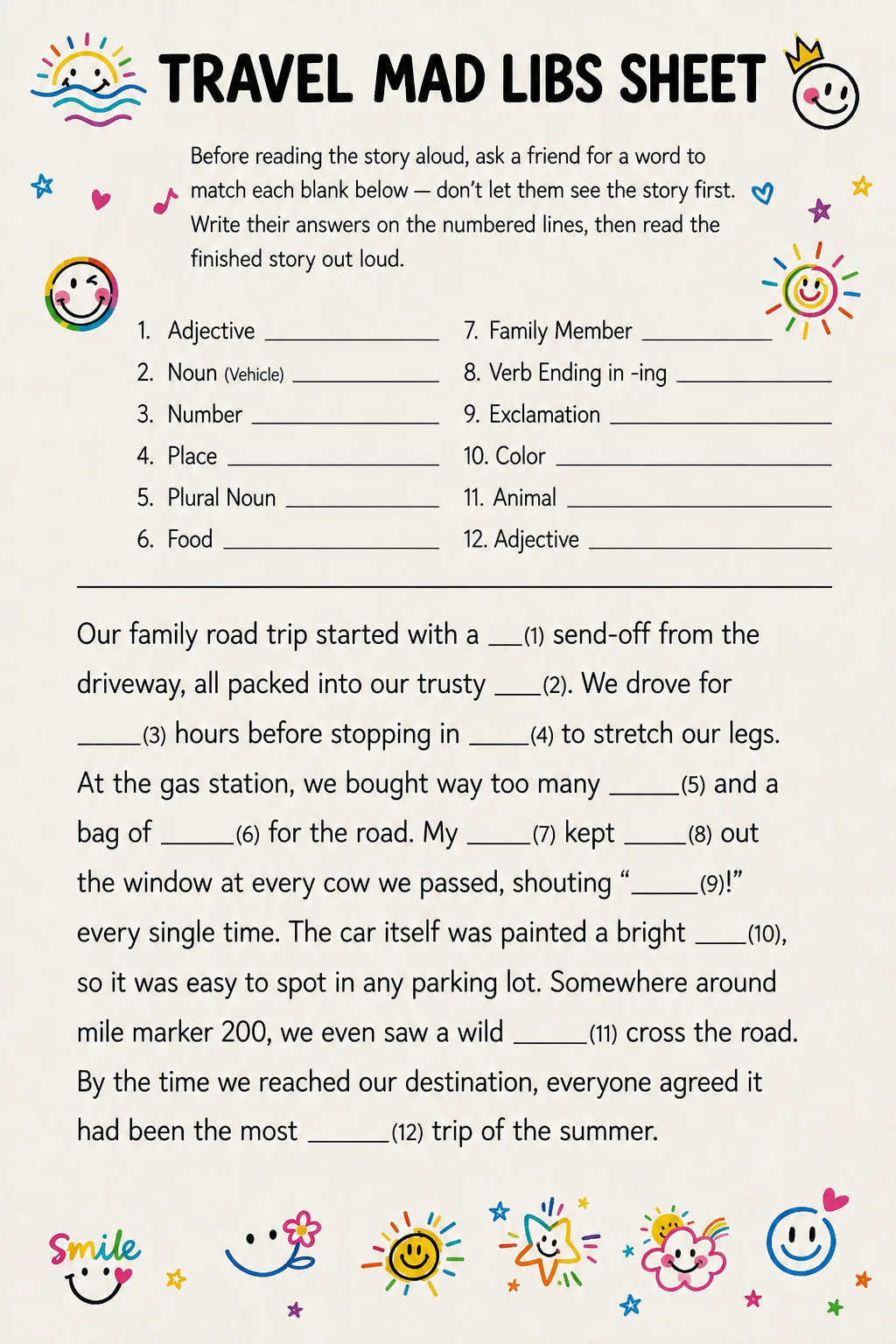
18. Travel Mad Libs Sheet
Mad Libs is the fill-in-the-blank storytelling classic that has been making families howl with laughter in back seats since the 1950s — and it remains absolutely undefeated as a car activity.
One person holds the sheet and asks the group (or each individual) for words by type: ‘Give me an adjective!’ ‘Give me a verb ending in -ing!’ ‘Name an animal!’ — without revealing the story context.
The words get filled in blind, and when the story is read aloud with all the silly substitutions, the result is glorious nonsense that everyone from age four to eighty-four finds completely hilarious.
This Travel Mad Libs printable features a road-trip-themed story with 15 blanks to fill: the tale of a family setting off on ‘the most [adjective] road trip in history’ in a ‘[color] [noun],’ driven by a ‘[adjective] [family member]’ who swears they know the way to ‘[silly place name].’
The blanks are clearly labeled with the part of speech needed (noun, adjective, verb, plural noun, exclamation) so older kids can practice grammar while also giggling uncontrollably. It’s educational! Kind of!
Print a few copies so you can play multiple rounds — the same story with different word inputs creates completely different results every time, and kids almost always want to go again immediately after the first read-through.
Younger kids who don’t know parts of speech yet can just shout random words when it’s their turn (‘BANANA!’ ‘PURPLE!’ ‘RUNNING!’), which actually produces some of the very best Mad Libs outcomes.
Save the best completed sheets in your keepsake craft folder for a hilarious trip memento.
- One person holds the sheet and calls out blank types only — never reveal the story!
- Fill in ALL blanks before reading the story aloud for maximum hilarious impact.
19. Family Trip Bucket List
The Family Trip Bucket List is the kind of quiet, cozy car activity that sounds simple but secretly generates some of the most meaningful family conversations you’ll have all trip.
Each person gets a card (or a section of the shared printable) and writes down five to ten things they most want to do, see, eat, or experience — either on this specific trip or on future adventures they dream about.
A six-year-old might write ‘swim in a waterfall’ and ‘eat a corn dog at a fair.’ A grandparent might write ‘drive along the Pacific Coast Highway.’ A teenager might write ‘stay in a glass-ceiling cabin in the mountains.’
Nobody judges; every dream goes on the list.
Once everyone’s written their lists, take turns sharing out loud — and as a family, circle any items that overlap. Those overlap items become your shared bucket list: things the whole family has agreed they want to do together at some point.
If any of them are achievable on the current trip, someone can nominate it for a vote right there in the car.
This is honestly one of the most natural and productive ‘family planning’ conversations you can have, and it happens totally organically because you’re stuck in a car together with nothing else to do.
The bucket list cards are worth keeping. Slip them into the back of the Family Travel Journal, stick them on the fridge when you get home, or store them in a dedicated ‘family dream jar.’
Revisiting them on future trips — ‘Hey, remember you put Yellowstone on your list two years ago? We’re going!’ — is genuinely heartwarming.
It’s the kind of quiet activity that doesn’t feel like a game at all in the moment but produces memories and inside references that stick for a very long time.
The ‘shared items’ exercise turns individual wishful thinking into a real family plan — kids take future travel more seriously when they helped design it.

20. Best Family Trip Memory Share
Best Family Trip Memory Share is the quiet, reflective closer that works beautifully either on the drive home or during the last stretch before you arrive at your destination.
The setup is beautifully simple: go around the car and have each family member share their single best memory from the trip — not necessarily the biggest or most expensive moment, but the one that made them feel the most happy, the most surprised, the most connected, or the most like themselves.
Little kids will often pick the weirdest, most specific things (‘the truck stop with the giant chicken statue’) and that is absolutely perfect.
To give the activity a bit more structure and make it feel like a real ritual, pass around a single notepad or use the notes app on a phone to write down each person’s memory as they share it.
When everyone has gone, read the full list back aloud as a group. What you get is a collaborative highlight reel of the same trip seen through completely different eyes — and the variation is always surprising, touching, and often funnier than anyone expected.
It’s one of those activities that feels small in the moment but becomes a treasured family ritual over many trips.
For families who do road trips regularly, keeping a dedicated ‘Memory Share’ document on a phone or in a notebook that you add to after every trip builds into something genuinely remarkable over the years — a running record of every trip’s best moment from every family member’s perspective.
Reading back through old entries on a long drive is an activity in itself. And honestly, it’s the best antidote to the post-trip blues: instead of mourning that the trip is over, you’re celebrating everything that made it worth the miles.
End the drive on that note, and everyone climbs out of the car smiling.
Save all Memory Share notes in a single running document or journal — reading past trips’ entries on future drives becomes a joyful activity in its own right.

Frequently Asked Questions
What are the best road trip games for families with mixed ages?
Games that require no reading or writing to participate work best when ages vary widely. Verbal games like 20 Questions, The Alphabet Game, Family Story Chain, and Name That Tune are accessible from toddlers to grandparents because everyone can contribute at their own level.
Printable games like Family Road Trip Bingo and the I-Spy Travel Sheet use pictures so younger kids can play alongside older ones without feeling left out.
The key is picking a mix of active verbal games, printable solo activities, and quiet reflection games so there’s always something for whoever needs it at any given moment on the drive.
How many printable road trip games should I print before a long trip?
For a road trip of four or more hours, aim for at least one printable per child per two to three hours of driving.
A good base kit: one bingo card each, one scavenger hunt sheet, one I-Spy sheet, one trivia sheet, one Mad Libs, and a journal page.
For a multi-day drive, add the Color the Route Sheet (it fills in gradually over the whole trip), Travel Riddles, and the matching cards. Print two copies of anything you want to play competitively so each passenger has their own sheet.
Printing on cardstock and laminating high-reuse games like Tic-Tac-Toe and This or That saves paper on multi-day trips.
What road trip games can the driver participate in?
The driver can fully participate in any verbal, eyes-on-the-road game: 20 Questions, The Alphabet Game, Punch Buggy Spotting, Name That Tune, Family Story Chain, Would You Rather (answer aloud), and the Memory Share.
Travel Riddles read aloud by a passenger also works well for the driver. The driver should skip any game that requires looking at a sheet, writing, or holding an item — save those printable activities for passengers only.
Are these road trip games screen-free?
Yes — every game on this list is completely screen-free. The active and verbal games need nothing at all: no phone, no tablet, no app. The printable games need a printer and paper (and a pen or crayons), but zero screens during play.
Name That Tune does use a phone for music, but you can also hum songs entirely without any device.
If you want maximum screen-free time, load up on the printable set before you leave and lean on the verbal games for the rest — you’ll be amazed how many miles disappear without anyone reaching for a phone.
How do I keep toddlers and very young kids engaged on a road trip?
For the youngest passengers (ages two to five), the best approach is short, visual, and participatory. The I-Spy Travel Sheet with pictures, the Color the Route Sheet (just coloring with no rules attached), and Bingo with picture squares work independently.
For group games, give toddlers the role of ‘spotter’ or ‘answerer’ rather than question-master — they love contributing answers to 20 Questions or Story Chain even if they can’t come up with a mystery item on their own.
Rotate activities every 20 to 30 minutes to match their attention span, and pack crayons and the printable set in an easy-reach bag so you can hand something new over without fuss.
Can road trip games work on short drives, not just long ones?
Absolutely — most of these games work brilliantly on a 20-minute drive to the grocery store. The Alphabet Game and Punch Buggy are perfect for short drives because they have no real start or end.
Would You Rather Cards, Travel Riddles, and Tic-Tac-Toe all scale perfectly to a quick drive. Even the License Plate Game can be played on a local errand run — spotting out-of-state plates in parking lots is surprisingly competitive.
Keep a small folder of printed sheets in the car so you’re always ready to play, whether you’re headed across a state or just across town.
📌 Save These for Later
Loved these? Pin your favorite image below so you can find this list again when you’re planning.

Light up your next party with 20 epic neon glow party games perfect for a blacklight night your teen

28 white balloon arch ideas that use finish, size, greenery and light to look considered, not forgot

120 charades ideas sorted by Movies, Animals, Actions, Occupations & Everyday Activities — plus fr
Leave a Reply