


Planning party games for teenagers is honestly one of the most stressful things on the host checklist — because if the games are boring, the phones come out, and suddenly everyone’s staring at their own FYP instead of talking to each other. I’ve been there.
I’ve also made the mistake of pulling out a ‘fun group game’ that was met with the kind of silence usually reserved for bad stand-up comedy.
So I did what any self-respecting party planner does: I went back to the drawing board and came up with a lineup that teens would actually enjoy — and maybe even film for their stories.
This list of 22 party games for teenagers covers everything from high-energy active games to cozy quiet rounds that feel more like a vibe than a structured activity.
There’s a mix of printable sheets (perfect for when you want something ready to go), social-media-worthy chaos games, and low-key bonding rounds that still pack in the laughs.
Whether you’re hosting a holiday party, a birthday bash, or just a big group hangout, there’s something here for every energy level and group size.
Pro tip: if you’re still sorting out the gift situation for your party guests, this Christmas gift guide has you covered. Now — let’s get to the games.
This post contains affiliate links — if you buy through them, I may earn a small commission at no extra cost to you.
- Pass-the-Phone Confessions
- Teen Scattergories
- TikTok Trend Charades
- Emoji Movie Quiz
- Escape Room Challenge
- Would You Rather for Teens
- Whisper Challenge
- Music Trivia Sheet
- Werewolf
- Teen This or That Sheet
- Lip Sync Battle
- Guess the Lyric Sheet
- Chubby Bunny
- Most Likely To (Teens)
- Blindfold Taste Test
- Two Truths and a Lie
- Human Knot
- Danger Word
- Photo Scavenger Hunt
- Dance-Off Battle
- Hot Seat Questions
- Sardines Hide and Seek
- Frequently Asked Questions
1. Pass-the-Phone Confessions
This one is the ultimate icebreaker that somehow also doubles as a chaos starter — in the best way.
One person reads a prompt from the screen (something like ‘most likely to ghost a group chat’ or ‘who always has drama’), picks the person in the room who fits best, and passes their phone to them.
That person then reads the next prompt and picks someone else, and the chain keeps going. You can use a free party app like Pass the Phone or just write prompts on slips of paper if you want to keep it lo-fi.
Best for groups of 6–15, and trust me, the bigger the group, the wilder the reveals.
To set it up, either download a free pass-the-phone party app beforehand and choose the ‘friends’ or ‘party starter’ mode, or grab a notepad and write 20–30 prompts before the party.
Keep them fun and observational rather than mean-spirited — think ‘who has the most unread texts’ or ‘who would survive a zombie apocalypse.’ Each person reads the prompt aloud to the group before passing, so everyone can react.
At the end of the game, tally up who got picked the most (the ‘phone magnet’) and who flew completely under the radar.
Why this one works so well at a holiday party is that it forces people who might not know each other super well to actually notice each other — and that generates incredible content.
Teens will absolutely be filming the reactions when someone gets picked for something wildly accurate.
Host tip: run this as your very first game of the night to break the ice before anything else, because after this, everyone will be warmed up and way less awkward.
- 6–15 players
- Opening icebreaker game
- Groups where not everyone knows each other
2. Teen Scattergories
Scattergories is a classics for a reason — it is fast, competitive, and wildly funny when two people accidentally write the same obscure answer.
The teen version swaps out generic categories for stuff that actually hits: social media, school life, pop culture, holiday traditions, and things you’d find in someone’s camera roll.
A letter is randomly chosen (roll a die or use a free online randomizer), and players race against a 2-minute timer to fill in one answer for each of the 12 categories on the sheet — every answer must start with the chosen letter.
Only unique answers score points, so the more creative you get, the better.
Print one sheet per player before the party (cardstock makes it feel fancier, tbh). Choose a letter by rolling a die or using a random letter generator on your phone, flip a timer, and GO. After time is up, everyone reads their answers aloud.
If two or more players wrote the same answer for the same category, those answers are crossed out — no points. Unique answers get one point each. Play three rounds with different letters and crown the most creative thinker in the room.
This works brilliantly with groups of 4–10 and takes about 20 minutes total.
The holiday party spin: include a few seasonal categories like ‘a gift you’d regift,’ ‘a song playing at every holiday party,’ or ‘something you eat too much of in December.’
These additions make the sheet specific to the moment without being cringe — and they always spark side conversations and debates that go way longer than the actual game.
Host tip: make a couple of spare sheets in case someone wants a rematch, because they always do.
Add a ‘holiday party’ themed column to make it seasonal without being awkward — teens love having local context.

3. TikTok Trend Charades
This is charades but make it 2026.
Instead of acting out movies or animals, players act out TikTok trends, viral dances, popular sounds, and internet moments — no talking, no props, just pure body language and the very specific energy of someone trying to mime ‘the griddy’ or ‘NPC mode’ while everyone screams guesses.
Divide into two teams and take turns sending one player up to act while their team guesses. Each correct guess in 60 seconds scores a point. Best played with groups of 8 or more for maximum chaos.
Write the prompts on folded slips of paper before the party and toss them in a bowl. Good categories include: viral dances, TikTok sounds, popular formats (like ‘POV’ or ‘things that just make sense’), trending challenges, and holiday-themed internet moments.
Keep the prompts broad enough that most players will recognize them — if you write something too niche, the whole room will just stare blankly at whoever is acting.
Set a 60-second timer per turn, and if the team can’t guess, the other team gets a free one-shot attempt to steal the point.
The social media gold here is obvious — someone is definitely going to film the moment a very shy person tries to act out a viral sound with full commitment.
Give bonus points for accuracy and extra style points for anyone who leans all the way in.
Host tip: add a few ‘holiday edition’ prompts like ‘acting out an elf on a shelf’ or ‘the vibe of a school holiday assembly’ to make it feel specific to the occasion without being forced.
- Folded prompt slips in a bowl
- A 60-second phone timer
- At least 8 players split into 2 teams
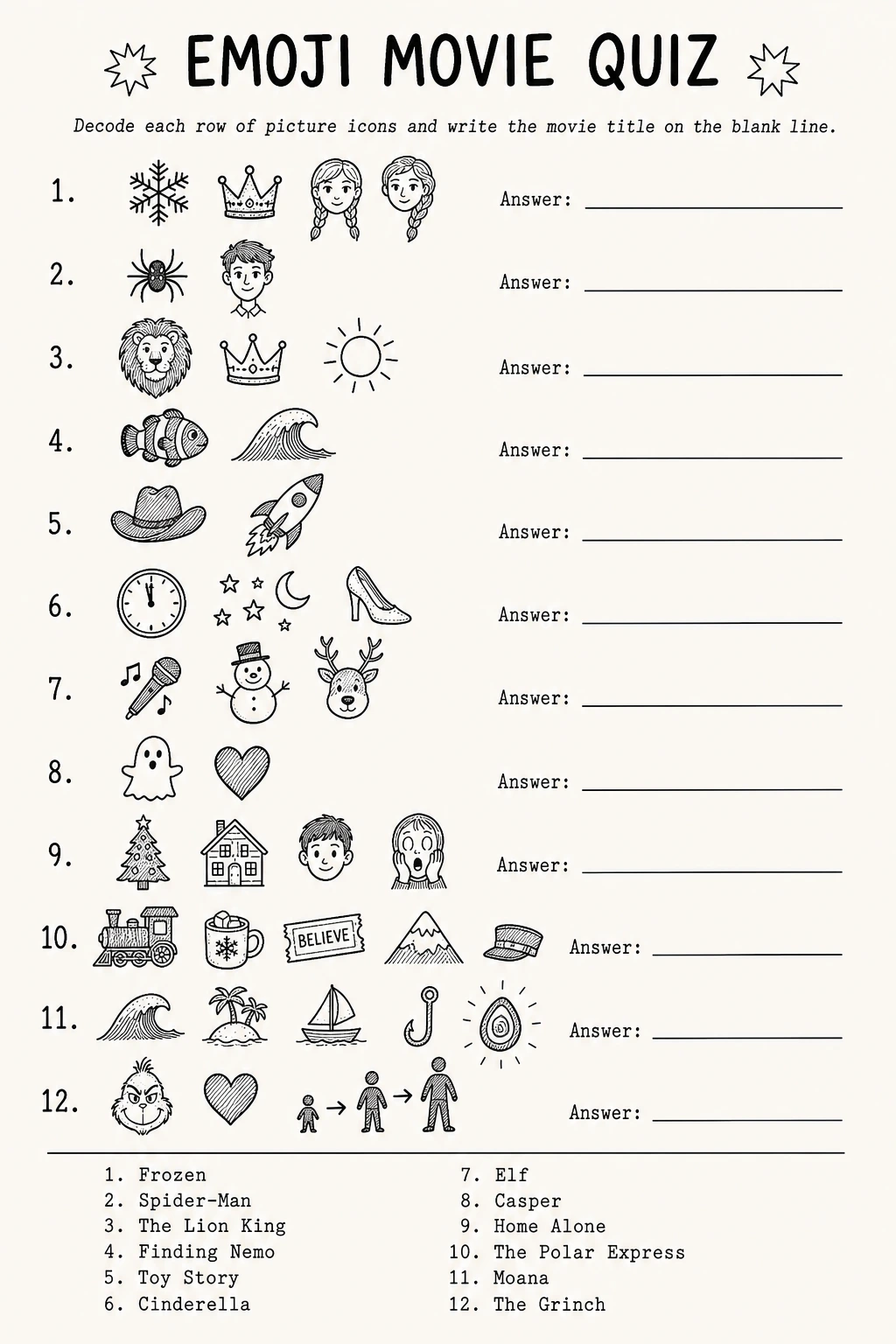
4. Emoji Movie Quiz
This one is genuinely fun for every single person in the room — even the ones who swear they ‘don’t watch movies.’ The sheet shows rows of tiny emoji picture symbols that represent a well-known movie title.
Players look at the clues and try to decode which movie each row of emojis represents, then write their answer on the blank line next to it.
No talking, no teams needed — it works solo or with everyone calling out answers together for a more chaotic group experience. Best for any group size from 4 to 30.
Print one sheet per player (or one between two if you want it to be a team thing). Give everyone 5–7 minutes to work through all the clues solo, then reveal answers one by one for maximum drama.
To keep it social, encourage players to share their wrong answers out loud — the creative misreads are honestly funnier than getting it right. For a holiday party, include a few holiday movie titles in the mix to keep it seasonal.
The answer key lives at the very bottom of the sheet in tiny, light-grey italic text so no one accidentally spoils it.
Why it works at a party: it fills that natural lull right after everyone arrives and before the energy picks up for louder games. People can drift in, grab a sheet, and start playing without any formal announcement.
It’s also the perfect game to photograph — someone always holds up their sheet for a reaction shot when they finally crack a tough one.
Host tip: make a few extra copies, because people will want to take them home or challenge a parent to beat their score later.
- Any group size — solo or team play
- The ‘arriving’ phase of the party when not everyone is there yet
5. Escape Room Challenge
Turning your living room or party space into a mini escape room is the kind of game that genuinely gets teens off their phones and into full problem-solving mode — and it looks incredible if you film the countdown timer ticking down.
The basic idea is that teams of 4–6 work together to solve a series of linked puzzles, riddles, and physical challenges hidden around the space before the clock runs out.
There’s no buy-in required: write the clues yourself, hide them around the house, and watch the chaos unfold as two teams race each other to escape first.
Before the party, plant 6–10 clues around the space in a chain — each clue leads to the next location, and the final clue unlocks a ‘treasure’ (could be a locked box with a combo, a bag of candy, bragging rights, whatever).
Make the puzzles varied: one math riddle, one anagram, one physical challenge (like a mini obstacle in the hallway), and one that requires observing something in the room carefully.
Run two identical courses simultaneously for two teams, or send them through one course and time each team separately for a speed-run format.
The holiday party twist is easy and genuinely fun — make the clues Christmas or winter themed. Think ‘the next clue is somewhere as cold as the North Pole’ (the freezer) or ‘elves work here’ (the kitchen).
Teens who are into Among Us, mystery games, or puzzle content will be completely in their element, and the team dynamics that emerge from a time crunch are pure comedy gold to watch. Best for groups of 8–20 split into teams of 4–6.
Write two identical clue chains so two teams race simultaneously — waiting around kills the energy completely.
🛒 What you’ll need
6. Would You Rather for Teens
Would You Rather is already one of the best verbal games for teens — but the printable version adds a whole new layer because players reveal their answers simultaneously, which means you can see in one glorious second exactly which choices created a room divided.
The sheet presents 15–20 would-you-rather scenarios themed around teen life, social media, holiday moments, and wild hypotheticals.
Players circle their answer for each one, and then the host reads them out one by one while everyone holds up their sheet or shouts their answer at the same time.
Print one sheet per player and hand them out before any verbal discussion — this prevents peer pressure answers and guarantees honest reactions. Give 3–4 minutes to circle everything, then go through each scenario as a group.
For the ones that split the room (and some WILL split the room dramatically), invite a couple of players to defend their choice. Set a 30-second timer for debate so it stays fun and doesn’t turn into a full argument session.
The holiday version includes questions like ‘would you rather get one perfect gift or ten random ones?’ and ‘would you rather spend the holidays with zero phone battery or zero snacks?’
This game works at any size group — it scales perfectly from 4 to 40, which makes it a great filler game during a party transition. It’s also low-stakes and welcoming for quieter guests who might feel intimidated by louder games.
Because there are no wrong answers and no point scoring, nobody feels put on the spot in a bad way. It’s one of those games that somehow leads to everyone learning something slightly surprising about someone they thought they knew.
No wrong answers = everyone feels safe to play. It sparks real conversations while staying completely light and fun.

7. Whisper Challenge
If you’ve never seen someone try to lip-read the phrase ‘my reindeer has a foot fungus’ while blasting music through noise-canceling headphones, you haven’t truly lived.
The Whisper Challenge is exactly what it sounds like: one player puts on headphones with loud music playing, and another player mouths a phrase — no sound, just lips — while the headphone-wearer tries to decipher it.
The guesses are almost always spectacularly wrong, and the reaction faces are the kind of content that gets saved and sent in group chats for months. Best for groups of 4 and up, though the game genuinely gets more hilarious the larger the group gets.
To play, one person puts on the headphones and cranks the music. Another player (or the host) mouths a phrase clearly while the headphone-wearer squints, guesses wildly, and usually says something completely unhinged. After three attempts or 30 seconds, reveal the real phrase.
Tally points for correct guesses if you want to add a competitive layer, or just play for pure laughs with no scoring.
Holiday-themed phrases are comedy gold: try ‘Santa lost his beard in the chimney’ or ‘the elf is on the wrong shelf again’ and watch what comes back.
This is one of those party games for teenagers that absolutely belongs on camera — the reaction shots alone make it worth setting up a tripod or propping a phone against a book.
Make sure the person mouthing the phrase really exaggerates their lip movements (think theatrical, not subtle) for maximum confusion. Host tip: write phrases on index cards in advance so the game moves fast between rounds with no downtime.
- Noise-canceling or over-ear headphones
- A music-playing device at high volume
- Prepared phrase cards (write 20 before the party)
🛒 What you’ll need
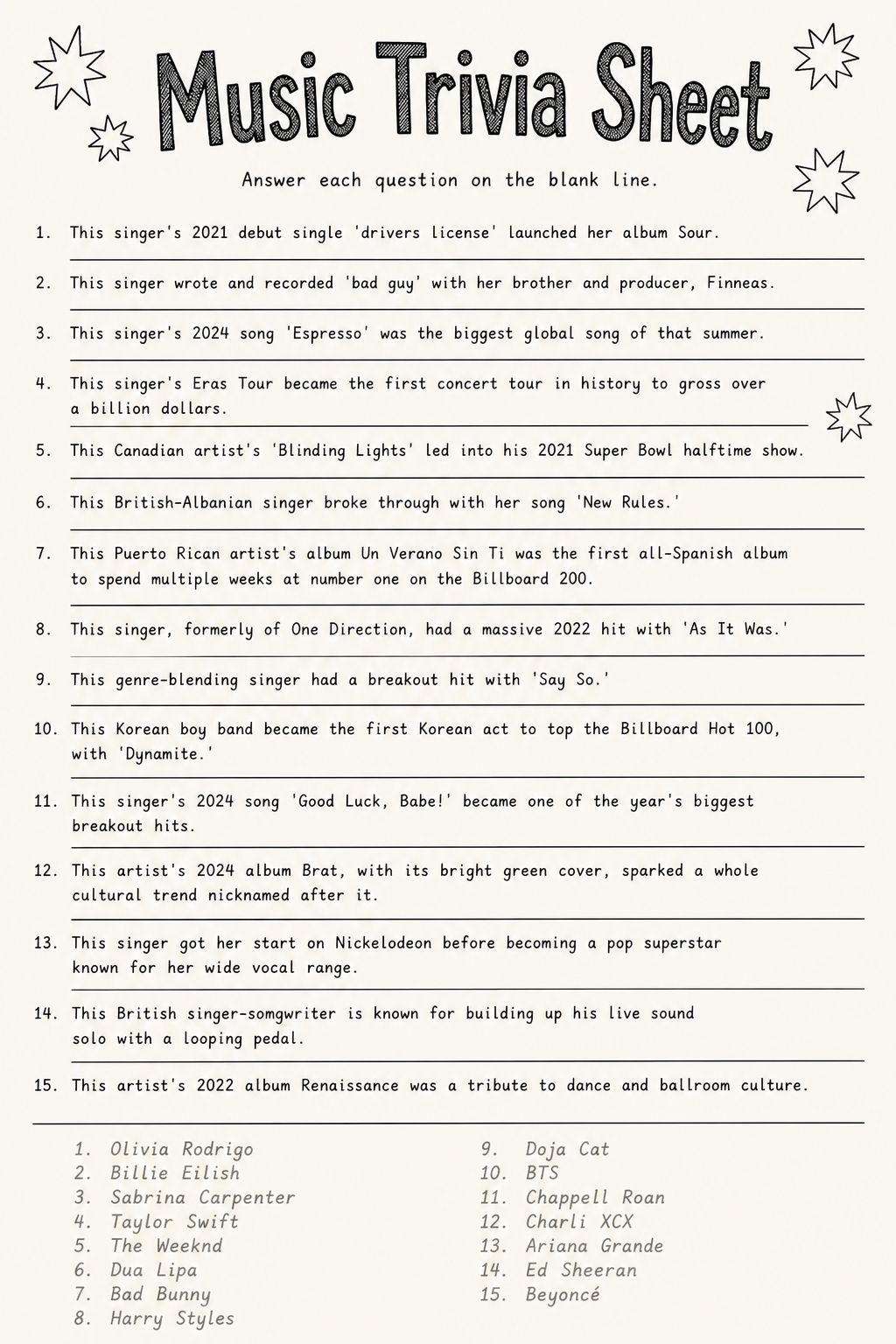
8. Music Trivia Sheet
Music trivia hits differently when the questions are actually about songs teens know — not your parent’s playlist.
This sheet covers pop, rap, R&B, viral hits, holiday bangers, and the kind of songs that have been background noise at every gathering for the past year. Players work through 20 questions solo or as pairs, writing their answers on the blank lines provided.
Question types are mixed up to keep it interesting: ‘name the artist,’ ‘complete the album title,’ ‘what year did this song drop,’ and a couple of ‘name that song from the first line’ challenges that will absolutely cause someone to start humming out loud.
Print one per player or one per team. Give 8–10 minutes to complete the sheet without any outside help (honor system, unless you want to implement a ‘phones down’ rule enforced by peer pressure).
Then go through the answers as a group — the host reads each question and the answer key at the bottom tells you what’s correct. Award one point per correct answer and let teams or players tally their own scores.
A holiday party variation includes a section on iconic holiday songs: ‘who originally sang this classic,’ ‘finish this lyric,’ ‘name the movie this song is from.’
The reason music trivia is consistently one of the best party games for teenagers is that it creates instant debate — someone always disputes an answer passionately, someone always knows a completely random deep-cut fact that impresses everyone, and at least one person will start singing the song to prove their answer is right.
It’s competitive without being exclusive, and you can customize the sheet entirely to your group’s musical taste. Host tip: include one absolutely impossible question per sheet so even the music nerds get humbled.
Include one ‘near-impossible’ deep cut question per sheet — it keeps even the most confident music fans humble and gives the underdogs a shot.
9. Werewolf
Werewolf is one of those games that takes about three minutes to explain and then takes over the entire party for two hours, and nobody complains.
It is a social deduction game where players are secretly assigned roles — most are innocent Villagers, but a hidden few are Werewolves. Each ‘night’ phase, the Werewolves silently eliminate a Villager while everyone else has their eyes closed.
Each ‘day’ phase, the whole group debates, argues, accuses, and votes to eliminate someone they suspect. Lies, misdirection, and very convincing innocent faces are the main strategies. Best for groups of 8–15, though it scales to 20+ with more Werewolves added.
You need a Moderator (one person who runs the game and doesn’t play), and role cards for every other player — Villager, Werewolf, Seer (who can secretly check one person’s identity each night), and Doctor (who can secretly save one person each night).
You can make cards with index cards and a pen, or use a deck from a store. The Moderator narrates: ‘Everyone close your eyes… Werewolves, open your eyes and choose a victim… Werewolves, close your eyes… Seer, open your eyes…’ and so on.
During the day, eliminated players drop out and the discussion gets increasingly paranoid and hilarious.
This is hands-down one of the most social and replayable party games for teenagers ever created, partly because every group develops its own meta — the kid who over-explains is always suspicious, the quiet one turns out to be the Werewolf, the most confident accuser is absolutely bluffing.
It rewards social awareness and creative lying in equal measure, which is basically the teen experience in a nutshell (I say that with love).
Add a holiday spin by giving roles seasonal names: Werewolves become ‘Krampus,’ the Doctor becomes ‘the Elf,’ the Seer becomes ‘the Star.’ Still exactly the same game, but now it has a theme.
- 8–15 players (add one Werewolf per 4 extra players)
- One designated Moderator who narrates
- Groups who love Among Us energy
🛒 What you’ll need
10. Teen This or That Sheet
Think of this as the printable, all-at-once version of a group conversation starter — faster than verbal Would You Rather and twice as revealing.
The sheet presents 20 ‘This or That’ pairs across categories teens actually care about: social media platforms, holiday traditions, food, music, pop culture, and random hypotheticals.
Players simply circle their choice for each pair and then hold up their sheets simultaneously on the count of three.
The visual of seeing who circled what — especially when the room is dramatically split 50/50 — is somehow way funnier than just talking about it.
Print one per player. Give everyone 3 minutes to circle their answers (no discussion, no peeking at neighbors’ sheets — that comes after). Then the host calls out each pair and players hold up their sheets or shout their answers in unison.
For any pair that splits the room evenly, pick one ‘This’ voter and one ‘That’ voter to defend their choice in 20 seconds flat. Keep the energy fast: you want to zoom through all 20 pairs, not linger on any one too long.
The holiday party edition includes pairs like ‘gift cards vs. wrapped presents,’ ‘Christmas playlist vs. holiday playlist with every genre,’ and ‘hot chocolate vs. eggnog.’
This is a brilliant game for large groups because it requires literally zero explanation time and zero materials beyond the printed sheet.
It’s also one of the most inclusive party games for teenagers because there are no right or wrong answers and no scoring — everyone participates equally regardless of how competitive or shy they are.
Bonus: it tends to kick off great side conversations that keep going well after the game officially ends, which is exactly the kind of warm, connected party vibe you’re going for.
Hold up sheets simultaneously on count of 3 rather than going around one by one — the group reaction moment is the whole point.

11. Lip Sync Battle
Lip Sync Battle is truly the game where the most unlikely person in the room always ends up absolutely stealing the show — and everyone loses their minds.
Players take turns lip-syncing to a randomly assigned song (or a song of their choice if you want to give them more control) in front of the group, going all-in on performance, staging, facial expressions, and commitment.
A panel of three ‘judges’ scores each performance on a scale of 1–10, or the group votes by applause level. Best for groups of 6 and up, with a playlist queued on a speaker and a cleared performance area.
Prepare a playlist of 20–30 songs in advance — a mix of hype tracks, emotional ballads, old-school bangers, and a few holiday jams for the festive factor. Write song titles on slips of paper and have each player draw blind from a bowl.
Give them 30 seconds to look up the song and mentally prepare, then it is go-time. Judges can hold up score cards (just folded cardstock with numbers written on) or do a theatrical ‘applause-o-meter’ vote.
Run 2–3 rounds and crown a winner at the end, or just play until everyone has gone once and declare it a collective victory.
This is genuinely one of the most social-media-friendly party games for teenagers ever created because the performance clips are consistently incredible content.
Designate one person as the official party videographer for this game — with permission from performers, obviously — and the footage will be gold.
Host tip: throw in a couple of surprise song assignments like ‘you have to perform as if you’re in a full music video, complete with backup dancers from whoever is standing closest to you.’ The chaos is worth it.
Commitment beats talent every single time in this game — the most dramatic performance always wins, not the best singer.
🛒 What you’ll need
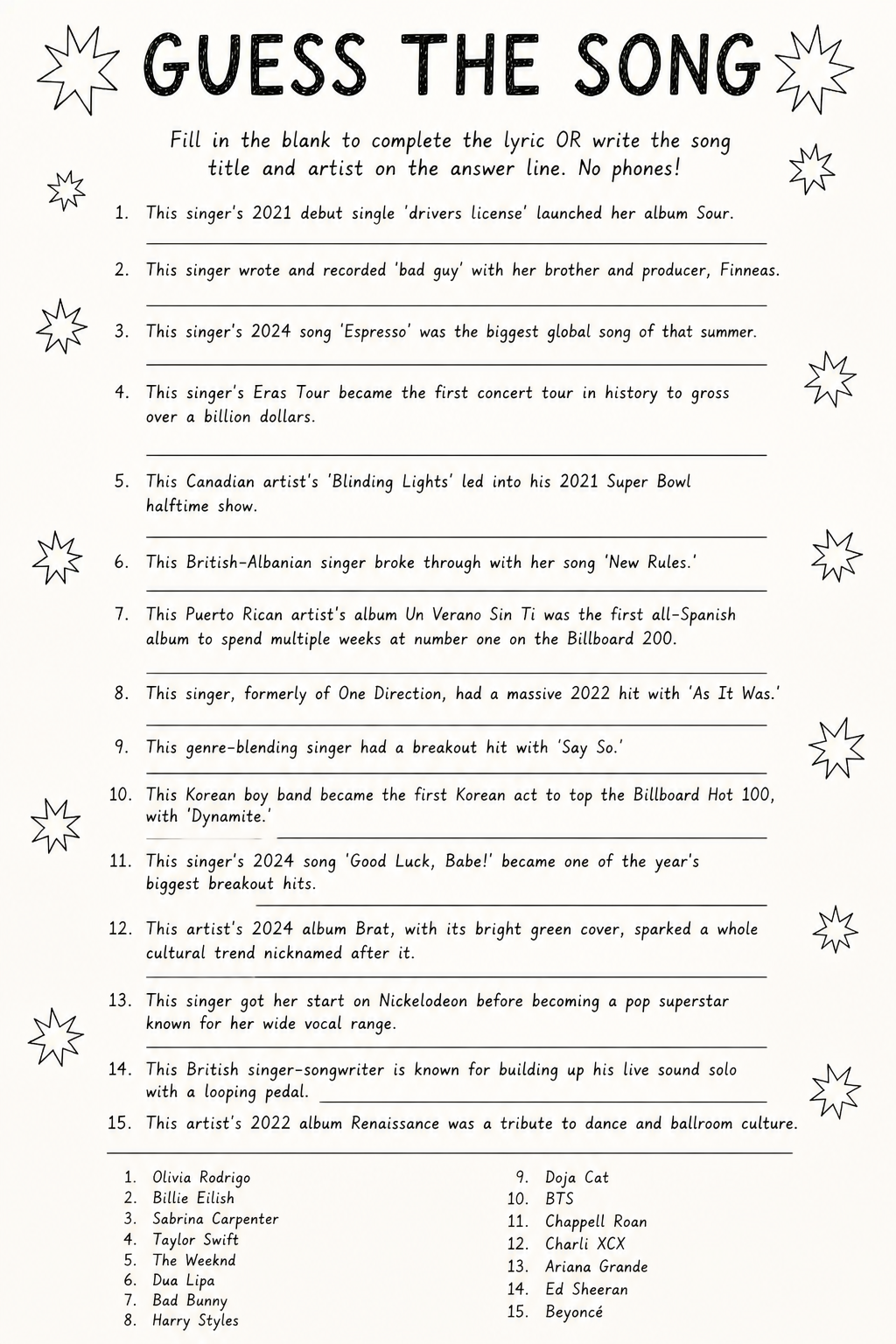
12. Guess the Lyric Sheet
This printable is a crowd-pleaser every single time, even for people who are convinced they don’t know any songs — because they do, they just don’t realize it until they’re staring at the first few words of the verse and the rest suddenly arrives in their brain uninvited.
The sheet shows 15–20 partial song lyrics (first line only, or a mid-verse snippet with a key word removed) and players fill in the blank with what comes next or write the song title and artist.
It hits pop, rap, R&B, viral hits, and holiday classics for a range that covers every type of music fan in the room.
Print one sheet per player and hand them face-down — flip on the host’s signal so everyone starts at the same time and nobody gets a head start. Give 6–8 minutes to complete the sheet.
For each lyric clue, there is a clear blank line labeled ‘Complete the lyric: ________’ or ‘Song title: ________’ so players know exactly what format the answer should take.
Then go through answers as a group, with the host reading the full lyric and artist — guaranteed someone will start singing the rest of the song, and that’s when the party really gets going.
The answer key is at the very bottom of the sheet in tiny, low-contrast type.
The holiday version of this sheet is especially fun because everyone has strong opinions about holiday music — some people know every word to every Christmas song ever recorded, and some people could not tell you who sings ‘Jingle Bell Rock’ even at gunpoint.
Including both classic holiday lyrics and recent ones keeps the playing field level and the energy competitive.
Host tip: add one trick question where the lyric sounds like a famous song but is actually a completely made-up line — the confident wrong answers are absolutely peak entertainment.
- 4–30 players
- Mixed music taste groups — questions cover multiple genres so everyone has a shot
13. Chubby Bunny
Look, I’ll be honest — Chubby Bunny is objectively ridiculous and that is exactly why teens love it. Players take turns putting a marshmallow in their mouth and saying ‘chubby bunny’ clearly (or as clearly as they can, which is the whole point).
Each round, everyone who’s still in adds another marshmallow and tries again. The person who can say ‘chubby bunny’ with the most marshmallows in their mouth — actually intelligibly — wins.
The faces, the muffled attempts, and the inevitable disaster moments make this one of the most filmed games at any holiday party. Best for groups of 4–12.
Set up a bowl of mini marshmallows in the center of the table and a trash bag nearby — you will need it. Start with one marshmallow per player, have everyone say ‘chubby bunny,’ and then add one more each round.
Players who can no longer say the phrase intelligibly (as judged by group vote) are eliminated. Keep the rounds short: add a marshmallow every 30–45 seconds so the game moves fast.
Important safety rule — always make sure players spit out the marshmallows and never swallow while the mouth is very full. Keep a glass of water nearby and never pressure anyone to continue if they’re uncomfortable.
Chubby Bunny is peak holiday party content — the video clips are hilarious, the competition is genuinely suspenseful, and the whole thing is over in about 10 minutes, which means you can run it multiple times if the group wants a rematch.
Pro tip: use regular mini marshmallows rather than the giant ones for a safer and more competitive game — giant marshmallows make it too easy to get a big number and too difficult to actually speak.
The sweet spot is somewhere between six and nine mini marshmallows where everything starts to go hilariously wrong.
- Bag of mini marshmallows
- A trash bag nearby
- Water for all players
- A phone propped up to film
🛒 What you’ll need
14. Most Likely To (Teens)
Most Likely To is the game that somehow feels both roasting and endearing at the same time — when it’s done with the right group and the right questions. One person reads a ‘most likely to…’
prompt, and on the count of three, everyone simultaneously points at whoever they think fits best. The person who gets the most fingers pointed at them ‘wins’ that round and has to give a dramatic 10-second monologue defending or accepting their title.
No scoring needed, no supplies needed beyond a list of prompts — just people and ruthless honesty served with good humor.
Prepare a list of 25–30 prompts before the party and keep them on your phone or printed on cards.
Teen-appropriate prompts that kill every time: ‘most likely to start a business before graduating,’ ‘most likely to accidentally go viral,’ ‘most likely to know every word to a song in a language they don’t speak,’ ‘most likely to be the reason a group chat gets muted.’
For holiday parties, throw in a few seasonal ones: ‘most likely to regift something,’ ‘most likely to fake sleeping through family obligations.’ Read through about 15–20 in one sitting for the best energy — reading too many starts to drag.
This is one of the best quiet party games for teenagers precisely because it creates genuine connection and reveals how people actually see each other — and most of the time those reveals are surprisingly sweet alongside the funny ones.
It’s the perfect wind-down game after a high-energy active round, or a great closer at the end of the night when the group has settled into cozy mode.
If you’re looking for more ideas to keep the holiday hangout going, check out some classic party game inspiration for extra prompts you can adapt to your crowd.
- Read a ‘most likely to…’ prompt aloud
- Everyone points simultaneously on count of 3
- Most-pointed-at person explains themselves in 10 seconds
- No scores — just vibes and chaos
15. Blindfold Taste Test
The Blindfold Taste Test is one of those games where the reactions are so genuinely funny that even the people waiting for their turn can’t stop laughing.
Players are blindfolded one at a time and fed small samples of mystery foods — the challenge is to correctly identify what they’re eating by taste and texture alone.
The twist for a holiday party is that all the foods are seasonal: think candy cane pieces, eggnog, peppermint bark, gingerbread crumbs, cranberry sauce, hot cocoa mix, a sliver of fruit cake (which produces perhaps the greatest reactions known to mankind), and a few unexpected wild cards.
Before the party, prep small sample cups or spoons with your mystery foods labeled only with numbers on the bottom — so you can track answers without the blindfolded player seeing anything.
Line up 8–10 foods on a tray covered with a cloth until it’s each player’s turn. Blindfold the player, then hand them one sample at a time. They have 20 seconds to taste, think, and guess.
Record their guesses on a score sheet and reveal results at the end. Award one point per correct guess and two points for getting a truly weird wild card right. The person with the most points wins bragging rights and possibly a prize.
The reason this game is so consistently great as a party game for teenagers is the combination of genuine suspense (what is that TEXTURE?!), the comedy of wildly wrong guesses, and the social entertainment of watching someone’s face contort trying to identify cranberry sauce versus fruit punch.
Film the reactions — with consent — because they will be absolutely priceless. Host tip: include one thing that is completely obvious (a Skittle, a chip) and one that is genuinely hard (cream cheese, a piece of brie) to keep confidence levels appropriately unpredictable.
- 8–10 mystery food samples in small cups
- A blindfold
- Score sheet and pen
- Holiday-themed foods for seasonal spin
🛒 What you’ll need
16. Two Truths and a Lie
Two Truths and a Lie is practically a rite of passage for any teen gathering — and for good reason. Every person shares three statements about themselves: two are completely true, one is a deliberate lie.
The group debates and votes on which one they think is the lie. The person who fools the most people wins, and the person who gets called out the fastest has to answer a bonus question chosen by the group.
It sounds simple, but the game consistently produces stunned silences, dramatic reveals, and the kind of ‘I can’t believe I didn’t know that about you’ moments that make parties memorable.
No materials required — this is a pure conversation game. Go around the circle one at a time, with each player taking a moment to think of their three statements before their turn (or assign thinking time at the start so everyone preps simultaneously).
After the statements are read, give the group 60 seconds to discuss and then vote by a show of hands or a count of three pointing.
The player reveals which was the lie, and then — crucially — briefly explains the truths, because the truths are often just as wild as the lies. Keep each turn to about 2–3 minutes so the game moves and everyone gets a round.
For a holiday party version, suggest that at least one of the three statements has to be holiday or winter related — ‘I once ate an entire gingerbread house by myself,’ ‘I have never watched a holiday movie,’ ‘I once cried at a gift I didn’t like.’
This gentle theme constraint produces more creative statements and keeps the game feeling seasonally relevant without being forced.
It’s a genuinely great closer to the night — after all the loud games, this one settles everyone into a comfortable, connected groove that doesn’t require any energy at all.
Suggest the holiday rule: at least one of the three statements must be holiday-related. The constraint forces creative answers every time.
17. Human Knot
The Human Knot is one of the only games on this list that will literally tie your friend group together — and I mean that quite literally.
Everyone stands in a circle, reaches across and grabs the hands of two different people (not the person directly beside them), and then the whole group has to untangle themselves into a circle again without letting go.
It sounds like it should take five minutes but somehow takes twenty, involves at least three people yelling directions at once, someone going fully under someone else’s armpit, and a lot of accidental nose-to-kneecap situations. Best for groups of 8–16.
Form a tight circle and have everyone extend their right hand and grab someone else’s right hand across the circle, then do the same with their left hand. The resulting ‘knot’ of arms and bodies is what the group must now collectively untangle.
The only rules: never let go of the hands you’re holding, communicate with your group, and work together to figure out who needs to step over, under, or through what.
There is no time limit unless you want to add competitive pressure — run two groups simultaneously and see who untangles first.
It’s also worth noting that the game doesn’t always end in a perfect circle: sometimes you get two loops, which is also a valid outcome.
This is a brilliant opener for groups where not everyone knows each other, because the physical coordination requirement forces instant communication and teamwork — you simply cannot be shy when someone’s arm is threaded through your legs and three people are waiting on your next move.
For a holiday party, theme the win condition: the group that untangles earns the first round of snacks or gets to pick the next game. It’s also just deeply funny to watch from the outside and an instant photo opportunity.
- 8–16 players in one group
- Early in the party as a physical icebreaker
- Pairs well with a loud upbeat playlist in the background
18. Danger Word
Danger Word is the kind of game that makes people increasingly paranoid with every single clue — in the best, most entertaining way possible. Inspired by Ellen DeGeneres’s Game of Games, it works like this: two competing teams each have a clue-giver and a guesser.
The clue-giver sees a card with a ‘winning word’ at the top and a ‘danger word’ below it. They give one-word clues to get their guesser to say the winning word, but if the guesser accidentally says the danger word instead, the other team scores.
The catch: both teams’ clue-givers see the same card and give alternating clues, which means you’re trying to lead your guesser to the right word while accidentally helping your opponents too.
Divide into teams of two (one guesser, one clue-giver per team), though larger teams can rotate through roles each round. The clue-giver draws a card, shows it to the other team’s clue-giver, and then alternating clue-giving begins.
Each clue is one word only — no gestures, no sounds, no partial words. The guesser calls out answers until they hit either the winning word (their team scores) or the danger word (other team scores or the round is lost).
Play to a set number of points — first to five wins, or whoever leads after 10 rounds takes the game.
Danger Word is absolute peak holiday party chaos because the danger words are often agonizingly close to the winning word — think ‘pool’ vs. ‘swim,’ or in a holiday version, ‘Santa’ vs. ‘gift,’ or ‘snow’ vs. ‘cold.’
The group watching can see the card (in some versions) and the collective tension when a guesser is dangerously close to saying the wrong word is genuinely cinematic.
You can make your own holiday-themed cards with index cards and a pen for a totally free version. Best for groups of 4–12 with teams of 2.
- Danger Word cards (homemade with index cards, or the board game)
- A score-keeping notepad
- 4–12 players in pairs
🛒 What you’ll need
19. Photo Scavenger Hunt
Photo Scavenger Hunt is regular scavenger hunt but instead of collecting physical objects, teams race to photograph a list of challenges and scenarios — which is a thousand times more social-media-friendly and about fifty times more chaotic.
Teams of 3–5 get a list of 15–20 photo challenges and a set amount of time (usually 20–30 minutes) to photograph as many as possible. The photos are then judged by the host or voted on by the whole group.
Best for large groups of 10+ who can be split into competitive teams.
Write the challenge list before the party and tailor it to your location and group.
Good prompts include: ‘recreate a famous movie scene with only people in this room,’ ‘take a photo that looks like a holiday card,’ ‘get a photo where everyone is mid-jump,’ ‘recreate a TikTok trend with at least three people,’ ‘find the most festive spot in the house and pose,’ ‘get a group photo where every person is doing a different thing,’ and ‘take a photo that tells a story in one image.’
Award points per completed challenge, plus bonus points for creativity or best staging.
This is genuinely one of the best party games for teenagers because it meets them exactly where they are — everyone already has a phone and already cares about how photos look.
The competitive photo-staging that happens is absolutely hilarious to watch, and the gallery review at the end (where all teams present their photos on the big screen or someone’s laptop) is its own mini event.
If you’re hosting a holiday party on a budget and want to keep things free, this budget party ideas post has great low-cost hosting tips you can adapt for the season.
- Teams of 3–5 each get the same challenge list
- 20–30 minute timer to photograph as many as possible
- Present photos to the group at the end for judging
- Most creative AND most completed both earn prizes
20. Dance-Off Battle
Dance-Off Battle is exactly what it sounds like and it never, ever fails to become the highlight of the night — especially when someone who claimed they ‘can’t dance at all’ suddenly unleashes an absolutely unhinged freestyle that brings the house down.
Players go head-to-head in 30-second dance battles while the rest of the group forms a circle and cheers.
A panel of three judges (or the entire crowd voting by noise level) decides the winner of each matchup, bracket-style, until one person is crowned the ultimate Dance-Off champion. Best for groups of 8 and up with a good speaker and some floor space.
Clear a small area in the center of the room — you don’t need a huge space, just enough for one person to move around. Create a bracket by writing names on a bracket sheet (like a sports tournament).
Match people up randomly, play a short clip of music (15–30 seconds is enough for a round), and let each dancer go head-to-head. Judges score on commitment, creativity, and crowd reaction — not skill. The ‘technical ability’ criterion is expressly NOT on the judging card.
The person who commits the hardest almost always wins, and that dynamic is what makes the game so great.
For the holiday party version, use the music strategically: play a few iconic holiday bop moments mixed in with current hype tracks so people have to adapt their energy on the fly.
Include one ‘surprise round’ where the song is a slow, dramatic ballad or an unexpected genre switch — watching someone who was doing a full hip-hop freestyle suddenly have to transition to ‘O Holy Night’ is genuinely the greatest entertainment you can provide.
Don’t forget to film this one — the clips age incredibly well and will be brought up at every party for years. Need gift inspo for your teens while you’re planning the party? This holiday wish list is full of ideas they’ll actually want.
Score on commitment and crowd reaction, NOT skill — this keeps it inclusive and produces way more entertaining battles.
🛒 What you’ll need
21. Hot Seat Questions
Hot Seat is simple, intense (in a fun way), and surprisingly revealing — one person sits in the ‘hot seat’ and the rest of the group has 60 seconds to fire questions at them that they must answer honestly and immediately.
No thinking time, no dodging — just rapid-fire honesty. The questions can be about anything the group wants to know: opinions, preferences, confessions, hypotheticals, or hilarious what-ifs. The person in the hot seat can pass on a maximum of two questions per round.
After 60 seconds, the next person rotates in. Best for groups of 5–12 where people know each other at least a little bit.
No materials needed beyond a timer on someone’s phone. Choose the first hot seat volunteer (usually easiest to ask for a willing victim rather than drafting someone), set a 60-second timer, and the group fires.
Questions should be fun, not cruel — good examples include ‘what’s the last thing you Googled,’ ‘who in this room would you call at 2am,’ ‘what’s something you’ve lied about that turned out fine,’ ‘what’s your most controversial food opinion,’ and for the holiday season: ‘what’s the worst gift you’ve ever received,’ ‘do you actually like fruitcake (honesty only),’ ‘what’s something you’ve pretended to like as a gift.’
The host can maintain a running list of good questions on their phone to toss in if the group runs dry.
Hot Seat is the perfect winding-down game for the end of the night when everyone’s settled in and comfortable with each other — the answers get more honest and more interesting as the party matures.
It also works as a follow-up to Two Truths and a Lie, since it builds on that same ‘let’s actually be honest with each other’ energy.
The rapid-fire format keeps energy up even when the game itself is low-key, and the ‘two pass’ rule means nobody ever feels genuinely trapped.
It’s one of those quiet party games for teenagers that actually makes people feel closer by the time the last person gets out of the hot seat.
- One person in the hot seat
- 60-second timer
- Group fires questions — must answer honestly
- Max 2 passes per turn, then rotate
22. Sardines Hide and Seek
Sardines is reverse hide-and-seek and it is genuinely one of the most underrated party games for teenagers — partly because it requires almost zero setup, partly because it gets increasingly suspenseful as the game goes on, and partly because the ending moment when you open a closet and find eight people silently crammed inside is one of the great physical comedy experiences of human history.
One person hides while everyone else closes their eyes and counts to 60. Then all the seekers spread out individually to find the hider.
When you find them — here’s the key — you quietly squeeze in and hide with them instead of announcing you found them. The spot gets more and more crowded until the last seeker finally figures out where everyone went.
Set clear boundaries before the game starts — decide which rooms are in play and which are off-limits. One volunteer hides while everyone counts together at a central spot. Seekers then spread out individually (no teaming up to search) and hunt quietly.
The stealth element is crucial: if you find the hiding spot and giggle loudly, you just blew everyone’s cover. The last seeker to find the group is ‘it’ for the next round, which is the appropriate punishment for being the worst detective in the room.
Games typically last 5–10 minutes per round, so you can run several rounds in a row without anyone getting bored.
Sardines works brilliantly at a holiday party because most hosting venues have interesting nooks, festively decorated spaces, and furniture arrangements that create genuinely creative hiding spots.
It also naturally includes everyone — there’s no elimination, no waiting around, and the game gets more fun the more people are playing. Works best in a medium-to-large house or multi-room space with 8–20 players.
The moment of cramming into a hiding spot with four other people, desperately trying not to laugh, is a party memory that genuinely lasts years.
- 8–20 players
- Medium to large indoor space
- Multiple rounds — gets better each time as people get more creative with hiding spots
Frequently Asked Questions
What are the best party games for teenagers at a holiday party?
The best party games for teenagers at a holiday party combine high energy with a social media-friendly element — think Lip Sync Battle, Photo Scavenger Hunt, TikTok Trend Charades, and Pass-the-Phone Confessions for active fun, plus printable sheets like the Emoji Movie Quiz and Teen Scattergories for built-in structure.
Mix active games with a couple of quiet bonding games like Most Likely To or Hot Seat Questions for a well-paced night.
How many games should I plan for a teen party?
Plan for 4–6 games per 2-hour party block. Not every game will run to full time, and teens often want to replay favorites.
Having 6–8 options ready gives you flexibility — you can skip something if energy is already high, or pull out a new game if a round ends early. Always have one ’emergency’ quiet game on backup in case the group needs a reset.
What party games work for large groups of teenagers?
Werewolf, Sardines Hide and Seek, Photo Scavenger Hunt, Dance-Off Battle, and Most Likely To all scale beautifully to large groups of 10–25+. For printable games, just print more sheets — Teen Scattergories, Guess the Lyric, and Emoji Movie Quiz all work for any group size without any modification.
Are these party games appropriate for all teens?
Yes — every game on this list is designed to be teen-appropriate, with no drinking, no adult-only content, and no activities that would exclude quieter or more introverted guests.
Games like Two Truths and a Lie, Hot Seat Questions, and Most Likely To include a ‘pass’ option so nobody feels pressured. Always read the room and adjust questions or challenges to suit your specific group.
How do I keep teens engaged and off their phones during party games?
The key is choosing games that move fast and feel relevant to teen culture — games with a social media angle (Photo Scavenger Hunt, Lip Sync Battle, Whisper Challenge) actually leverage phones as tools rather than distractions.
For games that need full attention, create a ‘phones down’ zone for the round with a fun consequence for breaking the rule, like having to do the next embarrassing challenge.
Starting with a loud, high-energy game gets everyone invested early, which carries momentum through quieter rounds later.
Can I play these party games for free without buying anything?
Most of these games are completely free! Pass-the-Phone Confessions, TikTok Trend Charades, Werewolf (made with index cards), Danger Word (DIY version), Human Knot, Most Likely To, Two Truths and a Lie, Hot Seat Questions, and Sardines Hide and Seek all require zero purchases.
The printable games just need a printer and plain paper. Only a few games — Whisper Challenge (headphones) and Lip Sync Battle (a good speaker) — work better with specific equipment.
📌 Save These for Later
Loved these? Pin your favorite image below so you can find this list again when you’re planning.

18 engagement party games that celebrate the couple and break the ice between both families. Fun, fr
19 clever road trip games for adults — verbal games, printable trivia packs & conversation cards t

24 football theme party ideas for watch parties, tailgates and championship nights. Décor, table st
Leave a Reply