


The first days of a new school year are buzzing with nerves, excitement, and a whole lot of “I don’t know anyone yet.” A well-planned back to school party can change all of that in under an hour.
Whether you’re a teacher setting up your classroom, a parent hosting a neighbourhood get-together, or a holiday programme leader filling a morning with energy, the right games warm a room up fast and turn a group of strangers into a crew.
We’ve put together exactly 20 back to school party games that actually work with primary-age children — no complicated rules, no expensive kits, and nothing that singles a child out and makes them want to disappear.
You’ll find printable sheets for the games that need them, active games to burn off first-day jitters, and creative challenges that get kids talking about themselves in ways they genuinely enjoy.
Dip in and pick a handful, or run the lot across a full party morning. Either way, the year is off to a brilliant start.
This post contains affiliate links — if you buy through them, I may earn a small commission at no extra cost to you.
Table of Contents
- Name Bingo Icebreaker
- Two Truths and a Lie Kids Edition
- Supply Scavenger Hunt
- Human Knot
- Classmate Match-Up
- Pencil Relay Race
- School Would You Rather?
- Memory Tray Game
- New Year Goals Cards
- Class Picture Round
- School Subjects Trivia
- Desk Neighbour Bingo
- My Favourite Things!
- Lunchbox This or That!
- Classroom Charades
- Paper Aeroplane Distance Challenge
- Back to School Pictionary
- Sock Sorting Relay
- Question Ball Toss
- Classroom Freeze Dance
1. Name Bingo Icebreaker
Print one bingo card per child before the party. Each card has a five-by-five grid filled with first names from the class list, arranged in a different random order on every sheet so no two cards are identical.
When the game begins, children walk around the room and find a classmate whose name appears in one of their squares. That classmate signs or stamps the square, and the child moves on to find a different person for the next square.
The goal is to fill a line — horizontal, vertical, or diagonal — and shout “Bingo!” to claim a small prize like a sticker or a new pencil.
You need the printed cards, one per child, plus a pen or pencil each. This works beautifully with groups of 15 to 35 children and takes around 15 to 20 minutes from first movement to final bingo call.
It is a gentle, low-pressure way for every child to learn names, because they have to approach classmates rather than waiting to be introduced. For a second round, challenge children to fill the whole card rather than just one line.
Host tip: Make the rule that each person can only sign your card once. Without it, two best friends simply sign each other’s cards repeatedly and the whole milling-around magic disappears.

🛍 Shopping guide
2. Two Truths and a Lie Kids Edition
Give every child a printed Two Truths and a Lie sheet and a few minutes to fill it in quietly.
Each sheet prompts them to write three statements about themselves — two that are true and one that is a fib — in child-friendly categories such as favourite food, a place they have visited, a pet they own, or a hobby they love.
Once everyone has written their three statements, children take turns reading them aloud while the rest of the group votes on which one is the lie by holding up a number card or simply calling out “one,” “two,” or “three.”
The printable sheet acts as a guide so younger children don’t freeze when it’s their turn; the category prompts spark ideas and keep statements on safe, fun topics. You need the printed sheets, pens, and nothing else — no equipment, no prep beyond printing.
Groups of 8 to 25 work well, and a full round takes 20 to 30 minutes depending on how much the group debates each answer. It’s one of the best conversation-starting back to school party games because children reveal genuinely surprising things about themselves.
Host tip: Play a practice round yourself first using clearly silly lies so the children understand the game instantly and feel confident enough to make their own fibs a little more creative.

3. Supply Scavenger Hunt
Hand out the printed Supply Scavenger Hunt Checklist and send children searching around the room — or the garden if space allows — for classic school supplies and back-to-school items that have been hidden in advance.
The checklist includes items like a red crayon, a ruler, a rubber, a pencil sharpener, a notebook, and a glue stick. Children tick each item off as they find it and bring their full collection back to a central table to be checked.
The first child or team to tick everything off wins.
You need the printed checklists, a set of hidden school supplies for each team (or one shared set if children are searching individually), and a timer. Set up the hunt before children arrive so the items are already scattered.
Groups of 10 to 30 work well; split larger groups into teams of three or four so no single child is overwhelmed hunting alone. The whole game runs in about 15 minutes.
Afterwards, gather all the supplies into a prize bundle for the winning team, or donate them to a classroom kit — nothing goes to waste.
Host tip: Tape items slightly out of obvious sight rather than hiding them completely. Primary-age children lose enthusiasm quickly if a hunt turns into a fruitless search, but they love the small thrill of spotting something just around the corner of a bookshelf.

🛍 Shopping guide
4. Human Knot
Ask children to stand in a circle of 8 to 12 people, reach across the circle, and grab the hands of two different people who are not standing directly next to them.
Once every pair of hands is connected, the group must untangle itself back into a clean circle without letting go.
Children step over arms, duck under linked hands, and spin to find their way through — the result is a brilliant tangle of laughter and teamwork that breaks the ice faster than almost any other game.
You need absolutely nothing except a clear floor space large enough for the group to stand in a circle. For larger parties, run two or three separate knots at the same time and see which group untangles first.
The game takes 10 to 15 minutes per round.
It works best with children aged 6 and above who are comfortable with light physical contact — always check this with the group before starting and allow any child who prefers not to join to act as a timekeeper or cheerleader instead.
Host tip: If the knot reaches a genuine deadlock where no move seems possible, allow the group one “free pass” — they can release one pair of hands, adjust, and reconnect. This keeps the energy positive rather than frustrating and usually gets things moving again within seconds.
5. Classmate Match-Up
The printed Classmate Match-Up sheet lists a series of fun facts and personal preferences in the left column — things like “has a dog,” “can do a cartwheel,” “loves pizza,” or “has been on an aeroplane” — and children circulate the room to find a classmate who matches each description, writing that person’s name in the blank beside it.
Unlike bingo, the aim here is to match as many facts as possible rather than complete a pattern, so children are motivated to keep chatting even after they’ve met most of the group.
You need one printed sheet per child and a pen each. This is a perfect game for groups of 12 to 35 and fills 15 to 20 minutes comfortably.
Because the prompts are about real life rather than school knowledge, quieter children often find it easier to open up — they’re the expert on their own facts, which levels the playing field completely.
At the end, gather the group and read out a few of the more surprising matches to spark more conversation.
Host tip: Add one or two prompts that almost nobody will match, like “has seen the Northern Lights,” so children experience the fun of hunting for a rare answer. That tiny challenge makes the sheet feel like an adventure rather than a worksheet.

6. Pencil Relay Race
Set up two parallel relay lanes with a start line and a finish line roughly 10 metres apart. Divide children into two equal teams.
Each child must carry a full-sized pencil balanced on the back of their hand from the start to the finish and back again, then pass it to the next teammate — without using their fingers to steady it.
If the pencil falls, the child must stop, pick it up, replace it on the back of their hand, and carry on. The team that finishes the relay first wins.
You need one standard pencil per team, a clear outdoor or indoor space, and a way to mark the start and finish lines (masking tape works perfectly). Teams of 4 to 8 children each work best, making it ideal for groups of 8 to 30.
Each race lasts about 5 to 10 minutes and you can run multiple heats to keep everyone involved. The pencil-on-hand rule adds a wonderful wobble of difficulty without making the game impossible for younger children.
Host tip: Run a short practice lap before the competitive round so children understand how the pencil behaves on the back of their hand. Without it, the first proper race is full of dropped pencils at the starting line and the momentum stalls before it builds.
🛍 Shopping guide
7. School Would You Rather?
The printed School Would You Rather? sheet is packed with back-to-school themed dilemmas that children answer by circling or ticking their choice. Questions cover things like “Would you rather have an extra break time or a shorter school day?”
and “Would you rather only eat school lunches forever or bring a packed lunch every single day?”
Children fill in their sheets individually first, then the host reads each question aloud and children raise their hands or stand on different sides of the room to show their answer, sparking lively discussion about why they chose what they chose.
You need the printed sheets and pens for the individual round, plus clear floor space if you want to do the stand-on-a-side version.
Groups of any size from 6 upwards enjoy this; the bigger the group, the more entertaining the split of opinions tends to be. Budget about 15 minutes for a full sheet, though the discussion often runs longer if children are particularly passionate about school lunches.
It’s a brilliant game for early in a party when children need a reason to talk but aren’t yet confident enough to speak freely.
Host tip: Seed one wildly unexpected question near the middle of the sheet — something like “Would you rather have a penguin as a teacher or a robot as a headteacher?” — to reset the energy right when attention starts to drift.

8. Memory Tray Game
Arrange 15 to 20 small school-related objects on a tray — think a rubber, a paper clip, a sticker, a crayon, a sticky note, a small ruler, a pencil cap, and so on.
Show the tray to the whole group for exactly 60 seconds, then cover it with a tea towel. Children then have two minutes to write down every item they can remember. The child who recalls the most correct items wins.
For a team version, small groups confer and write a shared list, which encourages discussion and adds a cooperative element.
You need a tray or large flat board, 15 to 20 small items, a tea towel or cloth to cover them, paper, and pencils for writing. This works with groups of 6 to 30 and takes about 10 to 12 minutes per round.
Run two or three rounds with different sets of items to extend the game and give every child a chance to do well — memory is quirky and a child who misses round one often dominates round two with a different set of objects.
Host tip: Change the number of items between rounds rather than the items themselves. Removing three or four things from the tray and asking children to write down what’s missing is a brilliant variation that sharpens observation skills and feels like a completely new challenge.
9. New Year Goals Cards
Hand out the printed My New School Year Goals sheet to each child and give them five to ten minutes to fill it in thoughtfully.
The sheet prompts them to write one goal for their learning, one goal for making friends, one thing they want to try that they’ve never done before, and one thing they’re most looking forward to this year.
Children decorate the borders with drawings or stickers, making the sheet genuinely theirs. At the end of the party, each child keeps their card to stick on their bedroom wall or tuck into their school bag as a reminder.
You need the printed sheets, pens or pencils, and ideally some coloured pencils or felt-tip markers for decorating. This works with any group size from 5 upwards and takes 10 to 15 minutes.
It’s a lovely quieter moment within a party — a calm creative activity that gives children a sense of ownership and excitement about the year ahead. Some hosts laminate the cards so they last longer; a simple home laminator does the job perfectly.
Host tip: Share your own completed goals card with the group before they start. When children see an adult taking the activity seriously, they lean in rather than rushing through it with one-word answers.

🛍 Shopping guide
10. Class Picture Round
The printed Class Picture Round sheet features a grid of school-themed photographs or illustrated images — things like a microscope, a globe, a musical instrument, a piece of sports equipment, and various classroom objects — and children write the name of each image in the box beside it.
It works exactly like a picture quiz round at a pub quiz, but every image is drawn from the world of school so it’s entirely age-appropriate and relevant to the party theme.
Children can work individually or in pairs, and the host reads out the answers at the end for a satisfying reveal.
You need one printed sheet per child or pair, plus a pen. Groups of 6 to 30 work beautifully, and the round takes about 10 to 12 minutes to complete plus a few minutes for marking.
It’s a great game to run while children are settling at tables, as it gives latecomers something to join mid-game without feeling lost.
Add up scores and give a small prize to the highest scorers — a bundle of coloured pens or a set of novelty erasers works perfectly.
Host tip: Include one image that is genuinely tricky — something like a protractor or a test tube rack — to create a moment of triumphant noise from whichever child actually gets it right. That one hard question makes the whole sheet more memorable.

🛍 Shopping guide
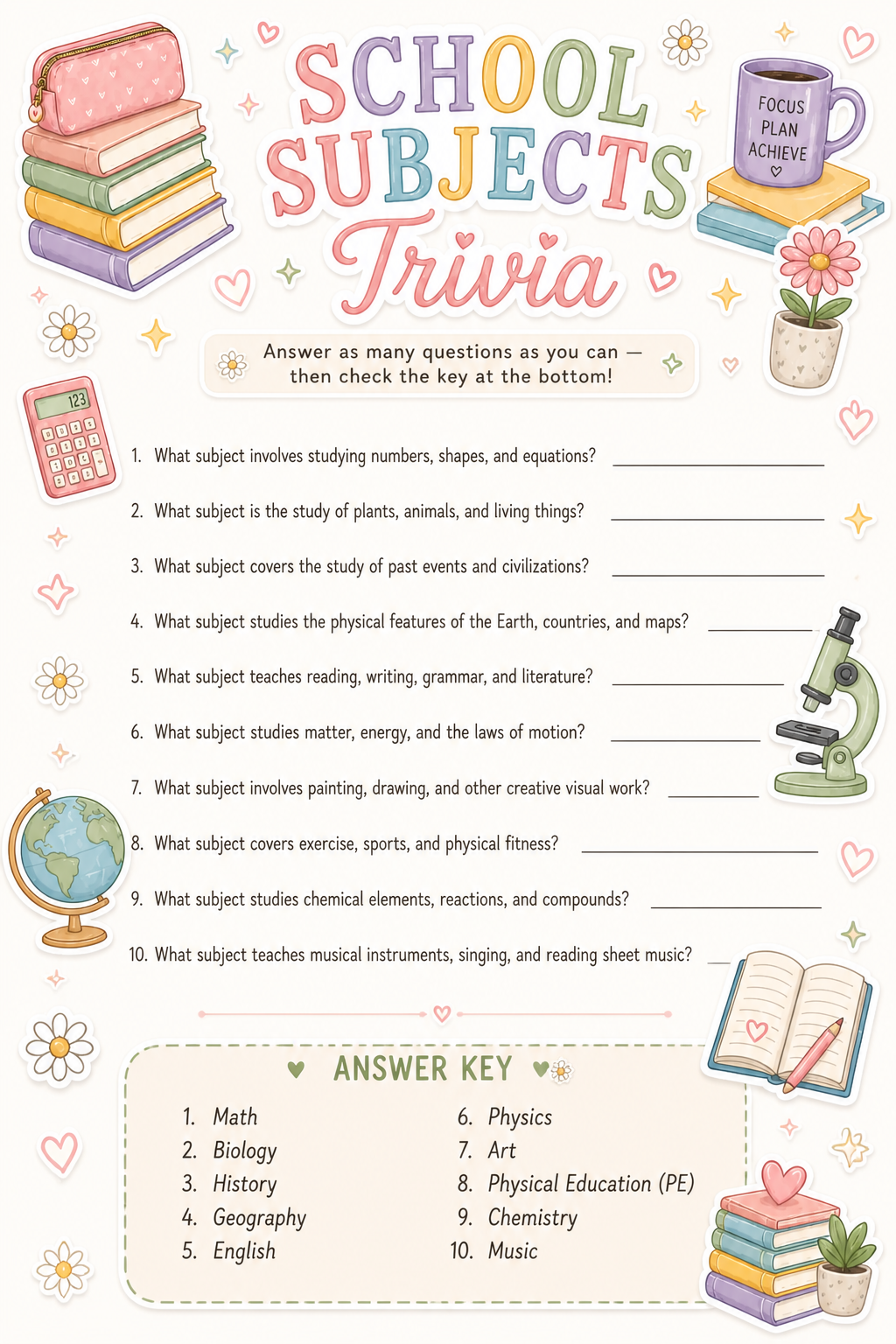
11. School Subjects Trivia
Give every child or team the printed School Subjects Trivia sheet, which features a series of questions drawn from primary-level subjects: a simple maths puzzle, a geography question, a basic science fact, a history snippet, and a few about art, music, and PE.
Children work through the sheet at their own pace and hand it in when finished. The host marks the sheets and announces scores, turning the activity into a light competitive quiz with a genuinely educational backbone — perfect for a back to school setting.
You need the printed trivia sheets and pens. Any group size from 6 to 35 works; for larger groups, have children work in teams of two or three so no child feels alone with a question they can’t answer.
The quiz takes about 12 to 15 minutes. Because the questions span multiple subjects, different children shine on different questions — the child who can’t remember a maths fact often knows the capital city nobody else gets, which makes the scoring feel fair and fun.
Host tip: After announcing the winner, do a quick verbal re-run of the trickiest two or three questions and ask children to explain the answers in their own words. It turns a quiz into a tiny celebratory lesson and the information sticks far better than just reading out a correct answer.
12. Desk Neighbour Bingo
The printed Desk Neighbour Bingo card works just like classic bingo, but the squares contain descriptions of people rather than numbers — things like “sits next to a window,” “has a green pencil case,” “brought a packed lunch today,” and “is wearing something with stripes.”
Children look around the room and mark off any square that describes someone they can actually see near them right now. When a child fills a line, they call out “Bingo!” and read back the descriptions to prove their answers are genuine.
You need one printed card per child and a pencil or bingo dabber to mark the squares. The game suits groups of 10 to 30 and typically runs for 10 to 15 minutes.
It’s ideal for the very start of a classroom party before children have moved around much, as the observational nature rewards those who are quietly paying attention to the people around them.
You can run a full-house round after the first line winner is found to keep everyone playing and give latecomers a proper chance.
Host tip: Prepare a second set of cards with slightly different squares for the full-house round. Reusing the same card means children already know which squares are filled, which kills the excitement. Fresh cards reset the game completely and make the second round feel brand new.

🛍 Shopping guide
13. My Favourite Things!
The printed My Favourite Things! sheet is a beautifully simple self-portrait activity disguised as a party game. Children fill in prompts covering their favourite colour, animal, food, book, subject, sport, after-school activity, and weekend tradition, then decorate the sheet with drawings of their answers.
Once everyone has finished, sheets are collected and shuffled, and the host reads out one sheet at a time while the group tries to guess whose it is.
The child who guesses the most correctly wins, but really everyone wins because the room ends up full of laughter and genuine surprise.
You need the printed sheets, pens, and coloured pencils for decorating. Any group size from 8 upwards works; the guessing element gets funnier the bigger the group. Allow 10 minutes for filling in and decorating, then another 10 to 15 minutes for the guessing round.
At the end, return each sheet to its owner — they make sweet keepsakes from the first day of a new school year, and many children take them home to share with their families.
Host tip: Collect the sheets yourself and read them aloud rather than passing them around. When you control the pace you can build suspense before the reveal — pause dramatically, throw in a mock wrong guess of your own, and the guessing becomes genuinely theatrical rather than just a quiet card-reading exercise.

14. Lunchbox This or That!
The printed Lunchbox This or That! sheet presents children with a series of head-to-head food comparisons — pizza vs. pasta, apple vs. banana, crackers vs. crisps, sandwiches vs. wraps — and children circle their preference in each pair.
Once sheets are completed, the host calls out each matchup and children raise their hand for their choice, revealing whose tastes clash delightfully and whose are surprisingly identical.
Children then find their “lunchbox twin” — the person whose answers match theirs most closely — and introduce themselves.
You need the printed sheets and pens. This game works brilliantly with groups of 10 to 30 and takes about 12 to 15 minutes in total.
Because the topic is food preferences rather than school knowledge, there are no right or wrong answers and no child feels put on the spot.
The lunchbox twin element at the end gives the game a natural social outcome that continues after the activity is officially over — twin pairs tend to seek each other out for the rest of the party.
Host tip: After the main twin-finding round, ask a few pairs to share one preference they completely disagree on. The “how can you possibly choose crackers over crisps?” debates are always the noisiest and warmest moments of the whole game.

15. Classroom Charades
Write the names of school subjects, classroom objects, and teacher actions on individual slips of paper and fold them into a bowl.
One child at a time draws a slip and acts out whatever is written on it — silently, using only body language — while the rest of the group calls out guesses.
Correct answers earn a point for the guesser, and the child acting earns a point for every correct guess made within the time limit. Keep rounds to 45 seconds each to maintain pace and make sure everyone gets a turn.
You need a bowl or hat, the pre-written slips of paper, and a timer. This works with groups of 8 to 30 and fits neatly into a 20-minute slot.
The school theme keeps every clue relevant to the party topic — children acting out “doing long division” or “playing the recorder” produce some of the funniest moments of the whole event.
It requires no printing and no equipment beyond the slips, making it a perfect filler game that can start at a moment’s notice.
Host tip: Include a few adult-in-school actions like “telling off a class for being too noisy” or “trying to get the projector to work.” Children absolutely love acting out teacher behaviour in an exaggerated way, and it consistently generates the biggest laughs of any charades round.
16. Paper Aeroplane Distance Challenge
Give every child one sheet of A4 paper and challenge them to fold their best paper aeroplane using any design they like. Allow five minutes of folding time, then line everyone up behind a throw line and take turns launching.
Mark where each aeroplane lands with a small sticky label bearing the child’s name.
The child whose aeroplane travels the furthest wins, but also award prizes for the most elegant design, the most creative fold, and the most spectacular crash landing — so multiple children walk away with recognition.
You need one sheet of plain A4 paper per child per round, sticky labels for marking landing spots, a tape measure or metre stick, and a clear indoor or outdoor throwing space of at least 6 metres.
Groups of 8 to 30 work well, and the whole challenge — folding plus three rounds of throws — fits into about 20 minutes.
Running three rounds rather than one means children can refine their design between throws, which adds a lovely problem-solving layer to what looks like a simple game.
Host tip: Demonstrate two or three basic aeroplane folds before the challenge begins so children who have never made one aren’t left staring blankly at a flat sheet while everyone else folds confidently. A quick two-minute tutorial raises the quality of all the planes and makes the competition far more exciting.
🛍 Shopping guide
17. Back to School Pictionary
Prepare a stack of cards each bearing a school-related word or phrase — examples include “school bus,” “assembly,” “science experiment,” “sports day,” “school dinner,” and “lost property.” Split the group into two teams.
One player from the drawing team picks a card and has 60 seconds to draw the word on a large whiteboard or piece of paper while their teammates call out guesses. No letters, numbers, or spoken clues allowed.
If the team guesses correctly within the time limit, they score a point; then the other team takes a turn.
You need the prepared word cards, a large whiteboard or flip-chart paper, and markers. A timer and a scoreboard on a chalkboard or sticky note complete the setup.
This suits groups of 8 to 30 split into teams of 4 to 15, and a full game of 10 rounds takes about 20 to 25 minutes.
Because every word belongs to the school world, children find the drawings immediately relatable and guessing comes faster — which means more rounds, more turns, and more fun per minute than a generic version of the game.
Host tip: Rank your word cards from easiest to hardest and deal them in that order. Starting with “pencil” builds confidence; saving “parents’ evening” for the final round means the game crescendos rather than fizzles, and the last point always feels hard-won and exciting.
🛍 Shopping guide
18. Sock Sorting Relay
Fill two large laundry baskets with identical mixed-up piles of colourful socks — aim for at least 30 pairs between each basket, all jumbled together. Divide children into two teams and place a long table or clear floor space between the teams and their baskets.
On “go,” one child from each team runs to the basket, finds a matching pair of socks, brings them back, and tags the next teammate. The team that correctly sorts and pairs the most socks in three minutes wins.
Any incorrectly paired socks don’t count toward the total.
You need two large baskets, at least 60 socks in varied colours and patterns (charity shops are an excellent source), and a timer.
This game works with groups of 8 to 30 split into equal teams, and the three-minute relay format keeps the energy extremely high throughout.
The back-to-school theme ties in naturally — getting organised, matching things up, and beating the clock are all first-week-of-school feelings children understand immediately.
Host tip: Buy socks with clearly different and distinctive patterns rather than plain colours. Plain colours are easy to sort at a glance, which makes the relay feel too simple; bold stripes versus polka dots versus stars creates the joyful chaos that makes children laugh and root each other on.
🛍 Shopping guide
19. Question Ball Toss
Use a permanent marker to write 20 to 25 back-to-school questions directly onto the panels of a large inflatable beach ball. Questions are light and fun: “What subject are you most excited about this year?” “What did you do in the summer holidays?”
“If you could swap lunches with anyone here, who would it be?” When a child catches the ball, they look at whichever question their right thumb is touching and answer it aloud before tossing to someone else.
No scores, no competition — just conversation wrapped in a game.
You need one large inflatable beach ball and a permanent marker. That’s it. The game suits any group from 8 to 35 and can run for as long as the energy lasts — typically 15 to 20 minutes before children want to move on.
Because every answer is different and personal, the group builds a genuine picture of each other through play without anyone feeling lectured or interviewed. It’s also extremely easy to pause and restart around other activities.
Host tip: Write questions in waterproof marker at least a day before the party and let the ball inflate overnight. Marker written on an inflated-then-deflated ball tends to crack and smudge; writing on a fully inflated ball gives you clean, readable text that lasts the whole party and can be used again next year.
🛍 Shopping guide
20. Classroom Freeze Dance
Play an upbeat playlist of child-friendly songs and encourage children to dance freely around the space.
Every time the music stops, children must freeze immediately in whatever position they are in — if you want to tie it tightly to the school theme, call out a “school pose” they must freeze in, such as “freeze like you’re reading a giant book,” “freeze like you’re solving a maths problem on the board,” or “freeze like you’re running in sports day.”
Any child who moves after the music stops sits out for one round, then rejoins for the next song.
You need a music player, an upbeat playlist, and enough clear floor space for the whole group to move safely.
This works with any group from 6 to 40 and runs for as long as you like — five songs takes about 10 to 12 minutes and is usually enough to get wiggles out without exhausting anyone.
It’s the ideal high-energy game to drop into the middle of a party when attention is flagging, or to use as a warm-up before sitting down for a quieter printable activity.
Host tip: Call out the freeze pose a split second before you stop the music rather than after, so children have a target shape to aim for. It transforms a simple freeze into a creative challenge and produces a room full of genuinely hilarious statues that everyone wants to photograph.
Frequently Asked Questions
How many back to school party games should I plan for a two-hour party?
For a two-hour party with primary-age children, plan six to eight games and activities.
Choose a mix of high-energy physical games like the Pencil Relay Race or Freeze Dance, quieter printable games like Name Bingo or My Favourite Things, and one or two longer creative activities like the Goals Cards.
Having eight games gives you buffer time — if one runs long because the children are loving it, you can quietly drop one of your spares. Always have one extra game ready that requires no preparation in case you finish early.
What if some children don’t know each other at all?
Start with the icebreaker games first — Name Bingo, Classmate Match-Up, and Question Ball Toss are all designed specifically for children who are meeting for the first time.
These games give every child a structured reason to approach and speak to someone new without the awkwardness of open-ended introductions.
Within 20 minutes of the first icebreaker, most groups find their natural rhythm and the more competitive games become much more fun because the children have already started to bond.
Do I need to print all the printable sheets before the party?
Yes, print everything before the day of the party. Printing on the day always takes longer than expected, and running out of ink or paper at the last minute is genuinely stressful.
Print one sheet per child for individual games, and print one per pair for games where children work together.
Use standard white cardstock rather than regular printer paper if you can — it feels more substantial in small hands, holds pen ink without bleeding, and the children are more likely to take it home and keep it as a memento of the day.
Are these games suitable for a full school classroom as well as a home party?
Absolutely. Every game in this list was chosen with both settings in mind.
The printable games work perfectly at desks or tables, while the active games like Human Knot, Pencil Relay, and Sock Sorting Relay need only a cleared space roughly the size of a classroom floor.
For a classroom setting, push desks to the walls for the active games and return them to position for the quieter activities.
The group sizes given for each game align with typical class sizes of 20 to 35 children, so you won’t need to adapt the rules.
What prizes work well for primary-age children at a back to school party?
The best prizes are small, practical, and school-related so they tie directly into the theme. Novelty erasers, fun pencil sets, sticker sheets, mini notebooks, bookmarks, and small packs of coloured pencils are all universally popular and cost very little per child.
Avoid prizes that create a big gap in excitement between winners and non-winners — if possible, give every child a small participation prize like a sticker at the end of the party so everyone leaves feeling celebrated.
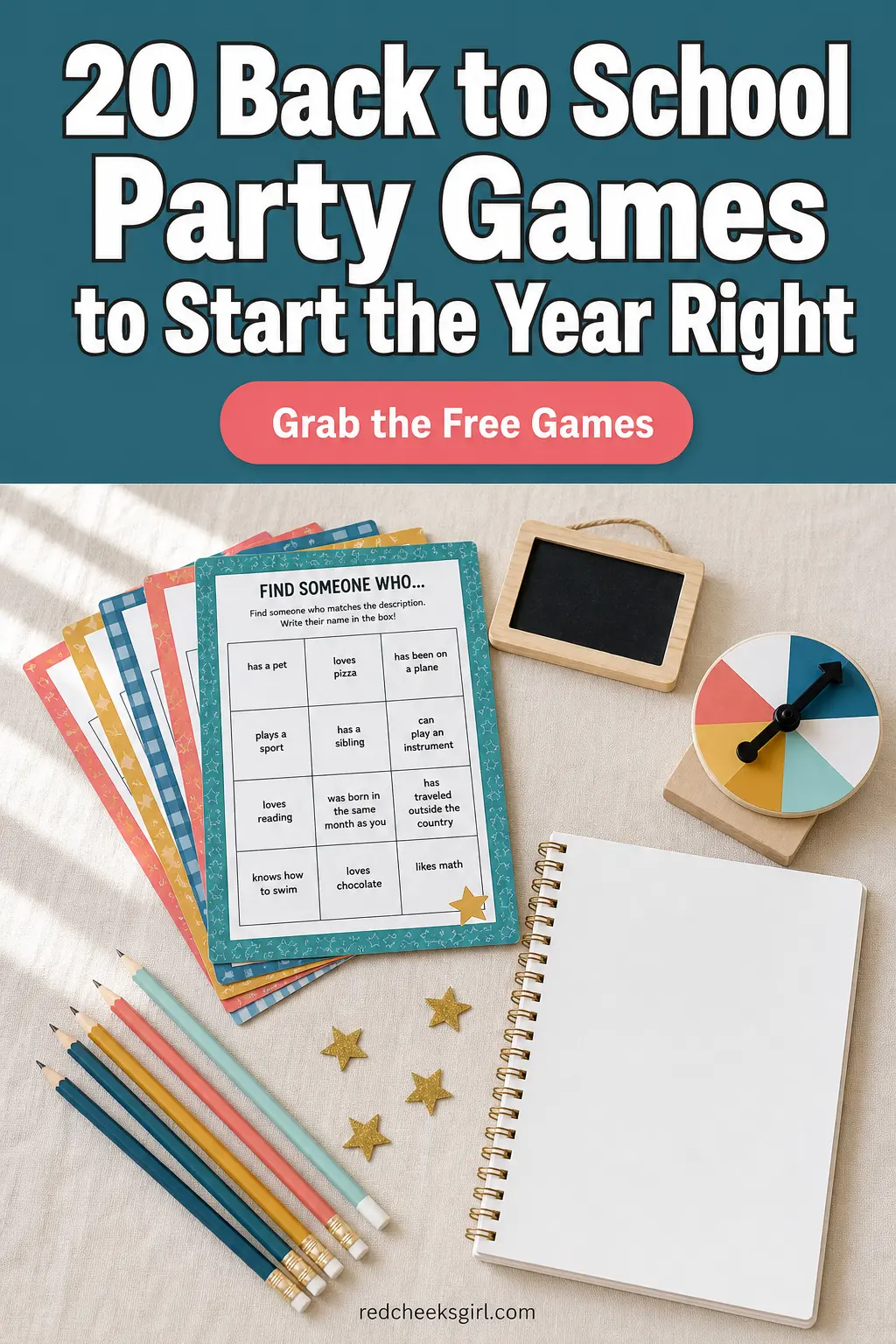
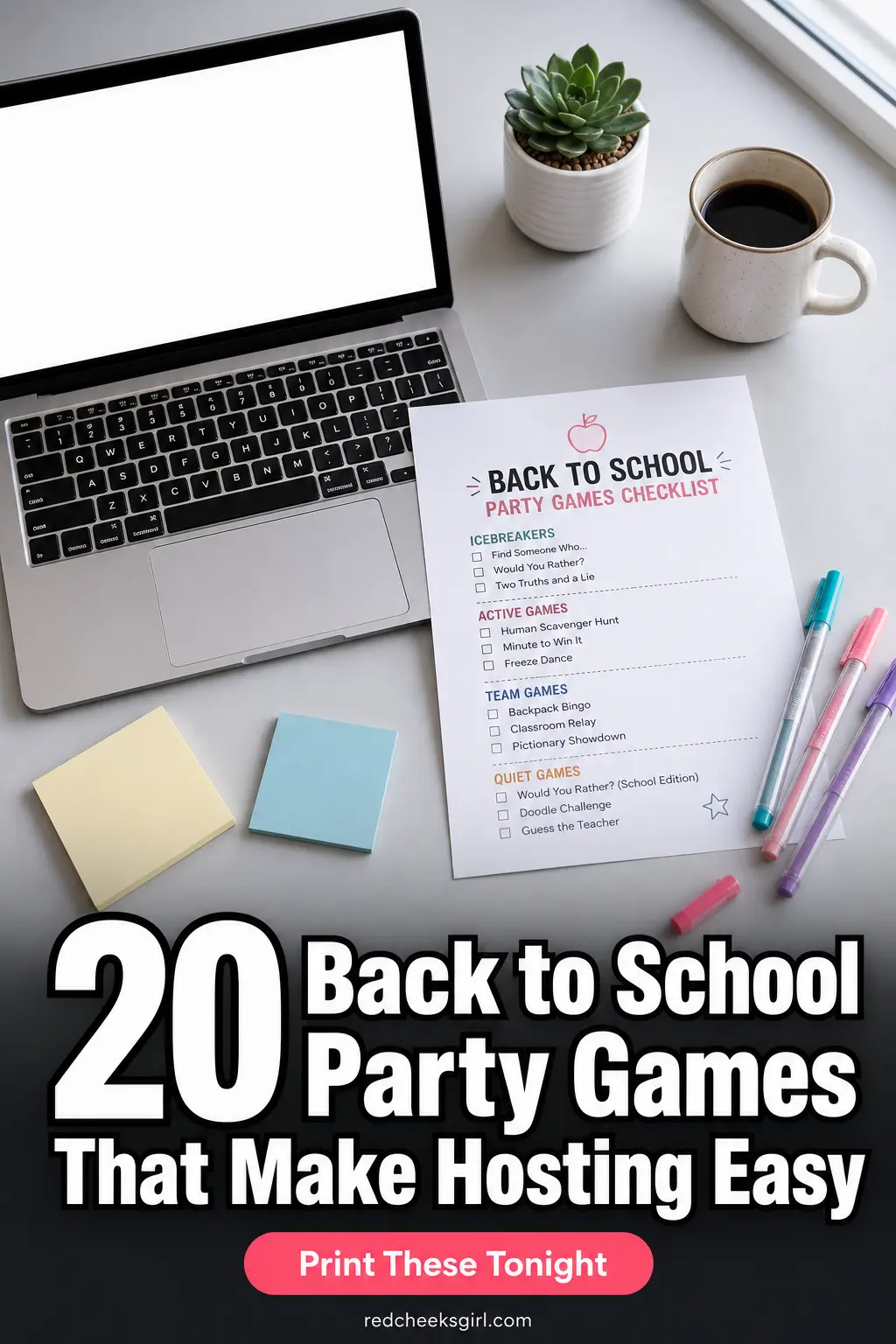
📌 Save These for Later
Loved these? Pin your favorite image below so you can find this list again when you’re planning.

17 dinner party games for adults you can play right at the table — no running, no mess, just laugh
31 rainbow balloon arch ideas from dusty adult palettes to bright kids' doorways, each one a finishe
Keep every guest laughing and moving with these 20 backyard BBQ games perfect for all ages, from law
Leave a Reply