


If there is one thing that will save a long drive faster than a gas-station snack run, it’s a fat folder of printable road trip games sitting in the backseat ready to go.
I’m talking bingo, scavenger hunts, mad libs, trivia, riddles, coloring pages — the whole screen-free shebang — printed and sorted before you even load the trunk. No Wi-Fi required, no dead batteries, no ‘the app crashed’ meltdowns at mile 47.
Just paper, pencils, and a genuinely good time rolling down the highway.
So I pulled together 20 of the best printable road trip games into one big downloadable pack you can grab, print, and stuff into a folder tonight.
There’s something in here for every age — little ones who love coloring, tweens who need a challenge, adults who swear they’re too cool to play bingo (they’re not).
Grab a clipboard, a few colored pencils, and maybe pack a snack while you’re at it — because once you hand these out, the ‘are we there yet?’ questions basically disappear. Consider this your pre-departure checklist sorted.
This post contains affiliate links — if you buy through them, I may earn a small commission at no extra cost to you.
- How to Use the Printable Pack
- Laminate for Reuse Tip
- Road Trip Bingo
- License Plate Game Sheet
- Road Trip Scavenger Hunt
- I-Spy Travel Sheet
- Would You Rather Travel Cards
- This or That Road Trip Sheet
- Travel Tic-Tac-Toe Sheet
- Road Trip Journal Page
- Travel Trivia Sheet
- Spot the Landmark Sheet
- Road Trip Riddles Sheet
- Alphabet Hunt Sheet
- Travel Mad Libs Sheet
- Color the Route Sheet
- Road Trip Picture Bingo
- Guess How Many Miles Sheet
- Trip Bucket List Sheet
- Favorite Stop Prompt Card
- Frequently Asked Questions
1. How to Use the Printable Pack
Think of this as your road trip game command center.
Before you leave home, print the entire pack — all 16 printable sheets — and sort them into a simple manila folder or a thin plastic expanding file (the kind you can grab at any dollar store).
Label the folder with a fun name like ‘Road Trip HQ’ or just hand it over to your most organized passenger and let them run the show.
The idea is that every game is already printed, cut if needed, and within arm’s reach so there’s zero scrambling once you’re actually on the road.
Set the vibe by giving each person in the car their own mini clipboard or a hardcover book to use as a lap desk — it makes writing 10 times easier and cuts down on the ‘I can’t dooooo it’ complaints dramatically.
Tuck a small zipper pouch into the folder with pencils, a couple of colored pencils or crayons, and a fine-tip marker or two.
If you want to get properly organized (no judgment, I respect it), paper-clip the sheets together by type: spotting games up front, trivia and riddles in the middle, journaling and keepsakes at the back.
One more pro tip before you go: don’t hand out every sheet at once.
Dole them out in waves — one game when you first hit the highway, another after the first fuel stop, the creative ones after lunch when everyone’s a little sleepy and needs a gentle nudge back to life.
Pacing the games keeps the excitement going for hours instead of burning through everything in the first forty-five minutes. Trust me on this one. Your sanity will thank you somewhere around hour three.
- Manila folder or expanding file for the pack
- Clipboard or hardback book per person
- Zipper pencil pouch with pencils, crayons, fine-tip markers
- Eraser and a small pencil sharpener
🛍 Shopping guide
2. Laminate for Reuse Tip
Here’s the move that separates a one-trip printable pack from a forever road trip kit: laminate the reusable game sheets before you leave.
Any sheet that works as a back-and-forth game — Tic-Tac-Toe, Would You Rather cards, This or That, I-Spy — is a prime candidate.
You print it once, laminate it at your local office supply store (usually under a dollar per sheet), and that same page can be played dozens of times across dozens of trips.
Future you, loading the car next summer, is going to be very, very grateful.
If you don’t have time for the laminator, the next best thing is slipping each sheet into a heavyweight clear sheet protector. If you’re already into paper crafting and memory-keeping, you probably have a stash of these already — they work perfectly.
Players use a dry-erase marker to fill in their answers, and a quick wipe with a dry cloth resets the sheet completely.
Stack the protected sheets into a small binder with a front pocket for the dry-erase markers and you’ve basically built a luxury road trip activity kit for about $8 total.
For the one-time-use sheets — the journal pages, the bucket list, the scavenger hunt tally — skip the laminator and just print a couple of extras so you’re not stressed if someone ‘accidentally’ scribbles over the wrong section. (Looking at you, youngest sibling.)
The goal is to make the system foolproof so the games run themselves and you can focus on the more important business of debating which gas station has the best snacks.
Laminate or use sheet protectors for any game played in rounds. Dry-erase markers wipe clean instantly and make every sheet reusable for the whole trip — and every trip after this one.
🛍 Shopping guide
3. Road Trip Bingo
Road Trip Bingo is the classic car game for a reason — it works on everyone from toddlers who can’t yet read to grandparents riding shotgun who claim they ‘don’t need games.’
Each player gets a bingo card filled with things you might actually spot out the window: a water tower, a rest-stop sign, a red barn, a tractor, a motorcycle, a police car, a billboard for a local diner.
As you drive, players mark off each square when they spy it for real. First to fill a row across, down, or diagonally shouts ‘BINGO!’ and claims the bragging rights (or a snack prize, your call).
The printable sheet includes four uniquely arranged 5×5 bingo cards on a single US Letter page so you can cut them apart and hand one to each passenger.
Each card shares the same 25 roadside images but in a different grid order, so everyone’s playing a slightly different game — no two people can win on the exact same sighting.
Pack a handful of small objects (pennies, dried beans, candy pieces) to use as markers if you want the tactile satisfaction of actually covering squares, or just let players cross them off with a pencil.
A fun variation for longer drives: go for a full blackout (all 25 squares covered) instead of just a single line, which keeps the game running for way more miles.
You can also play cooperatively — everyone marks off the same master card together and races against a timer to see how many squares you can fill before the next rest stop.
Either way, it keeps eyes glued to the landscape instead of a screen, which is honestly the whole win here.
- All ages — even pre-readers can play with picture-based squares
- Trips through varied landscapes with lots to spot
- Cooperative play with younger kids who get frustrated losing

4. License Plate Game Sheet
The License Plate Game might be the oldest road trip game in existence, and there’s a very good reason it’s survived every generation: it turns an otherwise boring highway into a geography lesson you actually want to play.
The concept is beautifully simple — every time someone spots a license plate from a different state, they call it out and check it off on their sheet.
The goal is to find as many of the 50 US states as possible before you reach your destination. Hawaii and Alaska are the white whales of this game, and spotting either one earns instant hero status in the car.
The printable sheet lays out all 50 states in a clean checklist grid, organized alphabetically so it’s easy to scan.
Each state has a small checkbox next to it and a tiny blank for the player to note where they spotted it (a parking lot at a rest stop counts, tbh — you do you).
If you’re playing competitively, give each passenger their own copy and the person with the most checked states at the end of the trip wins.
If you’re playing cooperatively — which is honestly way more fun with younger kids who get upset losing — use one shared sheet and work as a team.
For a cheeky variation, add a bonus column where players can write one word describing the state when they spot it — ‘sunny,’ ‘never been,’ ‘grandma lives there’ — which sparks surprisingly great conversation for about 20 miles.
You can also award bonus points for specialty plates (university plates, national park editions, veterans plates) to give eagle-eyed older passengers a reason to stay invested long after the novelty wears off. This one never gets old, which is saying something.
Keeps eyes on the road (literally) the whole trip — spotting plates means watching traffic, not a screen. It also sneaks in a little US geography at zero extra effort.

5. Road Trip Scavenger Hunt
A road trip scavenger hunt turns the passing landscape into a full-on mission.
Instead of spotting things at random, players work through a structured checklist of 25 items to find out the window — things like a yellow car, a cow in a field, a train, a bridge, a fast-food golden arch, a wind turbine, a person on a bicycle, or a car with a roof rack.
Each time someone spots an item, they check it off. The twist: every item can only be checked off once per trip, so you’re constantly scanning and paying attention to the world outside the glass.
The printable sheet is laid out as a two-column checklist with simple line-art icons next to each item so younger kids who aren’t reading yet can still participate by matching pictures.
There’s a tally box at the bottom where players record their final score — how many out of 25 they found before arrival. Print one sheet per passenger for a competitive version, or one shared sheet for the whole car.
A pencil works perfectly, but if you’ve laminated the sheet you can use a dry-erase marker and reset it for multiple trips.
To kick the energy up a notch, turn it into a point-scoring system: common items (a red car, a gas station) = 1 point, rarer items (a hot air balloon, a horse in a trailer, a double-decker bus) = 3 points.
Whoever has the highest score when you pull into the driveway wins. You can also play a team-versus-team version where the front seat competes against the back seat, which generates the kind of rowdy, good-natured rivalry that makes the miles genuinely fly by.
For very young players, circle the 10 easiest items on their sheet before handing it over so they have a clear starter mission — then let them tackle the harder ones as bonus challenges.

6. I-Spy Travel Sheet
I Spy gets a serious upgrade with a dedicated travel sheet that structures the classic game into a satisfying picture-hunt format.
Rather than free-form ‘I spy with my little eye,’ this printable gives players a grid of 20 illustrated items to find out the car window — each one drawn as a simple black-line picture on the sheet.
When you spot it in real life, you color it in or put a checkmark inside the picture box.
It’s basically a coloring page and a spotting game married together, which is a combination that is unreasonably entertaining for all ages (don’t knock it until you’ve watched a very serious adult triumphantly shade in a tiny mailbox illustration).
The printable sheet fits neatly on one US Letter page and features a 4×5 grid of illustrated travel items: a mailbox, a red stop sign, a bird on a wire, a dog in a car window, a police car, a picnic table, a river, a billboard, a tractor, a motorcycle, a rainbow (yes, they happen!), a pedestrian crossing sign, a farm silo, a gas pump, a trailer, a flagpole, a horse, a rest area sign, a blue car, and a tunnel or underpass.
Each cell has the item name printed in tiny text below the illustration so readers of all levels can play.
The beauty of this format is that it works for the youngest passengers in the car — no reading required, just picture-matching — while still keeping older kids engaged because some items on the list are legitimately tricky to find.
It also works brilliantly as a quiet, individual activity when the car energy dips and everyone just needs a low-key thing to focus on. Hand it over with a box of colored pencils and buy yourself at least 30 minutes of peaceful, harmonious highway driving.
- Ages 3 and up
- Quieter stretches of the drive when kids need a calm solo activity
- Doubling as a coloring activity for younger passengers

7. Would You Rather Travel Cards
Would You Rather is the game that turns a quiet car into a surprisingly philosophical debate club, and I mean that in the best way.
The Travel Cards version gives you 16 pre-printed travel-themed dilemmas cut into individual cards that you pass around the car, read aloud, and argue about for miles. Questions lean into the road trip experience — ‘Would you rather drive through a sandstorm or a snowstorm?’
or ‘Would you rather stop at every roadside attraction or drive straight through?’ They’re designed to be funny, slightly tricky, and genuinely revealing in a ‘huh, I didn’t know that about you’ kind of way.
The printable sheet fits 16 cards in a 4×4 grid on one US Letter page. Print, cut apart, and shuffle the deck before you leave. Deal three cards to each passenger face-down, then take turns flipping and reading.
Everyone in the car has to pick a side and briefly explain why — because ‘I don’t know’ is not an acceptable answer in this vehicle. The driver can play too as long as a passenger reads the card aloud.
Laminate the cards before the trip and they last for years of road trips to come.
This one works especially well with mixed-age groups because the questions don’t require any specific knowledge — just an opinion, which literally every person in a car has in abundance.
It’s also a sneaky way to get teenagers to actually talk, which, if you’ve ever driven with a silent teen in the backseat, you know is worth its weight in gold.
Plus, the debates these cards start tend to snowball into completely unrelated but wonderful conversations that nobody expected, which is tbh the best kind of road trip entertainment.
No right or wrong answers means zero frustration — everyone wins at having opinions. It’s the rare game where the quietest person in the car suddenly has the most interesting take.

8. This or That Road Trip Sheet
This or That is Would You Rather’s faster, snappier cousin — and it’s absolutely the right energy for when the car needs a burst of activity but nobody has the bandwidth for a long debate.
The Road Trip Sheet presents 20 pairs of travel-themed choices in a clean two-column layout: ‘Window seat OR middle seat?’ ‘Music OR podcast?’ ‘Mountains OR beach?’ ‘Fast food OR sit-down restaurant?’
Players circle their answer or check a box, then everyone compares to see who they agree with and who is apparently living an entirely different vacation philosophy. The results are always funnier than you expect.
The printable sheet works best as a pass-around activity — hand it to one passenger, let them answer all 20 pairs with a pencil, then pass it to the next person.
Once everyone’s had a turn, do a quick tally at the end: which choices were unanimous across the whole car? Which ones caused a tiny civil war?
The sheet has a built-in tally row at the bottom where you can record the car’s majority vote for each pair, so it doubles as a fun snapshot of your group’s collective road-trip personality.
You can also play it as a live verbal game — the driver reads a pair aloud, everyone holds up one finger for option A or two fingers for option B simultaneously, and you see who aligns.
No sheet required for that version, but having the printed sheet keeps track of the results in a satisfying, tangible way that a simple finger vote can’t replicate.
Either way, this is one of those games that generates real conversation about real preferences, which is low-key one of the best things about a long road trip — you learn new things about your travel companions every single time.
- Circle your answer for each pair
- Pass the sheet around so everyone fills in their own column
- Tally the car’s majority vote in the bottom row
- Debate any pair where the car is split 50/50

9. Travel Tic-Tac-Toe Sheet
Tic-Tac-Toe is arguably the world’s most portable two-player game, and a dedicated printable sheet turns it from a napkin scribble into a proper travel activity with enough rounds to last a hundred miles.
The Travel Tic-Tac-Toe sheet gives you 12 pre-drawn 3×3 grids on one page, so two players can knock out game after game without needing to redraw the grid each time.
Each grid is numbered, there’s a small scoreboard at the bottom, and the whole thing has a cheerful road-trip theme so it actually looks like something you brought on purpose rather than something you drew on the back of a receipt.
Print one sheet per pair of players, or laminate a single sheet and use dry-erase markers to play an unlimited number of rounds and wipe clean between them.
The sheet works with X and O as usual, but there’s also a fun variation prompt printed on the sheet: instead of X and O, each player picks a small doodle — a tiny car vs.
a tiny star, for example — and uses that as their symbol instead. It sounds small but it somehow makes the game feel 10 times more personal and silly, which is exactly the right energy for hour four of a road trip.
For a slightly more complex version that works well with older kids, suggest ‘Ultimate Tic-Tac-Toe’ — where winning one small grid earns you that square in a larger meta-grid, and you need to win the meta-grid to win the whole game.
It sounds complicated but takes about 30 seconds to explain and keeps two competitive passengers completely occupied for a very satisfying stretch of highway.
Pair this one with a laminator run before the trip and it becomes a permanent fixture in your road trip kit for years.
Laminate this sheet and use dry-erase markers for unlimited rounds — no reprinting needed for future trips.

10. Road Trip Journal Page
A road trip journal page is the kind of printable that seems small in the moment and becomes absolutely priceless years later.
Each page gives a passenger a structured but open-ended way to document one day of the trip: where you started, where you ended up, one thing you saw, one thing you ate, one unexpected moment, and a small box to draw a quick sketch of anything from the day.
It’s not a diary and it’s not homework — it’s closer to a fun, fast memory snapshot that takes about 10 minutes to fill in and captures the kind of specific detail that fades from memory fast.
The printable works for every age — younger kids can draw in the sketch box and have a parent help fill in the words; older kids and adults can write as much or as little as they want.
The prompts are short and specific enough that nobody stares at a blank page wondering what to write: ‘Today we drove from _______ to _______,’ ‘The most random thing I saw was _______,’ ‘I ate _______ and it was _______,’ ‘One word for today: _______.’
Print one page per person per day of travel and clip them together at the end for an instant trip diary that everyone contributed to.
This is one of those quiet activities that pairs beautifully with a long stretch of open highway when the games have wound down and the car is settled into a comfortable cruise.
If you’re already into journaling and memory-keeping, you could even hole-punch these pages and add them to a small binder with photos developed from a disposable camera after the trip — instant keepsake that cost basically nothing. Corny? Maybe. Worth it? One hundred percent.
Print one journal page per person per travel day. Clip everyone’s pages together at the end of the trip for a group travel diary you’ll actually want to read again in five years.

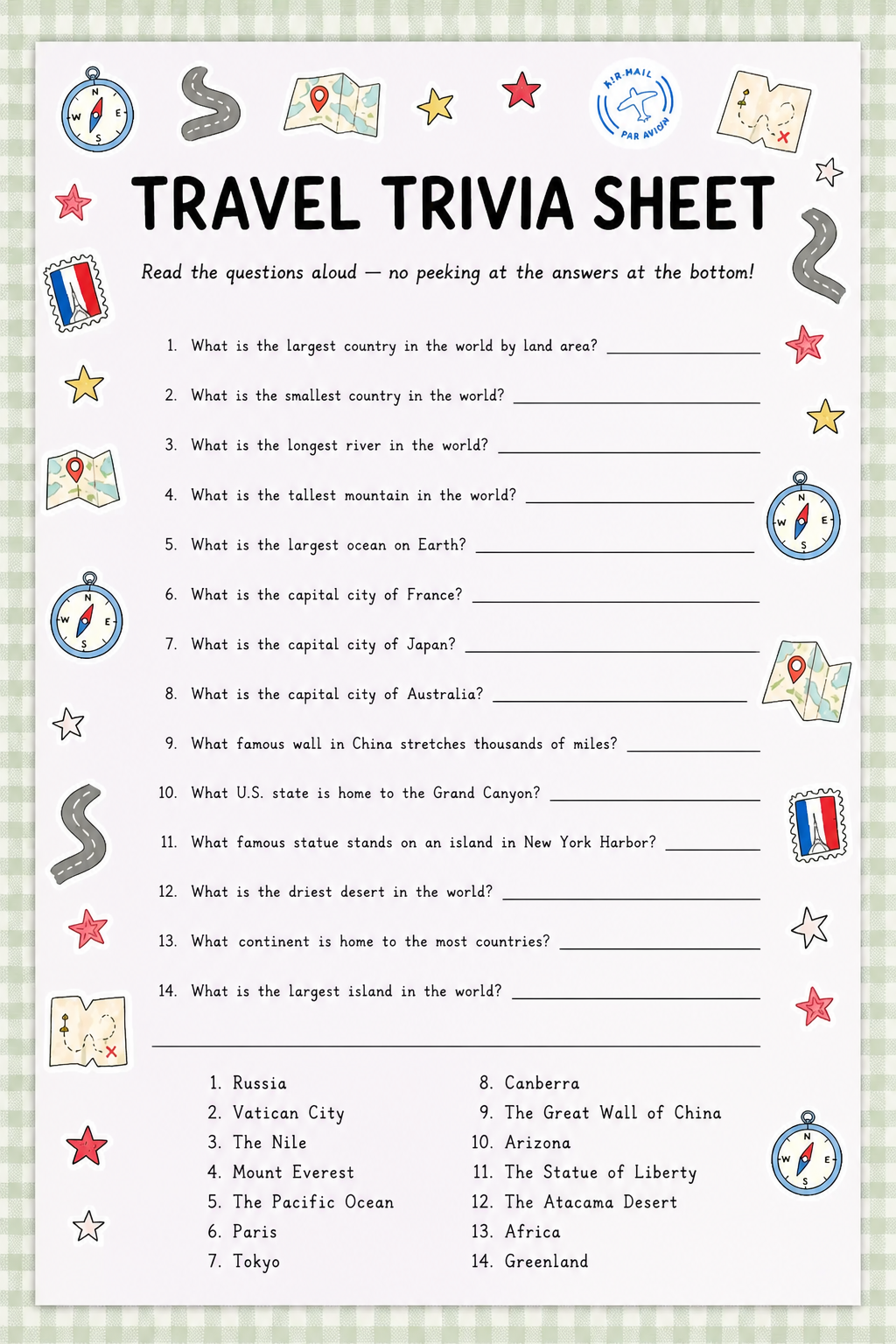
11. Travel Trivia Sheet
Travel Trivia is the road trip game that makes the car feel like a quiz show — in the best way.
The printable sheet has 20 road-trip and travel-themed trivia questions across four categories: Geography, US Roads and Highways, Nature and Landmarks, and Fun Travel Facts.
Questions are genuinely varied in difficulty so there’s something for every age: easy ones for kids (‘What ocean is on the West Coast of the US?’), medium ones for tweens (‘What is the longest highway in the US?’), and genuinely tricky ones that’ll stump most adults (‘In which state will you find the lowest point in the US?’).
The answer key lives at the very bottom of the sheet in small, light-grey italic text so the player doesn’t accidentally see the answers mid-game.
To play, one person (ideally not the driver — safety first, friends) acts as the quizmaster and reads the questions aloud while everyone else writes their answers on a separate scrap of paper or calls them out verbally.
Work through all 20 questions, then reveal the answers using the key at the bottom. Award one point per correct answer and tally scores.
The player with the most points wins the next pick of music — a prize that carries more weight than you’d think at hour five of a highway drive.
You can also break the 20 questions into four mini-rounds of five and spread them across the trip instead of doing all 20 at once, which paces the game nicely and gives everyone something to look forward to after each stretch of driving.
The Geography category works especially well right when you cross into a new state, which makes the trivia feel contextually timed and a little bit like you planned it all along (even if you absolutely didn’t).
- One player reads questions aloud; everyone else answers on scrap paper or verbally
- Award 1 point per correct answer
- Check answers using the key at the bottom of the sheet
- Winner picks the next playlist
12. Spot the Landmark Sheet
Spot the Landmark is a step up from a basic scavenger hunt — instead of looking for generic roadside items, players are hunting for iconic American landmarks and regional points of interest that you might drive past or near on a long trip.
The printable sheet lists 20 landmark types with a small illustration beside each one: a state welcome sign, a historical marker, a national park entrance, a covered bridge, a lighthouse, a drive-through tree, a famous statue, a roadside giant (you know the type — the enormous fiberglass cowboy), a battlefield marker, a famous bridge, and more.
When you spot one, check it off and write the name of the specific landmark in the blank beside it.
The fill-in-the-name element is what makes this one special — it’s not just a checkmark game. When someone spots a historical marker, they write down what it was for. When they see a national park entrance, they write the park’s name.
At the end of the trip you have a personalized, partially completed record of every notable thing you drove past, which is genuinely cool to look back on.
It also sparks real curiosity: kids who notice a ‘Revolutionary War battle site’ marker start asking questions about history that no school textbook could trigger quite the same way.
This sheet works brilliantly as a shared whole-car activity rather than a competitive individual one — keep one master copy on a clipboard up front and shout out additions as a team.
It also layers nicely with the Road Trip Journal Page: anything spotted on the Landmark Sheet can get a longer write-up in the journal, turning the two printables into a mini travel documentation system that would honestly make a great scrapbook page after the trip.
- Long cross-country or multi-state drives
- History-curious kids and adults who like context with their scenery
- Pairing with the Road Trip Journal Page for a full documentation system

13. Road Trip Riddles Sheet
Road trip riddles are the perfect car game because they work entirely out loud — no writing required, no staring at a sheet (though having the sheet for the answer key is essential).
The printable gives you 15 travel-themed riddles arranged on a single page in a clean question-and-blank-answer layout.
One person reads a riddle aloud to the car, everyone thinks and shouts their guesses, and the reader checks the discreet answer key at the very bottom of the sheet.
The riddles range from simple ones perfect for little kids (‘I have four wheels and take you places but I’m not a bus. What am I? A car.’) to genuinely tricky ones that’ll stump adults for a satisfying few miles.
All riddles on the sheet are travel-and-road-themed — they reference highways, maps, rest stops, road signs, bridges, tunnels, and the open road, so everything feels contextually tied to the trip you’re actually on.
That specificity makes them land better in the moment: when you’re staring at a long stretch of empty highway and someone reads a riddle about the horizon, it hits differently than a random riddle about a kitchen appliance.
The sheet also has a small ‘score’ tally in the corner where the reader can track how many riddles each player solved correctly, turning the listen-and-guess format into a light competition.
For maximum fun, give the role of ‘riddle master’ to a new person after every five riddles so everyone gets a turn reading.
Kids who are just learning to read aloud absolutely love this responsibility — and it gives them a moment to be the authority in the car, which, if you have a younger sibling in the mix, is a surprisingly powerful motivator for good backseat behavior during the stretches between riddles.
Riddles work entirely out loud — no writing surface needed — so even the driver gets to play. They also reset the car’s energy in about 30 seconds flat, which is worth a lot on a long drive.

14. Alphabet Hunt Sheet
The Alphabet Hunt is a beautifully simple game that can run for the entire length of a road trip without ever getting old.
The premise: find a word, sign, or object outside the car that starts with each letter of the alphabet, in order from A to Z.
The printable sheet gives each player their own structured A-to-Z grid with a blank line beside each letter to write down what they found and where they found it.
It sounds easy until you hit Q, X, and Z — those letters turn into a genuinely tense, everyone-pressed-to-the-window situation that is delightful chaos.
The sheet has 26 rows, one per letter, each with a checkbox and a ‘What I found: ___________’ write-in line.
Players work individually or as a team — the team version is great for younger kids, because you pool everyone’s observations and fill in the shared sheet together. Individually, the first person to complete all 26 letters wins.
There’s also a ‘time challenge’ variation printed on the sheet: set a timer for 30 minutes and see how far through the alphabet you can get, which works great when you’re on a busy stretch of highway with lots of signs and business names to draw from.
One of the things I love most about this game is that it’s self-pacing — players can work on it quietly at their own speed in the background while other games or conversations are happening.
It doesn’t demand the whole car’s attention, which makes it a fantastic individual activity to tuck in alongside a louder group game.
And honestly, the creativity that comes out when someone finds ‘Quail Creek’ for Q or a ‘Xtra’ gas station sign for X is the kind of triumphant moment that gets talked about for the rest of the trip.
For younger players, let them use objects inside the car too (a Book, a Cup, a Door handle) — this keeps little ones engaged and playing alongside older passengers without frustration.

15. Travel Mad Libs Sheet
Travel Mad Libs are — without question — the funniest printable in the whole pack, and I will die on that hill.
The format is beautifully classic: one player asks everyone in the car for words fitting certain prompts (a noun, an adjective, a place name, a silly sound) without revealing the story, fills in the blanks, and then reads the completed story aloud.
The resulting tale is always absurd, often slightly chaotic, and guaranteed to get at least one person doing a genuine spit-take laugh.
Travel Mad Libs put the story on the road — literally — with a narrative about a family road trip that goes hilariously off the rails.
The printable sheet has two Mad Libs stories on one US Letter page: a short one for the first stretch of the drive (about 15 blanks) and a longer one for later in the trip (about 20 blanks).
Each blank has a small label above or below it in tiny text indicating the type of word needed — ‘adjective,’ ‘noun,’ ‘verb ending in -ing,’ ‘a type of food,’ ‘a famous landmark,’ ‘an animal’ — but the blank line itself is clearly visible and writable.
The stories are completely travel-themed and all-ages-appropriate — nothing edgy, just gloriously weird family vacation narratives.
For maximum chaos and laughter, designate one person as the ‘collector’ who asks for words without reading the story first, fills in all the blanks, and then reads the completed version aloud in a dramatic voice. The more theatrical the reading, the better the reaction.
This is also a great one to save for a post-lunch energy lull when the car gets a little drowsy — nothing wakes everyone up faster than hearing that your family drove a ‘wiggly penguin’ across the ‘purple bridge’ into ‘Uncle Cheesecake Mountain.’
Trust the process.
- One player asks for words (adjective, noun, etc.) without reading the story
- Fill in each blank as words are collected
- Read the completed story aloud in your most dramatic voice
- Try not to laugh — it’s impossible

16. Color the Route Sheet
Color the Route is a coloring-meets-geography activity that keeps hands busy and eyes wandering over a gorgeous illustrated road trip map.
The printable sheet features a simple, stylized black-line map of the continental United States with major highway routes drawn across it, plus iconic illustrated landmarks placed in their rough geographic locations — a cactus in the Southwest, mountains in the Rockies, a beach on the coasts.
Players color in each state as you drive through it, color the route you’re actually taking, and draw a small star or an X on your starting city and destination. It becomes a personalized, colored-in record of your specific journey.
The coloring element makes this one genuinely relaxing — it’s the road trip equivalent of a mindful coloring page, and it works for everyone from young kids filling in states with bright crayons to adults quietly coloring with colored pencils while audiobooks play.
There’s also a small legend box at the bottom where players can write the color key they chose for each state (blue for states you’ve driven through, green for states you’ve visited before, orange for states you’ve never been to) which adds a light geography and memory component to what is otherwise just a very satisfying coloring activity.
Print multiple copies if you have multiple passengers who want their own version, and let each person create a completely individual color map — the comparison at the end of the trip is surprisingly interesting.
Kids who’ve never given much thought to US geography suddenly have very strong opinions about which states look the most interesting on the map, which is a delightful side effect.
If you’re the type who loves a creative, hands-on activity, this sheet has real keep-forever energy — it looks genuinely lovely framed after the trip as a travel memory.
Coloring is proven to reduce restlessness and anxiety — so this isn’t just fun, it’s actively calming for long stretches. It also sneaks in US geography without anyone feeling like they’re learning.

🛍 Shopping guide
17. Road Trip Picture Bingo
Road Trip Picture Bingo is the visual, all-ages companion to the classic word-based bingo card — and it’s specifically designed for passengers who are too young to read well but absolutely do not want to be left out of the game.
Instead of text labels, every square in the 5×5 bingo grid contains a simple, clear black-line illustration of something you might spot out the window: a red barn, a motorcycle, a police car, a hay bale, a river, a rainbow, a billboard, a rest stop sign, and so on.
Players scan the landscape, spot the item, and mark it off — no reading required, pure visual matching.
The printable sheet gives you four uniquely arranged picture bingo cards on one US Letter page — print, cut apart, and hand one to each player.
Every card has the same 25 images but in a different grid arrangement so that no two players hit bingo on the exact same sighting. A FREE center space marked with a car icon is automatically checked on every card.
Players use small candies, pennies, or pencil marks to cover their squares, and the first to complete a row calls ‘ROAD TRIP BINGO!’ with maximum drama.
What makes Picture Bingo stand out in the pack is its pure inclusivity — a toddler in a car seat and a grandparent in the passenger seat are playing the exact same game on equal footing, which creates a genuinely sweet shared experience.
It also has a lovely secondary effect: because players are constantly watching out the window for their images, everyone’s more engaged with the passing scenery and way less likely to ask how many more miles are left.
That alone is worth the 30 seconds it takes to cut the cards apart.
- Mixed-age groups with pre-readers and young children
- First hour of the drive to kick off the excitement
- Playing as a whole-car group with one called bingo per round

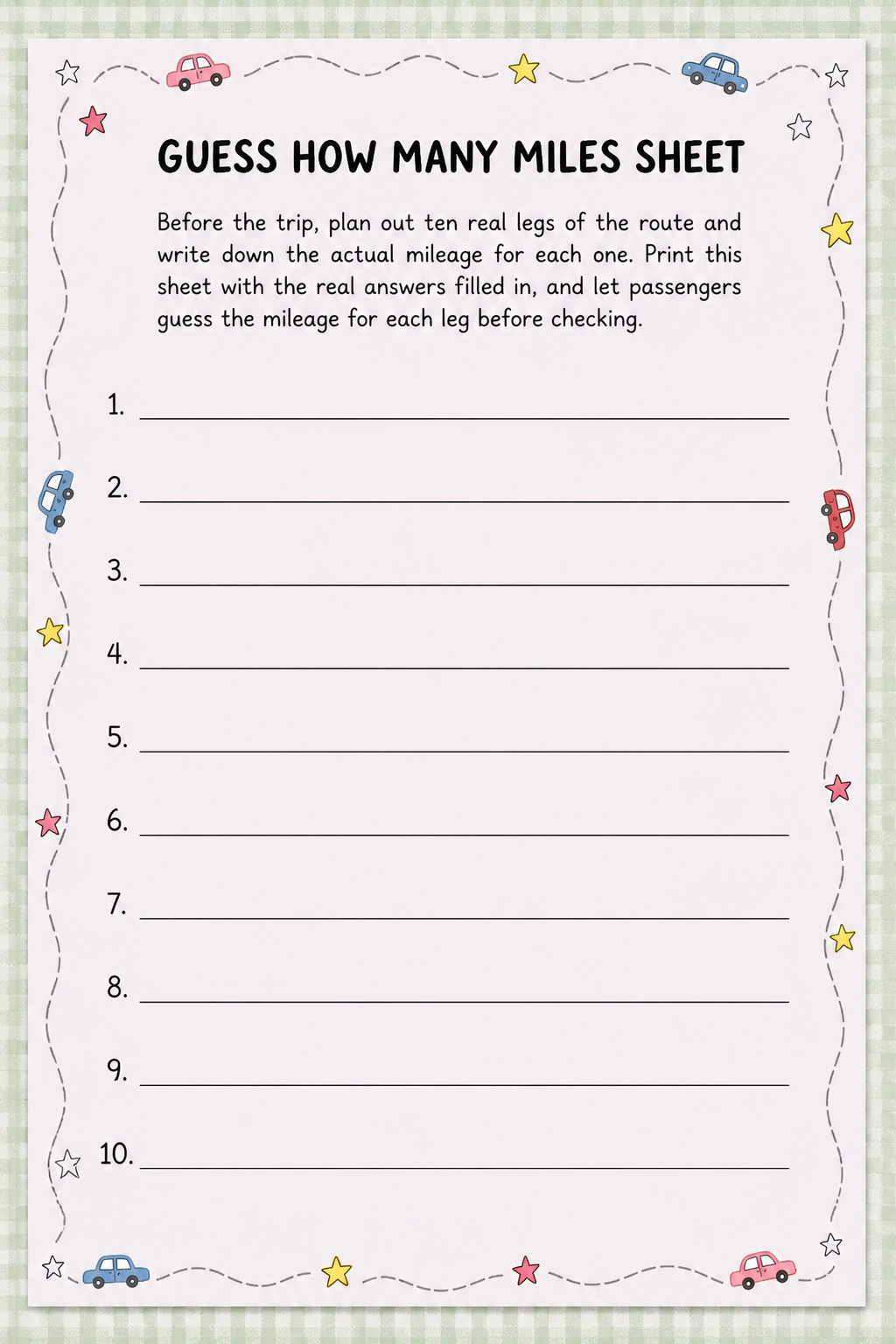
18. Guess How Many Miles Sheet
Guess How Many Miles is the road trip game that turns your car’s odometer into the ultimate judge and jury.
The concept is delightfully simple: before hitting a new stretch of driving — leaving a rest stop, entering a new state, or starting after a fuel stop — everyone in the car writes down their guess for how many miles to the next destination or milestone.
The person whose guess is closest to the actual odometer reading at arrival wins the round.
It sounds almost too simple, but the suspense of watching the miles tick by while everyone quietly monitors their guess is genuinely gripping in a ‘this is so dumb and I love it’ kind of way.
The printable sheet has a structured scorecard for 10 rounds of play: each round has a ‘milestone or destination’ write-in line at the top, then labeled rows for each player (up to 6 players) to write their guess, and a final ‘actual miles’ row to record the real number at the end.
There’s a running tally column on the right so the standings update after each round, and a ‘GRAND WINNER’ box at the bottom where the ultimate champion is recorded in glory.
The sheet is designed to run across the full trip, one milestone at a time.
To keep it interesting across multiple rounds, add a twist rule printed right on the sheet: if someone’s guess is within 5 miles of the actual total, they get 2 points instead of 1.
If someone nails it exactly (which almost never happens but occasionally does, and when it does the car goes absolutely wild), they get 5 points. It adds a strategic element — do you guess conservatively or take a risk on a bold number?
— that makes the game feel genuinely exciting all the way to the final destination.
- Pick a milestone (next rest stop, state border, destination)
- Everyone writes their mileage guess on the sheet
- Check the odometer at arrival — closest guess wins the round
- Within 5 miles = 2 pts | Exact match = 5 pts | Closest = 1 pt
19. Trip Bucket List Sheet
A Trip Bucket List Sheet is the kind of quiet, reflective activity that works beautifully at the very start of the drive — before the bingo cards come out and before the riddle rounds begin.
Each person gets their own sheet and spends 10 quiet minutes writing down everything they hope to do, see, taste, or experience before the trip is over.
It could be as big as ‘see a real mountain for the first time’ or as small as ‘try a local ice cream flavor I’ve never heard of.’
There are no wrong answers, no minimum requirements, and no pressure — just excited, anticipatory dreaming on paper.
The printable sheet has 15 numbered blank lines for bucket list items, a small ‘trip details’ header section at the top with blank fill-in lines for destination, travel dates, and who’s on the trip, and a charming ‘status’ column beside each item where players can mark it ‘Done!’, ‘Almost!’, or ‘Next time’ at the end of the journey.
That status column is the magic ingredient — it turns the list from a wish list into an interactive tracking document that passengers revisit throughout the trip and reflect on at the end.
This type of keepsake-style sheet is also something kids especially love to hold onto long after the trip.
Collect everyone’s completed sheet at the end of the trip and read them aloud on the drive home — hearing what each person hoped for vs. what actually happened is always moving, funny, and often surprisingly emotional in the best way.
Tuck the sheets into the Road Trip Journal pages for a complete trip memory document. This is the quiet, low-key game that becomes the one everyone remembers most, which is very on-brand for a long car ride with people you love.
Hand out this sheet at the very first rest stop, not at home — that way the excitement of being ‘on the road’ is already in the air and the bucket list items are more specific and vivid.

20. Favorite Stop Prompt Card
The Favorite Stop Prompt Card is a small but mighty keepsake printable that you hand to each passenger after a notable stop on the trip — a great diner, a scenic overlook, a quirky roadside attraction, a national park visitor center.
The card prompts them to capture the moment in a structured but personal way: the name of the stop, where it was, who was there, one thing they saw, one thing they tasted or tried, and a one-sentence verdict — would they come back?
The whole thing takes about three minutes to fill in but becomes one of the most cherished travel documents from the trip.
The printable sheet has six prompt cards per page in a 2×3 grid, each card the size of a standard index card, separated by dashed cut lines.
Each card has a small illustrated border of simple travel icons — a compass, a road sign, a map — and the prompts are pre-printed in clear, friendly text with visible blank lines for all answers.
No dates or specific trip details are pre-filled (the host writes those in). Print one page per passenger and hand out a new card after each significant stop so they’re filled in while the memory is fresh, not reconstructed days later when details have blurred.
At the end of the trip, collect all the cards, hole-punch the top corner of each one, and loop them together on a small binder ring — instant, zero-effort travel memory album that costs almost nothing.
Kids tend to be hilariously specific in the best way (‘the bathroom smelled like vanilla and there was a cat at the desk’) while adults capture broader impressions, so the combined set of cards from a mixed group is always a genuinely entertaining read.
This quiet little printable is the one that surprises people the most — it seems small but it punches so far above its weight.
Filling in the card right after a stop locks in specific sensory details that fade fast from memory — the name of the diner, what you ordered, the funny thing that happened. Future you will be very glad someone wrote it down.

Frequently Asked Questions
How many copies of each printable road trip game should I print?
For competitive games like Bingo, License Plate, Scavenger Hunt, and Alphabet Hunt, print one copy per passenger so everyone has their own sheet to mark.
For shared or read-aloud games like Travel Trivia, Road Trip Riddles, and Would You Rather, one copy for the whole car is fine — one person reads, everyone plays.
For keepsake sheets like the Journal Page, Bucket List, and Favorite Stop Card, print at least one per person plus a spare. When in doubt, print two extras — you’ll thank yourself at mile 200.
What supplies should I pack alongside the printable game pack?
The essentials are pencils (pack more than you think you need — they vanish), a fine-tip marker or two for laminated sheets, a small eraser, a few colored pencils or crayons for the coloring sheets, and a clipboard or hardback book per passenger to use as a lap desk.
A small zipper pouch keeps everything together and stops pencils from rolling under seats. Dry-erase markers are a bonus if you’ve laminated any of the reusable sheets like Tic-Tac-Toe or Would You Rather.
Can these printable road trip games work for adults, or are they just for kids?
Absolutely for adults — most of the games in this pack are genuinely enjoyable for all ages.
Would You Rather, This or That, Travel Trivia, Road Trip Riddles, Travel Mad Libs, Guess How Many Miles, and the License Plate Game are all particularly fun for teens and adults.
The coloring and picture-matching sheets trend younger, but plenty of adults find Road Trip Picture Bingo and Color the Route surprisingly relaxing and enjoyable. Mix and match based on who’s in the car.
How do I keep the printable sheets from getting crumpled or damaged in the car?
The best options are laminating reusable sheets (like Tic-Tac-Toe, Would You Rather, and I-Spy) before the trip so they survive the whole journey and future road trips too.
For one-use sheets, slip them into individual clear sheet protectors and store them in a small expanding file folder or binder. Attaching sheets to clipboards keeps them flat and writable.
Avoid leaving loose sheets on the back window shelf in the sun — heat and sunlight will curl and fade them fast.
What are the best printable road trip games for very young children?
The best options for toddlers and pre-readers are Road Trip Picture Bingo (picture-matching, no reading needed), I-Spy Travel Sheet (color in what you spot), Color the Route (a coloring-meets-map activity), and the Road Trip Scavenger Hunt (especially if you circle the easiest 10 items for them before handing it over).
The Favorite Stop Prompt Card is also wonderful for young kids — let them draw a picture in the ‘what I saw’ section instead of writing words.
How do I use the printable pack on a multi-day road trip without running out of activities on day one?
Pace yourself! Don’t hand out the entire pack at once — divide the games into batches and reveal them gradually across the trip. Start the first day with high-energy spotting games like Bingo, License Plate, and Scavenger Hunt.
Introduce trivia, riddles, and Mad Libs on day two for a different energy. Save the quieter keepsake activities — Journal Pages, Bucket List, Favorite Stop Cards — for the final day when everyone’s a bit more reflective and road-weary.
The Tic-Tac-Toe and This or That sheets can be laminated and replayed all trip.
📌 Save These for Later
Loved these? Pin your favorite image below so you can find this list again when you’re planning.

120 clean truth or dare questions for teenagers — funny, embarrassing, crush, social-media & silly
Keep every guest laughing and moving with these 20 backyard BBQ games perfect for all ages, from law

20 party games with no supplies needed — no printing, no props, no shopping. Just people and laugh
Leave a Reply