

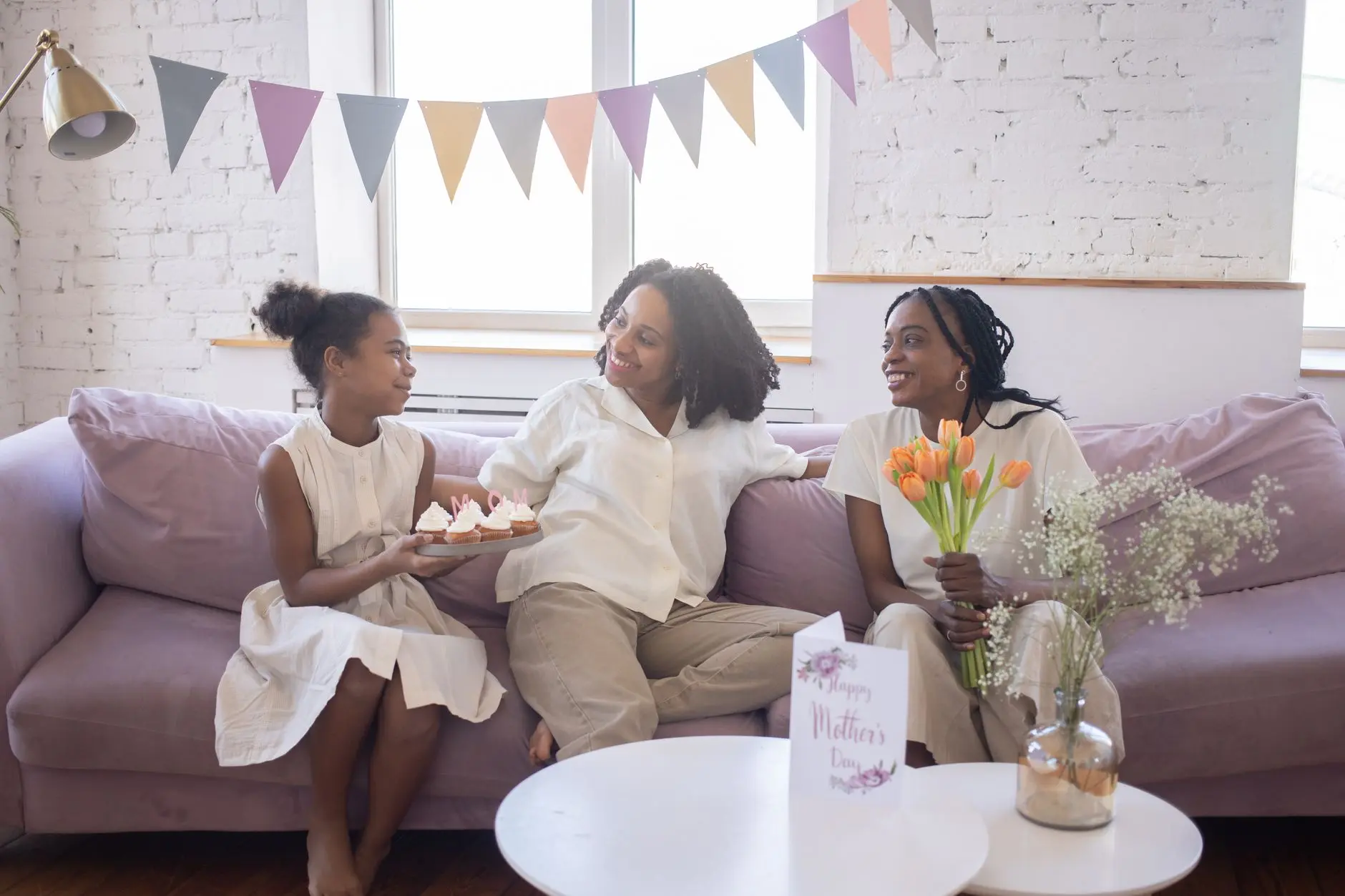
Mother’s Day deserves more than flowers on the table and polite conversation over eggs.
If you’ve ever watched the gathering lose steam by 11 a.m., you already know that what the day really needs is a reason for everyone — mum, the kids, the grandparents, the cousins who drove two hours — to actually talk to each other.
Games do that faster than any centrepiece ever could. The 18 ideas below range from gentle and sentimental to laugh-out-loud competitive, so you can mix and match depending on whether your crowd skews rowdy or reflective.
Ten of the games come with dedicated printable sheets you can download, print, and place on the table before anyone arrives — no craft skills required.
The other eight need nothing more than things you likely already own: a phone, a handful of pens, a few old photos, or just the people in the room.
Work your way through the whole list or cherry-pick three or four; either way, mum will remember this one long after the mimosas are gone.
This post contains affiliate links — if you buy through them, I may earn a small commission at no extra cost to you.
Table of Contents
- How Well Do You Know Mum?
- Mum Trivia Rounds
- Guess Mum’s Answer
- Memory Sharing Cards — Mother’s Day Edition
- Mum Would You Rather
- Photo Timeline Match
- Compliment Circle Cards – For Mum
- Guess the Baby Photo!
- Mum Charades
- Wishes for Mum
- Emoji Decode: Mum’s Favourite Things
- Mum’s Life in Headlines
- The Mum Awards Ceremony
- Two Truths and a Mum
- Family Recipe Challenge
- Guess That Decade
- Mum’s Soundtrack Showdown
- Story Spine Round-Robin
1. How Well Do You Know Mum?
Print one sheet per player and hand them out as soon as guests sit down.
Each sheet lists 20 questions about mum — her favourite film, the city where she was born, the meal she always requests on her birthday, the hobby she keeps saying she’ll start — and every player fills in their answers independently and in silence.
Once pencils are down, mum reads her own answers aloud while everyone marks their score. Whoever knows her best wins, and the gaps between what people guessed and what mum actually said are almost always funnier than anything scripted.
You need one printed sheet per player, a pen each, and about 15 minutes for a group of six to eight. The game scales easily — a table of four flies through it in ten minutes, while a big extended family might need 20.
It works equally well as an icebreaker at the start of the afternoon or as a warm-up before a meal.
Host tip: Before the party, sit down with mum privately and fill in her answer sheet. Seal it in an envelope and hand it to her only when everyone else has finished writing. That small ritual adds suspense and stops her from being nudged into changing her answers by whoever is sitting next to her.

🛍 Shopping guide
2. Mum Trivia Rounds
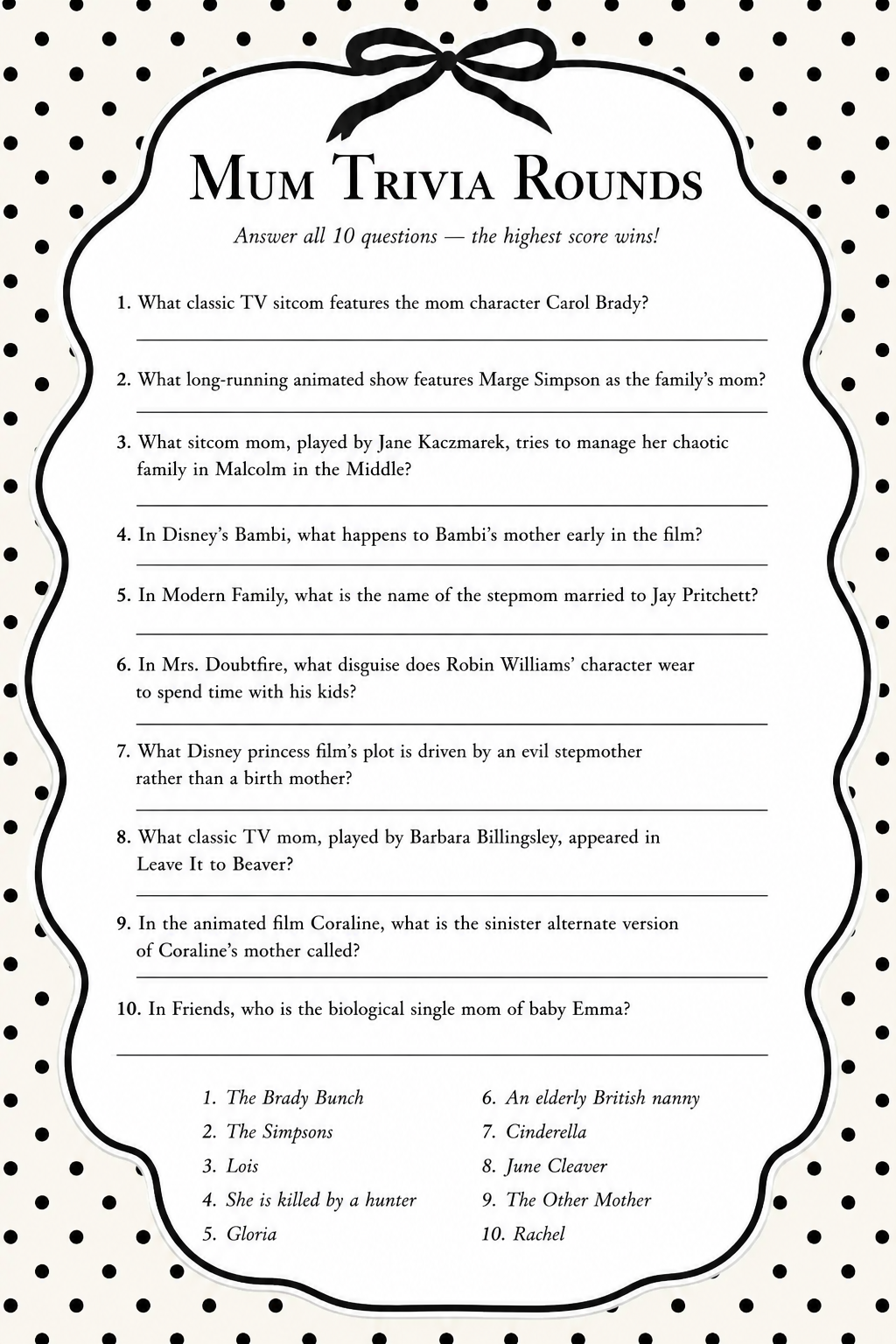
This is a structured trivia game built entirely around the mother or mothers being celebrated, divided into themed rounds — early life, her working years, family firsts, things she loves, and a lightning round of rapid-fire facts.
Print one answer sheet per player or team, then read the questions aloud as host. Players write their answers and hand sheets in at the end of each round for scoring.
The competitive structure gives it energy that open-ended games sometimes lack, and the rounds keep things moving so nobody’s attention drifts.
You need the printed answer sheets, a pen per player or team, and a host willing to read questions clearly and keep score. It plays well with four to twelve people split into two or three teams, and a full five-round game takes around 25 minutes. Families who love a pub-quiz atmosphere will immediately feel at home with the format.
Host tip: Ask mum to verify all the answers before the party, not just most of them. One wrong “official” answer — especially in the lightning round — will derail the whole thing into a good-natured argument that takes five minutes to settle.
Get her sign-off in advance and keep a paper copy of the answer key with you at the host table.
🛍 Shopping guide
3. Guess Mum’s Answer
Think of this as a reverse quiz: instead of everyone trying to remember facts about mum, everyone is predicting how mum will respond to a set of opinion-based prompts right now.
Questions like “Would mum rather spend a weekend at the beach or in the mountains?” or “What does mum think is the most overrated household chore?” are printed on the sheet.
Players fill in what they think mum will say, then mum reveals her actual answers one by one. It’s less about historical knowledge and more about how well you understand the way she thinks today.
One sheet per player, one pen each, and about 15 to 20 minutes is all you need.
It plays beautifully with mixed ages because grandchildren who weren’t around for mum’s early life can still compete on equal footing — they just have to think like her. Groups of four to ten work best; beyond that, the reveal section gets a little long.
Host tip: Have mum complete her own answers on a separate copy of the sheet before the game starts and tuck it face-down in front of her.
When it’s time to reveal, she flips and reads directly from her sheet rather than answering off the top of her head. It prevents her from second-guessing herself mid-reveal when she sees everyone staring expectantly.

4. Memory Sharing Cards — Mother’s Day Edition
Each card in this set carries a gentle prompt designed to pull out a specific memory: “Tell us about a time Mum surprised you,” “Describe the best meal she ever cooked,” “Share something Mum taught you that you still use every day.”
Players draw a card on their turn, read the prompt aloud, and share their memory with the group. There’s no scoring and no winner — the whole point is the conversation that follows.
What begins as a structured activity almost always turns into a spontaneous exchange of stories that nobody planned.
Print and cut the cards before guests arrive, then stack them face-down in the centre of the table. You need scissors and a bit of prep time, but nothing else.
The game suits any group size from four to twenty and can run for as long or as short as the mood demands — typically 20 to 40 minutes.
It works particularly well over dessert when the pace naturally slows and people are ready to linger.
Host tip: Seed the deck with one or two cards written specifically for your family — a prompt that references something only your group would know — and shuffle them in with the printed set. When those cards come up, the recognition in mum’s face is worth every minute of the extra preparation.

🛍 Shopping guide
5. Mum Would You Rather
The classic “Would You Rather” format gets a Mother’s Day makeover: every dilemma on the printed sheet is tailored to the kind of choices mums actually face, from the warmly relatable (“Would you rather have one hour completely alone or one hour with everyone you love?”)
to the hilariously practical (“Would you rather never fold laundry again or never unload the dishwasher again?”). Players circle their own answer for each pair, then compare with mum to see how closely their preferences align.
The dilemmas are designed to provoke opinions and minor arguments, which is exactly what makes it fun.
Hand out one sheet per player with a pen and let everyone answer individually before any discussion starts — that’s the key to getting honest answers rather than people mirroring mum.
A full sheet of 15 dilemmas takes about 20 minutes for a group of six. It’s one of the easiest games to pause and resume, so it works well if your gathering is spread across a long afternoon.
Host tip: Read a few of the best dilemmas aloud after everyone has circled their answers and turn them into a group vote. Seeing a show of hands and then hearing mum’s answer produces a satisfying reveal moment even when the game is played in a casual, non-competitive way.

6. Photo Timeline Match
Gather ten to fifteen family photos spanning mum’s life — childhood snaps, teenage years, wedding day, early parenthood, recent decades — and number them on the back. Players receive a printed answer sheet and must arrange the photos in chronological order, writing down their sequence.
Once everyone has submitted, the correct timeline is revealed and the room discovers who actually paid attention to the family albums over the years. The game is surprisingly competitive and always turns into a treasure hunt of “wait, where was that taken?” conversations.
You need the physical photos (printed copies work perfectly so originals stay safe), the printed answer sheets, and a pen per player. Organising the photos is the only real prep work, and it can be done the night before.
Five to twelve players is the sweet spot; it runs in about 15 minutes and leaves plenty of time for the photo-browsing that inevitably follows.
Host tip: Make copies of the photos rather than passing around originals. Colour-copy or print digital images at a drug store the day before — A4 sheets work fine — and number each copy lightly on the back in pencil. That way photos can be passed around freely without anyone panicking about bent corners or sticky fingers.

🛍 Shopping guide
7. Compliment Circle Cards – For Mum
Each player receives a card printed with sentence starters — “The thing I admire most about you is…,” “A moment you made me feel completely safe was…,” “Something you do that I hope I never forget is…” — and fills it in privately before reading it aloud to mum.
The structure of the prompt removes the awkwardness that often stops people from saying sincere things out loud, because the sentence is half-written for them. What results is a round-the-table moment that regularly reduces mum to happy tears without feeling forced or performative.
Print one card per person, hand them out with pens early in the gathering so everyone has time to think, and read them aloud as a group activity near the end of the afternoon.
No scoring, no competition — just one beautiful ten-minute moment before everyone heads home. Works for any group size, though it’s most intimate with four to ten people.
Host tip: Collect the completed cards at the end and slip them into a small envelope for mum to keep. She will re-read them long after the day is over, and knowing they’ll be preserved means players tend to write more carefully and sincerely than they would if the cards were just read and set aside.

🛍 Shopping guide
8. Guess the Baby Photo!
Every player submits a baby or childhood photo of themselves in advance — collected by the host via a group chat in the days before the party — and the host prints or displays them numbered but unlabelled.
Players use the printed answer sheet to match each photo to the person they think it shows.
The game is funnier than it sounds because nobody looks quite the way their grown-up self suggests, and the gap between “confident guess” and “completely wrong” is a reliable source of laughter. Mum usually wins because she remembers every single one.
You need collected photos (the host should chase stragglers at least two days before), a way to display them — printed and pinned to a board, displayed on a phone passed around, or projected on a TV — and the printed answer sheets.
Ten to twenty players works beautifully; the more people, the harder and funnier it gets. Budget about 20 minutes including the reveal.
Host tip: Include a baby photo of mum herself in the lineup without telling anyone you’ve added it. Label it with a number like all the others. When people are confused by a photo they can’t place — and at least half the room will be — the reveal that it’s mum produces the biggest reaction of the whole game.

🛍 Shopping guide
9. Mum Charades
This is charades built around a category list tailored entirely to mum’s world: things she says constantly, her favourite films and books, tasks she does around the house, hobbies she loves, places that mean something to the family.
The printed sheet provides the category list and blank cards so you can write specific phrases before the game. Split into two teams, set a one-minute timer per turn, and act out as many as you can without speaking.
Because every prompt is personal to your family, even the miming is funnier than standard charades — someone acting out “reorganising the entire pantry at 10pm” needs no explanation.
You need the printed category sheet, blank cards or slips of paper for writing prompts, a bowl or hat to draw from, and a timer.
Five to sixteen players split into teams is ideal, and a full game of three rounds per team runs about 30 minutes.
It’s one of the most physically energetic games on this list, which makes it a good choice after a meal when people need to move.
Host tip: Write the cards yourself based on things specific to your mum rather than using generic phrases, and keep at least two or three that are absurdly specific — “the face she makes when someone puts something in the wrong recycling bin” is an example that will launch the whole room into recognition laughter before the person even starts miming.

10. Wishes for Mum
The printed Wishes for Mum cards give every person at the table a structured space to write one wish for mum’s year ahead — something they hope she gets to experience, feel, or do before the next Mother’s Day.
Prompts on the card guide the thinking: “I wish you more of…,” “I hope this year brings you…,” “One thing I want you to finally do for yourself is…” Players fill in their cards privately, then read them aloud in a round-the-table moment.
Unlike a generic card, each wish is personal, specific, and something mum can return to throughout the year.
Print one card per person and hand them out at the start of the meal so people can think while they eat. The reading-aloud portion takes ten to fifteen minutes for a group of eight and can happen at any natural pause in the afternoon.
No competition, no winner — just a warm close to the games portion of the day. Any group size works.
Host tip: Ask one trusted family member to collect all the completed cards, photograph them on a phone, and send the images to mum in a single message later that evening. The physical cards are lovely, but having a digital copy means mum can re-read her wishes any time without worrying about losing the originals.

🛍 Shopping guide
11. Emoji Decode: Mum’s Favourite Things
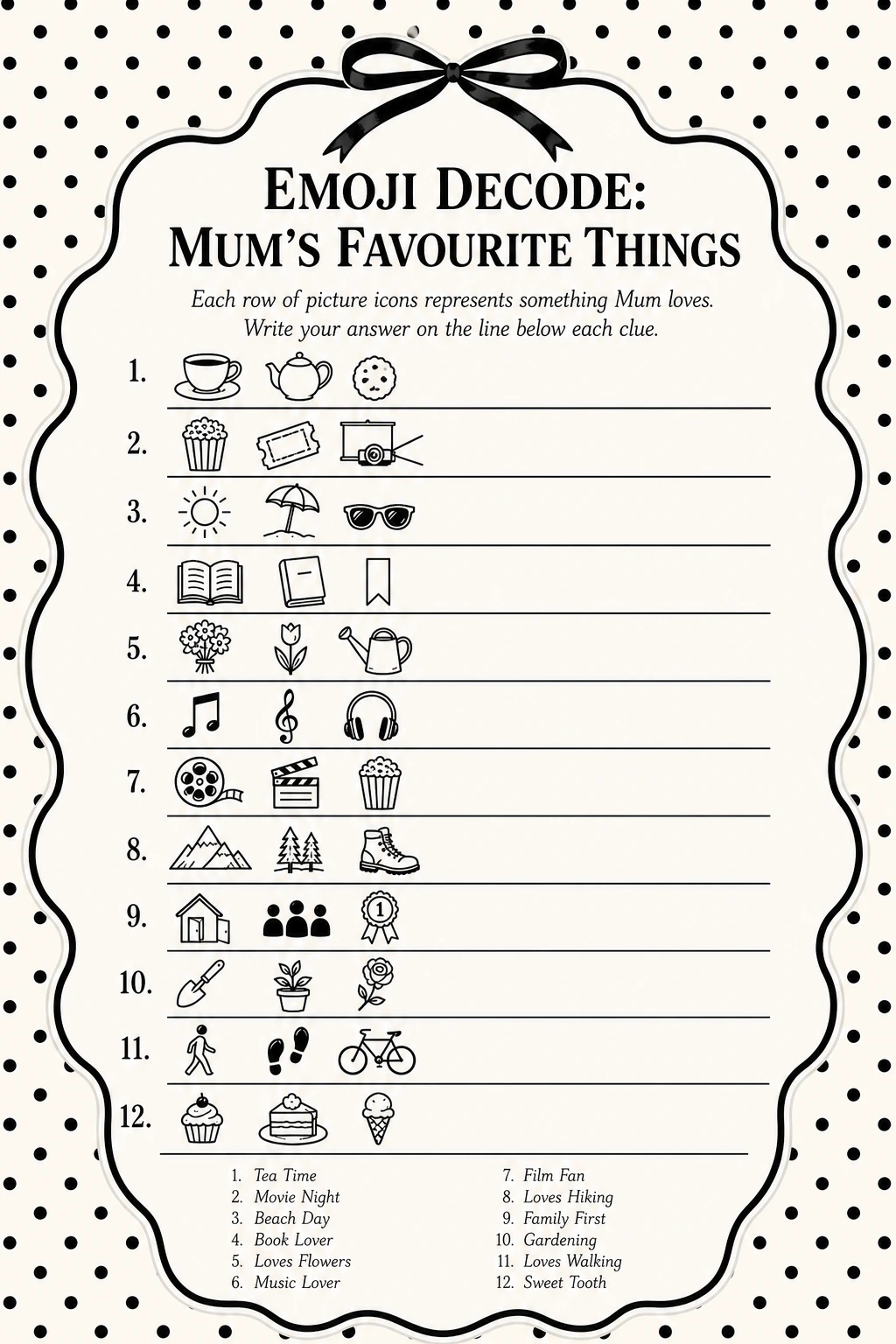
The printed Emoji Decode sheet shows rows of emoji sequences, and players must work out which of mum’s actual favourite things — films, foods, places, pastimes, people — each sequence is hinting at.
Unlike open-ended rebus puzzles where answers can’t be verified, every answer on this sheet is drawn directly from a list of mum’s known favourites that the host fills in before printing (or writes alongside the sheet as a reference card).
Players aren’t guessing abstract phrases; they’re matching emoji clues to real things about a real person they know, which makes every answer checkable and every wrong guess immediately funny.
You need the printed sheet, one per player, plus a pen each. Before the party, the host writes mum’s real favourites into the reference section of the sheet so there’s a definitive answer key.
The game takes about 15 minutes for a group of six and generates good conversation as people debate their answers before the reveal. It works especially well as a table activity during a relaxed meal.
Host tip: Keep the reference answer list hidden until scoring time. The moment of reveal — especially when someone was convinced a sequence meant something completely different — lands much better if nobody has been peeking. A simple folded piece of paper over the answer key is all you need.
12. Mum’s Life in Headlines
The printed Mum’s Life in Headlines sheet presents key moments from mum’s life written as if they were newspaper front pages — “Local Woman Lands Dream Job After Three Rejections,” “Exhausted Parent Completes School Pickup Streak: Day 2,847” — and players must match each headline to the real event it describes, choosing from a list of options printed alongside it.
The format is warm and celebratory, and the headlines are written in a way that makes even ordinary moments feel genuinely momentous. It’s part trivia, part tribute, and entirely entertaining.
The host fills in the events and writes the headlines in advance, either in the editable fields on the sheet or by hand. Print one copy per player and give everyone a pen.
A sheet of ten headlines takes about 15 minutes to complete, followed by a group reveal where mum explains the real story behind each one. Groups of four to twelve work well; it naturally prompts storytelling once the answers are read out.
Host tip: Draft the headlines a week before the party and read them back to yourself out loud.
A headline that seems funny in your head sometimes reads differently when spoken aloud in a room — and this is one game where you want every headline to land with warmth rather than accidentally feel like a dig.
A quick edit pass makes all the difference.

13. The Mum Awards Ceremony
Every person in the room nominates mum — and each other — for a series of lighthearted, personalised awards: “Most Likely to Call Just to Say She Was Thinking of You,” “Undefeated Champion of Finding Things Nobody Else Can Find,” “Lifetime Achievement in Pretending Not to Have a Favourite Child.”
Before the party, the host prepares a list of ten to twelve award titles that fit the family. During the ceremony, read each award aloud and invite a short acceptance speech from the winner. It’s part comedy show, part roast, entirely affectionate.
You need a list of award names (written on paper or displayed on a phone) and optionally a simple “trophy” — a wooden spoon dressed with a ribbon works perfectly and costs nothing. No printing required.
The ceremony runs 20 to 30 minutes depending on how long the speeches get, which is always longer than you expect. It suits groups of four to twelve best, where everyone gets at least one award.
Host tip: Write at least two awards specifically for mum that reflect something she takes genuine pride in — not just the funny ones. Balancing the silly awards with a couple that are sincerely celebratory ensures the ceremony feels like a tribute as well as a laugh, which is exactly the right tone for Mother’s Day.
14. Two Truths and a Mum
A twist on the classic Two Truths and a Lie, this version centres every round on mum. Players write three statements about mum — two true, one invented — and read them aloud while the group votes on which one is false.
Then mum gets her own turns, writing statements about each of her children or grandchildren for the group to sort through.
The game reveals how well people know the family’s stories, produces a steady stream of “I had no idea that was true” moments, and turns mum into both the subject and an active competitor.
All you need is paper and pens — no printing, no preparation beyond gathering the group. It works beautifully with five to twelve players and runs for as long as you like, typically 20 to 30 minutes before energy naturally starts to drift.
Because there’s no board or timer, it’s easy to pause for more food or drinks and pick up again without losing momentum.
Host tip: Brief mum privately before the game starts and ask her to prepare at least three sets of statements about different family members. If she walks in having already thought it through, her turns are sharper and funnier — and she won’t accidentally reveal a truth she wanted to keep quiet by hesitating at the wrong moment.
15. Family Recipe Challenge
Write out the ingredients list for three or four dishes mum makes regularly — her signature pasta sauce, the biscuits she bakes every Christmas, the soup she produces whenever anyone is ill — without naming the dish.
Teams or individual players read the ingredients and try to identify which of her recipes it is, then go one step further by writing down the one ingredient they think makes it different from every other version they’ve ever tasted.
Mum then reveals the real dish and the secret ingredient, if there is one, and the room discovers who has actually been paying attention in her kitchen.
Prepare the ingredients lists on paper or index cards before the party — ten minutes of prep the evening before is plenty. You need a pen per player and a copy of the lists for each team.
A round of four recipes takes about 15 minutes. It works especially well with a group that shares regular meals together; families who gather less often find it harder but enjoy it just as much.
Host tip: Include one completely fictional recipe — ingredients that don’t belong together at all — alongside the real ones. Players who are guessing confidently will tie themselves in knots trying to name a dish, and mum’s reaction when she sees people earnestly debating a list you invented on the spot is genuinely priceless.
16. Guess That Decade
The host collects one memorable fact, decision, or event from each decade of mum’s life — where she lived at 17, the car she drove in her 30s, what she was passionate about in her 40s — and writes each one on a separate slip of paper.
Slips are shuffled and drawn one at a time; players write down which decade of mum’s life they think the fact belongs to. After all slips are drawn, mum reveals the correct answers and players score one point per correct decade.
The game is a gentle way of exploring mum’s whole life, not just the chapters the family was present for.
You need the slips of paper prepared in advance (a conversation with mum a day or two before the party is the best research method), an answer sheet or blank paper per player, and pens.
Six to twelve players works well and a full game of twelve slips takes about 20 minutes. It’s one of the quieter, more reflective games on this list — good for a moment when the energy is calm and people want to listen.
Host tip: After the scoring, ask mum to say one more sentence about each fact — just a brief expansion. Those spontaneous additions consistently turn into the most interesting stories of the afternoon, often things she’s never told the family before, simply because nobody asked the right question until now.
17. Mum’s Soundtrack Showdown
Before the party, ask mum to name ten songs that mean something to her — one from her teenage years, her wedding, a road trip, a difficult time she got through, the era when the kids were small, and so on.
At the party, play a ten-second clip of each song from a phone or speaker. Players write down what they think the song means to mum — what memory or chapter of her life it represents — before she reveals the real story.
There’s no single right answer beyond mum’s own, which makes every reveal a window into something personal.
You need a phone or speaker, a short playlist prepared in advance, paper and pens for players, and about 25 minutes for a group of any size.
The music makes the atmosphere immediately warmer, and even people who guess wrong often explain their reasoning in ways that spark entirely new conversations.
It suits any group from four to twenty — the larger the group, the more varied the guesses, which makes the reveal section richer.
Host tip: Ask mum to record a short voice note — thirty seconds each — explaining what each song means to her, and play the voice note after the guessing instead of having her explain live.
Hearing her tell the story in her own recorded words, while everyone is looking at her across the table, produces a different kind of quiet than anything else in this list.
18. Story Spine Round-Robin
Story Spine is an improvisational storytelling game where each player adds one sentence to a collaborative story using a provided prompt word: “Once upon a time…,” “Every day…,” “Until one day…,” “Because of that…,” “Until finally…,” “And ever since then…” In this Mother’s Day version, every story must be about mum — a fictional exaggerated adventure, a fairy-tale version of something that really happened to her, or a completely invented tale where she is the hero.
Stories spiral in unexpected directions and the laughter builds sentence by sentence.
No materials required beyond the list of prompt words, which the host can write on a single piece of paper or simply remember.
Groups of four to ten work best so each player gets multiple turns in a story cycle; a group of six typically completes a satisfying story in four to five minutes, so you can run three or four rounds in 20 minutes.
It’s a wonderful final game of the afternoon because it ends on a high-energy, slightly chaotic note that sends everyone home laughing.
Host tip: Start the very first story yourself as host so the group understands the rhythm before it’s their turn.
Keep your opening sentence deliberately ordinary — “Once upon a time, Mum decided to reorganise the kitchen cupboards” — so that whoever follows you has to do the work of making it interesting.
The contrast between a mundane opening and where the story ends up is what makes the game.
Frequently Asked Questions
How many games should we actually play at a Mother’s Day gathering?
Three to five games is the sweet spot for most gatherings. Open with something easy and low-stakes — a trivia sheet or a quick quiz — to get the room warmed up, then move into a more involved activity once people are relaxed.
Save the sentimental ones, like Compliment Circle Cards or Wishes for Mum, for the end of the afternoon when the mood is naturally quieter.
You don’t need to run through the entire list; choosing games that match your crowd’s energy on the day always works better than sticking rigidly to a schedule.
Do we need to print the printable games in advance, or can we display them on a screen?
Printing in advance is strongly recommended. Passing a screen around a table is awkward, and most of the printable games require players to write their answers privately and simultaneously — something that simply doesn’t work with one shared device.
Print at least one sheet per player, add a few spares for mistakes, and use standard A4 paper or cardstock.
If you don’t have a home printer, most copy shops will print a PDF file for a small fee with no wait when you upload it online the day before.
What if we have a wide age range, from young grandchildren to elderly grandparents?
Most games on this list work across generations because they centre on mum — someone everyone in the room knows and loves. How Well Do You Know Mum, Guess Mum’s Answer, and Mum Would You Rather are all genuinely accessible to players of any age.
For very young children, pair them with an older family member so they can contribute without needing to read or write. The Mum Awards Ceremony and Story Spine Round-Robin are especially good for mixed ages because they rely on speaking and listening rather than writing.
Can these games work for a small group of just two or three people?
Yes, most of them adapt well to a small group. The trivia games, Would You Rather, and Memory Sharing Cards all work beautifully with just two or three players — the experience is more intimate rather than less fun.
Skip the team-based games like Mum Charades or Soundtrack Showdown if your group is very small, or adapt them by playing co-operatively instead of competitively.
Some families find that a gathering of three people produces the most honest and heartfelt answers precisely because there’s no crowd to perform for.
How do we handle it if mum doesn’t want to be the centre of attention?
Start with a game where mum is a participant rather than the subject — Two Truths and a Mum or Story Spine Round-Robin work well because the spotlight moves around the room rather than staying fixed on her.
Once she’s laughing and comfortable, the more mum-centred games feel less exposing.
It also helps to frame the sentimental games as something the family is doing together rather than something being done to her — “we all filled these in” lands very differently from “this is all about you.”
📌 Save These for Later
Loved these? Pin your favorite image below so you can find this list again when you’re planning.


Someone in my neighborhood threw a sea-themed baby shower last summer and the photos have been livin
My son turned two in October, and for about four months before that, every single morning started th

You’ve been thinking about it for three weeks. The park party idea keeps coming back. It&rsquo
Leave a Reply