


Father’s Day deserves more than a card propped against a coffee mug.
Whether you are hosting a backyard cookout for a handful of kids or a sprawling family reunion with grandads, uncles, and neighbours spilling onto the lawn, the right game turns an ordinary Sunday into a story Dad will still be telling at Christmas.
The eighteen Father’s Day games below run the full spectrum — printable sheets that work on a picnic table, lawn classics that get everyone on their feet, and creative rounds that let every generation play together without anyone feeling left out.
You do not need a party-planning budget or a craft room full of supplies. Most of these games need nothing more than a printed sheet and a pen, while the outdoor options rely on gear that is easy to borrow or buy cheaply.
Scan the list, pick four or five that suit your crowd, and consider running one calm seated game between every two physical ones so that grandads get a breather and the little ones stay engaged.
The host tip at the end of each entry comes from people who have actually run these games, so the practical snags are already ironed out for you.
This post contains affiliate links — if you buy through them, I may earn a small commission at no extra cost to you.
Table of Contents
- How Well Do You Know Dad?
- Dad Joke Contest – Official Ballot
- Dad Trivia Rounds
- Guess Dad’s Answer!
- Tool Guessing Game
- Backyard Ring Toss
- Photo Timeline Match
- Dad Would You Rather
- Corn Hole Tournament
- Wishes for Dad Cards
- Dad’s Emoji Pictionary
- Dad’s This or That
- Dad’s Greatest Hits Mad Libs
- Backyard Bocce Ball
- Two Truths and a Dad Lie
- Lawn Bowling Skittles
- The Price Is Dad
- Sack Race Relay
1. How Well Do You Know Dad?
This is the classic Father’s Day centrepiece, and it earns that status every single year.
Before the party, ask Dad to fill in a private answer sheet covering twenty or so questions — his favourite meal, the car he learned to drive in, the job he wanted as a child, the song he secretly knows every word to.
On the day, hand every guest their own identical questionnaire and give everyone five minutes to write down what they think Dad’s answers are.
Read the questions aloud one by one, reveal Dad’s true answer, and watch the room erupt as it turns out nobody knew he once wanted to be a professional wrestler.
Scoring is straightforward: one point per correct match. You can run it as individuals competing against each other or split into teams — kids on one side, adults on the other — which adds a gentle generational rivalry.
The person with the most matches wins a small prize; Dad himself is not eligible to score, but you can give him a running commentary role so he feels like the host of his own game show.
Plan for fifteen to twenty minutes of play time, and it works beautifully for any group from five people to fifty.
Host tip: collect Dad’s completed answer sheet at least two days before the party and keep it hidden. If you leave it until the morning of the event, someone will find it or Dad will forget a detail and change his mind mid-game, which completely undermines the scoring.

2. Dad Joke Contest – Official Ballot
Every dad in the room has a backlog of jokes he has been waiting for permission to deploy, and this game grants that permission in the most structured, ceremonious way possible.
Each willing contestant — not just dads, anyone can enter — steps up and delivers their best dad joke to the group. Groans are encouraged; laughter is mandatory.
After each joke, every seated guest marks their Official Ballot sheet, rating the joke on three criteria: originality, delivery, and groan-worthiness. Scores from one to five in each column are tallied after all jokes have been told.
The ballot sheet is the heart of the game because it gives shy guests something to do with their hands and keeps the energy focused between turns.
Collect all the sheets after the final joke, add up the scores quickly — designate a trusted twelve-year-old as your maths assistant — and crown the Dad Joke Champion with whatever prize feels right.
A plastic trophy, a ribbon, or simply the right to choose what goes on the barbecue next all work perfectly. The whole game runs in twenty to thirty minutes depending on how many entrants you have.
Host tip: cap entries at eight jokes maximum. Beyond that, even the most patient crowd starts to flag, and the later jokes always score lower simply because everyone is tired rather than because they are worse.

3. Dad Trivia Rounds
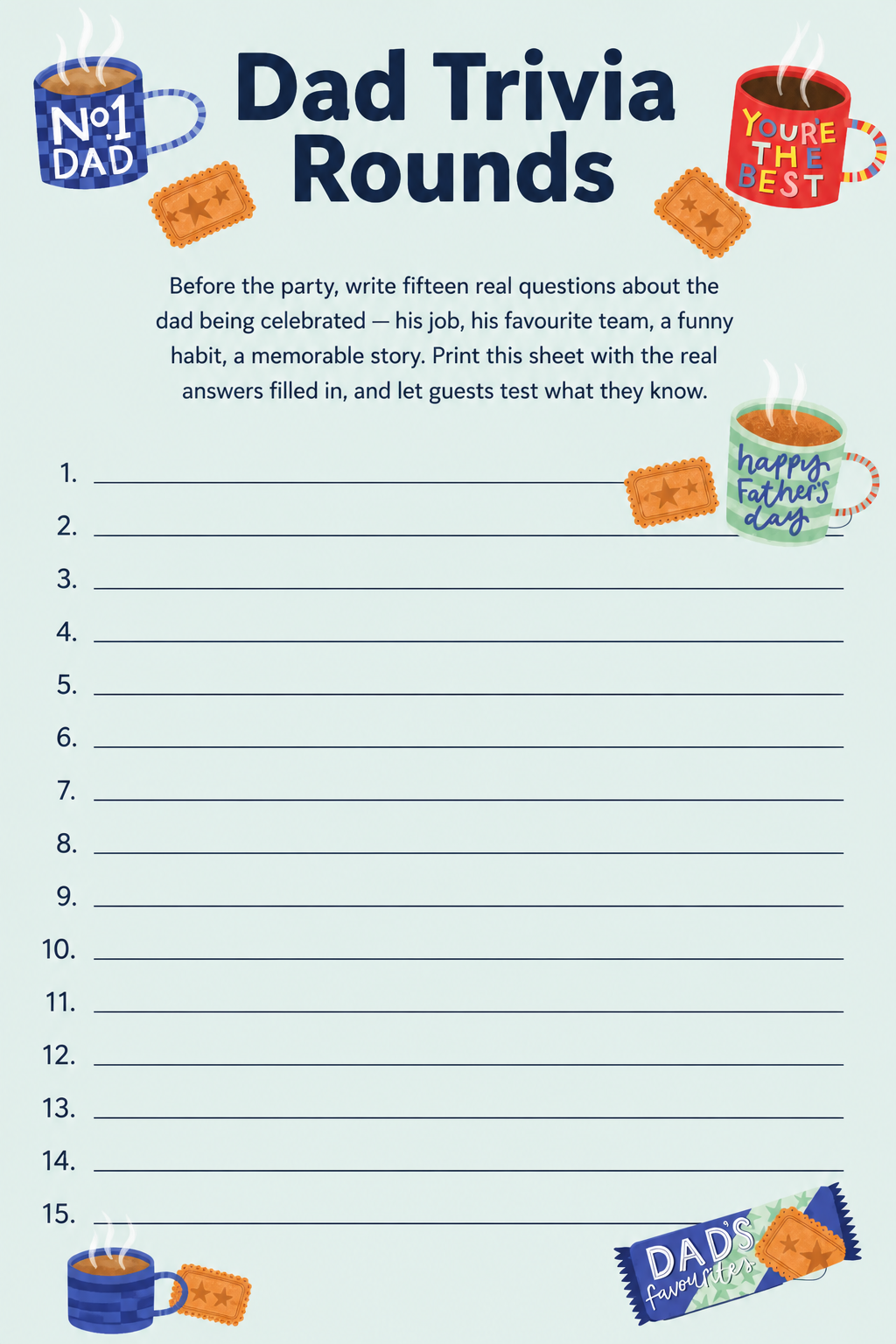
Dad Trivia Rounds uses a printed multi-round sheet to run a proper pub-quiz-style trivia game built around fatherhood, family history, and topics that dads typically love — sports records, DIY facts, famous fathers from history, and a wild-card round that changes depending on what your particular crowd enjoys.
Teams of two to four people work through each round simultaneously, writing answers on their sheets without shouting them out.
A round timer of about three minutes per section keeps things moving and stops any one team from debating endlessly over the answer to a 1980s football question.
At the end of each round, teams swap sheets with the team beside them and mark the answers as the host reads them out.
Running scores are kept on a shared scoreboard — a piece of paper taped to a fence post works fine — and the team with the most points after all rounds wins.
Build in a tiebreaker question ready to go, because teams finish level more often than you would expect. The game accommodates any group from eight people upward, and a full four-round game takes about thirty-five minutes.
Host tip: read each answer with a single sentence of context rather than just stating the correct word. “The answer is 1966 — the year England won the World Cup, which means some of your grandads watched it live” keeps even losing teams engaged and gives the game a sense of occasion.
4. Guess Dad’s Answer!
This game is the dynamic cousin of How Well Do You Know Dad, but the twist changes everything: instead of players guessing what Dad’s personal preferences are, Dad is presented with a list of scenarios and must predict what his own family members would guess he said.
It sounds straightforward until you realise that Dad has to hold two thoughts at once — what he actually believes, and what he thinks the room thinks he believes.
The printed sheet lays out fifteen to twenty scenario-style questions and gives Dad a column to fill in secretly while guests fill in theirs independently.
Scores are awarded to guests who match Dad’s written answer exactly, but a bonus point goes to any guest who correctly predicted not just Dad’s answer but the exact wording he used.
That bonus category sounds impossible until someone’s wife wins it three times running and the room goes wild. This works best with twelve or fewer players so the reveal of each answer can get the individual reaction it deserves.
Budget around twenty minutes and keep the energy up by having Dad read his own answers aloud rather than letting the host do it.
Host tip: include at least two questions where the obvious answer is something embarrassing but entirely PG — something like “What is Dad’s least favourite chore?” The laughter that follows his answer anchors the game in goodwill and stops it from feeling like an interrogation.

5. Tool Guessing Game
This one is a genuine crowd-pleaser that works brilliantly across age groups, especially when you have children in the room who have never seen a pipe wrench in their lives.
The printed sheet shows images or written descriptions of real tools — from the familiar hammer and tape measure right through to a basin wrench, a spirit level, and a Japanese pull saw — and players must name each tool and write down what it is used for.
Points are awarded for correct identification, with a bonus point if the use description is accurate and specific rather than vague.
You can run this purely from the printed sheet as a solo or team exercise, or amplify it by placing actual tools on a table and having players match the physical object to the sheet.
The physical version works especially well outdoors because kids can touch and inspect the tools, which makes the learning feel genuine rather than academic. Either format plays in around fifteen minutes.
Works for groups of any size, and it naturally generates conversation between dads and children about what each tool actually does.
Host tip: include one or two very obscure tools that even experienced DIYers might not name correctly — an oil filter wrench or a card scraper, for instance. It levels the playing field unexpectedly and means Dad does not automatically win just because he owns a garage.

6. Backyard Ring Toss
Ring toss needs almost no introduction, but the Father’s Day version earns its place here because it is genuinely one of the most inclusive outdoor games you can run.
Set up a row of five or six pegs or bottles at varying distances — the closest worth one point, the furthest worth five — and give each player a set of five rings.
Players take turns tossing from a fixed line, and scores are tallied over three rounds. The simplicity is exactly what makes it work: a four-year-old and a seventy-year-old can play in the same round without anyone feeling patronised.
You can run it as a straight individual competition, as a doubles format pairing the youngest available family member with the oldest, or as a full elimination bracket if your group is large enough.
A bracket tournament format works nicely for twenty or more guests and can run comfortably in the background while food is being prepared, with rounds taking only five minutes each.
All you need is a ring toss set, which you can buy inexpensively or improvise with rope rings and garden stakes.
Host tip: anchor your pegs or bottles firmly before the game starts. On any surface with a slight slope or soft turf, the targets shift after the first few throws and disputes about whether a ringer really counted will derail the whole afternoon faster than you would think.
🛍 Shopping guide
7. Photo Timeline Match
In the days before the party, gather ten to fifteen photographs of Dad taken across his lifetime — baby photos, school pictures, awkward teenage shots, the photo from his first job, the one from a family holiday in the mid-nineties.
Print them out without dates and number each one.
The printed Photo Timeline Match sheet gives guests a numbered grid and asks them to arrange the photos in chronological order, then answer a short question about each one: “How old do you think Dad was here?” or “Where was this taken?”
The reveal moment is the real magic. Go through the photos in correct chronological order and let Dad narrate each one briefly — the story behind a particular haircut, or why he is holding a fish he clearly did not catch himself.
Guests score points for correct ordering and bonus points for accurate age guesses within two years. This works for any group size and takes about twenty-five minutes all in, including Dad’s narration, which guests genuinely want to hear.
It doubles as a lovely piece of family storytelling.
Host tip: ask a sibling or long-term family friend to secretly label the photos with the correct year before you number them for the game. You will need the answer key during scoring and you do not want to be hunting through old albums mid-game while thirty people wait.

8. Dad Would You Rather
Would You Rather is a game that has been entertaining families on long car journeys for decades, and the Father’s Day version sharpens the premise by writing every question specifically around dad-life dilemmas.
The printed sheet presents twenty to twenty-five carefully chosen scenarios — “Would you rather mow the lawn every week for a year or cook every meal for a month?”
or “Would you rather know every sports score before it happened or never have to sit in traffic again?” — and players circle their answer for each one before the group compares results.
The best version of this game uses Dad’s own answers as the benchmark: guests who match the majority of Dad’s choices score a point per match, and the person whose thinking aligns most closely with Dad wins.
But you can also play it purely as a conversation starter with no scoring at all, which works beautifully as a warmup game before food or as a way to fill a lull in the afternoon.
Any group size works, and it takes about fifteen minutes with scoring or as long as the conversation runs without it.
Host tip: include two or three questions that are specific to your own dad’s known preferences — inside jokes, running family arguments, or longstanding debates — because those questions generate ten times more laughter than any generic option on the sheet.

9. Corn Hole Tournament
Corn hole is a staple of outdoor celebrations for very good reason.
Two boards are set up facing each other roughly twenty-seven feet apart, and players take turns tossing bean bags — four per side — aiming to land on the board for one point or drop one through the hole for three.
Standard scoring uses cancellation rules, meaning only the net score between the two teams counts each round. First team to reach twenty-one points exactly wins the leg, and you can run as many legs as time allows.
For a Father’s Day tournament, bracket everyone into pairs, mix generations deliberately so that a grandad is partnered with a grandchild wherever possible, and run a single-elimination bracket on a piece of paper taped to the fence.
The bracket format means people who are knocked out early still have something to watch and cheer for, and the final match almost always draws a crowd. Budget about ninety minutes for a full eight-team bracket, or forty-five for a four-team version.
All you need is a corn hole set.
Host tip: set the boards on level ground and check that the hole is not obstructed by a lip of peeling paint or a warped board edge before the tournament starts. A bag that bounces back out of the hole because of a manufacturing flaw will cause exactly the kind of argument that follows a family barbecue into September.
🛍 Shopping guide
10. Wishes for Dad Cards
Wishes for Dad is part game, part keepsake, and the printable sheet is what makes it both.
Each guest receives a card to complete — filling in prompts like “My favourite memory with you is…”, “The thing I want to thank you for is…”, and “My wish for you this year is…” — working quietly and independently for about five minutes.
The cards are then folded, collected, and read aloud one by one by the host while Dad listens without knowing who wrote which card until the very end of the reading.
The guessing element — Dad tries to identify the author of each card before it is revealed — turns a sentimental moment into a genuine game with light scoring.
Dad scores a point for each correct guess; guests score a point if Dad cannot identify them. It sounds simple, but the combination of laughter and genuine emotion makes it one of the most memorable moments of any Father’s Day party.
It works for any group size from four people up, and the whole activity takes about twenty minutes. The completed cards make a beautiful keepsake that Dad can keep.
Host tip: make sure younger children get a little help with the writing prompts if needed, and tell them in advance that their card will be read out — otherwise some kids go very quiet when they realise what they have written is about to be shared with the whole family, and the resulting shyness disrupts the flow.

11. Dad’s Emoji Pictionary
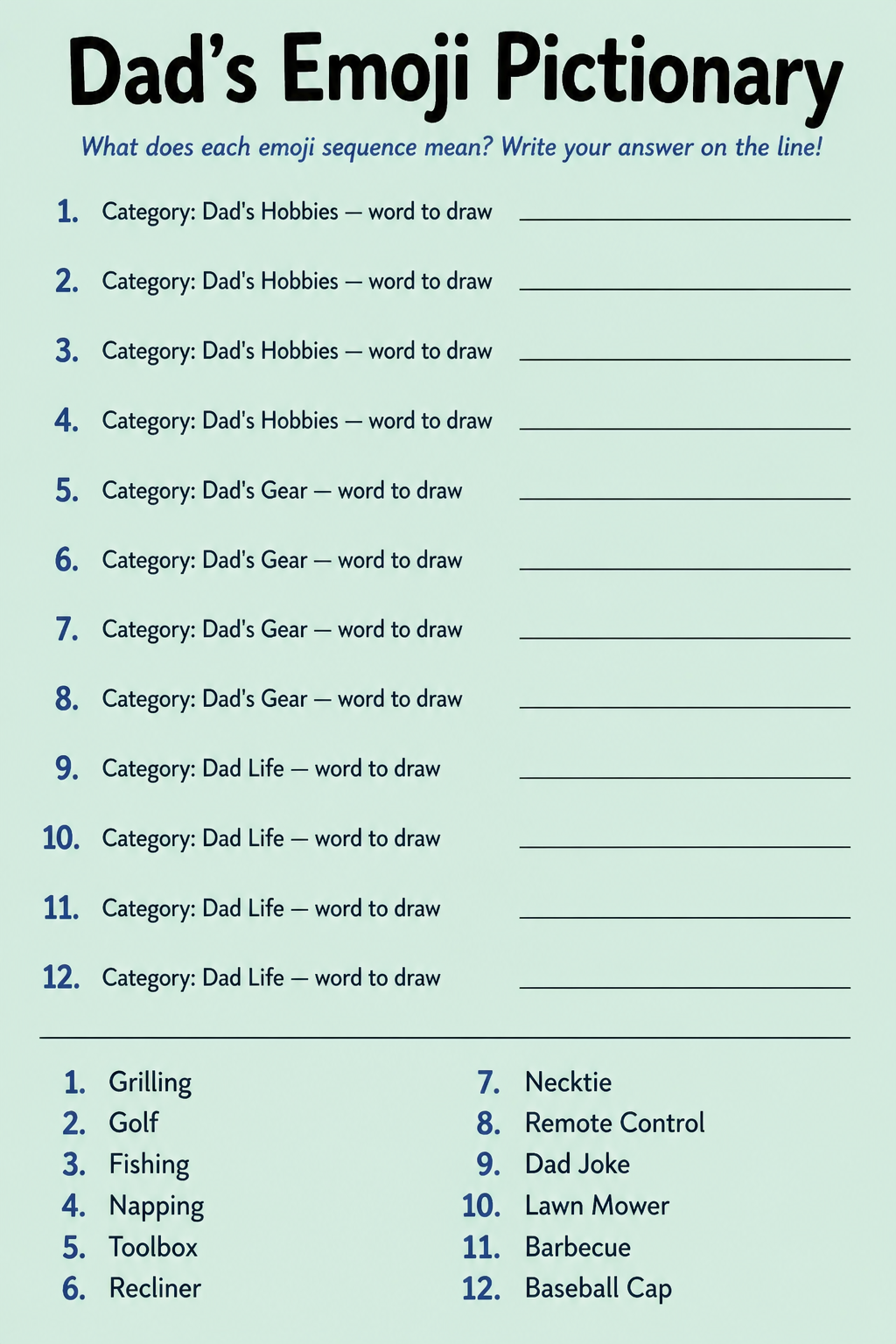
This is not an emoji-decode or rebus game — there are no phrases hidden in strings of pictures. Instead, Dad’s Emoji Pictionary works like classic pictionary but uses a printed sheet of emoji as drawing prompts.
Each prompt is a single, unambiguous subject — a barbecue grill, a fishing rod, a lawnmower, a sports trophy — represented on the sheet by its corresponding emoji so that even non-readers can participate.
Players take turns drawing the subject on a whiteboard or large notepad while their team tries to call out the correct answer within sixty seconds.
The printed sheet acts as a prompt deck for the person drawing, keeping the game organised and ensuring nobody debates whether a subject was fair. Divide guests into two or three teams of roughly equal size, and alternate which team draws each round.
Award one point for each correct guess within the time limit. The game runs beautifully for groups of eight to twenty players and takes about thirty minutes for a full game.
It is especially good for mixed-age groups because younger children are often faster at identifying the subject than adults who overthink the drawing.
Host tip: give the drawer five seconds to look at their prompt and mentally plan their sketch before the timer starts. Watching someone stare blankly at a page for fifteen seconds before making a single confused line wastes the whole team’s time and kills the energy in the room.
🛍 Shopping guide
12. Dad’s This or That
This or That is a fast, low-pressure game that works brilliantly as an icebreaker or between two more demanding activities.
The printed sheet presents fifty pairs of options — morning or evening, mountains or beach, grill or stovetop, power tools or hand tools — and every player, including Dad, circles their preference for each pair simultaneously.
Once everyone is done, the host calls out each pair and everyone holds up their sheet or simply raises a hand for their chosen option.
The room divides, arguments break out in the best possible way, and Dad gets to stand up and justify every one of his choices to increasingly incredulous family members.
Scoring is optional. You can play it purely as a conversation generator, or you can award points to guests whose answers match Dad’s and find out who really knows his preferences best.
The latter version plays in about fifteen minutes; the unscored version can fill a comfortable forty-five minutes of pre-dinner conversation without anyone noticing how much time has passed. It accommodates any group size and requires nothing beyond the printed sheet and a pen per person.
Host tip: write three or four bespoke “This or That” pairs specific to your family’s own running debates and slip them into the middle of the sheet. “Football on the big TV or cricket on the radio?” or “Holiday cottage or camping?” will get a louder reaction than any generic option and makes the game feel tailored rather than downloaded.

13. Dad’s Greatest Hits Mad Libs
Mad Libs is a timeless format for a reason: you fill in blanks with words you choose before hearing the story, and the resulting sentences are reliably absurd.
Dad’s Greatest Hits Mad Libs uses a printed story template built around classic dad moments — fixing something around the house, falling asleep during a film, giving legendary driving advice — and asks players to supply the missing nouns, adjectives, and verbs before the full story is read aloud.
The player filling in the blanks hears only the word category, not the surrounding sentence, so the combination of their choices and the actual context produces results that range from mildly silly to completely ridiculous.
You can run one sheet per player and read all of them aloud at the end — which works well for smaller groups and gives you multiple stories — or run it as a single group sheet where different guests shout out each word in turn, which works better for larger gatherings and keeps everyone involved simultaneously.
Either way, reading the finished story aloud is the payoff, and it reliably produces the kind of collective laughter that brings a party together. Budget ten to fifteen minutes per sheet. Works for any group size from four upward.
Host tip: read the completed story with the full theatrical commitment it deserves. A flat, deadpan delivery kills the format — you need to play it completely straight, as if you are reading a serious biography of Dad, and let the absurdity of the language do the work. The slower and more sincere you sound, the funnier it gets.

14. Backyard Bocce Ball
Bocce is one of those lawn games that looks leisurely but generates quietly fierce competition among people who have played it before, and it is accessible enough that first-timers are competitive within two rounds.
One player throws the small target ball — the pallino — and each team then takes turns rolling their larger bocce balls as close to the pallino as possible.
The team with the ball nearest to the pallino at the end of each round scores one point for every one of their balls that is closer than the opposing team’s nearest ball. First team to twelve points wins.
For Father’s Day, run it as a doubles or triples game and pair generations deliberately — grandad and grandchild versus dad and teenager, for instance — which naturally creates cross-generational conversation during the slow, thoughtful moments between throws.
The game is ideal for grass or gravel surfaces and takes about forty minutes for a full game between two teams.
It is relaxed enough to play while holding a drink and a conversation, which makes it the perfect background activity for the middle hour of a long afternoon.
Host tip: establish before the game starts exactly who is responsible for measuring disputed balls. If two balls look equidistant from the pallino, you need a tape measure and a single designated person to call it, or every close round descends into a group argument where nobody agrees and nobody is technically wrong.
🛍 Shopping guide
15. Two Truths and a Dad Lie
This is the classic two-truths-and-a-lie format rebuilt specifically around dads and their famously implausible life stories. Each dad in the group — and any other willing participant — prepares three statements about themselves: two genuinely true and one convincing lie.
The lie should be in the same territory as the truths, meaning it should sound plausible rather than obviously ridiculous.
Other players vote privately on which statement they believe is false, then the dad reveals the answer and scores a point for every person they successfully fooled.
What makes the Father’s Day version especially rich is that dads have usually accumulated enough genuinely strange life experience that their true stories are harder to believe than the lies.
The dad who really did once get lost in a national park, really did attempt to rewire his own kitchen, and really did once meet a minor celebrity at a petrol station is going to fool everyone with ease.
This works for groups of six to twenty, takes about twenty-five minutes for a full round where every adult plays, and requires nothing beyond a few minutes of preparation per player.
Host tip: encourage dads to prepare their three statements the night before rather than on the spot.
The lies that are invented in thirty seconds are always obvious, but a lie that has been thought through carefully — one that fits neatly into the same register as the true stories — will fool even family members who think they know everything about that person.
16. Lawn Bowling Skittles
Lawn skittles is a brilliant outdoor game that requires almost no equipment beyond a set of lightweight pins and a ball, and it plays fast enough that you can run a full round-robin tournament in under an hour.
Set up nine or ten pins in a diamond or triangle formation on a flat patch of grass, mark a bowling line about six metres back, and players take turns rolling the ball to knock down as many pins as possible in two rolls.
Classic tenpin scoring keeps it familiar, or you can use a simpler “count the pins knocked flat” system for younger players.
For Father’s Day, run it as a father-child pairs tournament where each pair combines their scores across three frames to produce a team total.
This format is especially kind to younger children because a child who knocks over two pins contributes genuinely to the team score rather than dragging a competitive parent down. Budget about forty-five minutes for a four-team round-robin.
The game works on any reasonably flat grass surface, and the pins reset quickly enough that there is no dead time between turns.
Host tip: bring a small brush or cloth to wipe the ball between turns if you are playing on damp morning grass. A wet ball on a slightly downward slope will curve dramatically and hit nothing, and after the third consecutive gutter-equivalent in a row, even the most patient crowd starts to check their phones.
🛍 Shopping guide
17. The Price Is Dad
Channel the spirit of a classic pricing game show for this one.
In the days before the party, collect the receipts or price tags from fifteen to twenty everyday household items that Dad typically buys — a specific brand of barbecue sauce, a box of his favourite teabags, a packet of screws, a litre of engine oil, a garden hose nozzle.
Present each item one at a time, and players write down what they think it costs without going over. The closest guess without exceeding the real price wins that round. Run all fifteen items and the player with the most round wins takes the game.
The game works on two levels simultaneously: it is a genuine test of household price awareness, and it is also a subtle and rather amusing commentary on which family members have absolutely no idea what things cost.
Children who have never bought a tube of silicone sealant will guess wildly, which is funny. Adults who have similarly never bought a tube of silicone sealant but confidently guess wildly are funnier still.
The game takes about twenty minutes and works for any group of six or more people. No printed sheet is needed — just a notepad per player and the items themselves.
Host tip: include one or two items that are genuinely surprising in price — something cheap that looks expensive, or something expensive that looks like it should cost nothing.
The gasps of disbelief when the real price is revealed are the emotional high point of the game and give you a natural talking point that carries the energy forward into the next round.
18. Sack Race Relay
No Father’s Day garden party is complete without at least one activity that gets everyone physically ridiculous, and the sack race relay delivers that in the most straightforward possible way. Divide guests into teams of four to six, mixing ages as much as you can.
Each player climbs into a sack — or a large pillowcase, which works just as well — and hops to a turning cone and back before handing the sack to the next team member.
The relay format means everyone races only once, which is manageable even for grandads, and the team element means individual stumbles are forgiven and collectively laughed about.
Run three heats and keep a running team score, or go straight to a final. The game takes almost no time to explain, requires minimal equipment, and produces exactly the kind of chaotic, photogenic moments that everyone will talk about afterwards.
It works for any outdoor space large enough for a ten-metre straight, takes about twenty minutes including heats, and is genuinely more fun with a larger crowd cheering from the sidelines.
Ages four to seventy-four can all participate in the same race without anyone being at an unfair disadvantage — hopping in a sack is an equaliser of magnificent efficiency.
Host tip: test your sacks or pillowcases the morning of the party to make sure none of them have splits along the seam.
A sack that tears apart the moment a competitive dad commits to full speed will stop the game cold, and the replacement search always takes longer than it should when twenty people are standing in the sun waiting.
🛍 Shopping guide
Frequently Asked Questions
How many Father’s Day games should I run at a typical backyard party?
Three to five games is the sweet spot for most backyard gatherings. Run one seated icebreaker as guests arrive, one or two active outdoor games during the main afternoon, and a sentimental closer like Wishes for Dad Cards before the day winds down.
Having more games planned than you need is always wise — you can skip one if the energy is naturally high — but trying to squeeze in eight or nine games leaves everyone feeling rushed rather than entertained.
What Father’s Day games work best when the age range is very wide?
Games that do not require reading or fine motor skills at one end, or athletic ability at the other, are your best options. Ring Toss, Corn Hole, and the Sack Race Relay all scale naturally across ages.
For seated games, Dad Would You Rather and This or That work because they have no wrong answers and younger children can simply pick a side and participate confidently.
Avoid anything with a reading-heavy printed sheet as the primary mechanic if you have guests under six or over eighty.
Do I need to print all the printable games in advance?
Yes — print everything at least the evening before the party. Morning-of printing almost always encounters a low-ink warning, a paper jam, or a file that will not open, and scrambling with a printer while guests arrive is a miserable way to start Father’s Day.
Print a few extra copies of each sheet beyond your headcount, because someone always makes an error and wants a fresh copy, or an unexpected guest turns up who needs their own sheet.
Can these Father’s Day games work indoors if the weather turns?
Most of them translate indoors without any modification at all. Every printable game is naturally indoor-friendly. Two Truths and a Dad Lie, Dad Joke Contest, Dad’s Greatest Hits Mad Libs, and The Price Is Dad all work perfectly around a dining table.
The lawn games — Ring Toss, Corn Hole, Bocce Ball, Lawn Skittles, and the Sack Race Relay — do need outdoor space, but if you have a garage or a large living room, scaled-down indoor versions of Ring Toss and Skittles are manageable with soft foam equipment.
Should Dad know about the games in advance?
For the printable games that require Dad’s private answers — How Well Do You Know Dad and Guess Dad’s Answer in particular — Dad needs to complete his sheet beforehand, so he will know those games are coming.
For everything else, keeping it a surprise adds to the occasion. The element of being celebrated publicly, of having games built around his life and preferences, lands much better when Dad walks into it without fully knowing what to expect.
📌 Save These for Later
Loved these? Pin your favorite image below so you can find this list again when you’re planning.



This post contains affiliate links. If you buy something through these links, I may earn a small com

My mother-in-law is not a crier. She’s the woman who got through her own son’s wedding s
The most beautiful gift at the shower — the one wrapped in tissue paper with the coordinating
Leave a Reply