

The Fourth of July and blazing sunshine go hand in hand, which means you need a lineup of games that keeps kids moving, laughing, and — most importantly — cool. Whether you are hosting a backyard barbecue, a neighborhood block party, or a low-key family gathering, the right mix of water games, active races, and printable activities can turn an ordinary afternoon into the highlight of the whole summer. These eighteen games are designed for children aged four to ten, so every kid from wobbly preschoolers to confident third-graders can jump right in.
You will find wet and wild water games to battle the heat, relay races that burn off every last bit of energy, and printable sheets that give kids a calm moment in the shade before they sprint back into the action. We have organized the list so you can pick just two or three games or run the whole party from start to finish. Grab your red, white, and blue decorations, fill up the cooler, and get ready for the best Fourth of July your kids have ever had.
This post contains affiliate links — if you buy through them, I may earn a small commission at no extra cost to you.
Table of Contents
- Water Balloon Piñata
- Sponge Relay Race
- Patriotic Picture Bingo
- Flag Colour Sorting Race
- Star Bean Bag Toss
- Fourth of July I Spy Sheet
- Sprinkler Freeze Dance
- Firecracker Pop Race
- Parade Decorating Contest
- Red White and Blue Colour by Number
- Bubble Chase
- Summer Scavenger Hunt
- Red White and Blue Trivia Challenge
- Patriotic Memory Match Cut and Play
- Patriotic This or That!
- Wet Sponge Bullseye
- Patriotic Parachute Color Wave
- Patriotic Sock Toss Ring Game
1. Water Balloon Piñata
Hang a bunch of filled water balloons from a low tree branch or a rope strung between two poles at roughly shoulder height for the youngest player. Kids take turns putting on a blindfold, spinning three times, and swinging a foam pool noodle at the dangling balloons. When a balloon bursts, everyone nearby gets a refreshing splash — which, on a hot July afternoon, feels like the best prize in the world. Keep the blindfold portion brief for very young children; it is perfectly fine to let four- and five-year-olds skip the spin and simply swing freely.
You will need water balloons, a rope or clothesline, foam pool noodles, and a blindfold. Aim for at least three balloons per child so no one misses out. This game works beautifully for groups of six to twenty kids, and each round takes about two minutes per player, so the full game usually wraps up in fifteen to twenty minutes. Set a towel station nearby because everyone will be dripping by the end.
Host tip: Pre-fill all the balloons the morning of the party and store them in a large plastic bin with a little water in the bottom to keep them from drying out and cracking before the game starts.
🛍 Shopping guide
2. Sponge Relay Race
Divide players into two or more teams and line each team up in a single-file row. Place a large bucket of water at the front of each line and an empty bucket at the back. The first player soaks an oversized kitchen sponge in the full bucket, then passes it over their head to the next child, who passes it between their legs, and so on in an alternating over-under pattern all the way down the line. The last player squeezes whatever water remains into the empty bucket before running to the front to start the next round.
After a set number of rounds — or a set time limit like three minutes — the team with the most water in their back bucket wins. You need one large sponge per team, two buckets per team, and enough water to refill the front buckets a couple of times. Teams of four to eight players work best, and the game plays out in about ten minutes. The relay format means everyone is active and engaged the whole time, with no one standing around waiting for a turn.
Host tip: Use the biggest, thickest sponges you can find — the car-washing kind hold far more water than kitchen sponges and make the soaking and squeezing much more satisfying for little hands.
🛍 Shopping guide
3. Patriotic Picture Bingo
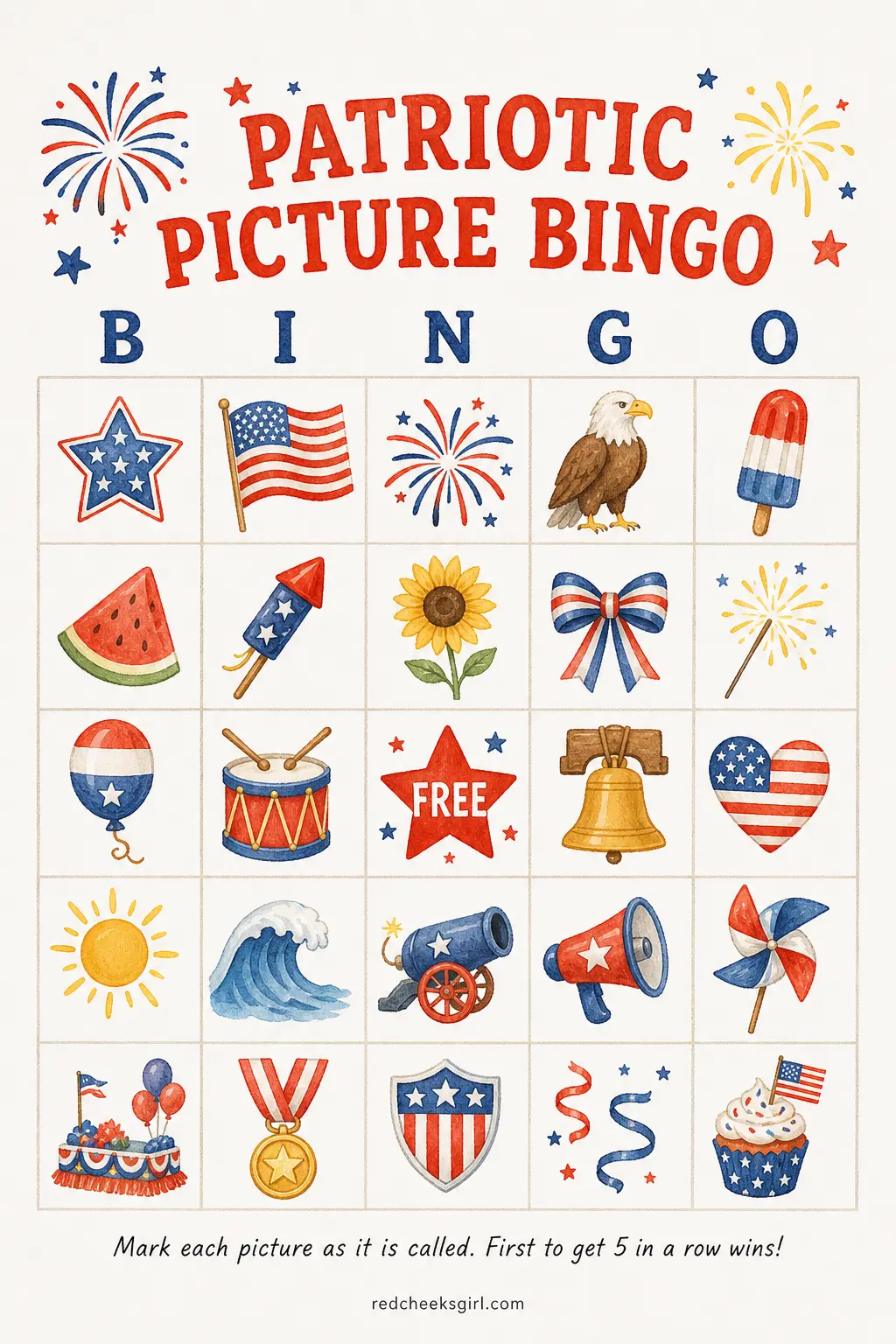
This printable bingo game swaps numbers for cheerful Fourth of July pictures — think stars, flags, fireworks, popsicles, eagles, and sparklers. Print one unique card for each player, which the sheet is already designed to provide, and cut out or prepare a matching set of caller cards. A host or older child draws one caller card at a time, holds it up or names it, and everyone searches their bingo card for that image and covers it with a penny, a dried bean, or a small star sticker.
The first child to cover five squares in a row — horizontally, vertically, or diagonally — shouts “Bingo!” and wins a small prize. Because the images are pictures rather than numbers, children as young as four can play without any reading ability required. The game supports groups of two to twenty players and takes around fifteen minutes per round. Running two or three rounds keeps everyone happy and gives more children a chance to win.
Host tip: Laminate a few bingo cards and use dry-erase markers as daubers so you can wipe them clean and replay the game multiple times throughout the day without reprinting.
🛍 Shopping guide
4. Flag Colour Sorting Race
Set up three large containers or hula hoops on the ground, one labeled RED, one WHITE, and one BLUE, using simple paper signs or colored tape. Fill a basket with an assortment of everyday objects or craft pom-poms in red, white, and blue. On “go,” children race to grab one item at a time from the basket and place it in the matching colored container. The child who correctly sorts the most items before the timer buzzes wins the round.
This game is especially perfect for the four- to six-year-old crowd because it reinforces color recognition while keeping little legs running. You will need pom-poms or small colored objects, three baskets or hula hoops, labels, and a one-minute sand timer or phone timer. Groups of two to eight work well for this setup, and each round takes only a couple of minutes, so you can run several back-to-back rounds or set it up as a station at a party with many activities happening at once.
Host tip: Add a handful of purple or green items to the mix as friendly decoys — children who get excited and toss the wrong color into a bin have to retrieve it and find the correct one, which adds a fun extra layer of thinking to the race.
🛍 Shopping guide
5. Star Bean Bag Toss
Cut or purchase five-pointed star shapes from foam board or plywood and paint them red, white, and blue. Lean them against a fence or prop them up with stands, each one with a hole in the center just large enough to toss a bean bag through. Assign point values to each star — closer stars are worth fewer points, farther stars are worth more — and let each player take three to five throws per turn. Tally scores on a whiteboard or chalkboard between rounds.
Bean bag toss is endlessly adjustable: move the throwing line closer for younger children and farther back for confident throwers, so every age group gets a genuine challenge. You need foam or wooden star targets, bean bags, and a way to keep score. The game handles two to twenty players easily since kids simply wait in a short line for their turn, and a full rotation through the group takes about ten to fifteen minutes. Decorate the targets with star stickers or patriotic streamers to tie the look into your Fourth of July theme.
Host tip: If a purchased toss set does not come in patriotic colors, a few coats of inexpensive acrylic craft paint transform plain wooden targets in under an hour — just let them dry overnight before the party.
🛍 Shopping guide
6. Fourth of July I Spy Sheet
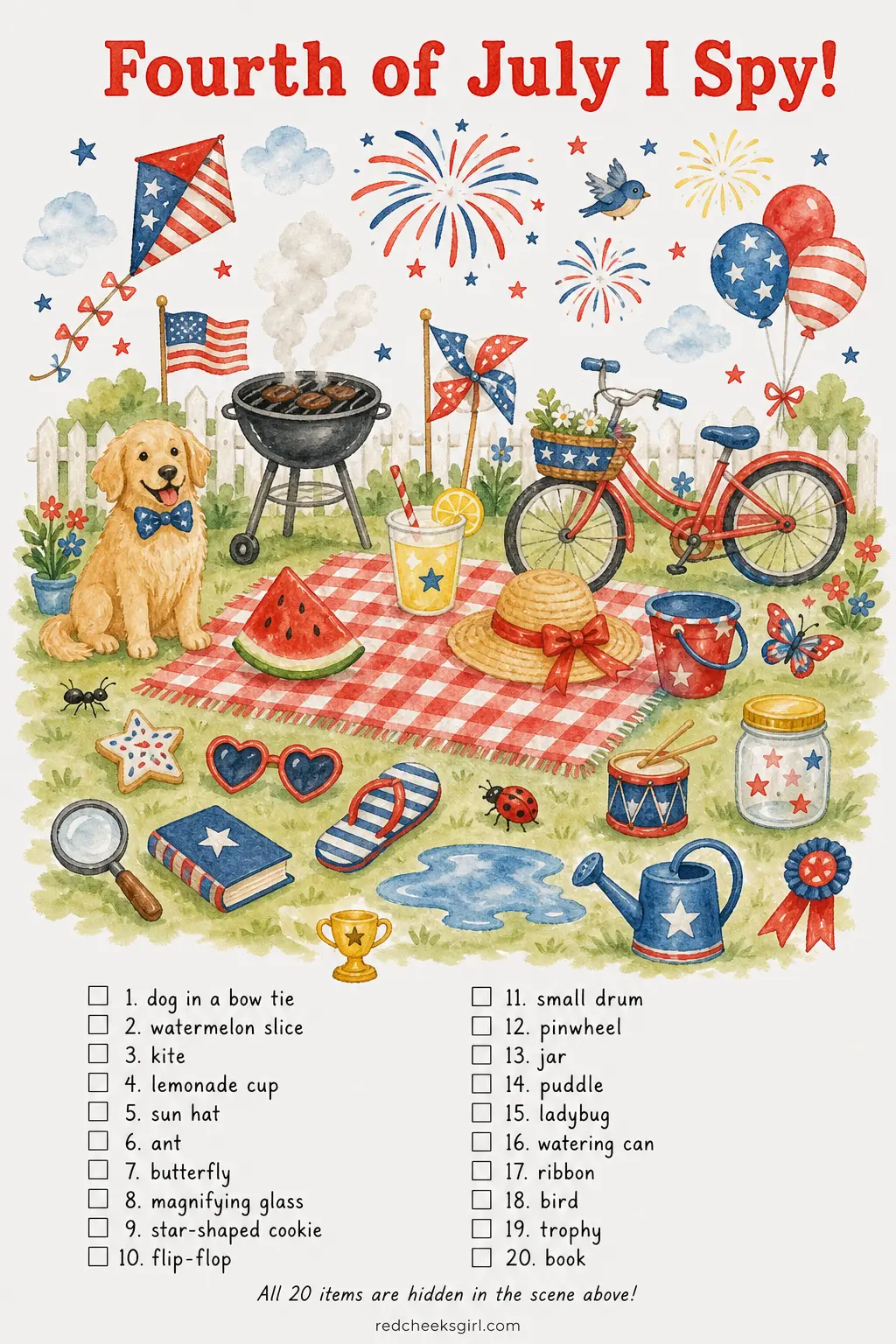
Print one “Fourth of July I Spy!” sheet for each child. The sheet features a busy, colorful scene crammed with patriotic objects — flags, stars, firecrackers, drums, balloons, and more — and lists a set of items along the side that players must find and count within the picture. Kids circle or tally each item they spot, writing the total in the box next to it. The child who finds and correctly counts the most items wins, though playing cooperatively and comparing answers works just as well for younger groups.
This is a perfect activity to hand out while kids are waiting for food, cooling off in the shade, or winding down after a big relay race. No materials are needed beyond the printed sheet and a pencil or crayon. It works for one child or a whole group of twenty, and most kids complete the sheet in five to ten minutes. Because it is self-contained and quiet, it doubles as a brilliant tool for settling an over-excited crowd before you transition to the next game.
Host tip: Print a few extra copies and tape them to clipboards — clipboards make kids feel official and keep the paper from blowing away in the breeze, which matters more than you might think on a breezy July afternoon.
🛍 Shopping guide
7. Sprinkler Freeze Dance
Set up one or two lawn sprinklers in an open grassy area and connect them to the hose. Play upbeat patriotic music — marching band tunes, festive pop songs, anything with a strong beat — and let children dance freely in and around the sprinkler spray. Whenever the music stops, every child must freeze instantly, even if the cold water is hitting them directly. Anyone who keeps moving or lets out more than a small surprised giggle is out for that round.
Last child still in the game wins, but the real prize is that everyone gets soaked and cooled down regardless of who is eliminated. You need at least one oscillating sprinkler, a garden hose, a speaker or phone for music, and a quick finger on the pause button. Any group size works, and the game usually lasts ten to fifteen minutes with enough rounds for multiple winners. Play multiple rounds so eliminated players never wait long before jumping back in.
Host tip: Position yourself to watch the whole play area when you control the music — children near the edge of the sprinkler range will try to step out of the water during freezes, so standing where you can see everyone keeps the game honest and fun.
🛍 Shopping guide
8. Firecracker Pop Race
Blow up red, white, and blue balloons and scatter them across a large grassy area. Divide children into three teams — one red, one white, one blue — and at the signal each team races to stomp and pop as many balloons of their assigned color as possible before the timer runs out. Only stomping is allowed; no hands, no sitting on the balloon. When all the balloons of one color are gone or the timer sounds, count the deflated scraps to determine which team popped the most.
This game is gloriously chaotic in the best way, burning off enormous amounts of energy in a short burst. You will need plenty of pre-inflated balloons in three colors, a timer, and a wide open space free of sharp objects. Teams of three to eight kids each work well, making this a great pick for parties of ten to twenty-five. Always collect all balloon scraps immediately after the game to prevent younger children from putting pieces in their mouths.
Host tip: Inflate balloons the night before and store them in large garbage bags — blowing up forty balloons on the morning of a party while also managing everything else is the kind of stress that is entirely avoidable.
🛍 Shopping guide
9. Parade Decorating Contest
Give each child a plain cardboard box, a bike, a wagon, or a simple cardboard frame to wear as a “float costume,” along with a pile of supplies: streamers, stickers, foam stars, construction paper, tissue paper, and tape. Set a fifteen-minute decorating timer and challenge everyone to create the most spectacular patriotic parade float they can. When the timer ends, kids line up for a mini parade around the yard or driveway, showing off their creations to cheering grown-ups.
Award every participant a small ribbon or certificate so no child goes home empty-handed — the joy here is in the making and the showing-off, not in competitive ranking. You need decorating supplies, cardboard boxes or wagon frames, and a short parade route. The activity suits groups of three to twelve children and the whole thing, decorating plus parade, runs about twenty-five to thirty minutes. This is a wonderful opener to the day’s festivities because it gets kids invested in the patriotic theme right from the start.
Host tip: Pre-cut streamers into manageable lengths and pre-tear pieces of tape and stick them along the edge of the table before kids sit down — this prevents the decorating time from turning into a fifteen-minute battle with the tape dispenser instead of an actual creative session.
🛍 Shopping guide
10. Red White and Blue Colour by Number
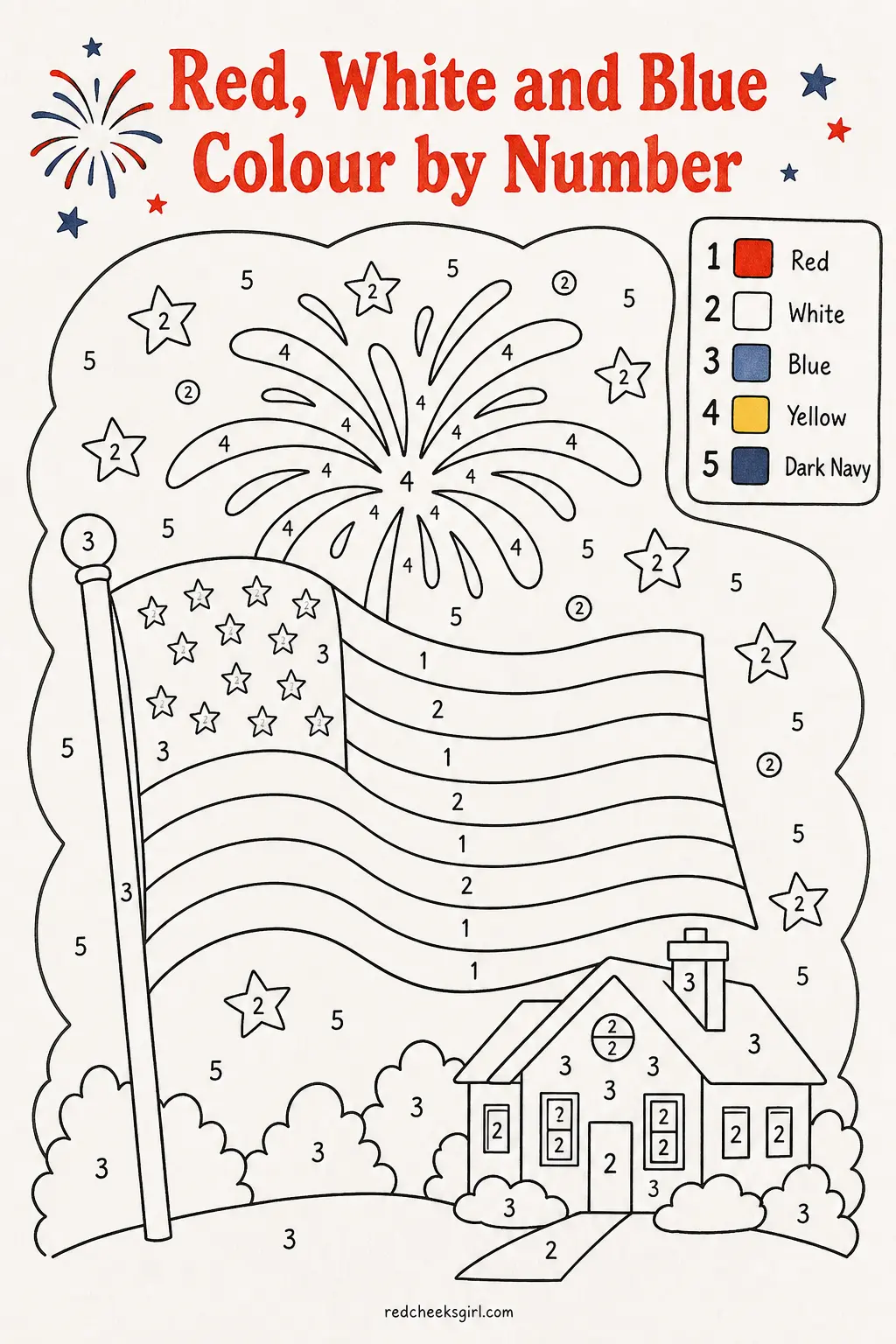
Print one “Red, White and Blue Colour by Number” sheet for each child. The sheet presents a patriotic illustration — perhaps a fireworks display, a waving flag, or a festive star burst — broken into numbered sections. Each number corresponds to a specific color: red, white, blue, and sometimes gold or black for outlines and details. Children color each section to reveal the hidden picture, with the finished result looking like a proper piece of patriotic artwork they can take home.
This printable is ideal for a calm mid-party activity, especially after a water game when kids need a few minutes to towel off and settle before the next big activity. All you need is the printed sheet and a set of crayons or colored pencils. It works for any group size from one to thirty and takes approximately ten to twenty minutes depending on the child’s age and how carefully they want to color. Hang the finished sheets on a fence or wall with clothespins for an instant patriotic gallery.
Host tip: Set up this station with a box of sharpened colored pencils rather than crayons — pencils give children better control in small numbered sections and reduce the frustration that comes from accidentally going outside the lines with a fat crayon tip.
🛍 Shopping guide
11. Bubble Chase
Have a host armed with a large bubble wand and a big bottle of bubble solution step into the middle of a grassy area and begin blowing a steady stream of bubbles. Children run, jump, and scramble to pop as many bubbles as they can before those bubbles touch the ground. Count out loud together as each bubble pops to build excitement, and switch to a new bubble blower every couple of minutes so different children get a turn making the bubbles too.
This is one of the gentlest games on the list, making it perfect for the youngest guests or for a cooldown moment between more intense activities. All you need is bubble solution and wands — the bigger the wands, the more spectacular the results. Any group size from two to twenty plays naturally, and the game can run for as long as the bubble solution holds out, typically ten to twenty minutes. Set up near the sprinkler area so popped bubbles leave a slight cool mist that feels wonderful on a hot day.
Host tip: Make your own extra-strong bubble solution by mixing six cups of water, one cup of dish soap, and one tablespoon of glycerin — the glycerin, available at any pharmacy, makes bubbles far sturdier and longer-lasting than anything you will get from a store-bought bottle.
🛍 Shopping guide
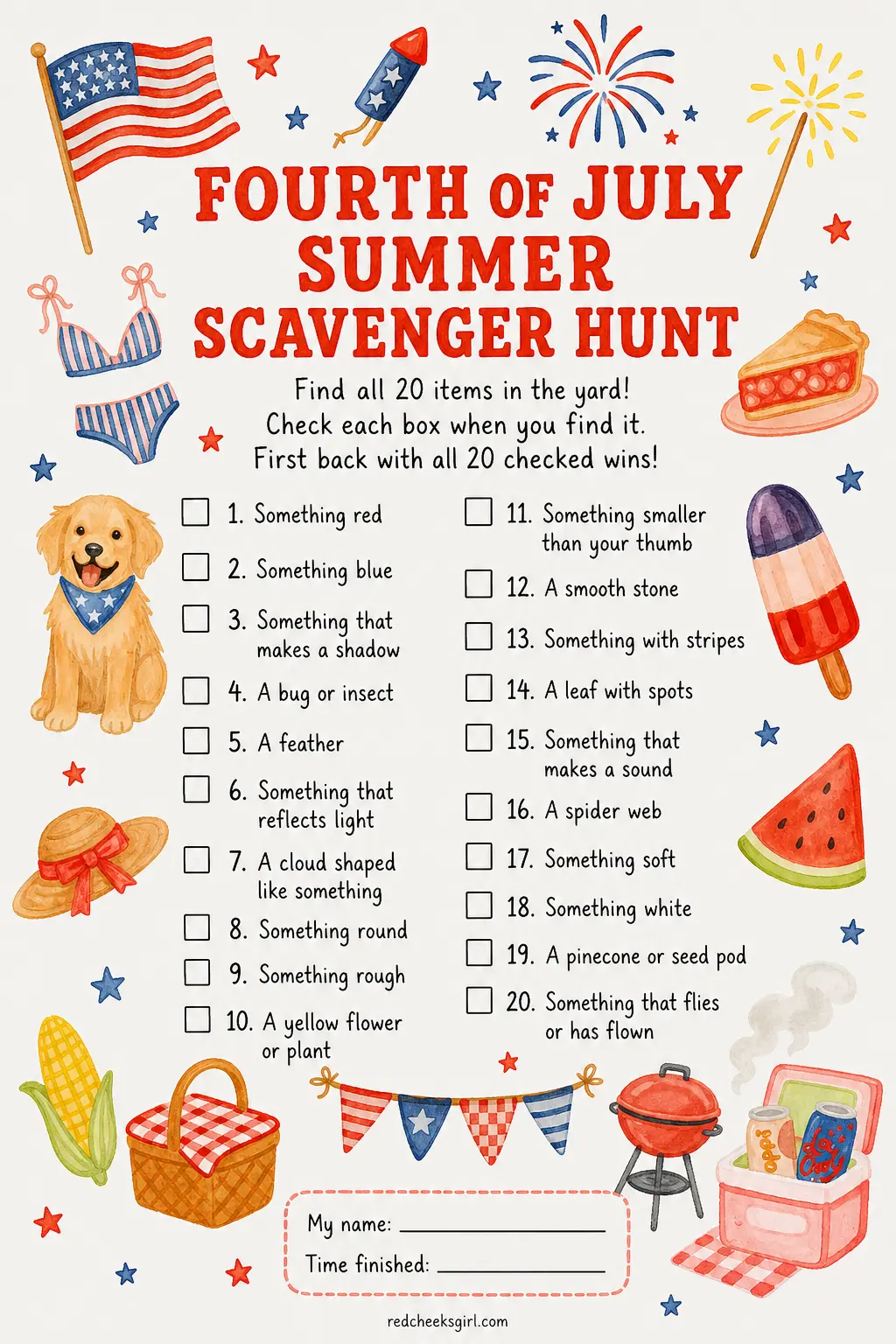
12. Summer Scavenger Hunt
Print one “Fourth of July Summer Scavenger Hunt” sheet for each child or team. The sheet lists a mix of things to find, spot, or do around the yard and party space — items like “find something red,” “spot a bird,” “find a leaf shaped like a star,” “count the number of American flags you can see,” and other summer and patriotic challenges. Children check off or circle each item as they find it, racing to complete the most items within the time limit.
You can run this as an individual race or pair younger children with older ones for a buddy-team format, which works especially well for mixed-age groups. Beyond the printed sheet and a pencil, no extra materials are needed, making it one of the easiest games on the list to set up. It suits groups of two to twenty and plays out in fifteen to twenty minutes. After the hunt, gather everyone together to compare lists and share the funniest or trickiest things they discovered.
Host tip: Before the party, do a quick walk around your yard and confirm that at least two-thirds of the items on the list are actually findable in your specific space — generic printable lists sometimes include things that simply do not exist in every backyard, and a child who cannot complete the list feels deflated rather than excited.
🛍 Shopping guide
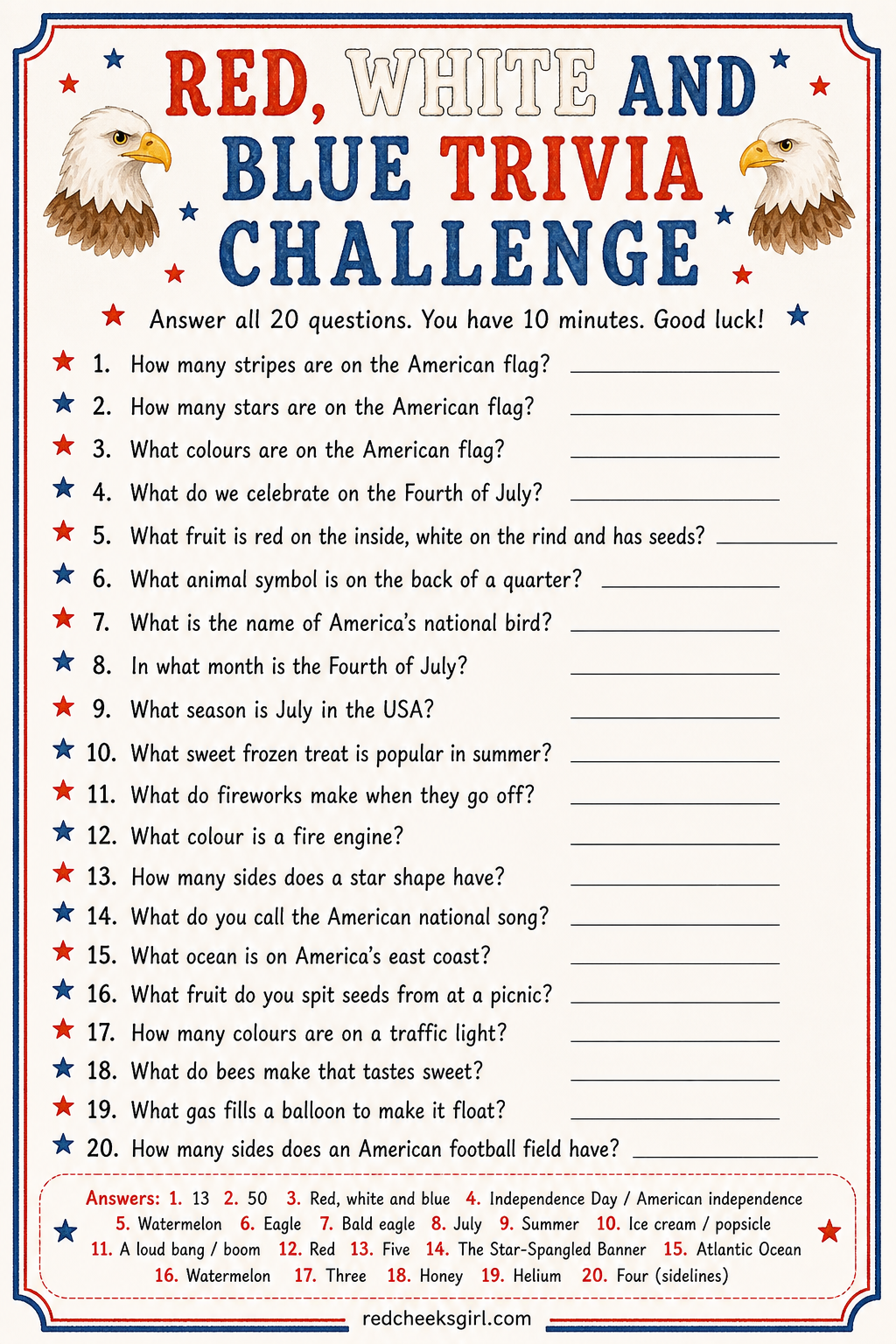
13. Red White and Blue Trivia Challenge
Print one “Red, White and Blue Trivia Challenge” sheet per player or team. The sheet presents a series of fun, age-appropriate questions about American history, patriotic symbols, summer, and Fourth of July traditions — questions pitched at a level that makes children think without stumping them completely. Players write their answers on the sheet individually or huddle with a partner, then a host reads out the correct answers one by one so kids can mark how many they got right.
Trivia rounds create natural conversation and a little friendly competition without anyone being put on the spot, since everyone writes answers privately before the big reveal. No extra materials are needed beyond the printed sheet and a pencil. The game suits groups of two to thirty players and takes about fifteen minutes for a full round. Award a small patriotic prize — star-shaped erasers, flag stickers, or a pack of fruit snacks — to the player or team with the highest score each round.
Host tip: Read each question aloud as well as letting kids read it on their sheets, because some younger players in the four-to-six range are still building reading confidence and will fully understand a question when they hear it even if they cannot decode it on paper yet.
🛍 Shopping guide
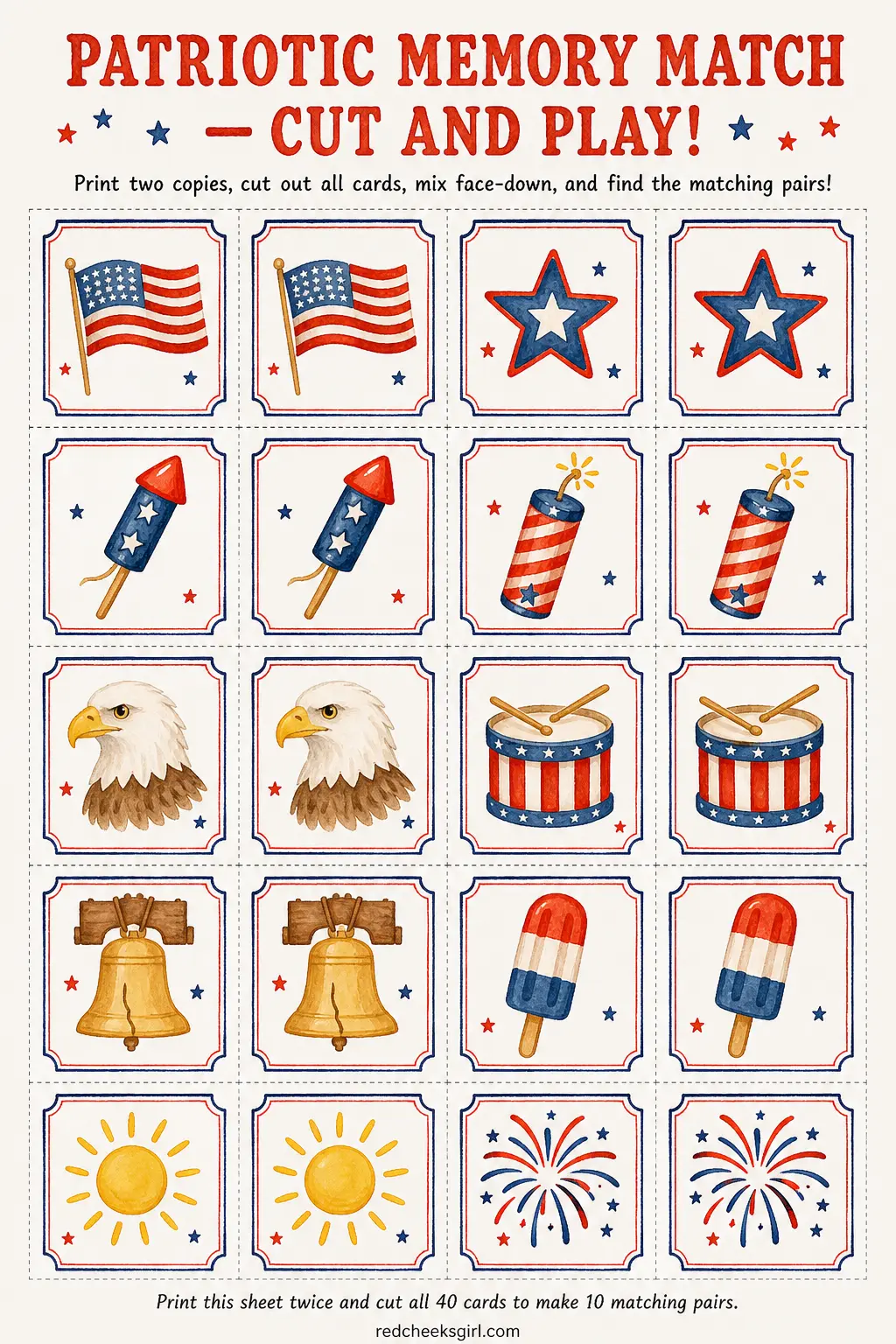
14. Patriotic Memory Match Cut and Play
Print the “Patriotic Memory Match Cut and Play” sheet for each player or pair. The sheet contains a grid of paired patriotic images — flags, bells, eagles, stars, fireworks, and more — that players cut apart to create a personal set of memory match cards. Once cut, players shuffle their cards, lay them face-down in a grid, and take turns flipping two at a time, trying to find matching pairs. A matched pair is kept; a non-matching pair is flipped back over. The player who collects the most pairs wins.
The cutting and assembly step is itself a worthwhile activity for older kids in the group, and pre-cutting the cards for younger players takes only a minute and lets four- and five-year-olds jump straight into the matching game. All you need is the printed sheet, scissors, and a flat surface. The game works for two to four players per set and takes ten to fifteen minutes per round. Print multiple sets so several small groups can play simultaneously at a party.
Host tip: Print the sheets on slightly heavier cardstock rather than regular printer paper — thicker cards are easier for small fingers to pick up off a flat surface and hold their shape through multiple games without curling at the corners.
🛍 Shopping guide
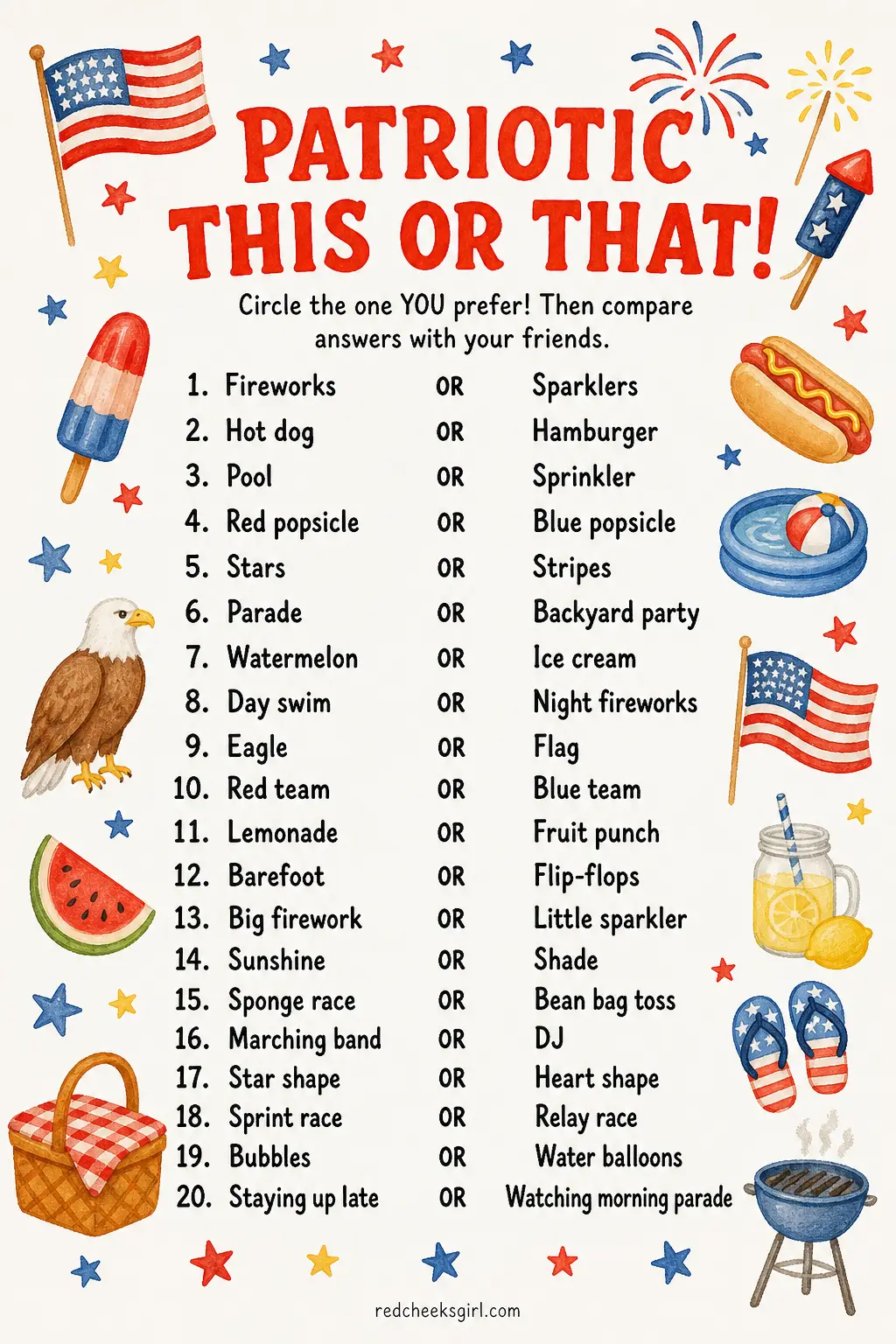
15. Patriotic This or That!
Print one “Patriotic This or That!” sheet for each player. The sheet presents a series of fun either-or choices with a patriotic or summer twist — would you rather watch fireworks from the beach or from a rooftop? Hot dog or hamburger at the barbecue? Wave a flag or bang a drum in the parade? Players circle or tick their chosen answer for each question. Afterward, kids pair up or gather as a group and read their answers aloud, discovering who shares their choices and who picked the opposite.
This or That is a brilliant icebreaker for parties where children do not all know each other, because it sparks immediate conversation and shared laughter without requiring any skill or prior knowledge. Beyond the sheet and a pencil, nothing extra is needed. It suits any group size from two to thirty and takes around ten minutes to complete the sheet plus another five to ten minutes of sharing. Run it as guests are arriving so early arrivals have something engaging to do while others trickle in.
Host tip: After everyone has shared their answers, call out a few choices and ask kids who picked that option to stand on one side of the yard while the others stand on the opposite side — this turns a written activity into a quick physical game that gets kids moving and laughing together.
🛍 Shopping guide
16. Wet Sponge Bullseye
Draw a large bullseye target on an old bed sheet or a piece of cardboard using fabric paint or washable spray paint — a small center circle worth ten points, a middle ring worth five, and an outer ring worth two. Hang or prop the target against a fence, then soak several large sponges in a bucket of water. Players stand behind a throwing line and take turns launching soaked sponges at the target. Where the wet splat lands determines the score, and a host keeps a running tally on a whiteboard.
The wet splat marks exactly where each throw landed, making scoring clear and honest — no arguments about whether it hit the line. You need an old sheet or cardboard, paint, sponges, a bucket of water, and a way to track scores. Groups of two to fifteen play comfortably, and the game runs about fifteen minutes for a full rotation. This game pulls double duty as a refreshing activity because every near-miss results in sponge water flying through the air and cooling down the thrower and the crowd alike.
Host tip: Hang a second identical target lower on the fence for children under six — having their own height-appropriate bullseye means small kids are aiming at the right spot and getting fair feedback on their throws rather than always hitting the very bottom ring by default.
🛍 Shopping guide
17. Patriotic Parachute Color Wave
Spread a large play parachute flat on the grass and have every child grab a handle around the edge. Place a dozen or more lightweight balls or inflated balloons in red, white, and blue on the parachute surface. A host calls out one color at a time — “RED!” — and players must work together to wave and shake the parachute so that only the red balls fly into the air while trying to keep the other colors on the fabric. It is more challenging than it sounds and produces spectacular, silly results.
Parachute games build teamwork and cooperation naturally because no single child can succeed alone — everyone must move together and read each other’s energy. You need a play parachute, a mix of lightweight balls or balloons in three patriotic colors, and open grass. The game suits eight to twenty players beautifully and runs for fifteen to twenty minutes of continuous engagement. Switch the challenge occasionally by calling “ALL!” so kids launch every ball skyward at once in a spectacular patriotic explosion.
Host tip: If you do not own a play parachute, a large flat bedsheet works as a surprisingly effective substitute for a single party — just make sure every child has a firm edge to grip so no one accidentally lets go and gets hit by a snapping sheet corner.
🛍 Shopping guide
18. Patriotic Sock Toss Ring Game
Roll six to eight pairs of socks into tight balls — the classic “sock ball” fold — and color-code them with a rubber band in red, white, or blue. Set up a row of open-topped containers at varying distances from a throwing line: a small bowl worth the most points at the far end, a medium bucket in the middle, and a large tub closest for the easy score. Each player tosses all their sock balls in turn, one at a time, trying to land as many as possible into the containers before stepping aside for the next player.
Sock toss is wonderfully safe and quiet for a yard game, produces no mess, and can be reset in under thirty seconds — making it perfect as a rotation station at a busy party where multiple games are running simultaneously. You need rolled sock balls, three containers of different sizes, and a strip of tape or rope for the throwing line. Any number of players can cycle through, and each turn takes only about ninety seconds. Children naturally adjust their own throwing power once they see how the containers are arranged, which makes this one of the most self-regulating games of the afternoon.
Host tip: Keep a spare pile of unrolled socks on the side — after the first couple of rounds the sock balls tend to unroll from enthusiastic throwing, and being able to quickly re-roll and hand a replacement to the next player keeps the line moving without any frustrating pauses.
Frequently Asked Questions
What is the best age range for these Fourth of July games?
Most of these games are designed for children aged four to ten, but many are easily adjusted for the specific ages in your group. For children under five, simplify the rules, shorten the distances, and focus on participation over competition. Children aged eight to ten can handle the full rules of every game on this list and often enjoy being junior helpers for younger players.
How many games should I plan for a two-hour party?
A good rule of thumb is to plan five to seven games for a two-hour party, which allows time for explaining rules, natural transitions, bathroom breaks, and snack time. Choose a mix of active games and calmer printable activities so children can cycle between high energy and recovery throughout the afternoon. Having two or three backup games on standby is always a smart move in case something runs short or a game does not land the way you expected.
How do I keep games fair for a wide age range?
The easiest approach is to pair older and younger children into buddy teams for relay and cooperative games, which naturally balances ability levels. For individual competitive games, set age-adjusted rules: move the throwing line closer for younger players, give younger children extra turns, or use a shorter timer. Framing every game around fun and participation rather than strict winning means children of all ages stay enthusiastic and engaged regardless of the score.
What if it is too hot for outdoor games?
Prioritize the water-based games — Water Balloon Piñata, Sponge Relay Race, Sprinkler Freeze Dance, Wet Sponge Bullseye, and Bubble Chase — during the hottest part of the afternoon, typically between noon and three o’clock. Schedule printable activities like Bingo, Colour by Number, I Spy, and Trivia in a shaded spot or briefly indoors during the peak heat. Keeping a cooler stocked with water, juice boxes, and frozen treats nearby ensures children stay hydrated through all the fun.
Do I need to print the printable games in color?
Color printing is strongly recommended for the Patriotic Picture Bingo cards, the Fourth of July I Spy sheet, the Colour by Number sheet, and the Memory Match cards because the color is a functional part of the game rather than just decoration. The Scavenger Hunt, Trivia Challenge, and This or That sheets work fine in black and white since they are primarily text-based. If your home printer does not print in color, most office supply stores offer low-cost color printing services and can usually handle a small print job the same day.
📌 Save These for Later
Loved these? Pin your favorite image below so you can find this list again when you’re planning.

My mother-in-law is not a crier. She’s the woman who got through her own son’s wedding s
My daughter turned two last spring and I almost went with the generic pink balloon arch. You know th
My daughter turned five in April, and I spent two weeks going down every party Pinterest rabbit hole
Leave a Reply