


Finding games for family gatherings that actually work across three or four generations is one of the trickiest parts of hosting a reunion or holiday celebration.
Grandparents may not love fast-paced app games, toddlers can’t sit through a two-hour strategy session, and teenagers need something with enough energy to pull them away from their phones.
The 20 games collected here solve that problem by leaning on what every generation already shares: family stories, shared memories, inside jokes, and the universal human love of a little healthy competition.
This list mixes printable games you can prepare in advance with active games, music rounds, and storytelling formats that need nothing more than the people in the room.
Several are designed so younger players and older players have genuinely equal advantages — because grandma absolutely has the edge when the question is about a family recipe from 1987.
Print what you need, clear a little floor space, and pick two or three games that match your group’s energy. You’ll find timings and group-size notes with each entry so you can build a full afternoon’s schedule without any awkward lulls.
This post contains affiliate links — if you buy through them, I may earn a small commission at no extra cost to you.
Table of Contents
- Family History Trivia
- Guess Who Said It?
- Family Photo Match
- Generation Gap Quiz
- Charades All Ages Card Deck
- Memory Sharing Prompt Cards
- Human Bingo – Family Edition
- Guess the Family Recipe
- Storytelling Round Robin
- Family Feud Home Edition
- Name That Tune Across Decades
- Family Tree Fill-In
- Emoji Family Story Decode
- This or That — Family Edition
- Family Mad Libs
- Two Truths and a Family Tale
- Family Scavenger Hunt
- The Price Is Right — Family Edition
- Wink Assassin
- Balloon Pop Trivia
1. Family History Trivia
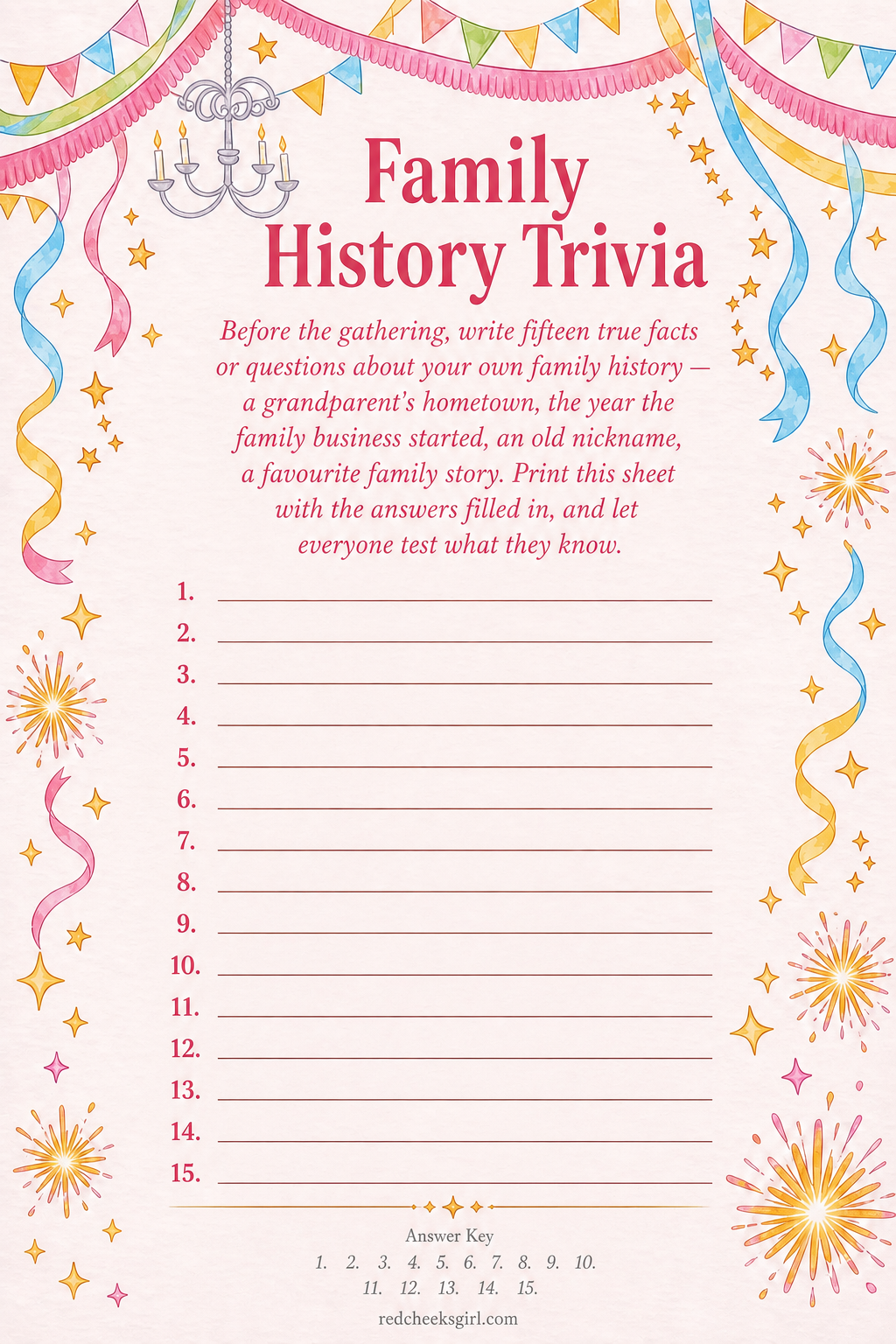
Family History Trivia turns the stories your relatives have been telling for years into a proper quiz game.
Before the gathering, the host collects facts from older family members — the year grandparents met, the town where great-grandma was born, how many siblings dad has, the family’s immigration story — and writes them onto the printable question-and-answer sheet.
At the event, divide everyone into mixed-age teams so grandchildren sit alongside grandparents, then read the questions aloud one by one. Teams write their answers and reveal them simultaneously, scoring a point for each correct response.
The magic here is that nobody holds all the answers. Grandparents dominate the early-history rounds while younger family members often remember recent milestones — a cousin’s graduation year, the newest baby’s birthday — that the elders blank on.
Plan for 20 to 30 questions and allow about 30 to 40 minutes. The printable sheet works as both a question script for the host and an answer card for each team; print one host copy and one answer sheet per team.
Works well for 8 to 40 guests split into teams of 3 to 6. Host tip: collect facts secretly from one branch of the family and quiz the other branch — the gentle rivalry between sides of the family almost always produces the loudest reactions of the night.
🛍 Shopping guide
2. Guess Who Said It?
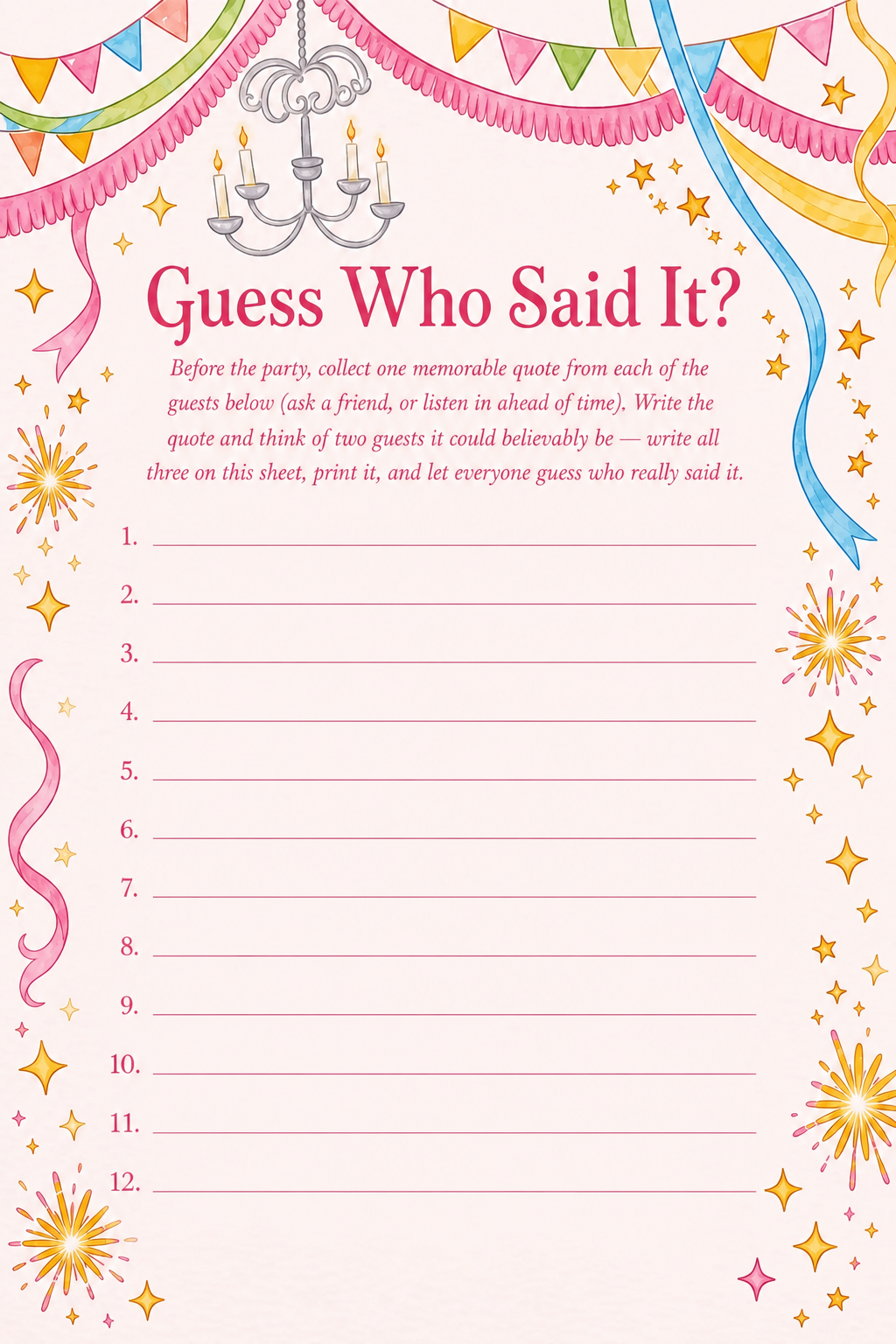
A week before the gathering, email or text every family member one prompt: “Send me the most ‘you’ sentence you’ve ever said, or your most famous family quote.”
Compile the responses onto the printable Guess Who Said It sheet, one quote per line with a blank next to each for players to write a name.
At the party, hand a sheet to every guest and give them 10 minutes to work through it independently before comparing answers as a group.
The laughs come fast because quotes capture personality perfectly — dad’s famous “We’re not lost, I’m just exploring” and a teenager’s texted “This is literally so unfair” are equally hilarious when read aloud to a room full of family.
The game needs no teams, no scorekeeper, and no equipment beyond the printed sheet and a pen per person. It plays in 20 to 30 minutes and works for any group size from 6 to 60.
Host tip: include at least two or three quotes from children under ten — their earnest, literal observations almost always beat everything else for laughs and tend to be the ones people photograph and share afterward.
3. Family Photo Match
Gather 15 to 25 old family photos from different eras — baby pictures, school portraits, vacation snapshots, and wedding photos all work beautifully — and number each one.
Arrange them on a table or tape them to a wall, then hand every guest the printable answer sheet, which lists family member names alongside numbered blanks.
Players move around the display, studying each photo and writing the name of the person they think is pictured.
This game is a genuine equalizer. A grandparent can immediately identify a 1960s photo of themselves as a teenager, but a grandchild who only knows them silver-haired is completely stumped.
Meanwhile, recent photos of the youngest generation are obvious to the kids and mysterious to older relatives. Allow 15 to 20 minutes for independent guessing, then reveal answers together — ideally having the pictured person tell one brief story about the moment captured.
Best for groups of 6 to 50; the physical display scales easily.
Host tip: scan and print photos at 4×6 inches rather than displaying originals — it protects irreplaceable images from sticky fingers, and guests can handle them freely without worry.

🛍 Shopping guide
4. Generation Gap Quiz
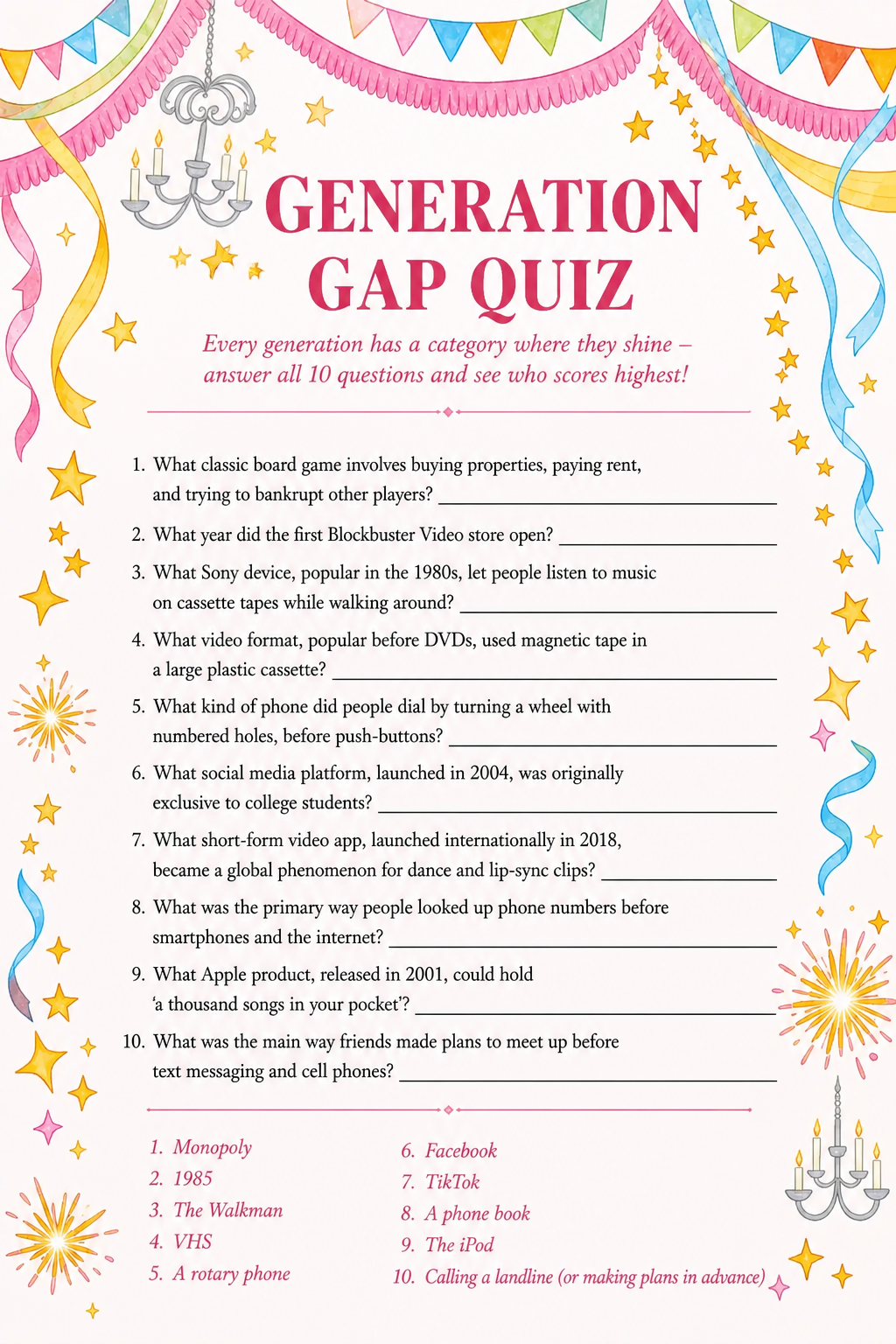
The Generation Gap Quiz pits the generations against each other on purpose, with questions explicitly sorted by era.
The printable sheet contains three columns: questions only grandparents are likely to know (rotary phones, ration books, black-and-white TV shows), questions parents should ace (cassette tapes, early video games, classic sitcoms), and questions kids and teens will dominate (streaming platforms, current slang, recent chart-toppers).
Read questions from all columns to every team — the scoring is designed so each generation has its moment of triumph.
Teams of 3 to 5 work best when deliberately mixed across generations, because a grandparent whispering the answer to a grandchild is exactly the kind of moment this game is engineered to create. Budget 25 to 35 minutes for a full game.
The printable host sheet includes suggested answers and brief context notes so the host doesn’t need to be a pop-culture expert across seven decades.
Host tip: add five questions specific to your own family’s timeline — “What year did the family move to this house?” — mixed in among the general knowledge rounds. It makes the quiz feel personal rather than something downloaded from the internet.
5. Charades All Ages Card Deck
Charades needs no introduction, but a well-designed card deck makes all the difference when your players range from age 5 to 85.
The printable Charades All Ages Card Deck is organized into three difficulty tiers: easy cards with simple animals and everyday actions for young children, medium cards with occupations and common phrases for parents, and hard cards with abstract concepts and multi-word titles for teens and adults.
Print and cut the cards before the event, then deal from the appropriate tier depending on who is performing.
Divide guests into two teams with a mix of ages on each side. One player draws a card, reads it silently, and has 60 seconds to act it out while their team guesses.
No sounds, no mouthing words, and no pointing at objects in the room. The team that guesses correctly earns the point. Rotate performers so everyone gets at least one turn. The game plays in 30 to 45 minutes and works for 6 to 30 players.
Host tip: let children under seven whisper the card content to an adult teammate who then acts it out with them — it keeps little ones fully engaged without the frustration of performing alone in front of a crowd.

🛍 Shopping guide
6. Memory Sharing Prompt Cards
Memory Sharing Prompt Cards turn a family gathering into a structured oral-history session without anyone feeling like they’re being interviewed. The printable deck contains 30 to 40 open-ended prompts such as “Describe the kitchen you grew up in,” “What is the earliest sound you remember?”
and “Tell us about a time a family member surprised you.” Shuffle the deck and place it in the center of the table. Each person draws a card, reads the prompt aloud, and shares their answer — no judgment, no timer, just listening.
This game works beautifully at the dinner table after the meal, when conversation is already flowing but starting to drift. It also works as a quiet corner activity for smaller sub-groups who want something more meaningful than a competitive game.
There are no winners, no points, and no elimination — just stories.
It accommodates any group size from 4 to 20 at a single table, and a full round through a 20-card deck typically runs 40 to 60 minutes depending on how talkative your family is.
Host tip: designate one person per table as a quiet note-taker or ask permission to record audio on a phone — the stories that come out of this game are often things younger family members have never heard, and they disappear the moment the gathering ends.

7. Human Bingo – Family Edition
Human Bingo replaces the traditional number squares with personal descriptors: “Has visited more than five countries,” “Learned to cook from a grandparent,” “Once won a trophy,” “Has read more than 50 books in a year.”
The printable Family Edition sheet gives every guest their own 5×5 bingo card. Players must move around the room, find a real family member who fits each description, and have that person sign the square.
The first person to get five in a row — verified with matching signatures — calls out and wins.
This format is outstanding for the first hour of a gathering, before everyone has caught up with each other, because it gives every guest a structured reason to approach relatives they might not otherwise seek out.
Shy kids, in particular, find it much easier to walk up to a great-uncle and say “Did you ever win a trophy?” than to manufacture small talk. It works for 12 to 80 guests and takes 20 to 30 minutes of active mingling.
Host tip: customize at least half the squares for your specific family — “Shares a birthday month with grandpa” or “Has been to the family cabin” — so guests can’t just grab any stranger’s signature and must actually know their relatives to fill the card.

🛍 Shopping guide
8. Guess the Family Recipe
Ask three to five family members who are known for a signature dish to each prepare one small component of their recipe — a sauce, a spiced mixture, a baked good — or simply describe three key ingredients in writing without naming the dish.
At the gathering, guests receive the printable answer sheet listing all the family member names and a numbered space for each mystery ingredient set or taste sample. Players move through the stations and try to match each sample to the cook who made it.
If a full tasting-station setup isn’t feasible, a written version works just as well: list five clue sentences about each recipe (“This dish has been made at every Christmas since 1978. It uses exactly four spices.
The recipe came from a magazine clipping”) and ask players to identify the dish and the person who makes it. Both formats work for 6 to 40 guests and play in 20 to 25 minutes.
The printable sheet doubles as the answer card and a mini recipe-collection keepsake.
Host tip: ask each contributing cook to write one sentence about where they learned the recipe on their station card — those little origin stories provoke more conversation than the guessing game itself, and often spark the evening’s best storytelling.

9. Storytelling Round Robin
The Storytelling Round Robin Prompt Cards give your family the opening line of a story and then pass the narrative around the room, one sentence at a time.
The printable deck contains prompts like “It was the summer everything went wrong, and Aunt Rosa had the car keys…” or “Nobody expected the reunion to end with a parade, but here we are…” One player reads the prompt, adds their own sentence to continue the story, and then points to the next person.
The story builds until it reaches a natural — or gloriously absurd — conclusion.
The generational mix creates wonderfully unpredictable stories. Grandparents tend to steer the narrative toward resolution and moral lessons; teenagers derail it into chaos; young children introduce talking animals at unexpected moments. There’s no winning, no scoring, and no wrong contribution.
It works for 4 to 20 players seated in a circle or around a table, and a single story typically takes 10 to 15 minutes, making it easy to run two or three rounds.
Host tip: appoint one person as the “recorder” who types or writes the story in real time — reading the completed tale back to the group at the end of the gathering, exactly as told, is consistently the funniest five minutes of the night.

10. Family Feud Home Edition
In the weeks before the gathering, send a short survey to every family member: “Name something always found in grandma’s kitchen,” “Name a place this family loves to vacation,” “Name something a teenager always says.”
Tally the most common answers and enter them on the printable Family Feud Home Edition Host Sheet, ranked by frequency, just like the television format.
At the party, split guests into two teams and let the host run the game exactly like the show: two players face off for each round, and the winning team plays down their five survey answers for points.
What makes this version special is that the “survey” is your own family. When someone answers “grandma’s spoon collection” and it turns out three family members said the same thing, the room erupts.
The printable host sheet keeps the game organized — all answers are pre-filled with point values so the host can focus on pacing and banter rather than score-keeping.
Play for 6 to 40 guests in two teams; a full game of eight rounds takes about 35 to 45 minutes.
Host tip: run the survey at least two weeks in advance and collect at least 15 to 20 responses per question so the answer board has genuine spread — a survey with only four respondents produces ties and arguments rather than laughs.

11. Name That Tune Across Decades
Name That Tune Across Decades is a music identification game built specifically around the generational spread in the room.
The host prepares a playlist of 30 to 40 short clips — 5 to 10 seconds each — drawn from every decade represented by the guests: big-band and early rock for the oldest generation, classic pop and soul for the middle generation, and current chart hits for the youngest.
Play a clip and let teams write down the song title, artist, or decade — awarding points for each correct element.
You need a phone or laptop, a speaker loud enough for the room, and a playlist prepared in advance through any streaming service or music library. No printable sheet is required; teams write answers on any scrap paper.
Groups of 6 to 50 work well in teams of 3 to 6, and a 30-clip game runs about 30 to 40 minutes. The beauty of the format is that every generation gets a round where they’re the experts, and no single age group dominates.
Host tip: include at least two or three songs with a personal family connection — the song played at grandparents’ wedding, a tune from a famous family road trip — and announce the connection after revealing the answer. Those moments produce applause every time.
🛍 Shopping guide
12. Family Tree Fill-In
The Family Tree Fill-In printable sheet presents a blank or partially completed family tree spanning three to five generations, with names, birth years, and birthplaces left empty.
Guests receive a copy each and spend 15 to 20 minutes filling in as much as they can from memory alone — no phones, no asking other guests.
After the solo round, players compare sheets and pool their knowledge to build the most complete version possible as a group, with older relatives serving as the authoritative source for earlier generations.
This game works as both a competition (who can fill in the most blanks independently?) and a collaborative activity (can the whole family piece together great-great-grandma’s maiden name?).
It’s particularly meaningful for younger family members who often have only a vague sense of their lineage beyond grandparents. The completed group sheet makes a wonderful keepsake to photograph and share.
Works for any size gathering; 15 to 30 minutes for the solo phase, plus open-ended discussion time.
Host tip: pre-fill the sheet with names you’re certain of and deliberately leave a few blanks you know only one elderly relative can answer — it positions that person as the expert and gives them a beautiful moment of being sought out and celebrated.

13. Emoji Family Story Decode
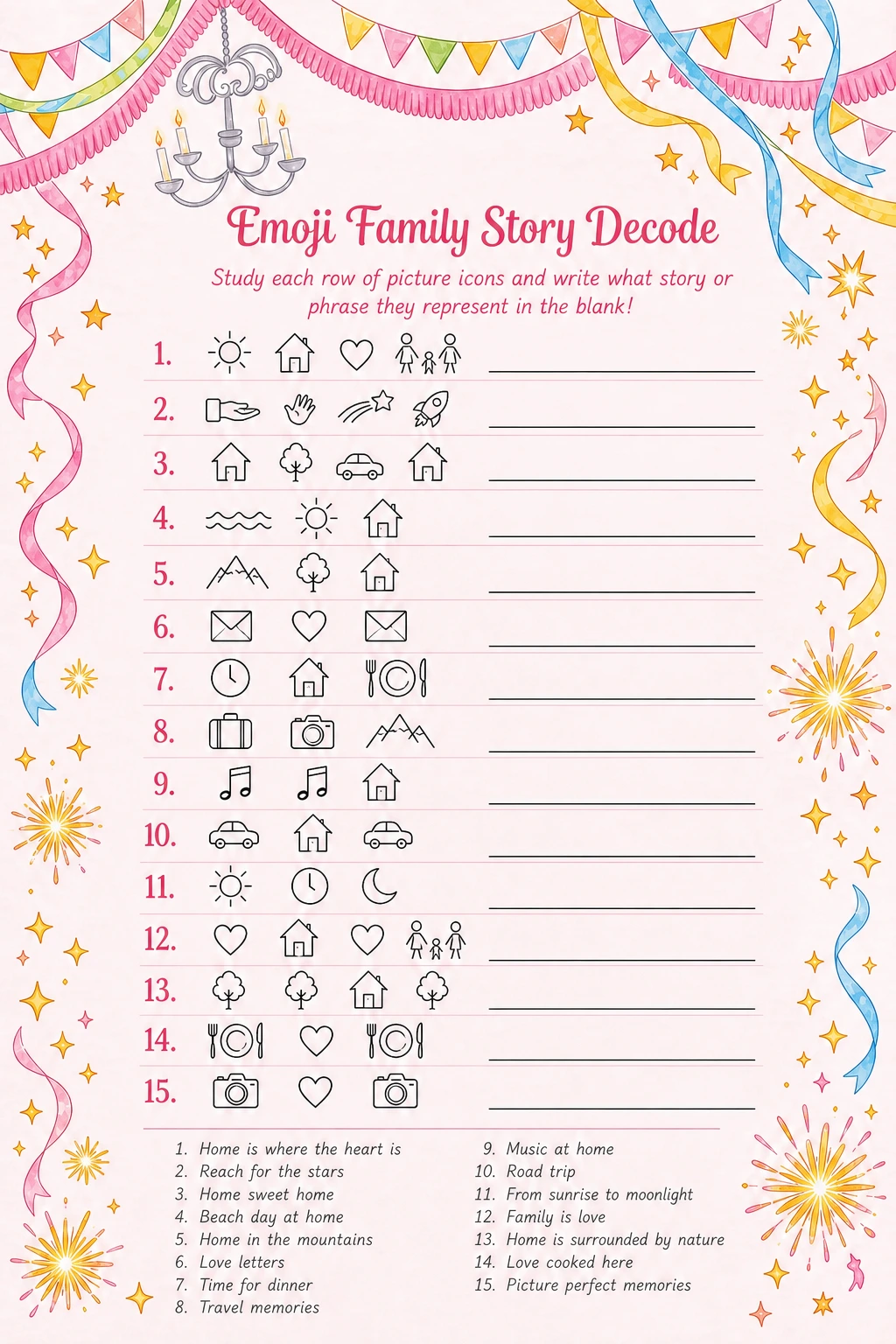
The Emoji Family Story Decode printable sheet presents a series of short family-themed stories or scenarios written entirely in emoji sequences.
Players read each line of emoji and write out in plain English what they think the story or situation describes — a family road trip, a holiday dinner disaster, a new baby’s arrival.
The sheet includes 12 to 15 emoji story lines, each with a blank answer space, and a host answer key on a separate page.
Unlike a rebus or phrase-guessing game, the goal here is creative interpretation rather than a single correct phrase — players write a sentence or two describing the scene the emoji sequence tells, and the host reads the funniest or most creative answers aloud for the group to vote on.
This means every answer is valid as long as it tells a coherent story, and the laughs come from how wildly different each generation’s interpretation can be. Works for 4 to 40 guests; 20 to 25 minutes playing time.
Host tip: let young children dictate their answers to a parent who writes them down — their interpretations of the emoji sequences are consistently the most inventive, and they love having their version read aloud to the whole family.
14. This or That — Family Edition
This or That is a rapid-fire preference game with a family twist. The printable Family Edition sheet lists 40 paired choices — “Mountains or beach?” “Board games or card games?” “Cook it yourself or order in?” “Early bird or night owl?”
— along with a column for each player to tick their preference.
Players fill in the sheet independently, then the host reads each question aloud and asks everyone to call out or raise their hand for their choice, revealing surprising agreements and arguments across the generations.
The game has no winner, no score, and no elimination — its purpose is to spark conversation and reveal personality. A grandparent and a teenage grandchild discovering they are both unambiguous night owls is the kind of small connection that actually sticks.
It works beautifully as an icebreaker for the first 20 minutes of a gathering, or as a low-energy wind-down game after a meal. Any group from 4 to 60 can play simultaneously. Allow 15 to 20 minutes for the sheet plus discussion.
Host tip: add 10 family-specific choices to the printed sheet — “Grandma’s pie or Aunt Helen’s cake?” “Family cabin or beach rental?” — before printing. These hyper-local questions produce the loudest debates and the most genuine conversation.

15. Family Mad Libs
Family Mad Libs uses the classic fill-in-the-blank story format, but every story is written specifically about your family: the tale of how grandparents met, the legend of the famous Thanksgiving disaster of 1999, the story of how the family pet got its name.
The printable sheet presents the story with key words replaced by blank spaces labeled by part of speech (noun, adjective, verb, name of a relative).
One player collects the words by asking other guests for suggestions without revealing the story — then reads the completed, hilariously garbled version aloud.
The generational mix makes word collection wonderfully chaotic. Ask a seven-year-old for an adjective and you’ll get “slimy”; ask grandpa and you’ll get “distinguished.” When both words end up in the same sentence describing the family dog, the room loses it.
Each story takes about 5 to 8 minutes to collect words and read aloud, making it easy to run three or four rounds in a single session. Works for 4 to 30 guests; no teams needed.
Host tip: write two or three Mad Libs stories in advance based on real family legends — the more specific and accurate the framing story, the funnier the random-word substitutions land. Generic stories produce polite laughs; stories about actual family events produce tears of laughter.

16. Two Truths and a Family Tale
Two Truths and a Family Tale is the classic two-truths-and-a-lie format reimagined so every statement must be drawn from real family history or personal experience within the family context. Each player prepares three statements about themselves or another family member: two true, one invented.
They read all three aloud and the rest of the group votes on which statement is the lie. The player then reveals the answer and briefly explains the true stories behind the two real statements.
The family-history framing transforms the game from a party icebreaker into a genuine story-sharing exercise.
True statements like “I once hitchhiked to a family reunion,” “I have a tattoo nobody in this room has seen,” or “I was born during a blizzard that shut the hospital” invite questions and extended storytelling that a standard icebreaker wouldn’t produce.
It works for 4 to 20 players in a single circle; allow 3 to 4 minutes per person, making a full round about 30 to 40 minutes for 10 players.
Host tip: brief elderly relatives privately before the game and encourage them to include one statement from their youth that younger family members couldn’t possibly know — these are consistently the most surprising and the most memorable revelations of the gathering.
17. Family Scavenger Hunt
A family scavenger hunt sends guests hunting through the home or venue for items or experiences rather than trivia answers.
Before the event, the host hides 15 to 20 clues around the space — some pointing to physical objects (“Find something in this house older than you are”), some requiring interaction with family members (“Find someone who has lived in another country and get them to teach you one word in another language”), and some requiring mini-tasks (“Take a photo of three generations standing together”).
Teams race to complete every item on the list.
Mixed-age teams work best: adults read clues, children squeeze into small spaces to retrieve hidden items, and teenagers handle the phone-based photo tasks. The interaction clues are the heart of the game — they force cross-generational conversation in a playful, low-pressure way.
You’ll need the printed clue list per team, a phone per team for photo tasks, and small prizes for the winning group. Best for 10 to 40 guests in teams of 4 to 6; allow 30 to 45 minutes.
Host tip: hide one clue in grandma’s purse or grandpa’s jacket pocket — with their permission and delight — so the children have to approach the eldest relative directly to advance in the game. It’s a guaranteed warm moment amid the competitive chaos.
🛍 Shopping guide
18. The Price Is Right — Family Edition
Before the gathering, the host collects 15 to 20 everyday household items or groceries with their current price tags removed or covered, and notes each item’s actual retail price.
At the event, hold each item up one at a time and ask every player to write down their guess for the current price on a slip of paper. The guest whose guess is closest without going over wins that round.
Run five rounds as a team game or 15 rounds with individual scoring for a longer session.
Generational pricing gaps make this game endlessly funny. Grandparents who haven’t bought their own groceries in years genuinely believe a gallon of milk costs what it did in 1987; teenagers have no mental model for commodity prices at all.
Nobody has a clean advantage, and the discussions about inflation, “what things used to cost,” and “how much they charge for that now?” become the actual entertainment. No printing required; you need only items from around the house and paper for guesses.
Works for 4 to 40 guests; 25 to 35 minutes.
Host tip: include one dramatically mispriced item — a small luxury item that costs far more than it looks, or a giant package that costs less than expected — to trigger the loudest collective reaction of the game.
19. Wink Assassin
Wink Assassin is a classic social deduction game that needs nothing more than a standard deck of cards and everyone seated in a circle. Deal one card to each player; the person who receives the Ace of Spades is secretly the assassin.
The assassin eliminates other players by making deliberate, discreet eye contact and winking at them; a winked-at player must dramatically “die” within five seconds. Meanwhile, all surviving players are trying to catch the assassin in the act.
Any player who thinks they’ve identified the assassin declares “I have an accusation!” — and needs one other player to second it before naming the suspect. If correct, the round ends; if wrong, the accuser is eliminated.
The game is perfect for multi-generational groups because it requires no reading, no general knowledge, and no physical agility — just attention and a poker face. Young children are often unexpectedly brilliant assassins because nobody suspects them.
Grandparents who’ve spent decades mastering the subtle art of keeping a straight face across a Thanksgiving table are also formidable. Works for 6 to 20 players; each round takes 5 to 10 minutes, and groups almost always play five or six rounds in a row.
Host tip: set a 90-second timer per round — without a time limit, cautious assassins stretch the game to tedium by winking once every three minutes. The timer forces bold play and creates far more dramatic moments.
20. Balloon Pop Trivia
Before guests arrive, write individual trivia questions on small slips of paper — mixing general family knowledge, easy general knowledge for children, and harder questions for adults — roll them up, and stuff one into each balloon before inflating it.
Hang the balloons around the room or pile them in a corner. When it’s time to play, each player pops a balloon (sitting on it, stomping it, or using a pin depending on age), retrieves the question, and answers it aloud for the group.
Correct answers earn a point or a small prize token.
The physical act of popping the balloon creates a burst of anticipation and energy that resets the room’s enthusiasm mid-gathering — it’s an excellent game to pull out after lunch when energy dips.
Young children love the popping; older relatives enjoy the trivia; everyone benefits from the momentum boost. Prepare 30 to 40 balloons for a group of 10 to 30 guests; the game plays in 20 to 30 minutes depending on discussion.
All you need are balloons, slips of paper, and a pump.
Host tip: color-code the balloons by difficulty — yellow for children’s questions, blue for adults, red for hard family-history questions — so you can hand each guest an age-appropriate balloon and nobody is embarrassed by a question they genuinely cannot answer.
Frequently Asked Questions
How do I choose the right games for family gatherings with a very wide age range?
Pick at least one game that requires no reading (like Wink Assassin or Charades), one that rewards lived experience and memory (like Family History Trivia or Memory Sharing Prompt Cards), and one that gives younger guests a physical or pop-culture advantage (like Name That Tune Across Decades or Balloon Pop Trivia).
Running three games of different types across an afternoon ensures every generation has at least one moment where they’re genuinely competitive.
How far in advance should I prepare the printable games?
Print and cut everything at least two days before the gathering. For games that require pre-collected information — Family Feud Home Edition, Guess Who Said It, and Family History Trivia especially — start gathering content one to two weeks early. Rushing the content collection produces thin, less-funny games, while a well-prepared sheet that includes real family details lands dramatically better.
What is a good order to run these games throughout the day?
Open with a low-pressure social game like Human Bingo or This or That to get guests mingling while people are still arriving. Move into team games like Family Feud or Generation Gap Quiz once everyone is settled.
Save the more reflective activities like Memory Sharing Prompt Cards or Storytelling Round Robin for after the meal when the energy is calmer. End with a high-energy finisher like Balloon Pop Trivia or Name That Tune to send everyone home on a high note.
Do all 20 games require purchasing supplies?
Most of these games for family gatherings require nothing more than printed sheets and pens. A handful — Balloon Pop Trivia, the Scavenger Hunt, and Name That Tune Across Decades — need a few inexpensive supplies like balloons, a phone, and a speaker.
The printable games are designed to be the most resource-efficient options: print them at home on standard paper and you’re ready to play.
How do I handle guests who don’t want to participate in games?
Keep participation genuinely optional and avoid calling out non-players. Games like Human Bingo and This or That are low-commitment enough that reluctant guests often join without realizing it.
Seat non-players near the action so they can watch and laugh without being put on the spot — many will quietly join a second or third round once they’ve seen how relaxed the atmosphere is.
Having a quiet corner with Memory Sharing Prompt Cards also gives conversation-preferring guests an engaging alternative to competitive games.
📌 Save These for Later
Loved these? Pin your favorite image below so you can find this list again when you’re planning.

72 this or that questions for kids sorted into six rounds. Read them aloud, print the cards and watc

15 easy family game night food ideas — one-handed finger foods, warm dips, a snack board, a sweet

72 would you rather questions for siblings across 6 rounds. Balanced, funny and family-safe prompts
Leave a Reply