

Family reunions have a way of exposing the awkward truth that some of your relatives are essentially strangers wearing your nose.
You recognize the face, you vaguely remember a holiday card, and then you both reach for the potato salad at the same time and spend the next three minutes talking about the weather. The right games fix all of that.
They give cousins a reason to team up, grandparents a reason to show off, and teenagers a reason to put their phones down — at least for an hour.
The 22 family reunion games below are built for big mixed groups: different ages, different energy levels, and different ideas of what “fun” looks like. Some are printable sheets you can prep the night before; others need nothing but bodies and a patch of grass.
Every single one has been chosen because it creates conversation, not just competition. Grab a folder, print what you need, and let the chaos begin.
This post contains affiliate links — if you buy through them, I may earn a small commission at no extra cost to you.
Table of Contents
- Family Human Bingo
- Family History Trivia
- Cousin Scavenger Hunt
- Three-Legged Race
- Guess the Family Photo Decade
- Water Balloon Toss
- Family Feud Teams
- Tug of War
- Recipe Swap Cards
- Family Tree Fill-In
- Relay Race Teams
- Memory Jar Cards
- Name That Relative – Emoji Quiz!
- Guess the Baby Photo!
- Family Reunion Mad Libs
- Family This-or-That — Cast Your Vote!
- Where in the World Is Your Family?
- Bocce Ball Tournament
- Family Talent Show
- Cornhole Tournament
- Two Truths and a Family Lie
- Capture the Flag
1. Family Human Bingo
Print one bingo card per person, but instead of numbers, each square contains a personal fact — “has lived in three or more states,” “can whistle really loudly,” “remembers Grandma’s maiden name,” or “has a twin.”
Players mingle and find a real family member who matches each square, writing that person’s name inside. The first player to fill a row, column, or diagonal shouts “Bingo!” and wins a small prize.
Because every square requires a face-to-face conversation, the game essentially forces introductions without anyone feeling put on the spot.
This works beautifully for groups of 20 to 100 and takes about 20 to 30 minutes — perfect as an arrival activity while stragglers trickle in. All you need are printed cards, pens, and a prize for the winner.
You can customize the squares before printing by asking family members to submit fun facts in advance, which makes the clues feel personal rather than generic.
Host tip: print several slightly different card layouts so two people standing side by side aren’t chasing the exact same squares. A quick shuffle of the grid in any word-processing app takes two minutes and prevents the whole group from stampeding toward the same five relatives.

🛍 Shopping guide
2. Family History Trivia
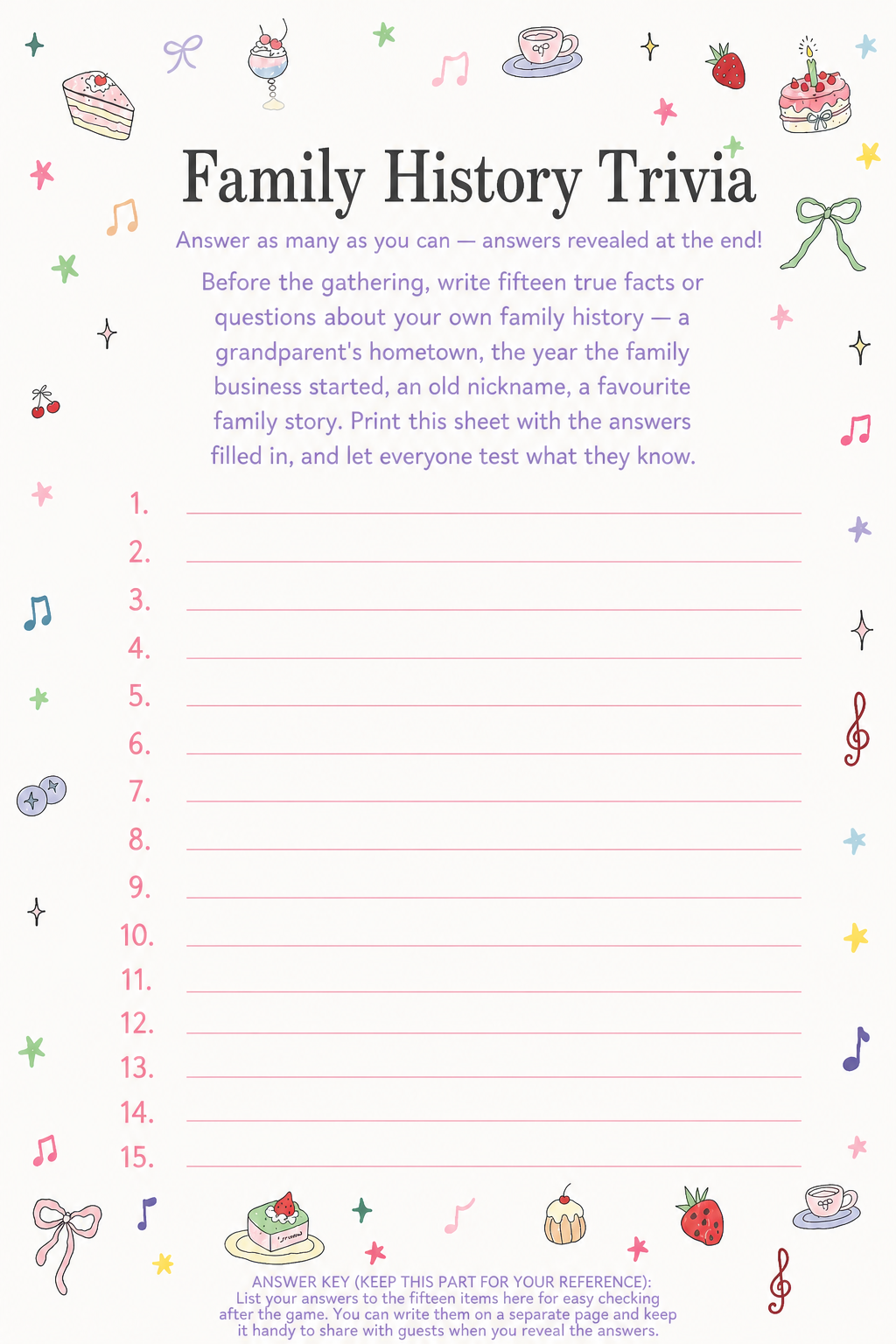
Divide everyone into mixed-generation teams of four to six, then read aloud trivia questions drawn from your actual family’s history — the year great-grandpa immigrated, the city where your grandparents met, the number of cousins in the current generation, the decade your family’s signature dish was invented.
Teams huddle, agree on an answer, and write it on a small answer slip. Points accumulate over ten to fifteen questions, and the winning team earns a little bragging rights trophy or a bag of candy.
The printable sheet doubles as a question-and-answer reference for the host, keeping the game moving without any fumbling. Preparation is the real work here: send a short questionnaire to older family members a few weeks before the reunion and mine their responses for questions.
The more specific and surprising the facts, the louder the room gets. Budget about 30 minutes for a full round, and plan for at least 15 people to make the team competition feel meaningful.
Host tip: include at least two or three questions that only young cousins would know — favorite family meme, who won last reunion’s tug of war — so the game doesn’t feel like a quiz designed purely for elders. Balanced questions keep every generation leaning in.
🛍 Shopping guide
3. Cousin Scavenger Hunt
Give each small team a printed list of items and tasks to complete around the reunion venue — find something that represents your family’s heritage, take a photo with the oldest and youngest person at the reunion, locate a relative born in a different country, collect a leaf and a rock that remind you of a family story.
Teams race to complete as many items as possible within a set time limit, usually 25 to 35 minutes. Points are awarded for each completed task, with bonus points for creativity.
The printable sheet acts as the official checklist, giving teams something tangible to carry and annotate as they go.
This game is genuinely great for 15 to 60 people split into teams of three to five, and it works equally well in a backyard, a park, or a rented hall.
Kids and teenagers especially love having a mission, and the photo tasks naturally create shareable content for the family group chat afterward.
Host tip: designate one task that requires every team to interview a grandparent or great-aunt for a piece of family wisdom. Teams almost always end up staying longer at that conversation than they expected, and the elders tend to be the ones who bring it up for years afterward.

🛍 Shopping guide
4. Three-Legged Race
Pair up players — try to mix ages and heights for maximum comedy — tie adjacent ankles together with a soft bandana or strip of fabric, and race from a starting line to a finish line about 20 to 30 feet away.
The pair that crosses first wins. Run heats by age group if you have a large crowd, then bring the heat winners back for a grand final. The resulting stumbles, laughter, and synchronized shuffling are reliably the most-photographed moment of any outdoor reunion.
You need almost nothing: a flat strip of grass and a handful of bandanas or old neckties. Groups of 10 to 60 can all play in rotating heats, and the whole event — heats plus a final — runs about 20 minutes.
Pair a confident teenager with a grandparent willing to give it a go and you’ll have a memory that gets retold at every reunion for the next decade.
Host tip: have a few extra bandanas on hand in different widths. Thicker fabric is more comfortable on ankles, especially for older participants. Announce beforehand that anyone who falls and laughs gets an automatic round of applause — it removes the fear of embarrassment and gets hesitant players to sign up.
🛍 Shopping guide
5. Guess the Family Photo Decade
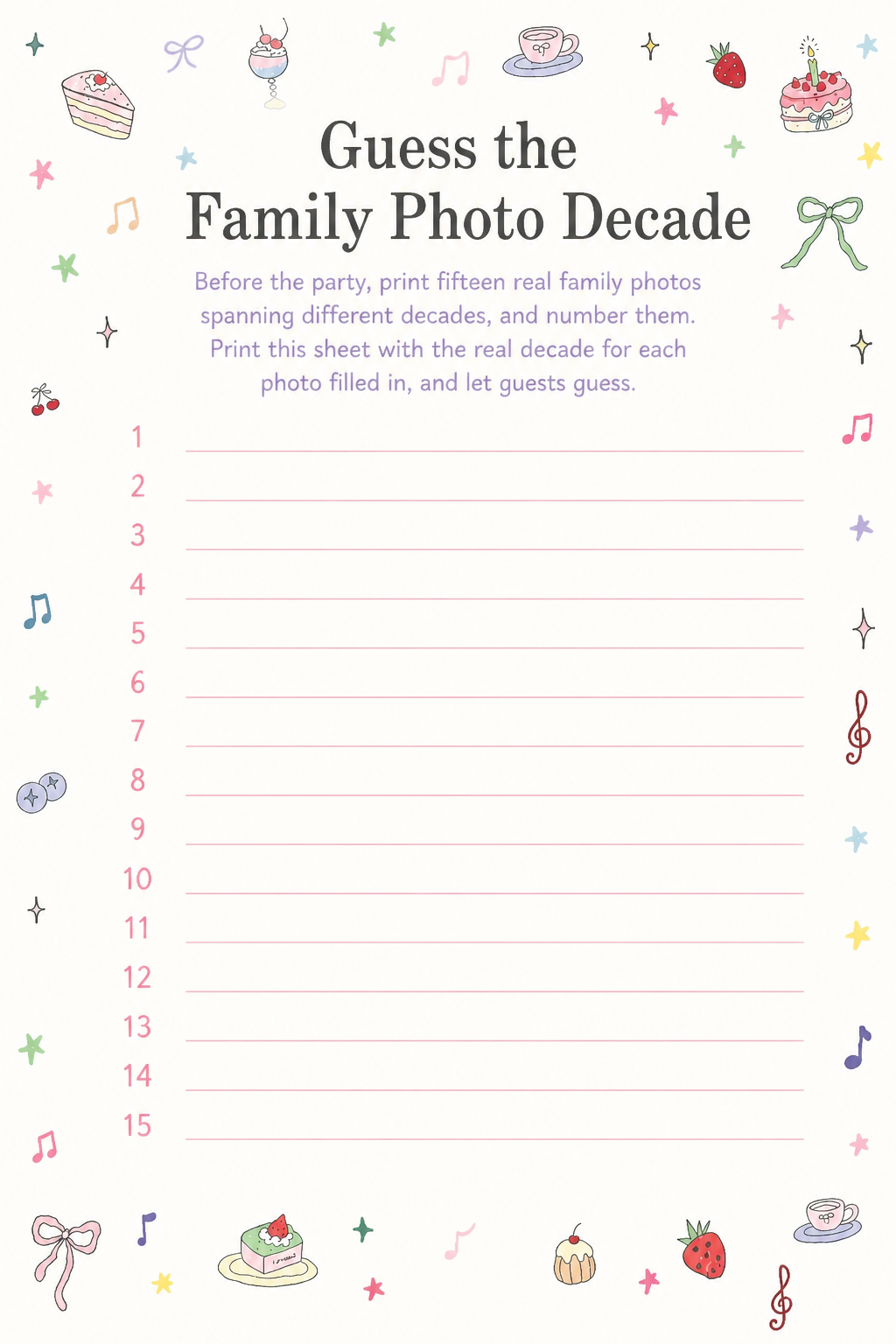
Collect old family photos in advance — scanned and printed works perfectly — and display or distribute them without captions.
The printable answer sheet lists each photo by number, and players write down which decade they think the photo was taken: the 1950s, 1970s, 1990s, and so on. Once everyone has submitted their guesses, reveal the correct answers one by one.
Award a point per correct decade, with a bonus point for anyone who can also name the people in the photo.
This game is as much a storytelling trigger as it is a competition. The moment you reveal that the grainy beach photo is from 1968, someone’s aunt will launch into a story about that exact trip, and the whole table leans in.
It plays well for 10 to 80 people, takes about 20 minutes, and requires only the printed sheets, pens, and your curated photo collection. Displaying photos on a folding table or pinning them to a board works even better than handing them out individually.
Host tip: ask family members to submit their most mystifying old photo — the one where nobody is quite sure of the decade or the occasion. Those ambiguous shots generate the loudest debates and the best stories. Avoid using photos where the date is visible on the print border.
🛍 Shopping guide
6. Water Balloon Toss
Fill a few dozen water balloons ahead of time and have partners stand facing each other across a starting distance of about three feet. On the signal, one partner tosses the balloon gently to the other.
If the catch is clean, both partners take one large step backward to increase the distance, then toss again. Any pair whose balloon bursts is out. The last dry pair standing wins.
It sounds simple, and it is — which is exactly why it works for every age from six to ninety.
You’ll need a good supply of pre-filled balloons — 50 to 100 for a large group — and an outdoor space with grass that can handle getting wet.
Groups of 10 to 80 can play simultaneously in pairs, with the whole game wrapping up in 15 to 25 minutes. The stakes feel surprisingly real once the distance grows, and even the people watching get invested in who’s going to get soaked.
Host tip: pre-fill balloons the morning of the reunion and store them in a plastic bin with a damp cloth on top to keep them from drying and cracking. Assign one or two teenagers as “balloon crew” to handle refills — they always enjoy the responsibility, and it keeps the game moving between heats without long pauses.
🛍 Shopping guide
7. Family Feud Teams
Run your own version of the classic survey game using questions surveyed from your own family members ahead of time — “Name something always found in Grandma’s kitchen,” “Name a family vacation spot everyone remembers,” “Name a relative you’d call first in an emergency.”
Divide into two teams, read the question aloud, and let one player from each team buzz in to start. The team that guesses the top answers on the board earns points; three wrong guesses passes control to the other team.
The printable host answer sheet keeps all the surveyed responses organized so the host can run the game smoothly without losing track.
This game rewards family knowledge and generates a roar of recognition every time someone nails a top answer. It works best with 12 to 40 players split into two teams, and a full round of eight to ten questions takes about 30 to 40 minutes.
You’ll need a host willing to ham it up, the printed answer sheet, and a simple scoreboard on a whiteboard or large paper.
Host tip: survey at least 10 family members per question in advance to get a realistic spread of answers — fewer than that and every answer ties for first place, which kills the drama. Use a free online survey tool to collect responses easily, then rank them by frequency before printing your host sheet.

🛍 Shopping guide
8. Tug of War
Divide the group into two teams — go by family branch, age group, or a random mix — and set up a rope across a center line marked with a ribbon or chalk.
On the signal, both teams pull as hard as they can until the ribbon tied to the middle of the rope crosses the line on one side. Three rounds, best of three wins.
The game is ancient for a reason: it requires zero explanation, creates instant team identity, and produces a level of noise that is genuinely impressive for a game that lasts about 90 seconds per round.
All you need is a sturdy rope at least 30 feet long, a center marker, and a flat patch of grass. Works for any group of 10 or more, with each team needing at least five solid pullers.
The whole event — including lineup negotiations and a victory lap — runs about 15 to 20 minutes. Kids love scrambling into position alongside their parents and aunts, creating natural cross-generational bonding without anyone engineering it.
Host tip: before the pull, ask teams to assign a captain who calls the pull cadence — “one, two, three, PULL” — in unison. Teams that coordinate this way almost always beat teams that just yank individually, which teaches a satisfying lesson about family teamwork without anyone having to say the words “teamwork” out loud.
🛍 Shopping guide
9. Recipe Swap Cards
Print the Family Recipe Swap Cards and set out a stack at a table with pens.
Each family member writes down a recipe they’re known for — or one passed down from an elder — including the dish name, ingredients, and a short note about where the recipe came from or who used to make it.
Cards are collected, shuffled, and distributed randomly so everyone goes home with a new recipe that belongs to the family’s shared history. A simple recipe box or envelope keeps the collected cards tidy.
This works for any group size from 10 upward and requires no competitive element whatsoever, which is a genuine relief after several rounds of outdoor games.
Budget about 15 minutes for the writing phase; the reading and swapping conversation tends to run longer as people recognize dishes and swap stories. The cards become keepsakes — more than one family has ended up compiling them into a homemade cookbook.
Host tip: prime the pump by sending a note to family members before the reunion asking them to think about their signature dish. Showing up with a blank card and a sudden request to recall a full recipe produces a lot of “I don’t really measure anything” responses. A little advance notice gets you richer, more detailed cards.

🛍 Shopping guide
10. Family Tree Fill-In
Print one Family Tree Fill-In sheet per player or per family unit. The sheet displays a branching tree with labeled slots for names, birth years, and birthplaces — going back at least three generations.
Players work individually or in small family clusters to fill in as much as they know from memory. Then, here’s the social part: players circulate to find relatives who can fill in the blanks they’ve left empty.
The grandparents become the most sought-after people in the room, and the game naturally creates intergenerational conversations that wouldn’t have happened otherwise.
This works for any group size and takes 20 to 40 minutes depending on how deep the tree goes and how many elders are present.
You need only the printed sheets, pens, and ideally a designated “fact-checker” — an older family member or the person who researched the family history — who can arbitrate disagreements about dates and spellings.
The completed sheets are worth saving and can later be digitized into a proper family record.
Host tip: prepare a master answer sheet in advance by interviewing one or two family historians before the reunion. Without a reference, the game can stall on disputed facts; with one, you can post corrections at the end and turn the reveal into a mini lesson in family history.

🛍 Shopping guide
11. Relay Race Teams
Set up a classic relay course on the lawn: each team member runs a leg of the course and tags the next person in line.
To make it distinctly “family reunion” style, customize the legs — carry an egg on a spoon, waddle with a balloon between your knees, run backward, or carry a small bucket of water without spilling.
Mix generations across teams intentionally so every relay features a six-year-old handing off to a sixty-year-old. That generational mix is where the real magic — and the real comedy — lives.
You’ll need cones or markers to define the course, plus whatever props match your chosen relay variations. Groups of 15 to 60 work well, with teams of four to eight competing simultaneously.
The whole event runs 20 to 30 minutes and produces enough action shots to fill a family photo album. Set up the course early so kids can inspect it and build anticipation before the official start.
Host tip: make the egg-and-spoon leg the anchor — the last leg before the finish line. Whoever runs that final stretch faces the most pressure, and watching a teenager desperately trying not to drop the egg while their team screams at them is a moment that never gets old, no matter how many reunions you’ve attended.
12. Memory Jar Cards
Set out the printed Memory Jar Cards — each one prompts a person to write a specific memory: a time someone in the family made them laugh, their earliest reunion memory, a piece of advice from a relative, or the best meal they’ve ever eaten at a family gathering.
Players fill out their cards, fold them, and drop them into a large glass jar displayed in the center of the table.
At the end of the reunion, a host or family elder draws cards at random and reads them aloud — anonymously if the writer prefers — to the whole group.
This works for any group size and requires almost no facilitation once the jar and cards are set up.
Place the jar near the food table where people naturally linger, and most guests will fill out a card organically during the natural rhythm of the day.
Budget 10 to 15 minutes at the end for the reading portion — it tends to become the emotional highlight of the event, the moment when the nostalgia hits everyone at once.
Host tip: add a few blank cards to the stack so people who want to write a memory that doesn’t fit any prompt can still contribute. Some of the best reads come from the unprompted ones — the oddly specific memory that somehow every cousin shares without knowing it.

🛍 Shopping guide
13. Name That Relative – Emoji Quiz!
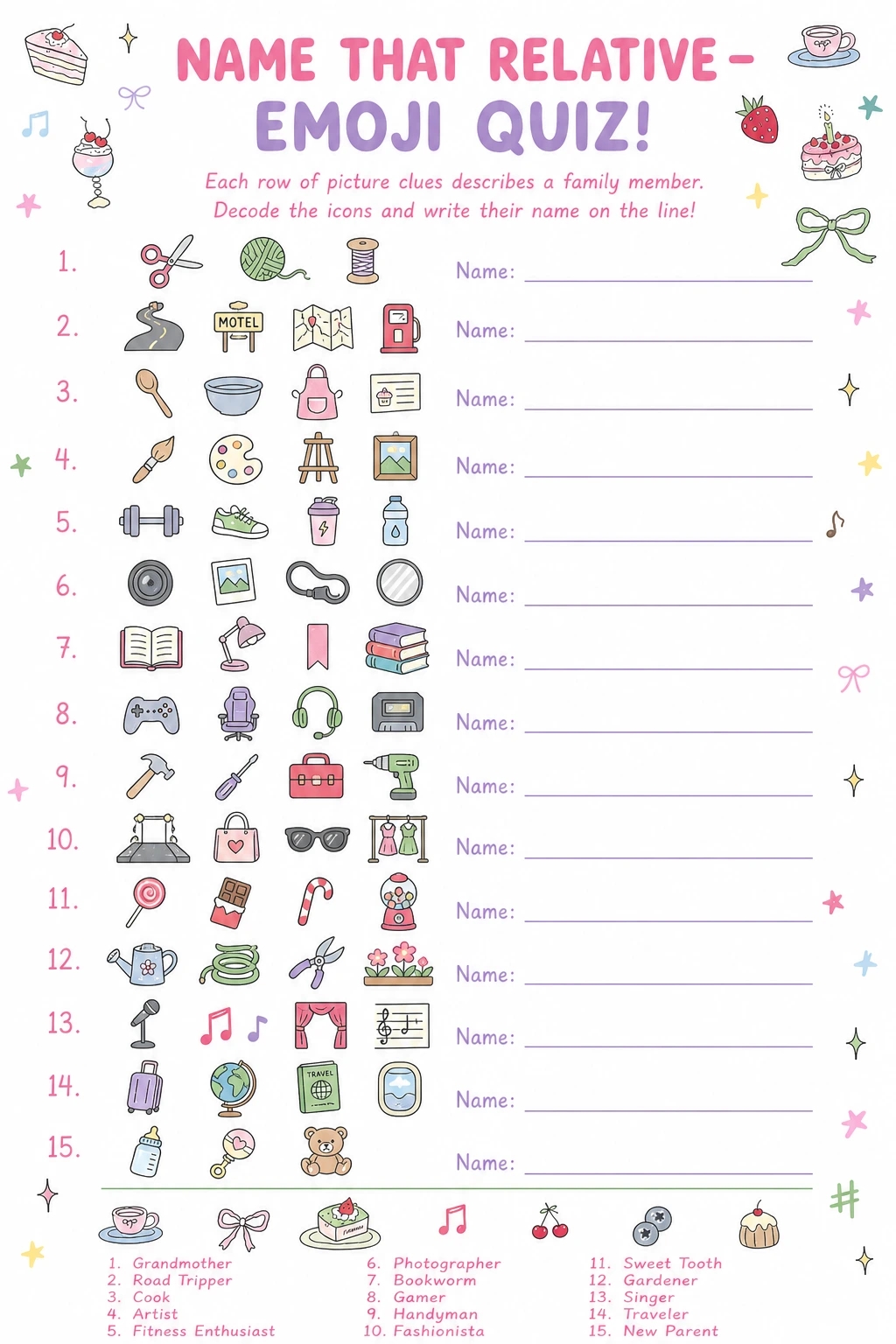
This printable game presents a series of clue sets — each one uses a combination of pictures, symbols, and descriptive icons to represent a family member’s defining traits, hobbies, career, or nickname.
Players look at the clues for each numbered entry and write down which relative they think is being described. Once everyone has submitted answers, the host reveals the correct matches and, ideally, invites the described relatives to stand and take a bow.
The room always erupts when someone realizes the clues for #7 are pointing unmistakably at their Uncle Gerald.
This game plays well for groups of 15 to 60 and takes about 15 to 20 minutes. You’ll need printed sheets, pens, and — crucially — a host who has prepared the clue sets in advance by gathering fun facts from willing family members.
Keep the clues affectionate rather than roast-level sharp, since not every relative will be amused the same way.
Host tip: give described family members a heads-up before the game so they can react in good humor rather than surprise. A relative who knows they’re being featured is far more likely to play along, add a funny comment during the reveal, and turn the moment into a crowd-pleaser instead of an awkward pause.
🛍 Shopping guide
14. Guess the Baby Photo!
Ask family members to submit a baby or toddler photo of themselves before the reunion — email or a group chat works fine. Print them out, number them, and display them on a board or tape them to a wall.
Give each player a printed answer sheet listing the numbers, with a blank line next to each one. Players walk the display, study the cherubic faces, and write down which family member they think each photo belongs to.
The player with the most correct matches wins.
This game works brilliantly for groups of 15 to 80 and runs about 20 to 25 minutes, including the reveal. The reveal is its own event — read the answers one at a time, show the corresponding baby photo, then reveal the current-day family member.
The contrast between then and now generates the kind of full-room laughter that makes a reunion feel like a real party. All you need are the printed photos, answer sheets, pens, and tape or a display board.
Host tip: collect more photos than you think you need, because a handful of relatives will inevitably forget to send one despite three reminders. Having extras means you can quietly swap in a late arrival’s photo and still run the game with a full and satisfying lineup.

🛍 Shopping guide
15. Family Reunion Mad Libs
The Family Reunion Mad Libs printable presents a short story — a fictional account of your family’s day, adventure, or history — with key words replaced by blanks labeled by part of speech: noun, adjective, verb, a relative’s name, a family location.
Without seeing the story, players take turns calling out words to fill in the blanks. The host writes them in, then reads the completed story aloud in one dramatic sweep. The results are reliably absurd and often genuinely hilarious.
Mad Libs work for every age, which makes them a rare find in a mixed-generation crowd.
Run one sheet for a small group of 5 to 15 gathered around a table, or split a larger group into teams each completing their own sheet and competing to produce the funniest result.
The whole activity takes 10 to 15 minutes, and the completed stories are worth saving — they read even better at the next reunion.
Host tip: read the finished story with full theatrical commitment, pausing for emphasis on the most ridiculous substitutions. A monotone read-through gets a polite chuckle; a host who performs it like a dramatic narrator gets the room on their feet. Energy is everything with this one.

🛍 Shopping guide
16. Family This-or-That — Cast Your Vote!
The printed Family This-or-That sheet presents a series of either/or questions tailored to your family — “Mountains or beach?”, “Grandma’s pie or Grandma’s cookies?”, “Summer reunions or winter reunions?”, “Early bird or night owl?”
Players circle their preference for each question and then tally the results as a group to see which choices dominate.
The real game is in the discussion: every question invites someone to explain, defend, and debate their choice, and those conversations tend to sprawl cheerfully in every direction.
This works for any group size from 8 to 100, either done individually and tallied by a host, or done live with a show of hands for each question.
It takes about 15 to 20 minutes to work through a full sheet and tally the results. No prizes needed — the bragging rights of being on the majority side of “Grandma’s pie vs. cookies” are prize enough in most families.
Host tip: end the sheet with one genuinely divisive question that you know your family debates every year — whether it’s a sports team rivalry, a travel preference, or a long-standing food argument. Saving the most contentious one for last sends the activity out on a high note of mock outrage and laughter.

🛍 Shopping guide
17. Where in the World Is Your Family?
Roll out a large printed world map — or use the dedicated printable sheet — and give each family member a set of small dot stickers in a color assigned to their branch of the family.
Players place a dot on every city, country, or region they’ve lived in or have family roots in. As the dots accumulate, a vivid picture of your family’s geographic spread takes shape. Clusters and surprising outliers generate immediate conversation: “Wait, you lived in Lisbon?”
“Grandpa was born where exactly?”
This activity works for any group size from 10 upward and runs as a passive, drop-in activity throughout the reunion rather than a formal timed game. Post the map at eye level near a high-traffic area like the food table.
By the end of the day, the completed map is a genuine artifact of the reunion worth photographing and preserving.
All you need are the printed map sheet, colored dot stickers in two or three colors, and tape to secure the map to a wall or board.
Host tip: label the sticker colors by family branch ahead of time and write a small legend in the corner of the map.
Without the legend, the dots blur into a single colorful mass; with it, guests can see at a glance which branch has scattered farthest from home, which usually sparks a spirited ten-minute conversation about who’s the most adventurous branch of the family.

🛍 Shopping guide
18. Bocce Ball Tournament
Set up a bocce court on the grass — a flat, roughly rectangular strip about 60 feet long works well, though any open lawn area will do.
Each team of two or three players throws their colored bocce balls toward a small target ball called the pallino, aiming to land as close as possible. The team with the ball nearest the pallino scores points at the end of each round.
Run a bracket-style tournament across family branches, posting results on a simple whiteboard so the standings build drama as the day goes on.
Bocce is ideal for a family reunion because it’s genuinely multigenerational — grandparents often quietly dominate younger competitors, and the slow pace invites conversation between throws.
Groups of 8 to 32 work well in a bracket format, and the tournament can run as a relaxed background activity over an hour or two rather than requiring everyone’s attention at once. The set pays for itself over years of reunions.
Host tip: run a “beginner’s bracket” for kids under 12 using slightly shorter throwing distances. Keeping kids in their own competitive lane means they experience genuine success rather than frustration, and they tend to keep playing all day long — freeing up adults to actually finish a round without interruption.
🛍 Shopping guide
19. Family Talent Show
Give every willing family member or group five minutes on a makeshift stage — a cleared patch of grass, a porch step, or a designated corner of the hall — to perform whatever they like: a song, a poem, a magic trick, an impressive physical feat, a dramatic reading of a grocery list.
The bar for “talent” should be set deliberately low and the applause should be unconditionally enthusiastic. A host emcees between acts, keeping energy up and transitions quick. No judges, no elimination — everyone who performs wins by definition.
This works best with groups of 20 or more and a willing roster of six to twelve acts, each capped at five minutes to keep the show under an hour.
You need essentially nothing except a sign-up sheet posted at the start of the reunion and maybe a single microphone if you’re in a noisy outdoor space.
The show becomes a permanent part of reunion lore — especially the acts that go spectacularly off the rails.
Host tip: personally recruit two or three people to sign up before the reunion so the sheet isn’t blank when guests arrive.
An empty sign-up sheet stays empty; a sheet with three names already on it makes everyone feel the social permission to add their own.
Family elders who share a short story or recite a poem they remember from childhood tend to be the most unexpectedly moving acts of the show.
🛍 Shopping guide
20. Cornhole Tournament
Set up two or more cornhole boards across from each other at the regulation distance — or whatever distance fits your space — and run a round-robin or bracket tournament.
Teams of two take turns tossing bean bags, aiming for the hole (three points) or landing on the board (one point). First team to 21 wins the round.
Mix family branches across teams so no pair is from the same household, which creates cross-family alliances and ensures trash talk stays affectionate.
Cornhole is one of the most universally beloved outdoor games for a reason: it’s easy to explain in 30 seconds, competitive enough to hold interest across all ages, and slow-paced enough that conversations happen naturally between throws.
Run a full eight-team bracket over one to two hours as a background activity, or run shorter casual games with no formal structure. Either way, the boards end up in use all day. Groups of 8 to 40 work well in organized play.
Host tip: write team names on the bracket board that reference family branches or reunion themes rather than just using numbers. “The Coastal Cousins vs. The Heartland Crew” generates far more investment than “Team 1 vs. Team 2.”
A permanent marker and a sheet of poster board is all it takes to turn a casual game into a tournament people actually track.
🛍 Shopping guide
21. Two Truths and a Family Lie
Every player prepares three statements about themselves or their family experience — two true, one false — and reads them aloud to the group.
Everyone else privately votes on which statement they think is the lie, holding up fingers (one, two, or three) simultaneously on the host’s count to prevent copying. The player then reveals the lie and earns a point for every person they fooled.
The person with the most points at the end wins, but the real prize is the string of surprising revelations about relatives you thought you knew.
This game needs absolutely nothing — no materials, no setup, no budget. It plays well for groups of 8 to 30 seated in a circle or around tables, and a full round with 15 to 20 players takes about 25 to 30 minutes.
It’s especially powerful at reunions because the truths tend to surface stories nobody else knew: travel adventures, hidden skills, long-ago embarrassments that have finally ripened into funny.
Host tip: give players five minutes of quiet prep time before the game starts rather than putting them on the spot. The statements get significantly more creative when people have a moment to think, and the lies get significantly harder to detect — which is exactly what you want. A round that’s too easy becomes a round that feels short.
22. Capture the Flag
Split the group into two teams and divide your outdoor space into two equal territories. Each team hides a flag — a bandana or colored ribbon works perfectly — somewhere visible but defensible in their territory.
The goal is to cross into enemy territory, grab their flag, and return it to your side without being tagged. Tagged players go to a designated “jail” area and must wait to be freed by a teammate who tags them safely.
The team that captures the opposing flag and returns it successfully wins the round.
This is best for groups of 16 to 60 with plenty of open outdoor space — a park field or large backyard is ideal.
Games typically run 15 to 25 minutes per round, and you can play multiple rounds with reshuffled teams to give everyone a different experience.
Kids and teenagers naturally take the lead roles, but adults who join in tend to be the ones with the longest postgame stories. The only things you need are two bandanas and a clear boundary for the playing field.
Host tip: brief both teams on boundaries and jail rules before the game starts, and appoint one referee per team to settle disputed tags. Without a referee, “I tagged you!” “No you didn’t!” debates slow the game to a crawl. With one, disputed moments resolve in five seconds and the energy stays high from start to finish.
🛍 Shopping guide
Frequently Asked Questions
How many games should we plan for a one-day family reunion?
For a full-day event, plan for four to six games spread across the day rather than running them back to back. Mixing active outdoor games with calmer printable activities gives everyone a chance to participate at their own energy level.
Keep at least one or two games running as drop-in activities throughout the day — like the Memory Jar, the Recipe Swap table, or the Where in the World map — so latecomers and young children always have something to do without disrupting a structured game already in progress.
What family reunion games work best for mixed ages, including toddlers and grandparents?
Games with adjustable participation levels work best for truly mixed ages. Bocce ball, the Guess the Baby Photo display, Memory Jar Cards, and the Three-Legged Race are all naturally inclusive across generations.
For toddlers, keep a separate low-key activity zone with bubbles or simple ring-toss near the main action so they feel part of the event without disrupting competitive games.
The best reunion games are the ones where a grandparent and a grandchild can be on the same team — those pairings produce the most talked-about moments of the day.
How far in advance should we prepare printable reunion games?
Print all sheets at least two to three days before the reunion, not the morning of. Testing your printer with a small batch early catches ink and alignment issues before they become a crisis.
For games that require advance data — Family History Trivia, Family Feud Teams, Guess the Family Photo Decade — start collecting information from relatives three to four weeks out. A simple group email or message thread is usually enough to gather what you need.
Laminating host reference sheets adds just a few minutes of prep and makes them much easier to manage if the weather turns breezy outdoors.
Do we need prizes for all of these games?
Not at all. Many of the best family reunion games — Two Truths and a Family Lie, Memory Jar Cards, Family This-or-That — carry their own reward in the form of laughter and connection.
For competitive games like Human Bingo, Cornhole, or Relay Race Teams, small prizes add excitement without requiring a big budget: a bag of candy, a funny trophy from the dollar section, or the honour of choosing dessert first.
The goal is celebration, not a competitive hierarchy, so keep prize stakes light and inclusive.
What’s the easiest game to run with no prep at all?
Two Truths and a Family Lie requires zero materials and zero advance setup — just willing players and five minutes of quiet thinking time. Capture the Flag comes in a close second, needing only two bandanas and a patch of grass.
If you arrive at the reunion and realize you’ve forgotten your printed sheets, either of these games can fill 30 minutes effortlessly and usually become the ones people remember most clearly, precisely because they rely entirely on the people in the room rather than on props or paper.
📌 Save These for Later
Loved these? Pin your favorite image below so you can find this list again when you’re planning.



Winter party games for a January or February night in: 8 free printables plus 7 no-prep games that w

Twenty tried-and-tested indoor games for family rainy days, from printable scavenger hunts to sock b
72 truth or dare questions for classmates, split into six rounds with free printable card decks. Saf
Leave a Reply