

Planning a family game night with kids sounds adorable in theory — and then a three-year-old throws a game piece across the room and someone cries because the rules are ‘too hard.’ Been there.
The secret to a game night that actually works with little kids is keeping things short, silly, and reading-free, and wrapping up before anyone melts down at bedtime. That’s exactly what this list does.
I’ve put together 20 games — active ones to burn off that last bit of energy, printable sheets you can download and use tonight, and sweet quiet moments to wind everyone down before bed.
There’s no complicated setup, no tiny pieces kids will definitely lose, and zero games that require a PhD to explain. Just good old-fashioned fun the whole family can actually play together.
So grab some snacks (maybe alongside a cozy Amish Breakfast Casserole for a lazy game-morning next weekend), clear the living room floor, and let’s do this.
This post contains affiliate links — if you buy through them, I may earn a small commission at no extra cost to you.
- Heads Up Family Edition
- Simon Says
- Freeze Dance
- Musical Chairs
- Balloon Keep-Up
- Pin the Tail Classic
- Kids Bingo
- Kids Would You Rather Cards
- This or That Kids Sheet
- Kids Riddles Sheet
- Coloring Contest Sheet
- Family Maze Sheet
- I-Spy Sheet
- Matching Memory Cards
- Guess How Many Jar Sheet
- Roll-a-Challenge Dice Sheet
- Kids Charades Card Deck
- Awards Certificates
- What Do You Love Circle
- Family Wishes Share
- Frequently Asked Questions
1. Heads Up Family Edition
Heads Up Family Edition is the card-based party game version of the wildly popular app, and it is an absolute crowd-pleaser for family game night with kids.
One player wears a headband with a card facing outward — showing a word or picture they can’t see — while everyone else shouts out clues to help them guess. Teams race against a sand timer, earning a chip for every correct answer.
The team with the most chips at the end wins, but honestly, the real prize is watching Dad try to act out a dinosaur.
For little kids who can’t read yet, stick to the ‘Act It Out’ category, where clues are physical and purely visual — no reading required from anyone. Teammates can point, gesture, make noises, or mime their hearts out.
Younger siblings love being the loudest clue-giver in the room, which means everyone feels included. Set a shorter timer interval for toddlers so rounds move quickly and nobody loses interest mid-guess.
The genius of this game is how naturally it scales. Older kids and adults give verbal clues in the wordier categories while the littles wildly act things out in the kids’ category — same game, different lanes, zero tears (hopefully).
Pro tip: if you have a mix of ages, pair a little one with an older sibling as teammates so the reading-heavy rounds stay fair and fun for everyone at the table.
Stick to the ‘Act It Out’ or picture-based category on the first round so even your youngest feels like a superstar from game one.
🛍 Shopping guide
2. Simon Says
Simon Says is basically the MVP of family game night with kids — zero setup, zero cost, and it works on kids as young as two. One person is ‘Simon’ and gives commands like ‘Simon says touch your nose’ or ‘Simon says jump three times.’
Players only follow the command if it starts with ‘Simon says.’ Anyone who moves when Simon didn’t say — or freezes when Simon did — is out.
Last one standing wins (or you can just play for laughs with no elimination, which is honestly more fun with tiny kids).
To make this work beautifully with little ones, use silly, movement-based commands that get everyone giggling: ‘Simon says roar like a lion,’ ‘Simon says spin in a circle,’ ‘Simon says pretend to eat spaghetti.’ The funnier the better.
You can also let kids take turns being Simon — they LOVE the power, and watching a five-year-old try to trick you with ‘Simon says… Simon says… wiggle your bottom!’ is genuinely hilarious entertainment for the adults at the table.
This game is a quiet hero for bedtime-adjacent game nights because you can gradually wind down the energy level just by making Simon’s commands slower and calmer — ‘Simon says take a deep breath,’ ‘Simon says do a big stretch,’ ‘Simon says tiptoe to the couch.’
It doubles as a sneaky transition tool to get everyone calm before the final wind-down games. Your future self will thank you.
- Ages 2 and up
- Groups of any size
- Zero prep — just your voice and your silliest commands
3. Freeze Dance
Freeze Dance is pure, joyful chaos in the best possible way, and it is a non-negotiable on any family game night with kids list. Play a fun song and everyone dances — wiggles, spins, jumps, the whole shebang.
The moment the music stops, everyone freezes like a statue. Anyone who moves after the music cuts out is out, and the last person still ‘frozen’ at the end wins. Simple? Yes.
Does it make every single child in the room absolutely lose their mind with happiness? Also yes.
You don’t need anything fancy — just a phone or speaker and a good playlist. For little kids, lean into silly songs they already know (think: anything from their favorite animated movies or a fun kids’ dance playlist).
Pause the music at unpredictable intervals so nobody can anticipate the freeze — catching the toddler mid-twirl is always the highlight of the evening. You can also add themed freeze poses: ‘When the music stops, freeze like a robot!’ or ‘Freeze like a sleeping bunny!’
for extra giggles.
What makes Freeze Dance such a winner is that it burns off that pre-bedtime energy spike in about five minutes flat, leaving everyone happily tired and ready for quieter games.
It’s also one of those rare games where a two-year-old and a ten-year-old are genuinely equally entertained, which is the holy grail of family game night with kids.
Play it early in the lineup to get the wiggles out, then transition to calmer activities — you’ll have a much smoother rest of the evening, I promise.
Burns off pre-bedtime energy fast so kids are happy-tired rather than wired when it’s time for quieter games.
🛍 Shopping guide
4. Musical Chairs
Musical Chairs is a timeless classic that every family game night with kids deserves at least once — and it works just as well in your living room as it does at any party.
Arrange chairs in a circle (one fewer chair than the number of players), play some music, and everyone walks around the circle. When the music stops, everyone scrambles to sit in a chair.
The player left standing is out, and you remove one more chair before the next round. It keeps going until one champion claims the last seat.
For very little kids, tweak the rules so nobody sits out — instead, everyone who finds a seat cheers, and the round simply resets. This version keeps toddlers engaged without the devastation of being eliminated in round one (been there, not fun for anyone).
You can also let younger kids sit on laps if there aren’t enough chairs, which becomes its own hilarious scramble. Use a playlist of upbeat kids’ songs and pause them unpredictably to keep the energy high and the anticipation delicious.
Musical Chairs is perfect as the second active game of the night because by then kids are warmed up and ready to run. Keep rounds short — aim for five to seven minutes total — so the excitement doesn’t tip over into overstimulation.
The host tip that changed my life: announce ‘last round!’ so kids know it’s wrapping up, which avoids the meltdown that comes from abrupt endings. You’re welcome in advance.
Let toddlers share chairs or sit on a parent’s lap so they stay in the game and the fun rather than sitting on the sidelines.
5. Balloon Keep-Up
Balloon Keep-Up is exactly what it sounds like — blow up a balloon and the whole family works together to keep it from touching the floor. That’s it. That’s the game. And somehow, it is absolutely riveting to children of all ages.
Everyone can play, nobody gets eliminated, and the cooperative nature means even the littlest toddler feels like a hero when they bat the balloon back up into the air.
You can also add a gentle competition: count how many times you keep it up before it hits the ground and try to beat your record each round.
For an extra challenge, add a rule: no using your hands, only heads and elbows. Or call out a body part (‘left hand only!’) and everyone has to switch mid-rally.
You can also use two balloons at once for older kids who need more of a challenge — double balloon chaos is something to behold.
Use standard round balloons rather than long ones since they float more predictably and are easier for tiny hands to bat around safely.
The beautiful thing about Balloon Keep-Up for a family game night with kids is how easily it fills the ‘we need to move but we also can’t break the lamp’ gap.
It’s gentle enough for the youngest players, engaging enough for older kids, and genuinely fun for grown-ups who didn’t expect to be diving across the couch to save a balloon at 7 pm on a Tuesday.
Keep a few spare balloons on hand because they will pop, and that pop will either cause tears or the greatest laugh of the evening — fifty-fifty odds either way.
- Several round balloons (blown up ahead of time)
- A clear open floor area free of breakables
🛍 Shopping guide
6. Pin the Tail Classic
Pin the Tail on the Donkey is one of those games that has survived generations of family game nights for good reason — it is genuinely thrilling for little kids and genuinely funny for everyone watching.
Hang a large poster of a donkey (or a fun animal of your choice) on the wall, blindfold each player in turn, spin them gently a few times, and send them off to stick their paper tail as close to the right spot as possible.
Whoever gets closest wins, but honestly, the person who pins the tail on the donkey’s nose is the real star of the evening.
For very young kids, skip the spinning and just use the blindfold — the gentle disorientation of not being able to see is more than enough challenge and excitement without making anyone dizzy.
You can also do a simplified version where kids simply close their eyes and walk forward, which is safer and equally hilarious. Use sticky-backed tails rather than actual pins to keep the activity safe for small hands.
If you want to make it extra silly, swap the donkey for a themed animal (a cat, a unicorn, a dinosaur) and call it ‘Pin the Horn on the Unicorn’ — kids love the theme mashup.
What makes this game shine on a family game night with kids is the pure anticipation of the reveal — the whole family watches and giggles as the blindfolded player wanders confidently in completely the wrong direction.
It’s one of those rare games where spectating is almost as fun as playing, which means even the youngest kids who aren’t quite ready to take their turn yet stay entertained and engaged.
Play this one before the printable games so everyone is still buzzing with laughter.
Use a repositionable sticky tail instead of pins so little ones can play safely and tails can be reused all night long.
🛍 Shopping guide
7. Kids Bingo
Kids Bingo is the printable that saves every family game night — and this version is designed especially for little kids who can’t read yet.
Instead of letters and numbers, each square features a simple picture icon: a star, a dog, a rainbow, a pizza slice, a rocket, and more.
The caller draws picture cards or calls out clues, and players find the matching image on their sheet and mark it with a sticker dot or crayon. First to get five in a row shouts ‘BINGO!’ and does their best victory dance.
Print one unique card per player (the sheet below has four different card layouts so no two players have the exact same card), grab a box of sticker dots or some crayons for markers, and you’re ready.
Keep the pace lively — call a new image every 20 seconds or so — to hold little attention spans.
You can play traditional Bingo (five in a row), blackout (fill the whole card), or corners (just the four corner squares) to change the difficulty depending on how much time you have left before bedtime.
The reason picture Bingo works so brilliantly on a family game night with kids is that even a two-year-old can play independently — they just look for the picture that matches what you’re calling.
There’s no reading, no complex rules to remember, and the thrill of getting close to a Bingo keeps kids laser-focused in a way that most games can only dream of. Plus, sticker dots are satisfying to place in a way that never gets old.
Grown-ups, you’ll love it too — don’t even pretend otherwise.
- Printed Kids Bingo cards (one per player)
- Sticker dots or crayons for markers
- Small prizes or sticker rewards for winners

🛍 Shopping guide
8. Kids Would You Rather Cards
Would You Rather is one of the greatest conversation starters ever invented, and this kids’ version keeps every question silly, lighthearted, and totally kid-appropriate — think ‘Would you rather have spaghetti for hair or pizza for hands?’
and ‘Would you rather be able to fly or be invisible?’ Each card has one fun dilemma and two illustrated answer boxes. Players circle or point to their choice, then explain why (the ‘why’ is always the most entertaining part, especially from a four-year-old).
Print the card deck and cut along the dotted lines to make a proper card set, or simply print and read the questions aloud from the sheet without cutting — both work great.
Go around the circle so everyone gets a turn to answer, and encourage the whole family to vote on each question before revealing their reasons.
Little kids who can’t articulate a full ‘why’ can just point to their favorite, while older kids and adults can argue their case passionately. It becomes a surprisingly revealing window into how everyone’s mind works.
What makes this game a standout on a family game night with kids is that it requires absolutely nothing beyond the printed sheet — no dice, no tokens, no setup.
It also naturally sparks real family conversation, which means you’re not just playing a game; you’re learning fun new things about each other in the process.
Tuck the printed cards into your bag and you’ve got an instant road trip activity, a dinner table game, and a waiting-room lifesaver all in one. Talk about a printable that works overtime.
- Ages 3 and up
- Groups of 2 to 10 players
- Zero setup — just print, cut, and go

9. This or That Kids Sheet
This or That is Would You Rather’s speedy little cousin — faster rounds, more options, and completely irresistible to kids who love to share their opinions about everything (so, all kids). The printed sheet lists 20 fun ‘This or That’ pairs: Dogs or Cats?
Beach or Mountains? Cake or Cookies? Players circle or point to their pick and you go around the table comparing answers.
The goal isn’t to win — it’s to discover who in your family would actually choose mountains over the beach (wild) and whose answers surprise you most.
This sheet works brilliantly as a low-key game between more active rounds because everyone can participate at once rather than taking turns one at a time.
Read each pair aloud and everyone shouts or holds up their answer simultaneously — it turns into a fast, fun vote where the room naturally splits into camps and kids love seeing which side they’re on.
For pre-readers, pair each option with a little icon on the sheet so they can identify their choices without any help.
The This or That Kids Sheet earns its spot on this family game night with kids lineup because it’s one of those rare activities that genuinely delights every age in the room — toddlers love pointing to the picture they recognize, school-age kids love building a case for their choice, and adults love being reminded that their seven-year-old would choose living in a submarine over a treehouse every single time without hesitation.
Frame it, honestly.
Read each pair aloud and have everyone shout their answer at the same time so there’s no waiting and no one gets bored between turns.

10. Kids Riddles Sheet
A riddles sheet is the kind of printable that has everyone leaning in — little kids love trying to guess, big kids love knowing the answer before anyone else, and parents love watching the ‘ohhh!’ lightbulb moment when the answer finally clicks.
This sheet features 15 short, easy, kid-friendly riddles with picture hints beside each one, making them accessible even for pre-readers. Think classics like ‘I have hands but I can’t clap — what am I?’
(a clock) and ‘I’m tall when I’m young, short when I’m old — what am I?’ (a candle). Simple, satisfying, and endlessly replayable.
Read the riddles aloud one at a time (the sheet is really a read-aloud tool, not a solo activity for little ones), and give everyone time to think before accepting guesses.
You can do it elimination style — whoever guesses correctly gets a point — or simply play for fun with no score. Have players whisper their answers in your ear rather than shouting them out so everyone gets a fair chance to think.
The answer key runs along the bottom of the sheet in small text so you can peek discreetly without spoiling it for the kids.
Riddles are brilliant for a family game night with kids because they slow the pace down naturally — perfect after a round of Freeze Dance or Balloon Keep-Up — while keeping brains engaged and curiosity buzzing.
They also sneak in genuine critical thinking in a way that feels like pure play. And there’s something deeply sweet about watching a three-year-old shout a completely wrong but totally confident answer and be absolutely certain they’ve got it.
Riddle sheets: low effort, high reward, maximum giggles.
- Read each riddle aloud
- Everyone whispers their guess to the host
- Host reveals the answer from the key at the bottom
- First correct guess earns a sticker or point

11. Coloring Contest Sheet
A Coloring Contest might just be the most underrated game on any family game night with kids list, and I’m here to make the case for it.
Everyone gets the same printed line-art sheet — a fun illustrated scene like a friendly animal neighborhood or a rocket blasting into space — and a set of crayons or markers.
Set a timer for 8 to 10 minutes and everyone colors their sheet as creatively as they can. When time is up, display all the finished sheets and vote on categories: most colorful, most creative, most surprising color choices, best detail work.
Every kid wins a category because you invent the categories to match what everyone actually did.
The key to making this work for little kids is using bold, simple line art with large areas to color — intricate detailed scenes are frustrating for small hands and short attention spans.
The sheet below features a cheerful animal scene with roomy sections perfect for chunky crayons. Set out a good variety of colors — the more the better — and let kids go completely rogue with their choices. A purple elephant? Absolutely. A rainbow striped house?
Obviously. That’s the whole point.
What makes a Coloring Contest perfect for family game night with kids is the glorious combination of quiet focus and completely unpredictable results.
Even the most chaotic household gets genuinely peaceful for eight minutes when crayons are involved, and the ‘awards ceremony’ at the end where you hold up each sheet and announce silly categories is pure joy.
You can frame the winner’s sheet on the fridge, which is the highest honor any five-year-old can receive. Just saying.
Make up a unique award category for every single entry so every child wins something — ‘Most Rainbows Used’ and ‘Bravest Color Choices’ are always good starting points.

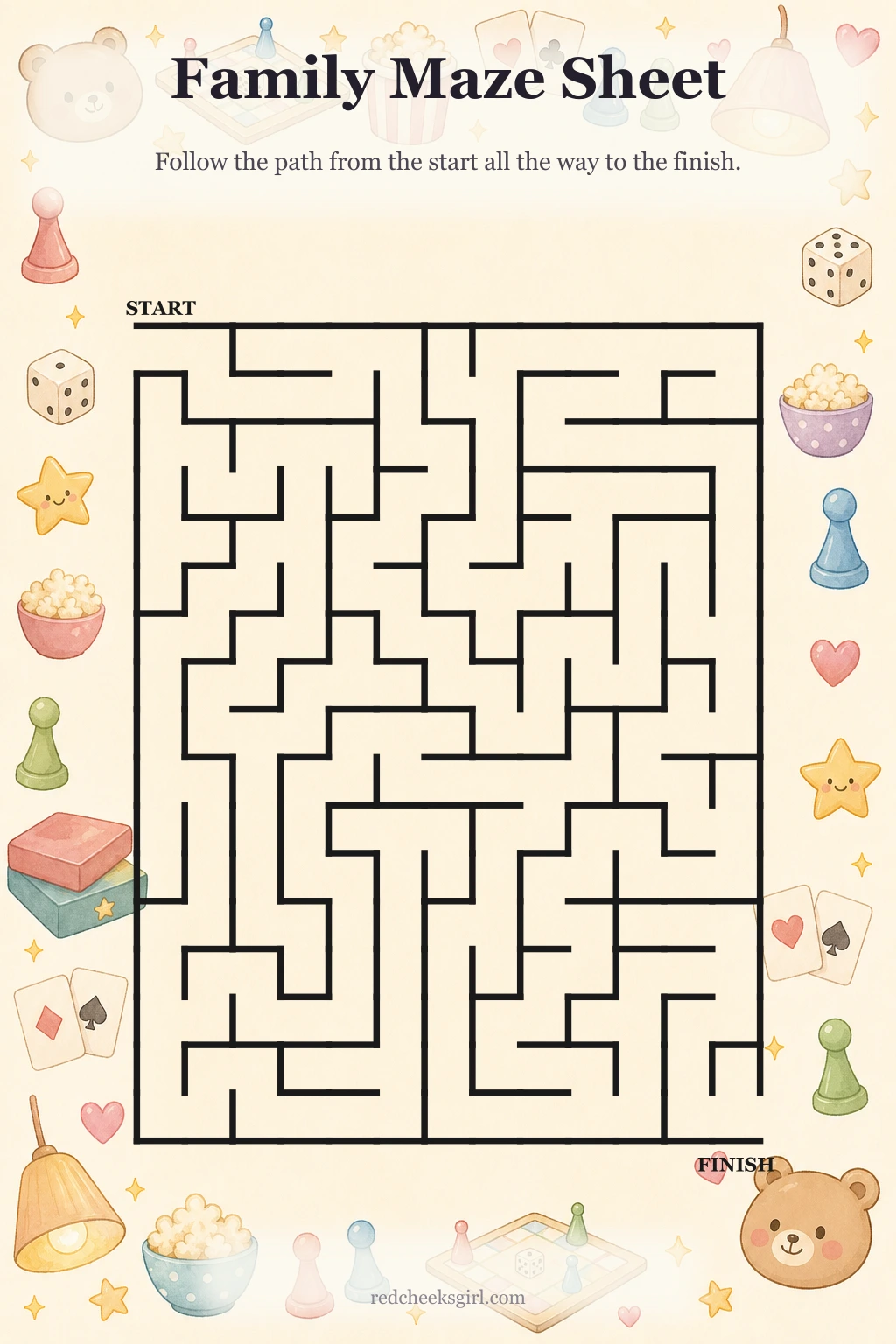
12. Family Maze Sheet
A maze sheet is pure, pencil-in-hand satisfaction for kids, and this family-themed version is designed to be challenging but totally solvable for the 4-and-up crowd — with a simpler path built in for the littlest ones so nobody gets frustrated and throws their pencil (speaking from experience).
The maze features a fun illustrated start point — say, a little kid at the front door — and an illustrated finish point, like a game table surrounded by the whole family.
Getting from start to finish is the challenge, and the winding paths between feel genuinely tricky while still being completable in one sitting.
Print one sheet per player (or have siblings take turns with the same sheet if you’re running low on printer ink — been there). Everyone starts at the same time, and the first to reach the finish wins.
For little kids who struggle with mazes, play cooperatively: everyone works on the same sheet together, taking turns moving the pencil.
You can also have parents ‘race’ their kids, giving kids a head start for fairness, which kids absolutely love because beating a grown-up at something is the greatest feeling in the world.
Maze sheets earn a spot on family game night with kids because they provide that focused, semi-competitive quiet energy that’s perfect between active games. Kids feel genuinely proud when they solve a maze — it’s a concrete, visual win they can see and keep.
Pro tip: laminate the sheet and use dry-erase markers so you can play the same maze multiple times to try to beat your best time. That replay value alone makes it worth a spot in your game night rotation every single week.
Let tiny kids use their finger to trace the path first before committing with a pencil — it builds confidence and cuts down on eraser-related meltdowns significantly.
🛍 Shopping guide
13. I-Spy Sheet
I-Spy is one of those perennially brilliant games for little kids, and a printed I-Spy sheet takes it to the next level because everyone can play simultaneously instead of waiting for their turn.
The sheet features a detailed illustrated scene packed with hidden objects, and a checklist along the side listing everything to find.
Players scan the scene and check off each item as they spot it — first to check off everything on the list wins, or you can play cooperatively as a team to find every hidden object together before a timer runs out.
For very little kids (2-4), simply point to the picture and say ‘Can you find the star? Can you find the frog?’ without any pressure to complete the full list — it becomes a gentle, playful visual search that holds their attention beautifully.
For older kids, make it competitive: set a one-minute timer per category and see who can find the most items before time is up.
You can also play a ‘hot or cold’ guiding version where one player knows where a hidden item is and guides others with ‘warmer… colder…’ clues.
The I-Spy Sheet is genuinely one of the most versatile tools in the family game night with kids toolkit — it works as a quiet individual activity, a group game, a waiting-game while you’re setting up the next activity, or even a take-home keepsake kids can bring to school.
The illustrated scene on this one features a cozy living room full of sneaky hidden objects, making it perfectly on-theme for a game night setting. Cute, right? Very cute, tbh.
- Ages 2 and up
- Groups or solo play
- Works as a quiet buffer between high-energy active games

14. Matching Memory Cards
Matching Memory Cards — the printed version of the classic concentration game — are a family game night with kids staple that never, ever gets old.
The sheet features 24 cards (12 matching pairs) printed on a single page: cute illustrated icons like animals, foods, objects, and shapes, each appearing twice. Players cut the cards apart, shuffle them, and lay them all face-down in a grid.
On each turn, a player flips two cards over: if they match, they keep the pair; if they don’t, they flip them back. The player with the most pairs when all cards are matched wins.
Print on cardstock for best results — regular printer paper works but cardstock cards feel more satisfying to flip and are less likely to go transparent in the light (which would defeat the whole purpose, obviously).
You can also laminate the cards after cutting for a set that survives repeated game nights without getting bent and dog-eared.
For very little kids, start with just 8-10 cards (4-5 pairs) face-up rather than face-down for an easier matching game that builds the visual recognition skills needed for the full memory version.
What makes printable Matching Memory Cards such a winner is the sweet spot of challenge they hit for the 3-to-7 crowd — demanding enough to feel like a real game, achievable enough that little kids genuinely win sometimes.
Older siblings who remember card positions feel like geniuses; younger kids who stumble onto a match feel equally triumphant.
It’s one of the few games where the score genuinely doesn’t predict the fun level, and that’s the exact vibe you want for family game night with kids.
Print on cardstock and add a simple pattern or solid color to the back of all cards before cutting so the fronts stay hidden during play.

15. Guess How Many Jar Sheet
Guess How Many is one of those games that sounds almost too simple to be genuinely exciting — and then a six-year-old guesses 4,000 and a four-year-old guesses 3 for the same jar of 47 gummy bears and the whole room loses it.
Fill a clear jar with small objects before game night (wrapped candies, pom-poms, mini erasers, dried pasta — anything small and countable), and give everyone a printed guess sheet to write in their estimate.
Whoever guesses closest without going over wins the jar and everything in it, which makes for an excellent prize.
The printed sheet has a spot for each player’s name, their guess, and a space to reveal the actual count at the end.
You can run multiple rounds with different jars of different objects to extend the game — a tall thin jar of small candies, a wide jar of large marshmallows, a medium jar of coins.
Each jar challenges kids to think about size and density in a wonderfully intuitive way. For pre-writers, have a parent write down their guessed number while the child says it aloud.
Guess How Many is the perfect palate-cleanser game for family game night with kids — it takes about three minutes, everyone participates simultaneously, and the reveal moment generates genuine excitement every time.
Fill the jar with something the kids love to eat and the winner gets to keep and share the contents, which adds a delicious real-world stakes element that no board game can match.
Plus, counting out the objects to find the real answer is its own mini math lesson disguised as pure fun. Sneaky and brilliant.
- A clear glass or plastic jar
- Small countable objects (wrapped candies, mini erasers, pom-poms)
- Printed guess sheets and pencils for each player

16. Roll-a-Challenge Dice Sheet
Roll-a-Challenge is the kind of game that makes kids absolutely feral with excitement in the best possible way.
The printed sheet shows a simple grid: one axis lists numbers 1-6 (matching a die), and the other axis lists a second set of numbers 1-6 (matching a second die).
Where the two rolled numbers intersect on the grid reveals the challenge — a silly physical action the player must perform right then and there.
Challenges include things like ‘hop on one foot 10 times,’ ‘act like a monkey for 30 seconds,’ ‘do 5 jumping jacks,’ and ‘make your funniest face while everyone tries not to laugh.’
All you need beyond the printed sheet is two standard dice. Players take turns rolling both dice, find where the numbers intersect on the grid, and immediately perform whatever challenge is in that box. Everyone else judges whether they completed it successfully.
You can keep score (one point per completed challenge) or just play for pure chaotic entertainment — both approaches result in exactly the same amount of living room chaos, so take your pick.
Roll-a-Challenge earns massive points on a family game night with kids because it keeps energy high without requiring any setup, storage, or cleanup beyond rolling dice.
The randomness of the dice means nobody knows what’s coming, which creates that delicious anticipation that keeps kids glued to the game.
It also means a shy kid might roll ‘roar like a lion’ and a confident kid might roll ‘whisper your favorite word five times’ — the dice are democratic and delightfully unpredictable. Print a few copies so you can play multiple rounds with fresh challenges.
The randomness of two dice means every turn is a surprise — and surprise is basically rocket fuel for keeping kids engaged and in their seats.

🛍 Shopping guide
17. Kids Charades Card Deck
Charades is a family game night classic for a reason — and this printable Kids Charades Card Deck makes it completely accessible to little kids by using illustrated picture cards instead of written words.
Each card features a big bold black-outline drawing of an animal, action, or everyday object that kids can act out without any reading required.
Draw a card, hold it up for the actor to see (or show a parent who whispers the category), and watch the performing begin. Teammates shout their guesses and the team scores a point for each correct answer within the timer.
The deck has 24 cards across three categories: Animals (dog, elephant, butterfly, frog, penguin, horse, cat, monkey), Actions (swimming, jumping, eating spaghetti, brushing teeth, flying a kite, driving a car, sleeping, dancing), and Objects (a balloon, a rocket, a birthday cake, a pizza, an ice cream cone, a drum, a flower, a star).
Print and cut the cards, shuffle them into one combined deck, and you’re ready. For little kids who act, give generous hints — ‘Think about something in the sky!’ — to keep the game moving and avoid frustrated tears mid-performance.
The picture-based format of this charades deck is what makes it genuinely brilliant for family game night with kids — the youngest player in the room can draw a card, look at the picture, and launch into the most enthusiastic (if completely unrecognizable) rendition of a penguin you’ve ever seen, and everyone still has the best time.
Charades at its core is less about guessing correctly and more about watching someone you love try to mime ‘eating spaghetti’ with total commitment. And that never stops being funny, no matter how old you are.
- Draw a card and look at the picture (no peeking, teammates!)
- Act it out — no words or sounds allowed
- Teammates guess before the timer runs out
- Score a point for each correct guess

🛍 Shopping guide
18. Awards Certificates
Every great family game night with kids deserves an awards ceremony at the end, and these printable Awards Certificates make the wrap-up moment genuinely magical.
The sheet features six different certificate designs — each with a bold illustrated trophy or ribbon graphic, a decorative border, and blank fill-in fields for the winner’s name, the award category, and the date.
Categories on the pre-designed certificates include: Game Night Champion, Best Sport, Silliest Player, Most Enthusiastic, Creative Genius, and the coveted Family MVP. Print them ahead of time and fill in names at the end of the night with your best fancy handwriting.
The certificates are sized at roughly half a US Letter page each (two per page, three pages total for six certificates), making them big enough to feel official and exciting but small enough to tuck into a backpack or stick on the fridge.
For extra pizzazz, keep a small supply of gold star stickers to press onto each certificate before handing it out — that tactile moment of receiving a real award with a shiny sticker on it is deeply satisfying to a five-year-old in a way that no trophy can replicate.
You can also fill in a custom category (‘Best Balloon-Keeper-Upper,’ ‘Freeze Dance Frozen-est’) so every single player walks away with a certificate tailored just for them.
Ending family game night with kids on an awards ceremony is genuinely one of the best hosting moves you can make — it gives the evening a clear, celebratory ending that signals ‘this is wrapping up’ without anyone feeling like the fun is just arbitrarily stopping.
Kids feel seen and celebrated, parents feel like they nailed the whole thing (because they did), and everyone goes to bed happy. It’s the bow on the whole gift, and it takes about four minutes to set up. Absolutely worth it every time.
Make up a custom award for every single player — even ‘Best Sock Feet Slide to the Chair’ counts — so nobody goes to bed without a certificate of their very own.

19. What Do You Love Circle
What Do You Love Circle is the warm, cozy wind-down game that every family game night with kids needs in its back pocket.
Everyone sits in a circle — on the floor, on the couch, wherever’s comfortable — and one person starts by sharing something they love: a food, an animal, a person, a place, a feeling, a color, anything goes.
Then the next person shares something they love that is somehow connected to the previous answer. (‘I love pizza!’ — ‘I love cheese because it’s on pizza!’ — ‘I love the moon because it’s yellow like cheese!’)
The connections can be as loose and creative as the kids want.
There’s no winner, no score, and no elimination — just a flowing circle of sharing that gives every child a genuine moment of being heard.
Set a gentle rule that everyone listens quietly while someone is speaking (a good life skill, not just a game rule), and celebrate each answer with a soft clap or a family thumbs-up.
For very little ones who might not understand the connection element, simply go around the circle with ‘something you love’ and let the chain rule be optional — the sharing is the real magic, not the mechanics.
This game earns its place at the end of family game night with kids because it gradually brings the energy down while creating a genuine moment of connection and warmth.
Pediatric sleep experts note that transitioning from excitement to calm with a structured but low-key activity makes bedtime easier — and there’s something genuinely beautiful about ending the evening knowing exactly what everyone in your family loves most right now.
It’s one of those tiny family traditions that kids remember for years. Highly recommend making it your game night closing ritual every single time.
Gently brings energy down after active games while giving every child a moment to be truly heard — the perfect transition to bedtime.
20. Family Wishes Share
Family Wishes Share is the sweetest possible way to close out a family game night with kids, and I may or may not get a little emotional every time we play it (don’t tell).
Everyone in the circle gets a turn to share one wish — something they hope for, something they’d love to do together, something they dream about, something kind they wish for someone they love.
Wishes can be big (‘I wish we could go to the ocean!’) or wonderfully tiny (‘I wish the dog could talk’).
A parent can write the wishes down in a little notebook to keep, or simply let them float through the air and land gently in everyone’s hearts.
To make it feel extra special, dim the lights slightly and use the glow of a small battery-powered lantern or a few tea light candles in the center of the circle.
The ambient shift signals ‘this is different — this is special,’ which kids respond to instinctively.
You can also use a simple ‘wishing stone’ (any smooth rock from the yard works) that gets passed around the circle: whoever holds the stone has the floor, and everyone else listens.
The passing of the stone gives even the youngest child a sense of ritual and ceremony that feels surprisingly meaningful.
Ending family game night with kids on Family Wishes Share does something genuinely powerful: it redirects everyone’s energy from competition and excitement toward gratitude and connection, which makes for calmer, happier bedtimes.
It also gives parents a beautiful, low-pressure window into what their kids are currently thinking about and hoping for — information that is pure gold.
Pair this with the 15 Mother’s Day Gift Crafts Kids Can Make for another sweet way to turn feelings into something tangible, or browse the 14 Cute Scrapbook Ideas to preserve your kids’ best wishes and game night memories in a keepsake book.
Keep a small notebook nearby to jot down each person’s wish — reading them back months later is one of the most heartwarming things you will ever do as a family.
Frequently Asked Questions
What are the best family game night games for kids under 5?
For kids under 5, the best family game night games are ones that require zero reading and have very short rounds. Freeze Dance, Balloon Keep-Up, Simon Says, and picture-based Kids Bingo are all perfect for toddlers and preschoolers.
The key is keeping rounds under 5 minutes and making sure little ones can participate fully without needing to read or follow complex rules. The What Do You Love Circle and Family Wishes Share are also excellent wind-down games for this age group.
How do I keep a family game night from running too late for young kids?
Start game night earlier than you think you need to — aim for right after dinner so you have a full 1.5 to 2 hours before the youngest child’s bedtime.
Sequence your games from highest energy to lowest: start with active games like Freeze Dance and Musical Chairs, move to interactive printable games in the middle, then finish with quiet connection games like What Do You Love Circle and Family Wishes Share.
This natural energy arc makes the transition to bedtime much smoother and avoids the overtired meltdown spiral.
How many games should I plan for a family game night with little kids?
For little kids (ages 2-6), plan 5 to 7 games maximum, with each game running 5 to 10 minutes.
Having more games than you need on your list is smart — you can always skip one if kids are flagging, or add one if everyone’s still energized.
Do I need to buy anything special for a family game night with kids?
Not necessarily! Many of the best family game night games for little kids need nothing at all — Simon Says, Freeze Dance, and the What Do You Love Circle are completely free. The printable games require just a printer and some crayons or sticker dots.
The only games that truly benefit from a small purchase are Heads Up Family Edition (which comes with its own supplies) and Balloon Keep-Up (just a bag of balloons). Otherwise, you likely have everything you need at home right now.
How do I handle kids who get upset when they lose a game?
The easiest solution is choosing more cooperative and non-elimination games for the youngest players. Balloon Keep-Up, What Do You Love Circle, and Family Wishes Share have no losers at all.
For competitive games like Bingo or Matching Memory Cards, frame winning positively and always have a small prize or special sticker for every player at the end — not just the winner.
The Awards Certificates printable is perfect for this: invent a unique award category for every single child so everyone goes to bed feeling like a champion.
What’s a good order to play the games in this list?
A great game night flow for little kids goes: start with one or two active games to burn off energy (Freeze Dance, Simon Says), play a crowd-pleasing group game (Heads Up Family Edition or Musical Chairs), then settle into printable games at the table (Kids Bingo, Matching Memory Cards, Riddles Sheet), followed by a few more active games to re-energize (Balloon Keep-Up, Pin the Tail Classic), then quieter printable activities (Coloring Contest, I-Spy, Would You Rather Cards), and finally close with the quiet connection games (What Do You Love Circle, Family Wishes Share) and the Awards Ceremony.
📌 Save These for Later
Loved these? Pin your favorite image below so you can find this list again when you’re planning.

72 this or that questions for kids sorted into six rounds. Read them aloud, print the cards and watc
Fall activities for kids using leaves, conkers and pumpkins, plus 14 free printables to colour, cut,
18 clever family game night ideas for adults — competitive, a little cheeky, drink in hand. Free p
Leave a Reply