

Okay, the kids are finally asleep, the monitor light is blinking green, and you have approximately two glorious hours before someone needs a glass of water at midnight.
This is your moment — and these family game night ideas for adults are exactly what you’ve been waiting for. No baby-proofed rules, no mercy rounds, no ‘let’s let the youngest win.’
Just clever games, light competition, a drink you actually chose, and friends who still remember what fun feels like post-bedtime.
I’ve rounded up 18 of the best games for exactly this scenario, and yes, there are free printable sheets in here so you can literally download and go.
I’ll be honest: planning a grown-up game night used to stress me out. Do I buy expensive board games? Make something from scratch at 11pm? (Hard no.)
But the best nights I’ve ever hosted cost almost nothing and ran on crowd-sourced chaos, a killer trivia sheet, and whatever snacks survived the kids’ dinner.
Whether you’ve got four people around the kitchen table or twelve spread across the living room floor, this list has you covered. So pour yourself something nice, bookmark this page, and let’s get into it.
This post contains affiliate links — if you buy through them, I may earn a small commission at no extra cost to you.
- Salad Bowl (3-Round Game)
- Celebrity Headband
- Cards Against Originality
- Fishbowl
- Blind Snack Tasting
- Adult Trivia Sheet
- 80s and 90s Trivia Sheet
- Would You Rather for Adults Cards
- This or That Adults Sheet
- Music Guess Sheet
- Guess the Year Sheet
- Game Night Score Sheet
- Tournament Bracket Sheet
- Two Truths and a Lie Sheet
- Awards Certificates
- Charades for Adults Card Deck
- Hot Takes Roundtable
- Best Story Never Told
- Frequently Asked Questions
1. Salad Bowl (3-Round Game)
If you only play one game tonight, make it Salad Bowl — it’s the ultimate family game night idea for adults that costs exactly zero dollars and delivers maximum chaos.
Everyone writes four to six words or phrases on slips of paper (pop culture figures, inside jokes, random nouns — the wilder the better), folds them up, and drops them into a big bowl.
Split into two teams, set a one-minute timer, and the fun begins. The same slips get recycled across all three rounds, which means by round three, your team is basically telepathic. It sounds simple. It is absolutely not simple.
Round 1 is Taboo-style: the clue-giver describes the slip without saying any part of the word — verbal clues only, no gestures. Round 2 is pure charades — no talking, just full-body flailing.
Round 3 is the brutal one: one single word as a clue, and your teammates have to pull the answer from memory alone.
The same slips go back in the bowl after each round, so by the time you hit round three everyone vaguely remembers the earlier clues, and the one-word hints become absolutely unhinged. ‘Spaghetti.’ ‘…Brad Pitt?’ ‘YES.’ That is a real thing that will happen.
The secret genius of Salad Bowl is that the players themselves write the content, so it’s automatically calibrated to your group’s humor level.
Tell people to write things that are culturally specific to your friend group — inside jokes, your most notorious moments, the name of that one neighbor everyone has opinions about. The more personal the slips, the harder everyone laughs.
Host tip: if you have an odd number of players, the leftover person makes an excellent timer-keeper and heckler.
- A large bowl or pot
- Slips of paper and pens (4-6 per person)
- A phone timer set to 60 seconds
- 6+ players for best results
2. Celebrity Headband
Celebrity Headband is the game where you strap a name to your forehead and spend five minutes asking increasingly desperate yes/no questions while your friends try not to accidentally give it away.
Each player gets a sticky note or headband card with a celebrity, fictional character, or pop-culture name written on it by someone else — you can’t look at your own.
Then you take turns asking the group yes/no questions to figure out who you are: ‘Am I a real person?’ ‘Am I alive?’ ‘Did I win an Oscar?’ ‘Am I embarrassingly famous for something I did in the 90s?’
The group can only answer yes or no, and the player who guesses their celebrity in the fewest questions wins the round.
For the adult version, lean into pop culture from your actual era — think reality TV villains, controversial musicians, 90s heartthrobs, and the specific kind of celebrity that makes everyone groan in delight.
You can play in rounds where everyone has a card simultaneously and tables quiz each other, or go one at a time for maximum theatrical suffering. Sticky notes work perfectly fine if you don’t have headbands — just stick them to foreheads and commit.
(Yes, someone will complain their note fell off. That’s part of the game.)
What makes this one of the best late-night family game night ideas for adults is how quickly it reveals everyone’s pop-culture blind spots. Nothing is funnier than watching your very confident friend ask ‘Am I respected?’ and the entire room immediately go quiet.
You can theme the names around a decade (80s/90s icons only!), a category (only athletes, only TV villains), or go completely free-range. Free-range is chaotic. Free-range is correct.
Write names on sticky notes before guests arrive so there’s no peeking — keep them face-down in a pile until everyone is seated and ready.
🛍 Shopping guide
3. Cards Against Originality
This is your DIY version of the infamous black-card game — same delightfully dark energy, zero copyright issues, and completely customizable to your specific group of friends who’ve known each other long enough to have zero filters.
Before the party, write a stack of fill-in-the-blank prompt cards on black index cards and a larger stack of answer cards on white index cards.
Think prompts like ‘The real reason bedtime takes so long is ________’ or ‘I would never admit this at the school gates, but I actually love ________.’ Deal seven white answer cards to each player.
One person draws a prompt card, everyone else plays the white card they think is funniest, and the prompt-reader picks the winner. The winning card-player gets a point.
The beauty of making your own deck is that you can write prompts that are hyper-specific to your friend group — your neighborhood, your shared parenting struggles, your group chat’s greatest hits.
Keep it Mediavine-safe and still absolutely hilarious: the funniest answers are almost never the most explicit ones, they’re the ones that are painfully true. Aim for 30 prompt cards and 100 answer cards minimum for a full night’s play.
Print them on cardstock, cut them up, and done. This is also a fantastic reusable party game — once you’ve made the deck, it lives in your game-night box forever.
Rotate the prompt-reader role clockwise so everyone gets a turn at judging, and feel free to add a ‘house rule’ where the funniest card that doesn’t win still gets an honorable mention read aloud. That usually produces the most memorable moments of the night.
You can also let guests add one blank card to the answer pile each round — blank cards with handwritten answers in the moment tend to be chaotic in the best possible way. Trust the process.
- Groups of 4–10 who know each other well
- Nights when you want something laugh-out-loud but still host-controlled
- Friends who survived the school run together
🛍 Shopping guide
4. Fishbowl
Fishbowl is Salad Bowl’s slightly more structured cousin and one of the most criminally underrated family game night ideas for adults out there.
The setup is quick: every player writes three to five words or phrases on separate slips of paper — celebrities, places, objects, anything goes — folds them up, and drops them into a bowl. Divide into two equal teams.
Then you play three rounds using the exact same slips of paper each time, which is where the magic happens. Each round changes the rules for how you give clues, escalating from easy to genuinely absurd.
Round 1 is free-form verbal description (no saying the word itself). Round 2 is silent charades only. Round 3 — the one everyone dreads and secretly loves — is just one single sound. That’s right: no words, no gestures, just a noise. ‘MMMMM.’
‘…Is it spaghetti?’ The fact that everyone has already seen these words in rounds one and two means the connections are already half-formed in your brain, and the sounds your friends make will haunt you.
Each team gets one minute per turn; teams alternate until the bowl is empty, then all slips go back in for the next round.
Fishbowl is best with 8 to 16 players, which makes it perfect for a larger gathering when you’ve got a full living room of adults who needed this more than they realized.
Encourage players to write a mix of easy gimmes and genuinely tricky ones — the best bowls have a few wildcards that stump everyone in round one and somehow become obvious by round three.
Pro tip: if someone writes ‘Elon Musk’ and nobody can mime it, just accept that and move on.
The same words get funnier with each round because everyone subconsciously remembers the earlier clues, making round three feel like shared telepathy.
5. Blind Snack Tasting
Blindfold your guests and let them eat mysterious snacks while their dignity slowly unravels — that’s the elevator pitch for Blind Snack Tasting, and I stand by it entirely.
The host prepares 8 to 12 small bites in advance: some obvious (a potato chip, a grape), some genuinely tricky (a specific brand of cracker, a flavored gummy, a cube of fancy cheese).
Players are blindfolded or simply close their eyes (honor system, but somebody always cheats), and they taste each sample one at a time, writing down or calling out what they think it is. Points go to whoever identifies the most items correctly.
Set up a numbered tasting station with small paper cups or plates and a prepared answer sheet for each player. Reveal answers dramatically at the end — this is not a game where you casually announce results. You announce results. With pauses.
The competitive adults in your group will be absolutely furious that they got the Oreo wrong. You can theme the tasting around a category — all international snacks, all supermarket-own brands, all ‘childhood nostalgia’ foods — or go full chaos with a random selection.
Either way, someone will confidently identify a Ritz cracker as ‘maybe a water biscuit, European?’ and that moment alone is worth hosting the whole night.
The beauty of this game is that it requires zero explanation and works for any group size: people who aren’t playing can watch and heckle the guessers, which is half the entertainment.
Have a cold drink on hand for palate cleansing between samples, and keep portions tiny — you want enough to taste, not a full snack. And if you want to make it extra competitive, do two rounds: one savory, one sweet, and track scores separately.
The savory round winner almost never wins the sweet round. It’s a whole personality-reveal.
Prep your numbered samples behind a closed door so guests don’t accidentally see the packaging — mystery is everything in this game.
🛍 Shopping guide
6. Adult Trivia Sheet
There’s a reason trivia is a bar staple: adults are deeply, competitively invested in proving they know things, and a well-written trivia sheet turns a quiet kitchen table into a surprisingly tense scene.
This Adult Trivia Sheet is a 20-question printable covering five categories that are squarely aimed at a grown-up crowd who came of age before smartphones: Pop Culture, History, Science, Sports, and ‘Random Stuff You Somehow Know.’
It’s the kind of sheet you print on cardstock, hand out with a pencil, and immediately regret when your friend who ‘doesn’t watch much TV’ aces every pop culture question.
Print one sheet per player (or per team, if you’re playing in pairs), set a timer for 10 minutes, and let everyone fill in their answers silently before the big reveal.
The answer key lives at the bottom of the sheet in small text, so the host can read them aloud dramatically — bonus points for doing a fake game-show voice.
You can also run it bracket-style if you’re playing with a larger group: pair players up, compare scores, and advance the top scorers to a speed tiebreaker round.
This sheet works as a standalone game or as a warm-up to get brains firing before the rowdier games start.
The 20 questions are spread evenly across the five categories (four questions each) so nobody gets unfairly punished for having one big knowledge gap. That said, the questions are genuinely challenging — this isn’t a ‘name the capital of France’ situation.
Think ‘which band’s debut album came out the year the Berlin Wall fell’ level. Competitive adults will be deeply satisfied. The one friend who knows everything about 80s music will finally have their moment. Let them have it. They’ve waited years for this.
- Groups of 4–12
- Warm-up game before noisier rounds
- Friends who compete over literally everything

🛍 Shopping guide
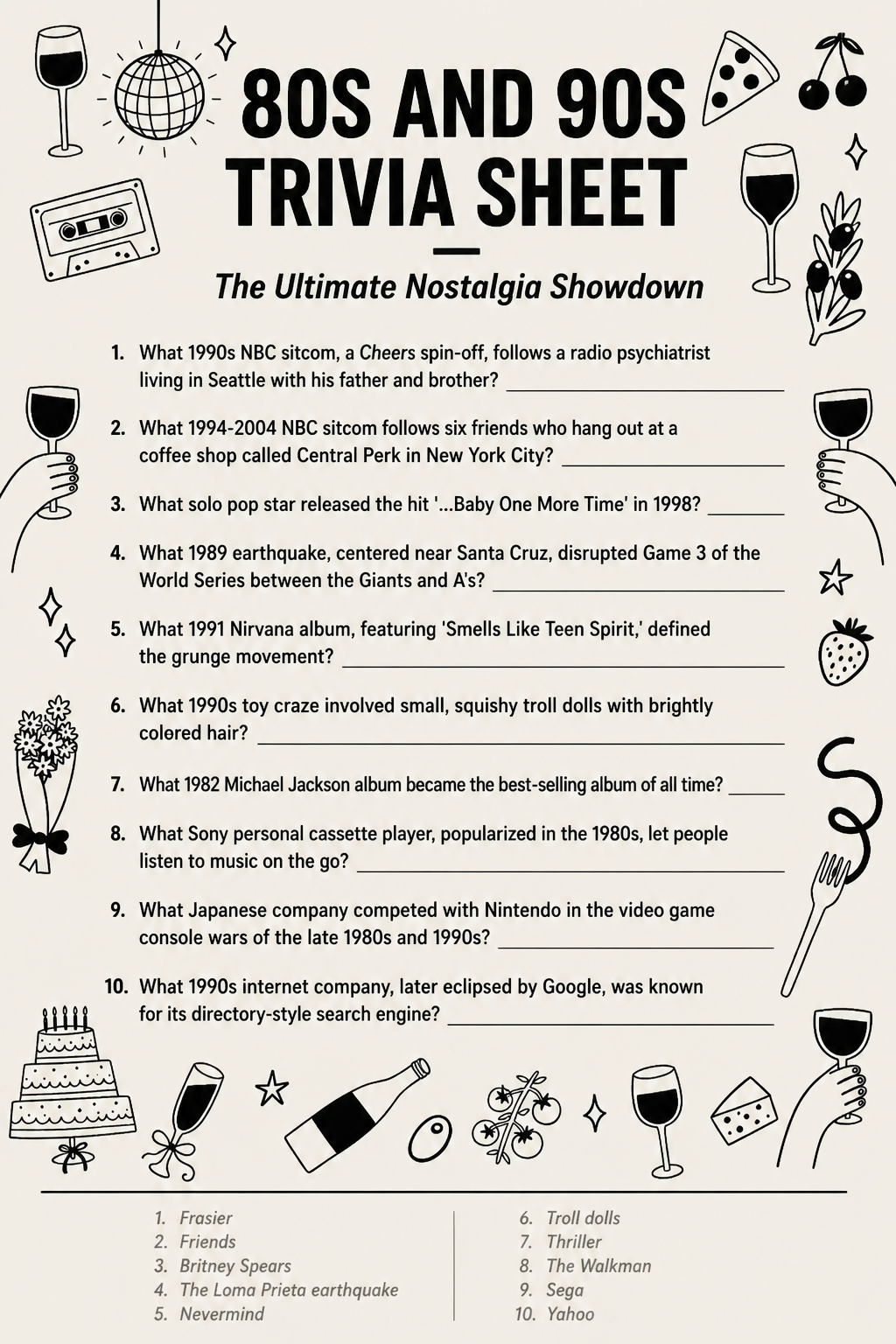
7. 80s and 90s Trivia Sheet
This one is custom-made for the crowd that grew up watching TGIF, knew every lyric to a Spice Girls B-side, and had strong opinions about dial-up internet.
The 80s and 90s Trivia Sheet is a 20-question printable laser-focused on two of the most culturally dense decades in recent history — music, movies, TV shows, fashion, iconic moments, and the kind of nostalgic trivia that makes adults suddenly very loud and very competitive.
It’s the game where someone will aggressively insist the answer is ‘definitely 1994’ and they will be wrong by two years, and that is the entire point.
The sheet is divided into four categories: Totally 80s, Totally 90s, Name That Banger (music-focused), and Pop Culture Deep Cuts (the tricky ones for true nerds). Questions run continuously 1 through 20 and each has a blank write-in line.
Hand them out, give everyone 10 minutes, then go around the table reading answers aloud — the corrections and arguments that follow are essentially a bonus game.
This sheet is particularly brilliant as a competition between couples: it will immediately reveal which partner has been quietly absorbing pop-culture knowledge for decades and which one has been bluffing.
Print them on cardstock so they feel official and can be reused at future game nights (just don’t let anyone keep score across multiple sessions — some rivalries are better left untracked).
The answer key prints in small light italic text at the very bottom so the host can verify answers without ruining anyone’s moment.
Host tip: read the wrong answers aloud too, and let the group guess who wrote what — it adds a whole extra layer of chaotic fun to the reveal round.
Nostalgia makes adults shockingly competitive — people who ‘don’t really care about games’ suddenly care a lot when Nirvana is involved.
8. Would You Rather for Adults Cards
Would You Rather is the world’s most deceptively simple conversation game, and this printable adult version is specifically written for people with opinions, opinions, and more opinions.
The deck is a printable set of 20 question cards, each featuring a dilemma that’s clever, occasionally uncomfy, and always designed to spark a good argument — not in a bad way, in the ‘wait, why did you choose THAT’ way.
Think scenarios about lifestyle trade-offs, social dilemmas, professional absurdities, and the kind of hypothetical situations that reveal far more about a person than they intended to share at game night.
Print the sheet on cardstock, cut along the card borders, and shuffle the deck. Players take turns drawing a card and reading the dilemma aloud.
Everyone has to commit to an answer — no ‘it depends’ allowed, that’s the rule — and then defend their choice to the group.
You can play it casually as a conversation starter or competitively by having the group vote on which answer is most popular; if your answer matches the majority, you score a point.
Either way, you will learn things about your friends tonight that cannot be unlearned, and honestly that’s the best possible outcome.
The cards work beautifully as an icebreaker at the start of the night when people are still arriving and settling in — just fan them out on the coffee table and let people grab one whenever there’s a lull.
They also make a great palate cleanser between more active games. If you want to extend the fun, have guests write their own Would You Rather on a blank card at the end of the night and shuffle those in for a second round.
Warning: the homemade ones are always the most chaotic. Always.
Cut the cards before guests arrive and rubber-band them into a deck — it feels more ‘game’ and less ‘DIY project’ and people engage with it immediately.

9. This or That Adults Sheet
This or That is Would You Rather’s snappier, faster-paced little sibling — same concept, punchier delivery, and perfect for the part of the night when everyone has loosened up and wants something they can play between sips of whatever’s in their glass.
This printable adult version features 30 rapid-fire pairs on a single sheet: two options per round, and you circle, check, or shout your answer. Beach or mountains. Early bird or night owl. Text or call. Fancy dinner or food truck.
The pairs escalate from easy and relatable to genuinely revealing, and by question 20 the table is deep in a debate about whether Paris or Tokyo is the superior city that nobody invited but everyone is having.
The sheet works in two formats: solo (everyone fills it out silently, then compares answers) or real-time (host reads pairs aloud and players call out their answers simultaneously — first one to speak commits, no changing).
The real-time version is louder and more chaotic and is therefore the correct version.
Tally how many pairs your answers match with the person to your left — the pair with the most matches is either soulmates or terrifyingly alike, and both outcomes are entertaining to announce to the group.
This or That is one of those family game night ideas for adults that works as a standalone 15-minute mini-game or as a transition between bigger games. It’s also zero-setup: print and go.
Stack a few sheets face-down on the table before guests arrive, flip them over when the moment’s right, and watch a perfectly calm dinner party transform into a passionate debate about whether pineapple on pizza is acceptable. (It is not. This is not a debate.
But someone will make it one.)
Read the pairs aloud for the whole group and use a 3-2-1-GO countdown — simultaneous answers are way more fun than silent reflection for this one.

10. Music Guess Sheet
If your group has strong music opinions — and every group of adults absolutely does — the Music Guess Sheet is going to cause scenes in the best possible way.
This printable features 20 music trivia challenges across four categories: Name the Artist (a lyric snippet is given, guess who sang it), Name the Year (a song title and artist, guess the release year), One-Hit Wonders (the artist is given, guess their one hit), and Complete the Chorus (first half of a famous chorus line is printed, fill in the rest).
It covers a broad enough range of decades and genres that nobody gets a free ride, but it’s tuned to songs that adults who grew up in the 80s, 90s, and 2000s will genuinely know — or think they know.
Print one sheet per player, hand out pens, and give everyone 12 minutes of silence — no humming allowed, no ‘oh I know this one’ commentary until the reveal.
Then go through the answers as a group, with the host playing a clip of each song on a Bluetooth speaker for maximum dramatic effect.
Hearing the actual song after you’ve written a confidently wrong answer is one of the great humbling experiences of adult game night.
Leaning into the music playback during the reveal is strongly encouraged — it turns the answer session into a mini DJ set, and suddenly everyone’s dancing at the kitchen table at 10:30pm.
This sheet pairs brilliantly with the 80s and 90s Trivia Sheet if you want to run a full nostalgia-themed game night, or works completely standalone for a mixed-decade crowd.
The answer key is printed in tiny italic text at the bottom of the sheet so the host can verify without peeking at anyone else’s answers, and the format is clean enough to print on regular paper — no cardstock required.
Just print, hand out, and prepare to have your music knowledge humbled.
Playing the actual song clip during the answer reveal turns a trivia sheet into a spontaneous dance party — people sing along to the songs they just got wrong and nobody cares anymore.

11. Guess the Year Sheet
Guess the Year is a deceptively simple game that turns out to be wildly difficult the moment you sit down with a pen in hand.
The printable sheet presents 20 famous events, releases, or cultural moments — a movie’s premiere, a song’s chart debut, a world record, a viral moment — and your job is to guess the year it happened.
No multiple choice, no hints, just the event and a blank line. You get points based on how close you are: dead-on gets three points, within two years gets one point, and anything further is a zero.
It rewards people who actually remember when things happened rather than just knowing that they happened, which turns out to be a completely different skill set.
The scoring system is what elevates this from a basic trivia sheet to a genuinely strategic game — people start debating their own memory in real time, second-guessing themselves, and occasionally completely fabricating their confidence. ‘I’m SURE that was 1997.’ It was 2003.
The answer key is printed in tiny text at the bottom of the sheet; the host reads scores aloud and players update their own running totals.
Play two rounds (the host can have a second set of 20 events ready) and compare cumulative scores for a full-night competition.
This sheet works beautifully as one of the anchor family game night ideas for adults who love a bit of intellectual competition with their cocktails.
It’s printable on regular paper, requires only a pen per person, and takes about 12 minutes to complete — enough time for everyone to finish their drink and refill before the reveal.
Print a few extra copies in case someone wants a rematch (they always do).
- Exact year = 3 points
- Within 2 years = 1 point
- More than 2 years off = 0 points
- Highest total after 20 questions wins

12. Game Night Score Sheet
Every great game night needs a score sheet, and this one is designed specifically for a multi-game adult evening where the competition is real and the bragging rights matter.
The Game Night Score Sheet is a clean, structured printable that tracks up to eight players or teams across up to eight rounds of different games, with a running total column and a final winner section at the bottom.
It’s the kind of sheet that looks official enough to make people take the competition seriously, which is the exact energy you want at 10pm when everyone is on their second drink and somehow deeply invested in winning a made-up trophy.
Print one copy per table or designated scorekeeper — you only need one master sheet for the whole evening.
The top section has blank fields for player or team names (underlined blank lines for the host to fill in with a pen), and each row tracks a different game with individual scores entered per round.
The running total column on the right keeps the leaderboard visible at all times, which creates an ongoing narrative tension across the night. Who’s in the lead? Who just had a comeback? Who has suspiciously consistent scores that should probably be investigated? The drama.
The sheet also includes a small ‘House Rules’ box at the top for jotting down any custom scoring decisions before play begins — because nothing derails a game night faster than a retroactive scoring dispute, and yes, this is speaking from experience (RIP my hosting reputation circa several years ago).
Laminate a copy if you host game nights regularly and use a dry-erase marker, or just print a fresh one each time. Either way, having an official-looking score sheet on the table immediately elevates the whole evening from ‘hanging out’ to ‘an event.’
Designate one person as Official Scorekeeper before any game starts — rotating mid-night leads to disputed tallies and at least one accusation of creative accounting.

13. Tournament Bracket Sheet
Want to turn a casual game night into a full-on championship event? Print the Tournament Bracket Sheet and watch adults who claim to be ‘just here for the snacks’ suddenly become deeply strategic.
This single-elimination bracket printable supports up to 16 players or teams, laid out in the classic bracket format: first round, quarterfinals, semifinals, and a final — with a winner’s podium at the end because yes, there should absolutely be a winner’s podium, even if it’s just a sticky note that says ‘Champion.’
It works with any competitive game you’re already playing: trivia rounds, head-to-head Salad Bowl, Blind Snack Tasting, any game where two players or teams can face off and produce a clear winner.
The bracket is fillable by hand — all name slots are blank underlined lines for the host to fill in before play begins or as the bracket is drawn randomly at the start of the night.
Drawing the bracket together (write names on slips, pull from a hat, assign the matchups) is itself a mini ceremony that gets everyone invested before a single game has been played.
Run each round as a timed mini-game, fill in the winner, advance them through the bracket, and build toward the final with appropriate drama. The host reads out matchups like a sports announcer. Nobody told you to do this. You just will.
This bracket sheet is particularly great for a group of 8 to 16 adults who are at least mildly competitive, which is to say every group of adults ever.
It works beautifully paired with the Game Night Score Sheet if you want to track both individual performance and tournament progression across the night. For groups smaller than 8, simply use the bracket from the quarterfinal stage onwards and fill in the first-round byes.
The printable is clean enough to photograph and share to your group chat afterward, which is really what we’re all here for, tbh.
- Groups of 8–16 for a full bracket
- Groups of 4–8 starting from the semifinal round
- Any host who wants an excuse to say ‘advancing to the finals’

14. Two Truths and a Lie Sheet
Two Truths and a Lie is a classic for a reason — it reveals genuinely surprising things about people you thought you knew — and this printable version takes it from ‘fun party thing’ to ‘structured competitive game’ with actual scoring.
The sheet gives each player a dedicated section to write their two truths and one lie (clearly labelled, so the player remembers which is which), plus a separate scoring grid where everyone tracks their guesses about each other’s sets.
When it’s your turn, you read your three statements aloud; everyone else marks their guess on their grid; points go to anyone who correctly identifies the lie — and also to the player whose lie fooled the most people.
The dual scoring system is what makes this version special: you’re rewarded both for reading other people well AND for crafting a convincing lie, which means everyone wins points for different reasons and nobody gets completely shut out.
Print one sheet per player, have everyone fill in their own section privately before the game starts (no peeking), and then play through in a clockwise order.
This version works especially well when there’s at least one person in the group who has a weird and wonderful secret life, which is every group, always.
What I love about this as a family game night idea for adults is that it generates conversation that lasts well beyond the game itself.
The best nights I’ve hosted have had the Two Truths and a Lie discussion running parallel to every other game for the rest of the evening — ‘wait, so you ACTUALLY did that?’
— because adults are deeply, endlessly interesting when you give them permission to be. The sheet is print-and-play on regular paper, one per guest, and you won’t need anything else beyond a pen and a good poker face.
Which, to be clear, you probably don’t have. None of us do.
- Each player writes 2 truths + 1 lie privately on their sheet
- Read your three statements aloud — no particular order
- Everyone marks their lie guess on their own scoring grid
- Points to correct guessers AND to whoever fools the most people

15. Awards Certificates
Every game night needs a closing ceremony, and Awards Certificates are the ridiculous, wonderful, completely over-the-top way to deliver one.
This printable sheet gives you 8 unique, pre-named certificates for the categories that actually matter at adult game night: Best Poker Face, Most Competitive (read: scariest when losing), Best Dramatic Acting (Salad Bowl round two was a lot), Worst Liar Award, Most Likely to Google It Next Time, Loudest Reactor, Best Sport (aka the one who lost gracefully and we respect that), and Game Night MVP.
The host fills in the winner’s name on the blank line before presenting each certificate with maximum theatricality. You’re welcome.
Print the sheet on cardstock and cut the certificates apart before the night starts — or, for maximum chaos, do it live at the table with slightly wonky scissor lines, which somehow makes them feel more legitimate.
The name fields are blank underlined lines so the host can write in each winner’s name by hand at the end of the night, based on actual game-night performance.
The certificates are sized to fit in a standard frame (hint for your most competitive friend) and designed to look genuinely official in a playful way — like something between a county fair ribbon and a corporate award, but make it funny.
The closing ceremony is, not exaggerating, one of the most important parts of the game night. People remember how the night ended, and ending it with fake awards handed out with great seriousness is an objectively perfect way to do it.
Have someone do acceptance speeches. Have a rule that the speech must be under 30 seconds or they lose the award. Watch how seriously everyone takes the 30-second rule. This is peak adult game night energy and I will die on this hill.
Pre-cut the certificates and keep them in an envelope until the end of the night — the reveal moment lands much better if they look like actual awards being presented.

🛍 Shopping guide
16. Charades for Adults Card Deck
Charades is one of those games that sounds simple, ages perfectly, and somehow gets better with adults who are just tired enough to fully commit to a physical performance of ‘Nicolas Cage’ at 11pm.
This printable Charades for Adults Card Deck is a set of 24 cards across four categories: Movies, Famous People, TV Shows, and Actions/Phrases — all calibrated to an adult audience who grew up watching actual movies and has opinions about actors.
Each card has the charade prompt printed on one side with a category label, so the card-puller knows what domain they’re in but no words or gestures are allowed once the timer starts.
Print on cardstock and cut into individual cards — fold them in half so the prompt faces inward and players can peek privately before acting. Shuffle the full deck and place face-down in the center of the table.
Players take turns drawing a card, silently reading their prompt, and then acting it out for their team with 60 seconds on the clock. Standard charades signals apply: tap fingers on arm for syllables, pull ear for ‘sounds like,’ two fingers for two-word phrase, etc.
Teams alternate; scorekeeper tracks correct guesses. The team with the most correct guesses across the full deck wins.
The adult version earns its name because the prompts are genuinely hard in the way that’s appropriate for people who’ve watched a lot of TV and have cultural references spanning multiple decades.
We’re talking ‘Method Acting,’ ‘Passive Aggressive,’ ‘The Algorithm,’ and similarly wonderful abstract concepts alongside the movie titles. The charades signals become increasingly creative as the night goes on and everyone gets more competitive.
Absolutely do not let anyone opt out of acting — the ones who protest the hardest are always the most entertaining to watch. Always.
- Printed and cut card deck (cardstock recommended)
- A 60-second timer
- A scorekeeper
- At least one person willing to act out ‘Passive Aggressive’ with their entire body

17. Hot Takes Roundtable
Hot Takes Roundtable is the game where you say the thing you’ve always thought but never said out loud at a dinner party — specifically because there were children present — and now there aren’t, so here we are.
Each player takes a turn sharing one genuine hot take: a strong, slightly controversial opinion they actually hold, stated with full conviction and no hedging. The take has to be real (not just deliberately provocative for shock value), specific, and defensible.
Topics can be anything: parenting philosophies, pop culture, food opinions, social norms, life choices, unpopular film takes, the correct way to load a dishwasher. After each take, the group votes: ‘Hot’ (bold, respect) or ‘Not’ (disagree or too obvious).
The player with the most ‘Hot’ votes at the end wins the title of Most Interesting Person Here, which is an incredibly important title to hold.
The rules are simple: no personal attacks, no topic that makes someone in the room visibly uncomfortable, and most importantly, no ‘well it depends’ takes. A take is a take. You commit.
The host should go first to model what a good hot take sounds like — something genuine and specific, not a safe opinion dressed up as controversial.
Good hot takes are the ones where half the room immediately groans and the other half nods vigorously, because that’s where the most interesting conversation lives.
Hot Takes Roundtable is the perfect quiet anchor game for the wind-down part of the evening — after the loud competitive games, when everyone’s settled in, drinks are refilled, and the group has warmed up enough to be honest with each other.
It generates conversations that run for the rest of the night and probably come up in your group chat for weeks afterward.
Plus, you find out who in your friend group has an absolutely unhinged opinion about whether cereal is a soup, and that kind of knowledge is priceless.
No materials needed — just voices, opinions, and people who trust each other enough to be a little bit honest.
- The wind-down portion of the night
- Groups who’ve known each other long enough to have real opinions
- Rounding out a full evening after louder games
18. Best Story Never Told
Best Story Never Told is the game that ends game nights on a genuinely memorable note — not because it’s competitive or loud, but because it creates one of those rare moments where adults actually tell each other the truth about themselves.
The premise is beautifully simple: each player shares one story from their life that they’ve never told this particular group before.
It has to be real, it has to be theirs, and it has to be something they’ve genuinely never mentioned in this friend group’s presence.
After all stories have been shared, the group votes on the best one — most unexpected, most relatable, most ‘how have I known you for ten years and never heard this.’
The winner gets bragging rights and the title of Most Surprisingly Interesting Person, which is better than it sounds.
The host kicks things off by going first — this sets the tone and gives everyone a model for what ‘never told this group’ actually means. Encourage stories that are funny, unexpected, mildly embarrassing, or genuinely surprising rather than heavy or overly personal.
The sweet spot is the story that makes everyone say ‘WAIT, what?’ followed by fifteen minutes of follow-up questions.
Good examples: the time you were accidentally in a movie scene as an extra, the job you had for three days before quitting, the time you met a celebrity in an airport and acted way too cool about it.
This is one of the family game night ideas for adults that requires no materials, no setup, and no prep — just a group of people who trust each other enough to be real for a minute.
It works best at the very end of the night when defenses are down and everyone’s relaxed, and it almost always ends with the group sitting around talking for another hour after they were definitely supposed to leave. That’s not an accident. That’s the design.
And honestly, the best sign that your game night was exactly what everyone needed.
Go first yourself to set the tone — a genuinely good story from you gives everyone permission to dig deep and share something real rather than playing it safe.
Frequently Asked Questions
What are the best family game night ideas for adults with a small group?
For smaller groups of four to six adults, the best games are ones that work without needing large teams. Salad Bowl, Celebrity Headband, Two Truths and a Lie, Hot Takes Roundtable, and the trivia printables all work brilliantly with just four players.
Best Story Never Told is especially great for small, close-knit groups because the intimacy makes the stories land better. For printable games, you can also just play individually and compare scores, which works perfectly with any group size.
How do I keep a game night going for a full evening without it dragging?
The key is variety and pacing.
Start with a loud, active game like Salad Bowl or Celebrity Headband to get energy up early, move through competitive printable rounds like the Adult Trivia Sheet or Music Guess Sheet in the middle, run a Tournament Bracket if you have eight or more people, and close with something quieter like Hot Takes Roundtable or Best Story Never Told.
Switching formats every 20 to 30 minutes keeps momentum up and ensures everyone has a chance to shine at something. The Game Night Score Sheet and Tournament Bracket help maintain a running narrative across the whole evening so there’s always something to root for.
Are these games appropriate for a mixed group of adults who don’t know each other well?
Yes — most of these games work as icebreakers too. Fishbowl, the Would You Rather Cards, and This or That Adults Sheet are all great for groups where people don’t know each other deeply yet, because they don’t require personal vulnerability.
Salad Bowl and Celebrity Headband are also excellent icebreakers because they’re competitive and fast-paced without requiring anyone to share personal information.
Save Two Truths and a Lie, Hot Takes Roundtable, and Best Story Never Told for when the group has warmed up — usually after the first hour.
What printable games in this list work best for a trivia-focused evening?
If you want a full trivia-focused game night, run the Adult Trivia Sheet, 80s and 90s Trivia Sheet, Music Guess Sheet, and Guess the Year Sheet back to back as four rounds, tracked on the Game Night Score Sheet.
That gives you 80 questions across distinct categories and enough variety in format to keep it interesting. You can also use the Tournament Bracket to run head-to-head trivia face-offs between players for the final rounds, which escalates the competitive energy beautifully.
Can these games be played at a dinner party or do I need a dedicated game night setup?
Most of these games require nothing more than a kitchen table, some paper, and pens — which means they’re completely dinner-party friendly.
The printable sheets like the Would You Rather Cards, This or That Adults Sheet, and Two Truths and a Lie Sheet can be left out on the table before guests arrive and work perfectly between courses.
Active games like Salad Bowl and Fishbowl work best with a bit of floor space, but can absolutely be played around a large table. No dedicated game room required.
How many people do I need for a good adult game night?
The sweet spot for most of these family game night ideas for adults is six to ten players. Salad Bowl and Fishbowl get better the more people you add and work well up to 16.
The printable games scale to any number since everyone plays their own sheet. For really small groups (four people), stick to the quiet and trivia-style games plus Celebrity Headband, which shines with just four.
For large groups of 12 or more, the Tournament Bracket Sheet is your best friend for keeping the competition organized and everyone engaged.
📌 Save These for Later
Loved these? Pin your favorite image below so you can find this list again when you’re planning.

72 funny, safe never have I ever questions kid friendly enough for any party or sleepover. Six round

72 truth or dare questions at school that stay safe, finish fast and never get anyone in trouble. Si

Twenty tried-and-tested indoor games for family rainy days, from printable scavenger hunts to sock b
Leave a Reply