

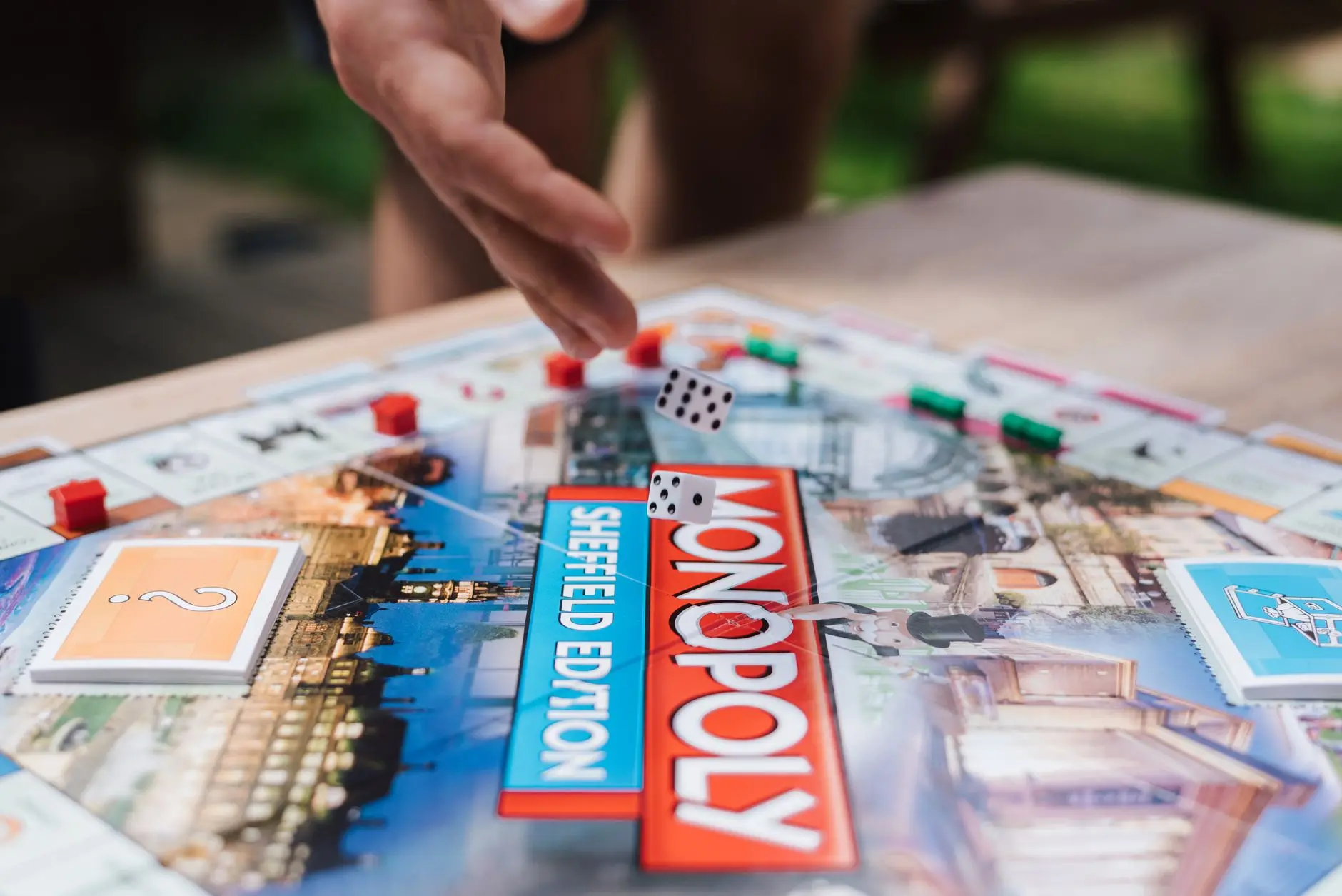
If your school or church silent auction committee just texted you asking for a basket idea, stop scrolling — a family game night gift basket is the one that gets bidders circling the table all night.
I’ve seen gorgeous spa sets go for less than a well-styled game basket because there’s something about the promise of a cozy Friday night in with board games, snacks, and zero homework that speaks to every parent in the room.
Building a themed gift basket that looks cohesive and intentional is genuinely easier than it sounds, and the payoff at the auction is real.
This guide walks you through every piece of the puzzle: which games to toss in, how to style the presentation so it photographs beautifully for the auction display, and a full set of 14 downloadable printables — from a polished bid sheet to family trivia cards — that make the whole package look like it cost twice what it did.
Grab your hot-glue gun and let’s build something people will actually fight over (the cordial, silent-auction kind of fighting, obviously).
This post contains affiliate links — if you buy through them, I may earn a small commission at no extra cost to you.
- Build-the-Basket Game Picks
- Snack Pairing Ideas
- How to Present the Basket for Auction
- Add a Family Movie Night
- Silent Auction Bid Sheet
- Raffle Tickets
- Donation Thank-You Card
- Family Game Night Bingo
- Would You Rather Family Cards
- This or That Family Sheet
- Family Trivia Sheet
- Family Charades Card Deck
- Game Night Score Sheet
- Game Night Awards Certificates
- House Rules Sign
- Movie Night Voucher
- Family Wishes Card
- Memory Lane Prompt Card
- Frequently Asked Questions
1. Build-the-Basket Game Picks
The games you choose are the heart of any family game night gift basket, so this is not the place to grab whatever’s on the clearance shelf and call it a day.
The sweet spot is a mix of one headline board game that everyone already loves (think Uno Attack, Jenga, or Taco Cat Goat Cheese Pizza), one strategic card game for older kids and adults, and one quick filler game the whole family can play in 15 minutes or less.
That three-tier approach means whoever wins the basket has something for every mood — and it telegraphs thoughtfulness to bidders even before they look inside.
For the headline game, crowd-tested auction winners include Ticket to Ride (First Journey edition for mixed ages), Codenames: Duet, Sushi Go!, and Exploding Kittens (the family-safe original).
Stack them in the basket with their boxes facing outward so the bold cover art does the visual selling for you.
For the filler slot, a deck of Taco Cat Goat Cheese Pizza or a travel-size Sequence for Kids rounds things out without blowing your budget.
If you want to add an element of surprise, tuck in one game nobody in the room has heard of — something with good reviews and a fun title almost always triggers a bidding war, because novelty feels exclusive.
Here’s a host tip tbh nobody tells you: remove the game boxes from their plastic wrap before the auction night. Opened, touched, slightly imperfect boxes read as ‘this person tested this and vouches for it,’ which is weirdly more compelling than pristine shrink-wrap.
Plus it gives you an excuse to add a handwritten sticky note inside each one that says ‘Our family’s favorite!’ — small touch, massive charm, zero extra cost.
- Mixed ages 6 and up
- Families who want variety without a huge box count
- Baskets in the $75–$150 auction range
🛍 Shopping guide
2. Snack Pairing Ideas
Let’s be honest: the snacks are half the reason people bid on a game night basket. Board games and a bag of pretzels are fine.
Board games, a tin of gourmet popcorn, a bag of M&Ms, and a box of fancy crackers feel like an event.
The trick is to pair your snacks thematically and arrange them so they’re visible — because a bidder who can see the Ghirardelli chocolate squares peeking out from behind the Jenga box is a bidder who reaches for the pen.
Aim for at least three to four distinct snack items so the basket feels abundant even before they look at the games.
The snack formula that photographs best at auction tables: one salty crunchy item (individual bags of kettle chips or a flavored popcorn tin), one sweet item (a bag of movie-style candy or a chocolate bar assortment), one ‘fancy’ item that elevates perceived value (a gourmet trail mix, chocolate-covered pretzels, or a small jar of artisan caramel dip), and one drink option (a four-pack of sparkling lemonade or a hot cocoa mix sampler).
Nestle the drinks at the back of the basket so they anchor and elevate everything in front of them — it’s the gift-basket equivalent of putting the tall people at the back of the school photo.
A quick note on allergies: if your school or church event skips nut-containing products, swap the trail mix for a seed-and-dried-fruit mix or a bag of Goldfish crackers.
It’s a small consideration that makes the basket accessible to more families — and more families eyeing it means more bids.
If you want to go the extra mile, pairing a wholesome snack like chia-based energy bites alongside the indulgent treats adds a fun contrast that savvy parents appreciate.
Arrange snacks in height order: tallest at the back, shortest at the front, so everything is visible in photos.
🛍 Shopping guide
3. How to Present the Basket for Auction
Presentation is where a good basket becomes a great one — and where an average basket becomes the item nobody bids above the minimum.
The physical container sets the whole tone, so skip the flimsy wicker basket that wobbles on the table and go for something sturdy: a galvanized metal tub, a large wooden crate, a handled wicker tote with a solid base, or even a fabric storage bin in a neutral color.
Whatever you pick, it should be something the winning family can actually reuse as a storage bin for their games, which adds perceived value without adding cost.
Once you have your container, fill the bottom with shredded paper filler or tissue paper (stick to neutral colors — kraft brown, cream, or black — to keep it season-free and professional-looking).
Arrange the games first since they’re the tallest items, leaning boxes against each other so covers face outward. Tuck snacks into the gaps, add any printable cards in a small kraft envelope tied with twine, and place the basket tag visibly at the front.
Wrap the whole thing in clear cellophane gift wrap and finish with a ribbon bow at the top. Layering textures the way scrapbookers layer paper — games, snacks, filler, wrapping — is exactly the right mental model here.
At the auction table, place a small standing tent card in front of the basket listing the retail value of every item inside (add it up honestly and write it in bold: ‘Estimated retail value: $140’).
Presentation matters — arrange items with clear signage and professional-looking displays that highlight value. That number anchors bidder expectations and makes the starting bid feel like an obvious bargain.
Add a small LED battery tea light inside or beneath the cellophane wrap if you want it to glow under event lighting — cheesy? Maybe slightly. Effective? Absolutely.
- Large wooden crate or galvanized tub
- Shredded kraft paper filler
- Clear cellophane gift wrap (large sheets)
- Ribbon and gift tag twine
- Small LED tea light (optional glow effect)
🛍 Shopping guide
4. Add a Family Movie Night
Stacking a movie night bonus on top of the game night basket is the auction equivalent of a ‘buy one get one’ deal — and it costs very little to pull off.
The idea is simple: tuck in a small movie night kit that transforms the basket from ‘one Friday’s worth of fun’ to ‘two nights of entertainment,’ which measurably increases perceived value to bidders.
A $10 streaming gift card, a bag of microwave popcorn, a couple of boxes of movie candy, and a cozy set of two or three matching popcorn bags is all it takes to suggest an entire second experience.
To make the movie night component feel intentional rather than an afterthought, write out a small ‘Movie Night Voucher’ card (we have a printable for that — see item #18 in this list!)
that the family can redeem for a specific genre pick, like ‘one family adventure movie of your choice.’
You can also include a short list of movie recommendations based on age — five titles the whole family will love — printed on a small card tucked into the envelope.
It costs nothing to print and genuinely delights whoever wins the basket when they open it at home.
One variation worth considering: swap the streaming card for actual movie theater gift cards if your school community skews toward that.
A family movie night package with local movie theater gift cards, popcorn buckets, and cozy blankets is consistently one of the strongest performers at school auctions, and adding it to your game night basket gives bidders two reasons to compete for it.
If you’re budget-conscious, even a $5 Redbox code printed on cardstock works — it’s the gesture of a curated evening that matters, not the dollar amount on the card.
Bundling two themed nights (games + movie) dramatically increases perceived value and gives bidders more reasons to justify a higher bid.
🛍 Shopping guide
5. Silent Auction Bid Sheet
A well-designed bid sheet does more than collect names and numbers — it creates competitive energy.
When bidders can see previous bids climbing the sheet, they feel the pull to top the last number, which is exactly the dynamic that turns a $40 basket into an $85 one.
This printable bid sheet is formatted with a bold item title field at the top, a minimum bid line, a minimum raise increment, and then a numbered table of 15 bid rows — each with columns for Bidder Name, Phone or Bidder Number, and Bid Amount.
That’s plenty of rows for a lively auction night without looking presumptuous on a quieter table.
Print it on regular 8.5×11 paper (no cardstock needed — it lives on the table and gets written on).
Laminate a separate ‘display card’ on top of the sheet holder if you want the item name to look polished, but the bid sheet itself should be easy to write on.
All fields are blank: the organizer fills in the item name, the minimum opening bid (usually 30–40% of retail value is the sweet spot), and the minimum raise (typically $5 increments for baskets under $100, $10 increments for higher-value items).
Attach a pen on a string to the clipboard or table — yes, this sounds obvious, and yes, pens still go missing at every single auction.
One detail that makes this bid sheet stand out: there’s a small ‘Item Description’ box at the top of the sheet where you can write or stamp a one-line description of the basket contents.
Presentation matters — clear signage and descriptions that highlight value keep bidders engaged. Bidders who walk up mid-event and missed the display table still know exactly what they’re competing for, which means no lost bids from confusion. Small detail, big impact on your final total.
Set the opening minimum bid at 30-40% of the basket’s total retail value — low enough to feel accessible, high enough to signal real worth.

6. Raffle Tickets
Some auction events run a raffle alongside the silent auction — a lower-barrier way for attendees who are nervous about competitive bidding to still feel like they can win something.
Printable raffle tickets are the secret weapon here: you can print an entire book of tickets for the cost of one sheet of cardstock, customize the cause name and prize description, and hand them out at the door or sell them at a table.
This design includes both halves of the ticket — the stub the attendee keeps and the counterfoil that goes into the draw bowl — so the system is self-contained and easy to manage for volunteer-run events.
The ticket design has a perforation-style dashed line down the center dividing the keep stub (right side, with a raffle number, the prize description, and a blank line for the attendee’s name and phone number) from the draw stub (left side, with the matching raffle number and the event name).
Print on cardstock and use a paper cutter to slice the sheets into individual tickets — or print on pre-perforated raffle ticket paper for an even more professional result.
Number the tickets continuously starting at 001, which is represented on the sheet as a field you fill in with a stamp or pen after printing.
A tip that seasoned PTO fundraisers swear by: price raffle tickets in bundles — say, 1 for $2 or 6 for $10 — and always display the bundle deal on the ticket itself so sellers in the hallway don’t have to memorize the pricing.
This printable has a small ‘Ticket pricing:’ note field at the bottom of each stub for exactly that reason. It’s a tiny thing that makes volunteer sellers more confident and, as a result, more effective — which means more money raised for your cause.
- Cardstock or pre-perforated raffle ticket paper
- Paper cutter or scissors
- Fine-tip black marker for filling in raffle numbers
- Small bowl or container for the draw

🛍 Shopping guide
7. Donation Thank-You Card
Every donor who contributed a game, a snack, or their time to help build your family game night gift basket deserves a thank-you card — and a printed one says ‘we made this specifically for you’ in a way that a text message simply does not.
This printable thank-you card is designed to be folded in half and used as a standard A2 note card, with a bold ‘Thank You’ headline on the front and a warm, fill-in-the-blank message template on the inside.
It’s clean enough for a school fundraiser and heartfelt enough for a church community event.
The inside of the card has a structured gratitude message with blank fields for the donor’s name, the item they donated, the event name, and the organization’s name.
That level of personalization — their actual name, their actual donation — is what makes recipients keep the card rather than recycle it.
Print on cardstock, fold in half, and if you want to go the extra mile, run a coordinating envelope through your printer with the organization’s address pre-printed in the corner.
The whole process takes about ten minutes for 20 cards, which is a reasonable investment for the goodwill it generates.
Here’s why this matters beyond politeness: donors who feel genuinely appreciated are dramatically more likely to donate again next year.
If your school or church auction relies on recurring community donations (and most do), reaching out to local businesses and community members who donated is how you build the relationships that sustain your auction year after year. A well-designed, personalized thank-you card is the single cheapest way to protect next year’s donation pipeline, so don’t skip it.
Donors who receive a personalized thank-you are more likely to contribute again — and to give more — the following year.

8. Family Game Night Bingo
Family Game Night Bingo is the perfect warm-up activity for the actual game night — print a few cards and tuck them into the basket as a bonus round the family plays while they’re unboxing everything else.
The bingo squares are filled with family game night phrases, objects, and moments instead of numbers: things like ‘someone accuses someone else of cheating,’ ‘the dog tries to steal a game piece,’ ‘Dad insists on reading the rules out loud,’ and ‘someone says best two out of three.’
It’s observational humor bingo, and it gets funnier the deeper into game night you get.
Each bingo card in the set is unique (different square arrangements) so the whole family can play simultaneously without anyone having the same card. The card is a standard 5×5 grid with a FREE space in the center.
Print four cards on two sheets (two cards per letter-size page) and cut them apart — each family member gets one, and you play while the actual board game is happening in the background.
No bingo caller needed; players mark their squares themselves whenever the event happens naturally during the evening. First to get five in a row yells ‘GAME NIGHT BINGO!’ and earns a small prize (a piece of candy from the snack stash works perfectly).
Why this earns its place in the basket: it’s one of those rare activities that requires zero extra supplies, plays itself without any extra setup, and generates memory-making moments.
Parents who receive this basket will genuinely use these cards every single game night — which means the basket lives in their brain rent-free long after auction night.
That kind of lasting impression is exactly the kind of community goodwill a school or church fundraiser should be building.
Print all four bingo cards on cardstock and laminate them so the family can use dry-erase markers and reuse the cards every game night indefinitely.

9. Would You Rather Family Cards
Would You Rather is one of those games that sounds too simple to be fun and then somehow keeps a table of six people entertained for 45 minutes without anyone realizing how much time has passed.
This printable card deck gives you 24 family-friendly Would You Rather questions formatted as individual playing cards — print on cardstock, cut apart, and you have a complete portable game that needs zero setup and works for ages 6 through adult.
The questions are genuinely funny and occasionally thought-provoking, which is the right balance for a mixed-age family game night.
Each card has a bold ‘Would You Rather…’ header, two bold lettered options (A and B), and a small ‘Why?’ prompt at the bottom that encourages players to explain their choice — which is honestly where the real entertainment lives.
Questions range from silly and physical (‘Would you rather have to hop everywhere you go or speak in rhyme for a week?’)
to mildly strategic (‘Would you rather always know when someone is lying but never be able to lie yourself, or keep your poker face?’) so the conversation never stalls.
Print all 24 cards on two sheets of cardstock, cut them out, and store them with a rubber band — they fit perfectly tucked into a basket envelope alongside the other printables.
A fun variation for the basket: include a small instruction card that explains how to use the Would You Rather cards as an ‘icebreaker before the main game’ routine — one card per player per round before the board game starts.
Families who build pre-game rituals tend to have longer, more connected game nights, and that kind of lasting habit is the best possible outcome for a basket gift.
Gifts that inspire repeated family moments together are the ones that get remembered long after the auction check clears.
- Ages 6 and up
- Groups of 2-8 players
- Zero setup — print, cut, and play instantly

10. This or That Family Sheet
This or That is the faster, snappier cousin of Would You Rather — instead of open-ended debate, you snap your answer instantly and move on, which makes it perfect for younger kids who lose the thread in longer conversations.
This printable sheet gives you 30 This or That pairings laid out in a clean two-column format on a single page, with a checkbox beside each option so every player can mark their own answer simultaneously, then compare.
It plays in about ten minutes flat, which makes it the ideal ‘while we’re waiting for everyone to sit down’ game before the main event.
The sheet is designed as a fill-and-compare activity: everyone gets their own printed copy, circles or checks their answers solo, then the group reveals and debates at the end.
Topics are split across four fun categories — Food, Adventure, Superpowers, and Random — so the sheet covers a wide range of what-would-you-pick territory without any question feeling like a repeat of the last one.
The category headers are printed on the sheet; the questions run continuously numbered 1 to 30 across all four sections. Players who land on the same answer as another player get a point, making this accidentally competitive in the best possible way.
Tuck six copies of this sheet into the basket — enough for a family of four plus two extras for when friends come over on game night.
Cardstock copies are nice but totally optional; regular printer paper works fine since this is a fill-in-then-toss activity rather than a keepsake.
The sheet is so fast and crowd-pleasing that families tend to want to play it again at the next game night, at which point they’ll wish they’d printed more copies — so add a note in the basket that the sheet is downloadable and reprintable as many times as they need.
- Everyone fills out their own sheet solo
- Reveal answers one question at a time
- Score 1 point each time your answer matches someone else’s
- Most matched answers wins!

11. Family Trivia Sheet
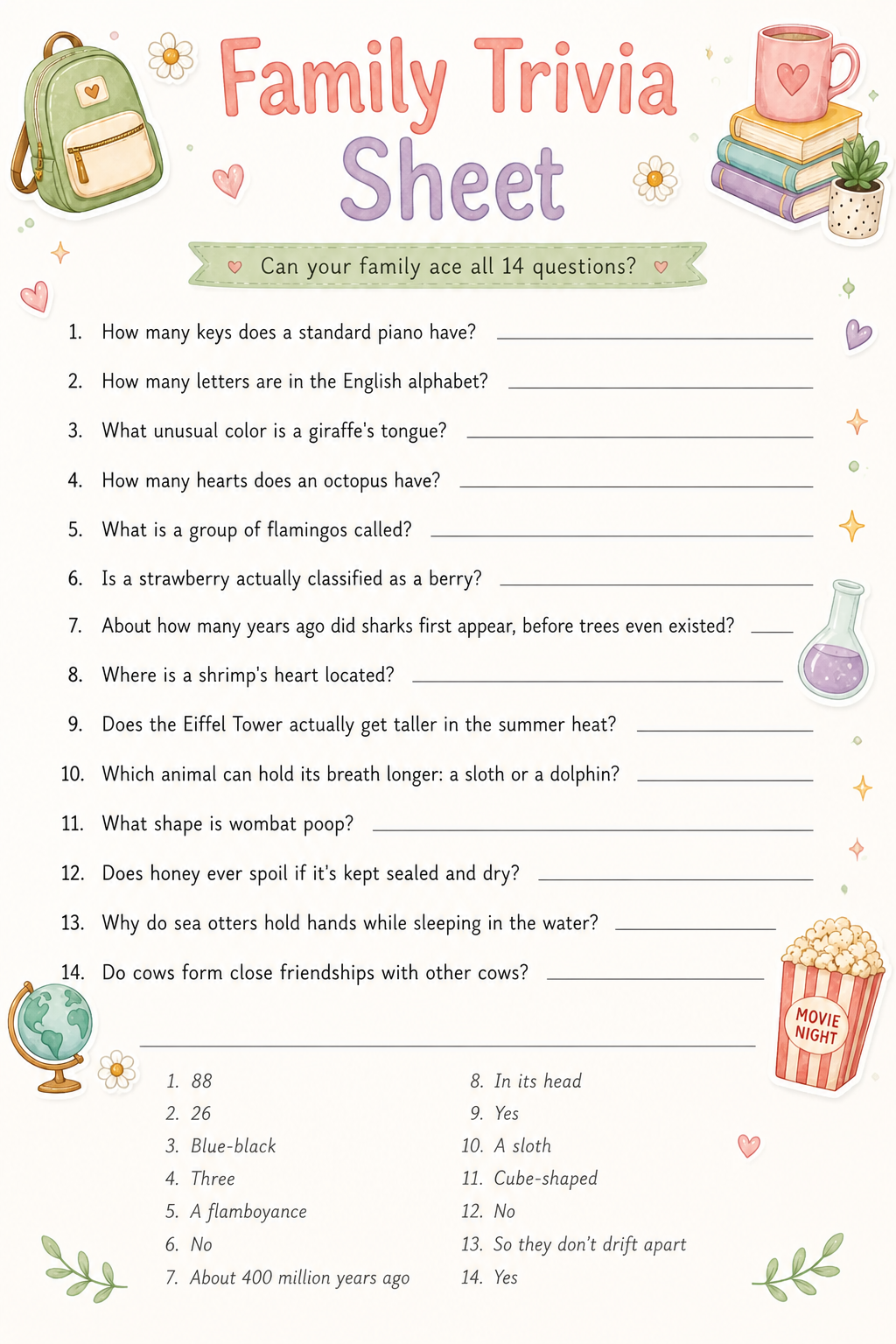
Family Trivia is the anchor printable of the whole set — it’s the one that feels most like a ‘real game’ to families who open the basket, and it’s the one they’ll reach for first on game night.
This sheet has 20 trivia questions across four kid-friendly categories: Animals & Nature (Q1–5), Science & Space (Q6–10), History & Geography (Q11–15), and Pop Culture & Entertainment (Q16–20).
Questions are calibrated so that younger kids can genuinely answer some (Q1–5) while older players and adults are challenged by others (Q11–20), which is the exact sweet spot for a mixed-age family game night.
Each question is numbered continuously 1 through 20 across all four sections. The play area shows only the question — no answers appear anywhere near the questions.
A complete, low-contrast italic answer key appears at the very bottom of the sheet below the footer, numbered 1 through 20 to match every question.
To play as a team game, one player reads the questions aloud while others write their answers on a separate scrap of paper; reveal and score together after every five questions.
To play head-to-head, give each player a copy and have them answer independently before comparing. Either format works with one sheet.
The category spread here is intentional. Trivia cards and family quiz games are consistently one of the most-used items in a game night basket — but printed trivia sheets beat bought card decks on one key dimension: they’re free to replace.
When the sheet gets coffee-ringed or the dog eats it (and the dog will eat it), the family can download and reprint in 30 seconds.
That reprint-ability is a subtle feature worth mentioning on the basket’s ‘What’s Inside’ card, because parents who plan ahead will genuinely appreciate it.
- Team mode: one reader, everyone writes answers on scrap paper
- Solo mode: each player gets their own sheet
- Score after every 5 questions for maximum suspense
- Answer key is at the bottom of the sheet (no peeking!)
12. Family Charades Card Deck
Charades is the one game that needs zero reading ability from the person acting, which makes it genuinely all-ages — a four-year-old acting out ‘bunny’ is equally hilarious to a teenager, and that’s the magic of it.
This printable card deck gives you 40 family-friendly charades prompts formatted as individual cards to cut apart and pile face-down in the center of the table.
Categories include Animals (act it out), Movies & Books (family-friendly titles), Everyday Actions, and Silly Scenarios — a wide enough range that no two rounds feel the same even if you play three games in a row.
Print on cardstock, cut the cards apart along the dashed lines, and sort them into four face-down piles by category if you want to control the difficulty — or mix all 40 into one big shuffled pile for maximum chaos, which honestly tends to produce the funniest moments.
Each card shows only the prompt word or phrase (no illustrations, no hints) so the actor has to commit fully.
A small category icon in the corner of each card (a paw print for Animals, a star for Movies & Books, a lightning bolt for Actions, and a smiley face for Silly) helps players quickly identify which pile a stray card belongs to if someone knocks the table mid-round.
One host tip that transforms this from a good game to a great one: include a small sand timer in the basket to use as the charades timer.
A 60-second timer creates enough pressure to make the acting genuinely frantic and funny, while still giving most people enough time to convey their prompt.
You can find small colorful sand timers for almost nothing online, and they add a tangible prop element to the basket that photographs beautifully for the auction display.
- Cardstock for printing
- Scissors or paper cutter
- A sand timer (60 seconds)
- A flat surface to pile the card stacks

🛍 Shopping guide
13. Game Night Score Sheet
Every family has at least one person who insists on keeping score even during games where scores don’t technically matter, and every family also has at least one person who disputes the score at the end because it was kept on a napkin.
This printable score sheet solves both problems elegantly.
It’s a universal game night score tracker that works for any board game or card game: space for up to six players’ names across the top, ten numbered round columns, a running total row, and a bold ‘Winner!’
banner at the bottom for the final tally. One sheet handles an entire evening’s gaming across multiple games if you use different colored pens per game.
The layout is deliberately game-agnostic — it doesn’t say Monopoly or Uno on it, which means families can use it for whatever game they pull out, not just the ones in the basket.
The header simply reads ‘Game Night Score Sheet’ with a blank ‘Game:’ field and a blank ‘Date:’ field at the top so each sheet is a small record of that specific evening.
Printing ten copies and storing them in a small kraft envelope tucked into the basket gives the family a ready supply without any extra effort on game night. This is the kind of low-drama practical printable that gets used every single week.
A variation for competitive families: print the score sheet double-sided with a ‘Season Standings’ leaderboard on the back — a simple table where the family tracks who has the most wins over multiple game nights across the year.
It’s the kind of meta-game-within-a-game that turns a one-night basket into a year-long family tradition, which is honestly the most impressive thing a gift basket can do.
A little handwritten note from the basket organizer pointing out the standings table on the back adds a lovely personal touch that costs nothing.
Print 10 copies, fold them in half, and tuck them in a small kraft envelope so they’re ready to grab every game night without printing again.

14. Game Night Awards Certificates
This is the printable that makes kids actually want to be there on game night — because nothing motivates a seven-year-old to sit through five rounds of a card game like the knowledge that there will be a certificate at the end.
This set of printable awards certificates covers six categories: Best Sport (for the player who lost graciously), MVP (for the highest scorer), Fastest Player (completed their turn the quickest consistently), Sneakiest Strategist (pulled off the best surprise move), Most Enthusiastic (loudest celebrations), and Fan Favorite (voted on by the group).
Print the full set on cardstock, cut them apart, and let families hand them out at the end of every game night.
Each certificate is formatted in a classic ribbon-and-border frame style with the award name in large bold font at the top, a blank line for ‘This award is presented to: ________,’ a blank line for ‘For: ________’ (so you can write the specific reason), and a blank line for ‘Date: ________.’
Everything blank, everything ready for a Sharpie or fine-tip marker. Six unique certificates per sheet means one print job covers one complete game night’s awards ceremony — or laminate a reusable set and use a dry-erase marker to write the winner’s name fresh each week.
Here’s why this is genuinely brilliant for an auction basket: it transforms a single evening gift into a repeating ritual.
Adding a small trophy or award element to a game night basket creates a competitive but fun tradition among the family — and a tradition means they’ll think about this basket every single game night for months.
That’s the kind of recall that makes your school or church fundraiser memorable and turns first-time auction bidders into annual donors who look forward to the event.
Laminate one set and use a dry-erase marker so the same certificates get reused every game night — no reprinting needed.

15. House Rules Sign
Every family that plays games regularly has a set of house rules — the unwritten modifications they’ve made to the official rules over the years that everyone agrees on but nobody has ever actually written down.
This printable House Rules Sign gives them a permanent, frameable home: a stylish 5×7 or 8×10 sign with a ‘House Rules’ header and ten blank fill-in lines where the family writes their own custom rules in marker.
It’s part keepsake, part practical tool, and entirely the kind of thing that hangs in a playroom or game closet for years.
Print on cardstock and frame it as-is for a neutral, minimalist version — or print on regular paper, have the kids decorate the border with colored markers, and then frame the decorated version for a more personalized keepsake.
The sign design has a clean banner headline, numbered lines 1 through 10 with blank underlined spaces and a small italic ‘Rule:’ prompt beside each line, and a footer that reads ‘These are our rules. Everyone plays by them.’
(Honestly, that line alone earns this printable its place in the basket.) The styling is timeless enough to look intentional on a shelf rather than like homework.
A creative suggestion for the basket: print the House Rules Sign twice — once blank for the family to fill in their own rules, and once with a set of ‘Starter Rules’ you’ve pre-written as suggestions: things like ‘No phones during game night,’ ‘Everyone gets snacks before the game starts,’ and ‘The youngest player goes first.’
Starter rules give new families a fun template to react to — they can keep the ones they love and cross out the ones they hate — which makes filling in the blank version feel easy and inviting rather than like a blank-page assignment.
A frameable House Rules Sign turns a one-time gift into a permanent piece of the family’s game night tradition — the basket lives on every time they glance at it.

16. Movie Night Voucher
A Movie Night Voucher is a brilliantly low-cost basket addition that punches well above its weight in perceived value.
It’s essentially a printed promise — a stylish card that the winning family redeems for one designated family movie night, complete with snacks, cozy blankets, and everyone’s phones in the other room.
Since you’ve already tucked movie night snacks into the basket, the voucher is the ceremonial card that officially unlocks them: it transforms a bag of microwave popcorn and some candy into an event. That small reframing is genuinely powerful.
This printable voucher is designed as a gift-card-sized card (3.5×2 inches, standard wallet size) with a bold ‘Family Movie Night Voucher’ header, a fun subtitle like ‘Good for one cozy movie night — snacks included!’, and a blank ‘Redeemable by:’ line plus a ‘Movie choice goes to:’ fill-in field so families can customize who picks the film.
Print eight vouchers per sheet on cardstock, cut them out, and tuck them in a small kraft envelope in the basket. Give the family more than they need — extra vouchers mean more movie nights, which means more value perception at the auction table.
The most charming use of this voucher: include a small handwritten note from the basket organizer that says something like ‘Redeem this when you need a reset night — no agenda, just your people and a good movie.’
It costs nothing, adds warmth and humanity to an auction basket that could otherwise feel transactional, and is the exact kind of personal touch that people remember at next year’s auction when they’re deciding whether to bid again. Small gestures, big ripple effects.
Print 8 vouchers per sheet and include the full set in the basket — the more movie nights they can schedule, the more they feel like they got an incredible deal.

17. Family Wishes Card
The Family Wishes Card is the quiet, heartfelt moment tucked inside an otherwise energetic basket — a single oversized card that invites the winning family to sit together and write down five things they wish for as a family in the year ahead.
It’s not therapy homework and it’s not a vision board exercise; it’s a five-minute dinner-table conversation starter that produces something genuinely sweet to read back months later.
Think of it as a tiny time capsule for hopes: family vacation dreams, silly goals (‘we wish to beat Dad at Uno at least once’), and real ones (‘we wish to have more of these game nights together’).
The card is printed on one side of a half-sheet of cardstock with a warm, conversational header (‘As a Family, We Wish For…’)
and five numbered blank fill-in lines — one for each wish — with enough vertical space to write a full sentence rather than just a word. A small ‘Date:’ line in the corner completes it.
The card is designed to be filled in together as a group, so it’s not one person’s private journal but a shared family artifact.
Suggest to the basket recipient (via the basket tag or a small note) that they fill it in on their very first game night together, fold it, and tuck it back into the basket envelope to re-read in a year.
Why this belongs in a school or church auction basket specifically: community fundraisers are fundamentally about bringing people together and strengthening family bonds — and a Wishes Card speaks directly to that value.
Research on intentional reflection practices consistently shows that families who articulate shared goals and positive wishes feel more connected and cohesive, so this little card is doing real relational work underneath its charming exterior. It’s the emotional anchor of the whole basket.
Fills in together as a group on the first game night, creating an instant shared memory and a keepsake to re-read in a year.

18. Memory Lane Prompt Card
The Memory Lane Prompt Card is the perfect closer for a game night — a single card with five conversation prompts that invite the family to share a favorite memory together before everyone disperses for bedtime.
It’s deliberately low-key and warm: no competition, no score, no winner. Just five questions that start sentences like ‘The funniest thing that happened to our family this year was…’ and ‘A game night we’ll never forget was when…’
and ‘If we could relive one family day from the past year, it would be…’ Each prompt takes about two minutes and the whole card takes ten, which makes it a perfect wind-down after an energetic game night.
Print the card on one side of a quarter-sheet of cardstock (four cards per letter-size page) so it’s a compact, pocket-sized card the family can prop on the table or tuck in the game box for next time.
The design is simple — a ‘Memory Lane’ header, five numbered prompts with blank fill-in lines after each one so the family can jot down answers if they want a written record, and a small footer that says ‘Keep this card — you’ll want to read it again.’
That footer is doing a lot of emotional work in six words: it signals that the card is a keepsake, which means the family treats it like one.
Including a Memory Lane Prompt Card in a family game night gift basket is one of those touches that separates a thoughtfully curated basket from one that was assembled in fifteen minutes from an Amazon cart.
It shows the basket-builder understood the deeper goal of game night — not winning, but connection — and packaged that understanding into a tangible takeaway.
That’s the kind of detail that gets mentioned in the ‘thank you’ note the winning family sends later, and that mention is worth more to a school or church community than the extra $10 a shinier item might have fetched at auction.
- End-of-game-night wind-down ritual
- Families with kids ages 6 and up
- Anyone who wants to turn a game night into a genuine memory-making event

Frequently Asked Questions
How much should a family game night gift basket cost to build?
For a school or church silent auction, aim for a retail value of $75–$150, which typically translates to a build cost of $50–$100 if you source smartly.
The games are usually the biggest expense (budget $30–$60 for two to three games), while snacks, printables, and presentation supplies round out the rest.
Printable extras like the trivia sheets, bid sheet, and awards certificates cost essentially nothing to produce, but they increase the basket’s perceived value significantly because they look thoughtful and curated.
What are the best board games to include in a family game night basket?
The strongest picks for mixed-age families are games that work from about age 6 upward: Uno Attack, Taco Cat Goat Cheese Pizza, Sushi Go!, Jenga, and Exploding Kittens are crowd-tested auction favorites.
For families with older kids or adults, Codenames: Duet or Ticket to Ride (First Journey edition) adds a strategic tier. Aim for one headline game, one card game, and one quick filler game — that mix covers every game-night mood.
What’s the best way to display a gift basket at a silent auction?
Use a sturdy container (galvanized tub, wooden crate, or handled wicker tote), layer shredded kraft paper at the base, arrange items with tallest at the back and labels facing outward, and wrap everything in clear cellophane finished with a ribbon bow.
Place a printed ‘What’s Inside’ card in a small acrylic stand in front of the basket listing every item and the total retail value. Clear signage and visible contents are the two biggest factors in driving higher opening bids.
How do I set the opening bid and minimum raise for my basket?
The standard formula is to set the opening minimum bid at 30–40% of the basket’s total retail value. So if your basket has a retail value of $120, open at $36–$48.
Set minimum raise increments at $5 for baskets under $100 retail value, and $10 increments for higher-value items. These numbers make the opening bid feel accessible to budget-conscious attendees while still creating a competitive ladder that pushes the final price toward or above retail value.
Can I include printable games in a gift basket for a silent auction?
Absolutely — and you should. Printed game sheets, trivia cards, bingo cards, and award certificates add perceived value to the basket for almost zero cost, and they signal a level of thoughtfulness that generic store-bought items don’t.
Print on cardstock, trim neatly with a paper cutter, and store them in a small kraft envelope tied with twine. Labeling the envelope ‘Bonus Game Night Printables’ on the basket’s ‘What’s Inside’ card makes bidders perceive it as a bonus rather than filler.
What snacks work best in a family game night gift basket?
Stick to a four-item snack formula: one salty crunchy item (gourmet popcorn or kettle chips), one sweet item (chocolate or movie candy), one ‘fancy’ item that elevates perceived value (artisan caramel dip, chocolate-covered pretzels, or gourmet trail mix), and one drink option (sparkling lemonade or hot cocoa mix).
Avoid nut-containing items if your school or church community has allergy policies, and arrange snacks in height order — tallest at the back — so everything is visible in auction display photos.
📌 Save These for Later
Loved these? Pin your favorite image below so you can find this list again when you’re planning.
Free printable winter alphabet coloring pages for kids, A to Z. One letter per sheet, snowy theme, n

Twenty tried-and-tested indoor games for family rainy days, from printable scavenger hunts to sock b

Discover 20 fun and memorable games for family gatherings that connect grandparents, parents, and ki
Leave a Reply