

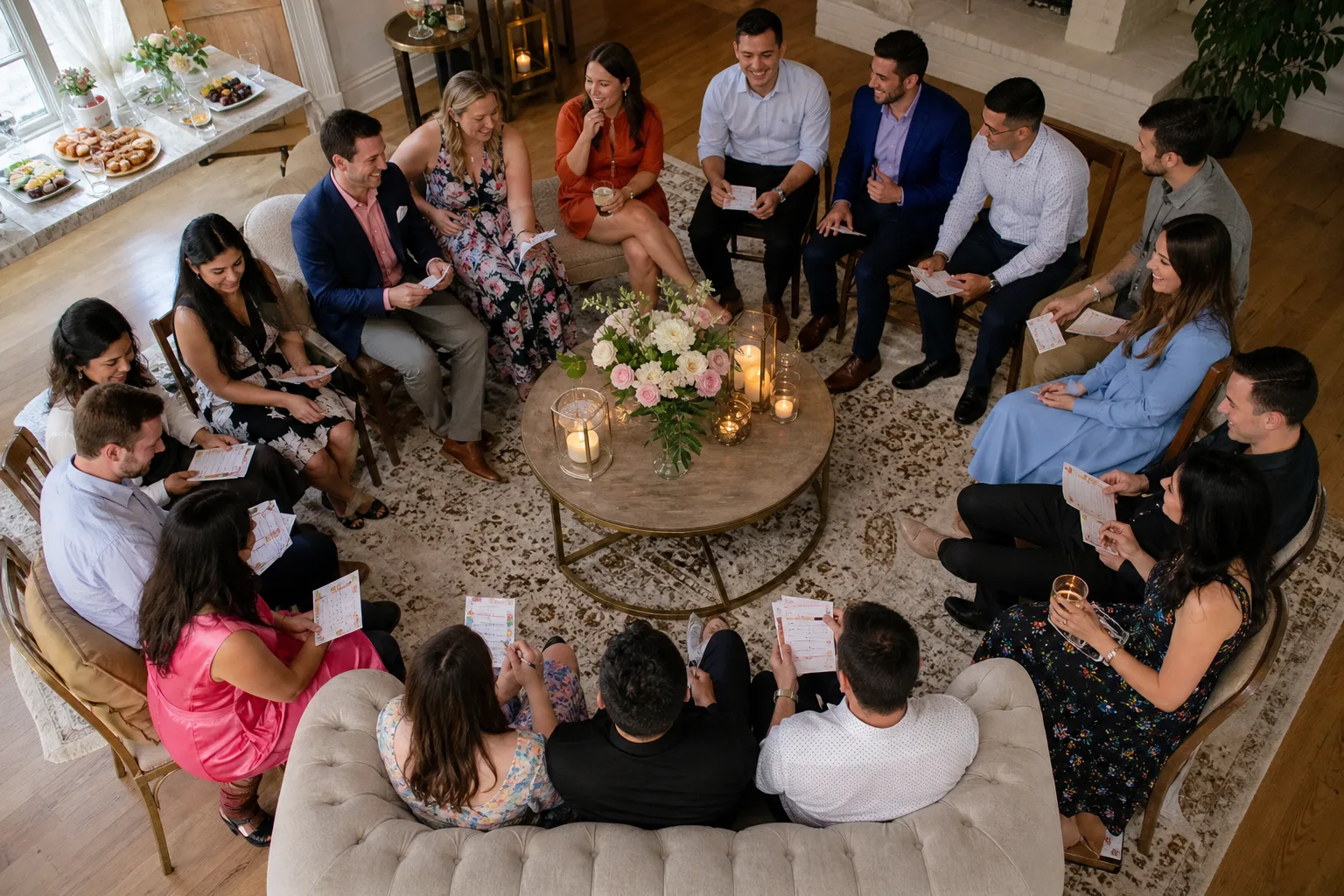
Engagement party games for families exist for one real reason: two sets of relatives who have never shared a room need something to do with their hands besides holding a drink and making small talk.
The twenty games below split evenly between quick printables, easy mixers and a few that need nothing but a floor and two teams, all gentle enough for a grandparent to win and lively enough for a six-year-old cousin to stay interested. Pick two or three, not all twenty, and keep the rest in reserve for whenever a lull needs rescuing.
This post contains affiliate links. If you buy through them, I may earn a small commission at no extra cost to you.
Table of Contents
- Whose-Side-Are-You-On Family Bingo
- Meet the In-Laws Speed Mingle
- Bride’s Family vs Groom’s Family Trivia Showdown
- His Side, Her Side Tug of War
- Baby Photo Match
- The Great Family Recipe Taste Test
- Family Recipe Swap Cards
- Guess the Proposal Story
- Guess That Relative: Family Trait Trivia
- The Newlywed Prediction Round: Who Said It?
- Love Story Mad Libs
- Family Trivia Feud: Survey Says
- Family Tree Scavenger Hunt
- Paper Gown Relay: Dress the Mannequin
- Guess How Many Candy Kisses in the Jar
- This or That: Wedding Style Showdown
- Ring Toss for the Rings
- Family Heirloom Show and Tell
- Pass the Parcel: Family Edition
- Family Advice & Well-Wishes Cards
- Frequently Asked Questions
1. Whose-Side-Are-You-On Family Bingo
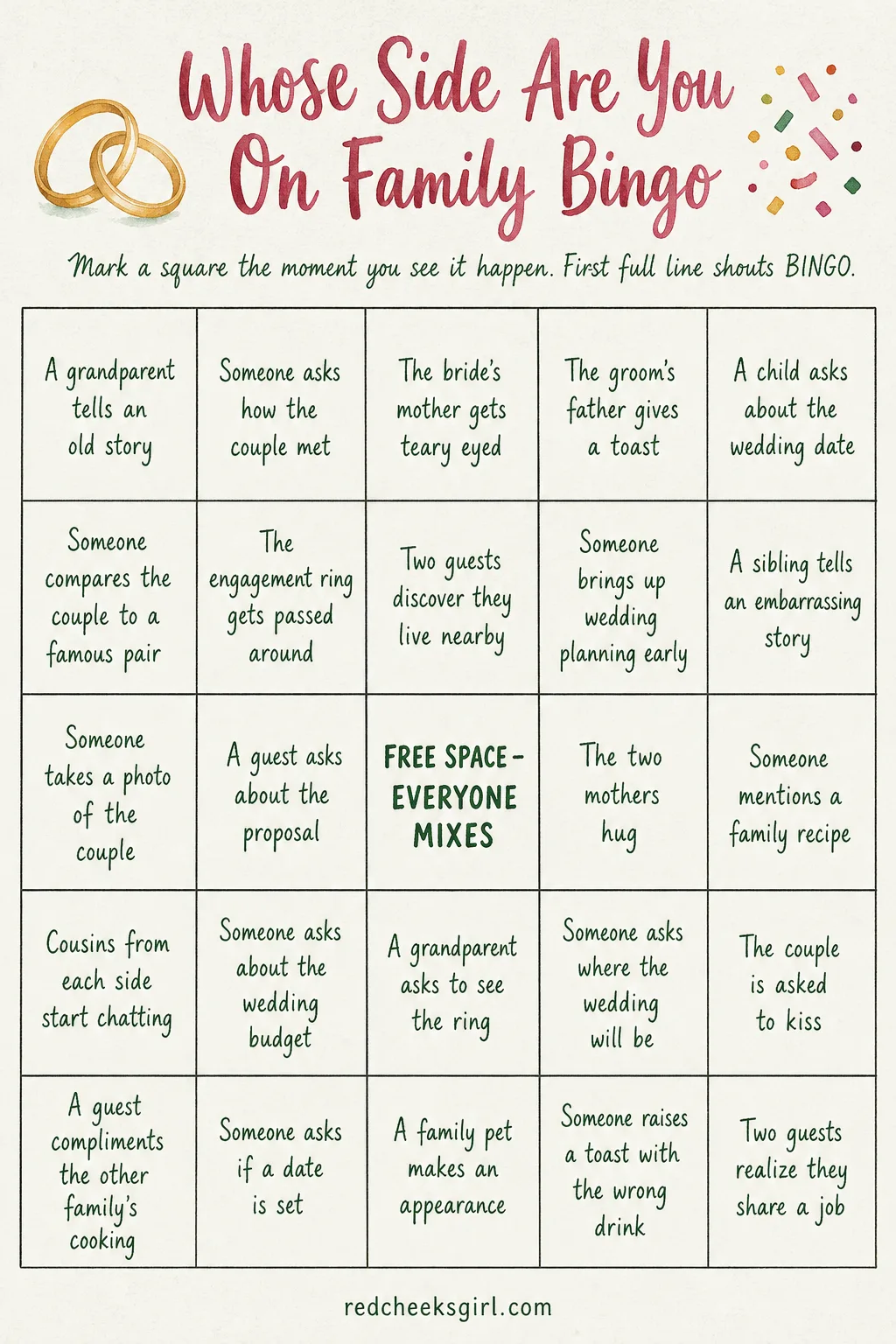
Hand everyone a bingo card the moment they arrive and the stiff first ten minutes have somewhere to go. Each square names something one side or the other is almost guaranteed to do, from a grandparent launching into a story to someone asking who is paying for the wedding.
Guests mark a square the second they catch it happening live, and whoever shouts bingo on a full line first wins.
It needs nothing but the printed cards and a pen per guest, works for anywhere from twelve to sixty people, and runs quietly in the background for the whole first hour, which is exactly what good engagement party games for families are supposed to do without stopping the party cold.
The one thing that trips it up is a card nobody can realistically fill, so keep the squares to things that genuinely tend to happen rather than anything too specific to one family. For a livelier version, set a ten-minute timer and whoever has marked the most squares when it rings wins instead of waiting for a full line.
A bingo card gives shy guests something to do with their eyes instead of forcing small talk, no performance required.
2. Meet the In-Laws Speed Mingle
Arrange two rows of chairs facing each other, one row entirely from the bride’s family, the other entirely from the groom’s, in no particular order. Each pair gets ninety seconds to answer a prompt card the host reads aloud, then one row shifts down a seat and new pairs form.
The round ends once everyone in one row has sat across from everyone in the other, and nobody is named a winner, since the real prize is a room full of people who are no longer strangers.
It needs two rows of chairs or two loose circles, a stack of prompt cards, and a timer. It works for ten to forty guests and takes about fifteen minutes start to finish.
The biggest risk is a prompt too personal for a first meeting, so keep questions light, like a favorite karaoke song, rather than probing.
For a bigger crowd, run two smaller mingles side by side instead of one long line; if you would rather skip structured rounds altogether, browse engagement party games that break the ice between two families for gentler options.
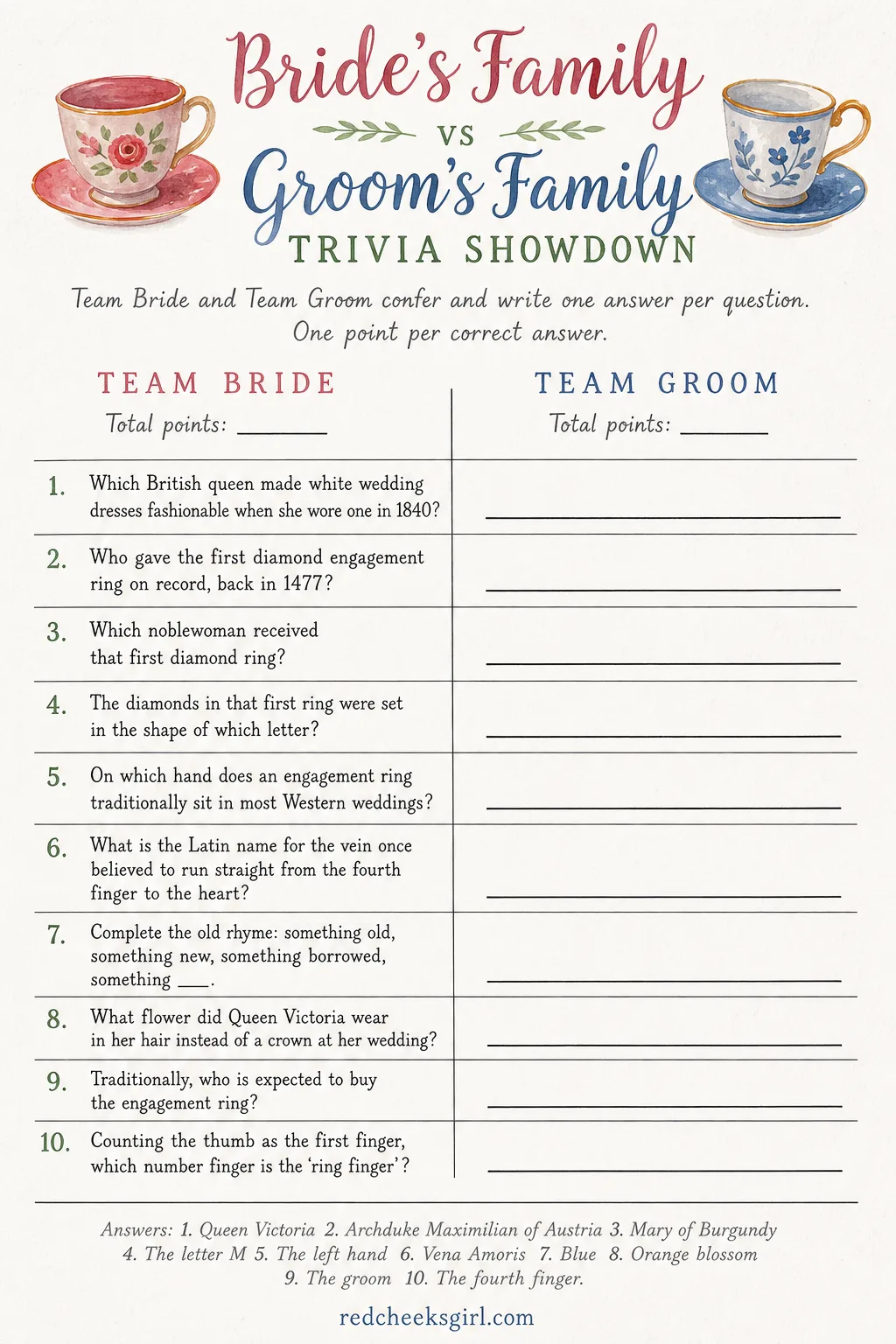
3. Bride’s Family vs Groom’s Family Trivia Showdown
Split the room straight down the middle, bride’s relatives on one side, groom’s relatives on the other, no switching for this round.
The host reads ten questions aloud one at a time, each side huddles and writes one shared answer, and a point goes to whichever family answers first and correctly, right down to. The round ends after question ten, and whichever family has more points keeps the bragging rights for the rest of the night.
It needs one printed sheet per team and a pen; a small bell to buzz in first is optional but fun. It plays well for six to forty people and takes about fifteen minutes including the arguing over answers.
One loud relative tends to take over the huddle, so have everyone write their own guess on scrap paper first, then pick the team’s final answer by show of hands. To make it easier for grandparents, read each question twice and give the full ten seconds before locking in an answer.
Read every question twice before either side locks in an answer, so grandparents and distant cousins get a fair shot too.
🛍 Shopping guide
4. His Side, Her Side Tug of War
Line both families up on opposite ends of a sturdy rope, groom’s side gripping one end, bride’s side the other. On the host’s signal both sides pull, and the game ends the moment either team drags the center marker past their own line, which makes that family the undisputed strongest in-laws of the day, for photo purposes only.
It needs one tug of war rope long enough for the group, a marker for the center such as tape or a scarf, and flat ground. It works for eight to thirty people split evenly and is over in under two minutes per pull.
Uneven team sizes make it a non-contest, so count heads first and borrow a player from the bigger side. For grandparents or small children, run a gentler version with a softer rope and a shorter pull, or let them act as referee instead.
🛍 Shopping guide
5. Baby Photo Match
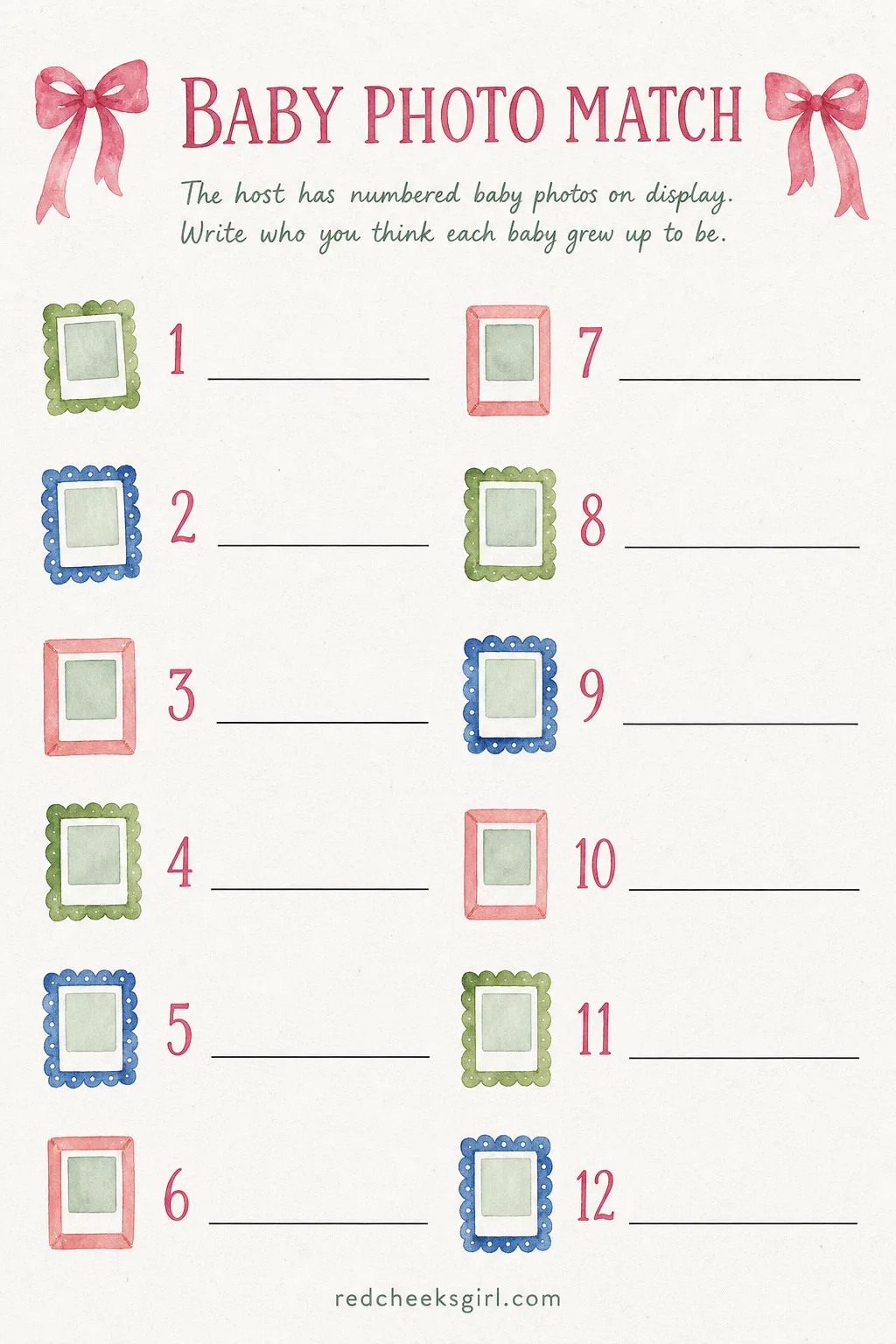
Weeks before the party, ask each family for one baby photo of someone who will be in the room, from the bride herself to an uncle nobody expects.
Number each photo and display them on a board at the party, then hand out the guess sheet so guests can wander past and write down who they think grew into which baby. Whoever gets the most matches right when the host reads the real answers near the end wins first pick of dessert.
It needs one baby photo per person included, a display board, numbered stickers, and the printed sheet per guest. This works especially well at small engagement party ideas for close family and friends, where guests already know some names but not all the faces.
It only works if the photos are genuinely hard to place, so skip anyone whose baby photo looks exactly like their adult self. Make it easier for kids by sticking to immediate family only, or harder by mixing in a few family friends who are not blood relatives at all.
Best for families who already have a group chat full of baby photos waiting for an excuse like this.
🛍 Shopping guide
6. The Great Family Recipe Taste Test
Ask each family to bring one dish nobody outside their own family has tasted, something made every holiday without a written recipe.
Lay the dishes out in small unlabeled tasting portions, let guests go bite by bite and guess which family each dish came from, and the round ends when the host reveals the real list. Whoever matched the most dishes to the right family wins the last plate.
It needs two or more dishes, small cups or spoons for tasting portions, and a numbered card by each dish, plus a simple guess sheet. It takes about twenty minutes including seconds.
A dish that is too recognisable, a very regional dessert, say, gives the game away instantly, so pick something closer to a basic casserole or a simple baked good. For allergies, print the ingredients quietly beside each dish rather than skipping anyone’s contribution.
🛍 Shopping guide
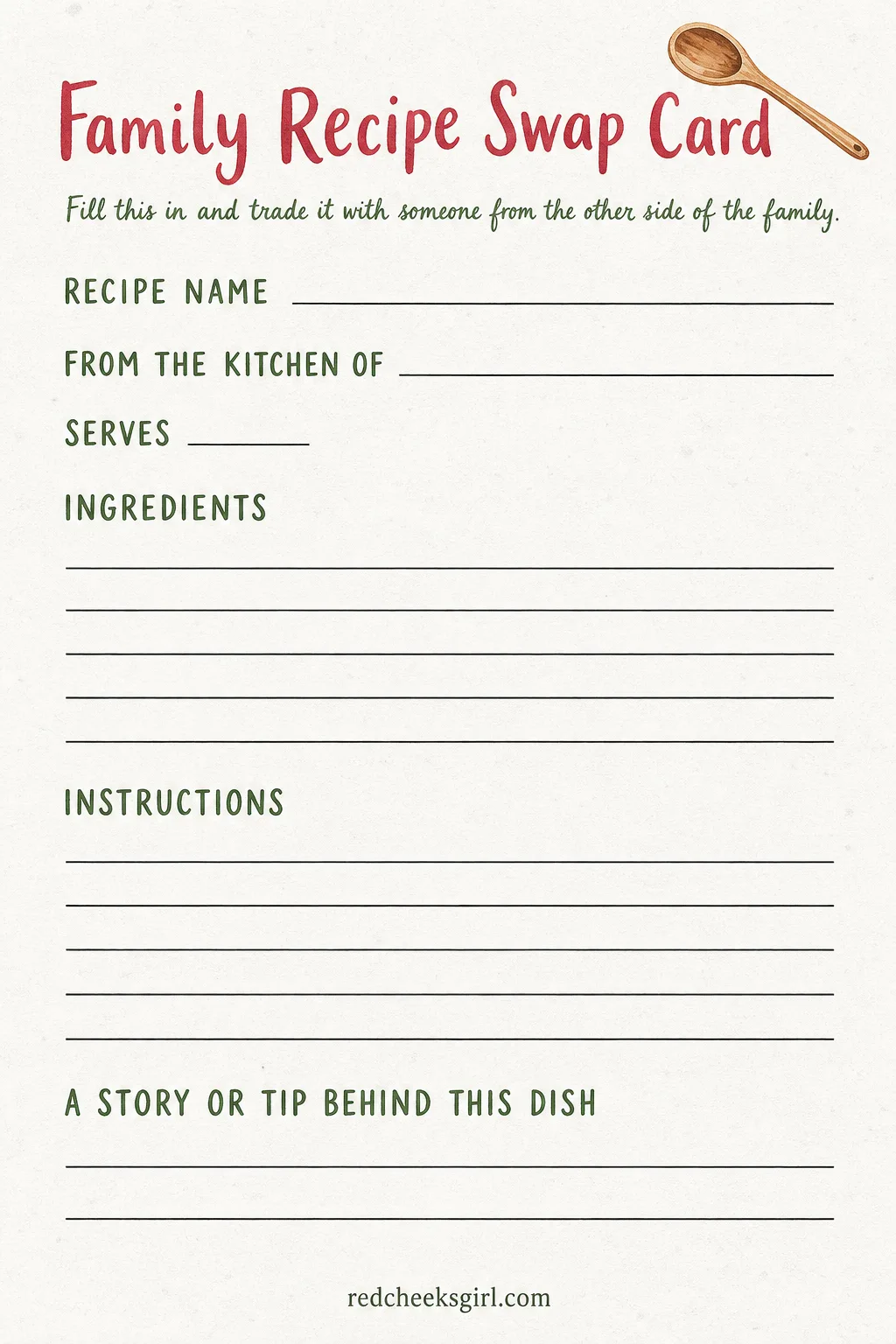
7. Family Recipe Swap Cards
Once appetites are satisfied, pass out a blank recipe card to every guest and ask them to write down one dish that actually gets cooked in their house, the kind that shows up at every holiday.
Guests trade cards with someone from the other family rather than keeping their own, so everyone leaves with a brand new family’s recipe. There is no winner; the game ends when the cards run out and the swapping stops naturally.
It needs one printed card per guest, pens, and a basket in the middle of the table to collect and redistribute the cards. It works for any group size and takes about ten quiet minutes.
A handwriting-shy relative will just write “ask grandma,” so a small prompt on the card, like one tip that makes the dish work, coaxes out more detail. For a quieter version, skip the random trade and bind all the cards into one shared family cookbook afterward.
Print one small prompt on the card, like the tip that makes the dish actually work, so handwriting-shy relatives write more than two words.
🛍 Shopping guide
8. Guess the Proposal Story
Before the party, quietly ask the engaged couple to answer five or six true details about the actual proposal: where it happened, who knew in advance, what was said right after.
During the party, the host reads a scrambled, multiple-choice version of each detail without naming the correct option, and guests from both families call out or hold up a guess. The round ends once every question is read and the couple finally confirms the real story out loud, which usually gets the loudest reaction of the night.
It needs nothing but the host’s notes and the couple’s five minutes of prep beforehand. It works for any size group since it is listen-and-shout rather than written, and takes about ten minutes.
Vague multiple-choice options make every guess a coin flip, so keep each detail to two or three real, specific choices. For a livelier version, let each family shout their guess separately and keep score of which side got closer to the truth.
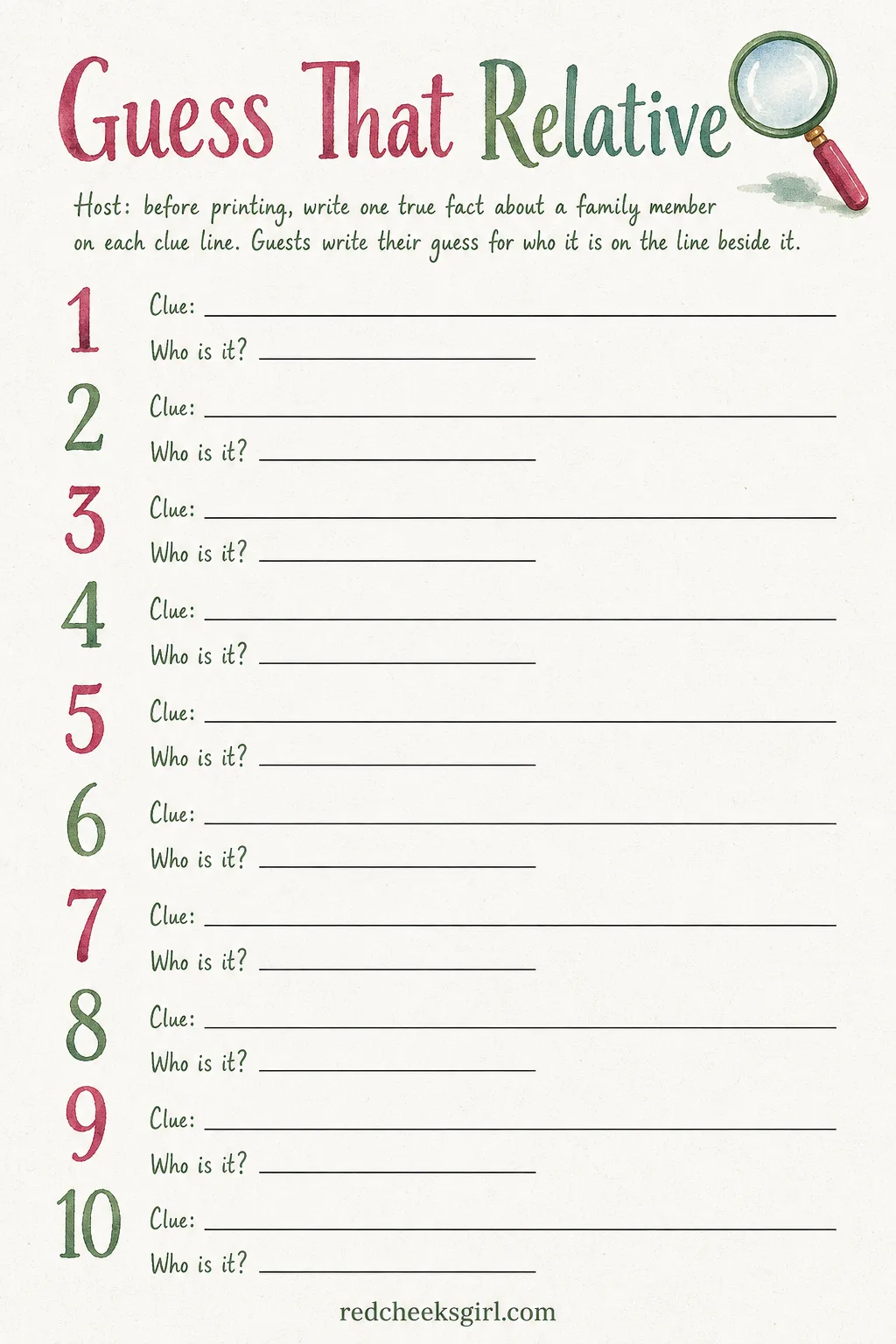
9. Guess That Relative: Family Trait Trivia
Hand the host a stack of blank clue cards a week before the party and ask each side of the family to quietly fill in ten true, harmless facts about their own relatives, the kind only people who grew up with them would know.
On the day, the host reads each clue aloud while guests write their guess for who it describes on the printed sheet, and whoever matches the most clues to the right person by the final one wins.
It needs the host to collect real facts in advance, one clue per guest works well, plus the printed guess sheet and a pen per guest. It plays well for fifteen to fifty people and takes about fifteen minutes.
Clues that are too easy give nothing away and clues that are too obscure stump everyone, so aim for specific but knowable, like a childhood nickname or a memorable mishap. Make it easier for grandparents by reading each clue twice before moving on.
- Host collects one true, harmless fact about a family member from each side a week ahead
- Clues get read aloud one at a time during the party
- Guests write their guess for who each clue describes on the printed sheet
- Whoever matches the most clues correctly by the last one wins
10. The Newlywed Prediction Round: Who Said It?
Sit the engaged couple at the front, hand them each a small whiteboard, and ask a run of simple questions about each other, one at a time, with both partners writing their answer at the same moment without peeking at the other’s board.
Guests from both families call out whether they think the answers will match before the reveal, and the round ends when the couple has answered the last question, with the pair who agreed most often “winning” best-matched for the night.
It needs two small whiteboards and markers, or paper and pens, plus a short list of questions the host prepares beforehand. It takes about ten minutes and works for any crowd size since everyone just watches and reacts.
Questions that are too easy produce a boring string of matches, so mix in a few that could genuinely go either way, like who is the messier cook. Save the trickier, more personal questions for a longer version at the wedding reception instead.
🛍 Shopping guide
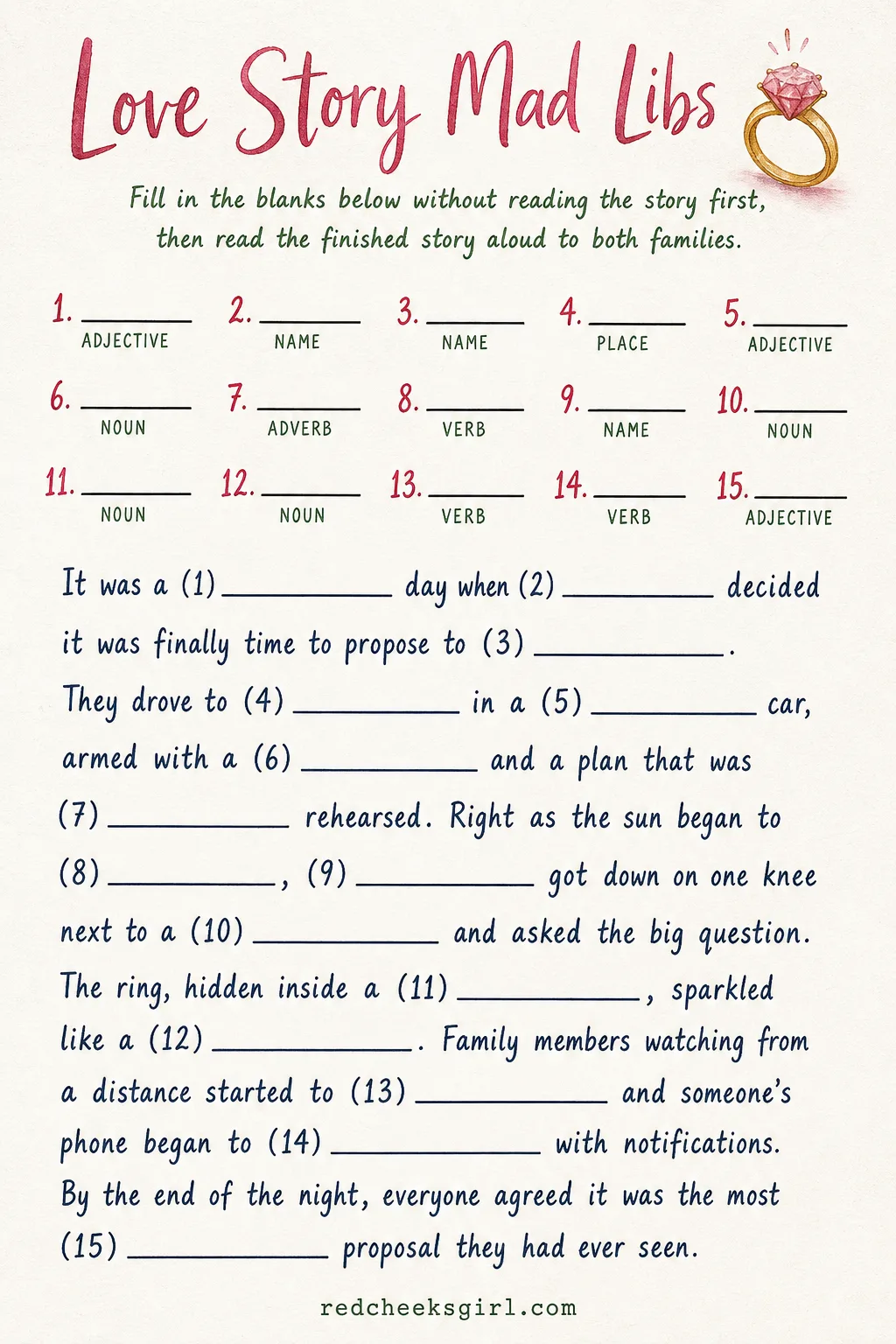
11. Love Story Mad Libs
Hand a sheet to any guest willing to play narrator and let them collect words from the room before reading a single sentence of the actual story. One person calls out “give me an adjective” or “name a place,” writes down whatever the room shouts, and only reads the finished, usually ridiculous, proposal story aloud once every blank is filled.
It needs one printed sheet per small group, a pen, and a few willing voices. It plays in about five minutes and works at any table, which makes it a good filler between courses.
Shy relatives freeze when asked for a word on the spot, so let the narrator take suggestions from anyone at the table rather than pointing at one person. For a sillier version, ban the first word anyone offers and make them think of a second.
Let the narrator take word suggestions from the whole table instead of calling on one shy guest by name.
12. Family Trivia Feud: Survey Says
Before the party, ask a handful of relatives from each side the same wedding-related survey questions, things like the best gift to give a couple or the one thing every wedding needs.
At the party, the two families take turns guessing the most popular answers from their own side’s survey, earning points for each match, and the round ends after both families have had a turn at every question, higher score winning.
It needs the host to run a quick private survey beforehand, a group text works fine, a way to track points, and a loud “ding” sound if anyone wants the full game-show feel. It takes about fifteen minutes for six questions.
A survey of only three or four people gives too few answers to guess around, so poll at least eight to ten relatives per side first. To make it easier for a mixed-age crowd, let any family member call out the team’s guess rather than one spokesperson.
🛍 Shopping guide
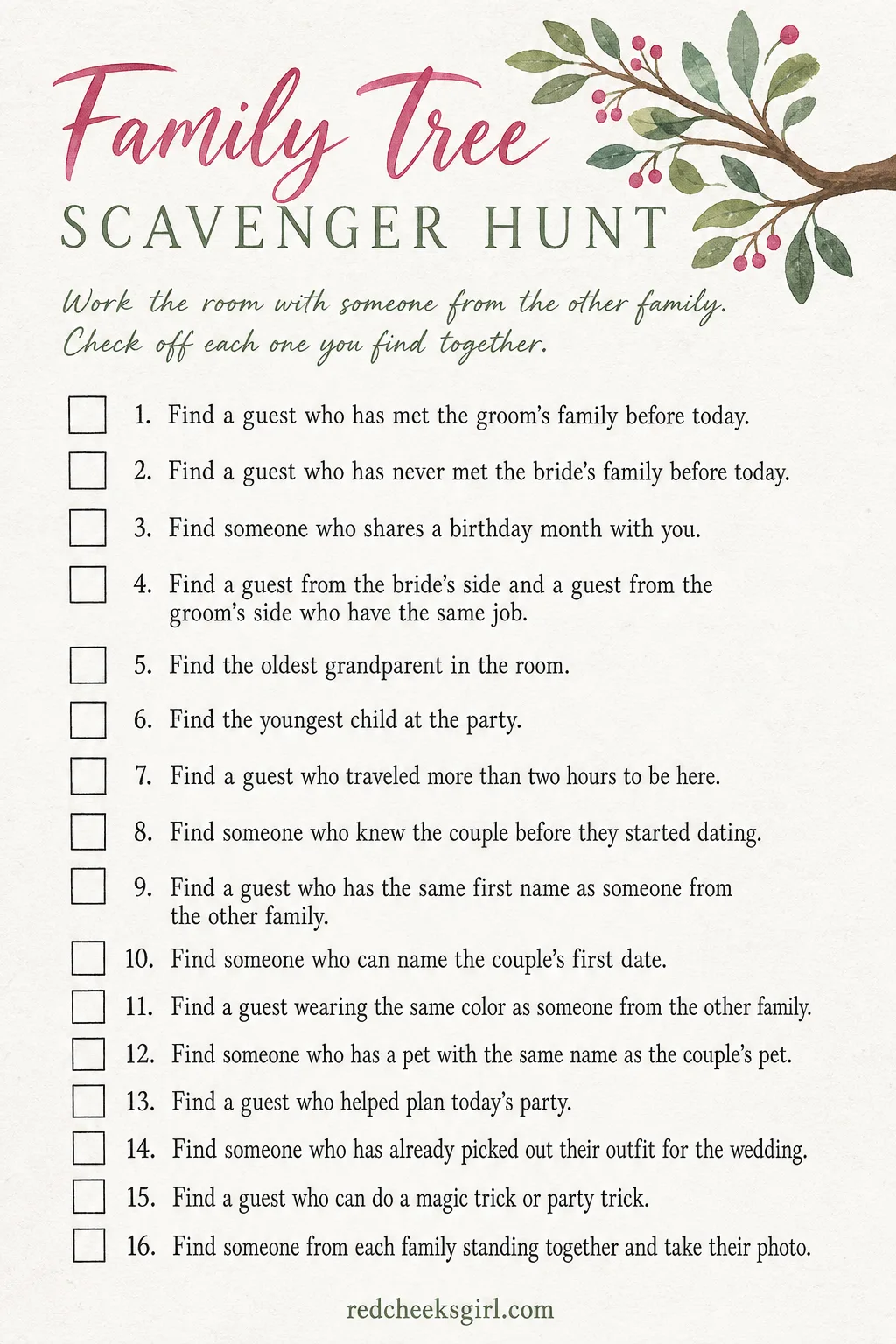
13. Family Tree Scavenger Hunt
Hand every guest a checklist as they walk in and send them off to find specific people rather than specific objects, items like someone who shares a birthday month or the oldest grandparent present. Guests check off each item as they complete it, and the game ends whenever the host calls time, usually about twenty minutes in, fullest checklist winning.
It needs one printed checklist and a pen per guest, clipboards help if there is no table nearby, and it works for any size gathering while pairing easily with whatever engagement party decorations for a home or backyard are already up, since nothing about it needs a dedicated table.
A checklist that is too hard to finish just gets abandoned halfway through, so keep at least a third of the items genuinely easy. Pair children with an adult partner so reading the clues is not the bottleneck.
Best for a backyard or open floor plan where guests can wander freely while they hunt.
🛍 Shopping guide
14. Paper Gown Relay: Dress the Mannequin
Split into two teams by family, hand each team a roll of toilet paper or crepe streamer and a roll of tape, and give them five minutes to dress one volunteer from their own side as a makeshift bride or groom.
When the timer stops, the two “models” walk a short runway together and the room votes by applause, louder team declared the winner.
It needs two rolls of toilet paper or streamers, tape, and one willing model per team. It takes about ten minutes total including the runway walk, and works best with teams of four to eight people each.
One overenthusiastic team member tends to take over the whole design, so set a rule that everyone has to tape on at least one piece. For a tamer version with young kids involved, dress a stuffed toy or a balloon figure instead of a person.
🛍 Shopping guide
15. Guess How Many Candy Kisses in the Jar
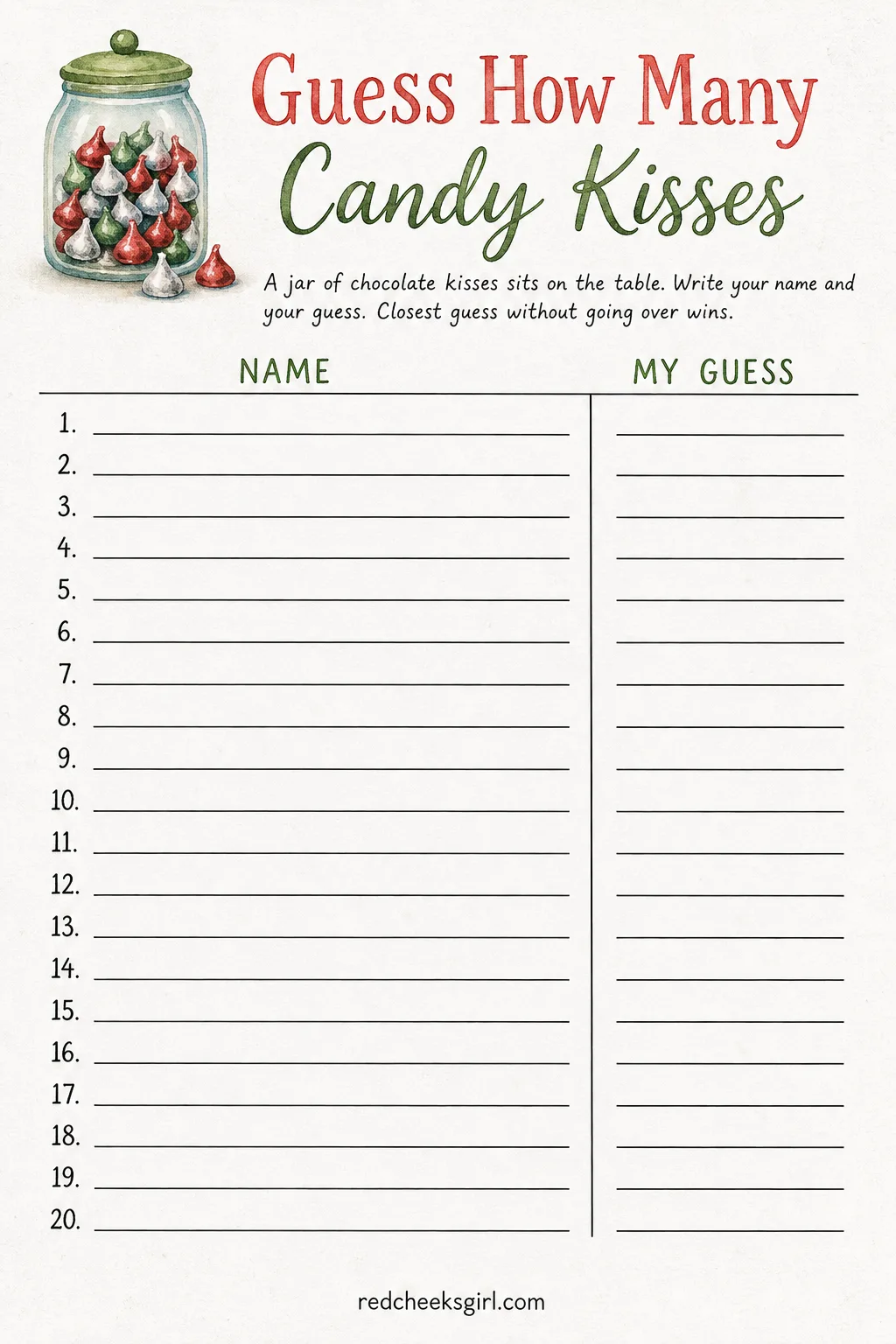
Fill a clear jar with chocolate kisses before the party and set it somewhere guests pass by naturally, with the printed guess sheet and a pen nearby.
Guests write their name and their best guess any time during the party, and the game ends when the host counts the real total near the end of the night, closest guess without going over winning the jar itself.
It needs one clear jar, a bag or two of chocolate kisses, and the printed guess sheet. It runs passively for the whole party and needs no supervision until the final count.
A jar that is too small makes the count obvious at a glance, so use a tall, narrow jar rather than a short wide one to keep the guessing genuinely hard. For sweeter stakes, let the winner take the jar home instead of just bragging rights.
A jar nobody can eyeball at a glance keeps guests circling back past it all afternoon, which is exactly the point.
🛍 Shopping guide
16. This or That: Wedding Style Showdown
Call out a string of paired choices, one at a time, like big wedding or small wedding, cake or pie, and have guests physically move to one side of the room to show their pick rather than raising hands.
The host reads each pair, both families scatter to whichever side matches their answer, and the round keeps rolling until the host runs out of pairs, no real winner beyond who ends up standing next to someone new.
It needs nothing but a prepared list of ten to fifteen pairs and enough open floor for people to walk from side to side. It takes about ten minutes and works for any group size.
Pairs that are too similar stall the energy, so mix in a few genuinely divisive ones like beach wedding or mountain wedding. To slow it down for older guests, let people call out their answer from their seat instead of walking.
17. Ring Toss for the Rings
Set up a simple ring toss board or a row of pegs outdoors, and let guests take turns tossing rings from a marked line, points assigned to whichever peg a ring lands on.
Each guest gets three tosses per turn, the game runs until everyone has had a go, and whoever racks up the highest total score across their turns wins.
It needs a ring toss set, store-bought or a homemade version with bottles and dollar-store rings, plus flat outdoor ground. It works for any age since the toss line can move closer for children or grandparents, and takes about fifteen minutes for a full group to cycle through.
A toss line set too far back shuts out anyone without a strong arm, so mark two lines, one closer for kids and grandparents, one further back for everyone else. For a quicker version with a big crowd, run it in pairs racing side by side instead of one at a time.
Mark two throw lines, one closer in for grandparents and kids, so nobody sits this one out.
🛍 Shopping guide
18. Family Heirloom Show and Tell
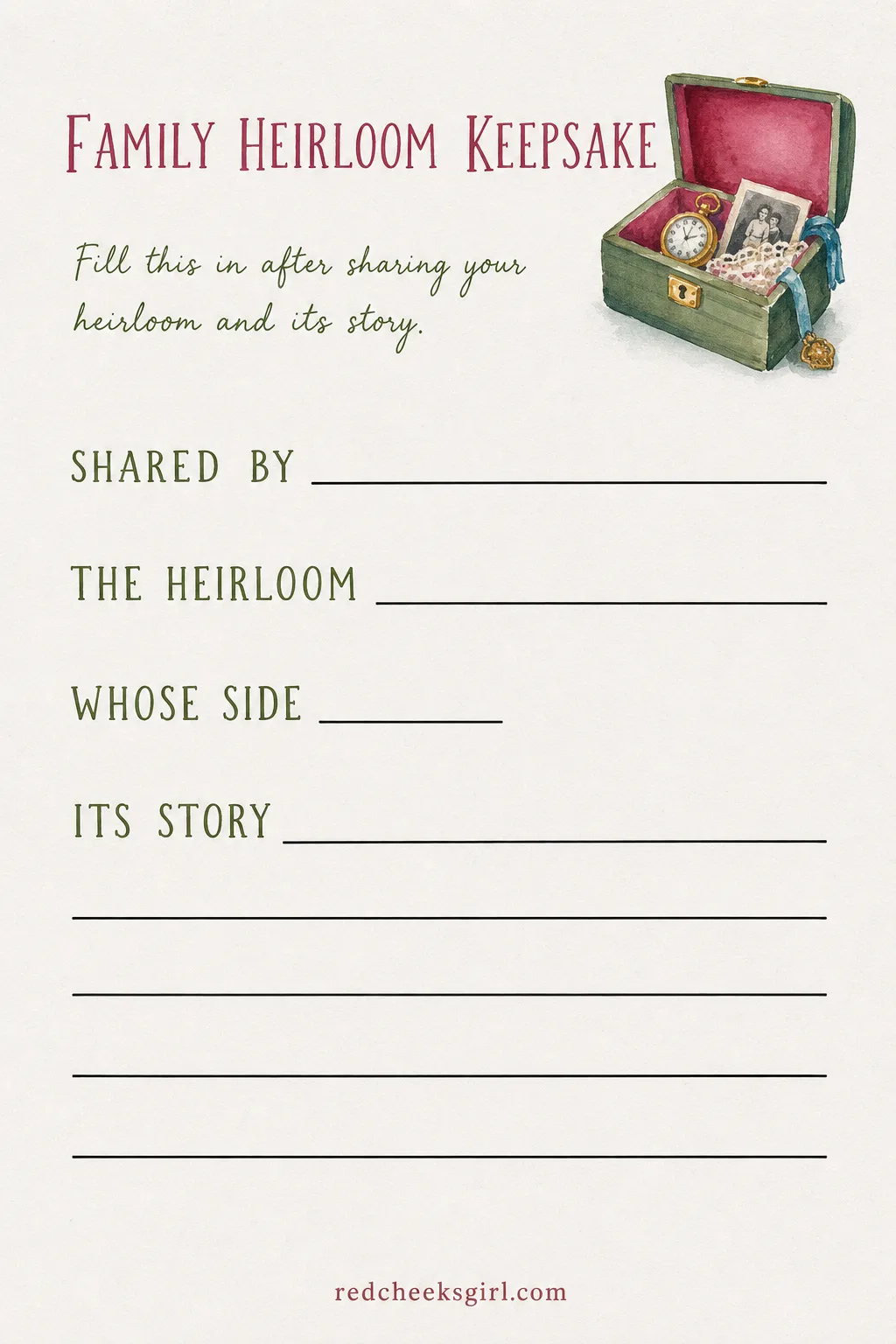
Ask a few relatives from each side, ahead of time, to bring one small object with a real story attached, a ring, a photo, a worn recipe box, anything that has been in the family a while.
One at a time, each person stands and shares the object and its story in under two minutes, and the round ends once everyone who signed up has had a turn, no winner since the point is simply hearing the stories out loud.
It needs nothing from the host beyond asking people in advance and keeping a loose order. It works for groups of any size, though it is best kept to six or eight speakers so it does not run long, and takes about twenty minutes total.
Without a time limit, one storyteller can eat the whole slot, so give a gentle thirty-second warning, a bell works, before each person’s two minutes is up. For a shorter version, ask people to bring a photo instead of an object so the story stays quick.
19. Pass the Parcel: Family Edition
Wrap one small prize in many layers, with a simple prompt tucked between each layer, things like sharing a favorite memory of the couple or doing a quick dance move.
Guests sit in a circle mixing both families on purpose, pass the parcel while music plays, and whoever holds it when the music stops unwraps one layer and completes that layer’s prompt before passing it on. The game ends when the final layer comes off and that last person keeps the small prize inside.
It needs one small wrapped prize, wrapping paper for several layers, slips of paper with prompts tucked between layers, and music that can start and stop on cue. It works for twelve to thirty people in a circle and takes about fifteen minutes.
Too many layers drags the game out past its welcome, so aim for one layer per two guests rather than one per guest. For a mixed-age circle, keep the prompts to things anyone from six to eighty can do, like naming a favorite family meal.
Best for a seated, mixed-age circle where not everyone wants to be the center of attention for long.
🛍 Shopping guide
20. Family Advice & Well-Wishes Cards
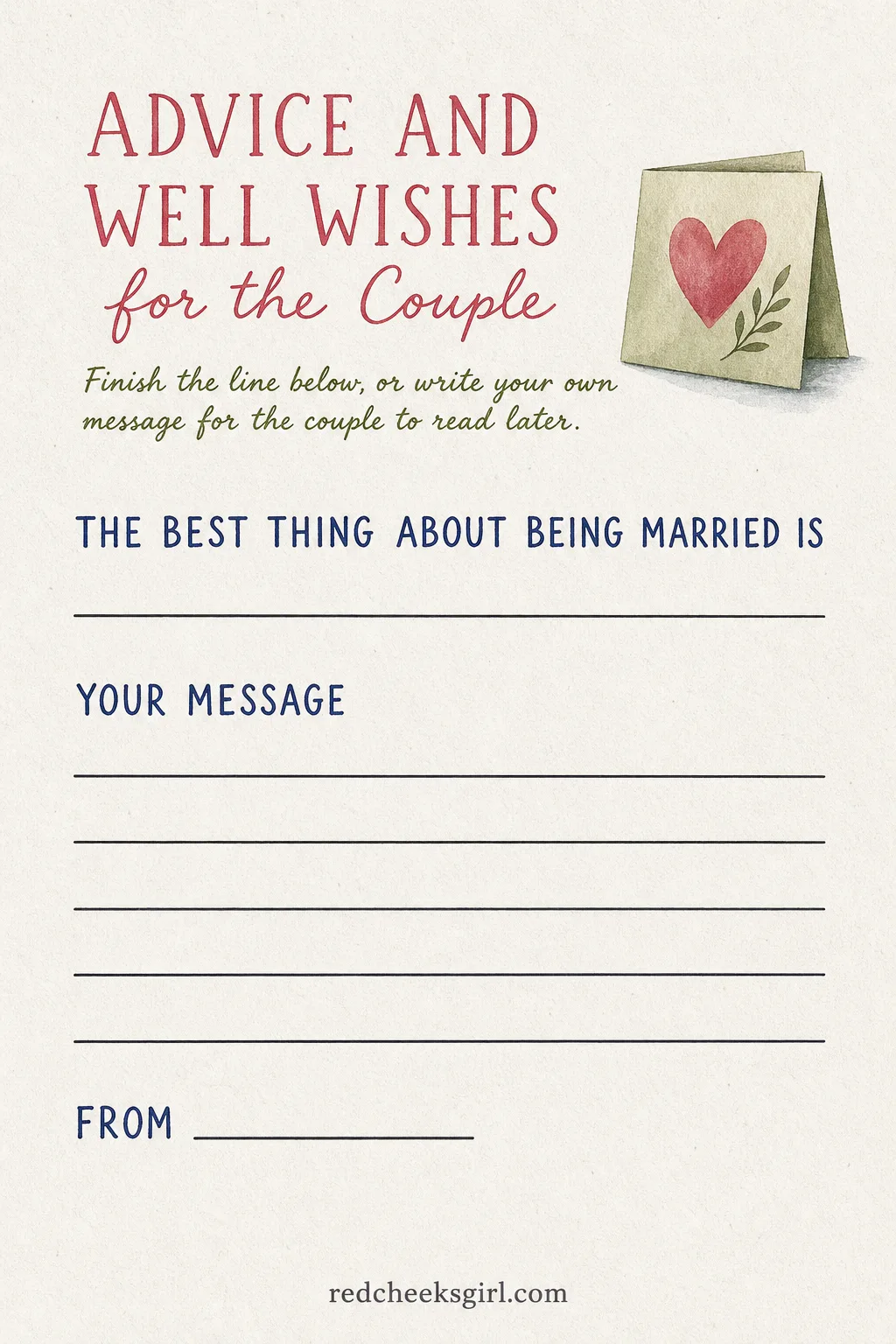
Set out a small stack of blank cards near the gift table and invite every guest, whenever they have a free minute, to write one piece of advice or one well-wish for the couple’s marriage.
There is no performance and no reading aloud at the party itself; guests simply drop their finished card into a box, and the game ends only when the box is collected at the end of the night for the couple to read later, together, in private.
It needs one blank card per guest, pens, and a box to collect them in, set out near a gift table with thoughtful ideas for the couple. It works passively all party long and needs no other setup.
A blank card with no prompt gets left blank too, so print one small line at the top, like “the best thing about being married is,” to get people started. For a lighter version, skip advice entirely and ask for one memory instead.
Frequently Asked Questions
What games do you play at an engagement party?
The most popular engagement party games for families mix a couple quiz, a proposal-story guessing round, family-versus-family trivia, bingo, and a light relay, so no single type takes over.
How do you get two families to mix at an engagement party?
Pair people across family lines on purpose: team games split bride’s side against groom’s side, or mingling rounds that rotate partners, force the two families to talk instead of clustering with people they already know.
Do you have to play games at an engagement party?
No, engagement party games for families are optional, and the day works fine on food, toasts and mingling alone, though one or two short rounds give shy relatives and small children something easy to join.
When should you play games at an engagement party?
Play the main game about an hour in, once everyone has arrived and had a drink, and keep it to fifteen or twenty minutes so it never crowds out the toasts and the food.
What is a good engagement party game for a big group?
For a big group, the best engagement party games for families let two teams play at once, such as trivia or a survey-style feud round, rather than one guest performing while everyone watches.
Are engagement party games good for grandparents and kids too?
Yes: bingo, trivia answered as a team, and scavenger hunt checklists need no special skill, let grandparents sit while they play, and give children something to do alongside an adult.
22 bridal shower centerpiece ideas from champagne buckets to ring boxes, each one built to double as
34 simple wedding centerpieces you can actually repeat across every table, from bud vases to julep c
16 small engagement party ideas, from a dinner party at home to a jar of handwritten wishes, ordered
Leave a Reply