

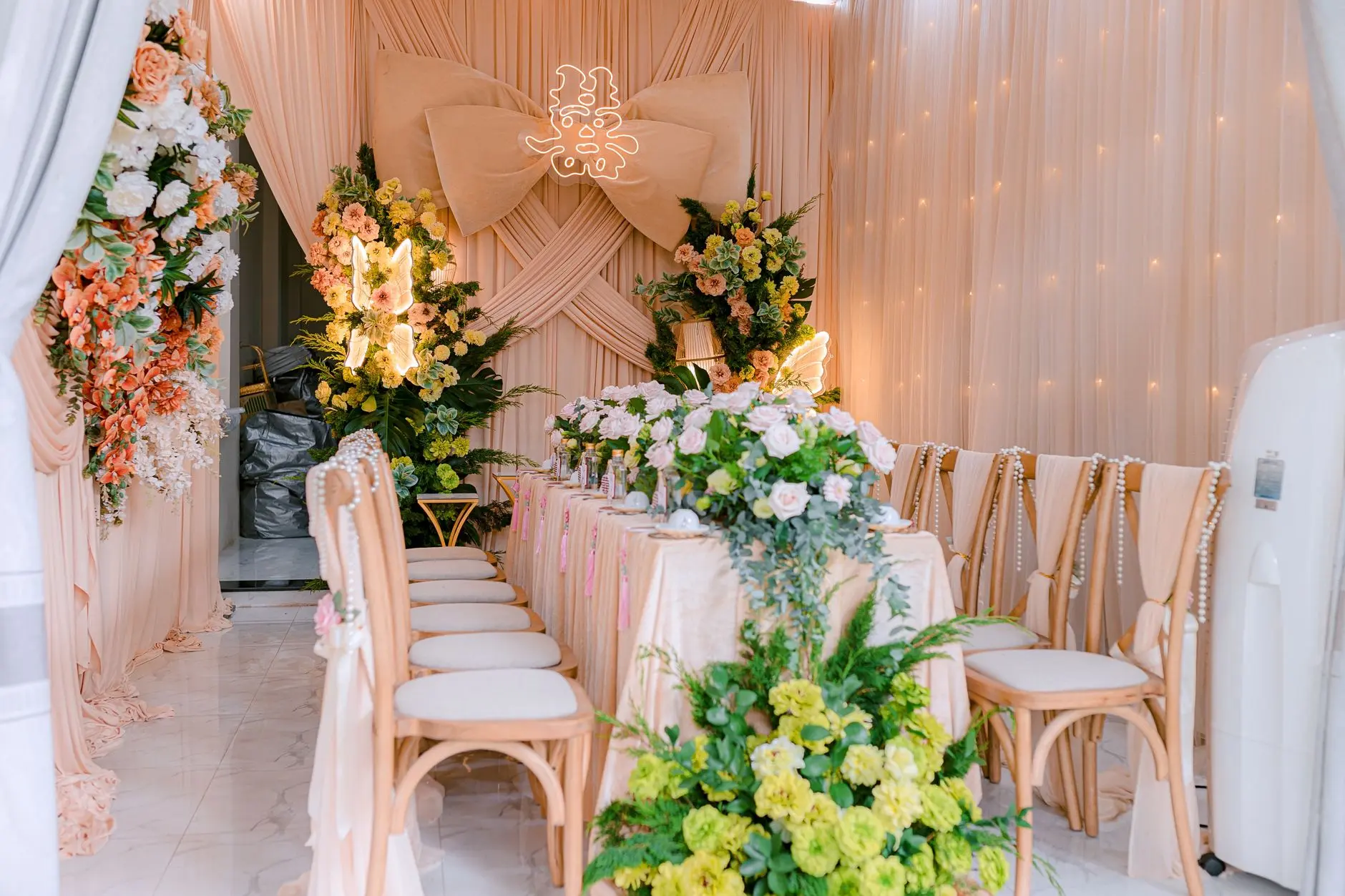
An engagement party is one of the few occasions when two completely different families sit in the same room and smile politely at each other across a cheese board.
They share one thing — they both love the couple — but beyond that, common ground can be hard to find. That is exactly why the right games matter so much.
A well-chosen activity gives everyone something to do with their hands, a reason to laugh, and a story to tell at the wedding later.
The 18 engagement party games below are designed specifically for that moment when two families are still sizing each other up. Some are printable sheets you can prep at home the night before. Others need nothing more than a few props and a little space.
All of them are built to warm the room up fast, pull in guests of every age, and leave everyone feeling like they already know each other a little better.
Pick a handful that suit your crowd, and you will have an engagement party that people actually remember.
This post contains affiliate links — if you buy through them, I may earn a small commission at no extra cost to you.
Table of Contents
- How Did They Meet Quiz
- Two Families Human Bingo
- Advice for the Couple
- Guess Who Said It?
- Couple Trivia Rounds
- Photo Timeline Match
- Wedding Predictions Card
- Emoji Love Song Decode
- Ring Toss Tournament
- Charades Couple Edition
- Date Night Jar Suggestions
- Family Recipe Swap
- Wedding Mad Libs
- Shoe Game Showdown
- Name That Couple Playlist Challenge
- Build-a-Vow Workshop
- Two Truths and a Wedding Tale
- Memory Lane Relay
1. How Did They Meet Quiz
Before the party, ask the couple to answer ten questions about how they first got together — where it happened, who spoke first, what they were wearing, what song was playing, and so on.
Type those answers onto a printable quiz sheet with multiple-choice options and hand one to every guest as they arrive. Guests work individually or in pairs to pick what they think is the true version of the story.
The couple reveals each answer at the end, and the guest with the highest score wins a small prize.
This game works beautifully as an opener because it requires zero prior knowledge of the other family. A grandparent who has never met the future in-laws is on exactly the same footing as the couple’s college roommate.
That shared ignorance is the whole point — it levels the room instantly and gives everyone the same thing to talk about. Plan for groups of any size from eight to sixty, and budget about fifteen minutes for the quiz plus the reveal.
Print one sheet per guest on standard letter-size paper. You will also want a small whiteboard or large notepad so you can tally scores publicly — the visible leaderboard keeps energy up during the reveal.
Host tip: record a short voice note of the couple giving their answers before the party, then play it back as the “official” reveal. Hearing their voices tell the story lands far better than you reading it aloud yourself.

🛍 Shopping guide
2. Two Families Human Bingo
Human Bingo — sometimes called people bingo — turns mingling into a mission.
Each guest receives a printed five-by-five bingo card where every square contains a personal description rather than a number: “has been to the same country as the couple’s honeymoon destination,” “can name both families’ hometowns,” “has a funny story about the bride or groom,” and so on.
Guests must walk around, find a real person who matches each square, and collect their signature or initials in that square. First to complete a row calls “Bingo!”
The genius of this format at an engagement party is that it forces the two families to talk to each other rather than retreating to their own corners.
Write half the clues around the bride’s side of the family and half around the groom’s, so no one can fill their card without crossing the room.
This game suits groups of fifteen to sixty guests and runs naturally for twenty to thirty minutes, making it ideal right after arrivals when people are still loosening up.
Print one unique card per guest — shuffle the square positions so no two cards are identical, which is easy to do in a basic spreadsheet.
Host tip: seed the card with one or two clues that only one specific person at the party can satisfy, such as “has the same job as the groom’s father.” That single square sends people on a hunt that always ends in a real conversation.

🛍 Shopping guide
3. Advice for the Couple
Set up a small table with a stack of printed prompt cards and a collection box or decorated jar.
Each card gives guests a warm, specific prompt to respond to in writing: “The best thing about being married is…,” “One thing I wish someone had told us before the wedding…,” or “A small habit that will keep you laughing in year twenty…” Guests fill in their card at any point during the party and drop it in the jar.
The couple reads them together that evening or saves them as a keepsake.
Unlike an open guestbook, the structured prompts mean guests actually write something meaningful rather than just signing their name.
The cards also work as a natural icebreaker at the table — two guests who don’t know each other will often end up reading each other’s answers aloud and laughing.
This activity runs passively throughout the party with no scheduled time slot, which is one of its great practical advantages for a host managing other games.
Print the cards on cardstock and cut them apart, or leave them as a half-sheet for easier writing. Provide good pens — thin ballpoints skip on cardstock and frustrate older guests.
Host tip: place a completed sample card in the jar before guests arrive so they can see exactly how much detail is expected. A blank jar with no example produces three-word answers; a jar with one thoughtful card in it produces paragraphs.

🛍 Shopping guide
4. Guess Who Said It?
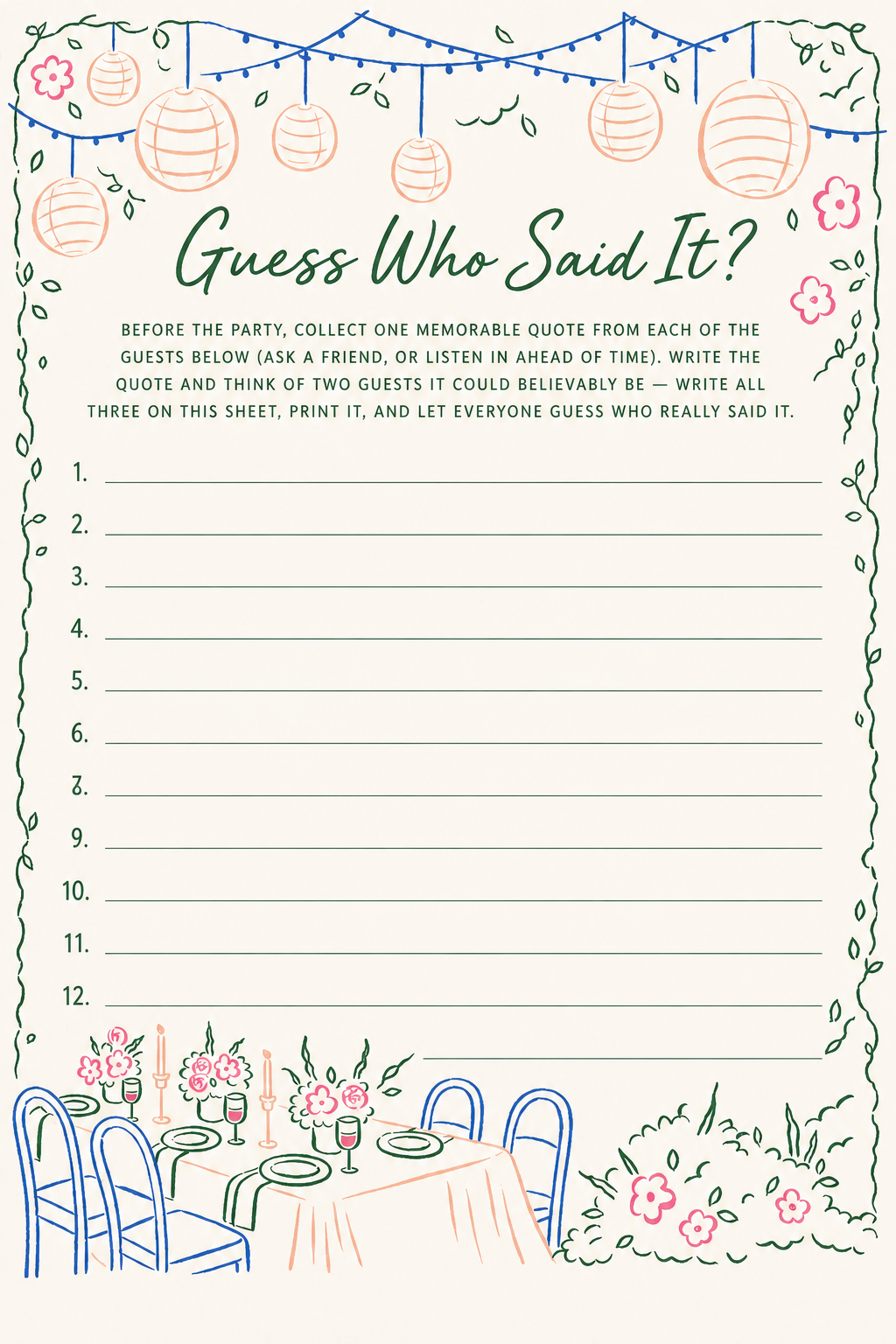
Before the party, collect a quote from every guest — ask them via email or text to send one sentence that describes the couple, one piece of relationship advice, or one memory involving the pair.
Compile all the quotes onto a printed sheet with a numbered list, and leave a blank column beside each one where guests write whose name they think belongs to that quote.
At reveal time, go through the list one by one and let the real author stand or raise their hand.
This game is especially powerful at an engagement party because the reveal moment is layered with genuine surprise — the groom’s uncle says something unexpectedly poetic, the flower girl writes something hilarious, the couple’s long-distance friend submits something that makes the room go quiet and then burst into applause.
Plan for ten to forty guests and about twenty minutes of active play. The preparation is the heaviest part, so send the quote request at least a week before the party.
Print one answer sheet per guest on standard paper. Collect the quotes by text or a simple online form and type them up yourself so the handwriting doesn’t give anything away.
Host tip: always include one quote from each member of the couple about the other person, but don’t announce it in advance. When guests realize they were trying to guess which quote came from the bride or groom, the energy in the room doubles.
🛍 Shopping guide
5. Couple Trivia Rounds
Divide the room into teams of four to six, mixing both families intentionally — put one person from each side in every team so the competition itself creates cross-family bonds.
Run three or four rounds of trivia, each with a different category: the couple’s story, general wedding traditions, the families’ home cities or regions, and a wild-card pop culture round.
Read questions aloud or display them on a screen, give teams sixty seconds to discuss and write an answer on their sheet, then score and move on.
The mix of categories is important. A round of pure “facts about the couple” trivia tends to favor whoever knows them best, which can feel exclusionary.
Adding a round about wedding traditions from around the world or a geography round about both families’ home regions gives guests from every background a fair shot.
This format suits groups of twelve to fifty and runs thirty to forty-five minutes depending on how many rounds you play.
Print one answer sheet per team and prepare your question list in advance with an answer key. A small whiteboard for keeping team scores visible keeps the competitive energy alive.
Host tip: name the teams after places that are meaningful to the couple — the city where they met, where they got engaged, where each family is from — and announce the names with a little fanfare at the start.
It sounds like a small thing but it immediately tells a story and gets people curious about each other.

🛍 Shopping guide
6. Photo Timeline Match
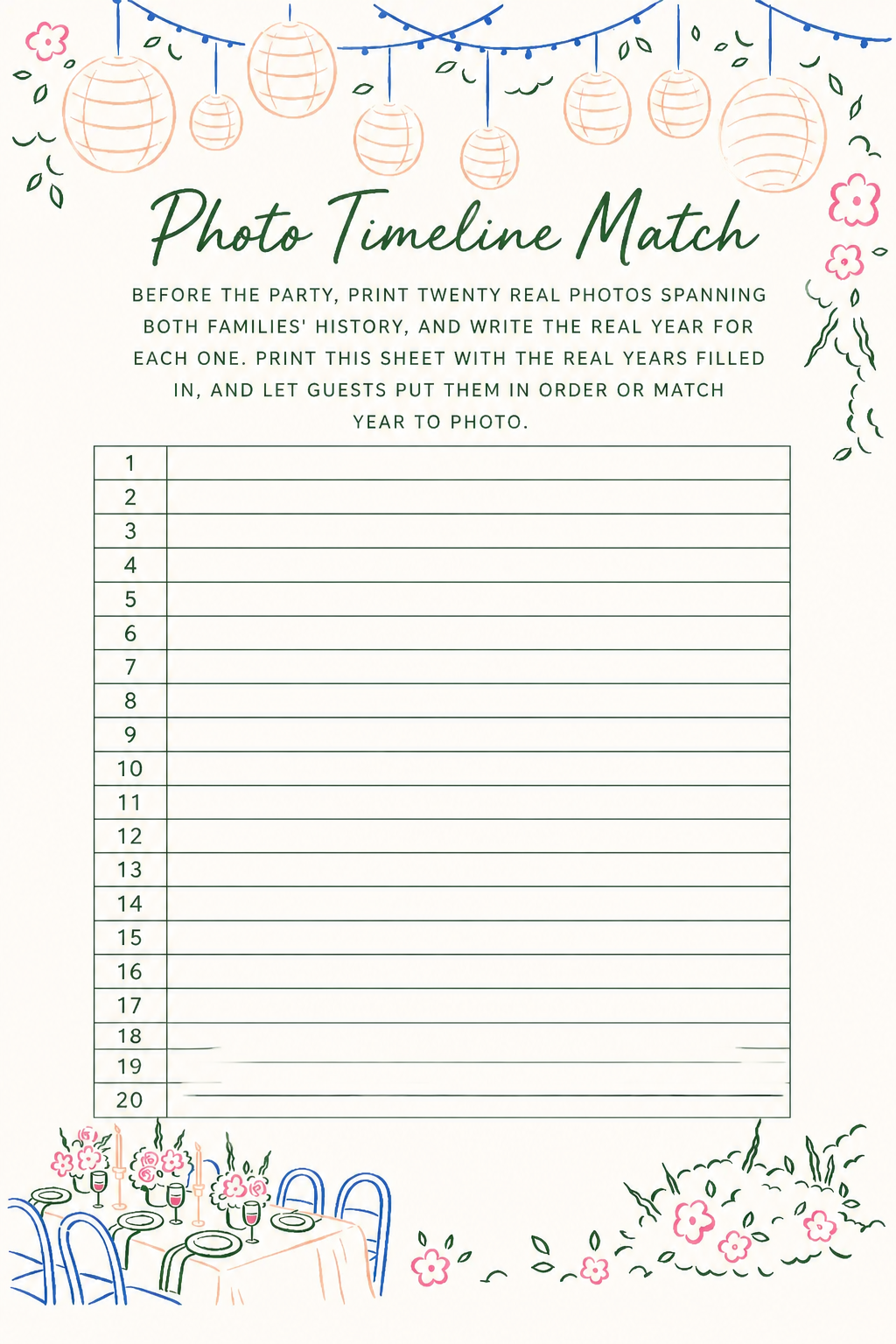
Gather ten to fifteen photos of the couple at different ages and life stages — childhood pictures from both families, early relationship photos, the engagement shoot — and print or display them without dates.
Then create a printable answer sheet that lists the dates or years and asks guests to match each photo to the correct time period. Alternatively, lay the photos on a table and ask guests to physically arrange them in chronological order as a team.
Sourcing the childhood photos from both families is itself a lovely piece of pre-party contact between the two sides. A parent who emails three old photos over is already invested in the game before it starts.
At the party, the photos almost always generate spontaneous storytelling — “Oh, that’s from the summer we all went to the lake,” or “He had that haircut for three years.”
Budget about fifteen minutes and plan for any group size, since the table version works well as a drop-in activity.
Print the photos at four-by-six inches and laminate them if you want to reuse the game at a bridal shower. Use the printable sheet as the answer key and scoring card.
Host tip: include one photo that is genuinely tricky — a childhood picture of one partner that could easily be mistaken for the other — and watch the room erupt when the answer is revealed.
That one image tends to generate more conversation than all the others combined.
🛍 Shopping guide
7. Wedding Predictions Card
Hand each guest a printed prediction card and ask them to make specific, date-stamped forecasts about the couple’s future: where they will live in five years, how many children they will have, what the groom will say in his vows, what unexpected thing will happen at the wedding, who will cry first.
Guests sign and seal their cards in individual envelopes, which the couple keeps and opens on their first anniversary or fifth.
The time-capsule format gives this game a sentimental weight that most party activities lack. Guests take the writing more seriously because they know it will be read again in real life, not just at the party.
It also runs completely passively — set out the cards, envelopes, and a good pen station, and guests fill them in whenever they have a quiet moment.
Any group size works, and the activity hums along in the background all evening without needing a host to run it.
Print the cards on slightly heavier paper so they feel like something worth keeping. Provide small envelopes and a marker for guests to write their name on the outside.
Host tip: prepare a decorative box or tin where sealed envelopes get deposited, and label it clearly with the couple’s names and “Open on your first anniversary.”
A beautiful container makes guests more likely to take the writing seriously — and makes it a lovely gift the couple actually receives at the end of the night.

🛍 Shopping guide
8. Emoji Love Song Decode
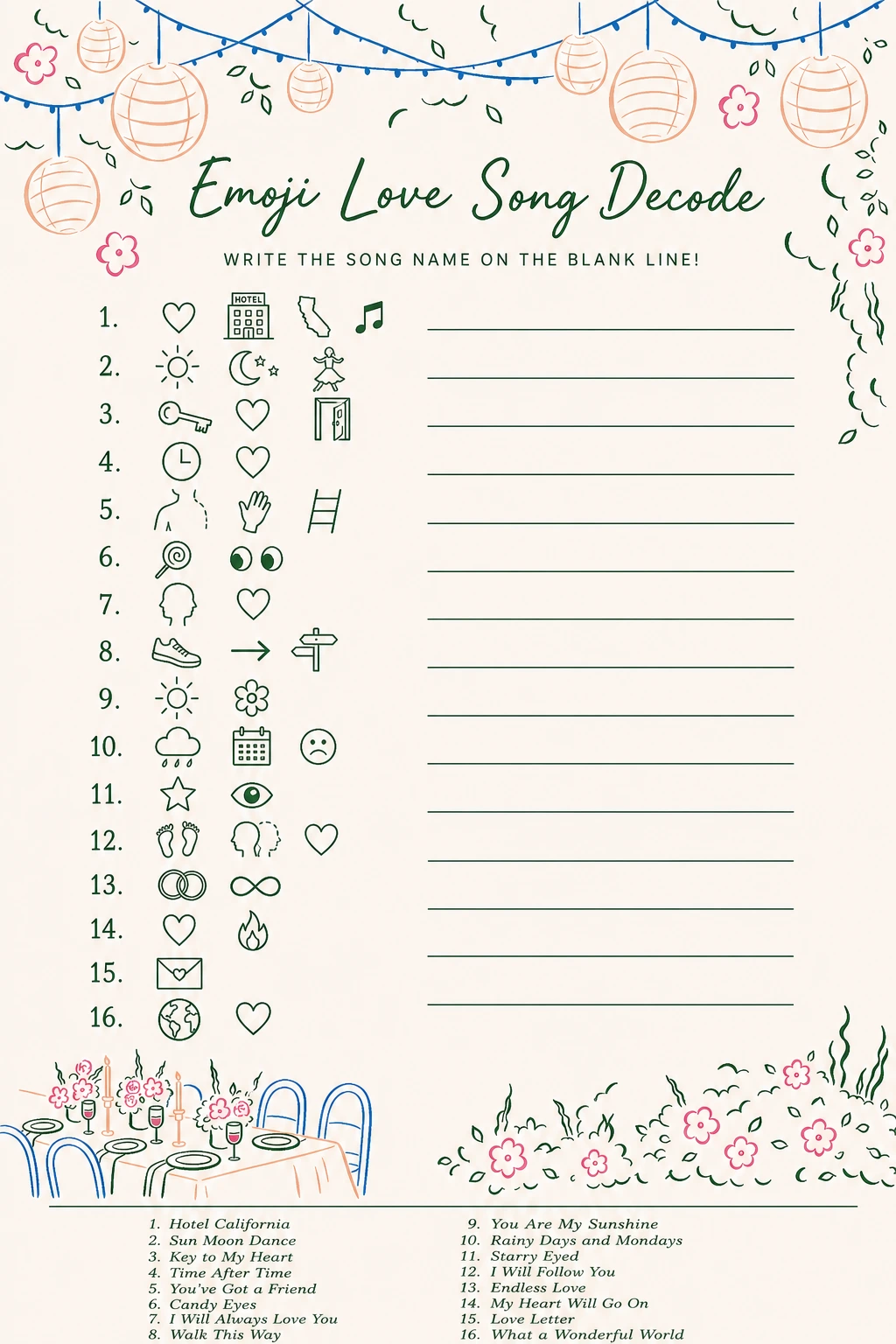
Create a printed sheet where popular love songs are represented not by emoji riddles or rebus puzzles, but by their actual opening lyrics printed in plain text with the song title blanked out.
Guests read each lyric excerpt and write in the song title and original artist. Bonus points are awarded for correctly naming the decade the song was released.
This format rewards genuine music knowledge across generations — a guest in their seventies might nail the Motown round while a twenty-year-old cleans up on the recent chart hits.
The multigenerational angle is what makes this game shine at an engagement party where ages range from eight to eighty.
Organize the sheet into decade sections — the 1960s through today — so guests can immediately see which era they are strong in and which they need help with. Pair guests across family lines for extra mixing.
The game runs about fifteen minutes and suits groups of any size.
Print one sheet per guest or per pair. Prepare your answer key in advance and double-check that every lyric is correctly attributed.
Host tip: include at least one song that is personally meaningful to the couple — maybe the song playing when they first danced or one from their first road trip together — and reveal that detail when you announce the answer.
That single moment always gets a genuine reaction from the room.
🛍 Shopping guide
9. Ring Toss Tournament
Set up a classic ring toss station outdoors or in an open indoor space using a wooden peg board, a ring toss stand, or a DIY version made from bottles arranged in a grid. Each peg or bottle is assigned a point value.
Guests take turns tossing a set of rings from a marked line, accumulating points over two or three rounds.
Run it as a bracket-style tournament with a small prize for the winner, and post the bracket on a visible board so everyone can track the action.
The physical, competitive nature of ring toss reaches guests who find paper-and-pen games intimidating — kids, people who don’t speak the dominant language at the party, guests who are shy in group settings.
Once someone is standing at the line holding a ring, every person nearby is watching and cheering, and that shared attention dissolves awkwardness faster than almost any other activity. Plan for groups of ten to forty and budget forty-five minutes to run a full bracket.
You will need a ring toss set, a printed bracket sheet taped to a board, and a volunteer or family member to run the station. Decorate the set with ribbon or flowers in the couple’s colors to tie it to the party theme.
Host tip: seed the bracket so that one person from each family ends up in the final two.
It sounds manipulative, but when both families are cheering for their own finalist, the room becomes one unified, noisy crowd — which is exactly the atmosphere you are trying to build.

🛍 Shopping guide
10. Charades Couple Edition
This is charades built entirely around the couple’s story, their inside jokes, their shared hobbies, and the wedding world.
Print the clue cards in advance and cut them apart — each card has a phrase, activity, or moment relevant to the couple, such as “the night they got engaged,” “the groom’s cooking disaster,” “first dance at the reception,” or “the father-of-the-bride speech.”
Divide into two teams mixing both families, draw a card, and act it out in the classic no-words format while your team guesses.
The couple-specific content is what lifts this above a generic charades game. When the groom’s mother has to act out a scene that only the bride’s family knows well, she has to ask questions and listen — and that exchange is the whole point.
The game suits groups of ten to thirty and runs thirty to forty-five minutes. The printable sheet of clues does all the heavy lifting, so prepare it carefully by collecting story material from the couple beforehand.
Print the clue sheet on cardstock, cut the cards apart, and keep them in two separate piles for each team. A one-minute sand timer keeps rounds moving.
Host tip: write a few cards that require two people to act together — one person plays the bride, the other plays the groom, and they must mime the scene as a duo.
Those rounds are consistently the most memorable and produce the biggest laughs of the evening.

🛍 Shopping guide
11. Date Night Jar Suggestions
Place a large decorative jar on the activity table along with small strips of paper cut from the printable sheet.
Each strip has a prompt at the top — “An adventure date idea,” “A stay-at-home date for a rainy Sunday,” “A date that costs nothing,” “A date for your first anniversary” — and a blank space for guests to fill in their suggestion.
Guests write their idea, fold the strip, and drop it in the jar. The couple takes the jar home as a practical, personal wedding gift they will actually use.
The structured prompts solve the blank-page problem that kills most “write a message” activities at parties. Because each strip tells a guest exactly what kind of idea is needed, even guests who struggle with open-ended prompts will write something specific and useful.
The jar ends up containing fifty to a hundred genuinely different suggestions rather than fifty versions of “dinner and a movie.” Any group size works, and the activity runs passively all evening.
Print the suggestion strips on cardstock, cut them apart, and fan them out in a basket next to the jar. Provide a few good pens. Host tip: write ten or fifteen strips yourself before the party and drop them in as seed ideas.
When guests look in the jar and see it already has content, they feel like they are adding to something real rather than starting from scratch — and they tend to write more thoughtful suggestions as a result.

🛍 Shopping guide
12. Family Recipe Swap
Ask every guest to bring one printed or handwritten family recipe to the party — a dish that has been made at family gatherings, a grandmother’s signature dessert, a holiday staple.
Collect all the recipes on arrival, give each one a number, and distribute a printed answer sheet that lists every recipe title. Guests mingle and try to figure out which family or which guest submitted each recipe, writing their guesses in the blanks.
At the end, the couple keeps every recipe and compiles them into a shared family cookbook.
This game works on two levels simultaneously. As a guessing game it gets people talking — “Did you bring the pierogi recipe? It has to be someone from the groom’s side.”
As a keepsake it gives the couple something genuinely irreplaceable: a handwritten collection of both families’ food traditions gathered in one place on the night they were officially joined.
Plan for groups of twelve to forty and budget twenty minutes of active guessing, though the recipe-sharing conversations tend to continue all evening.
Prepare the printed answer sheet in advance once you know which recipes have been submitted. Have a folder or binder ready to collect the recipe cards cleanly.
Host tip: ask one person from each family in advance to bring a recipe that is a real talking point — something unusual, something with a story, something made only at Christmas for the last sixty years.
Those anchor recipes drive the longest conversations and make the guessing game genuinely competitive.

13. Wedding Mad Libs
Create a printed fill-in-the-blank story built around the couple’s wedding day — a one-page narrative with key words removed and replaced by blank spaces labeled by part of speech or type of word: “noun,” “verb ending in -ing,” “a place,” “an adjective,” “a celebrity name.”
Without showing anyone the story, go around the table and collect one word per blank from different guests. Then read the completed story aloud in full, with all the substitutions in place.
The resulting story is always ridiculous, and the laughter it produces is the kind that reaches every corner of the room.
Because guests contribute words without knowing the context, a grandparent’s perfectly innocent “adjective” ends up describing something absurd, and a child’s enthusiastic noun ends up in an unexpected spot.
This game suits groups of eight to thirty, takes about ten minutes to play, and requires virtually zero preparation beyond writing and printing the story template.
Print one story sheet per table or group. Read it yourself as the host for maximum comic effect — timing and delivery matter.
Host tip: write two versions of the story, one told from the bride’s perspective and one from the groom’s, and play both back to back.
The differences between the two completed stories, each shaped by a different cluster of guests, create a natural comparison that generates another five minutes of conversation on its own.
🛍 Shopping guide
14. Shoe Game Showdown
Seat the couple back to back in two chairs at the front of the room. Each partner removes one of their own shoes and one of their partner’s shoes, then holds one shoe in each hand.
The host reads out a series of questions — “Who said ‘I love you’ first?” “Who is the better cook?” “Who is always late?” “Who will plan every vacation?” — and each partner raises the shoe of the person they think the answer describes.
Since they cannot see each other’s responses, the room sees both answers simultaneously.
The format is self-revealing and endlessly entertaining because disagreements are visible in real time. When both shoes go up for “Who is more stubborn?” the room loses it. When the answers match perfectly on something sentimental, the room goes quiet before erupting into applause.
This game requires no materials beyond the couple’s shoes and a list of questions, suits any group size, and runs about fifteen minutes — making it one of the easiest high-impact games on this list.
Prepare twenty to thirty questions in advance, ranging from lighthearted to slightly sentimental, and end on a warm note rather than a contentious one. The host’s job is to read with energy and let the pauses land.
Host tip: let guests shout in suggested questions halfway through. A question submitted by the groom’s mother and then answered live by the couple creates an immediate, personal connection between her and the pair that no icebreaker card can manufacture.
15. Name That Couple Playlist Challenge
Before the party, build a playlist of songs that are personally meaningful to the couple — the song from their first date, the one playing when they met, the one she always sings in the car, the one he put on every road trip.
Number each track and play a ten-to-fifteen-second clip while guests write down what they think the significance of that song is to the couple. After all clips have played, the couple explains each one’s real meaning.
This game gives the couple a chance to narrate their own story through music, which is consistently more moving and more interesting than a straight verbal retelling.
Guests who know them well may recognize a few songs; guests meeting the couple for the first time will be charmed by the stories regardless of whether they guessed correctly.
Plan for any group size and budget twenty to twenty-five minutes including the couple’s explanations, which are where the real magic happens.
You will need a playlist prepared and queued in advance, a speaker, and a simple numbered answer sheet. A phone or laptop with a streaming service handles the music easily.
Host tip: cue the clips to start at the most recognizable part of each song rather than the intro.
Guests who hear a familiar melody are more engaged and more likely to start speculating aloud, which is exactly the conversation you want happening across family lines.
🛍 Shopping guide
16. Build-a-Vow Workshop
Divide guests into small groups of four to six and give each group the same simple brief: write a thirty-second set of mock wedding vows on behalf of the couple, incorporating at least three real facts about the pair that they know to be true.
Groups have ten minutes to write and then must perform their vows aloud — one person reading, the others acting as impromptu witnesses. The couple scores each set on accuracy, creativity, and how emotional they genuinely made them feel.
The research element — needing to include real facts — sends groups into immediate cross-family conversation. Someone from the groom’s family knows things the bride’s family doesn’t, and vice versa, so the groups have to pool their knowledge to write something accurate.
The performance element then gives the whole room a shared laugh or a shared moment of unexpected sincerity. Plan for groups of twelve to thirty and budget about twenty-five minutes total.
No special materials are needed beyond paper and pens, though printing a half-sheet prompt card with the brief written on it helps groups stay on task.
Host tip: give each group a different specific constraint rather than the same brief — one group must include a sports metaphor, one must rhyme the last line, one must begin with something the couple argued about.
The constraints produce wildly different results and make the performance round much more entertaining.
17. Two Truths and a Wedding Tale
This is a couples-and-families twist on the classic two truths and a lie. Each guest prepares three statements: two that are genuinely true about themselves or their relationship with the couple, and one that is a plausible fiction.
The format is adjusted for the engagement party context — statements should relate to the couple, the family, or shared experiences rather than being purely self-focused.
Guests read their three statements, the rest of the table votes on which is the lie, and then the truth is revealed.
The engagement-party framing transforms a familiar game into something that actually teaches both families about each other. When the bride’s aunt reveals a true story about taking the bride to her first concert, the groom’s family learns something real and specific.
When the groom’s brother’s “lie” turns out to be the truth, the resulting story always surprises people. This game works at the table during dinner, suits groups of six to twenty per table, and runs about twenty minutes.
No materials are needed, though printing a small prompt card at each place setting that reminds guests to tie their statements to the couple helps keep the game on theme.
Host tip: seed the game by playing first yourself as the host, and make your own lie a genuinely surprising fact about the couple that no one in the room has heard yet.
It raises the stakes immediately and signals to guests that they should be aiming for real stories, not obvious jokes.
18. Memory Lane Relay
Set up a relay-style team game where each team must collectively reconstruct the couple’s relationship timeline by answering questions in sequence. Team members sit in a line. The host reads the first question — “Where did the couple go on their first date?”
— only to the first person in each line, who whispers their answer to the second person, who whispers it to the third, and so on telephone-style down the line. The last person in line must stand and announce the answer aloud.
Correct answers earn a point; the team with the most points after ten questions wins.
The telephone element introduces deliberate chaos that makes even a wrong answer entertaining.
By the time “Italian restaurant in the city” has traveled through six whisperers, the last person may be announcing “a lighthouse in Sicily,” and the gap between the original answer and the final one is half the fun.
The relay format also forces guests to sit interleaved — alternating family members — which means every whisper is a cross-family moment. Plan for groups of twelve to thirty and budget about twenty minutes.
Prepare your question list in advance with a clear answer key, and have small prizes ready for the winning team. No printed materials are required, though a scorecard on a visible whiteboard keeps the competition honest.
Host tip: make the final question something only the couple themselves know the definitive answer to, and bring them in to deliver the final verdict.
Having the couple settle a disputed answer live is consistently the loudest moment of the game and ends the activity on a high note.
Frequently Asked Questions
How many engagement party games should we actually play?
Three to five games is the sweet spot for most engagement parties.
You want enough variety to cover different energy levels — one active game, one or two paper-based activities running passively, and one group game with a scheduled reveal — without the evening feeling like a game show.
If your party runs three hours, plan for one or two structured games with a defined start and end, and leave one or two passive activities like the Advice Cards or Date Night Jar running on a side table all evening so guests can engage on their own schedule.
What if the two families don’t speak the same first language?
Lean heavily on games that rely on action rather than language. Ring Toss Tournament, the Shoe Game Showdown, and the Photo Timeline Match all work beautifully when guests don’t share a common first language because the gameplay is visual and physical.
For printable games, translate the sheets into both languages if you have the capacity — even a rough translation signals to guests that they are fully included.
Pair guests across the language divide during team games; the resulting mix often produces the warmest moments of the evening.
Do engagement party games work for small gatherings of under fifteen people?
Many of the games on this list are actually better with a smaller group.
Two Truths and a Wedding Tale, the Shoe Game Showdown, Build-a-Vow Workshop, and Guess Who Said It all become more intimate and more personal when the group is small enough for everyone to hear every answer and reaction.
For very small gatherings of eight to twelve, skip the bracket-style tournament games and focus on the conversational formats, which reward depth over breadth.
How far in advance should we prepare printable games?
Give yourself at least a week for any game that requires collecting information from guests beforehand — Guess Who Said It, Photo Timeline Match, and the Family Recipe Swap all need lead time.
Pure printable sheets like the How Did They Meet Quiz and Wedding Predictions Cards can be prepared the night before, as long as you have already gathered the couple’s answers.
Print extras of everything; a table of six always has one person who spills something on their sheet.
Are these games suitable for all ages, including children?
Most of them are. The Shoe Game Showdown, Ring Toss Tournament, Human Bingo, Photo Timeline Match, and Memory Lane Relay are all naturally accessible to children and tend to delight younger guests more than anyone.
For printable games, pair children with an adult so they are included rather than sidelined.
The Build-a-Vow Workshop and Couple Trivia Rounds can be adjusted so that teams include one or two children who contribute answers in their area of knowledge — kids often know surprising details about the couple that the adults have forgotten.
📌 Save These for Later
Loved these? Pin your favorite image below so you can find this list again when you’re planning.
Twenty elegant bachelorette party games—from wine blind tastings to heartfelt letters—that feel

120 charades ideas sorted by Movies, Animals, Actions, Occupations & Everyday Activities — plus fr

20 printable road trip games to download, print & play — screen-free hours sorted before you even
Leave a Reply