

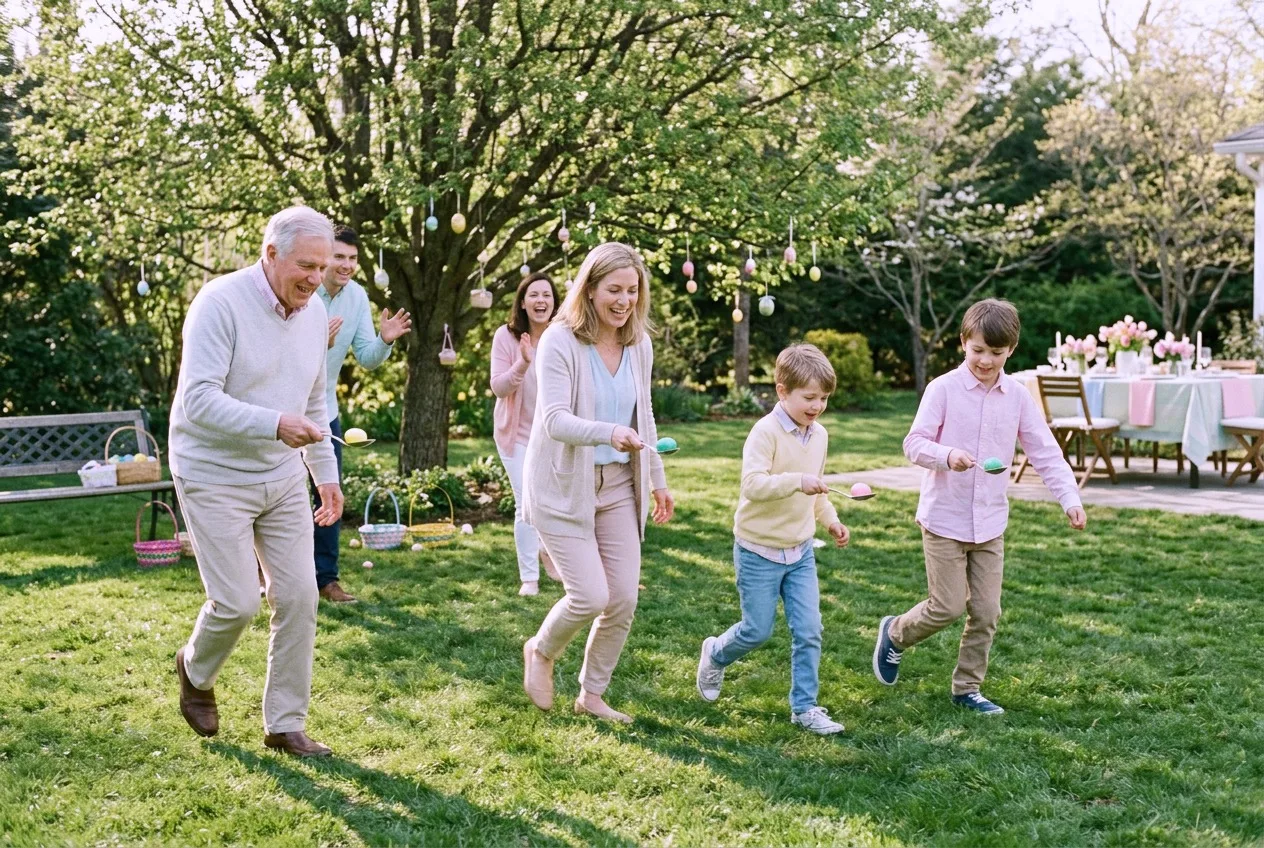
The hunt is over, the ham still needs another forty minutes, and a dozen people of wildly different ages are standing around a backyard with nothing to do. That gap is where the day either stalls or turns into the part everyone actually remembers.
None of what follows needs a games cupboard or a weekend of prep. A few plastic eggs, a couple of baskets, some chalk and a spoon or two cover most of it, and the rest comes from things already in the kitchen drawer.
Start loud and outside while the grass is still dry and the cousins still have legs for it, then work the group indoors toward something calmer as the table gets set. That is the order below, race by race, hunt by hunt, right through to the last quiet game before grace.
This post contains affiliate links. If you buy through them, I may earn a small commission at no extra cost to you.
Table of Contents
Big Lawn Races to Start the Day
These want space more than they want supplies, so claim the widest flat stretch of grass before the yard fills up with chairs and coolers. Chalk lines and a couple of flags do the job of a finish line, and nobody needs a rulebook to join in.
If the group is small or the morning is already running late, the quickest of these take less than five minutes to set up, which is the whole idea behind 20 Easy Easter Games That Need Zero Prep (Beyond the Egg Hunt).
Roll Eggs Down the Lawn in an Egg Rolling Race
Pick the gentlest slope in the yard, chalk a starting line at the top and a finish line a few feet below, and hand everyone a hard boiled or plastic egg.
On the word go, each player gives their egg one push and lets gravity do the rest, using a long spoon to nudge it back on course if it veers.
First egg to cross the chalk line wins the round, though with a mixed group it helps to run heats by age so a four year old isn’t racing a twelve year old down the same patch of grass.
Dye the eggs in pale colors the night before if you want the lawn to look the part, or skip dye entirely and use plastic eggs, which also survive a second and third round without cracking.
Slow the whole thing down for little ones by widening the course and allowing two pushes instead of one.
🛍 Shopping guide
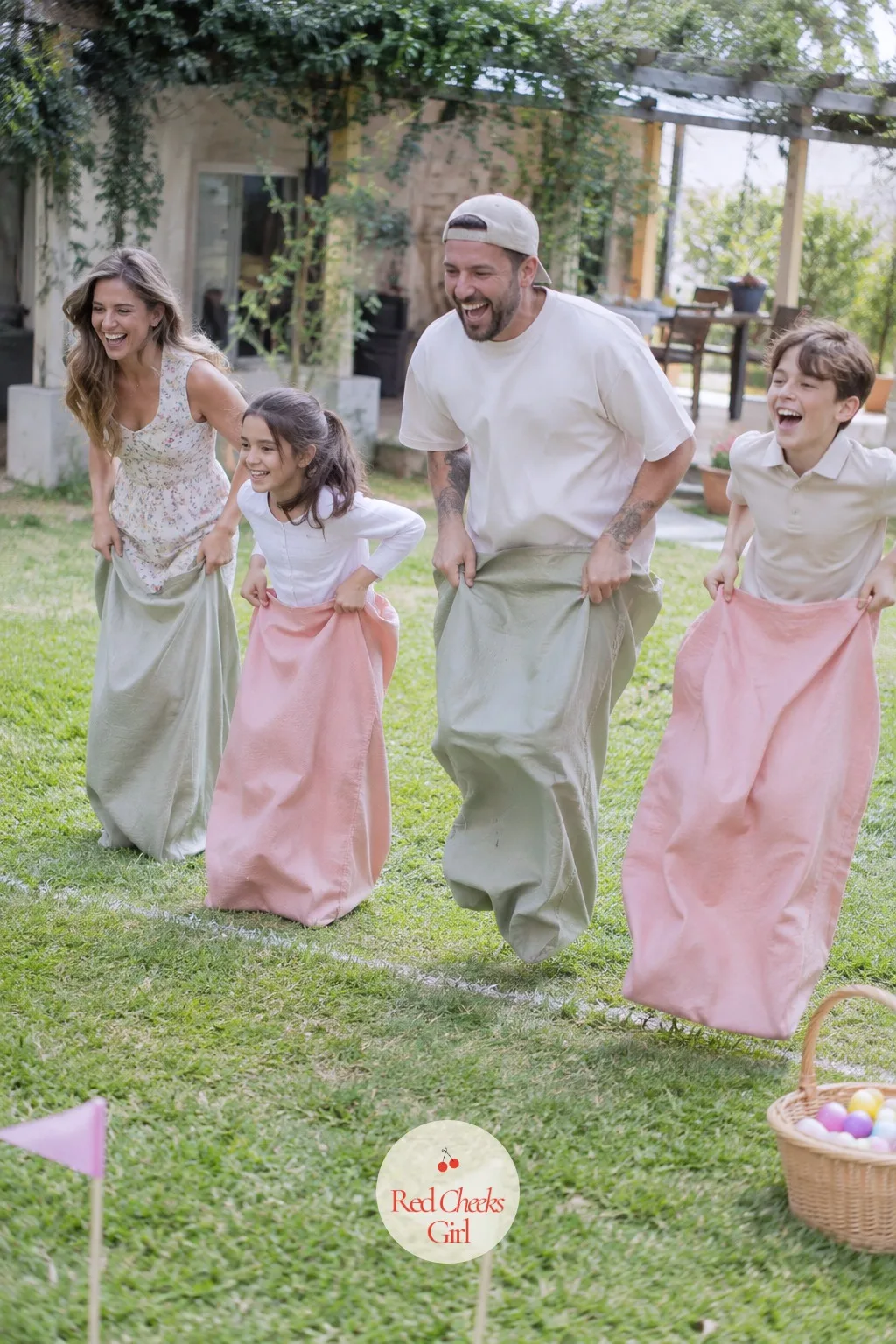
Hop to the Finish Line in a Bunny Sack Race
Line up a row of fabric sacks along a chalk start line, enough for one per racer, and set a finish line about fifteen steps ahead. Each player climbs into a sack, grips the top edge, and hops forward on both feet until someone crosses the line first.
Run it in heats of three or four so the course never gets crowded, and let the littlest hoppers go first while the grass is still even. Clip on a pair of felt bunny ears for every racer and the whole heat photographs like its own small parade.
If a full sack feels like too much for toddlers, let them hop with both ankles tied loosely with a ribbon instead, which gives the same wobble with a lot less falling.
🛍 Shopping guide
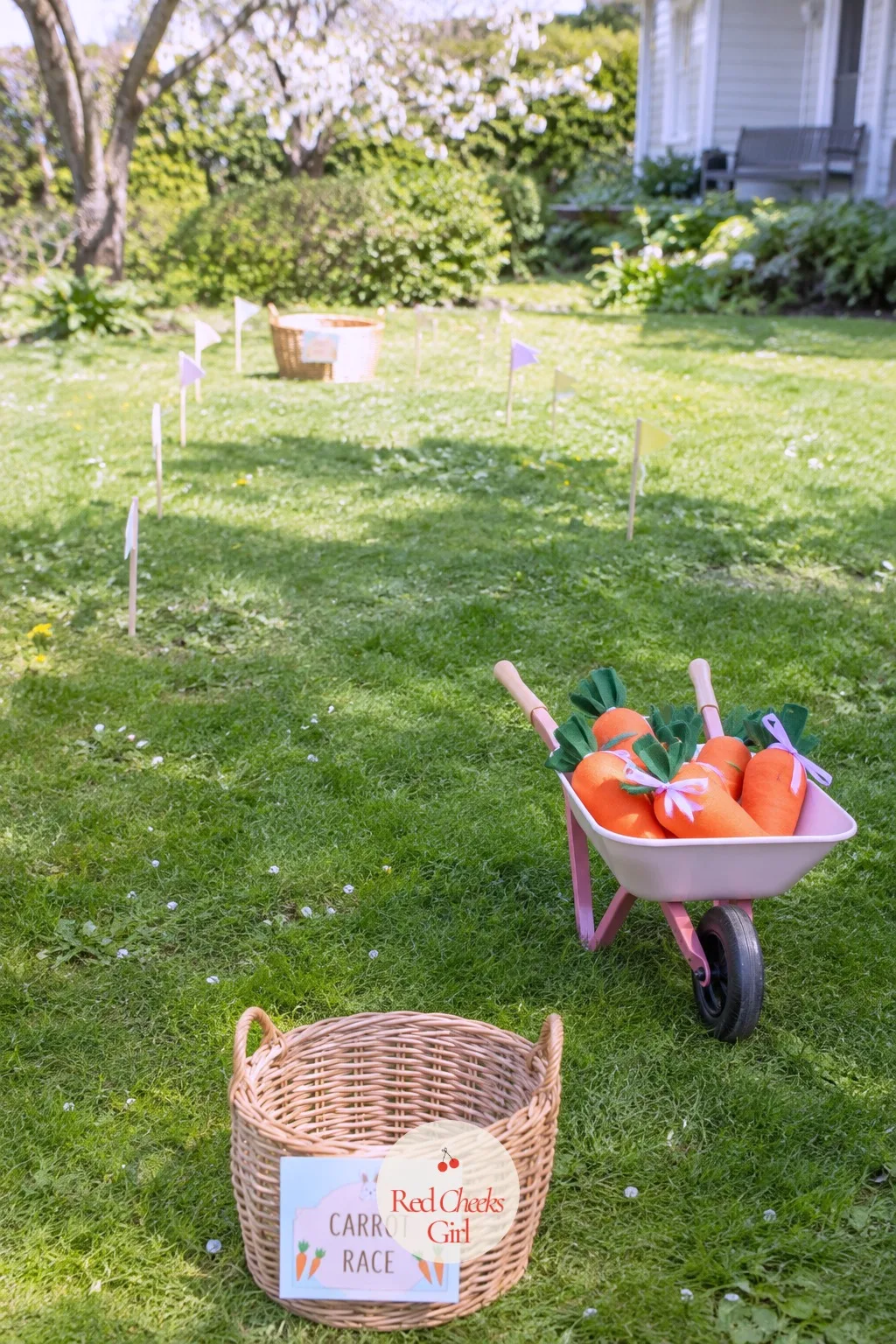
Push a Wheelbarrow of Carrots Across the Yard
Load a small toy wheelbarrow with a bundle of fabric or foam carrots, set it at one end of the yard, and mark a basket at the other end as the drop point. One player pushes the wheelbarrow in a straight line while a teammate steadies the carrot pile, and the pair empties the load into the basket to finish.
Run two wheelbarrows side by side for a proper race, or time a single wheelbarrow against the clock if the group is small. The carrots tend to bounce out on turns, so keep the course straight rather than looping it.
Swap the toy wheelbarrow for a wagon or even a laundry basket dragged by a rope if nobody owns one; the carrying matters more than the vehicle.
🛍 Shopping guide
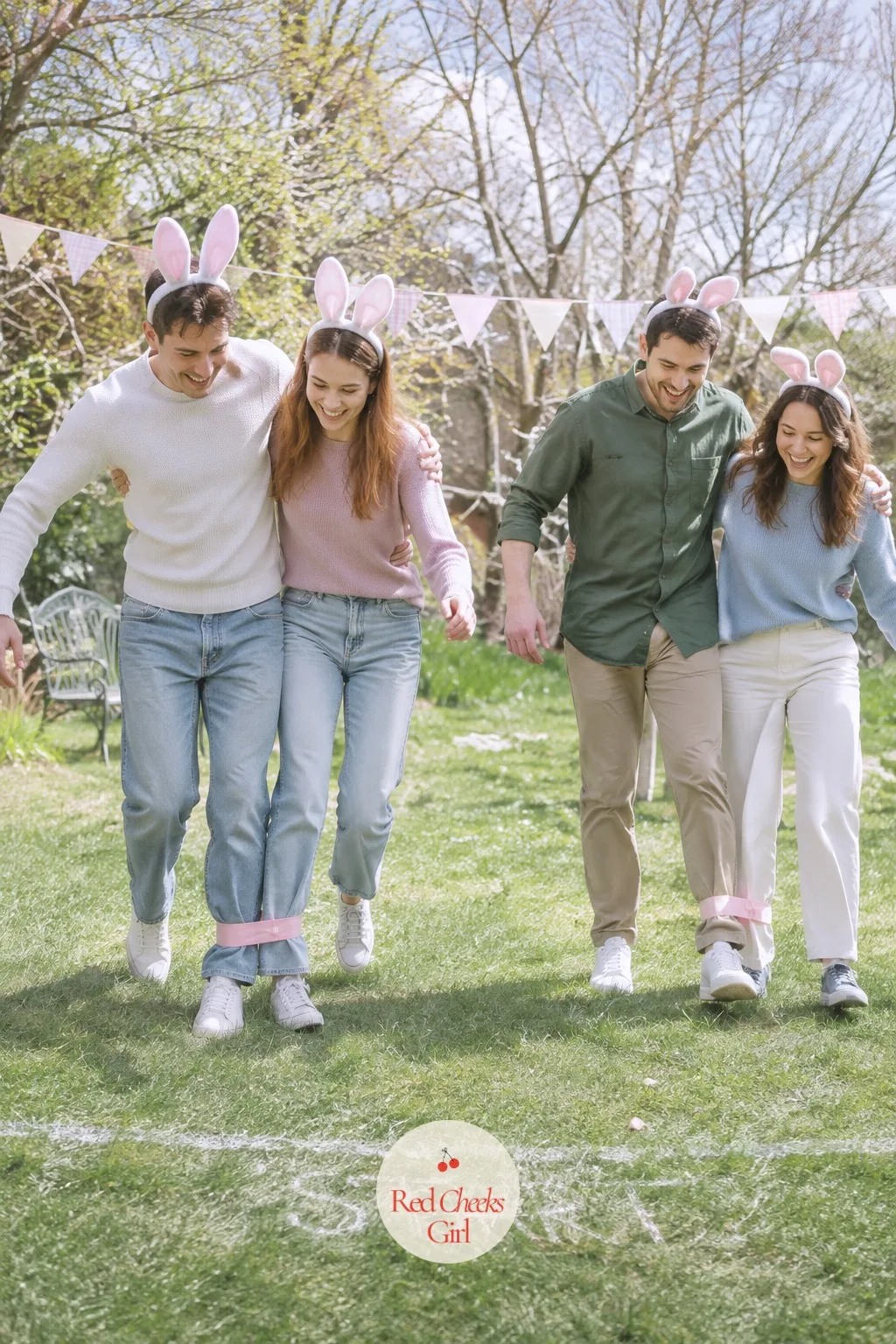
Tie Two Ankles Together for a Three Legged Bunny Dash
Pair up an older cousin with a younger one, loop a soft fabric strap around their inside ankles, and set them at the chalk start line facing the same finish used for the sack race. The pair has to find a shared rhythm, inside legs moving together, to cover the distance without toppling.
First pair across wins, but the real sport here is watching mismatched pairs (tall teenager, small sibling) figure out a working stride. Pad the strap with an old scarf so it doesn’t pinch, and keep the course short, about ten steps, since falling is part of the fun only up to a point.
For pairs who find it too wobbly, loosen the tie so the ankles are linked but not pressed tight together.
🛍 Shopping guide
Backyard Treasure Hunts
A hunt gives the youngest cousins a job that feels important and gives the teenagers something to roll their eyes at and then quietly enjoy anyway. Keep each one short enough that attention doesn’t wander off toward the trampoline halfway through.
For more ways to stretch the morning hunt itself before these start, 20 Easter Egg Hunt Ideas for Kids That Keep the Whole Yard Busy covers the main event these games pick up after.
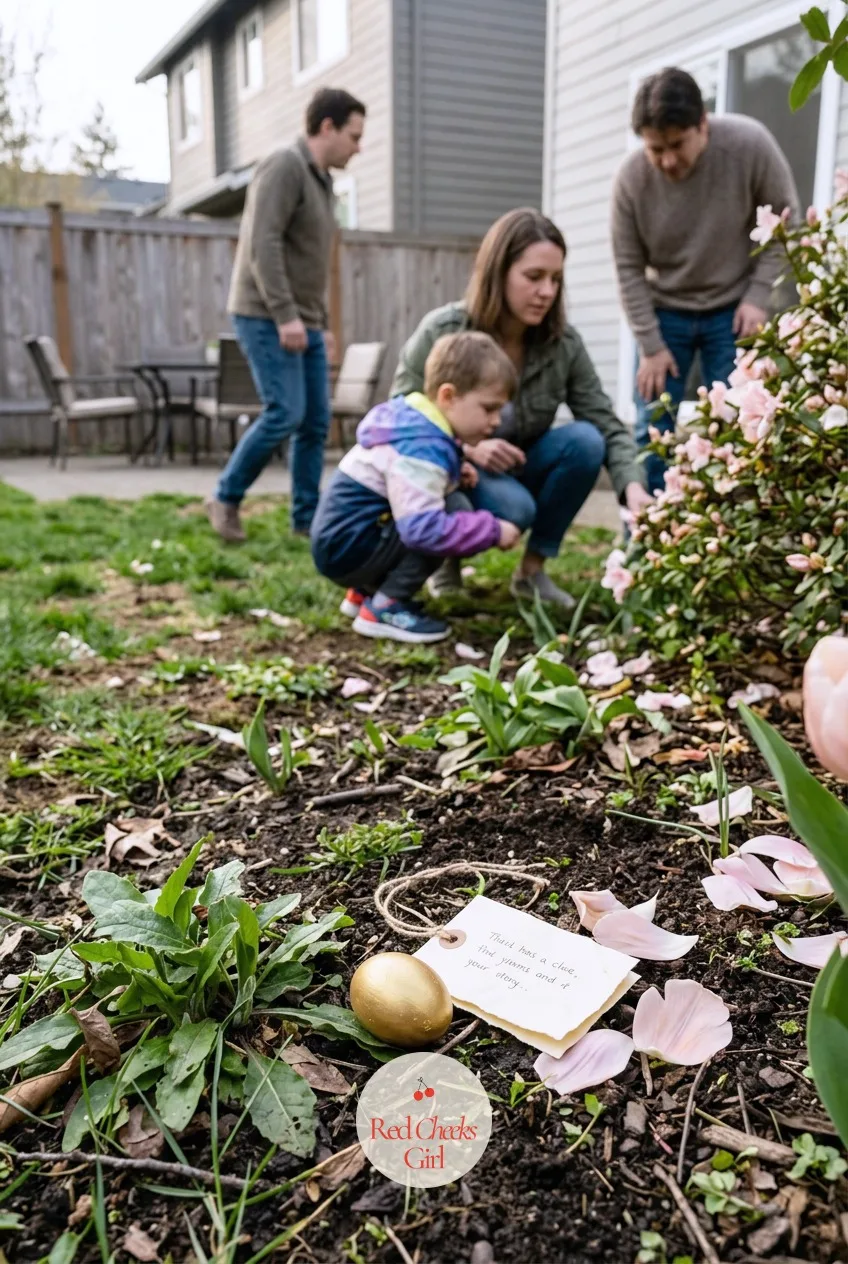
Follow Clue Cards to a Hidden Golden Egg
Write four or five short rhyming clues on small cards, each pointing toward the next hiding spot, with the last one leading to a single gold painted egg tucked somewhere in the flower bed or under a porch chair.
Hand the first clue to the whole group and let them work it out together, reading each card aloud before moving on.
Whoever actually spots the golden egg gets to open it, and it is worth filling that one egg with something worth the walk, a larger chocolate bar or a small token, rather than the usual jellybeans. Keep the clue wording simple enough for the youngest reader in the group, or read each card aloud so nobody is left behind.
Shorten it to three clues for a group that is hungry and ready for dinner, or stretch it to seven for one that wants the search to run long.
🛍 Shopping guide
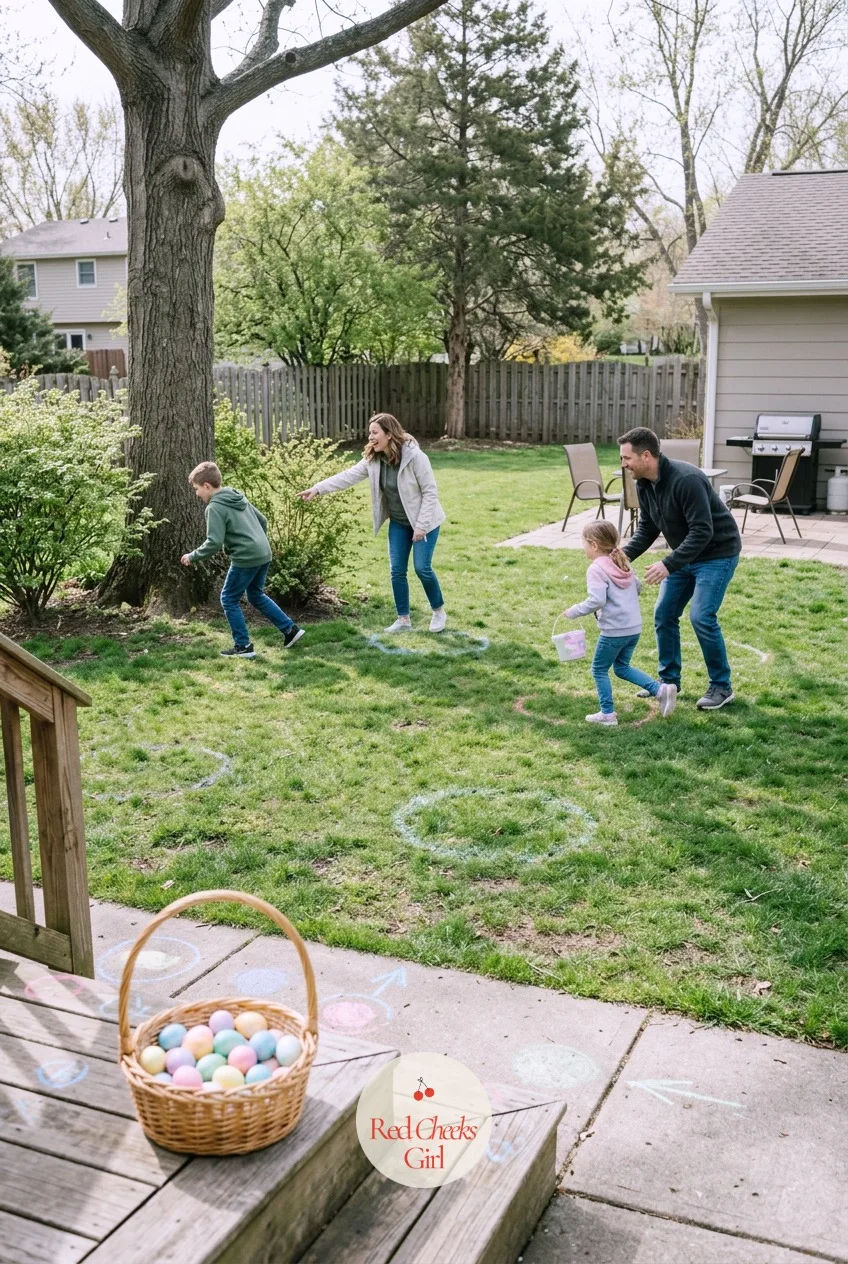
Let the Grown Ups Hide for a Reverse Egg Hunt
Flip the usual order: hand the basket of eggs to the kids and send the adults out to hide, giving each child a turn being the one in charge of a hiding spot while a parent or grandparent plays the seeker. Set a time limit of about five minutes so the adult doesn’t wander too far from the group.
There is no real winner here beyond the giggling, which is exactly why it works well for a mixed group with very young children who get frustrated losing to faster cousins. Let the kids watch and coach from the porch if they want, calling out warmer or colder as the grown up searches.
Make it harder by blindfolding the seeker on the walk out so they genuinely don’t know the yard layout, or easier by letting them peek before the countdown starts.
🛍 Shopping guide
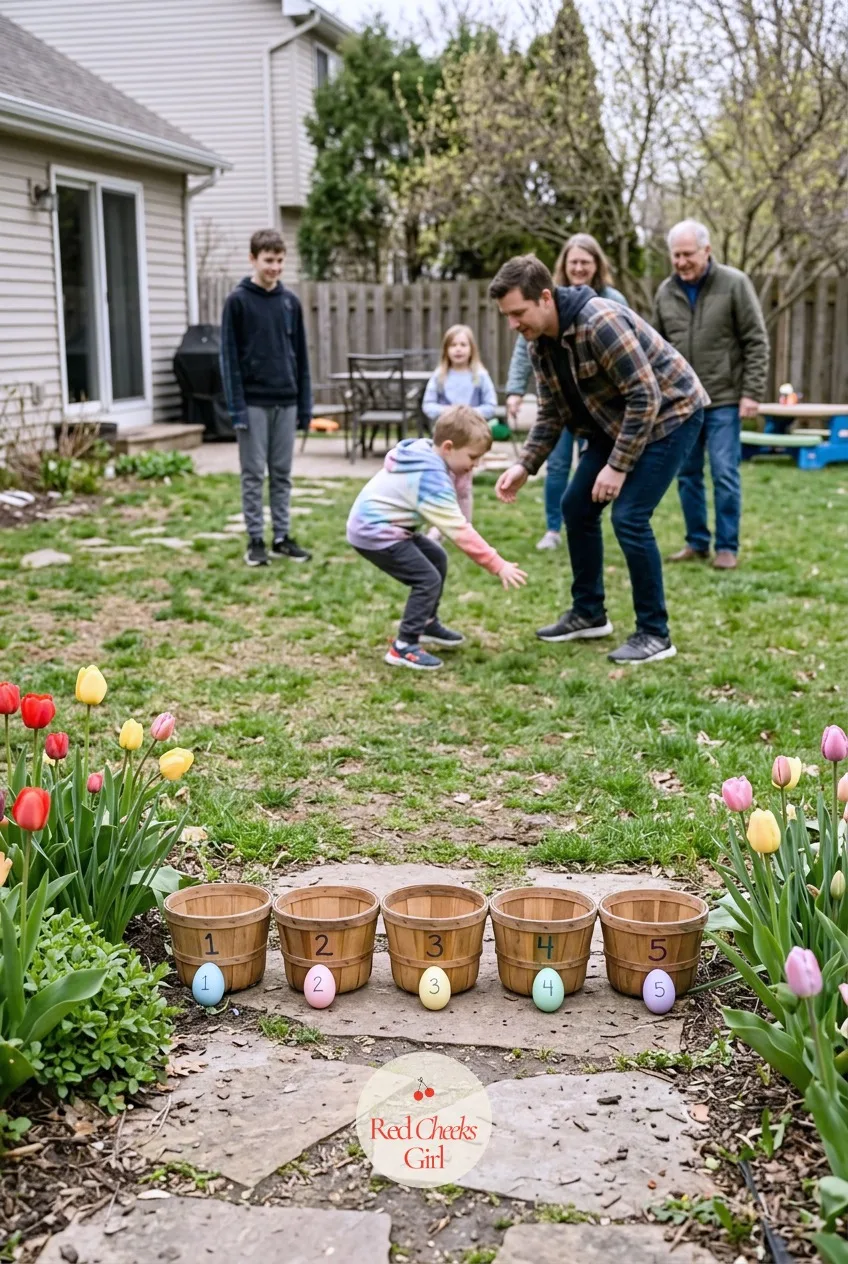
Match Numbered Eggs to Baskets in a Scavenger Hunt
Write a number on each plastic egg before the party starts, scatter them through the garden beds and under shrubs, then set out a row of small baskets labelled with the same numbers. Players hunt freely and drop each egg into the basket carrying its matching number as they find it.
The round ends once every basket holds its egg, and because the task is sorting rather than racing, it keeps a group of mixed ages hunting together instead of splitting off by speed. Use letters instead of numbers for pre readers, matching them to a single picture card taped to each basket.
Double the challenge for older kids by hiding two eggs per number and making them find the matching pair.
🛍 Shopping guide
Spot the Painted Decoy Eggs Hiding in Plain Sight
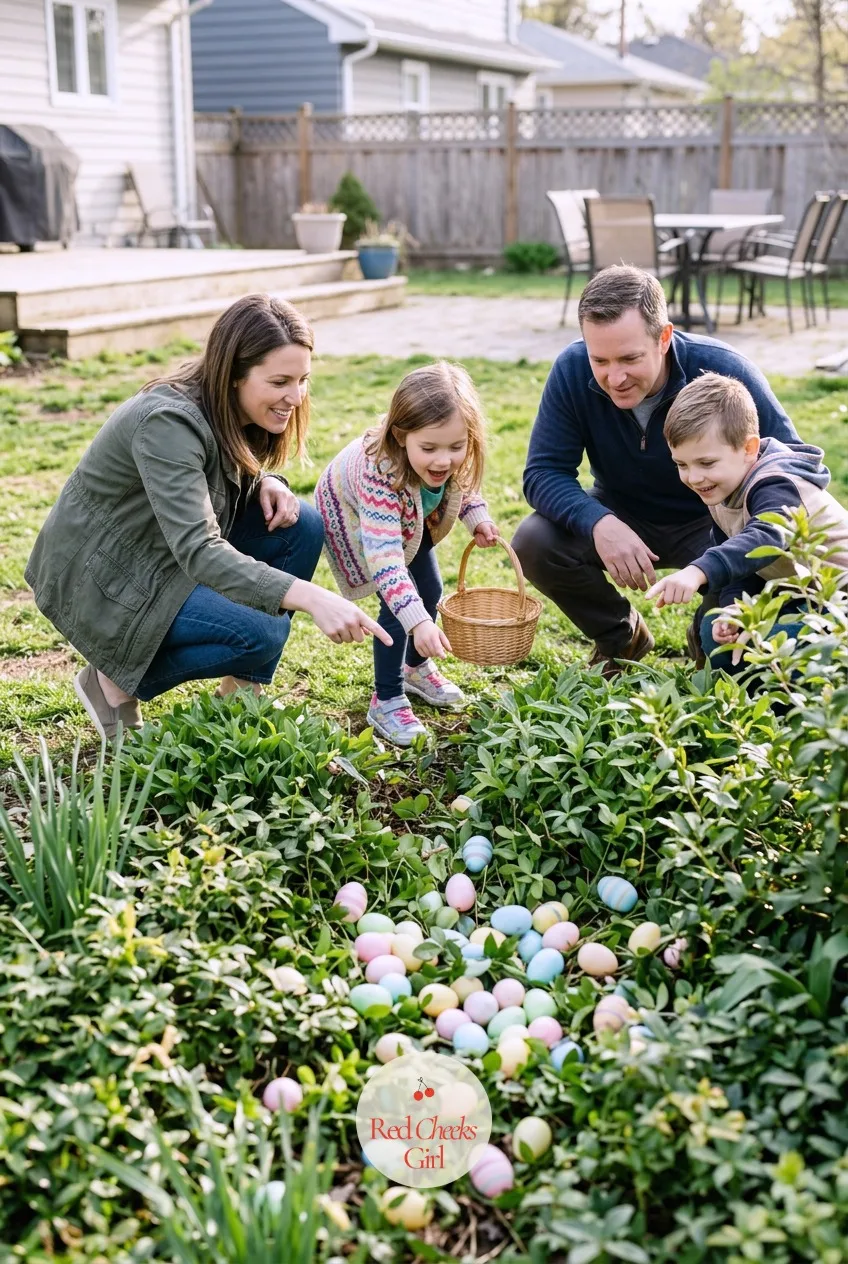
Hide the real plastic eggs through the garden as usual, but scatter in a handful of plain wooden or stone eggs painted to look almost identical from a distance. Players collect everything they find, then empty their baskets at the end to sort real from decoy.
Whoever collects the most real eggs, once the decoys are set aside, wins the round, which rewards a careful eye over pure speed. Paint the decoys in the same pastel palette as the real eggs so the trick only gives itself away up close.
Cut the decoy count down to two or three for younger hunters who find the trick frustrating, or add more for teenagers who want a genuine puzzle.
🛍 Shopping guide
Toss Games Across the Grass
Nobody needs to run for these, which makes them the ones grandparents actually agree to join. A thrown line, a target, a few tries each, and the scoring takes care of itself.
Toss Eggs Into a Basket From Three Paces Back
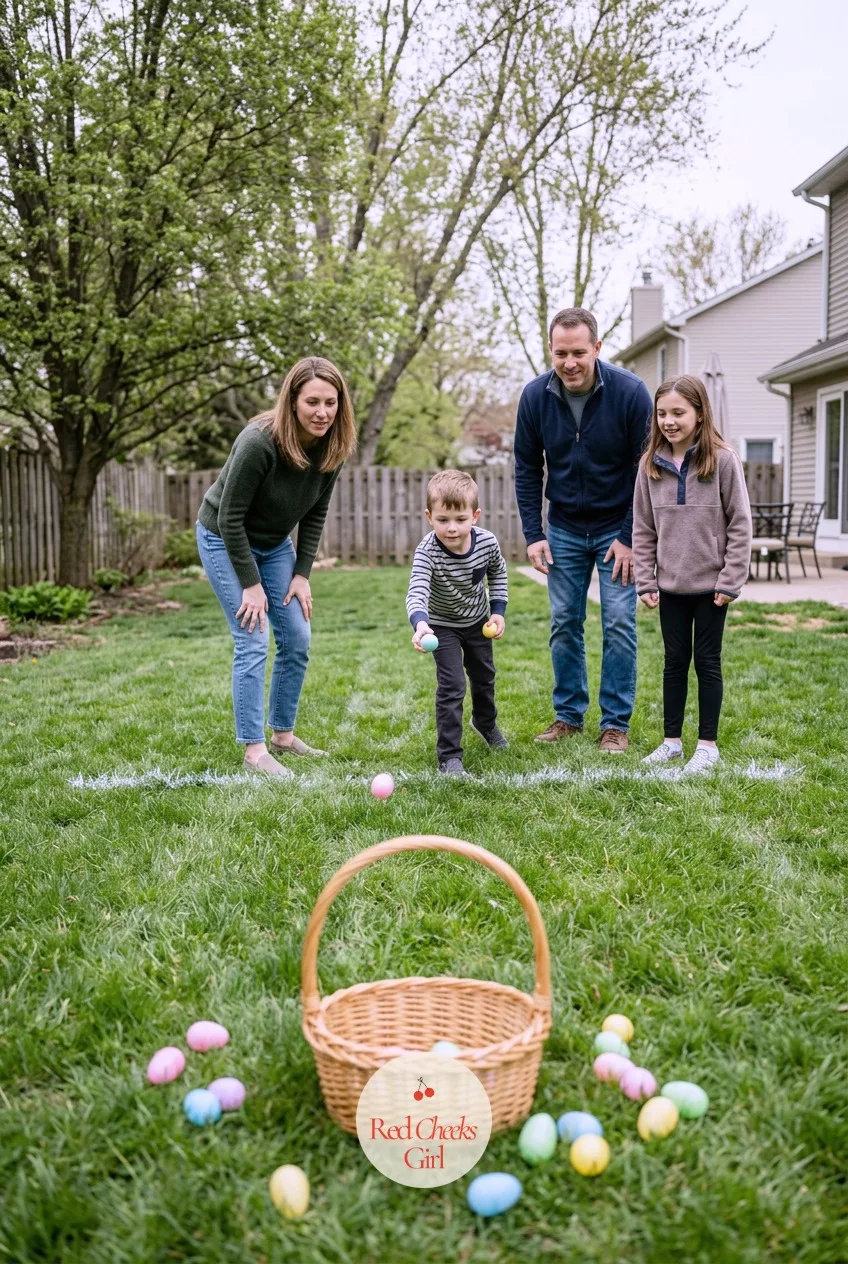
Set a single wicker basket on the lawn and chalk a throwing line a few paces back, adjusting the distance for age so a six year old throws from closer in than a teenager. Each player gets three plastic eggs and a point for every one that lands and stays inside the basket.
Highest score after everyone has had a turn takes the round, and it moves fast enough to run two or three times before anyone gets bored. Nest the basket slightly into the grass so stray eggs don’t roll straight back out and skew the count.
Move the line back a full stride for a harder round once the group has warmed up.
🛍 Shopping guide
Lob Bunny Bean Bags Through a Painted Ear Hole
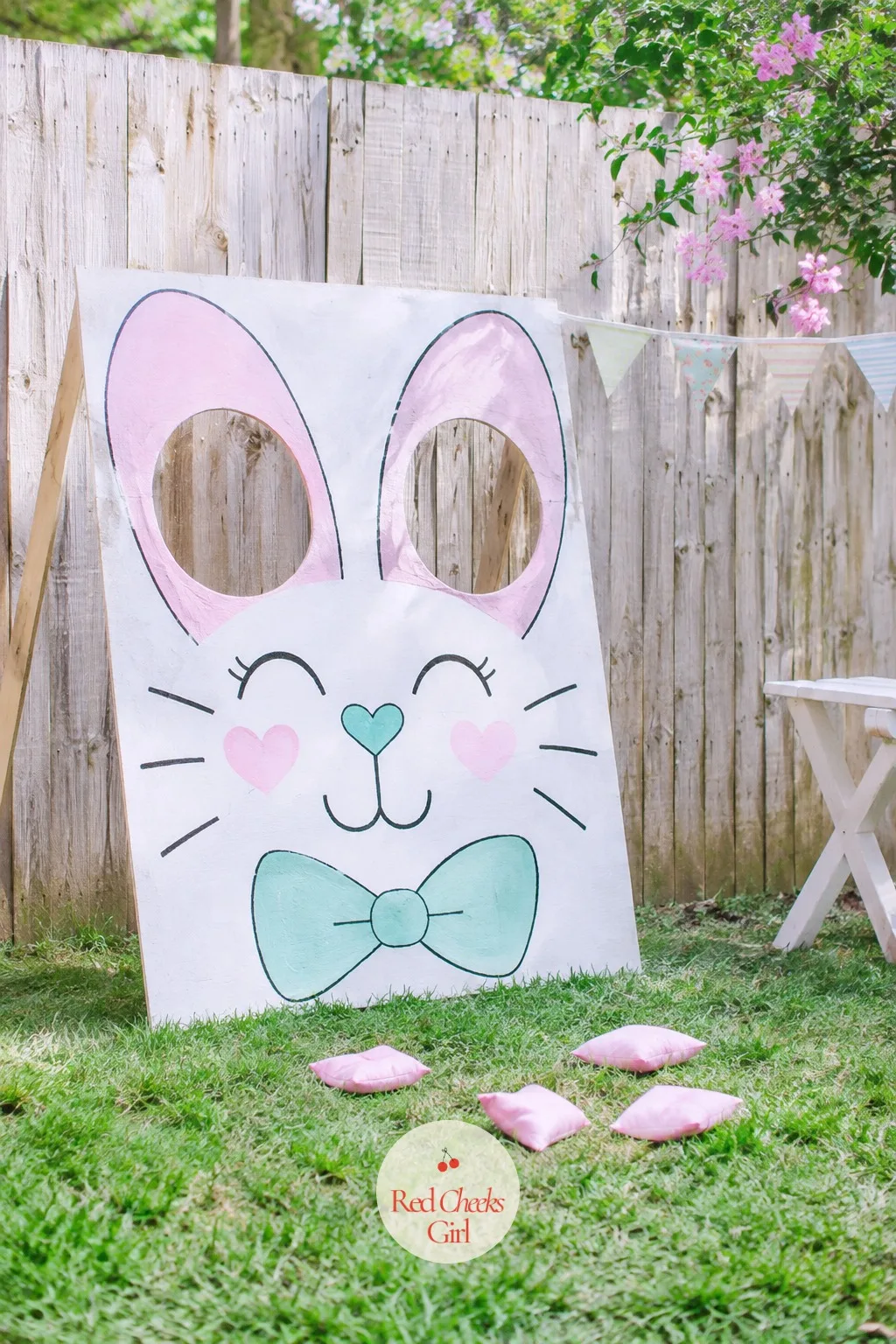
Paint a plywood board with a large bunny face and cut out two ear shaped holes near the top, then lean it against a fence or prop it on two sawhorses. Each player gets three bean bags and scores points for landing one through either ear hole, with a smaller bonus hole cut into the nose for a trickier shot.
Tally scores after everyone has thrown, and the leaning board works just as well set up indoors against a wall on a rainy afternoon. Keep the bean bags soft and light so a stray throw near the youngest players doesn’t sting.
Drop the throwing distance in half for anyone under six, and nobody will mind the easier shot.
🛍 Shopping guide
Ring Carrots Onto Stakes Planted in the Grass
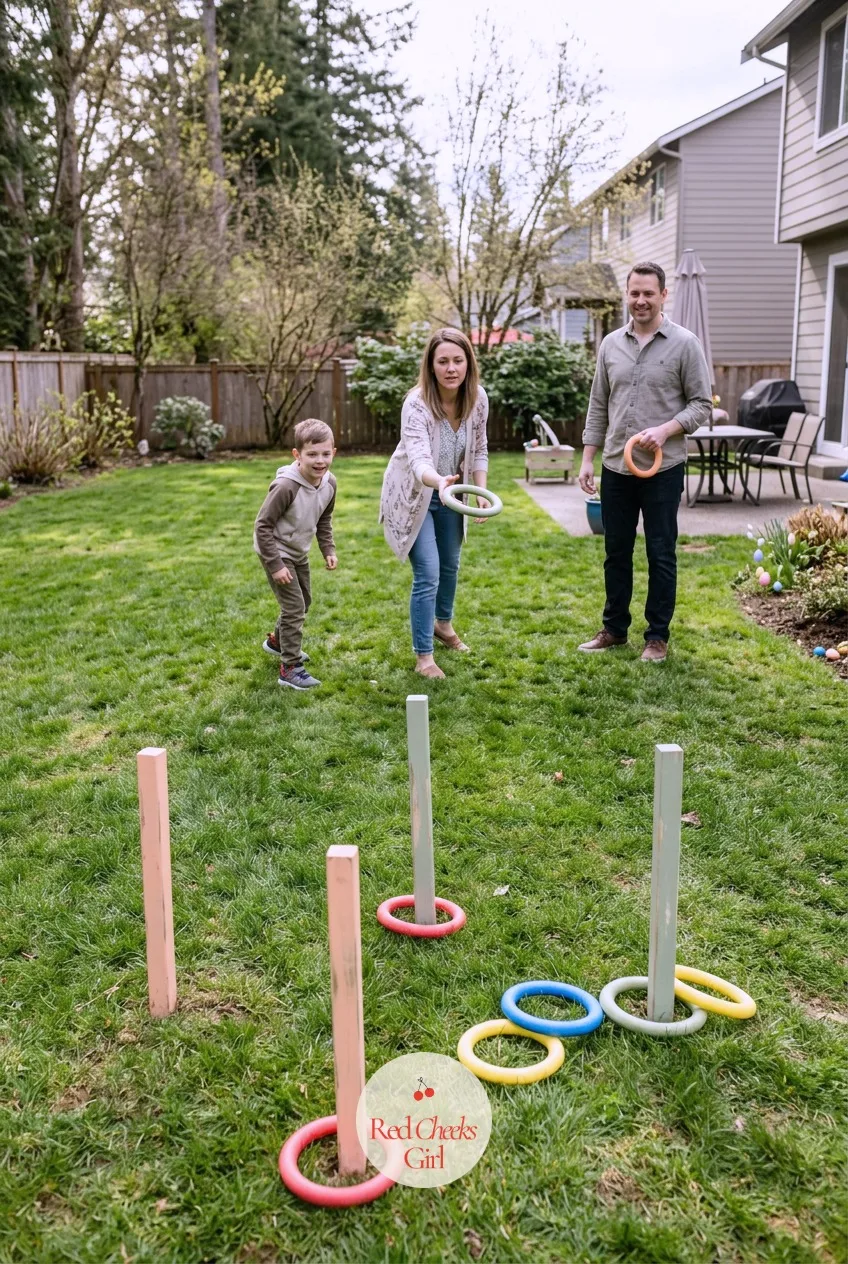
Push three or four wooden stakes painted pale orange into the lawn at varying distances, the farthest worth the most points, and hand each player a set of foam rings to toss. A ring that settles around a stake scores; one that misses or slides off doesn’t.
Play five rings per turn and total the score once everyone has gone, with the highest total claiming the round. Paint the stake tops in different pastel shades so scores are easy to call out from across the yard.
Shrink the distances for younger throwers, or add a single far stake worth double for older kids chasing a bigger number.
🛍 Shopping guide
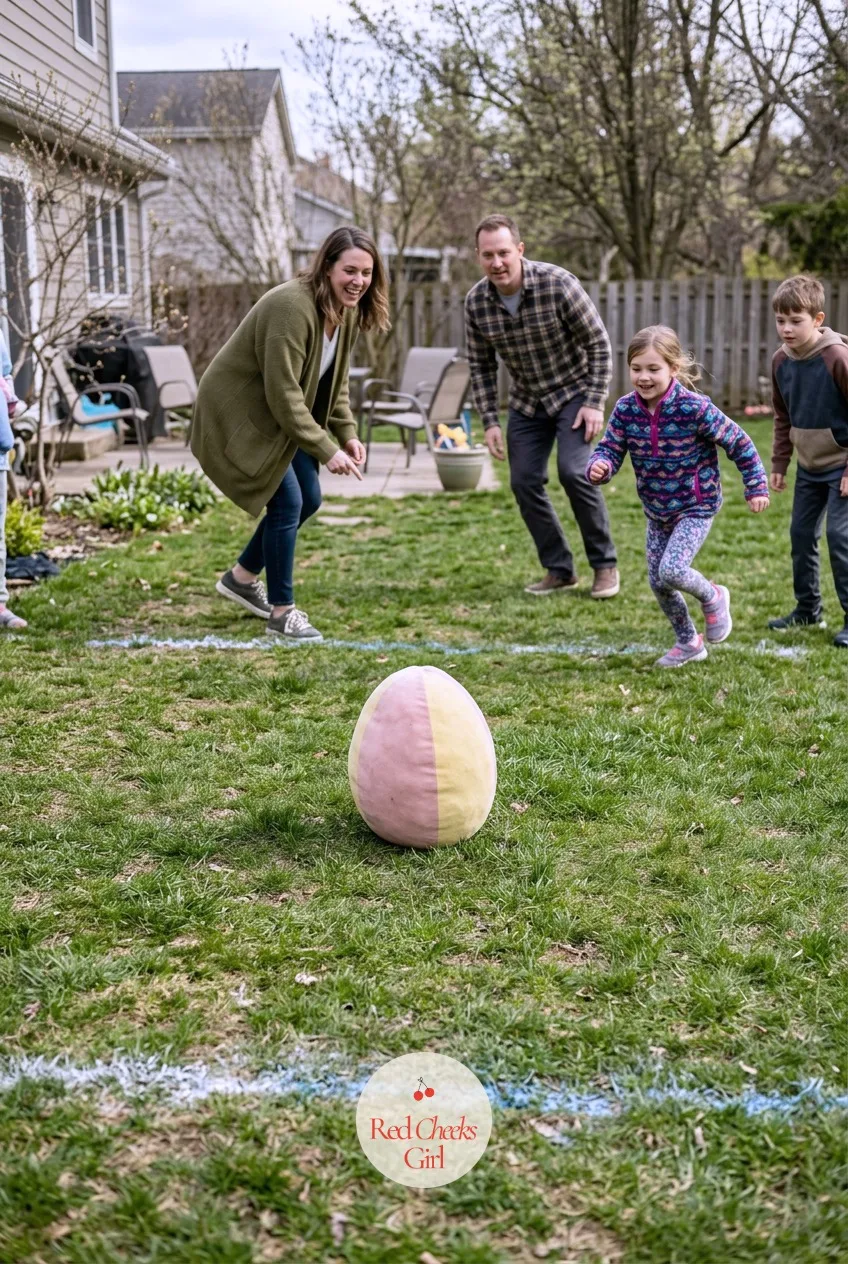
Toss a Giant Plush Egg Back Without Dropping It
Pair up players facing each other a few steps apart, hand one side a single oversized plush egg, and have the pair toss it back and forth, each successful catch earning a step backward before the next throw. One drop ends that pair’s round, and the last pair still catching at the widest distance wins.
It needs almost nothing beyond the one soft egg, which makes it the easiest of the toss games to run with a small or very mixed age group. Pair a confident thrower with a younger catcher rather than matching two beginners, which keeps the early rounds from ending too fast.
Use a real water balloon instead on a warmer afternoon if the group wants a splashier finish.
🛍 Shopping guide
Relay Races for the Whole Family
Split into teams and the whole afternoon gets a scoreboard. These work best with at least two even sides, so count heads before anyone picks teams and borrow a toddler for the smaller one if the numbers come up odd.
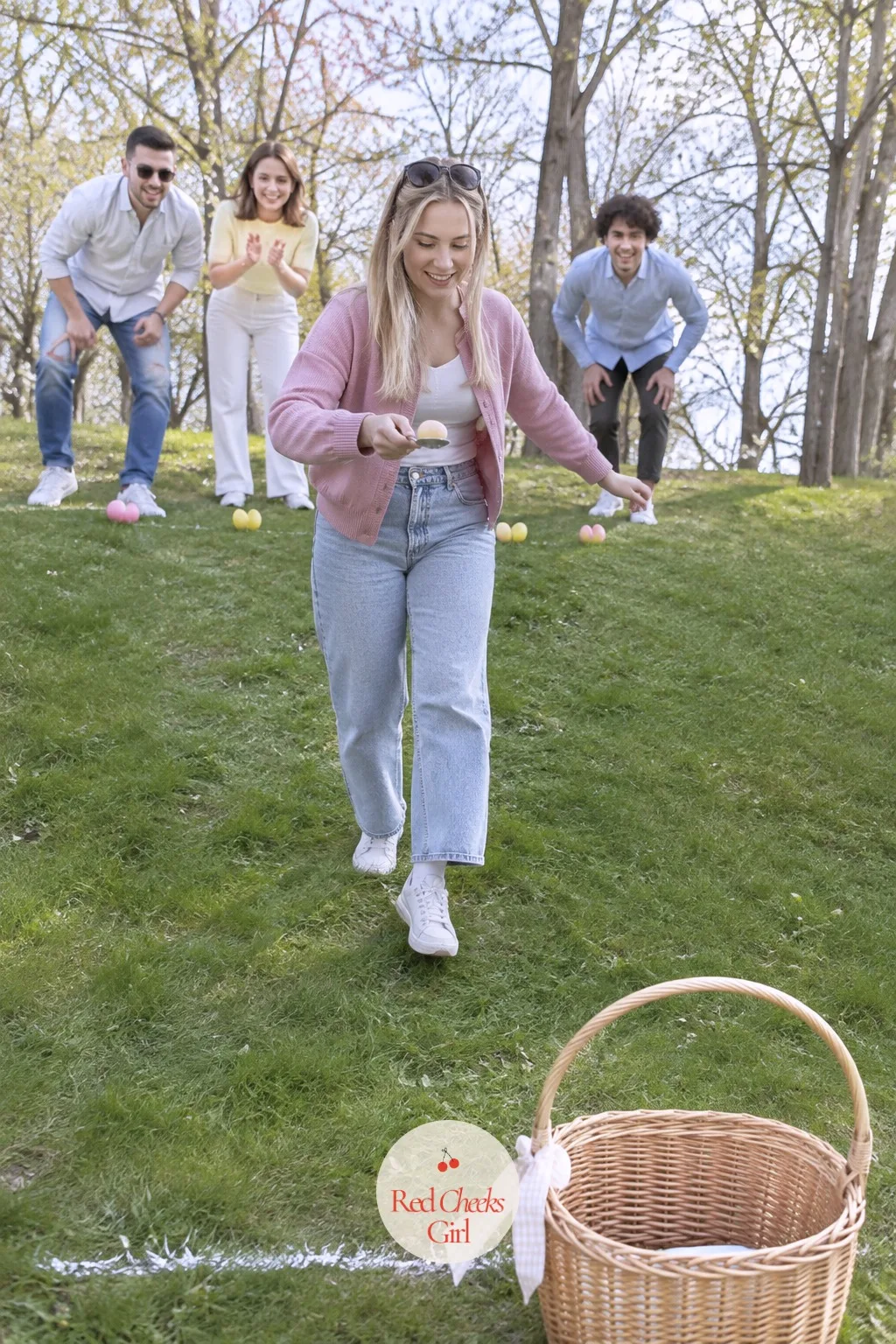
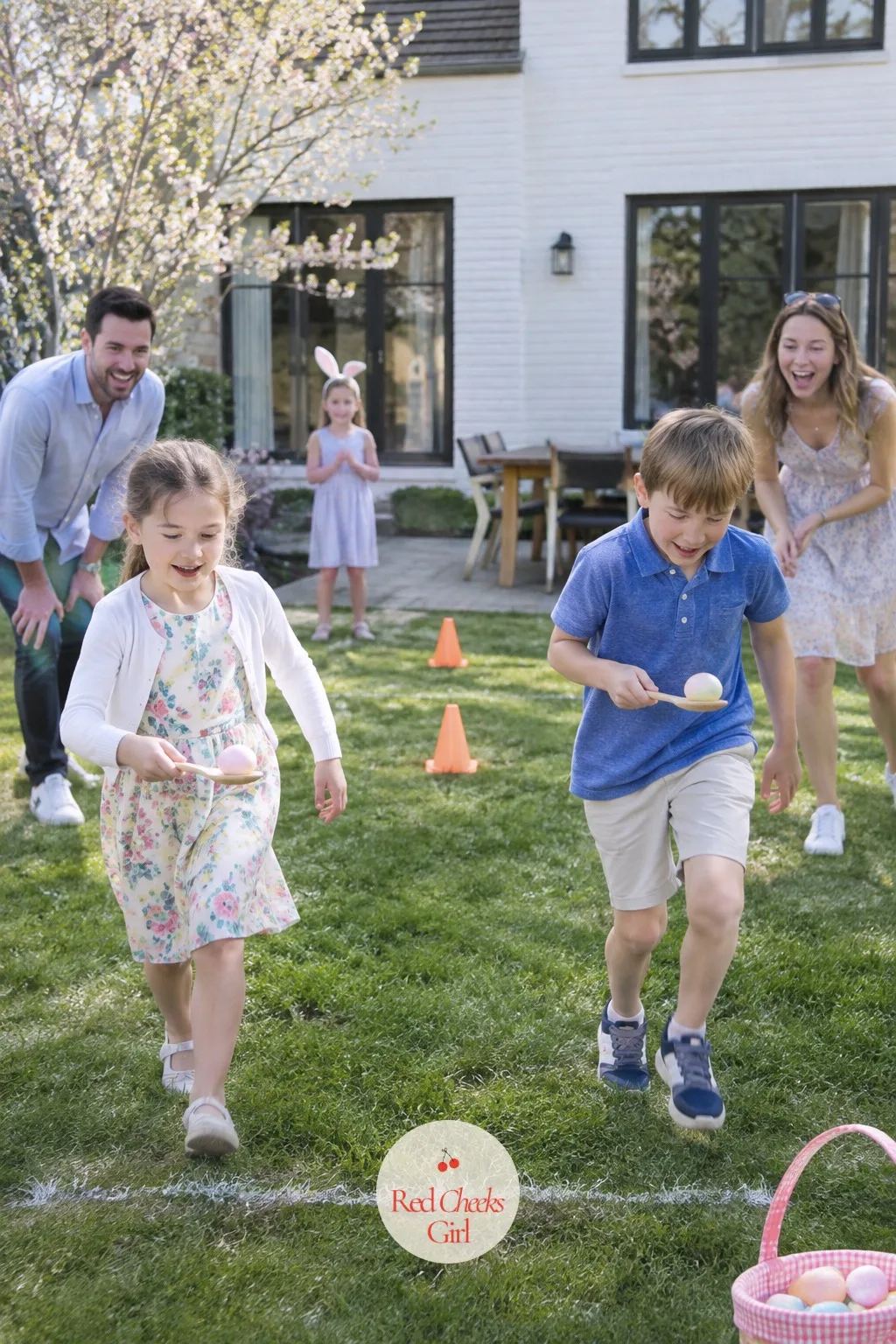
Carry an Egg on a Spoon in a Relay Race
Split into two teams, line each up behind a wooden spoon and an egg at the start, and mark a cone to circle around partway down the course. One player at a time balances the egg on the spoon, walks or jogs around the cone, and hands the spoon off to the next teammate without touching the egg.
A dropped egg means that player returns to the start and tries again, and the first team to get every runner through wins the relay. Switch hard boiled eggs for plastic ones once the grass gets wet, since plastic bounces rather than cracks.
Slow the whole thing down by allowing a steadying finger on the egg for younger racers, which keeps the relay moving without the constant restarts.
🛍 Shopping guide
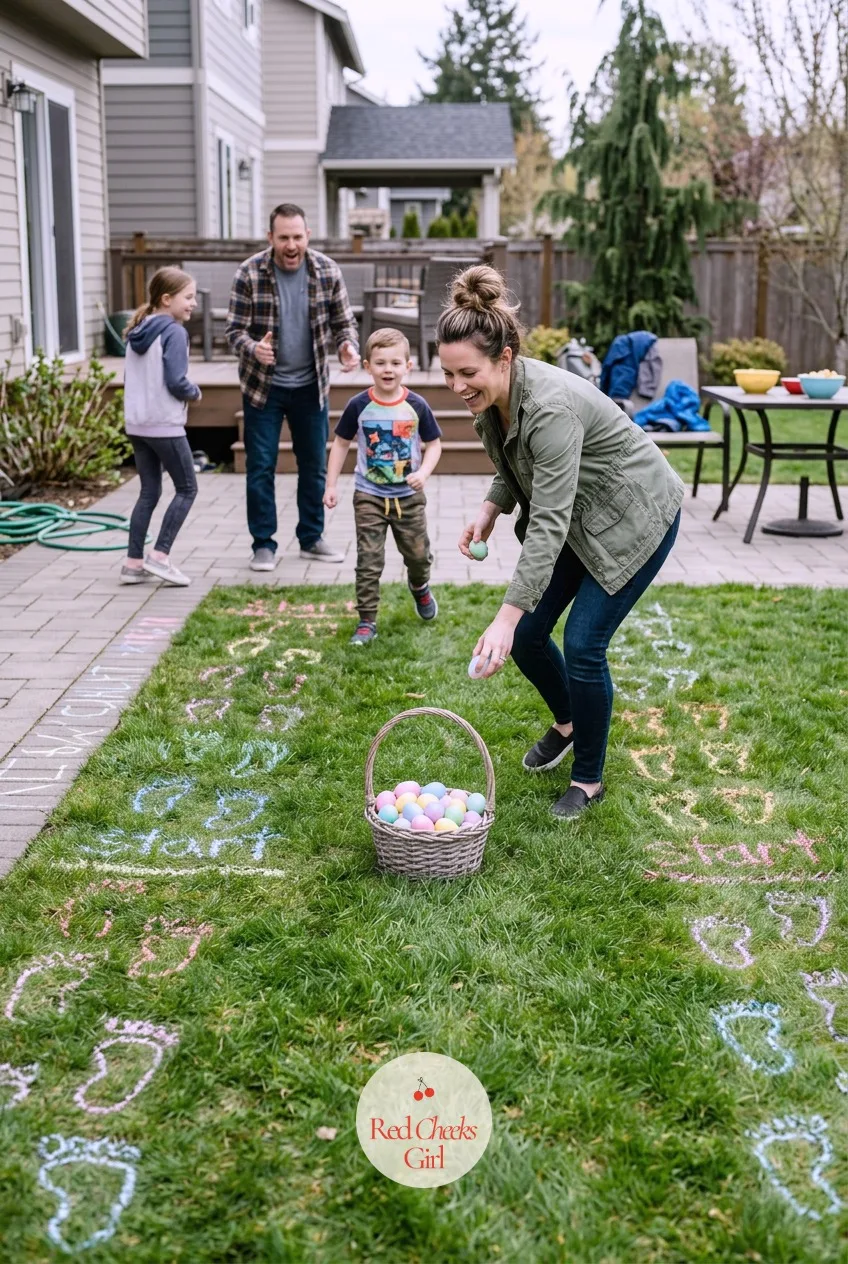
Pass an Egg Basket Overhead Down the Line
Split into two teams standing in a single file line, hand the first player in each line a small basket filled with plastic eggs, and have it pass overhead from player to player down the row without anyone turning around to look. The last player runs the basket back to the front once it reaches the end.
Spilled eggs get scooped back in without penalty, since the point is the passing itself rather than a perfect carry, and the team that gets the basket back to the front first wins. Fill the baskets lightly for the first round so nobody struggles with a heavy lift overhead.
Pass it between the knees instead of overhead for a trickier second round once everyone has the hang of it.
🛍 Shopping guide
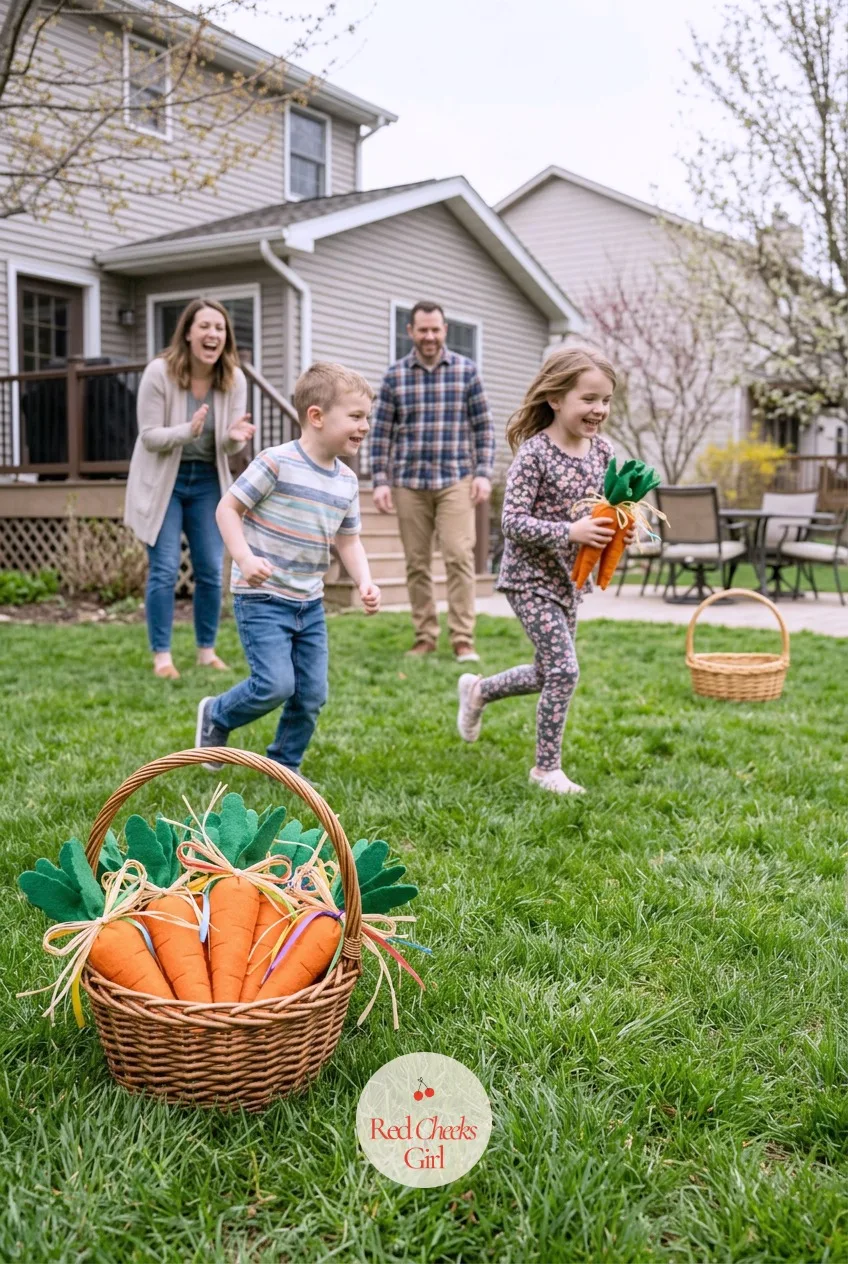
Run a Carrot Bunch Between Two Baskets
Set one basket of fabric carrot bunches at the start and an empty basket at the far end of the course. One runner at a time grabs a single carrot bunch, sprints it down to the empty basket, drops it in, and sprints back to tag the next teammate.
The round ends once a team has moved every carrot across, and because each trip is short, it suits a group with a wide age range better than a longer relay does. Add a second lap, carrying the carrots back to the original basket, to stretch the game for a crowd with energy to spare.
Cut the course in half for younger runners so they can keep pace with older teammates on the same team.
🛍 Shopping guide
Yard Challenges Before Dinner
Less running, more nerve. These suit the stretch when energy starts to dip but nobody is ready to sit down yet, and they flatter patience over speed, which tends to even the field between a six year old and an uncle.
If the group skews older this year, 18 Easter Games for Adults That Are Not Just for the Kids has more in this same quieter register.
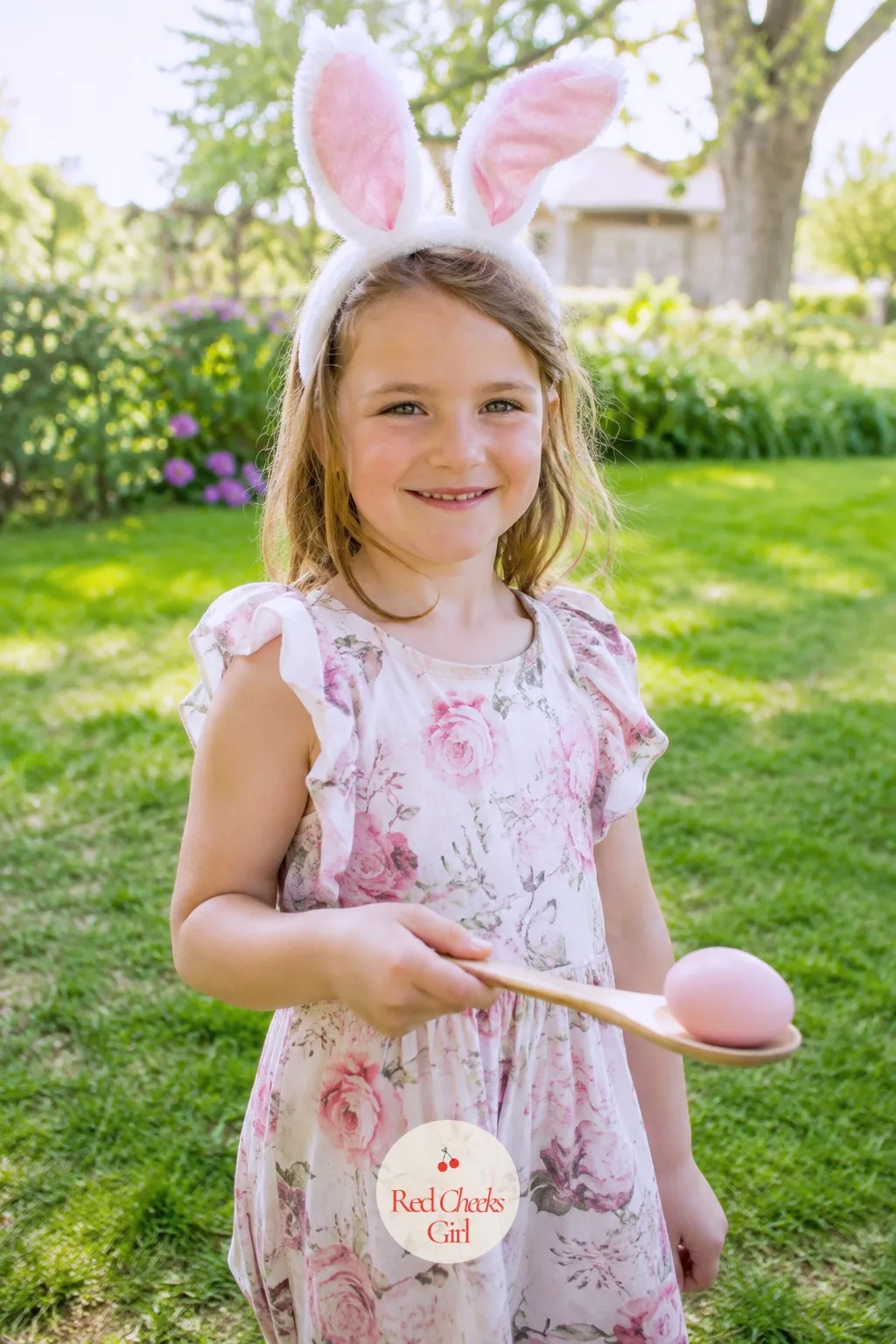
Hold an Egg on a Spoon Without Taking a Step
Hand everyone a spoon and an egg, have the group spread out standing still, and set a timer. Players hold the spoon out at arm’s length with the egg balanced on top, and anyone whose egg rolls off is out; last one still balancing wins.
Unlike the spoon relay, nobody runs here, which makes it an easy one to fold in right as people start drifting toward the table. A light breeze or an uneven patch of lawn adds the difficulty on its own, no extra rules needed.
Make it harder by having players hold the spoon in their non dominant hand, or easier by letting younger players rest their elbow against their side.
🛍 Shopping guide
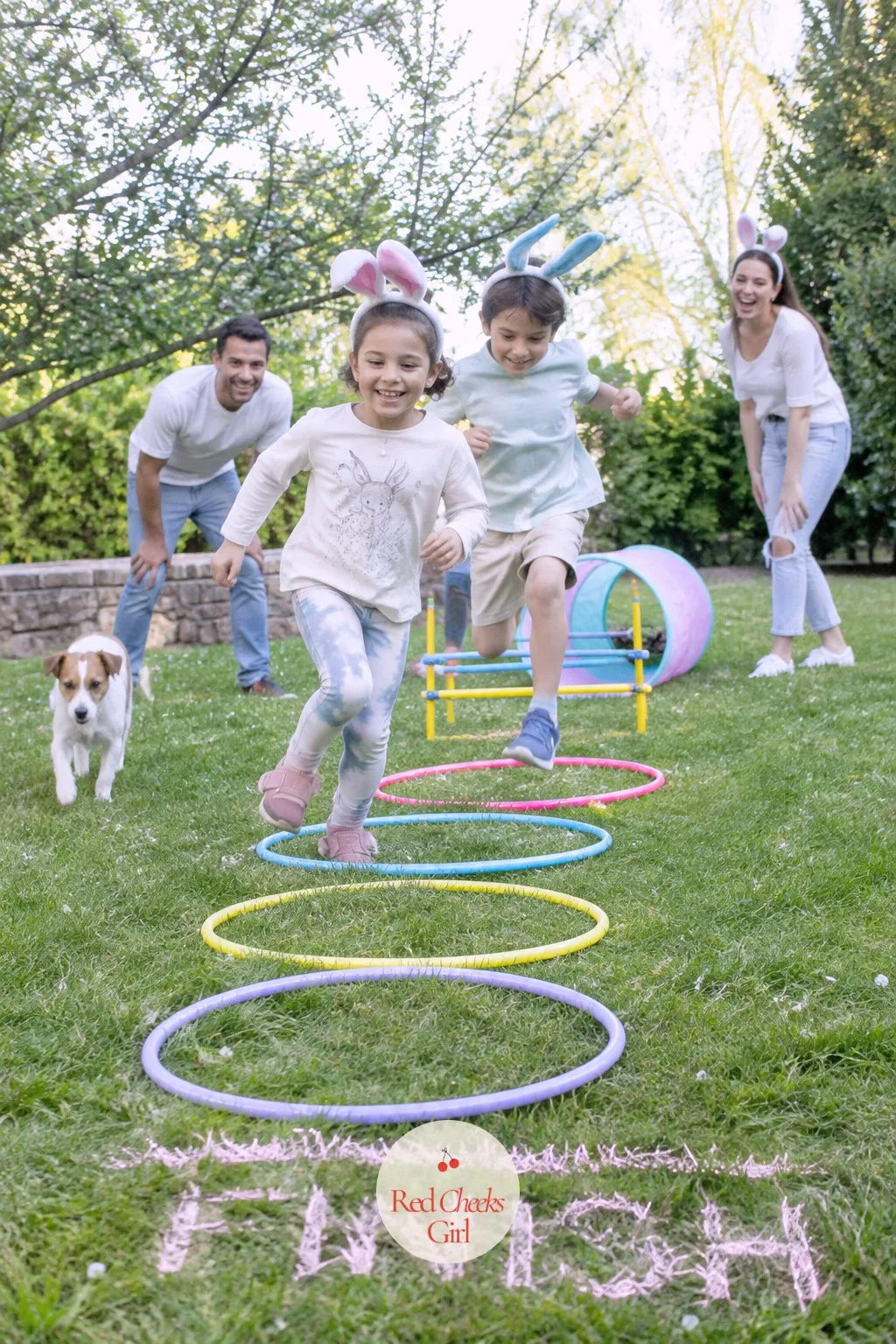
Hop an Obstacle Course Set Up Like a Bunny Trail
Lay out a short course across the yard: a few hula hoops to hop through, two low hurdles to clear, a tunnel to crawl under, and a final stretch where players hop on both feet like a bunny to the finish. Run it against the clock, one player at a time, with the fastest full completion winning.
It works as well for a four year old moving slowly through each section as it does for a cousin sprinting it, since the course rewards finishing over outright speed. Keep the hoops and hurdles low enough that nobody worries about tripping.
Add a second lap for older kids who finish quickly, or let younger ones skip the tunnel crawl if the grass is wet.
🛍 Shopping guide
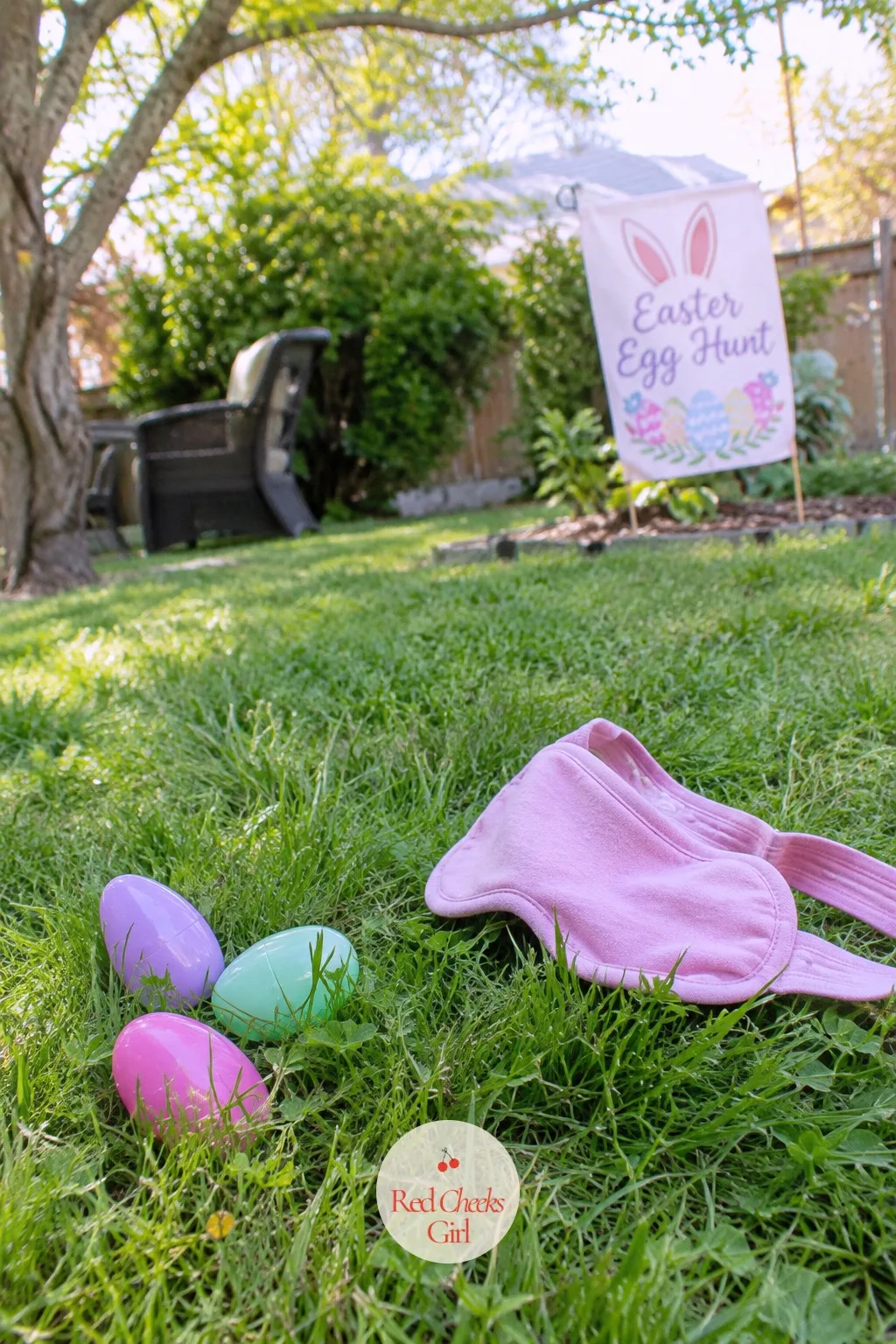
Find the Egg Blindfolded by Touch Alone
Hide a handful of plastic eggs through a small patch of grass, blindfold one player at a time, and let them feel through the grass with their hands for a set sixty seconds. Whoever collects the most eggs within their minute wins the round.
Keep the hiding patch small and clear of sticks or anything else that might surprise a searching hand, and call out warmer or colder from the sidelines if the group wants to coach along. It turns the usual hunt into something slower and funnier to watch, which suits a lull in the afternoon well.
Shrink the search area for younger players so a minute feels generous instead of impossible.
🛍 Shopping guide
Calm Table Games to Close the Afternoon
By now someone has started setting napkins down, and the games should match that mood: seated, low volume, nothing that knocks over a glass. These carry the group straight to the table, which is where 18 Easter Dinner Ideas for a Family Table From Ham to Spring Sides picks up next.
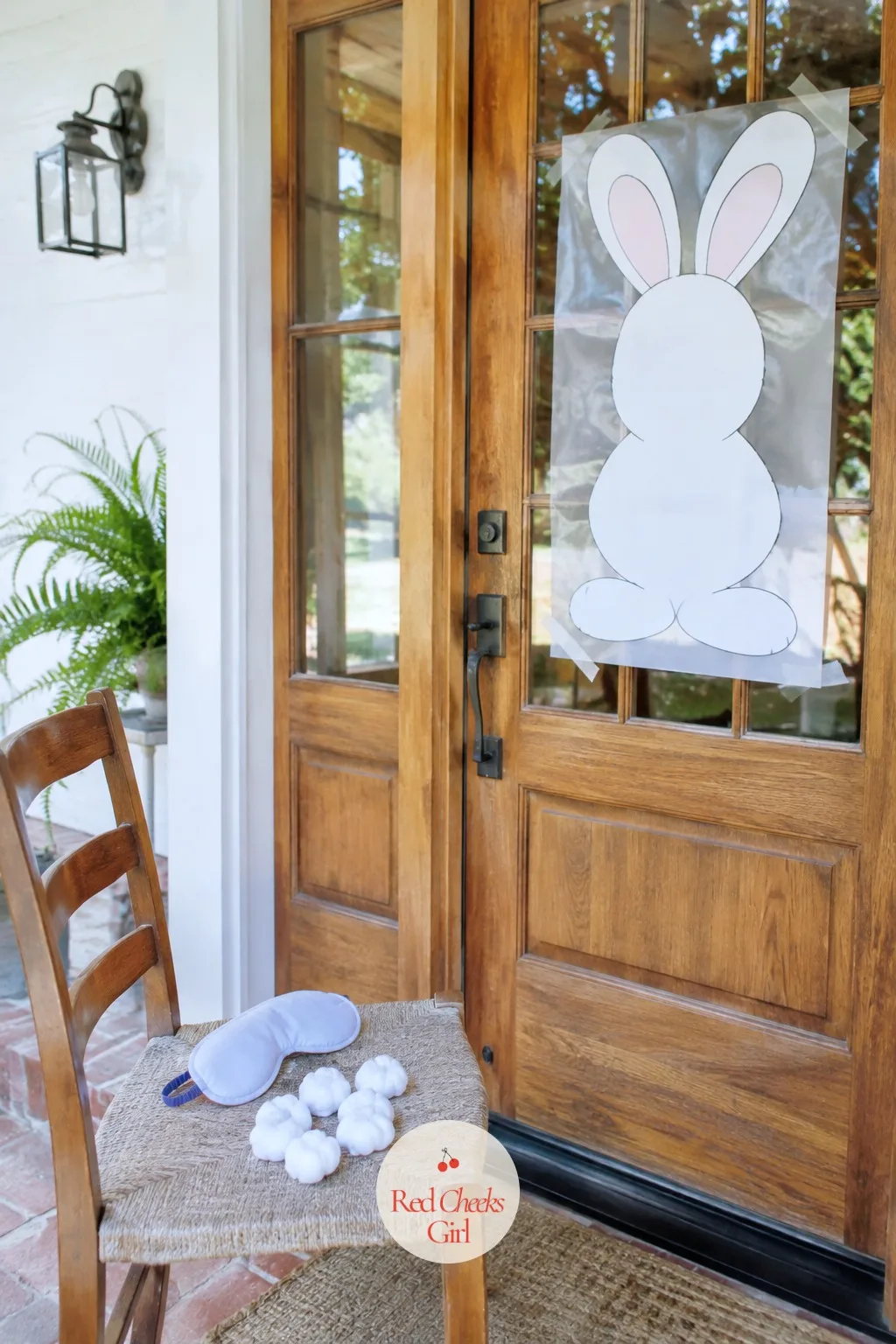
Pin the Tail on the Bunny by the Door
Tape a large printed bunny, missing its tail, to the porch wall or a door at the entrance where the group naturally gathers before heading in to eat. Each player gets a paper cotton tail with a loop of tape, gets spun gently while blindfolded, and tries to stick it in the right spot.
Closest tail to the correct spot when everyone has had a turn wins, and it fits naturally into the last stretch before dinner since players rotate through one at a time rather than all racing at once. Mark each guest’s tail with their initial so there’s no arguing over whose landed where.
Skip the blindfold entirely for very young players and let them simply place the tail with eyes open.
🛍 Shopping guide
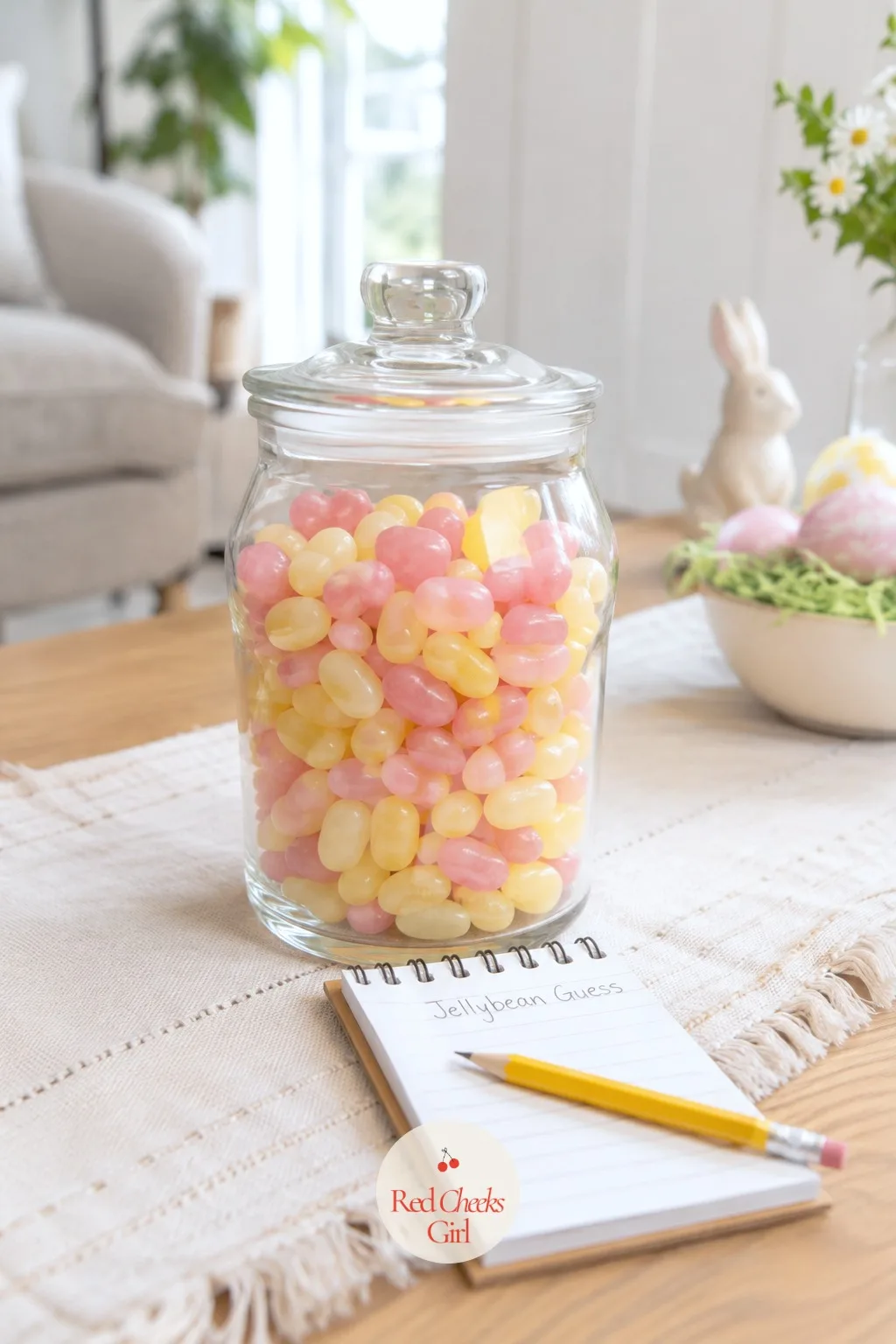
Guess How Many Jelly Beans Fill the Jar
Fill a clear glass jar with pastel jelly beans ahead of time and keep the exact count written down somewhere nobody can peek. Set the jar on the table with a notepad and pencil beside it, and let every guest write down their guess as they take their seat before dinner.
Whoever guesses closest without going over wins the jar itself to take home, which makes it a fitting last game since the prize doubles as a parting favour. Count the beans once more before announcing the winner, since jars are notoriously easy to miscount the first time.
Use a smaller jar for a younger group so the numbers stay manageable to guess.
🛍 Shopping guide
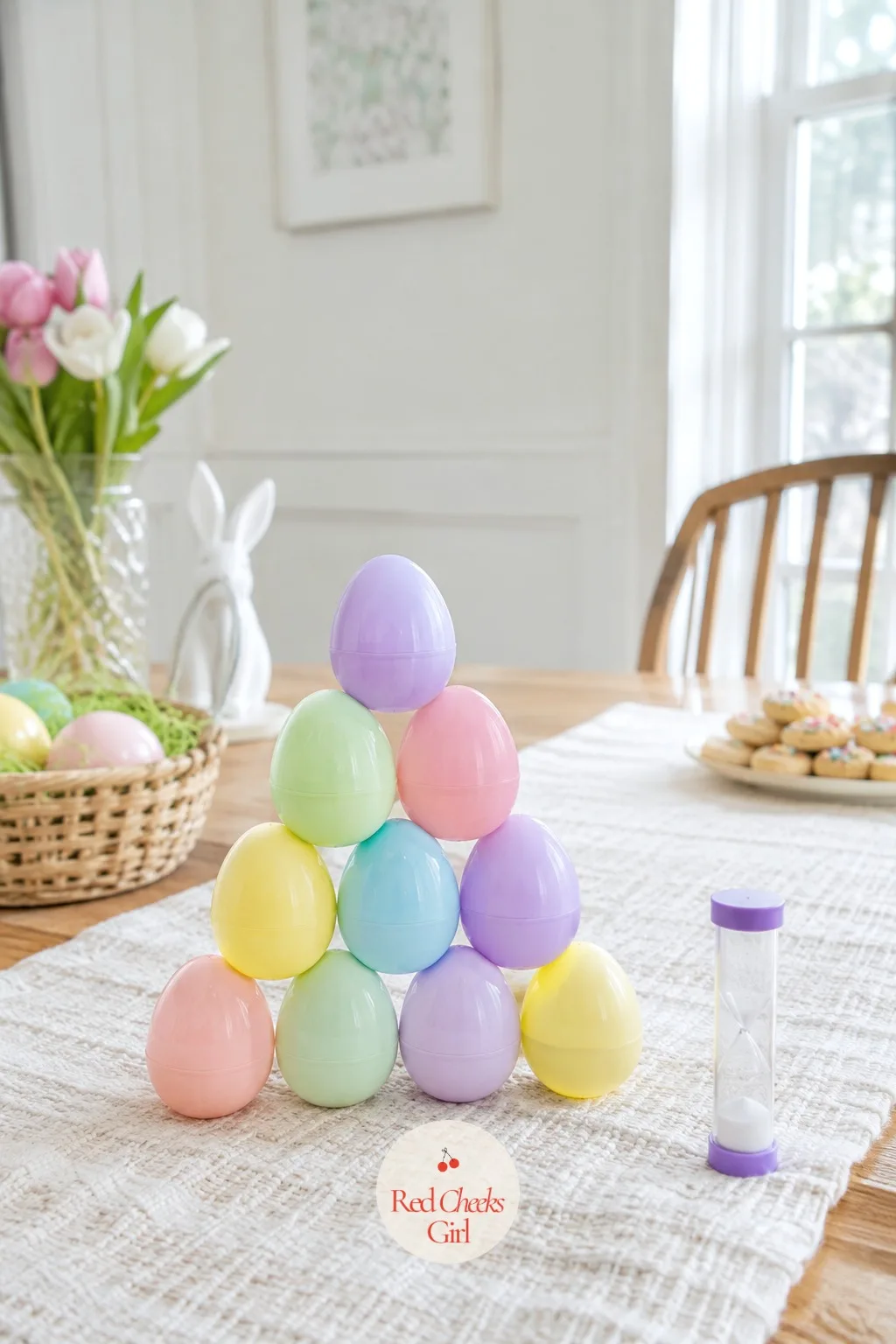
Stack Eggs Into a Pyramid Before the Timer Buzzes
Give each player a small set of plastic eggs, set an egg cup or napkin ring as a base, and challenge them to build the tallest stable pyramid before a one minute timer runs out. A collapsed stack doesn’t eliminate anyone, it just means starting that tower over.
Tallest standing pyramid when time is called wins the round, and because it happens seated at the table it slots in easily while the last dishes come out from the kitchen. Use egg shaped stacking cups instead of real eggs if the table is already set with glassware nearby.
Extend the timer to two minutes for a group that wants a slower, steadier build instead of a race.
🛍 Shopping guide
Frequently Asked Questions
What are good Easter games for a family gathering with different ages?
Mix running games like relays and sack races for the kids with quieter rounds like a jelly bean guess or pin the tail on the bunny that grandparents can join seated. Alternating loud and calm keeps every age involved through the day.
How many plastic eggs do you need for Easter games?
Plan on at least sixty to a hundred plastic eggs for a mixed group playing several games, since relays, hunts and toss games all go through their own stash. Buy one bulk bag rather than several small boxes to keep the colors consistent.
How long should Easter games run before dinner?
Most families find ninety minutes to two hours covers a full run of outdoor races through calm table games without anyone getting restless. Trim the list to four or five games if dinner is already running close.
What if it rains and the games have to move indoors?
The toss, relay and table games all adapt indoors with a cleared hallway or living room floor standing in for the lawn, while the bigger lawn races are best swapped for a round of pin the tail or the jelly bean jar instead. Lower ceilings mean shorter throwing distances for anything tossed.
Do Easter games need prizes to work?
No, though a small chocolate egg or a ribbon for the winner of each round gives the games a natural finish line that keeps competitive players engaged. A shared basket of treats at the end works just as well as individual prizes.
How do you keep teenagers interested in family Easter games?
Give them a real role, running a relay as team captain or timing the obstacle course, rather than asking them to play exactly as the younger kids do. Challenges that reward steady nerve over speed, like the egg balance, tend to hold their attention longest.
Discover 22 fun Easter party games for kids ages 3–10, from egg-and-spoon races to printable bingo
18 Easter table decorations in soft sage, blush and white: linens, centerpieces, place settings, can
16 outdoor Easter games for lawn and patio, from a lollipop hunt to a bonnet parade, built for kids
Leave a Reply