

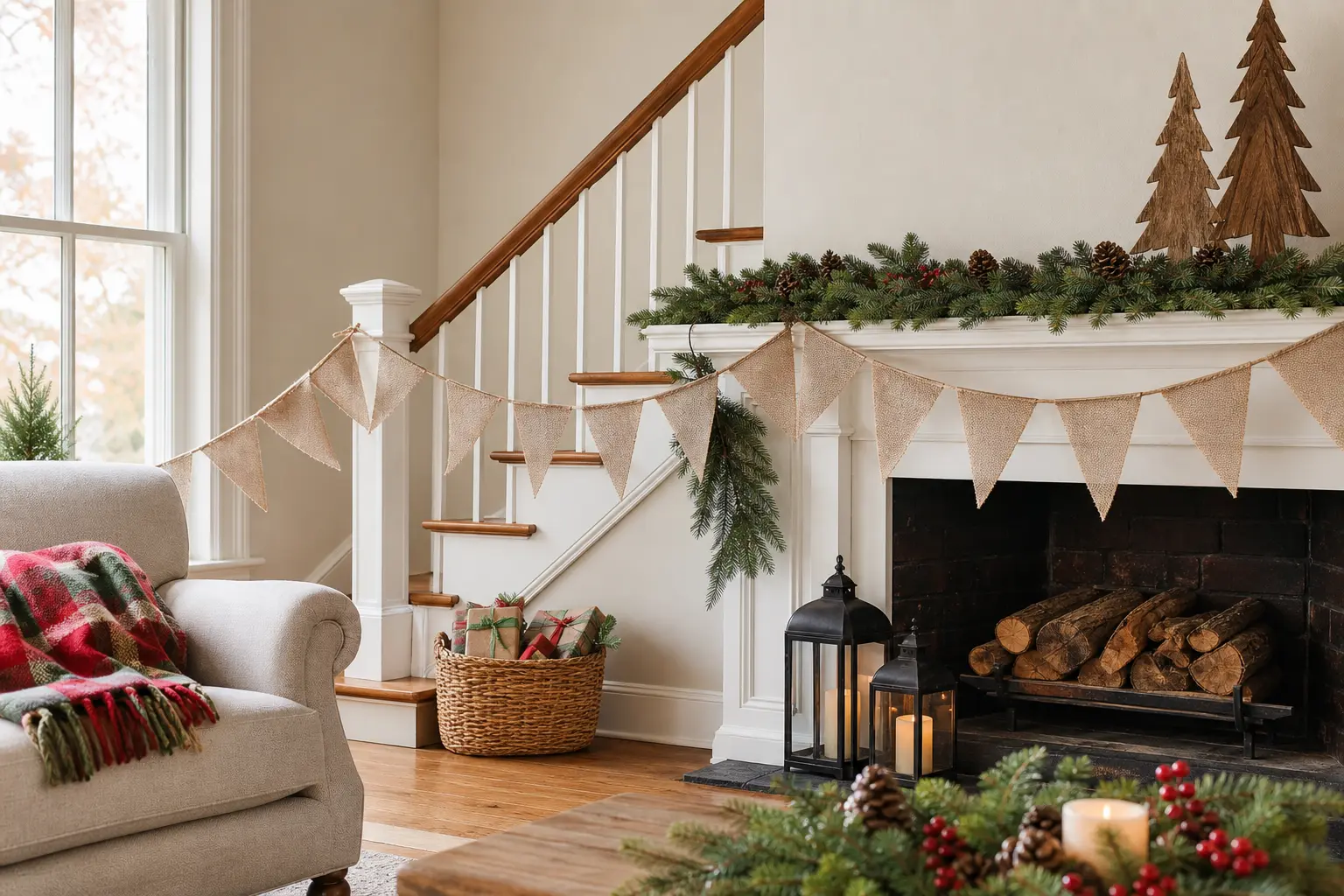
Every diy christmas banner on this list comes with three numbers: the span it fills, the letter height that reads from a doorway away, and the hanging method that leaves zero marks on your walls. No guessing, no sagging, no word that runs out of room at the last letter.
The 25 ideas below move in order from a two-foot shelf edge up to a full staircase run. Find your wall first, then pick your banner. Each one stays inside a palette of cream, oxblood, hunter green, brass and tartan, so they all look deliberate together rather than like a craft-store raid. For everything hanging around the fireplace, pair your banner with a set of well-chosen christmas stockings ideas and the whole mantel becomes a finished scene.
Nothing here requires a printed template, glitter letters, or anything nailed or taped to painted plaster. If your last attempt buckled in the middle, the fix is almost always about anchor points and cord tension, and every entry below covers both.
This post contains affiliate links. If you buy through them, I may earn a small commission at no extra cost to you.
Short Spans: Shelf Edge and Bookcase Runs
A two-foot shelf or a single bookcase bay is not too small for a banner. It is exactly the right scale for fine detail: tiny triangles, pegged cards, little flags. Keep the triangles at least three inches tall so they read from across the room rather than disappearing into the shelf styling.
Anchor each end to a small cup hook screwed into the underside of the shelf, which leaves the wall and the shelf face untouched. Waxed linen cord holds its tension without stretching overnight.
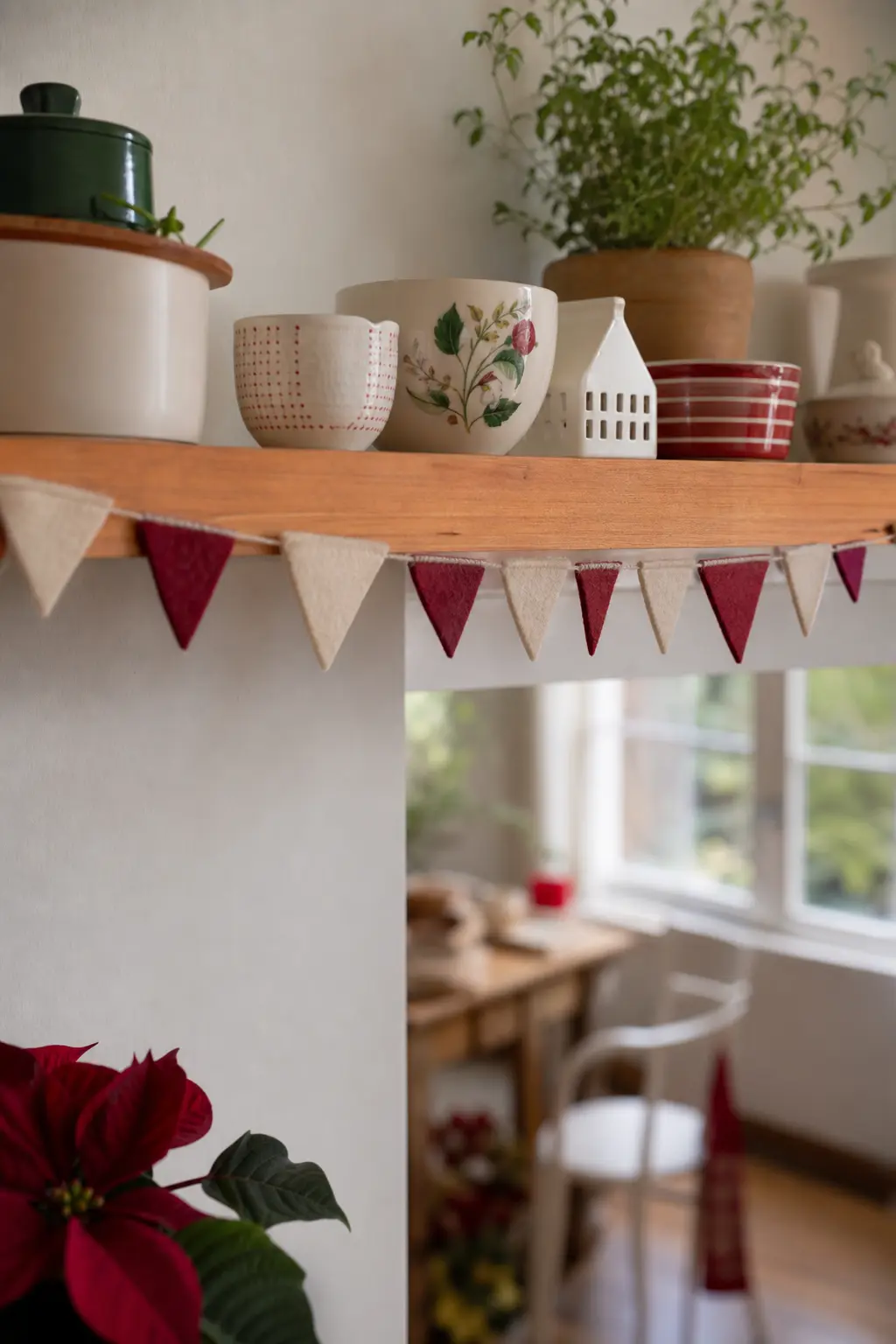
Two-Foot Shelf Edge Run of Small Triangles
Span: 24 inches. Letter or triangle height: 3 inches. Anchor: two small cup hooks on the underside of the shelf, leaving the wall untouched.
Cut cream and oxblood felt into equilateral triangles with a three-inch base. Fold the top half-inch over waxed linen cord and secure with a thin bead of fabric glue rather than a staple, which splits fine felt. Space each triangle one inch apart so the cord shows as a deliberate design line.
This length fits a single Ikea Kallax bay, a kitchen shelf above the cooker, or the top of a small bookcase. Because the span is short, the cup hooks carry almost no weight and can be unscrewed cleanly at the end of the season.
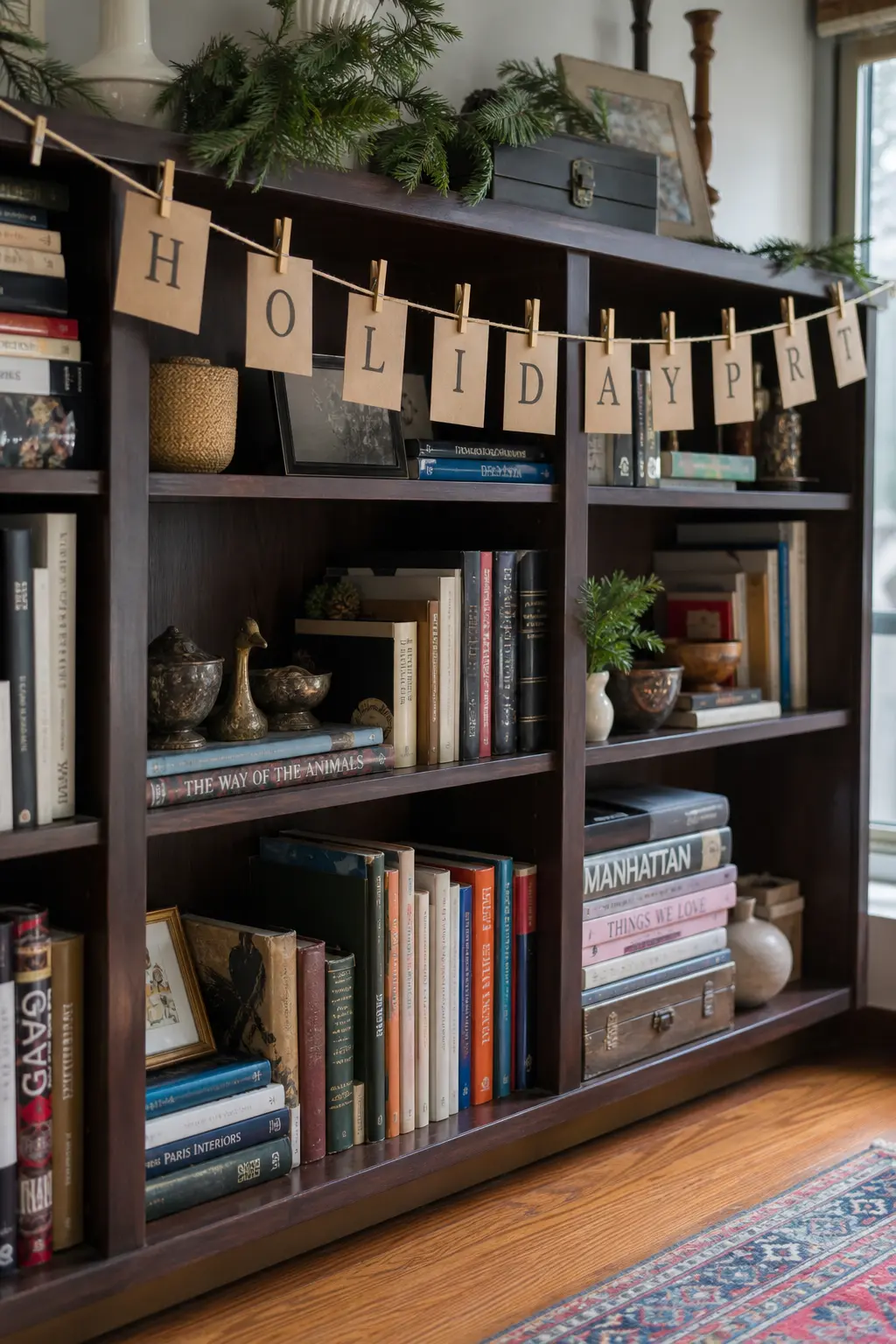
Bookcase Run of Pegged Cards
Span: 30 to 36 inches across one bookcase. Letter height: not applicable, the cards carry images or single block letters. Anchor: two binder clips on the top shelf edge grip the cord at each end.
Cut kraft card into three-by-four-inch rectangles. Stamp or hand-write a single letter in oxblood ink on each, or leave them plain and let a small sprig of dried eucalyptus sit behind the peg. Clip each card with a brass mini clothes peg onto jute twine.
The binder clips on the shelf edge leave no mark and hold firmly. This banner doubles as a display for holiday cards once the letters are removed.
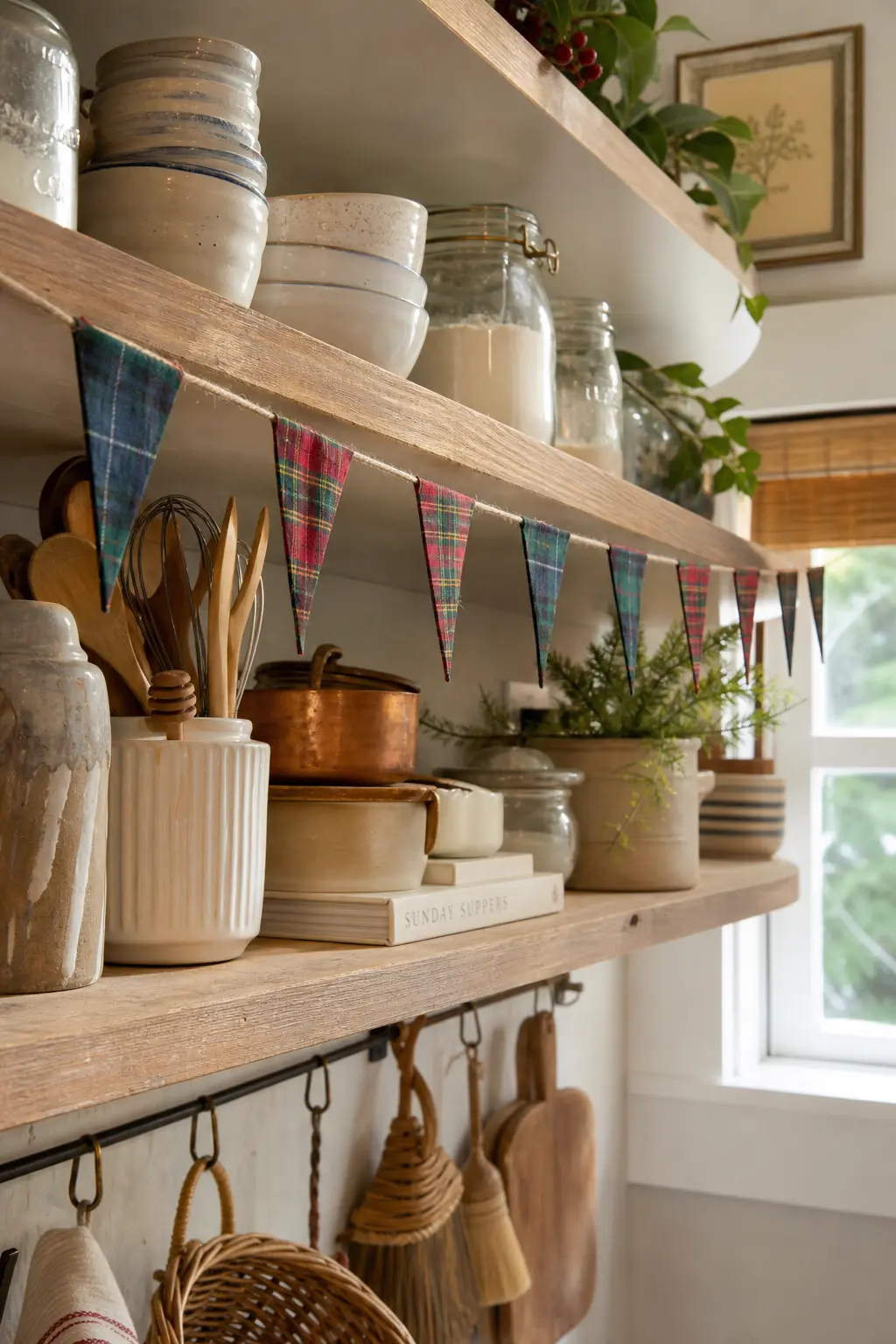
Kitchen Shelf Line of Tiny Flags
Span: 18 to 24 inches. Flag height: 2.5 inches. Anchor: the cord loops around two nails already in the shelf brackets, so nothing new touches the wall.
Cut tartan cotton into two-and-a-half by two-inch rectangles. Fold the short end over a thin dowel toothpick and glue. Thread each toothpick vertically between two strands of twisted jute cord so the flag stands upright rather than hanging down.
Because the flags face upward they read from across the kitchen without the viewer needing to crouch. Scale is the trick here: anything larger than three inches looks heavy on a kitchen shelf.
Medium Spans: Mantel, Doorway, and Window Widths
Most mantels run between four and six feet. Most doorways sit around thirty-two to thirty-six inches wide. Both spans reward letters cut at four inches tall, which read clearly from eight feet away without dwarfing the space. Felt is the friendliest material here: it does not fray, needs no hem, and takes a hot-glue bead without warping.
Tension cord between two removable adhesive hooks placed on the side walls of a doorway, or on the side faces of a chimney breast, not on the painted front face. This keeps the cord taut and the banner level without a single mark.
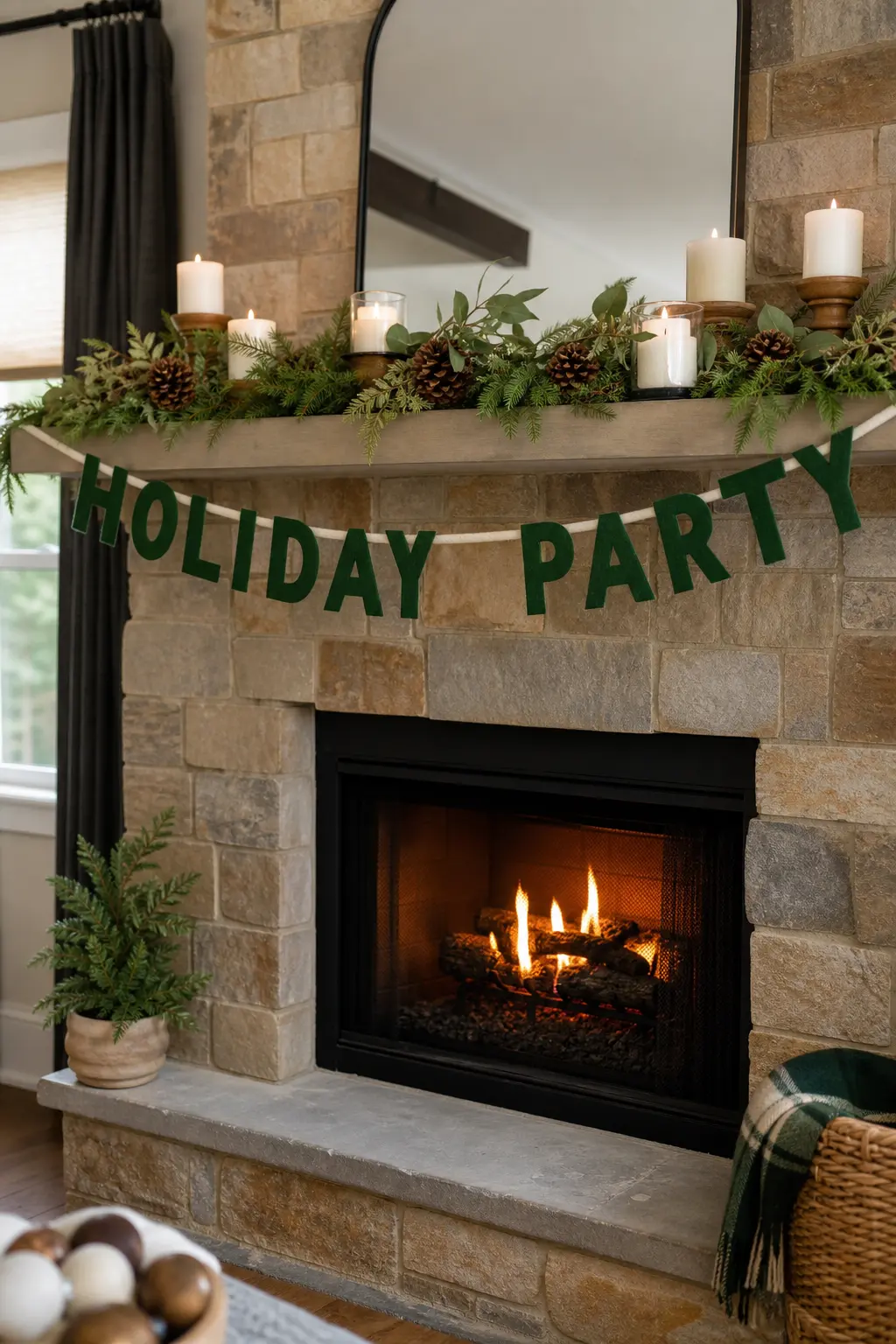
Mantel Span of Felt Letters
Span: 48 to 60 inches. Letter height: 4 inches. Anchor: two removable adhesive hooks on the side faces of the chimney breast, never the front face.
Cut four-inch block capitals from hunter green felt. Spell a word that fits: JOY fits three letters cleanly on a four-foot mantel at this scale. NOEL fits four. MERRY needs at least five feet. Space each letter two inches apart on cream grosgrain ribbon, which keeps them level far more reliably than cord because it does not twist.
Back each letter with a thin strip of heat-bond tape pressed to the ribbon so the letters do not slide. The ribbon reads as a design element in its own right when the fireplace is lit.
🛍 Shopping guide
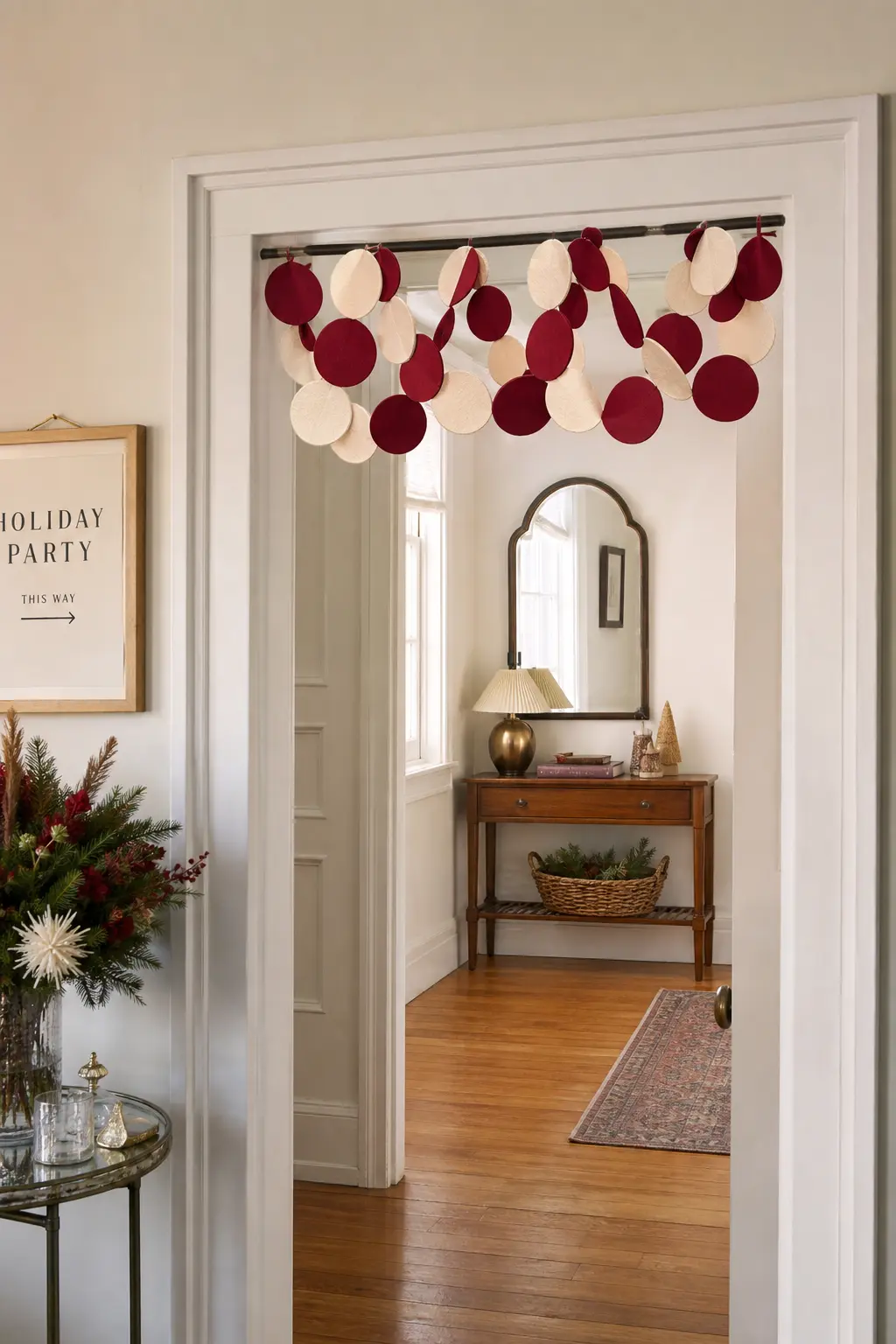
Doorway Arch of Paper Circles
Span: 32 to 36 inches across the doorway width, with a drop of six inches on each side to follow the arch. Letter height: not applicable. Anchor: one tension rod pressed into the doorway at the top, the same kind used for a café curtain.
Cut three-inch circles from cream and oxblood card. Score and fold each circle in half, then glue alternating pairs back-to-back along a length of brass-coloured thread so each unit becomes a double-sided flag. The result reads as a continuous scallop from both sides of the doorway, which matters in a through-room.
The tension rod leaves no marks, holds to twelve feet of cord weight without slipping, and comes down in one pull.
🛍 Shopping guide
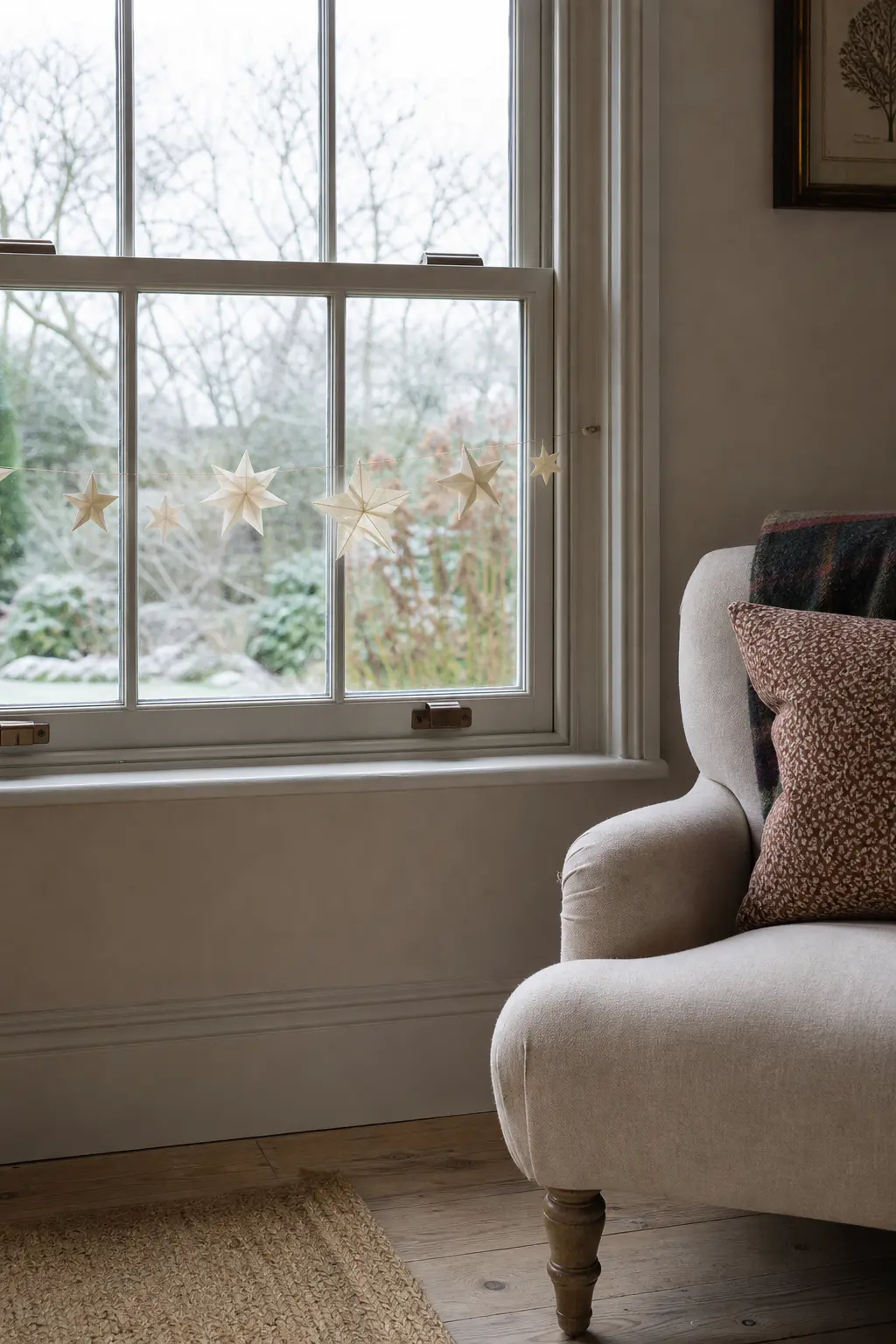
Window Width of Paper Stars
Span: 36 to 48 inches across a standard sash or casement window. Star width: 4 inches point to point. Anchor: the cord ties to each side of the window frame using small suction-cup hooks on the glass, rated to half a pound each.
Fold six-pointed stars from cream paper using a simple accordion fold: no template needed, just a square sheet folded in thirds. String each star through its centre point on brass thread. The stars turn slowly in window light and catch the reflection.
Because the suction cups attach to glass rather than paint, they leave zero residue. Swap them for new ones each year at negligible cost.
🛍 Shopping guide
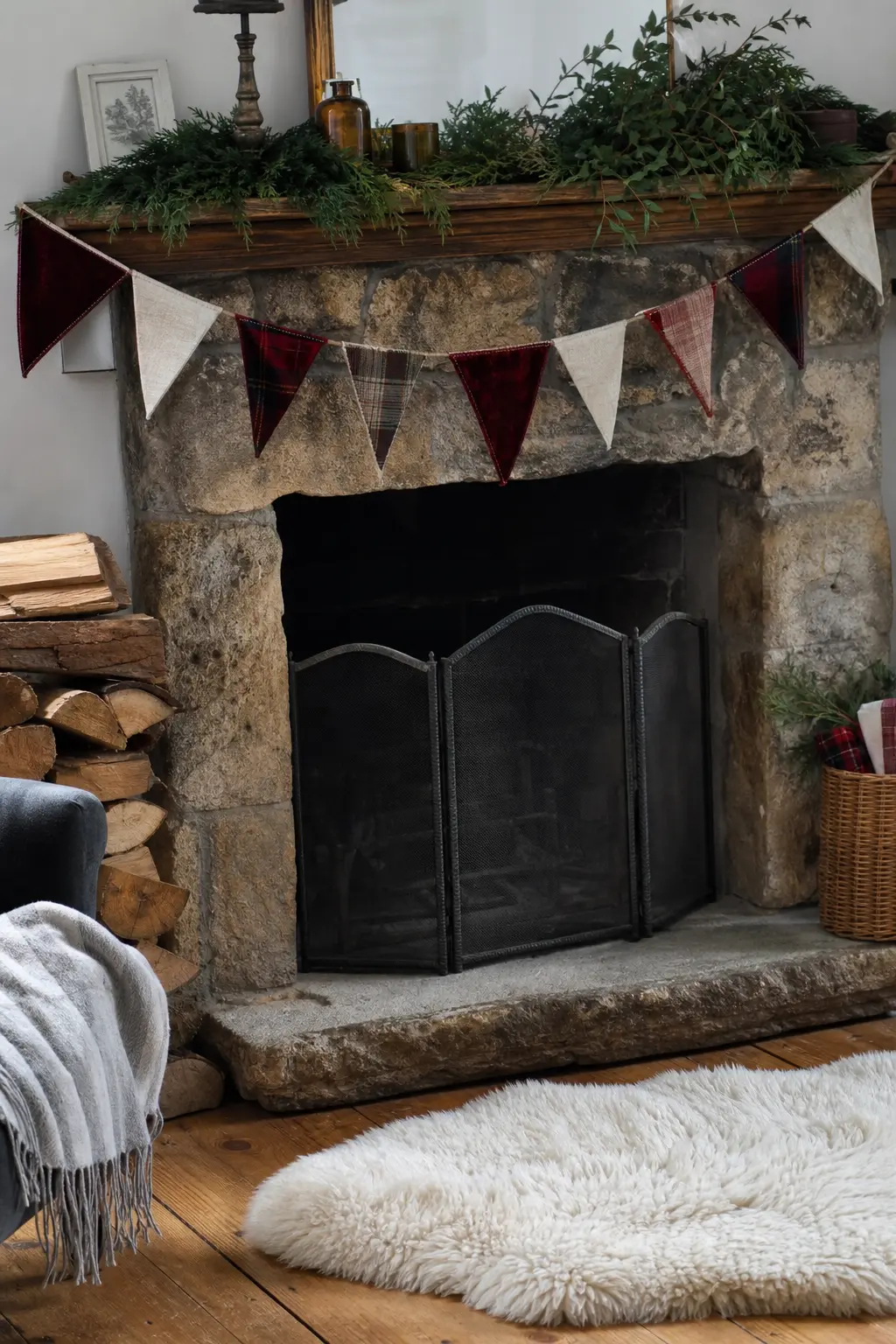
Fireplace Span in Fabric Scraps
Span: 48 inches. Triangle depth: 5 inches. Anchor: the cord ties around the far ends of the mantel shelf rather than to the wall, so the whole thing lifts off in one piece.
Cut triangles from whatever fabric scraps are in the bin: tartan, oxblood velvet offcuts, old linen napkins in cream. Variety in texture reads as curated when the colours stay consistent. Pin each triangle to the cord with a single hand stitch at the top two corners rather than gluing, so the banner folds flat for storage.
The tied-around-the-mantel method means the banner can be repositioned left or right in seconds, which solves the off-centre problem before it starts.
🛍 Shopping guide
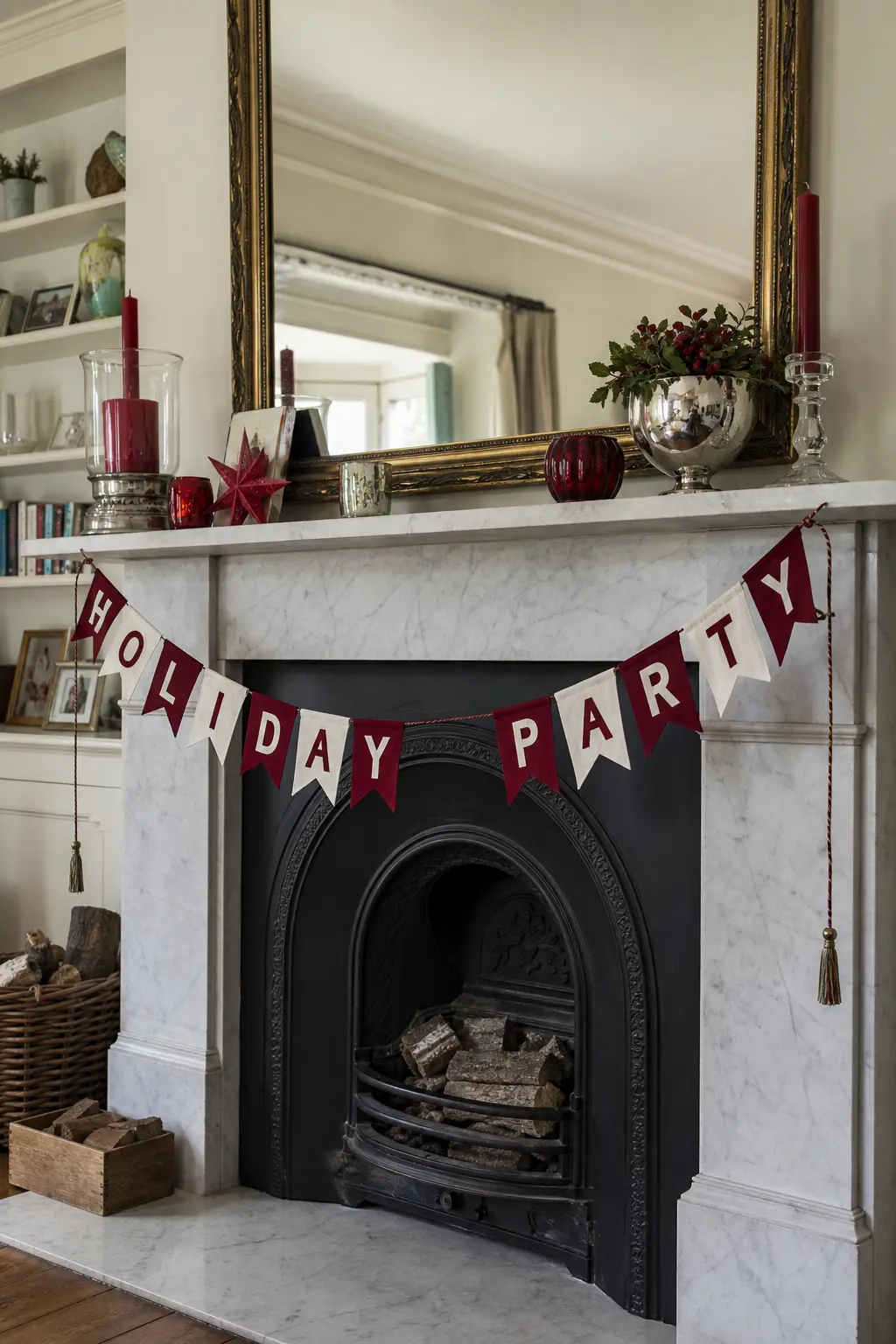
Mantel Banner Weighted at Both Ends
Span: 48 to 54 inches. Triangle or pennant height: 5 inches. Anchor: the cord loops around the two end brackets of the mantel shelf and hangs free, with a small brass ring or curtain weight stitched to each tail end so the cord hangs in a gentle controlled swag rather than a random droop.
The weighted tail is the detail that separates a finished mantel banner from an unfinished one. Without it the end cord flips back and catches on the shelf decoration. With it the tail hangs plumb and frames the whole span.
Cut pennants in alternating oxblood and cream felt. Stitch the top half-inch of each pennant to the cord with a single running stitch rather than gluing, so the pennants can be pressed flat at the end of the season.
🛍 Shopping guide
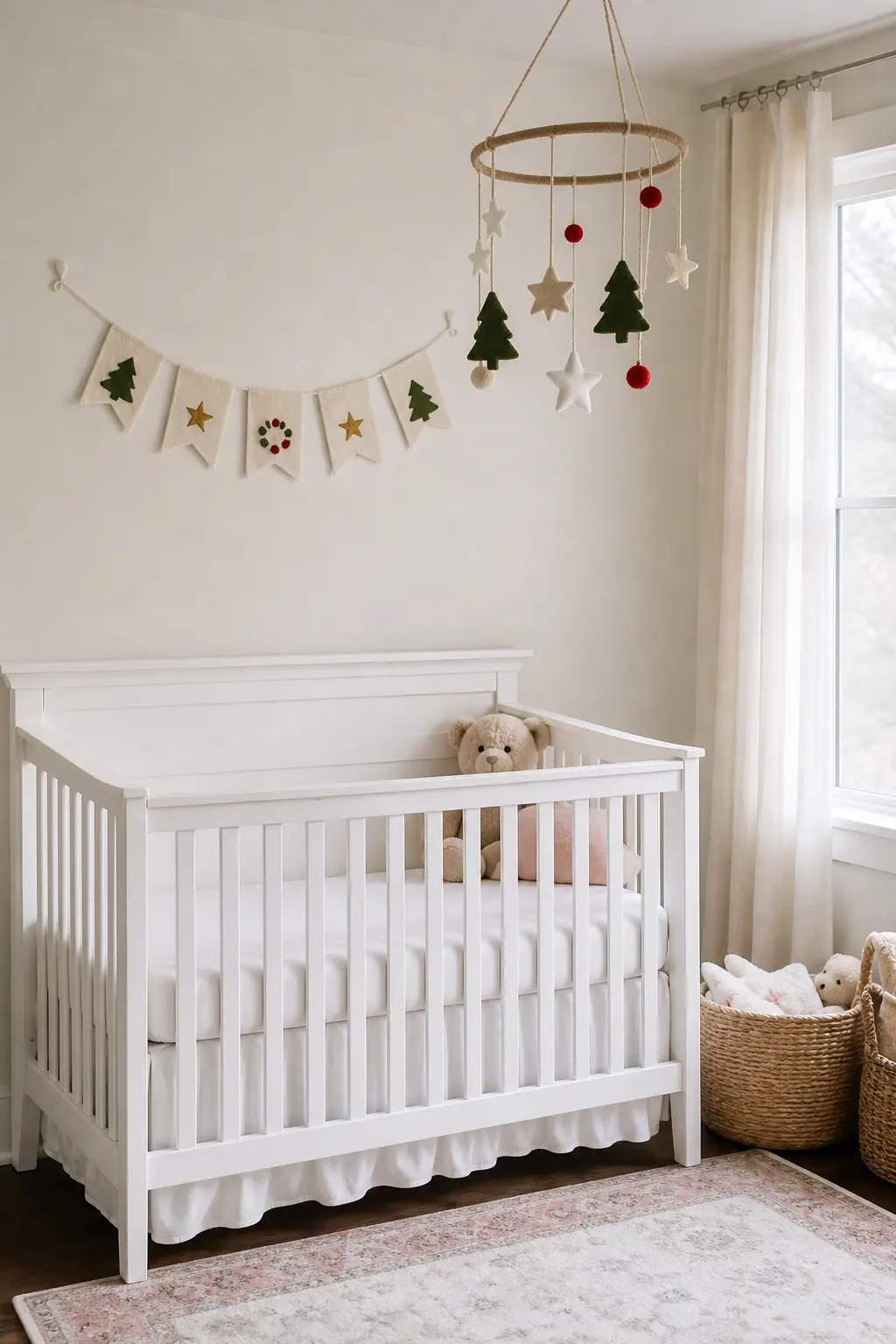
Nursery Span in Soft Felt
Span: 36 to 48 inches above a cot or change table. Letter height: 3 inches on small pennants. Anchor: two adhesive hooks on the back of the shelving unit or on the window reveal face, not the plaster wall, so they can be removed cleanly.
Use only soft felt here, not card or oilcloth: any piece that drops into a cot needs to be cloth rather than a choking or sharp-edge risk. String the pennants on soft cotton ribbon instead of cord. Leave no tails longer than four inches beyond the last pennant so there is nothing to grab.
Spell the baby’s name, or keep it seasonal with a simple repeated triangle in cream and sage. Either reads well from the doorway without requiring five-inch letters at this short span.
🛍 Shopping guide
Full-Wall and Hallway Runs
A hallway or a long wall asks for a banner that earns the space. Plain triangles at consistent spacing look more intentional than a mix of shapes. For a run longer than eight feet, divide the cord into two overlapping sections with a shared central anchor, because a single cord that long will always bow at the midpoint regardless of how tightly you tie it.
The central anchor can be a tension rod set into the hallway width, a picture-rail hook, or a removable adhesive hook rated for the cord weight. Test the hook’s rated load before you string anything: a strip rated at one pound will not hold a twenty-flag oilcloth banner.
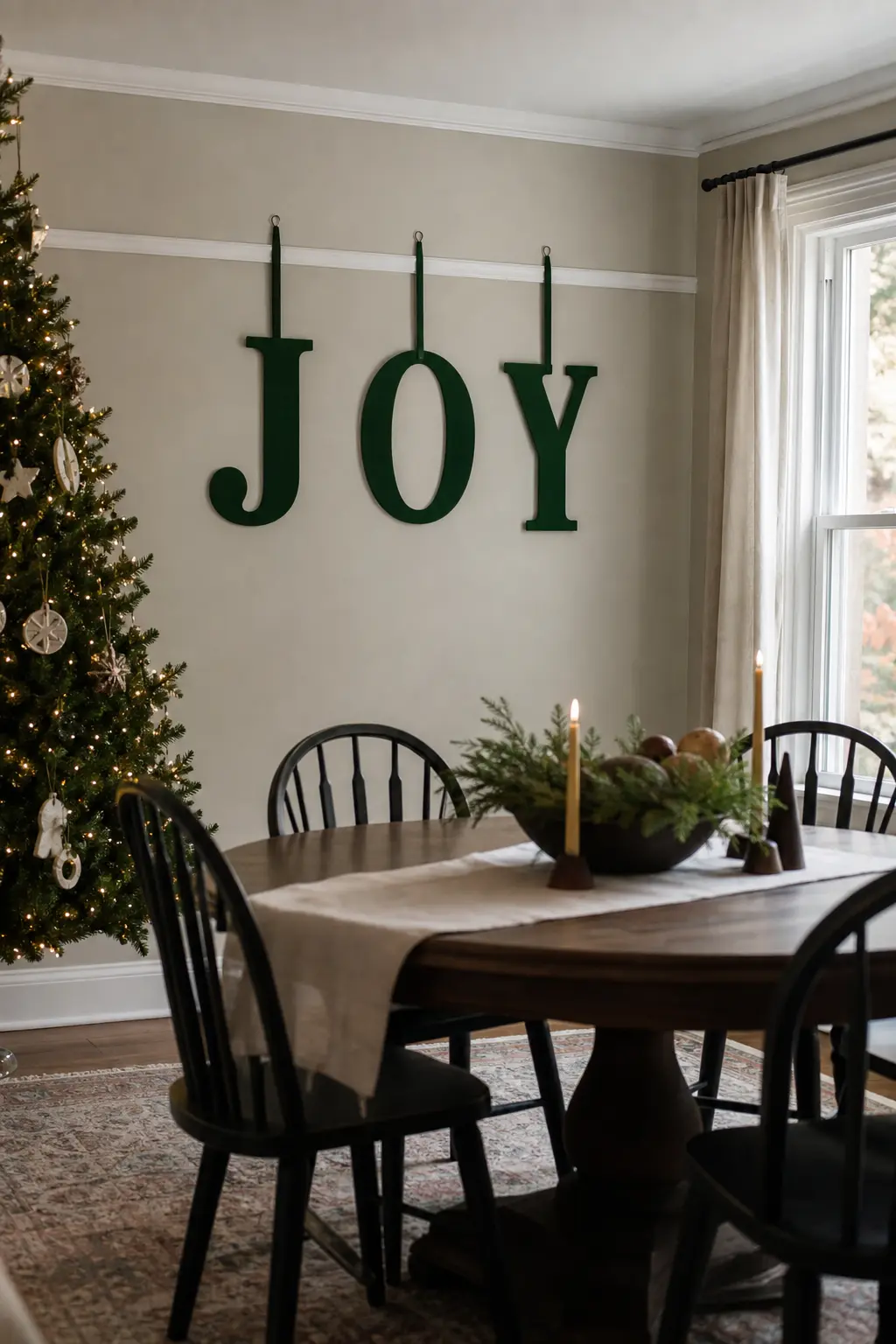
Wall Word in Letters a Hand Tall
Span: 36 to 48 inches for a three-letter word at five-inch height, which reads from fifteen feet. Letter height: 5 inches, which is literally about as tall as a flat hand. Anchor: each letter hangs on its own small removable adhesive strip hook, rated to one pound, placed on the wall at the back of a recess or picture-rail alcove rather than on open plaster.
Cut the letters from thick felt or double-layered felt glued together for body. A single layer of felt at five inches bows in the middle; two layers stay flat. Punch a small hole at the top centre of each letter and hang from a loop of brass thread over the hook.
Spell JOY, NOEL, or GLAD. Four-letter words at five inches need a span of at least forty-four inches to breathe.
🛍 Shopping guide
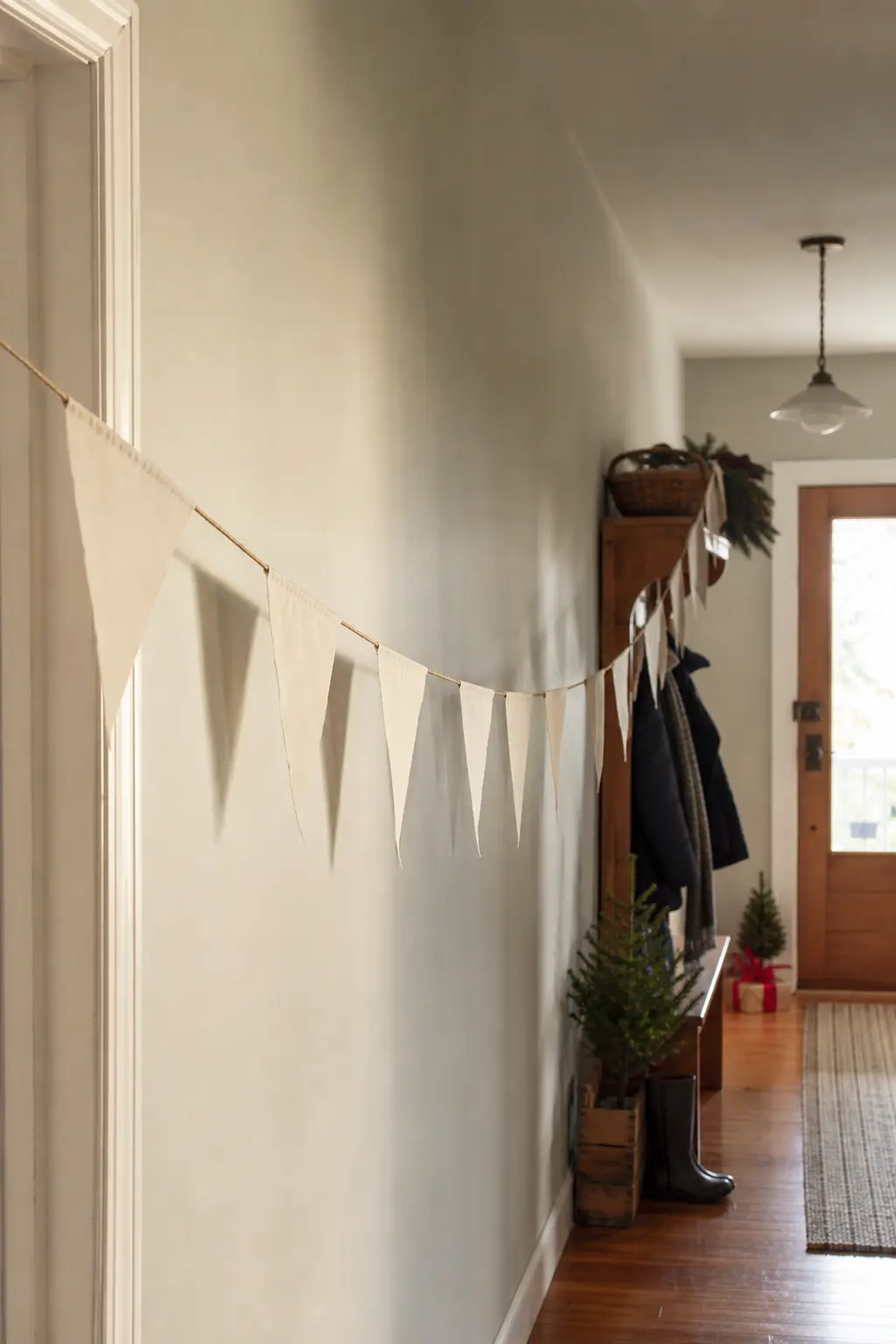
Long Hallway Run of Plain Triangles
Span: 10 to 14 feet. Triangle height: 5 inches. Anchor: two tension rods, one at each end of the hallway pressed between opposite walls, with the cord looped over each. A third tension rod or adhesive hook rated to two pounds goes at the midpoint to prevent the classic midpoint sag.
Cut all triangles in one session from a single piece of cream cotton sheeting. Uniformity is the whole point here: same size, same spacing of one inch, same cord. The hallway provides the drama through its length; the banner provides the rhythm.
A run this long reads best when the cord is visible and considered, not hidden. Waxed natural cotton cord in a medium weight looks intentional rather than makeshift.
🛍 Shopping guide
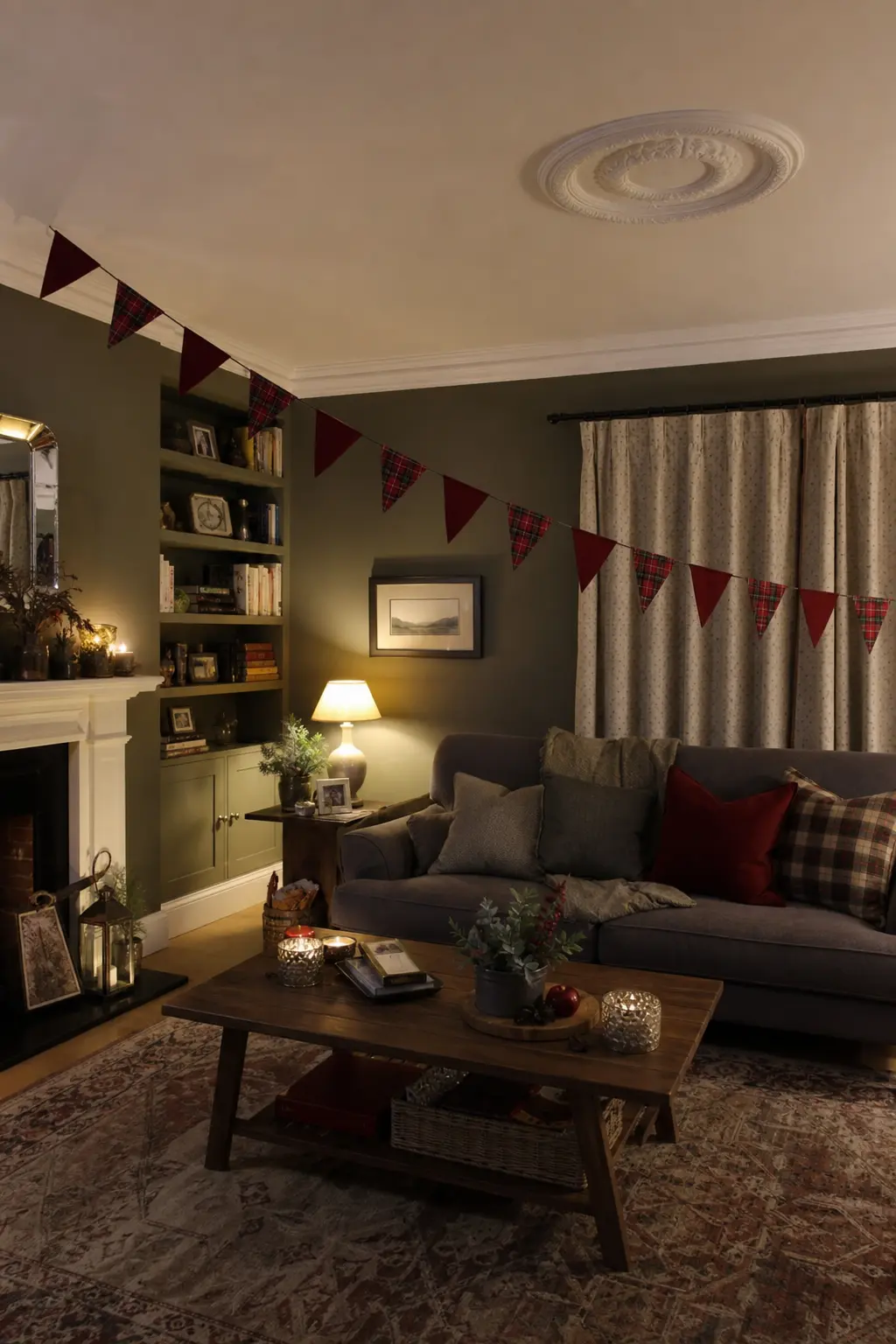
Corner-to-Corner Diagonal Run
Span: diagonal of a standard ten-by-twelve room, approximately fifteen feet. Triangle height: 6 inches. Anchor: one removable adhesive hook rated to five pounds at each top corner of the room, attached to the ceiling rose trim or cornice face, never flat plaster.
A diagonal banner makes a square room look larger and gives the eye a line to follow. Cut triangles from alternating tartan and oxblood felt. The angle of the cord means each triangle hangs at a slight slant, which looks intentional at this scale rather than misaligned.
Check the hook ratings before loading this span. Fifteen feet of felt triangles at six inches each weighs more than it looks. A five-pound-rated hook at each end is the safe minimum.
🛍 Shopping guide
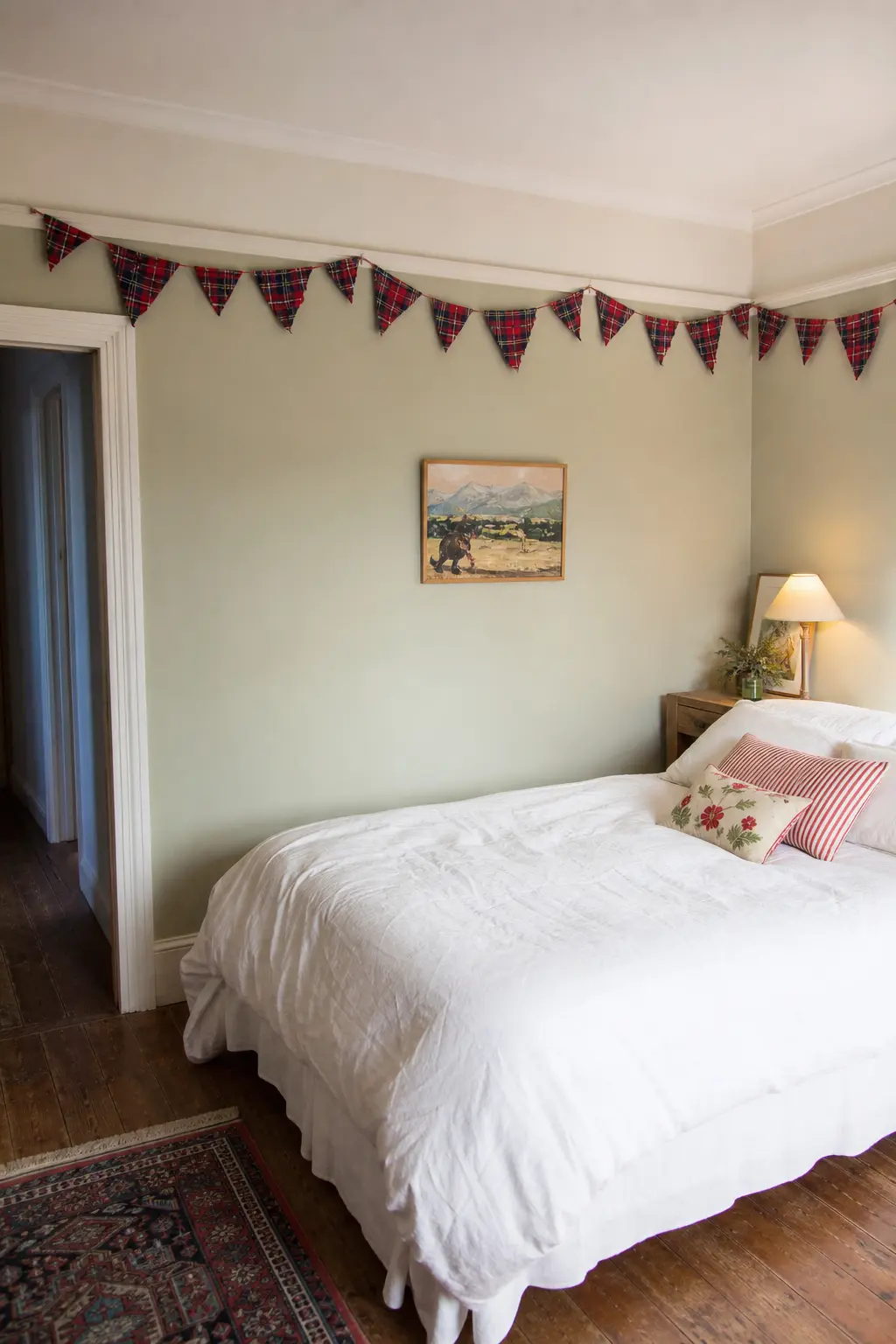
Bunting Made from an Old Shirt
Span: whatever the shirt yields, typically six to eight feet from a man’s large. Triangle height: 5 inches cut from the main body panels. Anchor: picture-rail hooks at each end, no wall contact needed.
Cut triangles along the fabric grain so fraying is minimal. A flannel shirt in oxblood or tartan is ideal: the check reads as deliberate bunting pattern without any additional decoration. Leave the edges raw and wash once before cutting so they fray a controlled half-inch rather than continuing to unravel.
The collar and cuffs yield contrast pennants at each end of the run if you keep them. This is the most genuinely free banner on this list.
🛍 Shopping guide
Staircase and Vertical Drops
A staircase handrail offers the most natural banner anchor in any house: every baluster is a tie point. Pin cord to each baluster with a small cable tie or a loop of twine, and the banner follows the rake of the stair without sagging or pulling. Letter height here needs to be at least five inches because the viewer is usually standing at the bottom looking up at an angle.
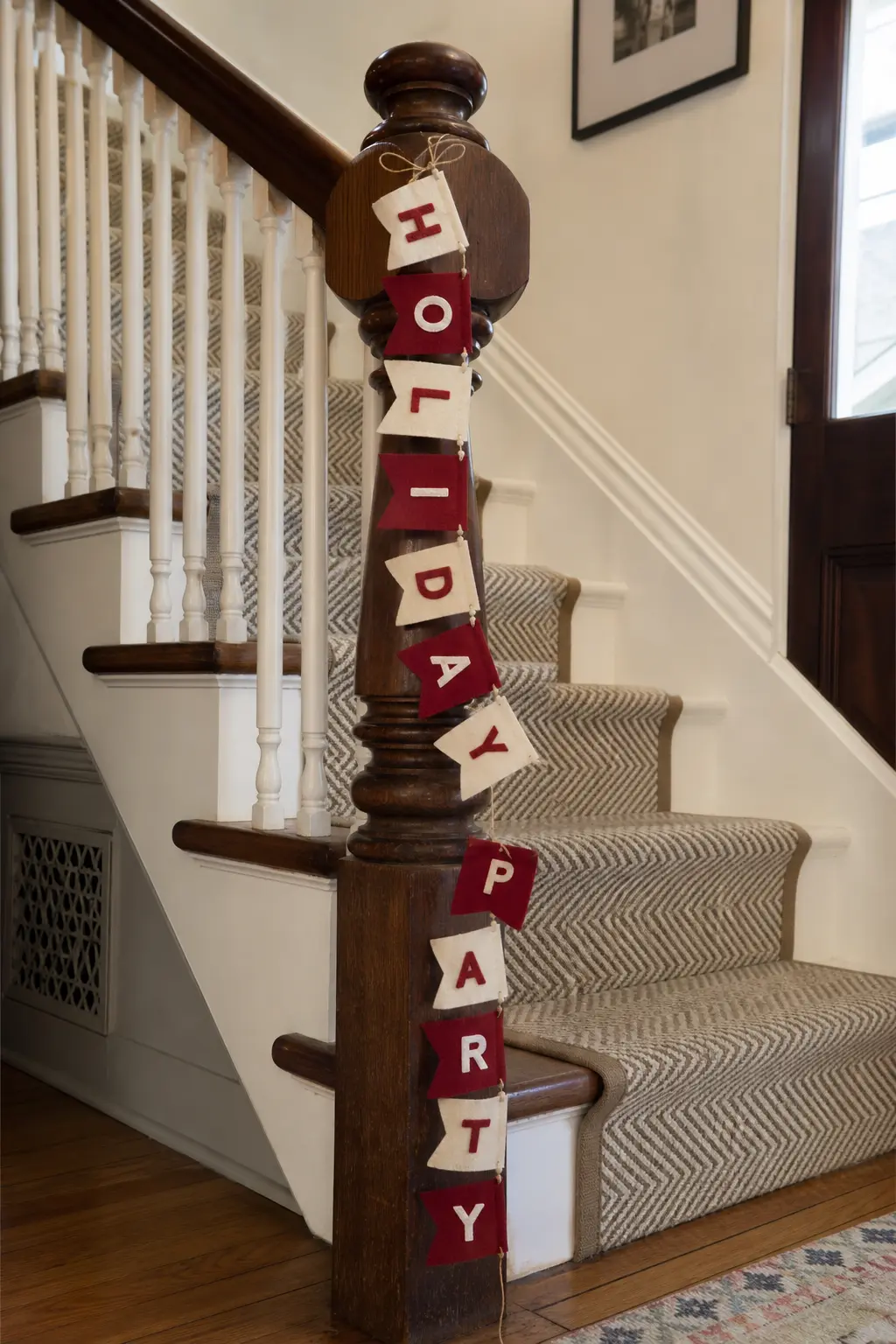
A vertical drop from a stair spindle works differently: hang it straight down from the newel post and weight the bottom with a small wooden bead or a brass ring so it hangs plumb rather than swinging. These two ideas use the same location but produce completely different visual effects.
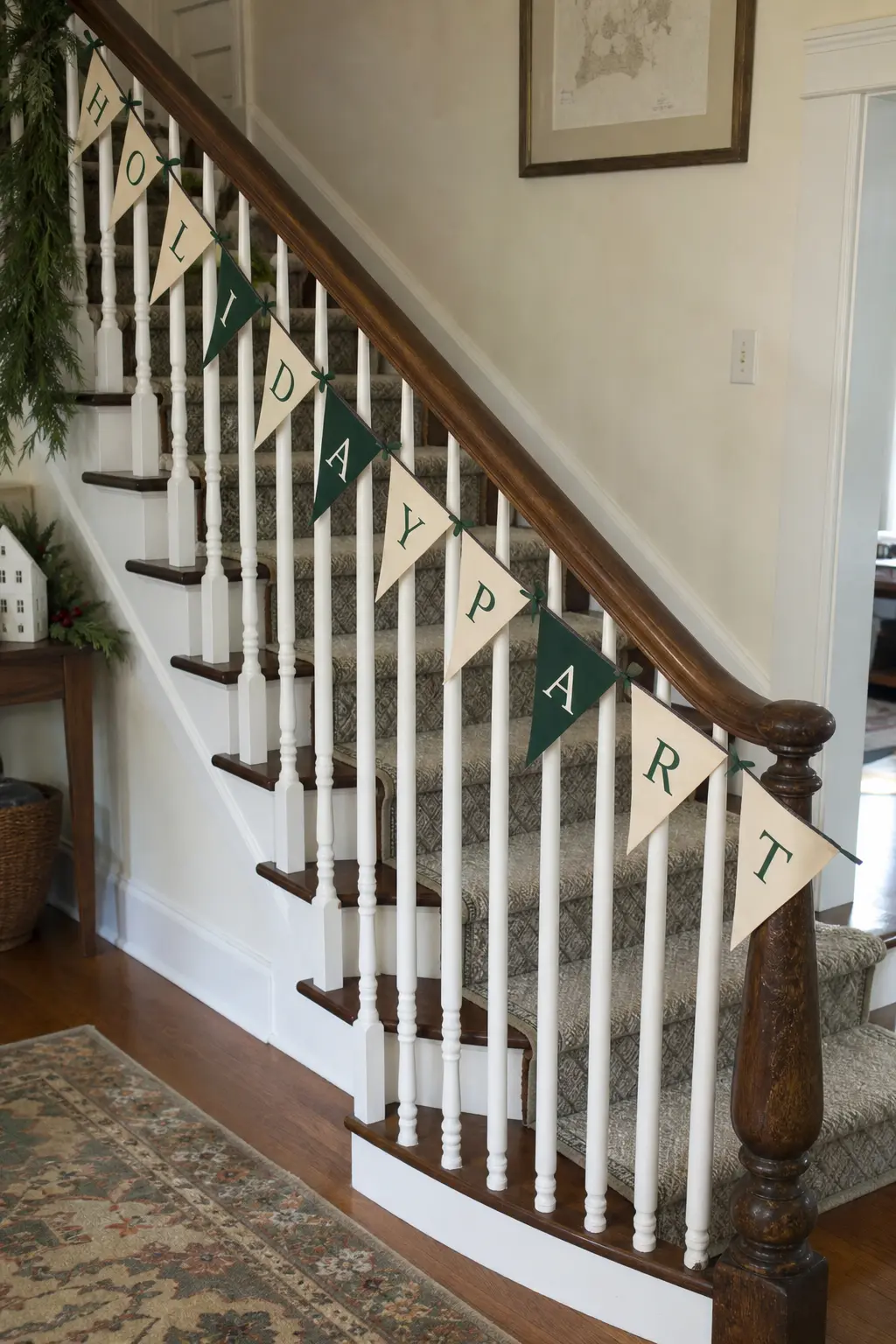
Staircase Run Pinned to the Handrail
Span: total rake length of the stair, typically ten to sixteen feet on a standard staircase. Letter height: 5 inches minimum. Anchor: the cord ties to the newel post at the bottom and the landing newel at the top, with a small cable tie looped around each baluster at two-foot intervals.
The cable ties sit flat against the underside of the handrail and vanish at any distance. Do not glue or pin the cord to the stair wall. Cut triangles six inches deep so they hang below the handrail height and read from the hallway below rather than only from the stair itself.
Alternate cream and hunter green triangles. The stair rake means the banner appears to climb, which reads as a deliberate visual effect rather than an uneven hang.
🛍 Shopping guide
Stair Spindle Vertical Drop
Span: vertical, 24 to 36 inches hanging from the newel post top. Letter height: 4 inches on each pennant. Anchor: the cord loop drops over the newel post cap without any fixing, held in place by a brass ring at the bottom as a weight.
Cut narrow pennants, two inches wide and six inches long, in alternating oxblood and cream felt. Stitch each pair back-to-back around the cord so both faces are finished. The brass ring at the base keeps the drop plumb and adds a hardware-store glamour that costs almost nothing.
This is the only banner on this list that is genuinely three-dimensional: it turns slowly when the front door opens and catches light from below.
Furniture-Scale Banners
Chair backs, bed heads, table edges and mirror frames all take banners that stay completely off the wall. Nothing to anchor, no paint at risk, no cord tension to calculate. These are the quickest banners on the list: tie on, adjust, done. Scale matters more than anywhere else here. A chair-back banner that droops below the seat looks accidental; one that sits at the top third of the chair back looks placed.
Mini banners in this category work best with a lightweight base, muslin, ribbon or doilies rather than felt, because the furniture itself is not built to carry weight at one point without tipping.
Table Edge Skirt Banner
Span: the full length of the dining or console table edge, typically 60 to 72 inches. Triangle depth: 4 inches. Anchor: the cord clips to the table edge with small binder clips at each end and one in the middle, leaving no marks on the wood.
Cut triangles from tartan cotton with pinking shears so the zigzag edge reads as an intentional border rather than a raw one. The banner hangs below the table edge and swings slightly when people sit down, which is charming rather than annoying when the triangles are no longer than four inches.
Match the tartan to a table runner in the same fabric and the two pieces read as a set rather than a bundle of separate decisions.
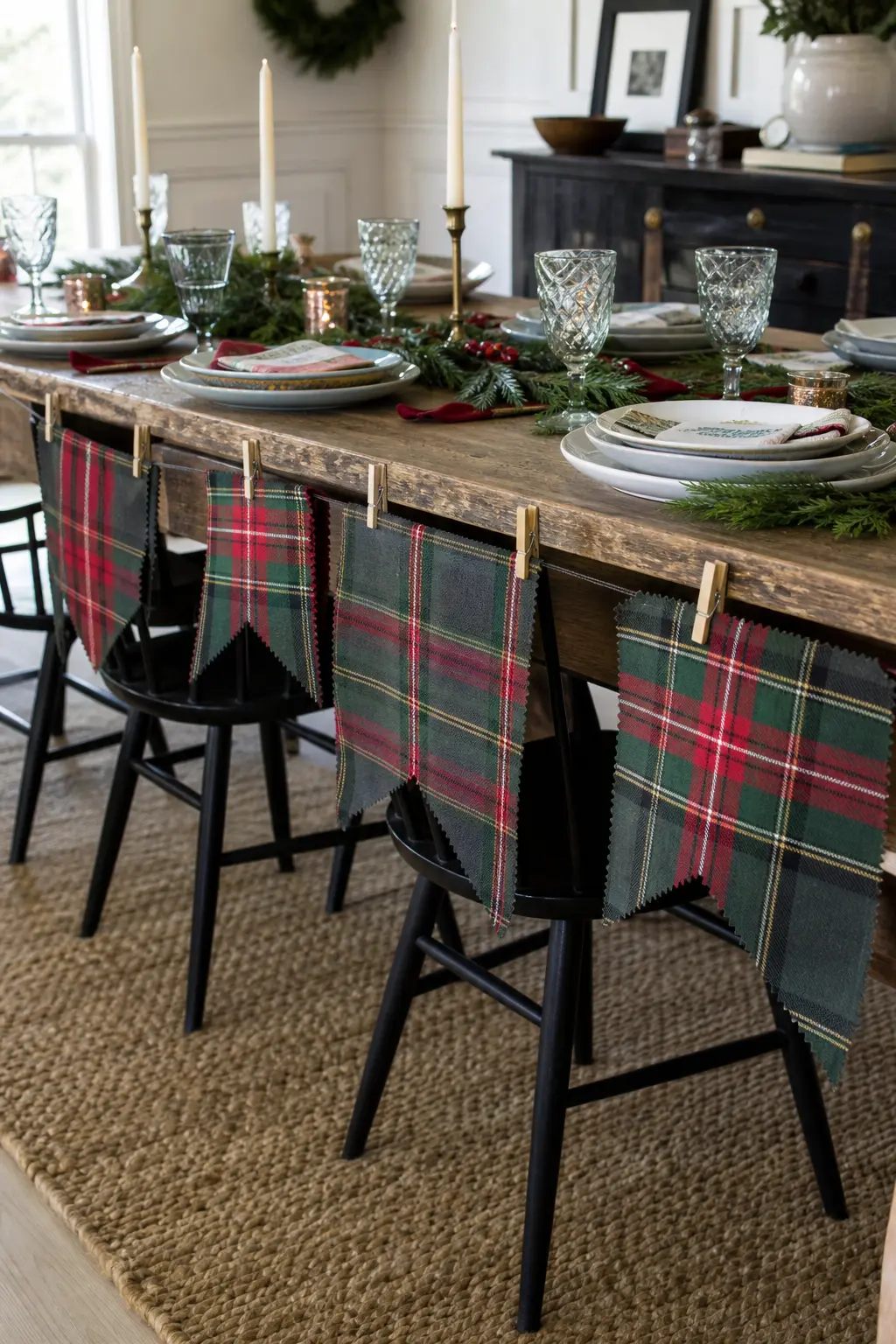
🛍 Shopping guide
Mirror Span of Hanging Tags
Span: the width of the mirror frame, typically 24 to 36 inches. Tag height: 3 inches. Anchor: the cord loops around the two top corners of the mirror frame, which is already hanging on its own hook, so nothing new touches the wall.
Cut tags from cream card using a tag punch or scissors, and tie each to the cord with a loop of oxblood satin ribbon. Write one letter per tag in a thick marker. The tags swing and shift when anyone walks past, and the mirror doubles the banner behind it so the effect reads twice the density for half the making time.
Keep no more than eight tags on a thirty-six-inch mirror or they crowd each other and the letters become illegible.
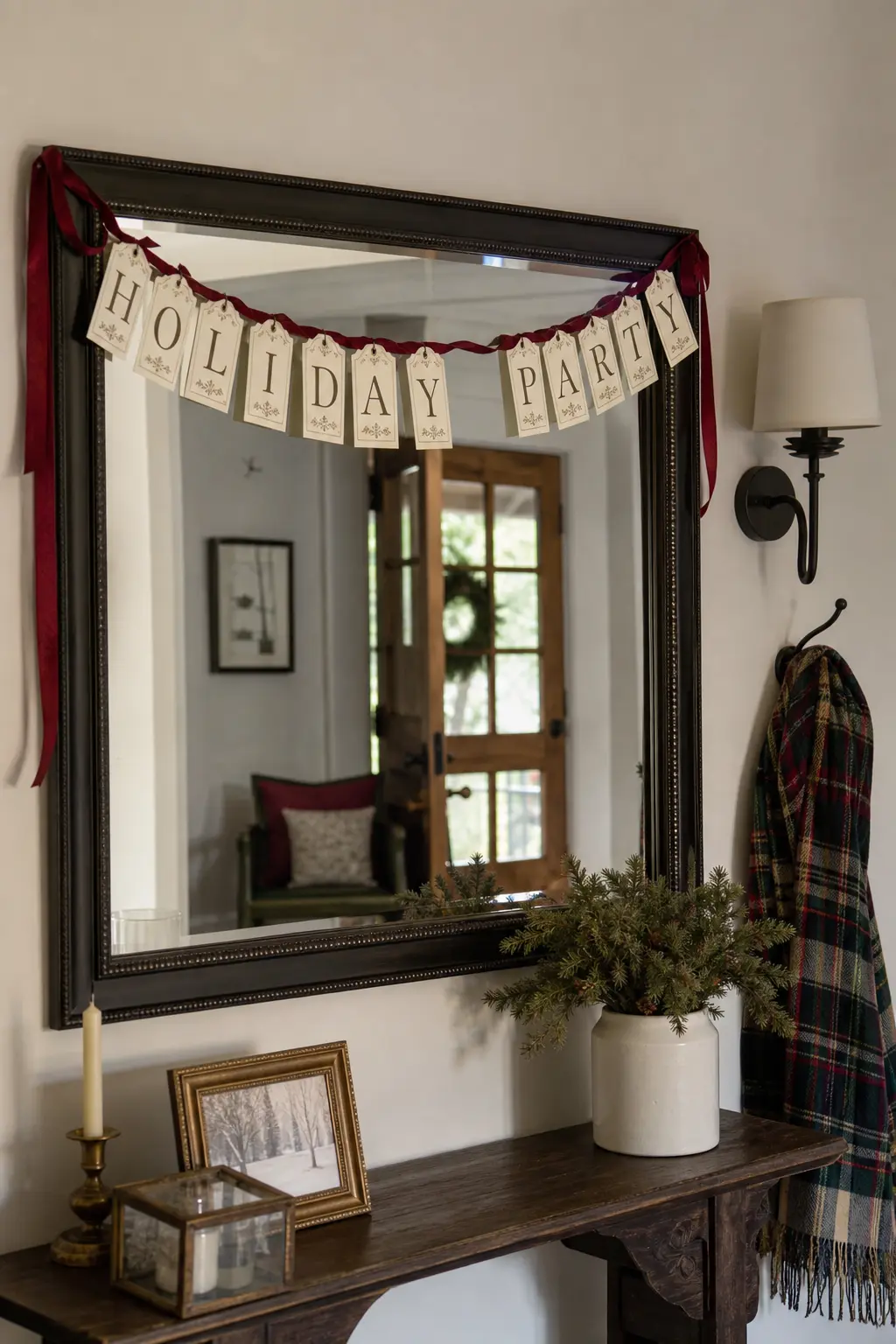
🛍 Shopping guide
Chair Back Mini Banner
Span: 16 to 18 inches across the top rail of a dining chair. Triangle height: 2 inches. Anchor: the cord ties around the two back uprights of the chair, which holds it taut and at the same height front and back.
This works best when every chair at the table wears the same banner, creating a repeated horizontal at eye level when guests are seated. Cut all triangles at once from a single oxblood felt sheet to keep the scale perfectly consistent. Tie each end cord in a bow rather than a knot so the banner slides off for washing or storage without scissors.
Sixteen chairs, sixteen banners, one felt sheet: this is the most scalable idea on this list.
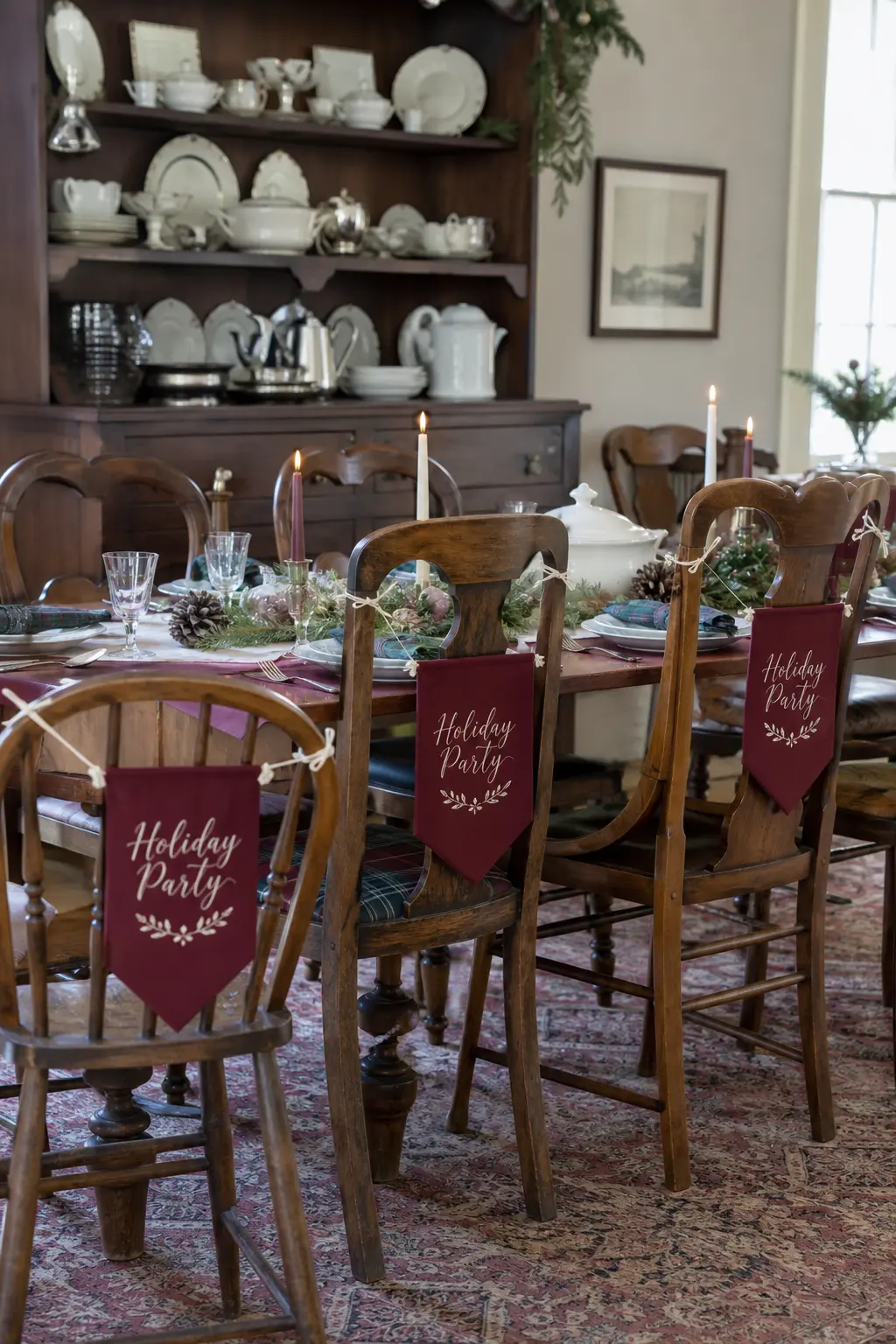
🛍 Shopping guide
Rope Span with Pegs and Photographs
Span: 48 to 72 inches between two hooks on a shelving unit, a ladder shelf, or a freestanding clothes rail. Photo height: 4-by-6 inches standard print. Anchor: the rope ties to existing furniture uprights so nothing touches the wall.
Use a twisted jute rope rather than cord here: the thickness keeps it from bowing under the weight of card and photo prints. Peg holiday photographs from previous years alongside cream card tags lettered with the year, alternating image and text so the eye moves along the line with variety.
This banner spans furniture rather than walls and stores with the photographs inside it, folded around the rope, which means reassembling next year takes under five minutes.
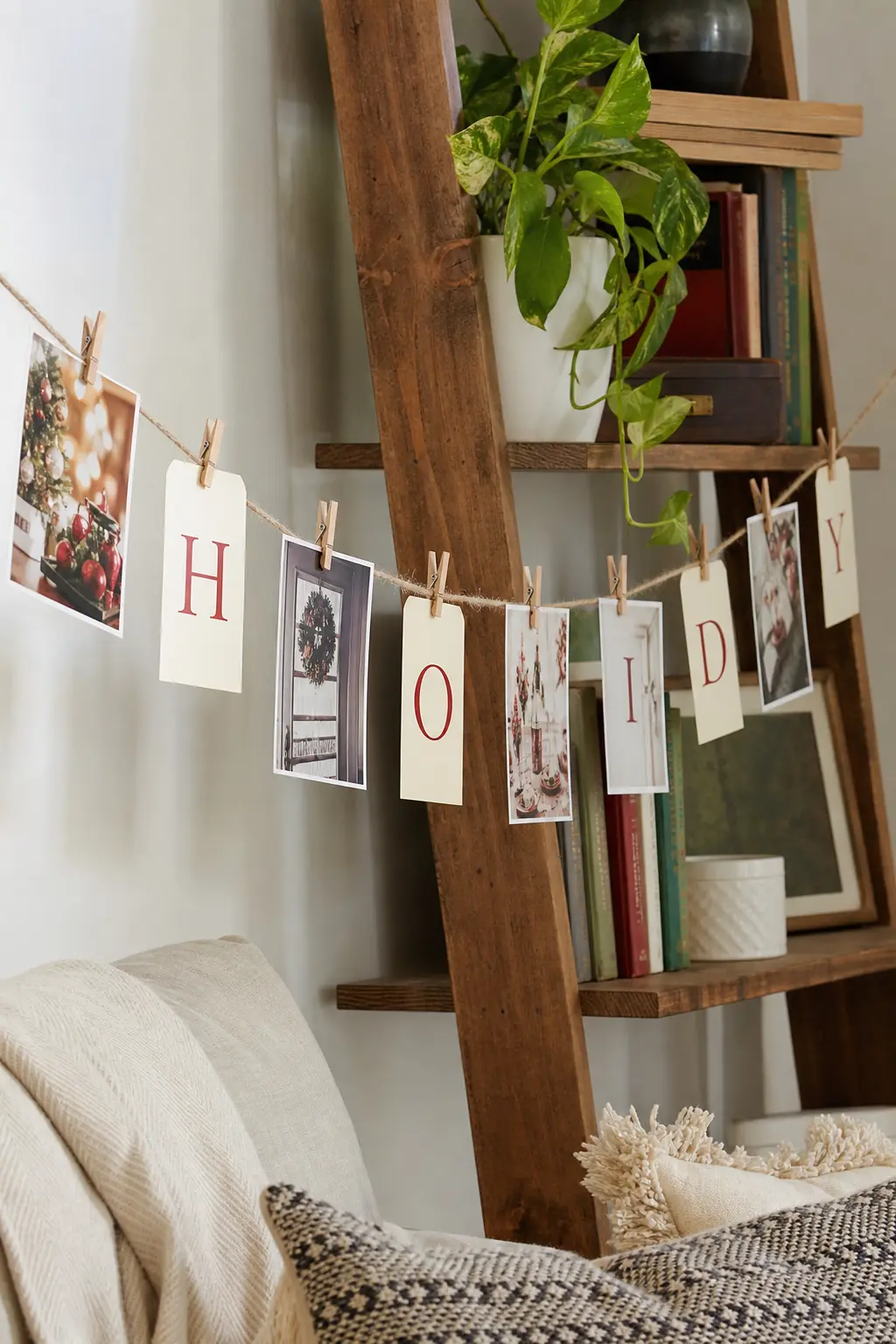
🛍 Shopping guide
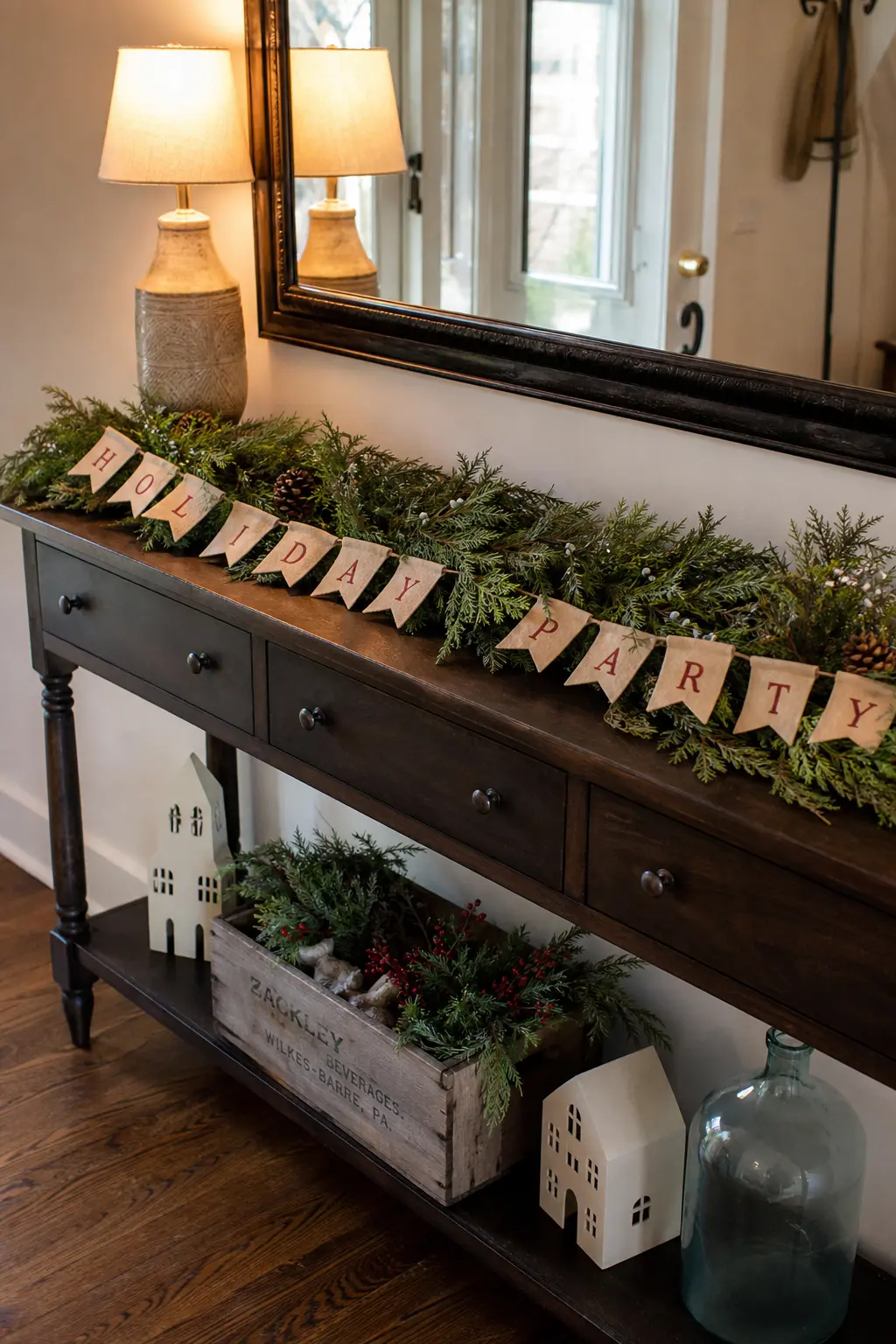
Garland with Letters Between Greenery
Span: 48 to 60 inches draped over a bookcase top or along a console. Letter height: 3 inches on small felt pennants tucked between stems. Anchor: the garland rests on the furniture surface; the weight of the greenery holds everything in place.
Wire a base garland of eucalyptus, pine and dried orange slices, then tuck hunter green felt letter pennants between the stems at regular intervals. The letters spell a word when read left to right through the foliage. Because the greenery is the carrier, the letters need no cord of their own.
Dried elements last the whole season without dropping. Fresh eucalyptus lasts ten days and smells better.
🛍 Shopping guide
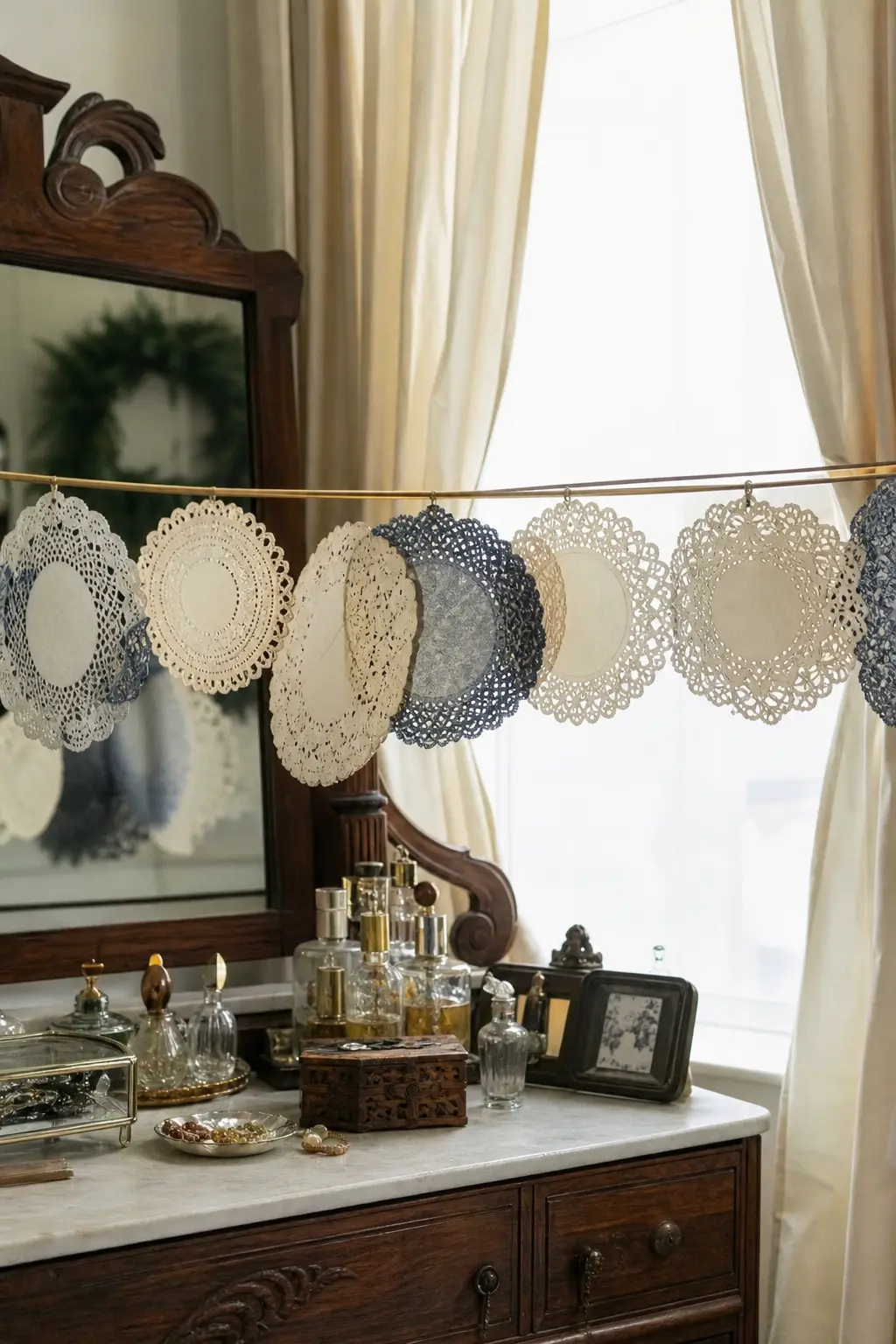
Banner of Overlapping Doilies
Span: 36 to 48 inches on a sideboard or dressing table. Doily diameter: 6 inches. Anchor: a single length of thin brass rod, the kind sold for café curtains, rests in two small wire clips that screw into the furniture back panel, not the wall.
Thread cream paper doilies onto the rod so each overlaps the next by one inch. Alternate plain cream doilies with ones dipped at the tip in diluted oxblood ink and dried flat. The ink dip creates an ombre edge without any paint or glitter.
The rod lifts off the clips in one movement and the doilies slide off the rod flat, so storage is a small envelope and a length of thin rod.
🛍 Shopping guide
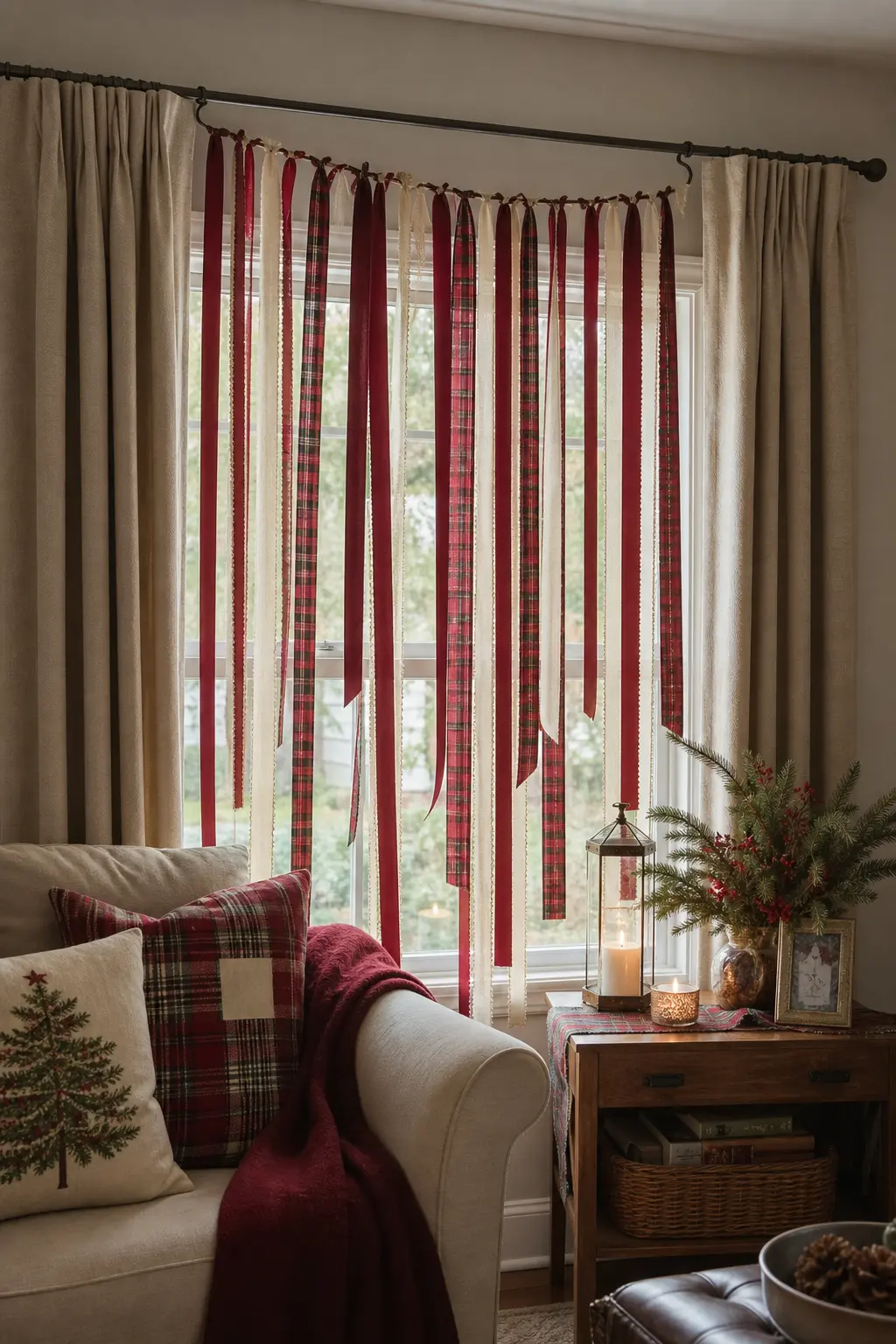
Curtain Pole Span of Ribbon Strips
Span: the full curtain pole width, typically 54 to 72 inches. Ribbon length: 18 to 24 inches hanging down from the pole. Anchor: the ribbons loop directly over the curtain pole between the curtain rings, so nothing touches the wall at all.
Cut oxblood, cream and tartan ribbon into equal lengths and loop each over the pole with a simple lark’s-head knot. Push the curtain rings aside to make a central gap about twelve inches wide, fill it with ribbon drops, then push the rings back to frame the panel. The curtains become the border.
This is the quickest banner on this list: under fifteen minutes from scissors to finished hang.
🛍 Shopping guide
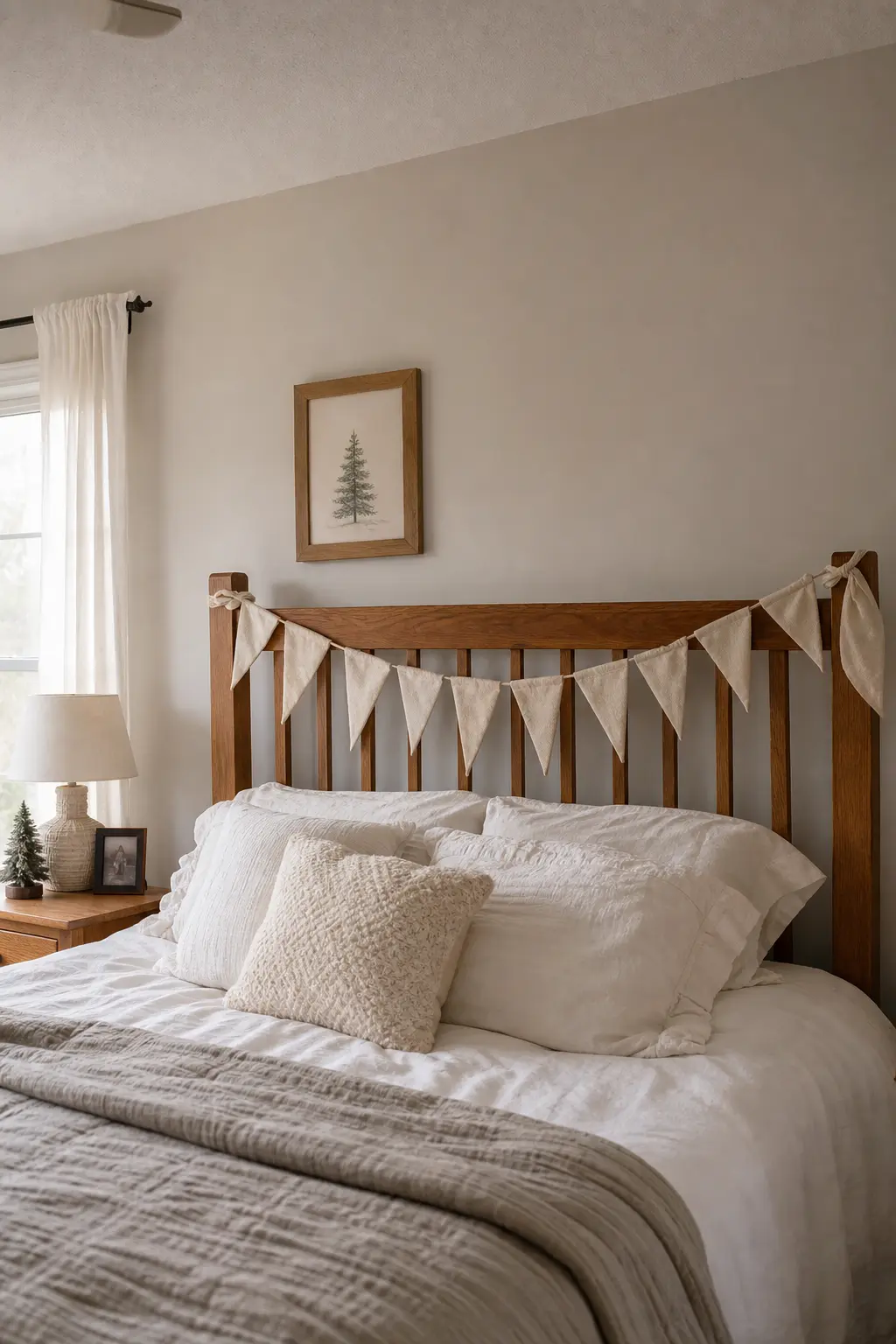
Bed Head Span in Muslin
Span: the width of the bed head, typically 54 to 72 inches. Triangle height: 4 inches. Anchor: the cord ties to each side upright of the bed head at its top corners, completely free of the wall behind.
Tea-dye natural muslin in a pot of strong black tea for thirty minutes to shift it from stark white to a warm cream. Cut the dried fabric into triangles while it is still slightly damp so the weave lies flat under scissors. The raw edges will fray a gentle half-inch fringe after the first wash, which suits the softness of a bedroom setting.
Tie each end cord with a bow, not a knot, so the banner slides off the bed head without effort when changing the bed linen.
🛍 Shopping guide
Outdoor and Utility Spans
A garden fence and a fridge face are at opposite ends of the glamour spectrum, but both reward the same principle: the mounting surface does the work so the banner itself can be lighter. Oilcloth triangles on a garden fence need grommets at the top so the wind does not tear them from the cord. Magnetic letters on a fridge face need no cord at all; the fridge is the anchor.
For outdoor runs, use jute or polyester cord rather than cotton. Cotton absorbs moisture, sags by morning and stains the triangles.
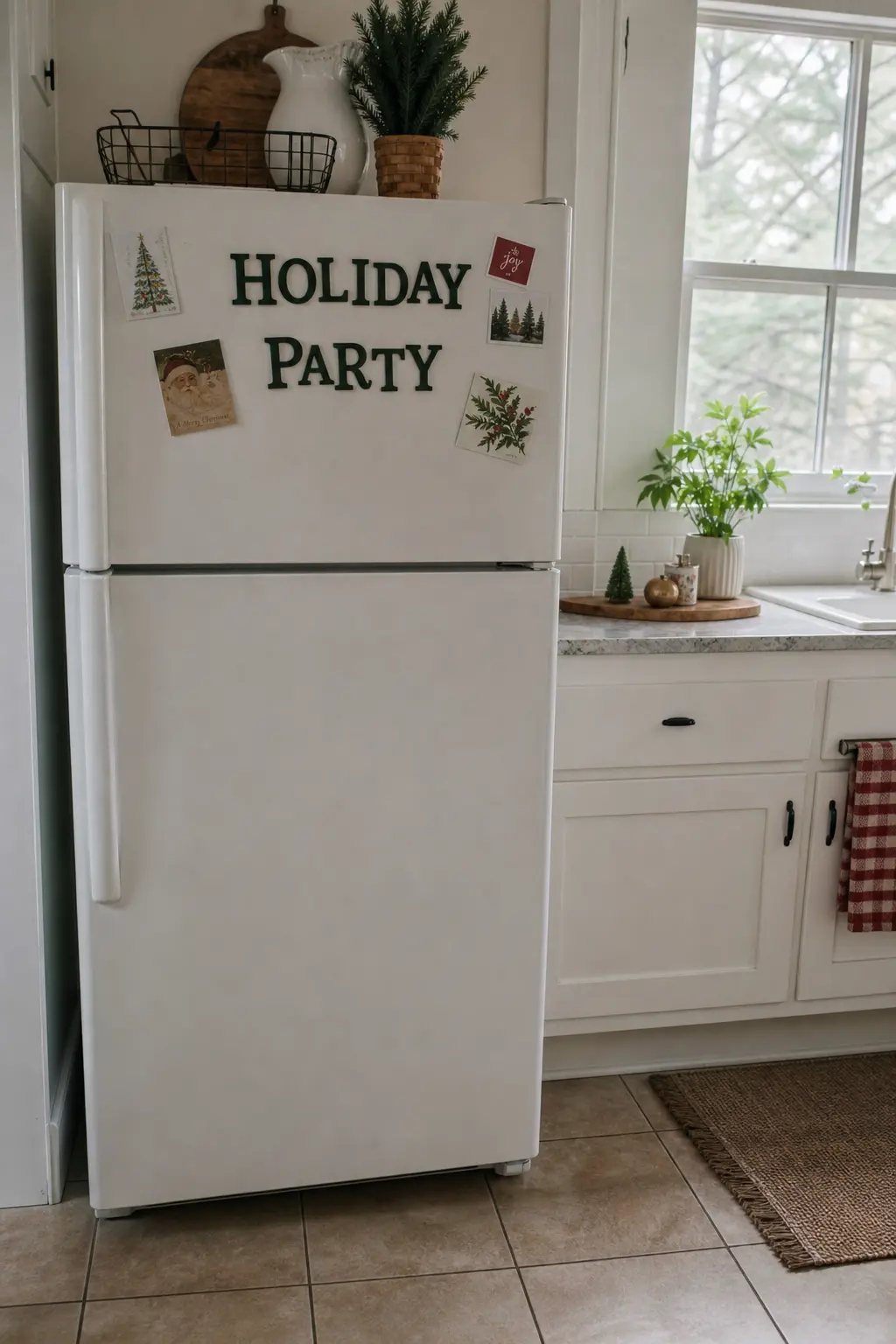
Fridge Width of Magnetic Letters
Span: 30 to 36 inches on a standard fridge face. Letter height: 3 to 4 inches on large magnetic tiles. Anchor: the fridge door is the anchor. Nothing else required.
Large wooden or acrylic letter tiles with a self-adhesive magnetic backing hold firmly on any standard fridge door. Paint the tiles in hunter green or oxblood craft paint before applying the magnetic backing, using two coats and a small sponge brush for an even finish. The paint sits on wood cleanly and wipes clean if a letter gets splashed.
Rearrange the letters for any word or occasion without making anything new. The whole set stores in a small box and this works on any fridge, any year.
🛍 Shopping guide
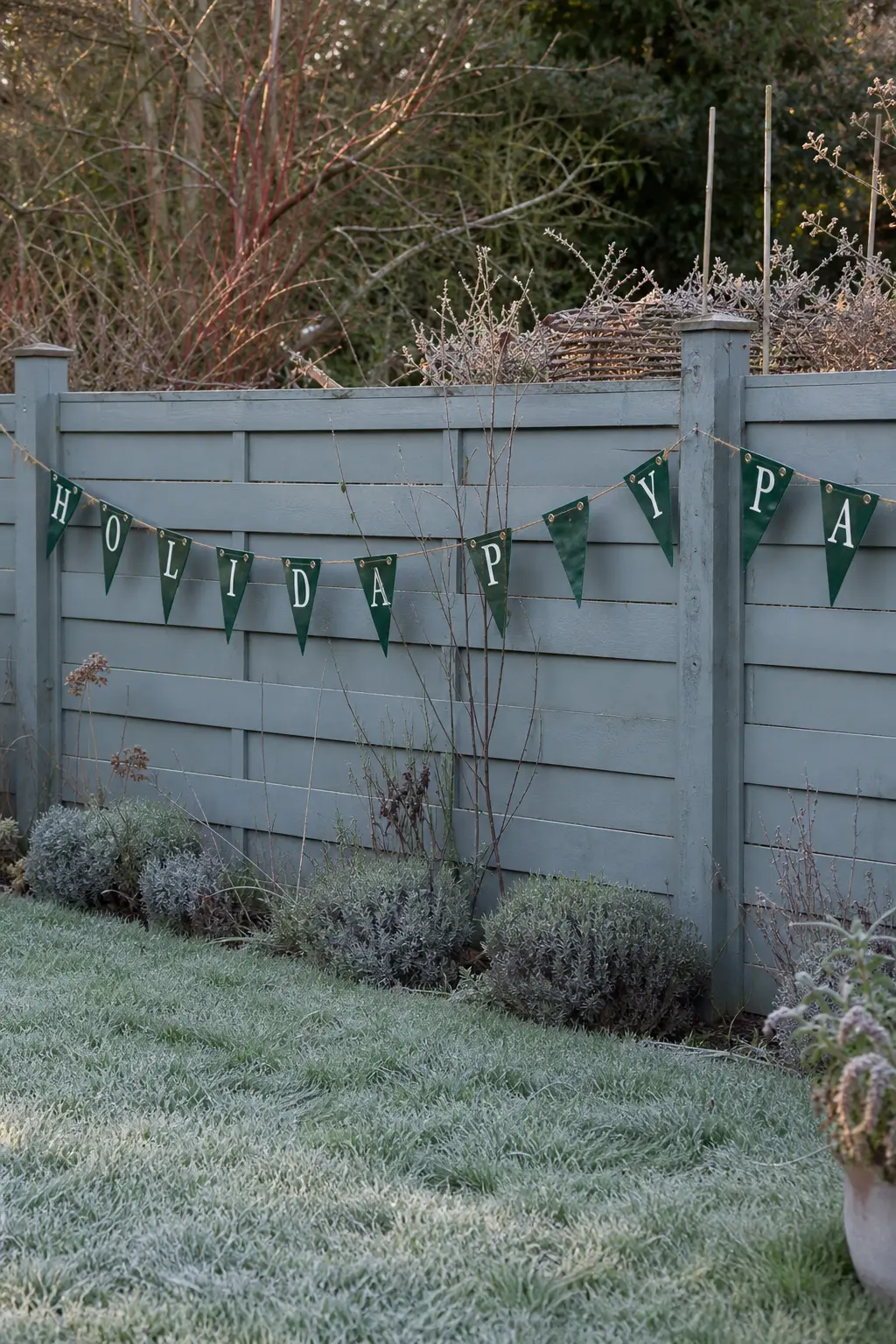
Garden Fence Run in Oilcloth
Span: as long as the fence panel, typically 72 to 144 inches. Triangle height: 6 inches. Anchor: brass grommets at the top two corners of each triangle loop onto thick jute or polyester cord tied to fence post tops.
Cut oilcloth triangles in hunter green or oxblood. Oilcloth does not fray, wipes clean, and holds colour in rain and frost. A standard grommet kit presses in without a machine. Space the triangles two inches apart so wind passes between them rather than loading the cord.
Use polyester outdoor cord, not cotton, which absorbs water and can stretch enough to let the banner touch the ground overnight after rain.
🛍 Shopping guide
diy christmas banner
The single thing that makes a homemade banner look considered rather than cobbled is consistency in one variable: either consistent triangle size, consistent letter height, consistent spacing, or consistent colour. Pick one, let the others vary a little, and the whole run coheres. Try to control all four at once and the making becomes a project that never gets finished.
For more ways to dress the room around your banner, browse christmas decor for mantel and shelf ideas, or start simpler with diy christmas decorations easy projects that use the same palette. If you want to build out the whole room from scratch, the full guide to diy christmas decorations covers every surface.
Measure the span, cut the cord six inches longer on each side, choose one material, and make twice as many flags as you think you need. The extras fill gaps, replace any that warp, and mean the word always fits. That last point is the one that solves the problem most people actually came here with.
Frequently Asked Questions
How long should a Christmas banner be?
Match the banner length to the span it fills: a mantel banner should reach within two to four inches of each end of the shelf, a doorway banner should span the full width of the frame, and a hallway banner should use a midpoint anchor for any run longer than eight feet to prevent sagging. Cut the cord six inches longer than the span on each side to allow for tying and adjustment.
How do you hang bunting without damaging walls?
Use removable adhesive hooks rated to the cord weight and always attach them to a non-porous surface such as a window reveal, tile, furniture face or the side of a chimney breast rather than directly onto painted plaster. Tension rods pressed between two walls leave no marks at all and hold cord runs up to fourteen feet without sagging. On staircases, cable ties looped around balusters work on every finish without leaving a trace.
How big should banner letters be?
As a working rule, four-inch letters read clearly from eight feet, and five-inch letters read from twelve to fifteen feet. For a hallway banner seen from the front door, five inches is the minimum. For a shelf banner read from across a kitchen counter, three inches is enough. Below three inches, letters read as texture rather than text from any normal viewing distance.
What fabric works for a homemade banner?
Felt is the most forgiving choice: it does not fray, holds shape at small sizes, and needs no hem. Muslin works well for soft or nursery settings and takes tea-dyeing well. Cotton sheeting suits long runs because it cuts in one session from a single piece and is lightweight enough for long cords. For outdoor banners, oilcloth is the only material that handles rain and frost without warping, staining or losing shape.
22 christmas wreaths diy ideas for every skill level and every room, with full materials, timing, ag

22 Christmas games for kids full of movement & hands-on fun — perfect for all December long!

Christmas eve activities for kids that get quieter as the night goes on. 10 free printables plus 6 n
Leave a Reply