

Not every bachelorette party needs a sash covered in buttons or a scavenger hunt down a dive-bar strip. Some of the best send-offs happen around a long table with good wine, the women who matter most, and games that actually spark real conversation.
If your bride is the type who’d rather laugh over a perfectly poured rosé than chase a dare around a parking lot, you’re in exactly the right place.
These twenty classy bachelorette party games are designed for a villa weekend, a wine-country retreat, a rented beach house, or any gathering where the vibe is warm, elegant, and a little bit roast-y without ever crossing a line.
Twelve of them come with printable sheets you can prep before you leave home; the rest need nothing more than everyday supplies you’ll already have on hand.
Read through, pick your favourites, and build a weekend schedule that feels effortless—because the best host tip of all is to plan ahead so you never have to scramble.
This post contains affiliate links — if you buy through them, I may earn a small commission at no extra cost to you.
Table of Contents
- Wine Blind Taste Ranking
- How Well Do You Know The Bride?
- Memory Lane Timeline
- Advice for the Bride
- Guess the Honeymoon Destination
- Bride Trivia Rounds
- Would You Rather Bride Edition
- Photo Memory Match
- Table Topics — Bachelorette Weekend
- Cocktail Making Contest
- Bridal Scattergories
- A Letter to the Bride
- Bride Bingo
- Signature Scent Guessing Game
- Ring Toss Rosé
- Couples Portrait Drawing Challenge
- Two Truths and a Twist
- Sommelier Says Blind Pairing
- Shoe Game — Seated Edition
- Collaborative Wedding Story
1. Wine Blind Taste Ranking
Set out five to eight unmarked wine glasses, each holding a small pour of a different wine—vary the grape, region, or style as much as your budget allows.
Guests receive a printed Wine Blind Taste Ranking sheet with numbered columns for each glass and rows covering aroma, colour, body, sweetness, and their overall star rating.
Everyone sips in silence, fills in their impressions, and finally writes their best guess at what the wine actually is before the reveal.
Once everyone has tasted all the glasses, go column by column and compare notes out loud. The conversation that erupts when two guests describe the same wine as “buttery and sophisticated” versus “tastes like a petrol station car wash” is worth the whole exercise.
Award a small prize—a mini bottle of the winning wine is perfect—to whoever correctly identifies the most varieties or scores closest on the ranking scale you’ve agreed on.
You need: the printed ranking sheets, brown paper bags or foil to hide the bottles, one pen per guest, and at least five wines. Works beautifully for six to fourteen guests and runs about forty-five minutes including the reveal.
Host tip: pre-pour all glasses in a separate room and number the bases with a wax pencil so you never lose track of which wine is which during the chaos of the reveal.

🛍 Shopping guide
2. How Well Do You Know The Bride?
Before the weekend, interview the bride privately—or send her a short questionnaire—collecting thirty or so facts about her life, her relationship, her opinions, and her quirks. Transfer the best ones onto the printed “How Well Do You Know The Bride?”
sheet as a series of multiple-choice and fill-in-the-blank questions. Think: “What was the bride’s first job?” and “Where did she and her partner have their first argument, and who apologised first?”
Hand a sheet to every guest at the start of a meal or gathering, give everyone ten minutes to answer individually, then read the correct answers aloud while the bride reacts to each one.
The guest with the highest score wins bragging rights as the official Best Friend—and the bride gets a surprisingly touching window into how well the people in her life actually know her story.
Groups of six to twenty work perfectly; the game runs about twenty minutes. Host tip: include at least two questions that even the maid of honour won’t know—it levels the playing field and keeps the bride delightfully smug.

3. Memory Lane Timeline
Collect a list of fifteen to twenty significant moments from the bride’s life—her first day of school, the year she moved cities, the night she met her partner, the holiday that changed everything—and print them on the Memory Lane Timeline sheet in completely scrambled order.
Each guest must arrange the events in the correct chronological order, working from memory and instinct alone.
Read the correct timeline aloud as a group once everyone has finished, and let guests tell the story behind any moment they remember being part of.
This is where the game quietly transforms into something more meaningful: the bride watches people reconstruct her life with love and laughter, and the stories that surface alongside each event are often more memorable than any formal toast.
Ideal for eight to sixteen guests; allow twenty to thirty minutes. Host tip: seed the list with one or two events the bride considers private but hilarious—confirm with her first—so the reveal moment gets a genuine reaction from the whole room.

4. Advice for the Bride
The Advice for the Bride printable is a beautifully simple card that each guest fills in with one sincere piece of marriage advice, one funny piece of marriage advice, and one thing she hopes the bride never forgets about herself.
There are no right or wrong answers, which is exactly why this one lands so well—guests who freeze up during toasts suddenly find they have plenty to say when the format is this contained.
Collect all the cards, shuffle them, and read them aloud one at a time while the group tries to guess who wrote each one.
The guessing game adds a layer of playful competition, and the bride ends up with a keepsake stack of cards she can re-read on any anniversary she needs a boost.
Slip them into a small envelope and tie it with a ribbon before you hand them over.
Works for any group size from four to thirty; the reading and guessing portion takes about twenty-five minutes. Host tip: read the funny advice before the sincere advice—it warms the room up so that when the genuinely tender cards land, nobody feels self-conscious about getting emotional.

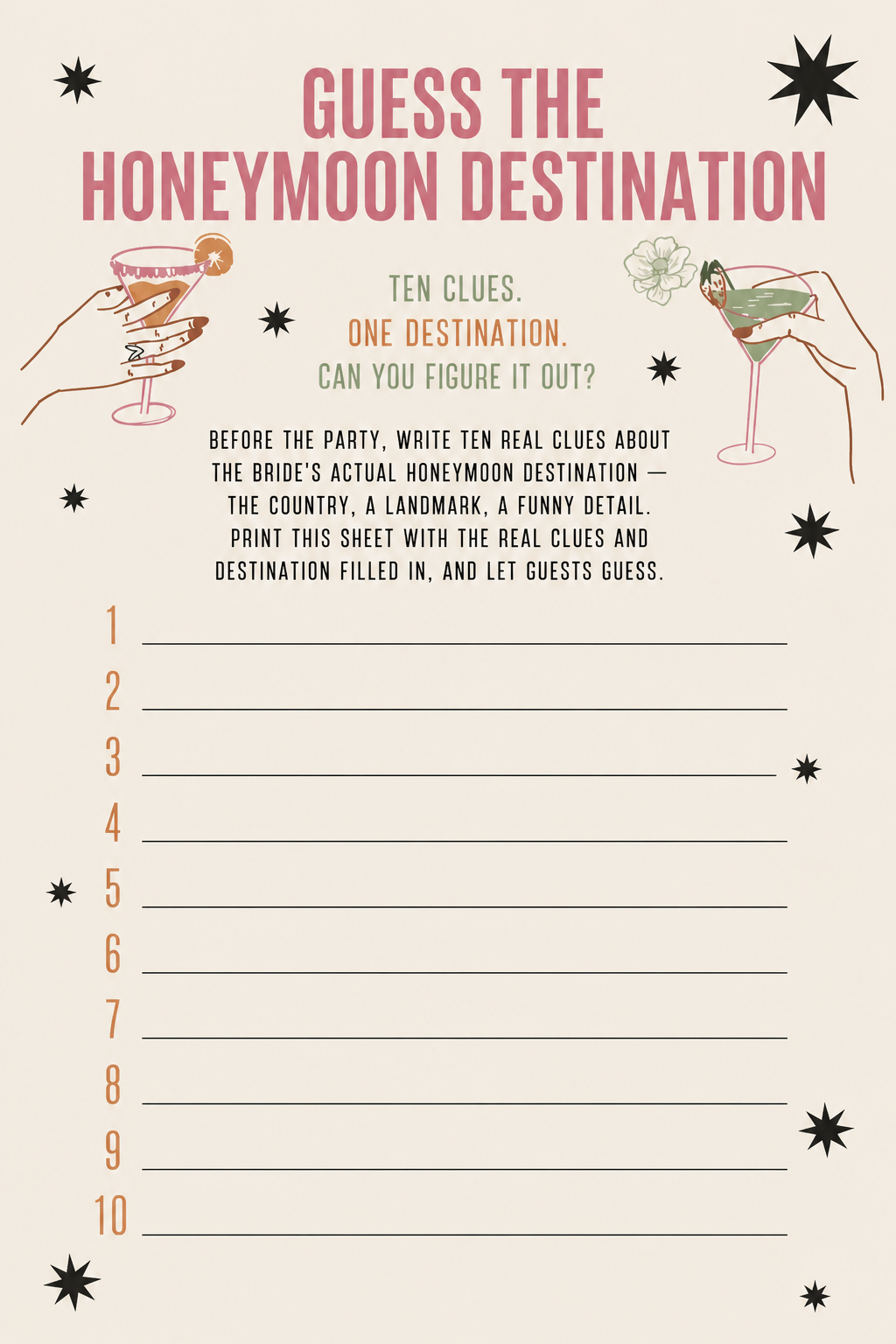
5. Guess the Honeymoon Destination
Before the weekend, ask the bride’s partner to give you three confirmed facts and three deliberate red herrings about the honeymoon destination—this only works if the destination is a surprise to the bride, so confirm that before you start.
Print the clues on the Guess the Honeymoon Destination sheet alongside a world map outline and a list of twenty possible destinations. Guests study the clues, eliminate options, and circle their final answer.
Read the clues aloud one at a time, pausing after each one so guests can change their answers.
The bride plays along and guesses too, which makes the eventual reveal—if the host has the actual destination in a sealed envelope from the partner—a genuinely special moment in the middle of the weekend.
If the honeymoon isn’t a surprise, simply have the bride write her own cryptic clues beforehand and see how well her friends know her taste in travel.
Six to twenty guests; runs fifteen to twenty minutes. Host tip: coordinate with the partner a week before the trip so you have time to print accurately—last-minute changes to travel plans have derailed more than one reveal.
6. Bride Trivia Rounds
Structure this one like a proper pub quiz, because that’s exactly what it is—just hosted in your villa with better snacks.
The Bride Trivia Rounds printable divides into four themed rounds: the bride’s life and history, the couple’s relationship, pop-culture questions the bride would crush, and a wildcard round chosen by the maid of honour.
Teams of two or three take on each round, writing answers on the sheet and passing it to a designated scorer.
Keep rounds to seven questions each and read them at a steady pace so the energy stays high. Between rounds, have the bride answer one bonus question on camera—her answer becomes the tiebreaker if scores are level at the end. A running scoreboard on a whiteboard or large notepad keeps the competitive tension alive through all four rounds.
Best for ten to twenty guests split into teams; full game runs fifty to sixty minutes. Host tip: write more questions than you need and cut the weakest ones the night before—a tight, punchy trivia game is always better than one that drags through its last five questions.

7. Would You Rather Bride Edition
The Would You Rather Bride Edition printable presents thirty dilemmas tailored entirely to the bride’s world: her relationship, her career, her social life, her travel style, and her biggest quirks.
Each dilemma is genuinely hard—”Would you rather spend a year without your partner or a year without your closest friends?”—so guests can’t just coast through it on autopilot. Everyone circles their answer individually, then compares with the group.
The real game is predicting what the bride chose. After the group reveals their own answers, the bride reads her pre-filled copy aloud. One point for every correct prediction; bonus points if you can explain your reasoning and the bride agrees it’s accurate.
The guest who knows the bride’s mind best wins, but the conversations that spiral out of every single dilemma are the actual prize.
Any group size; twenty to thirty minutes. Host tip: have the bride fill in her sheet privately before the party starts and seal it in an envelope—opening it live in front of everyone is far more dramatic than reading answers off a phone screen.

8. Photo Memory Match
Gather twenty to thirty photos from the bride’s life—childhood, teenage years, friendships, couple moments, travel—and print them small enough to fit two per playing-card-sized piece of cardstock. One copy becomes the “match” set and is arranged face-down in a grid on a table.
The Photo Memory Match printable sheet lists each photo with a partial caption that guests must complete from memory before they can “earn” a matched pair.
Players take turns flipping two cards and answering the corresponding caption question before keeping the pair. If they flip a match but can’t complete the caption correctly, the cards go back face-down and the turn passes.
The player who collects the most matched pairs wins, but every photo flipped tends to launch a story—someone always has context for a photo no one else remembers.
Works best with six to twelve guests; allow thirty to forty minutes. Host tip: laminate the cards if you have time—wine and cardstock are not natural allies, and laminated cards survive the evening intact for the bride to keep as a memento.

🛍 Shopping guide
9. Table Topics — Bachelorette Weekend
Modelled on the classic dinner-party conversation card format, the Table Topics – Bachelorette Weekend printable gives every guest a set of prompt cards designed specifically for this group and this occasion.
Questions range from “Describe the bride in exactly three words and defend every one” to “What’s the most unexpectedly useful thing you’ve learned from your own relationship?” They’re intimate without being intrusive, funny without being crude.
Place a stack face-down in the centre of the table at dinner or brunch. Each guest draws a card on her turn and either answers it herself or directs it to another guest.
There’s no scoring and no winner—the point is to generate the kind of conversation that keeps everyone at the table for two hours longer than they planned. It pairs beautifully with a long, relaxed dinner.
Any size group; the game runs as long as the group wants it to. Host tip: seed three or four particularly moving questions near the bottom of the deck so the conversation deepens naturally as the evening progresses rather than peaking too early.

10. Cocktail Making Contest
Divide guests into teams of two or three and give each team the same base spirits, mixers, garnishes, and tools. Each team has twenty minutes to invent a signature cocktail and name it something that relates to the bride, the couple, or the weekend.
The Cocktail Making Contest printable serves as an official ballot: judges—usually the bride and one other volunteer—score each drink on appearance, creativity of the name, taste, and overall presentation.
Once all cocktails are mixed and named, each team presents their creation with a brief thirty-second pitch explaining their inspiration. The judges mark the ballots, scores are tallied, and the winning cocktail becomes the official drink of the weekend, mixed in a larger batch for everyone to enjoy. Framed recipe cards for the winning drink make a lovely takeaway.
Best for eight to eighteen guests; the mixing and judging portion takes about forty-five minutes. Host tip: pre-measure spirits into small pitchers before the game starts—it keeps the competition focused on creativity rather than on fumbling with bottle caps, and it subtly limits overconsumption.

🛍 Shopping guide
11. Bridal Scattergories
Bridal Scattergories works exactly like the classic categories game but every category is tied to the bride, the wedding, or the weekend.
The printed sheet lists twelve categories—”Something you’d find at their wedding venue,” “A word that describes the bride’s style,” “A place the couple has travelled together”—and a letter is chosen at random by rolling a letter die or drawing from a folded set.
Every answer must start with that letter, and duplicate answers cancel each other out.
Play three rounds with different letters, tallying unique answers after each one. The categories stay the same across all three rounds, which means strategy builds as guests figure out which categories their answers are least likely to share. The final-round tension—when everyone realises they’ve all written the same answer for “something the bride collects”—is reliably hilarious.
Six to sixteen guests; three rounds take about thirty minutes total. Host tip: customise the categories on the sheet before you print it. Generic categories produce generic answers; categories built around specific details of the bride’s life produce the answers that get read aloud at future dinner parties for years.

🛍 Shopping guide
12. A Letter to the Bride
At some point during the weekend—ideally at a quiet moment, perhaps over a morning coffee or after dinner—give every guest the A Letter to the Bride printable and fifteen minutes of gentle background music and uninterrupted time.
The sheet has a guided structure: one paragraph about your first memory of the bride, one about what you admire most, one piece of honest hope for her marriage, and a closing line she can return to whenever she needs it.
The letters aren’t read aloud—that’s what makes this one different. They’re folded, sealed, and collected into a keepsake box or envelope that the bride opens privately after the weekend is over, or on a meaningful date she chooses herself.
The act of writing together in the same room, even in silence, creates a surprisingly tender collective moment that guests mention for years.
Any group size; allow fifteen to twenty minutes of writing time. Host tip: bring envelopes and a wax seal stamp so each letter feels like a proper keepsake from the moment it’s folded—it signals to every guest that what they’ve written actually matters.

🛍 Shopping guide
13. Bride Bingo
Each guest receives a Bride Bingo card pre-printed with a five-by-five grid of phrases, traits, and scenarios drawn from the bride’s real life—things like “has strong opinions about font choices,” “cried at a TV commercial this year,” or “can name every member of a specific band from the 90s.”
The centre square is always a free space.
Instead of a caller drawing numbers, guests mingle during the first hour of the party and mark off squares by finding a fellow guest who fits each description—or by listening for moments during conversation when the bride herself demonstrates a square.
The first guest to complete a line—horizontal, vertical, or diagonal—calls “Bingo!” and reads her completed line aloud. The group votes on whether each square was legitimately earned, which sparks its own round of laughter and gentle argument. Keep going until someone completes a full card for a blackout bonus prize.
Works for eight to twenty-four guests; runs forty-five to sixty minutes woven into the opening of the party. Host tip: make every card slightly different by shuffling the placement of squares before printing—identical cards produce a simultaneous bingo that nobody believes, and shuffled cards keep everyone competing until the very end.

14. Signature Scent Guessing Game
Ask each guest to bring a small sample of her favourite perfume—decanted into an unlabelled rollerball or spritzed onto a numbered paper strip—without telling anyone what it is.
Arrange the numbered strips on a tray and give every player a simple answer sheet with space to write the name of the perfume, the note she detects most strongly (floral, woody, citrus, musky), and which guest she thinks brought it.
The bride plays too, and her nose is usually better than she thinks.
Reveal answers strip by strip: first the note, then the perfume name, then the guest it belongs to. Award a point for each correct identification and a bonus point if the guest can explain why the scent suits its owner.
The conversation that follows—about scent memories, signature fragrances, and the perfume someone wore to a significant occasion—is unexpectedly rich and personal.
Six to fourteen guests; runs thirty to forty minutes. Host tip: limit each strip to one spritz and space them at least six inches apart on the tray—scent fatigue is real, and crowded strips bleed into each other, making the game genuinely impossible rather than pleasantly challenging.
15. Ring Toss Rosé
Set up six to ten wine bottles in a loose cluster on the floor or a low table—empty bottles filled with a little water or sand for stability work perfectly.
Each bottle is labelled with a different dare or truth prompt: “Give the bride a toast,” “Share your worst travel disaster,” “Describe your ideal wedding vow in one sentence,” and so on.
Guests take turns standing behind a tape line and tossing a small ring onto a bottle neck from about four feet away.
When a ring lands cleanly, the tossing guest reads the prompt on that bottle aloud and either answers it herself or directs it to the person of her choice.
Nobody is required to answer anything that makes them genuinely uncomfortable—passing costs one sip from your own glass, which is consequence enough to keep the game moving. The blend of physical coordination and conversational prompts keeps energy high across a wide range of guests.
Six to twenty guests; runs thirty to forty-five minutes. Host tip: weight the bottles evenly before the game—a bottle that topples every time a ring grazes it quickly becomes more frustrating than fun, and a stable target makes the satisfying “clink” of a successful toss audible across the room.
🛍 Shopping guide
16. Couples Portrait Drawing Challenge
Give every guest a piece of cardstock, a set of coloured pencils or markers, and exactly three minutes to draw a portrait of the bride and her partner from memory.
No reference photos allowed, no artistic ability required—in fact, the worse the drawing, the better the game. Everyone draws simultaneously, and when time is up, all portraits are propped up or taped to a wall in a gallery row for judging.
The bride serves as sole judge, walking the gallery and awarding three prizes: most realistic likeness, most artistic interpretation, and “most charitable to everyone involved.” She writes a one-line critique on a sticky note beneath each portrait, which becomes part of the charm. Photographs of the gallery make an outstanding addition to a wedding scrapbook.
Any group size; the drawing takes three minutes, judging and commentary run another fifteen. Host tip: set a countdown timer on a phone and make it visible—the ticking clock transforms mediocre drawers into hilariously committed ones, and the pressure produces much funnier results than an open-ended session would.
🛍 Shopping guide
17. Two Truths and a Twist
This is a more structured, high-stakes variation of the classic two-truths-and-a-lie format. Each guest prepares three statements about herself or about her relationship with the bride—two are completely true, and one is technically true but told in a deliberately misleading way (the “twist”).
The goal isn’t outright lying; it’s framing a real event so plausibly that it sounds like the fabricated one. This distinction makes the game far harder and far more interesting than the original.
After each guest reads her three statements, the group has sixty seconds to confer quietly before voting on which statement contains the twist. The guest then reveals and explains all three, including exactly how the twist was constructed.
Award a point to every guest who spotted the twist correctly, and a bonus point to the statement-giver if she fooled more than half the room.
Six to twenty guests; runs thirty to forty-five minutes depending on group size. Host tip: play a demonstration round yourself before guests take their turns—showing rather than explaining the “technically true but misleading” concept saves five minutes of confused questions and gets everyone into the right creative mindset immediately.
18. Sommelier Says Blind Pairing
Prepare four small cheese and charcuterie pairings—each one a single cheese, a single accompaniment like jam or nuts, and a small unlabelled pour of wine—and give guests a simple pairing scorecard to rank how well each combination works on a scale of one to ten.
The twist is that one pairing in each set is deliberately mismatched: a tannic red with a mild cream cheese, for instance, or a sweet dessert wine with an aggressively salty cured meat.
After guests score all four pairings, reveal which one was the deliberate mismatch and discuss why it doesn’t work in terms of flavour balance.
A local cheesemonger or wine shop staff member can often suggest pairings and mispairings for a small fee and will usually enjoy the creative brief. The guest whose scores most closely match the “expert” ranking wins the title of Resident Sommelier for the weekend.
Six to twelve guests; runs about thirty-five minutes. Host tip: prepare a single printed reference card for yourself listing what each pairing contains—when guests start asking detailed questions mid-game, having the information to hand keeps things moving smoothly without spoiling the blind element.
🛍 Shopping guide
19. Shoe Game — Seated Edition
The bride and her partner don’t need to be in the same room for this one—record the partner answering a set of “who” questions on video the night before: “Who said ‘I love you’ first?” “Who burns every meal they attempt?”
“Who would survive longer in the wilderness?” Play the video on a laptop or TV with the screen hidden from the bride.
The bride sits facing away from the screen, holding one of her own shoes and one of her partner’s shoes (or two clearly different objects standing in for them).
A host reads each question aloud, the group watches the partner’s answer on screen simultaneously, and the bride raises the shoe she thinks matches the answer.
When the answers align, the group cheers; when they diverge, the explanation is almost always more entertaining than the agreement. The game doubles as a touching window into how the couple sees their dynamic, told in the partner’s own words.
Any group size; runs twenty to thirty minutes. Host tip: film the partner’s answers somewhere visually nice and keep it under three minutes total—a tight, well-lit video holds the room’s attention far better than a shaky, rambling one recorded in a car park at midnight.
20. Collaborative Wedding Story
Give every guest three small pieces of paper and ask her to write one sentence that could plausibly appear in the middle of a romantic short story—no beginning sentences, no ending sentences, just a vivid middle moment.
Collect all the slips, shuffle them, and then appoint a narrator (usually the maid of honour or the most theatrical guest available) to weave them into a single improvised story in front of the group, connecting each sentence with bridges she invents on the spot.
The resulting story is always gloriously incoherent, occasionally poetic, and sometimes accidentally profound. The narrator earns points for smooth transitions and loses points—by group vote—for every time she visibly panics.
At the end, the bride selects her three favourite sentences from the chaos, and those sentences are written on a card she keeps. Several brides have worked a favourite sentence from this game into actual wedding speeches.
Eight to twenty guests; runs twenty to thirty minutes. Host tip: brief your narrator privately before the game—let her read the slips once so she isn’t encountering “she rode a horse into the municipal library” completely cold. One preview pass makes the performance dramatically more confident and the comedy dramatically more refined.
Frequently Asked Questions
What makes a bachelorette party game "classy"?
A classy bachelorette game creates genuine connection and lasting memories without relying on embarrassing dares, crude props, or humour that ages badly in photographs.
The best ones feel like something the bride would actually want to do—conversation starters, creative challenges, tastings, and heartfelt activities that leave guests feeling closer to each other at the end of the night than they did at the beginning.
How many games should I plan for a bachelorette weekend?
For a two-night weekend, four to six games spread across the itinerary is ideal.
Plan one anchor activity per gathering—a tasting game at Friday dinner, a trivia round at Saturday lunch, a heartfelt letter-writing session Saturday evening—and keep at least one game in reserve in case the group needs more.
Resist the urge to schedule every hour; unstructured time is part of what makes a weekend away feel luxurious.
Do I need to buy anything special for these games?
Most of these games need nothing beyond a printer, standard cardstock, and pens. A handful benefit from inexpensive props like ring toss rings or a cocktail shaker set.
For the wine tasting and cheese pairing games, your biggest investment is the food and drink itself—which you’d be buying for the weekend anyway. Print your sheets before you leave home, pack a small basket with pens and scissors, and you’re set.
Can these games work for a bachelorette party that isn’t a full weekend away?
Absolutely. Every game here works for a single evening, a long brunch, or an afternoon gathering. For a shorter event, prioritise the games that double as conversation pieces—Table Topics, Advice for the Bride Cards, and Would You Rather work beautifully woven into a meal with no setup required beyond placing printed sheets at each seat before guests arrive.
What if the group has a mix of people who don’t know each other well?
Start with the Bride Bingo or the Two Truths and a Twist game—both are designed to reveal personality quickly and give strangers an easy on-ramp into conversation.
Avoid opening with games that assume deep shared history; save Memory Lane Timeline and Photo Memory Match for after the first evening, once the room has warmed up and guests have begun to place each other in the bride’s story.
📌 Save These for Later
Loved these? Pin your favorite image below so you can find this list again when you’re planning.



20 birthday party games for adults that are actually fun — witty, competitive & nostalgic. No crin
Discover 18 energetic party games for teenagers in large groups that break up cliques, get everyone

20 slumber party games for teens that actually slap — printable sheets, active challenges & late-n
Leave a Reply