


Planning a graduation party means pulling off something that rarely happens in everyday life: the graduate’s college roommates are standing next to their kindergarten teacher, their grandparents are chatting with their best friends, and everyone is expected to have a great time together.
The right games are what make that work. They give every age group a reason to laugh, move around, and actually talk to each other instead of clustering in separate corners of the yard.
The twenty graduation party games below are built for exactly that mixed crowd. About half come with a printable sheet you can prep the night before, and the other half need nothing more than items you already have or can grab at any party store.
Each one is scalable — it works whether you have fifteen guests or a hundred and fifty. Pick four or five that feel right for your vibe, set them up before guests arrive, and let the graduate be the center of every single moment.
This post contains affiliate links — if you buy through them, I may earn a small commission at no extra cost to you.
Table of Contents
- Guess the Baby Photo of the Grad
- Advice for the Grad
- Graduation Trivia: How Well Do You Know the Grad?
- Predictions for the Future
- Where Will They Be in 10 Years?
- Cap Toss Ring Game
- Graduation Bingo — Find Someone Who
- Memory Lane Timeline
- Guess the School Year Photo
- Signature Scavenger Hunt
- Yearbook Superlatives Ballot
- Toast and Wishes Cards
- Grad Mad Libs: The Official Story of the Graduate
- I Spy the Grad’s Life – Photo Wall Challenge
- This or That: Grad Edition
- Graduation Memory Jar
- Two Truths and a Lie: Grad Edition
- Balloon Pop Dare Dash
- Compliment Hot Seat
- Life Skills Showdown
1. Guess the Baby Photo of the Grad
Before the party, ask the graduate’s family to dig up five to ten baby and toddler photos — the more obscure the better.
Print them out or display them on a poster board numbered one through ten, then hand every guest a printable answer sheet with numbered blanks.
Guests study the photos and write the age they think the graduate was in each shot, along with any memory or caption that comes to mind.
At a set reveal time, the graduate announces the real answers and the person with the most correct guesses wins a small prize.
This game works beautifully as a passive, walk-up activity during the first hour when guests are still arriving and the energy is warming up.
Older family members who have known the graduate since birth will feel like experts, while younger friends get a hilarious look at who the grad used to be. That leveling effect is exactly what makes it such a reliable icebreaker across generations.
All you need is the printed photos, the answer sheet, and a pen for each guest.
The game suits any group size — five guests or fifty — and runs itself over twenty to thirty minutes without a host needing to facilitate it actively. Set it up near the entrance so it is the first thing guests encounter.
Host tip: print a duplicate set of photos as a second display so guests on different sides of the room do not crowd around one board, which keeps lines from forming and energy moving.

2. Advice for the Grad
Place a stack of printable “Advice for the Grad” cards on a table alongside a few pens, and invite every guest to fill one out at any point during the party.
The card prompts guests to write one piece of genuine life advice, one thing they wish someone had told them at this stage of life, and a word or phrase they want the graduate to carry forward.
Finished cards are folded and dropped into a keepsake box or envelope the graduate takes home.
What makes this different from a generic guest book is the structure. The prompts push even shy guests past vague congratulations and toward something the graduate can actually use. Grandparents end up writing things that surprise their own children.
Friends write things they have never said out loud. The result is a collection of wisdom the graduate will return to for years. You need the printed cards, pens, and a decorated box or large envelope — nothing else.
This is another self-running table activity that works for any group size and requires zero facilitation time. Leave it out for the full party — some guests will fill theirs out early, others will wait until the end when the mood turns reflective.
Host tip: set the box somewhere the graduate will visibly notice it, because guests are far more likely to fill out a card when they watch the graduate glance at it and smile.

🛍 Shopping guide
3. Graduation Trivia: How Well Do You Know the Grad?
Print one trivia sheet per guest and gather everyone into a loose group — or leave the sheets as a table game guests complete individually and compare at reveal time.
The sheet poses ten to fifteen questions about the graduate’s life: their first job, their most-quoted movie line, their most memorable road trip, the subject they nearly failed, their go-to comfort food.
Guests fill in answers and the graduate scores each sheet, awarding a point for every correct answer. The highest scorer wins bragging rights and a small prize.
Because the questions are specific to this graduate rather than general graduation trivia, no amount of age or life experience guarantees a win.
A close friend who text-messages the graduate every day has just as good a shot as a parent who has known them for twenty years — sometimes better.
That leveling creates wonderful table talk as guests discover facts they did not know and stories they have never heard. All you need is the printed sheets, pens, and a list of correct answers the graduate prepares in advance.
Best played with eight to fifty guests over fifteen to twenty minutes, though it scales easily. Run it as a structured game with a host reading questions aloud, or simply leave sheets on tables for guests to complete independently.
Host tip: have the graduate record a short video of themselves reading the answers aloud and play it at reveal time — guests love hearing the answers in the graduate’s own voice rather than a host reciting a list.

4. Predictions for the Future
The printable card prompts guests to make specific, verifiable predictions about the graduate’s life in the years ahead: the city they will be living in by a certain year, the career they will actually end up in, whether they will have a dog before they have a house, the strangest job they will hold along the way.
Guests fill out the card, sign it, and either drop it in a sealed envelope marked “Open in Five Years” or hand it back to the host to bundle into a time-capsule packet the graduate receives as a keepsake.
The humor comes from how wildly different the predictions are. A grandparent might predict a steady professional career in the graduate’s field of study; a college roommate might predict three cross-country moves and a side business selling something unexpected.
Reading these together at the party generates loud laughter, and the sealed-envelope version gives the graduate something genuinely meaningful to open down the road. You need the printed cards, pens, and either a large envelope or a small box to collect them.
Works for any party size and runs passively alongside other activities, so you never have to pause the party to play it. Most guests take three to five minutes to fill one out.
Host tip: write the graduate’s current mailing address on the sealed envelope and assign a trusted family member to actually mail it on the chosen future date — otherwise, even the most sentimental time capsule tends to get lost in a moving box.

5. Where Will They Be in 10 Years?
This printable asks guests to paint a picture of the graduate’s life exactly one decade from now — not just their job title, but specifics: the kind of home they live in, how they spend a typical Saturday morning, what hobby surprises everyone who knew them in school, whether they are still close with the same people.
Guests write their vision, add their name, and submit the sheet to a collection envelope. The goal is not to be right but to be specific enough that the answers are hilarious or touching when the graduate eventually reads them.
Because the questions push past career predictions into lifestyle details, this game pulls out a different kind of creativity than the Predictions cards. Someone who fills out both will find themselves writing genuinely different things on each one.
It pairs well with a memory-lane display at the same table — guests look at who the graduate was and then imagine who they are becoming. You need the printed sheets, pens, and a labeled collection envelope or keepsake box.
Runs passively across the entire party, suits any group size, and takes guests about four to six minutes each.
Host tip: leave a few completed example entries from close family members visible on the table as models — guests who see how specific and funny a well-filled-out sheet can be will write much better answers than guests who stare at a blank form with no reference.

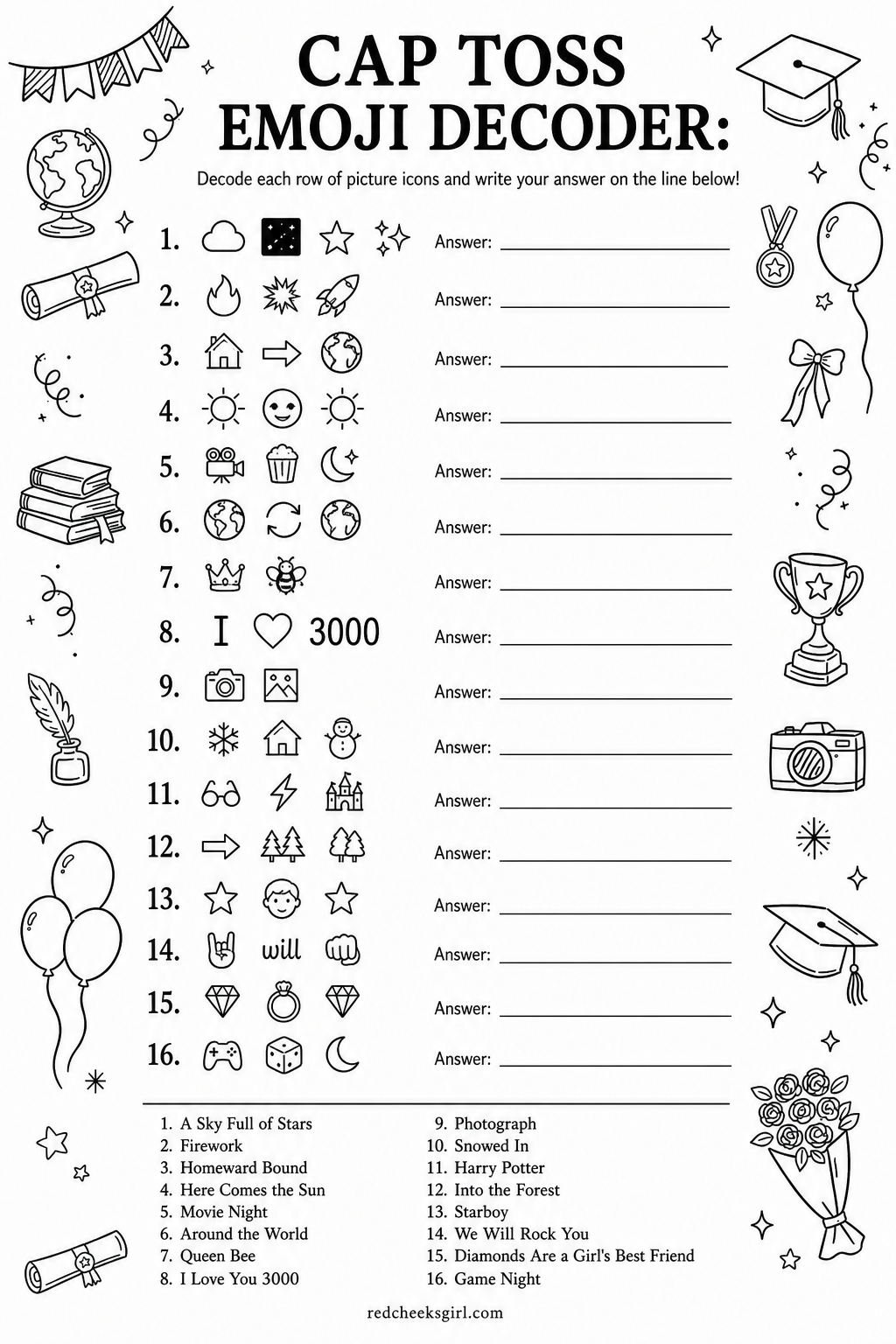
6. Cap Toss Ring Game
Set up a ring-toss target on the ground — a set of numbered rings, bottles, or cups arranged in a row — and give each player three graduation caps cut from stiff cardstock or three small dollar-store mortarboard party hats to toss.
Players stand behind a marked line and try to land their caps on or around the targets, scoring points based on distance or difficulty. Play in rounds, bracket style, and crown the toss champion at the end with a silly diploma-style certificate.
This is the outdoor physical game that gets guests off their chairs and laughing without requiring athletic ability.
Little kids, grandparents, and the graduate’s college friends can all compete on roughly equal footing because throwing a flat mortarboard-shaped disc is not an everyday skill anyone has practiced. The unpredictable flight of a cardstock cap is half the entertainment.
You need the cardstock caps or plastic party hats, ring-toss rings or weighted cups, and a strip of tape for the throwing line.
Best for eight to thirty players in a backyard or open outdoor space; runs thirty to forty-five minutes including brackets. Host tip: laminate the cardstock caps or use the cheap plastic mortarboard party hats from a party store — plain paper caps crumple after two or three throws in the wind and the game falls apart fast.
🛍 Shopping guide
7. Graduation Bingo — Find Someone Who
Print one bingo card per guest. Instead of numbers, each square contains a description of an experience or quality — “has attended a graduation ceremony before,” “can name the graduate’s major,” “has traveled to another country,” “was at the graduate’s first birthday party.”
Guests circulate through the party, find a real person who matches each square, and collect that person’s signature in the box. The first guest to fill a complete row, column, or diagonal and shout “Bingo!” wins.
This is the game that engineers conversations between people who would never otherwise speak to each other.
A teenage friend of the graduate suddenly needs a signature from someone who was at the graduate’s first birthday party, which means they have to find and talk to a grandparent or family friend. In the process, they hear a story.
That is the whole point, and it happens organically because the game requires it. All you need is the printed bingo cards, pens, and a small prize for the winner.
Ideal for fifteen to one hundred guests; works best in the first hour when people need a reason to circulate. Run one or two rounds over twenty to thirty minutes.
Host tip: make each bingo card slightly different by shuffling the square order or swapping out a few squares across cards — this prevents five people from filling the same row with the same signatures and all shouting “Bingo!” simultaneously.

8. Memory Lane Timeline
Print a large blank timeline sheet — or use a long strip of kraft paper taped to a table — marked with years from the graduate’s birth year to the present. Supply sticky notes, markers, and a pile of small printed photos.
Guests write a memory, milestone, or fun fact on a sticky note and place it on the year it happened, building a collaborative life timeline of the graduate throughout the party.
By the end of the event, the timeline is a dense, chaotic, beautiful record of an entire childhood and young adulthood.
The beauty of this game is that no single guest has the full picture. Grandparents remember the early years. A neighbor fills in a middle-school memory. College friends claim the recent years.
When the graduate walks the length of the finished timeline, they encounter memories they had completely forgotten next to milestones they consider the most important of their lives — and they are surrounded by the people who made each one happen.
You need the printed timeline sheet or kraft paper, sticky notes, fine-tip markers, and optional small photos pre-printed for guests to attach.
Works for ten to one hundred guests and runs passively across the whole party. Budget the full event duration for it to fill up properly. Host tip: anchor the timeline with three or four entries from family members before guests arrive — an empty timeline intimidates guests, but a half-started one invites them to jump in immediately.
🛍 Shopping guide
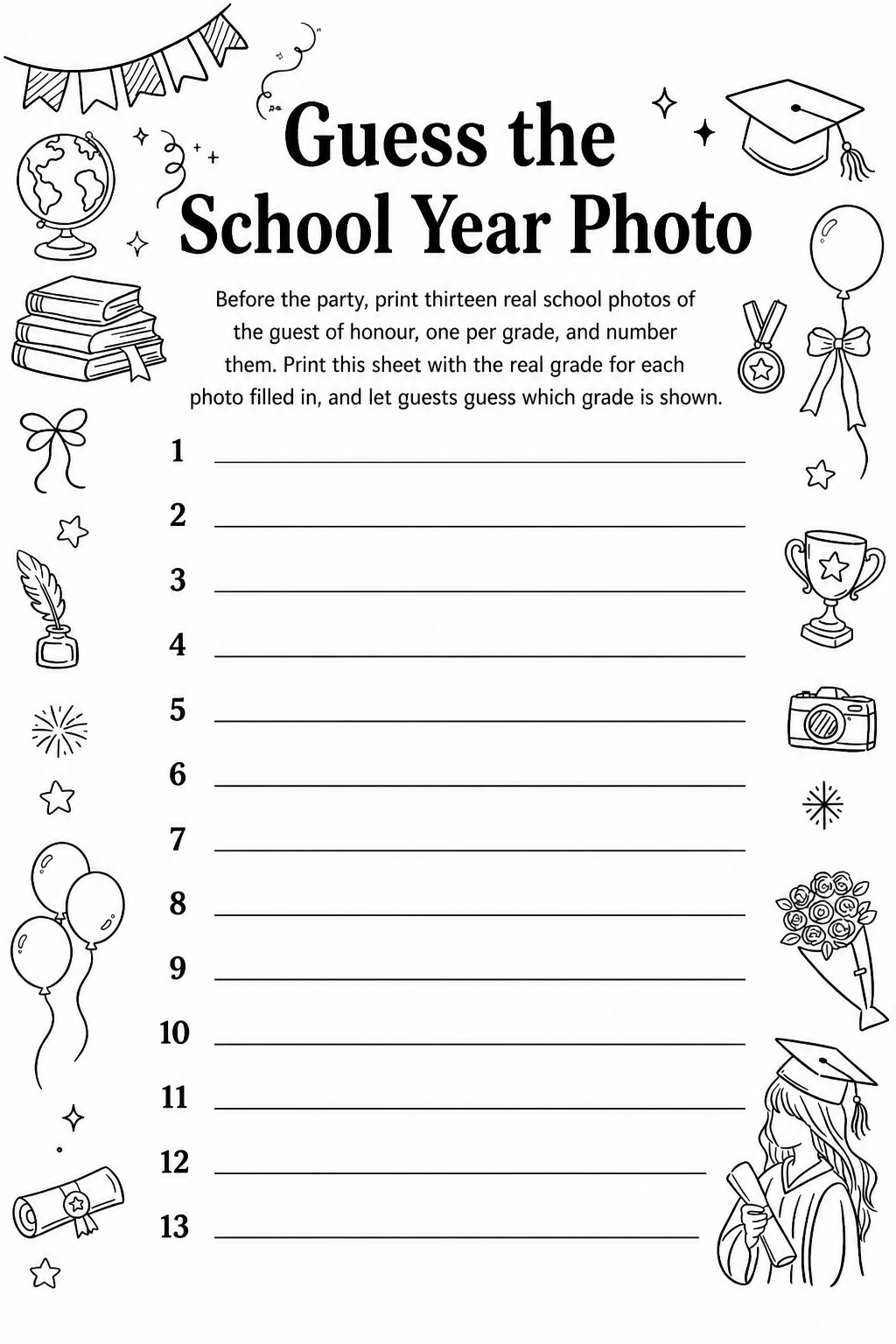
9. Guess the School Year Photo
Collect one photo of the graduate from each school year — first day of kindergarten through the most recent school year portrait — and display them on a board numbered randomly, not in order.
Hand each guest a printable answer sheet and ask them to write which grade they think the graduate was in for each photo. The graduate reveals the correct order and scores the sheets. The guest with the most correct answers wins a small prize.
This game works on a different level than the baby photo version because guests can watch the graduate actually grow up across the photos — the changing hairstyles, the shifting fashion choices, the slow transformation from small child to the person standing in front of them today.
It tends to get emotional in the best possible way, and it sparks conversations between family members who remember specific years vividly. You need the school photos, a display board, printed answer sheets, pens, and the graduate’s answer key.
Works for any group size; runs fifteen to twenty-five minutes as either a walk-up or structured activity.
Host tip: recruit a sibling or close family member to gather and scan the photos at least a week before the party — tracking down twelve years of school portraits at the last minute is the single most stressful part of running this game, and starting early is the only fix.
10. Signature Scavenger Hunt
Give each guest a printable scavenger hunt sheet listing fifteen to twenty categories of people to find and collect signatures from: “someone who taught you something,” “someone who has known the grad for more than fifteen years,” “someone who has the same birthday month as the grad,” “someone who is meeting the grad’s friends for the first time today.”
Guests circulate, find real people who fit each category, and collect signatures in the matching boxes. The first guest to fill all or most boxes wins.
Like Bingo, this game generates cross-generational conversation by design. The difference is that the categories here are warmer and more personal — they prompt guests to introduce themselves with a story rather than just a name.
“I taught them to ride a bike” is a different kind of hello than a handshake and a name. The sheet doubles as a keepsake record of everyone who attended, so the graduate can look back and remember who was in the room.
You need the printed sheets, pens, and a prize for the first finisher.
Best for twenty or more guests; runs twenty to thirty-five minutes during the social hour. Host tip: add one or two nearly-impossible categories — “someone who knows the grad’s locker combination” or “someone who has a photo of the grad on their phone right now” — because the scramble those squares cause is entertaining for everyone watching.

11. Yearbook Superlatives Ballot
Print one ballot per guest with a list of custom superlative categories tailored to the graduate’s real life: “Most Likely to Text Back Immediately,” “Most Likely to Start a Business Before Thirty,” “Most Likely to Move to Another Country,” “Most Likely to Win a Trivia Night.”
Guests vote on each category by writing in a person’s name — including the graduate, other guests, or anyone they know. Collect the ballots, tally the votes, and announce the winners publicly at a chosen moment in the party.
This game gets loud in the best way. When the “Most Likely to Cry at a Commercial” winner is announced and the graduate points immediately at their mother, the whole room erupts.
The superlatives work best when they reference real, specific things about the people in the room rather than generic graduation clichés.
Spend twenty minutes before the party writing categories that are specific to this graduate and their crowd — generic ballots produce polite laughter while specific ones produce chaos. You need the printed ballots, pens, and someone to tally votes quickly.
Works for fifteen to seventy-five guests; announce results over ten to fifteen minutes. Host tip: pre-write the superlative categories on a separate cheat sheet and recruit a co-host to tally while announcements are being made — trying to count votes and announce simultaneously always ends in confusion and a longer gap than the crowd will tolerate.

12. Toast and Wishes Cards
Print one card per guest and set them out with pens near the seating area or at each place setting if you are doing a sit-down meal.
The card invites each guest to write a short toast — two or three sentences they would deliver if given a microphone — and a genuine wish for the graduate’s future. Guests fill out the card and leave it in a collection basket.
At a chosen moment, the host reads a selection of the best ones aloud while everyone raises a glass.
This game transforms the toast portion of the party from a single long speech into a chorus of voices. Every guest gets to feel heard, even the ones who would never stand up with a microphone.
The cards also give the graduate something to keep — a physical record of what everyone in the room wished for them on this specific day.
You need the printed cards, pens, a collection basket, and a host willing to read a selection of them aloud with genuine feeling.
Works for any group size; the fill-out phase takes fifteen to twenty minutes and the reading portion takes ten to fifteen.
Host tip: read the cards yourself rather than asking the graduate to read them cold — the graduate will inevitably get emotional partway through and lose their place, while a host can pace the readings for maximum effect and keep the energy from stalling.

13. Grad Mad Libs: The Official Story of the Graduate
Print one Mad Libs sheet per guest or per table.
The sheet tells the graduate’s life story in a narrative paragraph form with key words blanked out and labeled with their part of speech — a noun here, an adjective there, a verb in past tense, a ridiculous number.
Guests fill in the blanks without seeing the story, then read the completed version aloud. The resulting “official biography of the graduate” is almost always absurd enough to cause genuine tears of laughter.
What makes this work at a mixed-age party is that the format is universally familiar and requires zero background knowledge about the graduate to play.
A family friend who has known the graduate for two weeks and a grandparent who has known them for twenty-two years fill out the exact same sheet and end up with equally ridiculous results. The game rewards pure creativity rather than inside knowledge.
Print sheets and supply pens — nothing else is required.
Best played in small groups of four to eight per sheet, with each group reading their version aloud for the room at a set time. Budget ten minutes to fill out and five to ten minutes per group to share.
Host tip: assign one extroverted guest per table to be the “official reader” before the game starts — when you leave the reading role open, groups either all try to read at once or everyone waits for someone else to go first, and the momentum dies.

14. I Spy the Grad’s Life – Photo Wall Challenge
Create a photo display wall or table before the party using photos, mementos, and printed images from throughout the graduate’s life.
Then give each guest a printable “I Spy” checklist of specific things to find in the display: “a photo where the grad is wearing a hat,” “a picture with more than four people,” “the earliest photo on the wall,” “something related to the grad’s favorite hobby.”
Guests explore the display, check off items they find, and write where they spotted each one on their sheet.
This turns a static photo display — something most guests would glance at once and move on from — into an active scavenger-style game that keeps people engaged with the graduate’s history for far longer than they would spend on their own.
It also creates a natural gathering point where guests of all ages end up standing next to each other, pointing at the same photos, and swapping stories about the moments captured there.
You need the display, printed checklist sheets, pens, and a small prize for the first guest to complete the list.
Works for any group size; runs passively during the first hour or alongside other activities.
Host tip: build the photo display two or three days before the party and walk through it yourself with the checklist to make sure every item on the list is actually findable — it is surprisingly easy to write a clue that references something that ended up not making it onto the wall.

15. This or That: Grad Edition
Print one sheet per guest — or one per table for a group version — listing twenty-five to thirty “This or That” pairings tailored specifically to the graduate: “beach vacation or mountain cabin?”, “stay up late or wake up early?”, “cook at home or eat out?”, “graduate goes left or right when leaving the stage?”
Guests mark their guess for which option the graduate would choose. Then the graduate fills out their own sheet and the answers are revealed, with points going to correct predictions.
The brilliance of this format is its speed. Guests move through twenty-five questions in under five minutes, which means you can run a full reveal in under ten.
The results reveal exactly who knows the graduate best, and the misses are just as funny as the hits — a parent who has known the graduate their entire life confidently picks the wrong answer on “coffee or tea” while a college friend gets it right immediately.
No supplies needed beyond the printed sheet and pens.
Works for any group size; best as a structured game where everyone fills out simultaneously and the graduate reveals answers one by one. Budget fifteen to twenty minutes total.
Host tip: have the graduate complete their answer sheet before the party and seal it in an envelope so there is no temptation to adjust answers after seeing what guests predicted — the sealed reveal adds drama and keeps the game honest.

16. Graduation Memory Jar
Set a large clear glass jar at the center of a table alongside small strips of paper and pens in the school or party colors.
Every guest writes one specific memory they have shared with the graduate — not a general wish, but a real scene: a specific conversation, a moment in a car, a meal, a late night, a crisis they navigated together.
Guests fold the strips and drop them in the jar. At the end of the party, the graduate shakes the jar, pulls out five or ten strips, and reads them aloud to the group.
The emphasis on specific memories rather than general sentiments is what separates this from every other “write something nice” activity.
When the graduate reads “the time we got lost driving to that concert and ended up eating gas station sandwiches in a parking lot for two hours,” the entire room either recognizes the story or leans in wanting to hear it.
The jar becomes a physical object the graduate keeps long after the party. You need the jar, small paper strips pre-cut, and pens — all inexpensive and easy to source.
Runs passively throughout the party; the reading portion takes ten to fifteen minutes. Works for any group size.
Host tip: put a sample memory strip — written in advance by the host — visibly hanging on or near the jar as a model for guests who freeze up staring at a blank strip, because the sample breaks the overthinking and gets people writing immediately.
🛍 Shopping guide
17. Two Truths and a Lie: Grad Edition
Before the party, ask the graduate to write five or six “two truths and a lie” combinations about themselves — sets of three statements where two are real and one is invented — and print or write them on a display card.
Guests circulate or gather and try to identify the lie in each group. Then flip the game: each guest at the table writes their own set of three statements, reads them aloud, and the table votes on which is the lie.
The person who fools the most people wins a round.
Starting with the graduate’s own statements grounds the game in the party’s theme and teaches guests interesting facts about the person they are celebrating. Expanding to include all guests makes it interactive rather than passive.
The game naturally produces storytelling — once the lie is revealed, people always want to hear the full story behind the truths. No materials are required beyond the graduate’s pre-written cards; small notecards and pens for the guest rounds are optional but helpful.
Works best in groups of six to twenty; multiple simultaneous table groups work for larger parties. Budget twenty to thirty minutes.
Host tip: coach the graduate before the party to include at least one truth so surprising that even their closest family members vote it as the lie — those are the rounds that generate the most genuine shock and the best stories.
18. Balloon Pop Dare Dash
Before the party, stuff small slips of paper into balloons before inflating them.
Each slip contains either a fun dare, a celebration challenge, or a question about the graduate: “do your best impression of the graduate,” “name three of the graduate’s closest friends in ten seconds,” “share one thing this graduate taught you.”
Hang or cluster the balloons around the party space. At intervals — or whenever the energy dips — the host invites a guest to choose and pop a balloon, then complete whatever is inside.
This game injects spontaneous energy into a party that might otherwise settle too comfortably into quiet table conversation.
The unpredictability of which balloon hides which dare keeps everyone watching even when it is not their turn, and the challenges are calibrated so anyone from age six to eighty can participate. The popping itself is satisfying in a way that never really gets old.
You need balloons, slips of paper, and a way to inflate — a small hand pump saves a great deal of breath.
Works for fifteen to sixty guests; run five to ten rounds spread across the party rather than all at once to maintain momentum without burning the game out.
Host tip: color-code the balloons by category — one color for dares, another for questions, a third for celebration challenges — so guests can choose the type of slip they want rather than drawing blind, which reduces the chance someone gets a dare that makes them genuinely uncomfortable.
🛍 Shopping guide
19. Compliment Hot Seat
Set a decorated chair at the front of the gathering space — the “hot seat” — and invite the graduate to sit in it for five minutes while anyone in the room stands and delivers a single, specific compliment or short tribute.
Not vague praise, but something real: a quality only they have noticed, a moment the graduate changed something for them, a characteristic they hope the graduate carries into the next chapter.
A host with a timer keeps each tribute to sixty to ninety seconds so the energy stays high and no one monopolizes the moment.
This game functions as a structured version of the open-mic toast without the pressure of a full speech. Because the format is explicit — one compliment, one minute, then sit down — even guests who would never give a toast are willing to stand up.
The result is a rapid-fire string of genuine tributes that tends to be more moving than any single long speech.
No materials needed beyond the decorated chair and a timer; a small bell or gentle sound cue to signal the end of each turn keeps things crisp.
Works for fifteen to fifty guests; run it for ten to fifteen minutes and stop before the energy peaks — ending while people still want more is always better than letting it run until the room goes quiet.
Host tip: pre-recruit three or four guests to go first so the chair never sits empty while people work up their nerve — once a few people model how it works, others will line up without prompting.
20. Life Skills Showdown
Set up three to five quick physical stations around the party space, each one testing a practical “adulting” skill the graduate is theoretically about to need: parallel park a toy car between two cones in under thirty seconds, fold a fitted sheet in under a minute, plunge a designated amount of coins into a piggy bank with one hand behind their back, or correctly sort a pile of fake mail into “important” and “junk” categories in ten seconds.
Guests rotate through the stations in small heats and earn points for speed and accuracy. The winner is crowned the Most Prepared Adult in the Room.
The humor of this game is in how dramatically it highlights that none of us — including the adults who have been doing adulting for decades — are actually as competent at these tasks as we think.
A grandparent who has folded fitted sheets for fifty years will still panic under a thirty-second clock. The graduate, watching from the sidelines, gets the satisfaction of seeing their entire family struggle with the same things they are about to face.
All you need is a set of simple, inexpensive props for each station and a stopwatch.
Works for ten to forty guests; runs forty-five to sixty minutes including all heats. Best in an open indoor or outdoor space with room to move between stations.
Host tip: test every station yourself the day before with an actual timer — what feels like a generous time limit while calm is often brutal under party pressure, and adjusting station difficulty before guests arrive is far easier than adjusting on the fly in front of a crowd.
🛍 Shopping guide
Frequently Asked Questions
How many games should I actually run at a graduation party?
Three to five games is the sweet spot for most graduation parties.
Pick one or two passive printable activities that run themselves throughout the event — like the baby photo guessing game or the advice cards — and two or three structured games you facilitate at specific moments.
Trying to run every game on a list like this will exhaust the crowd; curating a handful and executing them well creates a far better experience than cramming in as many as possible.
How do I choose games that work for both kids and grandparents at the same party?
Look for games that rely on knowledge of the graduate rather than physical skill or pop-culture familiarity, since the graduate is the one thing everyone in the room has in common.
Trivia about the grad, photo-guessing games, and card-based activities like the advice cards or toast cards work across all ages.
If you add a physical game like the cap toss or balloon pop, keep the stakes low and the tone silly so no one feels left out for not being the most athletic person in the yard.
What is the best way to manage printable games at a large party?
Print at least twenty percent more sheets than your guest count — people take extras, sheets get crumpled, and late arrivals always show up. Pre-cut any cards that need cutting and organize them into labeled stacks or baskets before guests arrive.
Designate a specific table as the “game station” so guests know where to find materials without asking. Laminate any shared reference materials, like answer keys or photo displays, so they survive a full party without falling apart.
Do I need a prize for every game?
No, and over-prizing a party can actually reduce the fun by making everything feel too competitive. For most games, bragging rights and a round of applause are reward enough.
Reserve small physical prizes — a gift card, a funny trophy, a bag of candy — for one or two games where there is a clear winner and a competitive structure, like the trivia game or the scavenger hunt.
Keepsake activities like the advice cards and toast cards are their own reward and need nothing added.
How far in advance should I prepare everything?
Print all sheets and cut all cards at least two days before the party.
Gather photos for the baby photo and school year games at least a week ahead — hunting down a dozen school portraits the night before is a genuine crisis waiting to happen. Set up the physical game stations the morning of the party.
The more you can do before party day, the more time you spend actually enjoying the celebration instead of running around with scissors and a stapler while guests arrive.
📌 Save These for Later
Loved these? Pin your favorite image below so you can find this list again when you’re planning.




17 pretty garden party games for a lawn or patio — no mess, no chaos, just afternoon fun in a summ

18 genuine cowboy party games — lassos, horseshoes, gold panning & more. Print the sheets and sadd

28 lavender balloon arch ideas paired with the right second colour so every arch looks considered, n
Leave a Reply