

15 Church Easter Games for Kids and Families After the Sunday Service
Church Easter games turn the stretch between the final hymn and the last brunch plate into something the kids actually look forward to, not just a holding pattern before the egg hunt.
This lineup leans on sheets a volunteer can set on a folding table in minutes, then a few no-mess group games for the fellowship hall once the paper runs out.
It suits mixed ages from kindergarten through the tweens who think they are too old for an egg hunt, and every entry keeps the resurrection story, not just the bunny, at the center of the table.
This post contains affiliate links. If you buy through them, I may earn a small commission at no extra cost to you.
Table of Contents
- Easter Story Bingo
- Empty Tomb Relay
- Resurrection Story Order Cards
- Resurrection Eggs Circle Time
- Who Said It From the Easter Story
- Hosanna Palm Branch Relay
- Easter Trivia for Families
- Loaves and Fishes Guessing Jar
- He Is Risen Scavenger Checklist
- Easter Story Charades
- He Is Risen Word Search
- Lamb and Shepherd Tag
- Easter Fill-in-the-Blank Verse Sheet
- Joyful Freeze Dance (He Is Risen)
- Easter Symbol I-Spy Sheet
- Frequently Asked Questions
1. Easter Story Bingo
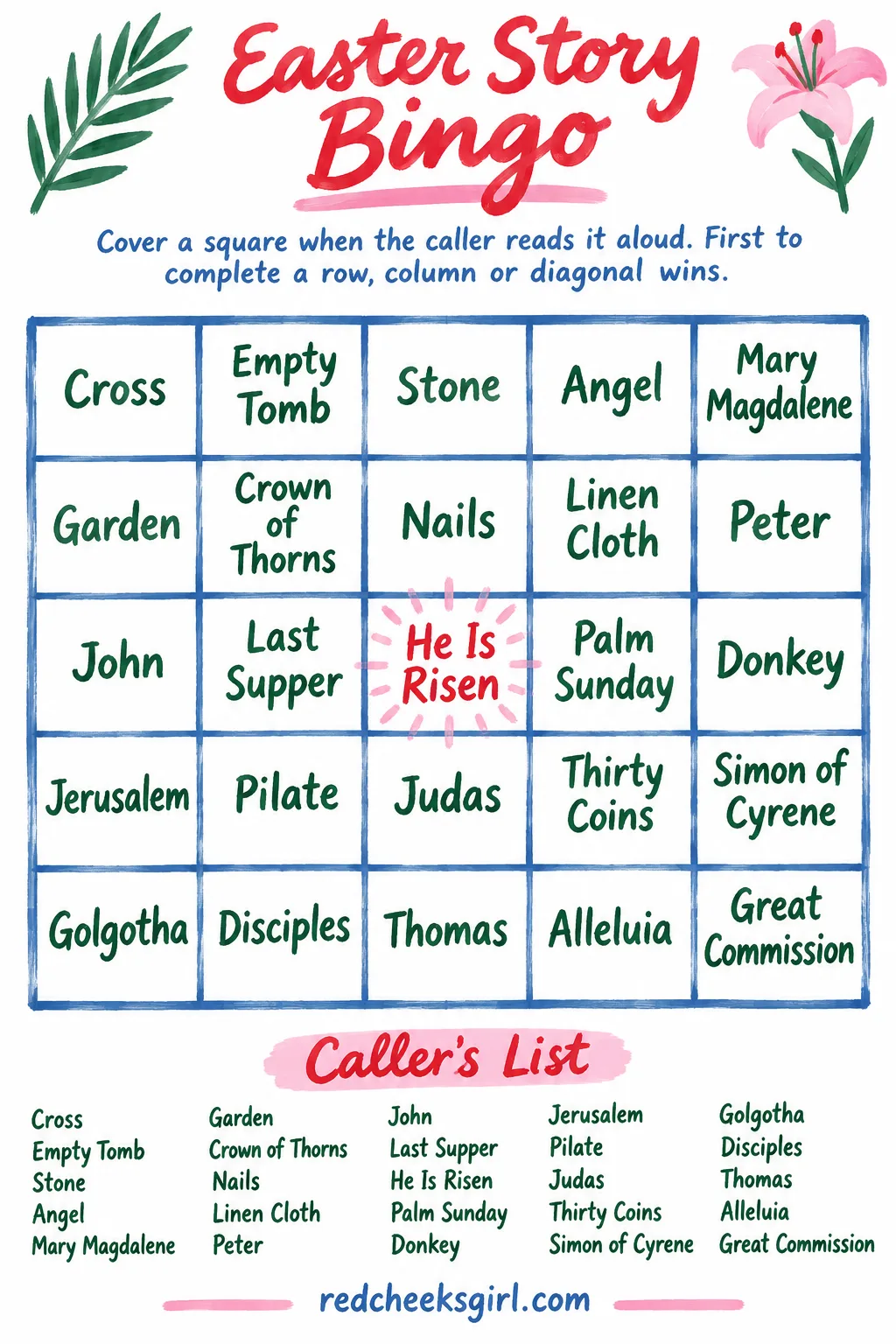
A volunteer calls out words from the Easter story one at a time: cross, angel, empty tomb, Palm Sunday.
Kids cover the matching square on their card with a dried bean or a bingo chip, and the first player to cover a full row, column or diagonal calls out and the round ends. Play a few rounds, swapping who calls, so more than one child gets to win.
This works for a single Sunday school class or a packed fellowship hall, since every player just needs their own printed card and a small handful of markers.
Budget ten to fifteen minutes per round including the explaining. It is one of the easiest church easter games to run because the caller does all the work and the kids just listen and cover.
Younger kids who cannot read the squares yet tend to get lost, so say each word twice and point to a sample card the first time through. Make it easier for preschoolers with a four-by-four card instead of five-by-five, or make it harder for older kids by requiring a full blackout card rather than one line.
Print cards a day ahead so the ink is dry before little hands and dried-bean markers get to them.
🛍 Shopping guide
2. Empty Tomb Relay
Split the kids into two or three teams lined up at one end of the fellowship hall. Each team’s cardboard “tomb” sits at the far end with its box flap closed.
One at a time, a runner rolls a soft ball, standing in for the stone, down the room and pushes it against the tomb to knock the flap open, then runs back to tag the next teammate.
The team that rolls its last stone open first wins, and a leader reads aloud that the tomb is empty just as the Bible describes it.
Plan for four to twelve kids per team, five to ten minutes total, and a roomy stretch of floor with nothing breakable nearby. All it needs is a large soft ball per team and a sturdy cardboard box set up as the tomb.
Balls that roll off course slow the whole relay down, so mark a straight lane with painter’s tape on the floor. For a bigger crowd than one hall can hold at once, running several lanes side by side borrows the same team structure described in 20 Easter Games for Large Groups to Run at a Church or Community Party.
Best for groups of twenty or more split into three or four teams, since the relay format scales up easily.
🛍 Shopping guide
3. Resurrection Story Order Cards
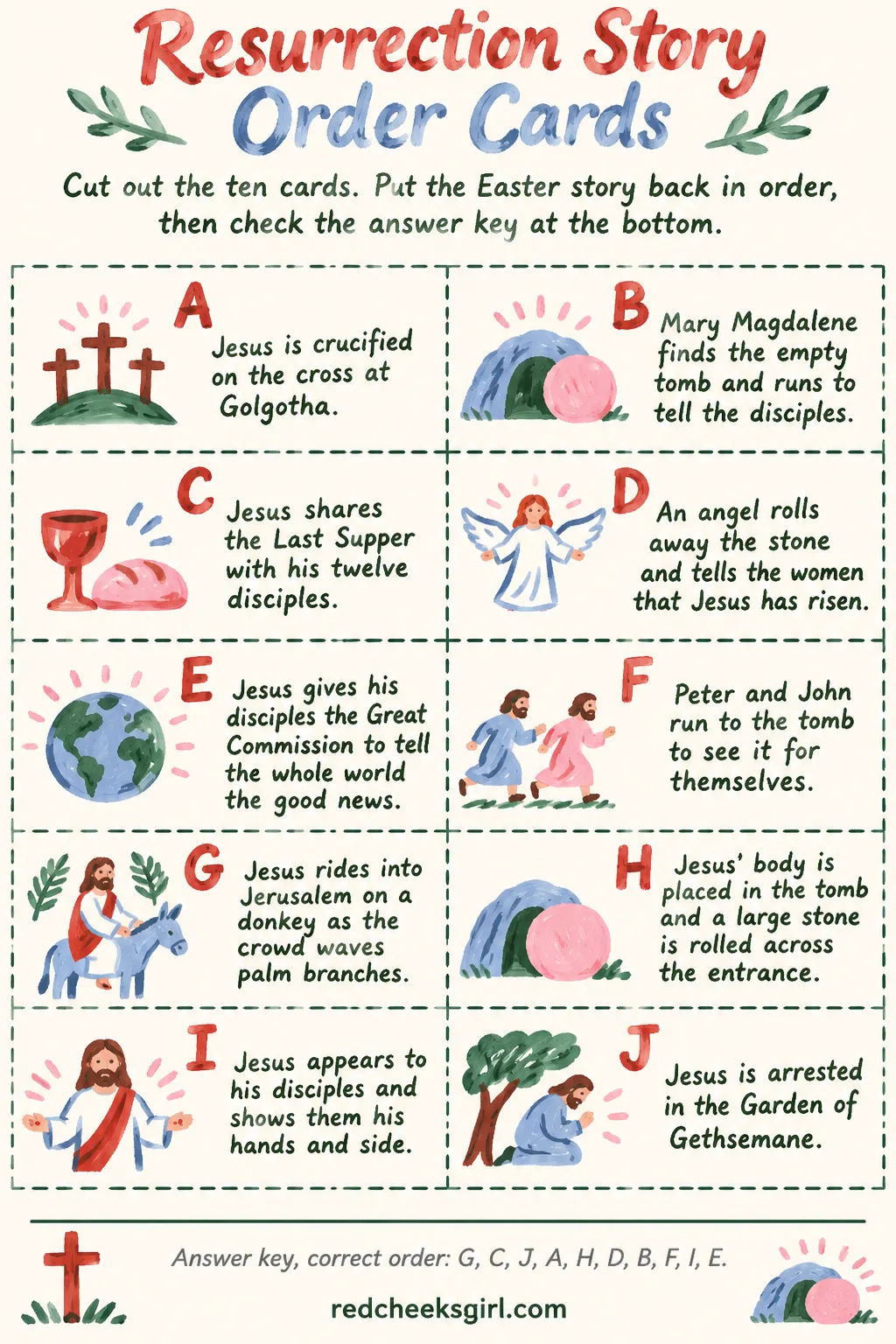
Kids cut apart ten cards, each holding one sentence from the Easter story printed out of order, then work alone or in pairs to lay them back out in the order the events actually happened, from Palm Sunday through the Great Commission.
Whoever finishes with the correct sequence first, or closest to it when time runs out, gets the win, and the answer key at the bottom settles any argument.
Give each child or pair their own printed sheet, scissors and about ten minutes once the cutting is done. It suits kids who already know the outline of the story, so second grade and up gets the most out of it.
Kids who have never heard the full sequence will guess at random, so read the story once together before handing out scissors. For younger kids, cut the sheet down to five or six cards instead of ten and skip the harder middle events.
🛍 Shopping guide
4. Resurrection Eggs Circle Time
Gather the kids in a circle and pass around a basket of twelve numbered plastic eggs. One at a time, a child opens the next egg to reveal a small object inside, a coin, a scrap of cloth, a toy rooster, a nail, and the leader reads the short line of the Easter story that object stands for.
The activity ends when egg twelve opens on the empty tomb and the leader says the story is finished.
It works for any size circle, from six kids in a Sunday school room to forty in the fellowship hall, and takes about fifteen minutes read through once. A pre-filled resurrection eggs set does the setup for you, or fill plain plastic eggs with the matching objects the night before.
Wiggly kids lose focus if every egg gets a long explanation, so keep each line to a single sentence and keep moving. For a shorter attention span, use six eggs covering the highlights instead of all twelve.
Drop to six eggs and skip the harder middle events for preschool and kindergarten classes.
🛍 Shopping guide
5. Who Said It From the Easter Story
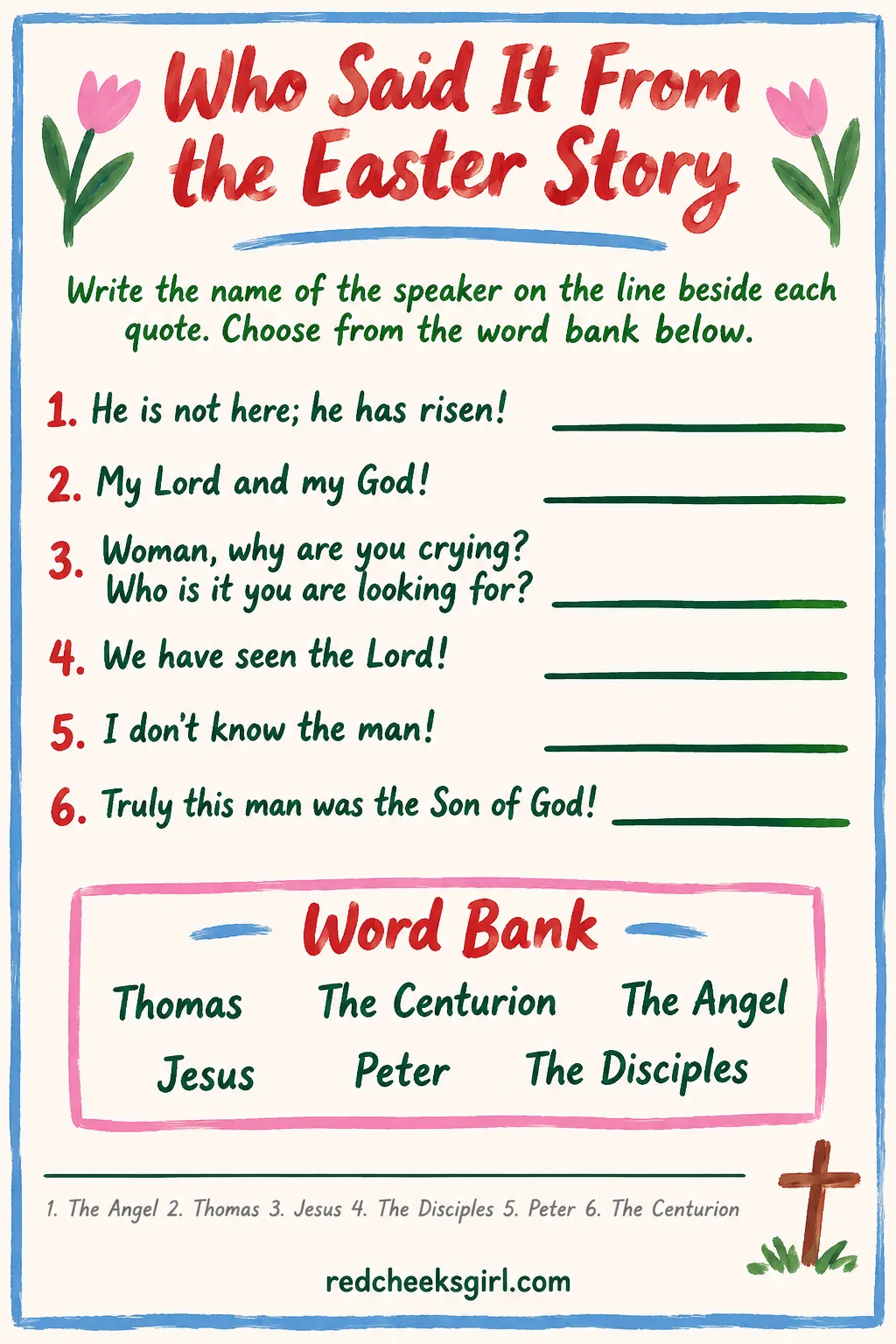
Kids read six quotes pulled straight from the Easter story and write who said each one on the blank line beside it, choosing from a word bank at the bottom of the sheet. Whoever matches the most names correctly when time is called wins, and the printed answer key at the very bottom settles any disputes.
One sheet and a pencil per child is all it takes, and it runs well as a quiet five-minute activity at the brunch table while the adults are still talking. It suits readers from about second grade up, since younger kids will need a helper to read the quotes aloud.
The harder quotes, like the centurion’s line at the cross, trip up kids who only know the egg-hunt version of Easter, so read through the full story together beforehand if the group is newer to it.
The same idea works well alongside the matching rounds in 20 Bible Games That Don’t Feel Like Sunday School for a longer Bible-based game block.
6. Hosanna Palm Branch Relay
Teams line up and each runner carries a paper palm branch, weaving it through a row of cones before planting it in a bucket at the far end and running back to hand the next palm to a teammate.
The round ends when a team’s last palm branch stands in its bucket, and that team wins. Play the final leg to worship music for a festive finish.
Four to eight kids per team works best, with a weaving course of five or six cones per lane and about ten minutes total including setup. Fellowship halls with a long open stretch of floor are ideal, and the game adapts to an outdoor patio just as easily if the weather holds.
Younger kids knock over every cone on the way, so space them wider apart or drop to three cones for kindergarten age. For older kids, add a second weave on the way back to make the course twice as long.
Line up teams, weave the palm through the cones, plant it in the bucket, tag the next runner, last bucket filled wins.
🛍 Shopping guide
7. Easter Trivia for Families
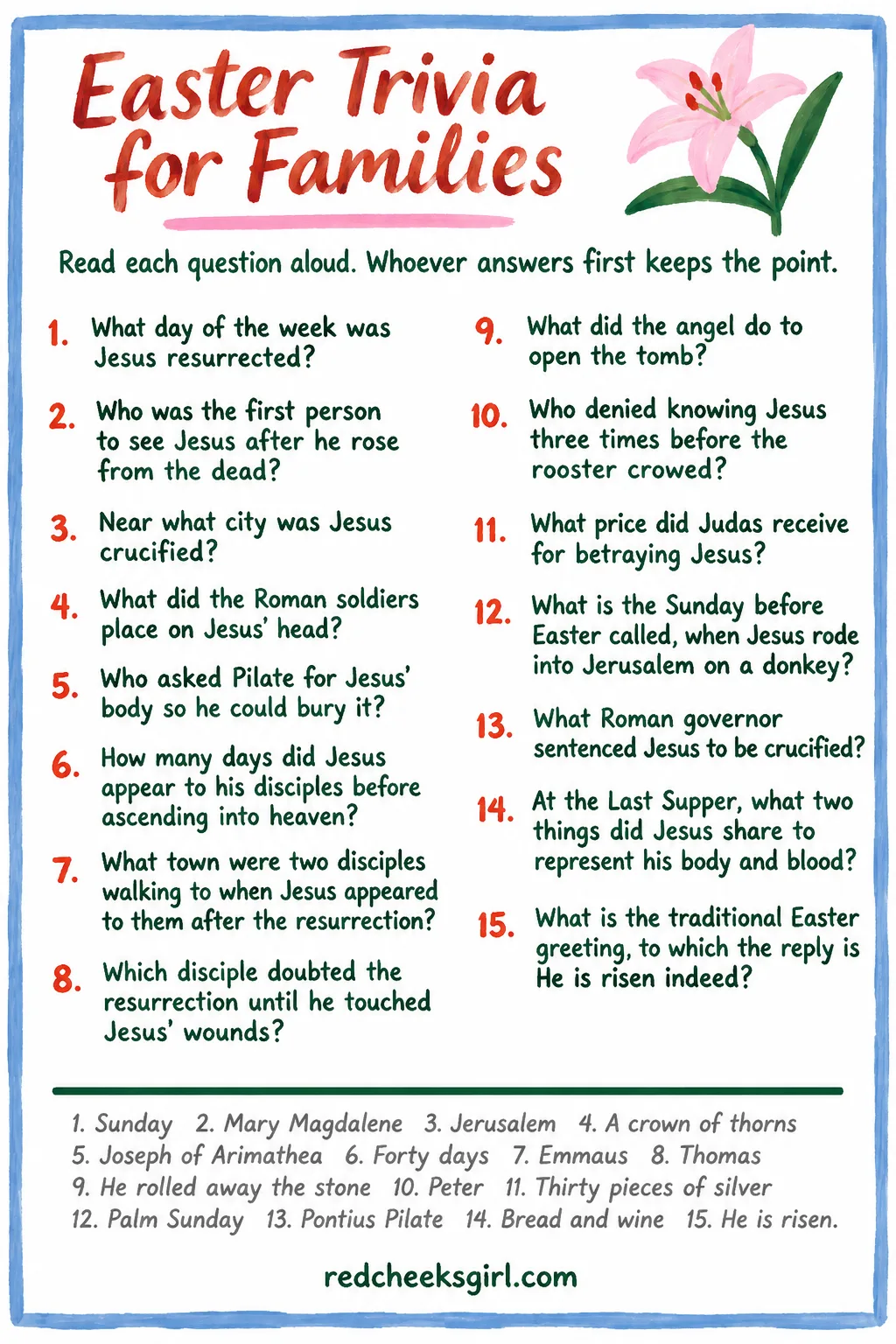
Read the fifteen questions aloud at the brunch tables, one at a time, and let whoever answers first keep the point for their table. The game ends when all fifteen questions are read, and the table with the most points wins, though most families keep playing past the finish just to see who knows the harder ones.
It needs nothing but the printed sheet and a reader, works for any table size from four to twelve, and runs about fifteen to twenty minutes depending on how much debate each answer sparks. Mixed ages play together easily since grandparents and kids both know different pieces of the story.
Questions about Pilate and the thirty pieces of silver stump younger kids fast, so let an older sibling or adult at each table whisper a hint rather than let the table go silent. For a faster round with just kids, skip straight to the easier half of the list and save the rest for the adults.
Mixed ages compete at the same table instead of splitting into a kids’ room and an adults’ room.
8. Loaves and Fishes Guessing Jar
Set a clear jar filled with goldfish crackers on the registration table where families arrive, with a stack of small slips beside it for guesses.
Everyone who passes by writes a name and a number on a slip and drops it in a basket before the service ends, and whoever guesses closest to the real count, without going over, wins the jar. Count the crackers once at the start and write the number down somewhere only a volunteer sees.
It needs nothing but the jar, crackers and slips, sits unattended all morning, and works for any size crowd walking past a welcome table. It is the one pure-guessing game in this lineup, which keeps the rest of the morning focused on things kids actually do rather than just hope.
A jar that is too full makes the true count impossible to guess within a reasonable range, so keep it to a count under three hundred for a game families can realistically get close to. Swap the crackers for jelly beans for an older crowd who likes a slightly higher stakes guess.
One quiet table activity gives families something to do while they wait for brunch to start without adding noise to the hall.
🛍 Shopping guide
9. He Is Risen Scavenger Checklist
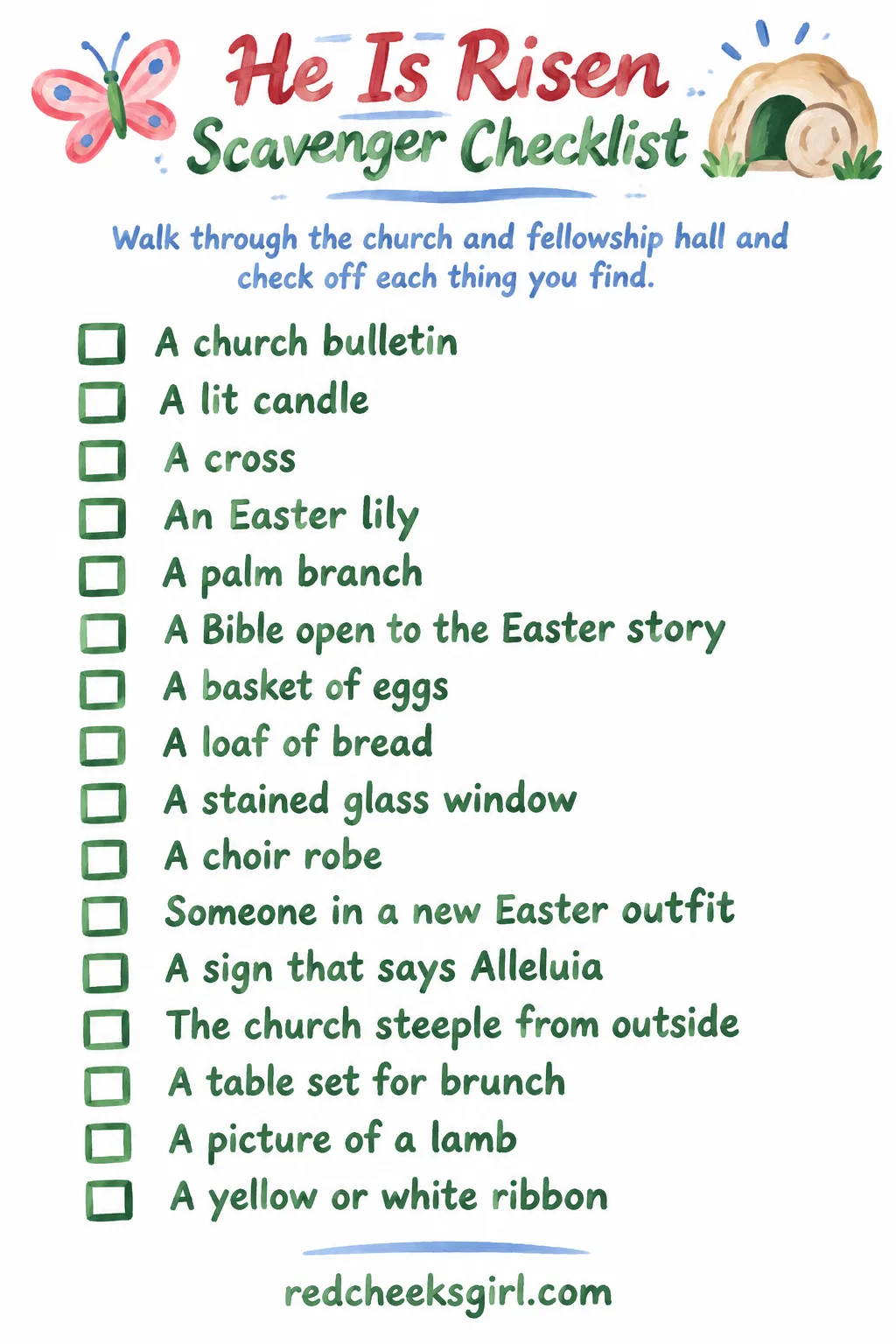
Hand each child a clipboard and a pencil and send small groups walking through the church and fellowship hall checking off everything on the list, a lit candle, a stained glass window, someone in a new Easter outfit.
There is no single finish line, so set a timer for fifteen or twenty minutes and call everyone back in once it rings, comparing how many boxes each group managed to check.
It suits groups of three or four kids with one adult chaperone per group, and works especially well right after the service while families are still milling around the building.
The same walk-through idea pairs naturally with the printable lessons in 22 Sunday School Worksheets for Kids You Can Print Ten Minutes Before Class if the Sunday school room needs a quiet follow-up activity after.
Kids wandering into closed-off rooms or the nursery mid-service is the usual snag, so walk the route once yourself beforehand and mark which hallways are off-limits. For a shorter version with toddlers, cut the list to six items they can spot without much reading.
Keep groups small and assign one adult per clipboard so nobody wanders off during the search.
10. Easter Story Charades
Write each Easter story scene on its own index card, Jesus washing feet, the Last Supper, the stone rolling away, and let kids take turns drawing a card and acting it out silently while their team guesses.
The round ends when the team guesses correctly or the thirty-second timer runs out, and the team with the most correct guesses after everyone has had a turn wins.
It plays well with groups of eight to twenty kids split into two teams, needs only the index cards and a timer, and runs fifteen to twenty minutes for a full round through the deck. It is a natural follow-up to a Bible lesson since kids have to actually know the scene to act it out.
Shy kids freeze up when asked to act alone, so let pairs act out scenes together instead of solo performers. For a bigger laugh with older kids, ban talking and pointing entirely and require the full scene in gesture only, the way the ideas are built out in 120 Charades Ideas for Kids.
Let shy kids act in pairs instead of alone, and allow one spoken clue for younger players.
🛍 Shopping guide
11. He Is Risen Word Search
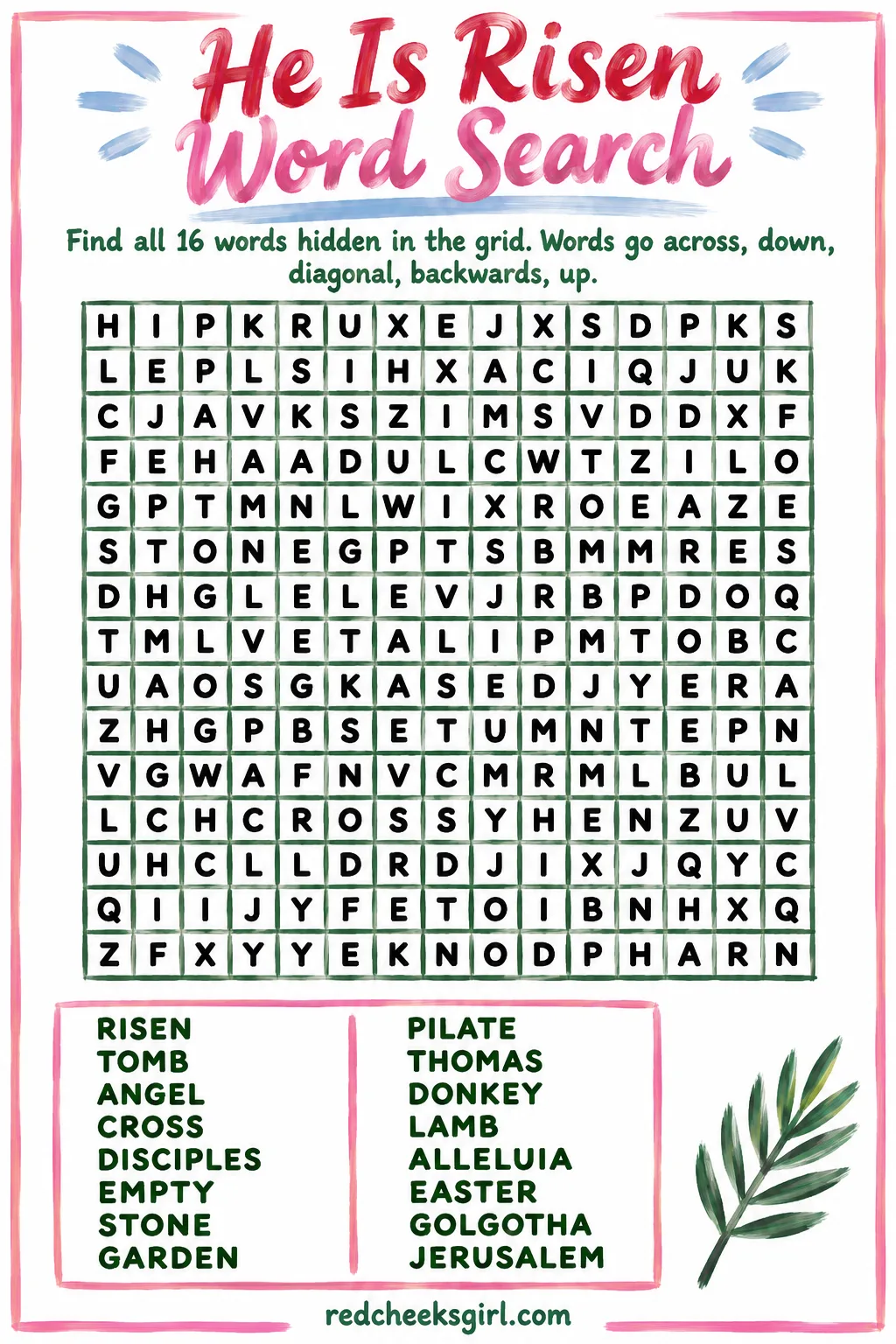
Kids scan the letter grid for sixteen words hidden from the Easter story, circling each one as they find it. The activity wraps up once every word on the list is circled, or when the timer runs out, whichever comes first, and the answer key at the bottom shows where any missed word was hiding.
It works as a quiet solo activity at the brunch table or in the car on the drive home, needs only a pencil, and takes most kids eight to twelve minutes depending on age. It suits readers from first grade up who already recognize the words by sight.
Kids who search randomly instead of row by row miss words that are right in front of them, so suggest scanning left to right, then top to bottom, before trying diagonals. For younger kids still learning to spell, read the word list aloud first so they know exactly what they are hunting for.
12. Lamb and Shepherd Tag
One child is the Shepherd standing in the middle, everyone else is a sheep scattered across the room. When the Shepherd calls out, the sheep try to cross from one end of the hall to the other without getting tagged, and anyone tagged becomes a helper shepherd for the next crossing.
The game ends when only one sheep is left uncaught, and that child becomes the new Shepherd for the next round.
It suits any size group from six kids up to thirty, needs no equipment beyond open floor space, and each round takes two to four minutes, so it fits easily between printable activities when kids need to move. It is a simple one to explain to volunteers who have never run a game before.
Kids who hide against the walls instead of crossing slow the round down, so set a rule that everyone must attempt the crossing within ten seconds of the call. For younger kids, let caught sheep sit out happily on the side rather than become helpers, since some toddlers find switching roles confusing.
13. Easter Fill-in-the-Blank Verse Sheet
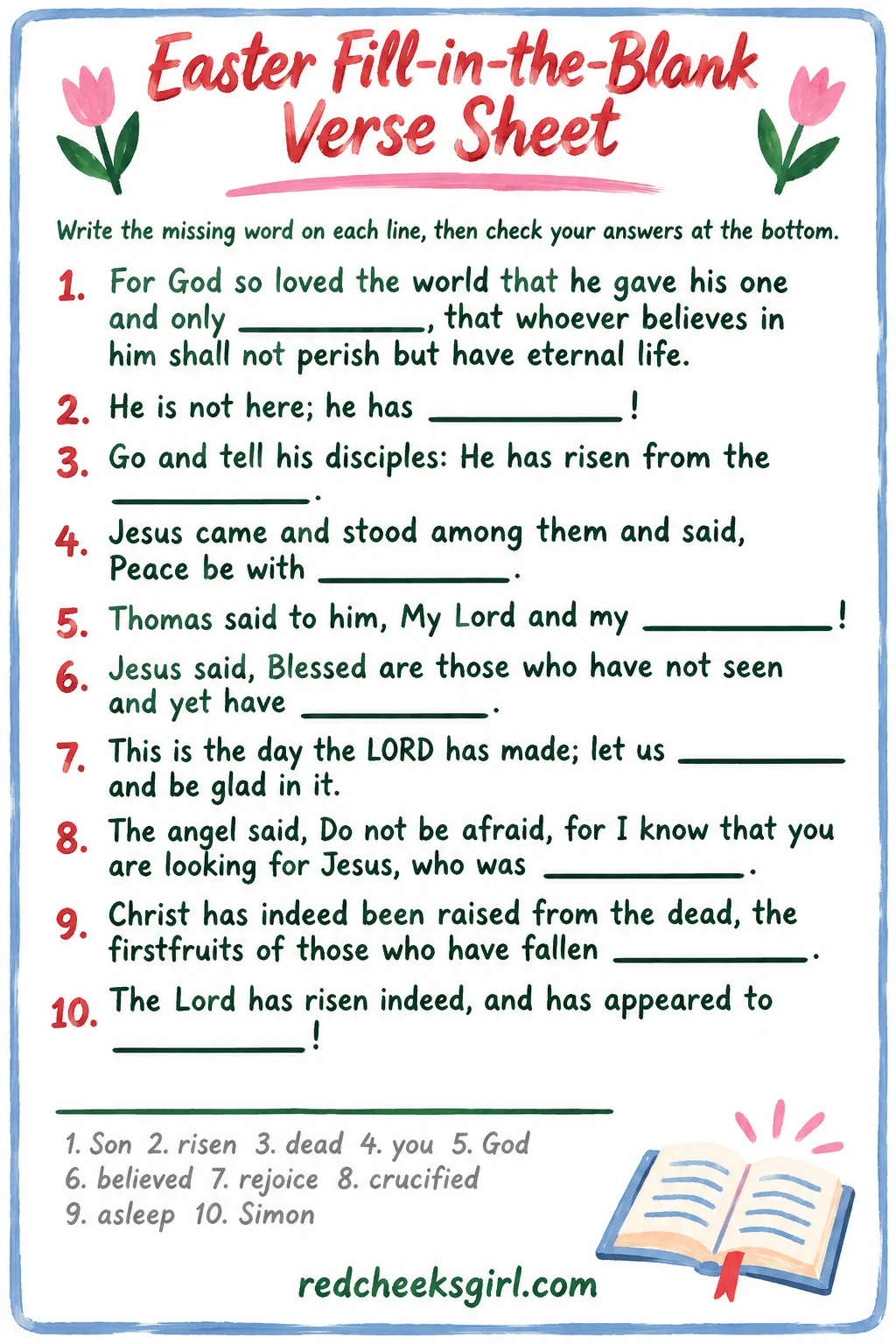
Kids read ten short Bible lines from the Easter story, each missing one word, and write the word they think belongs on the blank. The sheet is finished once all ten blanks are filled, and checking the answer key at the bottom turns it into a quick group review rather than a graded test.
One sheet and a pencil per child covers it, and it takes most kids ten minutes including time to think through the harder lines. It suits Sunday school classes who have already heard the readings once, since a few of the blanks need real familiarity with the verses rather than a lucky guess.
Kids who have never heard a verse before will leave the hardest blanks empty, so read each line aloud once as a group before handing out pencils if the class is new to the passages. For a faster version, cut the sheet to the five easiest verses and skip the rest.
Filling in the blank by hand sticks better for kids than just hearing the verse read aloud once.
14. Joyful Freeze Dance (He Is Risen)
Play upbeat Easter or worship songs and let kids dance anywhere in the open floor space, then cut the music without warning. Whoever is still moving when the music stops sits out for one round, and the game continues until only one dancer is left standing still every time, crowning that child the winner.
Any number of kids can join at once, it needs only a speaker and a playlist, and a full game runs about ten minutes through several rounds of music and freezes. It is an easy one to slot in right before or after a printable activity, since kids arrive already energized from sitting.
Kids who argue over who moved first slow the game down, so have one volunteer act as the sole judge and announce decisions are final before starting. For a gentler version with toddlers, skip the elimination entirely and just freeze and unfreeze together as a group.
Put one adult in charge of the music and the calls so there is no argument over close freezes.
🛍 Shopping guide
15. Easter Symbol I-Spy Sheet
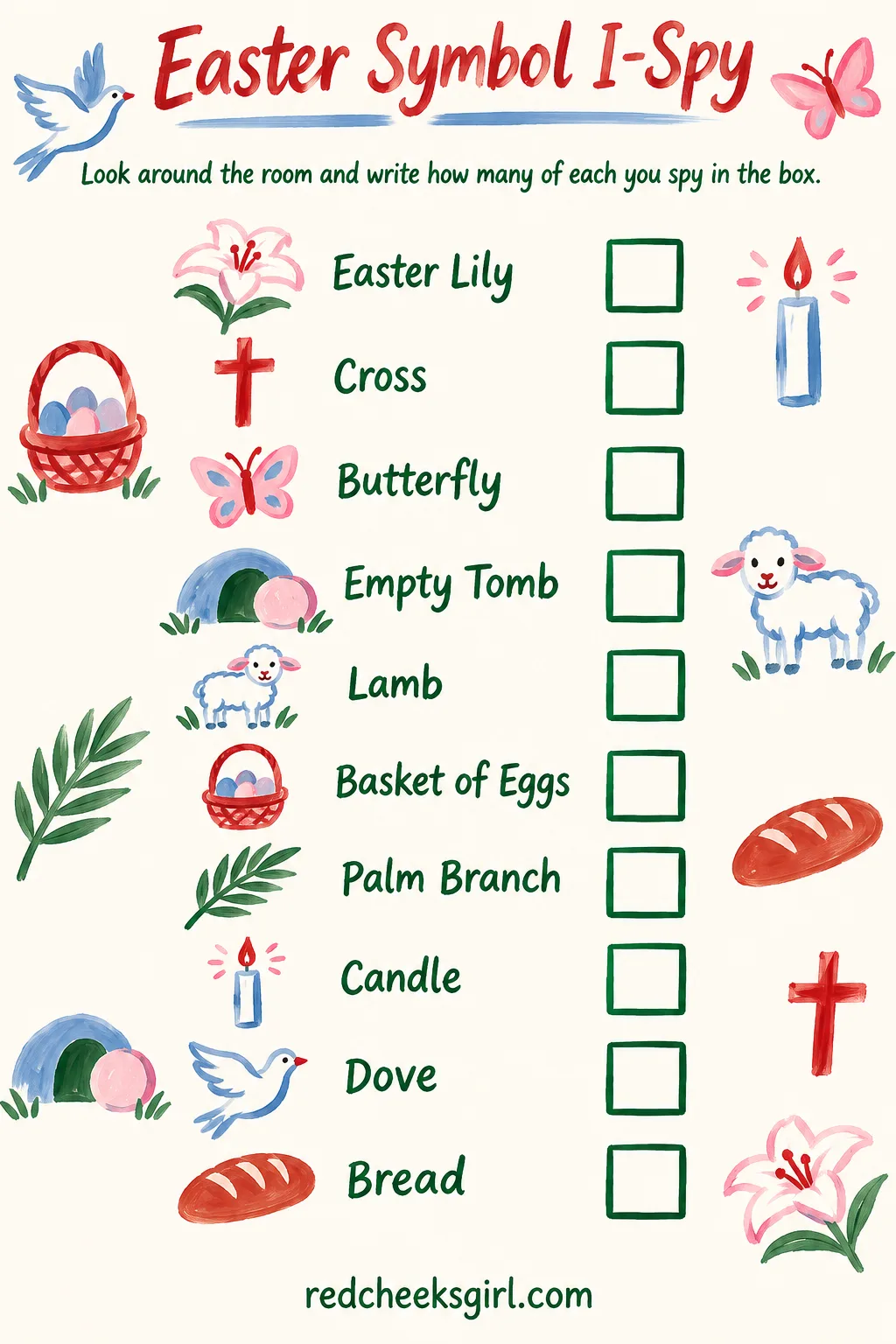
Kids look around the room, or around a page of illustrated symbols, and write how many of each Easter image they spot in the empty box beside it, a lily, a butterfly, a lamb.
There is no single correct total printed anywhere, so the activity simply ends when every box on the sheet has a number written in it, and kids compare counts with a neighbor just for fun.
It works well as a quiet five-minute activity for toddlers and preschoolers waiting for brunch, needs nothing but a pencil, and keeps little hands busy without any competition or winner to manage. Pair it with the toddler-friendly crafts in 23 Easter Crafts for Kids to Make Before the Egg Hunt for a longer quiet-table stretch.
Kids who cannot write numbers yet will need a grown-up nearby to help fill in the box, so keep an adult or an older sibling at the table rather than leaving toddlers with the sheet alone. For older kids, turn it into a race to spot every symbol first instead of a solo count.
Frequently Asked Questions
How long should a church Easter party for kids last?
Most church Easter parties run well in sixty to ninety minutes, enough time for the egg hunt, three or four games, and brunch without kids losing steam or nap schedules getting wrecked.
How many volunteers do you need to run Easter games for a children’s group?
Plan for roughly one adult per eight to ten kids, plus one extra volunteer per activity station to explain rules and keep the line moving.
Do church Easter games need prizes for the kids to stay engaged?
No, small stickers or a single piece of candy work fine, since most kids are motivated by the game itself and the chance to win in front of friends, not the prize value.
What age range do these Easter games work best for?
The lineup spans preschool through about age twelve, with easier and harder versions noted for most games so one group of mixed ages can play together.
Can these games be adapted for a small Sunday school class instead of a full fellowship hall party?
Yes, the printable sheets scale down easily to a class of six to ten kids, and the active games like tag or charades just need a smaller cleared space.
How do you keep the Easter story the focus instead of just the egg hunt?
Lead with the Bible-based printable sheets before the egg hunt starts, so kids engage with the resurrection story while they are still fresh and the hunt becomes the reward after.

20 gifts for girly girls, from pearl jewelry to cashmere, sorted by what they cost and who she is so
22 gifts for cool girls across fashion, beauty, home and travel, picked past the obvious candle and

18 gifts for hard to shop for men, sorted by what he actually does: recover, work, travel, stay warm
Leave a Reply