

Running a church or community Easter party for a crowd means you need games that scale — activities that work whether you have thirty guests or three hundred, that keep every age bracket laughing, and that don’t require a logistics degree to set up.
The twenty games below have been chosen specifically for large-group dynamics: relay races that fill a field, trivia rounds that seat entire families at one table, and printable sheets that you can run off in bulk the night before so every team has exactly what they need.
You’ll find a healthy mix here — active outdoor games, sit-down team rounds, creative stations, and a handful of printable formats that do the heavy lifting for you.
At least eight of the twenty games come with a dedicated printable sheet, so your emcee can stay organized and your guests always know what they’re doing.
Work through the list to build a full two- to three-hour program, or cherry-pick a handful to slot around your egg hunt and Easter meal.
Either way, you’ll have more than enough to keep every family entertained from the opening welcome through to the final prize draw.
This post contains affiliate links — if you buy through them, I may earn a small commission at no extra cost to you.
Table of Contents
- Team Egg Hunt Relay
- Easter Human Bingo (printable)
- Bunny Hop Team Race
- Egg Toss Tournament
- Easter Scavenger Hunt (printable)
- Family Feud Easter Edition (printable)
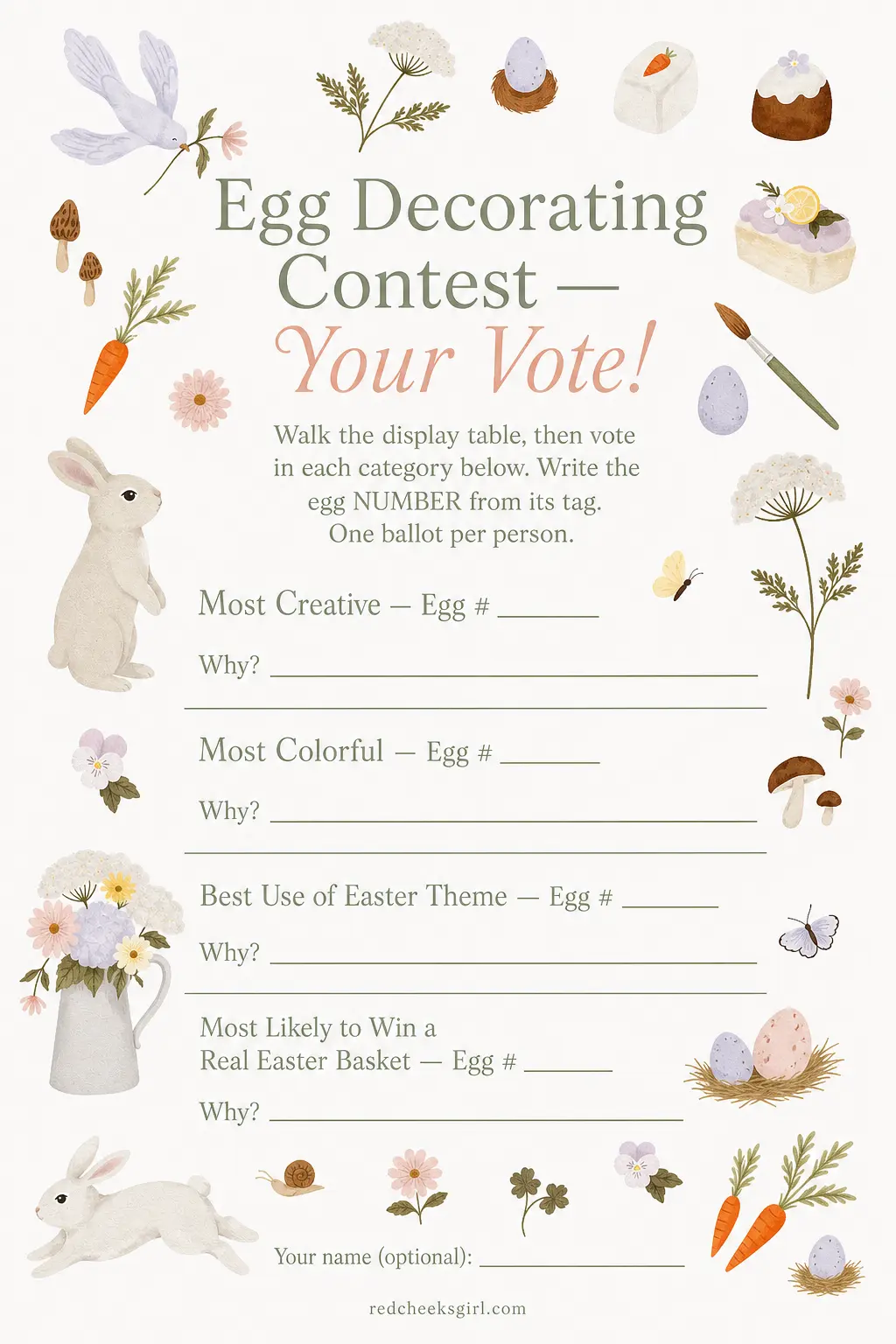
- Egg Decorating Stations With Ballots (printable)
- Group Picture Round (printable)
- Chick Chick Duck
- Easter Charades Teams (printable)
- Egg Roll Derby
- Easter Trivia Team Rounds (printable)
- Easter Emoji Decode!
- Easter Would You Rather – Cast Your Vote!
- Easter Community Mad Libs!
- Springtime Pictionary Relay
- Egg-and-Spoon Obstacle Course
- Balloon Pop Easter Surprise
- Giant Easter Noughts and Crosses
- Musical Easter Baskets
1. Team Egg Hunt Relay
Divide your crowd into teams of six to ten and assign each team a dedicated hunting zone marked with colored flags or rope.
Instead of a free-for-all scramble, one runner at a time races out to find a single egg, brings it back to the team basket, and tags the next runner — relay style. The team that collects the most eggs within a ten-minute window wins.
Because every team works simultaneously in its own zone, you avoid the chaos of bigger kids outpacing little ones, and you keep the energy focused and fair.
You’ll need a large outdoor or indoor space divided into equal zones, several dozen plastic eggs hidden per zone, and a clearly marked start-and-return line for each team.
Use different colored eggs per zone — or mark eggs with a team sticker — so there’s no poaching from a neighbor’s patch.
This runs beautifully with any number of teams and usually takes fifteen to twenty minutes from the starting whistle to the final count. Group size is flexible: add more teams and zones as your attendance grows.
Host tip: pre-count exactly the same number of eggs into each zone before the party starts and note the number — when the relay ends, you can quickly verify totals rather than counting by hand in the middle of the excitement.
🛍 Shopping guide
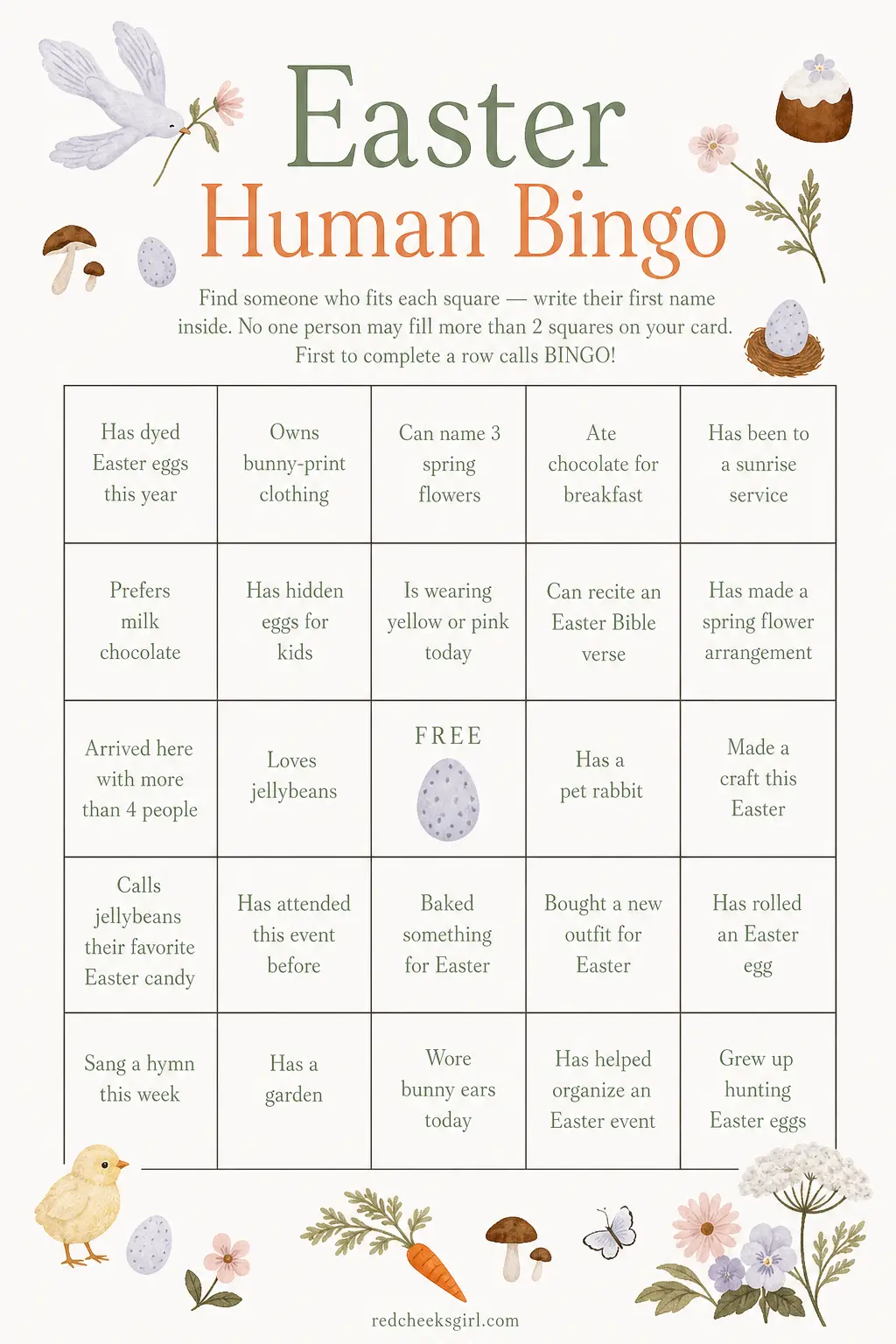
2. Easter Human Bingo (printable)
This is the perfect icebreaker for the first thirty minutes of a large community gathering when guests are still arriving and milling around.
Each player receives a printed five-by-five bingo grid filled with Easter-themed descriptions of real people — things like “has decorated eggs before,” “can name three books of the Bible,” “is wearing something yellow today,” or “has never eaten a chocolate bunny.”
Players circulate, find a real person who matches each square, and write that person’s name in the box. The goal is to complete a full row, column, or diagonal — and then shout “Bingo!”
Print one sheet per guest and have pens or pencils at the door. The game works for any crowd size and typically runs twenty to thirty minutes, though you can cut it shorter by requiring a single line rather than a blackout.
Because guests have to physically find and talk to each other, it breaks down cliques and gets strangers laughing within minutes — a huge win for mixed church-and-community crowds. Award a small prize for the first three bingos called.
Host tip: design the squares with a range of difficulties — a few easy ones to get people moving fast, and two or three genuinely tricky ones so the game doesn’t end in the first five minutes. The sweet spot is a winner emerging around the fifteen-minute mark.
3. Bunny Hop Team Race
Teams of five line up in single file, each player placing their hands on the shoulders of the person in front.
On the whistle, everyone crouches slightly and hops together — bunny style — from the start line to a cone twenty feet away and back. The whole chain must stay connected; if anyone lets go, the team must stop, reconnect, and restart from that spot.
First team to cross the finish line with the chain intact wins the round. Run it as a best-of-three bracket if your schedule allows.
All you need is open space — a church hall with chairs cleared, a gymnasium floor, or a grassy field — and a couple of traffic cones per lane. Teams of five work best for coordination, though you can adjust to four or six.
The race itself takes only a few minutes per heat, making it ideal as a high-energy interlude between seated activities. Expect a lot of laughter when chains collapse mid-hop. Total playing time including setup and bracket rounds is about fifteen minutes.
Host tip: enforce the reconnection rule firmly but cheerfully — it’s the rule that generates the most laughter and creates natural dramatic moments. Appoint a lane judge for each team rather than trying to watch all lanes yourself.
4. Egg Toss Tournament
Partners face each other at a starting distance of about four feet, each pair holding one hard-boiled or plastic egg. On the signal, one partner tosses the egg underhanded to the other. If the catch is clean, both partners take one large step backward.
If the egg is dropped or cracked, the pair is eliminated. The game continues — toss, step back, toss, step back — until only one partnership remains.
With a large crowd you can seed the tournament bracket in advance or simply run it as a last-team-standing elimination.
Hard-boiled eggs add genuine jeopardy (and a messy, hilarious finish when the last egg eventually breaks), but plastic eggs filled with a little playdough to add weight work well for indoor venues or if you’d rather not deal with raw egg cleanup.
You need open space proportional to your crowd — a parking lot, field, or long church hallway. Pairs can number anywhere from ten to a hundred; the game self-manages as teams drop out.
Budget twenty-five to thirty minutes for a full tournament with a large crowd.
Host tip: supply a clear plastic sheet or tarp as the “finals stage” if you’re using real eggs — it keeps cleanup fast and actually adds to the drama as the final pair reaches ludicrous distances.
🛍 Shopping guide
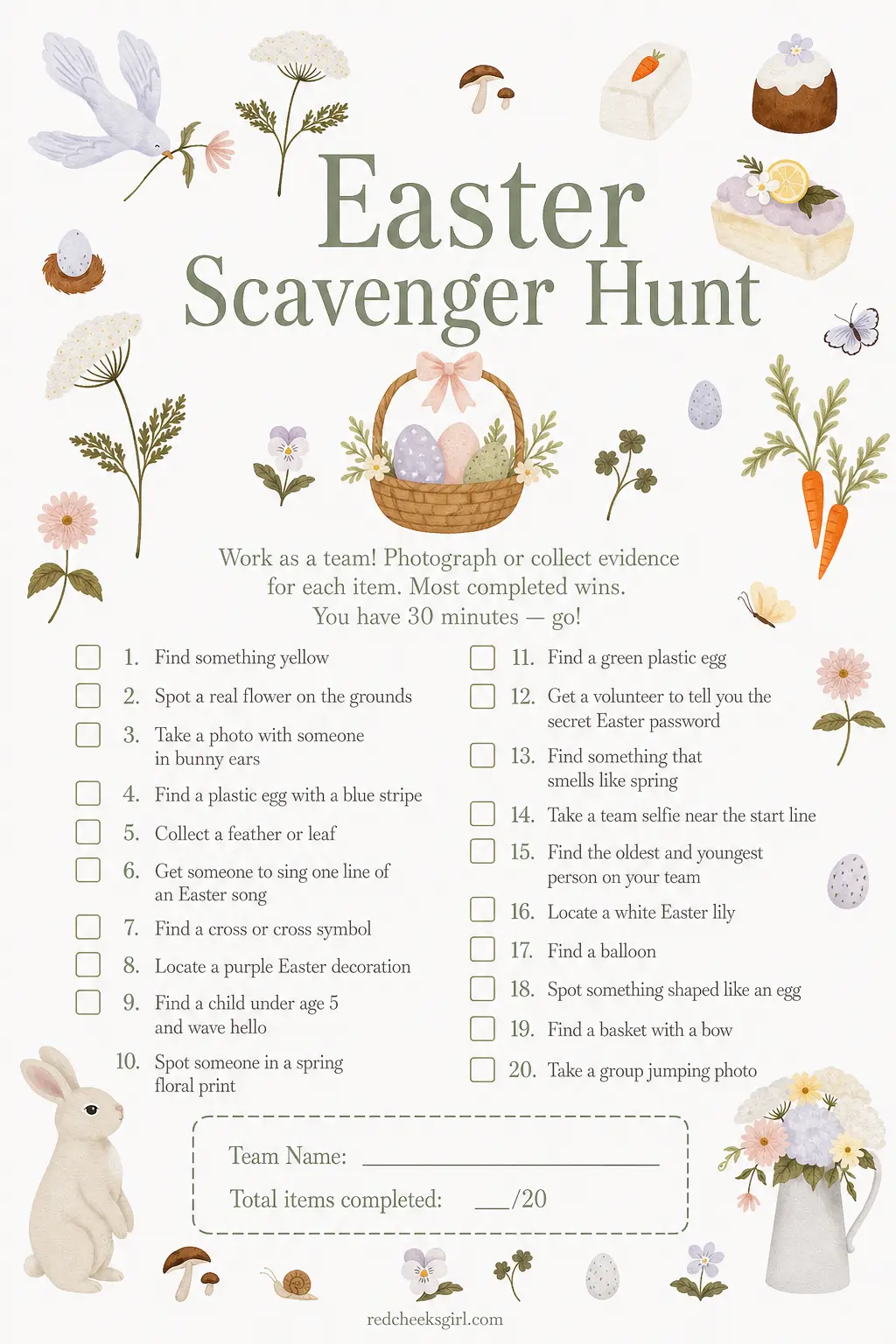
5. Easter Scavenger Hunt (printable)
Teams of four to six receive an identical printed list of Easter-themed items, clues, and challenges to complete around your venue or grounds.
Items might include “find something the color of a robin’s egg,” “take a group photo next to something that blooms,” or “collect one item that represents new life and bring it back to the host table.”
The list is tiered in point values — easy items worth one point, harder challenges worth three — so teams must strategize about where to spend their time. First team back with the highest score wins.
The printable sheet is the game: hand one to each team at the starting whistle along with a pen for recording their finds. Teams use their own phones for photo challenges.
This scales to any crowd size because teams operate independently across your whole space; the more room you have, the richer the hunt. Allow twenty-five to forty minutes depending on your venue size.
The game suits all ages because teams naturally let different members shine on different tasks.
Host tip: walk your venue the day before and write clues that reference specific real landmarks — the oak tree by the car park, the blue door on the hall, the signboard near the entrance. Location-specific clues prevent teams from gaming the list without actually exploring.
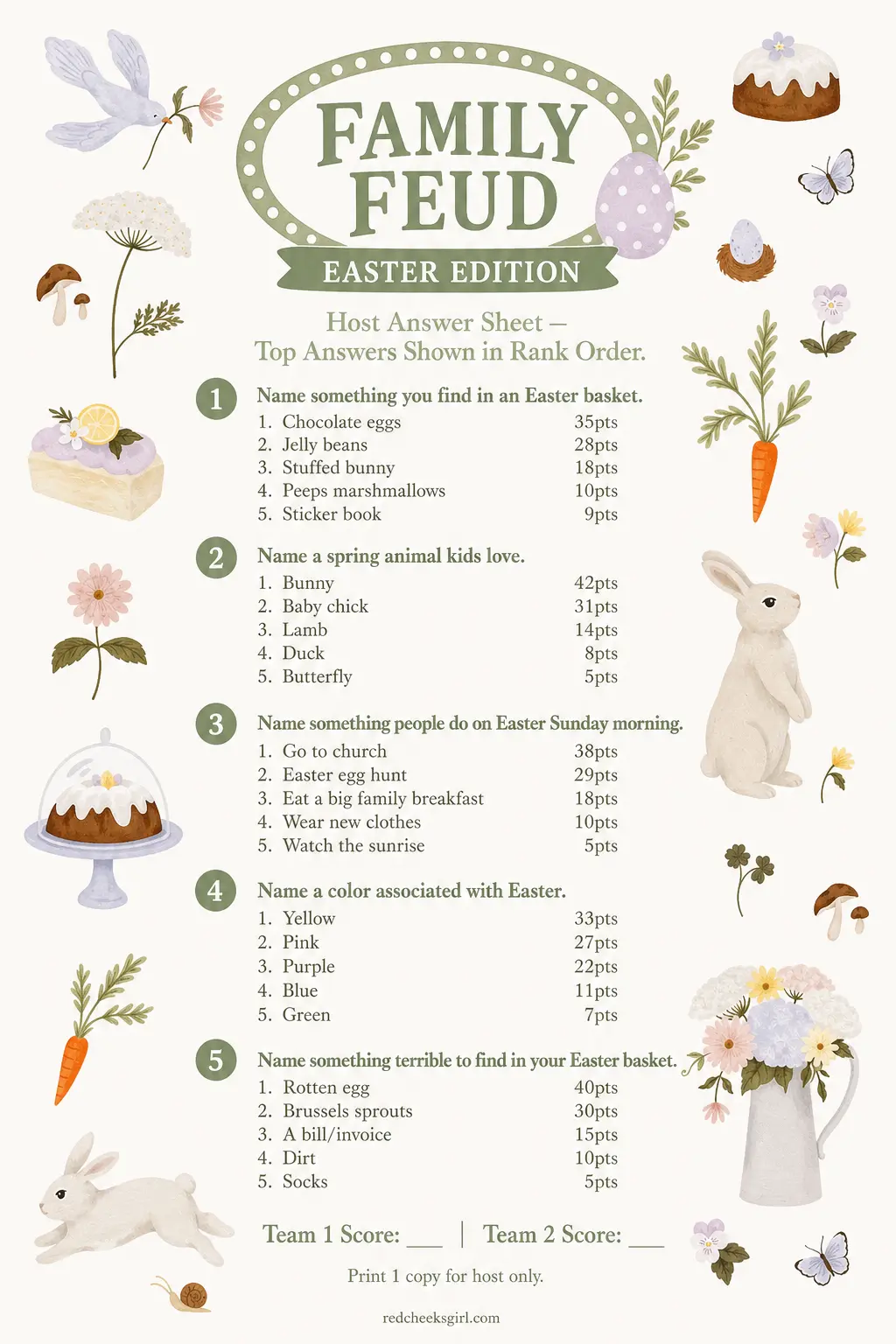
6. Family Feud Easter Edition (printable)
Seat teams of four to six at tables and appoint one spokesperson per team.
The host reads an Easter-themed survey question — “Name something you always find inside an Easter basket,” for example — and the spokesperson who buzzes in first (slap the table, ring a bell, or raise a hand) gets to answer.
Correct answers that match the pre-surveyed top responses earn points equal to that answer’s rank. Teams play through ten to fifteen questions; the team with the most points after the final round wins.
The printable answer sheet shows the question prompts and the ranked answers so your host can run the game smoothly without memorizing anything.
You’ll need a host, a printed answer sheet (one copy for the host only — teams should not see the answers), and a noisemaker or bell for buzzing in. Tables, chairs, and a microphone if your room is large.
This format works brilliantly for groups of twenty to two hundred because every table participates as a team simultaneously. Each game takes approximately twenty to thirty minutes.
The competitive energy in a large room when families argue over whether “jelly beans” or “chocolate eggs” ranked higher is genuinely electric.
Host tip: survey your own congregation or community two weeks in advance to generate real local answers — it makes the reveal moments far funnier and more personal than generic internet answers, and people love recognizing their own responses on the list.
7. Egg Decorating Stations With Ballots (printable)
Set up four to six decorating stations around the hall, each supplied with a tray of hard-boiled or blown-out eggs, a theme (watercolors, washi tape, natural dyes, sticker art), and all the materials guests need.
Families spend fifteen to twenty minutes creating their best egg at whichever station they choose, then display finished eggs in a central judging area labeled with a number.
Each guest receives a printed ballot and votes for their favorites across categories like “Most Creative,” “Funniest,” and “Most Beautiful.” The egg with the most votes in each category wins a small prize.
The printable ballot — titled “Egg Decorating Contest — Your Vote!” — does double duty: it keeps voting fair and anonymous, and it gives guests something to hold and complete while the judging area fills up with entries.
You’ll need egg decorating supplies for each station, tables, display stands or egg cartons for exhibit, and printed ballots plus collection boxes. This works for any crowd size; just add more stations as numbers grow.
Allow thirty to forty minutes for decorating, plus ten minutes for voting and five for the reveal.
Host tip: number every displayed egg with a sticky label rather than naming the creator — anonymous voting prevents friendship bias and makes the results genuinely surprising.
🛍 Shopping guide
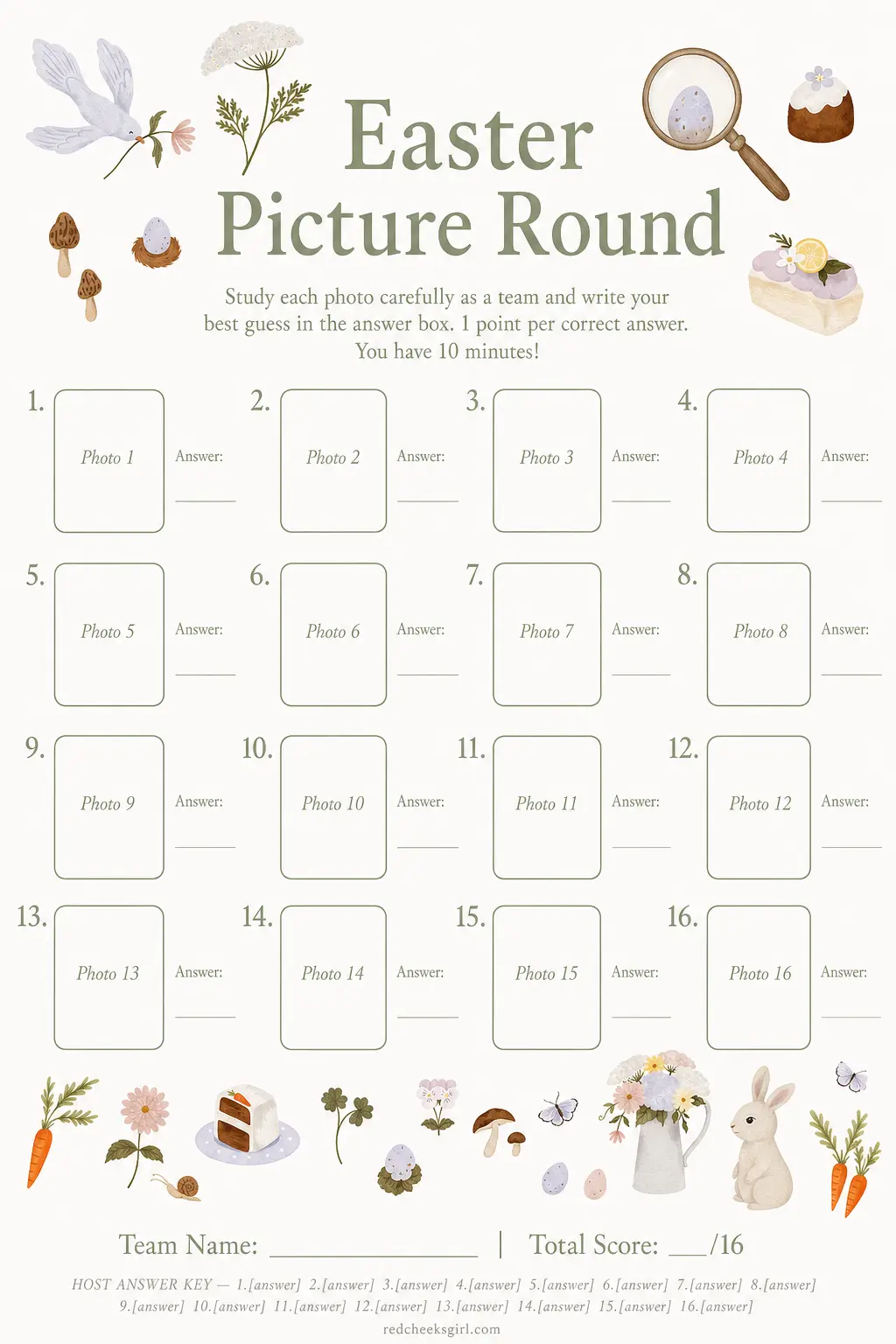
8. Group Picture Round (printable)
Teams of four to six sit at tables and receive the printed “Easter Picture Round” sheet, which contains a grid of photographs or illustrations — close-up shots of Easter-related objects, landscapes, food items, animals, and traditions from around the world.
Teams study each image and write down what they think it shows. Points are awarded for correct identifications, with bonus points for especially obscure images. The team with the highest total at the end wins.
This is a quiet, collaborative round that works beautifully after a high-energy relay or between meals.
One printed sheet per team is all you need, plus pens. The host sets a timer — typically ten to twelve minutes — and teams work in hushed, intense discussion before handing their sheets to the host for marking.
Because it’s visual rather than text-based, it works across language backgrounds and literacy levels, making it genuinely inclusive for diverse community gatherings. Total time including marking and revealing answers is about twenty minutes.
Host tip: include at least two images that are almost-but-not-quite what they seem — a photo of a quail egg next to a regular egg, or a white rabbit that could plausibly be a lamb — because the debate those images spark is half the fun of the reveal.
9. Chick Chick Duck
This is Duck Duck Goose rebuilt for Easter, and it is a guaranteed crowd-pleaser with younger children at large family events. Children sit in a large circle on the ground.
One child walks around the outside tapping each player on the head, saying “Chick” each time — until they choose someone and say “Duck!” That person leaps up and chases the tapper around the circle.
If the tapper makes it back to the empty seat safely, the chaser becomes the new tapper. If the chaser tags the tapper before they sit, the tapper goes again.
No equipment needed — just a cleared space large enough for the circle, which can be surprisingly big with a large group of children.
This game works best for ages three to ten and can accommodate twenty to forty children at once by making the circle wider. It runs continuously for as long as energy allows, typically ten to fifteen minutes before children are ready to move on.
It’s a wonderful filler game while adults are finishing a separate activity nearby.
Host tip: with very large circles the chase becomes exhausting quickly — if children are flagging, shift to a rule where every third tap is automatic, so the game keeps moving without waiting for a shy child to ever say “Duck.”
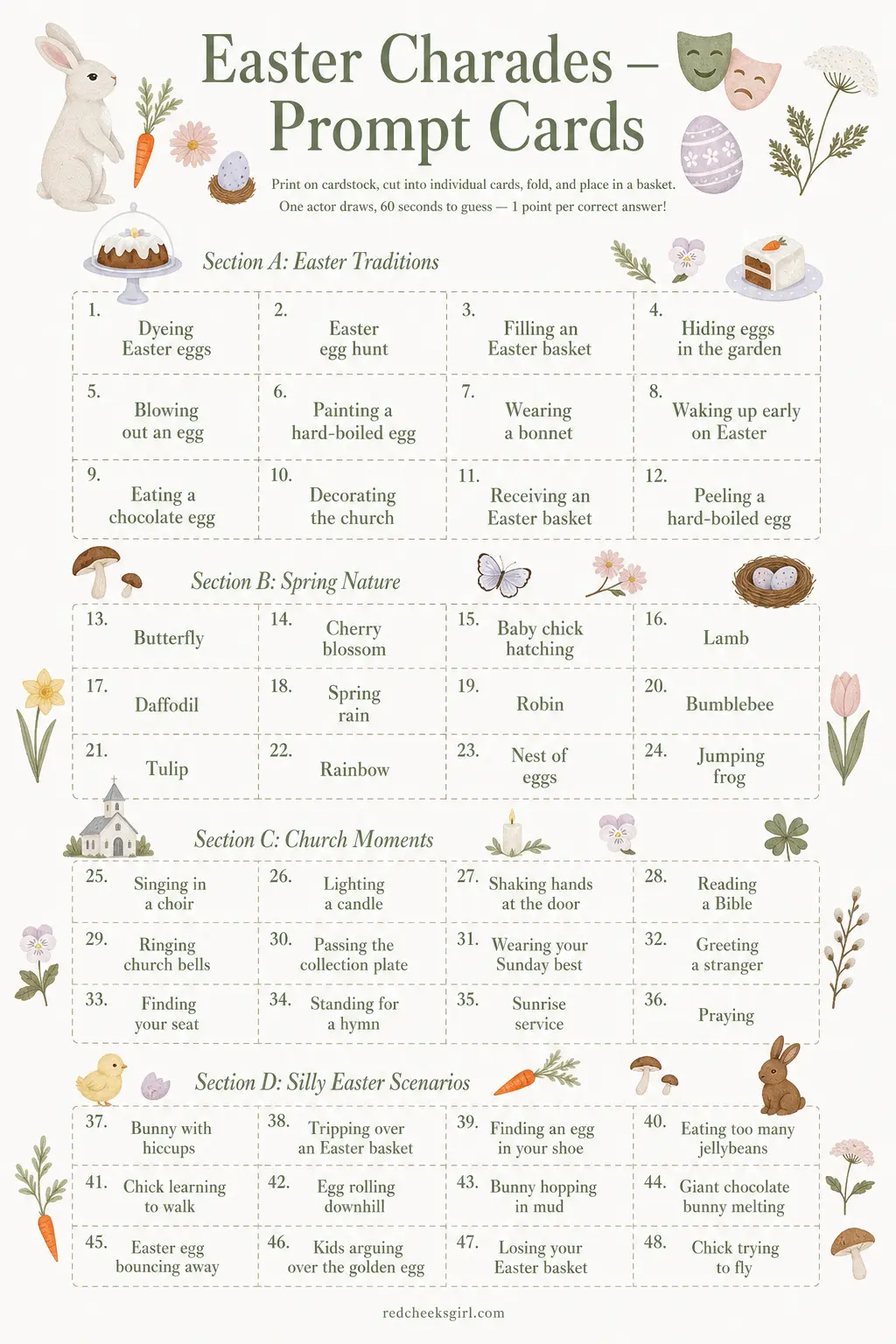
10. Easter Charades Teams (printable)
The printable “Easter Charades – Prompt Cards” sheet contains a full set of Easter-themed words and phrases — things like “sunrise service,” “Easter parade,” “cracking an egg,” or “a lamb in a field” — printed on cards that you cut apart before the party.
Teams of five to eight sit facing their own actor, who draws a card and acts out the prompt silently while teammates shout guesses.
A correct guess earns the team a point; the team with the most points after every player has had one turn wins. The card-based format means no wasted time thinking up prompts on the spot.
Print one sheet per team, cut the cards, and keep each team’s set rubber-banded separately. All you need beyond the cards is a timer (sixty seconds per turn works well) and a scorekeeper.
The game runs simultaneously across all teams, so it scales to any room size — ten teams of six can all play at once without any team waiting around. Total playing time is twenty-five to thirty-five minutes depending on team size.
The noise level in a large room of simultaneous charades is exhilaratingly high.
Host tip: seed each team’s card pile with an identical mix of easy, medium, and hard prompts rather than letting teams draw randomly — it keeps scores competitive and prevents one team from lucking into all the easy cards.
11. Egg Roll Derby
Players line up at a start line, each with one hard-boiled egg and a large serving spoon.
On the whistle, they race to roll their egg across the grass to a finish line twenty to thirty feet away — using only the back of the spoon to nudge it forward, never their hands.
Players who touch the egg with their hands must return to the start. Run heats of six to ten players at a time and advance winners through a bracket.
The egg roll is one of the oldest Easter traditions in many communities, and the sight of dozens of people crouched over nudging eggs across a lawn never fails to draw a crowd of laughing spectators.
You’ll need one hard-boiled egg and one large spoon per player, plus a flat grassy or smooth-floor surface. Mark lanes with chalk or rope to keep racers from veering into each other.
Heats take only two to three minutes each, so you can run a full tournament bracket in twenty minutes. This works for all ages — adults often find it harder than children, which is part of the comedy.
Crowd size is unlimited; just add more heats.
Host tip: boil a few spare eggs and keep them at the start line, because eggs will crack mid-race — having instant replacements means a dropped-and-cracked egg doesn’t eliminate someone through bad luck rather than poor skill.
🛍 Shopping guide
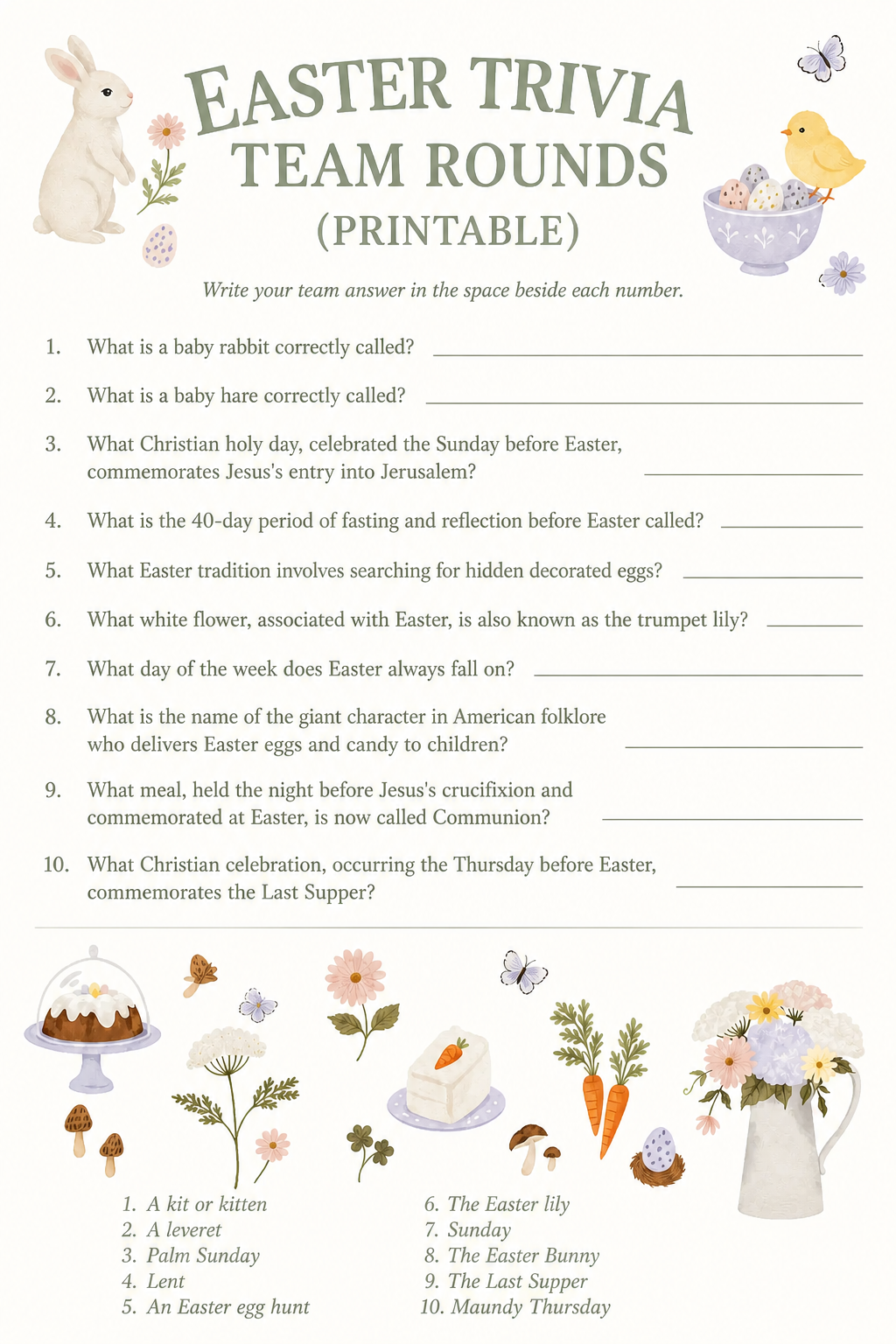
12. Easter Trivia Team Rounds (printable)
Teams of four to six receive the printed “Easter Trivia Team Answer Sheet” at the start of each round.
The host reads questions aloud — covering Easter traditions, biblical Easter narrative, spring nature, Easter foods from around the world, and Easter history — and teams huddle to discuss before writing their answer on the sheet. No shouting out; every team writes in secret.
At the end of each round the host reveals the answers and teams swap sheets to mark a neighbor’s paper. After four to five rounds, total scores are tallied and the winning team is announced.
Print one answer sheet per team per round — or design the sheet with multiple rounds on one page. You’ll also need printed question cards for the host, a microphone for large rooms, and pens per table.
This format works for crowds of twenty to three hundred, making it one of the most scalable games in the lineup. A full five-round trivia night runs forty to fifty minutes.
Calibrate question difficulty to your crowd — a church audience may know biblical detail that a general community crowd wouldn’t, so mix category weighting accordingly.
Host tip: build a “joker” rule into the answer sheet — each team can nominate one round as their joker round in advance, doubling their points for that round. It introduces a strategic layer that keeps experienced trivia teams fully engaged from round one.
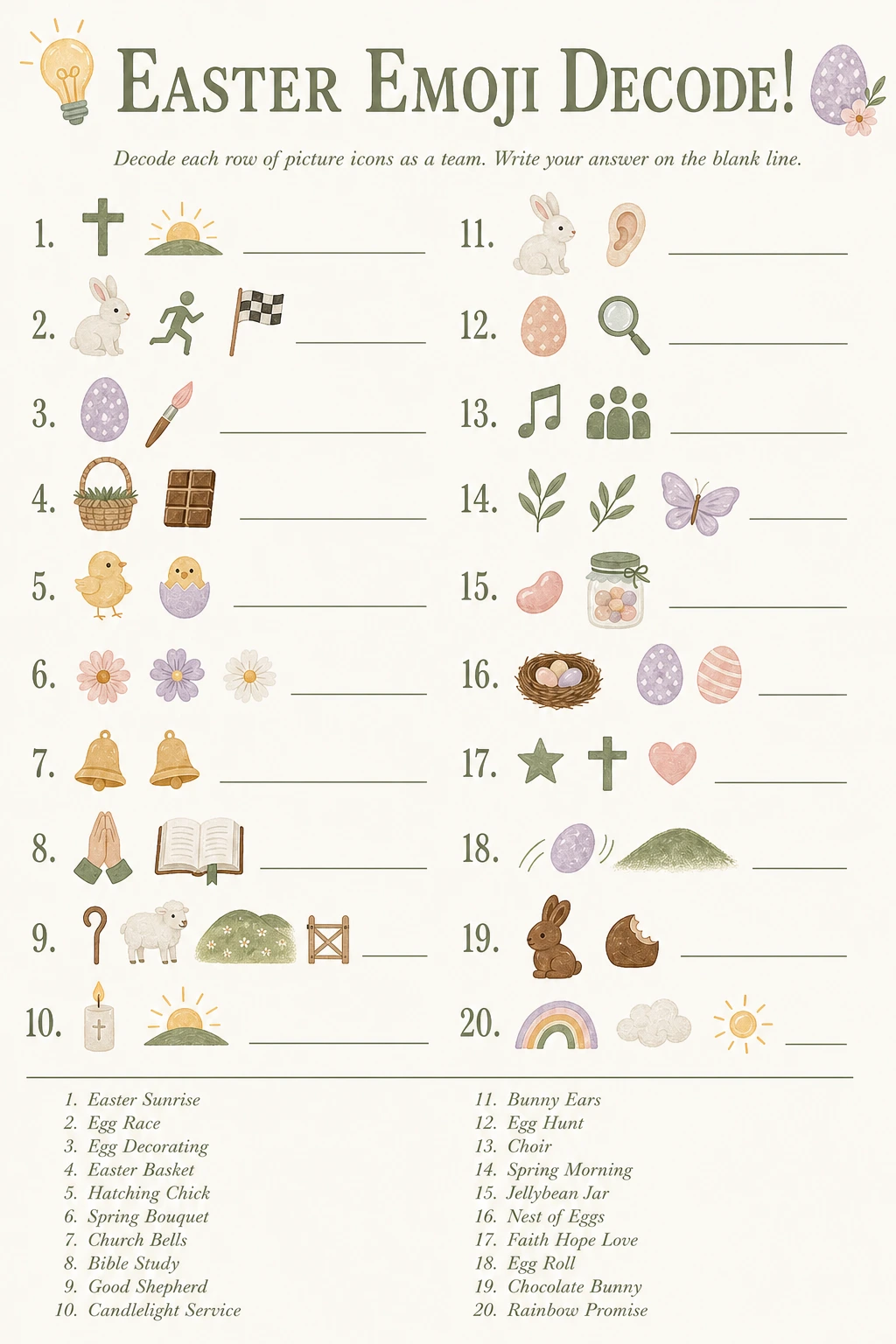
13. Easter Emoji Decode!
Teams of four to six receive the printed “Easter Emoji Decode!” sheet, which presents sequences of standard emoji that represent Easter-related words, phrases, or traditions.
Rather than a rebus or hidden-phrase puzzle, each sequence is a straightforward description challenge: teams look at the emoji grouping, discuss what Easter concept it evokes, and write their best answer in the space provided.
The sheet includes twenty sequences, and teams earn one point per accurate interpretation. The team with the most points when time is called wins the round.
Print one sheet per team and supply pens. Set a timer for twelve to fifteen minutes — enough time for teams to work through all sequences with good discussion but not so long that energy drops.
Because the sheet is self-contained, this round runs itself while the host circulates and answers clarifying questions.
It works for any crowd size and suits mixed ages well; teenagers and young adults tend to be fast at this, which levels the playing field against adult trivia veterans.
Mark as a host after time is called and reveal answers question by question for maximum reaction.
Host tip: announce before the timer starts that “creative but defensible” answers earn full credit — this encourages teams to commit to answers rather than leaving blanks, and the host’s judgment call on creative responses becomes a crowd-pleasing moment during the reveal.
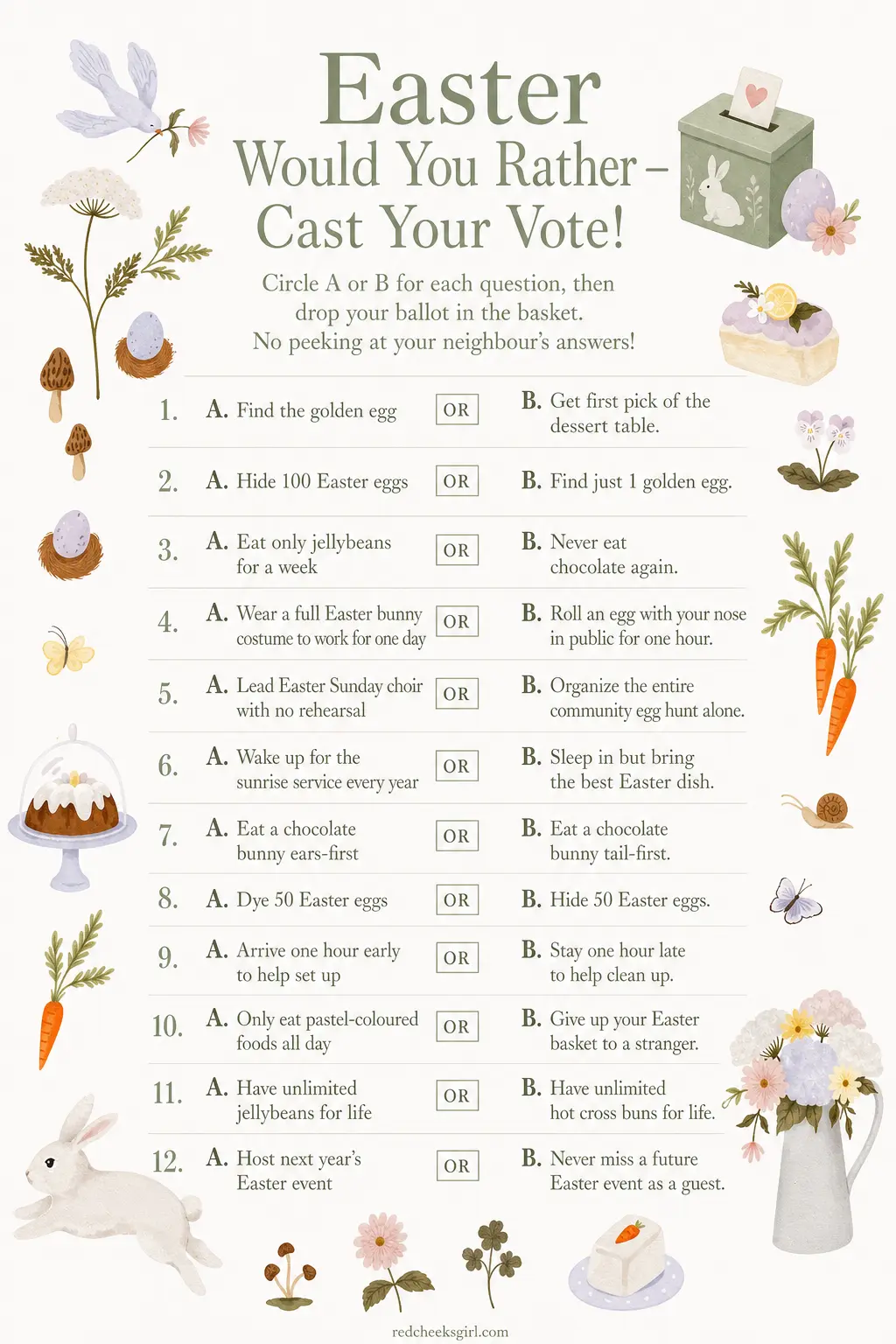
14. Easter Would You Rather – Cast Your Vote!
This large-group voting game uses the printed “Easter Would You Rather – Cast Your Vote!” sheet, which lists a series of Easter-themed dilemmas — for example, “Would you rather hunt for eggs in a muddy swamp OR in a prickle bush?”
or “Would you rather eat only hot cross buns for a week OR only chocolate eggs?”
Each player marks their choice for every question independently, then the host polls the room by show of hands and reveals the split — and the results are always funnier when a question produces a genuine fifty-fifty divide or one wildly unexpected majority.
Print one sheet per person and supply pens or pencils.
The game works in two phases: silent individual voting (five minutes), followed by the host reading each question and tallying hands while the room erupts over each reveal (ten to fifteen minutes of discussion and laughter).
No winner or loser — this is a community-bonding activity as much as a game, making it perfect for the quieter middle section of your program when you want connection rather than competition. Works for any crowd size.
Host tip: leave space on two or three questions for guests to write in their own alternative option — having the host read a few wild write-in responses during the reveal adds an improvised comedy moment that the whole room remembers.
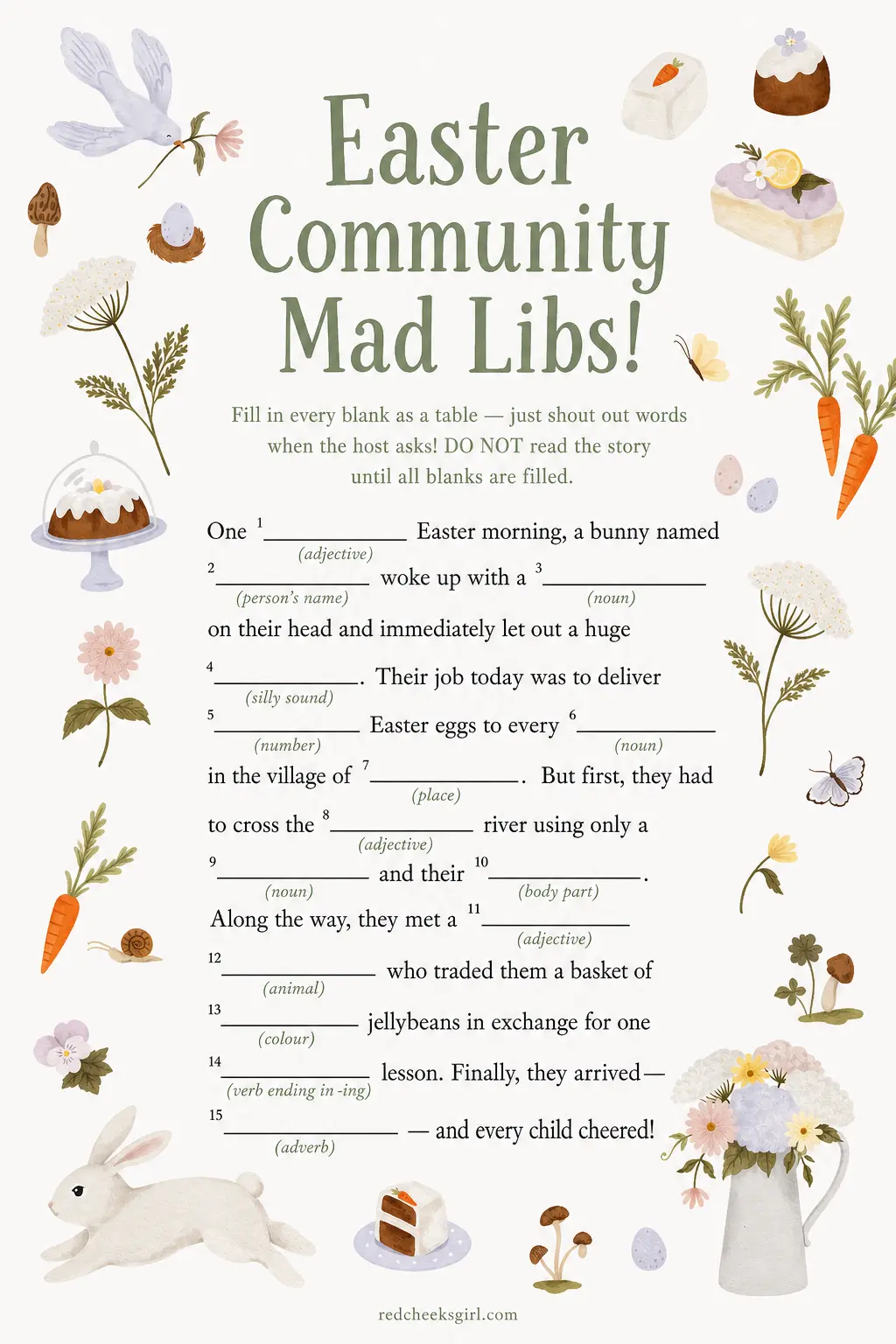
15. Easter Community Mad Libs!
The printed “Easter Community Mad Libs!” sheet contains a short Easter-themed story with key words blanked out and labeled by part of speech — noun, verb, adjective, and so on.
In the large-group version, the host stands at the front of the room with a microphone and calls out each blank in turn, asking the audience to shout out a word of the requested type.
The host fills in whatever the crowd shouts first (or picks the funniest suggestion), then reads the completed story aloud from start to finish. The more absurd the audience’s contributions, the funnier the final story.
Print one sheet for the host — though you can also print copies for every table so guests can follow along as the story is read. No other materials needed except a microphone for large venues.
This game takes ten to twelve minutes and is best placed just after a meal or between high-energy physical games, when the group benefits from a shared, low-effort laugh.
It works for any crowd size and every age group, and children especially love hearing ridiculous words inserted into a proper-sounding Easter story.
Host tip: have two or three Mad Libs stories ready and run them back to back if the room is responding enthusiastically — each read-through gets funnier as the audience starts trying to outdo themselves on each word request.
16. Springtime Pictionary Relay
Two teams of any size stand in two lines facing a whiteboard or large paper easel.
The first player in each line receives a folded card with an Easter or spring-themed word — “hatching,” “daffodil,” “Easter sunrise,” “bunny warren” — and races to draw it on their board while their teammates shout guesses.
The moment a teammate guesses correctly, that player runs up, takes the marker, receives a new card, and begins drawing. The team that works through the most cards correctly in three minutes wins the round. Repeat with fresh teams for a tournament format.
You’ll need two whiteboards or large paper pads on easels, markers, and a stack of pre-written word cards — thirty to forty is plenty for a large event. This runs for groups of ten to sixty comfortably; with larger crowds, run four simultaneous lanes.
Each round is only three minutes, so you can fit multiple rounds into a ten-minute slot. The relay format means everyone draws at least once in a long enough session, removing the bottleneck of one person hogging the marker.
Host tip: keep your word cards sorted by difficulty and escalate from easy to hard across rounds — early rounds build confidence and teach the teams how to communicate, while later hard words produce the chaotic shouting that everyone will talk about afterward.
🛍 Shopping guide
17. Egg-and-Spoon Obstacle Course
Set up a simple obstacle course across your hall or field: weave between cones, step through a hula hoop, walk a balance beam (a length of masking tape on the floor works fine), and duck under a rope before crossing the finish line — all while balancing a hard-boiled egg on a spoon held in one hand.
Drop the egg and you must stop, pick it up, and replace it before continuing. Run it as a timed individual challenge, recording each participant’s time on a shared scoreboard, or as a relay where the spoon is handed off at the finish line.
Equipment needed: spoons (one per lane), hard-boiled eggs, cones, a hula hoop or two, and chalk or tape for the balance beam section.
This course takes about two minutes per individual run, so time it as a continuous flow activity rather than a waiting-in-line one — send a new runner every thirty seconds.
Works for ages five and up; adults and teens find the obstacles harder than expected, especially the weave section, which is a great equalizer. Allow twenty to thirty minutes for a full group rotation.
Host tip: have a volunteer stationed at the hula hoop specifically to reset it when it gets knocked over — that single point creates the most delays, and keeping it moving there prevents a bottleneck that stalls the whole course.
🛍 Shopping guide
18. Balloon Pop Easter Surprise
Before the party, stuff round yellow and white balloons with small folded paper slips. Most slips say “try again” but a handful say prize categories — “small prize,” “medium prize,” or “golden egg prize.”
Inflate and tie all balloons, then scatter them across one section of your venue or hang them in a large net overhead. On the host’s signal, players rush in and pop one balloon each by sitting on it, stomping it, or squeezing it.
They open the slip inside to see what they’ve won, then bring winning slips to the prize table.
You’ll need balloons (yellow and white to stay on theme), small paper slips, a black marker for labeling, and prizes at a collection table. Prepare at least one balloon per guest, plus extras.
This game takes only five chaotic, joyful minutes and is best used as a grand finale or high-energy interlude. It scales to any crowd — simply inflate more balloons.
Supervise younger children closely and keep a bag nearby for popped balloon pieces, which can be a choking hazard for toddlers.
Host tip: pre-sort your balloons so prize-winning slips are distributed evenly throughout the batch — if all the golden egg slips end up in balloons that get popped first, the game loses excitement for late arrivers, so mix them in deliberately.
🛍 Shopping guide
19. Giant Easter Noughts and Crosses
Mark out a large three-by-three grid on a tarpaulin, a parking lot surface, or a grass field using tape or chalk — each square about two feet across. Divide your crowd into two teams: the Eggs (O) and the Chicks (X).
Each team nominates one player per turn to stand in a square of their choice. Once a player stands in a square, they stay there — no moving.
Teams alternate placing players until one team has three in a row horizontally, vertically, or diagonally, or until all nine squares are filled and the round is declared a draw. The giant human scale makes every placement decision feel momentous.
All you need is tape or chalk and nine willing players per round — plus a crowd watching and advising loudly.
Each round takes two to four minutes, so you can run six or eight rounds in a twenty-minute window, rotating in new players each time.
This works beautifully as a spectator game that involves the whole crowd in the strategy even when they’re not standing in a square, because everyone shouts advice. It’s effective for all ages and requires zero materials beyond what you can draw on the ground.
Host tip: introduce a rule where the watching crowd can attempt to distract standing players by doing Easter-themed actions — flapping like a chick, hopping like a bunny — but may not touch anyone or shout instructions. It keeps the bench engaged without disrupting the actual strategy.
20. Musical Easter Baskets
Arrange Easter baskets (or hula hoops laid flat) in a circle on the floor — one fewer than the number of players. When the music plays, everyone walks briskly around the outside of the circle.
When the music stops, every player dives for a basket and sits behind it. The player left without a basket is out, remove one more basket, and play again. Continue until one player remains and is crowned the Easter champion.
This is the classic musical chairs format dressed up for Easter, and it works just as well for adults as it does for children.
You’ll need baskets or hula hoops (one per player minus one), a music source, and open floor space. The game self-manages as players drop out; the playing area shrinks naturally as baskets are removed.
Run it with twenty to forty players for maximum energy — with very large crowds, run multiple simultaneous circles and merge the winners into a championship final. Total time for a group of thirty is about fifteen minutes.
Award the winner a filled Easter basket as the grand prize for maximum thematic payoff.
Host tip: use upbeat, age-appropriate spring music and vary the length of each musical segment unpredictably — sometimes stopping after five seconds, sometimes letting thirty seconds pass — so no one can game the stopping point by hovering near a basket.
🛍 Shopping guide
Frequently Asked Questions
How many of these Easter games for large groups work outdoors?
The majority of the twenty games work well outdoors.
The Team Egg Hunt Relay, Egg Toss Tournament, Bunny Hop Team Race, Egg Roll Derby, Egg-and-Spoon Obstacle Course, Giant Easter Noughts and Crosses, and Balloon Pop Easter Surprise are all especially well-suited to a field, car park, or church grounds.
The printable games like Trivia, Scavenger Hunt, and Human Bingo can be run outdoors if you weigh down paper sheets or laminate them in advance.
Check your local weather forecast and have a rain plan — designate an indoor room as a backup venue for the seated printable rounds.
What is the best order to run these games at a full-day Easter event?
Start with Easter Human Bingo as your arrivals icebreaker, then move into the high-energy Team Egg Hunt Relay once most guests have arrived.
Follow with a seated printable round like Family Feud or Group Picture Round to let everyone recover, then alternate active and seated games throughout the program. Save the Egg Toss Tournament or Balloon Pop Easter Surprise for a dramatic finale.
The Easter Community Mad Libs and Would You Rather sheet work well directly after a shared meal when energy is lower and you want easy communal laughter before the final games.
How far in advance should I print the game sheets for a large event?
Print all sheets at least two days before the event.
For a crowd of one hundred guests, you’ll typically need twenty-five to thirty copies of team-based sheets (one per table of four to six) and one hundred copies of individual sheets like Human Bingo and Would You Rather.
Print extras — around ten percent more than you think you need — to cover last-minute arrivals and any sheets that get damaged.
Store them in labeled manila envelopes sorted by game so your setup team can distribute them quickly on the day without searching through a pile.
How do you manage prizes fairly across so many games?
The simplest approach for a large community event is to use a ticket system rather than giving out prizes game by game. Every winning team or player receives a raffle ticket for each game they win.
At the end of the event, draw ten to twenty tickets and match them to a prize table where guests choose their own reward.
This keeps the energy positive — no one feels left out because every participant has at least a chance in the final draw — and it prevents the logistical headache of managing dozens of individual prizes throughout a multi-hour program.
Can these games work for a mixed-age crowd including very young children and seniors?
Yes — this list was deliberately built for mixed-age community and church gatherings. Games like Chick Chick Duck, Bunny Hop Team Race, and Musical Easter Baskets are natural fits for younger children.
Printable rounds like Trivia, Family Feud, and the Picture Round are perfect for adults and older teens who prefer seated, strategic games. The Egg Decorating Stations welcome every age because the creative task is self-directed.
When building your program, consider running a children’s activity zone simultaneously with adult-focused rounds so that neither group has to sit through content that doesn’t suit them.
📌 Save These for Later
Loved these? Pin your favorite image below so you can find this list again when you’re planning.

Discover 18 fun Easter games for adults perfect for brunch, backyard gatherings, and lightly competi
Discover 22 fun Easter party games for kids ages 3–10, from egg-and-spoon races to printable bingo

22 fun Easter party games for kids ages 3-10 — active races, printable sheets & quiet keepsakes be
Leave a Reply