

Let’s be honest — when someone says ‘bible games,’ half the room pictures folded chairs, a buzzing fluorescent light, and a quiz nobody asked for.
But here’s the thing: some of the most genuinely hilarious, competitive, edge-of-your-seat party moments I’ve ever witnessed happened around scripture, not despite it.
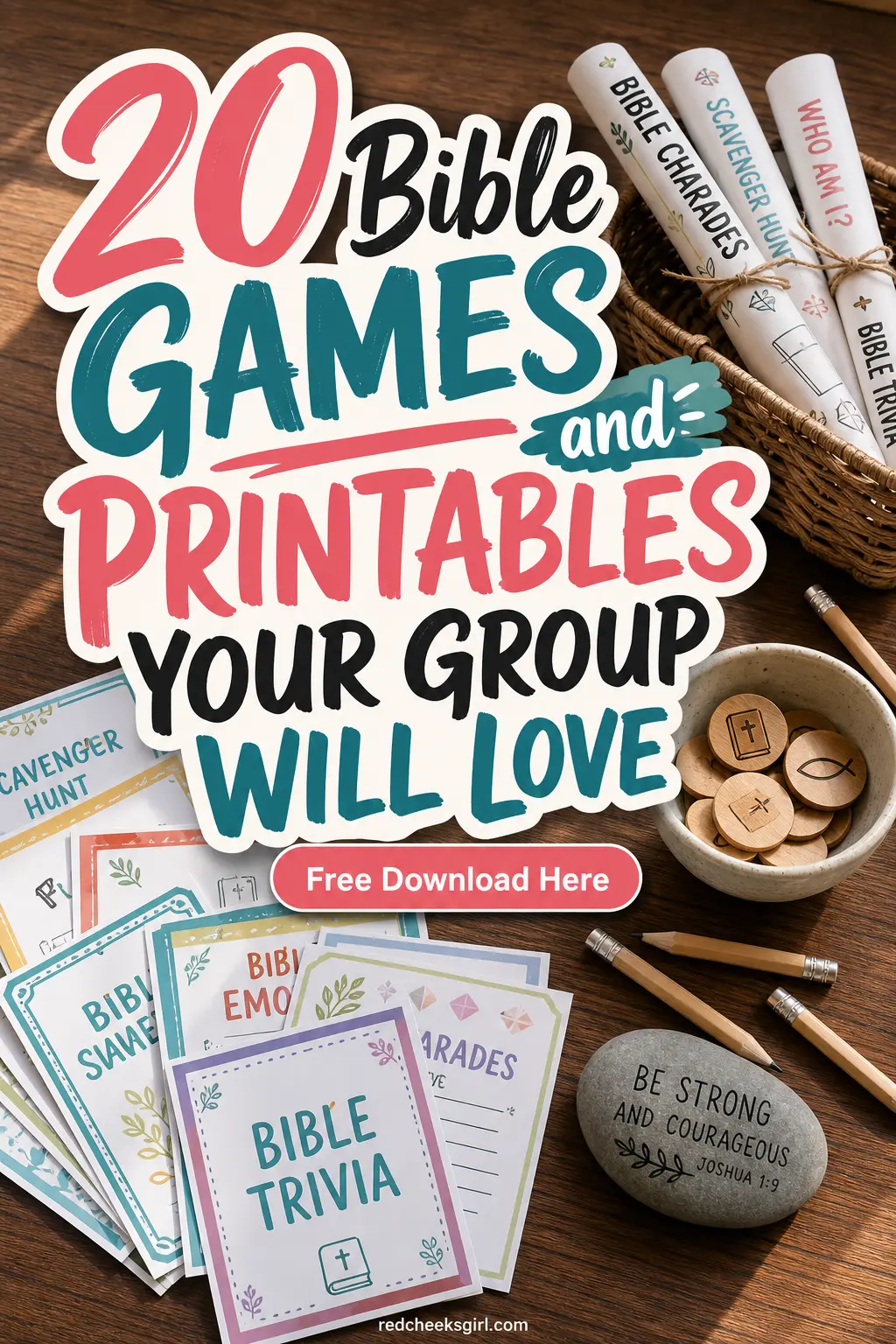
These 20 bible games are built for real gatherings — families, church groups, youth nights, small-group hangouts, VBS wrap parties — anywhere you’ve got a mixed crowd and want people actually laughing instead of checking their phones.
I’ve organized this list so it flows the way a great party should: loud and active to kick things off, printable sheets to keep everyone busy and give you a breather as the host, then quiet and meaningful to close the night on a beautiful note.
Grab the printable pack, clear some floor space, and get ready — your group is about to have way more fun than they expected. (Honestly, so will you.)
This post contains affiliate links — if you buy through them, I may earn a small commission at no extra cost to you.
- Bible Family Feud
- Bible Charades
- Sword Drill Race
- Act Out the Parable
- Bible Pictionary
- Bible Trivia Sheet (Old Testament)
- Bible Trivia Sheet (New Testament)
- Bible Bingo
- Name That Bible Book Sheet
- Bible Character Match Cards
- Bible Would You Rather Sheet
- Books of the Bible Order Sheet
- Bible Charades Card Deck
- Memory Verse Cards
- Bible Coloring Sheet
- Parables Match Sheet
- Bible Riddles Sheet
- Bible Scavenger Hunt Sheet
- Favorite Verse Share
- Gratitude and Prayer Circle
- Frequently Asked Questions
1. Bible Family Feud
Bible Family Feud is the ultimate crowd-pleaser for any size group, and it hits exactly the right note: competitive enough to get people yelling, but rooted in questions everyone from an eight-year-old to a grandparent can take a swing at.
Divide your crowd into two teams.
A host reads a survey-style question — ‘Name a miracle Jesus performed’ or ‘Name an animal on Noah’s Ark’ — and the frontrunner from each team races to the ‘podium’ (a table with a bell or a slap mat) to buzz in with the top answer.
The team that controls the board tries to uncover all the surveyed answers; three wrong guesses and the other team can steal everything.
Setup is easier than it looks. Write 8–10 open-ended, Bible-themed survey questions ahead of time and poll your own group beforehand (even a quick text thread works), or use a pre-made answer key.
A whiteboard or a simple flip-chart works as your board — reveal answers one at a time with big dramatic flair. Buzzers can be a dollar-store bell, two paper plates to slap, or just the honor system with hands.
Pro tip: keep rounds snappy (three to four minutes max) so the energy stays high all the way through.
What makes this one perennially great is that it rewards cultural Bible knowledge rather than strict memorization — so the person who’s never cracked a Bible in a year can absolutely win a round, which keeps it inclusive and breezy.
Great sample questions: ‘Name a disciple of Jesus,’ ‘Name something found in the Garden of Eden,’ or ‘Name a book of the Bible with only one chapter.’ The room gets loud fast, and that’s exactly the point.
Survey your own group via a quick text poll the week before — it makes the answers feel personal and the reveals even funnier.
🛍 Shopping guide
2. Bible Charades
Classic charades gets a scripture makeover here, and tbh it might be even more entertaining than the original.
Players draw a card from the deck (or a folded slip of paper) and silently act out a Bible person, place, event, or object while their team shouts guesses.
Think: parting the Red Sea, Jonah inside the whale, David slinging a stone, or the Tower of Babel — all gold charades material.
Set a one-minute timer, and if your team doesn’t guess in time, the other team gets one free shot to steal the point.
You can play in two big teams or in smaller rotating groups if your crowd is large.
Prep a bowl full of categories ahead of time: Bible characters (Goliath, Ruth, Elijah), Bible events (the Flood, the Last Supper, the Burning Bush), Bible objects (an ark, a staff, a crown of thorns), and Bible places (Jerusalem, Bethlehem, Egypt).
Keeping the categories mixed keeps every round fresh and gives different people their moment to shine — the person who can mime ‘walking on water’ deserves a standing ovation.
A few house rules that make it run smoother: no mouthing words, no pointing at objects in the room, and no using your fingers to indicate letter counts (unless your group is cool with that — no judgment).
The best part about Bible Charades is that it doubles as a sneaky memory refresher; people will be talking about ‘wait, what IS the story of Zacchaeus again?’ for the rest of the night. Mission accomplished.
- Groups of 6 or more
- All ages — kids love acting out the big dramatic stories
- Opening up a longer game night
🛍 Shopping guide
3. Sword Drill Race
Sword Drill Race is one of those bible games that sounds simple but turns into an absolute adrenaline rush the moment you shout ‘Charge!’ Everyone holds their closed Bible at their side. The leader calls out a verse reference — say, ‘John 3:16!’
— repeats it once, then yells ‘Charge!’ and every player races to flip to that exact verse. The first person to find it, stand up, and read it aloud wins the round. First to five points takes the match.
Bibles with index tabs are traditionally off-limits (no unfair advantages!), which levels the playing field beautifully.
To run this well, the leader should prepare a list of 15–20 verses spanning both Testaments — a mix of well-known passages (Romans 8:28, Psalm 23:1) and a few curveballs from less-familiar books (Habakkuk 3:2, anyone?).
You can play as individuals or divide into teams where one representative per round competes and scores for the whole group. Rotate who goes up each round so everyone gets table time and the energy keeps circulating around the room.
What I love about Sword Drill Race is that it genuinely builds Bible navigation skills without feeling like homework — the competitive pressure makes it thrilling, and you’ll be amazed how quickly people learn the order of the books when a point is on the line.
Throw in a small prize for the overall winner (a bookmark, a gift card, a silly trophy) and watch grown adults become surprisingly intense about finding Lamentations faster than their neighbor.
For younger or newer players, stick to the four Gospels and the major Psalms so no one feels lost from round one.
4. Act Out the Parable
Think of this as full-on Bible improv theater, and yes, it is exactly as chaotic and wonderful as that sounds.
Split into small groups of three to five people, draw a parable from the hat — the Prodigal Son, the Good Samaritan, the Sower and the Seeds, the Ten Virgins, the Lost Sheep — and give each group five minutes to plan a quick skit.
Then they perform it for the rest of the group, who score them on accuracy, creativity, and sheer entertainment value. The audience can use scorecards (1–10) or just cheer levels as judging.
Write the parable names on slips of paper and fold them into a bowl — that’s literally all the prep you need. For groups with mixed Bible knowledge, tuck a one-sentence summary under the parable name so performers know the basics of the story.
Encourage them to modernize it: the Prodigal Son at a pizza restaurant, the Good Samaritan in a parking lot, the Lost Sheep as a missing TV remote. The modern spin makes the parables stick in a way no lecture ever could.
Act Out the Parable is secretly the most effective biblical discussion starter in this entire list, because after each skit the host can ask the room: ‘So what’s the point of that one?’
and suddenly everyone is engaged and thoughtful without feeling like they’re in class. It’s also where you discover which member of your group has been hiding serious dramatic talent. (There’s always one.)
Acting out a story is one of the oldest ways humans remember things — your group will still be quoting the performances months later.
5. Bible Pictionary
Whiteboard markers out, competitive spirits on — Bible Pictionary takes the classic drawing game and fills it with scripture-rich prompts that will have everyone hollering across the room.
One player draws a Bible person, place, object, or event while their team races to guess before the timer runs out. No letters, no numbers, no words on the board — just art (and I use that term generously).
Think: the Tower of Babel, the Burning Bush, Daniel in the lions’ den, or the Star of Bethlehem. The sketches become legendary.
Divide into two to four teams and take turns sending one drawer to the board (or a large sketchpad if you’re working without a whiteboard).
The drawer picks a card from the stack — prepare about 40 cards sorted into categories: People, Places, Events, and Objects. Set a 90-second timer.
If your team guesses correctly, score a point and move on; if not, the other team gets a 10-second steal attempt. Rotate the drawer each round so no one gets stuck holding the marker for too long.
The glory of Bible Pictionary is watching someone try to convey ‘Shadrach, Meshach, and Abednego in the fiery furnace’ with a dry-erase marker in under two minutes. Impossible? Technically yes. Hilarious? Absolutely.
Tip for hosts: throw in one or two easier prompts per round (Noah’s Ark, a fish, a crown) alongside the tricky ones so newer players stay in the game and don’t feel like they’re drawing blindfolded.
- Whiteboard or large easel pad
- Dry-erase markers or thick felt-tip markers
- Pre-written card deck of 40 Bible prompts
- 60–90 second sand timer
🛍 Shopping guide
6. Bible Trivia Sheet (Old Testament)
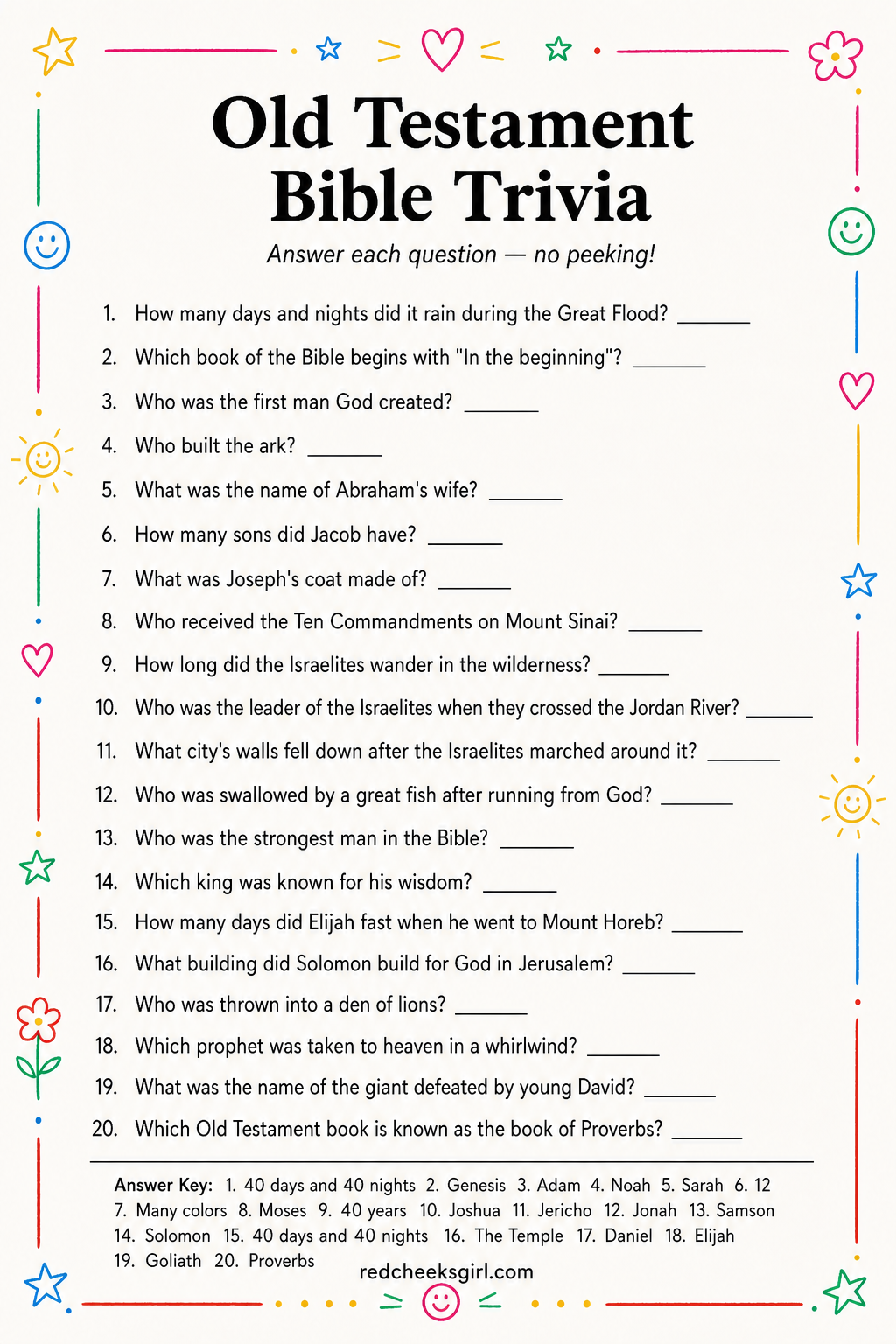
This is the printable that the trivia lovers in your group will absolutely devour — a focused Old Testament trivia sheet covering everything from Genesis through Malachi.
Each player (or team) works through 20 questions on their own sheet, pencil in hand, then scores are compared at the end. Questions range from the satisfyingly easy (‘How many days did it rain during the Flood?’)
to the genuinely tricky (‘Which prophet was taken to heaven in a chariot of fire?’), so everyone finds their level and the competitive energy stays alive all the way through.
Print one sheet per player on regular letter-size paper — cardstock is a nice touch but totally optional. You’ll want to keep the answer key with you (the host) and only reveal it once all sheets are handed in.
Give a 10-minute window for completion, play some soft background music during that time, and then go through the answers out loud one by one, which naturally becomes a mini-discussion moment as people react to the ones they missed.
Bonus: tally scores on a whiteboard for maximum drama.
This sheet pairs beautifully with the New Testament sheet (coming up next) for a full dual-round trivia tournament — Old Testament first half, New Testament second half, final scores combined for an overall champion.
It’s the kind of activity that feels casually fun in the moment but secretly sticks with people because the questions are so rooted in real, memorable Bible stories. Your guests will be Googling ‘who was Methuselah’ on the drive home. You’re welcome.
Run Old Testament and New Testament sheets back-to-back as one full trivia tournament and crown a single winner at the end.
🛍 Shopping guide
7. Bible Trivia Sheet (New Testament)
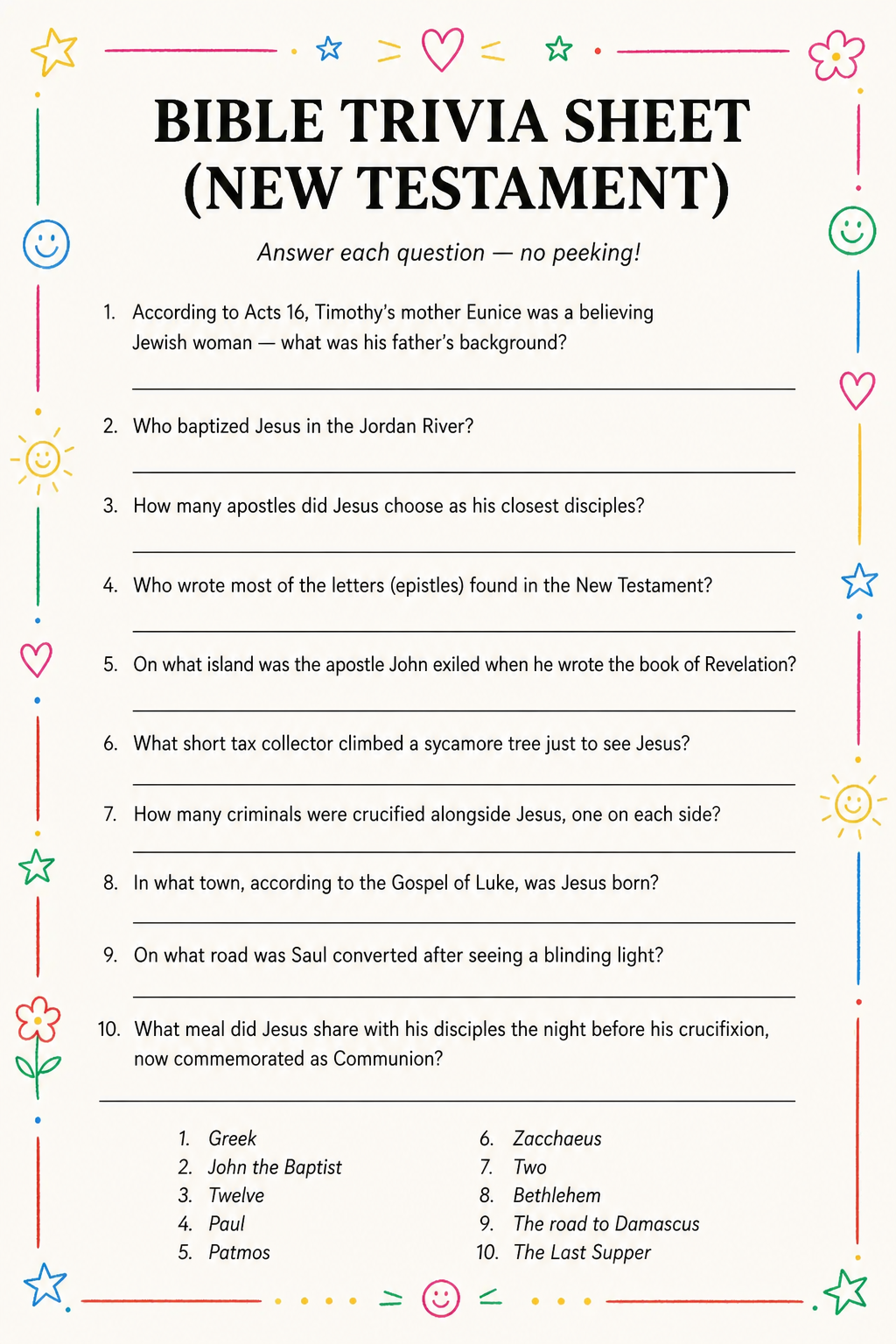
Same format, completely different territory — the New Testament trivia sheet picks up where the Old Testament sheet left off and takes players through the Gospels, Acts, the Epistles, and Revelation.
Questions here feel a little more immediately familiar to many players (‘How many loaves and fish did Jesus use to feed five thousand people?’)
but still pack in some genuinely challenging ones (‘Which city was Paul traveling to when he was struck blind on the road?’). The mix keeps everyone humble and engaged, which is exactly what you want mid-party.
Hand this sheet out immediately after collecting the Old Testament sheets, or use it as a standalone game for groups with less Old Testament background.
The format is identical — 20 questions, one sheet per player, host holds the answer key — so the transition is smooth and you don’t have to re-explain anything.
One hosting trick: read the trickier questions aloud as you reveal the answers, then let people shout out what they remember about that story. It turns the scoring moment into genuine conversation rather than just a winner announcement.
Together, the Old and New Testament trivia sheets form a complete 40-question Bible knowledge tournament that works for any mixed group — kids can team up with adults, newer believers can pair with longtime churchgoers, and everyone leaves the table knowing a little more than they walked in with.
That’s what good bible games actually do, and this sheet delivers it without a single moment of feeling like a test.
- Mixed-knowledge groups — pair newer and experienced players as teams
- 40-question double-round Bible trivia tournament when combined with the Old Testament sheet
8. Bible Bingo
Bingo is beloved for a reason — it is dead simple to explain, works for literally any age, and creates those perfect shriek-the-room-down moments when someone calls ‘BINGO!’ in the middle of everyone else’s concentration.
In Bible Bingo, each card’s squares are filled with Bible terms: names (Moses, Mary, Elijah, Esther), places (Jericho, Bethlehem, Nazareth, Egypt), objects (ark, manna, staff, scroll), and events (the Exodus, Pentecost, the Resurrection).
The caller draws from a stack of picture/word tiles and reads them aloud; players mark their card. First to fill a row — horizontal, vertical, or diagonal — wins.
Print enough cards for every guest (each card has a unique layout so no two are identical) and use dried beans, small stickers, or coin-sized cardboard chips as markers.
Prepare 30–40 calling tiles — write each term on a small folded slip of paper, shuffle them in a bowl, and draw one at a time.
Read the term clearly, maybe give a one-sentence clue (‘This is the mountain where Moses received the Ten Commandments — Mount…?’) to give newer players a fighting chance. Run three to five rounds back to back so everyone gets a win.
Bible Bingo is the rare game that works just as well as a quiet-table filler while people arrive as it does as a main-event group game.
It’s also incredibly easy to host — once the cards are distributed, the crowd basically runs itself while you just draw tiles and enjoy the chaos.
Small prizes for winners (a chocolate bar, a bookmark, a keychain) take the energy to the next level without any extra effort on your part.
- Printed bingo cards (one unique layout per player)
- Small tokens or dried beans as markers
- 30–40 calling tiles in a bowl

🛍 Shopping guide
9. Name That Bible Book Sheet
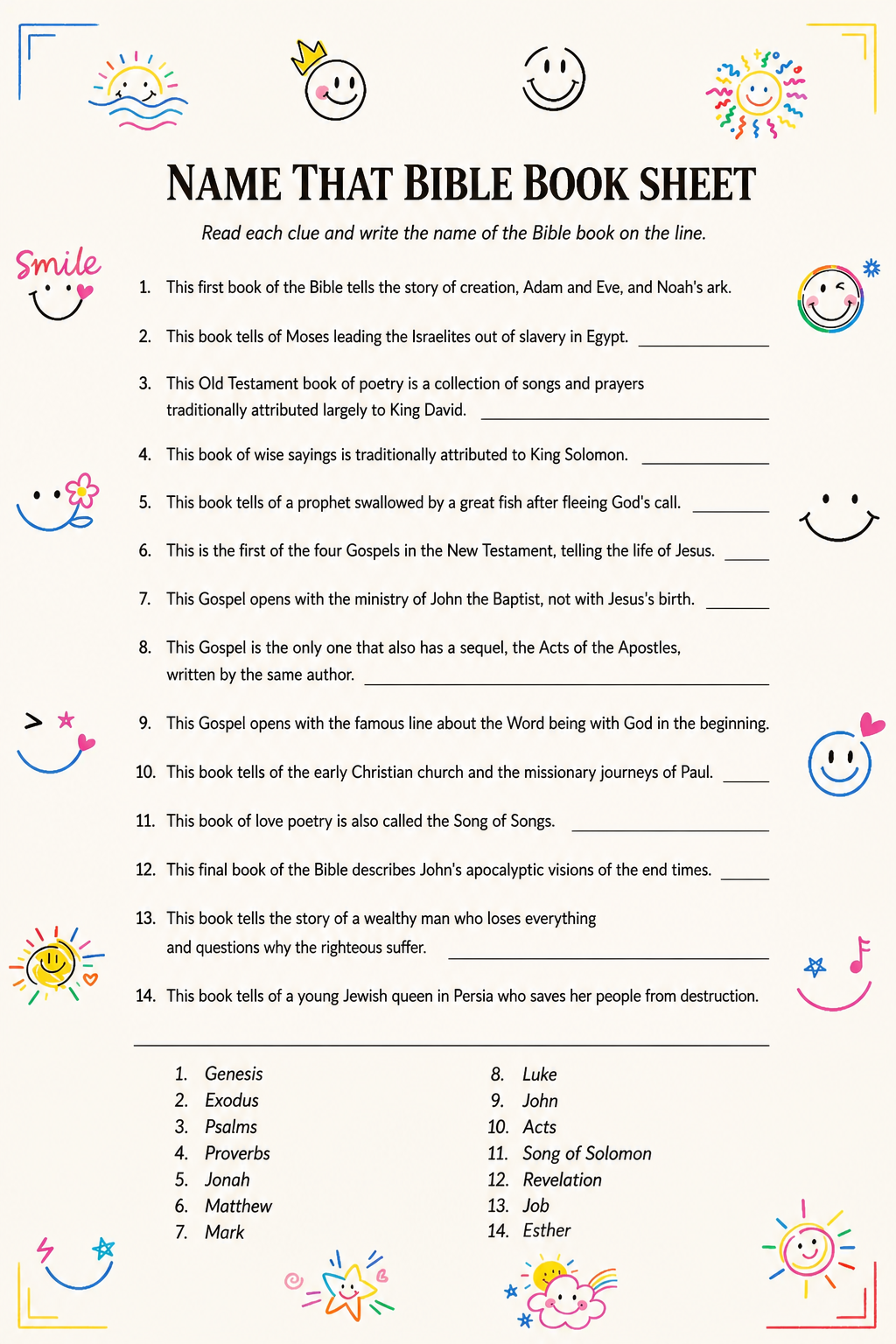
This printable is a brilliant little brain-teaser that works for everyone from the casual church attendee to the seminary student — and the results are always humbling in the best way.
Each question gives a one-to-two sentence clue describing a book of the Bible (its theme, famous passages, or key character) and players write the name of the book on the blank line beside it.
‘This book tells the story of a faithful woman who said: wherever you go, I will go.’ Answer: Ruth. ‘This book records 150 songs and prayers used in ancient Israelite worship.’ Answer: Psalms. Twenty clues, twenty blank lines, ten minutes on the clock.
Print one sheet per player and hand them out simultaneously so no one gets a head start. Players work solo — no conferring with neighbors (though enforcing that is half the fun).
The answer key stays with the host until the reveal, which you do out loud, one clue at a time, pausing for groans and ‘OH I knew that one!’ reactions.
Score one point per correct answer and tally on a whiteboard, or just let people self-score for a low-key version.
What makes Name That Bible Book stand apart from a standard trivia sheet is the clue format — it teaches through description rather than rote recall, which means players are actively reasoning through what they know about each book rather than just trying to retrieve a memorized fact.
It’s also a sneaky great conversation starter: the clue for the book of Job tends to spark the best discussion of the night, every single time.
Clue-based format rewards reasoning, not just memorization — so players who ‘don’t know their Bible’ often surprise themselves with how much they actually do know.
10. Bible Character Match Cards
Match Cards is the memory-meets-trivia mashup that works around any table, from a kitchen gathering of four to a church fellowship hall of forty.
Print and cut the deck of cards — half the cards show a Bible character’s name (Joseph, Deborah, Nehemiah, Lydia, Zacchaeus), the other half show a one-line description or signature event (‘Sold into slavery by his brothers,’ ‘A judge and prophetess who led Israel,’ ‘Rebuilt the walls of Jerusalem’).
Shuffle, lay them all face-down on a table, and players take turns flipping two cards at a time trying to find a matching pair.
For small groups of two to six, play classic Memory-style: pairs stay flipped only for the person who found them, and the player with the most pairs at the end wins.
For larger groups, lay the cards face-up and play it as a timed team relay — one rep per team races to the table to match as many pairs as possible in 60 seconds, then the next rep continues.
Either way, cut out your cards cleanly, print on cardstock for durability, and laminate if you plan to reuse the set for future events.
The match mechanic is wonderfully low-pressure — even if you don’t know who Nehemiah is going in, seeing his name next to ‘Rebuilt the walls of Jerusalem’ three times during the game means you absolutely know it by the end.
That’s the magic of match games: they teach without lecturing. And there is always a moment mid-game when someone flips ‘Sold into slavery by his brothers’ and confidently says ‘Moses?’ and the whole table loses it.
For younger players, reduce the deck to 10 pairs (20 cards) and keep the face-up relay version so no one gets frustrated.

🛍 Shopping guide
11. Bible Would You Rather Sheet
Would You Rather has no wrong answers — and that’s exactly why it sparks the liveliest conversations of the night. The Bible edition puts players in delightfully impossible biblical dilemmas: ‘Would you rather part the Red Sea or walk on water?’
‘Would you rather spend a night in the lions’ den with Daniel or three days in the belly of a whale with Jonah?’ ‘Would you rather have the wisdom of Solomon or the strength of Samson?’
Every question is rooted in real scripture, which means the inevitable debate about each choice becomes an accidental Bible discussion nobody saw coming.
Each player gets their own sheet and circles their choices — or you can project the questions one at a time on a screen and have the whole group vote simultaneously by raising hands.
The hand-raising version is especially fun because you can see exactly who in your group would rather battle Goliath and who would absolutely take the whale (cozy, apparently).
You don’t need a score or a winner — the conversations generated by each question are the whole point.
This one works beautifully as an icebreaker at the start of the evening — hand it out while people are still arriving, let them fill it in, and then circle back to a few of the more divisive questions once everyone’s seated.
It also makes a great companion activity to pair with a meal, since it keeps the conversation rolling without requiring anyone to stand up, race to a podium, or act anything out. Low-effort for the host, high-reward for the group.
Read a few of the most divisive questions aloud to the whole group and tally hands — the debates are half the fun.

12. Books of the Bible Order Sheet
Here’s a printable that feels like a quick warm-up but actually has players sweating by question five — the Books of the Bible Order Sheet challenges players to number a shuffled list of Bible books in the correct canonical order.
Both the Old and New Testament sections are represented, and every entry on the sheet is a real book of the Bible.
Players scan the scrambled list and write the correct position number (1 through 66) next to each book — or, in the simpler version, just rank the given books within their own Testament.
Either way, it is surprisingly tricky and wonderfully satisfying when you nail it.
Print one sheet per player and give everyone the same amount of time (eight to ten minutes works well). No Bibles allowed during the game — the point is to test what people already carry in their heads.
After time is called, go through the correct order aloud (or display it) and have players self-score, counting one point for every correctly numbered book.
Variations: play as a team relay where each person can fill in only five books before passing the sheet; or call it ‘speed round’ where the group shouts books in order from Genesis to Revelation and one person writes them down.
The conversation this sheet starts is priceless — ‘Wait, is Obadiah before or after Amos? Is Philemon even a real book?’ — and that’s exactly where the fun lives.
It’s also one of those activities where everyone improves just by playing once, because the correct order becomes clearer with every comparison and reveal. A great complement to the Sword Drill Race earlier in the night, since both activities reward knowing the layout of scripture.
Ordering books tests a different kind of knowledge than trivia — it rewards familiarity with the whole Bible structure, not just memorable stories.

13. Bible Charades Card Deck
This is the printable companion to the Bible Charades active game — a ready-to-cut deck of 30 charades prompt cards organized into four categories: People, Places, Events, and Objects.
Print, cut, and drop them into a bowl and you’ve got a fully self-contained charades game with zero prep beyond the printing.
Each card shows only the category label and the prompt word or phrase, so whoever draws it knows exactly what they’re acting out — and the rest of the table gets to lose their minds trying to guess ‘the Sermon on the Mount’ from someone’s enthusiastic arm-waving.
Print on cardstock for best results; if you laminate the sheets, you’ve got a reusable deck that can come out at every gathering for years. Fan the cards out in a bowl or a small basket, and rotate who draws each round.
You can run it as a classic charades game (teams, timer, points) or as a casual around-the-room activity where whoever guesses fastest draws next.
Suggested prompts across the four categories: People (Goliath, Mary Magdalene, John the Baptist, Queen Esther, Elijah), Places (the Garden of Eden, Bethlehem, the Red Sea, Jerusalem), Events (the Last Supper, feeding the five thousand, the baptism of Jesus, the walls of Jericho falling), Objects (Noah’s Ark, the Ten Commandments tablets, a shepherd’s staff, a sling and stone).
Having the cards printed and cut ahead of time is a surprisingly big quality-of-life upgrade for your evening — no scrambling for prompts mid-game, no one accidentally seeing another team’s card, no host trying to think of ideas on the spot.
It makes the game feel polished and intentional, and your guests will appreciate that.
Pro hosting tip: slip a couple of ‘wildcard’ easy prompts (a fish, a dove, a crown) into the deck so younger players always have a fighting chance when it’s their turn to draw.
Laminate the printed deck so it survives multiple game nights — this card set is a keeper.

🛍 Shopping guide
14. Memory Verse Cards
Memory Verse Cards turn scripture memorization into a table game — and they work for a party crowd just as well as they do for a homeschool morning.
The printable set includes 20 cards, each featuring a well-loved Bible verse with one to three key words blanked out. Players flip a card, read the verse aloud with the blank(s), and try to fill in the missing word(s) from memory.
Get it right and keep the card; miss it and it goes back to the pile. The player who collects the most cards wins — but honestly, everyone wins because they’ve just reviewed 20 scripture passages in under 15 minutes without it feeling like studying.
Print on cardstock and cut the cards apart.
For a group game, lay all 20 cards face-up on the table and let players race to claim cards by being the first to correctly call out the missing word(s) — no pen needed, just voices and speed.
For a quieter version, deal five cards to each player and let them work through their hand individually, self-checking against the full verse printed on the back of each card. Mix both approaches across rounds for variety.
Suggested verses: John 3:16, Psalm 23:1, Proverbs 3:5–6, Romans 8:28, Philippians 4:13, Joshua 1:9, Jeremiah 29:11, Isaiah 40:31.
What I especially love about Memory Verse Cards as a party game is that they scale perfectly — competitive with a big group racing to call out answers, quiet and reflective with a smaller circle passing cards around and discussing what each verse means to them.
If you’re planning a night that flows from active games into a more reflective close, this printable serves as the perfect bridge between the two moods.
And the cards make a sweet take-home token too, if guests want to keep a few for their fridge or Bible.
- Works as a bridge game between high-energy activities and the quiet closing circle
- Cards double as meaningful take-home souvenirs

🛍 Shopping guide
15. Bible Coloring Sheet
Every great party night needs at least one moment where people put down their competitive hats and just breathe — and a beautifully designed Bible Coloring Sheet is the perfect vehicle for that.
This isn’t a kids’-table activity; it’s a genuinely lovely mindful break that works for all ages.
The sheet features an intricate illustration of a classic scripture scene (think a stylized dove and olive branch, a detailed rendering of a lamp on a stand with radiating light, or an elaborate border of leaves and wheat surrounding a central verse) alongside an inspiring Bible quote — a visual keepsake guests can take home and display.
Print on the heaviest paper you have for best coloring results — regular copy paper works in a pinch, but cardstock or uncoated art paper takes colored pencils and fine markers much better.
Set out a shared supply of colored pencils, fine-tip markers, or watercolor pens in the center of the table. No pressure to finish during the evening; people can take half-colored sheets home and complete them later.
Play soft worship music or a gentle playlist in the background and watch the mood in the room shift completely.
This sheet is also a beautiful option to leave out at the very start of the event as guests arrive — it gives people something to do with their hands while they settle in and wait for the full group to gather, which removes that awkward standing-around-holding-a-cup energy.
If you want to make it extra special, write the verse reference at the top and use it as a conversation prompt: ‘Does anyone have a story connected to this verse?’ Some of the best moments of the night happen quietly, over a coloring sheet.
Coloring activates a relaxed, open state of mind — the conversations that happen over this sheet are often the most memorable of the whole night.

🛍 Shopping guide
16. Parables Match Sheet
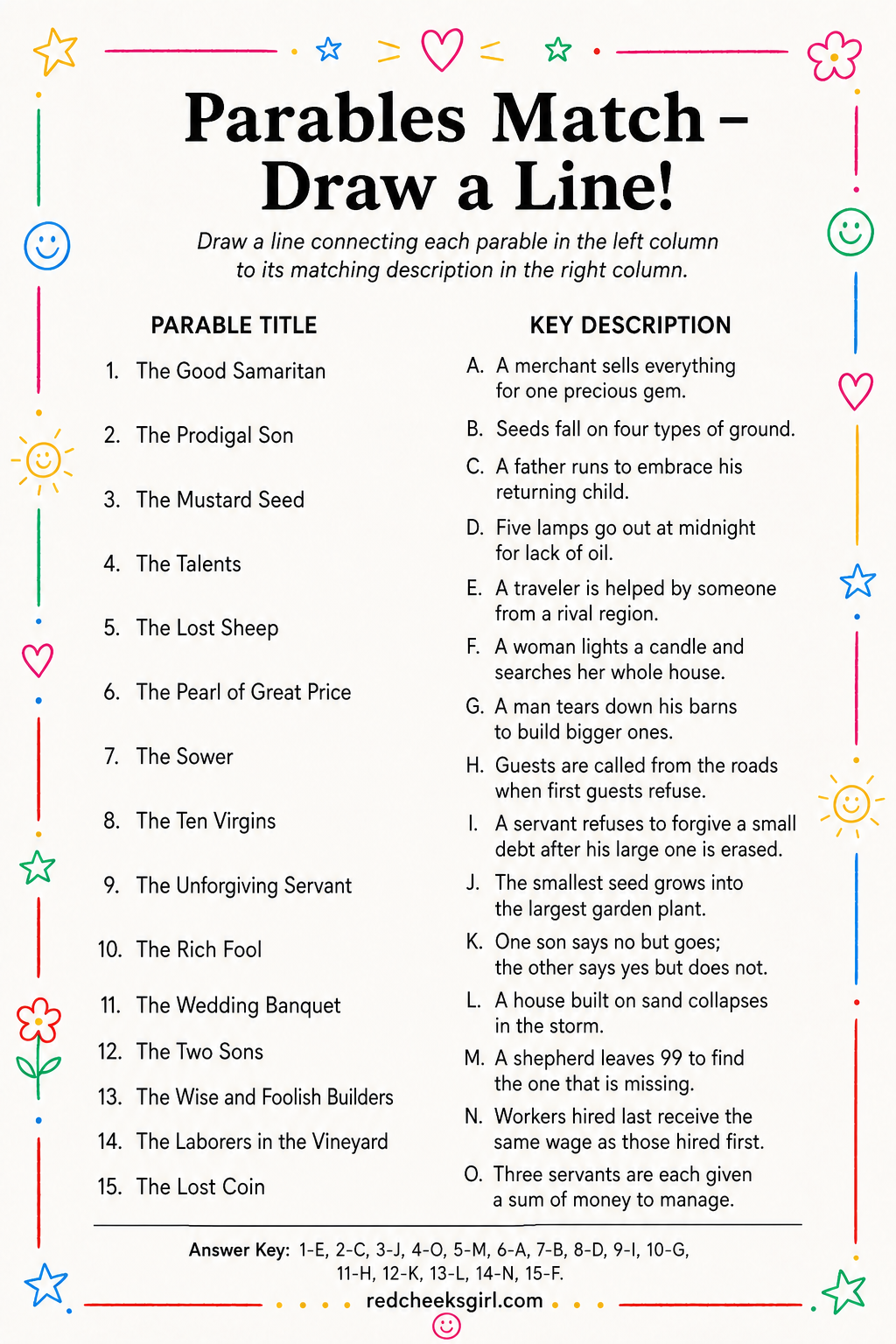
The Parables Match Sheet is a satisfying puzzle-style printable that tests how well players know their parables — specifically, which story goes with which key detail.
The left column lists 15 parable titles (The Good Samaritan, The Prodigal Son, The Mustard Seed, The Ten Talents, The Pearl of Great Price, etc.) and the right column lists 15 scrambled descriptions or key images from those parables.
Players draw a line — or write the matching letter — to connect each parable with its correct description. It’s a matching activity that works equally well in small teams or as an individual challenge, and the reveal moment is always lively.
Print one sheet per player or one sheet per team (the team version works especially well for younger guests who might not know all 15 parables independently).
Give 8–10 minutes for completion, then go through the answers aloud, pausing after each one to let the host add a one-sentence recap of what the parable teaches.
This transforms the scoring moment into a mini Bible lesson that never feels forced — people are genuinely curious about the ones they got wrong. Keep the answer key hidden until the reveal; hosts who peek early rob themselves of the best reaction moment.
One variation that consistently gets a great reaction: after matching, flip the sheet over (or use the back of the sheet) and ask guests to write a one-sentence answer to the question ‘What is this parable teaching?’ for their three favorite matches.
Sharing these aloud produces some genuinely thoughtful and occasionally hilarious answers, and it takes the activity from a matching quiz to an actual group discussion. That’s the hallmark of a great party game: it keeps giving even after the ‘game’ part is technically over.
- Draw a line connecting each parable title (left column) to its matching description (right column)
- Work solo or in teams — 8-minute time limit
- Host reveals answers one by one with a brief story recap
17. Bible Riddles Sheet
Bible Riddles might be the most addictive printable in the whole set — these scripture-based riddles are crafted so the clue never gives away the answer directly, but if you know your Bible, the ‘aha’ moment is so satisfying you’ll want to fist-pump.
Sample riddles: ‘I am the shortest verse in the Bible — two words, all emotion. What am I?’ (‘Jesus wept.’ — John 11:35) or ‘I swallowed a prophet, carried him three days, and set him on dry land. What am I?’
(The great fish / whale from Jonah). Each riddle is a self-contained brain teaser that can be solved individually or debated as a table.
Print one sheet per player and give everyone eight to ten minutes to work through all 15 riddles independently before sharing answers.
Alternatively, read the riddles aloud one at a time to the whole group and let anyone shout the answer — first correct answer wins a point.
The shout-out version is louder and faster, which makes it great energy for a mid-party moment when the room needs a reset.
Either way, the host keeps the answer key until the reveal, and every answer should be traceable to a specific Bible passage so no one can argue it.
The riddle format is genuinely universal — people who consider themselves not very ‘Bible-knowledgeable’ often get these by pure logic and wordplay, while people who know their scripture inside out get them by recognition.
Both paths arrive at the same answer, which makes everyone feel clever in their own way.
If you want to make them extra memorable, read the full Bible passage after each answer is revealed — it only takes 30 seconds and makes the connection between riddle and scripture concrete and sticky.
- Mixed-knowledge groups — logic and scripture knowledge both lead to the right answer
- Mid-party energy reset between bigger group games

18. Bible Scavenger Hunt Sheet
Bible Scavenger Hunt takes the group on a fast-paced race through scripture itself — each clue on the sheet points players to a specific Bible verse, and the answer to that clue is hidden in the verse text.
For example: ‘Find Proverbs 17:17 — what does a friend do at all times?’ Answer: loves. Or: ‘Look up Genesis 1:1 — how many words are in this verse?’
Players need a Bible (or Bible app) to hunt down each answer, which means this game quietly rewards those who know their way around scripture while giving everyone else a navigation workout. First team to correctly answer all 15 clues wins.
Print one sheet per team of two or three — playing in small teams is better than solo here, because one person can flip to the verse while the other writes the answer, which keeps the pace snappy.
Allow 15 minutes and provide Bibles or let people use their phones (Bible apps count). You’ll want a mix of Old and New Testament references, easy-to-find books and harder ones, long books and short ones — the variety keeps it unpredictable.
After time is up, reveal answers aloud and award one point per correct response, breaking ties by fastest finish time.
What sets the Bible Scavenger Hunt apart from the trivia sheets is that it’s kinetic — people are physically flipping pages, scrolling apps, whispering to teammates, pointing at words.
It has the energy of an active game while still being paper-based, which makes it perfect for the stretch of the evening when the room needs engagement but not necessarily a lot of running around.
And every single verse players look up during the hunt lands a little differently than it would in a normal reading — context makes scripture memorable.
- One printed sheet per team of 2–3
- One Bible (or Bible app) per team
- 15-minute timer
- Answer key held by the host

19. Favorite Verse Share
After all the buzzing-in and board-racing and charades arms-flailing, this is the moment the whole evening has been quietly building toward — and it lands every single time.
Favorite Verse Share is exactly what it sounds like: go around the circle and invite each person to share one Bible verse that has meant something to them, and say a sentence or two about why. That’s it.
No judging, no scores, no pressure to have the most impressive verse. Someone will share John 3:16 and mean it with their whole heart; someone else will share an unexpected verse from Lamentations that floors the room. Both are perfect.
Give people a minute to think before the first person shares — pass around paper and pens so no one is caught off guard and everyone can jot down the reference they want to share.
If your group includes people who are new to faith or just exploring, rephrase the prompt gently: ‘Share a sentence from the Bible you’ve always remembered, or one that surprised you.’ That opens the door without putting anyone on the spot.
The host should go first to model the tone — keep it warm, personal, and brief so others feel free to do the same.
What I’ve seen happen in rooms where Favorite Verse Share closes the night is quietly extraordinary: people who never speak in groups find their voice, verses come up that no one expected, and sometimes a single sharing leads to a conversation that continues for an hour after the official party ends.
This is one of those bible games that isn’t really a game at all — it’s just a structured invitation to be real with each other, which is the whole point. Keep some tissues nearby. You might need them.
Go first yourself to set a warm, personal tone — share a verse that genuinely matters to you, and the room will follow with equal openness.
20. Gratitude and Prayer Circle
This is the gentlest, most meaningful way to close any gathering centered on scripture — and it’s also the one people remember longest.
The Gratitude and Prayer Circle works by going around the room twice: on the first pass, each person shares one thing they’re genuinely grateful for — something from the past week, something in the room tonight, something big or something small.
On the second pass, anyone who wants to offer a brief spoken prayer or a word of encouragement for someone else in the circle may do so. Participation is entirely optional and never pressured.
You don’t need anything to run this — no paper, no timer, no setup.
But if you’d like a gentle structure, you can introduce it with a short scripture reading: Philippians 4:6–7 (‘Do not be anxious about anything, but in every situation, by prayer and petition, with thanksgiving, present your requests to God’) works beautifully as an opener.
Light a candle in the center of the circle if the setting feels right, or simply dim the room slightly to signal a shift in tone. The host models the first gratitude share to open the space warmly.
The Gratitude and Prayer Circle is the natural conclusion to a night of bible games because it draws together everything the evening has been pointing toward — laughter, knowledge, scripture, connection — and grounds it all in something real and personal.
People leave these evenings differently than they arrived: a little lighter, a little more known, a little more connected to each other and to the words they’ve been playing with all night. That’s a good party. That’s actually a great one.
Ending with gratitude and prayer transforms a fun game night into a genuinely meaningful shared experience — and that’s what keeps people coming back.
Frequently Asked Questions
What age group are these bible games designed for?
The whole list is built for mixed groups — meaning children, teens, adults, and seniors can all play together without anyone sitting out.
Games like Bible Bingo and the Coloring Sheet work brilliantly for younger guests, while the trivia sheets and Parables Match Sheet give adults a real challenge. The active games (Charades, Pictionary, Family Feud) naturally scale by how you form teams.
For a group with very young children (under 6), stick to Bingo, Charades with simple prompts, and the Coloring Sheet, and they’ll be happily engaged all evening.
Do guests need to bring their own Bibles?
Only for Sword Drill Race and Bible Scavenger Hunt — and even for those, a Bible app on a phone works perfectly well.
All the other games (trivia sheets, bingo, charades, matching, riddles, would-you-rather) are completely self-contained and need nothing but the printed sheet or the host’s prompts.
If you want to run Sword Drill Race, a quick heads-up text to guests the week before asking them to bring their Bible is all the prep needed.
How many people do these bible games work for?
Most games on this list work for anywhere from 4 to 40+ people. Team-based games (Family Feud, Pictionary, Scavenger Hunt) scale up easily — just make larger teams.
Individual printable games (trivia sheets, riddles, order sheet) work for any size because everyone gets their own sheet.
The quiet closing games (Favorite Verse Share, Gratitude and Prayer Circle) are most powerful in groups of 6–20, where everyone has space to contribute without it running too long. For very large groups (50+), focus on the team games and projected-screen formats.
How long does a full game night using this list take?
A complete evening using all 20 games would run about 3–4 hours, which is actually a full party program.
For a 1.5-hour gathering, choose 4–6 games: one active opener (Family Feud or Charades), two or three printables (trivia sheets + bingo), and the Gratitude and Prayer Circle to close. For a 2.5-hour evening, add Act Out the Parable and one or two more printables.
The printable games tend to take 8–15 minutes each; the active games run 15–25 minutes depending on the group’s energy.
What should I print in advance, and what can I skip printing?
Print everything labeled ‘printable’ in this list — that’s 13 sheets in total, and they form a downloadable game pack that covers the bulk of the evening’s structured activities.
For the active games (Family Feud, Charades, Pictionary, Sword Drill, Act Out the Parable), printing is optional: you can write prompts on slips of paper or index cards instead. The quiet closing games need nothing printed at all.
If you’re short on time, prioritize the two trivia sheets, Bingo, and the Riddles Sheet — those four alone make a complete and very fun party program.
Are these bible games appropriate for non-church events like family reunions or neighborhood gatherings?
Absolutely — and that’s exactly the spirit this list was designed in. These are bible games for any group, not exclusively churchgoers.
The Would You Rather Sheet, Family Feud, Charades, and Bingo are so naturally fun that they work even if half your crowd hasn’t been to a church service in years.
The quiet closing games (Favorite Verse Share, Gratitude Circle) are optional and gently framed — nobody is put on the spot or made to feel uncomfortable.
The tone throughout is warm, curious, and genuinely playful, which makes the whole evening accessible regardless of where people are on their faith journey.
📌 Save These for Later
Loved these? Pin your favorite image below so you can find this list again when you’re planning.

33 Christian couples games for date night at home or a small group evening, warm, clean and easy to

20 Bible quiz games with buzzer rounds, team play & free printables. Perfect for any group — compe

31 youth group games built for loud rooms and slouchy teens: printable trivia, bingo and challenge c
Leave a Reply