


If you have ever sat through a church game night that felt more like a third-grade Sunday school lesson than an actual gathering for grown-ups, you are so not alone. The good news?
Bible games for adults can be genuinely fun, thought-provoking, and — dare I say — a little competitive without anyone feeling talked down to.
Whether you are hosting a small-group night, a Bible study wrap-up, or just a faith-filled evening with friends, this lineup of 20 games covers everything from buzzer-style trivia showdowns to quiet reflection circles that will have people sharing things they have never said out loud.
I built this list around one goal: starting real conversation. Not the kind where everyone nods politely and checks their phone, but the kind where someone says ‘wait, I never thought about it that way’ and suddenly it is midnight.
You will find active team games, printable sheets you can download and print tonight, and a few slower, soulful rounds to close the evening on. Mix and match to fit your group, and do not be surprised if the printables become your most-requested party favor.
Let’s get into it!
This post contains affiliate links — if you buy through them, I may earn a small commission at no extra cost to you.
- Bible Trivia Showdown
- Guess the Verse
- Bible Family Feud
- Act Out the Parable
- Debate the Passage
- Bible Trivia Sheet (Advanced)
- Fill-in-the-Verse Sheet
- Bible Character Match Cards
- Bible Places Match Sheet
- Bible Would You Rather Sheet
- Books of the Bible Order Sheet
- Discussion Prompt Cards
- Memory Verse Cards
- Parables Match Sheet
- Fruits of the Spirit Sheet
- Bible This or That Sheet
- Ten Commandments Order Sheet
- Bible Riddles Sheet
- Favorite Verse Share
- Prayer and Reflection Circle
- Frequently Asked Questions
1. Bible Trivia Showdown
Bible Trivia Showdown is the game that gets a room buzzing in about ninety seconds flat. Split your group into two to four teams and designate one person as the host and question reader.
The host calls out a Bible trivia question — spanning Old Testament, New Testament, people, places, and famous verses — and the first team to buzz in (slap the table, ring a bell, or just shout) gets to answer.
A correct answer scores a point; a wrong answer gives the opposing team a chance to steal. First team to fifteen points wins, though in my experience the real prize is the trash talk that develops around question eight.
You do not need any fancy equipment for this one. Write twenty-five to thirty questions on index cards ahead of time, mixing difficulty levels so seasoned Bible readers and newcomers both have moments to shine.
Good categories to pull from: miracles, parables, the twelve apostles, Old Testament kings, and ‘name the book’ questions where you read a famous verse and teams race to name its source.
Keep a tally on a whiteboard or piece of paper, and award bonus points if a team can name the exact chapter and verse — that twist alone will have your theology nerds absolutely vibrating with joy.
Why it works so well as an opener is that it levels the playing field in an unexpected way.
Newcomers to Scripture sometimes nail the famous John 3:16-style questions while longtime churchgoers blank on a tricky Leviticus detail, and that flip creates a warm, humble energy that sets up every conversation game that follows beautifully.
Pro tip: after each question, pause for thirty seconds and ask the group, ‘Does anyone know the context behind that one?’ You have just turned trivia into discussion without anyone feeling put on the spot.
Prepare a tiebreaker question in a sealed envelope — opening it dramatically when the scores are tied is genuinely theatrical and very fun.
🛍 Shopping guide
2. Guess the Verse
Guess the Verse is the Bible game that separates the people who have actually read their Bible from the people who have read their Bible and underlined it in four colors.
One player (or the host) reads a Bible verse aloud — stopping at a dramatic word or phrase — and everyone else races to identify which book, and ideally which chapter, the verse comes from.
You can play this as a free-for-all shout-out game or use small whiteboards so everyone writes their answer simultaneously before revealing on the count of three. Either format creates that delightful mix of groans and gasps that makes a game night memorable.
The setup is wonderfully minimal. Prepare a list of twenty or so verses in advance, arranged from more recognizable (Psalm 23, John 3:16, Genesis 1:1) to genuinely tricky (Obadiah 1:3, anyone?).
Read each verse slowly and naturally, pausing as if you are having a conversation with the text rather than racing through it. Players score one point for naming the correct book and two points for naming the correct book and chapter.
You can add a ‘context bonus’ where a player earns a third point by correctly describing what is happening in the surrounding passage — this is where the real gem conversations start.
What I love most about this game is that it rewards a wide range of Bible engagement. Someone who grew up memorizing verses scores differently than someone who reads devotionally but broadly, and both feel genuinely valued.
It also quietly reveals which parts of Scripture your group knows deeply and which corners you have collectively never visited — which is itself a fantastic discussion starter. ‘Why do you think none of us recognized that Hosea verse?’
is the kind of question that can carry a whole evening.
For mixed-knowledge groups, give a book-name hint before reading: ‘This one is from the New Testament letters.’ Still challenging, still fair.
3. Bible Family Feud
Bible Family Feud brings the beloved survey-style energy of the classic TV show straight into your small group, and tbh it might be the most laugh-out-loud game on this entire list.
Divide into two teams and set up a central ‘podium’ spot — a chair at the head of the table works perfectly.
The host reads a survey-style Bible question (think: ‘Name a woman mentioned in the book of Ruth’ or ‘Name one of the fruits of the Spirit’), and one representative from each team races to the podium to buzz in first.
The team that wins the face-off gets to try to name all the top survey answers; if they strike out three times, the other team steals.
The key to making Bible Family Feud land for adults is writing questions that reward broad biblical knowledge rather than pure memorization.
Great question styles include: ‘Name a miracle Jesus performed,’ ‘Name a book of the Bible that is only one chapter long,’ or ‘Name something found in the Armor of God.’
You want answers that have enough variety that both the person who just joined a Bible study and the person who has attended church for forty years can contribute something meaningful.
Keep score on a whiteboard and run five to seven rounds for a satisfying game arc, finishing with a fast-money bonus round where one player from each team answers five rapid questions solo.
The real magic of this format is that it sparks the best kind of gentle debate.
When someone answers ‘faith’ and the host reveals the survey says ‘love’ was ranked higher, everyone immediately wants to talk about why — and suddenly you are having a genuine theological conversation disguised as a game show.
That is exactly the sweet spot this article is about. If you want to extend the fun after the game wraps up, check out some of the printable sheets further down this list for a quieter second act.
- Groups of 8–20 adults
- Church game nights and Bible study socials
- Anyone who grew up watching Family Feud and has strong feelings about it
🛍 Shopping guide
4. Act Out the Parable
Act Out the Parable is essentially charades with a theological twist, and it is far more entertaining than it sounds — especially once someone tries to mime the Prodigal Son’s return using only dramatic arm gestures.
One player draws a card naming a biblical parable (the Good Samaritan, the Lost Sheep, the Sower and the Seeds, the Ten Virgins, the Mustard Seed — the list is wonderfully varied) and has ninety seconds to act it out without speaking while their team guesses the correct parable title.
The acting player cannot point to objects, write anything, or make sounds; pure physical storytelling only.
To set up, write the names of fifteen to twenty parables on individual slips of paper or index cards and fold them up in a bowl. Split into two or three teams and take turns drawing and acting.
Each correctly guessed parable in the time limit scores a point for the team. Keep a running score and rotate who does the acting so everyone gets at least one turn in the spotlight.
For groups with very strong Bible knowledge, you can up the ante by requiring the guesser to name the parable AND which Gospel it appears in for the full point — that detail alone will humble approximately everyone.
Beyond the obvious hilarity, this game does something clever: it forces players to think visually and narratively about stories they may have only ever encountered as text.
When you have to physically show the moment a shepherd leaves ninety-nine sheep to search for one lost one, you think about that image in a way a reading never quite captures.
After the round, it is worth taking two minutes to ask, ‘Which parable surprised you with how hard it was to act out, and why do you think that is?’ You will get some beautifully honest answers.
- Slips of paper with parable names written on them
- A bowl or bag to draw from
- A timer (phone works great)
- A running score sheet
5. Debate the Passage
Debate the Passage is for the group that enjoys a little friendly theological sparring — no seminary degree required, though your resident theology nerd will absolutely thrive here.
The host reads a short Bible passage or a thought-provoking statement derived from one (for example: ‘Based on James 2, is faith without works genuinely useless, or is James overstating for emphasis?’) and assigns two players to argue opposite positions for three minutes each.
After the mini-debate, the full group votes on which argument they found most compelling, then the floor opens for everyone to share their actual view. Nobody is locked into their assigned position — the debate format is just the engine that gets ideas moving.
Prepare six to ten passage prompts in advance, selecting verses or passages that have genuine interpretive richness — not trick questions or anything designed to embarrass, but passages that thoughtful adults genuinely wonder about.
Good examples include the Sermon on the Mount’s ‘turn the other cheek,’ the tension between predestination and free will in Romans 8-9, or the scope of ‘neighbor’ in the Good Samaritan. Write each passage and its debate prompt on a card.
Before the game begins, remind everyone warmly that the goal is curious conversation, not winning, and that respectful disagreement is the whole point.
This is the game that will make your group say, ‘Can we do this every week?’ Because adults who gather around Scripture often have genuine questions and interpretive differences that never get airtime in a typical church service.
Debate the Passage creates a structured, safe container for exactly those conversations. A light snack spread helps too — something about discussing Romans over a hearty Amish Breakfast Casserole at a morning small-group session feels absolutely right. Just saying.
Set a warm, explicit tone at the start: ‘We are here to think together, not to win. All views shared here stay in this room.’
6. Bible Trivia Sheet (Advanced)
The Bible Trivia Sheet (Advanced) is the printable that sorts the room into quiet confidence and delightful panic — and everyone loves it for exactly that reason.
Each guest gets a single US Letter sheet packed with twenty challenging Bible trivia questions spanning both Testaments, organized into four categories: Old Testament History (Q1–5), New Testament People (Q6–10), Psalms and Proverbs (Q11–15), and Prophecy and Revelation (Q16–20).
Questions are framed as direct knowledge prompts — no multiple choice here, because this is the advanced sheet — and guests work through them individually before the host reads answers aloud and everyone self-scores.
A completed answer key lives subtly at the bottom of the sheet in small italic grey type.
Print one sheet per person on regular cardstock for a nicer feel, and give guests a five- to eight-minute window to answer independently before revealing.
Encourage people to leave a question blank rather than guess randomly — blanks spark better conversation than confident wrong answers (well, actually, confident wrong answers spark the best conversation, but we will let that be a surprise).
Score columns are included at the top right so players can tally their totals and compare. A light competitive element — a small treat for the top scorer, for instance — adds energy without pressure.
What makes this sheet genuinely valuable beyond the game itself is the discussion it generates question by question during the answer reveal. The host should read each correct answer and then pause with an optional ‘context note’ — a one-sentence story behind the answer.
That extra beat turns a score sheet into a Scripture exploration, which is exactly what bible games for adults should do. The sheet also makes a great takeaway: people often tuck it into their Bible or study notes to look up the questions they missed.
Read questions aloud as you reveal answers — some guests prefer listening to reading, and it keeps the whole room in sync.

🛍 Shopping guide
7. Fill-in-the-Verse Sheet
The Fill-in-the-Verse Sheet is the printable that makes even the most ‘I have not been to church in a while’ guest feel surprisingly capable — and that warm little rush of recognition when a familiar verse clicks into place is genuinely lovely to watch.
The sheet presents fifteen well-known Bible verses with key words or phrases replaced by blank lines. Guests read each partial verse and fill in the missing words from memory.
The verses range from widely recognized (John 3:16, Psalm 23:1, Proverbs 3:5) to a few that require a bit more recall (Jeremiah 29:11, Romans 8:28, Philippians 4:13), creating a natural difficulty arc across the sheet without anyone feeling excluded.
Print one sheet per guest and provide pens.
Give everyone about six to eight minutes to work through it quietly, then go around the room and read each completed verse aloud together — because there is something genuinely moving about hearing the room fill in Scripture as a chorus.
The answer key is printed in small italic grey text at the bottom of the sheet so guests can check their own answers.
Award a point for each blank filled in correctly, and add a ‘bonus point’ column for anyone who can recite the next verse after each one from memory — that bonus round creates a spontaneous, joyful Scripture recitation moment.
This game is a beautiful confidence-builder for mixed-knowledge groups, which is one of the things that makes it a standout among printable bible games for adults.
People who consider themselves biblical novices often know more than they realize, and this sheet proves it to them in a gentle, non-quiz-show way.
It also makes a sweet keepsake — after the evening, guests can take their sheets home as a personal Scripture reference or tuck them into a journal.
If your group journals or does devotional writing, pairing this sheet with some quiet morning time and a Low Calorie Veggie Breakfast Bake for a faith-and-wellness morning session sounds honestly delightful.
Fills in the gaps of what people already half-know — which sparks more genuine conversation than questions nobody can answer.

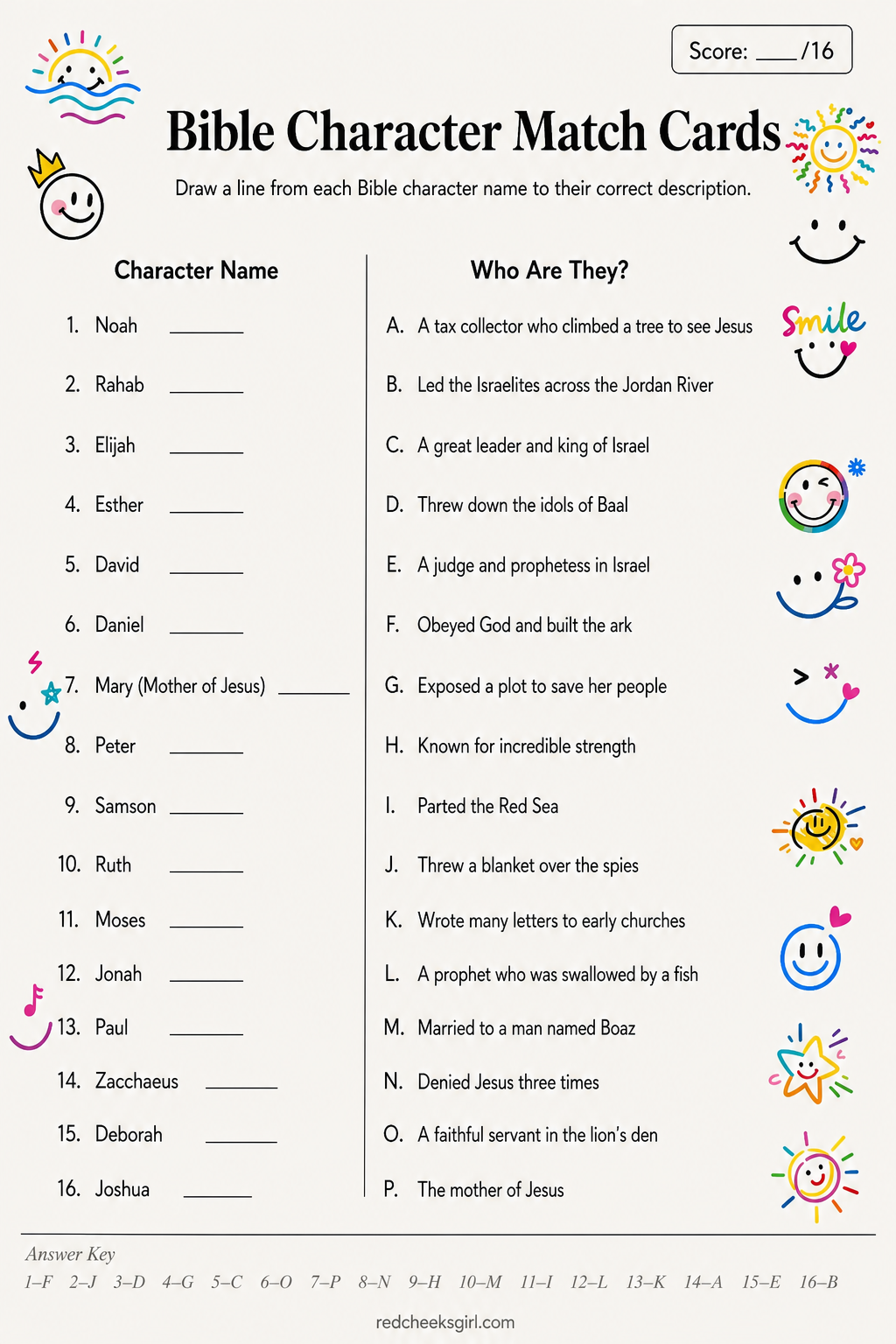
8. Bible Character Match Cards
Bible Character Match Cards turn a classic matching game into a surprisingly rich character study — and yes, someone will confidently mix up Elijah and Elisha, and yes, everyone will gently roast them for it (in love, obviously).
The printable sheet is laid out as two columns of cards: the left column lists the names of sixteen Bible characters, and the right column lists their corresponding descriptions or defining moments — shuffled so they do not line up directly.
Guests draw a line from each name to its matching description, working individually or in pairs. Characters span both Testaments and a range of familiarity, from Noah and Mary to lesser-known figures like Rahab, Priscilla, or Zacchaeus.
Print one sheet per guest or one per pair for a collaborative version.
Give groups three to four minutes to complete the matching, then reveal answers as a group while the host reads a brief story highlight for each character — thirty seconds per character is plenty to surface something fascinating about their life.
The answer key lives at the bottom of the sheet in small italic grey print. Scoring is simple: one point per correct match, with a running tally at the top right of the sheet.
For an extra layer, ask guests to star the character they personally find most inspiring — that single prompt opens a conversation that can genuinely last thirty minutes.
What makes this particular format so effective for bible games for adults is that it rewards narrative knowledge rather than rote memorization. You do not need to remember a chapter number; you need to remember a story.
That is a more human, accessible kind of knowledge, and it creates a more emotionally resonant discussion. ‘I matched Rahab immediately because her story always gets me’ is the exact kind of personal disclosure that draws a small group closer together.
- Small groups of 4–12
- Mixed knowledge levels — the descriptions give enough context that newer Bible readers can reason their way through
- Opening a character-study series
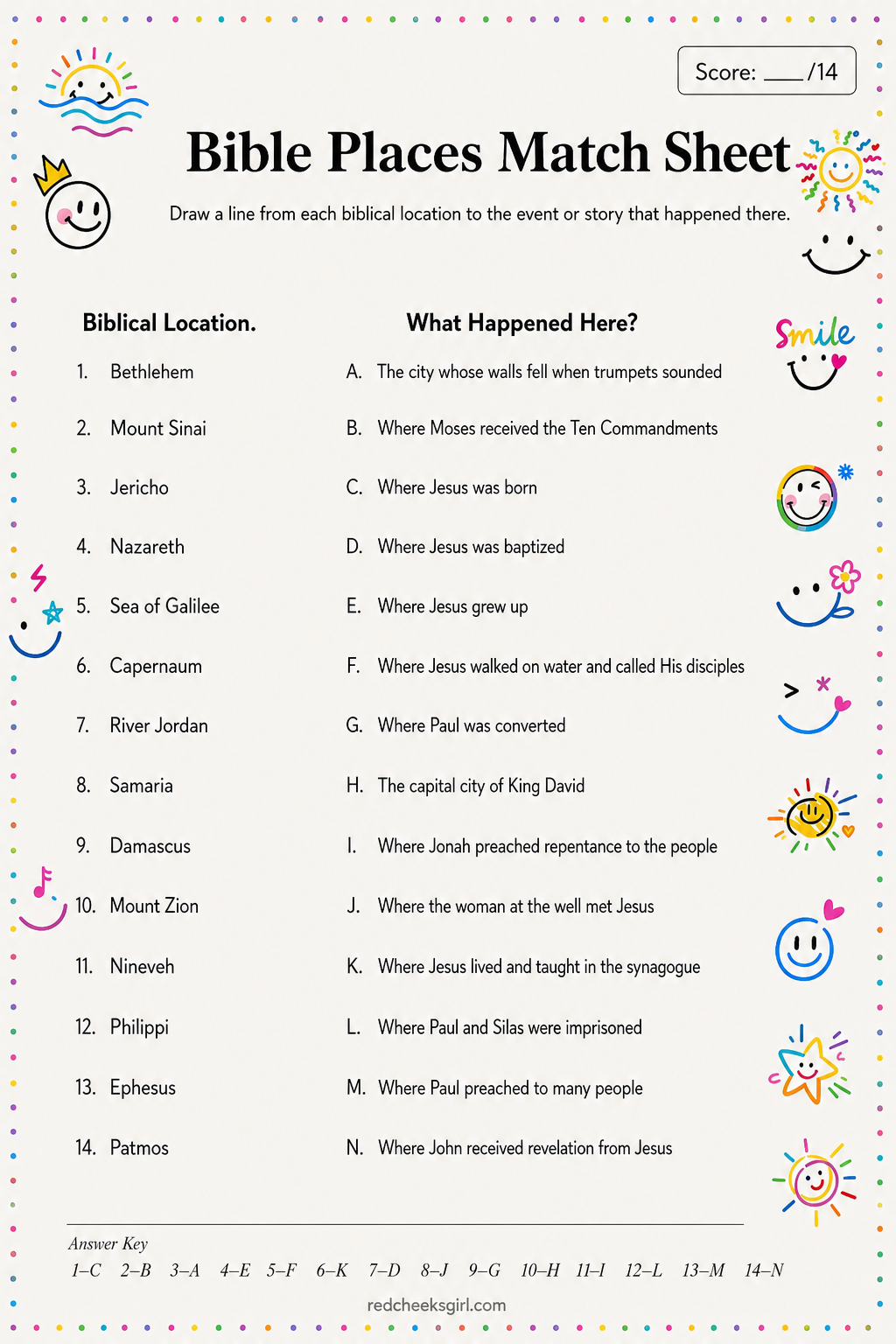
9. Bible Places Match Sheet
The Bible Places Match Sheet is the geography round your group never knew they needed — and it turns out that ‘wait, where exactly IS Nineveh?’ is one of the most energizing questions you can drop into a Bible game night.
This printable presents two columns: the left lists fourteen significant biblical locations (Bethlehem, Jericho, the Sea of Galilee, Mount Sinai, Antioch, Babylon, and more), and the right column lists their matching clue descriptions — key events or stories that happened there, shuffled out of order.
Guests draw connecting lines from each place name to its correct story clue, working from memory and reasoning skills.
Print one per person and allow four minutes of quiet matching time before going around the room for answers.
The host reveals each correct match and adds a thirty-second ‘why this place matters’ note — just enough to make each location feel vivid and real rather than abstract.
The answer key lives in small italic grey print at the bottom of the sheet for self-checking.
For groups who enjoy maps, a simple printed Bible map (free online) posted on the wall as a visual reference adds a wonderful tactile dimension to the discussion — people start pointing and saying things like ‘I had no idea those two cities were that close to each other.’
This game is especially good at surfacing the geographical and cultural imagination that brings Scripture alive.
When adults realize that the distance from Nazareth to Jerusalem — a journey Jesus made multiple times — is about ninety miles on foot, something shifts in how they read those travel narratives.
Bible games for adults work best when they move people from knowing facts to imagining stories, and this sheet does exactly that. It also pairs naturally with the Parables Match Sheet later in this list for a full geography-and-narrative double feature.
Pull up a free printable Bible map on your phone or print one — having a visual reference on the table while you reveal answers makes the geography feel three-dimensional.
10. Bible Would You Rather Sheet
Bible Would You Rather is the printable that sounds lighthearted and turns unexpectedly deep — which is my absolute favorite kind of game.
The sheet presents fourteen biblical would-you-rather dilemmas, each one inviting guests to circle their chosen option and then jot a one-sentence reason why in the space below.
Questions are crafted to be thought-provoking rather than trivial: ‘Would you rather have the wisdom of Solomon or the courage of David?’, ‘Would you rather witness the parting of the Red Sea or the resurrection of Lazarus?’, ‘Would you rather live during the Exodus or during the early church in Acts?’
Each question opens a window into how people personally connect with Scripture.
Print one sheet per guest and give everyone five minutes to circle and jot their reasons independently.
Then go around the room and share answers — you will be amazed how different people’s choices are, and the reasoning behind them is where the real conversation gold lives. No scoring needed for this one; it is purely a discussion engine.
The format works beautifully for groups where not everyone has the same level of biblical knowledge, because the questions are framed around imagination and personal preference rather than factual recall. Anyone who has ever read any Bible story at all can engage fully.
This is also one of the most ‘repeatable’ sheets in the set — you can bring it back month after month with new questions and it never gets old. I would honestly print a stack of these and keep them as a standing small-group icebreaker.
And if your group gets really into discussing wisdom and faith and the choices that define a life, that is the kind of rich evening that calls for a slow, grounding morning after — maybe something like these cortisol-lowering breakfast ideas to start the next day gently.
(Hey, a good conversation can keep you up late!)
Removes the pressure of being ‘right’ — every answer is valid, which frees quieter group members to participate fully.

11. Books of the Bible Order Sheet
Books of the Bible Order Sheet is one of those games where people who have been attending church for decades suddenly realize they are not as confident as they thought — and somehow that moment of humility makes the room immediately warmer.
The printable lists all sixty-six books of the Bible in a randomized, shuffled order. Guests must number each book from 1 to 66, indicating their correct canonical sequence.
The Old Testament and New Testament are presented on the sheet as two separate sections, so guests are ordering within each Testament rather than across the whole Bible at once — that structure makes it challenging but not impossible for a mixed-knowledge group.
Print one per guest and give six to eight minutes for completion — this one genuinely needs a bit of time, and you will see some very intense concentration happening around the table (which is honestly delightful to watch).
After time is called, provide a printed or displayed answer list and have guests self-check and tally their score. One point per correctly sequenced book, for a total possible score of sixty-six.
Bonus round: ask everyone to name the three books they were least sure about, then share why. That vulnerability creates immediate connection.
You can also run this as a team challenge, with two teams racing to correctly order a set of twenty books before the other team.
Beyond the game mechanic, this sheet is genuinely useful. Many adults have never had occasion to run through the full canon in sequence, and doing so even once creates a mental map of Scripture’s structure that changes how they read it.
The awareness that Malachi and Matthew are separated by four hundred years of silence, or that Paul’s letters are organized by length rather than chronology, are the kinds of insights that come out naturally during the answer-reveal and make the whole evening feel like it actually mattered.
For beginners, provide a word bank of all 66 book names on a separate strip — they just need to number them in order, which is still genuinely challenging.

🛍 Shopping guide
12. Discussion Prompt Cards
Discussion Prompt Cards are the quiet MVP of this entire collection — the printable that does the least flashy thing and produces the most meaningful moments.
The sheet prints as a set of sixteen question cards designed to be cut apart and placed face-down in the center of the table.
Players take turns drawing a card and reading the prompt aloud, then everyone in the group shares a brief response before moving to the next card.
Prompts are open-ended, reflective, and faith-focused without being preachy: ‘Which Bible story do you return to when life feels uncertain?’, ‘Is there a verse that changed how you see a relationship?’, ‘What part of Scripture do you find hardest to believe, and why?’
These are the questions adults actually want to discuss but rarely get a structured moment to explore.
Print the sheet on cardstock and cut the sixteen cards apart before your gathering. You can use them as a standalone game, a warm-up before Bible study, or a wind-down activity after a competitive game round.
No scoring, no answer key, no right answers — just generous, curious conversation. Shuffle the cards and let the draw determine the direction.
For smaller groups of four to six, you will likely work through all sixteen in a single evening; for larger groups, draw eight to ten and save the rest for next time.
The cards stay relevant across many sessions because they invite personal reflection that evolves as people grow.
One hosting note: these cards work best when the host participates and answers genuinely rather than facilitating from a distance.
When the person who set up the chairs admits that the story of Peter’s denial is the one that hits closest to home, something opens up in the room. That willingness to go first is the most powerful hosting tool you have, full stop.
And honestly, ending an evening of bible games for adults with this card draw is a beautiful way to close — everyone leaves having said something true.
Always answer the card yourself before opening to the group. Your vulnerability gives everyone else permission to be real.

🛍 Shopping guide
13. Memory Verse Cards
Memory Verse Cards turn the ancient practice of Scripture memorization into a genuinely fun group activity — and yes, grown adults will absolutely feel competitive about who can recite a verse the fastest, and that is completely fine and also very funny.
The printable sheet produces twelve double-sided-style cards: one side shows a Bible reference (e.g., Philippians 4:13), and the other side shows the full verse text.
The game mechanic is simple: players partner up, one holds the card with the reference facing them (acting as the prompter) and one tries to recite the verse from memory. Then they swap.
For verses no one knows yet, the prompter reads the verse aloud three times, the guesser covers their eyes and attempts to repeat it, and the prompter coaches them through it.
Print on cardstock and cut the twelve cards apart. You can also use the cards for a group recitation game: the host holds up the reference side, gives the group thirty seconds to silently recall, then calls on someone to recite.
One point for a word-perfect recitation, one point for ‘close enough’ (within one word), and a gentle group recitation for any verse that stumps everyone — because the point is learning, not elimination.
The twelve verses on the sheet are chosen to be beloved, broadly applicable, and ranging from very familiar to mildly challenging.
What makes Memory Verse Cards genuinely special as a printable is that they are a take-home gift as well as a game. People tuck them into a wallet, stick one on the fridge, or set a small stack on their nightstand.
There is something about having a physical card with a verse on it that makes memorization feel tangible and achievable rather than overwhelming.
Pair these with the Fill-in-the-Verse Sheet from earlier in the evening and you have a natural two-act structure: play the fill-in game first to surface what people already know, then use these cards to add twelve more verses to everyone’s working memory.
Physical cards make Scripture memorization feel manageable and personal — guests take them home and keep using them long after the party.

🛍 Shopping guide
14. Parables Match Sheet
Parables Match Sheet focuses on one of the richest, most storied corners of the New Testament — Jesus’s parables — and turns them into a satisfying matching challenge that rewards both story knowledge and interpretive thinking.
The sheet presents two columns: the left lists fourteen parable titles (the Prodigal Son, the Good Samaritan, the Talents, the Lost Coin, the Rich Man and Lazarus, the Ten Virgins, and eight more), and the right column lists shuffled one-sentence summaries or key images from each parable.
Guests draw connecting lines from each parable title to its correct description, working from memory and story recognition.
Allow four minutes for independent work, then go through each match aloud as a group. After confirming each correct answer, the host asks one brief discussion question about that parable — ‘What surprises you most about this story?’
or ‘Who in this parable do you most relate to?’ works beautifully for almost any of them. The answer key is at the bottom of the sheet in small italic grey text for self-scoring.
Running through all fourteen parables this way, even briefly, gives the evening a quietly rich theological texture that a straight trivia game never quite achieves.
The reason Parables Match Sheet earns its place as one of the best printable bible games for adults is that parables are inherently discussion-generative — Jesus told them specifically to make people think, argue, and reflect, which is exactly what you want from a party game.
Nobody finishes this sheet and feels like they just did a worksheet. They finish it and immediately want to know more about the story behind at least three of the fourteen. That is the whole goal.
This sheet also pairs naturally with Act Out the Parable from earlier in the evening for a wonderfully cohesive game night arc.
After revealing each correct match, ask: ‘Which character in this parable do you personally identify with most?’ You will get beautifully honest answers.

15. Fruits of the Spirit Sheet
The Fruits of the Spirit Sheet takes the nine fruits listed in Galatians 5:22-23 and turns them into a reflective self-assessment and group discussion tool — which sounds very serious but is actually one of the most warmly received sheets of the evening.
The printable lists all nine fruits (love, joy, peace, patience, kindness, goodness, faithfulness, gentleness, and self-control) and for each one presents two elements: a short definition box explaining the fruit in practical, relatable terms, and a write-in reflection prompt below it.
Prompts invite personal responses: ‘Which of these fruits comes most naturally to you?’ and ‘Which one do you feel most called to grow in this season?’ sit alongside lighter questions like ‘Which fruit do you think is most underrated and why?’
Print one sheet per guest and give eight to ten minutes for quiet individual reflection — this one benefits from a bit more time than a trivia sheet because the writing itself is part of the value.
Play gentle background music if your group is comfortable with that. Then open the floor for sharing, starting with the lightest question and moving toward the more personal ones.
No scoring, no answer key, no competition here — this is a reflection and conversation sheet, not a quiz. The host should go first to model the vulnerability the sheet invites.
This printable is one of those rare game assets that functions beautifully as a standalone devotional tool as well as a party game element.
People often want to take it home and revisit it privately, and that is exactly the right instinct — encourage them to.
If your group is interested in connecting faith practices with overall wellbeing (and many are), the conversation about peace and self-control often naturally touches on what daily rhythms support those qualities, which can lead to genuinely interesting discussions about everything from prayer habits to stress management.
The printable is also gorgeous enough to display — clean design, thoughtful prompts, and a light, timeless aesthetic.
- Bible study groups doing a series on Galatians or discipleship
- Retreats and smaller gatherings where people want to go deeper
- Groups where not everyone has a strong trivia background — this sheet welcomes everyone equally

16. Bible This or That Sheet
Bible This or That Sheet is the fast-paced, opinion-driven printable that gives your group the same energy as a lively group chat — just on paper and with significantly more Scripture involved.
The sheet presents sixteen biblical this-or-that choices, each framed as two options that guests must choose between by circling one.
Unlike Would You Rather (which leans reflective and imaginative), This or That leans playful and a little bit opinionated: ‘Old Testament or New Testament?’, ‘Psalms or Proverbs?’, ‘Moses or Elijah?’, ‘Sermon on the Mount or the Lord’s Prayer?’, ‘Acts or Revelation?’
Each prompt invites an immediate, instinctive reaction, which makes the reveal round genuinely lively.
Print one per guest, distribute pens, and give just three minutes to circle answers quickly — speed is part of the game’s energy, and overthinking defeats the purpose. Then go through each prompt as a group by show of hands: ‘Old Testament — hands up.
New Testament — hands up.’ Tally the split on a whiteboard, note any surprises (when the entire group unanimously picks the same option, someone always wants to know why), and invite brief comments.
The sheet takes about twelve to fifteen minutes from distribution to wrap-up, making it a perfect midpoint energizer between heavier activities.
What separates this from a trivial personality quiz is the genuine biblical literacy embedded in the choices.
Each pair was selected because it invites people to articulate something real about how they engage with Scripture — whether they are drawn to law and prophecy or grace and narrative, whether they find comfort in poetry or in history.
By the end of the sixteen prompts, you have a surprisingly clear picture of each person’s relationship with the Bible, which is the kind of thing that usually takes a full semester of small-group study to surface. In twelve minutes. Not bad for a printable.
Fast answers reveal instinctive preferences — and those preferences open deeper conversations about why we connect with certain parts of Scripture.

17. Ten Commandments Order Sheet
Ten Commandments Order Sheet is the printable that produces the most confident-then-humbled energy of any game in this collection — because every single person in the room thinks they know the Ten Commandments in order until they have to write them down.
The sheet lists all ten commandments in a scrambled, shuffled order and asks guests to number them from 1 to 10 according to their correct sequence as given in Exodus 20.
A brief one-sentence version of each commandment is provided so guests are matching the concept to its position, not hunting for exact wording — keeping the focus on knowledge and sequence rather than memorization of archaic phrasing.
Print one per guest and allow four to five minutes for completion. Then reveal the correct order one by one, and watch the satisfying mix of triumph and surprise play out around the table.
The full answer key is at the bottom of the sheet in small italic grey print for self-checking and score tallying. One point per correctly numbered commandment. As you reveal each one, pause to ask: ‘Does the placement of this commandment surprise anyone?
Why do you think it falls where it does in the list?’ Those questions turn a simple ordering exercise into a rich discussion about the structure and theology of biblical law.
This sheet is a gentle reminder that things we think we know deeply are sometimes stored more loosely than we realize — and there is something deeply humanizing about that discovery in a group setting. No one feels embarrassed because everyone is surprised.
And the resulting conversation about why ‘no other gods’ comes first, what it means that honoring parents is sandwiched between ‘remember the Sabbath’ and ‘do not murder,’ or what the commandments reveal about ancient Israelite priorities, is the kind of discussion that earns this game its place among the best printable bible games for adults.
For groups newer to the Old Testament, add a small ‘hint’ number range beside each commandment (e.g., ‘Hint: this one falls in the first half’) to give a directional nudge without giving away the answer.

18. Bible Riddles Sheet
Bible Riddles Sheet is the printable that makes the whole table lean in — because there is something irresistible about a good riddle, and Bible-themed riddles hit differently when the answer is a story you have known your whole life but never heard framed quite this way.
The sheet presents fifteen riddles, each one describing a Bible person, place, event, or object in poetic, indirect language that requires both biblical knowledge and lateral thinking to solve. Example style: ‘I walked on water twice — once by faith, once by fear.
Who am I?’ (Peter.) ‘I am the shortest chapter, but I carry a weight that silences the proud. What am I?’ (Psalm 117.) The riddles are crafted to reward creative thinking alongside Scripture knowledge.
Print one per person and give six to eight minutes for individual work — these riddles genuinely benefit from quiet thinking time. Guests write their answers on the blank lines provided beside each riddle clue.
After time is up, the host reveals answers one by one, and for each one shares a single sentence of context. The answer key lives at the bottom of the sheet in small italic grey text for self-checking.
Score one point per correct answer, with a possible fifteen points total.
Allow a two-point bonus for any guest who can add the chapter and verse reference for their answer — that bonus sends everyone back to their mental Bible index in a really satisfying way.
Riddles are one of the most ancient forms of biblical engagement — the Old Testament itself contains riddles, most famously Samson’s honey-and-lion puzzle in Judges 14.
Using them in a modern party game context connects your group to that long tradition in a way that feels playful but not childish. This sheet tends to generate the most ‘ohhh, that’s so clever!’
reactions of any printable in this set, and those moments of delighted recognition are exactly the kind of memory that makes people want to come back to your small group again and again.
Highly recommend pairing this with the Bible Trivia Showdown from the start of the evening for a satisfying bookend to a great game night.
Riddles reward creative thinking alongside Scripture knowledge — meaning people who ‘don’t know the Bible well’ often surprise themselves (and the room) with correct answers.

19. Favorite Verse Share
Favorite Verse Share is the simplest game on this list — and somehow the one people talk about the longest afterward.
The premise is beautifully uncomplicated: each person in the group shares their favorite Bible verse, reads it aloud, and takes two to three minutes to explain why that particular verse matters to them personally. No competition, no scoring, no trivia.
Just people and Scripture and the stories that connect them. The host goes first to set the tone, modeling the right level of vulnerability — enough to be real, not so much that the room feels heavy before everyone has had a turn.
The facilitation is easy but the hosting instincts matter here.
Before going around the circle, briefly frame the activity: ‘There are no wrong answers, there is no prize for the most obscure verse (looking at you, people who are about to say Habakkuk 3:19), and you do not need to explain your entire theology — just tell us what this verse means to you.’
That light, slightly self-deprecating opener releases any pressure people feel about saying the ‘right’ thing. Allow the time it takes; do not rush the shares.
After each person finishes, give one beat of silence before moving to the next — that pause is where something quietly sacred lives.
What makes this a game rather than just a circle discussion is the element of discovery.
You will be genuinely surprised by what verses people choose, by who chooses a warrior psalm and who chooses a gentle Proverb, by which obscure Old Testament verse stops the room cold because its context is devastating and gorgeous in equal measure.
Keep a note on your phone as people share — a running list of the verses mentioned becomes a beautiful group artifact you can share afterward via text.
Favorite Verse Share is also a perfect pairing with the Discussion Prompt Cards from earlier in the evening, creating a natural emotional arc from structured prompts to purely personal testimony.
Text the full list of shared verses to the group after the evening — it becomes a beautiful collective Scripture collection everyone keeps.
20. Prayer and Reflection Circle
Prayer and Reflection Circle is how you close a Bible game night and actually have people leave feeling full rather than just entertained — and honestly, that distinction is what separates a good evening from a genuinely meaningful one.
The format is simple: the group sits in a circle (or remains at the table) and the host explains that you will go around once and each person may do one of three things: share something they are grateful for from the evening, name a Scripture theme from the games that they want to carry into the week, or offer a brief prayer (silent or spoken) for someone in the group.
All three options are equally valid. Nobody is put on the spot to pray aloud if that is not their comfort, and nobody is required to say anything profound.
Give the circle a gentle structure by using a physical object — a small stone, a candle, or simply a pen — that gets passed from person to person so everyone knows whose turn it is and feels held in the moment.
The host opens and closes. The middle is for the group. Expect the circle to take between ten and twenty minutes depending on your group’s size and how the evening has gone — if the conversation has been rich, people will have more to say.
If the group is more reserved, the brevity is equally valid and beautiful. Do not fill silences; let them breathe.
The reason Prayer and Reflection Circle earns its place as the closing game rather than just an afterthought is that it gives the whole evening a frame.
All the trivia, the matching sheets, the debates, and the laughter get gathered up and offered back in this final quiet moment, and people leave knowing that the fun was in service of something real.
This is the thing people will mention when they text you the next day to say thank you.
And if your group meets in the morning, opening with something gentle — like the kind of grounding, nourishing breakfast explored in these cortisol-balancing meal ideas — and closing with a reflection circle creates a rhythm that genuinely sustains community over time.
- Closing any Bible game night or small-group gathering
- Groups that want to transition from fun into something spiritually grounding
- Any size group — the circle format scales from 4 to 20 people naturally
Frequently Asked Questions
How long does a Bible game night with these games typically take?
A well-paced evening running four to six games — one or two active games, two or three printables, and a quiet closer — usually takes two to two and a half hours.
If you want a shorter session, pick just the trivia showdown, two printable sheets, and end with Favorite Verse Share. That runs comfortably in about ninety minutes.
The printable sheets are genuinely fast (five to eight minutes each), so the bulk of your time is in the discussion that follows, which is exactly where it should be.
Are these Bible games for adults appropriate for mixed knowledge levels?
Absolutely, and that is intentional. The games here were designed so that someone who just started attending church can participate alongside someone who has been studying Scripture for decades.
Games like Would You Rather, This or That, and Favorite Verse Share have no ‘wrong’ answers, while tiered trivia questions mean newcomers can score on familiar verses while deeper readers tackle harder prompts.
The printable matching sheets also reward story intuition as much as memorization, so people who know biblical narratives well can do beautifully even if they struggle with chapter-and-verse details.
Can I use these games for a church small group, not just a party?
Yes — these games were specifically designed with the small-group setting in mind. The Discussion Prompt Cards, Fruits of the Spirit Sheet, and Prayer and Reflection Circle translate seamlessly into a weekly small-group format.
The trivia and matching sheets work equally well as icebreakers before a study session. Several games — like Debate the Passage and Guess the Verse — are structured to naturally lead into deeper Scripture discussion, making them ideal as study supplements rather than just entertainment.
Do I need to print all 13 printable sheets for one gathering?
Definitely not! Two or three printables per evening is usually the sweet spot.
A good combination might be the Bible Trivia Sheet (Advanced) as a competitive opener, the Would You Rather Sheet as a mid-evening conversation starter, and the Fruits of the Spirit Sheet as a reflective closer.
Save the others for future gatherings — the variety in this set means you can run a different combination each month and guests will always encounter something new.
What supplies do I need to host a Bible game night?
For the printable games, you just need a printer, paper or cardstock, and pens for each guest.
For the active games like Bible Trivia Showdown and Bible Family Feud, a small bell or buzzer set adds atmosphere but is entirely optional — table slapping works fine and is honestly more fun.
A whiteboard or large notepad for keeping score during team games is helpful. For the quiet games like Prayer and Reflection Circle, you need nothing at all. Total supply cost for a full evening is minimal.
How do I handle guests who are not Christian or are not familiar with the Bible?
Start with the more accessible games — Bible Family Feud, Would You Rather, and This or That — which reward broad cultural knowledge of Scripture rather than deep biblical study.
The matching sheets have built-in clues that help guests reason through answers even without prior knowledge. Most importantly, frame the evening as a curiosity and conversation exercise rather than a test. When the host models ‘I did not know that either!’
energy, it gives everyone permission to be genuinely new to something and still belong fully in the room.
📌 Save These for Later
Loved these? Pin your favorite image below so you can find this list again when you’re planning.


Sunday school worksheets for every well-known Bible story, ready to print in minutes for today's cla

20 free Bible games for kids — movement, printable sheets & quiet circles kids ask to play again.

100 Bible trivia questions for youth groups split into four escalating rounds with printable questio
Leave a Reply