

16 Christmas Games With Free Printables for Teenagers Who Will Not Admit They Are Enjoying It

Christmas party games for teens live or die on one thing: they cannot feel like a school activity. These 16 games cover a full afternoon, half with free printable sheets you can run off the night before, half needing nothing but phones, a speaker, and whatever is already in the room. All of them work on thirteen to seventeen year olds, including the ones who arrive with their arms crossed.
This post contains affiliate links. If you buy through them, I may earn a small commission at no extra cost to you.
- Christmas Trivia, Hard Mode
- The Playlist Battle on a Speaker
- Guess the Song From the Emoji-Free Clue
- Guess the Song From Three Seconds
- Christmas Would You Rather, Teen Edition
- The Group Chat Screenshot Round
- Film Quote Quiz, Recent Releases
- Charades With Phones Down
- Two Truths About the Year, Card Set
- The Sweepstake on Christmas Number One
- The Guessing Jar
- Predictions for Next Year, Fill-In Card
- Wrapping Paper Relay in Teams
- Best Christmas Jumper, Judged by Vote
- Find the Guest Bingo
- The Photo Challenge Around the House
- Frequently Asked Questions
1. Christmas Trivia, Hard Mode
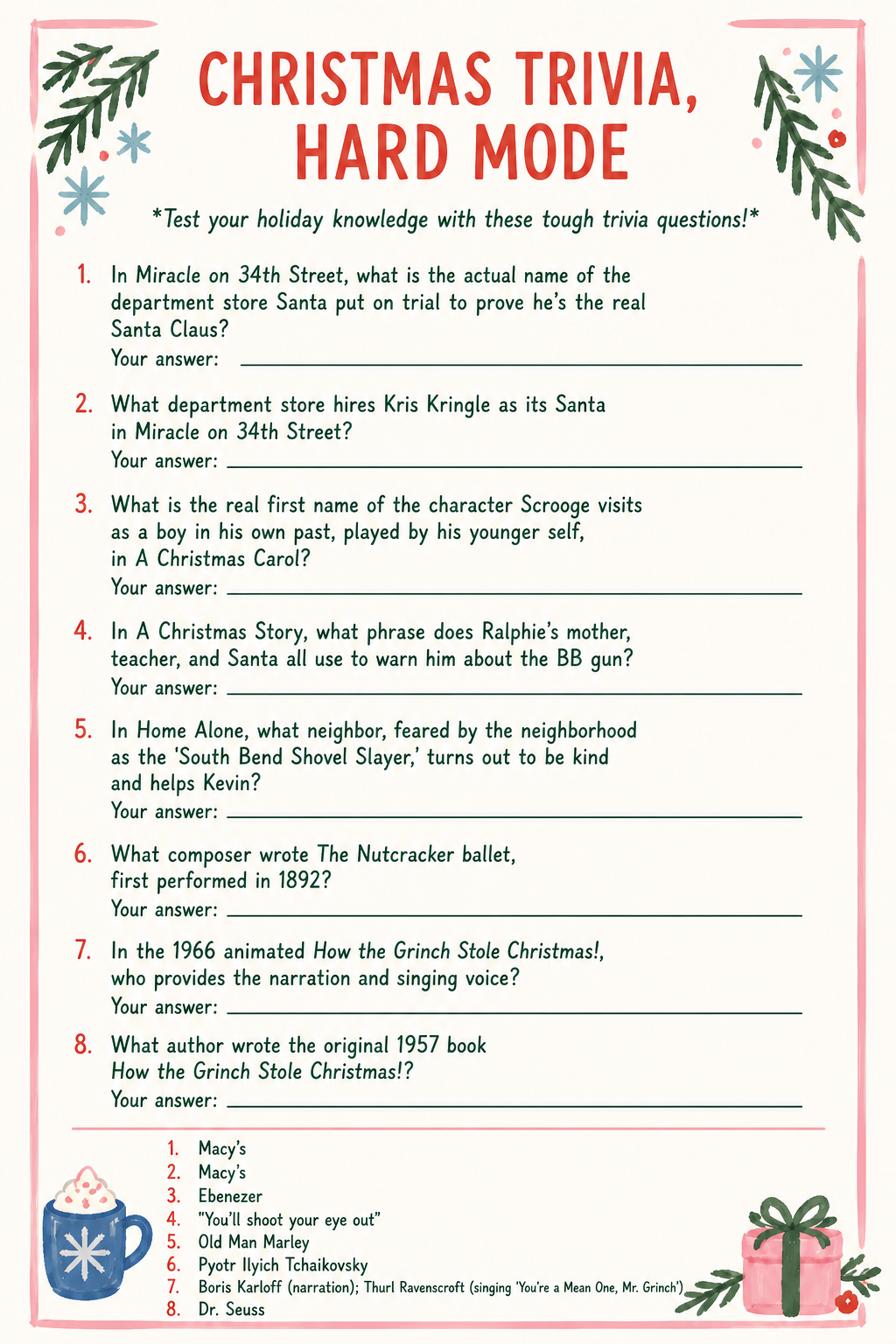
Three separate quiz sheets, each with ten questions, run as three rounds with a short break between them. Round one covers Christmas film and TV facts, round two hits music history and chart trivia, and round three goes deep on traditions, dates, and random seasonal facts that sound made up but are not. Guests play individually, tally their own scores on the scorecard, and compare totals at the end.
Print one set of three sheets per guest and keep the answer keys host-side only. The scorecard sits at the bottom of round three or prints as a separate strip. Works for six to twenty guests, takes about thirty-five minutes all in, and needs nothing but a pen per person.
The most common mistake is reading answers aloud between rounds: it kills the tension. Collect round one sheets before handing out round two so nobody sneaks a correction. If the group is competitive, have a neutral person (a sibling, another parent) hold the keys and call scores publicly at the end.
Seat guests so screens face away from each other. Teens will absolutely google the answers if they can.
🛍 Shopping guide
2. The Playlist Battle on a Speaker
Split into two or three teams. Each team gets three minutes to agree on their five ultimate Christmas party songs and queue them up in a shared playlist app. Then the teams take turns playing their picks through a single speaker while everyone else rates each song zero, one, or two points using a raised-hand vote. The team with the highest total rating wins.
No printing needed. You need one Bluetooth speaker, one device with a music streaming app, and the ability to pass a phone between teams without someone hijacking the queue. Ten to twenty players, about twenty minutes, and the arguing during the selection phase is half the entertainment.
Ban repeats: if two teams pick the same song, the second team to play it scores zero and has to sub in a wildcard on the spot. That rule alone prevents three teams all playing Mariah Carey and calling it a strategy.
- Groups who already have strong opinions about music
- Works especially well when teams are mixed in age so the taste clash is real
3. Guess the Song From the Emoji-Free Clue
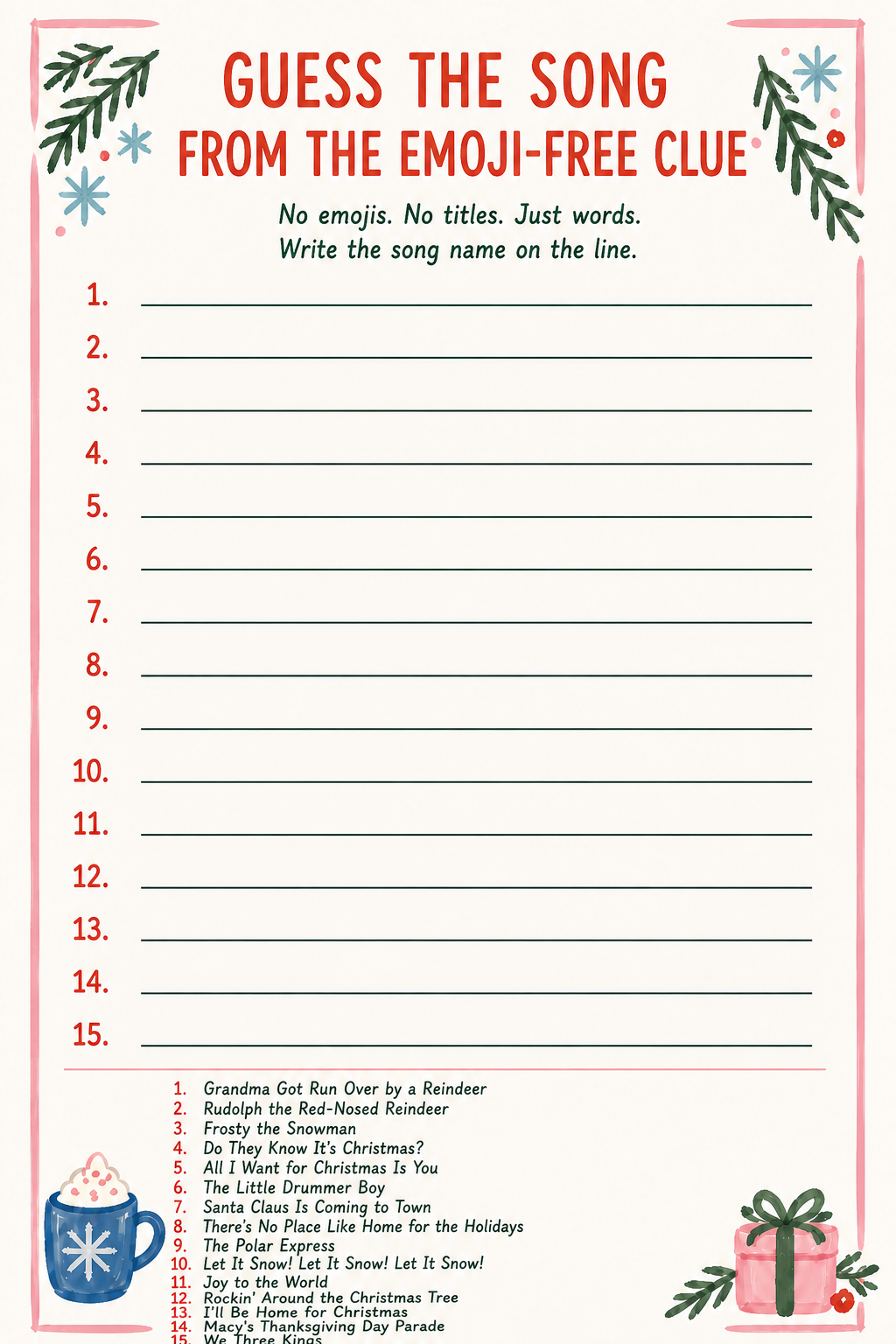
Every line on the sheet describes a Christmas song using only plain English words, zero emojis, zero music notes, and zero song titles. Guests read the clue and write the song name on the blank line beside it. The clues range from straightforward paraphrases to genuinely cryptic rewrites, so this plays harder than it looks.
One sheet per guest, one pen, about ten minutes to complete. Works solo or as a quiet round between louder games. The answer key prints separately and stays with the host until scoring time.
Write clues at two levels: the first half obvious enough to warm the group up, the second half needing actual thought. If the group blazes through it, run a tiebreaker: the host reads one bonus clue aloud and the first hand up wins a point. More ideas like this one can extend the quiz section if you need a longer session.
- One printed sheet per guest
- Pens or pencils
- A separate printed answer key for the host only
4. Guess the Song From Three Seconds
One person controls the phone. They pick a Christmas song on any streaming app, skip to a random point in the track, and play exactly three seconds. Everyone else shouts out the title and artist. First correct answer wins the point. Rotate the phone after every five songs so a different person controls the clip.
No printing needed. One phone with a music app, one speaker loud enough for the room, and a way to keep score on a whiteboard or a notes app. Best with eight or more players. Fifteen rounds takes about twelve minutes including the arguing over whether a late shout counts.
The controller choosing where to start the clip is where the game lives or dies. Encourage them to skip to verses, not choruses, because the chorus of most Christmas songs gives it away inside one second. A five-second rule for shouting avoids everyone screaming at once.
For a younger or more mixed group, extend clips to five seconds and limit the song list to the current year’s top twenty Christmas tracks
5. Christmas Would You Rather, Teen Edition
Six cards per sheet, each card posing a genuinely difficult Christmas dilemma written for teenagers rather than for a five-year-old’s party bag. Players read their card aloud to the group and everyone argues their corner before a show of hands settles it. The point is the debate, not the answer, so cards are designed to split the room.
Print one sheet and cut into six cards. For a group of twelve, print two sheets. The cards are conversation starters, not scored, so no answer key. Works as a warm-up before competitive games or as a cool-down after them. Needs nothing but scissors and a table.
The questions need genuine stakes to work. Weak would-you-rathers produce silence. Strong ones (a real trade-off between two things teens actually care about) produce ten minutes of loud disagreement, which is the point.
Teens who hate performing love arguing. This gives them an opinion to defend without putting them on the spot.

🛍 Shopping guide
6. The Group Chat Screenshot Round
Everyone screenshots three messages from their own phone, any group chat, any direct message from the past month, that could have been written by anyone in the room. Names are blurred or cropped. The host collects all screenshots onto one device and displays them one at a time on a TV or shared screen. The group votes on who sent each message.
No printing needed. You need a way to collect and display images, a TV with screen-share, or a laptop passed around works fine. Best with a group who already know each other, so six to fifteen people in an existing friend group. Takes about twenty minutes depending on how much everyone argues over each one.
Set one ground rule before starting: no screenshots from private conversations outside the room, only group chats where everyone present is already a member. That boundary stops the game from tipping into anything uncomfortable. The host should preview all submissions before displaying them.
Collect screenshots via AirDrop or a shared album fifteen minutes before the game starts so there is no dead air while you wait for submissions.
7. Film Quote Quiz, Recent Releases
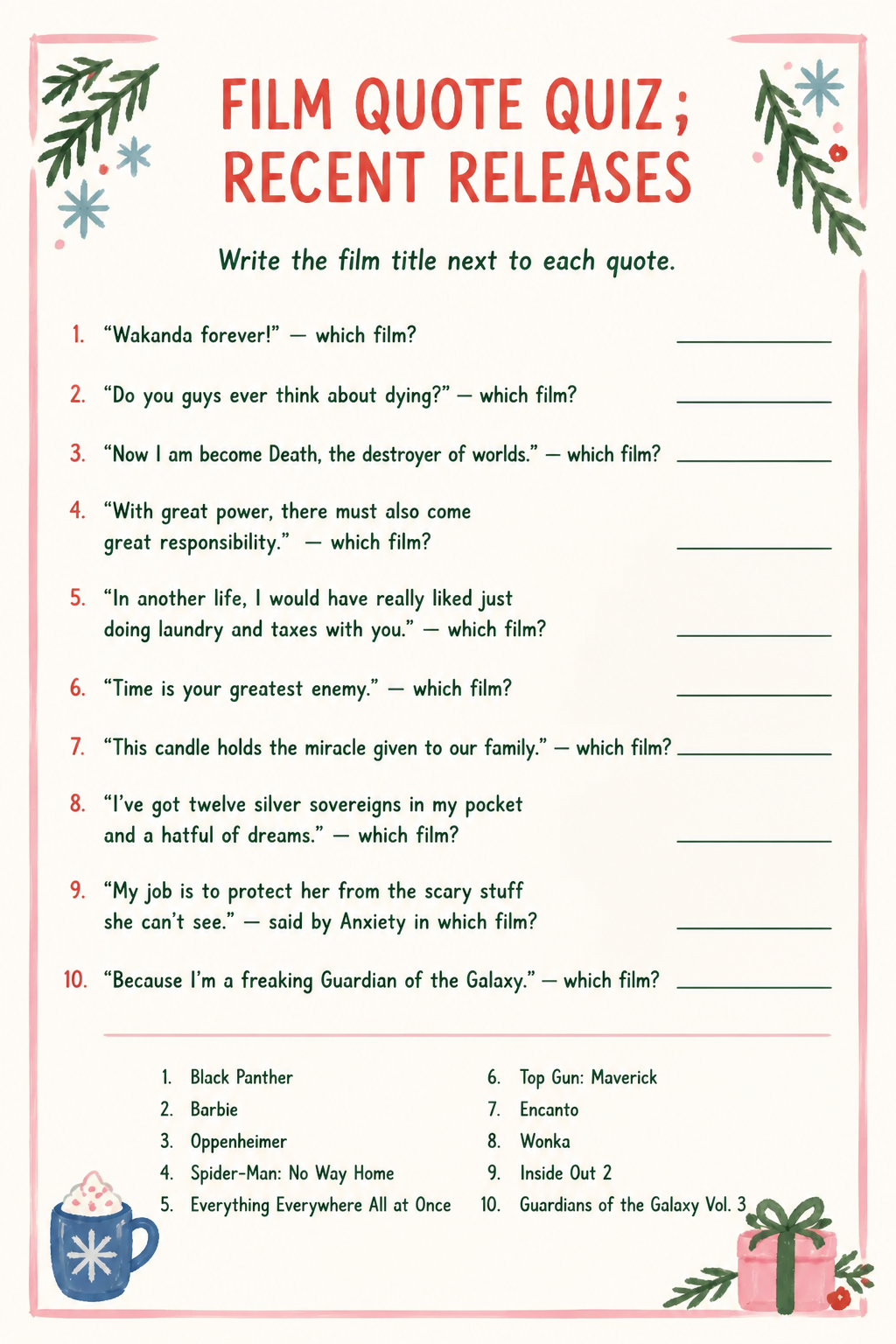
Fifteen quotes from Christmas and winter-themed films released in the past five years, printed without any title or character name attached. Guests write the film title on the blank line beside each quote. The sheet mixes streaming originals, wide-release comedies, and one or two animated picks so no single taste dominates.
One sheet per guest, one pen, about eight minutes. The answer key prints separately. Score by swapping sheets with a neighbour or have the host read answers aloud while guests self-mark. Works from eight guests upward.
Update the quote selection every year to stay current: stale quotes from films released a decade ago turn this into a parents’ round. Stick to releases guests actually watched, which means checking what landed on the main streaming platforms in the past two to three years rather than reaching back to classics.
- One printed quiz sheet per guest
- A separate answer key for the host
- Pens
8. Charades With Phones Down
Standard charades rules with one rule added: every phone goes face-down on the table before the round starts, and anyone who picks theirs up to check a notification sits out the next turn. Categories are Christmas films, Christmas songs, and festive TV moments only. The person acting gets thirty seconds.
No printing needed. Write the charades prompts on slips of paper in advance, fold them into a bowl, and the actor draws one blind. Six to twenty players, twenty to thirty minutes. Teams of three or four work better than two large teams because the waiting time per turn stays short.
The phone-down rule sounds stricter than it is. In practice, one person forgetting and getting caught becomes its own running joke that makes the game more memorable, not less. Keep the enforcement light and consistent rather than making it a big deal the first time it happens.
- All phones face-down before round starts
- Actor draws a slip and has 30 seconds
- Team shouts guesses, no miming words or sounds
- Rotate actors clockwise
9. Two Truths About the Year, Card Set
Each card has two prompts: one asks the guest to write one true thing that happened to them this year, and the other asks them to write one thing they wish had happened instead. Cards are collected, shuffled, and read aloud one at a time while the group guesses whose card it is. The game is low-pressure because nobody performs: they just write and then listen.
Print one sheet, cut into six cards, and hand one card to each guest with a pen. For larger groups, print multiple sheets. This works as a quieter interlude between louder rounds. No answer key: the guest who wrote it reveals themselves when the group has guessed.
The invented wish is what makes this land with teenagers. A straight two-truths-one-lie format asks them to deceive, which some hate. Replacing the lie with a genuine wish removes the performance anxiety while keeping the guessing element intact.
- Groups who know each other well
- Works as a cool-down after competitive rounds
- Good for groups of 6 to 12

🛍 Shopping guide
10. The Sweepstake on Christmas Number One
A single large poster goes up on the wall listing this year’s contenders for the Christmas number one single. Each guest writes their name next to the act they think will take the top spot on Christmas Day. The poster stays on the wall all party long and gets checked against the actual chart result when it drops.
One poster printed at A3 or tiled across two A4 sheets. Needs a pen and a bit of wall space. Works for any group size because everyone gets one pick. If the result is not out by party day, the poster becomes a conversation piece guests can photograph and return to later.
The blank fields matter here. Never pre-fill the contender names because the chart field shifts every year. Leave the name column as blank lines that the host fills in by hand from the actual chart the week of the party. That way the poster is useful regardless of when it gets printed.
Fill in the contender names yourself the week of the party by checking the midweek chart update. That way the list is always current.

11. The Guessing Jar
A large clear jar sits on the table filled with wrapped sweets or small chocolates before guests arrive. Nobody touches it or moves it. At some point during the party the host announces the guess: write your name and a number on a slip of paper, drop it in a bowl, and the closest guess to the actual count wins the jar.
No printing needed. You need one large clear jar, enough sweets to fill it, slips of paper, and a pen on a string near the bowl. Works for any group size and needs no explanation beyond one sentence from the host. Count the sweets before filling and write the number down somewhere only you can see it.
The game runs itself once set up. Announce it early, let the guessing bowl sit out, and reveal the answer at the end of the party so it creates a natural closing moment. Teenagers take this more seriously than expected, especially when the prize is edible.
- Large clear glass or plastic jar
- Individually wrapped sweets or small chocolates
- Slips of paper and a pen
- A small bowl for entries
12. Predictions for Next Year, Fill-In Card
Four cards per sheet, each with six fill-in prompts about the year ahead: chart predictions, personal goals stated as facts, sports results, and one absurd wildcard that the guest invents themselves. Cards are signed, sealed in a provided envelope, and either kept by the guest or collected by the host to open at a future reunion.
Print one sheet per two guests and cut into four cards. Envelopes are optional but add weight to the moment. Takes five minutes to fill in and works as a quiet individual activity that runs alongside music rather than pausing the whole party. No answer key: the guest owns the prediction and opens it themselves.
Frame this as a fun record rather than a meaningful exercise and teens engage. If it sounds ceremonial, they will write nonsense on purpose. Keep the prompts light and slightly competitive, like predicting a specific chart position or a sports score, rather than asking them to reflect on personal growth.
Feels like a private joke with future-self rather than a school worksheet. The sillier the wildcard prompt, the more seriously they fill in the rest.

🛍 Shopping guide
13. Wrapping Paper Relay in Teams
Teams of three race to wrap a box using only the materials in their kit: a sheet of wrapping paper, tape, and a gift tag. The twist is that each team member can only touch the item for ten seconds before passing it to the next person, so the relay is genuinely frantic and the results are predictably terrible.
No printing needed. You need one cardboard box per team (same size for fairness), one sheet of wrapping paper per team, tape, and a gift tag. Three to five teams of three work best. The whole thing takes about fifteen minutes including setup. A neutral judge or a show-of-hands vote decides the winner on a combination of speed and appearance, with appearance counted generously.
Cut the wrapping paper to the same size for each team before the relay starts. If one team gets a larger sheet, they will notice immediately and call it out. Tape the boxes shut in advance so nobody spends their ten seconds just holding the lid closed.
- One same-size cardboard box per team
- Pre-cut matching sheets of wrapping paper
- Tape dispensers
- Gift tags
🛍 Shopping guide
14. Best Christmas Jumper, Judged by Vote
Guests arrive in their best, worst, or most creative Christmas jumper. At a set point in the party, everyone stands in a line and the room votes by a show of hands across four categories: Most Festive, Most Hideous, Most Unexpected, and Best Ironic Effort. One person cannot win two categories.
No printing needed. Announce the categories in advance so guests know what they are dressing for. Four categories means four different winners, which keeps the voting spread and avoids the same person sweeping everything. Takes about ten minutes of actual game time, not counting the time guests spent at home choosing their jumper.
The four-category format is the fix for the classic problem where everyone just votes for their friend. Spreading the wins across distinct categories means the room stays engaged for all four rounds instead of switching off after the first vote. Small prizes per category, even just a chocolate bar, help land the moment.
- Groups where at least half the guests will genuinely try with their outfit
- Works better announced a week before the party than on the day
15. Find the Guest Bingo
A five-by-five bingo grid where each square contains a fact or behaviour: ‘has watched a Christmas film this week’, ‘owns an ugly jumper they bought ironically’, ‘knows the words to at least one carol’, ‘has sent a Christmas meme in the past 24 hours’, and so on. Guests circulate and find a real person who matches each square, writing that person’s name in it. First to complete a row calls bingo.
One grid per guest, one pen. Print as many as you need since it is a single-page design. Works for ten to thirty guests and takes fifteen to twenty minutes of mingling. This format works especially well at the start of the party when not everyone knows each other yet. No answer key: guests fill in real names, so no predetermined answers exist.
Write the square prompts specifically for teens rather than copying a generic bingo template. ‘Has rewatched Elf more than twice’ hits differently than ‘likes Christmas’. The more specific and slightly ridiculous the prompts, the more the game rewards knowing the group. More party games built for teenagers follow the same principle: specificity beats generic every time.
- One grid per guest, pen in hand
- Find a real guest who matches each square
- Write their name in the square
- First complete row wins
- No square can have the same name twice

16. The Photo Challenge Around the House
Teams of two or three get a list of fifteen photo challenges to complete around the party space in twenty minutes. Challenges are specific and slightly absurd: recreate a classic Christmas card pose using only people and objects already in the room, find the ugliest decoration and frame it like a museum piece, take a team photo where everyone looks genuinely cold despite being indoors. The team with the most completed challenges wins, judged by the host on a phone scroll-through.
No printing needed: read the list aloud once or send it to one phone per team via a group message. Best with three to five teams of two or three. The twenty-minute window is firm: when time is up, teams submit their best shot from each challenge for judging. Takes about thirty-five minutes all in, including the judging scroll.
Keep the challenges achievable within the actual space and with what is genuinely there. Sending teams to find props that do not exist wastes the clock. Walk through the venue yourself before the party and write the list based on what you can already see. Christmas party games that work across age groups use the same location-based format to keep energy up in any space.
Send the challenge list to one phone per team via text or a group chat so nobody can claim they forgot a prompt mid-round.
Frequently Asked Questions
How many christmas party games for teens should you run in one afternoon?
Four to six games is the realistic ceiling for a three-hour party. Two to three competitive games, one active relay, and one or two quieter rounds gives the energy somewhere to go up and down. Running eight or more back to back loses the group somewhere around game five.
What do you do if teenagers refuse to join in?
Do not single them out and do not make participation mandatory. Games that run in teams mean the group carries anyone who is quiet, and phone-friendly formats give reluctant players something to do with their hands. Teens who ‘refuse’ almost always drift in when the room is genuinely having fun without pressure on them.
What is the right group size for teen party games?
Six to sixteen is the sweet spot. Under six, most team games collapse. Over twenty, you need an extra adult running a second heat or the waiting time per turn kills the momentum. For large youth groups, run multiple simultaneous stations with a rotation rather than one game for the whole room.
Do you need prizes for teen party games?
Small ones help more than big ones. A chocolate bar per winner, a running points tally on a whiteboard, or even just public acknowledgement is enough. Expensive prizes create awkwardness rather than excitement. The bragging rights for a well-designed game are usually prize enough.
How far in advance should you print the game sheets?
The night before is fine for most printables. Print on plain paper if cardstock is not available: the games work either way. Cut any card sets in advance so you are not standing at the table with scissors while guests arrive.
Are these games suitable for a school Christmas party as well as a home one?
Most of them translate directly. The Group Chat Screenshot Round needs a preview step to check content, which matters more in a school setting. The Playlist Battle works anywhere there is a speaker. The printable quiz rounds are genuinely low-admin for a teacher to run: hand out sheets, set a timer, collect and score.

18 best outdoor Christmas lights for every roofline, budget and style, each with real pros, cons and

16 flocked Christmas tree ideas, from heavy snowbound firs to tinted flock in blush and black, with

12 handmade advent calendars in crochet, felt and fabric, with cheap swaps, quick builds and exactly
Leave a Reply